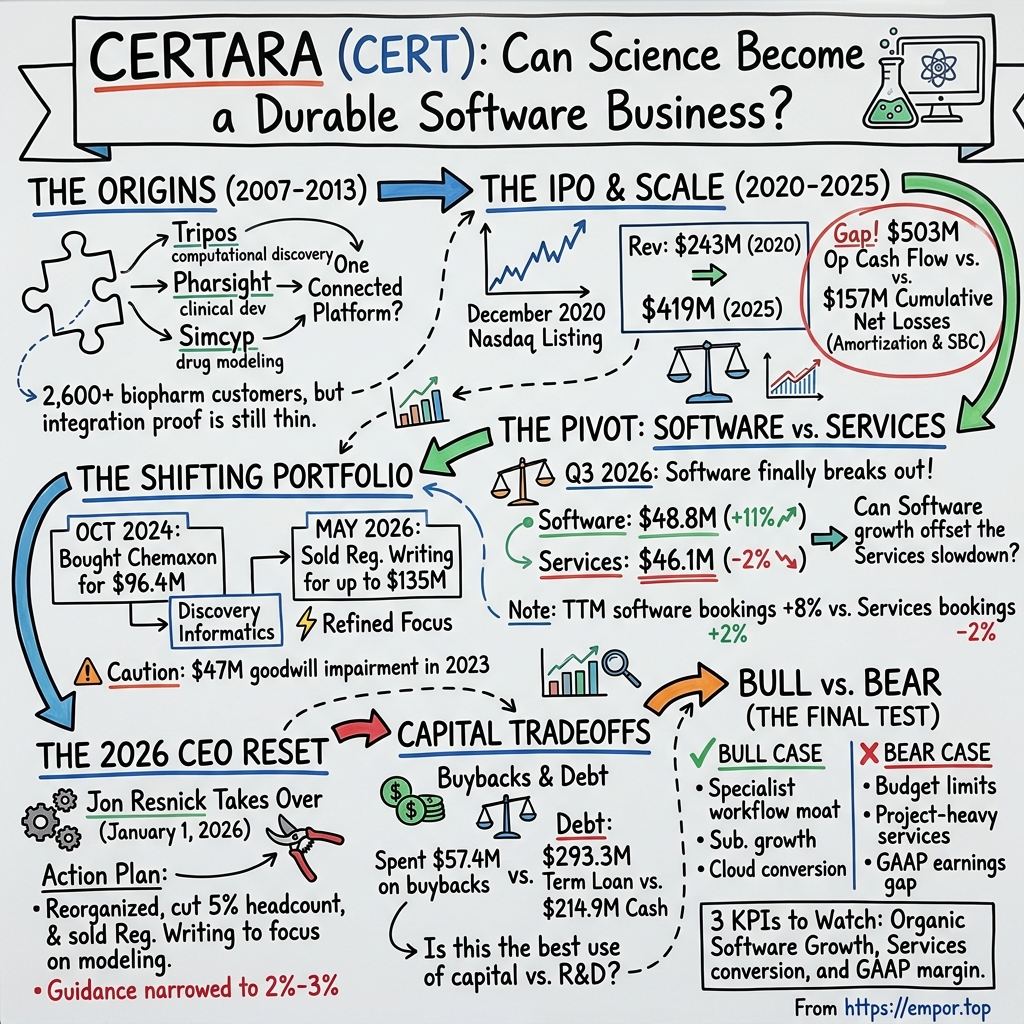
Certara: Can the Science Become a Durable Software Business?
I. The Quarter Software Finally Broke Double Digits
On the afternoon of November 5, 2026, Jon Resnick had a number he had been waiting ten months to say out loud. Certara's software revenue had grown 11% in the third quarter, to about $49 million.1 On the earnings call he called it the company's "first double-digit organic software growth quarter in two years," and he added that software bookings, the orders that turn into future revenue, had jumped 15%.2 For a chief executive who had taken the job on the first day of the year and spent much of it selling, cutting and reorganizing, it was the first clean piece of evidence that the plan might be working.
Then came the rest of the release. Services revenue, the consulting work Certara's scientists do for drug companies, fell 2% to about $46 million.1 Total revenue from continuing operations came to $94.9 million, up only 4%.1 And the full-year outlook did not widen in celebration. It narrowed, to revenue growth of 2% to 3% for 2026, with management saying software should grow faster than that range and services at or below its bottom end.1 The faster-growing half of the company was software; the half that was still shrinking was nearly as large. Put the two together and the company as a whole was barely moving.
That mismatch is the story. Certara sells something unusual: computer models of how drugs behave inside the human body, together with the scientists who know how to build, run and defend those models in front of regulators. For most of its life it has been described as a software company, priced at times like one, and run by private-equity owners who assembled it piece by piece. Yet in 2026 almost half its revenue still came from people billing hours and milestones, and the people side was the part in retreat.
Three questions hang over the company now. The first is whether its scientific software can become a growth engine big enough to carry the whole business, rather than a fast-growing half bolted to a slow one. The second is whether the substantial cash the business generates can ever turn into steady accounting profit for shareholders, something the record has not yet delivered. The third is whether today's capital allocation, which in 2026 meant selling a business, cutting staff and buying back stock while carrying debt, is strengthening the company or merely rearranging it.
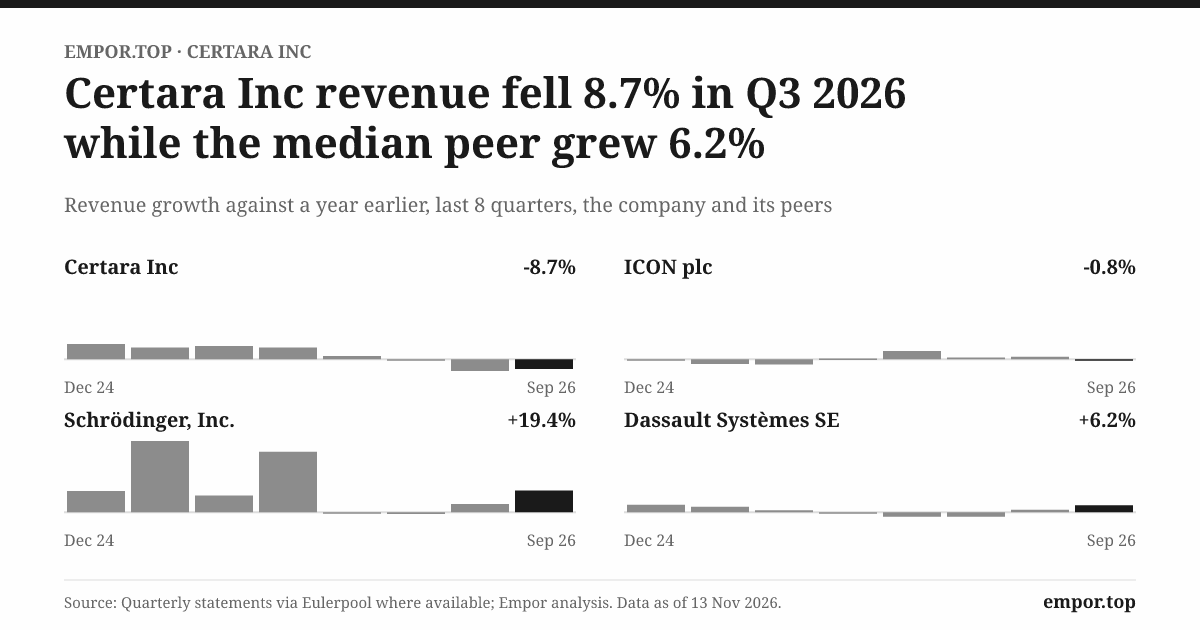
Before any of those questions can be answered, there is a boundary to draw, because the numbers otherwise contradict each other. In May 2026 Certara sold its Regulatory and Medical Writing business, the unit that drafted the documents drug companies submit to regulators.3 4 Accountants now treat that unit as discontinued operations, so the company's own comparison strips it out of both this year and last. On that basis, third-quarter revenue grew 4%.1 A simple series of reported consolidated revenue, which still carries the old unit in the prior-year quarter, shows the same quarter down nearly 9%.3 Both are arithmetic; only one describes the company that exists now. The 4% figure is the right lens for judging Resnick's Certara, and the difference between the two is itself a reminder of how much of this story is about deciding what the company should be.
The scale is worth fixing early. Certara reported $418.8 million of revenue in 2025, more than two and a half times the $163.7 million of 2018.[^5] 5 That is a real compounding record. But the speed has been fading. Revenue grew at about 11.5% a year over the five years to 2025 and about 7.7% a year over the three years to 2025, and the 2026 guidance is lower still.[^5] 1 A company that once grew in the high teens is now asking investors to believe that a software re-acceleration can pull it back up.
So the November quarter is best heard as a question rather than an answer. One quarter of double-digit software growth is a clue, and a promising one. The narrowed outlook and the continuing slide in services keep the burden of proof firmly on management. To understand why Certara is shaped this way, half product and half people, the story has to go back to how it was built: not by one founder with one idea, but by investors stitching three scientific toolkits into one company.
 Subscribe on LinkedIn
II. Three Scientific Toolkits Become One Company
Certara did not start as Certara. It started as a set of separate answers to separate scientific problems, owned by different people, and it became one company because a private-equity firm thought those answers belonged together.
The oldest piece was Tripos, a St. Louis software company whose tools helped chemists design molecules on a computer before anyone made them in a lab. Tripos belonged to the first generation of computational chemistry: software that let a medicinal chemist look at the three-dimensional shape of a protein and ask which molecules might fit into it. In 2007 Vector Capital, a San Francisco private-equity firm that specialized in technology businesses, bought Tripos's discovery-informatics business.6 It was a bet that the software of drug discovery was undervalued and could be run better as part of something larger.
The second piece came a year later. In 2008 Vector bought Pharsight, a company whose software and consultants worked further down the drug-development pipeline, analyzing how drugs move through the body and how patients respond in clinical studies.6 Pharsight's best-known product, Phoenix, became a workhorse for pharmacokinetics, the discipline that tracks how a drug is absorbed, distributed, broken down and excreted. Combining Tripos and Pharsight produced the company that took the name Certara.6
The third and arguably most important piece arrived in 2012, when Certara acquired Simcyp.6 Simcyp built what scientists call physiologically based pharmacokinetic models, a mouthful that describes something intuitive. Instead of waiting to see how a drug behaves in hundreds of patients, Simcyp builds a virtual human out of organs, blood flows and enzymes, and runs the drug through it. Change the virtual patient to a child, an elderly person, or someone whose liver processes drugs slowly, and the model predicts how the dose should change. That made Simcyp useful for one of the most expensive questions in drug development: what happens when the drug meets other drugs, or other bodies, that were never tested directly.
By the end of 2012 the strategic picture was clear. Certara owned tools for designing molecules, for analyzing how drugs behave in early studies, and for simulating how they will behave in populations no one has yet dosed. The ambition was to link scientific decisions across the drug-development chain rather than sell one isolated calculation tool. A company that could follow a drug from the chemist's screen to the regulator's desk would, in theory, become part of the way drugs got made.
That theory changed hands several times. In December 2013 Vector agreed to sell Certara to Arsenal Capital Partners, a New York private-equity firm focused on healthcare and specialty industrials.6 In 2017 funds advised by EQT, the Swedish investment firm, acquired the business, and EQT-affiliated holders still controlled a majority when Certara went public in December 2020.5 Each owner bought the same thesis and added to it. Under later ownership the company added regulatory-science and medical-writing services, clinical-data software and more, until the 2021 annual report described an end-to-end platform spanning discovery through regulatory submission and market access.7
The pieces that followed tell the same story of a company buying capabilities around its core. Pinnacle 21, acquired in 2021, brought software that checks clinical-trial data against the formats regulators demand before a drug application is filed.7 Regulatory-writing and market-access teams added people who could turn models and trial data into the documents and arguments that regulators and payers read.7 By the time of the listing, the company could plausibly claim to touch a drug from its first computer sketch to its approval dossier. That is a powerful sales story. It is also an operationally complicated one, because a software engineer improving Simcyp, a consultant billing hours to a biotech and a medical writer drafting a submission have very little in common beyond the customer.
It is worth keeping two things apart here. Certara was built, financed and repeatedly resold by private-equity firms, and the debt it still carries is in part a legacy of that era. But the returns those firms earned on buying and selling the company are not the economics of the listed business. The investor who buys a share today owns the operating company, its revenue, its debt and its accounting, not the sponsors' internal rate of return.
The deeper point is that the history supports a strategic logic, not a proof. Assembling Tripos, Pharsight and Simcyp gave Certara breadth that few specialist rivals can match. But breadth by acquisition is a portfolio until customers use the pieces together. Certara does not publish how many customers buy more than one product, how much more they spend, or whether multi-product customers renew at higher rates than single-product ones. Without those numbers, the joined-up toolkit remains the founders' thesis rather than a measured advantage. To see whether it can become one, it helps to stand in the room where a model actually has to earn its keep.
III. A Model Has to Survive Contact with Drug Development
Picture a development team at a mid-sized biotech. They have a drug candidate that looked good in animals and in a small first-in-human study. Now they must decide what dose to take into a larger trial, whether patients with weak kidneys need a smaller one, and whether the drug can safely be taken alongside common medicines that might block the enzymes that clear it. Each wrong answer costs time, money and, potentially, a patient's safety. A full clinical study to answer each question directly would take many months and many millions of dollars.
This is the moment Certara sells into. A pharmacometrician, the specialist who builds mathematical models of drug behavior, takes the data from the early studies, loads it into Phoenix, fits a model and asks how exposure changes with dose. A Simcyp model then simulates thousands of virtual patients with different physiologies and predicts how a drug interaction might raise blood levels. If the simulation is credible enough, regulators may accept it in place of some clinical studies, or use it to set labelling for populations that were never formally tested. The product is not the software. The product is a better decision, reached sooner, with fewer experiments.
That is a credible reason to buy. The harder question is why a drug company would buy it from Certara rather than build it in-house, use general-purpose tools, or go to a rival. The answer has three parts, and each needs testing.
The first part is reach. Certara says it serves more than 2,600 biopharmaceutical companies, academic institutions and regulatory agencies.[^5] That breadth is real evidence that the tools are widely used, and the presence of regulators among the users matters: when the people who review a submission use the same software as the people who wrote it, there is less arguing about methodology. Yet breadth does not mean dependence on any single buyer. No customer accounted for more than 10% of 2025 revenue, and the ten largest together accounted for 24%, down from 27% a year earlier.[^5] That leaves Certara with a diversified base but still exposed to the budgets of a handful of large pharmaceutical companies. When two big drugmakers merge, they do not need two sets of licences, and Certara's own filings warn that consolidation can reduce user seats.[^5]
The second part is how the money arrives. Certara sells perpetual and term software licences, cloud subscriptions and maintenance, and those behave like a typical software business: subscriptions are usually invoiced annually in advance and recognized evenly across the contract.[^5] Services behave differently. Some are billed by the hour; others are fixed-fee and recognized as the work progresses, often invoiced periodically or at milestones.[^5] Services revenue depends on winning projects, staffing them and getting them done on time, which ties it to drug-development budgets and biotech funding in a way subscriptions are partly insulated from. Over the trailing twelve months, software bookings rose 8% to about $202 million, while services bookings fell 2% to about $207 million.1
The third part is competition, and here Certara's own description is more modest than its marketing. The company names MathWorks, Dassault Systèmes, Ansys, Simulations Plus and ICON, whose NONMEM software is a long-standing standard in population pharmacokinetics, as competitors.[^5] It also names something harder to beat: customers' in-house methods and the status quo.[^5] That second category is the real rival in many sales. A large pharmaceutical company with its own modeling group can write its own code, license a cheaper point tool, or simply keep doing what it did last year. Certara does not publish market-share figures, and nothing in its record establishes that it leads the market in any category it does not explicitly define.
Why might customers stay once they start? The plausible switching costs are real. A model that has been validated, defended in a regulatory submission and built into a company's standard operating procedures is not swapped out lightly, because the cost of switching is not the licence fee but the risk of having to re-defend a new method to a regulator. Specialist know-how compounds this: scientists trained on Phoenix or Simcyp carry those habits from job to job. And when software is woven into the decisions about which drug to advance, it stops being a line item and becomes part of how the organization thinks.
The evidence for those switching costs is suggestive but thin. On the November call Resnick described Simcyp renewal rates as "historically strong," and his interim CFO credited "strong retention" for revenue growth.2 Simcyp's model is backed by a consortium of pharmaceutical members who fund development and help shape the tools, which embeds customers in the product's evolution.[^5] But Certara does not report a company-wide gross retention rate, net revenue retention, or a price-realization series. A software investor would normally expect all three. Without them, the claim that customers are locked in rests on anecdotes and on the absence of reported churn, not on measured behavior.
There is one more piece of evidence on the credibility side, and it comes from the regulators themselves. On the November call Resnick pointed to two new awards from the U.S. Food and Drug Administration, one from the drug-review center and one from the biologics center, alongside an expanded multi-million-dollar relationship for Pinnacle 21, the clinical-data validation product from the 2021 acquisition.2 Pinnacle 21 is a useful illustration of how regulatory gravity works, because the same data rules are being applied on both sides of the table. When the referee and the players use the same rulebook, changing rulebooks is costly. But awards from an agency are contracts, not proof of pricing power, and the company does not break out how much revenue its regulator relationships produce.
What would weaken the claim? Customers splitting work across multiple vendors, renewal rates slipping, discounting to keep accounts, or large customers taking modeling back in-house. There is one piece of disconfirming evidence already in the record: software bookings fell 6% in the fourth quarter of 2025, and the then-CFO cited external factors and "execution challenges."8 A product with ironclad switching costs can still see bookings wobble, because new deals and expansions are discretionary even when renewals are not. But it is a reminder that the moat, whatever its depth, has not insulated the top line.
The fair verdict is that Certara's breadth and domain expertise are plausible advantages, and the product sits in consequential workflows where trust matters. The moat is credible in shape but unproven in size. The evidence that would settle it is not more technical capability; it is sustained software bookings growth, disclosed renewal behavior and evidence that customers pay more over time. And that evidence is entangled with the other half of the business, the half that sells not the tool but the people who know how to use it.
IV. The Business Sells Both the Tool and the Scientists Who Know How to Use It
A Certara scientist sits on a video call with a customer's clinical team. She has spent three weeks building a model of their drug, and now she is walking them through what it says: the dose that probably works for adolescents, the interaction that probably does not need a dedicated study. The customer has two choices after the call. They can file the report and hire Certara again next time. Or they can decide that this kind of analysis should be done routinely, inside their own team, on Certara's software. The whole strategic bet of the company sits in that second choice.
That is the flywheel management describes. Expert services build trust and show customers what the tools can do; customers then embed the software in their recurring workflows, which produces subscription revenue that is more predictable and carries higher margins than consulting. In the third quarter of 2026, software and services were almost the same size.1 The services book-to-bill ratio, the value of new services orders divided by services revenue, was 1.15 over the trailing twelve months.1 A ratio above one means orders are still arriving faster than work is being delivered, which is a modestly encouraging sign that the services decline is not a collapse in demand.
Services are not interchangeable with software, and that is both their value and their limitation. A fixed-fee modeling project or a time-and-materials engagement can win a customer's trust and apply Certara's tools to a real development problem. But services revenue rises and falls with staffing levels, project timing and utilization, which is the share of a consultant's hours that are actually billed. A software licence sold a second time costs almost nothing to deliver; a second consulting project needs a second scientist. Resnick acknowledged on the February call that services "tend to be a more discretionary item," which is a polite way of saying they are the first thing a cost-cutting biotech trims.8
The company is investing to make the software half bigger. Research and development expense reached $41.0 million in 2025, up 11% from the year before and equal to roughly 10% of revenue.[^5] Management attributed the increase mainly to employee costs associated with software development, including the integration of artificial intelligence into its products, and Certara also capitalized $5.6 million more of development cost than the year before.[^5] That last detail matters for investors comparing profitability: capitalized development costs do not hit the income statement immediately but are amortized over time, so reported R&D understates the full cash cost of building software.
The cost base is knowledge, not machinery. Certara employed 1,576 people at the end of 2025, 1,515 full-time and 61 part-time, and its net property and equipment was a trivial $1.9 million.[^5] The company does not publish a comparable headcount trend, so it is not possible to tell from its disclosures how quickly the services workforce has grown or shrunk relative to revenue. What is clear is that the people are the asset, and for the services half they are also the capacity constraint.
The cash cycle follows from the mix. Invoices typically carry net 30 to 90 day terms.[^5] Receivables were equal to about 102 days of revenue in 2025, down from a peak of about 113 days in 2024.[^5] That is long for a software company and typical of a business that bills large pharmaceutical customers on milestones; it means Certara funds a quarter's worth of its customers' working capital at any given time. On the positive side, the company ended 2025 with $147.8 million of contracted work not yet recognized as revenue, of which about $121 million was expected to be recognized within twelve months.[^5] That backlog gives some visibility, though it is small relative to annual revenue, which confirms that much of each year's income still has to be won during the year.
The quality of what customers owe looks reasonable on the evidence available. At the end of September 2026 Certara reported about $77 million of billed trade receivables and about $12 million of unbilled receivables, the latter being work done but not yet invoiced, against a credit-loss allowance of only about $2 million.3 Credit-loss provisions and write-offs were each about $1 million in 2025, tiny relative to revenue.[^5] That fits a customer base dominated by large drug companies that pay slowly but reliably. The company does not publish an ageing schedule of overdue balances, so the share of receivables that is seriously late cannot be judged from its disclosures. The unbilled balance is the number to watch, because it is where optimistic estimates on fixed-price work would show up first.
There is one accounting judgment worth flagging where it belongs. In its 2025 audit, the company's auditor identified revenue recognition on fixed-price services contracts as a critical audit matter, the label auditors give to areas requiring especially challenging judgment.[^5] On a fixed-price contract, Certara recognizes revenue as work progresses, which requires estimating total effort and how much has been done. If estimates prove optimistic, revenue is pulled forward and later reversed. The auditor issued an unqualified opinion, and a critical audit matter is not evidence of a misstatement; it is a measurement risk built into the services business. It is also a reason to watch services margins and unbilled receivables when services growth is weak, because that is when pressure on estimates tends to be greatest.
So where does the flywheel stand? It is a management thesis, not yet a quantified outcome. Certara does not disclose how many services engagements convert into software subscriptions, nor how much software revenue comes from customers first won through services. The clearest evidence would be software bookings and revenue growing while services book-to-bill stays above one and services margins hold, which would suggest expert delivery is pulling customers into the product rather than substituting for it. Software is plainly the growth vector. Services still matter to scale, customer access and scientific credibility. Whether the two reinforce each other or simply coexist is the open question, and the company's most recent acquisition was a bet that adding yet another set of tools would make the answer more favorable.
V. The Portfolio Widened Again with a $96 Million Bet
In October 2024 Certara reached back to the very beginning of drug development and bought Chemaxon, a Hungarian scientific-software company whose tools help chemists draw, store, search and predict the properties of molecules.[^5] If Simcyp and Phoenix are used when a drug candidate is heading into people, Chemaxon is used much earlier, when it is still a sketch on a chemist's screen. In one sense the deal brought Certara full circle: the company that began with Tripos's discovery tools was again investing at the discovery end of the chain.
The strategic logic is the same thesis that animated the 2007 to 2012 assembly. A company that can follow a molecule from first design to regulatory submission can, in principle, carry data and insight forward, so that a property predicted in discovery informs a model in development. Chemaxon also brought a different customer base: chemists and informatics teams rather than pharmacometricians, and in many cases academic and chemical-industry users as well as drug companies.
The price was $96.4 million in total: $87.4 million paid to the sellers and $9.0 million placed in escrow.[^5] Of that, $46.5 million was recorded as goodwill, the accounting residue that remains after identifiable assets such as software and customer relationships have been valued.[^5] When nearly half of a purchase price is goodwill, the buyer is paying for something it cannot itemize: future growth, cross-selling, or strategic position. That is not unusual for software acquisitions. It does mean that the value of the deal depends heavily on things that have not yet happened.
Was it a good price? Honestly, the disclosures do not permit an answer. Certara did not disclose Chemaxon's standalone revenue or earnings in its purchase accounting, so there is no denominator for a revenue or EBITDA multiple.[^5] Without one, the deal cannot be called cheap or expensive, and any claim either way would be guesswork. The deal also explains one small oddity in the annual report: the Hungarian forint now appears among Certara's principal currency exposures, alongside the dollar, pound, euro and yen.[^5]
The more instructive evidence is not about Chemaxon at all. It is about what happened to an earlier addition. In 2023 Certara recorded a $47.0 million goodwill impairment on its Regulatory Writing reporting unit, the business that drafted regulatory submissions.[^10] An impairment is the accounting admission that a business is worth less than the value the company has been carrying it at, usually because its expected cash flows have fallen. In the September quarter of 2023 the charge helped push Certara to an operating loss of roughly $53 million.[^10] That unit was not Chemaxon, and the impairment says nothing directly about the newer deal. But it shows that a business that fits neatly in the strategic diagram can still fall short of what was paid for it.
The May 2026 sale to Veristat, a clinical research and consulting firm, closed on May 8 for up to $135 million.4 2 Management presented the sale as sharpening its focus on model-informed drug development and clinical intelligence.4 The divested business had produced about $50 million of revenue and about $17 million of adjusted EBITDA in 2025, before unallocated corporate overhead.4 Depending on how much of the contingent payment is earned, the headline value works out to roughly two to two and three-quarter times revenue and up to about eight times adjusted EBITDA. Those are the ratios of this transaction, not a benchmark against peers, and the adjusted EBITDA excludes overhead that does not disappear simply because the unit is sold.
Put the two deals side by side and a pattern emerges. Certara spent years widening its portfolio on the theory that breadth creates value. It is now selling part of that breadth because the theory did not hold for that piece. That does not condemn Chemaxon. It does mean that strategic fit, on its own, has not been a reliable predictor of value creation in Certara's own history.
The test for the remaining portfolio is measurable. Chemaxon and the other acquired products need to show up in software bookings, in cross-selling between discovery and development customers, and in sustained organic growth, not merely in a broader product catalogue. If they do, the goodwill will look justified. If they do not, the 2023 impairment will look less like an isolated episode and more like a pattern. Either way, the judgment now falls on public-market investors, who have been watching Certara's numbers since the day the private-equity era formally ended.
VI. The IPO Put a Price on Growth—and Left the PE Era Behind
December 2020 was a strange and generous moment for healthcare technology. The pandemic had made drug development front-page news, vaccines were being authorized in record time, and investors were eager for anything that promised to make the process faster. Into that market Certara listed its shares on the Nasdaq Global Select Market.5
The offering had two parts, and the distinction mattered. Some shares were newly issued by Certara, raising fresh capital for the company. Others were sold by existing holders, and the prospectus was clear that Certara would receive none of the proceeds from that portion.5 Even after the listing, EQT-affiliated holders were expected to retain a majority of the shares, so the IPO was less a handover than the first step in a long exit.5 Part of the money it did raise went toward repaying debt, and borrowings fell from roughly $400 million at the end of 2019 to about $300 million at the end of 2020, while cash jumped to about $271 million.5 7
The listing also left a mark on the income statement. In 2020 Certara recorded a jump in stock-based compensation, much of it accelerated by the IPO, which helped turn an operating profit in 2019 into an operating loss of about $24 million in 2020.5 7 That year is a poor guide to normal economics, but it was a preview of a theme: Certara's reported profits were repeatedly shaped by charges that did not touch cash in the period.
Measured by revenue, the public company kept growing. Revenue rose from about $243 million in 2020 to about $419 million in 2025, an annual pace of roughly 11.5%.5 [^5] But that average conceals a shift. In 2021 and 2022 revenue grew about 17% a year; from 2023 onward growth dropped into single digits, so that the three-year rate through 2025 was about 7.7%.7 [^5] Part of the boost in the early years came from acquisitions, including Pinnacle 21.7 The slowdown has coincided with tighter biotech funding and a more cautious drug-development spending environment, though Certara has also acknowledged its own execution problems.
The more revealing comparison is between profit and cash. Over the eight years from 2018 to 2025, Certara reported cumulative net losses of about $157 million, yet its operations generated about $503 million in cash.[^5] 5 7 [^10] Only once in that period, in 2022, did it report a meaningful annual net profit, of about $14 million.7 [^10] A shareholder looking only at the income statement would see a company that reported losses in most years; a shareholder looking only at the cash-flow statement would see a business that threw off close to $100 million a year from operations. Both described the same company.
The gap is not mysterious, but it is not costless either. In 2025 the cash-flow reconciliation added back $75.2 million of depreciation and amortization, much of it the amortization of intangible assets created when private-equity owners and Certara itself bought businesses, and $33.1 million of equity-based compensation.[^5] Amortization of acquired intangibles is a genuine non-cash charge: the cash was spent when the businesses were bought, often with borrowed money. Stock compensation is different. It does not consume cash, but it does dilute shareholders, and a company that pays people in shares instead of cash is still paying them. Investors who look at operating cash flow and ignore stock compensation are counting the same dollar twice: once as cash kept, and again as ownership given away.
The 2023 goodwill impairment sits squarely in this record. It was not a one-time quirk from the distant past but a $47.0 million write-down three years after the IPO, on a business that has since been sold.[^10] Combine it with the IPO-related compensation charge in 2020 and the losses in other years, and the pattern is that Certara's accounting earnings have been interrupted by something almost every year. Some of those interruptions are non-recurring by nature; their frequency is what matters.
The measured conclusion is that the public company's operating cash conversion is real and substantial. It has funded acquisitions, debt service and now share buybacks. But it has not yet produced a stable stream of GAAP profit, and it has not yet produced compounding per-share value, partly because of the dilution from equity pay. Investors who bought at the IPO have lived through enormous swings: the shares lost the large majority of their value from their post-listing highs before recovering sharply in 2026. When a public company's record looks like that, boards tend to change leaders. Certara's did.
VII. A New CEO Inherits a Company That Needs a Reset
On December 11, 2025, Certara announced that Jon Resnick would become chief executive on January 1, 2026, succeeding William Feehery, who had led the company through its IPO and would remain as an adviser during the transition.9 Resnick was an outsider to Certara but not to the business of selling information to drug companies. He had spent more than twenty years at IQVIA and its predecessor IMS Health, most recently, since 2019, as president of IQVIA's United States and Canada business, with overall responsibility for the region's commercial operations.9 Before that he ran IQVIA's Real World Solutions business, which sells analysis of patient data gathered outside clinical trials, and before joining IMS Health in 2002 he worked for the U.S. Senate Committee on Finance on healthcare policy, including Medicare and Medicaid.9
That résumé says something about what the board wanted. Certara had no shortage of scientific depth. What it lacked, judging by its slowing growth, was commercial muscle. Board chair James Cashman praised Resnick's "proven track record of building and scaling market leaders."9 A commercial executive from the largest life-sciences data company in the world was the kind of hire a board makes when it believes the products are good enough and the selling is not.
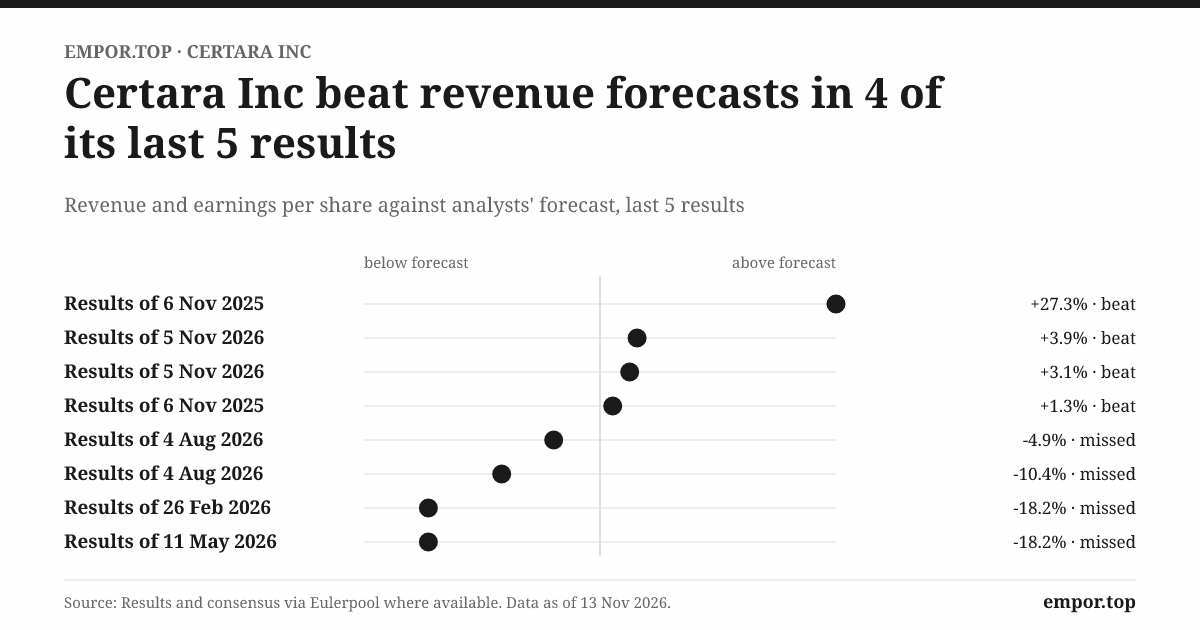
Resnick's first public outing as CEO, the fourth-quarter call on February 26, 2026, was candid in a way that new leaders can afford to be. He called 2026 "a transition year as we bring change to the organization and strengthen our focus."8 The guidance matched the tone: revenue growth of between zero and 4% for the year, an adjusted EBITDA margin of 30% to 32%, and adjusted earnings per share of $0.44 to $0.48.10 8 He said the company was in the final stages of a strategic review of the regulatory-writing business.8 And CFO John Gallagher acknowledged a software bookings decline, citing external factors and "execution challenges."8 A new chief executive guiding to possibly zero growth was not a promise; it was lowering the bar.
What followed over the next nine months was a sequence of visible moves. First came the sale of Regulatory and Medical Writing, agreed in April and closed in May.4 2 Then, in the second quarter, a workforce reduction affecting about 5% of employees, which management expected to save about $13 million a year.[^13] Alongside the cuts came a reorganization: Certara regrouped itself into two business units, one built around model-informed discovery and drug development and the other around accelerated clinical evidence, organized, in Resnick's words, around "how customers buy our software and services."2 [^13] And he recruited new leaders, including a chief product officer, Grant Peterson, who had held the same role at the contract-software company Conga and before that was chief technology officer at DocuSign, plus a new chief commercial officer.2 Bringing in a product leader from mainstream enterprise software was a signal that Resnick wants Certara's tools to be run more like software products and less like scientific instruments.
The reorganization deserves a moment of translation, because it is more than a new org chart. For years Certara was split along the line between its predictive software and its drug-development services, which meant a customer buying both often dealt with two parts of the company with different incentives. Grouping the business by the problem a customer is trying to solve, early-stage modeling and drug development on one side and clinical evidence on the other, is meant to let one team sell the software and the scientists together. It is a familiar move in enterprise software. It is also a disruptive one, because salespeople change territories, account relationships move and quotas reset, which is one reason a reorganized company often looks worse before it looks better. Resnick conceded as much when he said the effect of the changes "will take time to show in our numbers."2
The guidance tells a more complicated story. The initial range of zero to 4% was narrowed in November to 2% to 3% on the new continuing-operations basis.10 1 Narrowing a range around its midpoint is not a miss in itself. But the components moved. By the November call management referred to a previously communicated adjusted EBITDA margin outlook of 29% to 31%, a point below the February range, and adjusted earnings per share guidance had moved to $0.31 to $0.34, well below February's $0.44 to $0.48.2 8 Some of that change mechanically reflects the removal of the divested business's profit; the company's explanations on the calls did not fully separate that effect from operating performance. An investor comparing February's promises with November's guidance sees a company whose revenue outlook held roughly steady while its profit outlook fell.
The analyst questions on the November call went to the heart of the matter. Asked by UBS whether the software improvement reflected better market demand or Certara's own execution, Resnick replied: "It's tough to discern a specific trend in one way or another."2 It was an honest answer, and also an unsatisfying one. If management cannot yet tell whether the software rebound is the market or the company, then neither can investors, and the durability of the improvement remains uncertain.
Adjusted figures flatter the picture, as they usually do. Certara's third-quarter adjusted EBITDA margin was 31.8%, while continuing operations still recorded a GAAP net loss.1 The consolidated figure, which also carries the discontinued business, showed a small profit.1 3 The company says it cannot reconcile its forward adjusted guidance to GAAP figures without unreasonable effort, because acquisition costs, financing costs and stock compensation are hard to predict.1 That is a standard disclosure, but it means the guidance investors are given excludes exactly the items that have kept Certara's GAAP earnings negative.
Ownership and incentives shape how this plays out. Arsenal Capital Partners, the firm that bought Certara from Vector in 2013, held about 23.7% of the shares according to the 2026 proxy, with Wasatch, BlackRock, Vanguard and Dimensional also holding large stakes.11 That makes Arsenal a powerful minority holder, not a controlling parent, and its stake should not be confused with management ownership. Feehery's final year as CEO offers a guide to the incentive structure Resnick inherited: his reported 2025 compensation was about $6.5 million, roughly three-quarters of it in equity awards.11 In the proxy's pay-versus-performance table, the company-selected measure was adjusted EBITDA, which came to about $134.5 million in 2025, against a GAAP net loss.11 An incentive system anchored to adjusted EBITDA rewards operating improvement, but it can be satisfied without ever converting that improvement into GAAP earnings per share. Resnick's own awards and their performance conditions, set out in the appointment filings and the proxy, deserve the same scrutiny.
Shareholders mostly backed the board at the May 2026 annual meeting. Say-on-pay passed easily, with about 120 million shares voting for and about 2 million against.12 But director Stephen McLean received about 22.9 million withheld votes, a meaningful protest for an uncontested election.12 That is a signal worth noting rather than a verdict on the board as a whole; the company's committees are composed entirely of independent directors, according to the proxy.11
The last thread is the finance team. Gallagher was CFO when the 2025 annual report was filed in February 2026; by the November release, Faiz Mohammed was serving as interim CFO.[^5] 1 The company did not make the reasons for the change prominent in its third-quarter materials. An interim CFO is not a crisis, but it matters for a company whose investment case depends on guidance discipline and capital allocation. The appointment of a permanent CFO, and that person's first guidance for 2027, will be a test of how stable the new operating team really is.
Read in sequence, the three calls of 2026 show a management team that has done what it said it would do on structure: sell, cut, reorganize, hire. The results have improved on software but not yet on services or on the overall growth rate. Credibility now depends on outcomes, on clear explanations when numbers move, and on a stable team. And in the meantime the company has been making another kind of decision, one that will matter just as much to shareholders: what to do with its cash.
VIII. Buybacks, Debt and the Price of Patience
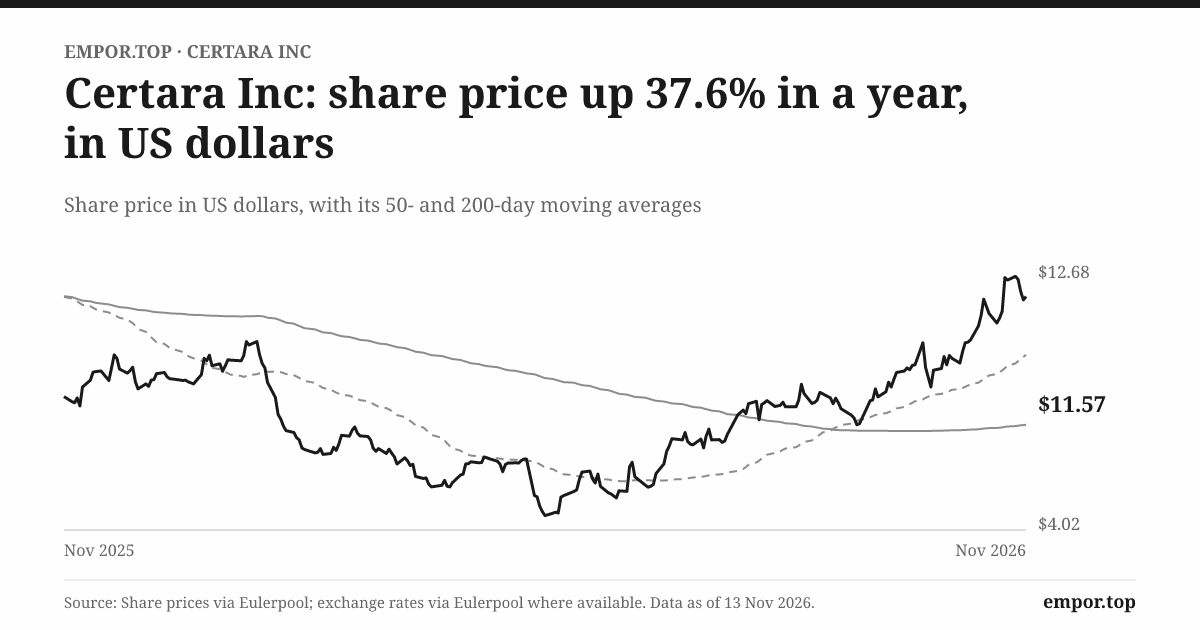
In August 2026, alongside its second-quarter results, Certara's board authorized another $50 million of share repurchases.[^13] The previous authorization, $100 million approved in April 2025, had been partly put to work: by the end of September 2026 the company had repurchased about 9 million shares for about $57 million.3 The average price works out to roughly $6.40 a share, compared with a share price of about $11.60 in mid-November 2026. On paper, that looks like well-timed buying, done in a year when the shares at one point traded below $4.50. But the question with buybacks is never only whether the price went up afterwards. It is whether buying back stock was the best use of the cash, given everything else the company needed to pay for.
Start with the balance sheet. At the end of September 2026, Certara owed $293.3 million on a secured term loan and held $214.9 million of cash, leaving net debt of roughly $80 million.3 It also had $100 million of undrawn revolving credit.3 The term loan matures in June 2031 and the revolver in June 2029, so there is no near-term refinancing wall, and the loan carried an effective interest rate of about 6.5% in the first nine months of the year.3 Quarterly principal payments began in December 2025.3 The debt is secured by substantially all of the company's U.S. assets.3 Operating lease liabilities of about $10 million should be kept separate; they are rent, not borrowing.3
That debt is manageable, but it is not trivial, and S&P Global Ratings' last published view, a March 2024 upgrade of the holding company's rating to BB-, placed it below investment grade.13 S&P cited a leading position in Certara's addressable markets and a diversified customer base as strengths and competition from a well-capitalized larger rival as a risk; that assessment predates the 2026 divestiture.13 A company with a 6.5% cost of debt, a sub-investment-grade rating and no GAAP profit has to justify why it is buying shares rather than paying down its loan.
The 2025 R&D spending and capitalized software costs are part of that investment picture.[^5] The new product leadership and the AI push will need money. If repurchases reduce the resources available for product investment, they could undermine the very software growth that would justify the higher share price. There is no evidence in the disclosures that this has happened, but it is the right question to ask.
There is also dilution to offset. The company also pays employees in stock, and part of any buyback simply soaks up the new shares issued to them.[^5] The guidance helps here: diluted share count guidance moved from 160 million to 162 million in February to 155 million to 157 million in November, a drop of about 3%, which suggests the repurchases have reduced the share count net of dilution.8 2 That is real progress on a per-share basis. Yet it sits alongside an adjusted EPS outlook that fell by roughly a third over the same period, which means the shrinking denominator has not yet been matched by a growing numerator.
A skeptical investor would put it bluntly: why repurchase shares while debt remains material, services are weak, and GAAP earnings per share are negative? The bull answer is that the shares were cheap when bought and the buyback has already created value at current prices. The bear answer is that buybacks are a bet on future earnings, and the earnings have not arrived. Both answers depend on three things the company will disclose over time: the price paid for future repurchases, the diluted share count, and the operating returns that follow.
The market's current price frames that bet. In mid-November 2026, Certara's enterprise value of about $1.8 billion was about 4.7 times sales and about 19 times EBITDA. Against operating profit, the multiple was a meaningless 268 times, and trailing earnings per share were negative.3 Free cash flow, at about $70 million in 2025, represented a yield of about 3.5% on the market value.[^5] Those figures are context, not a verdict. Certara does not have a long enough record of profitability to compare its price against its own history, and a like-for-like set of peers is hard to assemble. What the price appears to assume is that today's adjusted margins and cash flows are a fair guide to future owner earnings, and that software growth will recover enough to justify paying a software-like multiple for a business that is still half services.
The measurement going forward is straightforward. Watch net debt, diluted shares, GAAP operating margin and software growth together. If repurchases continue while net debt holds steady, share count falls and GAAP margins rise, the buybacks will have been a good use of capital. If the share count falls while margins stall and debt stays where it is, the buyback will have been a way of buying time. That brings the story to its central argument: what, exactly, is the case that Certara wins from here, and what would show that it will not?
IX. Analysis & Bear vs. Bull Case
The November call distilled the debate into a single uncomfortable juxtaposition. On one side was the 11% software growth figure, the first double-digit print in two years. On the other was a full-year outlook of just 2% to 3% growth, trailing-twelve-month total bookings up only 2%, and a share price that already valued the company at about 4.7 times sales.1 2 The bull case says the software number is the leading indicator and the rest will follow. The bear case says the software number is one quarter and the rest is the trend.
Start with the competitive structure, because everything else depends on it. Certara competes against MathWorks, whose general-purpose computing tools are used for modeling across science and engineering; against Dassault Systèmes and Ansys, which sell simulation software to many industries, including life sciences; against Simulations Plus, a direct specialist competitor in drug-behavior modeling; and against ICON's NONMEM, a long-standing standard for population pharmacokinetic analysis.[^5] Its largest competitor, though, may be the customer's own team, using in-house tools or simply preserving existing processes.[^5]
Through Porter's lens, the forces look moderate rather than extreme. Buyer power is real but not dominant: the top ten customers account for about a quarter of revenue and no customer exceeds 10%, which spreads risk, yet large pharmaceutical companies can multi-source, consolidate vendors after mergers, and squeeze budgets.[^5] The threat of substitutes is significant because the substitute is often doing the work internally or doing without modeling altogether. Supplier power is low; Certara's main input is specialist people, whose scarcity raises costs but whose bargaining power is diffuse. Rivalry is concentrated among a handful of specialists and general-purpose giants, and new entrants face the barrier of regulatory acceptance, since a model that regulators have not seen before must earn trust slowly.
Hamilton Helmer's seven powers offer a sharper test of whether Certara has a durable advantage. Switching costs are the strongest candidate: validated models, regulatory precedent and trained scientists make replacing Certara's tools costly and risky. Some measure of counter-positioning may exist, in that general-purpose software makers would have to invest heavily in pharmaceutical science to replicate Certara's domain depth. A cornered resource is plausible in Simcyp's accumulated physiological libraries and its consortium of members, though Certara does not quantify its value. Scale economies are weak in the services half, which scales with people. Network effects are limited; one customer's use of Phoenix does not obviously make it more valuable to another, except insofar as regulators and scientists share a common language. Brand matters in a field where reputation with regulators counts.
Assess the moat once, here. Certara's breadth and its scientific and regulatory expertise are plausible sources of differentiation, and switching costs likely protect its installed base. But market share, retention rates and price realization are not established by the company's disclosures, and nothing in the record supports calling Certara the market leader in any category except in management's own description. S&P's 2024 reference to a leading position is a credit analyst's judgment, not a disclosed measurement.13 The fair verdict is a moat that is real in kind, unproven in magnitude, and narrower than the company's marketing implies.
The bull case runs like this. Software bookings and revenue accelerate as the reorganization puts product and commercial leadership behind each line. Cloud conversion, which Resnick said had reached nearly 10% of all Phoenix accounts, keeps expanding, converting licence customers into subscription customers who pay more predictably and often more in total.2 Expert services help land and expand software accounts, so that the services decline proves to be a temporary consequence of rebalancing the delivery model toward specialists, not a structural weakness.2 AI features embedded in the tools make Certara's software more valuable rather than less, and regulators' growing acceptance of model-informed drug development makes the product more essential.
The bear case is just as specific. Drug-development budgets stay constrained, especially at smaller biotechs, so services bookings fail to convert into revenue. The broader suite does not displace point tools or in-house work, so cross-selling never materializes and each product grows only as fast as its niche. AI changes scientific workflows faster than Certara monetizes its products, letting customers or new entrants build models with general-purpose tools. Resnick told investors in February that clients affirmed there was "limited risk of AI-driven disintermediation," but that is a claim based on customer conversations, not a measured outcome.8
The AI optionality deserves particular restraint. Certara says it is embedding machine learning and generative AI into its products, including a data-integration platform built on the Model Context Protocol, a standard that lets AI assistants connect to software and data.2 The company launched Certara IQ in 2025 and expects its new capabilities to contribute to growth in 2027.8 2 But it has not quantified AI revenue, customer adoption or productivity gains, and its filings do not quantify displacement risk either.[^5] Technical integration is capability; it is not commercialization. Until Certara reports how many customers pay for AI features and how much, the AI story is optionality, not evidence.
Financial resilience is the other axis of the debate. Operating cash flow has been substantial and steady, about $96 million in 2025.[^5] But GAAP net losses, material stock compensation, $293 million of debt and acquisition-related amortization keep earnings quality and per-share value in question.3 [^5] In 2025, pretax profit was only about $7 million, and net other income of about $6.3 million, mostly currency remeasurement gains and asset-disposal income, accounted for nearly all of it.[^5] In other words, the 2025 pretax profit was largely an accident of exchange rates rather than evidence of operating earnings.
Currency adds a smaller layer of noise. About 31% of 2025 revenue came from outside the United States, and the company's main exposures are the pound, the euro, the Hungarian forint and the yen.[^5] Certara tries to match the currency of its contracts to the currency of its costs, but it had no forward hedges outstanding at the end of 2025.[^5] That approach limits the damage to margins but does not stop exchange-rate swings from moving reported revenue and, as 2025 showed, reported pretax profit. Investors comparing quarters should keep in mind that a weaker dollar flatters Certara's reported growth and a stronger one hides it.
History offers a direct test of the acquisition-led strategy that built the company. The 2023 goodwill impairment on Regulatory Writing and the 2026 sale of that business show that portfolio growth has, at least once, required a costly reassessment.[^10] 4 That does not disprove the potential of the remaining portfolio. It does narrow the case for acquisition-led value creation from a general claim to a specific one: Certara's model-informed development and software products must prove themselves on organic growth, not on the logic of the portfolio.
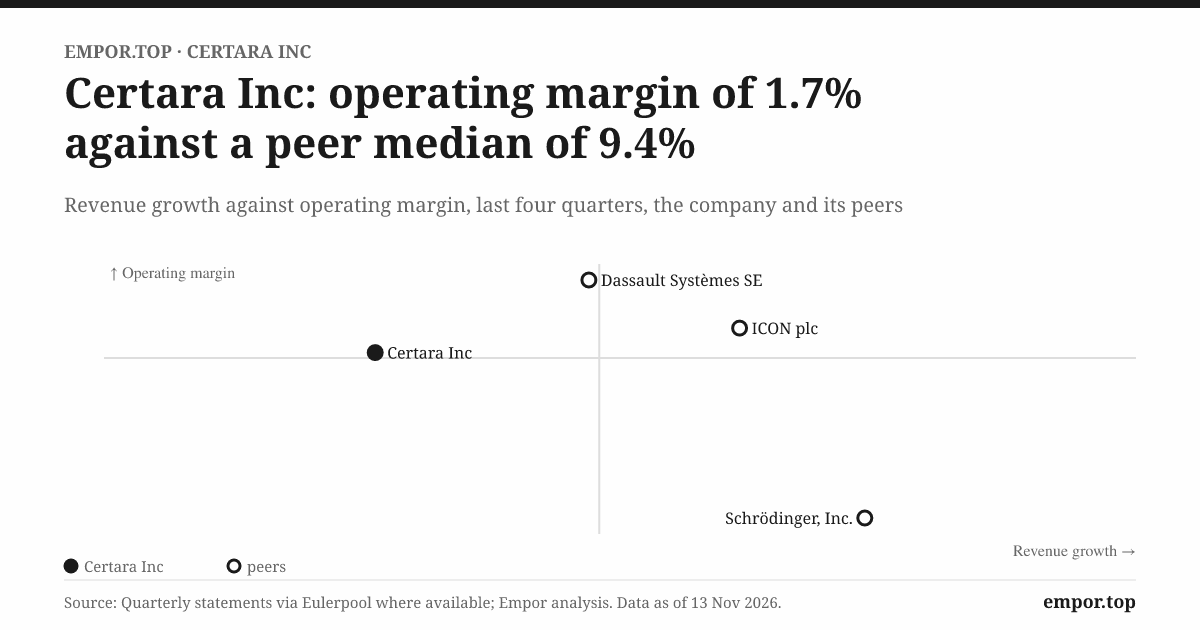
Three numbers can settle this debate. The first is organic software revenue growth, which reached 11% in the third quarter of 2026 after a weak end to 2025. The second is the services book-to-bill ratio and its conversion into revenue, which stood at 1.15 on a trailing basis while services revenue fell 2%.1 The third is GAAP operating margin alongside operating cash flow; the margin was about 5% in 2025 and lower on a trailing basis in 2026.[^5] 3 If software growth holds in double digits, services book-to-bill converts into revenue growth and GAAP operating margin rises, the bull case gains evidence. If software slips back to mid-single digits, services keep shrinking and GAAP margins stay in low single digits, the bear case wins.
Valuation cannot settle the debate on its own. Certara's own five-year median price-to-earnings ratio is not meaningful because its earnings have been negative or close to zero, trailing earnings per share are negative, and a verified like-for-like series of peer multiples is not readily available. At 4.7 times sales the market is paying for a software future that the current revenue mix only half supports. Whether that is a reasonable price depends entirely on which of the three KPIs moves first.
X. Playbook: Business & Investing Lessons
Certara's story is unusual because it was assembled more than built. Three owners and two decades of acquisitions created a company with an extraordinary range of scientific capability. Then the public markets arrived and asked a simpler question: does it make money for shareholders? The lessons sit in the gap between those two things.
The first lesson goes back to the beginning, when Vector Capital put Tripos, Pharsight and Simcyp under one roof. A scientific toolkit is only a platform when customers use the pieces together. The logic of linking molecule design to dose prediction to regulatory submission was compelling in 2012, and it remains compelling today. But the company still does not show investors how many customers use more than one product or whether those customers are worth more. For founders building through acquisition, the lesson is to measure integration from the first day, because a portfolio that cannot prove it is a platform will eventually be valued as a collection of parts.
The second lesson lives in the eight years of financial statements. Cash can keep a business moving before accounting earnings catch up; it cannot settle the owner's return. Certara generated about half a billion dollars of operating cash while reporting cumulative losses, and both numbers were true. The cash funded debt service, acquisitions and buybacks. But shareholders own a claim on earnings after every cost, including the shares paid to employees and the businesses bought with borrowed money. Investors who treat operating cash flow as owner earnings, in a company that pays heavily in stock and grows by acquisition, are being generous with their own money.
The third lesson comes from the business that was impaired in 2023 and sold in 2026. An acquisition thesis has to survive the next impairment test. Regulatory Writing fit the strategic diagram of an end-to-end drug-development company, and the fit did not prevent a $47 million write-down.[^10] Chemaxon fits the diagram too, with nearly half its $96 million price recorded as goodwill.[^5] The lesson for investors is to judge acquired businesses not by how well they fit the slide but by whether they show up in organic growth within a few years. For managers, it is that selling a business that no longer fits is a sign of discipline only if the next acquisition is held to a stricter standard than the last.
The fourth lesson is about the August 2026 buyback authorization, approved while the company still carried a secured term loan and reported negative GAAP earnings per share. A buyback is a claim on tomorrow's earnings, not a substitute for them. Buying shares at around $6 looks shrewd with the stock near $12. But a share price can fall as easily as it rose, and the remaining holders only keep that gain if the business underneath goes on to earn more per share than it does today. Repurchases made while services shrink and profit guidance falls are a bet that the turnaround will work. That bet is not wrong, but it should be named as a bet.
The broader lesson connects all four. Certara has always had excellent science. What it has struggled to prove is that excellent science, packaged as software and sold alongside people, can produce the predictable, growing, per-share earnings that public markets eventually demand. The companies that make that leap tend to be those that turn expertise into product, measure what customers actually do with it, and refuse to confuse cash generation with value creation.
XI. Epilogue
Tonight Certara is a simpler company than it was a year ago. The regulatory-writing business is gone, the workforce is smaller, the organization has been redrawn around two business units, and a chief executive from the commercial side of the industry has replaced a scientist at the top. The shares have more than doubled from their low of the past year. The software half has just delivered its best quarter in two years. And the full-year outlook still says the company as a whole will grow by about 2% to 3%.
The next several months will decide whether the reset is working. The first moment comes with the fourth-quarter results in early 2027, which will be the first full set of annual results under Resnick, and almost certainly the moment he gives guidance for 2027. Software growth persisting beyond a single double-digit quarter would suggest that the reorganization and new product leadership are doing more than shifting revenue between periods. Further cloud conversion would show that the subscription model is taking hold. A relapse would suggest that the third quarter was an expansion deal or two rather than a turn.
The second moment is the services story. Resnick has said that rebalancing the engagement model back toward specialists and expanding customer outreach will take time to show up in the numbers.2 The book-to-bill ratio above one gives reason to expect services revenue to stabilize. If it does, and margins improve without hollowing out the scientific expertise that makes the services credible, the flywheel argument will gain its first real evidence. If services keep shrinking despite strong bookings, investors will want to know why orders are not converting into revenue.
The third moment is about people and capital. Certara needs a permanent CFO, and that person's first guidance will say a great deal about how conservative the new team intends to be. Repurchase pace, debt balance and diluted share count need to move in the right direction together. A falling share count while net debt stays flat and GAAP margins climb would vindicate the buyback; a falling share count alongside flat margins would make it look like financial engineering.
Then there is AI, the subject most likely to dominate the headlines and least likely to settle the debate. Certara has embedded new tools and promised that they will contribute to growth in 2027. It should be treated as an investment case only when the company reports customer adoption, revenue contribution or measurable productivity gains. Until then, it is a capability waiting to become a business.
Each outcome maps onto the three questions facing Certara now. If software keeps growing in double digits, the first question, whether software can carry the company, starts to answer itself, because software could soon become the clear majority of revenue. If GAAP operating margin rises toward the adjusted figures management prefers, the second question, whether cash becomes owner earnings, begins to close. And if the share count keeps falling while net debt stays in check, the third question, whether capital allocation is strengthening the company, will have a numerical answer rather than a rhetorical one. None of those outcomes is guaranteed, and the evidence from 2026 points in both directions at once.
The direction of travel is clear. The question is whether the reorganization and the software push change Certara's economics or merely its presentation. That will be answered not by the next strategy slide but by the next four quarters of numbers.
XII. Outro
Go back to that development team. That moment, when a simulation becomes a decision, is what Certara has been selling for nearly two decades.
What makes Certara unlike a conventional software company is that its product only matters if a scientist trusts it enough to bet a drug program on it, and if a regulator trusts it enough to accept the bet. That trust has been earned in laboratories and review rooms over many years. The unanswered question is whether it can be turned into the kind of durable, growing earnings that shareholders can own. Certara's product is a better decision; its business is the proof that enough customers will keep paying for one.
References
-
Certara Reports Third Quarter 2026 Financial Results — Certara, 2026-11-05 ↩↩↩↩↩↩↩↩↩↩↩↩↩↩↩↩
-
Certara Q3 2026 Earnings Call Transcript — The Motley Fool, 2026-11-05 ↩↩↩↩↩↩↩↩↩↩↩↩↩↩↩↩↩
-
Form 10-Q for quarter ended September 30, 2026 — SEC, 2026-11-05 ↩↩↩↩↩↩↩↩↩↩↩↩↩↩
-
Certara Enters Definitive Agreement to Sell Regulatory and Medical Writing Business to Veristat — Certara, 2026-04-22 ↩↩↩↩↩↩
-
Vector Capital Sells Certara to Arsenal Capital — Vector Capital, 2013-12-19 ↩↩↩↩↩
-
Certara Q4 2025 Earnings Call Transcript — Stock Analysis, 2026-02-26 ↩↩↩↩↩↩↩↩↩↩
-
Certara Appoints Jon Resnick as Chief Executive Officer — Certara, 2025-12-11 ↩↩↩↩
-
Certara Reports Fourth Quarter 2025 Financial Results; Provides Full Year 2026 Guidance — Certara, 2026-02-26 ↩↩
-
Certara Annual Meeting Voting Results, Form 8-K — SEC, 2026-05-15 ↩↩
-
Certara Holdco Inc. Upgraded to 'BB-' — S&P Global Ratings, 2024-03-15 ↩↩↩
 LinkedIn
 WhatsApp
 Reddit
 Hacker News
 Email
 Kindle
 RSS Feed
 Spotify
 Apple Podcasts
 Amazon Music
 Audible
 YouTube