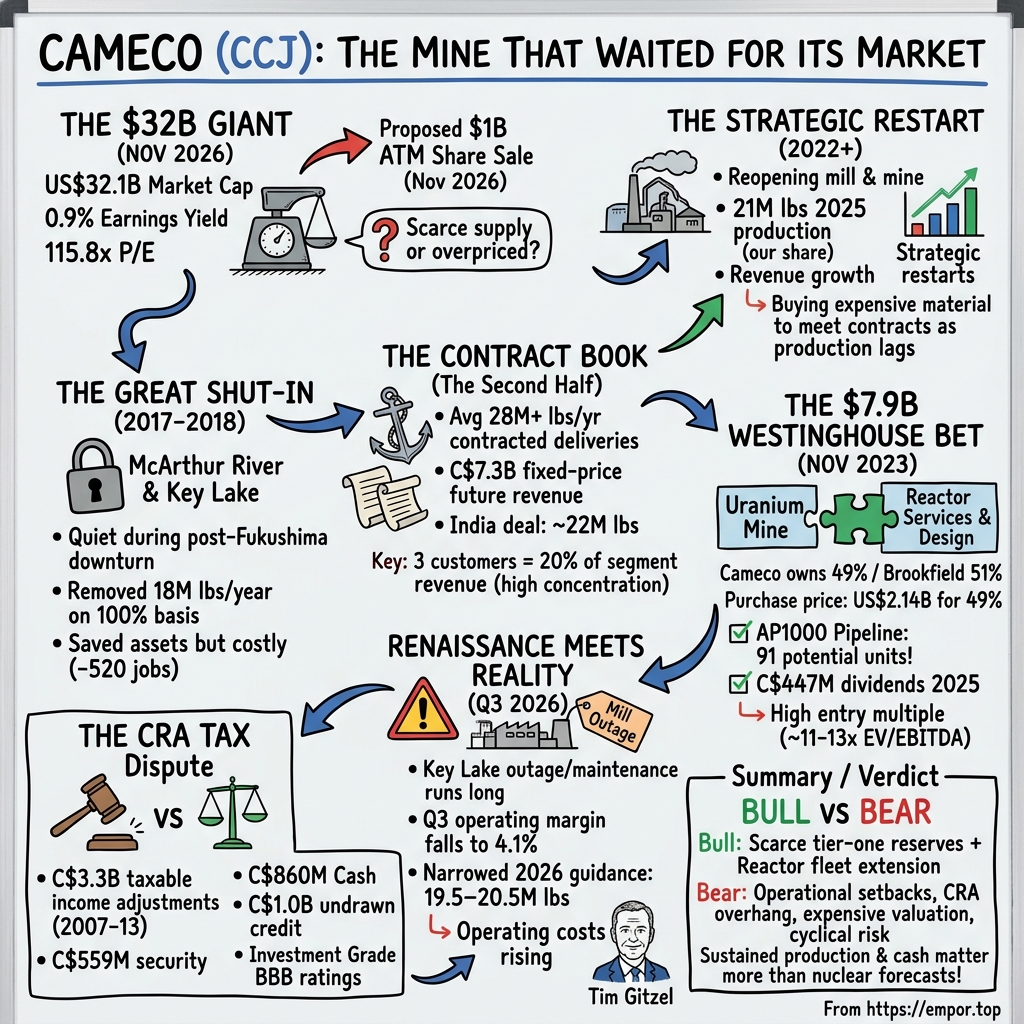
Cameco: The Mine That Waited for Its Market
I. A $32 Billion Miner With a 0.9% Earnings Yield
On November 5, 2026, a uranium company in Saskatoon did something investors usually expect from a young biotech, not a decades-old resource producer: it filed papers allowing it to sell up to US$1 billion of new shares into the market, a few at a time, whenever its agents saw fit.1 The mechanism is called an at-the-market program, and it works like a tap rather than a bucket. Nothing in the filing says the tap will be opened all the way, or opened at all. It says the company now has the right to turn it.
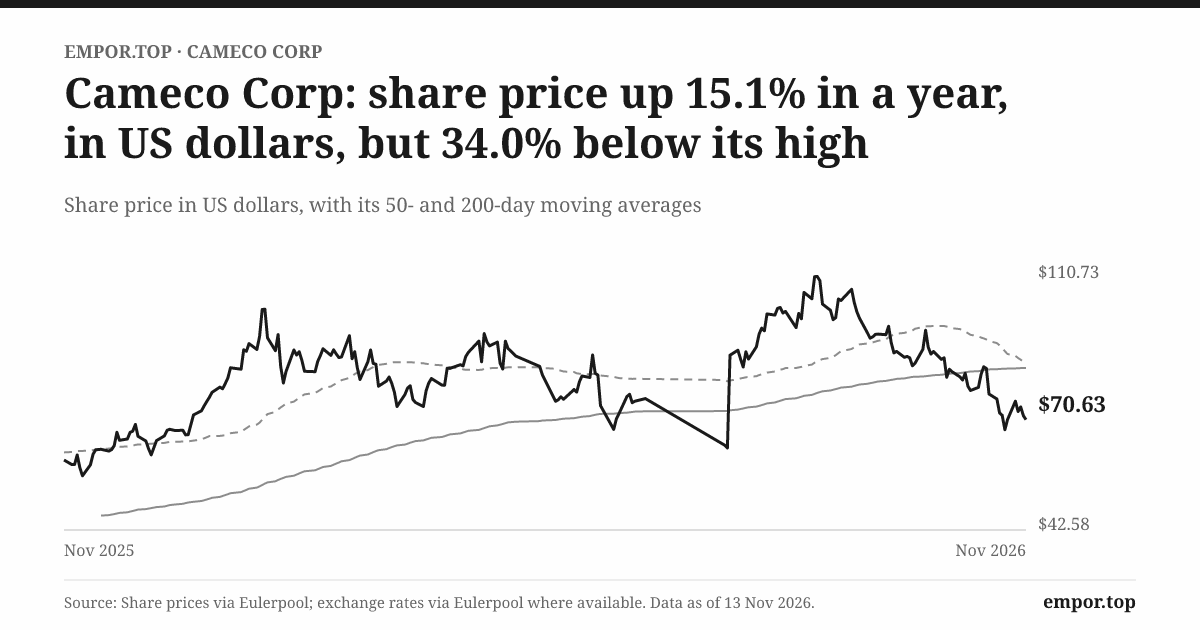
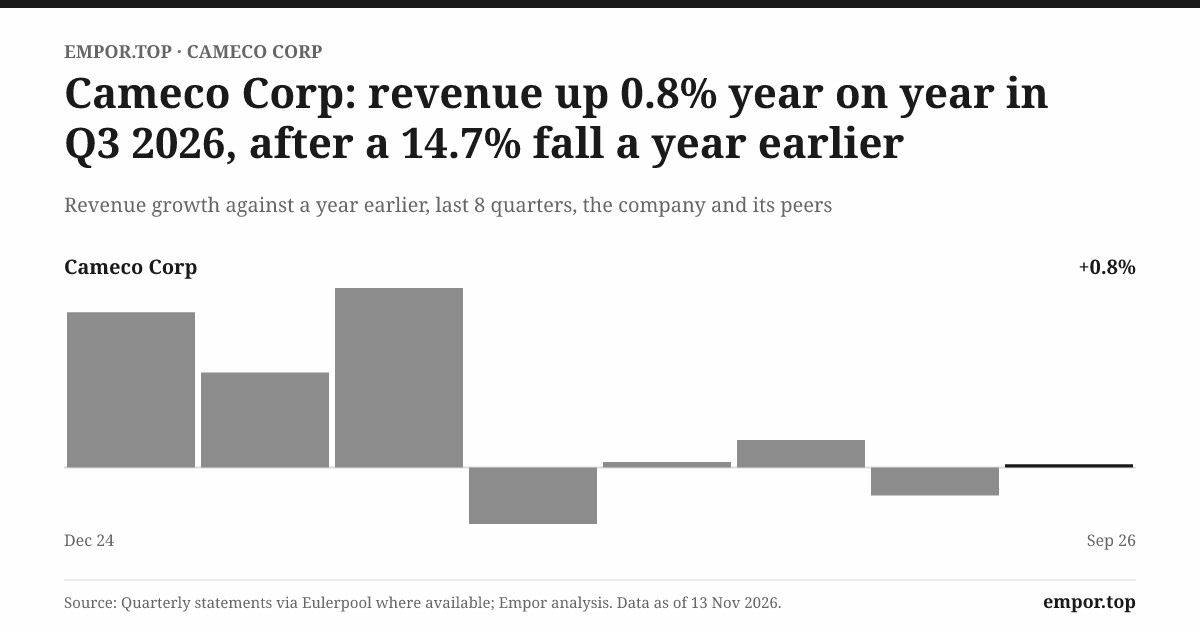
The timing made the filing hard to ignore. A week earlier, Cameco had reported a third quarter in which its consolidated operating profit had collapsed to about US$18 million on roughly US$442 million of revenue, an operating margin of about 4%, against about 15% in the same quarter a year before.2 The shares had already fallen hard. On November 13, 2026, they traded at about US$70.63, roughly a third below their 52-week high of about US$104.3
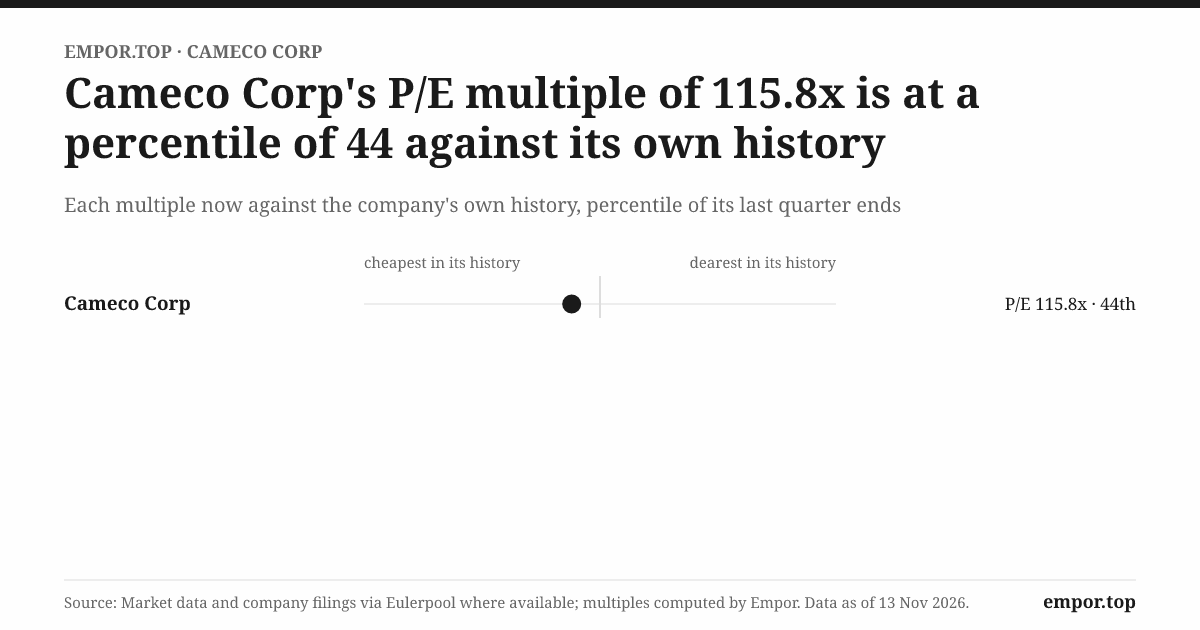
And yet even after that fall, the market still valued Cameco at about US$32 billion.3 For every dollar of earnings Cameco reported over the previous twelve months, an investor paid about US$116. Turn that around and the picture becomes stark: the shares offered an earnings yield of about 0.9%, less than an investor could have earned from a government bill.3 Strangely, that multiple was not unusual for Cameco. Its median price-to-earnings ratio over five years sat at almost exactly the same level, about 117 times.3 The market has been paying a premium for this company's future for half a decade.
That contrast is the place to begin. A business priced at more than a hundred times its earnings is supposed to be one that can fund its own growth. Instead, at the very moment its operations stumbled, Cameco reached for the ability to raise more equity. That does not prove the company needs the money; the program could be prudence, opportunism or insurance. But it does show that the people running Cameco think their shares are a currency worth having on hand, and it reminds investors that a valuation built on the future can also be spent in the present.
What the market is actually buying
To understand what that US$32 billion buys, it helps to be precise about what Cameco is. At its core, it digs uranium out of the ground in northern Saskatchewan, through mines it operates and joint ventures it shares, and it holds a stake in a large uranium operation in Kazakhstan.4 It then turns uranium into forms a reactor can use, through refining, conversion and fuel fabrication plants in Ontario.4 And since November 2023 it has owned 49% of Westinghouse Electric, the American company whose reactor designs and fuel and maintenance services sit inside a large share of the world's nuclear fleet.4
That last piece is easy to misread. Cameco does not consolidate Westinghouse. It records its share of Westinghouse's profit as a single line, the way an investor records a stake in a company it does not control.4 Westinghouse's sales do not appear in Cameco's revenue, and Westinghouse's tens of thousands of workers do not appear in Cameco's headcount, which was about 3,100 people at the end of 2025.4 When investors talk about Cameco as a nuclear "platform," they are adding together a uranium miner's revenue and a minority stake in a reactor company. Both matter. They are not the same kind of money.
The bull story is simple to tell. The world wants more electricity that does not burn carbon, from data centres, electrified industry and governments worried about energy security. Nuclear power can supply that around the clock. Every reactor needs fuel for decades, and qualified uranium supply is concentrated in a handful of places, with Cameco's Canadian mines among the richest anywhere. Add Westinghouse, and Cameco participates in the fuel and the machinery at the same time.
The skeptic's story is just as easy to tell. Cameco has been a "scarce asset" story before, and for most of the past decade that scarcity produced thin or negative operating profits. Its revenue grew only about 2% a year in Canadian dollars over the ten years to 2025.4 Its third quarter of 2026 showed that even in a strong market, a maintenance outage and shipment timing can erase most of a quarter's operating profit. And the Westinghouse earnings that flattered 2025 included large one-off project contributions that are already fading in 2026.2
So the episode carries four questions. Did Cameco's decision to shut its best mines during the uranium bust preserve a scarce advantage, or expose a business that cannot reliably deliver? Does long-term contracting capture the uranium upswing without giving too much of it away to utility buyers? Can Westinghouse earn back the price Cameco paid for it? And can the current management team turn a nuclear renaissance into cash without diluting shareholders or tripping over another operating problem? The answers begin with a mine that went quiet.
 Subscribe on LinkedIn
II. When the World's Largest High-Grade Mine Went Quiet
In November 2017, Cameco told its workers, its customers and its shareholders that McArthur River would stop.5 This was not a marginal pit. McArthur River, together with the Key Lake mill some 80 kilometres to the south where its ore was processed, was the largest high-grade uranium operation in the world.5 Its ore was so rich that, in parts of the deposit, uranium made up a meaningful fraction of the rock itself, rather than the tiny fractions typical of mines elsewhere. Miners there used remote equipment and freezing techniques to control water and radiation. It was, in every engineering sense, a crown jewel.
And Cameco chose to turn it off. Production was suspended from early 2018, initially for ten months, and about 520 site employees faced temporary layoffs.5 On a 100% basis, the shutdown took roughly 18 million pounds a year out of world supply.5 Cameco's own share of production from the complex fell from about 11.2 million pounds in 2017 to almost nothing in 2018.6 In July 2018, the suspension became indefinite.6
To understand why a company would idle its best asset, the clock has to go back to March 2011, the year Cameco's current chief executive took over. The earthquake and tsunami that struck Japan and disabled the Fukushima Daiichi plant did not just take Japanese reactors offline. It froze a large part of the global appetite for new nuclear power and left utilities sitting on inventory they no longer needed. Uranium is not traded like oil, where refiners buy cargoes every week. Utilities buy most of their fuel through long-term contracts, signed years before the pounds are needed. When those buyers stopped signing, producers like Cameco discovered that a mine is only as valuable as the contracts behind it.
The mechanics of the glut were simple and brutal. Utilities had signed contracts before 2011 for pounds they expected to burn in reactors that were now idle, especially in Japan. Those pounds piled up in inventories or were resold into the market, which meant every new buyer could find uranium without signing a long-term deal with a miner. Meanwhile producers kept mining, partly because mines are expensive to stop and restart, partly because some producers, including state-controlled ones, had reasons to keep output high. The result was a market in which spot prices sagged for years and long-term contracting, the lifeblood of Cameco's model, dried to a trickle.
Shutting the lesser assets first
Cameco's response came in stages, and the order of those stages reveals the logic. First it cut the operations that cost the most to run. Rabbit Lake, an older Saskatchewan mine, was suspended in 2016, and production at Cameco's US in-situ recovery operations in Wyoming and Nebraska was curtailed.7 In December 2016, the company announced preliminary 2016 results that included large write-downs and a further set of operational changes for 2017, including workforce reductions and cost cuts.7 Rabbit Lake and the Kintyre project in Western Australia were among the assets whose book values were written down in this period.7
Those impairments are the part of the story that the "scarce assets" narrative tends to skip. In accounting terms, an impairment is a company admitting that an asset will never earn back the money tied up in it. Cameco recorded operating losses in 2016 and 2017, and again in 2020 and 2021, years in which a supposedly irreplaceable portfolio of uranium assets could not cover its own costs.45
Then came the big one. Shutting McArthur River was qualitatively different from closing Rabbit Lake. Rabbit Lake was old and expensive. McArthur River was Cameco's best. Management's argument was that if it could not sell pounds at prices that paid for them, it would rather leave them in the ground, where they would keep, than mine them into a glutted market and sell them cheaply.5 To keep its delivery promises to existing customers, Cameco would draw down inventory and buy uranium on the market, where prices were often lower than its own production cost.5
The cost of discipline
The price of that discipline was paid by people as well as shareholders. Hundreds of northern Saskatchewan workers, many from Indigenous communities whose economies depended on the mines, lost their jobs or went on temporary layoff.5 Shareholders paid too. Alongside the suspension, Cameco cut its annual dividend from C$0.40 a share to C$0.08, a drop of 80%, explicitly to protect its investment-grade credit rating.5 In dollar terms, dividends fell from about US$122 million in 2017 to about US$23 million by 2019.8
That dividend cut deserves more weight than it usually gets. A company confident in a quick recovery does not slash its payout by four-fifths. Cameco was saying, in effect, that it could not see when term contracting would return, and that it would rather preserve the balance sheet than reward shareholders through a downturn of unknown length. It was the right call for a cyclical business. It is also evidence that the cycle, not the geology, set the terms.
What did management promise in return? Its message, repeated through the downturn, was that McArthur River would come back when Cameco had "acceptable" long-term contract homes for the pounds.6 That is a coherent strategy. It is also a strategy of waiting for customers. Cameco could control its own costs and its own supply. It could not control when utilities would decide that the uranium they had stockpiled after Fukushima was running down and that it was time to sign again.
That is the honest verdict on the shutdown. It was costly, but coherent. It preserved high-grade pounds for a better market and spared Cameco from selling its best resource at a loss. But the impairments, the layoffs, the dividend cut and the long wait also show the limit of the "scarce asset" thesis: rock in the ground does not generate returns on its own. Someone has to agree to pay for it, years in advance.
Which leads to the second half of the business, the half that never shows up in a picture of a headframe: the contract book.
III. The Contract Book Is the Mine's Second Half
Picture a utility executive somewhere in the United States, Europe or Asia. Her company runs reactors that will need fresh fuel in four or five years. Between the uranium in the ground and a fuel assembly loaded into a reactor sit a mine, a mill, a refinery, a conversion plant, an enrichment plant and a fabricator, each with its own lead time. If any link fails, a reactor that powers a city cannot run. So she does not wait until next year to buy. She signs contracts today for pounds that will be delivered years from now.
On the other side of the table sits Cameco, with its own dilemma. It can commit future production now, at today's terms. It can sell from inventory. Or it can wait, betting that prices or terms will improve. Every pound it commits early is a pound it cannot sell later at a higher price. Every pound it holds back is a pound that might not find a buyer if the market turns. That negotiation, repeated across dozens of utilities and years of deliveries, is the second half of the mine.
The contracts themselves are bilateral and usually long term. Some set a fixed base price that escalates each year with inflation. Others are "market-related," meaning the price is set near the time of delivery by reference to published market prices, often with a floor beneath and a ceiling above.4 Many blend the two. A floor protects Cameco if prices crash. A ceiling protects the utility if prices spike. The design is a negotiated sharing of risk, not a guarantee for either side.
In 2025, about C$2.2 billion of Cameco's C$3.5 billion of revenue came from market-related contracts, and about C$1.3 billion from fixed-price contracts.4 That split matters because it answers a question investors often get wrong. Long-term contracting does not mean Cameco is insulated from uranium prices. Most of its revenue still moves with the market, just with a lag and within bands. The fixed-price book provides ballast: at the end of 2025, fixed-price contracts with remaining deliveries represented about C$7.3 billion of expected future revenue, a figure that excludes the much larger stream of future market-priced deliveries.4
Volume coverage is where the contract book looks strongest. By the third quarter of 2026, Cameco reported more than 28 million pounds of average annual uranium deliveries contracted over the following five years.2 Against 2026 production guidance of roughly 20 million pounds, that is a book that already absorbs more than a full year's mine output each year.2 It is evidence that utilities are once again willing to sign, and that Cameco is a supplier they want on their list.
There is a catch in how this shows up in reported results. Because utilities take delivery when their own fuel schedules require, Cameco's sales arrive in lumps. Management says the timing of customer requirements drives quarterly revenue and cash flow, and that a weak quarter can simply mean pounds scheduled for a later one.9 That is true, and it is also a reason investors should not annualize any single quarter, good or bad.
Where the pounds come from
It helps to picture the fuel chain as a series of workshops a uranium atom must pass through. Mined ore is crushed and leached into a yellow powder called uranium concentrate. A refinery purifies it. A conversion plant turns it into uranium hexafluoride, a compound that becomes a gas at modest temperatures. An enrichment plant spins that gas in centrifuges to raise the concentration of the fissile isotope. A fabricator then presses the enriched uranium into ceramic pellets and stacks them into the long metal rods of a fuel assembly. Cameco runs the first four workshops, sells fabrication through its own plants and Westinghouse's, and has no stake in commercial enrichment today.
Behind the contract book sit the physical assets. Cameco operates McArthur River and Key Lake, and it owns a majority stake in and operates Cigar Lake, another of the world's richest uranium mines.4 It holds a 40% interest in the Inkai joint venture in Kazakhstan alongside the state producer.4 It also owns refining and conversion capacity in Ontario, at Blind River and Port Hope, and fuel manufacturing facilities.4
The distinction between total joint-venture output and Cameco's share is critical. When Cameco reports producing 21.0 million pounds in 2025, that is its share, not the full output of the mines it operates.4 Its partners own the rest. A great deal of loose talk about Cameco "producing" a given volume confuses the two.
On the global stage, Cameco is one of a handful of producers that matter. The World Nuclear Association's production table for 2024 put Kazakhstan's state company Казатомпром Kazatomprom at about 21% of world mine production, Cameco at about 17%, France's Orano at about 11%, and 中国广核集团 China General Nuclear at about 10%.10 McArthur River/Key Lake and Cigar Lake ranked among the largest producing mines in the world.10 Four suppliers produce well over half of the world's mined uranium, and two of the largest are directly controlled by governments.
Production share is not the same as market share in contracted deliveries, though. Cameco also buys uranium from others and sells it under its contracts, and it holds inventory. A buyer cares about who signs and delivers the contract, not whose mine the specific atoms came from. That is part of the commercial edge: Cameco can meet commitments from a mix of sources. It is also part of the risk, because pounds bought on the market do not carry the cost advantage of pounds mined from a tier-one deposit.
The third quarter of 2026 shows how the mix works. During the quarter, Cameco bought about 1.8 million pounds of uranium at an average price of about US$60 per pound, and it ended the period holding about 8.5 million pounds in inventory.9 Those purchases were not a sign of distress. They are how an integrated supplier smooths the gap between when a mine produces and when a customer wants delivery.
But each purchased pound carries a cost. Realized prices depend on which contracts deliver in a given period, at what fixed or market-linked terms. Costs depend on mine performance, on the price of purchased pounds, on transport and conversion. When production falls short, Cameco can still deliver by buying, but it earns less on those deliveries. That is why a quarter with roughly flat revenue can produce a collapse in margin.
Where the moat could break
The contract book also concentrates risk. Cameco's customers are utilities, and a small number of them buy very large volumes. In 2025, three customers accounted for about 20% of uranium and fuel-services revenue, down from about 34% in 2024.4 Cameco does not name them, and its annual report does not disclose its top-five or top-ten share. That is not unusual in the industry, but it means the reader cannot see how much leverage any single utility holds.
The credit record is clean. At the end of 2025, almost all of Cameco's trade receivables were current; just over C$1 million was more than 30 days past due on a book of about C$338 million, and every customer accounting for more than 10% of receivables carried an investment-grade rating.4 Utilities pay their bills. The risk is not that a buyer defaults. It is that a buyer negotiates hard, sources from someone else, or delays signing, as utilities did for years after Fukushima.
In 2026, Cameco signed a long-term uranium supply agreement with India for nearly 22 million pounds over nine years, on market-related terms.11 At the reference price used in the announcement, the deal was worth about C$2.6 billion.11 It is a concrete commercial win with one of the world's fastest-growing nuclear programmes, and it demonstrates that Cameco can win long-dated government business.
It also tests the moat. Government buyers are the most demanding counterparties in the world: they can diversify suppliers by policy, demand domestic content, and set terms to suit national strategy rather than commercial logic. The India contract is market-related, which means its eventual value will depend on uranium prices during delivery, not on a price locked at signing. It is a meaningful volume, about 2.4 million pounds a year on average, but it is not a fixed-price windfall.11
So the contract book works as a bridge between geology and cash. It reduces the risk of having nowhere to sell; it does not remove commodity risk; and it rewards a supplier that delivers on time. That raises the operational question that the shutdown left hanging: when the contracts came back, could Cameco actually produce the pounds at the cost it needed?
IV. The Shutdown Became a Supply Strategy
For more than four years, McArthur River sat on care and maintenance. The pumps and freeze systems that keep water out of a mine in saturated sandstone had to keep running, and the equipment had to be maintained, but no ore came out. Then, in 2022, with utilities finally returning to the term market, Cameco began bringing McArthur River and Key Lake back.4 By 2024, the complex produced a record volume of packaged uranium.4
That restart is the moment the shutdown story acquires a happy ending, and it is the version most often told: Cameco held its nerve, refused to sell cheaply, and was rewarded when the market came back. There is truth in it. The question is whether the record supports the stronger claim, that Cameco's discipline created a durable commercial advantage, or only the weaker one, that it survived a bad cycle intelligently.
The revenue record helps answer that. Over the ten years to 2025, Cameco's revenue grew only about 2.4% a year in Canadian dollars.4 Over the five years from 2020 to 2025, growth was about 14% a year. And from 2022 to 2025, it was about 23% a year.4 Reported revenue reached about C$3.5 billion in 2025, up from about C$2.6 billion in 2023.4
The acceleration looks impressive, but each period tells a different story. The ten-year figure includes the long downturn, so it compares a recovered business with a weakened one. The shorter periods begin near the trough, when revenue had fallen for several years in a row, so they show recovery from a low base. And from November 2023, Cameco's net results also include its share of Westinghouse earnings, which do not appear in revenue but do appear in profit.4 Recent growth is real; it is not a clean measure of a new trend line.
Profitability tells the same story more sharply. Operating margin moved from losses in 2020 and 2021 to about 17% in 2025.4 That is a large swing, and it reflects both higher realized prices and production returning. But a 17% operating margin is still modest for a company often described as owning the world's best uranium assets, and the third-quarter collapse showed how quickly that margin can vanish.
Did the restart deliver?
In 2025, Cameco produced 21.0 million pounds of uranium, its share, which beat its revised guidance.4 That revision matters. Cameco had cut its outlook earlier in the year, and then delivered slightly more than the lower number. Beating a reduced target is a sign of operational recovery, but it is not the same as meeting the original plan.
The 2026 record so far is weaker. In the first nine months of 2026, Cameco's share of production was about 13.6 million pounds, down from about 15.0 million a year earlier.2 Management narrowed its full-year guidance to between 19.5 and 20.5 million pounds.2 The Key Lake mill, the processing plant for McArthur River ore, had run through an extended maintenance shutdown that included new infrastructure and major repairs.2
None of this is a disaster. A mine that produces about 20 million pounds instead of 21 is still a large, productive operation. But it is a reminder that restarted assets are still old assets in harsh conditions. Key Lake has been processing ore for decades. The work it needs is the price of its age.
When production lags, Cameco fills the gap by buying. In the third quarter of 2026, its average purchase cost was above its average inventory cost, meaning each purchased pound was more expensive than the pounds already on the shelf.9 That is the hidden cost of a production shortfall: the contract book still has to be served, and a rising market makes it more expensive to serve it from other people's pounds.
A rising uranium price helps Cameco on its market-related deliveries. It hurts on the pounds it must buy to meet commitments. And it does nothing to cure higher operating costs if a mill runs below capacity. Inventory and a rising market are buffers, not guarantees.
The fork
The shutdown and restart therefore leave Cameco at a strategic fork. It can push for maximum output from its best assets, accepting higher capital spending and operating risk. It can prioritize margins, selling only what it produces at good terms and buying sparingly. Or it can preserve optionality, keeping some pounds uncommitted in the hope that prices rise further. It cannot maximize all three at once.
The record narrows the claim about discipline rather than rejecting it. Cameco's supply restraint helped it survive and positioned it to benefit when contracting returned. But its recovery has not been a straight line, and its ability to meet production targets has been tested twice in two years. The confirming evidence would be several consecutive years of production at or above guidance, with unit costs stable. The falsifying evidence would be another narrowed outlook.
While its mines and mills were struggling back to full speed, though, Cameco made its largest bet in a generation, on a company that had itself been through bankruptcy.
V. The $7.9 Billion Bet on Westinghouse
In October 2022, Cameco and Brookfield Renewable Partners announced that they would buy Westinghouse Electric Company from Brookfield Business Partners.12 The announced enterprise value was US$7.875 billion, a number that included Westinghouse's debt.12 Brookfield Renewable and its institutional partners would own 51%, and Cameco 49%.12 The deal closed in November 2023, with the final enterprise value adjusted to about US$8.2 billion.13 Cameco paid about US$2.14 billion for its stake.13
The name Westinghouse carries more than a century of American industrial history, and some of it is recent and painful. In 2017, its construction of two pairs of AP1000 reactors in Georgia and South Carolina ran so far over budget and schedule that Westinghouse filed for bankruptcy protection, nearly dragging down its Japanese parent, Toshiba.14 In January 2018, Brookfield Business Partners agreed to buy the company out of bankruptcy for about US$4.6 billion.14 Brookfield refocused it on the steady side of the business: fuel, maintenance, outage services and parts for the reactors already operating around the world.
Four and a half years later, the price for the whole company was about 70% higher.15 The comparison is tempting and dangerous. In 2018, Westinghouse was a bankrupt business with uncertain liabilities, sold in distress. By 2022, it had been restructured, the world was rethinking energy security after Russia's invasion of Ukraine, and nuclear power was moving back into policy favour. Ownership, debt, investment levels and market expectations had all changed. The 2018 price is a historical reference point, not a comparable transaction, but it shows that Cameco bought after the turnaround, not before.
Westinghouse's contribution to Cameco remains a single line in earnings, with cash arriving only when Westinghouse pays distributions to its owners.4 The value case therefore has two parts: Cameco's share of Westinghouse's profit and cash, and any commercial benefit to Cameco's own uranium and fuel-services business from owning a piece of the company that services so many reactors.
The strategic fit is credible. Westinghouse designs reactors, manufactures fuel assemblies, and provides the services utilities need to keep reactors running for 60 or 80 years.12 Cameco mines uranium and converts it. Together, the two cover much of the nuclear fuel cycle, with enrichment as the main missing link. A utility that buys fuel from Westinghouse and uranium from Cameco is dealing with two companies that now share an owner.
But fit is not the same as revenue. There is no public evidence that utilities award Cameco more uranium contracts because it owns part of Westinghouse, and customers generally buy each stage of the fuel cycle separately. Synergy is the opening argument for the deal; it is not, on its own, a measurable return.
How Cameco paid
Cameco funded its share of the purchase with roughly US$1.5 billion of cash, US$600 million of term loans, and the proceeds of an earlier share offering of about 34 million shares.1213 That offering, sold in October 2022 to pre-fund the deal, diluted existing holders by roughly 8%.12 The cash came from a balance sheet that had been built up during the recovery. At the end of 2022, Cameco held about US$1.8 billion of cash and short-term investments; a year later, after closing, it held about US$420 million.4
In other words, Cameco used most of its liquidity, borrowed, and issued shares. It later repaid the remaining US$200 million of the term loan in 2025.4 The acquisition did not over-lever the company. But it did convert a large cash cushion into an illiquid minority stake, and it is worth remembering that sequence now that Cameco has filed for the ability to issue another US$1 billion of shares.
For 2024, the first full year of ownership, Cameco guided that its share of Westinghouse's adjusted EBITDA would be between about C$445 and C$510 million.4 To compare that with the price, take Cameco's 49% of the roughly US$8.2 billion enterprise value, which is about US$4 billion, or around C$5.5 billion at the exchange rates of the time. Divide by the guided EBITDA range, and the implied entry multiple lands at roughly 11 to 13 times enterprise value to EBITDA.
That is a full price for a services-heavy industrial business, but not an outlandish one. There is no clean public comparable transaction for a company like Westinghouse, which is why no honest analysis can declare it a bargain or an overpayment from the multiple alone. The test is whether Westinghouse grows earnings and distributions enough to earn a return on the cash, debt and diluted equity Cameco committed.
The boom year
In 2025, Westinghouse looked like a jackpot. Cameco's share of Westinghouse's adjusted EBITDA rose by about C$297 million, helped by a large contribution linked to Westinghouse's role in the Dukovany new-build project in the Czech Republic.4 Cameco reported about C$216 million of share of earnings from equity-accounted investees in 2025, and it received about C$447 million in dividends from those investees, which include Westinghouse and others.4 That dividend figure is easy to misread as a Westinghouse cheque. It is not. Cameco's related-party note records about C$137 million of dividends from associates, the category Westinghouse sits in, in 2025; the larger balance came from its other equity-accounted investments, chiefly the Inkai joint venture in Kazakhstan.4 Westinghouse's distributions arrived in a year flush with Dukovany-related cash, which is precisely why they should not be read as a steady annual yield on Cameco's investment.4
But the boom was not a run rate. In the first nine months of 2026, Cameco's share of Westinghouse's adjusted EBITDA was about C$427 million, compared with about C$569 million in the same period of 2025.2 The difference is mostly the absence of the large project-linked contribution. A reader who extrapolated 2025 into the future would have overstated Westinghouse's steady-state earnings by a wide margin.
There is a second gap worth understanding, between Cameco's share of Westinghouse's adjusted EBITDA and the much smaller share of earnings that reaches its income statement. When a company buys another, accounting rules require it to revalue the acquired assets, including contracts, technology and customer relationships, and then to depreciate those new values over time. Add Westinghouse's own interest costs and taxes, and a share of EBITDA measured in the hundreds of millions shrinks considerably by the time it becomes net earnings.4 The EBITDA figure tells investors how the business is performing; the earnings figure tells them how much of the purchase price is being worked off; and the distribution figure tells them how much cash actually came home. Only the last one pays for anything.
The project pattern matters because project revenue is the most volatile part of Westinghouse's business. Fuel and services revenue tends to recur, because reactors keep running. Construction revenue arrives in bursts tied to milestones, and history, including Westinghouse's own bankruptcy, shows that construction contracts can also generate large losses.
The most dramatic development came in late October 2025. Cameco and Brookfield announced a partnership with the United States government under which Washington would facilitate financing and approvals for new Westinghouse reactors representing at least US$80 billion of investment.16 In return, the government would receive a participation interest entitling it, once vested, to 20% of Westinghouse cash distributions above US$17.5 billion, and, under certain conditions, the right to require an initial public offering of Westinghouse.16 Cameco's shares rose sharply on the news.
The AP1000 is the design at the heart of that ambition: a large pressurized-water reactor of roughly a gigawatt, built with passive safety systems that rely on gravity and natural circulation rather than pumps to cool the core in an emergency. Think of it as a reactor designed to keep itself safe with the power off. The engineering is not the hard part. The problem with the AP1000 has never been whether it works. It has been whether anyone can build it on budget, which is why the financing promise mattered more than any technical milestone.
The announcement was a term sheet, not a construction contract. Vesting of the government's interest depends on final investment decisions and definitive agreements for the reactor projects.16 On the third-quarter 2026 call, management described a pipeline of 91 potential AP1000 units around the world.9 That figure is a list of opportunities, not orders. The questions that decide the value are how many reach funded contracts, how many reach construction, and how much of the economics flows to Westinghouse's owners rather than to builders, governments and lenders.
The partnership also reshapes the upside. If Westinghouse ever generates very large distributions, a fifth of the excess goes to the US government.16 That is a reasonable price for policy support that could make reactors financeable, but it is a cost, and it trims the tail of outcomes that bulls often point to.
The verdict on Westinghouse is provisional. It is a strategic acquisition with a plausible industrial fit, bought at a price roughly 70% above its distressed 2018 value and at an implied multiple of about 11 to 13 times guided EBITDA. Its delivered economics in 2025 were strong but inflated by one project. Whether it earns back its cost will depend on recurring earnings and distributions over many years, not on pipeline announcements. And it now competes for attention with the operating problems back home in Saskatchewan, which came to a head in the third quarter of 2026.
VI. The Nuclear Renaissance Meets the Mill Outage
The Key Lake mill sits in the boreal forest of northern Saskatchewan, a long drive north of Saskatoon and a world away from data centres and policy summits. In 2026, it underwent a planned maintenance shutdown, and when Cameco reported its third-quarter results, commissioning was still in progress.2 The mill ran longer offline than usual, and that one decision reshaped the year.
Third-quarter revenue was about US$442 million, essentially flat against a year earlier.2 Operating profit, however, fell about 73% to roughly US$18 million.2 The operating margin, about 15% a year earlier, shrank to around 4%.2 Westinghouse earnings also eased from the prior year's project-boosted level.2
To read that quarter, it helps to separate Cameco's three engines. Uranium is the largest by far, the segment where mine output, contract prices and purchase costs combine to drive most of the company's earnings.4 Fuel services, which includes refining, conversion and fuel manufacturing, is smaller but strategic, because conversion capacity in the Western world is scarce and because it ties Cameco to customers at another step of the fuel chain.4 Westinghouse is a third engine that runs on its own clock, with earnings driven by service contracts and construction milestones that have nothing to do with Key Lake.
In the third quarter, management attributed the weaker consolidated results to lower uranium sales volumes and higher unit costs, while the previously noted Westinghouse decline reduced net results.29 These effects come from different places. The operating-margin collapse is a uranium-segment story, driven by fewer pounds sold and each pound costing more because the mill was down. The Westinghouse decline affects net earnings below the operating line, because it is an equity-accounted result.
Management framed the quarter as timing and transition: lower output now, a more reliable mill later.9 That explanation is plausible, and the company gave a specific reason rather than a vague one. But investors should judge it by what happens next. Maintenance that improves reliability should show up in steadier production and falling unit costs in 2027. If it does not, the explanation will look like an excuse.
Over the twelve years from 2014 to 2025, Cameco generated about C$6.9 billion of cash from operations against only about C$1.3 billion of cumulative net profit.4 That five-fold gap is striking, and bulls cite it as proof that reported earnings understate the business.
There is truth there, but it needs qualification. Much of the difference is depreciation, a non-cash charge that reflects the wearing out of mines and mills that must eventually be replaced. Some reflects working-capital swings as inventory is built and drawn down. Some comes from unrealized derivative losses and impairments that hit profit without touching cash. And in recent years, a growing share comes from distributions from equity-accounted investees, Inkai and Westinghouse among them.4 In 2025 alone, operating cash flow of about C$1.4 billion included about C$447 million of such dividends.4 Cash generation is real, but it is not the same as a recurring cash yield.
Capital spending is rising. Cameco spent about C$333 million on property, plant and equipment in 2025, and its 2026 guidance had called for between C$490 million and C$540 million, including work at Key Lake, Cigar Lake and McArthur River and on aging infrastructure.4 In the third quarter, management lowered its expected 2026 capital spending as some projects moved beyond year-end.2 Spending slipping into the next year is not a sign of saving; it is a sign of delayed work.
Currency adds another layer of noise. Cameco sells mostly in US dollars and pays most of its costs in Canadian dollars, so it hedges, under a policy that allows it to cover between 35% and 100% of expected net exposure up to five years out.4 At the end of 2025, it had about US$2.2 billion of US-dollar hedges in place, covering about two-thirds of 2026 exposure.4 Those contracts are marked to market each quarter, which is why Cameco swung from derivative losses of about C$183 million in 2024 to gains of about C$95 million in 2025.4 Neither number says anything about how many pounds were mined or what they cost. A careful reader strips them out before judging the operating trend.
Cameco expected research and development, mostly for Global Laser Enrichment, the laser-based uranium enrichment technology it is developing with its partner Silex, to rise to between C$50 million and C$55 million in 2026.4 That is a small sum relative to the company, and it buys an option on entering enrichment, the step of the fuel cycle Cameco does not currently serve. It is not yet revenue.
The man at the top
Tim Gitzel has run Cameco since July 2011.17 He was born and raised in Saskatchewan, studied law at the University of Saskatchewan, and spent years in the uranium business before joining Cameco, including running the global mining business of the French nuclear group Areva from Paris.1718 He returned home to join Cameco in 2007 as chief operating officer, was named president in 2010, and became chief executive the following year.18 He took the job months after the Fukushima disaster, and he has now led the company through the entire downturn and recovery.
That tenure is the best evidence for judging him. He steered Cameco through the shutdown and restart, and made the Westinghouse bet. Few chief executives in any industry have had to manage a single company through such a complete cycle. The record shows patience and balance-sheet caution in the downturn; it shows ambition in the recovery.
His pay has risen with the recovery. His total compensation awarded for 2025 was about C$10.96 million, up from about C$7.93 million in 2024.19 Total pay for the named executive officers was about 1.5% of adjusted EBITDA.19 Gitzel also owns a lot of the company: at the end of 2025, he held 532,211 shares plus share units, with total holdings valued at about C$88 million, well above the requirement for the chief executive to own five times his salary.19 His wealth is tied to the share price.
The long-term awards are mainly performance share units that pay according to share-price performance over three years.19 That aligns executives with shareholders, but it also rewards them for share-price gains driven by uranium prices or policy announcements, rather than operational execution alone.
The management bench has changed. Grant Isaac, long the chief financial officer, became president and chief operating officer in September 2025.19 Heidi Shockey became chief financial officer and is due to retire at the end of March 2027, with Leah Hipperson slated to take over as CFO on January 1, 2027.2 These are orderly transitions, but they mean that the finance chair will have had two occupants in roughly two years.
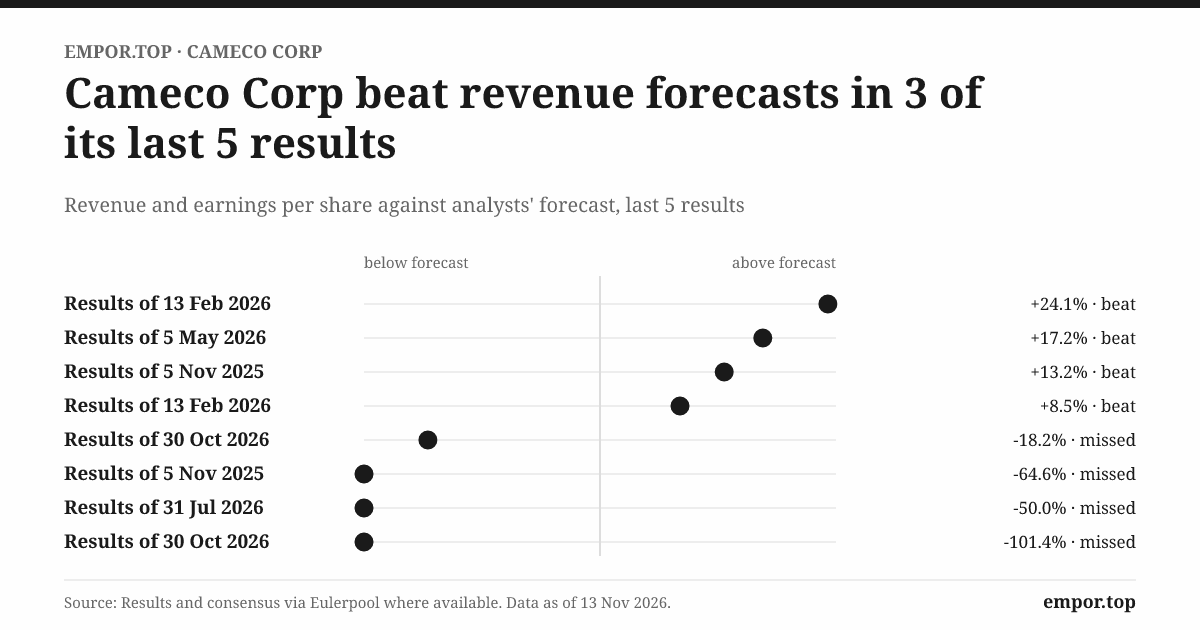
Judged by outcomes rather than self-description, the record on guidance is mixed. Cameco cut its 2025 production outlook, then beat the lower number.4 It narrowed its 2026 production outlook after the Key Lake outage and lowered expected capital spending as projects slipped.2 Those are not dramatic misses. They are a pattern of modest overpromising on operating plans, which matters more in a company priced as richly as this one.
Owning Westinghouse also creates large flows between the two companies. In 2025, Cameco bought about C$462 million of products from associates, chiefly from Westinghouse, roughly 13% of Cameco's revenue by comparison.4 Set against the dividends Westinghouse paid back to Cameco that year, the purchases ran more than three times larger. These are purchases and distributions, not sales: Cameco is a customer of Westinghouse, buying fuel products it then supplies onward. Such flows are normal in the industry, but they show how intertwined the two businesses have become.
So the 2026 update is a useful corrective to the platform narrative. Contracted demand and nuclear policy do not guarantee smooth quarterly earnings. Cameco's execution, its production, its costs and the timing of Westinghouse's project revenue remain central to the investment case. And behind all of it sits a legal fight with the Canadian tax authority that has been running for nearly two decades.
VII. The Tax Case That Still Ties Up Cash
The dispute began with a structure set up in the late 1990s and early 2000s. Cameco sold uranium through a Swiss subsidiary under long-term contracts, and when uranium prices rose sharply in the mid-2000s, much of the profit was earned in Switzerland rather than in Canada. The Canada Revenue Agency argued that the arrangement was a transfer-pricing scheme that shifted taxable income out of the country. Cameco argued it was a legitimate commercial structure. For years, the two sides have fought over who earned what, and where.
Cameco has won the most important rounds so far. Canadian courts rejected the CRA's position for the early tax years, and the Supreme Court of Canada declined to hear the government's appeal.4 That should have ended the matter. It did not. The CRA continued to reassess later years using different arguments.
What is still at stake
For the years 2007 to 2013, after reducing its claims by about C$1.8 billion, the CRA's remaining adjustment to Cameco's taxable income was about C$3.3 billion.9 Cameco is appealing and seeking the return of security it has posted.9 For 2014 to 2017, Cameco remitted about C$209 million in cash and provided about C$350 million of letters of credit, a combined C$559 million of security.9 It has also paid about C$346 million of cash tax for 2024 through 2026 to date because the reassessments reduced the tax pools it could otherwise use.9 Further reassessments relate to 2018 and 2019.9
It is important to read those numbers correctly. A C$3.3 billion adjustment to taxable income is not a C$3.3 billion tax bill. It is a disputed amount of income on which tax might be owed if Cameco loses. The cash Cameco has paid or secured is real and has already left the company or tied up its credit lines. The ultimate cost depends on the courts, and Cameco's past record in this fight is strong. But the dispute has already affected cash taxes and liquidity, so it is not a theoretical footnote.
At the end of September 2026, Cameco held about C$860 million of cash and carried about C$1.0 billion of debt, with its C$1.0 billion revolving credit facility undrawn.9 The Westinghouse term loan was repaid in 2025.4 That is a comfortable position for a company of its size.
But the history counsels humility. During the last downturn, Cameco cut its dividend by 80% to protect its credit rating.5 Today, it faces rising capital spending, potential Westinghouse funding needs, tax security and cash tax payments, and the ATM program. The tax case competes with the mines, Westinghouse and shareholders for capital. It is one more reason the ATM program exists as insurance.
Cameco's current issuer ratings are BBB from Morningstar DBRS, Baa2 from Moody's and BBB from S&P Global, with stable trends from DBRS and Moody's and a positive outlook from S&P.20 DBRS confirmed its rating in June 2026.21 Those are solid investment-grade ratings, a notch or two above the lowest investment-grade tier, consistent with a cyclical commodity producer with a strong balance sheet.
The auditor's opinion on the 2025 financial statements was unqualified.4 The critical audit matter the auditor highlighted was the recoverability of about C$666 million of deferred tax assets, whose value depends on Cameco generating enough future taxable income in Canada to use them.4 That is a judgment call, and it ties back to the tax dispute and the earnings outlook.
Cameco is widely held, with no controlling shareholder. Canadian law, reflecting the strategic nature of uranium, caps any single shareholder or group at 25% of the votes for directors.22 The largest disclosed holder in mid-2026 was BlackRock, which reported owning about 5% of the shares in a July 2026 filing.23 At the 2026 annual meeting, the advisory vote on executive pay received about 97% support before a statutory adjustment.24 These facts show a governance structure without a dominant owner and shareholders broadly comfortable with pay. They do not, on their own, prove anything about operating quality.
Two features of the dispute deserve emphasis for long-term holders. The first is duration. A fight that began over tax years in the mid-2000s is still generating reassessments for years near the end of the last decade, and each new round requires fresh cash or letters of credit while the appeal runs. Even when Cameco wins, money can be locked up for years before it comes back. The second is accounting. Because Cameco says it believes it will ultimately prevail, it does not book the full disputed amounts as liabilities; it treats much of the cash it has remitted as recoverable. That is a reasonable judgment given its court record, but it is a judgment, and it sits alongside the deferred tax assets whose recoverability the auditor flagged. If the courts were to rule against Cameco on the later years, both the balance sheet and the income statement would feel it.
The tax case is therefore best understood as a drag on liquidity rather than an existential threat. It has already absorbed hundreds of millions in cash and security, and future outcomes could release or absorb more. With that weight acknowledged, the full case can be assessed.
Analysis & Bear vs. Bull Case
Put the three businesses on the table side by side. A uranium mine in northern Saskatchewan, producing pounds that will be delivered under contracts signed years ago. A conversion plant in Ontario, turning uranium into the gas that enrichment plants need. And a minority stake in Westinghouse, whose project pipeline stretches from Poland to the Carolinas. Three ways to participate in nuclear demand, each with a different path from opportunity to cash.
The market values all of it at about US$32 billion, or about 116 times trailing earnings, 53 times EBITDA and 13 times sales.3 The free-cash-flow yield is about 0.7%.3 For 2026, the company expects to produce between 19.5 and 20.5 million pounds of uranium, its share.2 Those numbers frame the debate. The question is not whether Cameco is a good company. It is whether its future cash can justify a price that already assumes a great deal of it.
Start with buyers. Utilities are concentrated and sophisticated; their procurement teams negotiate contracts that stretch for a decade.4 They want security of supply, which gives qualified suppliers bargaining power, but they also diversify among suppliers deliberately. Buyer power is meaningful.
Suppliers to Cameco matter less; the key inputs are labor, contractors, reagents and energy in remote locations. Purchased uranium is a more important supplier relationship, and when Cameco must buy pounds to meet contracts, it pays market prices.
Rivals are few, with production concentrated among a handful of producers.10 That concentration helps price discipline, but state producers may act for national rather than commercial reasons, and Kazakhstan's output decisions can move the market.
New entrants face long timelines. Developing a new uranium mine takes many years of exploration, licensing and construction, especially in jurisdictions with strict nuclear regulation. Several developers in Saskatchewan's Athabasca Basin are advancing projects, but none is likely to match McArthur River's scale soon.
Substitutes for uranium in a reactor do not exist. Substitutes for nuclear power do: gas, renewables with storage, and efficiency. Nuclear's case rests on reliability and carbon-free output; if other technologies close that gap, demand growth would slow.
In Hamilton Helmer's language, Cameco's strongest claim is a cornered resource: high-grade Canadian deposits that cannot be replicated. The evidence supports that claim, but the shutdown years narrow it. A cornered resource is only powerful when buyers will pay for its output, and for several years they would not.
Scale economies are real but limited. Large, high-grade mines have lower unit costs than small or low-grade ones, but Cameco's 2026 quarter shows that scale does not protect against operational disruptions.
Switching costs are moderate. Utilities must qualify suppliers and fuel, which creates friction. They can and do diversify over time.
Process power, the accumulated know-how to mine in frozen, radioactive, waterlogged conditions, is a genuine advantage. It was earned over decades at McArthur River and Cigar Lake.
There are no network effects. Counter-positioning and branding are weak. Taken together, Cameco's advantage is a scale-and-system advantage: a combination of high-grade reserves, existing mines, conversion capacity, customer relationships and Westinghouse ownership that is difficult to assemble quickly. It is not a monopoly.
The case for the pounds
Long-term contracting has restarted, and Cameco has visible commercial proof: the company reported more than 28 million pounds of average annual deliveries contracted over five years, along with the India agreement.211 Its assets are large and operating. Global production is concentrated, and Western utilities have reasons to prefer Canadian supply over state-controlled alternatives. Westinghouse gives Cameco exposure to reactor services and fuel fabrication, and the US government partnership could, if it advances to definitive agreements, create a construction pipeline that the industry has not seen in decades.16
The case against the price
The case can break in several ways. Mine and mill outages, as at Key Lake in 2026, raise unit costs and force purchases at market prices.2 Customer concentration gives utilities leverage. Uranium prices remain cyclical, and the market-related contracts that give Cameco upside also transmit downside. Westinghouse's earnings are lumpy, and its construction history includes a bankruptcy. The CRA dispute ties up cash.9 And at today's price, even ordinary disappointments can matter a great deal.
An activist looking at Cameco would ask a pointed question: does this management team deploy capital well? The record is mixed. The earlier impairments and McArthur River shutdown were defensible responses to a downturn, and the later restart validated the patience.75 But they show that management has had to abandon or idle assets when the cycle turned. The Westinghouse deal is the next large test. Its value rests on future earnings that have so far been inflated by one project.
The activist would also ask why a company that generated about C$6.9 billion of operating cash over twelve years, and now trades at a lofty valuation, needs authority to issue another US$1 billion of shares. The answer may be prudent preparation for Westinghouse capital calls, mine investment, or tax outcomes. It may also be opportunism, selling shares at a high multiple. Either way, the burden falls on management to show the money earns more than the dilution costs.
The same activist would push on disclosure. Cameco does not name its largest customers or publish its top-five revenue share, so outsiders cannot judge how dependent the contract book is on a few utilities. Westinghouse reports to Cameco's shareholders through a handful of figures in each quarterly report, which makes it hard to separate recurring fuel and services profit from project milestones without waiting for management to explain the difference. And the company's preferred measure of Westinghouse, adjusted EBITDA, sits several steps away from the cash that actually arrives in Saskatoon. None of this is unusual for a minority stake, but in a company whose valuation leans so heavily on Westinghouse's future, opacity carries a cost. At this valuation, a shareholder is entitled to ask for a clearer view of what the second engine earns in a normal year.
Finally, the activist would question the incentive plan. Performance share units that pay on three-year share-price performance reward management when uranium prices or policy headlines lift the stock, whether or not the mills run on time. A scorecard that tied a larger share of pay to production against guidance, unit costs and cash distributions received would align executives more tightly with the measures that decide the investment case. Shareholders, for now, appear content: they backed the pay plan overwhelmingly in 2026. At current prices, US$1 billion is about 3% of the company's market value.3
The 91-unit AP1000 pipeline and Global Laser Enrichment are strategically relevant. They are not orders or recurring revenue. The history of the nuclear industry, including Westinghouse's own past, shows that milestones, designs and memoranda of understanding often take many years to become cash, and some never do. Investors should track signed projects, committed capital and Cameco's actual share of cash distributions rather than pipeline counts.
Cameco's P/E is close to its own five-year median.3 That might sound reassuring, but it means only that the market has consistently paid a high multiple. A "normal" historical multiple is not cheap if the earnings underneath it are low relative to what the price requires. At the November 13 price, the shares offered a 0.9% earnings yield and a 0.7% free-cash-flow yield.3 Kazatomprom, the largest producer, trades at a fraction of Cameco's multiples on vendor data, though the comparison is imperfect because the two differ in geography, structure and Cameco's Westinghouse and fuel-services exposure.25 The gap shows how much of a premium investors place on Cameco's jurisdiction, assets and nuclear-platform story.
Three measures will tell the story. First, Cameco's share of uranium production against guidance: 2026 guidance is 19.5 to 20.5 million pounds, and nine-month output was below the prior year's pace.2 Second, realized uranium price and unit cost on delivered pounds, which reveal whether contracts and operations are converting into margin. Third, cash received from Westinghouse, separated into recurring operations and project-linked distributions; its share of EBITDA has fallen from the 2025 peak.2
The verdict: Cameco holds a credible position in a concentrated, capital-intensive supply chain, but its moat is conditional on execution and contract economics. At today's valuation, sustained production, margin and cash conversion matter more than broad nuclear demand forecasts. The lessons of its story extend beyond uranium.
Business & Investing Lessons
Go back to the winter of 2018, when the lights went out at McArthur River and the dividend was cut by four-fifths. Then fast-forward to late 2023, when Cameco wrote one of the largest cheques in its history to buy a stake in a reactor company. Those two decisions, years apart, bracket almost everything Cameco teaches.
The first lesson is that a mine is only an advantage when the contract pays for the pounds. McArthur River's geology did not change while it sat idle; what changed was whether utilities would sign. Cameco's supply discipline preserved value through the downturn, but the losses and layoffs showed how sharply returns fall when buyers walk away. For investors in any scarce-resource business, the question is not whether the resource is rare. It is whether someone is willing to commit to buying it, on terms that cover its cost.
The second lesson is that a good asset can still produce a bad annual result. The third-quarter 2026 outage at Key Lake showed how quickly operating results can move, even when revenue is flat. Delivery timing, purchased pounds and production costs move the numbers around even when the underlying resource remains scarce. Resource quality sets the long-run potential; operations decide each year's results. Investors who confuse the two will overreact to good quarters and bad ones alike.
The third lesson is that strategic fit is the opening argument, not the verdict. Westinghouse connects Cameco to the global reactor fleet, and the logic of owning fuel and machinery together is easy to tell. But the results to date have been lumpy, and only recurring earnings and cash distributions can validate the price Cameco paid. Founders and investors should treat every "platform" acquisition this way: the story earns a hearing, and the cash earns the verdict.
The fourth lesson is that the cycle tests the balance sheet before it tests the thesis. During the downturn, Cameco cut its dividend and held output back to protect its credit rating. It survived because it kept its balance sheet intact. Now, with capital spending rising, tax security outstanding, Westinghouse ambitions growing and a US$1 billion share-sale program in place, capital discipline is relevant again. The best time to protect a cyclical company's balance sheet is before the cycle turns.
Epilogue
Tonight, Cameco stands at the intersection of a recovering mine, a booming narrative and a valuation that leaves little room for error. Its 2026 production guidance remains the immediate benchmark.2 Its contract book is substantial,2 and its ATM authority is in place.1
The next production update will come as Key Lake finishes commissioning its new infrastructure. If the mill returns to steady output and unit costs fall in 2027, management's explanation for the 2026 disruption will hold, and the claim that Cameco can align tier-one output with delivery commitments will strengthen. If production slips again, or another guidance cut follows, the market's patience could shorten quickly.
The second signal is the contract book. Cameco's realized uranium price and contract mix, measured against the pounds it actually delivers, will reveal whether the company is capturing the upswing or giving too much of it to utilities through ceilings and fixed-price terms. New market-related contracts, and the first deliveries under the India agreement, will show whether the commercial momentum is real.
The third is Westinghouse. Each quarter's share of adjusted EBITDA and cash distributions, separated into recurring services and construction-project payments, will show whether the 2025 surge was a peak or a preview. Any definitive agreements under the US government partnership, and any new AP1000 orders, will matter more than pipeline totals.
And the fourth is the ATM. How much Cameco sells, at what price, and for what purpose will show how management balances uranium capital spending, Westinghouse investment, tax security and shareholder returns. Material dilution at a high valuation could be smart, if the proceeds earn more than they cost. It could also signal that the cash needs of the nuclear renaissance are larger than investors assumed.
The thesis will be decided by pounds delivered at acceptable costs, by the quality of the contracts behind them, and by Westinghouse cash earned beyond exceptional project milestones. The tension that remains is between a market already paying for that future and a company still working to deliver it.
Outro
In 2018, the headframe at McArthur River stood over a silent mine. One of the richest uranium deposits on earth was waiting for a market that had forgotten it. Eight years later, the Key Lake mill is restarting after another long shutdown, this time not for lack of buyers but for repairs, while Cameco owns a large piece of the company that services reactors around the world.
That is the image that captures Cameco. It owns scarce assets across the nuclear chain, from rock in the ground to reactors on the grid. But scarcity becomes shareholder value only when contracts, operating execution and capital discipline meet. The fuel and the machinery may become more valuable together. Only delivered pounds and collected cash can prove it.
References
-
Prospectus Supplement for ATM Offering — Cameco, 2026-11-05 ↩↩
-
Quarterly Report — Q3 2026 — Cameco, 2026-10-30 ↩↩↩↩↩↩↩↩↩↩↩↩↩↩↩↩↩↩↩↩↩↩↩↩
-
2025 Annual Report — Cameco, 2026-02-12 ↩↩↩↩↩↩↩↩↩↩↩↩↩↩↩↩↩↩↩↩↩↩↩↩↩↩↩↩↩↩↩↩↩↩↩↩↩↩↩↩↩↩↩↩↩↩↩↩↩↩
-
Cameco Announces Preliminary 2016 Earnings Expectations and Operational Changes Planned for 2017 — Cameco, 2016-12-20 ↩↩↩↩
-
Quarterly Report — 2026 Q3 MD&A, Financial Statements and Notes — Cameco, 2026-10-30 ↩↩↩↩↩↩↩↩↩↩↩↩↩
-
World Uranium Mining Production — World Nuclear Association ↩↩↩
-
Cameco Signs Long-Term Uranium Supply Agreement with India — Cameco, 2026 ↩↩↩↩
-
Westinghouse Acquisition Prospectus Supplement — Cameco, 2022-10-11 ↩↩↩↩↩↩
-
Cameco and Brookfield Complete Acquisition of Westinghouse — Cameco, 2023-11-07 ↩↩↩
-
Bankrupt Nuclear Power Company Westinghouse Gets a Buyer — Axios, 2018-01-05 ↩↩
-
Nuclear Power Giant Westinghouse Being Bought for $7.9 Billion — Axios, 2022-10-12 ↩
-
Cameco and Brookfield Establish Transformational Partnership With United States Government to Accelerate Deployment of Westinghouse Nuclear Reactors — Business Wire, 2025-10-28 ↩↩↩↩↩
-
U of S Alumnus New CEO of Cameco — University of Saskatchewan, 2011 ↩↩
-
Cameco Corporation Credit Rating Report — Morningstar DBRS, 2026-06-10 ↩
-
Valuation: National Atomic Company Kazatomprom — MarketScreener ↩
 LinkedIn
 WhatsApp
 Reddit
 Hacker News
 Email
 Kindle
 RSS Feed
 Spotify
 Apple Podcasts
 Amazon Music
 Audible
 YouTube