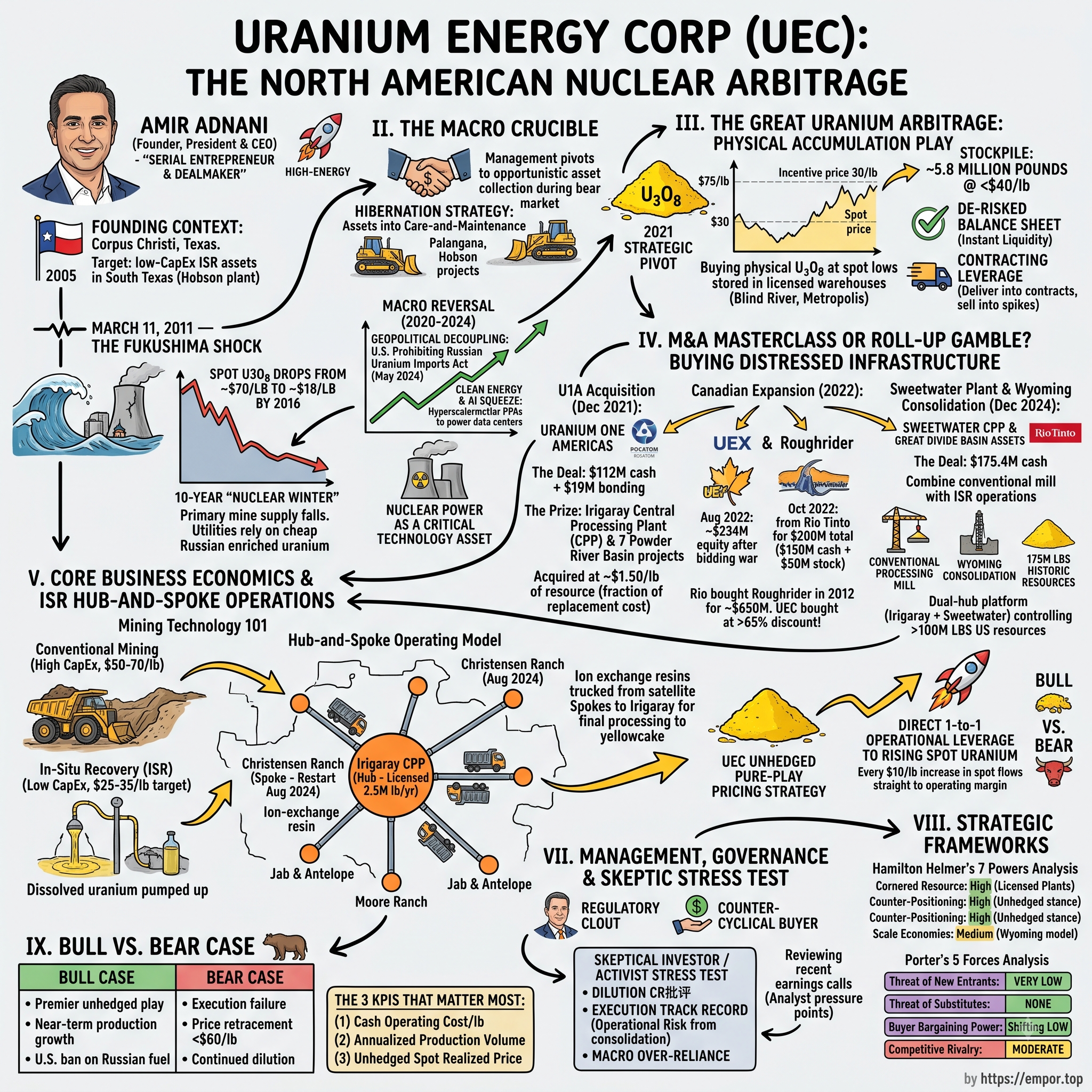
Uranium Energy Corp (UEC): The North American Nuclear Arbitrage
I. Introduction & Episode Roadmap (00:00 - 06:00)
On a spring morning in April 2026, in a scrubby stretch of Bee County, South Texas, a crew opened a valve and began pumping oxygen and carbon dioxide into a grid of 129 wells drilled into a sandstone aquifer roughly 400 feet below the mesquite. There was no headframe, no blasting, and no pit. To a passing rancher, it would have looked like an oilfield lease that had lost its pumpjacks. What was actually happening was that the United States had, for the first time in more than a decade, started up a brand-new uranium mine.1
The project was called Burke Hollow. Uranium Energy Corp discovered it in 2012, but the site reached production only in 2026. Fourteen years, one commodity depression, three U.S. presidential administrations, and an entire generational turnover in the mining workforce separated the discovery hole from the first pound of loaded resin. On the company's fiscal third-quarter earnings call two months later, founder and CEO Amir Adnani asked analysts to consider that timeline: "Let that sink in for a moment. It took 14 years to bring a new uranium mine online."2
Management presents that timeline as a moat argument, and it is a compelling one. Read from another angle, however, it is also the single most honest description of the execution risk inherent in owning the company.
The core thesis, stated plainly. Uranium Energy Corp — trading as UEC on the NYSE American — is not primarily an operating mining company today. It is a leveraged, unhedged, balance-sheet claim on three simultaneous conditions: a structural deficit in global uranium supply, a political decision by Washington to rebuild a domestic nuclear fuel chain dismantled forty years ago, and UEC's own ability to convert its permitted infrastructure into actual pounds of yellowcake. Two of those three factors are largely outside management's control and are, as of August 2026, trending favorably. The third is entirely inside management's control and is, so far, progressing slowly.
The gap between macro tailwinds and operational execution defines the investment debate. As of the quarter ended April 30, 2026, UEC held about $794 million in liquid assets, $488 million of it in cash, and no debt.1 It also holds licensed U.S. processing capacity of roughly 12.1 million pounds of uranium oxide per year.3 Yet against that licensed capacity, cumulative production since the company restarted mining in August 2024 stood at 276,516 pounds.1 That amount represents roughly two percent of a single year's licensed throughput, accumulated over approximately twenty-one months.
Roadmap. The analysis begins in the wreckage of the post-Fukushima decade, where UEC's cost basis was established. It examines the physical uranium stockpile the company built when prices were low — a distinct capital allocation strategy that funded much of what followed. It reviews the four acquisitions that assembled the asset base, including one purchased from a Russian state entity and two from Rio Tinto, benchmarking purchase prices against seller cost bases. The analysis then explores the technology of in-situ recovery, where operating economics differ fundamentally from conventional mining.
From there, the study turns to Canadian high-grade optionality and UEC's newest initiative — a wholly owned subsidiary attempting to build America's first new uranium conversion plant in seventy years. Management is evaluated on historical execution rather than guidance: matching past earnings call commitments against delivered results, analyzing explanations for operational delays, and assessing shifts in disclosure practices. The business is evaluated through Hamilton Helmer's 7 Powers and Porter's Five Forces, concluding with a balanced bull and bear framework anchored by three key operational metrics.
Market pricing frames the broader backdrop. In early August 2026, UEC traded around $11.26 per share against a 52-week high of $20.34 and a low of $8.91, giving the company a market capitalization near $5.6 billion. Meanwhile, the uranium spot price sat around $86.50 per pound.4
With the commodity near multi-year highs while the equity trades well below its peak, market sentiment shifted during 2026. Determining why that divergence occurred — and whether it presents an opportunity or a warning — is the central task of this inquiry.
A critical framing point underpins this evaluation: equity stories typically divide into business quality and commodity cycles. With UEC, that separation is unusually stark. The core business consists of scarce, licensed infrastructure whose asset value reacts slowly to uranium price movements, paired with an operating ramp and a physical trading book that react violently to them. Investors in the former are underwriting regulatory permits; investors in the latter are underwriting execution and commodity momentum. The share price combines both dynamics, and the market's 2026 repricing of UEC despite stable spot prices reflects that tension — a structural divergence this analysis will repeatedly address.
 Subscribe on LinkedIn
II. The Macro Crucible & The Nuclear Winter (05:00 - 18:00)
Amir Adnani founded Uranium Energy Corp in 2005 during the peak of the previous uranium cycle. Then in his late twenties, the University of British Columbia graduate brought a background in marketing rather than geology, offering a straightforward pitch: acquire South Texas in-situ recovery properties, restore the idle Hobson processing plant, and produce low-cost uranium into a rising market. For a brief period, the strategy delivered. Hobson was refurbished, the Palangana wellfield came online, and UEC established itself as a junior producer.
Then, on March 11, 2011, a magnitude 9.0 earthquake off Japan's Tōhoku coast triggered a tsunami that knocked out backup power at the Fukushima Daiichi plant. Within a year, Japan idled all fifty-four of its commercial reactors, while Germany accelerated its Energiewende nuclear phase-out. Roughly ten percent of global reactor demand disappeared almost overnight. Compounding the strain for producers, idled Japanese utilities turned into active sellers, dumping surplus contracted inventory back into an already oversupplied market.
Uranium spot prices, which traded near $70 per pound before the accident, drifted downward for five consecutive years, eventually bottoming near $18 per pound in 2016. That collapse hit the industry hard: typical operations required roughly $30 per pound just to cover basic cash costs, while financing a new mine generally demanded incentive prices between $60 and $80 per pound.
At $18 per pound, virtually no Western mine operated profitably. Primary producers placed operations on care and maintenance, junior exploration firms collapsed, and cash-strapped developers issued continuous equity, heavily diluting existing shareholders to stay afloat.
The resulting bear market proved exceptionally prolonged due to a structural feature often overlooked by conventional commodity investors: uranium clears against accumulated inventory rather than current mine production. Electrical utilities routinely hold multi-year forward supply, government stockpiles remain substantial, and enrichers can adjust operational parameters—specifically lowering the tails assay—to extract additional usable uranium from existing feedstock using excess power. Consequently, even when primary mine production fell below annual reactor requirements, spot prices failed to recover for years because secondary inventory absorbed the deficit.
In this market, prices respond not to the emergence of a structural deficit, but to the depletion of secondary inventory buffers. This dynamic explains why market conditions remained stagnant for nearly a decade before shifting abruptly.
The hibernation, and what it actually was. UEC responded by halting production entirely. Palangana and Hobson were placed in care and maintenance, and the company produced negligible uranium for nearly ten years. Financial statements from that period reflect minimal operating activity: fiscal 2020 and fiscal 2021 both recorded zero revenue, generating net losses of $14.6 million and $14.8 million, respectively—representing the baseline cost of maintaining operating permits, technical staff, and regulatory reclamation bonds.3
This decade was not characterized by disciplined, cash-flow-funded asset accumulation, as the company generated no operational cash. Instead, UEC preserved key permits and core technical staff by repeatedly issuing equity. Weighted-average shares outstanding rose from approximately 183 million in fiscal 2020 to 210 million in fiscal 2021.3 Relying on equity issuance to fund survival first and expansion later established a pattern that continues to characterize the company's financial strategy.
Where UEC's strategy proved effective was in securing the option value of its regulatory licenses. In the United States, obtaining a uranium mining permit requires multi-year reviews across the Nuclear Regulatory Commission (or an NRC-agreement state), the Environmental Protection Agency's underground injection control program, and state environmental regulators. Allowing permits to lapse during a downturn and reapplying during a market recovery is impractical, as permitting timelines routinely exceed the duration of a price rally.
UEC absorbed ongoing cash expenses and equity dilution to maintain permits it could not economically operate. While this strategy preserves substantial optionality in a rising market, distinguishing strategic foresight from survivorship bias remains essential. Numerous junior peers pursued identical holding strategies but failed to survive the prolonged downturn, indicating that a strategy dependent on enduring an extended commodity winter cannot be reliably replicated.
The extended industry downturn also produced human capital constraints that affect current operations. A fifteen-year contraction depleted specialized industry talent: experienced wellfield engineers retired, drilling contractors reassigned equipment to oil and gas, and regulatory agencies reduced staff.
Consequently, recent permitting delays stem less from political opposition than from staffing shortages at agencies managing a sudden influx of applications after years of low activity. Management acknowledged these operational friction points, characterizing them as "growing pains when an industry transitions from dormancy back into expansion."2 While this represents an industry-wide structural challenge, it remains an operational bottleneck that capital strength alone cannot quickly resolve.
The reversal, in three waves. Between 2020 and 2025, market conditions shifted significantly, driven primarily by external geopolitical, technological, and policy factors rather than traditional utility demand cycles.
The first catalyst was geopolitical. Following Russia's invasion of Ukraine, Western utilities reevaluated their reliance on Russian nuclear fuel processing—particularly enrichment services, where Russia had served as a primary low-cost global provider. In response, the U.S. Congress passed the Prohibiting Russian Uranium Imports Act, enacted on May 13, 2024. The import ban took effect on August 12, 2024, subject to a Department of Energy waiver process; significantly, all temporary waivers expire on or before January 1, 2028.56 This statutory deadline establishes a strict timeline requiring utilities to secure alternative domestic or allied supply sources before the exemption window closes.
The second catalyst was the expansion of artificial intelligence infrastructure. Hyperscale data centers require continuous, baseload, carbon-free power delivered in gigawatt quantities, driving technology companies to sign long-term power purchase agreements directly with nuclear operators. Capital allocation into commercial nuclear power increased significantly as tech sector demand expanded. Management highlighted this influx of private capital—spanning hyperscale power agreements and advanced reactor funding—as a key driver shifting broader market sentiment.2
The third catalyst was federal industrial policy. In November 2025, the U.S. Geological Survey reinstated uranium to its official critical minerals list. In January 2026, a presidential proclamation under Section 232 initiated formal negotiations with trade partners regarding critical mineral imports, specifically including uranium. The proclamation established a mid-July 2026 status report deadline while reserving the option for prospective trade measures.7 Subsequently, in April 2026, the Department of Energy launched its "nuclear dominance 3x33" initiative, aimed at securing domestic fuel supply chains and expanding advanced reactor deployment by 2033.2
Together, these structural tailwinds created highly favorable conditions for domestic asset owners holding uncommitted inventory and permitted processing infrastructure. However, assessing UEC's investment case requires separating macro sector tailwinds from company-specific operational execution.
III. The Great Uranium Arbitrage: The Physical Accumulation Play (18:00 - 30:00)
In March 2021, with uranium spot prices trading in the upper $20s per pound and UEC's operations idling, standard industry logic dictated raising capital to restart the Palangana wellfield. Instead, management pivoted to direct physical accumulation. On March 16, 2021, UEC announced a contract to purchase 400,000 pounds of uranium concentrate at a volume-weighted average price of $27.29 per pound.8 Within weeks, equity financings funded an expansion of the purchasing program to 2,105,000 pounds at an average cost of roughly $30 per pound.9 By April 2022, the program had grown to five million pounds at a volume-weighted average of around $38 per pound, with deliveries scheduled through December 2025.10
The mechanics of physical exposure. For a developer with dormant operations, purchasing physical metal offered distinct structural advantages over mine development. Restarting an idled mine requires wellfield drilling, regulatory filings, labor recruitment in a depleted market, commissioning tests, and a multi-year lag before producing yellowcake—introducing substantial operational and financial risk. Buying finished concentrate already assayed and stored in licensed converters in Ontario or Illinois provided identical commodity price upside while eliminating environmental liabilities, permitting timelines, and execution risk. Furthermore, physical inventory represents a liquid, marked-to-market asset that can serve as borrowing collateral. In effect, UEC converted shareholder equity into a liquid commodity position while maintaining its underlying project portfolio.
This strategy also exerted a supply-side impact on a thin spot market, where weekly transaction volumes often total only a few hundred thousand pounds. Large-scale physical purchases by non-operating entities removed near-term supply from circulation, reinforcing upward price momentum. Management noted on earnings calls that other physical vehicles were similarly raising capital to sequester material from the market.2 Consequently, physical accumulation functioned both as a balance-sheet strategy and as a catalyst for a market recovery driven largely by financial buyers rather than immediate utility demand.
The cost of physical accumulation. Direct inventory accumulation carries explicit trade-offs. Funding metal purchases through equity sales dilutes existing shareholders, who could have obtained direct spot exposure through physical trusts at lower fee structures and without management risk. Management defended the approach by arguing that U.S.-warehoused material commands a strategic premium over passive trust holdings. Adnani highlighted that initial U.S. Department of Energy strategic reserve purchases were completed at more than a 20 percent premium over prevailing spot prices, as eligibility was restricted to domestic entities holding domestic origin or inventory.2 While this distinction offers genuine optionality, its value depends on continued federal procurement.
Evaluating the arbitrage. The operational and financial results of the strategy present a mixed record. In the first half of fiscal 2025, UEC monetized 810,000 pounds from its physical stockpile at an average realized price above $82.50 per pound, generating approximately $68.8 million in revenue and $24.5 million in gross profit.2 Having acquired the metal near $30 per pound, the sales provided the company's primary cash inflow; overall fiscal 2025 revenue reached $66.8 million, while mining operations contributed virtually nothing.3
Sales paused in the second half of fiscal 2025. On the September 2025 earnings call, Adnani stated that with spot prices around $70 per pound at the July 31 fiscal year-end, management determined that "we just thought the $70 uranium price made no sense," opting to hold inventory instead.2 UEC concluded fiscal 2025 with 1,356,000 pounds of physical inventory valued at $96.6 million.2
This decision shifted the initiative from passive balance-sheet backing toward active commodity trading. In January 2026, UEC sold 200,000 pounds at $101 per pound—realizing a premium of approximately 25 percent over the quarterly average spot price near $80 per pound.2 By April 30, 2026, however, the inventory position of roughly 1.46 million pounds was marked down to approximately $127 million from $144 million three months earlier as spot prices softened and no sales were executed during the quarter.1
While physical accumulation initially provided essential liquidity and strategic balance-sheet strength, it effectively created a discretionary commodity trading operation within a mining company. Investors in UEC are thus underwriting management's price forecasting alongside its operational capability.
The strategy also introduces governance considerations. The trading book—comprising 1.4 million pounds of uranium valued at roughly $127 million as of April 30, 2026, alongside equity holdings in peer miners1—injects quarterly earnings volatility independent of mining operations. UEC has disclosed no formal trading policy, price targets, or structured liquidation schedule. Instead, inventory decisions rely on executive discretion: Adnani stated in September 2025 that $70 "made no sense," and observed in March 2026 that "just because uranium is at $80 doesn't mean we're rushing out and selling uranium at $80."2 While these decisions reflect market judgment, they remain informal, leaving shareholders without explicit criteria to evaluate trading performance in advance.
Nevertheless, the cash and liquidity built through physical accumulation provided the balance sheet foundation for UEC's subsequent asset expansion.
IV. M&A Masterclass or Roll-Up Gamble? Buying Distressed Infrastructure (30:00 - 48:00)
In late 2021, Russian state atomic enterprise Rosatom decided to exit its U.S. holdings in Wyoming.
The asset was Uranium One Americas, the U.S. arm of the company whose 2010 sale to Rosatom had generated years of American political controversy. By 2021, the strategic logic had inverted. Holding a portfolio of U.S. uranium licenses as a Russian state entity presented growing regulatory challenges with the Committee on Foreign Investment in the United States and federal policymakers, while the assets themselves remained idle. The situation created a motivated seller in a market with almost no active buyers.
UEC closed the purchase in December 2021 for $112 million in cash plus approximately $2.9 million in working capital, while assuming roughly $19 million in reclamation bonding. The transaction was funded entirely from cash on hand, leaving the company with about $120 million in cash and liquid assets.11
What that bought. The centerpiece was the Irigaray Central Processing Plant in Wyoming's Powder River Basin, licensed for 2.5 million pounds of uranium oxide per year. Alongside it came the Christensen Ranch in-situ recovery project with four installed wellfields, twelve uranium projects across Wyoming, roughly 100,000 acres of additional land, and historical measured-and-indicated resources of about 37.6 million pounds.11
Acquiring a licensed processing plant, a past-producing mine with installed wellfields, and tens of millions of resource pounds for $112 million implied a purchase price well below $3 per pound of resource. By comparison, permitting and constructing a replacement plant of equivalent scale today would require hundreds of millions of dollars and several years of regulatory review. Chief Executive Amir Adnani framed the deal as doubling the company "in three key categories: total number of permitted U.S. ISR projects, resources, and processing infrastructure."11 Chairman Spencer Abraham, a former U.S. Secretary of Energy, emphasized the domestic-supply angle.11 While the corporate messaging was aggressive, the underlying valuation logic was grounded in replacement-cost economics.
The critical element of the transaction was its availability. Uranium One Americas was not financially distressed, as Rosatom possessed ample capital. Instead, it was politically constrained, holding an asset whose strategic value to its parent company was capped by foreign ownership considerations. Identifying this opportunity required evaluating the intersection of geopolitics and mining assets rather than relying solely on commodity pricing, demonstrating key management initiative during a period of low market activity.
Canada, twice, in ten weeks. In August 2022, UEC completed the acquisition of UEX Corporation via a plan of arrangement, exchanging 0.090 UEC shares for each UEX share in a transaction valued around 260 million Canadian dollars.12 The deal secured key Athabasca Basin interests, including Shea Creek and Christie Lake, along with the West Bear cobalt-nickel project—an asset addressed later in this analysis.
In October 2022, UEC executed a transaction illustrating cycle dynamics by acquiring the Roughrider project from Rio Tinto for $80 million in cash and 17,805,815 UEC shares valued at $70 million. The $150 million total transaction closed on October 17, 2022, leaving UEC with $93 million in cash and liquid assets and no debt.13 Roughrider carried a historic resource of 58 million pounds at a high average grade of 4.73 percent uranium oxide.13
The valuation context highlights the cyclical shift. Rio Tinto had acquired Roughrider by winning a 2011 takeover battle for its original owner, Hathor Exploration. Rio entered as a white knight in October 2011 at 4.15 Canadian dollars per share, valuing Hathor near 578 million Canadian dollars. Cameco countered at 4.50 Canadian dollars per share, valuing the firm near 625 million Canadian dollars, before Rio ultimately prevailed at a higher price still.[^14]14 A major global miner paid over half a billion Canadian dollars for the asset near the top of the previous commodity cycle, held it through a decade-long bear market, wrote down its value, and eleven years later sold it to a junior developer for $150 million in combined cash and paper.
This trade offers clear support for a counter-cyclical acquisition thesis. However, it also reflects asset-specific realities: Rio Tinto, despite its capital and development expertise, opted not to build the mine, and Roughrider still lacks a completed feasibility study today.
Both perspectives remain valid. Rio Tinto did not sell because it viewed uranium as valueless, but because a project of Roughrider's scale was immaterial to a major operating on a multi-billion-dollar scale. Furthermore, carrying a non-core, non-permitted development asset through a decade of write-downs created internal administrative friction. The valuation discount UEC captured represented a portfolio-fit misalignment for the seller rather than a pure asset-value discount, allowing a focused small-cap developer to acquire scale from a diversified giant.
Sweetwater, and the shift from cheap to expensive. On December 6, 2024, UEC completed the acquisition of Rio Tinto's remaining Wyoming uranium assets for approximately $175.4 million in cash. The purchase included the fully licensed Sweetwater conventional mill—a 3,000 ton-per-day facility licensed for 4.1 million pounds per year—plus the Red Desert and Green Mountain projects carrying roughly 175 million pounds of historic resources. The deal expanded UEC's total licensed U.S. production capacity to 12.1 million pounds annually.152
The transaction marked a shift in acquisition dynamics. While the 2021 Uranium One transaction represented bottom-of-the-cycle distress buying, the Sweetwater purchase involved a $175.4 million cash outlay executed after sector sentiment had turned. Furthermore, the acquired resources reflect historic estimates rather than modern compliant reserves, and the site requires permit amendments before in-situ recovery extraction can occur. Sweetwater received a FAST-41 transparency designation from the Federal Permitting Improvement Steering Council on August 1, 2025, to compress federal review timelines, with Wyoming matching those timelines.2 While this designation helps expedite regulatory processes, UEC paid substantial capital for an asset that will not produce uranium for years.
Myth versus reality on the roll-up. Market commentary often summarizes UEC's growth as acquiring tier-one assets for pennies on the dollar. A more precise assessment indicates that UEC acquired licensed infrastructure—including two central processing plants and a conventional mill—below replacement cost from structurally motivated sellers. This infrastructure foundation represents a durable asset strength. However, the resource pounds attached to these facilities consist largely of historic or inferred estimates rather than reserves supported by feasibility studies. Consequently, management's cited figure of $1 billion in accretive acquisitions2 describes total capital deployed rather than proven economic value, as true accretion requires extracting uranium profitably under prevailing market prices.
Which brings the analysis to the point where those operational assertions are tested.
V. Deep Dive: Core Business Economics & ISR Hub-and-Spoke Operations (48:00 - 1:08:00)
Stand at the Irigaray plant in the Powder River Basin and what you notice is what is missing. There is no open pit. There is no waste rock dump, no tailings impoundment, no fleet of haul trucks. There is a modest industrial building, a lot of piping, and — scattered across the sagebrush for miles — small metal sheds the size of a two-car garage, each one connected to the others by buried plastic line. Those sheds are called header houses, and in this business they are the equivalent of a mine face.
How in-situ recovery actually works. Conventional uranium mining is exactly what it sounds like: dig up rock containing uranium, crush it, and chemically strip the metal out at a mill. It is capital-intensive, it moves enormous volumes of earth, and it leaves tailings behind that must be managed essentially forever. The cash cost of running such an operation typically sits in the $50 to $70 per pound range in Western jurisdictions.
In-situ recovery inverts the process: instead of bringing the rock to the chemistry, you take the chemistry to the rock. Certain uranium deposits — the "roll fronts" of Wyoming and South Texas — sit inside porous sandstone that is already saturated with groundwater and already sealed above and below by impermeable clay. Drill an injection well and a recovery well into that sandstone, add oxygen and carbon dioxide to the native groundwater, and pump.
The oxygenated water dissolves the uranium off the sand grains and carries it in solution to the recovery well. The pregnant solution is pumped to a small satellite plant, where it passes through columns of ion-exchange resin — think of tiny plastic beads that grab uranium molecules out of the water the way a home water softener grabs calcium. The stripped water goes back down the injection well. The loaded resin gets trucked away.
The economics follow from the physics. There is no earthmoving, so capital intensity is a fraction of a conventional mine. There is no tailings dam, so the long-tail environmental liability is far smaller. Surface disturbance is measured in well pads, not square miles. Well-run ISR operations have historically targeted cash costs in the $25 to $35 per pound range, which is why every serious U.S. uranium plan is built around it.
The trade-off is that ISR only works in the right geology, recovery rates are lower than milling, and — critically for this story — production is not a switch. It is a portfolio of wells, each of which follows a decline curve. A header house comes online, peaks, and fades. To hold output flat you must continuously drill, complete, permit, and commission new ones. To grow output you must do it faster than the old ones decline.
The closest business analogy is not a mine at all; it is a shale oil field. Both are manufacturing operations disguised as resource extraction. Both replace a single large capital event with a treadmill of small, repeatable ones. Both have steep initial declines that force continuous drilling just to stand still. And both reward exactly one thing above all others: cycle time — how fast you can get from a permit application to a producing well, over and over. Understanding this reframes what UEC's regulatory delays actually cost. A three-month approval slip in a conventional mine is an annoyance. In a treadmill business, it is a hole in the production curve that never gets filled, because the wells that would have been drilled in that window are now three months behind forever.
There is one more constraint that rarely appears in investor decks. ISR is licensed against a groundwater restoration obligation: the operator must eventually return the aquifer to a regulator-approved condition. That obligation is why reclamation bonding — UEC assumed roughly $19 million of it with the Wyoming assets alone11 — sits on the balance sheet as a genuine long-dated liability, and it is part of why regulators scrutinise each new wellfield data package rather than issuing a blanket approval. The low-disturbance advantage of ISR is real, but it is purchased with a heavier per-wellfield regulatory burden than the marketing usually conveys.
Hub and spoke. UEC's operating design is to concentrate the expensive, heavily licensed step — final stripping, precipitation, drying and drumming into yellowcake — at a small number of central processing plants, and feed them from many satellite deposits. Loaded resin from the satellites travels by truck in hauling trailers to the hub. Irigaray anchors Wyoming, taking resin from Christensen Ranch about fifteen miles away, with Ludeman planned as the second spoke.16 Hobson anchors South Texas, with Burke Hollow as the new spoke. Sweetwater is intended as a third hub, unusual in that it can process both conventional ore and ISR resin.
Why this matters commercially: the central plant is the licensed bottleneck and the fixed-cost base. Spreading it across many satellites is how per-pound overhead falls. It is a real scale economy, and it is the clearest operational justification for the acquisition spree — you buy the satellites because you already own the hub.
Now the uncomfortable part: the ramp. UEC restarted production at Christensen Ranch in early August 2024, in a previously operated mine unit, with Irigaray processing the resin.16 Fiscal 2025, ended July 31, 2025, produced approximately 130,000 pounds at a total cost of $36.41 per pound, comprising $27.63 of cash cost and $8.78 of non-cash cost.3 Management called it industry-leading, and on the evidence of other Western restarts, that claim held up.
Then the trend went the wrong way. In the quarter ended January 31, 2026, UEC produced 45,743 pounds at a total cost of $44.14 and a cash cost of $39.66.2 In the quarter ended April 30, 2026, it produced 32,195 pounds at a total cost of $54.61 and a cash cost of $46.69.1 Production fell sequentially. Cost per pound rose by more than fifty percent from the fiscal 2025 average.
Management's explanation, offered consistently across both calls, was regulatory: Wyoming's state agency was slow approving wellfield data packages for new header houses, so UEC incurred the cost of building capacity before the pounds arrived, and with a largely fixed cost base, unit costs blew out. Higher Wyoming ad valorem and severance tax factors — reset by the state's Department of Revenue on a four-year cycle and applied prospectively — added to it.2 Approval for three additional header houses in wellfield 11 came through at the end of March 2026, near the end of the quarter, too late to help.17
There are two ways to read this, and an investor should hold both. The generous read is that this is a genuine timing artifact of a dormant industry restarting, that the cumulative figures are what count — 276,516 pounds since restart at $39.30 total cost and $32.40 cash cost, which remains competitive — and that Brent Berg, SVP of U.S. Operations, gave concrete, verifiable detail about what is coming: eight active header houses in the quarter, over half of production from just two of them, five more under construction, drilling capacity tripled since restart, and the operations workforce grown from 103 people a year earlier to 185.2 That is a company visibly building, not stalling.
The skeptical read is equally supported by the same transcripts. Two consecutive quarters of declining production, blamed both times on regulators, is a pattern rather than an event. When BMO's Alexander Pearce pushed on it in June — setting the delayed header houses aside, why was underlying production down quarter over quarter? — the answer was decline curves in the existing wells, which is exactly the structural characteristic of ISR that makes a slow build dangerous.2
There is a concentration risk buried in the detail, too. Berg disclosed that two header houses, 10-7 and 10-8, accounted for more than half of the quarter's production, and that eighty-seven percent came from wellfield patterns installed within the same year.2 Adnani made the same point a quarter earlier, noting that "almost 70% of the load has been carried by 2 header houses."2 Management presents this as evidence of how productive individual units can be — which it is. But it is equally evidence that the operation is currently balanced on a very small number of assets, all of which are declining, and that the low cumulative cost figure the company cites was earned on the newest and best wells rather than on a representative sample. Averages computed over a short, favourable history tend to rise as the sample matures.
And a company whose headline cost per pound is defined, per CFO Josephine Man, as labor, chemicals and utilities at the mine and plant plus depreciation of acquisition cost2 is reporting a number that does not carry the capitalized wellfield development spending required to keep those pounds coming. The reported cost per pound is a real operating metric, but it is not full-cycle economics, and no full-cycle number has been published. For a treadmill business, that is precisely the number that matters most.
The unhedged doctrine. UEC's most distinctive commercial policy is that it has no long-term utility contracts at all. Cameco enters the current market with roughly 230 million pounds committed under contracts with deliveries scheduled out to 2030 — enormous revenue visibility, purchased by giving away much of the upside on legacy pricing terms. Қазатомөнеркәсіп Kazatomprom, which produces a plurality of the world's uranium, runs a similar book and in 2026 chose to cut nominal output by roughly nine to ten percent rather than sell into a market it considered underpriced.18
UEC's position is the mirror image. Every pound is uncommitted. Executive Vice President Scott Melbye put the case in September 2025: "we could have signed contracts over the last 3, 4 years that would have pressured us to produce faster, pressured us to sell into contracts that would be well below where the current spot and long-term prices are today."2 That is correct, and the $101 realization in the January quarter is the proof of concept.
But "unhedged" and "uncontracted" are the same word wearing different clothes. The upside version is total leverage to price. The downside version is that UEC has no committed revenue, no bankable offtake to finance construction against, and no floor. It also means the company must be a discretionary seller — and in the April 2026 quarter, it chose to sell nothing at all, so a business with essentially no mining revenue also booked essentially no trading revenue, while a roughly $19 million negative mark on its equity portfolio ran through the income statement.12 For fiscal 2025 the reported net loss was $87.7 million; through the first nine months of fiscal 2026 the accumulated deficit widened by roughly another $77 million.3
A company with $488 million of cash and no debt can absorb that indefinitely. But it should be named for what it is: UEC is currently a pre-revenue-scale mining operation attached to a commodity trading book and an enormous cash pile, and the mining part has not yet demonstrated it can carry the enterprise.
Which is exactly why the assets behind the current operations matter so much to the story.
VI. Hidden Optionality: Canadian High-Grade Exploration & Fuel Ecosystem (1:08:00 - 1:18:00)
Fly north from Saskatoon over the boreal forest and lake country of northern Saskatchewan to reach the Athabasca Basin, an area to uranium what the Permian Basin is to oil — except far more extreme. A typical Wyoming in-situ recovery roll front carries uranium at grades around 0.05 percent. By contrast, Roughrider's historic resource averages 4.73 percent.13 Some Athabasca intercepts even exceed 15 percent. At those grades, a single truckload of rock holds the uranium equivalent of an entire lower-grade wellfield, and the ore is radioactive enough to require remote handling.
Sizing the optionality honestly. This is where the discipline of proportion matters. Roughrider, Shea Creek, and Christie Lake represent world-class geology that would carry extraordinary value in a $150-per-pound uranium environment. Today, however, they generate zero cash flow and will remain unproductive for years. UEC has completed more than 80 percent of a 35,000-meter core drilling program at Roughrider to support a pre-feasibility study, while its Canadian team has worked with SaskPower toward a definition-phase agreement for a high-voltage power connection.2 On the June 2026 earnings call, Adnani declined to commit to a firm pre-feasibility publication date before estimating "towards the end of the calendar year" when pressed by analyst Joseph Reagor of ROTH — while explicitly flagging the timeline as an estimate contingent on assay results.2
That answer was appropriately hedged, but it underscores the asset's stage of development: a pre-feasibility study represents only the second of at least three major engineering gates required before a formal construction decision. Moreover, developing a high-grade Athabasca deposit requires either building a conventional underground mine alongside an expensive new mill or negotiating an ore-haulage agreement with an established third-party processor. Neither path has been defined. Roughrider functions as a long-dated call option rather than a near-term production asset. Investors should size it accordingly and remain skeptical of valuations that capitalize it as near-term output.
The bigger swing: conversion. A far more consequential piece of optionality involves a market segment absent from UEC's corporate outline just two years ago. On September 2, 2025, UEC launched United States Uranium Refining & Conversion Corp, known as URNC, a wholly owned subsidiary formed to develop a new domestic uranium refining and conversion facility.19
Understanding the strategic value of conversion requires examining a critical link in the nuclear fuel cycle. Concentrated yellowcake cannot be loaded directly into a reactor or fed into an enrichment facility. It must first be refined and converted into uranium hexafluoride, a compound that vaporizes at modest temperatures, making it the only practical form for centrifugal isotope separation. Conversion relies on unglamorous fluorine chemistry, forming a tight structural bottleneck in the supply chain.
Only a handful of commercial conversion facilities operate globally, with Russia and China controlling a major share of global capacity. Meanwhile, the United States — the world's largest nuclear fuel consumer with more than 90 operating reactors — relies on a single plant constructed in the 1950s. On a March 2026 call, Adnani observed that while domestic operators are rushing five or six new enrichment facilities into development, conversion capacity remains stagnant, leaving domestic processors able to meet only about half of U.S. demand even after planned incumbent expansions.2
URNC's proposed facility is designed to process approximately 10,000 metric tons of uranium per year as hexafluoride against estimated annual U.S. demand of nearly 18,000 metric tons, which would make it the largest conversion plant in the country. Fluor Corporation had completed about a year of preliminary engineering and a conceptual Class 5 cost estimate before the subsidiary's public launch, at a time when spot conversion services traded between $64 and $66 per kilogram of uranium — pricing that signaled acute market scarcity.19
In March 2026, URNC received a formal docket number from the Nuclear Regulatory Commission following the submission of a letter of intent — a preliminary procedural milestone rather than an approval.17 By June 2026, site selection had narrowed to a final shortlist, with additional candidate locations added specifically to align with Department of Energy priorities, while engineering work expanded under Fluor.2 Adnani guided that the next-stage study — a Class 4 cost estimate — would be completed in the first half of calendar 2027.2
Where UEC's pounds actually go. Tracing the entire fuel cycle illustrates why these distinctions matter, as investors frequently conflate separate processing steps. A pound of UEC yellowcake produced at Irigaray must first be refined and converted into uranium hexafluoride gas. That gas then travels to an enrichment facility, where centrifuges increase the concentration of the fissile uranium-235 isotope to roughly 5 percent for conventional reactors — producing low-enriched uranium — or up to nearly 20 percent for advanced reactor designs requiring high-assay material. Only after enrichment does a fuel fabricator shape the material into reactor-ready oxide pellets and fuel rods. The process spans four distinct industries, four regulatory frameworks, and four operational bottlenecks.
The United States maintains meaningful enrichment capacity that is expanding under federal incentive programs, along with established fuel fabrication facilities. What the country lacks is conversion redundancy: a single 1950s-era facility stands as the sole bridge between every domestic reactor and domestic uranium supplies. That structural point of failure defines the specific market gap URNC seeks to fill.
This bottleneck also clarifies a market dynamic Adnani has highlighted: conversion and enrichment prices have traded near record highs while spot uranium prices lagged, because downstream processing constraints suppress what buyers will pay upstream.2 If downstream conversion capacity expands, the theoretical result is increased buying pressure on raw uranium — benefiting UEC's mining operations and physical inventory alongside its conversion ambitions.
What to make of it. The strategic rationale is clear and well-timed. Vertical integration from mining to hexafluoride production mirrors the structure of state-backed entities like Rosatom and Chinese state nuclear companies, a blueprint Adnani explicitly cited as his model.2 If federal policy supports infrastructure buildouts in the nuclear sector, domestic conversion represents a logical candidate for government backing.
However, the operational risks remain substantial. UEC has never constructed or operated a chemical processing plant. A commercial-scale conversion plant is a multi-billion-dollar industrial project handling hazardous fluorine chemistry with a multi-year licensing process. The company has proposed licensing a major new Nuclear Regulatory Commission facility while simultaneously facing state-level regulatory delays on routine wellfield approvals. Furthermore, management has not disclosed an estimated capital cost because the Class 4 engineering study remains unfinished.
UEC has announced no financing structure, government partnership, or utility offtake agreement, with Adnani stating repeatedly that UEC is funding the initiative independently while discussions with government entities, utilities, and strategic partners remain ongoing.2 The October 2025 equity offering that funded the project acceleration raised $203.8 million gross at $13.15 per share, with an additional $30.6 million raised through the overallotment option.20 By August 2026, the stock traded near $11 per share.
Adding to management's operational scope is Alto Paraná, a titanium and vanadium project in Paraguay that management spotlighted on the June 2026 call as a "globally significant critical minerals platform," alongside the West Bear cobalt-nickel project inherited from UEX.12 While these deposits may hold intrinsic value, their inclusion in the portfolio raises legitimate questions for a company marketing itself as a pure-play American uranium producer while simultaneously attempting to enter the chemical conversion sector.
Which is the natural cue to look at that team directly.
VII. Management, Governance & The Skeptic Stress Test (1:18:00 - 1:33:00)
Listen to four consecutive UEC earnings calls and a distinctive dynamic emerges. Founder and Chief Executive Amir Adnani answers nearly every question himself, at length, often reframing tactical inquiries into broad strategic themes before delegating specific details to colleagues. Asked about a cost variance, he acknowledges it, provides context, and pivots within sentences to cumulative costs since the mining restart and the sector-wide scarcity of permitted assets. While effective as executive communication, this pattern means granular operational answers typically come from Senior Vice President of U.S. Operations Brent Berg or Chief Financial Officer Josephine Man rather than the chief executive.
Adnani. Adnani founded UEC in 2005 in his late twenties, operating out of Vancouver, and has led the company for more than two decades—an unusual tenure in an industry where junior mining executives often cycle between corporate entities. His primary background lies in capital markets and corporate narrative rather than mining engineering, and UEC's technical leadership reflects a deliberate effort to balance that orientation with an executive team management describes as bringing more than 900 years of collective uranium industry experience.2
What distinguishes Adnani as an operator is his focus on long-term themes. While junior mining executives often focus on immediate quarterly results, Adnani emphasizes multi-year structural trends—domestic supply deficits, vertical integration, and unhedged commodity optionality—a narrative he maintained even during periods when the sector was out of favor. Strategic consistency across commodity cycles provides narrative coherence; however, analysts on earnings calls frequently press for specific operational details when executive responses remain focused on macro strategy.
Spencer Abraham. As non-executive chairman, former U.S. Secretary of Energy and Michigan Senator Spencer Abraham provides strategic credibility and regulatory familiarity with key federal agencies, including the Department of Energy and the Nuclear Regulatory Commission, whose decisions directly affect initiatives like URNC. Given that the Department of Energy oversees Russian uranium waivers, strategic reserve policy, and nuclear fuel supply chain funding, regulatory access represents a significant strategic asset. At the same time, a board anchored by political expertise may offer less direct technical oversight of day-to-day mining operations, precisely where execution risks are currently concentrated.
Scott Melbye, the Executive Vice President, brings deep sector experience, also serving as president of the Uranium Producers of America trade association. Consequently, policy commentary on UEC calls is unusually well-sourced and also why it should be read as advocacy as well as analysis.2 When discussing legislative efforts to expand import restrictions from Russia to China, he is describing his own day job, not making a forecast.2
Testing the narrative across calls. Evaluating management requires comparing past earnings call commitments against delivered results over time.
On the September 2025 earnings call, Adnani stated that construction at Burke Hollow was 90 percent complete with construction targeted for November 2025 and operational startup in December 2025.2 Physical construction finished during the December 2025 to January 2026 quarter, and production commenced on April 8, 2026 after Texas Commission on Environmental Quality approval.121 The resulting one-quarter delay stemmed from a specific regulatory requirement: state approval of the drilling and completion report for a waste disposal well.2 For a greenfield in-situ recovery mine startup, a single-quarter delay tied to a specific permitting step represents a minor timeline slip, which management flagged to investors prior to its occurrence.
Conversely, UEC's disclosure practices on operational guidance remain limited. On the September 2025 call, Goldman Sachs analyst Brian Lee asked directly whether fiscal 2026 production would be in the hundreds of thousands of pounds or above a million. He did not get a number.2
Three months later, ROTH analyst Joseph Reagor asked whether UEC would consider pre-releasing production and sales data ahead of earnings, matching standard reporting practices among producing peers. Adnani declined, citing strategic reasons connected to potential U.S. government purchases.2 By June 2026, with three fiscal quarters reported, cumulative annual production remained below 200,000 pounds. When SCP analyst Justin Chan asked how many header houses would be needed to reach one or two million pounds a year, the answer was that the relationship is linear but "not every header house is the same size or created equal," so extrapolation might not be simple.2
While operational variability is inherent in wellfield development, the combination of unhedged exposure and limited guidance leaves investors dependent on trailing results rather than forward operating targets.
The disclosure change worth watching. On the June 2026 call, H.C. Wainwright analyst Heiko Ihle asked whether mark-to-market volatility from UEC's equity portfolio in peer uranium miners could be normalized for predictability. Adnani suggested moving toward reporting "on an adjusted basis where we can maybe pull that out," and Man agreed that "reconciliation of disclosure of adjusted EBITDA" would help stakeholders.2 Although requested by analysts, adopting non-GAAP measures to filter out investment volatility comes after UEC recorded a quarter when those losses were roughly $19 million.2 Investors will need to monitor whether non-GAAP adjustments are applied consistently during quarters with positive investment marks.
The activist case, assembled. A skeptical evaluation of UEC's financial and operational trajectory highlights several core risks.
Dilution as a primary capital source. Weighted-average shares outstanding expanded from approximately 183 million in fiscal 2020 to about 428 million in fiscal 2025, and the balance sheet showed roughly 493 million shares issued at April 30, 2026.3 Additional paid-in capital increased from $1.40 billion at fiscal year-end 2025 to $1.92 billion nine months later—representing over $500 million in equity issued in three quarters, against an accumulated deficit of $483 million.3 The company has also maintained a $300 million at-the-market program.22 Assets, physical inventory, and new project initiatives have been largely funded through stock issuances, meaning cited acquisition values must be weighed against share count expansion over time.
Operational execution at scale remains unproven. Twenty-one months following the mining restart, cumulative production is 276,516 pounds against 12.1 million pounds of licensed annual capacity.12 Unit operating costs rose over two consecutive quarters, and no asset in the portfolio holds a completed modern feasibility study, with the first targeted for around the end of 2026.2
Expanding capital deployment across multiple initiatives. Capital allocation moved from a $112 million distressed asset acquisition in 2021 to a $175 million cash purchase of Sweetwater in late 2024, followed by a $204 million equity raise in October 2025 to enter chemical conversion, alongside critical mineral projects in Paraguay and Canada. While individual transactions offer strategic rationales, collectively they reflect continuous capital deployment across new business lines before existing assets reach steady-state production.
Market pricing reflects execution discounting. Despite favorable macro conditions—including spot uranium near $86 per pound and an upcoming statutory ban on Russian imports taking full effect in January 2028—the equity trades near $11 against a $20.34 fifty-two-week high.4 This valuation discount indicates that the market is pricing in operational execution risks alongside sector tailwinds.
Correlated balance sheet risks. UEC's operational earnings, physical uranium holdings, and peer equity investments are all exposed to the same underlying commodity price movements. During a rising price environment, this structure provides leveraged upside; during a price pullback, operating margins, physical inventory valuations, and equity holdings decline simultaneously. The third quarter of fiscal 2026 illustrated this combined exposure, with falling production, an inventory position worth $17 million less than three months earlier, and a roughly $19 million negative mark on the equity book, all in the same three months.12 Furthermore, early-stage exploration projects in titanium, vanadium, cobalt, and nickel carry no operating cash flows to offset commodity volatility.
Counterbalancing these risks are UEC's debt-free balance sheet, nearly $488 million in cash, over $120 million in physical inventory, licensed infrastructure that is difficult to replicate, and demonstrated capital discipline during peak spot price rallies.
Crucially, equity dilution is value-accretive if shares are issued above intrinsic asset value. Management successfully issued equity at favorable valuations—such as the October 2025 raise at $13.15 per share when the stock later traded near $11—and deployed proceeds into infrastructure acquired at distressed valuations. The primary open question for investors is not the historical use of equity capital, but whether the assembled asset base can transition into self-sustaining operational cash flow.
VIII. Strategic Frameworks: 7 Powers & Porter's 5 Forces (1:33:00 - 1:45:00)
At a major utility's fuel-procurement desk in 2026, the strategic landscape is tightly constrained. A buyer managing reactor demand into the 2030s faces a statutory deadline that eliminates a key portion of the historic supply chain, leaving a counterparty list that fits on a single page. Cameco sits on that list with its massive long-term contract book. Kazakh producers remain central, albeit with geopolitical caveats. Beyond those lie a small group of American developers, among which Uranium Energy Corp stands out as the sole entity with three licensed processing facilities and an entirely uncommitted order book. That competitive positioning represents two decades of asset assembly, warranting a rigorous assessment of its underlying strategic value.
Evaluating UEC through established business frameworks requires an objective accounting of both strengths and structural limitations. Applying strategic analysis reveals advantages that are genuine and highly concentrated, yet primarily defensive.
Hamilton Helmer's 7 Powers Analysis
1. Cornered Resource (High, representing the primary moat). Helmer defines a cornered resource as preferential access to a coveted asset on terms that deliver differential returns. UEC holds three licensed uranium processing facilities in the United States — Irigaray and Sweetwater in Wyoming, alongside Hobson in South Texas — in a country that operates only a handful in total.2 The regulatory path for a new facility requires multi-year reviews across the Nuclear Regulatory Commission or state agreement equivalents, the Environmental Protection Agency's underground injection control program, and state environmental regulators. The fourteen-year development timeline at Burke Hollow underscores how formidable this entry barrier is in practice. Crucially, this asset moat functions independently of operational execution: regardless of production ramp speed, UEC retains ownership of scarce, licensed infrastructure, providing balance-sheet downside protection even if near-term output lags.
2. Counter-Positioning (Medium, and weaker than typically claimed). Counter-positioning occurs when an entrant adopts a business model that incumbents decline to copy because doing so would damage their existing business. UEC's unhedged posture contrasts sharply with Cameco's contract book of roughly 230 million pounds, a position Cameco cannot easily unwind. However, counter-positioning requires generating structurally superior economics, not merely maintaining different market exposure. Remaining uncontracted represents a directional commodity bet rather than a structural moat. Because a capitalized competitor could adopt an identical commercial policy, UEC's unhedged model reflects a deliberate market position rather than a durable power.
3. Scale Economies (Medium, currently theoretical). The hub-and-spoke architecture offers a mechanism for spreading fixed infrastructure costs: a single licensed central plant processes resin from multiple satellite deposits, reducing per-pound overhead as throughput grows. However, recent operational results highlight the inverse dynamic. As production declined, fixed facility costs pushed total unit costs from $44.14 to $54.61 per pound across consecutive quarters.12 Scale economies deliver competitive advantage only when supported by operational volume; UEC currently possesses scale capacity rather than realized volume.
What UEC does not possess. UEC demonstrates no process power, as in-situ recovery relies on established, industry-standard technology. It lacks branding power, given that uranium concentrate is a homogeneous commodity whose only differentiation stems from regulatory origin. The company exhibits no network economies or switching costs, as utilities operate without long-term contract lock-in. Valuation models that attribute a durable premium multiple to underlying business quality risk crediting competitive powers that the business does not currently exhibit.
Porter's 5 Forces Analysis
Threat of New Entrants — Very Low. Entry barriers are defined by time and regulatory requirements rather than capital availability. Establishing a new operation requires multi-year federal and state permits, NRC licensing, and environmental reclamation bonding. Furthermore, regulatory agencies face staffing constraints after a fifteen-year industry downturn, limiting approval speeds even for well-capitalized entrants.
Bargaining Power of Buyers — Shifting from High toward Balanced. For a decade, utilities dictated commercial terms amid abundant secondary supply. That dynamic is rebalancing as federal statutory bans on Russian imports take effect ahead of the 2028 waiver expiration, and with Kazatomprom electing to cut 2026 output by roughly nine to ten percent rather than sell cheap.18 Consequently, buyers face heightened competition for licensed, Western-origin material. This power shift primarily benefits contracted producers with locked-in delivery schedules. Because UEC operates without long-term contracts, it captures market tightening through spot price movements, exposing revenue to higher volatility.
Bargaining Power of Suppliers — Low, with human capital exceptions. In-situ recovery relies on standard industrial inputs—oxygen, carbon dioxide, and sodium bicarbonate—with minimal supplier lock-in. Ion-exchange resin involves a narrower supplier base but does not present an operational bottleneck. The primary supply constraint is specialized labor. After a fifteen-year contraction, the industry faces workforce shortages that cannot be quickly resolved. Although UEC's operations headcount nearly doubled in a year, to 185,2 management has repeatedly named human resources as the binding constraint on how fast it could accelerate even if prices spiked.2
Threat of Substitutes — Effectively None at the fuel level. Commercial light-water reactors cannot utilize alternative fuel sources. Because nuclear fuel represents a small single-digit to low-double-digit percentage of overall power plant operating costs, demand remains highly price-inelastic; significant increases in uranium prices have minimal impact on overall generation economics. Substitution risks exist primarily at the power generation level: if utilities select natural gas, renewables, or geothermal over nuclear for new data center demand, long-term reactor deployment could slow, flattening future demand growth over a multi-decade horizon.
Competitive Rivalry — Moderate, and unusually cooperative. Domestic developers like Energy Fuels and enCore Energy compete for specialized wellfield contractors, drilling equipment, experienced personnel, and regulatory agency processing bandwidth. However, because the sector faces a structural supply deficit rather than excess capacity, UEC describes working with peers through "a coordinated working group" on permitting throughput.2 Against global producers Cameco and Kazatomprom, UEC competes on geographic origin and uncommitted inventory rather than total output scale.
War-gaming the peer set. Comparing UEC against its primary peers highlights distinct strategic trade-offs. Relative to Cameco, UEC operates at a significantly smaller scale, lacks downstream refining and conversion revenues, and holds no long-term utility contracts. Conversely, this structure provides unhedged exposure to spot commodity price movements. Investors comparing the two are choosing between Cameco's revenue visibility and UEC's commodity leverage.
Compared to Kazatomprom, the primary distinction centers on jurisdiction. While Kazakh operations maintain lower cash costs and far greater production scale, their geographical location presents geopolitical supply chain risks for Western buyers, with a large share of Kazakh material already flowing toward Russia and China.2 UEC's market position rests on domestic origin rather than cost leadership.
Relative to domestic peers Energy Fuels and enCore Energy, UEC's differentiation lies in balance-sheet liquidity and permitted asset scale. Energy Fuels maintains conventional milling capacity alongside rare earth processing, while enCore operates complementary Texas ISR assets. UEC's cash reserves and portfolio of permitted projects allow it to manage wellfield development without immediate capital pressure, though converting that optionality into long-term value depends on sustained wellfield execution.
The overall framework reveals a favorable industry structure and a defensible asset position anchored by licensed processing capacity. Realized investment returns, however, will depend primarily on operational execution across active wellfields.
IX. Bull vs. Bear Case & 3 Vital KPIs (1:45:00 - 1:56:00)
The bull case, at its strongest.
The bull case starts with balance sheet resilience and unreplicable asset scale. UEC holds licensed U.S. processing capacity of 12.1 million pounds annually across three plants—the largest licensed footprint of any single company in the United States—alongside the country's largest domestic resource base.2 Supported by roughly $488 million in cash, zero debt, and approximately 1.4 million pounds of physical uranium,1 the company maintains substantial financial flexibility. This liquid posture shields management from forced asset sales, refinancing pressures, or distress-driven equity dilution, leaving share issuances as a strategic choice rather than a solvency requirement.
Macro developments provide a supportive backdrop. A statutory import ban on Russian nuclear fuel takes full effect on January 1, 2028.6 Uranium has been restored to the federal critical minerals list, and a Section 232 process remains active with prospective trade remedies held in reserve.7 Major international producers, including Kazatomprom, have deliberately curtailed output,18 while the forward price curve trades above spot levels against an annual U.S. domestic supply deficit of 46 to 47 million pounds.23 Should federal authorities fund a strategic uranium reserve, eligibility rules restricting purchases to domestic origin or inventory leave very few qualifying suppliers—a niche UEC deliberately positioned itself to serve.2
Operationally, two of UEC's three hub-and-spoke platforms are active. Burke Hollow initiated production in April 2026 and will contribute to results starting in the fiscal fourth quarter. Meanwhile, three state-approved header houses came online at Christensen Ranch at the end of March, five remain under construction, and one sits completed awaiting final regulatory sign-off.1 If output scales linearly with operating header houses as management asserts, fiscal 2027 production should expand significantly over fiscal 2026 levels. Furthermore, because UEC maintains an unhedged order book, every incremental pound produced captures prevailing market prices—as demonstrated by its $101 per pound realized sale against an $80 average spot benchmark.2
The bear case, at its strongest.
The bear case does not require a breakdown in macro tailwinds; it relies simply on operational execution remaining slow.
Production declined across two consecutive quarters while unit costs rose from $36.41 per pound in fiscal 2025 to $54.61 per pound in the quarter ended April 30, 2026.13 Management attributed both quarterly slippages to state permitting delays—an explanation that shifts from an isolated bottleneck into an operational pattern. Because in-situ recovery wellfields experience steep natural decline curves, delayed header house completions do not merely defer growth; they erode base volume. This dynamic was evident on the June 2026 call, where management acknowledged that underlying wellfield output fell even after adjusting for delayed header houses.2
Furthermore, reported operating costs exclude capitalized wellfield development expenditures, meaning UEC has not published full-cycle production costs, nor does any asset in its portfolio possess a completed modern feasibility study. The 175 million pounds at Sweetwater and 58 million pounds at Roughrider represent historic resource estimates rather than compliant, proven economic reserves.1315
Capital allocation practices also present ongoing dilution and execution risks. Weighted-average shares outstanding have roughly tripled since 2020, with paid-in capital increasing by more than $500 million across the first three quarters of fiscal 2026 alone.3 Equity proceeds are now being deployed into chemical refining and conversion—an industrial sector in which UEC has no operational track record, with no disclosed capital expenditure requirements, no announced commercial partners, and a Class 4 engineering study not expected until the first half of 2027.2 Expanding from raw uranium mining into commercial uranium hexafluoride conversion represents a structural shift into a separate, capital-intensive industry.
Finally, an unhedged commercial strategy offers no downside protection during commodity pullbacks. If spot uranium prices weaken toward $60 per pound, UEC lacks contracted cash flows to buffer revenues. Under that scenario, physical inventory valuations, operating margins, and peer equity holdings would contract simultaneously. The third quarter of fiscal 2026—marked by zero sales, falling production, rising unit costs, and a $19 million negative mark on equity investments—demonstrated how correlated balance-sheet exposures can compound during soft periods.12
The three KPIs that will settle it.
One: quarterly pounds produced, measured against active header houses. Production volume serves as the primary operational metric. Questions surrounding cost structure, operating margins, and the economic viability of UEC's 12.1 million pounds of licensed capacity depend on whether quarterly output compounds consistently. Tracking sequential volume alongside the count of active header houses reveals whether new wellfield completions are generating net growth or merely offsetting steep decline curves in mature wells. The fiscal fourth quarter ended July 31, 2026, represents the initial period incorporating contributions from both Burke Hollow and the three newly approved Wyoming header houses, providing a clear test of operational trajectory.
Two: total cost per pound, specifically whether unit costs return below $40. Management committed on consecutive earnings calls to reducing unit operating costs as throughput expands.2 This statement establishes a verifiable benchmark. If total cost per pound drops back into the upper $30s as volume scales, higher unit costs will prove to have been a temporary artifact of fixed-cost overhead. Conversely, if total costs remain above $50 per pound despite higher production volumes, structural cost pressures may extend beyond temporary timing delays.
Three: pounds sold and realized price relative to spot benchmarks. Operating an unhedged trading strategy leaves revenue generation subject to executive discretion rather than fixed delivery schedules. Evaluating performance requires tracking both the physical volume monetized each quarter and the realized price premium or discount against average spot benchmarks. While selling 200,000 pounds at a 25 percent market premium reflects effective execution, holding inventory without sales while booking a $17 million quarterly valuation markdown represents a capital management choice that investors must continuously assess.
These key performance indicators should be evaluated directly from quarterly financial filings to establish multi-quarter trends rather than relying on point-in-time figures or financial models.
The risk radar, restricted to what is actually material. Four core risks warrant primary investor attention. Execution and regulatory throughput represents the dominant operational bottleneck, having already impacted two consecutive quarters. Commodity price volatility is the primary market risk, amplified by an unhedged commercial model. Labor constraints present an underrated operational ceiling: management acknowledged that specialized personnel, rather than capital, limits how quickly operations can scale, a constraint reflected in headcount nearly doubling over twelve months.2 Political durability forms the final risk pillar; while the Russian import ban is established by federal statute, initiatives regarding strategic reserves, expedited permitting, and conversion support depend on executive orders and agency appropriations that remain subject to policy shifts.
Conversely, several standard risks are less relevant to UEC's immediate outlook. Refinancing risk is negligible given zero debt and $488 million in cash. Input cost inflation remains manageable because in-situ recovery reagents consist of widely available industrial gases. Product obsolescence is non-existent, as operating reactors require continuous uranium supplies for their multi-decade lifespans. Finally, cyclical demand volatility does not apply in the traditional sense, as nuclear fuel consumption is driven by base-load utility operations rather than broader macroeconomic fluctuations. Risk factors for UEC remain tightly concentrated, leaving little margin for operational missteps across core assets.
X. Playbook: Business & Investing Lessons (1:56:00 - 2:05:00)
There is a photograph that could stand as the thesis of this entire story, but it does not exist because no one thought to take it. Sometime around 2018, in a Wyoming or South Texas field office, a UEC employee signed a routine permit renewal for a mine that was not operating, could not economically operate, and faced no prospect of operating for years. It cost capital the company barely possessed and generated zero revenue. Yet eight years later, that routine filing underpins a substantial portion of why the company is valued in the billions rather than facing liquidation.
Nearly every durable strategic lesson from UEC's corporate trajectory compresses into that single non-event.
1. Buy option value at the bottom, but recognize what was actually acquired. The core lesson here extends beyond simply purchasing low. In cyclical, capital-intensive industries, the assets that survive a prolonged downturn best are those whose value is permission-based rather than production-based. UEC acquired licensed plants, permitted projects, and physical metal when market interest was minimal, proving that regulatory licenses are far more durable than attached resource estimates. The corresponding caveat is equally critical: acquiring cheap assets at the cycle trough does not automatically transform a developer into an efficient operator at the peak. Those represent fundamentally different competencies, and capital markets inevitably reprice equity based on operational execution.
2. In permitting-heavy sectors, infrastructure and regulatory paper beat ore in the ground. An undeveloped deposit is worth only what it costs to permit and construct, heavily discounted by the probability of completion. An existing licensed facility carries none of that development discount. This distinction explains why UEC's central processing facilities represent its most valuable physical assets, while an undeveloped 58-million-pound high-grade deposit—purchased at a steep discount from a major producer that abandoned development—functions as long-dated optionality rather than immediate production. The logic applies across midstream energy, waste management, chemical processing, ports, and telecommunications spectrum: wherever regulatory approval acts as the primary gatekeeper, existing paperwork forms the competitive moat.
3. Counter-positioning against legacy contracts creates narrative momentum, not necessarily a structural edge. UEC's unhedged commercial strategy is clearly differentiated and delivered realized price premiums during spot price spikes. However, investors must separate its dual functions: the posture attracts high-beta capital during commodity rallies while eliminating revenue visibility across all market conditions. A company whose primary distinguishing characteristic is unhedged commodity exposure offers market leverage rather than a structural operating moat—and commodity leverage can often be acquired elsewhere with lower execution risk.
4. A physical stockpile is a strategic balance-sheet tool—until it becomes a trading book. Purchasing physical uranium at $30 per pound provided UEC with balance-sheet liquidity, borrowing collateral, and upside optionality without wellfield execution risk. Yet once an inventory position grows large enough that quarterly earnings depend on discretionary sales, shareholders inherit an unhedged commodity trading risk tied to executive market timing. Investors must identify the threshold where an inventory strategy shifts from balance-sheet risk management to primary revenue generation, as corporate disclosure and governance standards for the two activities differ substantially.
5. Exercise caution when an asset adjacency masks a fundamentally different industry. Vertical integration into chemical conversion is strategically coherent within federal fuel-security initiatives. However, it requires a mining team with an unfinished wellfield ramp to license and construct a multi-billion-dollar fluorine processing facility, while simultaneously maintaining early-stage exploration projects in Paraguayan titanium and Canadian cobalt-nickel. The broader insight is not that diversification is inherently flawed, but that management bandwidth represents the scarcest operational resource during a corporate transformation. A primary market warning sign is an enterprise committing capital to new frontiers before establishing steady-state operations on existing assets.
6. In treadmill operations, cycle time is the primary compounding metric. The most transferable operational insight from UEC's restart centers on process cycle time. When a business model requires continuously replacing its production base—whether shale well pads, in-situ recovery header houses, commercial pipelines, or clinical programs—the binding constraint is rarely total resource size or output price. It is the elapsed time from capital deployment to initial cash flow, multiplied by the iteration frequency of the loop. Operators that compress cycle times compound capital efficiently; those that encounter systematic delays run in place with an expanding asset base. When executive teams attribute production shortfalls to external regulatory delays, the analytical question is not merely when approvals will arrive, but what structural modifications will remove that step from the critical operational path.
7. Policy tailwinds represent tangible assets, but they carry different half-lives. UEC's macro thesis relies on a combination of federal statutes, executive actions, and regulatory initiatives, each requiring distinct valuation treatment. A statutory import ban backed by a hard compliance deadline functions similarly to a structural contract. Conversely, executive orders, fast-track permitting designations, and unfunded reserve proposals reflect policy sentiment subject to administrative revision. Sound analytical discipline requires evaluating the reversal threshold for each policy pillar—specifically distinguishing between measures requiring an act of Congress and those dependent solely on executive discretion. In UEC's macro framework, one core pillar requires legislative repeal, while the remainder rely primarily on administrative continuity.
XI. Epilogue & Outro (2:05:00 - 2:10:00)
Return to the South Texas wellfield at Burke Hollow one last time. The valves are open, oxygenated water moves through sandstone that has held uranium since the Miocene, and down the line a column of resin beads is turning the color that signals the chemical process is working. It remains a modest start. In the quarter Burke Hollow initiated production, Uranium Energy Corp's entire mining operation produced roughly 32,000 pounds—about a single truckload of finished yellowcake against a licensed annual capacity of 12.1 million pounds.1 That gap between permitted throughput and realized output compresses the company's central investment debate into a single figure.
Twenty-one years after its founding, Uranium Energy Corp has assembled a platform vastly different from its early junior-explorer beginnings. The company holds the largest licensed uranium processing capacity and domestic resource footprint in the United States, backed by nearly $488 million in cash, zero debt, two operating in-situ recovery hubs, a major high-grade deposit in Saskatchewan, and plans for the nation's first new commercial uranium conversion plant in seventy years. Management built this position by acquiring distressed infrastructure during a decade-long commodity downturn, funding the expansion almost entirely through equity issuance.
What UEC has not yet established is steady, commercial-scale mining output. Cumulative production since restarting operations in August 2024 remains in the hundreds of thousands of pounds against annual licensed capacity in the millions, while recent quarterly results showed sequential volume declines alongside rising unit costs. The macro tailwinds—the January 2028 statutory ban on Russian imports, inelastic reactor demand, Kazakh supply discipline, federal critical-mineral designations, and domestic fuel supply chain re-shoring—remain favorable for U.S. producers. Yet operational execution remains the unproven variable, a gap reflected in the stock trading well below its 52-week peak.
The coming twelve to twenty-four months will provide clear empirical tests for management's thesis. Results from the fiscal fourth quarter ended July 31, 2026—incorporating initial output from Burke Hollow and three newly approved Wyoming header houses—will indicate whether production is scaling or if operational bottlenecks persist. The Roughrider pre-feasibility study, targeted for late 2026, will transition a historic resource estimate into an engineered mine plan. In early 2027, URNC's Class 4 cost study will establish preliminary capital requirements and financing parameters for the proposed conversion plant. Finally, regulatory outcomes from the Section 232 process and federal reserve policy will clarify whether domestic-origin uranium commands a lasting structural premium.
For long-term investors, the core debate centers on execution. Uranium Energy Corp has established balance-sheet protection through debt-free liquidity and scarce, permitted processing infrastructure. Realizing upside potential, however, requires management to demonstrate—quarter by quarter and header house by header house—that it can scale physical yellowcake production to match its licensed footprint. The asset foundation and macro catalysts are in place; operational delivery remains to be proven.
References
-
Uranium Energy Corp Reports Results for the Third Quarter of Fiscal 2026 — PR Newswire, 2026-06-09 ↩↩↩↩↩↩↩↩↩↩↩↩↩↩↩↩↩
-
Uranium Energy Corp (UEC) Earnings Call Transcripts and Q&A — Seeking Alpha ↩↩↩↩↩↩↩↩↩↩↩↩↩↩↩↩↩↩↩↩↩↩↩↩↩↩↩↩↩↩↩↩↩↩↩↩↩↩↩↩↩↩↩↩↩↩↩↩↩↩↩↩↩↩↩↩↩↩↩
-
Uranium Energy Corp Annual Report on Form 10-K for fiscal year ended July 31, 2025 — SEC EDGAR, 2025-09-24 ↩↩↩↩↩↩↩↩↩↩
-
Uranium Prices Today — Live U3O8 Spot Price and Nuclear Outlook — CarbonCredits.com, 2026-08-07 ↩↩
-
Biden-Harris Administration Enacts Law Banning Importation of Russian Uranium — U.S. Department of Energy, 2024-05-13 ↩
-
Russian Uranium Ban Waiver Guidance — U.S. Department of Energy, Office of Nuclear Energy ↩↩
-
Trump Administration Announces Results of Critical Minerals Investigation Under Section 232 and Directs U.S. Officials to Initiate Negotiations — Covington & Burling LLP, 2026-01 ↩↩
-
Uranium Energy Corp Establishes Physical Uranium Initiative and Provides Balance Sheet Update — SEC EDGAR Form 8-K Exhibit 99.1, 2021-03-16 ↩
-
Uranium Energy Corp Expands Physical Uranium Initiative to Purchase 2.1 Million Pounds U3O8 and Announces Financing — PR Newswire, 2021-04 ↩
-
Uranium Energy Corp Physical Uranium Program Expansion — SEC EDGAR Form 8-K Exhibit, 2022-04 ↩
-
Uranium Energy Corp Completes Acquisition of Uranium One Americas to Create America's Largest Uranium Mining Company — PR Newswire, 2021-12-17 ↩↩↩↩↩
-
Uranium Energy Corp Completes Acquisition of UEX Corporation to Create the Largest Diversified North American Focused Uranium Company — PR Newswire, 2022-08-22 ↩
-
Uranium Energy Corp Completes Acquisition of the World-Class Development-Stage Roughrider Uranium Project From Rio Tinto — PR Newswire, 2022-10-17 ↩↩↩↩
-
Bidding war possible after Cameco sweetens Hathor offer — The Globe and Mail, 2011 ↩
-
Uranium Energy Corp Completes Acquisition of Rio Tinto's Sweetwater Plant and Wyoming Uranium Assets — PR Newswire, 2024-12-06 ↩↩
-
Uranium Energy Corp Announces Restart of ISR Uranium Production in Wyoming — PR Newswire, 2024-08-13 ↩↩
-
Uranium Energy Corp Receives Approval for Expanded Production at Christensen Ranch and Secures NRC Docketing for U.S. Conversion Facility — PR Newswire, 2026-03-23 ↩↩
-
Kazatomprom Cuts 2026 Uranium Output as Market Tightens, Demand Seen Rising — Investing News Network, 2026 ↩↩↩
-
Uranium Energy Corp Launches United States Uranium Refining & Conversion Corp to Advance American Nuclear Fuel Security and Energy Dominance — PR Newswire, 2025-09-02 ↩↩
-
Uranium Energy Corp Announces the Closing of $203 Million Public Offering — PR Newswire, 2025-10-06 ↩
-
Uranium Energy Corp Commences Production at Burke Hollow, the World's Newest Operating ISR Uranium Mine — PR Newswire, 2026-04-08 ↩
-
Uranium Energy $300 million at-the-market offering — Davis Polk ↩
 LinkedIn
 WhatsApp
 Reddit
 Hacker News
 Email
Email Kindle
 RSS Feed
 Spotify
 Apple Podcasts
 Amazon Music
 Audible
 YouTube