BellRing Brands: The Protein Shake That Outgrew Its Balance Sheet
I. The Shake on the Shelf, the Questions Behind It
Walk into almost any Walmart or Costco in America and the scene is the same. Somewhere between the coffee creamer and the breakfast bars stands a wall of squat, brightly labelled cartons and plastic bottles, each promising thirty grams of protein, one gram of sugar and a flavour named after a dessert. A shopper drops a four-pack into the cart, or more likely a club-store case of eighteen, and moves on. For millions of households the decision now takes a second. That habit is the business of BellRing Brands, and its flagship is Premier Protein.
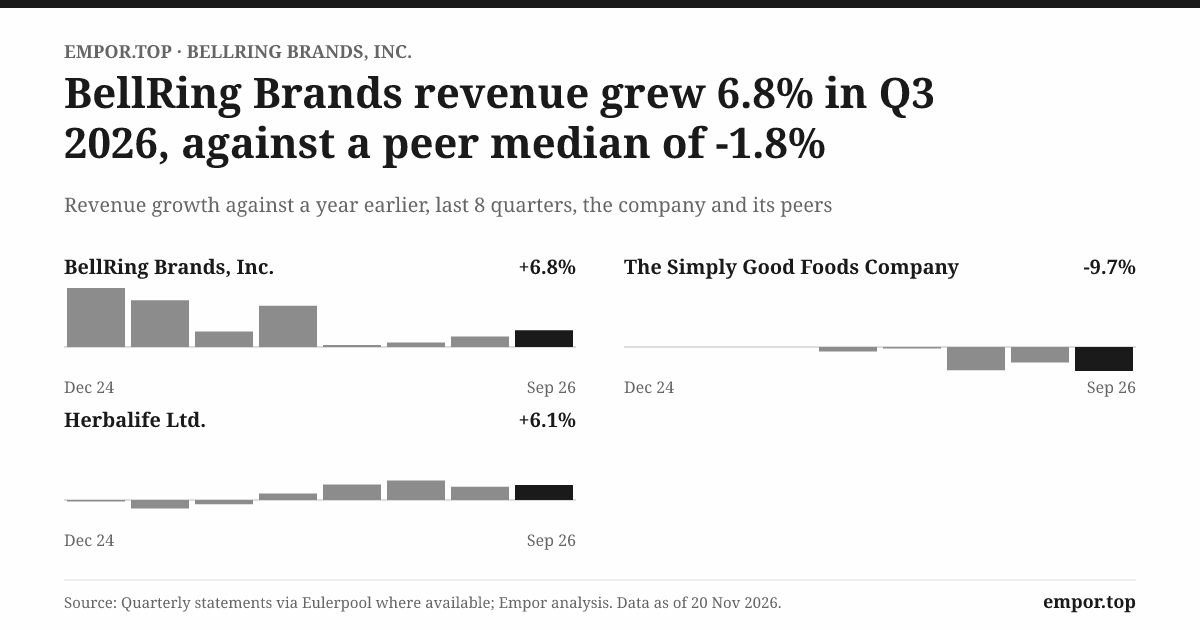
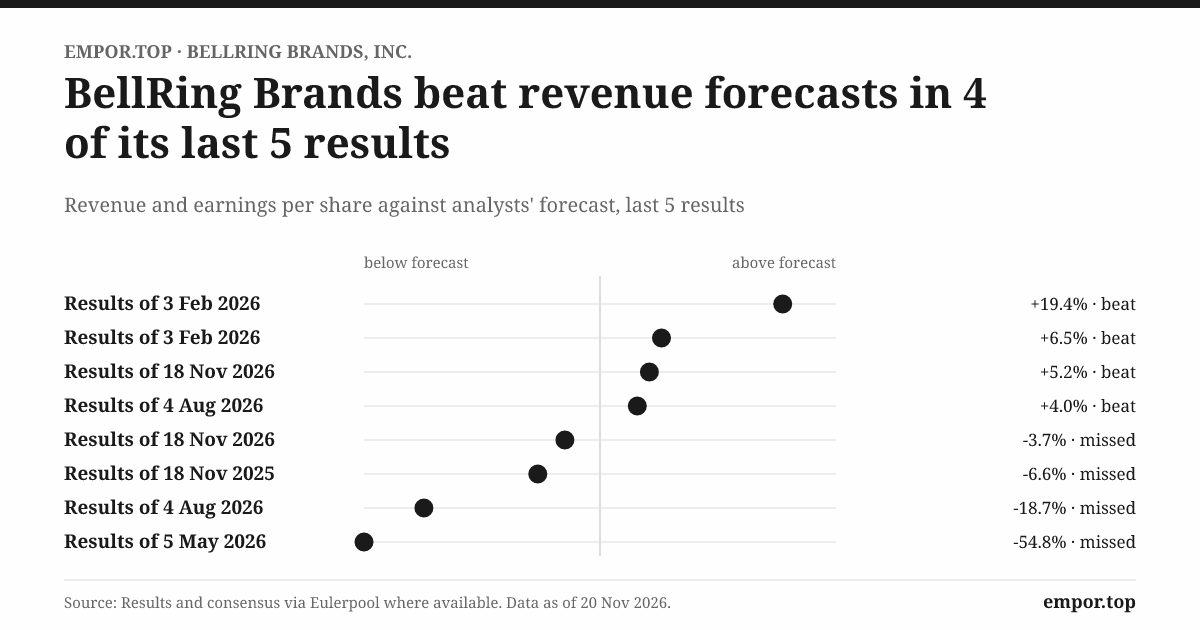
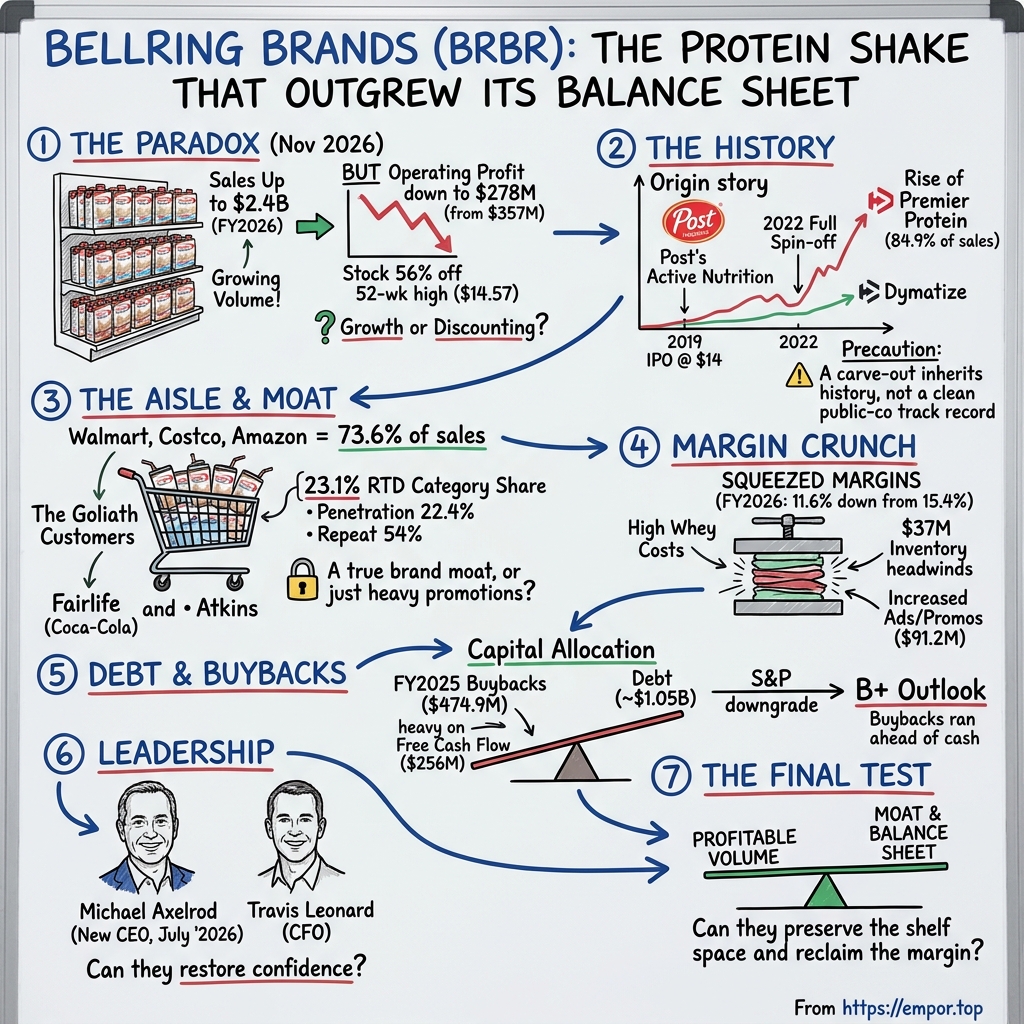
On November 18, 2026, BellRing reported the biggest quarter of sales in its history. Fourth-quarter net sales came to about $692 million, up almost 7% on the year before, and the company had shipped about 15% more product than a year earlier.1 For the full fiscal year, which ended in September, sales reached roughly $2.4 billion, up 3.5%.1 On the surface it looked like a growth company still growing.
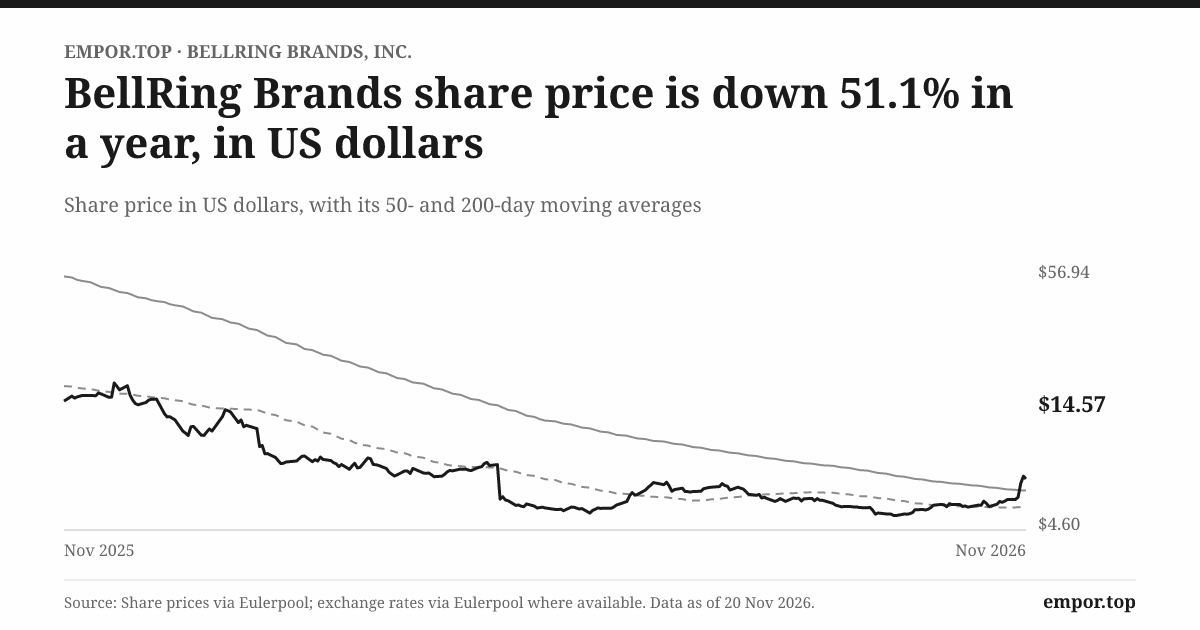
Underneath, the numbers ran the other way. Operating profit for the year fell to about $278 million from roughly $357 million, a drop of more than a fifth.1 Net income fell by almost a third, to about $147 million.1 BellRing sold more shakes than ever and kept noticeably less from each of them. On November 20, 2026, the shares closed at $14.57, about 56% below their 52-week high of $33.30.2 The low point of that same year, $7.40, tells its own story about how frightened the market had become before the partial rebound.2
That contrast is where this episode begins: more product sold, less profit made. It raises four questions that run through everything that follows. The first is whether Premier Protein's growth can last without heavier and heavier discounting, because the company's fourth-quarter volume surge came with a price/mix decline of about 8%.1 The second is whether margins can recover from the collision of protein input costs, promotions and inventory clean-ups that hit the business in fiscal 2026. The third is whether BellRing can keep buying back stock while reducing a debt load that has grown as profits shrank. The fourth, and the one that decides the others, is whether retailer access and brand leadership amount to a lasting advantage, or simply to a strong position in a crowded and fast-growing aisle.
A boundary needs to be set early. BellRing is the listed company. Post Holdings, the cereal and foods group, owned this business before the 2022 spin-off, and it no longer owns any of it.3 Much of the long financial record attached to BellRing's name was built inside Post, so that record is a history of the brands, not of BellRing as an independent public company.
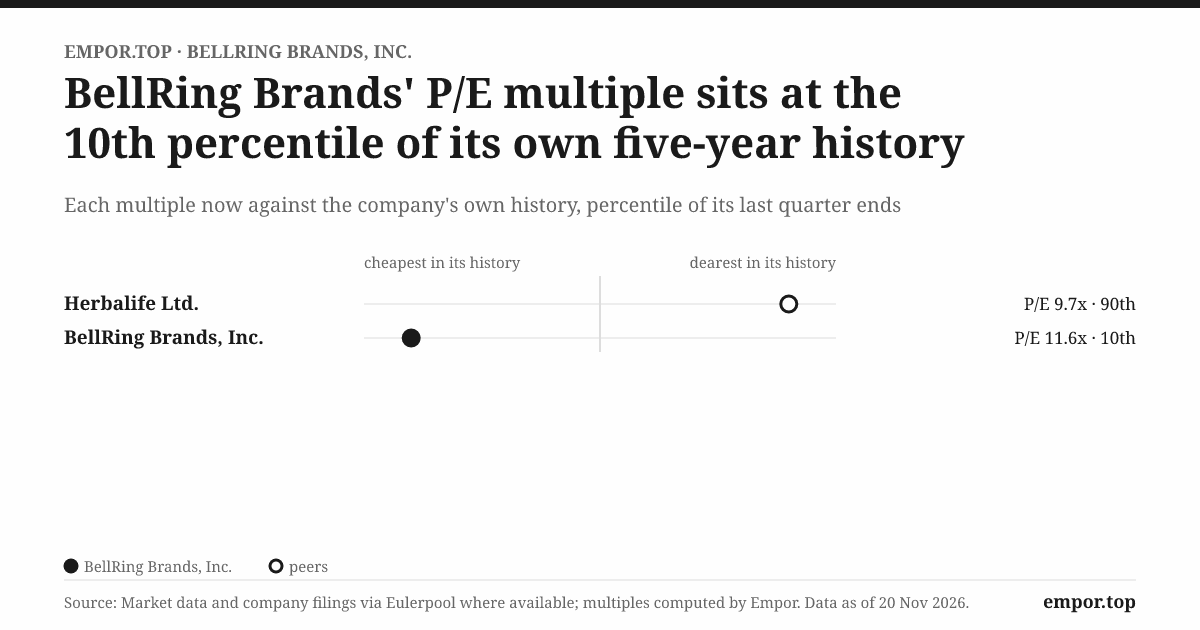
The market's verdict is unusually stark. At $14.57 the shares trade at about 11.6 times trailing earnings, against BellRing's own five-year median of about 32.6 times.2 A business that investors once priced like a premium consumer-growth story now trades at a multiple more often attached to slow, ordinary packaged food. That discount can be read two ways. Either the market is overreacting to a temporary disruption in an excellent brand, or it is correctly paying a lower price for earnings that have turned out to be lower in quality than the old multiple assumed.
The difference between those readings sits inside the shake itself. Premier Protein keeps winning shelf space and keeps finding new buyers. What is now under scrutiny is the price BellRing paid to win that space, and whether the shopper who picks up the carton at a discount will keep picking it up at full price. To answer that, the story has to go back to how the business came to be on the shelf at all.
 Subscribe on LinkedIn
II. The Business Post Put on the Shelf
BellRing did not begin in a garage or a founder's kitchen. It began as a line item. In the early 2010s, Post Holdings, freshly separated from Ralcorp and run by a team that liked to buy brands, assembled a collection of nutrition businesses. It bought Premier Nutrition, the maker of Premier Protein shakes and Joint Juice, in 2013, and then Dymatize, a sports-nutrition powder brand, and PowerBar in 2014.4 Inside Post the collection became the Active Nutrition segment. Nobody outside the company thought of it as a standalone business. It was one of several bets a cereal company had made on where American eating habits were heading.
The bet that mattered was Premier Protein. The others were respectable, but the ready-to-drink shake became the engine. By fiscal 2016, the first year in BellRing's long financial record, the business was already selling about $575 million a year, though it earned an operating margin of only about 5.5%.4 Over the following three years sales rose by roughly half and margins climbed toward 19%, as the shake moved from health-food shelves into the mainstream club and mass-retail channels.4
The Dymatize deal is a useful example of how Post built the portfolio, and of where the credit for it belongs. Post agreed to pay $380 million for Dymatize, subject to working-capital adjustments, and told investors it expected the brand to generate roughly $35 million to $38 million of EBITDA in 2014.56 That works out to roughly 10 to 11 times expected earnings before interest, tax, depreciation and amortisation. It is tempting to call that rich, and tempting to call it a bargain, depending on what one thinks Dymatize became. Neither verdict holds up well. No clean, like-for-like transaction benchmark settles the price, and the brand's later returns on that capital have never been separately reported. What can be said is narrower: the deal was Post's, made with Post's balance sheet, and BellRing shareholders inherited the brand rather than the decision.
By 2019 Post had a business large enough to be worth more on its own. In October that year BellRing Brands, Inc. sold 39,428,571 Class A shares to the public at $14 each, raising a little over $550 million.7 The structure deserves a careful look because it explains much of what came later. The newly listed BellRing owned only a minority economic interest in the operating business; Post kept the majority and control.7 The operating company took on debt at the listing, and in the old financial statements that debt and the accounting for Post's interest pushed reported shareholders' equity deeply negative almost from the first day.4
The real independence came in March 2022. On March 10 Post completed a spin-off, distributing 80.1% of BellRing to its own shareholders, and then sold its remaining stake by November 25, 2022.3 The $840 million of 7% senior notes that still sit on BellRing's balance sheet, due March 2030, are part of the capital structure the company carried out of that separation.3 So the listed entity of 2019 and the independent operating company of 2022 onward are different chapters of one book. The first was a controlled subsidiary with a public float. The second is a fully independent company that has to make its own decisions about cash, debt and capital returns.
Post's fingerprints did not vanish at once. Some BellRing directors held Post positions, and BellRing paid Post for management services until that agreement expired during fiscal 2026.3 More interesting is that Post still helps make the product. BellRing bought about $100 million of co-packing services from Comet Processing, a Post subsidiary, in fiscal 2026, up from less than $9 million in fiscal 2024.3 That is about 4% of sales and close to 6% of cost of goods sold. The company says those transactions are priced on arm's-length terms.3 The relationship is not large enough to dominate the economics, but it has grown quickly, and it means the former parent is now also a supplier.
Seen from a distance, the long record is spectacular. Revenue rose from about $575 million in fiscal 2016 to about $2.4 billion in fiscal 2026, a compound rate of about 15% a year for a decade.43 Few packaged-food businesses of any size can show that. But the line did not run straight, and profit did not track sales. Net income swung from about $123 million in fiscal 2019 to barely $24 million in fiscal 2020 as listing costs and Post-era financing bit, then climbed to about $246 million in fiscal 2024 before falling for two straight years.83 Cash from operations jumped around too, from about $226 million in fiscal 2021 to just $21 million the following year.8
That pattern is the honest summary of the inheritance. The brands and the operating machinery predate BellRing's independence, and much of the decade of growth happened while Post owned and directed the business. The long growth record is useful evidence that Premier Protein met a real consumer need. It should not be mistaken for a decade of standalone public-company execution, because the independent company has only about four and a half years of its own history, and the last two of them have been the hardest.
The spin-off settled who owned the brands. It could not settle the question that really mattered to the shareholders who now held them: would a concentrated portfolio of nutrition brands, one of which did almost all the work, keep growing once it had to stand on its own? The answer starts where the money starts, in the shopping cart.
III. The Shake Wins a Bigger Place in the Cart
Picture the moment of purchase, because the whole business model lives there. A Premier Protein shake is a convenience product with a nutrition label. It replaces a breakfast, rescues a skipped lunch, follows a workout or keeps a dieter full until dinner. It is portable, shelf-stable and needs no blender. Over the past few years it has also found a new audience in people taking GLP-1 weight-loss drugs who are told to protect muscle by eating more protein, a trend BellRing itself flags as a possible demand driver and risk.3 The shopper does not sign a contract. They buy a case when they run out.
That is exactly how BellRing earns its money. The company sells to retailers and distributors, and recognises revenue when product is delivered, with no long-term customer contracts, no minimum purchase commitments from customers and no subscription revenue to speak of.3 Every quarter's sales are therefore a fresh vote by retailers about how much shelf space and inventory to commit, and by consumers about whether to keep buying. Promotions, distribution points, volume and price/mix are the levers that matter, not contracted backlog.
The portfolio is far more concentrated than its list of brand names suggests. Premier Protein produced about 84.9% of fiscal 2026 sales, and ready-to-drink beverages as a format about 81%.3 Dymatize, the sports-performance powder brand, is the second meaningful business; PowerBar and the rest are small. BellRing reports a single operating segment, so there is no separate profit line for Premier or Dymatize and no way to say precisely which brand earns the better return.3 What the numbers do say clearly is that BellRing is, for practical purposes, a one-brand company with one dominant format.
The growth evidence for that brand is genuine. Premier Protein's volume rose about 8% in fiscal 2026, and in the fourth quarter its volume grew about 16%.1 Measured at the checkout, consumption of Premier's ready-to-drink shakes rose almost 9% in dollars in the quarter, which management called the strongest of the year.1 The brand held about 23.1% of the ready-to-drink protein category in the fourth quarter, the leading position, and reached about 22.4% of American households, with a repeat rate around 54%.9 Management told investors on the fourth-quarter call that the shake category itself grew about 11% in fiscal 2026 and that Premier's repeat rate is the highest in the category.10
Then comes the line that complicates everything. In the same fourth quarter that Premier's volume rose 16%, its price/mix fell almost 9%, and for the full year it fell about 5.5%.1 Premier's sales for the year therefore rose only about 2%, and BellRing's total only 3.5%.1 The company was explicit about why. BellRing attributed the volume gains to "incremental promotional activity and distribution gains," and the weaker price/mix to "incremental promotional investment."1
A simple analogy helps. Imagine a restaurant that fills every table on Tuesday by offering half-price entrées. The crowd proves people like the food enough to come in. It does not prove they would come at full price, and it certainly does not prove the restaurant is making more money. Premier's fourth quarter was a full house on discount night. That is not nothing: shoppers had alternatives and chose Premier. But it leaves open the question that matters most for investors.
The promotional context was not unique to BellRing. On the third-quarter call in August, chief financial officer Paul Rode said about 70% of the ready-to-drink category's volume had sold on promotion in that quarter.11 When seven of every ten shakes in an aisle are sold on deal, the "regular" price becomes something closer to a reference point than a real price. Promotion becomes the cost of staying visible rather than an occasional push.
The alternatives are real and well-funded. Coca-Cola's Fairlife sells Core Power and Fairlife protein shakes into the same occasion; Danone's Oikos protein drinks and newer entrants such as Nurri, sold through club stores, are also competing for the same shopper.12 In powders, Dymatize faces sports-nutrition specialists and private label. BellRing's $2.4 billion of sales is meaningful scale in this world, but the company does not report competitors' revenues or category-wide shares across every channel and format, so it is not possible to say from its disclosures exactly how fast rivals are gaining.
Club channels show how quickly the ground can move. Club stores account for roughly 40% of Premier's sales, according to S&P's analysis, and Premier's ready-to-drink consumption in that channel fell about 7% in the second fiscal quarter, after growing about 14% in the first.12 By the fourth quarter, management said club consumption had turned slightly positive while non-club consumption grew about 17%.10 In a business this concentrated, a reset in one channel at one retailer can swing a whole year.
That brings in the customers. Walmart alone accounted for about 35% of BellRing's fiscal 2026 sales, Costco about 24% and Amazon about 14%, together roughly 73.6%.3 No other customer reached 10%. Three buyers, each with immense purchasing power and the ability to give shelf space to a rival or to its own private label, decide how much of the BellRing story reaches the consumer. The relationship cuts both ways. Being a top supplier in a growing category at those retailers is valuable access that a new brand would struggle to replicate. But no one should mistake that access for leverage over the retailers. When retailers ask for deeper promotions to drive traffic, a supplier with three-quarters of its sales in their hands has limited room to refuse.
The supply side is concentrated too. BellRing relies on a limited supplier base, including one supplier for most of its milk-based protein, and it has a powder-supplier agreement with minimum purchase commitments through June 2028.3 Its shakes are largely made by contract manufacturers, some of whom require quarterly volume minimums; one major ready-to-drink manufacturer has an agreement running to December 2030.3 Those commitments secure capacity in a category where capacity has been scarce, but they can become a burden if demand or mix shifts.
The brand evidence has to be separated from any claim of technological advantage. BellRing spends less than 1% of sales on research and development, around $14 million in fiscal 2026.3 That is normal for a branded consumer-goods company and says nothing bad about the business. It does mean that the shake's formula, while carefully engineered for taste and shelf stability, is not protected by any patent or certification in the company's disclosures that a competitor could not work around. The moat, if there is one, is in the shopper's head and on the retailer's planogram, not in a laboratory.
Put the strongest evidence side by side and the picture is coherent. Premier has top-ranked category share, rising household penetration, a repeat rate that suggests real habit, and distribution gains that a weak brand would not win. Against that, retailers can choose among brands, shoppers can switch at the next price tag, and the very quarter that showed the brand's reach also showed its price falling. High repeat rates do not prevent falling price/mix if part of what is being repeated is the discount.
Management's own plan for fiscal 2027 turns this into a live experiment. The company announced low-double-digit price increases on shakes and further increases on powders, effective at the start of the new year, and said openly that it expects price elasticity greater than one, meaning volumes should fall by a larger percentage than prices rise.10 That is why the fiscal 2027 sales guide of $2.32 billion to $2.42 billion implies anything from a 3% decline to 1% growth.1 BellRing is no longer trying to buy volume. It is trying to find out how much of its volume stays when the price goes back up.
If Premier is genuinely the consumer favourite its share and repeat data suggest, it should hold most of its households and its shelf space as promotions ease and price/mix improves. If it cannot, the brand's leadership was rented, not owned. Either way, the first bill for winning the aisle had already arrived, and it landed squarely on the margin.
IV. The Cost of Winning the Aisle
The fourth quarter of fiscal 2026 should have been a victory lap. Sales hit a record, volume surged and consumption beat management's own expectations. Then came the profit line. Operating margin for the quarter fell to about 9.8%, from about 15.8% a year earlier.18 Gross margin, the share of each sales dollar left after paying for the product itself, dropped to about 22% from about 29%.1 For a business that a few years earlier kept more than a third of each dollar after making the product, that is a sharp fall. Part of the explanation, management said, was another round of inventory actions: about $16 million in the quarter, split between new reserves for slow-moving stock and extra trade spending to clear excess ready-to-drink bottles.1
To understand how a growing brand loses this much margin, it helps to walk through the bridge the way a shopper's dollar travels. Start with what it costs to make a shake. BellRing's main ingredient is milk protein, and in 2026 protein became one of the hottest commodities in food. The Associated Press reported in June that the world wanted more high-protein products than there was whey to supply them.13 BellRing's results release described the pressure as "significant input cost inflation (inclusive of tariffs)," together with higher freight.1 On the third-quarter call, Rode said he expected whey costs to stay elevated and freight pressure to "carry a bit into next year."11 So the cost of filling each carton rose.
Next comes realisation, the price BellRing actually collects. Every promotion funded by the supplier, every temporary price cut, rebate and display fee comes out of net sales. With price/mix down about 5.5% for Premier for the year, BellRing was collecting less for each unit just as each unit cost more to make.1 Those two forces alone explain most of the squeeze: costs up, prices down, and the gap between them is gross margin.
Then come the inventory actions, which are the most self-inflicted part of the year. The company recorded about $37 million of inventory-related headwinds across fiscal 2026, about $21 million before the fourth quarter and $16 million in it.1 Some of that came from an ingredient bought from a third party that did not meet quality standards, according to S&P's summary of the second quarter.12 Some came from simply having too many bottles. Excess inventory is a classic sign of a forecasting miss: a company orders capacity for growth it expects, the growth arrives in a different format or channel, and the surplus has to be written down or sold through on deal.
Finally there is advertising. BellRing raised marketing and consumer advertising to about $91 million in fiscal 2026, from about $75 million the year before and about $61 million in fiscal 2024.13 That is a deliberate choice to defend the brand while competitors spend, and it may be the right one. But advertising is only an investment if it eventually produces demand that pays full price. A rising advertising bill alongside rising promotional spend means BellRing was paying twice for the same shopper: once to make the shopper want the shake and once more to get them to buy it.
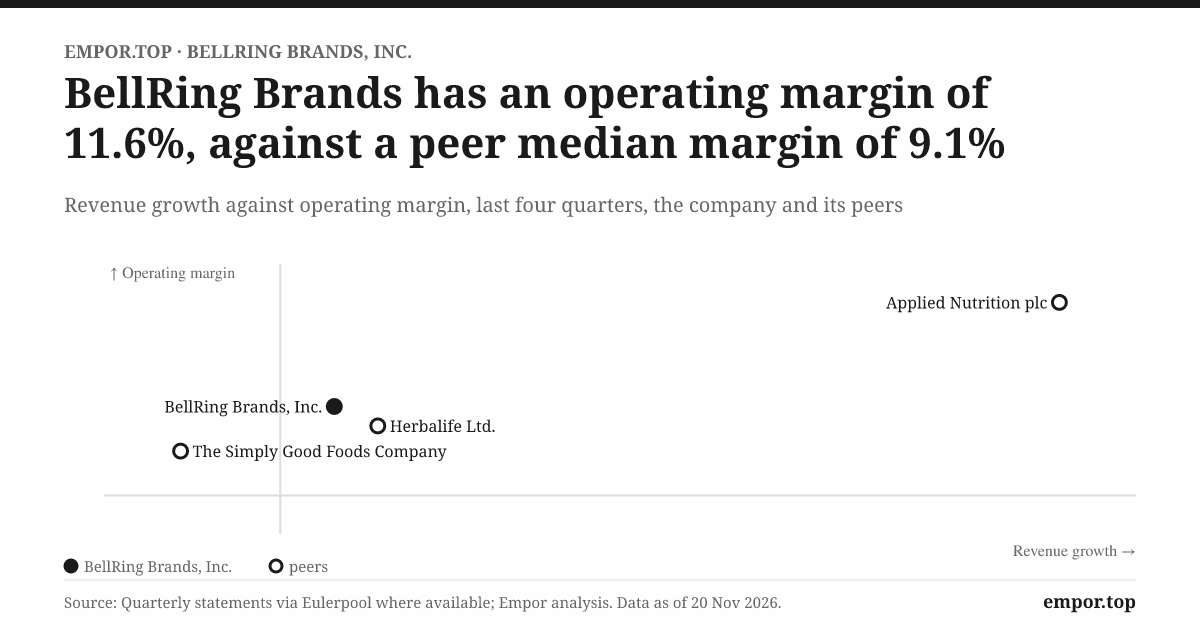
Separating the one-offs from the recurring economics changes the scale of the problem but not its direction. Add back the full $37 million of inventory headwinds and fiscal 2026 operating profit would still have been around $315 million, more than 10% below fiscal 2025.1 Operating margin would have been roughly 13%, still well below the 15.4% of fiscal 2025 and far below the 19.4% of fiscal 2024.18 The inventory story is real, but it is not the whole story. Costs and promotions did most of the damage.
The fiscal 2025 comparison needs one adjustment of its own. That year's administrative costs included a $69 million legal provision for the Joint Juice litigation, which concerned a joint-health drink the company discontinued in fiscal 2023.13 Without that provision fiscal 2025 profit would have looked even stronger, which makes the 2026 decline in underlying profitability larger, not smaller. Management's preferred measure, adjusted EBITDA, tells the same story starkly: it fell to about $289 million in fiscal 2026 from about $482 million, and the adjusted EBITDA margin fell from about 21% to about 12%.1
One feature of the cost structure deserves attention because it is easily misread. BellRing owns very little manufacturing. Capital spending has stayed below 1% of sales, and the company guided to just $3 million for fiscal 2027.13 That looks like a business that needs almost no reinvestment, and in the narrow sense of plants and machinery it is. But a contract-manufactured brand does not escape reinvestment; it moves it. The burden shifts to advertising, promotions, product development and the minimum-volume commitments it signs to secure third-party capacity. Little factory ownership means BellRing does not carry the fixed cost of idle plants, but it also means its main defences are expenses that run through the income statement every year.
The two brand trajectories show the trade-off clearly. Dymatize grew sales about 11% in fiscal 2026, with price/mix up about 9% and volume up slightly.1 That is the profile of a brand passing on cost inflation and keeping most of its customers. But the fourth quarter revealed the limit: Dymatize's price/mix rose about 18% while volume fell about 15%, and the company itself blamed "elasticities due to inflation-driven price increases" in its domestic business.1 Even the brand that took price paid for it in units. And Dymatize is far too small to offset Premier. Premier's realisation matters more than every other brand combined, because Premier is about 85% of the company.
Competitors validate the demand and intensify the fight at the same time. Fairlife's success proves that protein shakes are a mainstream occasion, not a niche. Its owner, Coca-Cola, has the distribution muscle to put shakes in convenience stores and grocery cold cases everywhere, and S&P cited competition from Fairlife, Oikos and newer brands as one reason for its downgrade.12 More brands competing for the same retailer shelf hand more bargaining power to the retailer, which can ask each supplier for deeper promotional funding. BellRing does not publish a competitor price or margin comparison, so there is no way to tell from its filings whether it is losing the price war, winning it, or merely matching it.
The management commentary across fiscal 2026 shows how the explanation for all this evolved. In August, on the third-quarter call, Michael Axelrod, then seven days into the CEO job, said the company had "not executed consistently at the level we expect ourselves," and described part of the pressure as "transitory."11 Management lowered its full-year adjusted EBITDA guide to $275 million to $295 million, citing freight and inventory actions, and guided to a fourth-quarter adjusted EBITDA margin of about 10%, assuming promotions would look more like the calmer second quarter.11 Asked where margins would settle, Axelrod declined to put "a stake in the ground," while Rode said the company did not see 2026 as its "new normal."11
The final numbers landed inside that lowered guide, with full-year adjusted EBITDA of about $289 million.1 But the fourth-quarter margin came in at about 9.6%, slightly below the roughly 10% guided, and the year's inventory headwinds grew to $37 million from the roughly $28 million management had expected.101 Those misses are small in isolation. Their pattern matters more: each quarter of fiscal 2026 brought a further inventory or cost item that the previous quarter had not fully anticipated.
By November the tone had changed. On the fourth-quarter call Axelrod said the company needed "to become more agile, more cost competitive and more disciplined in how we invest and execute."10 He withdrew the long-term growth targets BellRing had set in November 2025, announced a strategic review, and promised updated targets on the second-quarter call in May 2027.101 He also unveiled a cost programme aimed at at least $100 million of gross savings over three years, with about $25 million expected in fiscal 2027.10 That is a more specific plan than the third quarter offered. It is also an implicit admission that the old algorithm, built for double-digit growth at premium margins, no longer described the business.
The fiscal 2027 guide is where all of this comes to a point. Management expects adjusted EBITDA of $310 million to $350 million, about 14% of sales, on sales that are flat to slightly down.1 At the midpoint that is roughly 15% more EBITDA than fiscal 2026 from roughly the same revenue. Since sales are not expected to grow, almost all of that improvement has to come from margin: price increases sticking, inventory charges not recurring, the cost programme delivering, and protein inflation, which management expects to run in the high single digits, not overwhelming the gains.10 Some of the gap is simply the absence of fiscal 2026's inventory headwinds. The rest depends on a real recovery in gross margin. Shareholders will learn which within a couple of quarters. They will also learn whether the company can afford to wait, because the money had already been leaving through another door.
V. The Buybacks That Ran Ahead of the Cash
In fiscal 2025, the year before the margin collapse, BellRing's board made a bold capital-allocation call. It spent about $475 million repurchasing its own shares.3 That year the business produced about $256 million of free cash flow, the cash left after running the company and paying for capital spending.8 So BellRing returned almost twice the cash it generated, and the difference came from borrowing. At the time the stock was richly valued and the company was still guiding to strong growth. With hindsight, the timing looks unfortunate: the company was buying shares near the top of their valuation range, just before earnings began to fall.
The cash record needs to be told without flattening it. Over the eleven years from fiscal 2016 to fiscal 2026, cumulative cash from operations of about $1.5 billion exceeded cumulative net income of about $1.2 billion.483 That is healthy, the sign of a business whose profits are real cash rather than accounting entries. Over the same period the business also paid about $290 million in dividends, nearly all of them in the Post-controlled years between fiscal 2018 and fiscal 2021; it has paid none since.48 But the cumulative figure hides a sharp recent turn. Operating cash flow fell to about $126 million in fiscal 2026 from about $261 million the year before.1
Four things drove that drop. The largest was the Joint Juice litigation: BellRing paid about $90 million in fiscal 2026 to settle a New York case and a multistate case, after which the covered matters were dismissed with prejudice by May 2026.3 Lower net income took more. Non-cash gains on the company's commodity derivatives, which hedge protein and other input costs and run through cost of goods sold, flattered earnings relative to cash.3 And working capital moved with the timing of inventory and receivables. Strip out the legal settlement and fiscal 2026 operating cash flow would have been around $216 million, still down, but far less alarming. Even so, fiscal 2026 free cash flow of about $117 million was the weakest since fiscal 2022, the year of the spin-off.38
Buybacks slowed, but not immediately. BellRing spent about $137 million repurchasing shares in fiscal 2026, again more than the year's free cash flow.3 Most of it came early. S&P noted that the company had bought about $124 million of stock in the first half of the year while drawing on its revolving credit line.12 In other words, the company kept buying through the first months of the profit decline and largely stopped once the second-quarter results arrived. The weighted average share count fell to about 116 million in the fourth quarter, from about 124 million a year earlier.1 Shareholders who stayed own a larger slice of the company. Whether that slice was worth the price paid is a different question, and with the shares now far below where most of the fiscal 2025 buying took place, the early answer is unflattering.
The balance sheet shows the consequence. At September 30, 2026, BellRing carried about $1.05 billion of debt and held about $20 million of cash.3 Two years earlier its borrowings were about $840 million, essentially the senior notes alone.8 The extra roughly $210 million came from the revolving credit facility, which effectively funded the buybacks that cash flow did not. Interest expense rose to about $80 million in fiscal 2026 from about $68 million in fiscal 2025.3 Net debt of roughly $1.03 billion against fiscal 2026 adjusted EBITDA of about $289 million works out to roughly 3.6 times, a level management also cited on the fourth-quarter call.110
A note on the strange-looking equity figure is useful here. BellRing's reported shareholders' equity is negative, about minus $426 million at September 2026.3 To a casual reader that can look like insolvency. It is not. Negative book equity reflects the way the business was capitalised at listing and spin-off, when debt was raised and value distributed to Post, and it has been deepened by share repurchases, which reduce equity on the balance sheet.3 Plenty of healthy companies with heavy buybacks show negative equity. Book equity measures accumulated accounting capital, not liquidity. For liquidity, the relevant figures are debt, cash, revolver availability and cash generation, and those tell a tighter story than the equity line.
The debt itself is straightforward. The $840 million of 7% senior notes mature in March 2030.3 The $500 million revolver had $210 million drawn at year-end, and about $287.6 million still available after letters of credit.3 The catch lies in the credit agreement. It contains a so-called springing maturity: if the senior notes have not been refinanced or repaid by December 2029, the revolver's maturity springs forward to that date.3 Think of it as a lender saying it will happily lend for longer, but not if the bondholders are going to be paid ahead of it. The practical effect is that BellRing needs a credible refinancing plan well before 2030, and the terms it gets will depend on what its earnings and leverage look like in 2028 and 2029.
The credit markets have already started to price that test. In May 2026, S&P cut BellRing's rating to B+ from BB- with a negative outlook, citing "significant challenges facing its Premier Protein brand and elevated cost pressures."12 It projected leverage rising to about 3.7 times in fiscal 2026 from about 2.4 times the year before and warned it could cut again if leverage stayed above 4 times.12 Moody's had acted earlier and more gently: in December 2025 it affirmed BellRing at B1 but moved its outlook from positive to stable, setting brand strength, growth and liquidity against competition, customer and product concentration, and buybacks that exceeded free cash flow.14 Both agencies, in other words, named the buybacks as part of the credit problem.
Room to buy more remains. In November 2025 the board authorised up to $600 million of repurchases through November 2027, and about $507 million of that authorisation remained at the end of fiscal 2026.3 An authorisation is capacity, not a commitment. It tells shareholders what the board may do, not what it will do. On the fourth-quarter call management signalled that strengthening the balance sheet came first, though it stopped short of ruling out further repurchases.10
Ownership offers no controlling shareholder to force the choice. Post's stake is gone, and the largest holders are index and institutional managers. BlackRock reported about 7.7% and Goldman Sachs about 6.7% as of September 2026.1516 These are investment positions, not a block with a strategic agenda.
So the tension is clear. With the stock at roughly 12 times trailing earnings, the arithmetic of a buyback looks better today than it did in fiscal 2025. But the company has only about $20 million of cash, a revolver partly drawn, and a business that needs working capital for inventory, cash for promotions and roughly $80 million a year for interest. Buying cheap stock with borrowed money while ratings agencies watch leverage is a bet on the recovery, not a hedge against its failure. That bet now belongs to a new chief executive.
VI. The New CEO Arrives in a Confidence Test
On July 29, 2026, Michael Axelrod walked into BellRing's offices as president and chief executive.17 He was 58, and he came from a career built almost entirely in the less glamorous corners of American food. He had begun at Boston Consulting Group, then held executive roles at Kraft Foods, McCain Foods, Whirlpool and Pactiv.17 He spent five years at TreeHouse Foods, the private-label manufacturer, running its condiments division and serving as chief operating officer of its Bay Valley Foods business.17 After that came the top jobs at Passport Food Group, at Del Real Foods, a maker of Hispanic prepared foods, from 2019 to 2025, and most recently at Snak King, a salty-snack maker he had led only since July 2025.17 He holds an honours business degree from the Ivey Business School at Western University in Ontario and an MBA from Northwestern's Kellogg School.17
That résumé says something about why the board chose him. Axelrod is not a brand visionary from a glamorous consumer company. He is an operator who has run mid-sized, often family-influenced or private-equity-backed food manufacturers where procurement, supply chains and cost control decide whether there is any profit at all. His time at TreeHouse, a company whose whole business is competing on cost against branded products, is especially relevant to a brand now fighting promotional pressure. On his first call he named supply-chain execution and procurement as the areas to fix.11
He replaced Darcy Horn Davenport, who had led the business as chief executive through the 2019 IPO and the 2022 spin-off and who, the company said, had announced her intention to retire earlier in 2026.717 She left the board and became an adviser on the day Axelrod started.17 Her final full year of reported pay, fiscal 2025, totalled about $6.6 million, including about $4.4 million of equity awards. Under the proxy's "compensation actually paid" measure, which marks equity to its changing value, the figure was about minus $10.3 million, because her unvested stock had fallen so sharply.18 That number is a crude but honest gauge of how the share price treated the people paid in it.
The transition kept going. On November 18, 2026, the same day as the full-year results, BellRing announced that Paul Rode would step down as chief financial officer on December 1, 2026, and leave the company at the end of February 2027.19 The company said the departure did not result from any disagreement about its operations, policies or practices.19 His successor, Travis Leonard, 53, was selected through an external search. Leonard had been chief financial officer of Lockton, the private insurance brokerage, and before that of Hostess Brands, until J.M. Smucker acquired that snack-cake maker in November 2023; he had also held senior finance roles at Cardinal Health, Cargill and Kraft Foods.19 Hostess is an instructive credential: a branded snack company sold at a premium to a strategic buyer after a turnaround.
Axelrod's pay package shows what the board wants him to deliver. He receives a base salary of $1 million and a target annual cash bonus equal to that salary, with payouts ranging from zero to 150% of target.17 His initial equity award had a grant-date value of $4.75 million, split 40% into restricted stock units that vest in three annual instalments and 60% into performance units that vest after three years based on BellRing's total shareholder return relative to an industry peer group.17 The package also includes a $10,000 monthly housing and car allowance, severance of two times salary plus bonus, three times after a change in control, a cash transaction bonus equal to a year's salary in a sale, and a gross-up for excise taxes triggered by change-in-control payments.17 Leonard's package follows the same shape at a smaller scale, with an equity grant of $985,000 that is 80% performance-based.19
Two features stand out to a skeptical shareholder. The first is constructive: most of Axelrod's equity depends on beating peers' shareholder returns, so he does not get paid much for a rebound that the whole sector enjoys. The second is less so. Generous change-in-control protections and excise-tax gross-ups are provisions many governance-focused investors dislike, and for a company whose market value has fallen to about $1.7 billion, the new team has been handed clear rewards if BellRing is sold.172 That is not evidence of any plan to sell. It is a reminder that management's incentives and long-term owners' interests are aligned on some outcomes and not on others.
Award value is not the same as ownership. The appointment filing sets out what Axelrod was granted, but it does not say how many shares he will buy or hold, and the company's next proxy, due in the coming weeks for the fiscal 2027 annual meeting, will provide the first full record of his pay and ownership.17 Until then shareholders know how he is incentivised but not how much of his own money is at risk alongside theirs.
The board, meanwhile, had already received a warning. At the annual meeting in January 2026, Robert Vitale, the board chair and the former Post chief executive who oversaw the business when Post built and spun it out, received only about 73.9% support.2018 Say-on-pay drew about 82.4%.20 In large-company elections where support above 95% is routine, a quarter of the votes cast against the chair is a significant signal. It came after a year of falling profit and a volatile stock, and it probably reflected several grievances at once: performance, the board's ties to Post, and pay outcomes. The vote does not have a single explanation, and it should not be read as one. What it does establish is that a meaningful minority of shareholders wanted change before the CEO changed.
There is also a legal overhang. In January 2026 shareholders filed a securities class action alleging that BellRing made misleading statements about its performance and prospects over a period beginning in November 2024.3 A motion to dismiss was denied in part, a class-certification hearing was scheduled for December 3, 2026, and derivative actions remained pending; the company has not quantified any potential loss.3 The allegations are unproven. They matter here mainly because they concern precisely the period when management was guiding to strong growth and the board was buying back stock at high prices.
The question of credibility comes down to how the explanation has changed. During the leadership transition early in 2026, the problems were described largely as timing, mix and specific inventory issues. By August, with Axelrod a week into the role, the language had shifted to execution, discipline and transitory factors, and guidance was cut.11 By November the company had withdrawn its long-term targets, opened a strategic review, named a cost programme with a dollar figure and announced a price increase with an explicit warning that volumes would fall.10 The explanations became more specific over the three calls, and the latest guidance builds in the volume loss instead of hoping it away. That is what greater guidance discipline looks like. It is not yet evidence of operating repair; it is evidence of a more honest starting line.
Axelrod has had less than four months. He has no BellRing record to defend, which is both his freedom and his challenge. The hardest decision ahead of him is not about flavours or pack sizes. It is whether he will slow capital returns to protect the balance sheet while the business heals, or keep repurchases running ahead of operating repair. And that choice depends on how strong the brand's position really is when tested where it can break.
VII. The Advantage, Tested Where It Can Break
Every investment case for BellRing rests on a single claim: that Premier Protein is not just a popular shake but a franchise with durable economic power. The fiscal 2026 annual report contains the evidence for that claim and against it, sometimes on the same page. Premier leads its category with about a 23% share, and three customers account for nearly three-quarters of the company's sales.93 One brand produces about 85% of revenue, one format about 81%.3 Leadership and dependence sit side by side.
Michael Porter's five forces are useful here only because they map neatly onto the business's real pressure points. Buyer power is the most important. Walmart, Costco and Amazon together control about 73.6% of sales.3 They negotiate prices, promotions and shelf placement, and they can shift space to Fairlife, to a newer brand or to their own private label. Rivalry is intense, with roughly 70% of category volume sold on promotion in the third quarter of fiscal 2026.11 The threat of substitutes is broad: protein powders, high-protein yoghurts, bars, and ordinary food all compete for the same nutritional need. Supplier power is real in a year of whey scarcity, and BellRing's concentrated supply base and minimum-purchase commitments limit its flexibility.313 The threat of new entrants is moderate. Contract manufacturing makes it easy to launch a shake, but hard to win national distribution and the shopper's habit at scale.
Hamilton Helmer's seven powers offer a sharper test, because they ask which specific mechanism lets a company earn persistent returns above its competitors'. Most of the powers do not apply. BellRing has no network effects; one shopper buying Premier does not make the product better for another. It has no counter-positioning; incumbents can, and do, copy the format. It has no cornered resource, since the protein, the manufacturers and the formulas are available to rivals. Switching costs are close to zero; a shopper can pick up a different carton next week at no cost. Process power, the hard-to-copy operational know-how that a company like Toyota accumulates, is not visible in a business that outsources manufacturing.
That leaves two candidates: brand and scale economies. Brand is the strongest. A brand earns power when customers will pay more for it, or buy it more reliably, than an objectively similar product. Premier's evidence of the "more reliably" part is good: high repeat rates, rising household penetration, category-leading share.910 Its evidence of the "pay more" part is weak in fiscal 2026, because the brand's growth came with falling price/mix, and its powder business shrank in dollars in the fourth quarter even as shakes grew.1 Scale economies help with advertising efficiency, distribution and purchasing, but a $2.4 billion company buying protein in competition with Coca-Cola and Danone is hardly the largest buyer in the market.
So the claim has to be narrowed. History does not reject the idea that Premier has brand power; it has kept leadership through a brutal year, and consumers chose it when they had alternatives. But the record does not support the larger version of the claim, that BellRing owns a structural moat with pricing power. What survives is a brand-led position in a growing category: real, valuable and contestable. The test that would confirm a stronger version is unambiguous. It needs several consecutive quarters in which Premier's share and distribution hold or grow while price/mix turns positive and gross margin recovers.
The best counterevidence comes from BellRing's own record over the past two years. In fiscal 2024 the business earned an operating margin of about 19%, with revenue growing about 20%.8 That was the peak of the "premium brand with pricing power" story. Within two years, as competitors expanded and protein costs rose, the margin fell to about 12%.1 A truly entrenched brand might have defended more of its price. The speed of the collapse suggests the earlier margins depended partly on a favourable moment: a supply-constrained category in which demand exceeded what anyone could produce, so promotions were rarely needed. When supply caught up and rivals arrived, the pricing environment normalised.
Dymatize offers a second piece of evidence. It managed to raise prices in fiscal 2026, but its domestic volumes fell sharply in the fourth quarter as shoppers reacted.1 Even BellRing's better-performing brand did not have the kind of pricing power that lets a company raise prices without losing customers. That is not a failure; it is how most consumer brands behave. It is simply a reminder that the company's advantages operate within the normal laws of supply and demand, not outside them.
The competitive set should be seen in proportion. Fairlife, backed by Coca-Cola's distribution system, is the most formidable ready-to-drink rival. Simply Good Foods, the owner of Atkins and Quest, competes across bars, shakes and snacks in the broader nutrition aisle; Dymatize competes with specialist sports-nutrition brands. Those rivals' company-wide revenues are not directly comparable to BellRing's core shake market, so they say more about the breadth of competition than about share.
The category's supply side sets one more limit. Protein demand is expanding faster than whey supply, and when that happens, input costs rise before brands can raise shelf prices.13 A volume-growth strategy in such a market can increase the cost of the next unit before the brand has earned the price to cover it. That is precisely what happened in fiscal 2026. It means BellRing's growth and its margins can pull against each other until supply catches up with demand or pricing catches up with costs.
The cleanest test of the moat, then, is not a single quarter's share data but a pattern. Several quarters of steady share and distribution, combined with recovering price/mix and gross margin, would show a brand that commands its shelf. Share gains bought only with discounts would show a strong product in a commodity fight. The market has already started pricing which of those it believes.
VIII. Analysis & Bear vs. Bull Case
The shares remain well below their five-year valuation median.2 On enterprise value, which adds debt to the market value of the equity, the business trades at about 9.9 times EBITDA, and the stock offers a free-cash-flow yield of about 6.9%.2 For a category leader in one of the fastest-growing aisles of the grocery store, those are low numbers. They are also, critically, backward-looking. They measure the price against fiscal 2026 earnings, which may be a trough or may be the new normal.
The bull case is plain. Premier remains the leading ready-to-drink shake brand by disclosed category share, with high repeat buying and rising household penetration.9 The category grew about 11% in fiscal 2026, and management expects high-single-digit dollar growth in 2027.10 Penetration still leaves roughly three in four households without the brand, and distribution can widen beyond the big three retailers, including a push through direct-store-delivery distributors that management says now covers more than 25 distributors in 10 states.10 If inventory headwinds disappear, the price increases stick and the cost programme delivers, profit could rise faster than sales. In that world, today's multiple looks like a lasting misprice of a temporary disruption.
The bear case is just as plain. Growth has slowed from roughly 20% a year to low single digits, and management's own guide for fiscal 2027 allows for a decline in sales.1 Premier's price/mix weakened through the year, and promotions now seem to be the price of shelf presence. Profits have fallen two years running, and cash flow fell sharply in fiscal 2026. Retailer concentration remains high, and input costs remain high, with management expecting protein inflation in the high single digits in fiscal 2027.10 In that world, the old 30-plus multiple belonged to a company that no longer exists, and today's multiple may not be as cheap as it looks.
The fiscal 2027 guide is the hinge between those two cases. Adjusted EBITDA of $310 million to $350 million, about 14% of sales, compares with about $289 million and a 12% margin in fiscal 2026.1 The midpoint implies about $40 million more EBITDA from roughly the same revenue. Part of that should come simply from not repeating the $37 million of fiscal 2026 inventory headwinds, which, if it happens, would represent real cash and not an accounting adjustment.1 The cost programme's targeted $25 million of fiscal 2027 savings would add more.10 But adjusted EBITDA also excludes items that do recur in some form, and the gap between adjusted and reported earnings has widened. In fiscal 2026, adjusted EPS of $1.04 was actually below reported EPS of $1.25, because the reported figure was helped by gains on commodity hedges that the company strips out.1 Investors should watch whether the reported gross margin, not just the adjusted one, actually improves.
Comparison with Simply Good Foods illustrates how hard it is to anchor valuation in this sector. Simply Good Foods traded at about 7.5 times trailing earnings and about 0.8 times sales in November 2026, against a five-year median P/E of about 20.5 times.21 By that comparison BellRing looks more expensive than its nearest listed nutrition peer, not cheaper. Against its own history it looks far cheaper. The truth is that the whole branded-nutrition sector has been rerated as growth slowed and competition rose, and neither comparison by itself proves that BellRing is mispriced.
A skeptical investor or activist would focus on a few uncomfortable questions. Why did the board approve repurchases of nearly twice free cash flow in fiscal 2025, at multiples far above today's, while the company's leverage was rising? Why did the company keep buying in the first half of fiscal 2026, when the business was already slowing? Why does a company with about $20 million of cash and ratings agencies citing leverage still keep a $507 million buyback authorisation in place?312 And why did the inventory problems keep growing quarter after quarter? None of these questions proves mismanagement. Together they explain why the stock trades at a discount that probably includes some doubt about the board's judgment, not just about the protein market.
The risk radar is narrow but sharp. Input costs and supply are the most immediate: whey and other proteins can swing sharply, and BellRing's hedges only partly protect it.133 Refinancing risk grows with each year that leverage stays high and the 2029 springing maturity draws closer.3 Demand risk is more ambiguous: GLP-1 weight-loss drugs may increase interest in protein, but they may also change how much people eat in total.3 Execution risk is unusually high for a company with a new CEO, a new CFO and a strategic review all in motion at once. Litigation adds a measurable but unquantified overhang.3
Three measures matter most for following the story from here. The first is Premier Protein's price/mix alongside its volume, because only both together reveal whether the brand is winning on value or on discount; fiscal 2026 showed the gap widening.1 The second is gross margin with explained inventory actions separated out; the fourth-quarter results showed the pressure.1 The third is free cash flow after repurchases, together with net leverage; fiscal 2026 left little cushion, and leverage sat close to S&P's warning line.3112
A low multiple is evidence of skepticism, not evidence that the business has already recovered. The discount gives the recovery case room to work, but debt magnifies the cost if the margin slump lasts. The investment case depends far more on profitable volume and free cash flow than on how far the P/E has fallen from its own history.
IX. Playbook: Business & Investing Lessons
There is a single image that holds the entire BellRing story. In the fourth quarter of fiscal 2026, Premier Protein's share of its category stood at about 23%, its volume was up by double digits, and its price per unit was down by almost a tenth.91 The shelf was filling. The cash register was not keeping up. Every lesson in this story grows from that gap.
The first lesson is that a brand can win the cart and still lose the price. Premier's share, penetration and repeat rate are the envy of the aisle, yet the company's realisation fell because three retailers controlled most of its sales and the whole category was being sold on deal. Consumer love and supplier pricing power are different assets. Founders building a consumer brand should measure the second as carefully as the first, because the shopper's affection is worth only what the retailer lets you charge for it.
The second lesson is that distribution is an asset only when the next case earns its shelf. BellRing won new distribution points in fiscal 2026, and then had to fund trade spending to sell through excess bottles and take reserves on slow-moving stock.1 Shelf space is not a trophy; it is a lease that renews every week at the checkout. A brand that wins space with promotion has to keep paying for it, and a brand that wins it with demand gets paid for it. The difference shows up first in inventory and then in the margin.
The third lesson is that a buyback is a capital-allocation choice, not a confidence signal. In fiscal 2025 BellRing spent nearly twice its free cash flow on its own shares, financed partly by debt, near the top of its valuation range.38 Within a year the shares had collapsed, the ratings agencies were citing the buybacks as a credit concern and the company had about $20 million of cash.312 A board that buys back stock is making an investment decision, and it should be judged like one: on price paid, funding source and what it forgoes. BellRing's fiscal 2025 buyback is a textbook case of the confidence signal that turned into a constraint.
The fourth lesson is that a carve-out inherits a business, not a clean track record. Much of BellRing's dazzling decade of growth was built inside Post, with Post's balance sheet and Post's acquisitions. The independent company inherited the brands and the debt, and its own record, as a standalone company with its own capital-allocation decisions, is only a few years long. Investors who extrapolate a parent's success onto a newly separated company are often extrapolating something the new company never actually did.
The unresolved lesson concerns leadership. Credibility is not earned by a new CEO's arrival or a polished strategic review. It is earned in three steps: explaining the miss honestly, changing the operating result, and matching buybacks to cash. BellRing's new leaders have taken the first step. The other two are still ahead of them, and the market will not give them credit until both show up in the numbers.
X. Epilogue
Tonight BellRing stands at an unusual point for a company with a leading brand. It has a chief executive less than four months into the job, a new chief financial officer who starts on December 1, a strategic review under way, withdrawn long-term targets, and a fiscal 2027 plan that deliberately gives up some volume to rebuild price.10191 It also has about $1.05 billion of debt, about $507 million of unused buyback authorisation and adjusted EBITDA guidance of $310 million to $350 million.31 The next few quarters will show whether that plan is a reset or a retreat.
The first moment to watch is the first-quarter report of fiscal 2027, due early in 2027, which will show how shoppers reacted to the low-double-digit price increases that will take effect at the start of 2027.10 Management has told investors to expect volume to fall by more than prices rise. If Premier's share and household penetration hold up anyway, the brand case strengthens considerably. If share slips sharply toward Fairlife or newer rivals, or if promotions quietly return to defend volume, the moat claim weakens and the bear case gains ground. Share gains bought back through discounting would be the worst of both outcomes: lower price and no lasting gain.
The second is the margin path. Management expects gross and operating margin to improve through fiscal 2027 as inventory charges fall away, savings accumulate and price increases flow through.10 Investors should look for that improvement in reported figures, not just adjusted ones, with input costs, promotions and inventory effects distinguished. A margin recovery that depends on hedge accounting or on adjustments would be far less convincing than one that shows up in gross profit.
The third is the balance sheet. Free cash flow after any buybacks, net leverage against S&P's 4-times warning line and the approach of the December 2029 springing-maturity date will show whether the company is rebuilding flexibility or merely holding it.123 A company that resumes heavy repurchases while leverage is still around 3.6 times would be making the same bet it made in fiscal 2025, at a lower price but with less room for error.
Two other milestones will fill in the rest of the picture. The securities class action has a class-certification hearing scheduled for December 3, 2026, and its next procedural steps will show whether the litigation becomes a real financial overhang.3 And the next proxy will provide the first full record of the new leaders' pay and share ownership, and the next annual vote will show whether shareholder dissent around the chair and pay has eased or deepened.1820 Then comes the updated long-term outlook promised for the second-quarter call in May 2027, the first time Axelrod will put his own targets in public.1
The verdict could change in either direction. Sustained, profitable growth, with price/mix recovering alongside share, and steady debt reduction would validate the reset and suggest that the market's skepticism was too harsh. Continued price/mix pressure, more inventory surprises and buybacks running ahead of cash generation would deepen the bear case and suggest the old margin was the anomaly. The tension that remains is simple to state and hard to resolve: BellRing has to raise prices to repair its economics, and the brand has never been fully tested on whether shoppers will follow.
XI. Outro
Go back to that wall of protein shakes in the club-store aisle. It is longer than it was a few years ago, and there are more brands on it. More shoppers than ever reach for the Premier carton. That was never BellRing's problem. The problem is what the company keeps once the carton reaches the register, after all the costs of winning the sale.
The shelf keeps filling with protein, and only profitable repeat demand can make BellRing's lead last. BellRing has proved it can sell the shake. Now it has to prove it can keep the economics.
References
-
Q4 and FY2026 Results, Exhibit 99.1 — BellRing Brands, SEC, 2026-11-18 ↩↩↩↩↩↩↩↩↩↩↩↩↩↩↩↩↩↩↩↩↩↩↩↩↩↩↩↩↩↩↩↩↩↩↩↩↩↩↩↩↩↩↩↩↩↩↩
-
Form 10-K, FY2026 — BellRing Brands, SEC, 2026-11-18 ↩↩↩↩↩↩↩↩↩↩↩↩↩↩↩↩↩↩↩↩↩↩↩↩↩↩↩↩↩↩↩↩↩↩↩↩↩↩↩↩↩↩↩↩↩↩↩↩↩↩
-
Post Holdings Investor Presentation, Dymatize Transaction — Post Holdings, SEC, 2013-12-10 ↩
-
Form S-4/A, Dymatize Purchase Price — Post Holdings, SEC, 2014-06-13 ↩
-
Form 8-K, IPO closing — BellRing Brands, SEC, 2019-10-21 ↩↩↩
-
Q4 FY2026 Supplemental Presentation — BellRing Brands, SEC, 2026-11-18 ↩↩↩↩↩
-
Q4 FY2026 Earnings Call Transcript — The Motley Fool, 2026-11-18 ↩↩↩↩↩↩↩↩↩↩↩↩↩↩↩↩↩↩↩
-
Q3 FY2026 Earnings Call Transcript — StockAnalysis, 2026-08-04 ↩↩↩↩↩↩↩↩
-
S&P Downgrades BellRing on Weak Margins — Investing.com, 2026-05-13 ↩↩↩↩↩↩↩↩↩↩↩
-
The World Wants More High-Protein Products, but There's Not Enough Whey — Associated Press, 2026-06-12 ↩↩↩↩
-
Moody's Affirms BellRing at B1, Outlook to Stable — Investing.com, 2025-12-04 ↩
-
Schedule 13G — The Goldman Sachs Group, Inc., SEC, 2026-11-09 ↩
-
Form 8-K, CEO appointment and compensation — BellRing Brands, SEC, 2026-07-08 ↩↩↩↩↩↩↩↩↩↩↩↩
-
Form 8-K, CFO transition — BellRing Brands, SEC, 2026-11-18 ↩↩↩↩↩
-
Form 8-K, Annual Meeting Results — BellRing Brands, SEC, 2026-01-28 ↩↩↩
 LinkedIn
 WhatsApp
 Reddit
 Hacker News
 Email
 Kindle
 RSS Feed
 Spotify
 Apple Podcasts
 Amazon Music
 Audible
 YouTube