Blackbaud: The Software Behind the Donation
I. The Renewal Cohort That Put the Story on Trial
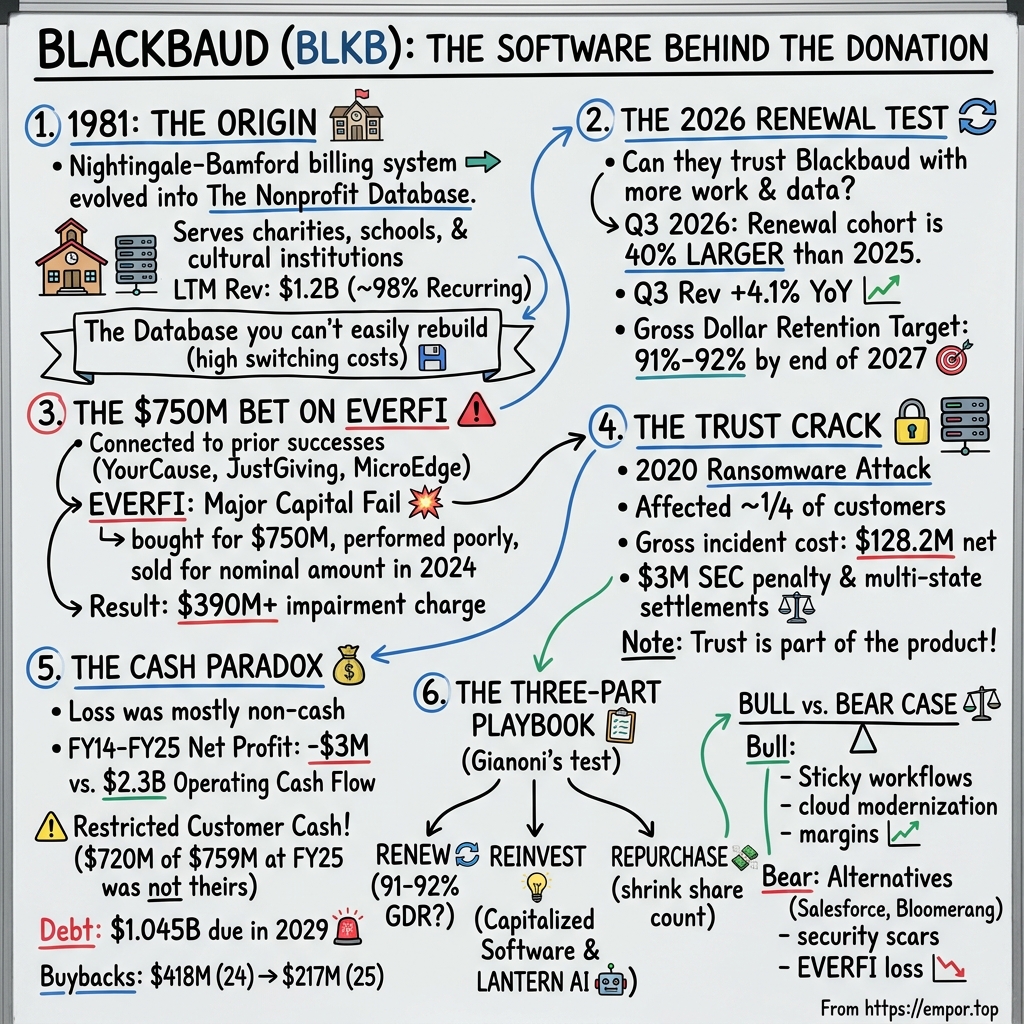
On the morning of October 28, 2026, Blackbaud's management team dialed into its third-quarter earnings call with two stories to tell, and the interesting part was how they fit together. The first was a story about the future. A few weeks earlier, at the company's bbcon conference in Columbus, Ohio, Blackbaud had unveiled Lantern, which it described as "the first domain-specific language model purpose-built to optimize fundraising intelligence," built in collaboration with Databricks and meant to sit inside a new architecture the company calls Platform for Good.1 The second story was about arithmetic. Chief financial officer Chad Anderson told analysts that Blackbaud's 2026 contractual recurring revenue renewal cohort was "approximately 40% larger than last year," and that this bulge was weighing on reported gross dollar retention and would keep moderating contractual growth "through the first half of 2027."2
CEO Mike Gianoni's explanation of the bulge was disarmingly plain. "It's just a high volume this year, that's all," he said, calling it "a kind of mathematical thing."2 And there is real logic to that. Blackbaud sells most of its software on contracts that run three years or longer. If an unusually large group of customers signed or renewed in the same year, that group comes up for renewal together, and every renewal is a moment when a customer can leave, negotiate, or shrink its order. A year with 40% more renewals is a year with 40% more exits available. Management expects the 2027 cohort to be nearly 25% smaller, and it expects gross dollar retention, the share of last year's recurring revenue that customers keep paying for, to return to "its historical norm of 91%-92% by the end of 2027."2
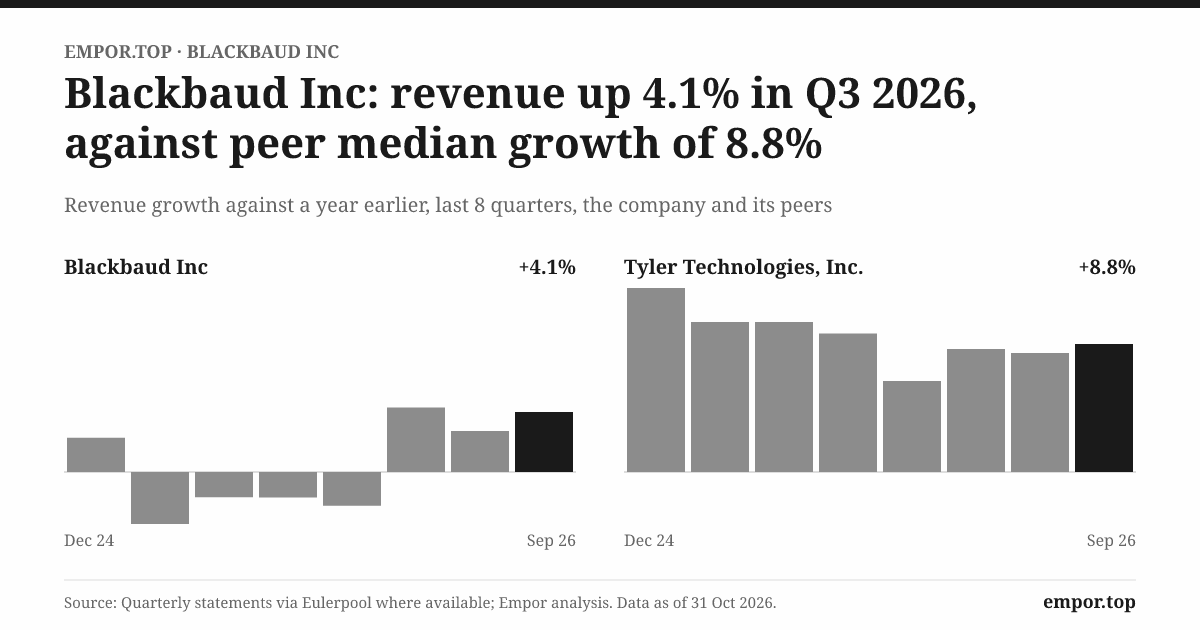
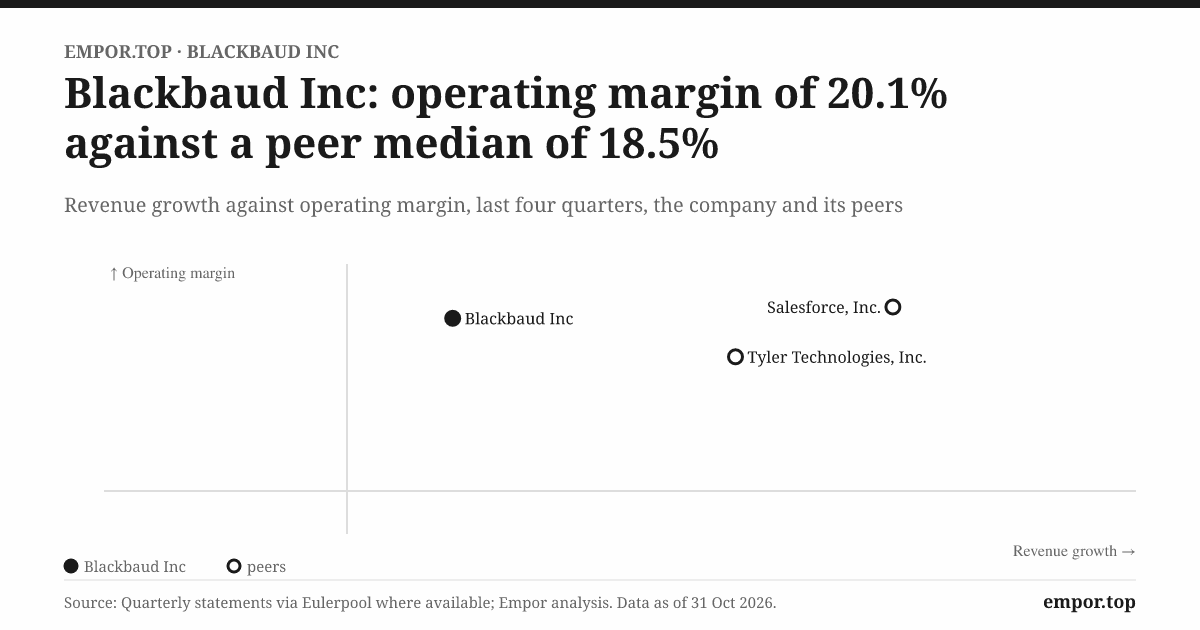
Notice what kind of statement that is. It is a forecast, delivered by the people whose compensation depends on it, about a number the company did not disclose for the current quarter on that call.2 The quarter itself was decent. Revenue rose 4.1% to about $293 million, recurring revenue made up 98.1% of the total, and GAAP operating margin reached 20.5%, up more than a percentage point from a year earlier.3 After a run of quarters in which reported revenue shrank, partly because Blackbaud had sold a business at the end of 2024, growth was back.34 Gianoni, never one to undersell, said in the press release that "innovation continues to drive our clear market leadership and a widening competitive moat."3
That sentence is the claim this story has to test. Blackbaud sits in an unusual place in the economy. When a donor gives to a university, a hospital foundation, a private school, a food bank or a museum, there is a good chance the record of that gift, the receipt, the event registration, the payment and the follow-up thank-you letter all pass through Blackbaud software. The company does not raise the money. It keeps the books of generosity. That position produces a business in which nearly every dollar of revenue recurs, which is the kind of profile long-term investors spend careers looking for.
But recurrence is not the same thing as permanence. A recurring contract is a promise to keep paying, renewed at intervals, and the 2026 cohort is the moment many of those promises come back up for a vote at once. So the question that hangs over Blackbaud now is simple to state and hard to answer: can it restore retention and growth while it asks customers to trust it with even more of their work and data, now including AI agents that draft appeals and identify prospects?
Three threads will carry the answer. The first is what actually makes customers stay, and whether that is a moat or merely inertia. The second is what the company's largest acquisition, a roughly $750 million bet on a business called EVERFI that ended in a sale for nominal consideration, says about the judgment behind management's bets.54 The third is whether today's mix of reinvestment, cost cutting and heavy share buybacks is building durable per-share value or simply rearranging the same cash. To understand any of them, the story has to go back to a single customer in New York and a problem that had nothing to do with fundraising at all.
 Subscribe on LinkedIn
II. One School’s System Becomes a Nonprofit’s Memory
In 1981, the Nightingale-Bamford School, a girls' school in New York City, needed a computerized billing system. Blackbaud's own retelling calls that "a transformational innovation in 1981," and says that "from that single customer and its success, Blackbaud began." The company adds, with evident pride, that the school remains a customer.6 The man who built the system was Tony Bakker, who, by the company's account, had answered a newspaper advertisement looking for someone to write student-billing software. "That software program turned into a product, and Blackbaud was born."7
It is worth pausing on how unglamorous this origin is. There was no grand vision of digital philanthropy, no venture round, no thesis about the nonprofit sector as an underserved software market. There was a school that had to send tuition bills and a man who could write the code to do it. Bakker then did what good vertical-software founders do: he noticed that other schools had the same problem, sold them the same answer, and kept going. The move that mattered came when the billing tool led to a second question. If a school could track who owed it money, could it also track who gave it money? From that adjacency came The Raiser's Edge, the donor-management product that, as Charleston's Post and Courier later put it, was "predominately purchased by fundraising groups and became the industry standard."8 Bakker moved the business to the Charleston, South Carolina region in 1988 and took it public in 2004.89
The pattern established in those years still defines the company. Blackbaud does not sell to consumers or to the general corporate market. It sells to institutions whose missions are not about software at all: schools and universities, charities, foundations, healthcare philanthropy offices, arts and cultural organizations, and companies that run employee-giving programs. Those buyers are often thinly staffed, risk-averse and reluctant to change systems, which is exactly why a vendor that embeds itself in their recurring work can stay for decades. Blackbaud's growth was not built on one blockbuster product so much as on accretion, adding tools for accounting, tuition, online giving, events, grants and payments around the core donor record.
Tonight Blackbaud is a standalone public company, a Delaware corporation listed on the NASDAQ Global Select Market, with one operating and reportable segment.4 That last detail matters more than it sounds: investors cannot see profit by product line or customer type, only the blended whole. In the spring of 2026, Blackbaud's largest shareholder was Clearlake Capital, a private-equity firm that held about 21% of the shares, but Blackbaud discloses no parent, no controlling holder and no related-party transactions with it.104 Clearlake is a large, patient minority owner, not the boss.
The shape of the business today is easy to describe once you sort revenue by how it arrives. In 2025 Blackbaud took in about $1.13 billion.4 Roughly $722 million of that was what the company calls contractual recurring revenue, mostly subscriptions and maintenance billed in advance under multi-year contracts. Another $384 million was transactional recurring revenue, the fees Blackbaud earns when money moves: donation processing, payment fees, tuition management and consumer giving. Only about $22 million came from one-time services such as implementation and consulting.4 Put together, about 98% of revenue was recurring.4 Over the last twelve months, revenue has run at roughly $1.16 billion.34
Those two recurring streams behave very differently, and the difference is the key to the whole business. Contractual revenue is the rent: a school or charity pays each year for the right to use the software, and the bill arrives whether or not it had a good fundraising year. Transactional revenue is the toll: Blackbaud takes a sliver of the flow when donors give, parents pay tuition or event-goers buy tickets. The rent provides stability and the toll provides upside, because when giving rises, Blackbaud's take rises with it without any new sale. The toll also means the company handles real customer money, which, as the cash story will show, complicates its balance sheet in ways a casual reader can easily miss.
Scale brought one more feature: diversity of customers. In its 2024 annual report Blackbaud counted nearly 100,000 customers paying transaction fees and about 40,000 with contractual billing arrangements.11 No single customer reached 1% of 2025 revenue.4 For a software company, that is about as fragmented as a customer base gets.
The base is also mostly American. About 16% of 2025 revenue came from outside the United States, chiefly the United Kingdom, where JustGiving and a long-standing local business sit, plus Canada, Australia and Ireland.4 Currency moves therefore nudge results rather than drive them; foreign exchange added only a few million dollars to 2025 revenue, and the company hedges part of its Canadian-dollar income and its sterling investment.4 For a listener trying to hold the shape of Blackbaud in mind, the picture is of an American institutional-software vendor with a meaningful British arm, not a global platform.
So the school-billing tool became, over four decades, something closer to an institution's memory: the place where a charity remembers who gave, how much, when, and what it promised them in return. That is a valuable position. But a memory system is only as valuable as the institution's willingness to keep it where it is. Recurring revenue is a description of what customers have done so far. Whether they keep doing it depends on what happens when the contract comes back up and someone in a development office asks whether there is a better way.
III. The Database a Charity Does Not Want to Rebuild
Picture the annual-fund office of a mid-sized private university on a Monday morning in December. The year-end giving push is on. One staff member pulls up a list of alumni who gave last year but not yet this year. Another checks whether a major donor's pledge payment cleared. A third is building the guest list for a spring gala and needs to know which trustees attended last time and what they gave afterward. All of that history, sometimes decades of it, lives in one database, linked to the payment records, the email campaigns, the receipts for tax purposes and the reports the board will read in January. Now imagine telling that office it has to move everything to a new system before the next campaign.
That imagined conversation is the heart of the bull case for Blackbaud, and it helps to understand the machinery behind it before deciding how much weight it can bear.
Blackbaud's contracts are generally three years long, non-cancelable and billed annually in advance, with price increases applied at renewal and annual escalators built into many agreements.4 On the third-quarter call Gianoni said about 90% of contractual recurring revenue was on contracts of three years or longer and about 25% on four years or longer, "up from 20% earlier in the year."2 Annual billing in advance is a gift to the vendor's cash flow: the customer pays for the year before it uses the year, so Blackbaud collects cash ahead of recognizing revenue. It also explains one of the quieter improvements in the company's numbers. In 2014 Blackbaud's receivables equaled about 50 days of revenue; by 2025 they equaled about 26.4 Customers are paying faster, or are on terms that bill and collect more efficiently, and the company carried a modest allowance for doubtful accounts of under $6 million against roughly $80 million of receivables at the end of 2025.4 That is evidence of a well-run billing machine and a customer base that does not, in aggregate, struggle to pay. It is not, on its own, evidence of loyalty.
On top of the rent sits the toll. Transactional revenue rises with donation volume and payment activity, so it carries seasonality and the occasional surprise when a disaster or viral cause sends giving surging.4 In 2026 Blackbaud added a new lever here: a platform fee on certain online form transactions, which donors can choose to cover.12 Gianoni described it on the third-quarter call as "a catch up because pretty much everyone else has a platform fee."2 That comment cuts both ways. It suggests Blackbaud had room to charge more, which is a sign of pricing headroom. It also concedes that the fee is a competitive norm rather than a unique power.
The toll is now a large part of the machine. On the first-quarter call in April, Gianoni told Evercore ISI's Kirk Materne that "more than a third of our company is transaction-based pricing now," and the 2025 revenue split bears that out.134 That changes how the business should be read. A pure subscription vendor's fortunes rise and fall almost entirely with renewals. Blackbaud's also rise and fall with how much money its customers raise, which is why management pointed out in October that holiday giving and viral giving events had been minimal in the third quarter.2 When a disaster or a celebrity campaign sends money flooding into charities, the toll fills. When giving is flat, it does not. In practice this makes the transactional line a modest hedge against the renewal problem, because it grows with donor activity even if a few contracts shrink, but also a reminder that part of Blackbaud's revenue is borrowed from the health of American philanthropy.
Why switching hurts, and why it is not impossible
The switching cost is real and easy to explain by analogy. Changing donor databases is less like switching email providers and more like moving a library while the readers are still using it. Records have to be cleaned and mapped field by field. Years of custom codes and reporting conventions have to be translated. Payment integrations have to be rebuilt and tested. Staff have to be retrained, usually in the middle of a fundraising calendar that never really stops. If the migration goes wrong, a charity can lose track of pledges, misreceipt donors or miss a campaign window. For an organization with a five-person development team, that risk alone can justify paying a price increase.
But plausible switching costs are not proof that customers cannot leave, and Blackbaud's own disclosures are a reminder that the alternatives are many. The company names Bloomerang, DonorPerfect, Salesforce and its partners, Virtuous, Bonterra, Benevity and a range of other specialist vendors as competitors across its markets.4 Some of those are focused donor-management tools that compete on simplicity and price for smaller organizations. Salesforce brings a general-purpose customer-relationship platform with a large partner ecosystem that can be configured for nonprofits, which is exactly the threat to a specialist: the big platform that is good enough everywhere. Benevity competes for corporate-giving programs. In other words, Blackbaud is not the only library in town. It is an established one, with heavy shelves, in a market where smaller and lighter libraries keep opening.
The customer base itself shapes the forces at work. Because no customer is even 1% of revenue, no single buyer can squeeze Blackbaud on price.4 The company does not publish what share of revenue comes from its top five or top ten customers, so investors cannot tell whether a handful of large universities or health systems carry outsized weight in the contractual line.4 Fragmentation protects the vendor in negotiations but does not lock anyone in. A thousand small charities each deciding independently that a cheaper tool will do is a slower, quieter form of buyer power than one giant customer demanding a discount, and it shows up in exactly one place: retention.
The 91% question
That brings the story back to the renewal cohort, which is best read as evidence rather than as an excuse. Blackbaud says its gross dollar retention has historically run at 91% to 92%.2 Put plainly, in a normal year customers representing roughly eight or nine cents of every dollar of recurring revenue leave or downsize. For a business whose customers face painful migrations, that is respectable but not extraordinary. The best enterprise software vendors selling to large corporations often retain more; vendors selling to small businesses often retain less. Blackbaud's base mixes large institutions with thousands of small charities, so its number sits where one would expect.
The more revealing detail is how management has described that norm over the year. On the second-quarter call in July, Anderson said he expected gross dollar retention "to climb back to our more recent norm of 91%-92% by the end of 2027," and acknowledged "a near-term dip in reported gross dollar retention."12 By October, the same range had become "its historical norm."2 The difference between "more recent" and "historical" is small, but it is the kind of drift careful listeners should note: the earlier phrasing implied that the norm had itself moved over time. On the first-quarter call in April, the retention dip did not come up at all in the discussion, even as management reaffirmed guidance.13
Analysts did push, though gently. On the July call, Robert Oliver of Baird asked about new logos and the bridge to guidance; Gianoni's answer on retention was that "the results of the quarter and the guide moving to the upper half is all in our plan," without a current retention figure.12 In October, Peter Burkly of Evercore ISI asked directly about renewal rates, price increases and attachment of new products against plan. Gianoni said renewals were "going as planned" and described offering the new Development Agent at renewal, but gave no attach rate or pricing figure.2 Across three calls, then, management explained why the cohort was large in mechanical terms, consistently guided to recovery by the end of 2027, and declined to quantify how the 2026 renewals were actually landing. That is not evasion in the sense of contradiction. It is a choice to ask investors to wait for the outcome.
There is one piece of hard evidence management did offer, and it deserves a closer look. The share of contractual revenue on four-year-or-longer contracts rose from about 20% to about 25% during 2026.2 Longer contracts are a double-edged signal. On one hand, a customer willing to commit for four or five years is telling the vendor it does not expect to leave soon. On the other hand, vendors often win longer terms by trading something for them, typically a gentler price escalator or a bundled product, and Blackbaud has been offering its new Development Agent at renewal.2 A renewal season that lengthens terms and attaches new products could be a sign of strength or a sign that the company is paying to lock customers in before the alternatives look better. The difference will show up in price realization, which Blackbaud does not break out.
What would falsify the moat claim? Not a single weak quarter. The test is whether, once the bulge passes, retention returns to the low 90s while price increases stick. If retention recovers but only because Blackbaud stopped raising prices, the moat is narrower than it looks. If it recovers with price increases intact and new products attached, the switching cost is doing its work. If it settles below 90%, the inertia explanation weakens and the alternatives are winning more often than management admits.
For now the honest conclusion is a narrowed version of the bull claim. Workflow depth and decades of accumulated donor history plausibly give Blackbaud genuine switching costs, which is why customers stay through price increases and why the company can bill a year in advance. Its disclosures do not establish a cornered market, and its retention record shows a sticky but leaky system rather than a locked one. A system can be hard to replace and still lose renewal value, if customers find a better fit or stop believing the vendor deserves their trust. Blackbaud has been tested on both counts. The first test came from an acquisition that promised to make the library much bigger.
IV. The $750 Million Bet on EVERFI
On January 3, 2022, Blackbaud announced that it had acquired EVERFI, a company led by its founder Tom Davidson that sold digital learning programs which corporations sponsored as part of their social-impact and ESG initiatives, reaching millions of learners each year.5 The price was approximately $750 million, made up of about $450 million in cash and roughly 3.8 million Blackbaud shares valued at about $300 million.5 The pitch was big. Blackbaud said the deal would double its total addressable market to more than $20 billion, "with over half of Blackbaud's addressable opportunity now in the corporate sector," and that EVERFI would add an estimated $120 million of 2022 revenue growing at a rate "approaching 20%."5 EVERFI, the company noted, had reached more than 45 million learners.5 Pro forma net leverage at closing would be about 3.4 times.5
To understand why management made that bet, it helps to see the pattern that preceded it.
A habit of buying adjacency
Gianoni arrived as chief executive on January 13, 2014, from Fiserv, the financial-technology giant, where he had run its Financial Institutions Group; before that he had led CheckFree's investment services business, which Fiserv acquired in 2007.14 He brought a payments-and-processing operator's instincts to a company that had grown up around school software and donor databases, and an early move signaled the strategy. In October 2014 Blackbaud completed its purchase of MicroEdge, a grant-management software provider owned by Vista Equity Partners and Bregal Sagemount, for $160 million. "For investors, we're enthusiastic that this acquisition expands our total addressable market by over $600 million," Gianoni said at the time.15 The phrase "total addressable market" would recur.
In October 2017 Blackbaud closed the acquisition of JustGiving, the London-based peer-to-peer giving platform, for about £95 million, or roughly $127 million. People in 164 countries had raised more than $4.5 billion through it since 2001.16 In January 2019 it paid about $157 million for YourCause, a Texas company that sold corporate-philanthropy and employee-giving software to employers.17 Each deal followed the same logic: find a product that touched the same flow of charitable money from a different angle, buy it, and sell it into Blackbaud's customer relationships.
EVERFI was that logic at a different scale. At about $750 million it cost nearly five times what Blackbaud had paid for either YourCause or MicroEdge and about six times the JustGiving price, and it was equal to roughly four-fifths of Blackbaud's entire 2021 revenue.54 These are not clean valuation comparisons, because Blackbaud did not consistently disclose the target revenues for its smaller deals. But the one number it did give for EVERFI is revealing: paying $750 million for an expected $120 million of revenue meant paying more than six times next-year sales for a business whose profitability the company did not spell out.5 The bet was that EVERFI's corporate sponsors would pair naturally with YourCause's corporate-giving clients, and that Blackbaud could become the software layer for corporate social impact, not just for charities.
The first full year of ownership offered an early warning. In 2022 Blackbaud's revenue jumped about 14%, the fastest growth in years, almost all of it bought rather than built. Yet operating profit swung to a loss of nearly $30 million, and the company reported a net loss for the year.4 Acquisition accounting, integration costs and the amortization of EVERFI's intangible assets explained part of that, but the pattern was the opposite of what a growth acquisition is supposed to deliver: more revenue and less profit. Leverage, meanwhile, had climbed to the roughly 3.4 times that management had flagged at closing.5 Investors were being asked to wait for the cross-selling to arrive.
How the story ended
The record answers whether it worked. In December 2024 Blackbaud announced an impairment charge related to EVERFI's assets.[^18] By the time the year closed, the total cost of exiting was about $405 million: roughly $390 million of noncash impairments plus a loss on disposal of around $15 million.4 On December 31, 2024, nearly three years after the deal was announced, Blackbaud sold EVERFI for nominal consideration.4[^19] The company said the sale primarily explained why its reported revenue fell in 2025.4
Three years from "doubles our TAM" to a sale for essentially nothing is a falsification, not a mixed result. The strategic logic was coherent on paper: adjacency, cross-selling and access to corporate budgets. The outcome was a major capital-allocation failure. The investors who paid for it were Blackbaud's own shareholders twice over: once through roughly $450 million of cash, much of it borrowed, and once through the issuance of new shares, which management has since spent heavily to buy back.
It is worth keeping the conclusion proportionate. EVERFI was small relative to the continuing core, and selling it removed a business that was dragging on growth and margins. Some of the margin recovery that followed reflects the absence of EVERFI's costs as much as any new efficiency. The impairment was noncash in the year it was booked, but the cash had already left years earlier; an impairment is simply the accounting moment at which a company admits the money is not coming back.
What changed afterward? Management has not publicly laid out a revised acquisition hurdle rate. What it has done is shift its stated capital-allocation priorities. On 2026 calls it set a target of deploying "50% or more" of cumulative 2026 to 2030 free cash flow to share repurchases, while leaving room for what it calls tuck-in acquisitions and debt reduction.2 That is a tacit answer: fewer big swings, more buying back its own stock. Whether that is discipline or simply a different bet is a question for the capital-allocation chapter. First, the accounting has to be untangled, because the EVERFI write-down produced one of the strangest-looking income statements in mid-cap software.
V. The Loss That Was Mostly Not Cash
In 2024 Blackbaud reported a net loss of about $299 million, a figure that, on its own, would describe a company in serious trouble.4 Yet in the same year its operating activities generated about $295 million of cash, the most in at least a dozen years.4 A business lost nearly $300 million and produced nearly $300 million at the same time. Both statements are true, and reconciling them is the most useful exercise an investor can do with this company's financial statements.
Start with the long view. Across the twelve years from 2014 through 2025, Blackbaud's reported net profit added up to roughly zero, slightly negative in fact, while cash from operations added up to about $2.3 billion.4 That gap is far too large to be a rounding difference. It is the signature of a business whose accounting earnings are weighed down by large noncash charges.
Where the missing profit went
The biggest single item is the EVERFI write-down, about $390 million of impairment in 2024 alone, which reduced earnings without moving a dollar of cash that year.4 Next come the recurring noncash charges. Depreciation and amortization, which spreads the cost of software, data centers and acquired intangible assets over their useful lives, ran at about $122 million in 2024 and $86 million in 2025.4 Stock-based compensation, the value of shares granted to employees, ran at about $105 million and $93 million.4 Then there is timing: because Blackbaud bills a year in advance, it collects cash before it earns revenue, so a growing base of prepaid contracts adds cash ahead of profit.4
Not every one of those add-backs is a free lunch, and this is where the long-run cash record needs a second look. Amortization of acquired intangibles is the echo of cash spent on acquisitions, including EVERFI. Stock compensation is a real cost paid in shares instead of cash; shareholders bear it through dilution, or, in Blackbaud's case, through the cash the company spends buying those shares back. A business that reports $2.3 billion of operating cash over a decade, while handing employees around $100 million a year of stock, is generating real cash, but less of it belongs to existing shareholders than the operating-cash line suggests.
After subtracting capital spending, including the software development costs Blackbaud capitalizes, cumulative free cash flow over the twelve years came to about $1.6 billion.4 Dividends absorbed about $141 million of it, before the company stopped paying them in 2020.4 Since then, buybacks have become the dominant return of capital, and that choice will matter in the next chapter.
The recent trajectory is clearly better. Operating margin climbed from under 5% in 2023 to about 17% in 2025 and to 20.5% in the third quarter of 2026.43 Some of that came from the EVERFI exit and lower amortization, and some from the cost programs management has pursued.4 For 2026, Blackbaud guided to non-GAAP free cash flow of $280 million to $290 million and said in October it expected to land "at or above the high end."32 Measured against a market value of roughly $2.5 billion, that is a free-cash-flow yield around 11%, which is a large number for a software company and a sign of how skeptical the market has been.
The cash headline that is not what it seems
Now comes the correction that matters most. At the end of 2025, Blackbaud's balance sheet showed about $759 million of cash and short-term investments, a striking jump from about $68 million a year earlier.4 A casual reader might conclude the company was suddenly flush. It was not. Of that total, only $38.9 million was cash and equivalents available to the company. The other $720.1 million was restricted cash: money collected on behalf of customers, mostly donations and payments in transit, held in segregated accounts and owed to the charities and schools it belongs to.4
The restricted pile swells and shrinks with the giving calendar. Year-end is the peak of charitable giving in the United States, so December balances are high; by September 30, 2026, restricted customer cash had fallen to $428.2 million, while unrestricted cash and equivalents were $35.7 million.18 The toll business, in other words, means Blackbaud holds large sums of other people's money at any moment, and none of it can pay down debt or fund a buyback.
Against that modest pool of its own cash sits material borrowing. At September 30, 2026, debt carried on the balance sheet was about $1.045 billion, made up mostly of term loans and revolving credit, with a small amount of real-estate debt.184 Net leverage, as defined under the company's credit agreement, was 2.29 times, comfortably within a 3.75-times ceiling, and interest coverage was 6.74 times against a minimum of 2.5.18 Blackbaud reported compliance with its covenants.18 The concentration to watch is time: about $999 million of principal comes due in 2029.4 Blackbaud does not disclose a current credit rating in its filings, so the company's own covenant math is the main public evidence of its credit standing.18
A rough worked example shows how much room that leaves. Management's 2026 guidance calls for adjusted EBITDA of about $430 million to $438 million.3 At the covenant ceiling of 3.75 times, that level of earnings would support well over $1.5 billion of net debt, so Blackbaud is not close to the wall. The pressure point is not the covenant but the calendar. Interest expense is expected to run between $62 million and $66 million in 2026, a meaningful slice of free cash flow, and the bulk of the debt has to be refinanced in a single window in 2029.34 If the business is growing and retention has recovered by then, refinancing should be routine. If retention is still dipping and credit markets are tight, the same maturity becomes a constraint on buybacks and investment at exactly the wrong moment. The company also carries about $164 million of minimum purchase commitments for third-party technology and services through 2030, mostly cloud and software suppliers, which are fixed obligations against a revenue line that is partly variable.4
The verdict on the loss year is straightforward. The 2024 net loss is not a good proxy for Blackbaud's ongoing earnings, and the company has generated real cash across the cycle. But the cash history overstates how much discretionary liquidity the company has. Its own cash is thin, its customers' cash is large but untouchable, its debt is material, and software investment and buybacks are competing for the same free cash flow. Management can fund the product, pay down the 2029 maturity, or keep shrinking the share count. It cannot do all three at full speed. And before it could argue about any of them, it had to survive a crisis that put the trust behind the entire business on trial.
VI. The Breach That Made Trust Part of the Product
In 2020, while the world was distracted by the pandemic, a ransomware attacker broke into Blackbaud's systems and stole data. On July 16, 2020, Blackbaud went public with the incident and told the world that the attacker "did not access donor bank account information or social security numbers."19 The incident had touched more than 13,000 of its customers: universities, hospitals, charities and the donors whose records they held.19
Then, according to the Securities and Exchange Commission, something worse happened inside the company. Within days of that announcement, Blackbaud's technology and customer-relations staff learned that the attacker had in fact accessed and exfiltrated donor bank-account information and Social Security numbers. They did not pass that knowledge to the senior managers responsible for public disclosure, because, the SEC found, the company "failed to maintain disclosure controls and procedures" adequate to make sure they would.19 When Blackbaud filed its quarterly report in August 2020, it omitted the information and described the risk of sensitive data exposure as hypothetical.19 The company later corrected its account.
That sequence matters more than the breach itself. Ransomware attacks hit well-defended companies every year; no serious investor expects any vendor to be impregnable. What a customer buying a system of record is really purchasing is the confidence that, if something does go wrong, the vendor will tell it the truth quickly. Blackbaud's failure was therefore twofold: a security failure, and a disclosure failure that left charities and schools making decisions about notifying donors based on an incomplete picture.
The bill, and what it does not measure
The consequences arrived slowly and then all at once. In March 2023 the SEC charged Blackbaud with making misleading disclosures; the company agreed, without admitting or denying the findings, to pay a $3 million civil penalty. "Public companies have an obligation to provide their investors with accurate and timely material information; Blackbaud failed to do so," said David Hirsch, chief of the SEC Enforcement Division's crypto assets and cyber unit.19 In October 2023 Blackbaud settled with 49 state attorneys general and the District of Columbia for $49.5 million, committing to improve its cybersecurity programs and not to make misleading statements about data protection and breach notification.20 Gianoni's statement at the time said the company was "continually strengthening our cybersecurity and compliance programs."20
Over the years, Blackbaud has recorded about $178 million of cumulative gross expense related to the incident, offset by $50 million of insurance recoveries, for a net cost of roughly $128 million; the expense in 2025 had dwindled to about $3 million.4 By the end of 2025 the consumer class actions had been resolved and the company carried no recorded liability for incident-related loss contingencies, but two insurance-subrogation cases, in which insurers who paid out to Blackbaud's customers seek to recover from Blackbaud, remained active and unresolved.4 The auditor's opinion on the 2025 financial statements and internal controls was unqualified, with no material weakness identified.4
It would be a mistake to treat those settlement totals as the full measure of harm. They capture what regulators and litigants could extract. They do not capture the hours that development offices spent notifying donors, the boards that asked whether to keep the vendor, or the sales cycles that grew longer because a prospective customer's IT committee had read the headlines.
Did the customers walk?
Did the breach change renewal outcomes? Blackbaud does not attribute churn to the incident in its filings and does not publish any customer-level measure of trust, so the honest answer is that investors cannot tell directly.4 What can be said is that the timing is suggestive without being conclusive. The incident broke in 2020; Blackbaud's revenue growth was already slowing that year, and the multi-year contracts signed or renewed around then are part of the renewal waves that followed.4 Contracts that run three years or more mean that a customer's verdict on a vendor's behavior often arrives one or two renewal cycles later. Management has framed the 2026 cohort as volume, not dissatisfaction.2 That may well be right. The data that would prove it, renewal rates by customer vintage or reasons for churn, is not something the company publishes.
The breach also changed the meaning of every new product Blackbaud launches. When the company now asks customers to let AI agents draft appeals or analyze donor records, it is asking for more trust, not less, from a customer base it once gave an inaccurate account of a data breach. Management appears aware of this. On the third-quarter call, Gianoni went out of his way to say that Lantern "does not use any customer-specific data," and was trained instead on synthetic scenarios and philanthropy-specific material.2 That design choice is partly technical and partly reputational. It reassures customers about privacy, but it also means that Lantern's edge cannot rest on the one asset only Blackbaud has, its customers' actual donor records, unless the company later asks for permission to use them.
There is a second, quieter dimension to trust that the breach exposed: Blackbaud does not only store donor records, it moves donor money.18 A payments business rests on an even more basic promise than a database does, namely that the money will arrive where it is supposed to, on time. Nothing in the incident record suggests customer funds were lost. But the reputational link is obvious: a vendor that misdescribed what data had been taken is asking customers to trust it with their cash flow as well as their memories, and the platform fee introduced in 2026 asks donors to pay a little more for that service.12 That combination makes security less a cost center than a revenue protector, which is why the post-settlement commitments to strengthen cybersecurity programs are part of the commercial story and not merely a compliance footnote.20
So trust has become part of the product. A system of record is only as sticky as the customer's belief that the system is safe and the vendor is honest. That belief was damaged in 2020 and has been partly repaired through settlements, security commitments and the passage of time. Whether it has been fully repaired will be decided not by Blackbaud's press releases but by its renewal rates. Which brings the story to the man who has run the company through all of it.
VII. Gianoni’s Three-Part Test: Renew, Reinvest, Repurchase
Mike Gianoni has now been Blackbaud's chief executive for nearly thirteen years, an unusually long tenure in public software.1410 He has been there for every chapter of this story: the string of acquisitions, the EVERFI purchase and its sale, the ransomware incident and its aftermath, and the current turn toward AI and buybacks. That continuity cuts both ways. No new regime explains away the past, and no outside hire can claim credit for the recovery. If the turnaround works, it is his. If the EVERFI loss was a failure of judgment, that was his too.
His operating style, visible across the calls, is that of a processing executive more than a product visionary. He talks in cohorts, contract lengths, platform fees and cost bases. On the third-quarter call he described the business as running "pretty much on Azure and AWS," said Blackbaud was "on track to close our last two company-operated co-lo data centers by year-end," and walked through the company's AI launches in the same even tone.2 The plan he is executing can be summarized in three verbs: renew the customer base through the 2026 bulge, reinvest in a cloud and AI platform, and repurchase stock aggressively with the cash in between. Each deserves a test.
Start with reinvestment. The investment record is more nuanced than either bulls or bears tend to claim. Expensed research and development fell from about $154 million in 2024 to about $138 million in 2025, dropping from roughly 13% of revenue to about 12%.4 Blackbaud attributed the decline mainly to the EVERFI sale and lower headcount, partly offset by AI spending.4 On top of that, the company capitalized about $53 million of software development in 2025, down from about $61 million in 2024; capitalizing means treating the spending as an asset on the balance sheet, amortized later, rather than as an immediate expense.4 Total cash going into capitalized software and equipment was about $62 million in 2025, roughly 5.5% of revenue.4
Put those together and the picture is of a company still investing meaningfully, but leaner than before and leaning more on capitalization. That matters for how margins are read: capitalized development flatters current operating profit relative to expensing everything, though it still shows up in free cash flow. The headcount data add a curious wrinkle. Blackbaud employed about 2,600 people at the end of 2024 and about 2,800 at the end of 2025, even as R&D expense fell.114 The most plausible explanation, consistent with the company's own description of moving work to a global capability center in Hyderabad, is that it is shifting roles to lower-cost locations; the third-quarter filing describes workforce-transition costs tied to that move but gives no current employee count.18 On the October call, Anderson said 2026 global workforce-transition costs would be about $8 million to $10 million, "modestly above our prior estimate of $6 million-$8 million," following a voluntary separation program executed in the third quarter, with activity continuing through 2027.2
Whether those savings arrive without weakening service is a fair question, and not one the company can yet answer. Gianoni insisted that AI spending is "in addition to, not instead of" core product investment, and mentioned that engineers now use tools such as GitHub Copilot and Anthropic's Claude.2
The leadership around Gianoni has also shifted, though without drama. On April 30, 2025, Chad Anderson became an executive officer and the company's chief financial officer, an internal move, while his predecessor Anthony Boor shifted to corporate development and strategy.10 Anderson's voice now carries much of the financial narrative on calls, and his phrasing has been careful: guidance "reaffirmed," AI revenue explicitly excluded, the retention dip acknowledged before analysts could ask.122 The board at the time of the 2026 proxy had seven directors, six of them independent.10 Placing the former CFO in charge of corporate development is worth noticing given the EVERFI history: the next acquisition, if there is one, will be shaped by an executive who lived through the last one. The closure of the last company-run data centers should help, but Anderson said those benefits would "blend in" over time beginning in 2027.2
A launch, not yet a business
The AI story is where the gap between announcement and evidence is widest. The first agentic product, the Development Agent, which helps fundraisers identify and work donor prospects, became generally available ahead of schedule in early 2026; in April management said it expected the price to be "in the tens of thousands per year," sold as an annual subscription.13 By July Blackbaud had launched or announced five new AI products, adding agents for data health, admissions, digital marketing and accounts payable.12 In October it unveiled Lantern, which "will begin powering featured Raiser's Edge NXT and Agents for Good capabilities in 2027."2
None of this is meaningful revenue yet. Anderson was explicit: "Our 2026 full-year guidance does not include any meaningful revenue contribution from our new AI products."2 Asked by Brian Peterson of Raymond James about the monetization path, Gianoni said "we've got new revenue lines being built," but "it is early days."2 He also noted that customers must use Raiser's Edge NXT, the cloud version of the flagship, to get the Development Agent, which makes the agent partly a tool to migrate customers onto the modern platform.2 Across three calls, no customer count, booking figure or attach rate for any AI product was disclosed.13122
That restraint is to management's credit; it has not inflated AI revenue it does not have. But it means that Lantern, today, is a technical milestone, and technical milestones are not commercialization. The bar for the AI bet is clear: paid adoption in 2027, visible either in recurring revenue or in retention. A product designed to be attached at renewal should, if it works, make the 2027 retention numbers better. If it does not, the AI launches will have been a marketing answer to a retention question.
Shrinking the denominator
The most aggressive part of the plan is the buyback. Blackbaud repurchased about $418 million of stock in 2024, falling to about $128 million in the first nine months of 2026.418 Including shares withheld to cover employee taxes on vesting awards, Anderson said the company had repurchased "just over 7%" of its year-end 2025 share count by the end of September, and that shares outstanding were down about 16% since the fourth quarter of 2023.2 Management says repurchases have offset all of the dilution from stock compensation over that period.12 Around $832 million remained under the authorization at September 30.3 Management has also told investors it intends to spend "50% or more" of cumulative free cash flow from 2026 through 2030 on repurchases, which turns the buyback from an opportunistic tactic into a stated pillar of the investment case.2
Those buybacks did two things to the balance sheet. They pushed shareholders' equity down to about $85 million at the end of 2025, which is why Blackbaud now shows a price-to-book ratio near 20 and a debt-to-equity ratio above 13.4 Those ratios look alarming but mostly reflect accounting: when a company buys back stock, equity shrinks, and with a small equity base almost any ratio built on it looks extreme. More important, the buybacks were funded partly with debt; borrowings rose to about $1.1 billion at the end of 2025.4 Management says it has since reduced leverage "from 2.7x at the end of Q1 to just under 2.3x in Q3."2 In other words, Blackbaud levered up in early 2026 to buy shares and then used strong cash generation to bring leverage back down.
Incentives matter for evaluating that choice. Gianoni's reported total compensation was about $6.0 million in 2025, down from about $10.2 million in 2024, the year of the EVERFI write-down, and up from about $3.5 million in 2023.10 His 2025 pay was dominated by stock awards of about $5.2 million on a salary of about $800,000, with no non-equity incentive award; his equity grants include performance-based units, so the reported grant value can differ significantly from what he eventually realizes.10 Pay that rose in the year of a $390 million impairment is not damning by itself, since grant values reflect decisions made before the outcome was known, but it is the kind of pattern a skeptical shareholder would ask about.
Shareholders have not revolted. At the June 2026 annual meeting, the say-on-pay vote passed with about 30.8 million shares for and 0.5 million against, and an amendment to the equity plan passed with about 30.3 million for and 1.0 million against.21 The plan amendment drew roughly twice the opposition of the pay vote, a modest signal that some holders are watching dilution even as they accept the pay structure. There is no activist on the register, and Clearlake's stake has been stable in share terms, rising as a percentage only because the share count has shrunk.1022 The other large holders are index and asset-management giants: BlackRock held about 12% in the spring of 2026 and Morgan Stanley nearly 10%, the latter having added shares over the prior year.1022 A shrinking share count with stable large holders means the owners who stay are slowly gaining a larger claim on the business without buying anything, which is precisely the effect the buyback is designed to produce, provided the business they own a bigger share of is not itself shrinking.
An activist-minded investor would still press three questions. Is buying back shares at today's prices a better use of cash than retiring part of the 2029 maturity early, given that the company's own unrestricted cash is thin? Is the reduction in expensed R&D a sign of efficiency or of underinvestment at the very moment AI is changing what fundraising software can do? And after EVERFI, what independent check exists on management's next big strategic swing? The answers will show up in five places: gross dollar retention, recurring revenue growth, adoption of the new products, free cash flow after software investment, and the net share count. With those proof points named, it is possible to weigh the whole case.
VIII. Analysis & Bear vs. Bull Case
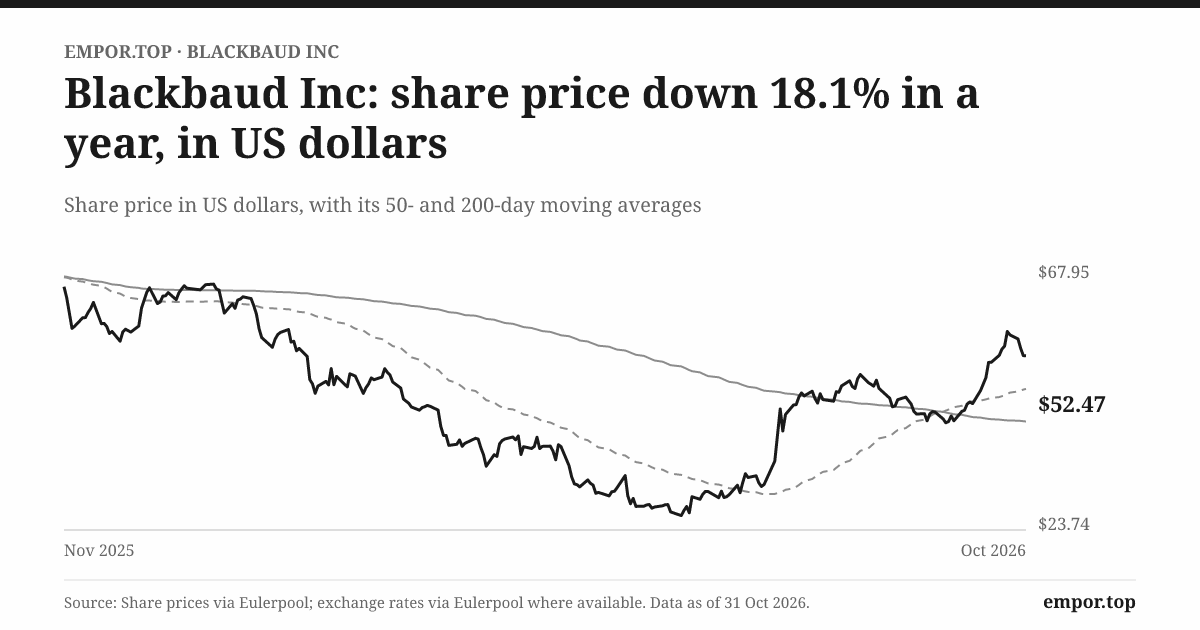
On October 31, 2026, Blackbaud's shares stood at about $52, roughly 18% below their 52-week high of about $64.23 At that price, the company was valued at about $2.5 billion in equity and $3.6 billion including debt, or about 17 times trailing earnings and 11 times trailing EBITDA.233 Its five-year median price-to-earnings ratio is about 84 times. That comparison makes the stock look strikingly cheap, and it is almost meaningless.
The median is inflated because, over the past five years, Blackbaud's earnings have swung from losses to near-zero profits to the EVERFI write-down and back.4 When earnings are close to zero, any price produces an enormous multiple. A more useful comparison is with peers. Blackbaud's 2026 compensation peer group includes Tyler Technologies, which sells software to governments, and Guidewire Software, which sells to insurers; both are vertical-software vendors with long-term customer relationships.10 On the same date, Tyler traded at about 50 times earnings and 31 times EBITDA, and Guidewire at nearly 100 times earnings.2425 Blackbaud trades at a fraction of those multiples. The market, in effect, is pricing it not as a premium vertical franchise but as a slow-growing, leveraged cash generator with something to prove. The gap is not mysterious. Tyler and Guidewire have grown faster, have not written off a major acquisition in the same period, and do not carry Blackbaud's combination of leverage and a recent disclosure failure. To close even part of that gap, Blackbaud would have to show that its growth can sustain itself in the mid-single digits without acquisitions and that its retention problem really was a calendar effect. The price, in other words, already assumes a business that renews well but grows slowly; it does not assume a business whose customers are drifting away, and it does not pay for the AI optionality at all.
The bull case starts with the contract structure. Multi-year, non-cancelable, prepaid agreements, combined with integrated donor, fundraising and payment workflows, give Blackbaud a recurring base that has kept generating cash through a breach, a failed acquisition and a revenue decline.4 On this view the 2026 cohort is a temporary bulge, and the smaller 2027 cohort will mechanically lift retention.2 The company says the data-center closures and the cloud migration should reduce costs from 2027.2 The platform fee and new AI products give the company new ways to charge for value it already delivers.2 Management's 2026 to 2030 targets call for organic revenue growth of 4% to 6% a year, adjusted EBITDA growth of 6% to 8%, an adjusted EBITDA margin above 40%, and double-digit growth in earnings per share, helped by repurchases.2 If the company executes even the low end of those ranges while shrinking the share count, the per-share math at 11% free-cash-flow yield is powerful.
The bear case reads the same facts in a different order. Revenue grew about 2% a year from 2022 to 2025 and about 4% over five years, well below the roughly 6% Blackbaud managed over the full decade.4 The renewal cohort shows how sensitive the business is to retention; nonprofits have credible alternatives, from focused donor tools to general-purpose platforms.4 The two largest tests of management's judgment and integrity in the past six years, EVERFI and the 2020 disclosure failure, both went badly.419 The buybacks were partly funded with debt, and the company's own cash is thin against a roughly $1 billion maturity in 2029.418 The new AI products have no disclosed revenue, and generative AI could just as easily lower the barrier for competitors to build good-enough fundraising tools as raise the value of Blackbaud's.
Where the walls are thick, and where they are thin
The industry structure helps decide which reading is more persuasive. Buyer power is dispersed: tens of thousands of customers, none above 1% of revenue, which limits any one buyer's leverage.411 But collectively those buyers have real choice, and choice expresses itself through churn. The threat of substitutes is meaningful: Salesforce's nonprofit offerings and partner ecosystem represent a general platform that can absorb specialist functions, and generic AI tools may handle some tasks, such as drafting appeals, that once required specialist software.4 New entrants such as Virtuous and Bloomerang have shown that cloud-native challengers can win smaller organizations.4 Supplier power is modest but rising in importance as Blackbaud depends on Microsoft Azure and Amazon Web Services for hosting and on partners like Databricks for AI; it had about $164 million of minimum purchase commitments for third-party technology and services through 2030.214 Rivalry is real but fragmented, segment by segment, which is why Blackbaud can lead in some niches without dominating the whole market. Because the company reports as a single segment, investors cannot see which of those niches earn the most profit.4
Through Hamilton Helmer's seven powers, only one power is clearly present. Switching costs are plausible and supported by contract lengths, advance billing and the pain of migrating donor histories; the 91% to 92% retention norm is the measurable evidence, and it describes a sticky but not sealed system.2 Scale economies exist in payments and in spreading product development across a large base, but the margin history, under 5% operating margin as recently as 2023, shows that scale alone did not produce superior profitability.4 Network effects are weak: JustGiving connects fundraisers and donors, but the core database business does not become more valuable to one charity because another uses it. Brand is a mixed asset after the breach. Counter-positioning, cornered resources and process power are hard to find in the evidence; Lantern does not use customer-specific data, so it does not yet convert Blackbaud's data position into a cornered resource.2 The improvement in debtor days and the absence of customer concentration are signs of a healthy billing base, but they do not prove pricing power or loyalty.4
What the record will support
So what does the record say about Gianoni's claim of "a widening competitive moat"?3 It narrows it. The history supports a smaller, sturdier version: Blackbaud has a sticky installed base protected by switching costs, which reliably generates cash. The history does not support a widening moat, because growth has slowed, retention is under pressure, and the company's largest attempt to extend its reach failed. The claim is not rejected; it is unproven, and the next eighteen months will decide it.
On capital strength, operating cash generation has been resilient, but unrestricted cash is modest relative to debt, and the 2029 refinancing and covenant headroom matter more than any headline cash figure.18 On valuation, the current multiple is best read as a market price that assumes modest growth and some risk of erosion, not as a statement of intrinsic value in either direction.
Three numbers can settle the debate. The first is gross dollar retention, whose latest reading management has not quantified beyond saying it is dipping below the 91% to 92% norm; the direction to watch is whether it recovers by the end of 2027.212 The second is contractual recurring revenue growth, which management says will stay moderated through the first half of 2027 and normalize in the second half.2 The third is free cash flow after software investment, which reached about $238 million in the first nine months of 2026, up from about $163 million a year earlier, and is the measure that funds everything else.3 If all three move the right way, the bull case is earning its keep. If retention stalls, no amount of buybacks will fix the story.
One risk deserves separate mention because it cuts against the newest part of the bull case. Generative AI is often described as a moat-deepener for incumbents with data and distribution, and Blackbaud is betting on exactly that. But the same technology lowers the cost of building software. A small donor-management challenger can now ship features that once took a large engineering team, and a general-purpose AI assistant can draft an appeal letter or summarize a donor's giving history from an export file without any specialist software at all. For a vendor whose value rests partly on being the place where work gets done, that is a substitution threat, not just a feature race. Blackbaud's answer is to embed AI inside the workflow, where the data already lives, and to price it as a subscription add-on.132 Whether that answer holds will appear first among smaller customers, where switching costs are lowest and price sensitivity highest.
IX. Playbook: Business & Investing Lessons
Two images sit side by side in Blackbaud's recent history. In one, a development officer at a small charity opens the same donor database the office has used for a decade, sees a price increase on the renewal notice, sighs, and signs anyway, because the alternative is migrating twenty years of gift history in the middle of the giving season. In the other, a boardroom approves the sale of a business bought three years earlier for $750 million, for consideration so small it is described only as nominal.54 The same company, the same leadership, the same years. The lessons sit in the space between those two scenes.
The first lesson comes from the breach. A system of record is sticky only while the customer still trusts the system. Blackbaud's switching costs were real in 2020, and they remain real tonight. But the SEC's finding that the company gave an incomplete account of what had been stolen showed that stickiness is not a property of software alone.19 It is a property of the relationship. Founders who build systems of record should understand that their moat is partly made of data and partly made of credibility, and only the first part is hard to rebuild. Investors should treat a vendor's handling of bad news as a leading indicator of renewal risk, not a footnote to it.
The second lesson comes from EVERFI. A larger addressable market is a promise; renewals and cash are the receipt. "Doubles Blackbaud's TAM to more than $20 billion" was a sentence that sounded like strategy.5 It described a market that existed in a slide deck rather than a market that Blackbaud's customers were willing to buy into. The test of an adjacency is not whether the new customers resemble the old ones but whether the old relationships actually transfer. That test was failed within three years.
The third lesson comes from the strange 2024 income statement. Noncash impairment does not mean a costless mistake. The $390 million write-down moved no money in the year it was booked, which is why Blackbaud's cash flow looked healthy while its earnings collapsed.4 But the cash had left long before, through the $450 million paid at closing and the shares issued to the sellers.5 An impairment is a receipt for money already spent. Investors who add it back and move on are counting the same dollar as both gone and never spent.
The fourth lesson is the one still being written. Buybacks create value only when the business being bought back is worth more than the debt and the forgone investment. Blackbaud has reduced its share count by about 16% since late 2023, partly with borrowed money, while trimming expensed R&D and carrying a roughly $1 billion maturity due in 2029.24 If retention recovers and the AI products earn their keep, those repurchases will look like a shrewd bet on an underpriced franchise. If retention erodes, the same repurchases will look like a company that shrank its equity at the moment it most needed flexibility. The lesson for founders is that per-share math is downstream of product health; the lesson for investors is to read a buyback program and a renewal rate together, never apart.
X. Epilogue
Tonight, on the last day of October 2026, Blackbaud is in the middle of the hardest part of its year. Its sales teams are already working the renewals that come due in the first quarter of 2027; Gianoni noted that renewal conversations begin about five months ahead.2 Its last two company-run data centers are scheduled to go dark by the end of the year.2 Its voluntary separation program has been executed, with the cash cost landing in the fourth quarter.2 And its newest product, Lantern, exists as an announcement and a technical design, waiting for 2027 to show whether customers will pay for what it does.2
The next moments that will decide the story are already on the calendar. Management's reaffirmed 2026 guidance calls for revenue of about $1.17 billion to $1.18 billion, adjusted EBITDA of $430 million to $438 million and non-GAAP free cash flow of $280 million to $290 million, with the company pointing to the upper half or better on each.3 Hitting those numbers would close a year in which management promised a dip and delivered growth anyway, and would give it a measure of credibility going into the harder test. The fourth-quarter results in early 2027 will show whether the 2026 renewal bulge passed as planned and what guidance management offers for the year in which the cohort is smaller. If the guidance assumes a retention recovery and a step-up in contractual growth in the second half, investors will have a falsifiable promise in hand. Each subsequent quarter through 2027 will then tell whether gross dollar retention climbs back toward 91% to 92%, as management has forecast, or settles lower.2 A clean recovery would turn the cohort explanation from a claim into a fact, and would make management's long-term growth targets more credible. A stall would suggest the leaks in the system are structural, and that the renewal bulge exposed them rather than caused them.
The AI products face their own moment of truth in 2027. Management has said it expects some new revenue from them next year; the question is whether that shows up in adoption, attach rates and retention, or only in conference keynotes.12 A Development Agent priced in the tens of thousands of dollars a year, attached to a meaningful fraction of the installed base, would be a new revenue line.13 A handful of marquee customers would be a pilot.
The cost story will test whether the margin gains are recurring productivity or one-time savings. Data-center closures and work moved to Hyderabad should lower the cost base; workforce-transition charges, by management's own estimate, will continue through 2027.218 Investors will need to separate the savings that recur from the charges that do not, and check that customer service and product velocity hold up while the workforce changes.
Debt, refinancing and repurchases have to be read together. Lower leverage and a shrinking share count are both good news in isolation, but they compete for the same free cash flow, and the 2029 maturity will need to be refinanced on whatever terms credit markets offer then.4 The two insurance-subrogation cases remain unresolved.4
The case remains open. Blackbaud's growth is back, but modest; its retention is dipping, by management's own account, with a recovery promised but not demonstrated; its AI ambitions are visible, but unpaid; and its cost savings are planned, but not yet proven. The company has asked investors to trust a forecast. It has asked its customers to trust it with more of their data and work. Both forms of trust will be tested at the same moment, when the next renewal notices land.
XI. Outro
In 1981, a girls' school in New York needed to send tuition bills, and Tony Bakker wrote the software to do it.67 Forty-five years later, that billing system has grown into something stranger and more intimate: software that helps thousands of institutions remember who gave, what they gave, and what they were promised in return. Blackbaud is not, at heart, a software company that happens to serve charities. It is a keeper of institutional memory that happens to be paid in software contracts.
That is what makes it unlike any other software business, and it is also its central risk. Memory is precious, and moving it is painful, which is why customers stay. But memory also has to be safe, and the vendor that keeps it has to be honest about what happens to it. Every renewal is a quiet exchange in a small office somewhere: a development director looks at the bill, thinks about the history inside the system, and decides whether the risk of staying has become greater than the cost of leaving. For forty-five years, most of them have stayed. Blackbaud's future depends on whether they keep making that choice.
References
-
Blackbaud Expands AI Leadership with Platform for Good and Lantern at bbcon 2026 — Blackbaud via PR Newswire, 2026-10-05 ↩↩
-
Blackbaud Q3 2026 Earnings Call Transcript — Stock Analysis, 2026-10-28 ↩↩↩↩↩↩↩↩↩↩↩↩↩↩↩↩↩↩↩↩↩↩↩↩↩↩↩↩↩↩↩↩↩↩↩↩↩↩↩↩↩↩↩↩↩↩
-
Blackbaud Announces 2026 Third Quarter Financial Results, Exhibit 99.1 — Blackbaud / SEC, 2026-10-28 ↩↩↩↩↩↩↩↩↩↩↩↩↩
-
Blackbaud 2025 Form 10-K — Blackbaud / SEC, 2026-02-19 ↩↩↩↩↩↩↩↩↩↩↩↩↩↩↩↩↩↩↩↩↩↩↩↩↩↩↩↩↩↩↩↩↩↩↩↩↩↩↩↩↩↩↩↩↩↩↩↩↩↩↩↩↩↩↩↩↩↩↩↩↩↩↩↩↩↩↩↩↩↩↩↩
-
Blackbaud Acquires EVERFI, a SaaS Leader Powering Corporate ESG and CSR Initiatives — Blackbaud, 2022-01-03 ↩↩↩↩↩↩↩↩↩↩↩↩
-
Powering an Ecosystem of Good — Blackbaud Corporate Solutions via 3BL Media, 2019-12-12 ↩↩
-
Blackbaud Celebrates 40 Years of Helping Good Take Over — Blackbaud, 2021-06-03 ↩↩
-
SC tech pioneer, family to match up to $500K in gifts to coronavirus fund — The Post and Courier, 2020-04-07 ↩↩
-
Blackbaud 2026 Proxy Statement — Blackbaud / SEC, 2026-04-18 ↩↩↩↩↩↩↩↩↩
-
Blackbaud Q2 2026 Earnings Call Transcript — Stock Analysis, 2026-07-29 ↩↩↩↩↩↩↩↩↩↩
-
Blackbaud Q1 2026 Earnings Call Transcript — Stock Analysis, 2026-04-29 ↩↩↩↩↩↩
-
Blackbaud Completes Acquisition of MicroEdge, Exhibit 99.1 — Blackbaud / SEC, 2014-10-02 ↩
-
Blackbaud Completes Acquisition of JustGiving — Blackbaud, 2017-10-03 ↩
-
Blackbaud Acquires Market-leading Corporate Social Responsibility Provider YourCause — Blackbaud / SEC, 2019-01-02 ↩
-
Blackbaud Q3 2026 Form 10-Q — Blackbaud / SEC, 2026-10-29 ↩↩↩↩↩↩↩↩↩↩↩
-
SEC Charges Software Company Blackbaud Inc. for Misleading Disclosures About Ransomware Attack — SEC, 2023-03-09 ↩↩↩↩↩↩↩
-
Blackbaud Resolves Multi-State Attorneys General Investigation, Exhibit 99.1 — Blackbaud / SEC, 2023-10-05 ↩↩↩
-
Blackbaud 2026 Annual Meeting Voting Results, Form 8-K — Blackbaud / SEC, 2026-06-11 ↩
-
Blackbaud 2025 Proxy Statement — Blackbaud / SEC, 2025-04-21 ↩↩
-
Blackbaud (BLKB) Statistics & Valuation — Stock Analysis, 2026-10-31 ↩↩
-
Tyler Technologies Valuation History — StockResearch, 2026-10-31 ↩
-
Guidewire Software Valuation Statistics — Stock Analysis, 2026-10-31 ↩
 LinkedIn
 WhatsApp
 Reddit
 Hacker News
 Email
 Kindle
 RSS Feed
 Spotify
 Apple Podcasts
 Amazon Music
 Audible
 YouTube