Business First Bancshares: Can a Community Bank Grow Without Losing the Plot?
The bank that keeps buying its way across the South
On the first day of January 2026, while most of North Louisiana was nursing a holiday hangover, a bank changed hands. Progressive Bancorp, a lender with deep roots in the northern part of the state, ceased to exist as an independent company, and its shareholders woke up owning 3,192,367 new shares of Business First Bancshares, the Baton Rouge holding company behind b1BANK.1 Over the following months the signs came down, the customer accounts moved onto new systems, and the conversion was finished.2 What came out the other side was a bank with roughly $9 billion of assets, about $6.8 billion of loans held for investment and about $7.4 billion of deposits.3
That is a big number for a company that, a decade earlier, had about $1.1 billion of assets.1 It is the kind of growth that makes a chart look like a ski jump. But anyone who has watched regional banks for long enough knows the trap hidden inside a chart like that. A bank can double its size by buying other banks, and its owners can end up no richer at all. Size is easy to buy. Returns per share are not.
And the moment of the Progressive conversion was not an entirely comfortable one. In 2025, b1BANK's ratio of nonperforming loans had jumped from 0.42% of the book to 1.24%, roughly tripling in a single year.1 By September 2026 that ratio had held at 1.24%, but the dollar amount of problem assets had kept rising, to $108.8 million.3 The acquired footprint, meanwhile, still had to prove that it could grow on its own, rather than simply sit on the balance sheet as a block of purchased loans and deposits.
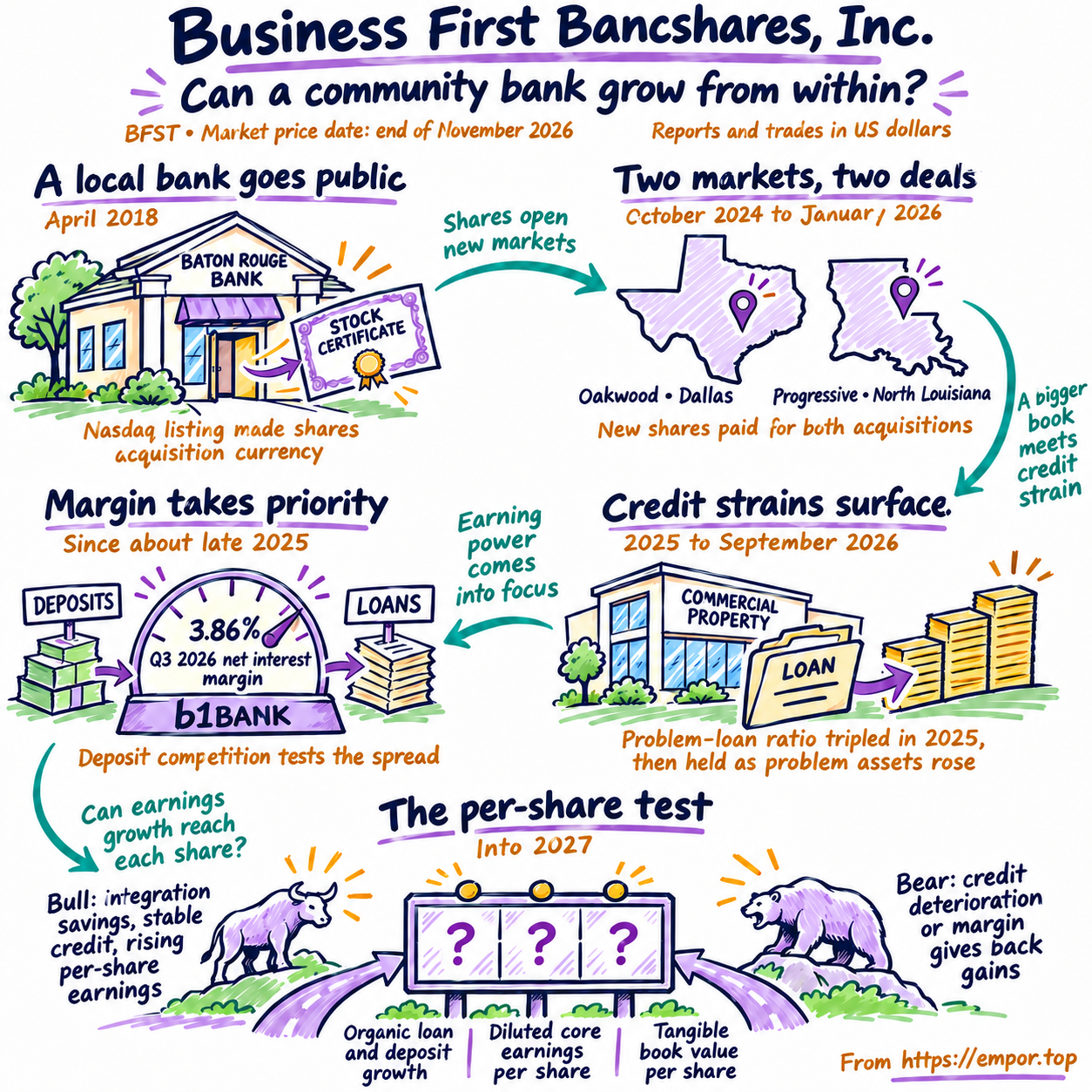
So the question hanging over Business First as 2026 draws to a close is simple to state and hard to answer. Can a company that grew by buying local franchises turn that bigger map into stronger returns for the people who already own it?
The question breaks into four smaller ones, and they will follow this story all the way through. The first is whether organic growth can follow acquisition growth: whether the bankers in the markets Business First bought can win new borrowers and depositors without the help of another deal. The second is whether the problem loans that surfaced in 2025 and 2026 are contained, or are the first visible part of something wider. The third is whether the bank's margin, the gap between what it earns on loans and what it pays for deposits, can hold as competitors bid for the same deposits. And the fourth is the one that ties the rest together: whether the acquisitions created value per share after the dilution and integration costs that came with them.
Before going further, it helps to be precise about what investors actually own. The company listed on Nasdaq under the ticker BFST is Business First Bancshares, Inc., a Louisiana financial holding company.1 Its principal operating subsidiary is b1BANK, which takes the deposits and makes the loans. There is no outside parent, no private-equity sponsor sitting above it, and no controlling shareholder; the biggest holders are index and institutional managers such as BlackRock and Vanguard, each with single-digit percentages.4 When this story talks about the bank's economics, it is talking about the economics that flow straight through to BFST shareholders.
Those economics, over the long run, have been striking. Between 2015 and 2025 the company's revenue grew about 29% a year, and its net profit grew about 36% a year.1 Revenue went from about $41 million to about $511 million. Net profit went from about $4 million to about $87 million. Few banks of any size can show a decade like that.
But look at the most recent stretch and the curve flattens. Over the three years to 2025, net profit grew about 17% a year, roughly half the decade's pace.1 And the gap between the company's profit growth and the growth that reached each individual share is even more telling. Over the same ten years in which net profit compounded at about 36% a year, diluted earnings per share compounded at about 18%.1 Half of the headline growth, in other words, was shared out among new owners who arrived with each deal and each equity raise. The company grew enormously. The slice of it belonging to any single share grew far less.
None of that means the deals were bad. A bank that doubles its earnings per share over a decade has done something real, and a bank that buys its way into Dallas and North Louisiana may be building a franchise whose value will only show up later. But it does mean the long record is not a clean story of organic growth. It is a story of lending and dealmaking braided together, and the two are hard to pull apart.
There is, though, one piece of evidence in the long record that favors the acquirer. Scale did change the bank's economics, not just its size. In 2015, Business First earned about 3.6% on its shareholders' equity, the kind of return that barely justifies owning a bank at all.1 By 2025 that figure was about 9.7%, and return on assets had climbed from well under half a percent to about 1.1%.1 Some of that improvement reflects the rate environment and the maturing of a young bank, but some of it is the reward for spreading compliance, technology and management costs across a much larger balance sheet. A small bank carries the same regulatory machinery as a large one, and every acquisition let Business First spread that machinery over more loans. The bull case begins here: the deals made the bank big enough to be properly profitable. The bear case begins in the same place, because returns near 10% on equity are respectable rather than exceptional, and they were achieved with a lot of help from issuing new shares.
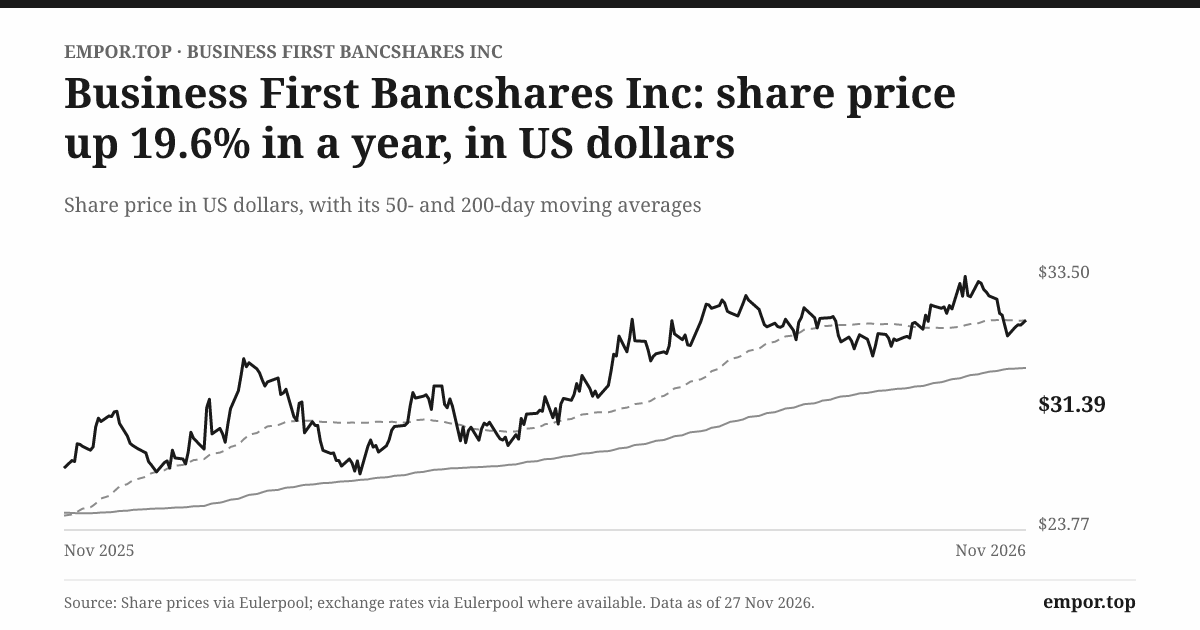
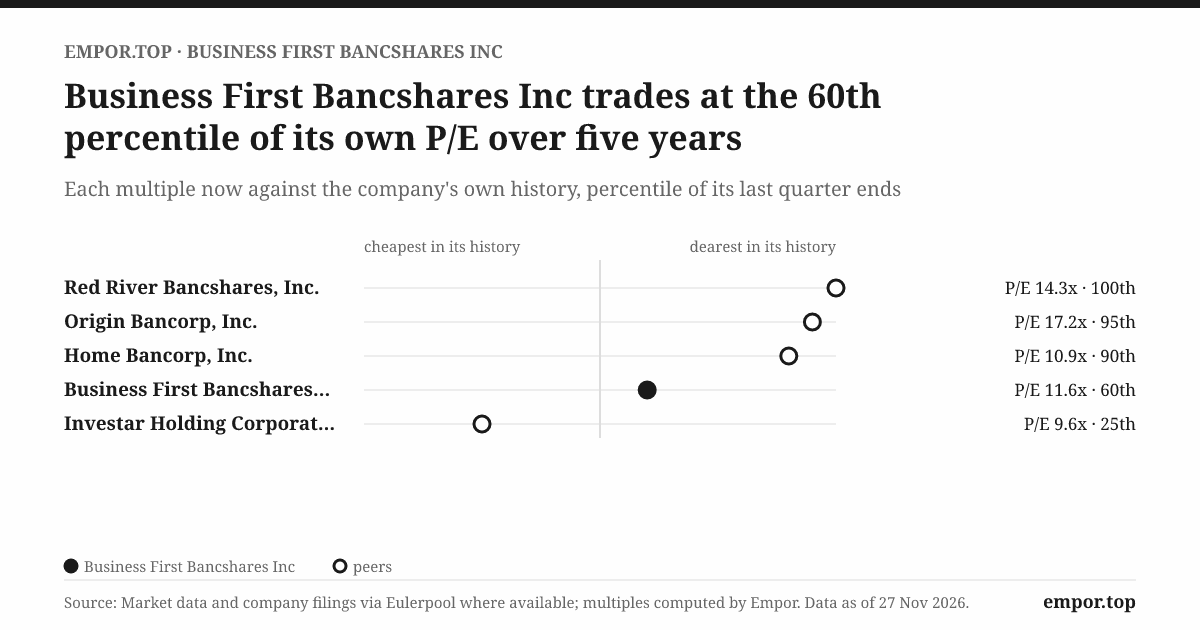
The market seems to have reached a similar, cautious verdict. At the end of November 2026 the shares traded at $31.39, a little below their 52-week high, for a market value of roughly $1 billion.5 Measured against reported earnings, that was about 11.6 times trailing earnings, against the stock's own five-year median of about 11.0 times, and about 1.1 times book value.5 The market is not paying a growth premium for Business First, and it is not offering an obvious discount either. It is, in effect, paying roughly what it has paid before and waiting to see what happens next.
What happens next depends on whether the new scale can produce repeatable earnings. That means earnings that do not lean on a branch sale, a debt-extinguishment gain or a freshly acquired loan book; earnings that come from bankers winning business in markets the company already owns. To understand why that test matters so much, and why it is harder than it looks, the story has to go back to the moment Business First stopped being a local bank and became a public acquirer.
 Subscribe on LinkedIn
From Baton Rouge bank to public acquirer
Baton Rouge in the mid-2000s was not an obvious place to start a bank. Louisiana's banking market was already crowded with the branches of national giants and well-established regional names. But that crowding was also the opening. When large banks consolidate, local business owners often find their longtime banker gone, their loan decisions made in another city and their calls routed to a service center. A new bank that promises to answer the phone, know the customer and decide locally has a pitch that writes itself.
The man who has made that pitch for two decades is David R. Melville III, known to nearly everyone as Jude. He has been chief executive of Business First since 2006, and he also chairs its board.4 That longevity is unusual. Most of the banks Business First has bought over the years were run by people who eventually decided to sell; Melville has spent his career on the other side of the table, as the buyer. The bank's character, its commercial focus, its appetite for deals and its willingness to grow into new markets, carries his fingerprints.
The early local-bank years matter less to today's investor than what came after them, so they can be told quickly. For its first decade, Business First was a Baton Rouge commercial bank building relationships with small and midsized businesses. Then, in 2015, it bought American Gateway, and the shape of the strategy changed.1 The bank stopped being a single-market lender and began assembling a Louisiana franchise piece by piece. Minden, in the northwest of the state, and Richland, in the northeast, followed, giving Business First a real presence outside the Baton Rouge orbit.1
Buying banks takes capital, and capital was the constraint. In 2017, to help fund the Minden acquisition, the company sold shares in a private placement to institutional investors.1 A private placement works, but it is a narrow channel: a bank has to find buyers one at a time, and the shares it issues have no public market to give them a daily price. A listing would change both problems at once.
That listing came in April 2018, when the common stock began trading on Nasdaq.6 Business First did not go public through a classic initial public offering with a splashy roadshow. It filed a registration statement for resales by existing holders, and then, a few weeks later, ran a registered follow-on offering of 1,207,500 shares at $24 apiece, including the underwriters' option to buy extra.7 That raised a little under $29 million before costs.
The size of that offering was modest. Its importance was not. A public share is a kind of currency, and from 2018 onward Business First could pay for acquisitions with stock that sellers could actually value and sell. Over time the company raised about $151 million across three equity offerings since its listing, by its own count.8 In 2022 it added a different instrument: $75 million of Series A preferred stock, which gives a bank regulatory capital without immediately diluting common shareholders, at the price of a fixed dividend that ranks ahead of them.1
With that currency in hand, the deals reached farther. Pedestal extended the franchise in Louisiana. Then Business First crossed the Sabine River into Texas. Texas Citizens brought a Houston-area presence; Waterstone added a nonbank business alongside the bank; Oakwood opened the Dallas market; and Progressive, the latest, reinforced North Louisiana.1 Counting nonbank businesses, the company completed more than eight acquisitions in the decade after 2015.8
Why do these pieces fit together? The logic is easier to see from a borrower's chair than from a banker's. A business owner in Dallas or Shreveport who borrows a few million dollars to buy equipment or a building wants a lender large enough to handle the loan, offer treasury services and keep up with technology, but small enough to care about the account. Business First's pitch is that it can operate at a larger bank's level while keeping a relationship bank's attention. Each acquisition was a way to put that pitch into a new market with ready-made customers, deposits and, crucially, local bankers who already knew the territory. Buying a bank is often less about buying loans than about buying people who know which loans to make.
There is an elegance to that strategy, and there is also a cost that does not show up on the day a deal closes. Every share issued to a seller is a share that existing owners no longer hold a slice of. Oakwood's shareholders received nearly four million BFST shares in October 2024; Progressive's received more than three million in January 2026.1 The 2018 follow-on and the preferred issuance funded growth too. Each step made the company bigger and each step changed who owned it.
That is why the per-share gap described earlier matters so much. It is the arithmetic signature of a public acquirer, and a skeptic would point out that roughly half of the profit growth went to pay for the shares issued along the way.1
The test of a serial acquirer is not whether it buys a lot, but whether each purchase earns more than the slice of ownership given up to make it. On that question, the record is genuinely incomplete. The company's own annual report describes a long string of acquisitions but does not measure each one against its cost of capital, and the company has not reported a large goodwill write-off in the past two years that would mark an acquisition as an outright failure.1 That absence is worth noting, but it is not proof of success. A deal can fail quietly, by earning a little less than it should have, without any dramatic accounting event.
The honest historical verdict, then, is narrower than the company's own description of itself as a disciplined acquirer. The listing gave Business First the means to buy; the acquisitions transformed its size, geography and share count; and the per-share record shows real but diluted progress. What the history cannot yet show is what the bank does when the deals stop for a while. The question now is what happens to organic growth, returns and tangible book value per share once the acquired banks are fully absorbed. To answer that, it helps to understand exactly how b1BANK makes its money.
The loan-and-deposit spread that pays for the story
Picture two conversations happening on the same afternoon in two different offices of b1BANK. In one, a commercial real-estate developer is negotiating the rate on a construction loan, arguing that a competitor down the street will do the deal for a quarter of a point less. In the other, the owner of a regional distribution company is deciding whether to leave several million dollars of operating cash in a b1BANK account or move it to a bank offering a better promotional rate. The bank has to win both conversations, and it has to price them at the same time, because the second one pays for the first.
That is the whole business in miniature. A commercial bank borrows money from depositors and lends it to borrowers, and it earns the difference. The most important number for understanding that difference is the net interest margin, which measures how much the bank earns on its loans and securities, after paying for its deposits and borrowings, as a share of the assets that earn interest. Think of it as the bank's gross margin. In the third quarter of 2026, b1BANK's margin was 3.86%.9 For every $100 of interest-earning assets, the bank kept roughly $3.86 a year after paying for the money it used.
To see why small moves in that number matter so much, run the arithmetic on a bank of b1BANK's size. With somewhere around $8 billion of assets earning interest, every tenth of a percentage point of margin is worth roughly $8 million a year of pretax income. That is close to a third of a typical quarter's net profit for this bank. A margin that drifts down by a quarter of a point can erase a year of loan growth; a margin that widens by the same amount can do more for earnings than a mid-sized acquisition. This is why management's language on margin is worth more attention than its language on growth. In a spread business, the price of money is the product, and a bank that misjudges it pays immediately.
The borrowers on the asset side are mainly individuals and small to midsized businesses in Louisiana and Texas, and the company describes commercial and real-estate lending as the core of its portfolio.1 The funding comes mostly from deposits. Three forces therefore decide whether a growing balance sheet turns into growing profit: how much the bank can charge on loans, how much it must pay for deposits, and how many creditworthy borrowers want to borrow. Credit quality is the fourth force, and it gets its own chapter later.
Here is where a detail in the loan book matters. About 53% of b1BANK's loans carry variable rates, which means their yields adjust when market rates move.10 Bankers call a balance sheet like that "asset-sensitive." In plain terms, when rates change, the bank's loan income tends to adjust faster than its funding costs. On the third-quarter call in October 2026, management said it expected margin to expand if deposit costs lagged loan yields.10
But the other side of the balance sheet is where the fight is. On the same call, management acknowledged that competitors were running deposit specials at rates approaching what the bank would pay to borrow wholesale for a year, and that seasonal municipal balances, the cash that local governments park in banks, can raise funding costs at certain points in the year.10 When a rival offers a depositor nearly the same rate as the bank's alternative funding source, the deposit stops being cheap money and becomes merely ordinary money. The variable-rate loan book gives b1BANK room to reprice; the deposit market decides how much of that room it gets to keep.
There is some evidence that the bank has been winning that fight lately. Its average cost of interest-bearing deposits was 2.90% over the first nine months of 2026, down from 3.29% for all of 2025.3 Deposits rose about 10% between the end of 2025 and September 2026, though much of that increase came with Progressive rather than from new customers.3 And about $1.6 billion of the $7.4 billion in deposits was noninterest-bearing, money that customers leave in operating accounts without being paid for it.3 Those balances are the cheapest funding a bank has, and they are usually tied to genuine operating relationships, which makes them the closest thing to a scoreboard for the "relationship bank" claim.
There is a counterweight in the same disclosures. About $3.6 billion of deposits, or 49% of the total, were estimated to be uninsured at September 2026.3 Uninsured deposits are balances above the federal insurance limit, usually held by businesses, and they are not inherently bad; a commercial bank naturally has a lot of them. But the regional-bank crisis of 2023 showed that large uninsured balances can move quickly when confidence wobbles. For b1BANK, half its funding base sits with customers who have both the motive and the means to shop around. That makes deposit retention, not just deposit gathering, a central measure of the franchise.
The second revenue stream is noninterest income: fees and other income that do not come from the spread. In 2025 it was $51.5 million, up from $44.2 million in 2024.1 The sources are varied. Service charges on deposit accounts, card and ATM fees, wealth-management and brokerage income, gains on loan sales, fees from interest-rate swaps arranged for borrowers, bank-owned life insurance and correspondent-banking activity all contribute.1 That mix broadens the earnings base, but it deserves restraint. The 2025 total included a $3.36 million gain from selling a branch and a $0.63 million gain from retiring debt early, neither of which will recur on schedule.1 In the first nine months of 2026, noninterest income rose just 3.1%, against a prior-year period that had included that branch-sale gain.3 Management itself has described some of the correspondent and investment income as lumpy from quarter to quarter.10
It is also worth noticing how large fees have become relative to the bottom line. In 2025, noninterest income was equal to nearly half of the company's pretax income.1 That sounds like a diversified bank, and in part it is. But the same comparison works in reverse: because expenses absorb most of a bank's revenue, a modest swing in fee income can move profits by much more than its share of revenue would suggest. Fees are a stabilizer only when they are predictable, and some of these are not. Fees help. They do not change the fact that this is a spread business.
Which measures, then, actually govern this company? The useful ones are bank measures: net interest margin, the mix and cost of deposits, core earnings excluding one-off gains and merger costs, the efficiency ratio that shows how much of each revenue dollar is eaten by expenses, and credit quality. Some generic valuation tools misfire badly here. Enterprise value, for example, subtracts cash and adds debt, but for a bank, deposits are the raw material of the business, not a financing choice; screens that calculate a negative enterprise value for Business First are telling you about the formula, not the company. Conventional free cash flow is equally unhelpful, because for a bank, making loans and taking deposits are the operating activities themselves. Even a figure as simple as "revenue" can swing oddly in quarterly data compiled by outside providers, because banks present interest income, interest expense and fees differently from industrial companies. For trend claims, the bank's own filed income statement and its reconciliations are the reliable ground.
Seen through those lenses, the engine is clear. b1BANK earns most of its money by pricing two sides of a balance sheet, and its near-term swing factor is whether its variable-rate loans can reprice faster than competition forces up the cost of deposits. Fees round out the picture without changing its shape. That raises the harder question underneath: when a business owner can take a loan or a deposit across the street, what exactly makes them stay with b1BANK?
The relationship bank faces the scale banks
Imagine a business owner in Shreveport, or Monroe, or Ruston. The company makes a decent profit, employs a few dozen people and needs a line of credit, a mortgage on a new warehouse and somewhere to keep payroll. On one side of the street is a local banker who has known the family for years, who can walk the loan into a credit committee in the same state and who will answer the phone on a Saturday. On the other side is a national bank with a slicker app, a larger lending limit, branches in every airport the owner flies through, and, sometimes, a better rate. Which one wins?
That choice, repeated thousands of times, is the competitive battlefield for b1BANK. Banking is unusual in that a bank competes twice for every customer: once for the borrower and once for the depositor. The customer's power in each fight is local and specific. No single business owner can bend b1BANK's prices, but business owners can and do hold accounts at several banks at once, which means a relationship is rarely exclusive and a lost loan can take a deposit relationship with it.
To see the scale of the rivals, look at Louisiana's deposit market as it stood in June 2025. The state held about $133 billion of deposits.11 JPMorgan Chase held about 16.7% of them, Hancock Whitney about 12.7%, Capital One about 12.1% and Regions about 6.3%.11 Large national and regional banks together held more than half the market, about 53.6%.11 b1BANK held about 3.6%.11 First Horizon sits among the leading names too, and in the regional tier are rivals such as Origin Bank and Red River Bank, each pitching a version of the same local-relationship story.11
That 3.6% is worth sitting with. Business First is one of the largest banks headquartered in Louisiana, and it is a meaningful player in several of its local markets. But in the state as a whole, it is a fraction of the size of the giants, and its share is not the kind that gives a bank any power to set prices. In Texas the picture is starker. Dallas and Houston are among the most competitive banking markets in the country, crowded with national banks, large Texas regionals and dozens of ambitious community lenders. Business First's Texas expansion took it into large, contested metros, not into an empty field.
So what, concretely, does the franchise have? Three things stand out. The first is a granular deposit base: about 120,000 deposit accounts with an average balance of roughly $61,000, according to the company's mid-2026 investor presentation.12 That is a lot of modest-sized relationships rather than a handful of whales, which tends to make a deposit base stickier and less vulnerable to one customer leaving. The second is a correspondent-banking group that serves more than 150 other banks, providing services such as settlement, investment and loan participations to smaller institutions that lack scale of their own.12 That is a niche where a bank's reputation among peers matters, and it is a different business from retail banking. The third is a commercial lending operation spread across Louisiana and Texas, staffed in large part by bankers who came with the acquisitions.
Now apply the two frameworks that business analysts use to test a moat, once and properly. Michael Porter's five forces start with rivalry, and rivalry in banking is intense: many competitors sell money, which is the same product everywhere. Customer bargaining power is meaningful because commercial borrowers can shop loans and split deposits. The threat of substitutes is real, from online banks that pay higher deposit rates to private credit funds that lend to middle-market companies. Supplier power, in banking, mostly means depositors, which brings the analysis back to deposit pricing. The one force that leans toward incumbents is the barrier to entry: a bank charter, regulatory capital requirements and the time it takes to build credit judgment keep new entrants out. But that barrier protects all existing banks equally, including b1BANK's much larger rivals.
Hamilton Helmer's "7 Powers" asks a sharper question: does the company have a structural advantage that lets it earn better returns than competitors for a long time? Scale economies clearly do not favor a bank with 3.6% of its home state's deposits. Network effects do not really apply. Brand matters in a local sense, but it is hard to show that customers pay more for the b1BANK name. Switching costs are the most plausible power, because moving a commercial banking relationship, with its loans, treasury services and payroll, is a genuine nuisance. Yet the company does not publish customer retention rates or show that it prices loans above or deposits below its peers. Its process power, if it exists, would be credit judgment and local decision-making, and that is precisely the capability the 2025 credit problems put under question.
The honest conclusion is that the relationship-bank claim is credible as positioning and not yet demonstrated as a moat. Local decision-making, a diverse deposit base and a commercial focus are plausible advantages. They explain why a business owner might choose b1BANK. They do not, on the available evidence, prove that b1BANK can keep that customer when a larger bank offers a better rate.
What would falsify the claim? The mechanism is straightforward. If the relationships are as valuable as management says, they should show up as deposit costs that stay at or below peers, as noninterest-bearing balances that hold up as rates move, as organic deposit growth that does not need a promotional rate or an acquisition to sustain it, and as returns on equity that match or beat comparable regional banks. If, instead, deposit costs persistently run higher than peers, the bank loses commercial relationships when competitors underbid, organic deposit growth stalls between deals, or returns lag the regional peer group, then the relationship pitch is not enough. The current record gives mixed evidence. Deposit costs fell in 2026, which supports the claim. That return was respectable rather than exceptional, which neither proves nor disproves it.1
There is one more modern question that hangs over every relationship bank: technology. Large banks spend billions a year on apps, payment systems and fraud detection, and a business owner increasingly judges a bank partly by its software. Business First's management has said it will keep investing in infrastructure and technology while adding bankers in existing markets.10 That investment matters for service quality, fraud control and the cost of serving each customer. But it is a cost of staying in the game, not a separate product. Business First does not report a distinct software, digital or artificial-intelligence business, and there is no evidence that technology is a growth engine of its own. The risk runs in the other direction: if larger banks' digital tools become good enough that a business owner no longer values a local banker's phone call, the relationship premium erodes. For now, the relationship is still the product.
Which brings the story back to the acquisitions. If the relationships are the asset, then buying a bank is a way of buying relationships, and the price paid for them decides whether shareholders win. Two recent deals put that idea to the test.
Oakwood and Progressive: growth bought at a price
In October 2024, Business First closed its purchase of Oakwood Bancshares, a Dallas-area bank, and issued 3,973,134 new shares to Oakwood's owners.1 Fifteen months later, on the first day of 2026, it did it again with Progressive Bancorp in North Louisiana, issuing 3,192,367 shares.1 Two deals, two very different markets, more than seven million new shares. Each one was a bet that the franchise being bought was worth more inside Business First than the slice of Business First being handed over.
Start with Oakwood, because the merger documents give enough detail to test the price. Oakwood brought $863.6 million of assets, $700.2 million of loans and $741.3 million of deposits.13 The announced consideration was about $85.7 million.14
Bank deals are usually priced against two benchmarks, and each needs a short explanation. The first is tangible book value: the bank's equity minus intangible assets such as goodwill, roughly what would be left for owners if the bank were wound down at stated values. Paying 1.0 times tangible book means paying exactly that. Oakwood's price was about 1.06 times tangible book.13 The second benchmark is the core-deposit premium: how much the buyer pays above tangible book, expressed as a share of the target's stable, core deposits. It answers the question "how much did we pay for the customer relationships?" Oakwood's was about 1.0%.13 Set against the comparable transactions that the financial advisers assembled for the merger, neither measure stood out as expensive.13
The earnings multiple tells a more complicated story. On trailing earnings, Business First paid about 17.6 times Oakwood's profit, which sounds rich.13 But the adviser's estimate of Oakwood's 2024 earnings implied about 10.0 times.13 That gap is the whole debate in one number. If Oakwood's earnings were about to rise sharply, the deal was cheap; if the forecast was optimistic, it was not. Forecasts in merger documents are just that, and the people who prepare them work for one side of the transaction. The fair reading is that Oakwood was not bought at an obvious premium to its book value or its deposit base, and that the earnings case depended on a forecast that only time could confirm.
Progressive is a different animal. It brought about $773.8 million of assets.1 Its price was about 1.263 times tangible book, with a core-deposit premium of about 2.6%.15 Both are higher than Oakwood's, though still moderate within the selected set of comparable transactions.15 The earnings multiple, however, was not meaningful, because Progressive was losing money at the time.15 Buying a loss-making bank at a premium to its tangible book means the buyer is not paying for current profit. It is paying for deposits, customers, a market position and a belief that it can run the combined bank better. That can be a perfectly sensible bet. It is also the kind of bet where the evidence of success arrives late.
The strategic logic for each deal is easy to state. Oakwood gave Business First a foothold in Dallas, one of the fastest-growing metropolitan economies in the country, with an existing team and client base. Progressive deepened the company's position in North Louisiana, a region where Business First already had a presence through Minden and Richland. But there is an important distinction that the headline growth numbers blur. An acquired balance sheet is not the same thing as organic relationship growth. When Business First reports that deposits grew 10% in 2026, a large part of that is Progressive's deposits arriving on the balance sheet, not new customers choosing b1BANK.3
Then there are the costs of buying, which never appear in the "assets added" line. The shares issued are the largest cost, because they permanently dilute every existing owner. Merger and conversion costs, the expenses of combining computer systems, rebranding branches and paying severance, hit earnings in the quarters around each deal. And goodwill, the premium over tangible book, sits on the balance sheet as an intangible asset that must be tested for impairment every year. The quarterly per-share figures show the dilution plainly. In the third quarter of 2026, net profit was about 12% higher than a year earlier, but diluted earnings per share were about 8% lower, $0.71 against $0.77.9 The company earned more in total and less per share, because the Progressive shares had arrived and Progressive's earnings had not yet caught up with them.
Business First made two notable execution choices with Progressive. It completed the systems conversion within months of closing, and it sold a block of Progressive's loans.2 A loan sale after an acquisition can be a sign of discipline, cleaning out loans that do not fit the acquirer's credit standards or concentration limits, or it can be a sign that the acquired book was weaker than hoped. Management discussed the sale on the second-quarter call alongside the expense savings it expected from the combination.2 The test of that framing is whether the promised savings actually show up in the bank's core expense line over the next few quarters, and whether the combined loan book performs better than the two parts would have alone.
So how should an investor judge the company's description of itself as a disciplined acquirer? The record offers no dramatic counterexample. None of the 2025 or 2026 filings reports a large goodwill write-off or an acquisition that blew up, and the disclosed prices for Oakwood and Progressive do not look like outliers on tangible book or core-deposit premium.1 But the absence of a disclosed failure does not prove value creation. A deal can be priced reasonably and still fail to earn its keep if integration drags, if acquired credits sour or if the acquired customers drift away. The measures that will eventually settle the claim are organic loan and deposit growth excluding acquired balances, tangible book value per share, diluted core earnings per share and return on tangible common equity. Those numbers, not the deal announcement, are the scoreboard.
And one of those numbers depends on something the merger documents could only partly see: the quality of the loans themselves. In 2025, that question stopped being theoretical.
One problem loan became a broader credit question
It started with one relationship. During 2025, a $25.8 million commercial real-estate relationship moved to nonaccrual, the status a bank assigns when it no longer expects to collect interest as scheduled.1 For a bank of b1BANK's size, a single loan of that size is not catastrophic, but it is large enough to move every credit ratio on the page. The nonperforming-loan ratio rose sharply by the end of 2025.1
If the story had ended there, it would have been a tale of one bad loan. It did not end there. By September 2026, three more commercial lending relationships had moved to nonaccrual, and the bank had taken possession of a Texas property, booking it as "other real estate owned," the banking term for collateral seized from a borrower.3 Nonperforming assets, which count both bad loans and repossessed property, rose from $89.7 million at the end of 2025 to $108.8 million.3
Here the evidence pulls in two directions at once. The nonperforming-loan ratio held steady in 2026.3 Because the loan book grew, partly with Progressive, a steady ratio means the problem loans grew roughly in line with the book rather than faster. That is a genuine counterpoint to the bear case. But the dollar total of problem assets rose, new relationships kept moving into the problem bucket, and repossessed property added to the pile. A stable ratio built on a growing denominator is not the same as a shrinking problem.
The causes management has identified are specific: individual commercial relationships, a particular property in Texas, borrower-level circumstances. It is important to separate those disclosed causes from any broader inference. The filings do not say that the credit cycle has turned across b1BANK's markets, and a run of specific problem loans does not prove that it has. But a run of specific problem loans is also exactly how a broader turn tends to look in its early stages, because each one always has its own story.
The shape of the loan book explains why this matters. As of September 2026, real estate accounted for 69.6% of loans held for investment.3 Commercial real estate alone was 42.7%, construction loans another 11.4% and residential mortgages 15.5%.3 Commercial real estate is not inherently dangerous; it is the bread and butter of community banking, and well-underwritten property loans have historically performed well. But concentration means correlation. When property values or tenant cash flows weaken in a region, many loans weaken together.
The geography of that concentration is telling. The largest regional slices of the commercial real-estate book were North Louisiana at about 24%, Dallas at about 24% and New Orleans at about 18%.3 In the company's mid-2026 presentation, Texas represented about 35% of total credit exposure.12 Dallas is a market Business First entered largely through Oakwood; North Louisiana is where Progressive added weight. The credit question and the acquisition question are therefore the same question asked twice. If the acquired markets carry the weakest credits, the deals cost more than their purchase price.
Then there is the cushion. A bank sets aside an allowance for credit losses, a reserve that estimates the losses it expects to take over the life of the loans. As of September 2026, b1BANK's allowance was $64.3 million, about 0.95% of loans.3 Nonperforming loans were $84.1 million.3 On the surface, the allowance covered roughly three-quarters of the nonperforming loans. That ratio alone does not settle whether the reserve is adequate, because the allowance covers expected losses on the whole book rather than the full face value of bad loans, and nonperforming loans are often secured by collateral that will recover much of their value. Actual losses so far have been modest: net charge-offs, the loans written off minus recoveries, were $9.3 million over the first nine months of 2026, about 0.14% of average loans.3 The realized losses are small. The open question is whether the identified problem relationships will be resolved at values close to their carrying amounts, or whether more losses are coming.
It helps to understand how a nonaccrual loan actually ends, because the ending determines the loss. A bank has a handful of exits. It can work with the borrower to restructure the loan, accepting a longer schedule or a lower rate in exchange for eventual repayment. It can sell the loan to an investor, usually at a discount, and take the loss up front. It can foreclose and take the property, which turns a bad loan into repossessed real estate that the bank must then maintain, market and sell. Or it can simply charge the loan off as uncollectable. The Texas property that moved onto b1BANK's books in 2026 shows that the bank has already used the foreclosure route at least once. Each route takes time, and each carries a different cost. That is why the quarters after a loan goes bad often tell investors more than the quarter in which it first appears.
The auditors flagged exactly this judgment. Forvis Mazars, the company's auditor, issued a clean, unqualified opinion on the 2025 financial statements and internal controls.1 But it identified the allowance for credit losses, and specifically the qualitative adjustments management makes to its loss models, as a critical audit matter, meaning an area requiring especially challenging or subjective judgment.1 Qualitative factors are where a bank's management adjusts what the models say for things the models cannot see: local economic conditions, concentration risk, changes in lending standards. A clean opinion means the auditor found the process sound. It does not remove the estimation risk, and it reinforces that reserve judgment is central to this investment case.
Management's tone on the calls is part of the evidence. On the fourth-quarter 2025 call, management acknowledged that it had learned from working through the credit issues, an unusually candid framing for a bank executive team.16 By the third-quarter 2026 call, the conversation had moved toward resolution plans for the identified relationships and how the bank monitors its portfolio.10 What the record does not yet show is a full resolution: the identified loans worked out, sold or charged off, with the losses known.
The settling evidence is therefore clear and measurable. Quarterly nonaccrual loans, repossessed real estate, criticized and classified loans, net charge-offs and reserve coverage, alongside the outcome of the specific relationships already identified, will reveal whether 2025 and 2026 were a contained cleanup or the first visible part of a wider credit turn. Until then, credit selection is not a generic bank risk to be noted in passing. It is the hinge on which the whole thesis turns. And the people responsible for that hinge are the same ones who have run the bank for two decades.
A founder-CEO chooses margin over growth
On the third-quarter call in October 2026, Jude Melville said something that a bank chief executive with two decades of acquisitions behind him does not often say out loud. The bank, he explained, had begun prioritizing margin over growth about a year earlier.10 For a company whose entire public history had been about getting bigger, that was a change of emphasis worth noticing. It meant pricing loans for profit rather than volume, and being willing to let some deposits walk rather than pay any price to keep them.
The statement came at a particular moment. The Progressive integration was finishing, the credit problems were still being worked through, and the company had started buying back its own shares, repurchasing about $6.3 million of stock in the third quarter.9 Each of those actions says something about how management thinks about the next dollar. Together they paint a picture of a leadership team trying to shift from expansion to earning power.
Two people sit at the center of that shift. Melville has guided every acquisition in this story.4 Gregory Robertson has been chief financial officer since January 2017, which means he has managed the balance sheet through the listing, the Texas expansion, the 2023 regional-bank turmoil and the recent deals.17 That continuity is a real asset in a business where credit culture and relationships take years to build. It is also a reason to look harder at the record, because the same team that made the acquisitions is the team now asking investors to trust the integration.
How has that team done against its own targets? The clearest example is return on assets, the profit a bank earns on everything it owns. Management had set a goal of a core return on assets above 1%, and in 2025 the bank moved above that line.8 That is a concrete promise kept, and in banking, crossing 1% is a meaningful threshold that separates adequate performers from good ones. The weaker side of the record is that 2025's result benefited from items management itself adjusts out of its core figures, including the branch-sale gain and the debt-extinguishment gain.1 On margin, management said in October 2026 that it expected net interest margin to expand in the fourth quarter, while acknowledging the deposit-price pressure described earlier.10 That is a reasonable and appropriately hedged forecast. It is also a forecast that the fourth-quarter results will either confirm or contradict within weeks.
Then there is the question of incentives. Melville's reported total compensation fell from about $3.12 million in 2024 to about $2.58 million in 2025, even as net income available to common shareholders rose from about $59.7 million to about $82.5 million.4 Pay that falls while profit rises is unusual, and at the very least it shows that the compensation plan does not simply ratchet upward. But the bigger alignment question is ownership. Melville personally owns less than 1% of the company, and directors and executive officers together hold about 5.67%.4 For a founder-era chief executive, that is not a large personal stake. It means the leadership group's fortunes depend more on compensation and on the bank's continued independence than on the share price alone. Reported pay and share ownership are only proxies for alignment; the real test is whether decisions favor per-share value over size.
The outside shareholder register tells a quieter version of the dilution story. The company has no controlling shareholder. In the 2026 proxy, BlackRock held about 7.0% and Vanguard about 5.0%; a year earlier, the same two firms held about 7.7% and 5.5%.417 Their share counts were broadly stable. Their percentages fell because the total number of shares grew when Progressive's owners received their new stock. BlackRock later reported about 8.0% at the end of June 2026, while Vanguard reported about 5.1% as of March.1819 These are large index and institutional managers, not activists, and their positions are a reminder that most of BFST's owners hold the stock passively. For a board, that means the discipline on capital allocation has to come from within, because the shareholder base is unlikely to impose it.
Capital allocation is where that test becomes visible. The company has raised its dividend for seven consecutive years.8 It resumed share repurchases in 2025 and continued them into 2026.1 And it issued millions of new shares to pay for Oakwood and Progressive. A skeptic would ask whether those choices fit together. Buying back stock at about 1.1 times book while issuing stock to buy a loss-making bank at about 1.26 times tangible book is not necessarily inconsistent, because the two transactions served different purposes and occurred at different times. But it does invite the question of which use of capital management believes earns the higher return. On the third-quarter call, management said it was repurchasing shares while still growing tangible book value, which is the right test to apply.10 Buybacks that shrink tangible book per share would be self-defeating; buybacks that coexist with rising tangible book per share are not.
Governance evidence adds texture without changing the picture dramatically. At the May 2026 annual meeting, shareholders approved the company's executive pay by a wide margin, with about 17.9 million votes in favor and about 231,000 against.20 Sixteen directors stood for election.4 One of them, George Cummings, drew about 6.2 million votes against, by far the largest dissent on the slate; the others drew materially fewer.20 That is a signal that a meaningful bloc of shareholders had a specific concern about one director, not a broader revolt against the board. The company also reports modest and declining banking relationships with insiders: loans to directors, officers and their affiliates fell from about $15.2 million to about $7.2 million during 2025, and the company states that such loans are made on the same terms as those offered to unrelated customers.1
The calls themselves are useful for testing the consistency of the story. Prepared remarks tend to emphasize progress; analyst questions tend to find the soft spots. On the fourth-quarter 2025 call, management's acknowledgment that it had learned from the credit problems stood out because executives rarely volunteer that kind of lesson.16 On the second-quarter 2026 call, the conversation centered on the Progressive conversion, the loan sale and the expense savings.2 By the third quarter, analysts were probing whether the margin-over-growth message could survive the deposit competition that management itself described.10 The narrative has been consistent across those calls: integrate, clean up credit, protect margin. What the calls cannot yet show is the outcome.
The company reported no material legal proceedings.1 That is context, not proof of management quality. The real measure of this team will be whether integration savings appear, whether credit problems resolve at modest cost, and whether organic growth shows up between deals. Those are the questions that decide where the next dollar should go.
The next dollar: another deal, a loan, or a buyback?
With Progressive converted, Business First faces the same choice every bank faces at the end of an acquisition cycle, but with unusually high stakes. It can spend its next dollar of capital on bankers and technology in markets it already owns. It can spend it on another acquisition. It can return it to shareholders through buybacks and dividends. Or it can hold onto it while the credit questions resolve. Each choice says something different about what management believes the franchise is worth.
The record of recent reinvestment points in an interesting direction. Full-time staff fell from 859 at the end of 2024 to 831 at the end of 2025, even as revenue grew by about 12%.1 Net spending on premises and equipment fell from about $11.7 million in 2023 to close to zero in 2025, though those are net figures that include the proceeds of selling property, such as the branch sold that year.1 On their face, those numbers describe a bank tightening its belt after a period of expansion: fewer people producing more revenue, and little new spending on buildings. But "harvest" would be the wrong word. Progressive added people and branches at the start of 2026, and management said in October that it planned to keep investing.10 The real question is whether those new bankers produce organic growth fast enough to justify their cost, which is exactly the question the acquisitions were supposed to answer by other means.
The starting point is the balance sheet. Total assets were about $8.2 billion at the end of 2025 and about $9.0 billion by September 2026, the step-up largely reflecting Progressive.3 Return on equity was about 9.7% in 2025.1 The total risk-based capital ratio, the regulator's broadest measure of how much loss-absorbing capital a bank holds against its risky assets, rose from about 12.9% at the end of 2025 to about 13.6% at September 2026.3 Management said on the third-quarter call that the ratio had dipped slightly within the quarter as unfunded loan commitments grew, and that it expected capital to build as those loans funded and earned.10 In April 2026 the company also refinanced part of its capital structure, issuing $85 million of 6.50% subordinated notes due 2036 that are designed to count as regulatory capital, and using part of the proceeds to redeem older notes.3
Liquidity, in bank terms, means having access to cash when depositors want it. At September 2026, b1BANK had about $431 million of Federal Home Loan Bank advances and about $92 million of subordinated debt outstanding, and it reported no balances drawn on $145 million of correspondent-bank credit lines, with further capacity available from the Home Loan Bank and the Federal Reserve's discount window.3 Against $7.4 billion of deposits, those borrowings are a modest supplement rather than a crutch. The uninsured share of deposits, about half, remains the main liquidity variable to watch.
The subordinated debt carries its own small timetable. At the end of 2025, the company's subordinated notes carried fixed rates that convert to floating rates after a set period, with maturities stretching from 2028 to 2033.1 Notes like these are attractive to a bank because regulators count them as capital, but that treatment fades as maturity approaches, and the switch to floating rates can make them more expensive just when a bank might prefer to keep them. The April 2026 refinancing pushed part of that schedule out to 2036, at the cost of a 6.50% coupon. It was a sensible piece of housekeeping, and it is also a reminder that capital for a bank of this size is not free: every dollar of loss-absorbing cushion has a price.
So what is the core thesis, stated without advocacy? A regional lender can compound value for decades if it does four things well: gathers stable deposits at a reasonable cost, prices loans to earn a good spread, controls credit losses through the cycle, and integrates acquisitions at a price that earns more than the ownership given away. Business First has shown it can do the first two reasonably well, as its margin and falling deposit costs in 2026 suggest. It has shown it can complete acquisitions and conversions. The third and fourth are where the evidence is incomplete.
The skeptic's case is just as clear, and it deserves a full hearing. It rests on the same unresolved questions: whether the relationship model can withstand larger competitors, whether concentrated real-estate lending can withstand local weakness, and whether acquisitions create value per share after dilution.
Three measures cut through most of that debate. The first is organic loan and deposit growth, stripped of acquired balances, which tests whether the relationship model wins business without a deal. The second is net interest margin alongside the cost of deposits, which tests whether the bank is winning the pricing fight; the third-quarter margin was 3.86%, and interest-bearing deposit costs fell through 2026.9 The third is credit, measured by problem assets and charge-offs. Diluted core earnings per share and tangible book value per share sit above all three as the final scoreboard for whether the acquisitions paid off.
Valuation offers context rather than a verdict. The shares traded near the company's five-year earnings multiple and book value.5 Southside Bancshares, a Texas regional bank, traded at about 10.0 times earnings at the same time, which suggests BFST is not priced at a discount to at least one peer.21 That comparison is directional only, because the two banks differ in credit quality, capital, funding mix and growth history. What the price appears to assume is a franchise that continues to earn roughly what it earns now, without either a breakthrough in returns or a serious credit problem. Investors are paying for continuity, not for a turnaround and not for a dramatic expansion.
The deal screen sharpens the stakes. Oakwood's success depends mainly on integration and credit. Progressive's higher price and losses demand stricter follow-through: the cost savings, the credit performance of the retained loans and the per-share accretion all have to show up for that price to look sensible in hindsight.
So imagine an independent shareholder sitting across the table from management and asking where the next dollar should go. Another acquisition would extend the map but add new integration risk while credit questions are still open. Organic investment in bankers and technology would test the relationship model directly, at the cost of slower visible growth. More buybacks would increase each shareholder's slice, but would leave less capital for growth or for unexpected losses. Retaining capital while credit resolves would be the cautious choice, at the cost of lower returns in the meantime. There is no obviously correct answer, and that is the point. The evidence, not the company's growth narrative, should decide. And that evidence, over a decade, carries some lessons that reach beyond one bank in Baton Rouge.
Business & Investing Lessons
Every time Business First closed a deal, the map on the investor presentation got a little more crowded. New pins in Dallas, around Houston, across North Louisiana. The map is the most visible thing a serial acquirer produces, and it is the least useful thing for an owner to look at. The scoreboard that matters is not on the map. It is in two quiet numbers on the last pages of every quarterly report: earnings per share and tangible book value per share.
The first lesson is in the gap between profit growth and per-share growth already visible in the record. That is not a scandal; shareholders still saw meaningful per-share growth. But it is the clearest lesson a public acquirer can teach. A public share is acquisition currency; spend it only when the franchise you buy can earn more than the ownership you give away. For founders, the lesson is that a listing makes buying easy, which is precisely why it should make buying harder. For investors, it is that a decade of profit growth and a decade of per-share growth are two different stories, and only one of them belongs to you.
The second lesson comes from the credit problems that surfaced in 2025 and continued into 2026. A troubled relationship was presumably a good customer once. Someone at b1BANK knew the borrower, believed in the project and approved the loan. Relationship banking is built on exactly that kind of trust, and it is also the reason relationship banks can be slow to see trouble: the banker who knows the borrower best is also the one most inclined to give them another quarter. In lending, a relationship is valuable only until the credit file says otherwise. The lesson for investors is that the softer a bank's pitch, the harder its credit numbers deserve to be read.
The third lesson comes from the shift toward margin over growth. For most of its public life, Business First measured itself by how big it was becoming. Choosing margin is a recognition that growth has a price, and that the market sets that price through the cost of deposits and the competition for loans. A bank can always grow faster by paying more for deposits and charging less for loans. It cannot always grow profitably. Growth is a choice; margin tells you what the market made you pay for it. For any business that has grown by expansion, the moment it chooses margin is the moment it learns what its franchise is really worth.
The fourth lesson comes from the imbalance between b1BANK's local position and the national banks' scale. Business First's entire positioning rests on the claim that local knowledge beats scale. Sometimes it does. But knowledge alone is not an advantage; it only becomes one when customers act on it. Knowing the market is an advantage only when customers keep choosing you at a price that still works. That is the test every regional franchise faces against the national banks, and it is a test that can only be passed one deposit and one loan at a time.
Epilogue
As 2026 draws to a close, Business First stands at the end of its first full year with Progressive fully inside the bank. The conversion is done. The loan sale is done. The buybacks have resumed. Management told investors to expect margin improvement, while admitting that competitors are paying up for deposits. Those are the facts tonight. What happens next will be decided in a handful of specific moments, each arriving on the calendar with a quarterly results release.
The first moment is the fourth-quarter 2026 report, due in January 2027 if the company follows its usual pattern. It will show whether the margin expansion management expected actually arrived, and whether deposit costs kept falling or began to climb again under competitive pressure. If margin widens while noninterest-bearing deposits hold steady, the relationship claim gains real evidence. If margin stalls because the bank had to match deposit specials, the claim narrows.
The second moment stretches across 2027: the first full year in which Progressive's results are part of the comparison base. That will finally allow investors to separate organic growth from acquired growth with some clarity. If loans and deposits rise without a new deal, the franchise is earning its growth. If growth slows to a crawl once the acquired balances stop flattering the comparison, the decade's record was more about buying than building.
The third moment is the slowest and the most important: the resolution of the identified problem loans. Each quarter will show whether nonaccrual balances shrink, whether the repossessed Texas property is sold, and at what price. If those relationships are worked out with modest losses, the 2025 credit scare will look like a contained cleanup, and the reserve will look adequate. If new relationships keep sliding into nonaccrual, or if charge-offs rise sharply, the credit question becomes the dominant story, and the auditors' focus on qualitative reserve factors will look prescient.
Running beneath all three is the per-share test. Every quarter, investors can compare diluted core earnings per share and tangible book value per share with the shares issued for Progressive and the shares repurchased since. If those per-share figures grow faster than they did through the acquisition years, the integration has created value. If they stagnate, the deals bought size without buying returns.
The story, in other words, remains unresolved in ways that are specific and measurable. A successful integration with stable credit and rising per-share earnings would strengthen the case that Business First has earned its place among the South's credible regional banks. Renewed credit deterioration or a margin giveback would narrow it to something smaller: a bank that grew by buying, and is still learning whether it can grow from within. The central question remains unanswered.
Outro
Go back to that business owner in North Louisiana, deciding which side of the street to bank on. Business First has spent two decades betting that local knowledge can scale across Louisiana and Texas.
The deals were the easy part. The hard part is the conversation that happens next week, and the week after that, when the local banker has to earn the next deposit, the next loan and the right to keep growing. Its proof will be what remains after the deals, the credit cycle and the deposit competition have all had their say.
References
-
Business First Bancshares, Inc. Form 10-K for 2025 — SEC, 2026-02-26 ↩↩↩↩↩↩↩↩↩↩↩↩↩↩↩↩↩↩↩↩↩↩↩↩↩↩↩↩↩↩↩↩↩↩↩↩↩↩↩
-
Business First Bancshares, Inc. Q2 2026 Earnings Call Transcript — Seeking Alpha, 2026-07-23 ↩↩↩↩
-
Business First Bancshares, Inc. Q3 2026 Form 10-Q — SEC, 2026-11-03 ↩↩↩↩↩↩↩↩↩↩↩↩↩↩↩↩↩↩↩↩↩
-
Business First Bancshares, Inc. 2026 Definitive Proxy Statement — SEC, 2026-04-08 ↩↩↩↩↩↩↩
-
Business First Bancshares (BFST) stock price and statistics — Stock Analysis, 2026-11-28 ↩↩↩
-
Business First Bancshares, Inc. Form S-3 Prospectus — SEC, 2018-04-11 ↩
-
Business First Bancshares, Inc. Follow-on Offering, Form 8-K — SEC, 2018-06-04 ↩
-
Business First Bancshares, Inc. Q4 2025 Investor Presentation — b1BANK, 2026-01-20 ↩↩↩↩
-
Business First Bancshares, Inc. Q3 2026 Earnings Release — SEC, 2026-10-26 ↩↩↩↩
-
Business First Bancshares, Inc. Q3 2026 Earnings Call Transcript — Stock Analysis, 2026-10-26 ↩↩↩↩↩↩↩↩↩↩↩↩
-
Red River Bancshares, Inc. Q2 2026 Investor Presentation — SEC, 2026-08-06 ↩↩↩↩↩
-
Business First Bancshares, Inc. Q2 2026 Investor Presentation — SEC, 2026-07-23 ↩↩↩
-
Business First Bancshares, Inc. Oakwood Bancshares Merger Proxy/Prospectus — SEC, 2024-07-23 ↩↩↩↩↩↩
-
Business First Bancshares, Inc. Oakwood Acquisition Announcement — SEC, 2024-04-25 ↩
-
Business First Bancshares, Inc. Progressive Bancorp Merger Proxy/Prospectus — SEC, 2025-09-12 ↩↩↩
-
Business First Bancshares, Inc. Q4 2025 Earnings Call Transcript — PublicNow, 2026-01-22 ↩↩
-
Business First Bancshares, Inc. 2025 Definitive Proxy Statement — SEC, 2025-04-09 ↩↩
-
BlackRock Schedule 13G for Business First Bancshares — SEC, 2026-07-27 ↩
-
Vanguard Capital Management Schedule 13G for Business First Bancshares — SEC, 2026-04-29 ↩
-
Business First Bancshares, Inc. Annual Meeting Results, Form 8-K — SEC, 2026-05-27 ↩↩
-
Southside Bancshares, Inc. market data — Stock Analysis, 2026-11-27 ↩
 LinkedIn
 WhatsApp
 Reddit
 Hacker News
 Email
 Kindle
 RSS Feed
 Spotify
 Apple Podcasts
 Amazon Music
 Audible
 YouTube