Amplitude, Inc.: The Company That Measures What to Build Next
I. The $111 Million Quarter That Wasn’t All Amplitude
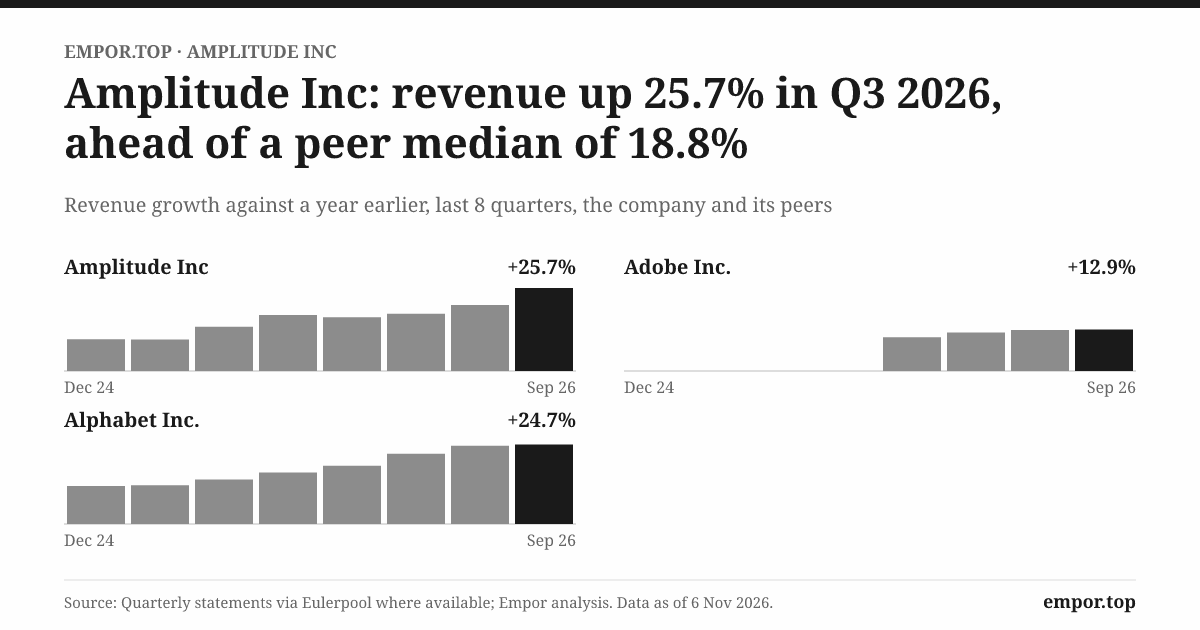
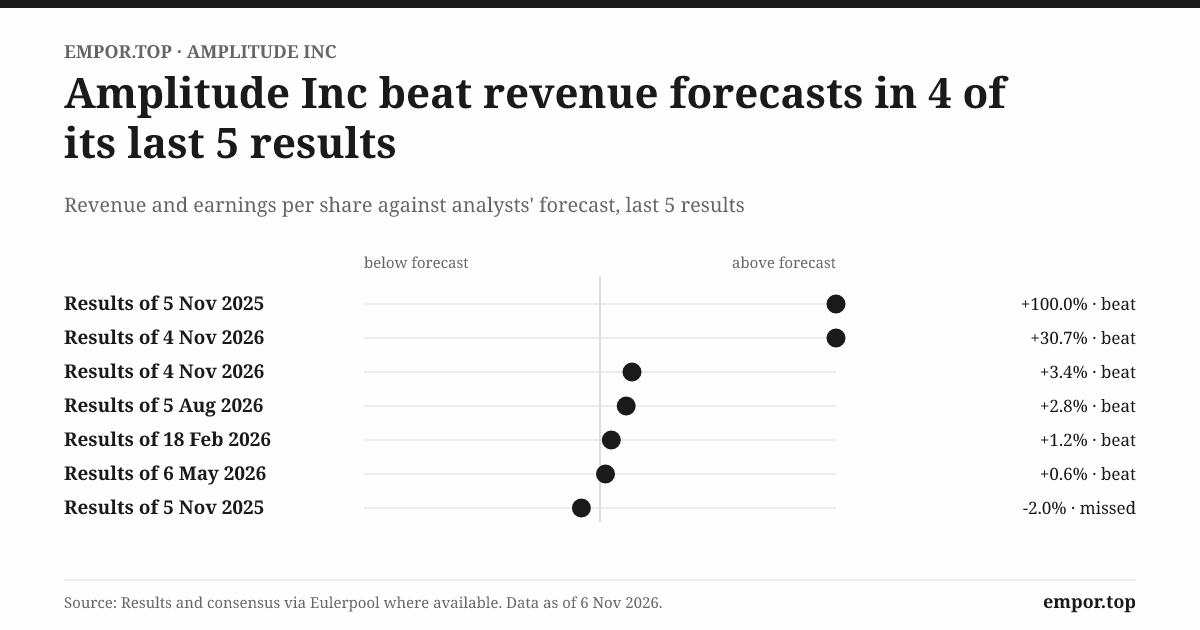
On the afternoon of November 4, 2026, Amplitude put out the kind of quarter its shareholders had waited years to read. Revenue for the three months to September came to $110.6 million, almost 26% more than a year earlier.1 That was the fastest growth the company had reported in years. A business that had spent most of 2024 growing in single digits was suddenly growing by a quarter a year.
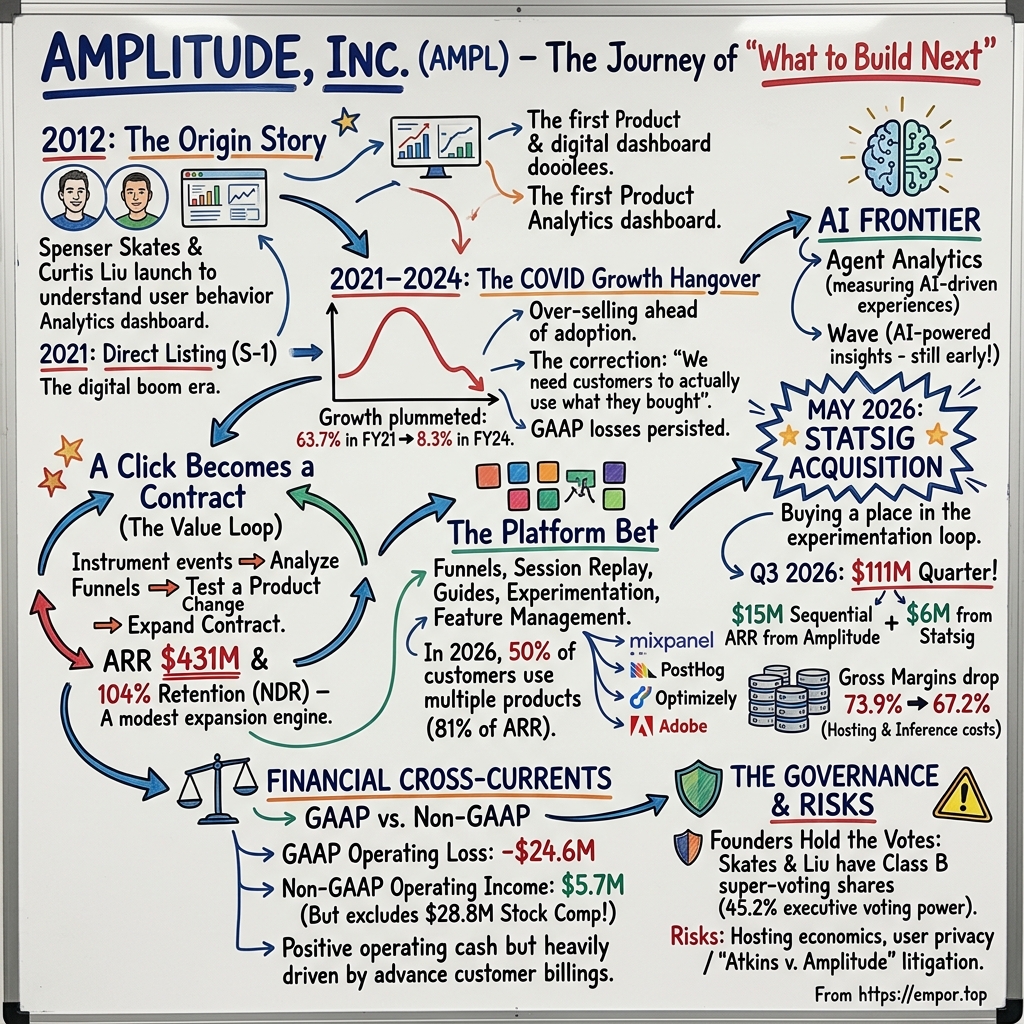
Annual recurring revenue, the figure software investors watch most closely because it shows the run-rate of subscriptions in force, reached $431 million, up 24%.1 In a single quarter the company had added about $21 million of it. Read quickly, the release described a turnaround that was finished.
Then came the conference call, and with it the detail that makes this quarter a puzzle rather than a victory lap. When management broke the $21 million into pieces, about $15 million came from Amplitude's own business. The other $6 million came from Statsig, the experimentation platform whose customers Amplitude had taken over in the spring.2
That split is the opening clue of this story. Statsig's customers now belong to the listed company. Their contracts are Amplitude's contracts, their renewals will be Amplitude's renewals, and their revenue is real. But an investor trying to judge whether the original business has found a second wind has to hold the two pieces apart. A company that buys a book of customers can show faster growth on the day the contracts arrive. The harder question is whether it can keep growing after that.
The scale matters for what comes next. Amplitude reported $343 million of revenue in fiscal 2025.4 On November 6, 2026, the stock market valued the whole company at about $2.2 billion, or roughly five and a half times its trailing sales.5 That is a modest company by the standards of enterprise software. It sells to product teams at other companies the tools that show how people actually use websites and apps. It has never earned a GAAP profit in any year it has reported publicly.4
So the episode has three stakes. The first is growth. Can Amplitude turn the enormous streams of customer behavior data it already processes, and the widening set of products it now sells on top of them, into growth that lasts? The second is economics. Can it do that while its losses, measured the conventional way and with the cost of employee stock counted, finally close? The third is the deal. What does Statsig give Amplitude that it could not have built for itself, and what does it cost to run?
None of those questions is settled by one quarter, however good. They are settled by a handful of numbers that will recur throughout this story. One is the ARR that Amplitude adds on its own each quarter, without acquired contracts.
Another is dollar-based net retention, which shows whether existing customers spend more each year after accounting for the ones who leave or shrink; at the end of September that measure stood at 104%.1 Gross margin shows what it costs to serve all that data. Stock compensation shows how much of the company's apparent progress is being paid for in shares rather than cash.
Keep the $15 million and the $6 million in mind. They are the two halves of the question this company now has to answer. To understand why that question matters so much, it helps to go back to a pair of MIT graduates who could not figure out why nobody came back to their app.
 Subscribe on LinkedIn
II. The Product Team’s Dashboard Became a Company
In 2011, Spenser Skates and Curtis Liu, both MIT graduates, built a voice-texting app for Android called Sonalight.6 Skates later described it as a version of Siri before Siri existed. It went through Y Combinator's Winter 2012 batch and reached about 500,000 downloads.6 By the standards of a student-founded startup, that was a respectable start.
It was also a failure in the way that matters most to a consumer app. People tried Sonalight once, and then most of them never came back. Skates later called it "a 95th percentile idea", good but not good enough, because the technology could not deliver an experience that kept users engaged.6 The founders had spent a large share of their time building their own analytics to work out why. Skates estimated that it was about half.6
That internal tool turned out to be the more valuable product. Skates had come to startups by an unusual route. After college he spent a year in finance and high-frequency trading, a world where every decision is measured against data.6 He and Liu were, in his telling, the algorithms people on the team.
When other Y Combinator developers saw the analytics they had built, they asked to use it. The team stopped working on Sonalight and began building Amplitude in 2012, joined by co-founder Jeffrey Wang, a Stanford computer scientist.6 Amplitude made its public debut in February 2014 as a mobile analytics service aimed at rivals such as Flurry and Mixpanel.7
The idea was simple to state and hard to execute. A product team tags the actions people take inside an app or website: signing up, clicking a button, adding an item to a cart, opening a feature, leaving. Each tagged action becomes an event. Stitch millions of events together and a team can see the journey users actually take. It can see where they engage, where they drop out, whether they return a week later, and which behaviors predict that they will pay.
An analogy helps. Old-fashioned web analytics was like a turnstile at a stadium: it told you how many people came through the gates. Product analytics is more like following each fan through the building. It shows who went to the concession stand, who left at half-time, and who came back for the next game. For a company whose product is software, that second view is the difference between guessing and knowing.
The timing was right. Over the decade that followed, more businesses moved their customer relationships into apps and websites. Banking, retail, media, travel and work software all shifted their storefronts onto screens. When the storefront is a screen, the behavior on that screen becomes the main evidence of whether the business is working. That pulled product analytics out of the startup engineering team and into the planning meetings of large companies.
By the time Amplitude prepared to go public, the business showed real demand. Revenue rose from $68.4 million in 2019 to $102.5 million in 2020, growth of about half in a single year.8 Subscriptions made up 97% of 2020 revenue, which meant almost all of that money came from customers paying recurring fees rather than one-off services.8 The company still lost money, but it had found a recurring need: making digital behavior legible to the people who build the product.
Amplitude then took an unusual route to the public market. In September 2021 it did not sell new shares through a conventional underwritten IPO. It used a direct listing on the Nasdaq. Its registration statement registered shares already held by existing investors and employees, so they could trade, and the company raised no fresh capital through the listing itself.8
A direct listing was a statement of confidence. It said the company did not need a bank's book-building to find its price, and its holders did not need a lock-up to protect it. It also meant the first price was set by the market of autumn 2021, at the height of the enthusiasm for software stocks.
The early record proved that customers wanted the product. It did not yet prove that Amplitude had a durable moat. Fast early growth in software is common. The test is whether customers expand year after year, at margins that eventually cover the cost of winning them.
Skates still runs the company. He has led Amplitude since 2011 and remains its chief executive and board chair; in April 2026 he also took the title of President.9 Liu remains chief technology officer and a director.9 The founding team is unchanged, but the question in front of it is now different.
It no longer turns on whether startups will buy a dashboard. It turns on whether large enterprises will buy a broader platform from the company that built that dashboard. Answering that requires a detour through the period when the dashboard business itself seemed to stall.
III. The COVID Growth Hangover
Picture the software economy of 2021. Lockdowns had pushed shopping, banking, entertainment and work onto screens almost overnight. Every company with an app wanted to know what its new users were doing, and budgets for digital tools seemed limitless. Amplitude's revenue grew almost 64% that year.4 The stock market, newly able to trade its shares, valued it at more than 40 times sales at the end of 2021.5
Then the curve bent, and it kept bending. Growth fell to about 43% in 2022, then to 16% in 2023, and to 8% in 2024.4 Measured from 2020 to 2025, revenue still compounded at about 27% a year. But measured over the last three of those years, the rate was 13%, less than half.4 Growth recovered to almost 15% in 2025.4 Even so, the company never returned to the pace of its listing year.
The popular explanation was the macro cycle. Interest rates rose, software budgets tightened, and every vendor in the sector felt it. That was true, and on the fourth-quarter 2022 call, management leaned on it. Executives described a harder economy, customers scrutinising their software spending, and more pressure at renewal time, with some customers churning or cutting back.10 They also described the company's own response: slower hiring, tighter expense control, and a workforce reduction as it adjusted to a slower-growing base.10
The fuller explanation, which management itself later gave, was less flattering and more useful. In the boom, Amplitude had sold contracts faster than customers learned to use them. Some customers had bought capacity and seats that their teams were not putting to work. When those contracts came up for renewal in a tighter market, an underused product was an easy cut. Management came to describe the earlier period as one of over-selling. It said the company needed to help customers adopt what they had already bought before it could expect them to buy more.[^11]
That is a meaningful admission, because it changes the diagnosis. A cyclical slowdown fixes itself when budgets loosen. An adoption problem does not. It requires a company to change how it sells, how it onboards customers, and what it measures its salespeople on. The question for an investor becomes whether management fixed the cause or simply waited for the weather to change.
By the fourth-quarter 2023 call, the tone had shifted from macro headwinds to discipline. Growth was still slowing, and management talked about expense control and about shifting attention toward larger, longer-lived enterprise relationships.[^11] The cost actions of 2022 and 2023, and a further restructuring that touched about 5% of the workforce in the first half of 2026, were responses to a slower revenue base.3 They were not, by themselves, evidence that the subscription model had failed. Revenue never shrank. It just stopped compounding at the rate the market had priced.
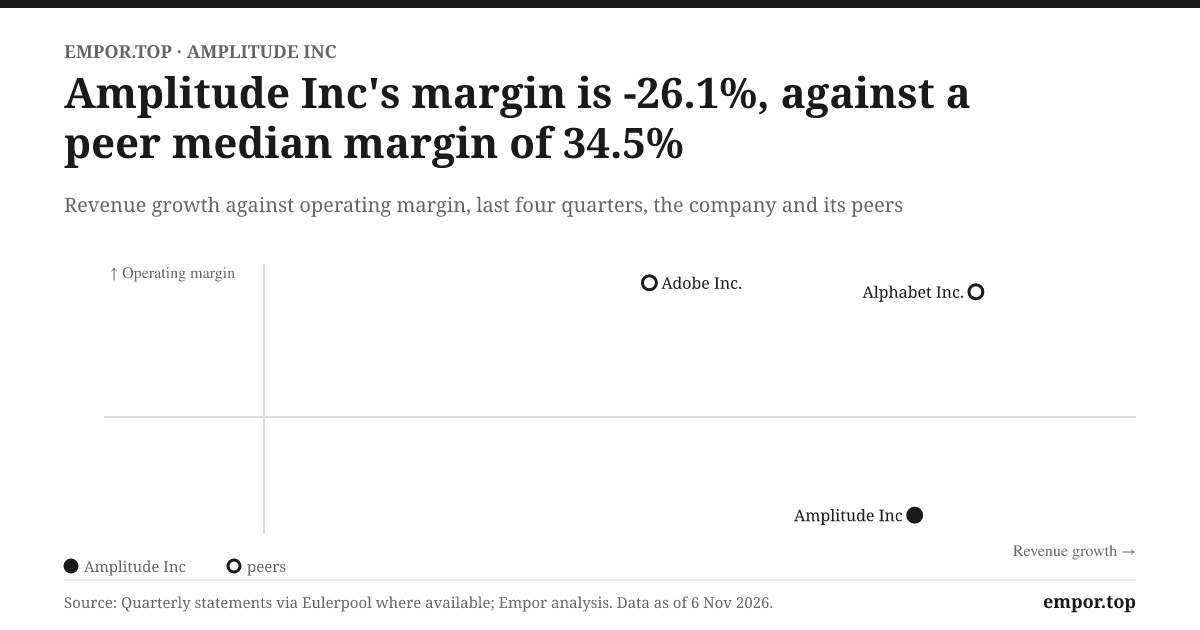
The profit record tells the second half of the story. GAAP operating losses ran between roughly $74 million and $107 million every year from 2021 to 2025.4 Operating margins did improve, from a loss of about 44 cents on every revenue dollar in 2021 to about 28 cents in 2025, because revenue grew faster than costs.4 But the company that had promised scale economics in 2021 was still losing more than a quarter of its revenue at the operating line four years later.
Weigh the evidence and the slowdown was not a brief blip. It was material, it ran for three years, and its root cause sat inside the business as well as outside it. The recovery since 2025 is real: growth has risen in each of the last several quarters, to almost 26% in the September quarter.1 But the record argues for treating retention and expansion as the main readings and any single fast quarter as a secondary one.
That record also sharpens the strategic question that dominates the rest of this story. If the problem in 2022 was that customers were not using enough of what they had bought, Amplitude's answer since then has been to sell them more things.
A wider platform might deepen adoption by giving teams more reasons to live inside the product every day. It might also repeat the old mistake, adding products that customers buy in a bundle without ever paying for them in full. To see which is happening, it helps to look at what a customer actually buys, starting with a single click.
IV. A Click Becomes a Contract
A product manager at a streaming service ships a new feature: a button that lets viewers build a shared watch-list with friends. A week later the numbers are in. Plenty of people tap the button. Very few finish creating a list. Somewhere between the first tap and the final step, they give up.
This is the moment Amplitude is built for. The product manager opens a funnel chart and sees that most users abandon the flow on the screen that asks them to invite a friend. A session replay shows real users hovering, scrolling and quitting. The team designs a simpler version and tests it against the original with half the audience each. Two weeks later the experiment shows which version keeps more people. The winner rolls out to everyone. The team then watches whether those viewers come back more often over the following months.
That loop of instrumenting, analysing, testing and measuring is the value a customer pays for. Each turn of the loop creates more events, and the events are the raw material. A company that runs this loop across dozens of teams and hundreds of features is generating an enormous stream of data. It is also building a habit of decision-making that depends on the tool producing it.
The contract follows the data. Amplitude prices its subscriptions around the platform features a customer uses and the volume of data it commits to send. That volume is measured either in events or in monthly tracked users, the number of distinct people whose behavior a customer measures in a month.4
Substantially all contracts for customers handled by the sales team run for at least a year. Most are billed annually in advance, and they are generally non-cancellable during their term.4 Revenue is recognised evenly over the life of the contract, and overage charges, the extra fees for exceeding a commitment, have historically been an insignificant share of revenue.4
Think of it as a gym membership with a twist. The customer pays upfront for a year of access at an agreed level of use. If it wants to use more, it signs up for a bigger plan at renewal, or adds a new service such as experimentation or session replay. The company gets cash in advance and predictable revenue. The customer gets a fixed bill. The economics depend on what happens when the year is up.
There is a subtlety here that matters for anyone reading Amplitude's usage claims. More events can come before more revenue: a customer that sends twice as much data is a candidate for a bigger contract. But Amplitude gives volume discounts, so a customer's data can grow much faster than its bill.4 Usage is a leading signal, not a revenue figure. A company can process far more data each year and still see revenue grow modestly, while the cost of storing and computing that data grows with the volume rather than with the price.
The best single answer to how strongly the existing customer base expands is dollar-based net retention, which stood at 104% at the end of September 2026.1
That is positive, but it is not the figure of a powerful expansion engine. Software companies whose customers deeply embed the product often report figures well above 110%, which means existing customers alone grow the business by double digits. At 104%, most of Amplitude's growth has to come from winning new customers or from acquisitions. Existing customers are adding only a little.
Another clue points in a more encouraging direction. Customers paying at least $100,000 a year numbered 855 at the end of September, up 31% from a year earlier.1 That count is growing much faster than retention alone would suggest. Large customers are being added, or smaller ones are climbing above the threshold, at a strong pace.
At the end of 2025, 56 customers paid more than $1 million a year.4 The enterprise base is broadening. What the counts do not show is the economics of each new group of customers: what it cost to win them, what discounts they received, and how they will renew.
On the third-quarter call, management offered two explanations that help reconcile the clues. Executives said cross-selling, existing customers buying additional products, was the largest contributor to organic ARR growth in the quarter.2 They also noted that some of the recent new customers had not been customers long enough to affect the trailing retention figure.2 If that is right, retention should rise as those customers pass their first anniversary and, ideally, expand. If it does not rise, the strong new-logo count will have been bought with contracts that do not grow.
One analyst asked the question directly: was demand decelerating? The chief financial officer pointed to a redesigned sales-territory structure and to new pricing and packaging as changes moving in the right direction.2 That is a reasonable answer, but it is an answer about inputs. The outputs that would confirm it are retention and organic ARR in the quarters ahead.
One reassurance sits in the footnotes. No single customer accounted for 10% or more of revenue in the third quarter or the first nine months of 2026, and none accounted for 10% of receivables.3 Amplitude does not disclose its top-five or top-ten customer shares, but the company's risk is not dependence on a single buyer.3 The risks are the value each customer gets, how long it stays, and what it costs to serve.
That brings the story to the real question about the contract. If a customer is paying for more than a dashboard, what exactly is it paying for? Amplitude's answer since its slowdown has been to make the dashboard one part of a larger system. Whether customers treat that system as something they consolidate around, or as a set of features they could buy elsewhere, is the next chapter.
V. The Platform Bet: From Analytics to Experiments
Walk back through the streaming service's watch-list problem, and count the tools it took to solve. Analytics found the drop-off. Session replay showed what users were doing on the problem screen. A survey asked a sample of viewers why they quit. An in-app guide nudged users through the new flow. An experimentation tool compared the old and new versions. A feature-management system controlled who saw which version and rolled the winner out safely.
For most of the last decade, those were six different products from six different vendors, each with its own contract, data pipeline and login. Amplitude's platform bet is that a product team would rather have them in one place, sharing one stream of event data. The company now sells product analytics, session replay, feedback and surveys, guides, experimentation and feature management as parts of a single workflow for building digital products.4
The strategic appeal is easy to see. Analytics identifies a problem; experimentation tests a fix; feature management controls the rollout; feedback and replay supply the human context that numbers miss. If all of those tools read from the same data, a team does not have to reconcile conflicting dashboards, and a vendor that owns the loop owns more of the team's day. Platforms in software tend to win when they remove the seams between tools that customers otherwise stitch together by hand.
The evidence that customers are buying the bundle is concrete. At the end of September 2026, half of Amplitude's customers used more than one of its products, and those customers accounted for 81% of ARR.2 Customers using five or more products accounted for 29% of ARR.2 That is a real cross-sell record. The biggest customers are clearly the ones buying the most products.
The record also has limits. Amplitude still says that substantially all of its revenue comes from subscriptions, and it does not disclose revenue, growth or profit by product.4 An investor cannot see whether experimentation is a business of its own or a discount inside a bundle. Nor can an investor tell whether the five-product customers pay proportionally more, or simply received more modules for a slightly larger contract.
The company's own history is the sharpest test of the platform claim. By the time it filed its annual report for 2024, Amplitude had already launched a customer data platform, Experiment, Session Replay, a warehouse-native version of its analytics, and Guides and Surveys. Yet substantially all of its revenue still came from Analytics.[^12]
Several years of product launches had broadened the menu without broadly diversifying what customers paid for. That does not mean the newer products failed, because bundling makes their revenue hard to isolate. It does mean that product breadth had not, at that point, shown up as a separately visible revenue engine.
The field Amplitude plays in is crowded on every side.4 In product analytics it meets Mixpanel, the old rival it named at its 2014 debut, and newer challengers such as PostHog and Contentsquare. In experimentation and feature management it faces Optimizely and LaunchDarkly. Fullstory and Quantum Metric compete in session replay, Pendo in in-app guides and surveys. Above them all sit Adobe and Google, whose web and marketing analytics reach almost every large company, often bundled into broader suites.
Comparisons of scale are difficult. Amplitude's $343 million of 2025 revenue made it a significant independent player, but many of its rivals are private, and the giants report analytics inside much larger segments.4 Amplitude's filings give no product-analytics market-share figures, and there is no reliable way to rank the field by revenue. Industry awards and search-interest rankings appear in plenty of marketing material. Neither is a market share.
What would make the platform hard to leave? Run the question through Hamilton Helmer's seven sources of lasting advantage, and most of them fall away quickly. Amplitude does not have scale economies large enough to undercut Adobe or Google. It has no cornered resource such as a patent or exclusive data, and no network effect in which each new customer makes the product better for the others. Its brand is strong among product managers, but that matters most when a buyer is choosing a vendor, not when it is renewing one.
The power that genuinely applies is switching costs. Once a company has instrumented its apps with Amplitude's software kit, built years of event history, trained hundreds of employees on its charts, and wired experiments and rollouts through it, leaving means re-tagging the product, losing historical comparisons and retraining teams. Those are real frictions. A platform that also runs experiments and controls feature releases embeds itself further into the engineering workflow, which raises them again.
Yet the evidence for lock-in is modest. Amplitude discloses neither its market share nor its largest customers' share of revenue. Retention remains modest, describing a customer base that stays but does not expand much. Switching costs keep customers from leaving. They do not, on this evidence, make customers spend much more each year. A newer, cheaper rival such as PostHog, or a suite vendor offering analytics as a discount inside a broader deal, can still pressure price at renewal even if the customer never leaves.
Weigh it and the moat claim narrows. The history does not reject the idea that Amplitude has switching costs, but it shrinks the claim from a platform that customers cannot replace to a tool that customers rarely rip out yet expand slowly. The figure that would widen the claim again is retention climbing well above its current level while multi-product customers keep rising as a share of ARR. If breadth keeps rising and retention stays flat, the bundle is being bought, not valued.
There is also an economic trade-off hidden inside the bundle. Consolidation can raise expansion and reduce what customers spend on other tools, which is good for Amplitude's revenue. But each product added to the loop processes more data. Session replay captures far richer data than a click event. Experimentation runs statistical computation on live traffic. AI features add the cost of running models. If prices do not rise with the volume, the platform makes customers stickier and gross margins thinner at the same time.
By 2025, one piece of the loop mattered more than the rest. Experimentation is where an insight becomes a decision, where a team proves whether a change worked. Amplitude had its own experimentation product, but rivals had built deeper ones. The company faced a classic strategic choice: keep building, partner with a specialist, or buy one. In the spring of 2026, an unusual opportunity let it do something between the last two.
VI. Statsig: Buying a Place in the Experiment Loop
The deal began with a sale that had nothing to do with Amplitude. On September 2, 2025, OpenAI announced that it was acquiring Statsig, an experimentation and feature-management platform, in an all-stock deal reported at $1.1 billion.11 OpenAI wanted Statsig's people and technology for its own products. It did not need to run an external software business serving other companies' product teams.
In May 2026, Amplitude announced the arrangement that solved OpenAI's problem and filled Amplitude's gap.11 Amplitude would take over Statsig's brand and customer base. The engineers, product leaders and statisticians who built the platform would stay at OpenAI.11 Skates framed the logic around the new era of software development: the challenge, he said, was how to evaluate code before it was released and track what was working after.11
The legal form of the deal matters, because it determines what Amplitude actually owns. This was an asset acquisition, not the purchase of Statsig the company. Amplitude acquired certain customer contracts, customer relationships, contracted backlog and the Statsig brand. It also received a perpetual, non-exclusive licence to the underlying technology.3 Non-exclusive means OpenAI keeps using the same technology internally. Amplitude got the right to run and sell the software, not sole ownership of it.
The balance sheet shows what came across. Amplitude assumed $17.9 million of deferred revenue, payments customers had already made for service still to be delivered, and acquired $9.4 million of receivables.3 It recognised $8.7 million of identifiable intangible assets, the accounting value assigned to customer relationships, backlog and the brand.3
The filing does not disclose the cash consideration paid. That gap matters. Without a price, an investor cannot calculate what Amplitude paid per dollar of acquired ARR or compare it with other software deals. The $8.7 million is an accounting allocation, not the transaction price, and it says nothing about whether the deal was cheap or expensive.
Critics were quick to name the obvious weakness. Optimizely's chief executive, Alex Atzberger, said Amplitude was getting Statsig's code without the talent. He called it "a race car without a driver", and predicted that one of Amplitude's two overlapping experimentation products would be shut down over time.11
He is a competitor with every reason to unsettle Statsig's customers, but the point he raised is fair. Many of those customers had chosen Statsig for its warehouse-native design, which runs analysis inside the customer's own data warehouse. Every change to pricing, roadmap or architecture is a moment when a customer may reconsider.11
The first results show the acquired base contributing. In the third quarter, about $6 million of the $21 million of new ARR came from Statsig.2 Management also said that attributing growth between Amplitude and Statsig would become harder as products, sales teams and contracts merged.2 That is a natural consequence of integration. It also means the cleanest test of the legacy business's growth will soon be unavailable to outsiders, just as the comparison is getting interesting.
The cost side of the deal arrived faster than the growth. In the third quarter, Amplitude's cost of revenue rose 57% from a year earlier, while revenue rose about 26%.1 Gross margin, the share of each revenue dollar left after paying to host and serve the product, fell to 67.2% from 73.9%.1 For every $100 of revenue, Amplitude was keeping almost $7 less than a year earlier after its hosting and support bills.
The mechanism is specific. Management said Statsig's hosted environment had not been optimised for the economics Amplitude needed when it took over.2 The quarterly filing attributes the rise in cost of revenue to higher hosting and inference costs from added capacity and customer usage, including that of the acquired customers.3 Put simply, Amplitude inherited customers running on infrastructure built for a different owner. It is now paying to serve them while the systems are re-engineered.
On the third-quarter call, management gave a concrete answer about the fix. Amplitude had signed a long-term hosting contract with Google and was optimising its AWS and Google environments.2 Long-term cloud commitments typically trade a guaranteed volume for lower unit prices, so the step is plausible.
Whether it works will show up in one number: gross margin in the quarters ahead. If it climbs back toward the mid-70s while Statsig's customers renew, the margin dip will look like an integration cost. If it stays near the high-60s, the acquired business will have permanently lowered the economics of the whole company.
Statsig was the largest of a series of capability purchases. Over the previous two years Amplitude had bought Command AI, a maker of in-app user assistance; Inari, for customer feedback; June.io, a product-analytics tool; and Kraftful, which used AI to analyse customer feedback.4 It also bought InfiniGrow for $0.2 million in cash, plus employee equity awards with a target value of $6.5 million.4 That last detail is typical of such deals: the visible price is small, and the real cost arrives later as stock compensation for the people who came with the business.
Those deals show a coherent build-out strategy: each one adds a capability adjacent to the core loop. They do not yet establish financial returns. Amplitude does not disclose revenue from any acquired product, and the earlier acquisitions are now blended into the platform.
In October 2026 the company used a contractual right of first refusal to buy back and retire about 396,000 shares from the founders of Command AI for $6.3 million.3 The repurchase was small, but it was a reminder that acquisitions paid in equity leave a trail of shares that can come back to market.
So was Statsig a bargain or an overpayment? Without a deal price, the honest answer is that nobody outside the company can tell. The acquired contracts' future renewal rates and margins are still unknown. What can be said is that the deal fits the product loop.
That gives Amplitude a stronger claim to the full workflow. The proof will come in three readings: Statsig's customers renewing, gross margin recovering, and the combined business adding ARR without the help of a new purchase.
Amplitude's next bet extends the loop in a different direction. If product teams increasingly build software with AI, and their customers increasingly talk to AI agents rather than clicking buttons, the events worth measuring start to change.
VII. Can AI Make the Loop More Valuable?
Imagine a retailer that has replaced half its customer-service screens with an AI agent. Shoppers no longer click through menus; they type questions in plain language and the agent answers. The old funnel chart cannot see much here. A shopper does not abandon a page. A conversation goes wrong, the shopper gets frustrated, and the sale never happens. Nobody on the product team knows which answer caused it.
That is the problem Amplitude's newest products are aimed at. In the third quarter, the company launched Agent Analytics, which measures how users interact with AI agents and where those interactions fail.3 Management said more than 125 customers had used it within a little more than a month of launch.2 On the call, executives described one customer that had used it to discover where users were becoming frustrated in conversations with the customer's agent.2
The logic is a natural extension of the core business. If software interfaces are shifting from buttons to conversations, the teams building them still need to know what works. They need to see where conversations fail and whether a change to the agent actually improves outcomes. That is the same question product analytics has always answered, asked of a new kind of interface. Amplitude already has the customer relationships, the data pipes and the analytical habits.
Wave is a more ambitious and more speculative product. Management describes it as a tool that can identify where a product is underperforming, recommend changes, and help implement them.3 In effect, the analytics loop would start running itself. Rather than a product manager reading a chart and deciding what to try, the software would propose the experiment. On the call, management described a customer using Wave to improve engagement with a feature.2
The caveats came from management itself, and they deserve full weight. Executives described Wave as early. It required significant setup and close collaboration with each customer, and it was not yet fully automated.2 Management said the bottleneck to adoption was the customer's willingness to change how it works, not just the capability of the software.2 That is an unusually candid admission. It also means that today Wave looks more like a consulting engagement wrapped around software than a product that sells and installs itself.
The distinction between the products matters for valuation. Agent Analytics extends a proven use case into a new interface. Wave tries to change who makes product decisions. Meanwhile, the core analytics products and the newly acquired Statsig tools remain the established revenue engine. Customer anecdotes from an earnings call, however vivid, are evidence that the software works for some customers. They are not evidence that customers will pay for it at scale.
Amplitude's earlier launches took years to show up as separately visible revenue.[^12] Launches and early users are not revenue, and Amplitude has not historically disclosed when a new product becomes a material business. That history means it should not get full credit for this one on the strength of 125 early users.
There is also a cost question. Model inference costs are already part of the gross-margin pressure.3 If Agent Analytics and Wave are priced as add-ons that customers pay for, those costs can be recovered. If they are included to keep existing customers from leaving, they become a cost of retention rather than a source of growth.
That is the falsification question for the whole AI chapter. Will customers pay for these products as distinct, incremental modules, adding ARR that would not otherwise exist? Or will adoption mainly help retain the existing subscription, which is valuable but much less so? A rising retention rate would be consistent with either story. Rising ARR from AI products, disclosed or clearly attributed by management, would support only the first.
An investor trying to assign value to the optionality has four things to watch: paid adoption rather than trial usage, incremental ARR, the rate at which free usage converts to contracts, and gross margin as model costs scale. Until those show up, the AI products are best treated as a plausible extension of the core with a speculative tail. They do not yet change the investment case.
AI has a second, quieter effect on the business. As AI tools help engineers write software faster, product teams will ship more features. More features mean more to measure, and that should help a company whose business is measuring what gets built. But faster code production does not prove paid demand for analytics. Whether the extra building turns into extra spending will show up, again, in retention.
The products are new, and so is their cost. The question that has followed Amplitude since its listing is older: does the company's progress show up in its profits, once every cost is counted?
VIII. The Margin Improvement Has a Stock-Compensation Asterisk
The third-quarter release carried a line that Amplitude's management had been working toward for years. The company reported its highest non-GAAP operating margin to date, with $5.7 million of adjusted operating income.1 On the adjusted measure, Amplitude now earns a small profit from its operations.
The GAAP figures tell a different story. On the conventional accounting measure, Amplitude lost $24.6 million from operations in the same quarter.1 The difference between the two is mostly one item: $28.8 million of stock-based compensation and related payroll taxes, which the adjusted figure adds back.1 The equity paid to employees in the quarter was about five times the adjusted operating profit.
Start with what genuinely improved. GAAP operating margin rose to a loss of about 22% of revenue from a loss of about 29% a year earlier.1 Decomposing that seven-point improvement shows exactly where it came from. Sales and marketing fell to about 44% of revenue from about 55%. General and administrative costs fell to about 16% from about 18%. Research and development stayed at about 30%.1 Together, the lower selling and overhead costs saved more than 13 points of revenue.
The counterweight was a gross-margin decline tied to hosting and inference costs.1 So the arithmetic of the quarter is clear. Expense leverage of about 13 points, mostly in sales and marketing, more than offset a gross-margin decline of about seven, and the net was a seven-point improvement in the operating loss.
That decomposition matters because the two forces may not persist equally. The sales-and-marketing ratio fell partly because revenue grew faster than the sales budget, helped by acquired revenue that did not require a sales team to win. If growth slows, that leverage shrinks. The gross-margin decline, by contrast, reflects the cost of serving more data and running more models, which grows with usage. A company whose operating improvement comes from selling costs, while its delivery costs rise, has to keep growing to keep improving.
The research budget deserves its own note. Amplitude spent $97.6 million on research and development in 2025, about 28% of revenue, the same dollar amount as the year before.4 In the third quarter of 2026, the ratio was about 30%.1
The company has kept investing in product while revenue grew faster than R&D, and it reduced staffing along the way. It ended 2025 with 780 employees, against 490 in June 2021, and cut about 5% of its workforce in the first half of 2026.43 That looks like a company pursuing efficiency while still building, not one harvesting a mature product.
Now the stock-compensation asterisk. Over the first nine months of 2026, stock compensation and related payroll taxes totalled $74.5 million, almost a quarter of revenue for the period.3 In 2025 the figure was $95.6 million.4 That is a real cost to shareholders. It does not leave the company as cash, but it transfers ownership from existing holders to employees, and if the company buys back shares to offset it, it does cost cash. The adjusted margin treats that cost as if it were not there.
Cash flow adds another layer. Over the seven years from 2019 to 2025, Amplitude's net losses added up to about $496 million. Over the same period, its operating cash flow was positive, about $10.8 million in total.4 How can a company lose half a billion dollars and still generate cash from operations?
The answer has two parts. The first is stock compensation: a large share of the expenses that drive the losses were paid in shares, not cash. The second is advance billing. Because customers pay for a year upfront, a growing company collects cash before it earns the revenue.
In the first nine months of 2026, rising deferred revenue contributed about $25.9 million of cash, while receivables and deferred sales commissions absorbed some of it.3 Neither of those is profit. One is ownership paid out in shares; the other is cash collected for service still to be delivered.
Free cash flow depends on what you subtract. Measured as operating cash flow minus purchases of equipment, Amplitude generated about $28.2 million in 2025.4 The company's own definition also subtracts software development costs that it capitalises rather than expenses, and on that basis free cash flow was $23.5 million.4 Both are positive. Both are small against a company valued at $2.2 billion, and both exist largely because shares rather than cash paid a big part of the payroll.
Weigh it and the quarter marks progress, not a settled transition to owner earnings. Expense leverage is visible and appears real, especially in sales and marketing and administration. But the gap between GAAP and adjusted results remains wide, and gross margin is moving the wrong way. Owner earnings, the profit left for shareholders after every real cost including equity, are still negative.
The next four quarters will show whether this changes. Three readings matter most: GAAP operating margin, stock compensation as a share of revenue, and gross margin. A company truly making the turn would show all three improving together, with free cash flow after capitalised software growing faster than revenue. If adjusted profit grows while stock compensation stays near a quarter of revenue, the improvement is real but incomplete. Whether that discipline arrives depends heavily on the people who control the company, and at Amplitude they are not hard to identify.
IX. The Founders Still Hold the Votes
Fifteen years after the voice-texting app, the two MIT friends still run Amplitude, and they still control a large share of its votes. Skates is chief executive, board chair and, since April 2026, President.9 Liu is chief technology officer and sits on the board.9 Few software companies of this size are still led by the same founding pair a decade and a half later.
The share structure keeps it that way. Amplitude has two classes of common stock. Each Class B share carries five votes; each Class A share, the kind most public investors hold, carries one.9 As of April 2026, Skates held about 5.9 million Class B shares, worth 12.6% of the total voting power.
Liu held about 7.4 million, worth 15.2%.9 Directors and executives together controlled 45.2% of the votes.9 That total includes Pat Grady, a director whose Sequoia-affiliated holdings, at about 16% of voting power, make up part of it. Jasmine Ventures affiliates held another 10%.9
No single shareholder controls the company, but founders and early venture backers hold enough votes to shape almost any outcome. That has a real benefit. A founder with secure control can make a long product bet, such as a platform build-out, a strategic acquisition or a costly AI push, without fearing that one weak quarter will bring an activist to the door. It also has a real cost. Outside shareholders cannot easily force a change in strategy, management or capital allocation if the bet goes wrong.
Skates' pay is modest by Silicon Valley standards. He received total compensation of $789,019 in 2025, including $339,019 of cash incentive tied to company performance, and no equity award that year.9 His pay had been $300,000 in 2023 and $393,750 in 2024.9 For a founder with his voting stake, cash compensation barely matters. His fortune rises and falls with the share price, which is the strongest alignment a shareholder could ask for.
The wider executive team is paid differently. In 2025, chief financial officer Andrew Casey received about $2.2 million. Thomas Hansen, then President, received about $6.2 million, and Liu about $8.3 million, mostly in equity awards.9
Casey became CFO in 2024, after several changes in the role in the years following the listing, and remained in the position through the third quarter of 2026.93 The turnover in the finance chief's chair is worth noting for a company still trying to prove its economics. Casey's tenure is now long enough that the next year's results will be partly his record.
Those equity awards are the discipline test. The $74.5 million of stock compensation in the first nine months of 2026 is a cost borne by every shareholder.3 A founder-controlled company with modest founder pay can still be generous with equity further down, and the outside holders, with limited voting power, have little direct say over it.
Capital allocation offers a second test of behavior rather than words. The record shows a consistent pattern of buying adjacent capabilities: user assistance, feedback, AI analysis and, most consequentially, experimentation through Statsig. That is a coherent strategy. It is not yet a proven one, because none of the deals has disclosed returns and Statsig's price is not public. The company has not issued new public equity since the direct listing. Changes in its share count have come from employee awards and acquisitions, partly offset by small repurchases under rights of first refusal.83
The governance counterweights are real but limited. The board is majority independent, with James Whitehurst, the former chief executive of Red Hat, as lead independent director.9 At the June 2026 annual meeting, the say-on-pay vote passed with about 172.9 million votes for and 1.9 million against.12 The 2025 vote had drawn 98.3% support.9 Those margins say shareholders are not in revolt. Given the voting structure, they also say less than they would at a widely held company, because the founders' and insiders' votes are part of the count.
Related-party dealings are small and largely historical. The company has no parent and no royalty or management fee flowing to an insider. The proxy describes an investors' rights agreement that gives certain large holders, directors and executives registration rights, the right to have their shares registered for sale.9 An earlier transaction, Liu's 2020 sale of about 259,000 shares to Jasmine Ventures for $2.1 million, was a transfer between shareholders that involved no company money.8 Nothing in the disclosures suggests an operating relationship that diverts value from public holders.
The verdict is balanced. Founder leadership and concentrated voting power give Amplitude continuity, and Skates' modest cash pay aligns him with outside holders. But the record also includes a growth promise that went unmet for three years and a CFO seat that turned over several times. Control does not remove the need to judge execution against results. If anything, it raises the importance of results, because they are the main check outside shareholders have. And the results can be broken by risks that no amount of founder conviction can remove.
X. The Risks That Can Break the Growth Loop
Picture the risk in a single customer account. An online retailer doubles the number of events it sends to Amplitude over a year, because it has added session replay, launched an AI shopping assistant and started running more experiments. At renewal, its volume discount kicks in and the bill rises by a fraction of the data growth. Meanwhile Amplitude pays its cloud providers to store and process every one of those extra events, and to run the models behind the AI features.
That is the central business risk in a single image. Usage rising faster than revenue is good for customer engagement and bad for gross margin. A loop that gets used more without getting paid more can grow the cost base faster than the revenue base. The third-quarter decline in gross margin shows the risk is not hypothetical.1
A second signal sits on the balance sheet. At the end of September 2026, receivables, money customers owed, stood at $41.2 million, against $23.4 million at the end of 2025.3 Part of that rise reflects the calendar, since annual invoices cluster at certain times of year, and part reflects receivables acquired with Statsig.3 Bad-debt expense, the cost of accounts the company does not expect to collect, was $0.9 million for the first nine months, up from $0.1 million a year earlier.3
The amounts are small against revenue, and the company says its collections history is well established.3 But Amplitude does not publish an ageing table or a history of overdue balances, so outsiders cannot tell whether customers are paying more slowly. Receivables growing faster than revenue is a reading to watch, not a conclusion.
The balance sheet itself is a cushion, though a smaller one than at the listing. At the end of September, Amplitude held $58.9 million in cash and $95.4 million in marketable securities, about $154 million in total.3 It reported no funded borrowings.
The debt-like figure that appears in some data sets is $9.3 million of operating lease liabilities, mostly office rent, not bank or bond debt.3 No credit rating is central to a company with no borrowings. For a business with positive operating cash flow, that cushion covers its commitments comfortably. It would not fund a large acquisition paid in cash.
The third risk is built into the product's design. Amplitude collects behavior data through software kits that its customers embed in their apps and websites. That makes privacy both a legal and a commercial exposure. In Atkins v. Amplitude, plaintiffs brought a proposed class action alleging that mobile apps using Amplitude's software kit collected users' data improperly.4
In September 2025, the court ordered the claims to arbitration. On March 25, 2026, it denied the plaintiffs' request to certify an immediate appeal of that ruling.13 The quarterly filing says pending matters are not expected to have a material adverse effect, but it gives no quantified exposure or updated status for the case.3
The legal exposure appears contained for now. The commercial exposure is harder to measure. Large companies buying a data platform ask what data it collects, where it is stored and who can see it. A high-profile privacy dispute can lengthen sales cycles or narrow what customers are willing to track, even without a damaging judgment.
Security works the same way. Amplitude has disclosed no material breach. But enterprise buyers have grown more wary of third-party software after a run of supply-chain attacks across the industry. A vendor whose code runs inside customers' products, and whose servers hold their users' behavior data, faces extra scrutiny in every procurement review and implementation.4
Currency risk, by contrast, is secondary. The vast majority of subscription contracts are priced in US dollars, while expenses are spread across euros, pounds, Canadian, Singapore and Australian dollars, and yen.4 The company does not hedge. It has said that foreign-exchange gains and losses have not been material, and that a 10% move in the dollar would not materially affect its results.4
Auditor signals are clean. KPMG issued an unqualified opinion on the 2025 accounts. Its critical audit matter, the area it judged hardest, was revenue recognition for contracts with non-standard terms. That is a normal focus for a subscription company, not a sign of trouble.4
So the risks that can break the loop are not the usual suspects. No single customer dominates the revenue, and the company carries no funded debt. The pressure points are inside the model: whether usage converts into revenue, whether the economics of hosting improve, and whether the trust needed to collect product-interaction data holds.
The readings to follow are retention, receivables growth against revenue, gross margin as usage grows, and the next material update in the Atkins case. Against all of that, the market has put a price on the company, and that price contains its own set of assumptions.
XI. The Multiple Is Pricing a Turn, Not a Profit Stream
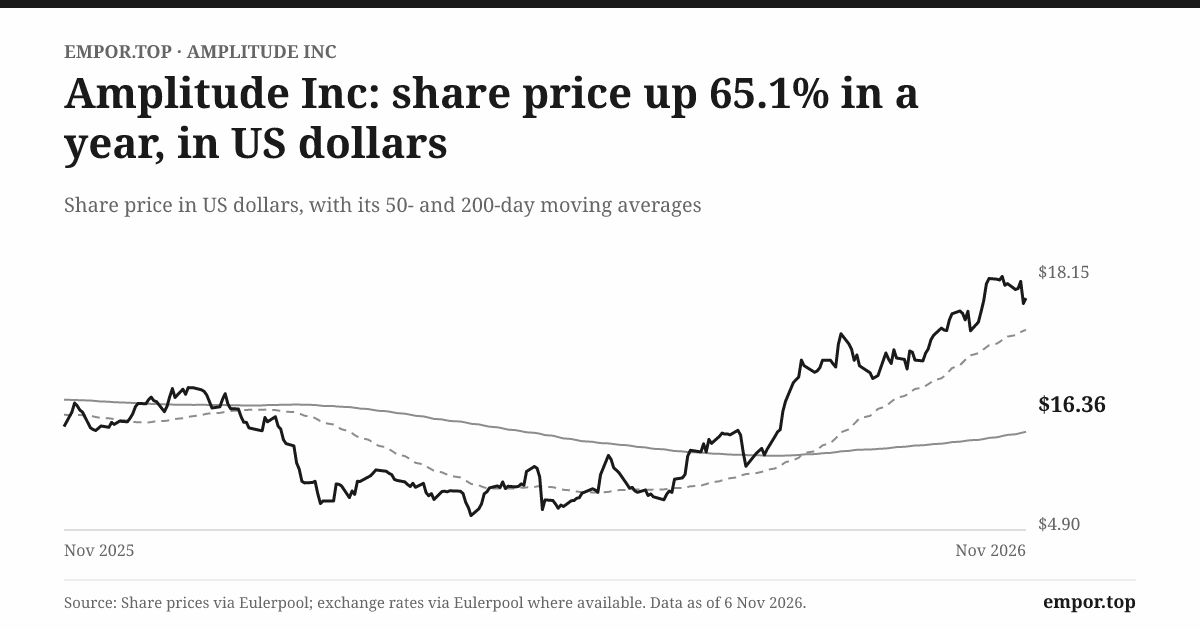
On November 6, 2026, two days after the results, Amplitude's stock closed at $16.36.5 That was about 6% below its high for the past year, and almost three times its low of $5.61 over the same period.5 The market had watched the growth rate climb through 2026 and had repriced the shares sharply in response.
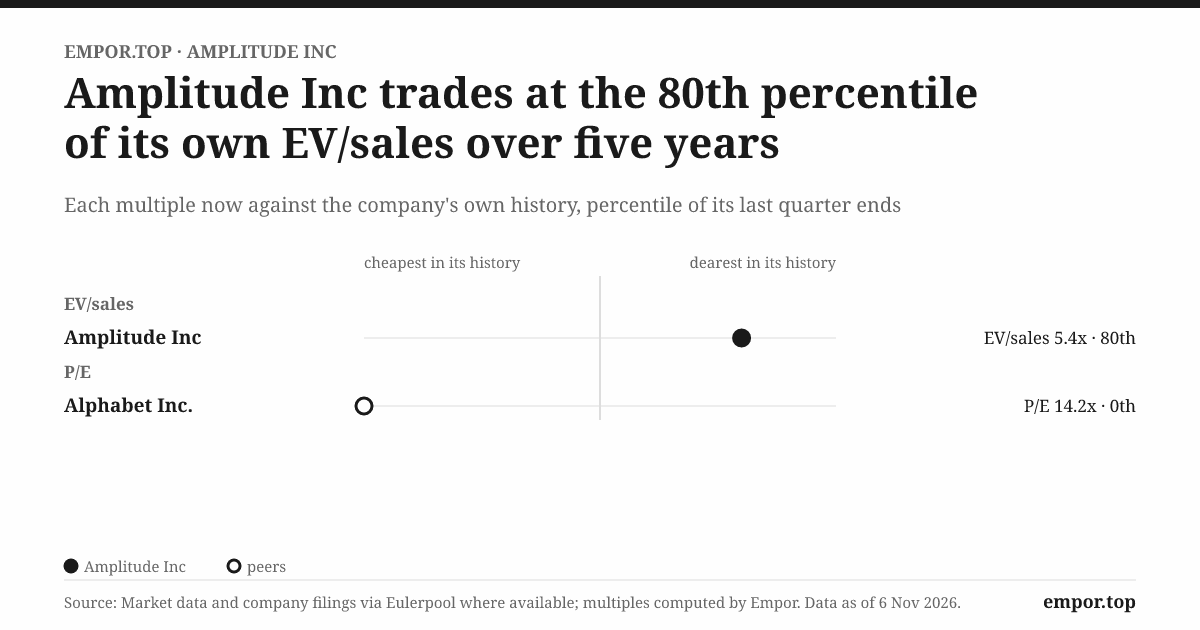
At that price, the market valued the company at about $2.2 billion, or about five and a half times its sales over the last twelve months.5 Adjusted for its net cash, the enterprise value was about $2.1 billion, also about five and a half times sales.5 Earnings multiples do not help. Trailing GAAP earnings are a loss of about 77 cents a share, and adjusted earnings exclude the stock compensation that is one of the company's largest costs.5
The company's own history gives the multiple some context. At the end of 2021, after the direct listing, the shares traded at about 42 times sales. By the end of 2022 the figure was below 7, and by the end of 2024 and 2025 it had settled at about 4.5 to 4.7.5 Today's multiple sits above those trough-year levels and far below the listing-year peak. The market is paying for the reacceleration, but at a fraction of the price it paid for the original growth story.
Peers offer context rather than a benchmark. Braze, a listed customer-engagement software company, traded at about six times sales on November 6, 2026.14 Datadog, a much larger and faster-growing software-monitoring platform, traded at about 21 times sales at the end of October.15 Neither is a direct comparison, because their product mix, scale and growth differ. But they bracket where Amplitude sits: priced like a recovering mid-sized software company, not like a platform with proven compounding.
Before weighing the cases, it helps to look at the industry's structure. Buyers hold real power: large customers negotiate volume discounts, consolidate vendors and can choose a free or cheaper alternative. The threat of substitutes is high, because Adobe and Google bundle analytics inside broader suites, and data warehouses increasingly let customers build their own analysis. New entrants face low barriers in software; PostHog's rise shows how quickly an open-source challenger can win developers.
Supplier power is meaningful too, because Amplitude rents its computing from a handful of cloud providers. Rivalry among existing competitors runs on every product line, from Mixpanel in analytics to Optimizely and LaunchDarkly in experimentation. That is a demanding industry. Its structure rewards the switching costs that come from owning a workflow, and it punishes the vendor that does not have them.
The bull case starts with momentum. Growth has risen for several quarters in a row, from single digits in 2024 to almost 26% in the September quarter.1 The count of customers paying more than $100,000 a year is rising by almost a third.1 Multi-product customers already account for most of ARR, and cross-selling was the biggest source of organic growth in the quarter.2
Sales and marketing costs are falling fast as a share of revenue, and Statsig gives Amplitude the experimentation step it had lacked.1 On this reading, the platform bet is starting to work, and the multiple has room to rise as GAAP losses narrow.
The bear case starts with the same quarter. About $6 million of its $21 million of new ARR was acquired.2 Retention of 104% says existing customers are expanding only modestly.1 Gross margin fell almost seven points.1
The gap between adjusted and GAAP profit is still about $30 million a quarter, almost all of it stock compensation.1 The AI products are early, and the company's history of converting new products into visible revenue is thin. On this reading, the market is paying for a turn that has not yet shown up in the measures that matter most.
Both cases agree on what would settle the argument. If the AI and platform products are working, three things should be visible without relying on acquired ARR or ever-larger stock-compensation adjustments. Organic ARR additions should hold up or rise. Retention should climb as multi-product adoption deepens.
GAAP operating margin should keep improving, with gross margin recovering. A skeptical long-short investor would ask to see all three before believing the turn. A skeptic would especially want them after the Statsig contribution can no longer be separated, because that is when acquired growth becomes impossible to tell apart from the real thing.
The current price assumes that the reacceleration largely continues and that losses keep narrowing. It does not assume the 2021 dream of hypergrowth. It does assume that the 2022 to 2024 slowdown was a correction rather than a ceiling. Which of those turns out to be true is the subject of the lessons Amplitude's story has already taught.
XII. Playbook: Business & Investing Lessons
Go back to the event stream, the endless record of clicks and taps that started as a tool for diagnosing why people abandoned a voice-texting app. That same stream now powers funnels for some of the world's biggest digital businesses, runs experiments through Statsig and measures conversations with AI agents. The data has scaled beautifully. The business built on it has scaled more awkwardly. That gap is the first lesson, and every lesson that follows is a version of it.
A product can be loved and still be underused. Amplitude's growth fell from about 64% in 2021 to about 8% in 2024, and management eventually admitted part of the reason.4[^11] The company had sold customers more than their teams were using. Bookings recorded in a boom are only as good as the habits that renew them. For founders, the lesson is that adoption is a product feature, not a customer-success afterthought. For investors, it is that the year after a boom shows how much of the boom was real.
A bundle earns its moat one renewal at a time. Half of Amplitude's customers buy more than one product, and they account for four-fifths of ARR.2 That is the look of a platform. But retention of 104% says the platform has not yet made customers expand meaningfully each year.1 Breadth is a claim; retention is the proof. Investors should judge a platform strategy by what existing customers spend next year, not by how many modules they hold today.
Cash flow can flatter a loss-making model. Amplitude has lost about half a billion dollars over seven years while reporting slightly positive operating cash flow.4 Shares that paid much of the payroll, and customers who paid a year in advance, explain the gap. Both are legitimate. Neither is profit. A prepayment is a promise to deliver, and a share grant is ownership given away; owner earnings begin only after both are counted.
Buy the missing loop only when customers can close it. Statsig gave Amplitude the experimentation step at the heart of product development, along with customers and a brand, but not the team that built it.11 The deal's value now depends on renewals and on fixing a hosting setup that cut almost seven points from gross margin in a quarter.1 An acquisition that fits the strategy still has to fit the economics. Adjacency is the start of the case, not the end of it.
AI optionality gets priced after customers pay. More than 125 customers tried Agent Analytics within weeks.2 Management itself said Wave needed heavy setup and customer change.2 A company whose earlier launches took years to become visible revenue should expect the market to wait for contracts this time too.
Management credibility, finally, is a track record rather than a tone. On the fourth-quarter 2025 call, management described a sharper enterprise focus and changes to pricing and packaging as the engines of the next phase.[^18] By the third quarter of 2026, it was pointing to those same changes as evidence that demand was holding.2
The consistency is welcome. The test is whether the next year's organic ARR, retention and GAAP results confirm it, because founders who once oversold a boom now have to show they can measure their own business as precisely as their customers measure theirs.
XIII. Epilogue
Tonight, Amplitude stands in a strange in-between. It is growing faster than it has in years. It has a bigger product, a larger enterprise base and a new piece of the experimentation market. It is also losing money on a GAAP basis, carrying a lower gross margin than a year ago, and facing the moment when its acquired growth will blend into its reported growth and disappear from view.
The next year of reporting will decide which story it tells. The first moment will come with the fourth-quarter results in early 2027, when the company reports full-year 2026 and, in all likelihood, will give guidance for 2027. Management said the split would become harder to draw.2
If organic ARR additions stay near the roughly $15 million of the third quarter, or rise, the case for a durable recovery strengthens even as the dividing line fades. If they shrink while total growth is held up by the acquired base, the reacceleration will have been partly bought.
The second reading is retention. The new customers management described as too recent to count will start to reach their first anniversary over the coming quarters.2 If they expand, retention should climb from 104%. If retention stays flat while the share of multi-product customers keeps rising, the platform thesis narrows to something smaller: customers accepting a bundle without paying much more for it.
The third reading is gross margin. Management said the long-term hosting contract with Google and work on Amplitude's cloud environments were meant to bring hosting costs down.2 Gross margin's recovery will show whether the Statsig integration was a one-time cost or a lasting drag on profit.
The fourth is the pairing of GAAP operating margin and stock compensation. Adjusted profit is already positive. The question is whether the GAAP loss closes, and whether stock compensation falls as a share of revenue rather than growing with the headcount of acquired teams. Progress on the adjusted figure alone will not answer the owner-earnings question that has followed the company since its listing.
The fifth is commercial proof for Agent Analytics and Wave. That means paid expansion, repeatable onboarding that does not require months of hand-holding, and ARR that management can point to. Customer anecdotes will keep coming; what matters is whether they turn into contracts.
Two quieter watch-points sit in the background. The next status update in Atkins v. Amplitude, or its resolution in arbitration, will show whether the privacy exposure stays contained.13 The next proxy will show whether the founders' voting power, and the dilution from equity awards, has shifted.9
If all of those readings move together, Amplitude will have done something rare: recovered from a post-boom slowdown by becoming a broader company without becoming a less profitable one. If they diverge, with growth up while retention stays flat and margins slip, the market will have paid for a turn that turned out to be partly a purchase.
XIV. Outro
Back to the product manager staring at the funnel chart. Every click on that screen is evidence. But evidence alone does not close the loop. The loop closes only when the team changes the product, users change their behavior, and someone is willing to pay for the insight that made the change possible.
Amplitude sells the instrument panel for the people who build software, and its third quarter is a reading worth studying. Its new ARR came mostly from the original business, with the rest from Statsig.2
The company's test is the one it sells: whether its readings lead to products customers keep expanding, at margins that reward the people who own it. Fourteen years after two friends built a tool to learn why nobody came back to their app, Amplitude is asking its own customers the same question, and waiting to see how many of them return.
References
-
Amplitude Announces Third Quarter 2026 Financial Results — Amplitude, Inc., 2026-11-04 ↩↩↩↩↩↩↩↩↩↩↩↩↩↩↩↩↩↩↩↩↩↩↩↩
-
Q3 2026 Earnings Call Transcript — Amplitude, Inc., 2026-11-04 ↩↩↩↩↩↩↩↩↩↩↩↩↩↩↩↩↩↩↩↩↩↩↩↩↩
-
Form 10-Q for the Quarter Ended September 30, 2026 — Amplitude, Inc., 2026-11-05 ↩↩↩↩↩↩↩↩↩↩↩↩↩↩↩↩↩↩↩↩↩↩↩↩
-
Form 10-K for the Fiscal Year Ended December 31, 2025 — Amplitude, Inc., 2026-02-18 ↩↩↩↩↩↩↩↩↩↩↩↩↩↩↩↩↩↩↩↩↩↩↩↩↩↩↩↩↩↩↩↩
-
Amplitude Price-to-Sales History — Atlantis Data Solutions ↩↩↩↩↩↩↩↩
-
35-Year-Old CEO Dumped His "Pretty Good" Startup and Built a $1.4 Billion Business Instead — CNBC, 2023-09-18 ↩↩↩↩↩↩
-
Sonalight (YC W12) Team Relaunches as a New Mobile Analytics Service Amplitude — Y Combinator, 2014-02-21 ↩
-
Form S-1/A Registration Statement — Amplitude, Inc., 2021-09-13 ↩↩↩↩↩
-
2026 Proxy Statement — Amplitude, Inc., 2026-04-24 ↩↩↩↩↩↩↩↩↩↩↩↩↩↩↩↩
-
Amplitude (AMPL) Q4 2022 Earnings Call Transcript — The Motley Fool, 2023-02-15 ↩↩
-
Amplitude and Statsig Deal Raises Questions for Customers — MarTech, 2026-05-08 ↩↩↩↩↩↩↩
-
2026 Annual Meeting Voting Results, Form 8-K — Amplitude, Inc., 2026-06-10 ↩
-
Atkins v. Amplitude, Inc., Order Denying Certification for Interlocutory Appeal — U.S. District Court for the Northern District of California, 2026-03-25 ↩↩
-
Datadog Price-to-Sales Ratio History — Wall Street Numbers ↩
 LinkedIn
 WhatsApp
 Reddit
 Hacker News
 Email
 Kindle
 RSS Feed
 Spotify
 Apple Podcasts
 Amazon Music
 Audible
 YouTube