Albany International Corp.: The Paper Belt and the $147 Million Helicopter Problem
I. The $147 Million Estimate
Picture two objects on the same workbench. The first is a long loop of engineered fabric, wide enough to span a paper machine, woven or needled from synthetic fibers, designed to carry a wet sheet of pulp through a press at high speed while squeezing the water out of it. It will wear out in a matter of months, and when it does, the mill will order another one. The second is a composite structure built for the Sikorsky CH-53K King Stallion, the heavy-lift helicopter the U.S. Marine Corps is buying to haul troops, vehicles and cargo off ships and into places runways cannot reach. That part is engineered to last for decades and is sold under a contract that runs for years.
Both objects come from the same company. Albany International, a business founded in 1895 to make felts for paper mills, still earns most of its money from the first kind of product.1 Over the past decade it has staked much of its growth on the second. And in the autumn of 2025, the second kind nearly broke the company's plans.
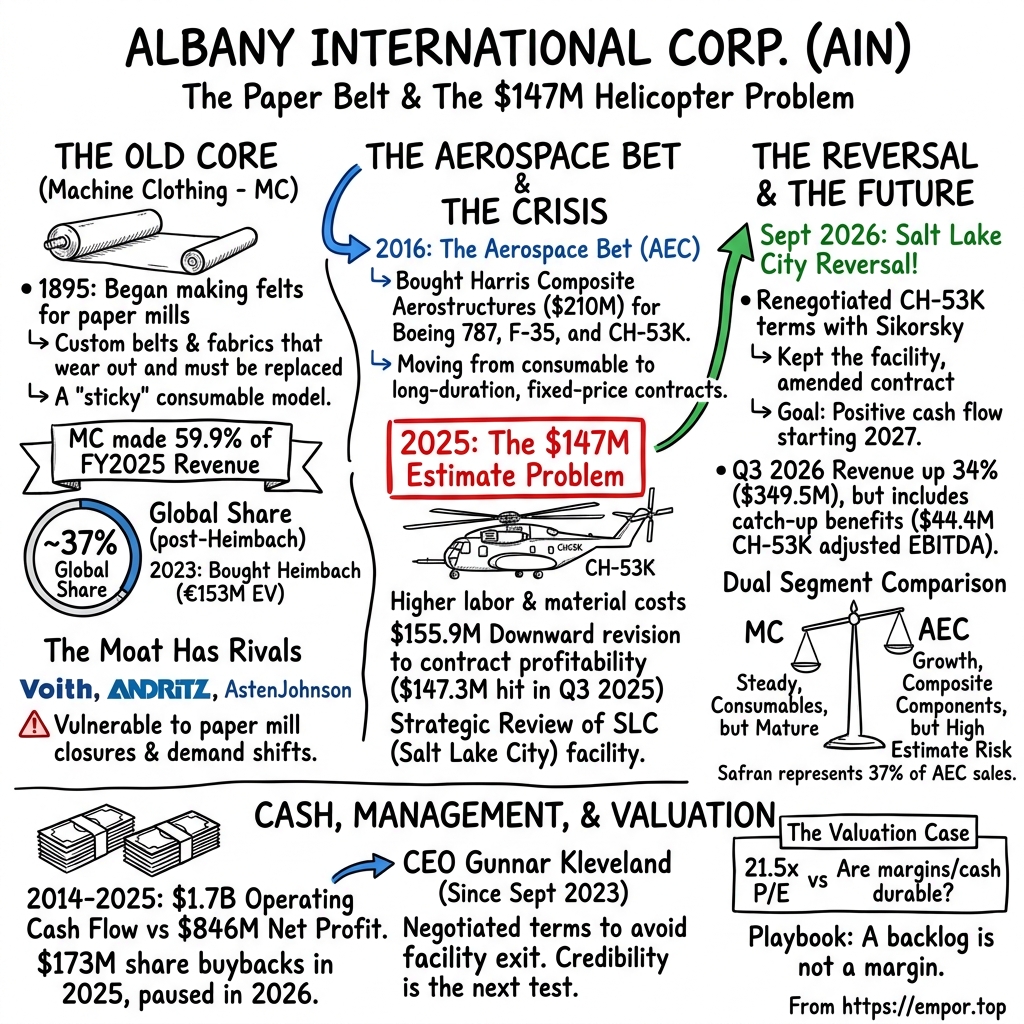
The moment arrived in the third quarter of 2025. Albany's engineers and finance team had been updating their estimate of what it would cost to finish the CH-53K work, and the new numbers were brutal. The program was consuming more labor hours than planned, and the materials going into each shipset cost more than the original pricing assumed. Under the accounting that governs long-term contracts, when a company concludes that a contract will make less money over its whole life than it previously believed, it must recognize the change immediately, and if the contract is now expected to lose money, it must book the entire expected loss up front. Albany did both. Across 2025, it cut the expected profitability of the CH-53K contract by $155.9 million, including a $98 million provision for losses it expected to suffer on work it had not yet performed.2 Of that, $147.3 million landed in a single quarter.[^3]
The effect on the income statement was immediate and stark. Albany's third-quarter 2025 revenue fell to about $261 million, and the company reported an operating loss of roughly $113 million, against an operating profit of about $25 million a year earlier.[^3]2 It withdrew its full-year guidance. It launched a strategic review of its Salt Lake City composites facility, the site on Amelia Earhart Drive where the CH-53K work was done, with an exit on the table.[^3] For a company that had spent nine years telling investors that aerospace was its second growth engine, this was a confession that one of the engine's cylinders was misfiring badly.
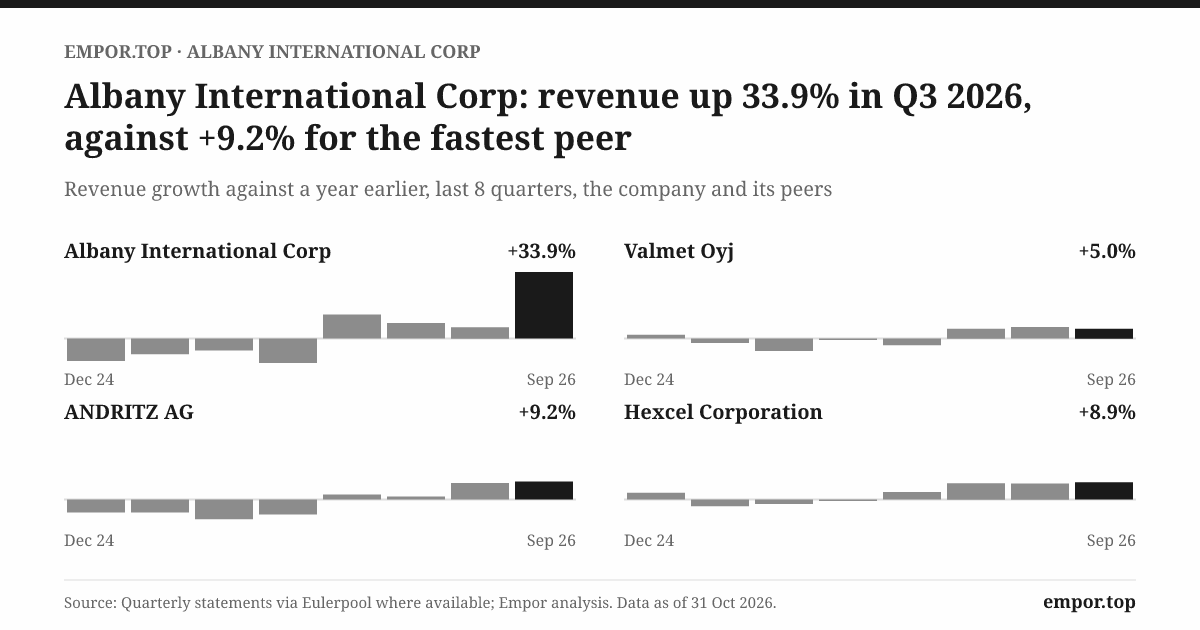
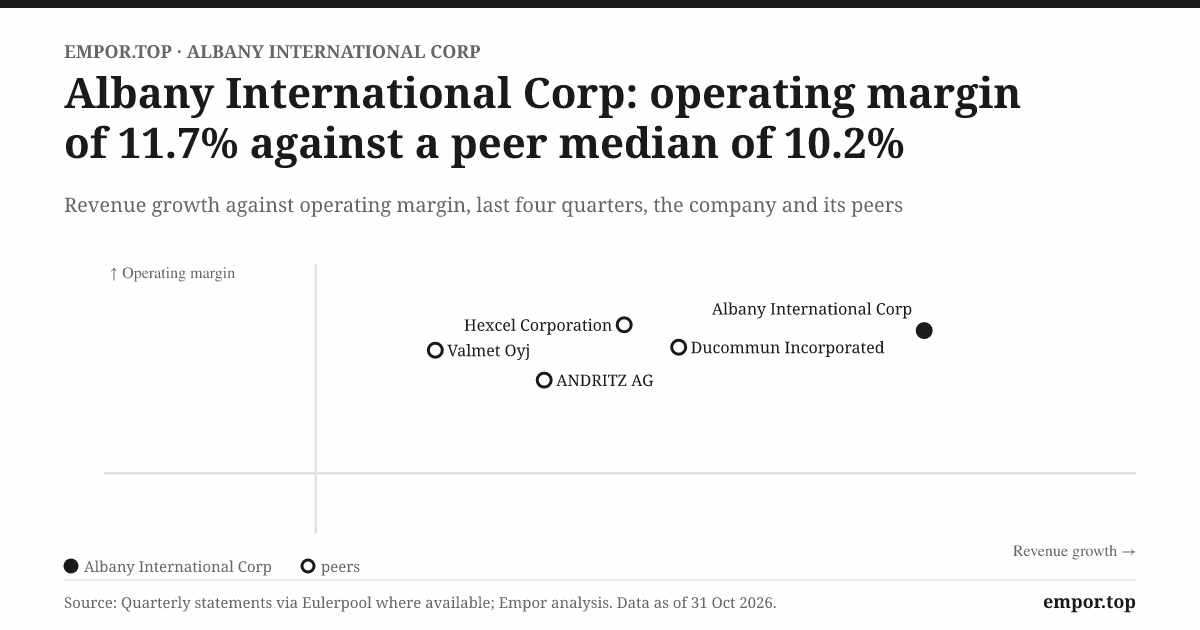
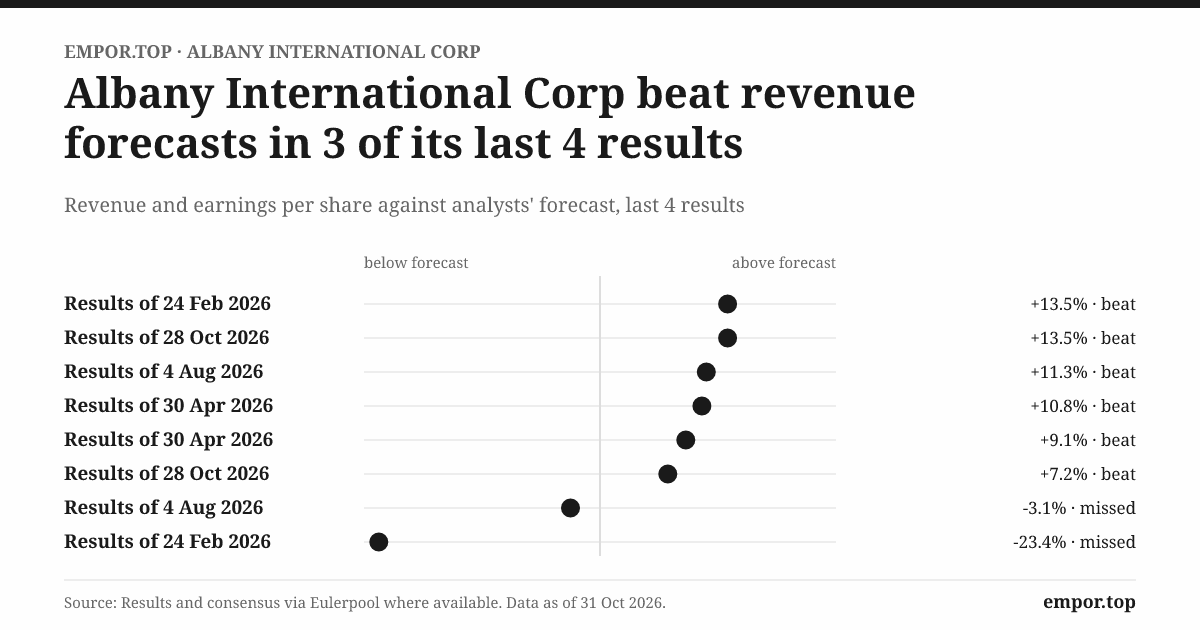
Now jump forward a year. In the third quarter of 2026, Albany reported record quarterly revenue of $349.5 million, up 34% from the year before.[^4] Operating profit was $59.4 million, a margin of about 17%, the highest in years.3 Net profit was $41.7 million, against a $97 million loss a year earlier.3 The strategic review had ended in September with Albany keeping the Salt Lake City facility and announcing amended terms on the CH-53K contract with Sikorsky.4 On the surface, it looked like one of the cleanest turnarounds an industrial company could hope for: from crisis to record in four quarters.
The surface is where the story gets interesting. That record quarter included a $44.4 million benefit to adjusted EBITDA arising from the strategic review's conclusion, partly offset by $11.0 million of catch-up depreciation and amortization on assets that had stopped being depreciated while the facility was held for sale.[^4] Revenue itself included an $11.6 million favorable adjustment, and gross margin carried a $33.4 million favorable effect from the contract modifications.3 In other words, part of the record was the accounting reversing itself. When a contract's expected profitability improves, the company catches up on the profit it would have recognized all along under the new terms, and that catch-up lands in one quarter. It is real, in the sense that it reflects a genuine improvement in expected economics, but it is not a run rate. If one takes the $44.4 million benefit out and puts the $11.0 million of catch-up depreciation back, the quarter's operating profit looks closer to the mid-$20 millions, which is roughly where Albany had been running in ordinary quarters before the crisis.
So the episode's opening question is not whether Albany survived the CH-53K problem. It clearly did. The question is whether the renegotiation fixed the contract's economics, or moved the losses into a new set of promises, with management now forecasting that the modified contract will generate positive cash flow beginning in 2027.4 That forecast is the hinge.
Behind that hinge sit two larger questions that will carry this story. The first is whether Albany can protect its position in paper-machine clothing, the century-old consumables business that still pays most of the bills, as paper demand shifts by grade and region and mills consolidate. The second is whether its aerospace business, Albany Engineered Composites, can make long-term contracts pay, because the CH-53K experience showed that a backlog of exciting programs can just as easily become a backlog of losses. Running through both is a third question about people: whether the current management team, led by Gunnar Kleveland, can convert a painful miss into durable economics and rebuild the credibility the miss cost.
To answer those questions, the story has to start where Albany started, with a belt on a paper machine.
 Subscribe on LinkedIn
II. A Paper-Machine Belt, Replaced Again and Again
In 1895, in Albany, New York, a small company began making felts for the paper mills that dotted the Hudson Valley and New England.1 Paper in that era was made the way it largely still is: a slurry of fibers and water spread across a moving screen, drained, pressed and dried into a continuous sheet. The felts that carried the sheet through the presses were not glamorous, but every mill needed them, and every mill wore them out. The founders had found something better than a product. They had found a consumable.
More than 130 years later, that idea still sits at the center of Albany International. The company has been listed on the New York Stock Exchange since 1974, and over the decades it bought, built and sold a variety of businesses.1 But the core never changed. In 2025, Machine Clothing, the segment that makes those fabrics and belts, produced 59.9% of Albany's revenue, roughly $710 million out of $1.18 billion.2 Aerospace may dominate the headlines, but paper remains central.
To understand why the business has lasted, it helps to see what a modern paper machine actually does. A large machine can be longer than a football field and run a sheet of paper or board at speeds that would be dangerous on a highway. At the wet end, the forming section uses a fine mesh fabric to drain water from a slurry that is mostly water. The press section uses felts to squeeze out more water between heavy rolls. The dryer section uses fabrics to hold the sheet against heated cylinders as the last moisture evaporates. Each of those fabrics is, in effect, a moving conveyor belt that also does a precise engineering job: it shapes how water leaves the sheet, which affects how much energy the mill spends on drying, how fast the machine can run, and what the finished paper feels like.[^7]
Albany describes its products as custom-designed for each machine and each application.2 That is not marketing language. A tissue machine, a linerboard machine and a printing-paper machine need different fabrics, and two machines making the same grade at different mills may need different designs because their equipment, raw materials and process settings differ. Albany's technical teams work with a mill on its specific equipment, fiber furnish, process and paper grade, and the company argues that this application knowledge, combined with a broad product line covering forming, pressing and drying, helps customers run more efficiently.[^7]2 A good fabric can let a mill run faster or dry the sheet with less steam. A bad one can cause a sheet break, and a sheet break on a large machine means lost hours of production.
That is the heart of the economic model. The fabric is a small part of a mill's total costs, but it influences much larger ones: energy, uptime, machine speed and product quality. The mill's buyer is therefore not purely shopping on price. The mill's engineers care whether the fabric works. When a fabric does work, the easiest decision is to order the same design again. Albany recognizes Machine Clothing revenue generally when the product is delivered, and because fabrics wear out, demand recurs as long as the machine keeps running.2
The phrase "as long as the machine keeps running" is where the limits come in. Machine Clothing demand depends on how many paper machines are operating, how hard they run, and what they make.2 Demand for newsprint and printing papers has been declining in developed markets for years as reading moved to screens, while packaging grades and tissue have held up better. When a mill closes or a machine is converted to another grade, the consumable revenue stream from that machine either stops or changes shape. Albany's own disclosures tie MC demand to paper-machine utilization, paper-grade mix and mill closures.2
Those limits were not theoretical in 2025 and 2026. Consolidation and weak demand weighed on parts of Machine Clothing in both years.2[^4] In the first nine months of 2026, MC revenue fell 3.0% from the prior year after adjusting for currency, with weaker demand in the Americas, and Albany spent more on restructuring as it consolidated manufacturing sites.3 A consumable does not protect a supplier from its customer's cycle. It just means the supplier feels the cycle through order volumes rather than through a cliff.
This is where the investment case for the old core gets subtle. Albany's technical relationships with mills are real, and the replacement cycle is real. But there are two different things those relationships might be doing. They might be giving Albany pricing power, the ability to charge more than a rival because the mill trusts its designs and does not want the risk of switching. Or they might mainly be helping Albany win its share of replacement orders in a market where several capable suppliers offer similar service, in which case the relationship is a cost of staying in the game rather than a source of excess returns. The difference matters enormously for what the business is worth. A fabric supplier with pricing power deserves a premium; a fabric supplier that wins by working hard in a competitive market deserves respect, but not necessarily a premium.
Albany's historical margins offer a clue, though not a clean answer. Before aerospace became large enough to shape the consolidated numbers, Albany's operating margin was in the high single digits to low teens; it rose to around 18% to 19% between 2019 and 2021 as the business mix and cost structure improved, then slid back toward 11% by 2024, before the CH-53K charge drove it negative in 2025.2 Those are consolidated figures that blend two segments, so they cannot isolate MC's economics on their own. But they suggest a business that earns solid industrial returns rather than one that prints money no matter what. Which raises the obvious question: who else is on the paper machine, and how hard do they compete?
III. The Moat Has Rivals
In its 2025 investor presentation, Albany put a single number in front of investors that captured its view of its place in the world: an estimated global share of roughly 37% of the paper-machine-clothing market, following the Heimbach acquisition.[^8] It is a striking figure. A company holding more than a third of a global industrial market sounds like a dominant player, the kind that sets prices rather than takes them. And Albany may well be the largest supplier in the industry.
But a market-share number is a claim, and claims deserve a war game. Who else is fighting for those paper machines, and on what terms?
Start with the competitors Albany itself names. The company's filings describe a market where the principal bases of competition are price, product technology and service, and the list of serious rivals is short but formidable.2 Voith, the German family-controlled engineering group, makes paper machines as well as the fabrics that run on them. ANDRITZ, the Austrian industrial group, also builds papermaking equipment and became a much larger force in clothing when it acquired Xerium Technologies, a former independent clothing and roll-cover supplier, in 2018.5 AstenJohnson, privately held, is a long-established specialist in paper-machine clothing. Beyond them are regional suppliers in Asia and elsewhere that compete hard on price in particular grades and geographies.
Notice what Albany itself lists first among the bases of competition: price. A company with an unassailable moat rarely puts price at the top of its own description of how customers choose. That is not proof of weakness; most honest industrial companies acknowledge that price matters. But it is a reminder that mills are sophisticated buyers who run competitive bids, test fabrics from more than one supplier, and switch when a rival offers better performance or better terms.
The single global-share number also hides how differently the market looks product by product. A 2019 capital-markets presentation from ANDRITZ broke the paper-machine-clothing market into its main categories and estimated who led each.5 In that analysis, Albany held about 29% of the press-felt market and about 22% of dryer fabrics, with Voith, ANDRITZ, AstenJohnson and others holding substantial positions across forming fabrics, press felts and dryer fabrics, and with different leaders in different categories.5 Those figures are dated, they come from a competitor with its own reasons to present the market a particular way, and they predate Heimbach. But they make a useful point: Albany's leadership is not uniform across the machine. In some categories it is the strongest player; in others it is one of several.
There is also a structural feature of this industry that should make any investor pause before declaring Albany's moat impregnable. Two of its largest rivals sell the paper machines themselves. When Voith or ANDRITZ builds a new line or rebuilds an old one, it is already in the room with the mill's engineers, already responsible for the machine's performance, and can offer clothing, rolls and aftermarket service as part of a package. Albany does not make paper machines. It must win its place on a machine built by a company that would happily supply the fabrics too. That bundling threat is real, and it cuts directly against the idea that customer-specific knowledge alone locks in a mill.
So how would one prove or disprove the moat? A durable advantage in this business would show up in a few observable places. It would show up in customer retention: mills that buy Albany fabrics would keep buying them, machine after machine, year after year. It would show up in price realization: Albany would be able to raise prices at or above inflation without losing volume. And it would show up in share: Albany would gain position over time rather than merely holding it through acquisitions. The trouble is that Albany does not publish a consistent series on any of those measures. Its filings do not disclose customer retention rates, a machine-clothing price-realization trend, or organic share changes by product category.2 Its investor presentations offer aggregate share estimates, but those are company estimates, not independent proof.[^8][^10]
What the record does show is more modest. Albany has held a leading position in a mature industry for a very long time, through multiple paper-demand cycles and the collapse of graphic papers in developed markets. No single MC customer accounts for 10% or more of segment revenue, which means Albany is not hostage to one mill group.2 Its scale and product breadth let it serve mills across forming, pressing and drying, and its technical teams embed it in mills' operating knowledge in a way a pure price competitor would struggle to match. Those are genuine sources of advantage.
The verdict, then, is that the moat is credible but not proven by the measures that matter most. Albany's scale, product breadth and customer-specific knowledge support the claim that it holds a durable leading position. The absence of disclosed retention and price data, the importance Albany itself assigns to price, and the presence of rivals that can bundle clothing with machines narrow that claim to something smaller than "pricing power." The best reading is that Albany is a strong leader in a competitive, mature oligopoly, which is a good business to own at the right price but not a business that can ignore its competitors. A falling MC margin through a weak demand patch, or a visible loss of position in a product category, would argue the moat is narrower still.
There is one more thing the competitive map reveals. When a leader in a mature market wants to grow faster than the market, it has two broad options: buy rivals in the core, or buy something entirely different. Albany did both. It bought something entirely different first.
IV. The Bet That Turned Albany Toward Aerospace
On February 29, 2016, Albany announced that it would buy the composite aerostructures business of Harris Corporation.[^11] To most people who thought of Albany at all, it was the paper-felt company. Now it was paying $210 million in total consideration, including an assumed lease, for a business that made engineered composite parts for some of the most closely watched programs in aviation.[^11] The portfolio included work on the Sikorsky CH-53K heavy-lift helicopter, the Boeing 787 Dreamliner and the Lockheed Martin F-35 fighter.[^11]
The logic was not as strange as it sounded. Albany had already spent years developing a composites capability of its own. Its expertise in weaving complex fiber structures for paper machines had a natural cousin in aerospace: three-dimensional woven composites, in which carbon fibers are woven into a shape and then infused with resin to form parts that are lighter than metal and extremely strong. The most important of those efforts was a partnership with Safran to make fan blades and fan cases for the LEAP engine, the CFM International powerplant that equips the Airbus A320neo family and the Boeing 737 MAX. Albany and Safran formed a joint venture, Albany Safran Composites, in which Safran owns 10%.2 By the mid-2010s Albany Engineered Composites was already a real business built on that relationship.
The Harris deal was a different kind of move. Rather than growing one partnership organically, Albany bought a ready-made portfolio of aerostructures programs, the factories that built them, and the workforce that knew how. It was a strategic change, moving Albany further from a mainly consumables business toward engineered components for commercial and military aircraft. Instead of selling a product that wears out and gets reordered, Albany would increasingly sell parts built to specifications under long-term agreements with prime contractors.
The underwriting was explicit. In its announcement, Albany said the acquired business was expected to generate roughly $80 million to $90 million of sales in 2016 and adjusted EBITDA of $13 million to $15 million.[^11] Then came the growth story: if programs ramped as expected, Albany projected sales above $200 million by 2020 with margins near 20%.[^11] Those projections were conditional, tied to program schedules and execution, and Albany said so. But they reveal what the price was really paying for.
Do the arithmetic. At $210 million against $13 million to $15 million of expected 2016 adjusted EBITDA, Albany was paying roughly 14 to 16 times that year's forecast earnings before interest, taxes, depreciation and amortization. For an industrial supplier, that is a rich multiple for current earnings. If the business had reached $200 million of sales at a 20% margin, it would have generated around $40 million of annual profit at that level, making the purchase price look like about five times forward earnings. The deal was a bet on the ramp, not on the starting point.
Did the bet pay off? The honest answer is that the public record does not allow a firm verdict. After the acquisition, Albany folded the Harris operations into Albany Engineered Composites and stopped reporting them separately. Its filings do not isolate the acquired unit's cumulative revenue, margins or return on the $210 million invested.2 So no one outside the company can say whether the Harris business reached $200 million of sales at 20% margins by 2020, or what its returns have been since. What can be said is that AEC as a whole grew substantially over the following decade, and that the consolidated business did not show the kind of uninterrupted margin expansion the 2016 projections implied. Albany's consolidated operating margin had already retreated by 2024, before the CH-53K charge.2
And then there is the CH-53K. The helicopter was part of what Albany bought in 2016, and nearly a decade later it was the source of a $155.9 million downward revision in expected contract profitability.2 It would be too simple to say the acquisition caused the 2025 loss. Contracts get renegotiated, programs change, production rates shift, and the specific terms that went wrong in 2025 reflected labor and material costs that rose well beyond what anyone was pricing in during 2016. But the acquisition brought Albany into exactly this kind of exposure: long-duration, firm-fixed-price work in which the supplier commits to deliver parts at agreed prices and absorbs the risk that costs rise. A paper-felt business that sets prices order by order does not face that risk in the same way. An aerostructures business on a fixed-price defense program does. The 2025 loss is the clearest evidence that the execution risk embedded in the 2016 bet was real.
It is important not to let one program stand in for the whole segment. AEC is not just the CH-53K. Its largest program is the LEAP engine work with Safran, which operates under a cost-plus-fee arrangement rather than a fixed price.2 It also builds parts for the 787 and the F-35 and has worked on missile and other defense programs.2 Those programs have their own risks, including customer concentration and production-rate swings, but they are not fixed-price bets in the same mold. AEC's growth in 2025 and the first nine months of 2026 came in part from LEAP, the 787, the F-35 and other programs ramping.3
The fair verdict on the Harris acquisition is therefore twofold. Strategically, it was material: it made Albany a real aerospace supplier with a portfolio of marquee programs, and it gave the company a growth vector its paper business could not provide. Financially, it was priced on a forecast, and the record does not show whether that forecast was met. The CH-53K loss proves the bet carried more execution risk than the 2016 framing suggested, even if it does not prove the price was too high.
Seven years later, Albany made a second, very different acquisition. This time it was not buying a new kind of business. It was buying more of the old one.
V. Heimbach Bought Scale in the Old Core
In the summer of 2023, Albany agreed to buy Heimbach, a privately held German supplier of paper-machine clothing with roots stretching back to the nineteenth century.[^12] The timing said something about the industry. Paper-machine clothing was consolidating, demand was shifting by grade and region, and a family-controlled specialist with a strong European footprint had decided that its future was better secured inside a larger group. For Albany, Heimbach offered something the Harris deal never could: more scale in the business it had been running for over a century.
The price was €153 million in enterprise value, including €21 million of net debt.[^12] Albany told investors the deal represented ten times Heimbach's 2022 EBITDA and was in line with industry comparables.[^12] The acquisition closed at the end of August 2023.6
What exactly did Albany buy? Heimbach brought paper-machine clothing products and customer relationships, particularly in Europe, along with a smaller business in technical textiles used outside papermaking.[^12] It broadened Albany's product coverage and gave it more manufacturing capacity and sales presence in a region where Albany already competed but where Heimbach had deep local ties. The enlarged share estimate appeared in Albany's 2025 investor presentation.[^8]
It is worth being precise about what the ten-times multiple means. It is Albany's own description of the price, and the comparison to "industry comparables" was Albany's own benchmark.[^12] Ten times trailing EBITDA is a reasonable-sounding number for a mature industrial business; it is lower than the multiple Albany paid for the Harris business against forecast earnings, and it was paid for an existing profit stream rather than a hoped-for ramp. But a multiple is only cheap or expensive relative to what the business earns afterward. Without a published set of realized acquisition multiples in the industry, and without disclosure of Heimbach's post-acquisition earnings, an outside investor cannot independently confirm that the price was attractive. The honest description is that Albany paid a moderate-looking multiple that management judged to be in line with the market.
The combined company still faces pressure from Voith, ANDRITZ and AstenJohnson, while mill consolidation gives the largest customers more bargaining power over suppliers.2 Heimbach made Albany bigger. It did not change the structure of the game.
So how should one test the synergy story? Management's case for the deal rested on a combination of broader product coverage, better geographic reach, manufacturing efficiencies and cross-selling. The evidence that matters is not the enlarged share estimate but what happened to margins, customer retention and returns on the capital invested. Here the record so far is mixed. Albany's consolidated revenue rose by about 11% in 2023 and 7% in 2024, helped by Heimbach's inclusion, but consolidated operating margin fell from about 17.5% in 2022 to about 10.7% in 2024.2 Those are consolidated numbers, distorted by aerospace, so they cannot be pinned on Heimbach. But they show that the acquisition did not deliver a visible step-up in profitability at the company level. Meanwhile, Albany's restructuring of its MC footprint, including site consolidations in 2025 and 2026, suggests the integration work is still under way.23
There is also an uncomfortable timing point. Heimbach bought Albany more exposure to European paper markets at a moment when European paper demand was weak and energy costs had spiked. Mill consolidation, which may have been part of the reason Heimbach's owners chose to sell, has continued. A bigger share of a shrinking or reshaping market is still valuable, especially for a consumable supplier that can rationalize capacity. But it is not the same as a bigger share of a growing one.
The non-paper technical textiles deserve a sentence and no more. Heimbach's industrial textiles are a modest part of the business, and Albany's filings do not present them as a separate material growth engine.2 Investors should not treat them as hidden optionality.
The verdict on Heimbach is that it appears to be a sensible extension of Albany's largest business at a price management described as in line with the market, and that the evidence to judge it properly has not yet arrived. The tests are MC margins after restructuring, MC organic revenue through the demand weakness of 2025 and 2026, and whether returns on invested capital recover toward the low teens Albany earned before 2023. Until then, Heimbach is a reasonable bet whose payoff is unproven.
By the time Heimbach was being integrated, Albany had a new chief executive, a larger paper business and an aerospace segment that seemed to be finally scaling. Then came the contract estimate that changed everything.
VI. The Contract Estimate That Changed the Company's Plans
The phrase "estimate at completion" sounds like the most boring thing in an engineering company. It is the number finance and program teams calculate to answer a simple question: given everything we know today, what will it cost to finish this contract? On a long-term program, that number gets updated regularly, and as long as it stays close to the original plan, nobody outside the company hears about it. In the third quarter of 2025, Albany's estimate at completion for the CH-53K contract moved so far that it rewrote the company's year.
The cause, as Albany described it, was two-sided. The program required more labor content than planned, meaning each shipset of composite parts was taking more hours of skilled work to build than the pricing assumed. And the material inputs cost more than expected.2 Neither factor on its own was exotic. Aerospace manufacturing across the industry spent the years after the pandemic wrestling with labor shortages, inexperienced workforces, supply-chain disruption and input inflation. But on a firm-fixed-price contract, those pressures have nowhere to go. The price is fixed. The cost is not. Every additional hour and every more expensive ply of material comes straight out of the supplier's margin, and if the overruns are large enough and expected to persist over the remaining life of the program, the contract flips from profitable to loss-making.
That is what happened. Albany reduced the contract's expected profitability across 2025, recognizing most of the charge in the third quarter.2[^3]
To understand why one estimate change could hit so hard, it helps to understand how this kind of accounting works. Under the method Albany uses for many AEC contracts, revenue is recognized over time as work progresses, based on the share of total expected costs that has been incurred. If expected total costs go up, the share of the contract that is complete goes down, and so does the revenue and profit recognized to date. The company must then record a cumulative catch-up adjustment that reduces revenue and operating income in the current period. The result is a large charge in a single quarter, much of it noncash at the moment it is recorded, because it represents losses on work not yet performed.2
That is why the third-quarter 2025 income statement looked so dramatic, and why the full-year 2025 results showed a $57 million net loss on revenue of $1.18 billion.32 It is also why operating cash flow for 2025 did not collapse along with profits: the $98 million loss provision was added back as a noncash item.2 The cash pain from the CH-53K was real, but it would arrive over time, as Albany delivered parts at prices below their cost.
Albany presented both GAAP results and adjusted figures that excluded the CH-53K charge. That is reasonable as a way to show how the rest of the business performed, and Albany's adjusted EBITDA for 2025 was $221.8 million.7 But excluding the charge cannot erase what it represented. The $155.9 million was Albany's own best estimate of how much worse the contract's economics had become. It was an economic loss, not an accounting quirk, and it carried a credibility cost: investors had been told about AEC's growth for years, and now one of its most visible programs had swung deeply negative.
The independent auditor's report underlined the point. KPMG, Albany's auditor, issued unqualified opinions on the 2025 financial statements and internal controls, but it identified one critical audit matter: the estimation of total costs to complete certain AEC fixed-price contracts.2 A critical audit matter is the auditor's way of flagging the area of the financial statements that required the most challenging, subjective or complex judgment. For Albany, that area was exactly where the CH-53K problem lived. The audit focus is a clear signal that contract-cost estimates are not a technical footnote to AEC's story. They are the central risk in it.
Management's message changed with the numbers. With the charge, Albany withdrew its full-year 2025 guidance and began a strategic review of the Salt Lake City facility on Amelia Earhart Drive, where the CH-53K work was performed.[^3] The facility's assets were reclassified as held for sale, which meant Albany stopped depreciating them, a detail that would matter a year later. Albany said it expected to restore guidance for 2026 when it reported its fourth-quarter results.[^3]
The withdrawal of guidance was itself a message. Companies withdraw guidance when they cannot see the next few quarters clearly enough to commit to a range. In Albany's case, the uncertainty was not about paper demand or currency; it was about whether it would keep a facility and a set of programs that had been central to its aerospace strategy. A review that contemplates an exit is a dramatic step for a company that had bought much of that capability less than a decade earlier.
For investors, the right questions about the miss were the ones that go to management's control over its own estimates. When did the team first see the cost escalation, and how quickly did the estimate respond? How were labor-hour and material assumptions tested, and what had changed since the prior estimate? What remained uncertain, and what were the risks of further revisions? Those questions matter because a fixed-price contract is only as good as the estimates behind it, and AEC has other fixed-price work. An estimating failure on one program raises a legitimate question about the estimating discipline on all of them.
The verdict is plain. This was an execution and estimating failure with consequences well beyond one quarter. It turned a profitable year into a loss, forced a guidance withdrawal, put a significant facility's future in doubt, and drew the auditor's sharpest attention. Whatever came next, Albany now faced a stark choice: walk away from the work and the facility, or go back to Sikorsky and try to change the terms.
VII. The Salt Lake City Reversal
On September 1, 2026, nearly a year after it had put the Amelia Earhart Drive facility under review, Albany announced that the review was over.4 The company would keep the facility. It had reached amended terms with Sikorsky on the CH-53K contract. And the next day, on a call with investors, management laid out why a business that had seriously contemplated walking away from a key aerospace site had decided to stay.8
A year earlier, Albany had been preparing to shrink its aerospace ambitions. Now the same site and program were back inside the business, under a contract Albany said was meaningfully better.
What changed, according to management, was the contract itself. Albany said the amended agreement reduces risk, offsets the losses it had projected, stabilizes production and preserves the current scope of work.48 Management also said the modified contract should generate positive cash flow beginning in 2027.4 That is a significant claim. A contract that had been expected to lose money over its remaining life was now, in management's telling, a contract that would generate cash.
The accounting consequences arrived in the third quarter of 2026. The contract modifications added $11.6 million to revenue and $33.4 million to gross margin.3 The strategic review's conclusion contributed $44.4 million to adjusted EBITDA.[^4] With the facility's assets no longer held for sale, Albany resumed depreciation and recorded an $11.0 million catch-up charge.[^4] About $68.6 million of assets that had been classified as held for sale returned to the balance sheet as contract assets.3
The quarter's record revenue and 17% operating margin therefore need to be read in light of that accounting reversal. That is not a criticism of the accounting, which works as it is designed to. It is a reminder that a single quarter in which estimates move favorably will always look better than the business's underlying run rate, just as the quarter in which estimates moved unfavorably looked far worse.
It also helps to separate two kinds of good news that are easy to blur. The first is program-wide demand. In September 2025, the U.S. Navy awarded Sikorsky a multiyear procurement contract for up to 99 CH-53K aircraft, giving the helicopter program unusual production visibility.9 That matters for Albany because more aircraft means more shipsets of composite parts over time. But the Navy's commitment to Sikorsky does not set the price Sikorsky pays Albany or the costs Albany incurs to build each part. A program can enjoy strong demand while a supplier on that program loses money; indeed, that is exactly what Albany's 2025 experience demonstrated. The second kind of good news, the contract amendment, is the one that actually changes Albany's economics, and it is the one investors cannot fully see.
That is the crux of the problem for anyone trying to judge the reversal from outside. Albany has disclosed the direction and the accounting effects of the amendment, but the precise terms that matter most for future profitability are not public. How much of future cost inflation can Albany now pass through to Sikorsky? How much of the original loss reserve remains, and how will it unwind? When exactly does cash turn positive, and how large are the flows? What protections, if any, does Albany have against another round of overruns? These are the questions that analysts on the September strategic-review call and the October third-quarter call needed answered, and they are the questions that will determine whether the amendment is a genuine reset or a reprieve.810
Management's forecast of positive cash flow beginning in 2027 is the testable part. It is specific enough to check against future cash-flow statements, and it is the right metric: on a contract that had been booked as a loss, the cash flowing in and out over the remaining deliveries is the clearest evidence of whether the economics really changed. Until that cash shows up, "positive cash flow beginning in 2027" remains a forecast, not an outcome.
There is also a wider lesson for the rest of AEC. The segment is growing. In the third quarter of 2026 it reported $179.7 million of revenue, which for one quarter exceeded Machine Clothing, helped by program ramps on LEAP, the 787, the F-35 and others, plus the CH-53K catch-up.[^4] Rising volume on long-term programs is welcome, but the CH-53K showed that volume and profit can diverge sharply when costs run ahead of contract prices. The discipline investors should apply is the same across the segment: program volume matters only if margins hold as production scales, and the margin that matters is the one excluding catch-up adjustments, in either direction.
So the verdict on the Salt Lake City reversal is cautious. The amendment improves the disclosed outlook, avoids a costly facility exit, and keeps Albany on a program with strong long-term demand. It is a real course correction. But it is not yet proof of sustained profitability. The next annual roll-forward of contract cost estimates, the CH-53K's cash generation in 2027, and AEC's underlying margin will decide whether the reversal was the beginning of durable economics or simply a better-negotiated version of the same risk.
That question cannot be answered in isolation, because Albany is not an aerospace company. It is two companies under one roof.
VIII. Two Segments, Two Different Kinds of Risk
Look at Albany's third quarter of 2026 and the two businesses appear almost perfectly balanced. Machine Clothing reported $169.8 million of revenue; Albany Engineered Composites reported $179.7 million.[^4] It would be tempting to conclude that Albany has become a true two-engine company, with the paper consumables business and the aerospace business now roughly equal partners.
That conclusion would be wrong, or at least premature. The aerospace number in that quarter was inflated by the CH-53K catch-up, and the comparison with the prior year was distorted in the other direction by the charge that had depressed AEC revenue in the third quarter of 2025. The more reliable picture comes from full years. Machine Clothing remains the larger business overall, accounting for 59.9% of Albany's revenue in 2025.2 AEC, though growing, is not yet an equal.
The more important difference between the two segments is not their size but how they make money. Machine Clothing's delivery-based sales are recurring, with risks mostly tied to volume and price.2 A bad year for paper means fewer orders and lower utilization at Albany's plants. It rarely means a single contract turning into a nine-figure loss.
AEC combines shorter purchase orders with longer agreements, some cost-plus-fee and others firm-fixed-price.2 In 2025, about $465 million of Albany's revenue was recognized over time, mostly reflecting AEC's long-term work.2 Its risks are concentrated and lumpy: program schedules, customer production rates, and the accuracy of cost estimates over contracts that run for years.
Albany's current AEC work includes programs such as LEAP, the Boeing 787, the F-35, the CH-53K and missile programs.23 Albany has also discussed future opportunities in areas such as hypersonics, space and next-generation aircraft. Those should be treated as possibilities, not material revenue today. Aerospace is full of technical milestones that take years to become production programs, and some never do.
Then there is concentration. Safran is Albany's single most important aerospace relationship and accounted for about 15% of consolidated 2025 revenue and 37% of AEC revenue, with sales of $177 million.2 Safran is also a 10% owner of Albany Safran Composites, the joint venture that makes LEAP parts, which makes it both a customer and a minority partner.2 The LEAP agreement is cost-plus-fee, with a narrow fee range tied to cost targets, which is a protective structure for Albany on costs. But Safran has no minimum purchase obligation.2 If engine production slows, as it has at times because of supply-chain disruption across the commercial-aerospace industry, Albany's volumes slow with it, and there is no contractual floor.
The working-capital evidence on Safran is reassuring but bears watching. At the end of 2025, receivables plus contract assets due from Safran were $60.8 million, down from $78.5 million a year earlier.2 Albany does not publish an aging schedule for receivables. At the company level, debtor days, a measure of how many days of sales are tied up in unpaid invoices, fell sharply from about 150 in 2023 to about 73 in 2025, which suggests Albany collected faster and reduced unbilled balances.2 By September 2026, however, net receivables and contract assets had risen again, to about $278 million and $164 million respectively, from $235 million and $87 million at year-end.3 Most of the contract-asset increase reflected the $68.6 million reclassified from held-for-sale assets when the review ended; the rest related to unbilled revenue on commercial and defense programs.3 There is a disclosed explanation, but cash tied up in contract assets is cash not yet in the bank.
Can these two segments hedge each other? In theory, a steady consumables business could fund the investment phase of a growth business, while the growth business adds momentum when paper is weak. In practice, Albany's two segments softened at the same time in 2025: MC faced weaker demand while AEC absorbed its largest-ever charge. The two businesses are exposed to different cycles, which provides some diversification, but they do not reliably offset each other, because each has its own form of risk: MC to mill closures and price competition, AEC to program concentration and estimate errors.
The verdict is that Albany has two real businesses, each with a distinct kind of risk, and that investors should track them separately rather than treat the consolidated figures as one story. Two indicators matter most. For Machine Clothing, the measure is organic revenue and operating margin after restructuring, which will show whether the core can hold its economics through weak demand. For AEC, the measure is contract margin and cash collection excluding major catch-up adjustments, which will show whether the segment can earn money steadily rather than through estimate swings.
Both of those measures feed into a single question that every shareholder ultimately asks: does all of this produce enough cash to pay for the strategy?
IX. Can the Cash Pay for the Strategy?
In 2025, while its aerospace business was heading for the largest charge in its history, Albany was buying back its own stock at a brisk pace. Over the year, the company repurchased about 2.68 million shares for $173.3 million, including taxes and fees.2 That was roughly double its 2025 free cash flow, and it happened in the same year Albany reported a $57 million net loss.2 The buyback was largely complete before the scale of the CH-53K problem became public in the third quarter.
To understand whether that capital allocation was reckless or reasonable, it helps to step back and look at the longer record. Over the twelve years from 2014 through 2025, Albany generated about $1.7 billion of operating cash flow against about $846 million of cumulative net profit.2 In other words, the cash coming in from operations was roughly twice the reported earnings. That gap is not mysterious. Albany's earnings are reduced by depreciation and amortization on its plants and acquired intangibles, by noncash charges such as the 2025 contract-loss provision, and by timing differences in working capital. Over a long period, a business whose cash flow consistently exceeds its earnings is generally a healthy one.
After capital spending, Albany's free cash flow over those twelve years totaled about $814 million.2 Of that, about $296 million went to dividends, a little over a third.2 The rest went to acquisitions, including the Harris and Heimbach purchases, to share repurchases and to debt service. And the company's cash balance ended up lower: cash and short-term investments fell by about $110 million between the end of 2013 and the end of 2025.2 Albany has not been hoarding cash. It has been deploying it, and borrowing to supplement it when acquisitions or buybacks demanded more than operations provided.
The 2025 numbers deserve their own look because they are easy to misread. Operating cash flow was about $152.5 million, which looks solid for a year with a net loss.2 But the main reason operating cash held up was that the $98 million CH-53K loss provision was a noncash charge, added back to the cash-flow statement.2 Meanwhile, working capital absorbed cash, partly because AEC shipped more product at year-end.2 So the headline relationship between operating cash and earnings for 2025, which looks extraordinary beside the $57 million net loss, is a statistical artifact of the charge, not a sign of exceptional cash conversion. The cash cost of the contract loss had simply not arrived yet.
After capital spending of about $71.5 million, 2025 free cash flow was about $81 million.2 Dividends took about $32 million and buybacks $173 million. Together, shareholder returns of about $205 million were roughly two and a half times free cash flow. The difference was funded by borrowing and cash: total debt rose from about $387 million at the end of 2024 to about $456 million at the end of 2025.2
Then the buybacks stopped. Albany made no repurchases in the first nine months of 2026, leaving about $76.7 million of the $200 million authorization set in 2021.23 The pause was the right response to a year in which the company needed to resolve the CH-53K problem, and it is a sign that management recognized the balance sheet had absorbed enough. But it also throws the 2025 buyback into sharper relief. The repurchases were made at a time when the company's own estimate of the CH-53K contract was deteriorating, even if the full charge had not been recognized. An investor can reasonably ask whether the board would have authorized the same pace of buybacks had it known what the third quarter would bring.
The balance sheet is stretched but not stressed. At September 30, 2026, Albany had $422.1 million drawn on its $800 million unsecured revolving credit facility, which matures in August 2028.3 Including cash of about $79 million and remaining borrowing capacity, total liquidity was $457 million.3 The company's covenant leverage ratio was 1.68 times, well inside the 3.75-times maximum, and interest coverage was about 7.7 times against a 3.0-times minimum.3 Those are comfortable cushions. The 2028 maturity is a date to watch, because refinancing will occur in whatever interest-rate environment prevails then, but nothing in the disclosed numbers suggests near-term pressure.
The dividend is modest relative to Albany's long-run free cash flow and has grown steadily, from about $19 million in 2014 to about $32 million in 2025.2 It is not the source of financial strain. The larger question is the use of cash beyond the dividend: whether buybacks resume before free cash flow and debt normalize, and whether the company repeats the 2025 pattern of returning more cash than it generates in a year when its largest risks are unresolved.
The verdict is that Albany's long-run cash record is stronger than its reported earnings alone suggest, but the 2025 figures are distorted by a noncash provision and the record of using borrowed money for buybacks ahead of a major charge is a legitimate concern. Future free cash flow after working-capital investment, measured against dividends, buybacks and debt reduction, is the test that will matter more than any cumulative conversion ratio.
Capital allocation, of course, is a choice made by people. Which brings the story to the person at the center of the reset.
X. The CEO's Scorecard
Gunnar Kleveland became Albany's chief executive in September 2023, arriving just as the Heimbach acquisition was closing.7 He inherited a company in transition: a newly enlarged paper-clothing business, an aerospace segment that had been sold to investors as a growth engine, and a portfolio of long-term contracts whose economics were about to be tested by post-pandemic inflation in labor and materials. Within two years, he presided over Albany's CH-53K miss and its subsequent course correction.
That is a lot of drama for one tenure, and it makes Kleveland's record harder to judge than a simple growth story would. The fair reading starts with the course correction. A management team faced with a loss-making fixed-price contract has limited options. It can keep building at a loss, try to exit, or go back to the customer and renegotiate. Kleveland's team ran a review that put an exit on the table, which gave it leverage, and then reached amended terms that management says will turn the contract cash-positive from 2027.48 If that forecast holds, it will be a consequential piece of execution.
But the course correction followed a miss, and the miss carries a credibility cost. The 2025 miss and guidance withdrawal carry a credibility cost.2[^3] Investors have a right to ask whether the cost escalation should have been seen earlier, and whether the estimating discipline that missed it has been repaired. The auditor's focus on AEC contract-cost estimates reinforces that management judgment in this area matters most.2
The pay scorecard tells a revealing story. Kleveland's reported total compensation for 2025 was about $4.3 million, roughly flat against about $4.3 million in 2023 and up from about $3.9 million in 2024.7 In a year when Albany reported a $57 million net loss, its pay-versus-performance disclosure also reported $221.8 million of adjusted EBITDA.7 Albany's annual incentives weight adjusted EBITDA, adjusted free cash flow and safety, and its three-year awards use adjusted EBITDA, return on invested capital and relative total shareholder return.7 There is nothing unusual about using adjusted metrics; most industrial companies do. But in a year when the gap between adjusted and GAAP results was driven by a contract estimate that management itself was responsible for, the adjustment matters. A scorecard that excludes the cost of a contract miss does not fully hold management accountable for it. The inclusion of ROIC and relative TSR in long-term awards provides some counterweight, because those measures do reflect the damage.
Shareholders did not object. At the May 2026 annual meeting, executive compensation was approved with 98.7% of votes cast.11 That is a strong endorsement, and it suggests the major institutional holders, among them BlackRock, Vanguard and EARNEST Partners, which the proxy lists as the largest beneficial owners at about 15%, 11% and 9% respectively, were not inclined to punish management for the 2025 miss.7 Albany has no controlling shareholder; it is a widely held company whose largest owners are index and active institutions.7
Kleveland's own stake is modest. He held 38,019 shares as of March 1, 2026, worth about $2.5 million at the October 2026 share price of $67.7 That is less than one year of his reported compensation. It does not suggest misalignment, but it does not provide the kind of ownership that would make incentive design irrelevant. Investors should judge alignment by results and guidance discipline rather than by the structure of the pay plan.
Capital allocation belongs on the scorecard too. The 2025 buyback preceded the third-quarter charge, and repurchases paused in 2026 while Albany worked through the reset.23 That sequence can be read charitably, as a board acting on the information it had, or critically, as an aggressive return of capital at a moment when the company's largest risk was still building. Both readings have some merit. What would settle it is a clear statement of capital-allocation priorities going forward, and adherence to it.
There has also been turnover in the finance function. Robert Starr resigned as chief financial officer in May 2025.12 His successor, Willard Station, took medical leave effective August 31, 2026, and Controller Sean Valashinas became acting principal financial officer.13 Transitions like these happen for many reasons and are not, on their own, evidence of a problem. But for a company whose central risk is the accuracy of financial estimates on long-term contracts, the stability and strength of the finance team is not a trivial detail. It is something to monitor in filings, alongside the quality of disclosure and contract controls.
The verdict on management is that Kleveland's team made a consequential and so far constructive course correction, but the 2025 miss and the reliance on adjusted incentive metrics during a GAAP loss leave credibility to be rebuilt. The way to rebuild it is not through better presentations but through results: restored guidance that is met, a CH-53K contract that produces the promised cash, and AEC margins that hold without catch-up adjustments.
All of which brings the story to the question the market is pricing every day.
XI. Analysis & Bear vs. Bull Case
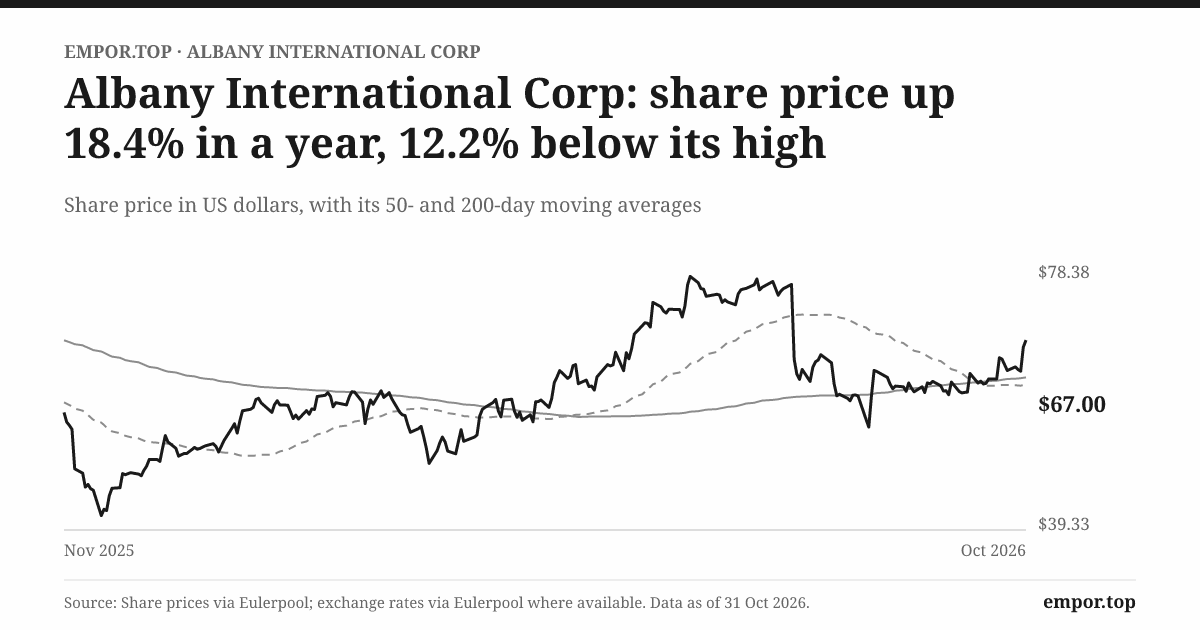
On October 31, 2026, Albany's shares closed at $67, giving the company a market value of about $2.0 billion and an enterprise value, including debt, of about $2.3 billion.[^21] The stock sat about 12% below its 52-week high of roughly $76 and well above its 52-week low of about $41. Over the past five years, its largest peak-to-trough decline was about 64%, and its one-year volatility was about 40%, numbers that reflect how violently the market reacted to the contract problem and its reversal.
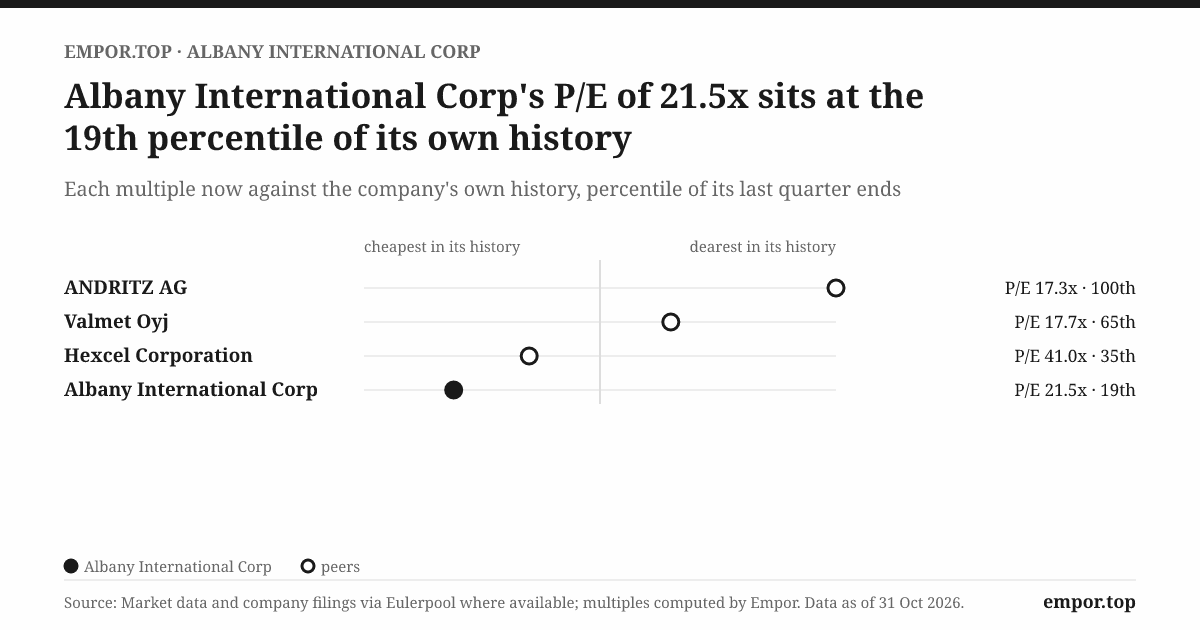
On trailing earnings, the stock traded at about 21.5 times, below its own five-year median of about 26.4 times.[^21] It traded at about 9.7 times EV/EBITDA, offered a dividend yield of about 1.7% and a free-cash-flow yield of about 3.0%. A quick glance suggests Albany is cheaper than its own history. But that comparison is treacherous. The trailing earnings include the favorable CH-53K catch-up in the third quarter of 2026, which inflates the denominator, and the five-year median was set during a period when Albany's margins were higher and its aerospace business was being valued as a growth story. Strip out the catch-up and the multiple on underlying earnings is higher than 21.5 times.
For context, the listed aerospace-materials supplier Hexcel traded at about 35 times earnings and 17 times EV/EBITDA in October 2026, and the aerospace-parts maker Howmet at about 40 times and 28 times.1415 Those companies are not direct peers. Neither makes paper-machine clothing, and both have their own reasons for a premium, but they show that the market pays far more for pure-play aerospace exposure than it pays for Albany's mix. What Albany's multiple seems to assume is that its aerospace business is worth less than an aerospace pure play, either because of its smaller scale, its program concentration or the estimate risk the CH-53K exposed, and that its paper business deserves a mature-industrial multiple.
The bull case rests on Albany's leading position in paper-machine clothing and the potential for its major aerospace programs to ramp.[^8][^4] The CH-53K benefits from the Navy's multiyear procurement commitment,9 and the amended contract improves Albany's disclosed economics on its most troubled program.4 If AEC can deliver steady margins without further estimate surprises, and MC holds its margins through the weak demand patch, the combination of a cash-generating core and a growing aerospace business could earn a higher multiple than the market currently assigns.
The bear case rests on mature, uneven paper demand, competition from machine makers, AEC's fixed-price exposure and the undisclosed CH-53K terms. Safran is a major customer without minimum LEAP volumes, and its dual role as a minority owner of the joint venture adds a layer of related-party complexity.2 The 2025 buybacks also raise questions about discipline.
The most useful way to weigh these cases is to run the industry forces once, with evidence. Start with the buyers. In Machine Clothing, no single customer accounts for 10% of segment revenue, which limits any one mill's leverage, but mill consolidation is gradually concentrating buying power.2 In AEC, buyer power is high, particularly because of Safran's share of the segment and the LEAP agreement's lack of a minimum purchase commitment.2 The CH-53K renegotiation showed that a supplier can push back when a contract becomes uneconomic, but it also showed how much the original terms favored the customer.
Rivalry in MC is real, and Albany's rivals include two of the world's largest papermaking-equipment makers.2 In AEC, Albany competes for program positions against other composite specialists and the in-house capabilities of large aerostructures and engine makers. Supplier power appears limited, as Albany does not disclose a material supplier concentration, though material-cost inflation clearly hurt the CH-53K economics.2 The threat of new entrants is low in both segments: making paper-machine fabrics at scale requires specialized equipment and know-how, and aerospace qualification takes years. The threat of substitutes in MC is indirect but powerful: it is not a substitute for the fabric, but a substitute for the paper, as digital media displaced printing papers.
Through the lens of Hamilton Helmer's seven powers, Albany's most plausible advantages are scale economies and switching costs in MC, and something close to a cornered resource in AEC's 3D-woven composite technology for LEAP. Scale is real: a supplier with a third of the global market can spread research, manufacturing and service costs widely. Switching costs exist in the operational sense, because changing fabric supplier on a running machine carries risk, but the evidence that they translate into pricing power is thin, since Albany does not disclose retention or price realization. The LEAP technology is distinctive and protected by long qualification cycles, but it is also bound to one customer that holds equity in the venture. Albany has no meaningful network effects, counter-positioning or brand power in the consumer sense. The moat, in short, is a scale-and-know-how moat in a competitive oligopoly, plus a specialized technology position in aerospace that depends heavily on one partner.
An activist looking at Albany would ask some pointed questions. Would the two segments be worth more apart? Did the board's buyback decisions and the incentive scorecard adequately account for estimating risk? And why have the acquisition returns on Harris never been disclosed? Those questions frame the debate.
Paper demand, mill consolidation, AEC cost overruns, estimate risk and rising unbilled balances remain key operational risks.23 Currency moves add noise: Albany operates globally, and a hypothetical 10% adverse move in exchange rates would have implied about $60 million of fair-value exposure on its non-U.S. net assets and intercompany loans at the end of 2025.2 The 2028 revolver maturity is a refinancing date to watch, though covenants are comfortably within limits.3 The legacy asbestos docket, with about 3,700 claims pending at the end of 2025 but trivial annual settlement payments, is a disclosed overhang that does not appear material on the record.2
The valuation, then, is context rather than a verdict. Albany trades below its own five-year median multiple, but that comparison flatters the stock because trailing earnings include a one-time catch-up. The evidence supports a leading MC position and a credible AEC recovery possibility. It does not yet prove durable pricing power or restored contract returns. Three measures will settle the thesis: Machine Clothing organic revenue and margin, which showed revenue down about 3% in the first nine months of 2026, with restructuring under way; AEC contract margin excluding catch-ups, which is not yet visible in a clean quarter after the amendment; and free cash flow after working-capital investment, which was about $81 million in 2025 and must now absorb the cash costs of the CH-53K while working capital builds.32
XII. Playbook: Business & Investing Lessons
Set two objects side by side one more time. On one side, a worn press felt pulled off a paper machine after months of service, its fibers compacted, ready to be replaced by an identical one from the same supplier. On the other, a spreadsheet in Salt Lake City, its labor-hour assumptions rewritten, its estimate at completion swinging a contract from profit to a nine-figure loss. Albany's story lives in the space between those two objects, and it yields lessons that belong to this company and no other.
The first lesson is that a consumable can be sticky without being immune to the customer's cycle. Albany's paper-machine business is recurring, but MC revenue slipped as demand softened and mills consolidated, and Albany consolidated its own plants. A consumable ties the supplier's fortunes to the customer's machine. When the machine slows or shuts down, so does the consumable. For founders and investors, the wider point is that recurring revenue describes how often a customer pays, not whether the customer's business will keep needing what you sell.
The second lesson is that a backlog is not a margin. Albany's CH-53K contract showed how a program with years of production ahead could still generate a major loss when the cost of building each part ran ahead of the fixed price. A long-term contract's duration matters less than who bears the cost when the work turns out to be harder than expected.
The third lesson is that a deal multiple is only as good as the cash it earns. Albany's acquisitions show why neither a projected ramp nor a reasonable-sounding multiple proves a deal was wise. The Harris business's outcome was never isolated publicly, and Heimbach's payoff remains unproven. For acquirers, the discipline is to disclose and measure returns afterward; for investors, it is to treat a reasonable-sounding multiple as a hypothesis rather than a conclusion.
The fourth lesson is that a course correction earns trust only when the next numbers confirm it. Albany's management ran a review that could have ended with an exit, negotiated amended terms with Sikorsky, and promised positive cash flow beginning in 2027. That is a credible plan, well executed so far. But the record quarter that followed was built partly on accounting catch-ups, and the cash has not yet arrived. The broader lesson for any company recovering from a miss is that the market should give credit for the plan, not for the result, until the result appears in the cash-flow statement.
Taken together, these lessons describe the difference between a strong market position, a compelling acquisition thesis and earned returns on a difficult contract. Albany has the first. It has made the second twice. It is still working on the third.
XIII. Epilogue
Tonight, at the end of October 2026, Albany stands at a hinge. Its shares have recovered much of the ground they lost after the CH-53K charge, even as its record third quarter was partly built on accounting catch-ups. The forecast that matters most, positive cash flow from the amended CH-53K contract beginning in 2027, is still a forecast.4
The next few moments will decide whether the reset holds. On December 15, 2026, Albany will host an investor day, where management is expected to set out its strategy and, perhaps, its medium-term targets.[^4] Investors will listen for how Albany frames the CH-53K amendment, how it plans to restore growth in Machine Clothing, and how it will allocate capital between buybacks, debt reduction and investment. Promises made at that event will become the benchmarks against which the next two years are measured.
Then come the full-year 2026 results and the 2026 annual report, likely in early 2027. That report will contain the next annual roll-forward of AEC contract-cost estimates. If the CH-53K estimates hold steady or improve, and if AEC's underlying margin, excluding catch-up adjustments, settles at a respectable level, the amendment will look like a genuine reset. If the estimates move against Albany again, the market will conclude that the renegotiation bought time rather than economics, and that the estimating risk the auditor flagged has not been tamed.
Through 2027, the cash-flow statement will tell the rest of the story. Management has said the modified contract should generate positive cash flow beginning that year. If it does, the cash will show up in operating cash flow and in the unwinding of contract assets. If it does not, the gap between promise and outcome will be the clearest possible signal of where management credibility stands.
In Machine Clothing, the test is quieter but no less important. The segment needs to show that it can hold its margins through weak demand, especially in the Americas, and that the restructuring under way delivers savings rather than just costs. Organic revenue by region and margin after restructuring will reveal whether Albany's position in the core is as durable as its share estimate implies.
Capital allocation will round out the picture. Albany paused buybacks in 2026 after an aggressive 2025. Whether and when they resume, and whether that happens before free cash flow normalizes and debt comes down, will reveal how management and the board weigh shareholder returns against balance-sheet resilience.
And some questions may stay open because Albany does not publish the answers. It still does not disclose consistent customer-retention, price-realization or acquisition-return data. Until Albany chooses to disclose them, investors will have to infer them from margins, cash and market share.
The reset, in short, remains provisional. The next full-year results must show whether the reset holds across both segments. Albany has bought itself a second chance. The next twelve months will show whether it used it.
XIV. Outro
Go back to the paper machine. A sheet of wet fiber races through the press section, riding on a felt that Albany designed for that machine, at that mill, for that grade of paper. It is not glamorous work. It is the kind of work that has kept Albany alive since 1895.
Then go to Salt Lake City, where composite parts for a heavy-lift helicopter take shape under a contract that, a year ago, looked like a reason to close the factory. That work is glamorous, in its way. It is also unforgiving, because it requires a company to promise a price today for work it will do years from now, and to be right.
Albany is a company built on two kinds of precision: the repeated fit of a consumable to a mill, and the long, costly promise embedded in an aerospace contract. One business wins by being replaced reliably. The other must first prove that its estimates can survive the life of a contract. The CH-53K reset matters only if the next results turn a reversal into repeatable economics. Until then, the felt is the business Albany knows how to run, and the helicopter is the business it is still learning to price.
References
-
Form 10-K for FY2025 — Albany International Corp., 2026-02-27 ↩↩↩↩↩↩↩↩↩↩↩↩↩↩↩↩↩↩↩↩↩↩↩↩↩↩↩↩↩↩↩↩↩↩↩↩↩↩↩↩↩↩↩↩↩↩↩↩↩↩↩↩↩↩↩↩↩↩↩↩↩↩↩↩
-
Form 10-Q for Q3 2026 — Albany International Corp., 2026-10-29 ↩↩↩↩↩↩↩↩↩↩↩↩↩↩↩↩↩↩↩↩
-
Albany International Announces Successful Completion of its Strategic Review — Albany International Corp., 2026-09-01 ↩↩↩↩↩↩↩↩
-
Machine Clothing market-share estimates by product, Capital Markets Day 2019 — ANDRITZ, 2019 ↩↩↩
-
Heimbach acquisition closing, Form 8-K — Albany International Corp., 2023-08-31 ↩
-
2026 Proxy Statement — Albany International Corp., 2026-04-02 ↩↩↩↩↩↩↩↩
-
Strategic Review Investor Call Transcript — Albany International Corp., 2026-09-02 ↩↩↩↩
-
CH-53K Program Enters Multi-Year Procurement Contract with Sikorsky — Naval Air Systems Command, 2025-09-26 ↩↩
-
Albany International Corp. (AIN) Q3 2026 Earnings Call Transcript — Seeking Alpha, 2026-10-29 ↩
-
Form 8-K: 2026 Annual Meeting Vote Results — Albany International Corp., 2026-05-19 ↩
-
Form 8-K: CFO Resignation — Albany International Corp., 2025-05-19 ↩
-
Form 8-K: Acting Principal Financial Officer Appointment — Albany International Corp., 2026-08-31 ↩
-
Howmet Aerospace Financial Ratios — Stock Analysis, 2026-10 ↩
 LinkedIn
 WhatsApp
 Reddit
 Hacker News
 Email
 Kindle
 RSS Feed
 Spotify
 Apple Podcasts
 Amazon Music
 Audible
 YouTube