C3.ai: The Enterprise AI Company That Has to Prove Itself Again
I. The Quarter the Turnaround Had to Begin
On September 2, 2026, C3.ai put out the kind of press release a company in a hole badly wants to write. Bookings, management said, had jumped 73% from the previous quarter.[^1] For the first time in a long while, the business had generated cash rather than consumed it: free cash flow for the three months to July came to a positive $2.1 million.[^1] Tom Siebel, the founder who had walked back into the chief executive's office only four months earlier, now had something to point at that looked like motion in the right direction.
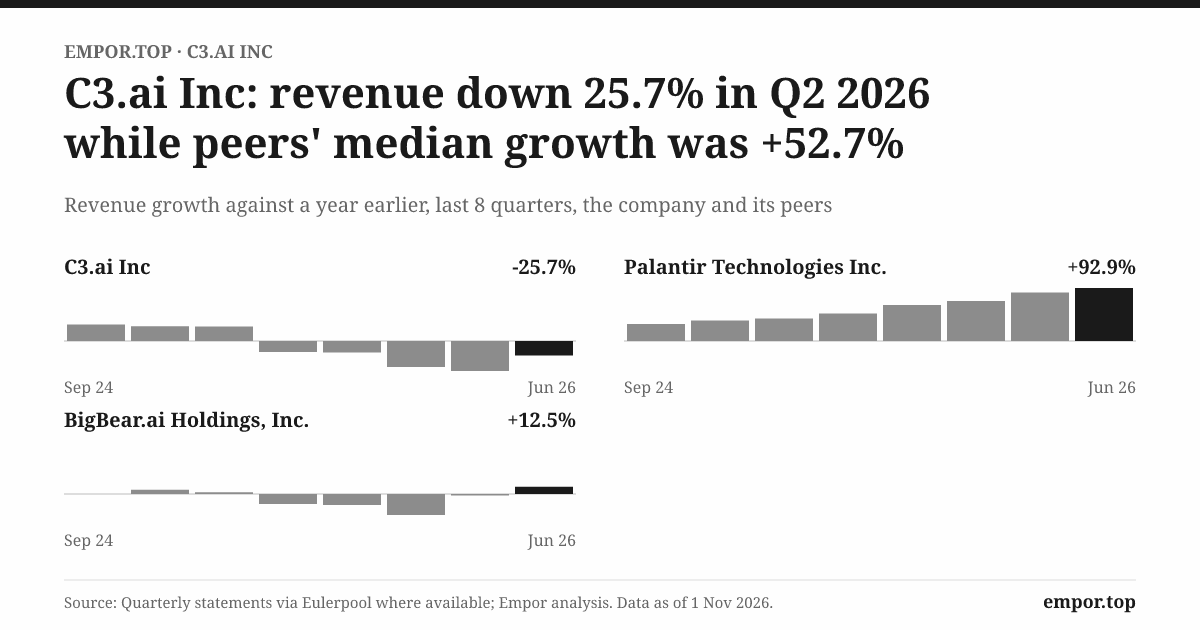
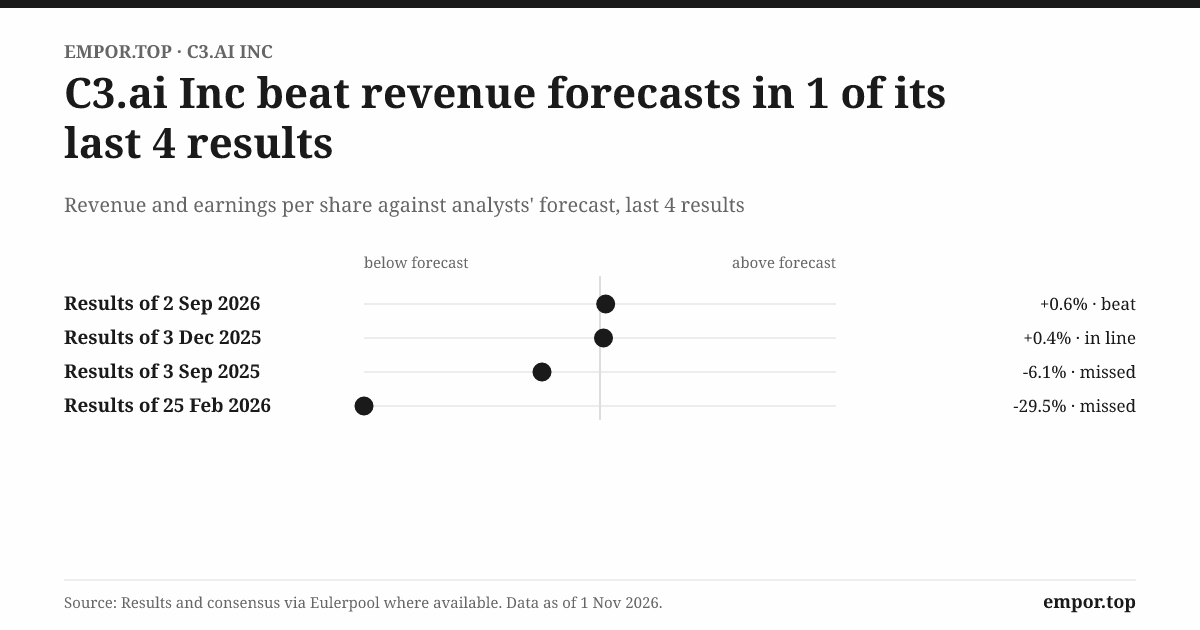
Then there was the line that the headline could not cover. Revenue for the quarter was $52.4 million, down 25.7% from the same quarter a year earlier.[^1] And that year-earlier quarter had itself been a disaster, the one in which the company's sales collapsed by roughly a third from the quarter before and its founder publicly called the result "completely unacceptable."[^13] In other words, C3.ai was celebrating sequential progress measured from the bottom of a crater, while its revenue was still falling against a base that had already broken.
That gap between the headline and the business is where this story lives. A 73% rise in bookings from one quarter to the next sounds like a turnaround. But bookings are promises to buy, not purchases, and at C3.ai many of those promises are measured in software usage that customers can turn up or down as they please. A positive free-cash-flow quarter sounds like the end of the burn. But the company used about $190 million of operating cash in the fiscal year that ended in April 2026, and one good quarter after a year like that is a data point, not a trend.2
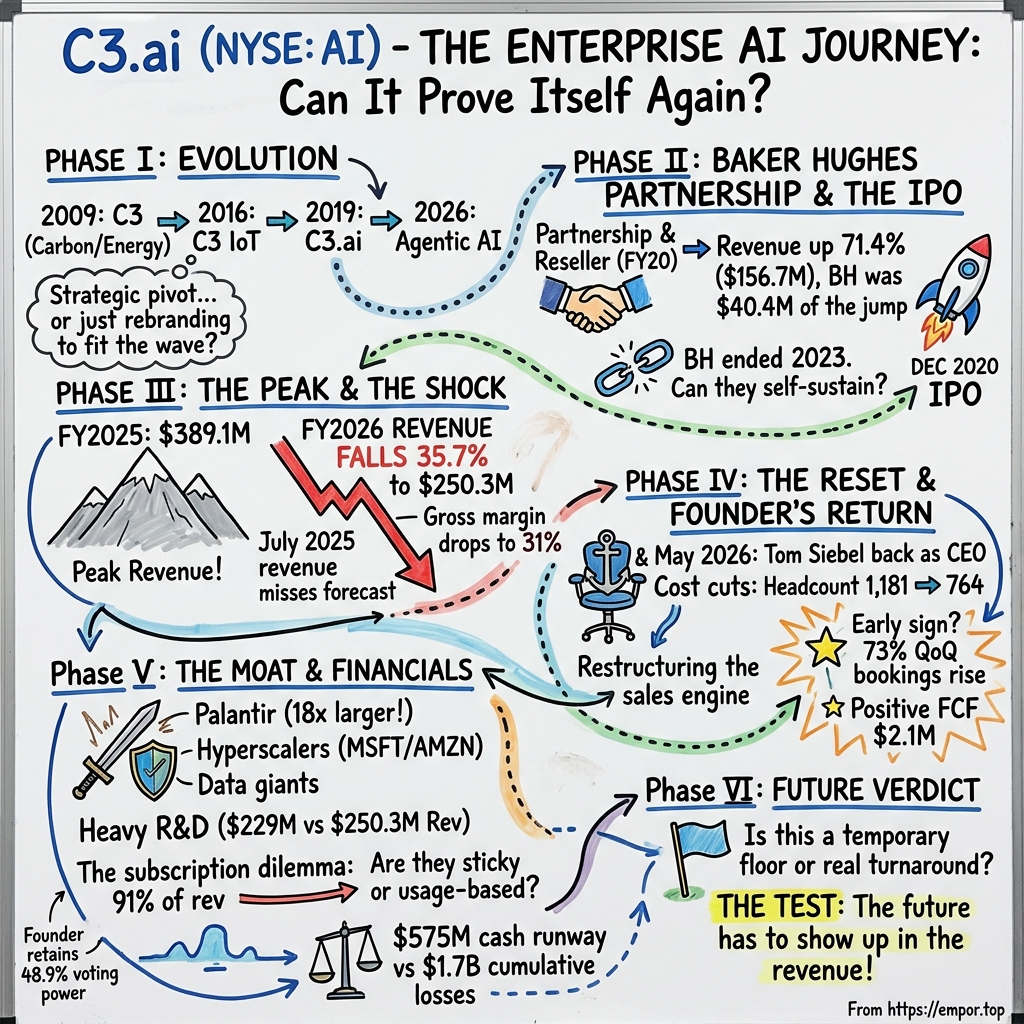
The scale of the year that preceded this quarter matters. C3.ai's revenue in the fiscal year to April 2026 was $250.3 million, down 35.7% from $389.1 million the year before.2 That is not a slowdown; that is a business losing more than a third of its sales in twelve months during the most enthusiastic period for artificial intelligence spending in the history of enterprise technology. While corporate boards were ordering their chief information officers to "do something with AI," the company whose ticker symbol is literally AI was shrinking.
And yet the market still valued the company at about $1.7 billion at the start of November 2026, or roughly seven and a half times its trailing sales.15 For a business that loses far more money than it books in revenue, that price is not a valuation of current earnings. It is a bet on what the C3 platform might become: the operating system for how large companies turn their scattered data into working AI applications. The company has $651.1 million of cash and investments to fund that bet, a cushion that buys real time.1
Four questions will carry this story, and they are the questions any serious investor has to answer before deciding what C3.ai is. The first is whether growth can return without leaning on a handful of very large customers; one customer alone accounted for 15% of revenue in the July quarter.1 The second is whether the company's subscription revenue gives the visibility that the word "subscription" usually promises, or whether it is closer to a utility meter that customers can turn down. The third is whether C3.ai has a defensible edge against rivals many times its size, from Microsoft, Amazon and Google to Palantir. And the fourth is whether cost cuts and generous equity awards can be reconciled into economics that a shareholder would accept.
There is a charitable reading of the past eighteen months. Enterprise AI is a market still being formed, buyers are confused, budgets are moving between pilots and production, and a company that had a bad year during a messy transition might simply have stumbled. There is also a harsher reading: that after seventeen years, three name changes and more than $1.7 billion of cumulative accounting losses, the product promise has never quite become a repeatable business.2 The September quarter does not settle that argument. It only reopens it.
To understand which reading is closer to the truth, the story has to go back to the beginning, to a billionaire software founder who decided in 2009 that the next great enterprise problem was carbon.
 Subscribe on LinkedIn
II. From Carbon to IoT to AI
By 2009, Tom Siebel had already lived the full arc of an enterprise-software fortune. He had founded Siebel Systems in 1993, which became the dominant vendor of customer-relationship-management software during the dot-com boom before Oracle bought it in January 2006.4 He had degrees in history, business and computer science from the University of Illinois, and a reputation as one of the most relentless salesmen the industry had produced: disciplined, data-obsessed, impatient with excuses.4 He did not need another company. He started one anyway.
The idea, as the company tells it, began with energy and carbon.[^5] In the late 2000s, climate policy and the smart-grid buildout were pushing utilities and large industrial companies to measure their energy use and emissions in ways their old systems could not handle. The data was everywhere and nowhere: in meters, billing systems, building sensors and spreadsheets. Siebel's bet was that whoever could pull those streams together and run analytics on top of them would own a valuable new software category. The company released its first energy-management product in 2010.[^5]
The more interesting decision was architectural, and it would define everything that followed. Siebel did not build just an application for carbon reporting. He built a platform: a layer of software meant to ingest data from many different sources, model it in a consistent way, and let developers build applications on top without rewriting the plumbing each time.4 Think of it as the difference between building a single house and building the factory that prefabricates walls, wiring and plumbing for any house. The factory is harder and more expensive to build, but if it works, every subsequent house is cheaper.
That platform ambition explains why the company's name kept changing. As C3 Energy, it sold to utilities wrestling with smart meters and grid analytics.[^5] In February 2016, it renamed itself C3 IoT and launched its platform for enterprise markets more broadly, arguing that the same data-integration machinery that worked for electric grids could work for any industry flooded with data from connected sensors.5 The "internet of things" was the reigning technology slogan of that moment, and the company leaned into it. Then, in 2019, it became C3.ai, as artificial intelligence and machine learning displaced IoT as the phrase that opened corporate budgets.[^5]
There is a generous way to read this sequence. The underlying problem never changed: large organizations sit on enormous quantities of messy, siloed data, and getting value from that data requires integrating it before any clever analytics can run. Carbon management, sensor networks and machine learning are all, in a sense, use cases of the same capability. A company that built the integration layer could reasonably expect to ride each wave in turn. On that reading, the name changes were a platform broadening from utilities into manufacturing, energy, defense and finance, and the labels simply tracked what buyers were calling the problem that year.
There is also a sceptical reading, and it deserves equal airtime. Each rename coincided with the hottest phrase in enterprise technology at that moment. A company that has found product-market fit usually does not need to change its name to be heard; it gets pulled forward by customers asking for more of what it already sells. Repeated reframing can mean that the platform is genuinely general. It can also mean that each market, once entered, proved too small or too slow to carry the business on its own, and that a new story was needed to attract the next round of capital and customers.
The company's own history, told in its naming documents, emphasizes the continuity of vision.[^5] The independent test is different: did revenue and customer adoption follow each reframing in a way that showed broad, diversified demand? On that measure, the early record is thin and opaque, because C3 was private and did not publish detailed results until its IPO filings in 2020. What those filings did reveal was that the business had grown to $91.6 million of revenue in its fiscal year to April 2019, still small after a decade of work and a founder with Siebel's resources and network.4
That is the unresolved question from the early years. Siebel had built something ambitious and technically sophisticated, sold to some of the most demanding industrial customers in the world. But had he built a horizontal enterprise platform that any company could adopt, or a collection of large, bespoke vertical projects that needed a fresh story every few years to scale? The answer started to take shape in 2019, when one of the world's largest oilfield-services companies decided to bet on C3, and turned a decade-old startup into something that looked, from a distance, like a breakout.
III. Baker Hughes: The Partner That Proved the Product—and Complicated the Growth Story
In June 2019, the same year the company took the name C3.ai, it signed a deal that changed its trajectory. Baker Hughes, one of the giants of oilfield services and energy equipment, agreed to become a customer, a reseller and a strategic partner, bringing C3's software into the oil-and-gas industry under a jointly branded offering.4 For a company that had spent a decade knocking on the doors of utilities and industrial buyers one at a time, this was something different: a partner with existing relationships across nearly every major oil company on earth, offering to carry C3's platform into those relationships.
The structure of the deal mattered as much as its symbolism. Baker Hughes committed to minimum annual payments to C3.ai, bought subscriptions for its own use, and received rights to resell C3's applications to customers in the oil-and-gas sector.4 In effect, C3 got a guaranteed revenue floor, a flagship reference customer and a distribution channel in one agreement. The commitments were revised over time, but they remained, for several years, a meaningful source of the company's revenue.4
The immediate financial effect was dramatic. In the fiscal year to April 2020, C3.ai's revenue rose 71.4% to about $156.7 million.4 Of the roughly $65 million increase, $40.4 million came from Baker Hughes.4 Put plainly, almost two-thirds of the company's growth in its breakout year came from one partner. That does not make the growth fake. Baker Hughes paid real money, deployed real software and sold it to real customers. But it does mean that the growth curve investors later saw in the IPO prospectus was not a clean measure of independent, diversified customer pull.
There is a useful analogy here. Imagine a restaurant that doubles its sales in a year, and then you discover that a single corporate client signed a contract to cater its entire staff canteen. The food might be excellent; the corporate client chose it, after all. But the doubling tells you much more about one contract than about whether the neighborhood wants to eat there. To judge the restaurant's underlying appeal, you need to know what happens to walk-in traffic, and what happens when the catering contract ends.
The partnership had genuine strategic logic for both sides. For Baker Hughes, it was a way to sell digital services to oil producers without building an AI platform from scratch. For C3, the oil-and-gas industry offered exactly the kind of complex, sensor-heavy, high-stakes operations where predictive maintenance and production optimization could save tens of millions of dollars, and where a reference customer like Baker Hughes made every subsequent sales conversation easier. Validation from a company of that size was worth something no marketing budget could buy.
It is also worth being clear about what the relationship was not. Baker Hughes was never C3.ai's parent, and C3.ai was never a subsidiary of an energy group. It was and remains a standalone, Siebel-founded company, and the revenue and losses discussed throughout this story are its own.4 Baker Hughes was a related party because of the depth of the commercial relationship, not because it controlled the company.
Over time, the partner's weight faded. By the fiscal year to April 2024, Baker Hughes-related revenue was about $16.4 million, roughly 5.3% of total revenue, and Baker Hughes ceased to be classified as a related party on June 30, 2023.2 A relationship that once supplied most of the company's incremental growth had become a meaningful but declining slice, and then no longer a disclosed line at all.
That trajectory is the double edge of a big partner. In the early years, Baker Hughes accelerated deployment and lent credibility. But it also concentrated revenue and blurred the most important question an investor can ask about a platform company: how many customers are choosing this independently? As the partner's contribution receded, C3.ai had to answer that question with its own sales force. The company's history after 2023, including its best year and its worst, is largely the story of that answer.
By late 2020, however, nobody was asking hard questions about concentration. The market for anything with "AI" in its name was white-hot, interest rates were near zero, and C3.ai was about to sell its story to public investors at a price that would make the Baker Hughes footnote look like a detail.
IV. The IPO Bet on a General-Purpose Enterprise Platform
On the evening of December 8, 2020, C3.ai priced its initial public offering at $42 a share, above the range it had marketed, selling 15.5 million shares and raising about $651 million.67 The next morning, the stock opened on the New York Stock Exchange at $100.7 It closed its first day at $92.49, up about 120%, giving a company with under $200 million of annual revenue a market value in the neighborhood of $10 billion at the day's peak.7 The ticker was AI. The timing could hardly have been better.
To understand that day, remember the mood. The pandemic had pushed every company toward digital operations; software stocks were trading at historic multiples; Snowflake had gone public a few months earlier in one of the biggest software debuts ever; and money was nearly free. Investors were looking for the companies that would own the next layer of enterprise computing, and Siebel offered them a crisp thesis: enterprises would need to build hundreds of AI applications, and building each one from scratch was slow, expensive and failure-prone. C3's platform, the company argued, could shrink that time and cost dramatically by giving developers prebuilt components for data integration, modeling and deployment, plus a catalogue of ready-made applications for common industrial problems.4
The pitch had a subtle but crucial assumption inside it: reuse. The value of a platform comes from doing the hard work once and reapplying it many times. If every customer's deployment required months of custom engineering to connect data systems and tailor models, then C3 would look less like a software company with software margins and more like a consulting firm with a proprietary toolkit. The IPO filings described a business that sold software subscriptions alongside professional services, with services often used to help customers implement applications and connect their data.4 That mix is common in enterprise software. The question was which way it would drift over time.
The early public-company record looked like a platform scaling. Revenue reached about $183 million in the fiscal year to April 2021, then climbed steadily, with occasional pauses, to $389.1 million in the fiscal year to April 2025.28 That is more than a doubling in four years, and it happened as the Baker Hughes contribution shrank, which suggests that real, independent customer demand existed. The product catalogue grew too, spanning predictive maintenance, supply-chain optimization, fraud detection, energy management and, later, generative AI applications for searching and reasoning over corporate documents.
But the growth was not smooth, and its rate is worth putting in context. Over the five years from FY2021 to FY2026, revenue grew only about 6.4% a year, and over the three years to FY2026 it actually declined about 2% a year.2 That is the record after FY2026's collapse is included, so it is harsh on the company; the four-year run to FY2025 looked much better. But even at its best, C3.ai's growth during the most generous funding and hype environment that enterprise AI has ever seen was respectable rather than explosive. Its fastest year as a public company, FY2022, saw growth of about 38%; by FY2023 growth had dropped to under 6%.8
Meanwhile, the losses grew faster than the revenue. Operating losses widened from about $60 million in FY2021 to about $324 million in FY2025.8 Some of that was deliberate investment in research, sales and marketing, financed by the IPO cash. Some of it was the cost of stock-based compensation, which became large once the company was public. Either way, the scaling that investors bought in December 2020 was a scaling of revenue without any scaling of profitability.
There is also an inheritance from the pre-IPO period that public shareholders took on. They bought the platform thesis and a growth history partly shaped by Baker Hughes, which meant they were buying a company still proving how independently it could scale.4 The prospectus disclosed the concentration; it was not hidden. But in the excitement of a 120% first-day pop, few were asking what the business would look like without its anchor partner.
The public-company record, then, gives a measured verdict. The platform reached meaningful scale, and enough customers paid for it to nearly quadruple revenue from the $91.6 million of FY2019 at its peak.48 But the claim at the heart of the IPO, that a reusable platform makes each new deployment fast and cheap and therefore makes growth compounding, is less proven than the breadth of the product catalogue suggests. To see why, it helps to look at how C3.ai actually charges its customers, and what the word "subscription" means in its contracts.
V. A Subscription Business Where Customers Can Turn the Dial Down
Picture a large manufacturer that wants to predict when its machines will fail. Its operations team signs up with C3.ai for a production deployment of a reliability application at a handful of plants. C3's engineers, sometimes with the customer's own staff, connect the application to maintenance records, sensor feeds and enterprise-resource-planning systems. The models begin flagging equipment at risk. If it works, the manufacturer can roll it out across dozens more plants, add new use cases like inventory optimization, and run far more computing on C3's platform. If it disappoints, or if budget priorities shift, the manufacturer can simply use less.
That last sentence is the key to understanding C3.ai's revenue. The company sells subscriptions in two broad ways. Some are usage-based, priced on compute hours or similar measures of how much the customer runs on the platform. Others are time-based commitments for a defined period.2 More recently, subscriptions to the C3 Agentic Platform can be priced by the number of developer users.2 Most agreements do not require renewal, and customers can reduce their usage.2 The company does not disclose a standard contract term, nor a company-wide recurring-revenue percentage beyond what it classifies as subscription.2
This is where the conventional software narrative needs a correction. Most investors hear "91% subscription revenue" and picture a classic software-as-a-service business: customers sign multi-year contracts, revenue is locked in, and the main question each year is how much it grows. C3.ai's subscription share did indeed rise to 91% of revenue in FY2026, up from 84% in FY2025.2 But that rise happened partly because professional-services revenue shrank as the business contracted, and the subscription label itself covers a model in which a large part of revenue behaves more like a utility bill than a lease. A utility customer is recurring in the sense that they keep paying each month, but nothing stops them from turning off the lights.
There is a measure designed to show contracted future revenue, called remaining performance obligations, or RPO. At April 30, 2026, C3.ai's RPO was $203.1 million, of which $129.3 million was expected to be recognized over the following twelve months.2 That sounds like solid visibility against an annual revenue base of $250 million. But two qualifications cut deeply. About $50.7 million of that RPO consisted of non-cancelable commitments in which the customer had not yet chosen which products, or how much of them, it would use.2 And RPO excludes much of the usage-based runtime revenue, because consumption that has not happened yet is not contracted.2 So RPO is both partly soft at the top and incomplete at the bottom. It gives some visibility, but less than the headline number suggests.
The more revealing evidence is who is paying. In FY2026, existing customers generated 76% of subscription revenue.2 That is a meaningful sign that customers who adopt C3's software tend to keep using it and sometimes expand. But it also means new customers supplied only about a quarter of the subscription base during a year of collapsing revenue. And then, in the first quarter of FY2027, the share of subscription revenue from new customers fell to just 1%, compared with 32% in the year-earlier quarter.1 Read literally, almost none of C3.ai's subscription revenue in the July 2026 quarter came from customers it had signed in that period.
There are reasonable explanations for that drop. New customers often begin with a small initial deployment, so their revenue contribution in the first quarter is tiny, and the year-earlier comparison may have been flattered by large early-stage contracts. A sales reorganization, which C3.ai went through in 2025, can also delay new wins. But whatever the explanation, it makes new-customer acquisition the critical watchpoint. A business living almost entirely off its installed base, during a period when that installed base's spending has been falling, cannot grow its way out of trouble without new logos.
The obvious way to settle the stickiness question would be retention data. Most mature software companies disclose net revenue retention, which shows how much a group of customers spends this year compared with last year, including expansions and losses. C3.ai does not publish that metric, nor gross retention, nor customer-level expansion trends.2 That absence is itself a clue. When a company's customers are expanding nicely, management usually wants investors to know.
So the subscription label captures real software revenue, and the company is right that most of what it sells is software rather than consulting. But it does not establish locked-in recurring revenue. Usage can fall, renewal is generally not required, and the forward contracted backlog misses much of what customers might consume. The question, then, is not whether C3.ai has subscriptions; it does. It is whether its platform is so useful that customers keep turning the dial up. That depends on how C3.ai stacks up against the alternatives that every one of its customers has on the table.
VI. A Broad Platform in a Market Full of Giants
Put yourself in the chair of a chief data officer at a large industrial company in 2026. The board wants AI applications in production, not more pilots. On one side of your desk sits a C3.ai proposal: a prebuilt application for predictive maintenance or supply-chain optimization, running on a platform designed to stitch together your sensor data, maintenance logs and ERP systems. On the other side sit at least four other options. Your cloud provider, whether Microsoft Azure, Amazon Web Services or Google Cloud, offers its own AI and data tools, often bundled into an enterprise agreement you have already signed. Your data team is already using Databricks or Snowflake and would rather build on those. Your incumbent enterprise-software vendors are layering AI into products you already own. And Palantir, the other big name in enterprise AI platforms, has a sales team that has been in your building twice this quarter.
That is the competitive structure C3.ai faces, and it is a crowded one. The hyperscalers, Microsoft, Amazon and Google, bundle AI and data capabilities into cloud platforms with enormous distribution and pricing flexibility. Data platforms such as Databricks and Snowflake compete for the same data and application budgets. Incumbent enterprise vendors embed AI features into systems customers already use. And Palantir sells an enterprise AI platform that, at least by revenue, has pulled far ahead.29
The scale gap with Palantir is striking. Palantir reported $4.48 billion of revenue in its fiscal year 2025, about 18 times C3.ai's FY2026 revenue.9 The comparison is not perfect: Palantir has a large government business, a different customer mix and different product architecture, and market share in this broad, evolving category is not disclosed on a comparable basis by either company. But both companies pitched themselves, at the start of this decade, as the platform enterprises would use to operationalize AI on their own data. One of them has grown into a business with billions of dollars of sales. The other has a revenue base smaller today than it was two years ago.
What is the strongest case for C3.ai in this fight? It goes like this. C3.ai has more than fifteen years of experience integrating messy industrial data, which is the hardest and least glamorous part of making AI work in a large organization. It has a catalogue of prebuilt industry applications, so customers are not starting from a blank page. The company says its platform is designed to run across the major cloud environments, which matters to customers who do not want to lock their AI strategy to one hyperscaler.2 And it keeps spending heavily on its product: research and development cost $229.1 million in FY2026, almost as much as the company's total revenue.2 A company that spends nearly a dollar on R&D for every dollar of sales is, at the very least, not starving its technology.
Now test that case against customer behavior, because claims about advantages are only as good as the evidence that customers act on them. Start with concentration. One customer accounted for 14% of FY2026 revenue, and one customer accounted for 15% of revenue in the July 2026 quarter.21 In FY2025, two customers represented 19% and 12% of revenue; in FY2024, two represented 27% and 14%.8 The company does not name the customers. A single customer's large share is evidence that this customer finds C3 valuable. It is also evidence that this customer has bargaining power, and it is not proof of broad adoption. When the largest customer supplies a seventh of revenue, its decisions about usage, renewal and pricing can move the whole company.
On the FY2027 first-quarter call, an analyst asked about concentration, and management's answer suggested there had not been a meaningful change and that it did not think there was any one customer of that importance.3 The 10-Q filed a week later disclosed a single customer at 15% of quarterly revenue.1 The filing is the better evidence, and the gap between the call and the filing is a small but telling data point about how carefully the company's spoken narrative tracks its reported facts.
The real question is whether C3.ai has a moat, and moats show up in behavior, not branding. If customers faced high switching costs, that would appear as high retention and steady expansion; C3.ai does not disclose retention, despite its recent contraction. If the company had a data advantage, it would show up as faster, cheaper deployments or demonstrably better outcomes than rivals; there is no published evidence comparing deployment times or win rates. If it had superior distribution, it would show up in new-customer wins; new customers supplied 1% of subscription revenue in the latest quarter. If it had brand power, it would show up in pricing; the company does not disclose price realization. None of this proves that C3.ai lacks advantages. It means the filings do not provide enough evidence to say those advantages are already durable.
Which brings up the newest label: agentic AI. C3.ai now markets the C3 Agentic Platform, a toolkit for building AI "agents," software that does not just answer a question but takes a sequence of actions, such as diagnosing a fault, checking inventory and scheduling a repair.2 In plain terms, an agent is like a junior employee that can be told to handle a task end to end, rather than a calculator that answers one question at a time. That is strategically relevant to C3's core idea, because agents need exactly the integrated, well-modeled enterprise data that C3's platform was built to provide. But the product has not yet been shown to be a separately proven growth engine. The useful question is not whether "agentic" is the right word for 2026; it is whether the new tooling lowers deployment costs or increases customer usage. That is measurable, and so far it does not show up in revenue.
The long arc of C3.ai's history offers the sharpest test of the platform-as-moat claim. Each previous technology wave ended with C3 still small relative to the opportunity it described. Now the hyperscalers and Palantir are offering their own versions of the integration-plus-AI stack, many of them bundled or discounted. If C3.ai's platform genuinely saves customers time, the hardest question is whether that advantage survives once larger platforms offer similar capabilities at lower marginal cost. The evidence so far narrows the claim rather than rejecting it: C3.ai plausibly holds a niche in complex, data-heavy industrial applications, but the broader claim of a durable, general-purpose edge is unproven. And the most dramatic test of that narrower position came in 2025, when the company's best year turned into its worst within a single quarter.
VII. The $389 Million Peak—and the Guidance Shock
In late May 2025, C3.ai closed its fiscal year looking like a company that had finally found its stride. Revenue for the fiscal year to April 2025 had grown 25.5% to $389.1 million, and the April quarter alone had brought in about $108 million, up about 26% from a year earlier.8 For the fourth consecutive quarter, growth was above 20%. On the fourth-quarter call, management presented an outlook for the new fiscal year that implied the momentum would continue.10 To an investor who had sat through the flat years after the IPO, it looked like the platform thesis was being vindicated at last.
Eleven weeks later, the story broke. In August 2025, the company warned that revenue for its fiscal first quarter would come in at roughly $70 million, far below a prior outlook of around $100 million or more.11 Siebel, who had disclosed serious health problems earlier in the summer, attributed the miss in part to his own reduced involvement and to a sales reorganization that had disrupted deal flow.1112 Analysts cut ratings; the stock fell sharply.11 When the formal results came out on September 3, 2025, revenue for the July quarter was about $70.3 million, down about 19% from a year earlier, and a new chief executive was announced alongside them.[^13]12
The reversal was not a single bad quarter. Revenue fell year over year in all four quarters of FY2026, and the declines deepened. The October 2025 quarter was down about 20%; the January 2026 quarter fell to about $53 million, down about 46%; the April 2026 quarter came in at about $51 million, down about 53%.2 In twelve months, a business running at more than $100 million a quarter had become a business running at about half that.
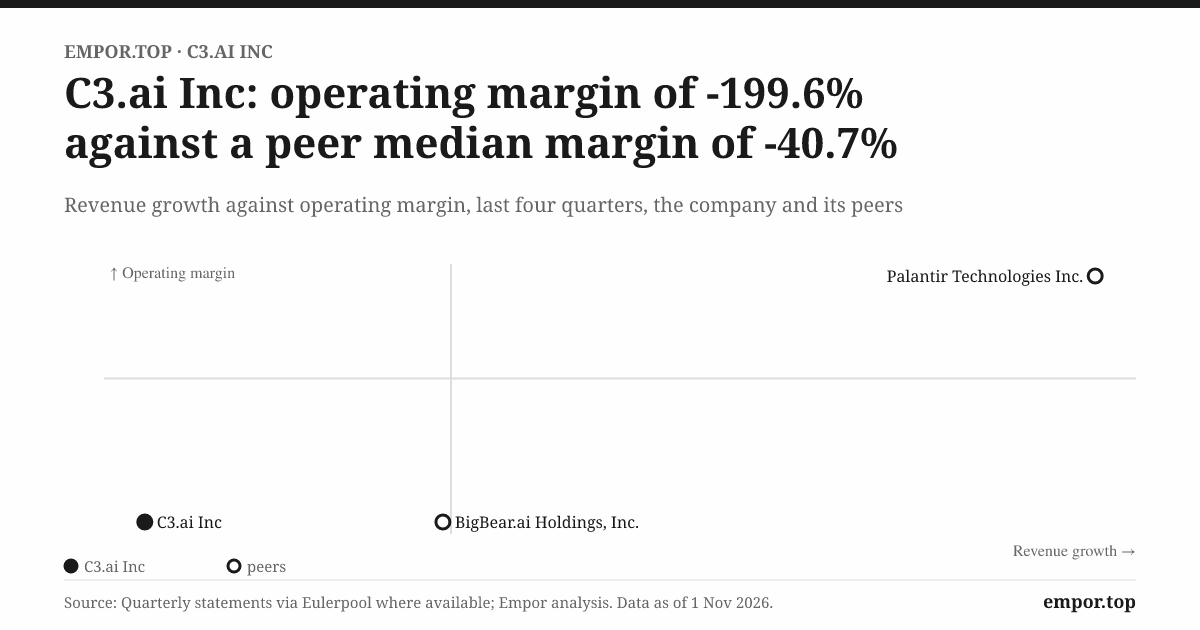
The deeper damage was in the economics. Revenue fell by roughly $139 million in FY2026. But the cost of delivering that revenue did not fall; it rose, from about $151 million to about $172 million.2 Gross profit, the money left over after paying for the cloud hosting, support and implementation work needed to serve customers, collapsed from about $238 million to under $80 million.2 Gross margin fell from about 61% to about 31%.2 Put another way: in FY2025, C3.ai kept about 61 cents of every revenue dollar after delivery costs; in FY2026 it kept about 31 cents.
Why did delivery costs rise as revenue fell? The company's own explanation points to three mechanisms: lower subscription revenue spread over a relatively fixed hosting and support base, higher payroll and contractor costs for its delivery teams, and engineering services projects that the company described as lower priority.2 That last item hints at a revealing practice. A software company that does service work for customers, sometimes at low or no price, in order to secure future subscription revenue is investing in deals. When that subscription revenue does not arrive on schedule, the investment shows up as pure cost. It is a pattern that would be consistent with a sales motion that leaned heavily on pilots and proofs of concept, a familiar trap for enterprise AI vendors.
It is tempting to assign the collapse to one external cause, such as a macroeconomic slowdown or a shift in AI budgets toward generative models from the hyperscalers. The filings do not support a single-factor story. What they show is a combination of disrupted sales, weaker subscription revenue and a delivery cost base that did not adjust.2 The founder's health and the sales reorganization were real factors by management's own account.11 But a sales reorganization that can cut revenue by a third within a quarter also suggests that the pipeline depended on a small number of large deals closed through a few key relationships, rather than a broad, repeatable funnel.
Comparing what management said across these moments is instructive. On the FY2025 fourth-quarter call in May 2025, the tone was confident, focused on growth, partnerships and the generative-AI product line.10 On the FY2026 first-quarter call in September, the tone had turned to accountability and reset: the result was unacceptable, the sales organization was being restructured, and the new CEO would lead a turnaround.12 By the time the third quarter of FY2026 reported a revenue decline of nearly half, the explanation had broadened from a temporary sales disruption toward a fuller restructuring of costs and headcount.2 Management did own the miss, and it did describe changes. What it did not provide, in a way investors could verify, was a concrete accounting of which customers or deal types had disappeared and why. The narrative shifted as the numbers deepened, from a bump to a reset.
The verdict on FY2025 is uncomfortable but clear. The peak year was real revenue, from real customers. But it was not the start of a scalable growth curve; it was a high-water mark built on demand that the company could not sustain once its sales engine was disrupted. The 2025 miss was a major break in C3.ai's credibility. Recovery now has to be demonstrated in reported results, not promised on calls. And the man who would ask investors to believe in that recovery was, once again, the founder.
VIII. Siebel Returns to the CEO Seat
Stephen Ehikian had the resume of a credible turnaround leader. He had co-founded RelateIQ and Airkit.ai, both sold to Salesforce, and had briefly served as acting administrator of the U.S. General Services Administration.12 When C3.ai named him chief executive in September 2025, with Siebel moving to executive chairman, the message was that a seasoned operator would bring discipline to a company that had lost its footing.12 He took over a business whose revenue was falling at a double-digit rate and whose founder's health had become a public question.
His tenure was short. In May 2026, Tom Siebel returned to the CEO role.1314 Reports in late 2025 had also said the company was exploring strategic options, including a possible sale.13 The details of the leadership change matter less than what it means for the present business: the person who founded the company, controls its votes and shaped its strategy for seventeen years is once again the person directly accountable for its results. Whatever else that achieves, it removes ambiguity about who owns the outcome.
The reset Siebel inherited from his own successor, and then continued, has three parts. The first is cost and headcount. C3.ai's workforce fell from 1,181 employees at April 2025 to 764 at April 2026, a reduction of about 35%, roughly matching the decline in revenue.28 Restructuring charges in FY2026 totaled $10.8 million.2 The second is the sales organization, which management restructured after the 2025 miss in an effort to rebuild the pipeline it had disrupted.12 The third, and most consequential, is what the company chose not to cut: product development.
Research and development spending was about $229 million in FY2026, compared with about $226 million in FY2025.2 In a year in which revenue fell by more than a third and headcount by about a third, R&D dollars stayed essentially flat. As a share of revenue, R&D jumped from about 58% to about 91.5%.2 There are two ways to read that. One is that management deliberately protected the product during a downturn, betting that the platform must be ready when demand returns, and that cutting engineers in the middle of an AI platform war would be self-defeating. The other is that the cost structure did not adjust to the reality of a smaller business. Both readings can be partly true. What the numbers make clear is that the rise in R&D intensity was mostly caused by collapsing revenue, not by a step up in investment.
The first quarter of FY2027, the July 2026 quarter, delivered the first tangible evidence that the reset might be biting. Operating cash flow turned positive at $2.1 million, and capital expenditure was negligible, so free cash flow was also about $2.1 million.[^1]1 Compared with an operating cash outflow of $190.2 million in FY2026, that is a striking swing.2 But it is one quarter, and a careful look at the cash flow statement shows how much depends on timing: collections from receivables, the timing of payments to cloud suppliers and the seasonality of billing can all flip a single quarter's cash flow from negative to positive. The test is several consecutive quarters, along with gross margin and free cash flow after accounting for the cost of equity compensation.
On the FY2027 first-quarter call, Siebel and his team led with the 73% sequential increase in bookings as the sign that the reset was taking hold.3 What analysts pressed for, and what remained thin, was the concrete evidence behind that bookings figure: how much was new customers versus expansions, how much was usage commitments versus time-based subscriptions, and how quickly it would convert into recognized revenue. Bookings are not a defined accounting measure, and the company does not report them in its financial statements. The 10-Q, meanwhile, disclosed that one customer supplied 15% of revenue and that new customers supplied 1% of subscription revenue.1 The bookings surge may be real progress. It is not yet visible in the audited numbers.
The founder's return creates a clearer point of accountability, and the cuts have narrowed costs. What they cannot do by themselves is answer whether the market wants C3.ai's product at sufficient scale. That answer will come from customers, and in the meantime, the company has to pay for the wait. How long it can afford to wait, and who bears the cost, is a question about cash, equity and dilution.
IX. Cash, Equity Awards and the Cost of Waiting
At the end of April 2026, C3.ai held about $575 million of cash and investments.2 Three months later, that number had risen to $651.1 million.1 For a company whose operating business had burned $190 million the year before, that looks like a remarkable recovery. It is worth understanding where the money came from. Operating cash flow in the July quarter was only $2.1 million. The bulk of the increase came from employees exercising stock options, which brought in about $72.8 million of cash in the quarter.1 The cash pile grew mostly because employees bought shares from the company, not because customers paid more than the business spent.
That detail captures the financial architecture of C3.ai better than any ratio. Over the eight fiscal years from FY2019 to FY2026, the company recorded about $1.7 billion of cumulative net losses.24 Over the same period, it used about $625 million of operating cash and about $748 million of free cash flow.24 The gap between a $1.7 billion accounting loss and a $625 million cash outflow is large, and most of it is explained by stock-based compensation, which is an expense on the income statement but not a cash payment. C3.ai's stock-based compensation was $215.8 million in FY2024, $231.0 million in FY2025 and $263.7 million in FY2026.2 In FY2026, stock-based pay was larger than the company's entire revenue.
Stock-based compensation is easy to dismiss as "non-cash," and it is true that it does not drain the bank account. But it is a real economic cost, and shareholders pay it in a different currency: dilution. Class A shares outstanding rose from about 130.4 million to about 144.5 million during FY2026, an increase of more than 10% in a single year, driven by equity awards and option exercises.2 A shareholder who owned 1% of the company at the start of the year owned noticeably less at the end without selling a share. And the option exercise inflow in the July quarter shows the mechanism working in real time: employees pay cash to the company to buy shares, which helps the balance sheet but adds to the share count.
Where has the capital gone? Not to acquisitions. C3.ai had no material acquisition-led expansion or acquisition price to benchmark.2 There have been no buybacks and no dividends.2 The capital raised at the IPO and since has been spent internally: on research and development, on sales and marketing, on staffing, on cloud infrastructure and delivery, and on equity awards. That is a clean story in one sense, free of empire-building takeovers. But it means the full return on that capital depends on one thing: whether the platform those dollars built generates durable customer revenue.
There is one obligation that looms larger than any debt. At April 2026, C3.ai had about $441.4 million of multi-year purchase commitments for cloud hosting and professional services, of which $379.8 million was for cloud hosting, spread over one to four years.2 Its actual cloud-hosting costs in FY2026 were $104.6 million.2 These are not borrowings; they are promises to buy capacity from cloud suppliers, typically in exchange for better pricing. But set them next to the company's $250.3 million revenue base and the risk is clear. If customer usage grows into those commitments, C3.ai will have locked in favorable rates. If usage does not scale, the company will be paying for computing capacity it cannot resell, which would put further pressure on gross margins that have already halved.
The debt picture is reassuringly simple by comparison. C3.ai reported about $5.6 million of borrowings, and the audited statements do not describe a funded borrowing facility or financial covenants.2 Separately, it carried about $58.7 million of operating lease liabilities, mainly for offices.2 There is no debt maturity wall and no disclosed covenant pressure. The near-term financing question is entirely about cash burn and whether customer usage absorbs the cloud commitments.
A brief diligence aside on contingent items: the company faces securities and derivative litigation, including a case narrowed in March 2026 and a separate case concerning disclosures about Siebel's health that was dismissed in July 2026 and then proceeded on an amended complaint; C3.ai says it cannot estimate potential losses.21 On the other side of the ledger, a jury awarded C3.ai $23.3 million in its trade-secrets case against Cummins in May 2026, but the company had not recorded that amount, and collection remains uncertain.2 The FY2026 auditor's opinion was unqualified, with no material weakness reported.2
The verdict on the balance sheet is straightforward. Cash and investments of about $651 million provide a substantial runway even at FY2026's burn rate, and the company is not at risk of a financing crisis. But the cost of waiting is not zero. It is paid through dilution, through supplier commitments that only make sense if usage grows, and through the time value of capital that has so far earned negative returns. Cash buys time for the turnaround. Whether that time benefits shareholders depends on what the company does with it, and on who, ultimately, decides.
X. Control Without a Majority of the Shares
At C3.ai's annual meeting in October 2026, shareholders cast their advisory vote on executive pay. The result, filed with regulators on October 30, was 79.6% in favor.[^18] That is a majority, and the vote passed. But it also meant that 48.8 million votes went against the company's compensation plan.[^18] At most large U.S. companies, say-on-pay support routinely runs above 90%; a result below 80% is the kind of number that compensation committees notice. In a company whose founder controls nearly half the votes, it is a notable signal.
The reason the founder's control is so significant lies in C3.ai's dual-class structure. Class A shares carry one vote each. Class B shares carry 50 votes each.14 As of August 2026, Siebel held about 13.9% of the Class A shares and about 87.8% of the Class B shares, giving him about 48.9% of total voting power.14 His economic ownership, the share of the company's value he would get if it were sold, is much smaller than his voting power. Large institutional holders such as BlackRock and Vanguard each held more than 5% of the Class A shares, but their voting influence is diluted by the Class B structure.14
Siebel's control has declined over time. At the IPO, he held about 77.1% of the voting power before the offering and 71.8% after it.4 Dilution from equity awards and changes in ownership have pulled that figure below 50%. But at 48.9%, he remains close to a majority and can sway shareholder votes, especially when turnout among other shareholders is low. His support is likely to be influential in shareholder votes on director elections or strategic transactions.
Compensation is the area where this structure meets scrutiny. In FY2026, reported compensation was $24.3 million for Siebel and $36.2 million for Ehikian, whose tenure as CEO ended shortly after the fiscal year in which his sign-on awards were reported.14 Chief financial officer Hitesh Lath received $5.5 million.14 Siebel's reported pay had been $25.5 million in FY2025 and $24.8 million in FY2024.14 Most of these amounts reflect the grant-date value of equity awards rather than cash salary, and the realized value of those awards depends on the share price. But the company recorded a $470.4 million net loss in FY2026, and shareholders were also diluted.2 Large awards during a year of collapsing revenue are bound to draw dissent.
The board was majority independent, with Siebel as chair.14 That is the standard structure for a founder-controlled company. It provides oversight in form, but with the founder holding nearly half the votes, the independence of directors is tested only when their judgment diverges from his.
How should investors weigh management credibility in this setting? The best evidence is behavior over time. On guidance, the record is mixed at best: the company entered FY2026 with an outlook for continued growth and delivered a 35.7% decline.102 On explaining the miss, management acknowledged it as unacceptable and named the sales reorganization and the founder's health, but provided limited specifics about which deals or customers had fallen away.11 On restructuring, it cut headcount significantly while preserving R&D. On compensation, the reported awards did not adjust downward in line with results. And on consistency, the gap between the FY2027 first-quarter call's comments on customer concentration and the 10-Q's disclosure is a small but real crack.31
There is no activist campaign identified in the company's filings through the October 2026 meeting, and with Siebel's voting power, a traditional proxy fight would be nearly impossible to win. But a skeptical investor has a legitimate stress test to apply. Why should public shareholders accept concentrated control and large equity awards before the economics improve? The honest answer is that they accept it because the structure gives them no choice, and the alternative is to sell. The governance test, then, is not whether Siebel retains control; he will. It is whether future executive pay and equity issuance become tied to durable operating outcomes, such as revenue growth, gross margin and cash flow, rather than leadership continuity or headline bookings. That brings the story to the core question for anyone pricing the shares: what has to be true to justify the market's expectations?
XI. Analysis & Bear vs. Bull Case
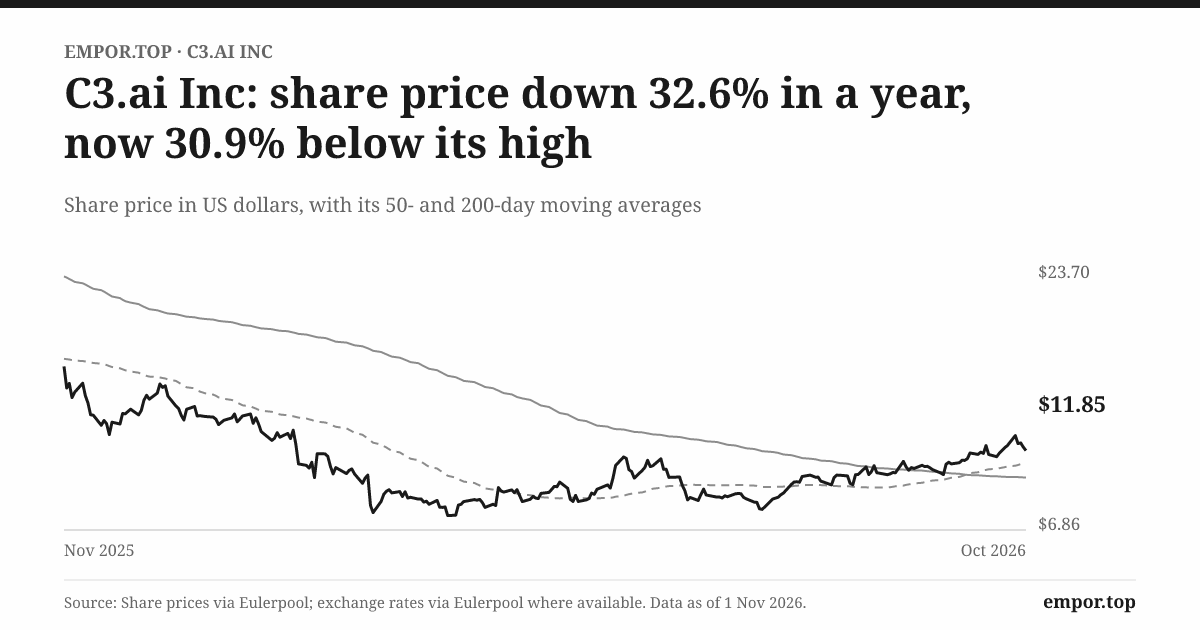
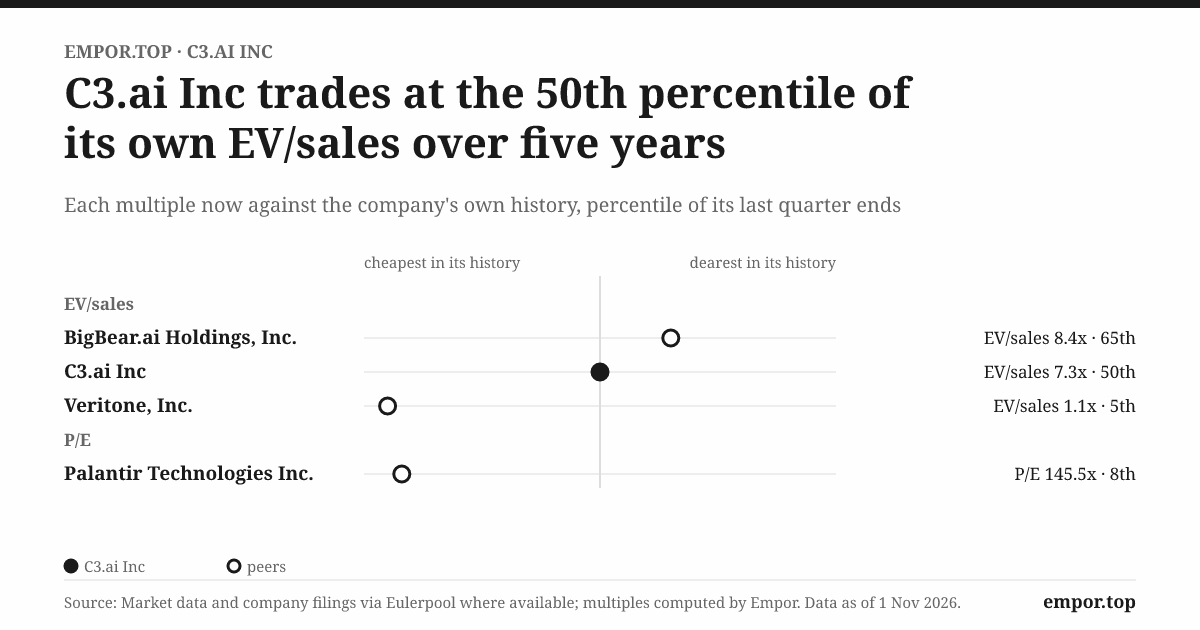
At the start of November 2026, C3.ai's shares traded at $11.85, about 31% below their 52-week high, giving the company a market value of about $1.7 billion and an enterprise value of about $1.1 billion once its cash pile is set aside.15 Against trailing sales, that is about 7.5 times price-to-sales and 7.3 times enterprise value to sales.15 With losses, price-to-earnings and EV-to-EBITDA multiples are meaningless. The market is paying several times sales for a business whose revenue fell by more than a third in its last fiscal year. That is the puzzle.
The multiple itself has a history worth noticing. At the end of FY2026, C3.ai traded at roughly 5 times sales, versus about 7.3 times at the end of FY2025 and about 8.7 times at the end of FY2024.15 The current multiple has risen from that FY2026 low partly because sales have kept contracting while the share price has held up. A rising multiple on falling sales is not a sign of improving fundamentals; it is the market paying more for each dollar of a shrinking revenue base, on the expectation that the base will grow again. For context, Snowflake, a much larger cloud-data platform, was reported at about 24 times sales in September 2026, though that is not a same-date or like-for-like comparison.16 C3.ai sits well below that peer, but high relative to its own recent fundamentals.
The bull case, in its strongest form, runs like this. Enterprises everywhere are being told to deploy AI, and most of them are discovering that the hardest part is not the model but the data: it is scattered across dozens of legacy systems, inconsistent and poorly understood. C3.ai has spent more than fifteen years building a platform to solve exactly that problem, and it has a portfolio of industry applications that give customers a running start. The company says its platform runs across the major clouds, which appeals to customers wary of putting their AI strategy entirely in one hyperscaler's hands. It has an existing installed base that already supplies three-quarters of subscription revenue, which means that if usage rises, the company can grow without needing many new customers. It has $651 million of cash, no meaningful debt and a workforce that has been cut by about a third. The first quarter of FY2027 delivered positive cash flow, and the company reported a sharp rise in bookings. On this view, FY2026 was a painful but survivable stumble in a market that is still forming, and the shares are cheap relative to what a recovered C3.ai could earn.
The bear case deserves equal weight. Revenue fell 35.7% in FY2026 and was still falling 25.7% year over year in the latest quarter.2[^1] Gross margin halved, from about 61% to about 31%, which means that even the revenue C3.ai does earn is far less profitable than it was.2 One customer supplies about 15% of revenue, and new customers supply about 1% of subscription revenue.1 Most contracts do not require renewal, customers can reduce usage, and the company does not disclose the retention metrics that would show whether customers are staying.2 The competitive field includes cloud platforms many times C3.ai's size that can bundle AI tools at little or no incremental cost, and Palantir, which has grown to roughly 18 times C3.ai's revenue.9 And the history of the company shows repeated reinvention without ever achieving profitability. On this view, the turnaround is more hope than evidence, and the cash pile is the main thing supporting the valuation.
Porter's five forces sharpen the picture. Buyer power is high, because C3.ai's customers are large enterprises that can reduce usage, multi-source from competing platforms or build in-house; the concentration of revenue in a few customers amplifies that power. Supplier power is meaningful: cloud providers like Amazon, Microsoft and Google host much of C3.ai's software and are also its competitors, and the company has committed to more than $440 million of cloud and services purchases.2 The threat of substitutes is significant, because hyperscaler AI tools, data platforms and incumbent enterprise vendors can all address overlapping use cases. The threat of new entrants is elevated, because generative AI has lowered the barrier to building AI applications and attracted enormous venture investment. And rivalry is intense, with players far larger than C3.ai competing for the same budgets. What the evidence does not show is the direct outcome of these forces on price, because C3.ai does not publish price realization or win rates, so the strength of buyer and supplier power is inferred from structure rather than proven by observed pricing.
Hamilton Helmer's seven powers offer a complementary lens, and the results are sobering. Scale economies favor the hyperscalers and Palantir, not C3.ai. Network effects are not evident; one customer's use of the platform does not obviously make it more valuable to another. Counter-positioning, where an incumbent cannot copy a newcomer's model without hurting itself, does not clearly apply; cloud providers can bundle AI tools without cannibalizing their core business. Switching costs are C3.ai's best candidate: once a customer has integrated its data into C3's platform and built applications on it, ripping it out is painful. But the company's revenue collapse, its lack of renewal requirements and its silence on retention mean that switching costs are plausible but unproven. Branding exists in the sense that the ticker and name are well known, but there is no evidence that it commands a price premium. A cornered resource, such as exclusive data or unique talent, is not evident. And process power, the accumulated know-how of deploying AI in complex industrial settings, is real but hard to measure and difficult to separate from the services work that has been dragging on margins. The verdict: C3.ai's strongest potential power is switching costs within its installed base, and the evidence currently supports that only in a narrow, unquantified form.
There are important gaps in what investors can know. C3.ai does not disclose net revenue retention, a standard contract term, customer-level expansion trends or market share in a comparable enterprise AI category.2 These are not trivia; they are exactly the metrics that would settle the bull-versus-bear debate. Their absence is not proof of weakness, but it does mean that investors are being asked to take the stickiness of the business more on faith than they would for most software companies.
If an investor were to track only a handful of numbers, three matter most. The first is year-over-year revenue growth, alongside the share of subscription revenue from new customers; the latest reading was a 25.7% decline, with new customers at 1% of subscription revenue, versus 32% a year earlier.[^1]1 The second is gross margin, which fell from about 61% in FY2025 to about 31% in FY2026 and will show whether deployments are turning into profitable usage.2 The third is operating and free cash flow after the cost of stock-based compensation: the latest quarter was positive $2.1 million before counting equity pay, while FY2026 was deeply negative even before that cost.[^1]2
The investment spine is explicit. Why C3.ai might win from here: it has a credible product, a real installed base, years of hard-won deployment experience and enough cash to keep investing while the enterprise AI market matures. Why it might not: the measurable evidence of repeatable demand and differentiated economics has not caught up with the ambition, and the competitive field is moving faster, at larger scale, with deeper pockets. Current evidence supports optionality, not a proven moat or a self-funding growth engine. The lessons from that gap reach beyond this one company.
XII. Lessons from a Company That Keeps Changing Its Name
Go back to the sequence of names. C3. C3 Energy. C3 IoT. C3.ai. And now, the C3 Agentic AI Platform. Each name was a bet on where enterprise technology was going, and most of the bets were directionally right. Energy data did become a big deal. Connected sensors did proliferate. AI did become the defining technology of the decade. The company was rarely wrong about the weather. The trouble was turning a good forecast into a durable business.
The first lesson is about the difference between a technology and a budget. Siebel's founding insight in 2009, that the hard problem was integrating enterprise data rather than analyzing it, was sound, and it let the platform travel from carbon to sensors to AI. But a platform that can solve many problems still has to win a specific line in a specific customer's budget, and each time C3 changed its frame, it had to win those budget lines again. The lesson for founders and investors: a platform can travel across markets; a business still has to land in a customer's budget.
The second lesson comes from the 2025 shock. C3.ai's revenue was mostly classified as subscription, and that label made it look like a recurring software business. Then, within a quarter, sales fell by a third, and they kept falling. The contracts did not require renewal, usage could be reduced, and the forward backlog missed much of what customers might consume. For investors, the lesson is to read past the label to the contract. Recurring software is only recurring when customers keep using it.
The third lesson is about the R&D line. As revenue fell from $389 million to $250 million, R&D held near $229 million.2 That can be defended as protecting the product during a storm. But a company that spends more than 90 cents on research for every dollar of revenue is betting that the market will eventually reward the product, and the market has not yet done so at the needed scale. The discipline that matters is not cutting R&D but making it accountable to customer outcomes: shorter deployments, higher usage, more expansion. Protect the product, but make the spending answer to the customer.
The fourth lesson belongs to the founder. Tom Siebel built one of the great enterprise-software companies of the 1990s, and his return to the CEO seat in 2026 reflects both his commitment and his control. Dual-class shares let a founder keep a long-term strategy intact through bad quarters and impatient markets, which can be a real advantage. But they also remove the mechanism by which shareholders force change when the strategy is not working. Control can keep a strategy intact; it cannot make the strategy work.
These lessons do not condemn C3.ai. They describe the specific shape of its challenge: a company that has repeatedly read the future well, but has not yet proved that customers will keep paying for its reading of it. Whether that changes will be decided over a remarkably short horizon.
XIII. The Next Four Quarters
Tonight, C3.ai stands at an inflection point that may or may not be one. The July quarter's bookings rose 73% sequentially and free cash flow was $2.1 million, while revenue remained sharply lower year over year.[^1] One customer supplied 15% of revenue.1 The company has $651 million of cash, a founder back in charge and a new platform label. What it does not yet have is a trend.
The next four quarterly reports will decide what the July quarter meant. The first thing to watch is revenue itself. The year-over-year comparisons get easier from here, because the collapse began in the July 2025 quarter and deepened through April 2026. A return to year-over-year growth in the coming quarters is therefore a low bar, and clearing it would be necessary but not sufficient. The more revealing signal will be whether new customers contribute meaningfully more than the 1% of subscription revenue they supplied in the first quarter.1 If that share climbs back toward the levels seen before the collapse, it would suggest the sales engine is working again. If it stays near zero, any growth is coming from existing customers turning their usage back up, which is fragile.
The second thing to watch is gross margin. Bookings alone will not settle whether deployments turn into profitable usage. If C3.ai's gross margin recovers from the 31% of FY2026 toward its historical levels, it would mean the delivery cost base has adjusted, the lower-priority engineering projects have ended, and customer usage is filling the cloud capacity the company has committed to buy. If gross margin stays depressed, it would suggest that C3.ai is winning deals by doing expensive work up front, the same pattern that preceded the collapse.
The third is cash. One positive quarter is a data point. Several consecutive quarters of positive operating and free cash flow would be a trend, and would change the company's financial position fundamentally. Investors should also watch the cost of stock-based compensation, which ran above $260 million in FY2026, because positive cash flow achieved while issuing large amounts of equity is a transfer from shareholders, not a self-funding business.2
The fourth is concentration and commitments. Watch whether the largest customer's share falls as the business grows, and whether the $441 million of cloud and services commitments are supported by actual customer usage.2 Either could become a source of risk if the recovery stalls: a large customer's decision could swing a quarter, and unused cloud commitments would weigh on margins.
Each outcome has a meaning. If revenue grows, new customers return, gross margin recovers and cash flow stays positive across several quarters, the July 2026 quarter will look like the first step of a genuine turnaround, and the market's optimistic multiple will have been early rather than wrong. If revenue stabilizes but margins and new-customer contribution stay weak, C3.ai will look like a smaller, steadier business living off its installed base, with less optionality than the valuation implies. And if revenue resumes falling, the July quarter will have been only a pause in the decline, and the cash pile will become the main thing propping up the story. The tension that remains is that each of these outcomes is still possible.
XIV. The Platform Still Has to Earn Its Name
Go back to that September morning. Bookings and cash flow improved, but revenue remained sharply lower year over year and far below its peak.[^1]8 The headline and the business, side by side, as they have been for much of C3.ai's history.
Tom Siebel has spent seventeen years, and a good part of his fortune and reputation, anticipating where enterprise software would go. He was often right about the direction. What C3.ai has never quite demonstrated is that customers will keep paying, in growing amounts, for the platform he built to meet them there.
Enterprise AI may well be one of the largest software markets ever created. C3.ai's place in it will be measured not by the size of the market but by returning customers, rising usage and cash that lasts. C3.ai has changed its name to match the future more than once; now the future has to show up in the revenue.
References
-
C3.ai, Inc. FY2027 Q1 Form 10-Q — SEC, 2026-09-09 ↩↩↩↩↩↩↩↩↩↩↩↩↩↩↩
-
C3.ai, Inc. FY2026 Form 10-K — SEC, 2026-06-24 ↩↩↩↩↩↩↩↩↩↩↩↩↩↩↩↩↩↩↩↩↩↩↩↩↩↩↩↩↩↩↩↩↩↩↩↩↩↩↩↩↩↩↩↩↩↩↩↩↩↩↩↩↩↩↩↩↩↩↩
-
C3.ai Fiscal First Quarter 2027 Earnings Call Transcript — EarningsCalls, 2026-09-02 ↩↩↩
-
C3 Energy Renamed C3 IoT; C3 IoT Platform Launched for Enterprise Markets — C3.ai, 2016-02-23 ↩
-
C3.ai IPO adds to software deal boom with 100% gain in trading — CNBC, 2020-12-09 ↩↩↩
-
C3.ai Fiscal Fourth Quarter 2025 Earnings Call — C3.ai, 2025-05-29 ↩↩↩
-
Oppenheimer cuts C3.ai rating after steep revenue warning, CEO exit — Investing.com, 2025-08-13 ↩↩↩↩↩
-
C3.ai's stock crumbles on "unacceptable" results as new CEO promises to turn things around — SiliconANGLE, 2025-09-03 ↩↩↩↩↩↩
-
Thomas Siebel Is Back as C3.ai CEO. Will This Help the Stock Rebound? — Nasdaq, 2026 ↩↩
 LinkedIn
 WhatsApp
 Reddit
 Hacker News
 Email
 Kindle
 RSS Feed
 Spotify
 Apple Podcasts
 Amazon Music
 Audible
 YouTube