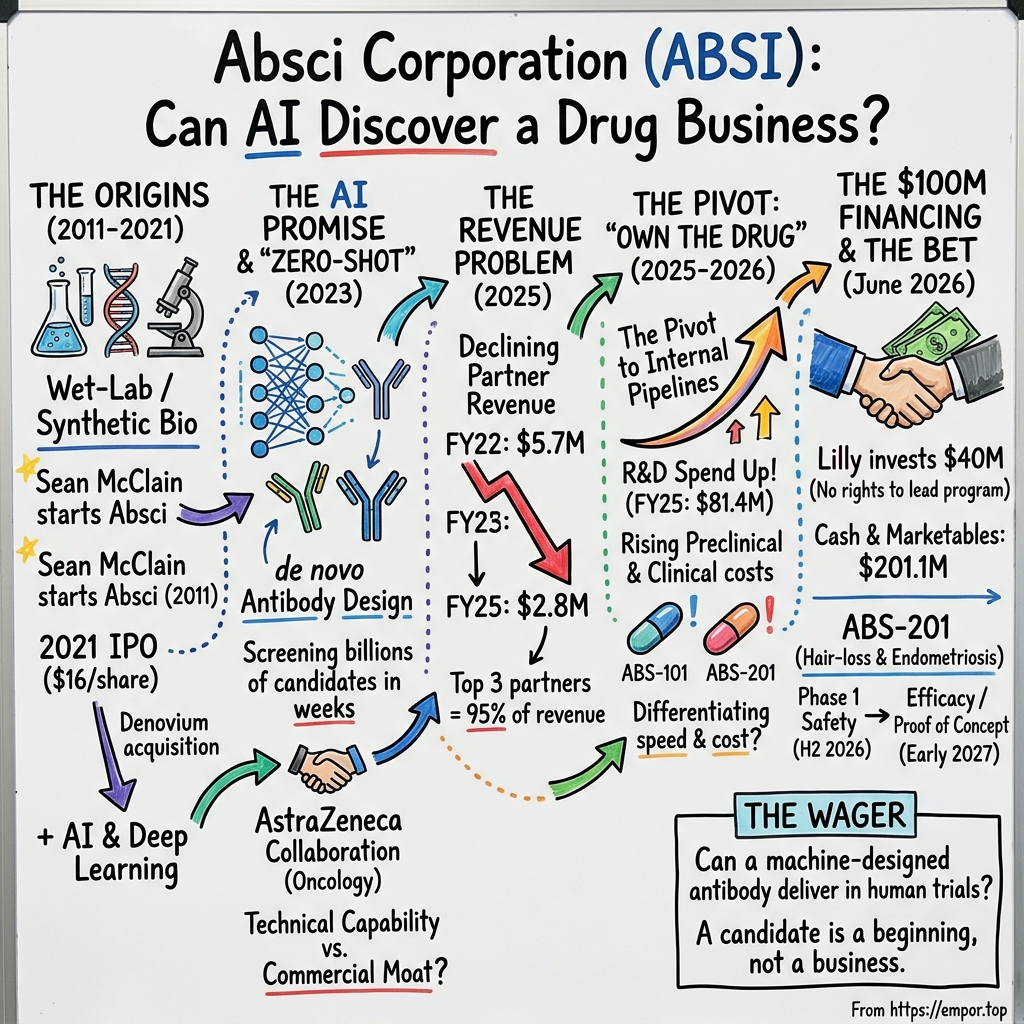
Absci Corporation: Can AI Discover a Drug Business?
I. The $40 Million Vote of Confidence
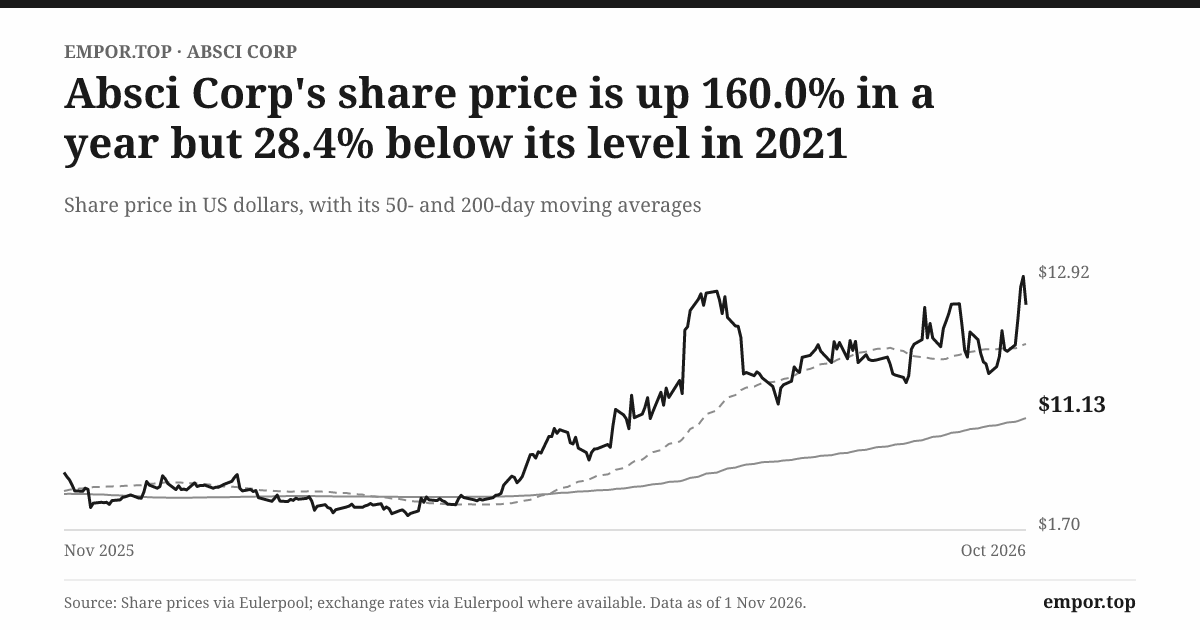
In the last week of June 2026, a small biotech in Vancouver, Washington, did something that companies of its size rarely manage. It raised $100 million in a single underwritten offering, and $40 million of that money came from one of the most valuable pharmaceutical companies in the world.1 Eli Lilly, the maker of some of the best-selling obesity drugs in the world, had written a cheque to Absci Corporation. A few days earlier, Absci had published the first human data on its lead antibody, ABS-201, and its stock had jumped about 36% in a single session.2 For a company whose share price had traded as low as $2.30 during the previous year, this looked like the moment the story finally turned.3
The detail that matters most came later, in the earnings call on August 11. Chief financial officer Zach Jonasson explained that the partnership with Lilly "is tailored around the clinical development strategy for ABS-201 and does not confer rights to the program, which we plan to develop ourselves."1 Lilly would put a senior clinical executive on Absci's endometriosis advisory board. It would own shares. It would not own the drug. There was no licence, no upfront payment for rights, and no milestone schedule tied to the molecule. Lilly had bought into the company. It had not bought the medicine.
That distinction is the key to the whole story. A strategic investment tells you that a sophisticated buyer finds the biology interesting enough to own a piece of the company at a given price. It does not tell you that the antibody works, that Lilly will ever license it, or that the commercial outcome will match management's estimates. Absci itself has never shown the data that would answer those questions. Its human data so far cover safety and how long the drug stays in the body. They say nothing yet about whether it grows hair.
The financing did change Absci's runway. Cash and marketable securities reached $201.1 million at the end of June, up from $125.7 million three months earlier, and management said the balance should fund its operating plan into the second half of 2028.4 For a company that spent roughly $27 million a quarter in operating cash in the first half of 2026, that is real breathing room.5
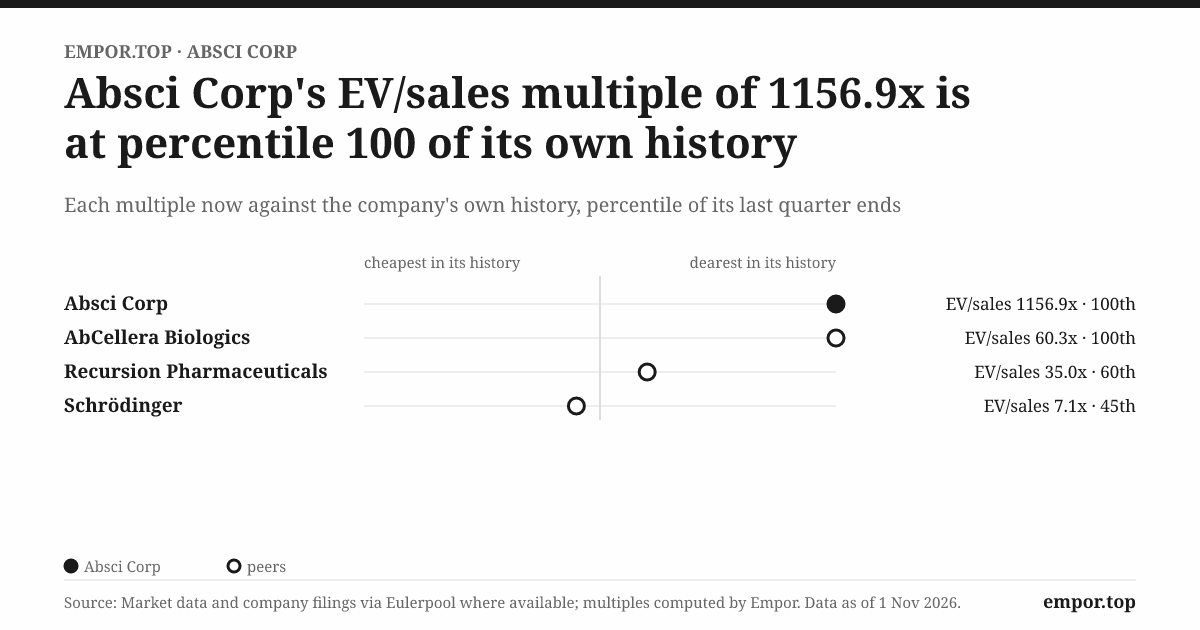
Now put the rest of the picture next to it. On November 1, 2026, the market values Absci at about $1.9 billion.3 Over the previous twelve months the company reported about $1.6 million of revenue, all of it from partner programs, and that revenue is shrinking.46 The market value is roughly 1,200 times trailing sales, a figure that means nothing in the usual sense, because nobody is valuing Absci on its sales.3 Investors are valuing a drug that has not yet shown efficacy and a platform that has not yet produced a licensed medicine.
So the story Absci now tells is a story about a transition. For most of its life Absci sold discovery work to other drug companies. It now wants to own the drugs it discovers, starting with ABS-201 in pattern hair loss and endometriosis. Four questions run through everything that follows. Can internally developed drugs replace the value that partner revenue never delivered? Does the platform make drugs more cheaply and reliably than the industry, or does it only make the research bill bigger? Will the cash last until the clinical evidence arrives, without another round of heavy dilution? And what does a $1.9 billion valuation already assume?
Lilly's cheque helps fund the attempt to answer them. It does not answer any of them. To see why Absci ended up making this bet, the story has to go back fifteen years, to a young biology graduate who wanted to teach bacteria to behave like human cells.
 Subscribe on LinkedIn
II. A Lab Built to Make Biology Move Faster
Sean McClain arrived at the University of Arizona intending to become a mechanical engineer. A 100-level chemistry class changed his mind, and he later said he "knew right away this was the field I wanted to be in."7 He finished a degree in molecular and cellular biology a year early, in 2011, specifically so he could start a company.7 He moved back to his home state of Oregon, whose biotech scene he called "fairly limited compared to areas such as Boston or San Francisco," and began, by his own description, as "the sole full-time founder with support from friends and family."7 Industry profiles place the first lab in a Portland basement.8 McClain described it as a low-budget space in a local business accelerator, where he met the founders and investors who introduced him to venture capital.7
The founder in that picture is not a famous scientist with a decade of academic papers. He is a young operator with an engineering instinct and a habit, since middle school, of starting businesses. As a teenager he mowed neighbours' lawns and grew that into a business that paid his way through high school.7 His stated philosophy is about persistence rather than brilliance: "success isn't defined by how smart you are, but by the grit and resilience you have."7 He also says to "hire people smarter than yourself" and to treat advice with suspicion, because "advice is cheap and often incorrect."7 Those lines matter later. Absci's history is one of persistent reinvention, and the man doing the reinventing has always been the same.
The original idea was industrial. Biologic drugs, the large protein molecules such as antibodies that now make up much of the pharmaceutical industry's revenue, are usually made in mammalian cells, because those cells fold and finish proteins correctly. Mammalian cell lines are slow and expensive to develop. E. coli bacteria grow quickly and cheaply but are poor at making complex human proteins. McClain's bet was that engineering principles could make E. coli behave more like a mammalian cell. Absci was founded with a focus on manufacturing proteins in E. coli, and by 2018 it had launched its first commercial product, a production strain called SoluPro.9 In 2019 it added what it called a "protein printing" platform.9
This was a tools-and-services business. Absci sold capability: a faster way for partners to find and make proteins. The drug companies kept the drugs.
Then came the turn toward artificial intelligence. In January 2021 Absci acquired Denovium, a company that used deep learning to categorise proteins and predict how they would behave, with an engine trained on more than 100 million proteins.9 In June 2021 it bought Totient, another discovery business.9 Absci does not disclose a separate price for Denovium in its public materials, so there is no basis for treating the deal as large or for comparing its valuation with other AI acquisitions. What it signalled was clear enough. The lab would now be paired with machine learning, and the story would be about AI.
Absci went public a month later. The final prospectus, dated July 21, 2021, offered 12.5 million shares at $16 each.10 Pre-IPO filings implied a pre-money valuation of about $1.5 billion, and on the first morning of trading the shares rose to about $21.9 Before the listing, the company had already raised about $230 million, including a $125 million crossover round in June 2020.9 McClain pitched it as "a fully integrated end-to-end solution for pharmaceutical drug development."9 The prospectus described a set of partner projects at stages ranging from preclinical work to Phase 3, many of them linked to the earlier cell-line and protein-production business.10
That partner pipeline was easy to misread. A protein-production strain used in someone else's Phase 3 programme is real commercial validation of a manufacturing tool. It is not evidence that an AI system can discover better drugs, and it does not guarantee meaningful royalties for Absci. The IPO story combined the two. The later record would separate them.
There is a striking fact for any investor who bought in 2021. Five years later, Absci's market value of about $1.9 billion is only modestly above that pre-IPO valuation.3 In between, the shares fell by as much as 93.6% from their peak.3 The company accumulated about $556 million of net losses between 2019 and 2025, and the share count kept rising.6 The market value has made a round trip. The company has not stood still. It has changed what it is.
The 2025 annual report describes a company focused on AI-designed antibody therapeutics, combining generative models with a wet lab that tests designs and feeds the results back into the models.6 The SoluPro story has largely disappeared from the pitch. What survives from the old Absci is the lab. Its Vancouver site now covers more than 77,000 square feet of wet-lab space, alongside AI research teams in New York and Serbia and a drug innovation centre in Zug, Switzerland.11 Absci calls the combination "lab-in-the-loop." The phrase is the bridge between the old company and the new one.
What has changed is who carries the risk. The old Absci sold capability and let partners take the clinical gamble. The new Absci wants to take the gamble itself and keep the upside. Before it could make that choice, it needed something worth gambling on. In 2023 it announced that its machines could design antibodies from scratch.
III. The Promise of "Zero-Shot" Antibodies
On January 9, 2023, a 34-author preprint appeared on bioRxiv under a confident title: "Unlocking de novo antibody design with generative artificial intelligence."12 Two days later Absci announced what it called the first design and validation of de novo therapeutic antibodies using "zero-shot" generative AI.12
The jargon is worth unpacking, because the rest of the story depends on it. An antibody is a Y-shaped protein. The tips of the Y contain short, looping regions, called complementarity-determining regions or CDRs, that grip a specific target, much as a key fits a lock. Traditionally, antibody discovery has worked like a huge lottery. Scientists immunise animals or screen enormous libraries of variants, then sift through the results for the few that bind. "Zero-shot" means the model designs the loops without being shown examples of antibodies that already bind that target. In plain terms, it is asked to cut a key for a lock it has never seen anyone open.
The first version of the work was narrower than the headline. The team used HER2, the breast-cancer target of the established drug trastuzumab (Herceptin), as a test case. It designed the third heavy-chain loop, the HCDR3, and then extended the method to all three heavy-chain loops.12 Absci screened about 440,000 variants for binding to HER2 and characterised 421 binders in detail. Three of them bound more tightly than trastuzumab.12 The company also claimed that AI design could cut drug-discovery timelines by more than half, "from as much as six years down to 18-24 months."12 That last claim was a projection, not a measured result.
As a scientific step, the work was meaningful. As a business result, it was a starting point. The test target already had a famous, highly optimised antibody, so the experiment showed that the model could find new binders in known territory. It did not show that an AI-designed antibody would become a better medicine. By its 2023 annual report, Absci described a platform able to generate and screen billions of antibody designs, with lab validation in about six weeks.13 Speed of that kind matters only if it produces candidates good enough to survive the long, expensive process that follows.
Pharma's response came quickly. In December 2023, Absci announced a collaboration with AstraZeneca to deliver an AI-designed antibody against a specified oncology target.14 The agreement included "an upfront commitment, R&D funding and milestone payments, in addition to royalties on product sales."14 Absci did not disclose the size of any of those parts in its announcement.14 Deals of this shape are mostly contingent: a modest committed sum up front, and much larger payments that arrive only if a candidate succeeds years later. AstraZeneca's Puja Sapra called it "an exciting opportunity to utilize Absci's de novo AI antibody creation platform."14
The AstraZeneca deal was a scene, not a revenue win. Two years later, Absci's 2025 annual report said the company had generated no significant recurring revenue, and that no partner had licensed a platform-derived candidate for clinical or commercial use.6 In early 2026 Absci deprioritised its own oncology work altogether.[^15] A designed antibody, a partner announcement and a marketable drug are three different milestones, and as of the latest filings the platform had reached only the first two.
The technology kept improving. In early 2026, Absci published details of Origin-1, a generative model that management described as the first demonstration of de novo, full-length antibody design against "zero prior epitopes," meaning target sites with no known structure of anything bound to them.[^16] Management said Origin-1 could find lead candidates by screening fewer than 100 designs per target.[^16] On the August call, Jonasson said the newest Origin models allowed a "1,000x reduction in library size" for finding high-quality leads.1 If those claims hold up, the lottery has become something closer to a short list.
The commercial test is harder than the technical one, because the question is not whether Absci can design antibodies but whether customers must come to Absci to get them. The competition is broad. Schrödinger, the most established listed computational-chemistry company, reported $255.9 million of revenue in 2025, of which $199.5 million came from software sold to researchers.15 Recursion, which combines automated biology with machine learning, reported about $74.7 million.16 Those businesses differ from Absci's and from each other, so the comparison shows scale rather than market share. Even so, the gap is large. Absci's partner revenue in 2025 was $2.8 million.6
Beyond the listed peers, large drug companies now run their own AI groups, academic laboratories publish protein-design methods openly, and many private biotechs pitch the same promise of faster, AI-designed biologics. Pharma's ability to build the capability in-house is the problem for any platform vendor. A buyer that can build the capability itself has little reason to pay a premium for it.
Absci does not disclose the data that would prove it can charge such a premium: customer retention, repeat purchases, revenue per partner, or price per programme. Without them, the claims about speed and being "AI-first" remain hypotheses. They could be confirmed by better candidates, by clinical success, by partners returning and paying more, or by visibly better economics. The next chapter of the story shows what actually happened to the money partners paid.
IV. When Partner Revenue Stopped Looking Like a Business
If you had read only Absci's press releases from 2023 and 2024, you might have expected revenue to rise. There was the AstraZeneca collaboration, a later tie-up and equity investment from chipmaker AMD, and repeated references to platform interest from large pharma.146 Yet when the 2025 annual report came out in March 2026, full-year revenue was down 38% from the year before.6 Three partners accounted for 95% of it.6
The longer view is clearer still. Revenue fell from about $5.7 million in 2022 to $2.8 million in 2025.136 It continued to decline over the twelve months to June 2026.46 Revenue in the second quarter of 2026 was $318,000, compared with roughly $600,000 a year earlier.4 Partner revenue in the first half of 2026 was down about 70% year on year, and three partners provided all of it.5 This is not one weak quarter. It is a business shrinking from an already tiny base while the company's ambitions grew.
To see why, look at how the contracts work. A typical Absci partnership is a staged drug-creation agreement. Absci works on finding or optimising a target and a candidate, with the possibility of technology transfer and licensing later. The partner pays a mix of fixed fees and variable, success-based amounts. Absci recognises revenue over time, measured against the costs it has incurred and the costs it expects to incur to finish the work.6 Revenue therefore depends on whether partners sign new programmes, whether existing programmes progress, and when milestones fall.6 Absci does not disclose the pricing unit, typical contract length, minimum commitments or the share of revenue that recurs.6
That structure explains the volatility. In a quarter when a partner hits a milestone, revenue jumps. When a partner pauses a programme or slows work, revenue falls. Management attributes the year-to-year swings to milestone timing and programme mix, and in any single year that explanation is reasonable.6 Over four years it becomes harder to accept, because timing should even out and it has not. Partners were not scaling their spending with Absci. The revenue stream never compounded the way a platform business needs it to.
The concentration figures point in the same direction. Two partners provided 99% of revenue in 2024, three provided 95% in 2025, and three provided all of it in the first half of 2026.65 Substantially all of it came from partners outside the United States.5 Absci does not name the partners behind those figures. In a normal business, that degree of concentration would be the main risk to discuss, because a few customers who know they matter can push on price and terms. Here the revenue base is so small that losing a customer barely changes the investment case. The question is not whether one partner leaves. It is whether the platform can produce assets valuable enough that someone will pay real money for the rights.
The receivables tell a calm story. At June 30, 2026, Absci reported about $0.3 million of contract assets and $1.4 million of contract liabilities, the latter being cash received in advance for work to be recognised over the next one to two years.5 Trade receivables were nil at the end of 2025, and the company says it has not had significant collection problems.65 Nobody owes Absci much money because there is not much money to owe.
The live version of the story came out on the calls. In November 2025, management told analysts it continued to "anticipate signing one or more drug creation partnerships, including with a large pharma company by year-end."17 No such platform deal was announced by year-end. By May 2026 an analyst noted on the call that the cadence of partnerships "has been slower than what we have seen in the previous years" and asked whether pharma was building its own tools or offering economics that did not work for Absci.18 McClain answered that partnerships "have to make sense for us." Jonasson went further, saying an internal analysis showed that the risk-adjusted value of partnering a finished asset, even at the preclinical stage, was "a multiple" of a target-based platform deal.18
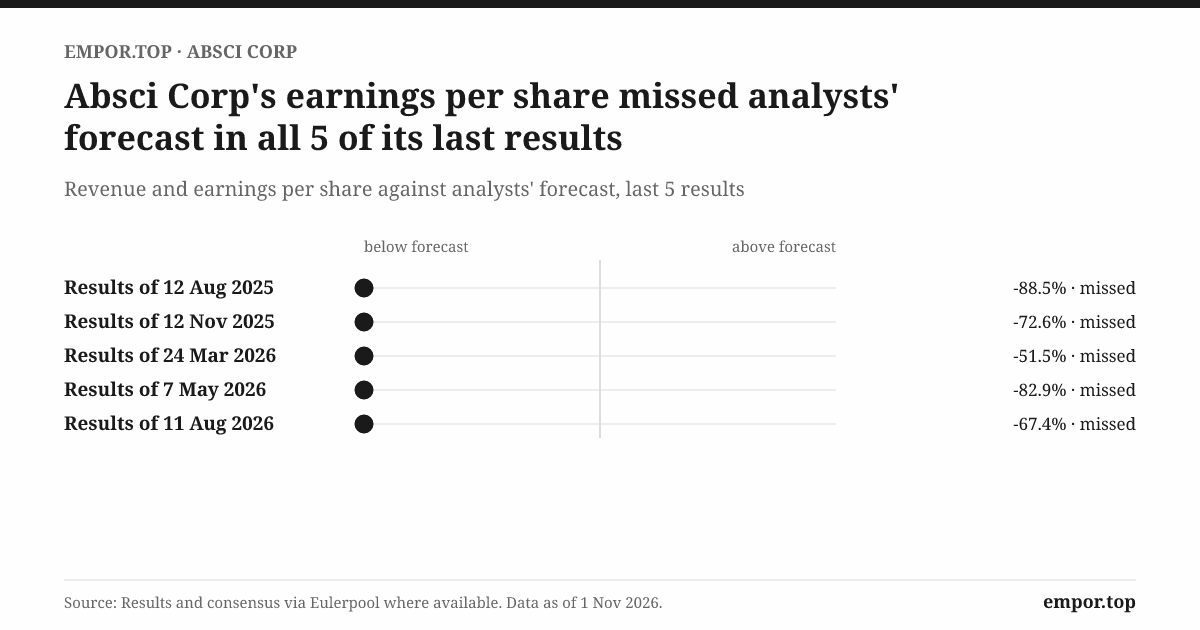
Then, on the August call, analyst Vamil Divan reminded management that it had talked about signing a large-pharma partnership by the end of 2025 and asked whether one had been signed. McClain replied that the Lilly arrangement, "both the investment and... the collaboration on ABS-201 on clinical development," was how the company saw "achieving that large pharma partnership."1 That is a generous reading. The deal management had anticipated in 2025 was described as a drug-creation partnership, the platform model in which a pharma partner pays Absci to design molecules. What arrived in June 2026 was an equity investment, not the drug-creation partnership management had anticipated. Each may have value. They are not the same thing, and the gap between the two is a small but telling test of how management reports results against what it promised.
Taken together, the evidence leads to a plain conclusion. Absci's partner revenue is a concentrated, milestone-driven stream, not a scaled recurring business. Management describes its shift away from platform deals as strategic preference. The numbers suggest the shift was also a response to a platform model that had never grown. That does not make the decision wrong. It means the decision to own the drug was made partly because selling the work had not paid.
V. The Decision to Own the Drug
Every biotech eventually faces the choice between being a toolmaker and being a drug developer. Toolmakers stay small and solvent but capture little of the value they help create. Drug developers can capture the full value of a successful medicine, but they pay the full cost of the many that fail. Absci made its choice gradually and then decisively, and the clearest record of it is in the research budget.
Research and development spending rose from $63.9 million in 2024 to $81.4 million in 2025, an increase of about 27%, while revenue fell by 38%.6 In 2024 Absci spent roughly 14 dollars on research for every dollar of revenue. In 2025 it spent roughly 29.6 Payments to outside laboratories and clinical contractors for preclinical and clinical work, the fastest-growing part of that budget, rose from $9.3 million to $22.4 million.6 That is the cost of taking molecules into animals and people.
This was not a building spree. Capital spending was only about $1.1 million in 2025, and headcount fell from 157 to 140 even as research spending rose.6 The company was getting smaller in people and larger in clinical commitments. Money that once paid scientists to serve partners was now paying trial sites and contract research organisations to test Absci's own molecules. Operating losses widened accordingly, to about $120 million in 2025, and net losses reached about $115 million.6 In the first half of 2026, R&D rose again, to $22.6 million in the second quarter compared with $20.5 million a year earlier, driven by "external preclinical and clinical development of ABS-201."1
Management's defence of this spending is an efficiency claim. On the March 2026 call, McClain said Absci had taken its first two programmes from AI design to IND, the filing that allows human trials, "in approximately two years at roughly $15 million investment per program, compared to an industry standard of four to six years and $50 million or more."[^16] By August, Jonasson phrased it as "under 2.5 years and under $15 million in total cost" to reach IND-enabling studies, and said newer models should "significantly improve on these metrics."1 The two versions are not identical, since "IND" and "IND-enabling studies" are different milestones and "approximately two years" became "under 2.5 years." The direction of the claim is the same, and it is plausible that AI-assisted design shortens the earliest part of drug development.
Early speed is not the same thing as productivity, however. Most of the cost and almost all of the risk in drug development come after the IND, in clinical trials, where most candidates that enter human testing fail. A platform that saves $35 million and two years before the clinic has created real value only if its molecules then succeed in the clinic at least as often as everyone else's. The measure that would settle the question is cost, time and clinical success rate per internally generated candidate, across several programmes. Absci does not publish it, and with so few candidates in people, it could not yet calculate it.
The company does have one finished test case, and it deserves attention because it is the only one. ABS-101 was an anti-TL1A antibody aimed at inflammatory bowel disease, one of the most competitive areas in drug development, where large companies had spent billions acquiring TL1A programmes. It was Absci's first internally developed molecule to reach people. In November 2025, management reported interim Phase 1 results. The antibody had a longer half-life than first-generation competitors "but not versus next-generation programs," an acceptable safety profile, and no apparent effect of anti-drug antibodies on how the drug behaved in the body.17 In the same call, Absci said it would seek a partner for ABS-101 and "no longer pursue additional internal clinical development for this asset beyond the completion of the phase one clinical trial."17
McClain's explanation was candid. "We fell short of second-gen," he told analysts, adding that "given the competitive landscape we were seeing in IBD," it made sense to redirect the money planned for an ABS-101 Phase 2a study into ABS-201 for endometriosis.17 Jonasson said the company was exploring "first-in-class" indications outside IBD that might widen the pool of potential buyers.17 By March 2026, management grouped ABS-101 with its oncology programmes ABS-301 and ABS-501 as assets "better suited for a partner."[^16] In May, it dropped oncology from its strategy entirely and said it would commit no more internal capital to ABS-301 and ABS-501.[^15] As of the August call, no partnership for any of these programmes had been announced.1
What does the ABS-101 record show? It shows that the platform could design a molecule good enough to enter the clinic quickly and safely. It also shows that the molecule was not good enough to beat the best competitors in its target market, and that "AI-designed" was not, on its own, a reason for a buyer to pay for it. The first full test of the internal-pipeline strategy produced a clinical-stage asset with no announced buyer and no further internal investment. That does not prove the platform cannot produce winners. It narrows the claim. The platform can generate clinical candidates efficiently. It has not yet shown it can generate candidates that are better than the competition.
The pivot to owning drugs therefore makes economic sense. The platform model had not grown, and wholly owned assets offer far larger potential returns. But so far the evidence supports a costly development strategy, not a proven productivity edge. Absci has put the weight of the company on a single molecule, and that molecule came out of an unusual corner of biology.
VI. ABS-201: The First Asset That Could Change the Story
The idea behind ABS-201 started in a laboratory that was looking for something else. Years ago, researchers at Bayer were developing antibodies against the prolactin receptor as a treatment for endometriosis, the painful condition in which tissue similar to the lining of the uterus grows elsewhere in the body. In animal studies they noticed something odd. The animals grew hair. Andreas Busch, who worked on the programme at Bayer and later became Absci's chief innovation officer, described the hair finding on an Absci call as "serendipitous."17 That earlier Bayer antibody went on to become HMI-115, now developed by Hope Medicine, and it is the reason Absci's lead programme exists.17
The biology is easier to grasp than its vocabulary. Prolactin is a hormone best known for its role in milk production, but its receptor sits on cells throughout the body, including in hair follicles. Absci's hypothesis is that prolactin signalling inside the follicle helps push hair out of its growing phase and suppresses the stem cells that rebuild it. Block the receptor, and the follicle should stay in its growth phase longer, while its stem-cell "niche" can recover. Chief medical officer Ransi Somaratne described the mechanism in August as "regenerative for the hair follicle," protecting stem cells and stimulating growth factors, unlike minoxidil, finasteride or supplements.1 If that is right, the drug would do more than slow hair loss. It could regrow hair from follicles that had gone dormant.
Every part of that sentence is still a hypothesis in people. The supporting evidence comes from mice, from stump-tailed macaques, which naturally develop a form of pattern baldness, and from human scalp biopsies kept alive in the laboratory.[^16]17 Those are useful signals. They are not clinical results.
What Absci built with its platform was a better version of the same key. Its AI-designed antibody was engineered for a long half-life, which in preclinical studies was three to four times that of the competitor antibody, and for a concentrated formulation that can be injected under the skin.[^16] The commercial point of that engineering is convenience. Today's treatments for pattern hair loss involve daily pills or lotions that many patients abandon. Absci's target is a product given as "just two to three administrations" that could produce hair regrowth lasting for years.[^16]
The first human evidence arrived in June 2026. The single-ascending-dose portion of the Phase 1/2a HEADLINE trial gave 32 healthy volunteers intravenous ABS-201 at doses from 150 to 1,800 milligrams, or a placebo.2 Through the June 8 data cutoff there were no serious adverse events. Most side effects were mild, and headache was the most common; the drug's estimated half-life was at least 65 days.2 Anti-drug antibodies did not appear to change how the drug behaved in the body.2 Somaratne said in August that new modelling suggested two or three doses over six months could keep more than 90% of the target receptors occupied, which management regards as the threshold needed for efficacy.1
It is important to be clear about what those data are. They were blinded, aggregate results from healthy volunteers. They show that the drug was tolerated at single doses and lasts a long time in the bloodstream. That supports continuing the trial and makes the planned dosing schedule plausible. They say nothing about hair growth, nothing about safety over longer and repeated exposure, and nothing about whether the dosing schedule actually works. Management's own phrasing acknowledged this, describing the two-to-three-dose schedule as "pending confirmation through continued follow-up."1
The market estimates require even more caution. Based on consumer surveys and conversations with dermatologists, management estimates a potential total available market for ABS-201 in hair loss of more than $25 billion a year in the United States, and potential peak sales of more than $4 billion in endometriosis.1 The hair-loss figure came from a survey of 610 people with pattern hair loss who were shown a hypothetical product profile: hair regrowth comparable to high-dose oral minoxidil, lasting two to three years, from about three injections over six months.[^16] Jonasson reported that 87% of men and 69% of women in the survey said they would be extremely or very likely to ask a doctor about such a product.[^16] Absci's own disclaimer on every call notes that these "research findings... reflect participant responses to a hypothetical product profile and do not represent clinical results of ABS-201."1 A survey of what people would like to buy is not evidence of what they will pay for, at what price, after real-world side effects, needles and insurance are involved. The $25 billion figure is a management estimate of a hypothetical market, not a revenue forecast.
Management has at least been specific about what success looks like, which gives investors something to measure against. Jonasson has said that a 26-week increase in hair count of about 30 to 35 hairs per square centimetre, "roughly on par with high dose oral minoxidil," would make ABS-201 "a home run product."1 Management also argues that a smaller effect would "still unlock a multibillion dollar market opportunity."1 That fallback deserves scrutiny. A premium-priced injection that grows less hair than a cheap daily pill would have to win almost entirely on convenience and durability, and neither has been demonstrated yet.
The competitive context sharpens the test. HMI-115 was tested at 240 milligrams every two weeks. McClain argued in August that it achieved only around 60% to 70% receptor occupancy, which oscillated between doses, and that this is why it fell short on hair growth.1 That is Absci's interpretation of a competitor's data, and it doubles as the thesis for ABS-201. If ABS-201's longer half-life keeps the receptor blocked and hair grows, the thesis will look strong. If occupancy is high and hair still does not grow, the mechanism itself comes into question. Meanwhile, standard care is improving rather than standing still. Veradermics has reported data for an extended-release oral minoxidil, and other companies are developing new topical treatments.1[^16] McClain's response was that the data show "standard of care is really poor."1 Whatever the merits of that view, the benchmark ABS-201 must beat is a pill that patients already know.
The trial design gives investors the timetable. HEADLINE is randomised, double-blind and placebo-controlled, enrolling up to 227 participants, and its multiple-dose stage in people with pattern hair loss is powered to test proof of concept.[^16] The safety measures are the primary endpoints. Hair count, hair width and darkening are secondary endpoints.1 Management plans an interim look at 13 weeks in the second half of 2026 and full 26-week data in early 2027.1 It has deliberately lowered expectations for the first readout, calling it "directional" and declining to guide to a hair-count number.18 Durability, which is central to the commercial argument, "is not going to be answered in the 13 or the 26 weeks," Somaratne said in August.1
One more detail shows how management frames the market. In August, Absci began calling the indication "pattern hair loss" rather than androgenetic alopecia. McClain gave three reasons: the old name "implies the androgen receptor," while Absci believes prolactin sits upstream of it; key opinion leaders preferred the new term; and consumers understand it better.1 Jonasson added that the change had no effect on the company's market estimates.1 It is a small change, but it reflects a company preparing to sell to consumers.
The Lilly investment and its clinical executive on Absci's endometriosis board add strategic context, but neither confirms ABS-201's efficacy nor guarantees a buyer.1
So ABS-201 is a plausible mechanism, a well-engineered molecule and a clean early safety profile, attached to market estimates that assume much of what the trial has yet to show. The clinical readout, not the AI label, now has to carry the thesis. That raises an awkward question about the platform that produced it.
VII. One Platform, Two Different Businesses
On the August 11 call, McClain spent part of his prepared remarks on something new. Absci had extended its platform "upstream with Atlas," which he described as an "agentic discovery engine" and a "target to lead autonomous scientist."1 The company says Atlas reads the scientific literature, genetic data and single-cell sequencing data, then surfaces and ranks hypotheses about which biological targets matter in which diseases. Those hypotheses go into Origin, which designs antibodies against specific sites on the chosen target, and then into Absci's own lab for testing.1 McClain said this "closes a hypothesis to molecule loop and turns discovery into a high throughput fail fast engine."1
The image is appealing: a machine proposes a target, another designs the molecule, and the lab tests it, all in a loop. Management offered one example. Atlas had surfaced possible new uses for Absci's prolactin-receptor franchise and had independently found genetic evidence linking the pathway to pattern hair loss and endometriosis.1 Finding evidence for a pathway the company already backs is a useful check, but it is also exactly what a confirmation-seeking system would be expected to do. The disclosed evidence for Atlas is early and internal.
The more concrete product of the platform is ABS-202, a second antibody against the prolactin receptor, announced in May 2026 for an undisclosed immunology and inflammation indication.[^15] Management has kept the profile and target disease confidential for competitive reasons, and says it may develop ABS-202 itself or partner it.18 It is preclinical. It matters mainly because it shows how the strategy is being organised: not as an AI engine aimed at any disease, but as a franchise built around one receptor that Absci believes it understands better than anyone else.
That is where the story splits in two. Absci is presenting itself as both a platform company and a drug company, and the two businesses have very different economics.
A platform company sells design work. The partner carries the development cost, and the platform earns fees, milestones and perhaps royalties. Absci's version of this business produced $2.8 million of revenue in 2025 against $81.4 million of research spending.6 Its future depends on partners returning, paying more and licensing the molecules. So far they have not.
A drug company owns its molecules and pays to develop them. If ABS-201 works, Absci could capture most of its value. It would also bear all of the trial costs, all of the regulatory risk and the cost of building a commercial operation. Management has made its choice clear. On the August call Jonasson said, "our primary objective today is the successful execution of our clinical trial for ABS-201," and McClain said Absci plans to take ABS-201 "to market ourselves," with everything behind it evaluated through the lens of "what could we commercialize ourselves."1 Management has even described future pipeline products that could be sold "direct to consumer" alongside ABS-201, aimed at cash-paying customers interested in "total vitality."1
That is a large ambition for a company that had 140 employees at the end of 2025.6 In March, Jonasson laid out a plan in which registrational trials could support a potential FDA approval "in the 2030 timeframe," with distribution through dermatologists, medical spas and plastic surgeons, which he said together offer more than 30,000 potential locations in the United States.[^16] Building that commercial channel would be a new business entirely, quite separate from designing antibodies.
Porter's competitive forces sharpen the trade-off. On the platform side, the buyers are a handful of large pharmaceutical companies, and three of them provided all of Absci's partner revenue in the first half of 2026.5 They have strong bargaining power, and they have alternatives: their own AI teams, other platforms, academic methods and traditional discovery. The threat of substitution is high and switching costs appear low, though Absci does not disclose retention data that could show otherwise. On the drug side the forces work differently. A successful drug protected by patents, regulatory approval and clinical data is hard to copy, and that is where durable advantages in this industry usually come from. The catch is that those protections come with a successful drug, and Absci has not yet produced one.
So the lab-plus-AI system is a capability, not a demonstrated moat. The strongest evidence of a moat would be repeated clinical success from platform-designed molecules, or partners repeatedly paying meaningful amounts for differentiated candidates. Neither has happened yet. For now, the near-term value of the company rests on ABS-201, and the platform is valuable to the extent that it can produce the next ABS-201.
That focus makes strategic sense. It also makes Absci a single-asset biotech in practice, which raises the question of how long its money will last.
VIII. A Runway Bought With New Shares
Biotech companies run on a simple and unforgiving formula: cash divided by burn equals time, and time has to last until the next piece of evidence. Absci has been funding that formula with new shares for its entire public life. The June 2026 offering was the latest and largest in a series of raises since the IPO.
The sequence is worth tracing because together the raises tell a story that no single deal does. After the 2021 IPO, Absci sold about 19.2 million shares in a March 2024 follow-on for about $80.8 million in net proceeds.6 In January 2025 it sold about 5.7 million shares to AMD in a private placement for about $20 million.6 In July 2025 it ran another follow-on that brought in about $46.7 million net, and over 2025 it sold another 10.4 million shares through an at-the-market programme for about $35.7 million.6 In June 2026 it sold about 13.5 million shares in the Lilly-anchored offering for about $93.6 million net.19520
The share count followed. Absci had about 115 million shares outstanding at the end of 2024 and 172 million by the end of June 2026.65 That is nearly 50% more shares in eighteen months. Each new share has a smaller claim on any future royalty, licence fee or product profit from ABS-201. Existing shareholders have funded the company's progress partly by giving up their share of its eventual value.
The burn rate is rising as the trial programme grows. Operating cash outflow was about $72 million in 2024 and $93 million in 2025.6 In the first half of 2026 it was $53.9 million, up from $38.7 million a year earlier.5 Some of the reported losses are non-cash, including about $18 million of stock-based compensation and $12 million of depreciation and amortisation in 2025, so cash burn runs below the net loss.6 Those items do not reduce the underlying cost of running the company. They only change when and how it is paid.
The balance sheet does give real comfort in one respect. Absci owes almost nothing. Debt was $0.15 million at June 30, 2026, after the company repaid about $0.7 million during the first half, and lease liabilities were about $3.7 million.5 The cash was held largely in money-market funds and US Treasuries.5 There is no lender to call a loan and no maturity wall. In biotech that matters, because companies with debt can be forced into bad decisions at the worst moment. Absci's constraint is not credit. It is the need to keep selling shares at prices high enough to avoid crushing dilution.
Now compare the runway guidance with the money raised. In November 2025 and again in March 2026, management said its cash would fund operations "into 2028."17[^16] In May 2026, with $125.7 million in hand, it said "into the first half of 2028."[^15] In August, after adding about $93.6 million of net proceeds, it said "into the second half of 2028."4 On the surface, nearly $94 million of new equity bought only about six months of extra runway. The explanation is that the spending plan grew at the same time. Jonasson said in August that the balance would support "an expansion of our planned endometriosis clinical trial" and the early-stage pipeline.1 The money was not used just to extend the old plan. It funded a bigger one.
A simple stress test points the same way. At the first-half 2026 burn rate of about $27 million a quarter, $201 million lasts about seven and a half quarters, or into early 2028.5 Reaching the second half of 2028 therefore implies that the burn will be lower than it was in early 2026, that non-dilutive money will arrive, or both. That could happen. Management said in May that it was rolling out AI-based "agentic workflows" across research and administration and expected cost savings "over the next few months."18 It has also talked about earning cash from partnering early assets.18 But the trial costs are going up, not down. The endometriosis study now planned is larger than the original, and a registrational programme for hair loss, if the data support one, would cost far more than anything Absci has run so far.
That last point is easy to miss. Management's runway estimate covers its current operating plan, and the current plan reaches the main proof-of-concept readouts. It does not, on any reasonable reading, fund the late-stage trials and commercial build-out needed to reach an approval that management itself has placed around 2030.[^16] Even in the best case, then, Absci will need much more capital or a partner willing to share the costs. The real question is not whether Absci will raise money again, but on what terms: after strong data, at a higher share price and with less dilution, or after ambiguous data, at a lower one.
The financing reduces near-term risk. It also continues a long pattern in which losses are covered by issuing shares. Runway into the second half of 2028 is management's projection, not a promise that every milestone will be reached without another raise. It shows how much rests on the judgement of the person who has run the company from the start.
IX. The Founder's Bet and the Shareholders' Test
Sean McClain has led Absci for fifteen years, through every version of the company. He started it as a protein-production business, took it public as an integrated discovery platform, rebuilt it around generative AI and is now turning it into a clinical-stage drug developer with consumer ambitions. What runs through that record is a talent for reinvention and an ability to keep raising capital. Industry profiles credit him with raising more than $600 million for the company.8
The team around him has also changed with the strategy. Zach Jonasson serves as both chief financial officer and chief business officer, which puts the money and the deals in one set of hands. In March 2026, Absci introduced Ransi Somaratne as chief medical officer. He is a cardiologist and internist who spent nearly two decades at Amgen, BioMarin and Vertex, where he led development of the first approved NaV1.8 inhibitor for acute pain from late-stage trials through FDA approval.[^16] He has since taken on the title of head of R&D as well.1 The hire made sense. A company planning registrational trials needs someone who has run one. At the same time, Andreas Busch, who built Absci's drug-creation organisation and brought the prolactin expertise from Bayer, retired from his executive role and moved to co-chair the scientific advisory board.[^16] Leadership has shifted from the people who designed the molecules to people who know how to test them.
McClain's personal stake is meaningful. As of March 31, 2026, he owned about 7.2% of the company.21 That aligns his interests with shareholders', although the June offering has since diluted the percentage. He is not a controlling holder. As of March 31, 2026, the other large holders were institutions: Fidelity-affiliated FMR at about 13.2%, Ark Investment Management at about 8.5%, and BlackRock, Redmile and Vanguard at about 5% each.21 Several of them bought shares in Absci's own offerings. Redmile and FMR affiliates bought in the March 2024 deal, and ARK, FMR, BlackRock and Vanguard affiliates bought in July 2025.21 These purchases are listed as related-person transactions because of the buyers' ownership levels. They were equity financings, not revenue or supply arrangements, and Absci discloses no related-party revenue or cost flows beyond normal executive and director arrangements.21
Pay is substantial for a company with Absci's losses. McClain's total compensation was about $9.79 million in 2024, including $6.29 million in stock awards, and about $3.69 million in 2025, including $1.96 million in incentive pay and $0.65 million in option awards.21 The fall is less a sign of restraint than a change in the timing and form of equity grants, and reported grant values reflect accounting estimates rather than cash received. Jonasson's total was about $2.31 million in 2025.21 As an emerging-growth company, Absci was not required to hold an advisory shareholder vote on executive pay.21
Shareholders did express some dissent in the vote they had. At the June 2026 annual meeting both director nominees were elected, but about 9.3 million votes were withheld from Menelas Pangalos and about 13.9 million from Dan Rabinovitsj.22 Withheld votes do not explain themselves, and the record does not show a specific protest campaign. They are, however, a measurable sign that a significant group of holders was not fully behind the board.
The more revealing test of management is the gap between what it says it will do and what then happens. The record is mixed, and it is worth looking at in detail.
On the side of delivery, ABS-201 has moved roughly as promised. In November 2025 management said the HEADLINE trial would begin in December, about a quarter ahead of its earlier plan, and it did.17[^16] In May 2026 it said safety and pharmacokinetic data would come in June, and they did.182 The Q2 call promised details of the endometriosis trial "later in the third quarter," and Absci published them on September 24.123 The hair-loss readout guidance has not moved: interim data in the second half of 2026, full data in early 2027.
On the other side, several promises slipped or changed shape. ABS-101 went from internal programme to "seek a partner" within a single quarter, and a year later no partner had been announced.171 The large-pharma platform partnership expected by the end of 2025 did not come in the form described, and the Lilly equity deal was later counted as fulfilling it.171 Oncology programmes described in 2025 as better suited for partners were dropped from the strategy in May 2026.[^15]
The most recent change is the most important. As late as August 11, Absci said it expected to start a Phase 2 trial in endometriosis in the fourth quarter of 2026, with potential proof-of-concept data in the second half of 2027.4 Six weeks later, on September 24, it described the trial, called STORYLINE, in more detail: a global, double-blind, placebo-controlled study of about 150 patients with surgically diagnosed endometriosis and moderate to severe pain, across ten or more countries, testing two or three dose levels.23 Its anticipated start had moved to mid-2027.23 The release did not mention the earlier timeline or explain the delay. The August call had already hinted at a larger trial, which may account for some of it, but Absci did not say so explicitly. A delay of roughly half a year for a bigger, better-designed trial may be sensible. Leaving the change unexplained is a disclosure choice investors should note.
Weighed together, the record supports confidence in McClain's ability to keep Absci financed and to make hard choices about which programmes to cut. It does not yet show a management team whose timelines can be taken at face value. Credibility from here depends on whether the hair-loss data arrive on schedule and whether any further slips are explained in specifics. That brings the story to the valuation and to the two cases investors are weighing.
X. Analysis & Bear vs. Bull Case
On November 1, 2026, Absci shares closed at $11.13, within about 10% of their 52-week high and nearly five times their 52-week low.3 At that price the company was worth about $1.9 billion. After subtracting its cash, the enterprise value was about $1.7 billion.3 The company also reported about $121 million in losses over the last twelve months.46 It was about seven times book value, while its return on equity was deeply negative.3 There are no earnings, so there is no price-earnings ratio, and there is no royalty stream or product revenue to anchor any multiple.
Sales multiples are meaningless here, and the peer comparison only shows how unusual the valuation is. Third-party data in October 2026 showed Absci's price-to-sales ratio far above those of Schrödinger and Recursion, which have real revenue bases.3 Both peers have much larger revenue bases.1516 "AI drug discovery" is not one business model, and Absci has largely left the version of it that earns revenue. The market is not paying for Absci's platform revenue. It is paying for a chance that ABS-201 becomes a large drug, plus some value for the platform's ability to produce more.
What that price assumes can be put simply. A $1.7 billion enterprise value for a pre-efficacy asset implies that investors see a meaningful probability of a commercial outcome many times that size. That is the logic of a $25 billion addressable-market estimate. It is also the logic of a valuation that already reflects a good deal of optimism before the first hair-count data are in.
The case for Absci
The strongest bull case runs like this. ABS-201 targets a mechanism with real human evidence behind it in endometriosis, where HMI-115's Phase 2 results showed a statistically significant pain reduction at the highest dose.17 Absci's antibody was engineered to fix the weaknesses its management sees in that competitor: a longer half-life, higher receptor occupancy and less frequent dosing. The first human data were clean.2 If the 26-week hair-count data come in at or above the high-dose oral minoxidil benchmark, ABS-201 would offer something no existing hair-loss treatment does: two or three injections over six months instead of a daily pill. Patients pay cash in that market, so pricing is not limited by insurers. Endometriosis offers a second, insurer-paid market with large unmet need and few non-hormonal options.
In this case, the platform matters too. Management's cost and timing estimates support this case.[^16]1 A company that can generate a stream of clinical candidates cheaply can afford to fail more often. If ABS-201 works, it would fund ABS-202 and the programmes behind it, and the platform's value would rise with every success. The balance sheet is clean, the runway reaches beyond the key readouts, and Lilly is close enough to the programme to be a natural partner or acquirer if the data are strong.
The case against Absci
The strongest bear case is just as clear. There is no efficacy data yet. The mechanism's effect on hair has not been shown in a controlled human trial, and the competitor antibody with the same target did not deliver strong hair growth. Absci's explanation for that, insufficient receptor occupancy, is reasonable but unproven. If ABS-201 reaches high occupancy and hair still grows only modestly, the problem may be the biology, not the dosing. Even a good result would face a market in which oral minoxidil is cheap, familiar and improving, and in which a premium injectable would need to prove its durability over years, which the current trial cannot do.
The platform record does not yet support a premium. Partner revenue has fallen for three years and is now negligible. No partner has licensed a platform-designed candidate for clinical or commercial use.6 The earlier ABS-101 result did not establish a competitive edge, and no buyer has emerged.17 The oncology programmes have since been dropped.[^15] Its stated efficiency advantage applies to the cheapest stage of drug development. And dilution and rising cash burn remain central risks.65
Hamilton Helmer's framework of seven sources of lasting advantage, often called the 7 Powers, is a useful way to judge which story the evidence supports. Absci has no scale economies, since it is tiny next to pharma's internal research budgets. It has no network effects, since one partner's use of the platform does not make it more valuable to another. It shows no switching costs, since partners can and do move work elsewhere and Absci does not disclose retention. It has no brand power with buyers that would allow premium pricing, and none with consumers yet. Counter-positioning is the most interesting candidate. Absci argues that incumbents cannot easily copy a consumer-style, cash-pay biologic strategy without abandoning their own models. But that argument applies to the business model, not to the AI, and it is untested.
That leaves two possible powers. The first is a cornered resource: proprietary data from years of wet-lab experiments, and expertise in prolactin biology that few companies have pursued. That is plausible, and the decision to build a whole franchise around one receptor is an attempt to exploit it. The second is process power, an organisation that designs better molecules faster than others can, which is exactly what the platform claims. Both remain unproven until they produce clinical results that others cannot match. In biotech, the durable advantage usually belongs to the drug, through patents, clinical data and regulatory exclusivity, not to the method that found it. If ABS-201 succeeds, Absci will have that kind of advantage for one molecule. Whether its platform has an advantage of its own will take several more successes to establish.
A sceptical activist looking at the company would ask a sharp question. Should a company that spends about $100 million a year and has one serious asset keep funding a broad AI platform, an immunology pipeline and an agentic discovery engine at the same time? Or should it concentrate everything on ABS-201, partner the endometriosis programme with a company that has women's-health infrastructure, and stop spending money on capabilities whose payoff is years away? Management's answer is that the platform is what produces the assets, and that cutting it would kill the future. That may be right. But it is a choice to keep a broad and expensive structure running before the narrow bet has paid off, and shareholders are funding it.
There are three measures that will matter most. The first is ABS-201's change in hair count at 13 and 26 weeks compared with placebo, and later its durability. As of today, there is no efficacy reading at all, only safety and pharmacokinetic data.2 The second is quarterly operating cash burn together with the share count. Dilution and rising cash burn remain central risks.5 The third is partner revenue and any disclosed licence, milestone or royalty economics, which will show whether outsiders will pay for the platform.45
The risks are best understood by mechanism. A clinical miss would remove the main source of value at a stroke, because the company's valuation rests mainly on one molecule. Partner concentration and milestone timing make the small revenue line unpredictable, but its real significance is as a measure of whether outsiders will pay for the platform. Dependence on equity means each financing transfers value from existing holders to new ones, and the price of that transfer depends on the data. AI competition could erode whatever design advantage Absci has, since the methods are spreading quickly through pharma and academia. Currency is a smaller issue. Absci has staff in Switzerland and Serbia and earns substantially all partner revenue from foreign partners, but it does not disclose a hedging policy, and its foreign-exchange results are buried in other income.65
The valuation is a wager on future drug and platform economics. Neither the sales multiple nor the addressable-market estimate can tell investors whether those economics will appear. Only clinical data can do that. Before it arrives, it is worth stepping back to ask what the Absci story teaches.
XI. Playbook: Business & Investing Lessons
Go back to the loop at the heart of the company. A model proposes a molecule. A robot-assisted lab builds and tests it. The result goes back into the model, and the loop runs again, faster each time. It is an elegant system. And at the end of it sits a step that no model can speed up: a few hundred people with thinning hair, a placebo-controlled trial and a 26-week wait.
The first lesson is that a candidate is a beginning, not a business. In 2023 Absci showed that a machine could design antibodies that bound HER2 more tightly than Herceptin. Within weeks, AstraZeneca signed up. Three years later, no partner had licensed a platform-designed candidate for clinical or commercial use, and Absci had abandoned oncology altogether. For founders, the lesson is that a technical first earns a meeting, not a market. For investors, it is that the distance from "designed" to "approved" is where most of the value is created and most of the capital is lost, and a platform's announcements should be judged by how many of them reach the clinic and how many of those succeed.
The second is that when partner revenue shrinks, owning the drug may be the right answer, but it changes the risk you have to carry. Absci's revenue fell for three straight years while its research spending rose. Moving to internal drugs was a rational response to a platform model that had stopped growing. It also turned a company with modest losses into one burning close to $100 million a year, with nearly all its value tied to one molecule. Moving into drug ownership does not remove risk. It concentrates it. Companies that make this move should be judged on whether they understand how much risk they have taken on, and whether their capital can carry it.
The third is that runway is measured in decisions reached, not quarters survived. In August, Absci raised nearly $94 million and extended its projected runway by about six months, because it chose to run a larger endometriosis trial at the same time. That may be a wise trade. But runway is only useful if it reaches a result that changes the company's prospects, such as data good enough to attract a partner on good terms or to raise capital at a higher price. A runway that ends just after an ambiguous readout is the most expensive kind.
The fourth is that a technical first earns attention; repeatable economics earn a moat. Absci was early to zero-shot antibody design, and its Origin-1 work pushed the field further. Being early has not yet produced pricing power, repeat partners or a revenue base, partly because large pharma and academic labs are moving into the same space. In AI-driven science, methods spread fast. The advantage that lasts belongs to whoever turns the method into something others cannot copy: a patented drug with clinical data, or a stream of them.
XII. Epilogue
Tonight Absci is a company waiting for one number. Somewhere in a database, the 13-week hair counts from the first multiple-dose groups of the HEADLINE trial are accumulating. Management has promised to release them in the second half of 2026, which means within the next two months if the guidance holds.1 It has called the readout “directional” and declined to give a target.18 The full 26-week data are due in early 2027.1
Each outcome would mean something different. A clear signal of hair growth at 13 weeks, followed by a 26-week result near the 30-to-35-hair benchmark, would turn ABS-201 from a hypothesis into an asset. It would also give Absci the chance to raise capital on far better terms, or to negotiate with a partner such as Lilly from a position of strength. A weak or ambiguous 13-week signal would push all the weight onto the 26-week data and test the market's patience. A 26-week miss would undercut both the hair-loss programme and the argument that the platform is good at choosing biology, with the stock already reflecting substantial optimism.
Endometriosis now runs on a later clock. The STORYLINE trial is expected to start in mid-2027, about half a year later than the company was guiding in August.234 Its results will come later still. The second major indication that once looked like a 2027 event now looks like a later one.
The cash clock keeps running in the background. Each quarterly report will show how quickly the cash is being spent and whether the share count is rising again. Watch for one thing in particular: whether Absci raises money again before the 26-week data. A raise before the data would suggest that the runway was shorter than it looked, or that management wanted to take advantage of a high share price. Both are defensible. Neither would be good news for existing holders' share of the outcome.
There is also the question that ABS-201 cannot answer alone. Even a clean success would prove one molecule, against one receptor, chosen by people who had known the biology since their Bayer days. It would not prove that Atlas and Origin can find the next one. That proof would require ABS-202, or another programme, to succeed in the clinic, or partners to pay real money for platform-designed candidates. The drug question could be answered within months. The platform question will take years.
XIII. Outro
Back to the scene in late June 2026: a $40 million cheque from Eli Lilly, a $100 million financing and a stock that had nearly quintupled from its low. Money changed hands quickly. Nothing in that transaction changed what an antibody does inside a hair follicle.
That is the gap at the heart of Absci. A machine can design an antibody in hours. A lab can validate it in weeks. Only a clinical trial, run over months on real patients, can show whether it helps anyone, and that is the step no amount of computing can shorten. Absci has spent fifteen years and hundreds of millions of shareholder dollars building ways to speed up the first two steps. The market has already put a value of almost $2 billion on the result of the third. At Absci, the most valuable molecule is still the one the company has yet to prove.
References
-
Absci Q2 2026 Earnings Call Transcript — Stock Analysis, 2026-08-11 ↩↩↩↩↩↩↩↩↩↩↩↩↩↩↩↩↩↩↩↩↩↩↩↩↩↩↩↩↩↩↩↩↩↩↩↩↩
-
ABSI Soars 36% on Positive Interim Update From Phase I Hair Loss Study — Zacks via Yahoo Finance, 2026-06-25 ↩↩↩↩↩↩↩
-
Absci valuation and peer metrics — Trefis, accessed 2026-11-01 ↩↩↩↩↩↩↩↩↩
-
Absci Reports Second Quarter 2026 Financial and Operating Results (Exhibit 99.1) — SEC, 2026-08-11 ↩↩↩↩↩↩↩↩↩
-
Absci Corporation Q2 2026 Form 10-Q — SEC, 2026-08-11 ↩↩↩↩↩↩↩↩↩↩↩↩↩↩↩↩↩
-
Absci Corporation 2025 Form 10-K — SEC, 2026-03-24 ↩↩↩↩↩↩↩↩↩↩↩↩↩↩↩↩↩↩↩↩↩↩↩↩↩↩↩↩↩↩↩↩↩
-
How to Successfully Launch a Career and a Company, by Sean McClain — Arizona Magazine, University of Arizona, 2019 ↩↩↩↩↩↩↩
-
Shares of protein discovery platform Absci pop in market debut — TechCrunch, 2021-07-22 ↩↩↩↩↩↩↩
-
Zero-Shot Moonshot: Absci Uses AI Platform to Create and Validate De Novo Antibodies — GEN Edge, 2023-01-27 ↩↩↩↩↩
-
Absci Announces Collaboration with AstraZeneca to Advance AI-Driven Oncology Candidate — SEC, 2023-12-04 ↩↩↩↩↩
-
Schrödinger Reports Fourth Quarter and Full-Year 2025 Financial Results — Schrödinger, 2026-02-25 ↩↩
-
Recursion Reports Fourth Quarter and Full Year 2025 Financial Results (Exhibit 99.1) — SEC, 2026-02-25 ↩↩
-
Absci (ABSI) Q3 2025 Earnings Call Transcript — The Motley Fool, 2025-11-13 ↩↩↩↩↩↩↩↩↩↩↩↩↩↩
-
Absci outlines ABS-201 interim 13-week data in H2 2026 while adding ABS-202 and funding plans into H1 2028 — Seeking Alpha, 2026-05-07 ↩↩↩↩↩↩↩↩
-
Absci Corporation 2026 Proxy Statement — SEC, 2026-04-22 ↩↩↩↩↩↩↩
-
Absci 2026 Annual Meeting Voting Results — SEC, 2026-06-05 ↩
-
Absci Announces Preliminary Details for Phase 2 STORYLINE Trial of AI-Designed Antibody ABS-201 for Endometriosis — GlobeNewswire via Yahoo Finance, 2026-09-24 ↩↩↩↩
 LinkedIn
 WhatsApp
 Reddit
 Hacker News
 Email
 Kindle
 RSS Feed
 Spotify
 Apple Podcasts
 Amazon Music
 Audible
 YouTube