Tech Mahindra: The Telecom Maverick's Turnaround
I. The Turnaround That Rewrote Indian IT
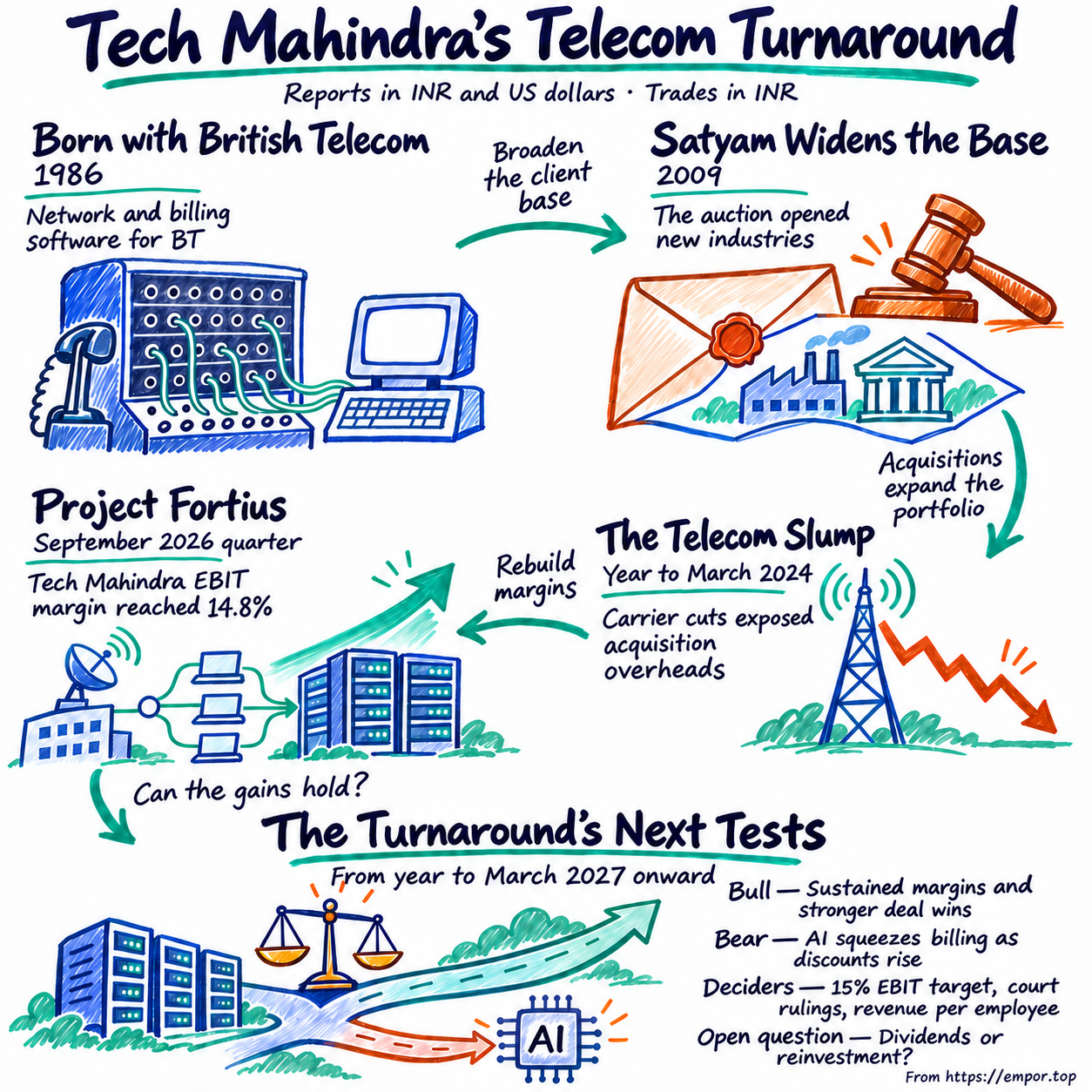
In late April 2024, the newest chief executive in Indian IT faced a room of analysts who had spent a year watching his company fall apart, and gave them a deadline. Mohit Joshi had been running Tech Mahindra for barely four months. He took over a business that had just reported its worst year in a decade: revenue had shrunk, profit had roughly halved, and the operating margin in some quarters had fallen to levels that would embarrass a mid-sized contractor, let alone India's fifth-largest software exporter. Joshi did not ask for patience. He published a three-year plan with a finish line: by the fiscal year ending March 2027, Tech Mahindra would grow faster than its peers and earn a 15% operating (EBIT) margin.12 Inside the company the cost program behind it carried a Latin name, Project Fortius, "stronger." Outside, the question was simpler. Could a company that had spent forty years as the telecom industry's back office really become something else?
The market answered first. The shares jumped by about 13% on the day after the roadmap was presented, even as one broker warned that hitting the targets would involve "significant near-term pain."3 That gap between the price and the pain is the story of Tech Mahindra today, and it has only widened since.
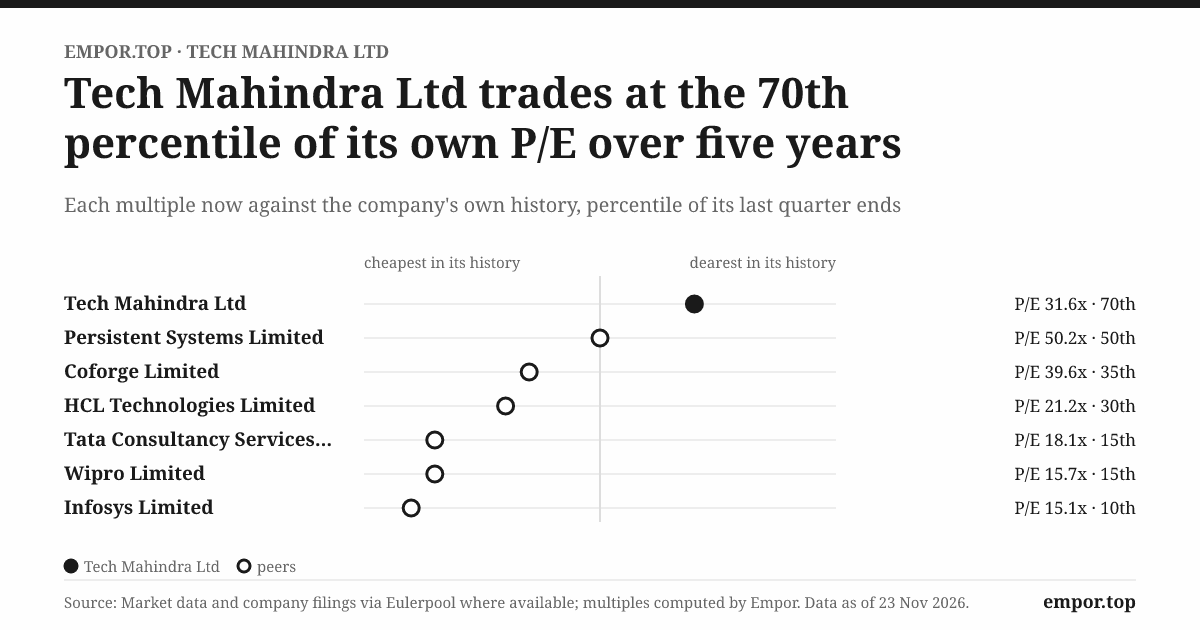
Here is where the company stands as of late November 2026. Tech Mahindra books about $6.4 billion of annual revenue, roughly ₹56,800 crore, and employs about 147,000 people.1 The stock market values it at about $17.5 billion, and its enterprise value, which nets off its cash pile, is about $17.0 billion.4 On the last four quarters of earnings the stock trades at about 31.6 times profit, above its own five-year median of about 28.6 times.4 Read that multiple carefully. It is not the price of a fast grower. Over the past decade, net profit has compounded at only about 4% a year in rupees.1 It is the price of a company the market believes is about to earn far more on the same revenue, because its margins are recovering from a trough.
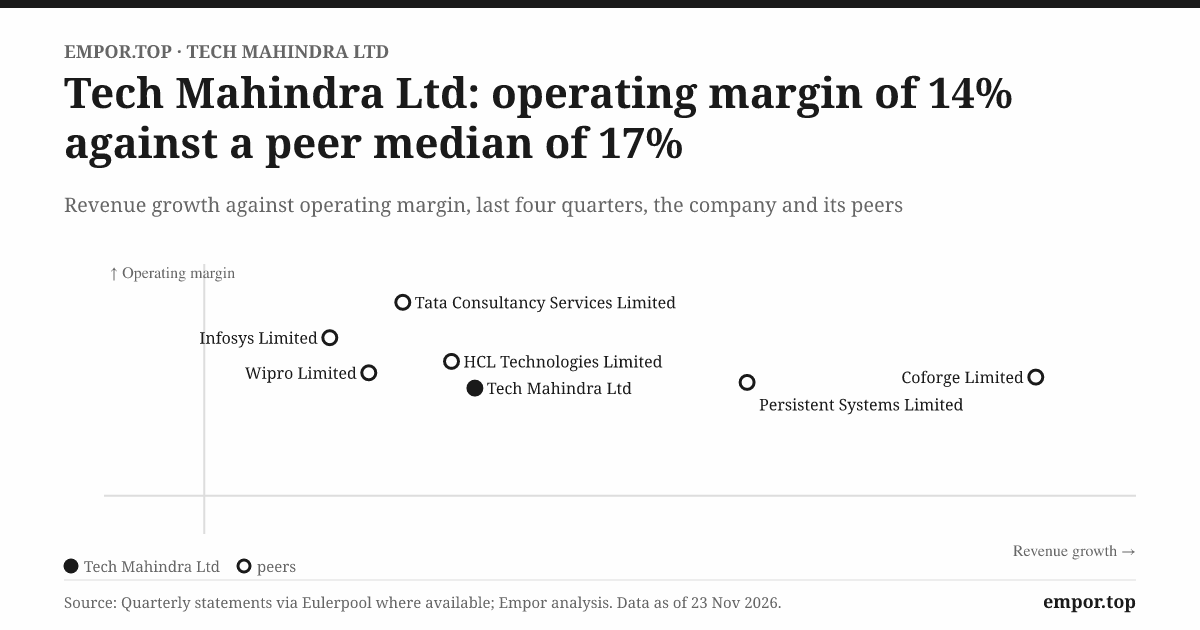
And they are recovering. In the quarter ended June 2024, three months after Joshi's roadmap, Tech Mahindra's operating margin was about 8.5%. By the quarter ended June 2026 it was 14.4%, and in the quarter ended September 2026 it reached 14.8%, within a fraction of the promised 15%.56 Net profit for that September quarter rose by about a third from a year earlier.6 On the face of it, Joshi has done almost exactly what he said he would do, on almost exactly the schedule he said he would do it.
So why is this still an open question? Because the same filings that record the recovery also record its price. In the year to March 2026, the discounts Tech Mahindra granted clients roughly doubled, to about ₹2,437 crore, and the penalties it paid for missing service-level commitments rose about tenfold.1 The median employee's pay fell, while the chief executive's package came to more than a thousand times that median.1 The company still earns a third of its revenue from telecom operators, the industry that broke it in 2023.1 It spends almost nothing on formal research and development, and it pays most of its profit out as dividends, a large slice of which flows to its parent, Mahindra & Mahindra.1 And it still carries a legal tail from the fraud it bought seventeen years ago: ₹1,230 crore of claims from companies linked to Satyam's disgraced founder sit in a suspense account outside the balance sheet, alongside roughly ₹2,500 crore of contested tax and provident-fund demands that are now before India's highest courts.1
Four questions follow, and they organise everything that comes next. The first is whether Project Fortius has lifted the business permanently into the upper tier of Indian IT, or whether the recovery is the mechanical bounce of a company that wrote everything off in 2024 and then squeezed its workforce. The second is whether artificial intelligence, which lets clients do with software what they used to pay Tech Mahindra's engineers to do by the hour, will shrink its revenue faster than its own AI offerings can grow. The third is how much of the Satyam-era legal exposure could actually turn into cash leaving the company. The fourth is the most uncomfortable: whether Tech Mahindra is run as a technology company that reinvests to win the next decade, or as a highly efficient machine for sending cash up to its parent.
To answer them, the story has to begin long before artificial intelligence, in a deal designed to serve a single customer: the British telephone monopoly. Tech Mahindra's strengths and its weaknesses were both born there, as was the habit that defines it: getting thrown into somebody else's crisis and coming out the other side with the cash.
 Subscribe on LinkedIn
II. The British Telecom Womb (1986–2006)
The Mahindra Group that signed the deal in 1986 was a very different animal from a software company. It had been founded in 1945 as a steel-trading business and had grown into the maker of the rugged utility vehicles and tractors that farmers and small-town India relied on.7 Its culture was patient, industrial and national: build things India needed, hold them for decades, and use the cash to build the next thing. Anand Mahindra, the grandson of a founder, had come home from Harvard Business School and was rising through the group in the 1980s; he understood that the next surplus would not come from metal alone.7
On the other side of the table sat British Telecommunications, which had been privatised only two years earlier and was wrestling with a vast, ageing network and the software needed to run it. Telephone networks are run by two kinds of software that most people never think about. One kind, known in the trade as operations support systems, keeps the network itself working: it tracks which switch connects to which line, schedules the engineer to fix a fault and plans capacity. The other kind, business support systems, turns calls into bills: it rates, invoices and collects. Both are enormous, fiddly and mission-critical, and BT needed armies of programmers to maintain them. India had programmers who were cheap, numerous and fluent in English.
The joint venture they formed, Mahindra British Telecom, was a straightforward bargain. Mahindra took 60%, BT 40%, and the new company would write and maintain software for BT from India.8 In effect, it began life as a captive: a dedicated workshop for one very large client. That model had virtues that are easy to underestimate. BT's systems were among the most complex in the world, so the engineers who learned them acquired an expertise that could not be picked up from a textbook. Every project made the next one cheaper. Every year of maintenance made the joint venture harder for BT to replace.
The model also had a flaw that is just as easy to see in hindsight. A workshop built for one client learns to do what that client asks, at the price that client sets. It does not learn to hunt.
The people who would eventually change that arrived in the early 2000s. The most important was Vineet Nayyar, a former officer of the Indian Administrative Service who had worked at the World Bank and been the founding chairman and managing director of the state gas company GAIL, before running technology businesses in the private sector.9 Nayyar was an unusual figure in Indian IT: a bureaucrat by training who behaved like a dealmaker, comfortable in government corridors and boardrooms alike. With him came an operating team that included CP Gurnani, a hard-driving salesman with a taste for the dramatic gesture, who would go on to run the company for more than a decade.9 Their job was to professionalise a captive and turn it into a real business.
BT, meanwhile, doubled down. In 2000 it raised its stake to about 43% and committed roughly £105 million of work over several years.8 For the joint venture that commitment was a gift, guaranteed revenue at a time when the dot-com bust was hammering its peers. It was also a trap. While Infosys, Tata Consultancy Services and Wipro spent the late 1990s and early 2000s building banking, insurance and retail practices across America, the British joint venture drew more than 90% of its revenue from communications companies, and a very large share from BT itself.8 The others were becoming department stores. Mahindra British Telecom was becoming the best specialist shop on a single street.
In 2006 the company changed its name to Tech Mahindra and went public, listing on the Indian exchanges in August with shares of ₹10 face value.810 (The shares were later split; today each has a face value of ₹5.1) The offering gave the company a public currency and campus money, and it quietly opened a door that both sides wanted opened: BT could sell down over time, and Tech Mahindra could start to court other telecom operators without its biggest shareholder looking over its shoulder.
The listing prospectus told investors plainly what they were buying: an exceptional telecom engineering shop that depended heavily on one customer and one industry.8 For two decades that concentration had been the source of the company's expertise. It was about to become the reason the company would bet everything on a stranger.
III. Buying the Crime Scene: The Satyam Auction Drama (2008–2013)
On the morning of January 7, 2009, B. Ramalinga Raju, the founder and chairman of Satyam Computer Services, sent a letter to his board and the stock exchanges that detonated India's technology industry. Satyam was the country's fourth-largest IT company, a sponsor of the football World Cup and a supplier to a long list of Fortune 500 companies. Raju confessed that for years he had been inventing its profits. Cash and bank balances that the company reported did not exist; the hole in the balance sheet ran to about ₹7,136 crore, roughly a billion dollars.11 He compared himself to a man riding a tiger who did not know how to get off without being eaten.
Within days Satyam's shares had collapsed, its clients were reviewing their contracts and the government had done something extraordinary: it dissolved the board and replaced it with its own nominees, among them the banker Deepak Parekh and the former head of the software industry body, Kiran Karnik.11 Their task was to stop the company from bleeding to death and then sell it, quickly, to someone who could keep its 50,000-odd employees and its clients. Every week of delay meant more defections.
The new board ran an auction in public view. Three serious bidders reached the final round. Larsen & Toubro, the engineering conglomerate, already owned a stake and was considered by many the natural buyer. The American distressed investor Wilbur Ross headed a consortium. And then there was Tech Mahindra, a company considerably smaller than Satyam itself.12
On April 13, 2009, the sealed financial bids were opened. Tech Mahindra's vehicle, a subsidiary called Venturbay Consultants, offered ₹58 a share. Larsen & Toubro offered ₹45.90. The Wilbur Ross group offered ₹20.12 The winning bid was less than a tenth of where Satyam's shares had traded before the confession, and it bought Venturbay a fresh allotment of about 31% of the company, followed by an open offer to other shareholders.12 The total cost of reaching control was estimated at around ₹2,900 crore.12
Why did the smaller company outbid an industrial giant by more than a quarter? The answer goes straight back to the BT womb. Satyam was strong exactly where Tech Mahindra was weak: in manufacturing, banking, healthcare and enterprise software for big American and European companies. Building that client list from scratch would have taken a decade. Buying it in a fire sale took one afternoon. Nayyar and Anand Mahindra were wagering that the clients would stay if someone credible arrived quickly enough to promise them that the engineers and the projects would not change.912 It was, in plain language, a bet on switching costs: the idea that a big company running its systems on Satyam's people would find it more painful to leave than to stay with a new owner.
The integration that followed was the part outsiders underestimated. Gurnani moved to Hyderabad to run what became Mahindra Satyam, and Nayyar became its chairman.9 The playbook was unglamorous: visit the big clients in person, offer guarantees from the new parent, pay retention money to keep key staff and hunt down the cost waste that a fraudulent management had left behind. The bet worked. Satyam's client relationships survived largely intact, and the merged business was eventually formally folded into Tech Mahindra by a court-approved scheme in June 2013, with an accounting effective date reaching back to April 2011.131
The merger transformed the company's shape. The combined business crossed about $2.7 billion of annual revenue, and telecom, which had been more than 90% of the old business, fell to under half of the new one.13 British Telecom, whose stake had been diluted and sold down through these years, faded from the share register, and Tech Mahindra became a Mahindra company with no other dominant shareholder.13
That is the version of the Satyam story told at business schools, and it is broadly true. The filings tell a longer one. To keep the acquirer clear of the proceeds of a crime, the merger was structured with an unusual legal carve-out. Thirty-seven companies linked to the Raju family claimed that they had advanced that money to Satyam and wanted it back with 18% annual interest. The Enforcement Directorate, India's financial-crimes investigator, ordered Tech Mahindra not to repay them.1 With the High Court's blessing, the money sits in what the company calls an "amounts pending investigation suspense account," presented outside the normal balance sheet in a way that the standard accounting rules would not otherwise permit.1 Seventeen years after the auction, that account is still open. So is a racketeering lawsuit brought in a Michigan federal court by Venture Global Engineering, a former Satyam partner.1
Smaller scars remain too. Pieces of land Tech Mahindra inherited from Satyam, worth about ₹69 crore on the books and including a parcel of about ₹47 crore in the MIHAN special economic zone in Nagpur, have still not been transferred into Tech Mahindra's name, tangled in disputes over transfer fees and the split of Andhra Pradesh into two states. The company's auditor flagged them again in the latest annual report.1 The same auditor's report carried an uncomfortable echo of 2009, though on a far smaller scale: the auditor had filed a formal report with the central government about suspected fraudulent and unauthorised transactions of about ₹12.3 crore carried out by former employees at an overseas branch of the business-process unit.1 The sum is trivial for a company of this size, and the company has disclosed it rather than buried it. But it is a reminder that in a business of almost 150,000 people spread across dozens of countries, controls are a permanent job rather than a problem solved once.
So what did the Satyam bet really prove? It proved that in enterprise IT services, client relationships are stickier than almost anyone in early 2009 believed, sticky enough to survive a billion-dollar fraud if a credible buyer moves fast. It also proved that you can buy a company's clients far more easily than you can bury its past. The legal tail is small next to a $17 billion company, but it has never gone away, and in 2026 its relatives in the tax courts are larger than it is. The deeper consequence, though, was strategic. Satyam made Tech Mahindra big and broad enough to believe it could keep buying its way into new markets. For the next decade it did exactly that.
IV. The Post-Merger Hangover and the 5G Mirage (2014–2023)
In the autumn of 2023, Tech Mahindra's quarterly results stopped looking like a wobble and started looking like a collapse. Net profit in the quarter ended September 2023 was down more than 60% from a year earlier, and the quarter after that was almost as bad.5 Revenue was falling. Telecom clients that had signed big transformation programmes were cancelling, delaying or demanding price cuts. Within months the long-serving chief executive was gone, and the company was explaining to investors why a decade of expansion had left it so exposed. To understand how it got there, rewind to the confident years right after Satyam.
The post-merger strategy followed the logic of the Satyam deal: keep buying. In November 2014 it agreed to acquire Lightbridge Communications, an American firm that designed and built wireless networks for carriers, at an enterprise value of about $240 million, one of its largest overseas deals to that point.14 Around the same time it pushed into adjacent and sometimes surprising territory: Pininfarina, the Italian car-design house famous for shaping Ferraris; Target Group, a British financial-services software and outsourcing business; Comviva, a mobile-payments and telecom-software maker; and later Born Group, a digital-marketing and customer-experience agency.1 In April 2021, it agreed to buy DigitalOnUs, a San Jose cloud-engineering firm with about $31 million of revenue, for up to $120 million including retention bonuses and earn-outs, a price of roughly four times sales.15
Each deal had a defensible rationale on its own. Lightbridge brought the radio-network engineers a 5G boom would need. DigitalOnUs brought cloud skills and near-shore delivery in Mexico and Canada.15 Born brought creative talent that traditional IT shops lacked. Taken together, though, they described a company assembling a portfolio rather than building a machine. Tata Consultancy Services, the industry's benchmark, had grown largely by hiring and training its own people into new skills; Tech Mahindra paid full market prices for small firms with their own cultures, back offices and sales teams, and then had to stitch them together. Some of the stitching held. Some created duplicate overheads and a heavy reliance on outside subcontractors that would later become one of the first targets of Project Fortius.1
For a while, the growth disguised the cost. Between the year to March 2015 and the year to March 2023, revenue rose from about $3.7 billion to about $6.6 billion.1 The final two years of that run were spectacular, with rupee revenue growing by roughly 18% and 19% as pandemic-era digital spending exploded and the industry could not hire engineers fast enough.1 But look closer at profit, and the story is already cracking. Net profit peaked at about $745 million in the year to March 2022 and fell in the year to March 2023, even as revenue jumped.1 The net margin slid from about 12.5% to about 9%.1 Growth was being bought with costlier people, more subcontractors and more fixed-price promises.
The bigger bet sat underneath. Tech Mahindra's management argued for years that the rollout of fifth-generation mobile networks would trigger a supercycle for telecom software: new network cores, new billing systems, private 5G networks for factories and ports, and edge computing wherever data needed to be processed close to the user. If that happened, the company that knew telecom's plumbing best would be the obvious winner. It was a reasonable thesis on paper. It was also a bet that the industry's oldest weakness, its dependence on one sector's capital spending, would turn into a strength at precisely the right moment.
The supercycle did not arrive on schedule. Operators had spent heavily on spectrum auctions and network equipment, and the consumer revenue from 5G stayed stubbornly flat. Then, through 2022 and 2023, interest rates rose sharply around the world, making their debt more expensive just as they needed to show investors some return. The software budgets that pay for consultants and developers are the easiest thing for a telecom company to cut, because cutting them does not turn any lights off. And communications remained a major exposure for Tech Mahindra.1
The result showed up in the year to March 2024. Revenue fell 2.4% in rupees, to about $6.3 billion. Net profit fell 51% to about $285 million, roughly ₹2,358 crore, and the net margin dropped to about 4.5%, a third of what it had been two years earlier.1 The causes were the predictable ones for a services firm caught at the wrong end of a cycle: projects ending without replacement, write-downs of work that had been done but could no longer be billed, client concessions and severance costs.1 Even after the worst had been absorbed, the operating margin was still recovering.5
The quarterly pattern made the pain vivid. In both the September and December 2023 quarters, Tech Mahindra kept less than four rupees of net profit from every hundred of revenue, a level more typical of a struggling staffing agency than of a software exporter with a famous parent.5 The workforce, which had been about 152,400 people in the year to March 2023, shrank to about 145,500 a year later as hiring froze and projects wound down.1 Yet the board kept paying the dividend at the old rate, distributing about 166% of the year's profit, more than the company actually earned.1 That decision, more than any slide in an investor presentation, showed where the board's priorities lay: the cash return to shareholders would be protected even when the business could not cover it.
The consensus version of this period blames telecom. That is fair, but incomplete. The telecom slump was the trigger; the damage was amplified by the way the company had grown. A business stitched together from many acquisitions, leaning on subcontractors and carrying more fixed-price risk than its peers, has less room to cut when revenue stalls. Rivals with deeper benches of their own employees and more diversified client books also felt the slowdown, but Tech Mahindra's earnings fell much further. The verdict on the acquisition decade is therefore narrower than either its defenders or critics would like. The deals broadened what the company could sell, and none of them was large enough to sink it. But they did not buy resilience, and the 5G thesis that justified much of the strategy turned out to be a forecast rather than a moat.
CP Gurnani retired in December 2023, closing an era that had begun in the Satyam war room.1 His successor was an outsider from the company's most disciplined rival, and he arrived with a very different idea of how an IT services company should make money.
V. Project Fortius: Restructuring Under Mohit Joshi (2024–2026)
Mohit Joshi took charge as managing director and chief executive on December 20, 2023.1 He was not a telecom man. He had spent most of his career in banking technology and rose to become a president of Infosys, where he ran its financial-services business, the company's largest, before leaving earlier in 2023.1 In the culture of Indian IT, the move was a statement. Infosys is known for process, for centralised control and for an almost religious attention to margins. Tech Mahindra, under Nayyar and Gurnani, had been known for deals, flair and a certain entrepreneurial looseness. The board was buying a different operating system.
Joshi brought people he trusted. Atul Soneja became chief operating officer, Richard Lobo chief people officer and Peeyush Dubey chief marketing officer, each recruited from the Infosys orbit.1 The first months were spent pulling apart the structure the acquisitions had left behind: regional fiefdoms with their own costs, delivery units that duplicated each other, and sales teams that chased deals without a common view of which ones were profitable.
The plan he presented in April 2024 was unusually explicit about where the money would come from. Management listed the levers one by one: reshaping the employee pyramid so that more work was done by junior staff, cutting subcontractors, moving more work offshore, raising utilisation, trimming overheads, pushing productivity and focusing on higher-margin business.3 None of these is glamorous, and none depends on winning new markets. They are the things an Infosys operator does to a business first, because they are within management's control.
The evidence says the levers were pulled hard. By the year to March 2026, about 86% of the people available to bill were billing, a very high utilisation rate for the industry, and about 78% of the work was delivered from offshore centres rather than at expensive client sites.1 The workforce, which had been about 152,400 in the year to March 2023, stood at about 146,800 by June 2026, even as revenue in rupees climbed to a record.1 Fewer people, busier people, working from cheaper places: that is most of the turnaround in one sentence.
The financial result followed. Operating profit in the year to March 2026 rose about 39% to about ₹7,152 crore, and the EBIT margin reached 12.6%, up nearly three percentage points.16 The margin kept climbing through 2026, to 13.8% in the March quarter, 14.4% in June and 14.8% in September.56 By the measure the credit agency CARE Ratings uses, which adds back depreciation, profitability rose from about 12.75% in the year to March 2025 to about 15.1% in the year to March 2026 and about 16.9% in the June 2026 quarter.17 In mid-2026 Joshi reminded analysts that in April 2024 the company had presented "a three-year turnaround plan with clear goalposts," and he was entitled to the reminder.18
Management credibility is worth weighing here, because Indian IT has a long history of turnaround promises that slipped. On the narrow test of saying what it would do and doing it, this management has passed so far: the margin target was set publicly, the levers were named in advance and the trajectory has moved steadily toward the target rather than lurching. Deal wins have improved too. New contracts signed in the June 2026 quarter came to about $1.08 billion, up about a third from a year earlier, and the number of clients paying more than $50 million a year rose from 25 to 29 during the year to March 2026.191
Where the growth came from matters as much as how much there was. In the year to March 2026, the fastest-growing parts of the business were retail, transport and logistics, up about 7%, and manufacturing, up about 6%, with banking and financial services up nearly 4%.1 Communications grew by under 3%.1 For the first time in years, the company's growth was being led by the industries Satyam had brought it rather than the one British Telecom had. That is the diversification the 2009 auction was supposed to deliver, finally showing up in the growth rates rather than merely in the revenue mix, and it is the most encouraging sign that the turnaround is about more than cost.
Now for the evidence that cuts the other way, and it sits in the same filings. Two lines in the revenue reconciliation are worth more attention than any margin chart. Before a services company records revenue, it starts from what its contracts entitle it to bill, then subtracts the discounts and penalties it has agreed to. In the year to March 2026, Tech Mahindra's discounts rose to about ₹2,437 crore from about ₹1,192 crore, and its penalties for missed service levels rose from under ₹20 crore to about ₹182 crore.1 Put plainly, for every ₹100 the company's contracts said it could bill, it gave back about ₹4 in discounts, almost double the share of a year earlier.1
There is an innocent reading of that. Big deals in IT services frequently come with upfront discounts and promises to pass on productivity gains, and the company was winning more big deals. There is also a less comfortable reading: clients know the company needs volume, and they are using that knowledge. The penalties are harder to explain away. A tenfold rise in payments for missing agreed service levels, in the same year that utilisation hit record highs and headcount fell, is at least consistent with a delivery machine running close to its limits.
The second tension is human. In the year to March 2026, Joshi's total pay came to about £5.4 million, roughly ₹60 crore, a figure that included about £2.9 million from exercising stock options granted at the shares' face value.1 That was about 1,085 times the pay of the company's median employee, and the median employee's pay fell by about 4.9% during the year, to roughly ₹5.9 lakh.1 Part of that fall reflects the pyramid strategy itself: hire more young graduates, and the middle of the distribution drifts down. But it means that the margin recovery was not only the result of smarter management. Some of it came, quite literally, out of the pay of the people doing the work.
The board's oversight of all this has been, by the usual measures, untroubled. Six of the ten directors are independent, led by the former bank chief executive Shikha Sharma as lead independent director, and every resolution at the last two annual meetings, including Joshi's appointment, passed with more than 98% of votes in favour.1 Chief financial officer Rohit Anand's pay rose by about a quarter including stock options.1 Shareholders, in other words, have endorsed the bargain: richly rewarded leaders in exchange for a margin recovery delivered on time. That is a reasonable bargain while the margin keeps rising. It will look different if the recovery stalls while pay at the top stays where it is.
The weight of evidence leaves the bull claim intact but smaller than the headline. Project Fortius is real, and it has been executed with discipline. But it has so far proved that Tech Mahindra can run its existing business far more efficiently, not that it has gained pricing power. The levers that delivered the first six points of margin, utilisation, offshoring and subcontractor cuts, have limits: utilisation cannot go much above where it is without burning people out, and offshore share cannot rise forever when some work must be done near the client. The next leg to 15% and beyond has to come from somewhere else, and the rising discounts suggest that clients are not yet volunteering it. The quarter-by-quarter EBIT margin and the share of gross billings given back in discounts are the two numbers that will tell investors which way this goes.
A business that has just freed up hundreds of crores of cost has a choice about what to do with the money. Tech Mahindra's choice has been consistent for a decade, and it says a great deal about whom the company is run for.
VI. The Cash Machine and the Conglomerate Tether
In spring 2026, Tech Mahindra's board did something it does every year: it decided how much of the year's profit to send to shareholders. The answer for the year to March 2026 was about 84% of net profit, ₹51 a share, and the company paid out about ₹4,026 crore in cash dividends during the year.1 About ₹1,118 crore of that went to the promoter group led by Mahindra & Mahindra.1 In the same annual report, the line for research and development spending, as defined under Indian company law, showed ₹24.7 crore, about $2.6 million, for a company with more than $6 billion of revenue.1 The research-and-development figure was about a forty-fifth of the amount paid to the promoter group. Together, they frame the question this section has to answer.
Start with what is admirable, because it is genuinely impressive. Over the twelve years from the year to March 2015 to the year to March 2026, Tech Mahindra reported about ₹46,935 crore of net profit and generated about ₹59,641 crore of cash from operations, roughly ₹127 of cash for every ₹100 of accounting profit.1 Many companies, especially fast-growing ones, convert well under 100%. Converting more than 100% over twelve years, through an acquisition spree, a fraud integration, a pandemic and a profit collapse, says the profits were real.
The reasons for the premium are worth understanding, because one of them is less flattering than it looks. The first is ordinary: depreciation and amortisation are expenses that reduce profit without using cash, and they added back nearly ₹1,900 crore in the year to March 2026 alone.1 The second is an accounting change. Since India adopted the rule known as Ind AS 116, rent on leased offices is treated like repayment of a loan, so roughly ₹460 crore a year of lease payments now shows up as a financing outflow rather than an operating one.1 That flatters operating cash flow compared with the years before the rule, without a rupee of difference to the company's actual bank balance. The third reason is the impressive one: Tech Mahindra got much better at collecting money. In the year to March 2015 it waited about 117 days, on average, to be paid; by the year to March 2026, about 86 days.1 Its whole cash conversion cycle, the time between paying for work and collecting for it, shrank from about 80 days to about 37.1 Its book of unpaid bills is in reasonable shape too: about two-thirds of current billed receivables were not yet due at March 2026, and the company carried about ₹1,517 crore of provisions against bad debts.1
So where did all that cash go? Very little went into physical assets. Over twelve years, capital spending totalled about ₹10,196 crore, about 17% of operating cash flow, which is what an asset-light services firm should spend.1 That left about ₹49,445 crore of free cash flow. Of that, about ₹29,093 crore, roughly 59%, went out as dividends.1 The payout has crept up over time: the board paid out about a fifth of profit in the middle of the last decade, more than four-fifths in recent years and, in the disastrous year to March 2024, more than the company earned.1 Management has formalised the habit, targeting the return of more than 85% of free cash flow to shareholders by the year to March 2027.20
The rest went into acquisitions and a growing cash pile. As of March 2026, the company held about ₹8,441 crore in cash, bank deposits and liquid mutual funds, overwhelmingly in short-term deposits and top-rated funds, against bank borrowings of about ₹70 crore.1 The larger debt figure that appears in standard databases is almost entirely the present value of office leases, about ₹2,117 crore.1 Strip that out, and Tech Mahindra has no meaningful financial debt and a net cash position of more than ₹8,300 crore. CARE Ratings reaffirmed its top AAA rating in October 2026, naming the company's liquidity and the backing of the Mahindra Group among its strengths.17
The treasury is conservative, but the currency book is not quiet. Because about 93% of revenue is earned abroad while most costs are paid in rupees, every 1% move in foreign currencies against the rupee shifts pre-tax profit by about ₹74 crore.1 The company hedges up to two years ahead, and as of March 2026 it held about $754 million of dollar-rupee forward contracts that were underwater by about ₹545 crore, because the rupee had weakened faster than the hedges assumed.1 That is why "other income," which had contributed about ₹855 crore in the year to March 2025, shrank to about ₹32 crore in the year to March 2026: hedging and exchange losses of about ₹480 crore swallowed the interest and investment gains, and the previous year's property-sale profits did not recur.1 Hedging smooths cash flows; it does not make currency risk disappear, it only moves it around the income statement.
Now the uncomfortable part. A 0.04% research-and-development ratio does not mean the company does no innovation. Tech Mahindra runs eight "Makers Labs" that build prototypes with clients, and it does most of its development inside client projects and with technology partners rather than in a central lab.1 That is normal for Indian IT services, whose product is skilled labour, not software licences. But it does mean that almost none of the cash generated is being turned into intellectual property the company owns. When a platform shift arrives, as artificial intelligence is arriving now, a business that owns little code has fewer ways to capture the value that shift creates.
The ownership structure explains why the payout policy suits the controlling shareholder so well. Mahindra & Mahindra owns about 25.3% of Tech Mahindra directly. A further 9.6% is held by the TML Benefit Trust, an employee-benefit trust that is classified with the promoter group, so the promoters together control about 35%.1 The largest single outside holder is the state-owned Life Insurance Corporation, at about 11.4%; Indian mutual funds collectively hold about 19% and foreign investors about 18.6%.1 Over the past three years, domestic institutions have steadily bought what foreign investors sold, and the register now counts about 765,000 shareholders, most of them small savers holding a sliver of the equity.1 That shift matters for the payout debate: Indian insurers and pension-minded funds tend to value a dependable dividend, so the shareholders who might push hardest for heavier reinvestment are a shrinking share of the register. For M&M, which is building electric vehicles and expanding its farm business, a reliable stream of dividends from a cash-rich subsidiary is valuable capital. The rating agency put it bluntly, listing the "substantial dividend cash flows" to the parent as part of Tech Mahindra's strategic importance to the group.17
A skeptical investor would point to a handful of smaller transactions as signs of how the group treats the subsidiary. In June 2025 Tech Mahindra bought Mahindra Racing UK from the promoter group for about £1.2 million and sold it back five months later, booking a net loss of about ₹5.9 crore.1 In the year to March 2025 it sold property and investment property to group entities, including Mahindra University, for about ₹535 crore; the money had been fully collected by March 2026, and in December 2025 its stake in the university's parent was diluted to 0.6%, removing it as a related party.1 It is worth noting that the year to March 2025 also included a one-time pre-tax gain of about ₹454 crore on land and property sales, which flattered that year's profit rebound.1 None of these sums is large, and all were certified as conducted at arm's length. Ordinary business with the group is small, too: revenue from the promoter, its subsidiaries and associates was about ₹432 crore, under 1% of sales, and the brand fee paid to M&M is nominal.1 The case against the conglomerate is not that it extracts value through side deals. It is that it extracts value through the front door, legally and transparently, in the form of dividends.
The verdict is therefore not "cash cow" in the pejorative sense, nor "technology builder." Tech Mahindra is an exceptional cash generator whose capital allocation favours distributing cash over owning technology. That policy rewards the shareholders who hold it today. Whether it serves the company in a decade depends entirely on whether a services business can defend its economics without owning much of anything, which is the question of the moat.
VII. Moats, Powers, and the Industry Structure
Picture the moment where a moat is tested in this industry. It is not a product launch or an ad campaign. It is a procurement review in a glass-walled meeting room in London or New Jersey, where a chief information officer and a purchasing team sit with three or four bids for a multi-year contract to run a large chunk of their company's technology. Every bidder now arrives with a branded artificial-intelligence platform. Tech Mahindra's is called Orion; Infosys and Tata Consultancy Services bring their own.1 The slides look similar. The client's questions do not: which firm will take responsibility if the system fails, how much cheaper will it be next year, and how many fewer people will the work need once the AI tools are in place? The answers to those questions, not the logos on the slides, decide who has power in this market.
Start with where Tech Mahindra sits. It is the fifth of India's big IT exporters, behind TCS, Infosys, HCLTech and Wipro, and well below the first two in size. About 84% of its revenue comes from IT services and about 16% from business process services, the outsourced call centres, back offices and transaction processing that are especially exposed to automation.1 Communications still provides about a third of revenue, followed by manufacturing at about 18% and banking and financial services at about 16%.1 Roughly half of revenue comes from the Americas and a quarter from Europe; only about 6.5% comes from India itself.1 No single client accounts for more than a tenth of revenue, which limits the damage any one customer can do, but also tells you the company has no dominant relationship it can count on.1
The shape of the client book is more revealing than its size. Tech Mahindra serves more than 1,100 clients, but the economics are concentrated in the top few hundred: about 512 pay it at least $1 million a year, 112 at least $10 million, 66 at least $20 million and 29 at least $50 million.1 The top two tiers grew during the year to March 2026, which is the clearest operational sign that Joshi's large-deal focus is working: these are the relationships where a vendor becomes embedded across many systems, and where switching costs are greatest.1 It is also where buyers are most sophisticated. A client paying $50 million a year employs people whose full-time job is to make that number smaller, and the doubled discounts suggest they are good at it.
The most useful way to test the moat is to go through the sources of durable advantage one by one and ask what the evidence supports. The economist Hamilton Helmer identified seven of them, and Tech Mahindra's record lets each be examined.
The strongest is switching costs, and it lives in the telecom heartland. When a company's people have maintained an operator's billing and network-management systems for years, they carry knowledge that is not written down anywhere: why a particular rule exists, which old system feeds which report, what breaks if you change it. Replacing them is expensive and dangerous. Satyam proved the point in reverse; even a billion-dollar fraud did not drive most of its clients away.12 But this advantage is narrower than it sounds. Switching costs protect the existing work; they do not guarantee new work or price increases. Operators cut their software budgets in 2023 without switching vendors, simply by spending less, and the company's communications revenue in the year to March 2026 grew only about 2.6%, slower than any other major vertical except hi-tech.1 The moat kept clients in place. It did not stop them from shrinking the bill.
Scale economies are weak. In IT services, scale lets a firm spread the costs of training, sales, research and management across more revenue, and it lets the largest firms take on the biggest contracts. TCS and Infosys are several times Tech Mahindra's size, which is precisely why it has to run its people harder, at utilisation rates of about 86%, to achieve margins they reach more comfortably.1 Network effects do not apply; a bank does not become a better customer because a carmaker also uses Tech Mahindra. Counter-positioning, the power of a newcomer whose model an incumbent cannot copy without hurting itself, works against the company rather than for it. Tech Mahindra is the incumbent here, paid largely for people's time, and an AI tool that halves the people needed for a task halves that slice of revenue unless the contract is repriced.
Cornered resources, assets nobody else can get, are absent. Its engineers are hired from the same colleges as everyone else's and can leave for a competitor; attrition in IT services was about 12% in the year to March 2026, low by the industry's recent standards but still meaning roughly one in eight people walks out each year.1 Its intellectual property is minimal, as its research spending implies. Branding is moderate: the Mahindra name signals solid governance and a parent with deep pockets, which matters to a European telecom chief worried about a vendor failing mid-project, but it does not carry the weight of a global technology brand in an American boardroom. Process power, the hardest-to-copy form of advantage because it is embedded in how an organisation behaves, is the most interesting case. Tech Mahindra has a demonstrated ability to manage complex multi-vendor telecom integrations and, separately, to absorb a broken company and fix it. That is a real capability. It is also, so far, one that has rewarded the company episodically rather than in its everyday margins.
The industry structure explains why. Michael Porter's five forces are unkind to every mid-sized Indian IT company, and Tech Mahindra's filings show each of them at work. Buyer power is high and rising: large clients run competitive tenders, demand annual productivity give-backs and, as the doubled discounts show, extract concessions when vendors want volume.1 Supplier power, meaning the people, is moderate; India produces enough engineers to keep entry-level salaries down, but specialists in cloud and AI are scarce and expensive. The threat of substitutes is high and growing: the big cloud platforms, software-as-a-service products and AI coding assistants let clients do internally, or automatically, work that used to be outsourced. And rivalry is intense, especially in routine application maintenance, where contracts are increasingly consolidated among fewer vendors at lower prices.
Even CARE Ratings, which is in the business of assessing creditworthiness rather than growth, singled out the shift. Its October 2026 rating rationale named generative and "agentic" AI, software that can carry out multi-step tasks on its own, as altering the traditional labour-intensive delivery model and threatening the size of billings, and it listed technology disruption among the company's key constraints.17 An agency that rates the company AAA is not predicting disaster. It is saying that the old arithmetic, where more work meant more people and more people meant more revenue, can no longer be taken for granted.
Is there any evidence that the company is adapting rather than being disrupted? Some. The company says about 80% of the workforce has been trained in AI skills and that it is moving toward contracts priced on outcomes rather than hours.1 The number of very large client relationships is growing, and committed but not yet delivered contract work stood at about ₹88,547 crore at March 2026, of which about 57% is due to turn into revenue within twelve months.1 Revenue per employee, about ₹38.5 lakh a year, is the cleanest test: if AI makes each person more productive and the company keeps the gains, that number rises; if clients take the gains, it stalls.1
Weighed together, the evidence narrows the moat claim to a specific, smaller version. Tech Mahindra has meaningful switching costs inside its telecom franchise and a demonstrated process strength in difficult integrations. Across the rest of enterprise IT, it competes as a capable, efficient but undifferentiated supplier in an industry where buyers hold the power. That is not a fatal position; plenty of companies earn decent returns as good operators in tough industries. But it is the opposite of the kind of position that usually justifies a premium multiple, which is exactly where the bull and bear cases collide.
VIII. Bull vs. Bear Analysis
Imagine the investment committee of a large Mumbai fund house in the autumn of 2026. Its funds, like the rest of Indian mutual-fund money, collectively own about a fifth of Tech Mahindra, and the committee has watched the stock climb back toward its 52-week high of about ₹1,835.14 On one side of the table an analyst argues that the company is in the late innings of the most successful turnaround in the sector. On the other, a skeptic slides across a single number: over the past ten years, net profit has grown only about 4% a year, yet the stock now trades at more than 31 times earnings.14 Who is right depends on what you think those earnings are about to become.
The bull case starts with the margin. Every percentage point of operating margin on about ₹60,000 crore of annual revenue is worth roughly ₹600 crore of operating profit, so the gap between the 12.6% earned in the year to March 2026 and a sustained 15% is worth about a fifth more operating profit before any revenue growth at all.16 The most recent quarters, at 14.4% and 14.8%, suggest that most of that gap has already been closed.56 If management keeps going beyond 15%, toward where the best of its peers operate, the earnings base under the current price would look considerably smaller in hindsight.
The second bull argument is that the telecom cycle has to turn. Operators cannot run their networks on ageing software forever; new network architectures that replace dedicated hardware with software, including the open radio networks that let operators mix vendors, require exactly the integration skills Tech Mahindra has spent forty years building. If capital spending recovers, the company is the specialist best placed to catch it. Third, the deal momentum supports the idea that the new management's sales discipline is working: about $3.8 billion of new contract value in the year to March 2026 and more than a billion dollars in each of the two most recent quarters.1196 Fourth, the balance sheet means the downside is cushioned. With more than ₹8,000 crore of net cash, the company cannot easily be forced into a bad decision, and the dividend yield, about 2% at today's price, provides a floor of sorts.14
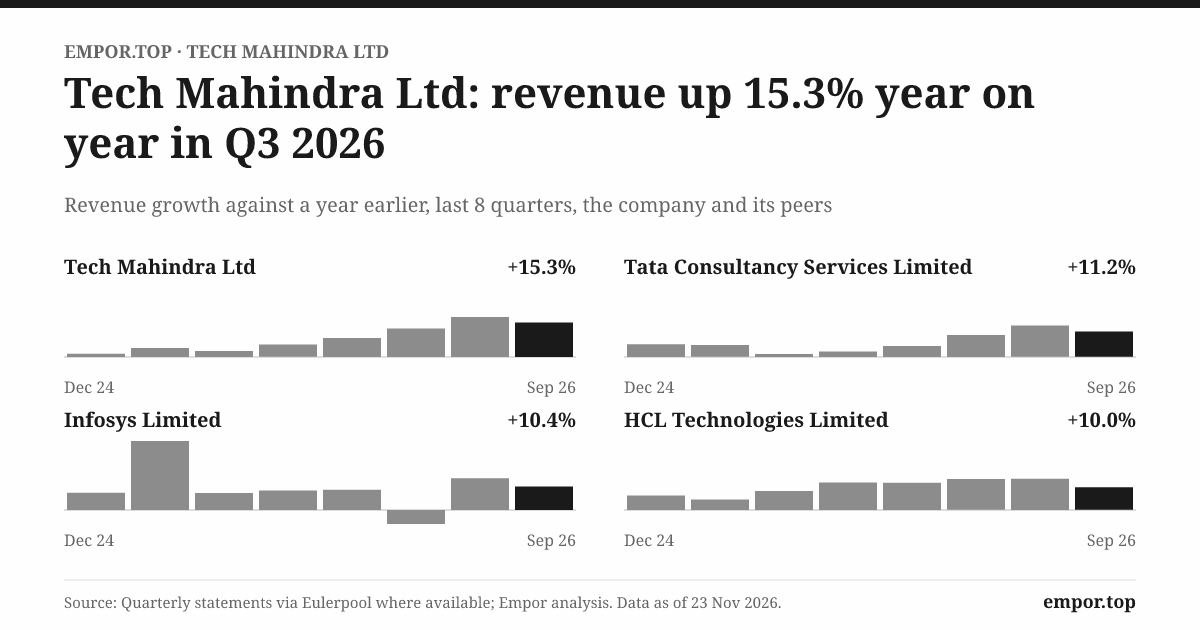
The bear case starts with the same numbers and reads them differently. The first point is valuation. A multiple above 31 times trailing earnings, against a five-year median of under 29, already prices in a successful turnaround.4 The earnings yield, about 3.2%, is below what an Indian investor can earn on a government bond, so the stock only works if profits grow substantially from here.4 And the growth is less impressive than the rupee figures suggest. Revenue in the September 2026 quarter rose about 15.6% in rupees, but in dollars it rose from about $1.6 billion to about $1.7 billion a quarter, because a sharply weaker rupee did much of the work.65 A weaker rupee helps reported profit too, but it is not something management controls, and the underwater hedges showed that it can cut both ways.
The second bear point is artificial intelligence's threat to labour-based billing. The bear does not need AI to destroy the business; it only needs AI to let clients demand larger annual price cuts, which would cap the margin recovery just as it nears the target. The third is the evidence of pricing pressure in the turnaround itself: discounts doubled and penalties up tenfold in the year margins improved most.1 A company with pricing power does not usually need to give back more each year to win business.
The fourth is the legal overhang, which is larger than most investors realise. In December 2025, India's Regional Provident Fund Commissioner ordered Tech Mahindra to pay about ₹1,287.5 crore, about ₹567 crore of provident-fund contributions and about ₹721 crore of penal interest, over employees sent to work in countries without social-security agreements with India and over certain allowances.1 The company challenged the order in the Bombay High Court. Separately, the tax authorities have demanded about ₹1,275 crore in service tax on the theory that work done by the company's overseas branches for overseas clients between 2008 and 2013 counted as an "import of services" into India; that case is before the Supreme Court.121 Income-tax disputes add about ₹1,535 crore more, mostly over transfer pricing and stock-option costs.1 None of these is booked as a liability, because the company believes it will win. Investors should treat that as a judgement, not a fact. Any single adverse ruling of the size of the provident-fund or service-tax claim would cost roughly as much as a full quarter of net profit, which in the September 2026 quarter was about $166 million, or roughly ₹1,500 crore.5 The company has ample cash to pay; the harm would be to earnings and to the narrative of a clean turnaround, not to solvency.
An activist reading the same file would push on three things. Why does a company with ample net cash invest so little in owned technology at the moment its industry is being rebuilt around software it does not own? Why did the board tolerate such a gulf in pay? And why, seventeen years after Satyam, are the legal and property loose ends still open? None of these suggests misconduct. Each suggests a board whose priorities are cash return and stability rather than reinvestment and speed.
Weighing it all, the market price looks like a bet that Project Fortius continues past its target and that AI turns out to be a tool Tech Mahindra sells rather than one that its clients use against it. The first half of that bet has strong evidence behind it. The second half is, so far, management's claim. Three numbers will decide which reading wins: the EBIT margin, now 14.8%; new deal wins, now running above a billion dollars a quarter; and the share of gross billings given back as discounts, which roughly doubled to about 4% last year.61 If margins hold above 15% while discounts stop rising, the bulls have the stronger case. If margins stall while discounts climb, the multiple has a long way to fall.
IX. The Tech Mahindra Playbook: Business & Investing Lessons
Lay the company's defining documents side by side on a boardroom table in Pune: the 1986 agreement with British Telecom, the sealed bid that won Satyam in 2009, the April 2024 plan with its three-year finish line. They look like the paperwork of three different companies. Read together, they teach four lessons that belong to Tech Mahindra and to no one else.
The first lesson is that in services, the customer list is the company, and it can be bought out of the wreckage. When Venturbay's ₹58 bid was opened in Hyderabad, it was a wager that Satyam's clients cared more about the engineers running their systems than about the criminal who had run the company.12 The wager paid because switching costs in enterprise IT are mostly human: the knowledge sits in people's heads, and moving it is risky. The lesson for acquirers is that a fire sale is cheap only if the buyer moves faster than the customers do. The lesson for investors is subtler: the same stickiness that saved Satyam explains why telecom clients in 2023 cut spending rather than switching vendors. Sticky contracts protect volume, never price. Or, put more sharply: a client who will not leave you can still pay you less.
The second lesson is that specialisation is a ladder until it becomes a cage. For twenty years, the telecom focus born in the BT joint venture gave Tech Mahindra expertise competitors could not match; for the decade after Satyam, management bet that the 5G build-out would turn that expertise into a supercycle. Instead, the single industry that made the company stalled, and with a third of revenue still tied to it, profits halved in a year.1 Deep expertise in one industry is an asset to be managed like any concentrated position: valuable, but only if the holder is honest about the downside.
The third lesson is that a turnaround built on cost has an expiry date. Joshi's team took the margin from the single digits to almost 15% with tools any disciplined operator would recognise: busier engineers, more work offshore, fewer contractors and a younger pyramid.13 Those tools work once. Utilisation above 86% and an offshore share near 78% leave little room to repeat the trick, and the same year that delivered the biggest improvement also saw discounts double and penalties soar.1 The wider lesson for anyone underwriting a restructuring is to separate the margin that management takes from its own cost base from the margin that customers are willing to pay. Only the second kind compounds. The first kind, sooner or later, gets handed back.
The fourth lesson is the one that matters most for the decade ahead. Converting ₹127 of cash for every ₹100 of profit over twelve years, and paying out most of the free cash flow, made Tech Mahindra one of the most generous dividend payers in Indian IT.1 It also left a company with ₹24.7 crore of formal research spending at the moment its industry is being redesigned by software it did not write.1 Asset-light is a virtue when the assets are people who can be retrained; it becomes a vulnerability when the value moves into code. Generosity to shareholders today can be a loan against the company's relevance tomorrow, and the interest on that loan comes due during platform shifts.
X. Epilogue: The Three Settling Tests
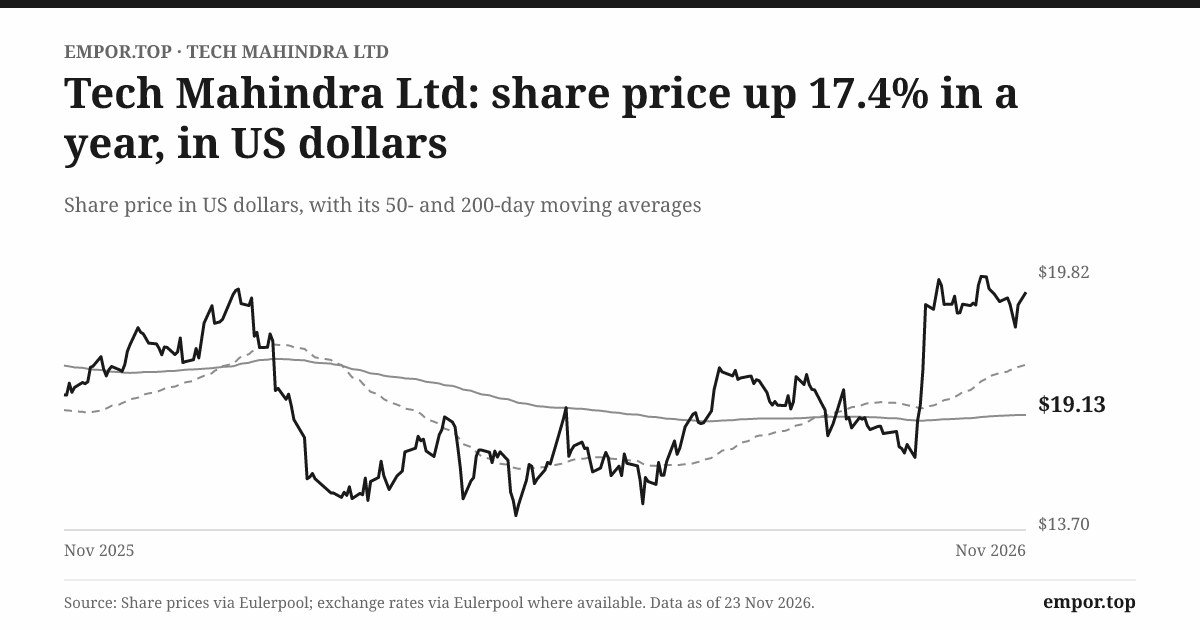
Tonight, late in November 2026, Tech Mahindra is closer to its promised destination than almost anyone expected when the plan was unveiled. The margin is 14.8%. The profit line grew by about a third from a year earlier. The share price sits within a few percent of its high.64 And yet the decisive moments are still ahead, and they come in three forms: a results day, a courtroom and a slow-moving test of what AI does to the work itself.
The first is the scorecard for the year ending March 2027, which the board will present in the spring of 2027. The test is straightforward: does the operating margin reach and hold 15% across the year, and does it do so without another round of falling median pay or another doubling of client discounts? If the answer is yes, Project Fortius will have done what it promised, and attention will shift to the next set of targets and whether they include growth that does not depend on a weakening rupee. If the margin stalls just short, the market will discover how much of today's price was paying for the final percentage point. Either way, management's next promise will be judged against an unusually clean record on the last one.
The second is legal, and its timing belongs to India's courts rather than to management. The Supreme Court will eventually rule on the roughly ₹1,275 crore service-tax demand, and the Bombay High Court will decide the company's challenge to the roughly ₹1,288 crore provident-fund order.121 A win in either case would remove an overhang that has hung over the shares for years in the case of service tax, and that arrived only in December 2025 in the case of provident fund. A loss would not threaten the company's solvency, given its cash, but it would cost the equivalent of a quarter's profit or more and would remind investors that the Satyam-era suspense account and its unresolved claims belong to the same family of open questions.1
The third test is the slowest and the most important. The company had a large backlog of committed work waiting to be delivered at March 2026.1 As that backlog converts, investors will be able to see whether AI is making each Tech Mahindra employee more valuable or each contract smaller. Revenue per employee is the cleanest gauge.1 If it rises while headcount stays flat and margins hold, the company is capturing the productivity gains. If headcount falls, revenue stalls and discounts rise, its clients are capturing them instead.
These three tests map onto the questions this story began with. The margin test settles whether the turnaround is structural. The AI test settles whether the business model survives the next decade. The courts settle the size of the Satyam-era tail. The fourth question, whether Tech Mahindra is run for reinvestment or for the dividend, will be answered by what the board does with the cash if all three go well. A company that has proved it can fix itself will have no excuse left for not building something new.
XI. Outro: The Mahindra Pragmatism
At Tech Mahindra's campus in Hinjewadi, on the edge of Pune, a new class of engineers is being trained in the tools that may one day do much of the work their predecessors were hired to do. Vineet Nayyar, the civil servant turned dealmaker who helped win Satyam, died in May 2024 at the age of 85, a few weeks after the turnaround plan was announced.9 He did not live to see how it would turn out. He would have recognised the method. The company he helped shape has never been the industry's visionary or its lowest-cost operator. It has been the one that walks into the room everyone else is fleeing.
Forty years after the BT handshake, the challenge has changed shape.1 Surviving chaos was the company's talent. The AI era asks for something it has rarely had to show: the willingness to spend heavily on owning the future instead of harvesting the present. Tech Mahindra remains what it has always been, the gritty, contrarian operator that buys what others fear, fixes what others broke and turns engineering sweat into shareholder cash. The open question is whether, this time, it can fix the thing that is breaking its own business before a client has to tell it.
References
-
Tech Mahindra Integrated Annual Report FY 2025-26 — Tech Mahindra Limited, 2026-04-22 ↩↩↩↩↩↩↩↩↩↩↩↩↩↩↩↩↩↩↩↩↩↩↩↩↩↩↩↩↩↩↩↩↩↩↩↩↩↩↩↩↩↩↩↩↩↩↩↩↩↩↩↩↩↩↩↩↩↩↩↩↩↩↩↩↩↩↩↩↩↩↩↩↩↩↩↩↩↩↩↩↩↩↩↩↩↩↩↩↩↩↩↩↩↩↩↩↩↩↩
-
Project Fortius and Mohit Joshi's Turnaround Blueprint — Business Standard, 2024-04-26 ↩
-
Tech Mahindra surges 13% on management commentary — Business Standard, 2024-04-26 ↩↩↩
-
Tech Mahindra Limited Company Page & Filings — National Stock Exchange of India (NSE) ↩↩↩↩↩↩↩↩
-
Investor Relations & Financial Results Archive — Tech Mahindra Limited ↩↩↩↩↩↩↩↩
-
Tech Mahindra's profit climbs 32.7%, deal wins surge — Staffing Industry Analysts, 2026-10 ↩↩↩↩↩↩↩↩
-
Mahindra & Mahindra Annual Report (Investments in Subsidiaries: Tech Mahindra) — Mahindra & Mahindra Limited ↩↩
-
Tech Mahindra Red Herring Prospectus (Initial Public Offering) — SEBI, 2006-07-24 ↩↩↩↩↩
-
Vineet Nayyar, former executive Vice Chairman of Tech Mahindra, dies; tributes pour in — Business Today, 2024-05-16 ↩↩↩↩↩
-
BSE India Corporate Filings & Disclosures: Tech Mahindra Ltd (532755) — Bombay Stock Exchange ↩
-
How Tech Mahindra Won the Satyam Auction — Livemint, 2009-04-14 ↩↩
-
Tech Mahindra snaps up Satyam — Business Standard, 2009-04-14 ↩↩↩↩↩↩↩
-
Tech Mahindra and Satyam: The Merger Saga Complete — The Economic Times, 2013-06-25 ↩↩↩
-
Tech Mahindra acquires US-based LCC for $240mn — Business Standard, 2014-11-20 ↩
-
Tech Mahindra acquires hybrid cloud and DevOps services provider DigitalOnUs for $120M — YourStory, 2021-04 ↩↩
-
Tech Mahindra FY26 EBIT rises to ₹7,152cr, up 39.2% YoY — Zawya, 2026-04 ↩↩
-
CARE Ratings Rationale: Tech Mahindra Limited — CARE Ratings Limited, 2026-10-06 ↩↩↩↩
-
Tech Mahindra Q1 FY27 Earnings Call Transcript — Tech Mahindra Limited, 2026-07 ↩
-
Tech Mahindra Q1 FY27 EBIT rises to ₹2,264 crores, up 53.3% YoY; New deal-wins at USD 1,078 Mn — Mahindra Group, 2026-07 ↩↩
-
Mahindra & Mahindra Limited Integrated Annual Report 2025-26 — Mahindra & Mahindra Limited, 2026 ↩
-
Supreme Court of India Case Status & Causelist (Service Tax Reverse Charge Matters) — Supreme Court of India ↩↩
 LinkedIn
 WhatsApp
 Reddit
 Hacker News
 Email
 Kindle
 RSS Feed
 Spotify
 Apple Podcasts
 Amazon Music
 Audible
 YouTube