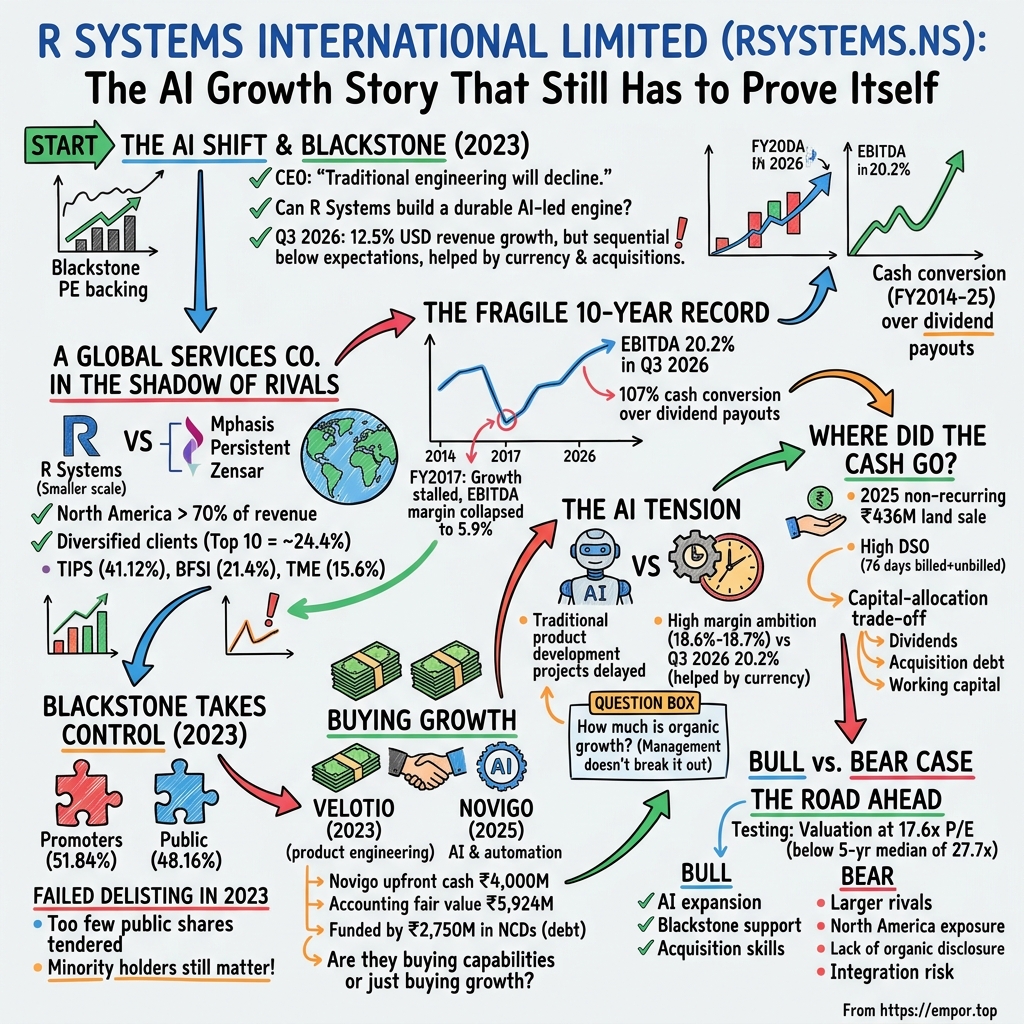
R Systems International Limited: The AI Growth Story That Still Has to Prove Itself
I. “Traditional engineering will eventually decline”
On November 4, 2026, Nitesh Bansal, chief executive of R Systems International, got on the line with analysts the day after his company reported its September-quarter results and said something few services chiefs say out loud. Traditional engineering services, the bread-and-butter work of writing, testing and maintaining software for product companies, will eventually decline.1 Bansal runs a business that has made most of its living from exactly that work for three decades, and he was not describing a distant threat to someone else. He was describing the ground under his own feet.
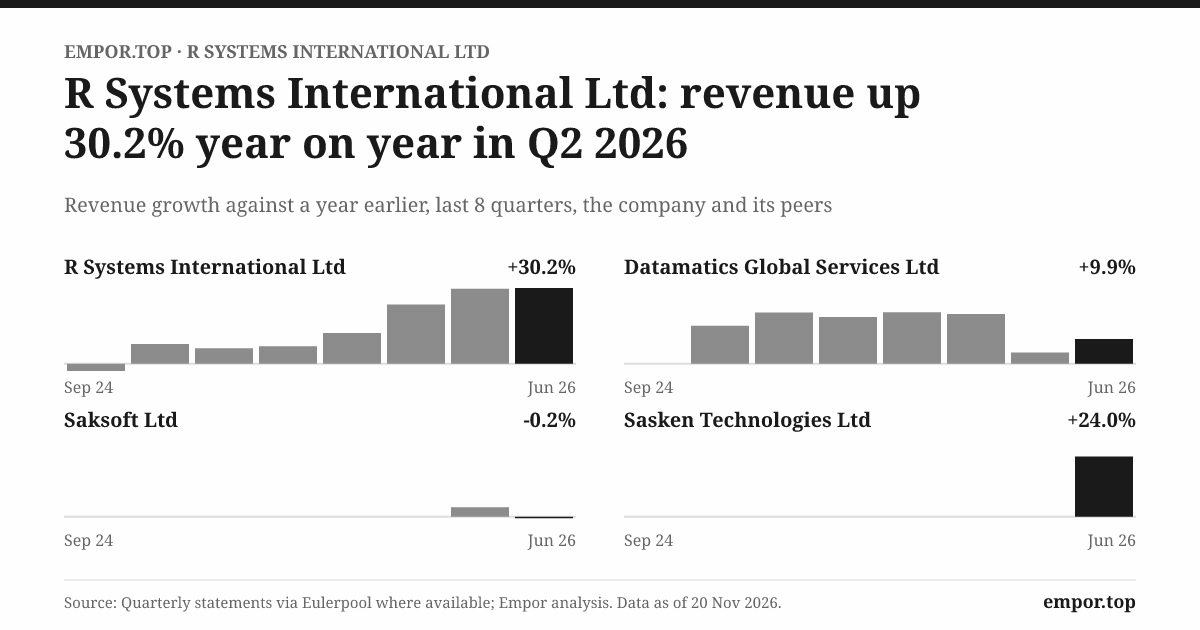
The numbers he had to defend that morning looked, at first glance, like a company already standing on new ground. Revenue for the quarter was up 12.5% from a year earlier in US dollars and 23.4% in rupees.2 Adjusted EBITDA margin, the measure management prefers, reached 20.2%, up from 16.9% a year before.23 For a mid-sized Indian IT firm in a year when many larger rivals were fighting for low single-digit growth, that is a headline worth printing in bold.
Then the analysts started asking questions, and the headline began to come apart into its pieces. How much of that growth came from the existing business, and how much from Novigo, the automation and AI engineering firm R Systems had bought the year before? Management's answer was that the organic and acquired businesses were "moving in lock step," and it declined to give a separate organic growth figure.1 How much of the margin came from better work, and how much from a weaker rupee that made every dollar of American revenue worth more at home? On management's own reckoning, currency added about ₹70 million to EBITDA in the quarter alone.1 And why had revenue grown so little from the June quarter to the September quarter, a stretch the analysts regarded as seasonally strong? Bansal acknowledged that sequential growth had come in below the company's own expectations, and that some traditional engineering projects had been delayed as clients redirected budgets.1
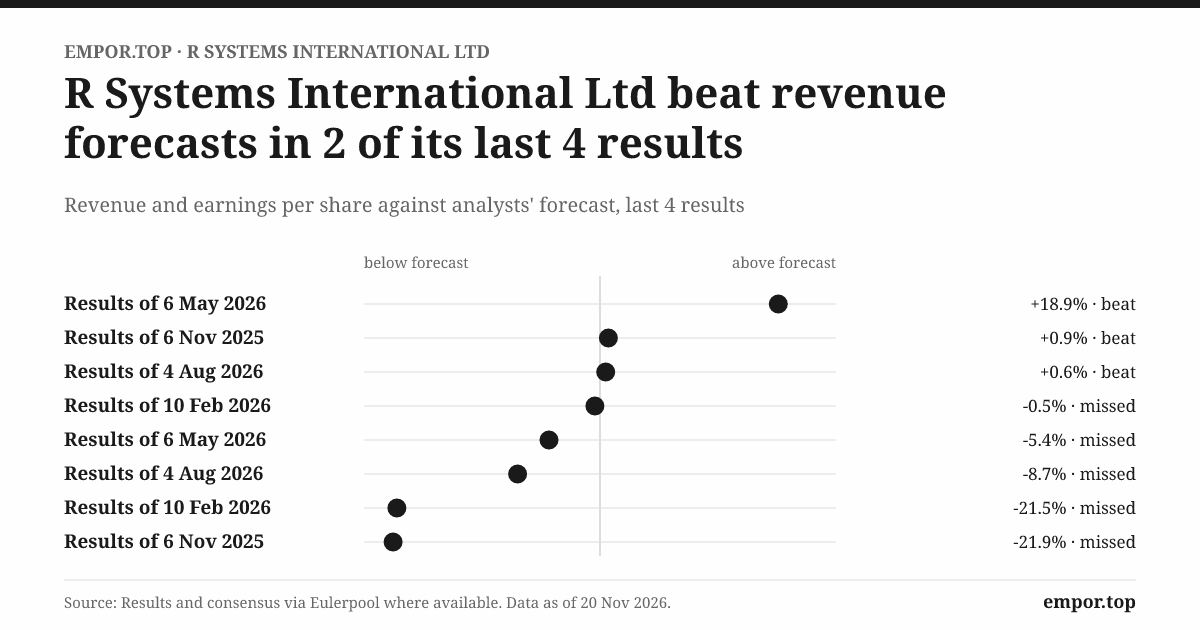
That is the story of R Systems in a single phone call. A listed Indian technology-services company with roughly $246 million of revenue over the past twelve months, controlled since 2023 by the private-equity giant Blackstone, is trying to reposition itself around artificial intelligence.45 Its reported numbers are improving. Its chief executive is candid that the old engine will cool. And the one figure that would tell an outsider whether the new engine is actually running, organic growth in constant currency, is the figure the company does not publish.
Four questions run through everything that follows. The first is simply where the growth comes from: the legacy client base, acquisitions, or the exchange rate. The second is whether AI can grow revenue for a company that sells engineers' time without shrinking the number of hours clients need to buy. The third is whether the acquisitions, Velotio in 2023 and Novigo in 2025, will earn back what they cost, including the debt taken on to pay for one of them. The fourth is whether Blackstone's control makes the listed company stronger, or simply makes it a smaller part of someone else's portfolio with a public float attached.
The temptation with a quarter like this is to read the margin and the rupee growth rate and declare the transition underway. The more careful reading is that the transition is consequential and real in management's mind, and that the current reported numbers do not yet establish how much of the improvement is organic, AI-led, acquisition-led or currency-driven. The rating agency CRISIL, looking at the same company in July 2026, described core growth excluding currency and acquisitions as low single digit in 2025 and in the first quarter of 2026.6 Hold that phrase next to the 23.4% rupee growth rate, and the size of the gap becomes clear.
So the episode follows that gap. To understand why it matters, it helps first to understand what kind of company R Systems actually is, and how small it looks standing next to the firms it competes with.
 Subscribe on LinkedIn
II. A global services company in the shadow of larger rivals
Picture the work itself. Somewhere in Noida or Pune or Mangaluru, a team of engineers is building the next release of a software product for an American company that sells tools to telecom carriers, or modernizing a claims platform for an insurer, or wiring a logistics firm's warehouse data into a new analytics layer. The client owns the product and the customer relationship. R Systems supplies the people, the methods and increasingly the automation that make the work go faster. A smaller team elsewhere handles business-process outsourcing, the back-office and customer-support work that sits alongside the engineering. In 2025, IT services made up about 89.7% of revenue and the BPO business the remaining 10.3%.4
The contracts come in three familiar shapes. In time-and-material work, the client pays for the hours and the people actually deployed, and revenue is recognized as the services are delivered. In fixed-price maintenance, the client pays a set fee to keep something running, recognized over time. In fixed-price development, R Systems commits to building a defined deliverable and recognizes revenue as the project progresses.4 What the company does not disclose is the share of revenue that recurs automatically, the typical length of a contract, or any minimum purchase commitments from clients.4 That gap matters because the investor is left to infer durability from the client list rather than from the contracts.
The client list is genuinely broad. As of September 2026, the largest single client contributed about 5.8% of revenue and the top ten together about 24.4%, slightly less concentrated than a year earlier.2 CRISIL counts more than 250 clients.6 Losing any one of them would hurt, but would not break the company. The concentration that does matter is geographic: North America supplied more than 70% of revenue in 2025.46 When American technology budgets tighten, R Systems feels it, and when the dollar strengthens against the rupee, R Systems' rupee results look better than its underlying activity.
By industry, the business tilts toward one cluster. In the September 2026 quarter, technology, internet, product and services clients, which the company groups as TIPS, provided about 41% of revenue. Banking, financial services and insurance supplied about 21%, telecom, media and entertainment about 16%, and healthcare and manufacturing-and-logistics roughly 11% each.23 That mix is a story in itself. The largest slice is product companies, the very clients whose traditional engineering spending Bansal says will eventually decline, and who were delaying projects in the quarter he was explaining.
It is worth pausing on what "product engineering" means, because it is the heart of the business and the part most exposed to AI. A bank buying IT services usually wants its own systems run, fixed and modernized. A software company buying product engineering wants something different: extra hands to build the very product it sells. Think of it as the difference between hiring a contractor to renovate your house and hiring one to help you build houses for sale. In the second case, the contractor's work becomes part of the client's revenue engine, which makes the relationship deeper, but it also means the contractor's fortunes rise and fall with the client's own product roadmap and funding. When software companies cut back, product-engineering vendors feel it first.
The other verticals behave differently. Banking and insurance clients tend to spend steadily on compliance, digital channels and modernization, and their budgets move with interest rates and regulation rather than venture funding. Healthcare clients spend on data, claims and patient platforms. Manufacturing and logistics clients spend on connecting physical operations to software. A portfolio weighted toward technology clients is, in effect, a bet on the health of the American software industry, with a smaller hedge spread across more defensive sectors. That is not a flaw so much as an exposure an investor should know they are buying.
Now set the company against its rivals. R Systems reported revenue of about ₹19.6 billion, or roughly ₹1,960 crore, for 2025.4 Zensar Technologies, often described as a mid-tier peer, reported about ₹5,280 crore for its fiscal year ended March 2025, close to three times larger.7 Persistent Systems reported more than $1.4 billion, roughly six times R Systems' size.8 Mphasis sits in the same upper bracket of Indian mid-tier players. None of these companies has an identical business mix, and the comparison is about scale rather than strategy. But scale matters in this industry in two concrete ways. Larger firms can afford bigger sales teams in North America, and they can absorb a lost project or a delayed ramp-up without it showing up in the quarterly growth rate.
R Systems describes its competitive field with unusual honesty. It competes, it says, with Indian and international IT-outsourcing firms, consultancies, software vendors and its clients' own internal technology teams, and its annual report describes intense competition and significant customer bargaining power.4 That last phrase is worth sitting with. In engineering services, a client can multi-source, can bring work in-house, and can renegotiate rates at renewal. The supplier's leverage comes from knowing the client's code and people better than anyone else, which is real but rarely decisive.
That is why the useful lenses for judging this business are not the ones used for a manufacturer. There is no inventory to count and no factory to fill. The things that matter are whether clients stay and expand, what price they pay per engineer, how many engineers are actually billing (utilization), how quickly new deals convert into revenue, and how much revenue each employee generates. R Systems discloses some of these in each quarter's materials, such as utilization, headcount and client concentration, but does not provide a long, consistent historical series for several of them.34 Headcount, for instance, was 5,172 at September 2026, against 4,716 a year earlier.2
The picture, then, is of a diversified but small player, dependent on one continent, competing in a crowded market against firms several times its size, without disclosed contractual protections that would prove switching costs. That does not mean it cannot win. It means any claim that it has a durable advantage has to be earned in the numbers. The company's own long record offers a stern test of how well those numbers have held up before.
III. The year growth stalled and margins broke
R Systems was founded in 1993 by Satinder Singh Rekhi, and from the start it set out to sell Indian engineering talent across borders, long before "global delivery" became a slide in every investor deck.910 The company listed on Indian exchanges in 2006, through a public issue that put it alongside a generation of mid-sized Indian technology exporters riding the outsourcing wave.9 For most of its history it was a founder-led business, steady rather than spectacular, with a habit of paying out a large share of its profits to shareholders.
The years from 2015 to 2017 show what that kind of company looks like when the wind turns. In 2015, the parent company's standalone accounts recorded significant gains from selling assets and subsidiaries, which flattered reported profit at the legal-entity level.11 Those gains are a reminder that standalone and consolidated accounts are different perimeters, and the consolidated operating story told something quieter. Revenue in rupee terms barely grew across those years.
Then came 2017. Revenue rose just 0.75% in rupees, essentially flat, and the company's EBITDA margin fell to 5.9% from 12.1% the year before.12 Net profit fell by more than half for the second year running.12 The scene is not a dramatic collapse with a single cause; it is a services firm discovering that when revenue stops growing, costs do not stop. Salaries rise every year in Indian IT. Sales investments are made ahead of deals that may not arrive. When billable work flattens, the margin is the shock absorber, and it absorbed a great deal.
What came afterward is the part bulls point to, and it is real. Growth returned toward the end of the decade, and then, through the pandemic-era digital boom, R Systems grew revenue by roughly 30% a year in both 2021 and 2022, as clients rushed to digitize everything from customer onboarding to supply chains.5 Over the ten years from 2015 to 2025, revenue compounded at about 12.5% a year in rupees.4 That is a respectable pace for a company that started the decade with one bad stretch behind it.
But net profit over the same decade compounded at only about 6.6% a year.4 Revenue grew nearly twice as fast as earnings. Part of that gap is the starting point, since 2015's profits were helped by those one-time gains. Part of it is that the margin recovery took years. Operating margin, which had collapsed in 2017, climbed back to about 11.9% in 2023 and 12.3% in 2025.45 That is a recovery, but to levels still well below the high teens and low twenties the company reported in the mid-2010s.
Some data screens show something spectacular in 2022: an operating margin of almost 32%. Treat that figure with suspicion. EBITDA that year was only about 14% of revenue, and true operating profit cannot exceed EBITDA, so the 32% reflects how one item was classified rather than a year of extraordinary client work.5 The real 2022 was a good year of growth, not a miracle of profitability. Anyone setting an operating benchmark for R Systems should start from the low teens, not from that outlier.
There is a steadier thread in the cash record. Over the twelve years from 2014 to 2025, R Systems generated about ₹1,268 crore of cash from operations against ₹1,181 crore of net profit, meaning the accounting profits did, over time, show up as cash.4 Year by year, though, conversion swung widely, from barely a third of EBITDA in some years to nearly all of it in others. A services firm's cash flow lives and dies on when clients pay, and that timing can move sharply from one year-end to the next.
The founder-era capital allocation had a recognizable personality. With little need for heavy capital spending and almost no debt, R Systems sent cash back to shareholders. Dividend payouts swung from nothing in lean years to more than the year's entire profit in others. In 2021, the company also bought back and cancelled about 1.33 million shares at ₹225 each, a modest repurchase that nonetheless signaled a management willing to shrink the share count rather than hoard cash.4 The habit was conservative and shareholder-friendly. It was also, arguably, the behavior of a company that did not see many large growth investments worth making, which is the opposite of the posture it adopted after 2023.
What should an investor take from the long record? Not that R Systems is fragile, exactly, and not that it is a proven compounder. It is a company that has shown twice in a decade that its revenue growth and its margins can diverge sharply: once in 2017, when flat revenue crushed margins, and again in the long stretch when strong revenue growth produced much slower profit growth. That history sets the standard for today's claims. When management says margins in the high teens are sustainable, the record says to wait for a full cycle of proof, ideally one in which currency is not helping. And when the company changed owners in 2023, the question was whether new control would change that pattern.
IV. Blackstone takes control; the public shareholders stay
In late 2022, Blackstone agreed to buy the founders' controlling stake in R Systems at ₹245 a share, a deal for roughly 52% of the company, and paired it with something more ambitious: an offer to buy out the public shareholders and delist the company from Indian exchanges entirely.13 Private-equity firms like to own their companies outright. A delisted R Systems would have been free of quarterly disclosure, minority shareholders and the share price as a daily scorecard.
Indian delisting rules give public shareholders a powerful veto. The acquirer needs to reach 90% ownership through a reverse book-building process, in which shareholders effectively name their price. Blackstone raised its offer to ₹262 a share from the ₹246 originally approved, and still fell short when the offer closed in May 2023.13 According to the company's own reporting, public shareholders tendered only about 0.3% of voting capital in the delisting offer.5 Public investors, in other words, overwhelmingly declined to sell at the price on the table. Blackstone ended up as the controlling shareholder of a listed company, through its vehicle BCP Asia II Topco II Pte. Ltd., rather than the sole owner of a private one.45
Why would a private-equity firm want a mid-sized Indian services company at all? The logic is familiar from Blackstone's broader Indian technology investing. A firm with a cash-generative base, an engineering workforce at Indian cost levels and a fragmented client list can be grown by acquisition into something larger and more valuable, then sold or refloated at a higher multiple. A private-equity owner thinks in holding periods, typically measured in years rather than decades, and its returns depend on the value of its stake at exit. That is not sinister. But it does mean the controlling shareholder's clock and a long-term minority shareholder's clock may not always tick at the same speed.
That failed delisting is a control inflection, not a completed transaction, and its consequences linger. It established that public shareholders believed the business was worth more than ₹262 a share in 2023. It left Blackstone holding a large but not total stake, with all the obligations of a listed-company promoter. And it means any future attempt to take the company private, if one ever came, would start from a known reference point.
Since then, the ownership structure has been remarkably stable at the top and remarkably busy underneath. The promoter's stake stood at about 51.9% in September 2024 and 51.8% in September 2026.1415 Public shareholders held the remaining 48.16%, including foreign institutional investors at about 3.9% and domestic institutions at about 4.7%.15 The number of individual shareholders, meanwhile, rose from about 32,000 in September 2024 to more than 56,000 by September 2026.1415 The float is real, and more retail investors own a piece of it than ever, even as the share price has fallen sharply from its highs.
It is worth drawing a clean line around what R Systems is and is not. Blackstone's portfolio, finances and headcount are not R Systems' operating results. One detail in the filings tends to alarm readers who skim it: there is a pledge at the parent level, under an offshore financing facility, over the shares of the promoter entity itself. The promoter has stated that it has not pledged any R Systems shares.415 The distinction matters. The listed company's shares are not collateral, though the promoter's own ownership structure carries financial obligations an investor should know exist.
Has Blackstone strengthened the business? CRISIL thinks it helps. In its July 2026 rationale, the agency cited Blackstone's support, including referrals from Blackstone's other portfolio companies and the financial backing that a large sponsor provides, as credit positives.6 That is plausible. A private-equity firm with dozens of portfolio companies, many of which buy technology services, is a ready-made introduction network. But the listed company's filings do not quantify how much revenue those referrals generate.4 Nor does the annual report separately quantify any Blackstone brand fee, management fee, royalty, intercompany loan or guarantee, and the consolidated related-party receivable at year-end 2025 was nil.4 The relationship is visible in strategy and in board seats, not in the revenue line, and that leaves the referral benefit plausible but unproven.
Governance evidence is bounded rather than alarming. At the end of 2025, three of the seven directors were independent, including the independent chair, Ruchica Gupta.4 At the June 2025 annual general meeting, about 4.7% of votes cast opposed the reappointment of Amit Dalmia, a Blackstone-nominated non-executive director.16 That is a modest protest vote, not a revolt, and a single vote is not proof of a broader governance problem. What it does show is that some minority holders pay attention to who represents the controller in the boardroom.
A skeptical minority investor would ask three pointed questions of this structure. First, when the controller's exit eventually comes, will it be through a sale of the control block, a fresh delisting attempt, or market sales, and on what terms will public holders participate? Second, as Blackstone's portfolio companies refer work to R Systems, will those relationships be priced and disclosed with the same rigor as any other client? Third, will the acquisition programme be sized to what the listed company can digest, or to what a sponsor's return model requires? None of these questions implies wrongdoing; the filings describe related-party dealings as ordinary-course and arm's-length.4 They are simply the questions any controlled company invites, and the answers will show up in capital-allocation decisions rather than in governance statements.
So the verdict on this chapter is mixed in a specific way. Blackstone has a controlling stake and may bring customer access and acquisition capacity. The public float remains large and engaged. But the combination of a failed buyout, concentrated control and an active acquisition strategy makes capital allocation the place where minority shareholders' interests will be tested. And it did not take long for that test to arrive, because Blackstone's R Systems quickly began to buy.
V. Velotio first, then Novigo: buying a faster growth curve
The first deal came in 2023, the same year Blackstone took control. R Systems bought Velotio Technologies, a Pune-based product-engineering firm whose engineers built software for technology start-ups and scale-ups, the kind of clients that sit squarely in R Systems' TIPS vertical.17 The logic was straightforward. Velotio brought modern product-engineering talent and clients in a segment where R Systems already played, and it was a capability purchase rather than a leap into a new market.
The price was material for a company of R Systems' size. The cash consideration was about ₹2,694 million, or roughly ₹269 crore, with additional arrangements involving preference shares.174 By the end of 2025, the acquisition was carried on the consolidated balance sheet with about ₹2,657 million of goodwill.4 Goodwill is simply the part of a purchase price that cannot be pinned to tangible assets like cash or receivables; it is the accountant's word for "we paid for future growth." Nearly the entire Velotio price sits in that bucket, and it will stay there only as long as the business keeps justifying it.
The second deal was bigger and more strategic. In August 2025, R Systems agreed to buy Novigo Solutions, a Mangaluru-based firm whose pitch centered on digital engineering, intelligent automation and AI capabilities, with a presence in the Middle East.1819 If Velotio was a capability tuck-in, Novigo was the bet that defined the new strategy. It gave R Systems a credible story about agentic AI, the next wave of software that does not just answer questions but carries out multistep tasks on a user's behalf, and a foothold in a geography that dilutes its American dependence.
Novigo's own numbers explained the appetite. R Systems said Novigo had grown revenue at about 44% a year over three years, reaching approximately ₹264 crore in its 2025 fiscal year, at an EBITDA margin of roughly 25%.1819 That margin was higher than R Systems' own, and the growth was several times faster. R Systems agreed to pay ₹4,000 million, or ₹400 crore, in upfront cash, plus compulsorily convertible preference shares whose eventual value would depend on Novigo's future EBITDA.1819
Now do the arithmetic a listener can hold. A 25% margin on ₹264 crore of revenue is about ₹66 crore of EBITDA. Divide ₹400 crore by that, and R Systems paid about six times Novigo's announced EBITDA in upfront cash alone. For a fast-growing, high-margin engineering firm, a headline multiple in the single digits is not outrageous; listed Indian IT firms routinely trade at higher multiples of their earnings. But that is not the full price. The performance-linked shares are the earn-out, and when R Systems completed its purchase-price accounting, it valued them at about ₹1,924 million, taking the total accounting consideration to about ₹5,924 million, of which roughly ₹4,105 million was booked as goodwill.204 On that larger figure, the multiple rises toward nine times the announced EBITDA.
Two cautions belong here. The accounting fair value of the preference shares is an estimate of what they might be worth, not a cash payment already made, and the eventual cost depends on how Novigo actually performs. And the headline multiple does not, by itself, prove overpayment; it proves that R Systems paid for growth that has to keep coming. The available evidence does not support a definitive verdict against comparable deals in either direction.
How did R Systems pay? It borrowed. The company issued ₹2,750 million of unsecured non-convertible debentures, bonds in plain terms, at a 9.75% coupon, in connection with the Novigo purchase.4 At the end of 2025, consolidated borrowings stood at about ₹2,692 million, alongside about ₹691 million of lease liabilities.4 Those two numbers should not be added together casually. Leases are mostly the rent on offices, an ongoing operating commitment, whereas the debentures are funded debt that must be repaid. CRISIL's adjusted debt measure combines them, at roughly ₹410 crore, but the cleaner way to think about the bet is that R Systems took on about ₹275 crore of new bonds at close to 10% interest to buy a growth engine.6 For a company that had carried almost no funded debt for most of its history, that is a real change in posture.
How much of Novigo's promise has shown up yet? Very little time has passed. In its short consolidation period in 2025, Novigo contributed about ₹282 million of revenue and ₹86 million of profit before tax.4 That is a respectable margin but only a few weeks of evidence, far too little to establish whether integration is succeeding, whether key people are staying, or whether clients are expanding.
The company's own record offers two useful checks on how acquisitions age. The first concerns Velotio. In the 2025 audit, the auditor treated the assessment of Velotio goodwill for impairment as a key audit matter, because the valuation depends on assumptions about future growth and the discount rate.4 That is a flag about sensitivity, not evidence of impairment or failure; no write-down was recorded. Velotio has also been folded further into the group. In 2026, the merger of Velotio and Scaleworx entities into the company resulted in preference-share allotments, the legal tidying-up that turns an acquired subsidiary into part of the parent.2 Integration of that kind makes the acquisition harder to track separately over time, which is one more reason why disclosure of acquired versus organic performance matters. But it means the goodwill is only as good as the growth forecasts behind it, and if Velotio's clients, many of them start-ups, cut back, the forecasts and the goodwill would come under pressure together.
The second check is smaller and older. When R Systems bought Innovizant, a data and analytics firm, part of the contingent consideration was later reversed because the conditions attached to it were not met.4 The record does not show a failed business, and the reversal actually reduced what R Systems paid. But it illustrates exactly why earn-outs matter. An earn-out protects the buyer when targets are missed, and it also signals that the acquired business did not grow as hoped. Novigo's preference-share structure works the same way.
So the acquisitions are material bets, not proof of an AI moat. What would settle the capital-allocation question is not a press release about capabilities. It is several years of disclosed revenue and profit from the acquired businesses, retention of their clients and senior engineers, scheduled repayment of the debentures, and impairment tests that keep passing. Until then, the deals have raised R Systems' growth rate and its burden of proof in the same stroke. The most important thing they bought was a seat at the AI table, and that is where the economics become genuinely uncertain.
VI. AI can sell more engineering—or make engineering cheaper
Put two documents side by side. In the investor presentation for the September 2026 quarter, R Systems describes itself in the language of AI-first engineering, with AI-led deals, accelerators and internal tools that make its delivery faster.3 A week later, the chief executive told Business Standard that a significant share of the company's revenue is now driven by AI.21 On the earnings call itself, meanwhile, management acknowledged that traditional product-development work was being delayed as clients redirected spending toward AI infrastructure, and that AI-agentic contracts were taking longer to close than the company had anticipated.1
Both things can be true at once. That is precisely what makes this transition so hard to read from outside.
The economic mechanism cuts both ways. Imagine a client that used to pay for twenty engineers to write and test code for a new product release. AI coding assistants and automated testing tools can now let a smaller team do the same work. If R Systems bills by the hour, as it largely does in time-and-material contracts, fewer hours means less revenue unless the price per engineer rises or the client spends the savings on new work. At the same time, the same client now wants help building AI features into its product, connecting large language models to its data, and deploying agents that automate its internal workflows. That is new engineering demand. The question is whether the new work arrives faster than the old work shrinks, and whether it can be sold at prices that protect margins.
An analogy helps. A taxi company paid by the kilometre does not obviously benefit when its customers discover a shorter route. It benefits only if they use the time saved to take more trips, or if the company starts charging per journey rather than per kilometre. For an engineering-services firm, the shorter route is AI-assisted coding. Moving to pricing per outcome, per feature delivered or per automated process, is how a vendor captures the productivity it creates instead of handing it to the client. That shift is happening across the industry, and it carries risk of its own, because fixed-price and outcome-based contracts put the cost of mistakes on the vendor. R Systems does not disclose the split of its revenue between time-and-material and fixed-price work in a way that would show whether it is making that pricing shift.4
Management's call language suggests that, at least in this quarter, the old work was shrinking or pausing faster than the new work was closing. Delayed traditional projects and slow-closing agentic contracts are two sides of the same timing problem. Clients are pausing what they used to buy while they figure out what they want to buy next.
So why did margins rise so much? Adjusted EBITDA margin rose sharply in the September 2026 quarter.2 It is tempting to credit AI-driven productivity, and management does point to mix and delivery improvements. But the call's own details complicate that reading. Currency added about ₹70 million to EBITDA in the quarter, and over the first nine months of 2026 management put currency's contribution at more than ₹780 million.1 A weaker rupee raises the rupee value of dollar revenue while most costs, the salaries of engineers in India, stay in rupees. That is a powerful, mechanical margin lift that has nothing to do with AI. Novigo, with its higher margins, also lifts the consolidated figure simply by being included.
The difference between adjusted and reported numbers matters too. Reported EBITDA margin in the quarter was 19.7%, half a percentage point below the adjusted figure.2 The adjustments strip out restricted stock unit costs and items management deems non-recurring.2 Stock-based compensation is a real cost to shareholders, paid in dilution rather than cash, and an investor tracking the business should watch the reported figure and the size of the adjustments, not just the adjusted headline.
And utilization, the share of engineers actually billing, barely moved. Blended utilization was about 82.2% in the quarter, essentially the same as a year earlier.3 If AI tools were dramatically transforming delivery economics, one might expect to see it in a metric like this, or in revenue per employee. Revenue grew faster than headcount over the year, but with an acquisition and a currency tailwind in the revenue line, that ratio cannot be cleanly read either.2
This is the place to test the moat, once. R Systems has moderate client concentration, which limits the damage from any single loss. It discloses utilization. But the evidence it publishes does not establish client retention rates, switching costs, pricing power, or a sustained win rate against larger competitors. There is no disclosed net revenue retention figure, no realized pricing series, no AI revenue share stated as a number in the filings. That does not mean the advantages are absent. It means that, as of tonight, the case for an AI-driven edge rests largely on management's description of its capabilities and on a margin expansion that has other, simpler explanations.
What would upgrade the claim? AI-linked revenue and bookings reported as numbers, quarter after quarter. Renewal and expansion rates with existing clients. Realized pricing per engineer. Utilization and margins holding up through a period when the rupee is not falling. Any one of those would turn a narrative into evidence.
The analysts on the November call clearly understood this. They asked for organic growth; management declined to separate it from Novigo.1 They questioned why sequential growth was so low in what should have been a seasonally strong stretch; management acknowledged the quarter was slightly below its expectation.1 They pressed on the cost of hiring AI talent and on whether margins had a ceiling; management cited higher hiring costs for AI specialists and pointed to its sustainable margin ambition in the high-18% range, below the quarter's reported level.1 The prepared remarks emphasized transformation. The Q&A surfaced the friction.
The comparison with the August 5, 2026 call is instructive. Then, management said growth in annual contract value, the bookings measure the company tracks, was not being driven by Novigo, and described geopolitical uncertainty in the Middle East as a factor in that region.22 By November, bookings commentary had flattened and sequential growth had disappointed.1 The message was consistent in its direction, that the core business is participating in growth, but the evidence offered to support it remained qualitative. An investor cannot reconcile "organic and acquired are moving in lock step" with "we will not show you the organic figure" except by waiting.
So the verdict on AI is that it is plausibly material to R Systems' future demand, and that the company is investing in it. But technical capability, client pilots and marketing language are not the same as durable AI revenue. The margin record is encouraging, while the currency contribution and traditional-project delays weaken any claim that AI alone explains the improvement. If the margin is partly borrowed from the exchange rate, the next question is whether the cash is real too.
VII. The margin improved; where did the cash go?
Late in 2025, R Systems sold land and buildings it owned. The sale produced a gain of roughly ₹435 million, booked as other income, and it landed in the same year the company was closing the Novigo deal and taking on new debt.4 It is the kind of transaction that makes perfect sense for an asset-light services firm: why own real estate when the business runs on people and laptops? But it also changes how the year's earnings should be read.
Here is the puzzle. In 2025, R Systems reported other income of about ₹536 million, up from just ₹83 million the year before, against profit before tax of about ₹2,552 million.4 Other income, in other words, contributed about a fifth of pre-tax profit, and most of it came from that one property sale. Net profit for 2025 rose about 42%.4 Strip out the gain, and the underlying profit growth was far more modest. The property gain is an investing event. It is not recurring margin, and it is not cash generated by client work.
The cash flow statement tells a quieter version of the same story. Operating cash flow in 2025 was about ₹2,199 million, actually lower than the ₹2,353 million of 2024, even though reported profit jumped.4 Why? Part of the answer is in working capital. Receivables and unbilled revenue rose by year-end, meaning more of the year's revenue was still owed by clients or had been earned but not yet invoiced.4 Non-cash items such as depreciation and share-based compensation were added back, as always, but the money tied up in client balances offset them. In plain terms, R Systems reported more profit and collected slightly less cash.
That should not be over-read. The longer record shows operating cash flow exceeding net profit over 2014–25.4 And the cumulative story shows where the money went. Across those years, R Systems generated about ₹1,025 crore of free cash flow, after capital spending. It paid about ₹610 crore of that, roughly 60%, to shareholders as dividends, and grew cash and short-term investments by about ₹299 crore over the period.4 This has been, for most of its life, a company that paid out most of what it earned and kept a cash cushion. In 2024, dividends even exceeded the year's net profit.4
The receivables deserve a closer look because they are where a services firm's cash conversion lives or dies. At December 2025, gross trade receivables were about ₹4,378 million, against an expected-credit-loss allowance of about ₹272 million.4 That allowance rose partly because Novigo joined the consolidated accounts.4 On top of billed receivables sat unbilled revenue, including about ₹794 million on non-fixed contracts and ₹367 million on fixed-price contracts.4 Unbilled revenue is work done but not yet invoiced; it is real, but it is one step further from cash than an invoice.
The September 2026 figures show the full shape. Billed days sales outstanding, the average time clients take to pay an invoice, was 55 days. Add unbilled revenue, and the figure rises to 76 days, with total receivables including unbilled revenue at about ₹5,270 million.2 The company notes that its trailing measure excludes Novigo.2 For comparison, debtor days measured on year-end balances were about 77 in 2025, roughly where they were a decade earlier and well above the low-50s level of 2024.4 Those definitions differ, so the numbers should not be compared one-for-one, but the direction is clear enough: R Systems' clients are not paying faster than they used to, and the 2024 improvement did not hold.
The balance sheet still gives management room. At December 2025, R Systems held about ₹3,084 million of cash and cash equivalents, plus a small amount in bank deposits, a liquidity cushion larger than its funded borrowings.4 CRISIL described liquidity as adequate, with about ₹314 crore of surplus cash at the end of 2025 and no repayment stress, and expected annual net cash accruals of ₹180–200 crore.6 The debentures are scheduled for equal semiannual redemptions only after the thirtieth month, which gives the company a runway before repayments begin.4
But CRISIL also drew a line. It flagged that net debt excluding leases rising above about 0.6 to 0.7 times EBITDA would be a downside trigger for the rating.6 That is the agency's way of saying the room is real but not unlimited. Another debt-funded acquisition before the Novigo bonds start amortizing would test it quickly.
An activist looking at this balance sheet would put the trade-off bluntly. R Systems is paying a dividend yielding about 2.5% on its share price while carrying bonds that cost 9.75% a year.423 In a pure arithmetic sense, every rupee of debt retired earns a guaranteed return close to ten percent before tax, a hurdle few uses of cash clear so reliably. The counter-argument is that the debentures cannot be repaid early without cost, that the dividend is part of the company's identity with its shareholders, and that cash on hand exceeds the bonds anyway. All fair. But the question will sharpen if growth disappoints, because then the company will be paying shareholders and lenders at the same time out of a cash flow that is not rising.
The cost of the borrowing also changes how the Novigo returns should be judged. Before 2025, R Systems' acquisitions were paid largely from a cash pile that earned modest bank interest, so the opportunity cost was low. Now the hurdle is explicit. An acquisition financed at close to 10% has to earn more than that after tax, from the acquired business, to create value for shareholders. Novigo's announced profitability suggests it can, if it holds; the point is that the margin for disappointment is narrower than it was under the founder's debt-free model.
So the cash record supports reasonable conversion over the long run, but the latest year's profit was inflated by a non-recurring gain, operating cash softened, and receivables crept back up. For a company now carrying acquisition debt, operating cash flow is more informative than adjusted margin, because it is cash, not EBITDA, that repays bonds and funds dividends. That trade-off, between paying shareholders, paying lenders and paying for growth, lands squarely on the desk of the man who promised to balance all three.
VIII. The CEO’s margin promise meets the growth target
Nitesh Bansal took over as managing director and chief executive of R Systems on May 30, 2023, as Blackstone's control took effect, inheriting the company from its founder, Satinder Singh Rekhi.10 He was not a founder and not a private-equity operator. He was a career services executive, a chartered accountant by training who had spent about 23 years at Infosys, finishing as senior vice president and global head of engineering services, and then served as president and chief operating officer at HTC Global Services before joining R Systems.10 The background is telling. Engineering services at Infosys is exactly the kind of business he now says will eventually decline, and he ran it at a scale many times larger than R Systems.
He did not arrive to an empty bench. Avirag Jain, who has served as chief operating officer since 2017, carries continuity from the founder era, and Nand Sardana remained chief financial officer through the September 2026 quarter.2 The one notable change in the corporate office in 2026 was the resignation of the company secretary, a role that matters for compliance but not for strategy.4 Continuity in the finance and delivery seats is useful for an investor: the people producing the numbers today are largely the people who produced them before the control change, which makes period-to-period comparisons more trustworthy.
That pedigree shapes how he talks. On calls, Bansal tends to speak in the language of portfolio management: deal pipeline, enterprise accounts, the shift from small product clients to larger enterprise relationships, and the need to invest ahead of demand.122 He has been explicit about one trade-off in particular. The company says it aims to maintain sustainable adjusted EBITDA margins of around 18.6% to 18.7%, and to reinvest anything above that level in AI capabilities and sales.1
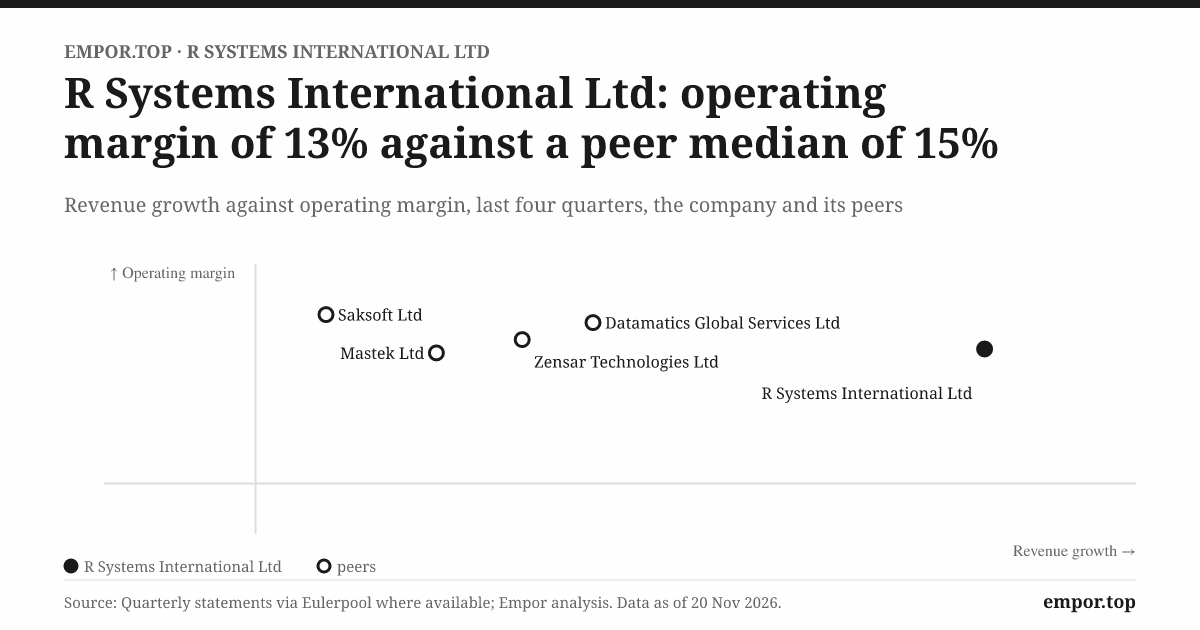
Read that promise against the numbers. The company's adjusted EBITDA margin was 17.5% for 2025 and 20.2% in the September 2026 quarter.24 A more conservative measure, operating margin after depreciation and amortization, was about 12.3% in 2025.4 So the sustainable target sits below the latest quarter's adjusted figure, which is itself flattered by currency. In effect, management is telling investors not to extrapolate the 20% quarter, and that it intends to spend some of the windfall. That is candid. It is also a target that leaves room: a margin guided to the high teens can be met even if part of the currency benefit fades, provided the reinvestment actually produces growth.
The choices visible since 2023 form a coherent strategy, at least on paper. Buy capabilities: Velotio for product engineering, Novigo for automation and AI. Push toward larger enterprise clients rather than the many smaller product companies that dominated the old book. Position the whole firm around AI. And keep paying a dividend while doing so. Each choice is defensible on its own. Together, they create a company whose next few years will be judged on whether organic growth improves while it reinvests and while margins normalize from a currency-boosted peak.
How is the chief executive paid for that? In 2025, Bansal's remuneration totaled about ₹88.5 million, made up of roughly ₹49.8 million fixed and ₹38.1 million variable, plus small benefits.4 The variable share, around 43% of the total, is meaningful. The company also runs a restricted stock unit plan, under which about 100,000 shares were issued on exercise in 2025.4 What the annual report does not provide is a long, comparable multi-year series of CEO-only pay, which makes it hard to judge how pay has tracked performance over time.4 And alignment through direct shareholding is modest by the nature of the structure: Blackstone owns the control block, and the CEO's equity comes through incentive plans rather than a founder's stake.
In September 2026, the company sought shareholder approval through a postal ballot that included the chief executive's remuneration and the appointment of an independent director.24 The independent-director resolution drew dissent of about 0.005% of votes cast.24 Set beside the opposition to a Blackstone nominee's reappointment at the 2025 AGM, the picture is of minority investors who are broadly accepting of management while occasionally registering a view about the controller's representation. The two votes concerned different issues, and neither suggests a shareholder base in revolt.
Credibility is best judged through behavior rather than words. Here the record is short but not empty. On the November call, management was candid about the sequential slowdown and currency's role in margins.1 Those are good habits. Against them, the company does not publish separate organic-growth figures or formal revenue guidance.12 Without guidance, there is no promise to miss; without an organic split, there is no figure to disappoint. Candor about the drivers is welcome, but the most testable claim management could make is one it has chosen not to.
The external check from the auditors is clean and bounded. The 2025 audit opinion was unmodified and carried no emphasis-of-matter paragraph, and the auditor reported no pending litigation expected to affect the company's financial position.4 One disputed income-tax demand of about ₹27 million for an older assessment year remained under appeal, small relative to the business.4 That opinion covers 2025, not the years since, and it does not certify the strategy. But it does mean the reported numbers on which this whole debate rests have passed their annual test.
The management verdict, then, is that this is a team willing to explain its numbers honestly and to set a margin floor it can probably defend. The forward test is whether that candor extends to the one disclosure that would end the debate. And the market, by late 2026, had clearly decided not to wait for it.
IX. Analysis & Bear vs. Bull Case
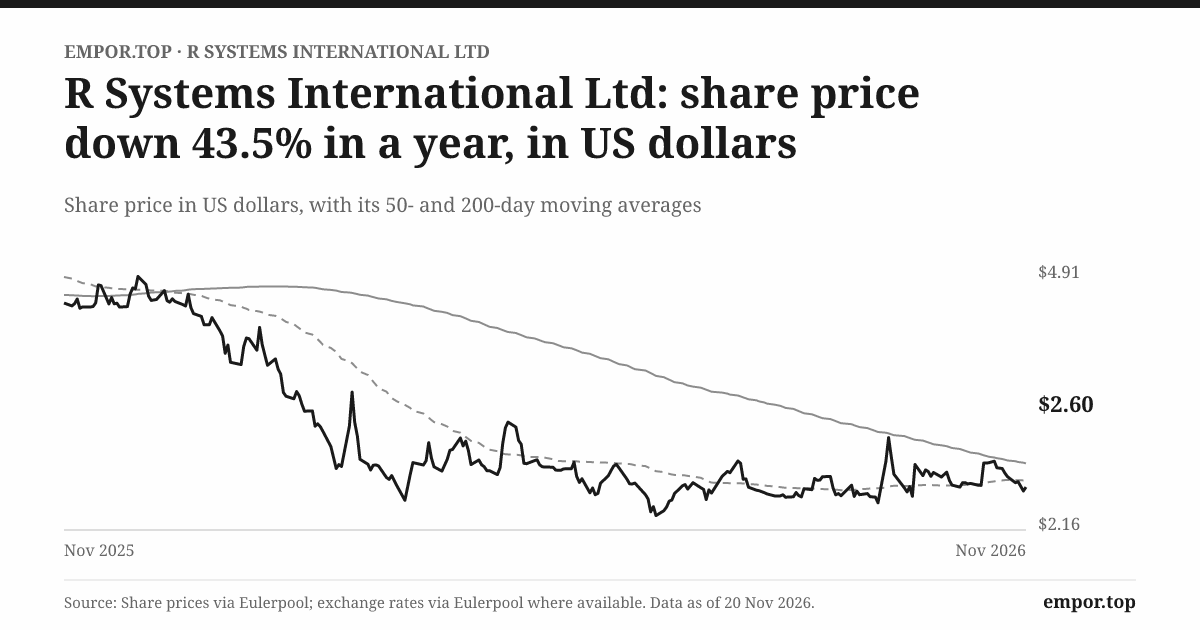
On November 20, 2026, R Systems' shares closed at ₹241.30.23 That was about 44% below the 52-week high of ₹427.60, and not far above the low of ₹220.23 It was also, strikingly, almost exactly the price at which Blackstone bought control in 2023, and below the ₹262 that public shareholders refused to accept in the delisting offer.13 Three years of reported growth, two acquisitions and an AI repositioning later, the market valued the company at roughly ₹3,388 crore, about where the private-equity buyer had valued it.23
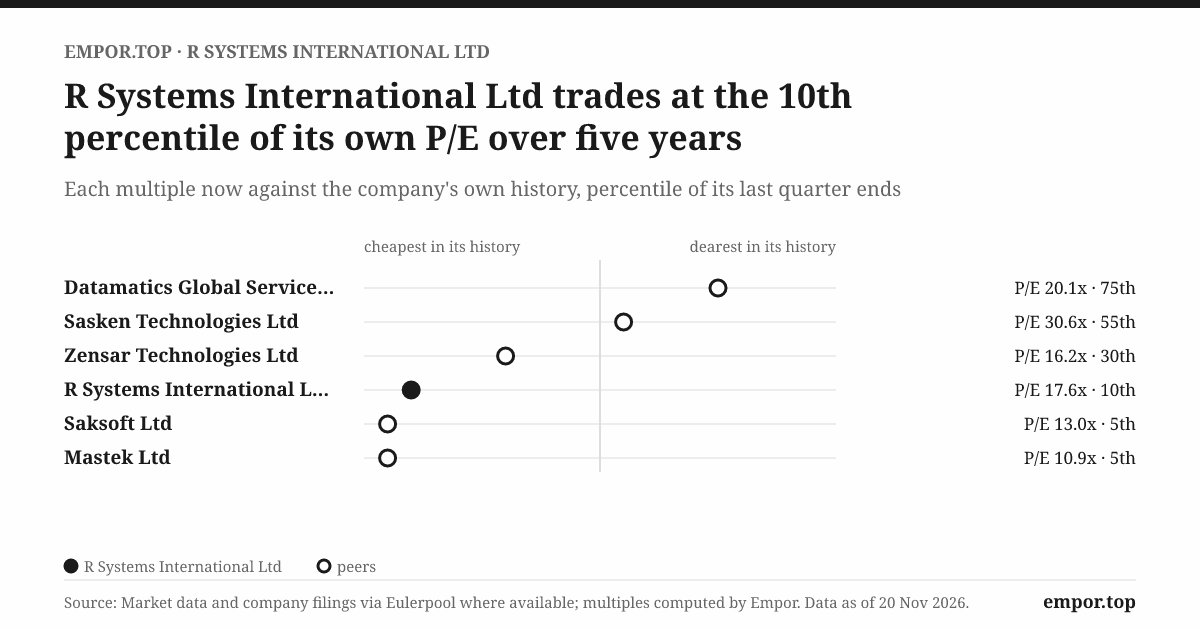
At that price, the shares traded at about 17.6 times trailing earnings, against a five-year median of about 27.7 times.23 Enterprise value was about 9.1 times EBITDA, and the dividend yield about 2.5%.23 The stock had also proved volatile, with a peak-to-trough fall of about 62% in the past five years.23 The market is plainly not paying a premium for the AI story. The question is whether it is discounting a temporary growth pause or a business that has yet to prove its new strategy.
Two cases, and the forces that decide between them
The bull case starts with the reported trajectory. Revenue in the first nine months of 2026 grew 17.5% in dollars and almost 28% in rupees.2 Margins are the highest in years. The client base is broad, with no client above 6% of revenue. The company has a long record of converting profit into cash and paying it out. AI engineering and automation could expand the work R Systems sells, rather than shrinking it, if clients spend their productivity savings on new AI projects. Novigo brings high-margin automation skills and a Middle East footprint; Velotio brings product-engineering talent. Stable utilization and a richer mix could hold margins in the high teens. And Blackstone may supply referrals and financing capacity that a company of this size could not muster alone.
The bear case starts with what is missing. Larger peers have greater scale and bigger sales engines. CRISIL described core growth as low single digit in 2025 and early 2026.6 The company does not disclose organic growth separately, so the headline acceleration cannot be decomposed by outsiders. Traditional engineering work, the largest part of the TIPS-heavy book, is being delayed. Novigo's integration and earn-out remain to be proven, and both acquisitions carry goodwill that depends on growth forecasts. The rupee's weakness has been doing much of the margin's lifting. And North America remains the company's main geographic exposure.
The credit view sits between them. CRISIL affirmed its AA-/Stable rating in July 2026, citing improving margins, low leverage, cash surplus, Blackstone support and customer breadth, while naming modest scale, North American concentration, macroeconomic sensitivity and AI disruption as constraints.6 ICRA reaffirmed its own AA-/Stable rating in October 2026.25 The rating agencies, in other words, see a financially safe company with an uncertain growth engine, which is close to what the share price implies. CRISIL's adjusted debt measure includes leases, but funded debt is covered by cash; the risk lies in what the company does next, not in what it owes today.6
Run the industry through Michael Porter's five forces and the shape of the challenge is obvious. Buyer power is high: clients can multi-source, insource or renegotiate, and R Systems itself describes customer bargaining power as significant.4 The threat of substitutes is rising, because AI coding tools are a substitute for some of the hours R Systems sells, and clients' internal teams are a substitute for all of them. Rivalry is intense, among Indian mid-tiers, global consultancies and offshore specialists. Supplier power, which here means the engineers themselves, bites whenever specialist skills are scarce, and management explicitly cited higher costs for AI talent.1 Barriers to entry are low for small boutiques and high only at the scale of global delivery, where R Systems is a smaller player. That is not a structurally comfortable industry for a sub-scale firm.
Hamilton Helmer's seven powers ask a narrower question: what would let R Systems earn returns above its cost of capital for a long time? Scale economies favor its larger rivals, not it. Network effects are absent in project services. Switching costs exist, since an embedded engineering team knows a client's systems intimately, but the company does not publish retention or renewal data that would prove they are strong. Counter-positioning is the most interesting possibility: a smaller firm with less legacy revenue to protect might embrace AI-driven delivery that cannibalizes hours faster than a giant would dare. Bansal's own warning about traditional engineering hints at that posture. But counter-positioning only becomes a power if the company prices for outcomes rather than hours, and there is no disclosed evidence yet that it does. Branding, cornered resources and process power are not established in the record. The honest conclusion is that R Systems has no proven durable power today; its best candidate is a counter-positioning bet that remains unproven.
An activist short-seller building the bear case would not need to allege anything improper. The argument would be about disclosure and sequencing. Here is a company that stopped growing much organically, by the rating agency's account, at the very moment it began buying growth with borrowed money, describing the combination as an AI transformation, and declining to separate the pieces. The adjusted margin excludes stock compensation; the reported profit included a property gain; the rupee did much of the margin's work. Each item is legitimate and disclosed. Together, they make the headline numbers a less reliable guide to underlying demand than they look. The bull's reply would be that every one of those effects is transparent in the filings, that mid-tier services firms routinely buy capability, and that the market's 17.6 times multiple already prices the skepticism. Both readings fit the evidence. What breaks the tie is the organic figure.
The risk radar beyond that is narrower than it first appears. A slowdown in American technology spending would hit the TIPS-heavy book first. AI substitution is the structural risk management itself has named. Currency can reverse, taking the margin tailwind with it. Cybersecurity and data-privacy incidents are a standing risk for any firm with access to client code and data, though the company has not disclosed a material incident. And integration risk, whether Novigo's people and clients stay, is the execution risk that matters most over the next two years.
Valuations against peers need caveats. On the same November date, Zensar traded at about 15.5 times earnings, Mphasis at about 23 times, KPIT Technologies at about 27 times and Persistent Systems at about 54 times.26272829 R Systems sits near the lower end of that range, closer to Zensar than to the high-growth names. These firms differ in growth, mix and scale, so the comparison is a description of how the market groups them, not a verdict. What the price appears to assume is that R Systems is a solid, cash-generating mid-tier services firm whose AI transition has not yet earned a premium.
What to watch
Three numbers would settle most of this debate. The first is constant-currency organic revenue growth excluding acquisitions. It is the single most important figure, and the company does not publish it; CRISIL's last characterization was low single digits.6 The second is trailing annual contract value bookings and how quickly they convert into revenue; management described bookings as flattish on the November call.1 The third is billed-plus-unbilled days sales outstanding alongside operating cash flow, which stood at 76 days at September 2026, with 2025 operating cash flow down from the prior year.24
The investment spine, stated plainly, is this. R Systems may win by combining acquired engineering capabilities with AI-led work at margins above its historical base, using a smaller firm's freedom to cannibalize its own hours before larger rivals do. It may not, if acquisitions and currency keep masking weak underlying demand and the debt taken on to buy growth comes due before the growth proves organic. The valuation is below the company's own history, but that comparison alone does not settle whether the discount is deserved. What the story does settle is a set of lessons that travel well beyond this one company.
X. Business & Investing Lessons
Go back to 2017, when revenue stood still.12 Then jump to 2025, when R Systems borrowed to buy a faster-growing company.4 Between those two moments sits most of what this company teaches.
The first lesson is that a margin recovery is a result, not yet a moat. R Systems spent the better part of eight years climbing back from 2017's collapse, and the climb is genuinely impressive. But the same margin that recovered over years can be compressed in months when revenue stalls, because a services firm's costs, its people, rise every year whether clients buy or not. The 20% quarter of 2026 is a result too, helped by a falling rupee and a high-margin acquisition. Founders and investors should treat a margin as a moat only after it survives a year when the currency, the cycle and the acquisitions are not helping. Until then, it is weather.
The second lesson is that an acquisition earns its story after the earn-out. Novigo was bought with an upfront price of about six times its announced EBITDA, plus performance-linked shares whose eventual value depends on what Novigo actually delivers.1820 Velotio's goodwill is a key audit matter precisely because its value rests on forecasts.4 And the smaller Innovizant deal showed that earn-outs can be reversed when targets are missed.4 The capability label attached to a deal, "AI," "automation," "agentic," is the pitch. The proof is in the customer retention, the cash generated and the debt repaid in the years after. A buyer that will not show acquired and organic growth separately is asking investors to accept the pitch in place of the proof.
The third lesson is that AI work counts when it becomes repeat business. The chief executive says a significant share of revenue is now AI-driven.21 On the same call that sold the transition, he acknowledged delayed traditional projects and agentic contracts closing slower than planned.1 For a services company, a pilot is a promise and a renewal is a business. The firms that will be valued as AI winners are the ones that can show the same clients coming back, at rising prices, for AI work that did not exist three years ago.
The fourth lesson is that the scarce assets of a services firm are not on its balance sheet. R Systems has no patents of consequence, no factories, and it sold its own buildings. What it owns is client trust, skilled engineers and repeatable delivery. The failed 2023 delisting offer and the 2026 share price put two prices on those intangibles, from very different sets of buyers.1323 The lesson for founders is that in a people business, value is rented every day through retention and reputation. The lesson for investors is to price it that way.
XI. Epilogue
Tonight, R Systems stands at an awkward point in its story. It has just reported the strongest margins it has shown in years, along with a sequential growth figure that its own management called disappointing.12 Its share price sits roughly where Blackstone bought in three years ago. Its bonds are not yet amortizing. Its most important acquisition has been consolidated for barely a year.
The next results day will be the first real test. The December quarter will complete Novigo's first full year inside R Systems, which means that, from early 2027, year-on-year comparisons will begin to include Novigo on both sides of the ledger. That is the moment the reported growth rate starts to strip out the acquisition on its own, whether or not management publishes an organic bridge. If growth holds in the teens once Novigo laps itself, the bull case gains its first hard evidence. If it falls back toward the low single digits CRISIL described, the acquisitions will have bought a single year of acceleration, not a new trajectory.
The currency is the second clock. Management's own figures show the rupee contributed more than ₹780 million to EBITDA over nine months of 2026.1 If the rupee stabilizes, that tailwind disappears, and the high-18% sustainable margin target becomes a real test of underlying delivery economics rather than a comfortable floor beneath a currency-boosted number. Holding margins above 18% in a flat-currency year would be meaningful evidence that mix and AI-driven productivity are doing real work.
The third clock is bookings. Annual contract value bookings were described as flattish in November.1 If they recover and convert into revenue over the next few quarters, the delayed traditional projects were a pause. If they stay flat while AI deals continue to close slowly, Bansal's warning about traditional engineering will have arrived faster than his new engine could replace it.
Then there is Novigo itself: whether its clients stay, whether its founders and engineers stay, whether its margins hold inside a larger company, and how much the performance-linked shares eventually cost. There is the cash: whether billed-plus-unbilled receivables come down from 76 days, and whether operating cash flow rises enough to begin retiring the bonds on schedule while keeping the dividend. And there is the AI narrative: it becomes commercial evidence only when the company reports AI revenue or bookings as numbers that repeat.
The central question remains open: whether growth is organic.
XII. Outro
Return to that November morning, and to the warning that framed the story.1 It was a brave thing to say, and probably a true one. But organic growth remained unquantified.
R Systems today is a mid-sized services company trying to buy and build its way into the next form of engineering work, with a private-equity owner above it, a public float that refused to leave, and a margin that has risen for reasons both earned and borrowed. The story will not turn on what the company says about AI. It will turn on whether clients keep paying it, again and again, for the work that comes after the old work is gone.
References
-
Q3 2026 Investors’ and Analysts’ Call Transcript — NSE, 2026-11-04 ↩↩↩↩↩↩↩↩↩↩↩↩↩↩↩↩↩↩↩↩↩
-
Earnings release, quarter and nine months ended September 30, 2026 — R Systems International Limited, 2026-11-03 ↩↩↩↩↩↩↩↩↩↩↩↩↩↩↩↩↩↩
-
Q3 2026 Investor Presentation — R Systems International Limited, 2026-11 ↩↩↩↩↩
-
Annual Report 2025 — R Systems International Limited, 2026-05-29 ↩↩↩↩↩↩↩↩↩↩↩↩↩↩↩↩↩↩↩↩↩↩↩↩↩↩↩↩↩↩↩↩↩↩↩↩↩↩↩↩↩↩↩↩↩↩↩↩↩↩↩↩↩↩↩↩
-
R Systems International Limited Rating Rationale — CRISIL, 2026-07-07 ↩↩↩↩↩↩↩↩↩↩↩
-
Zensar reports 6.3% YoY revenue growth in constant currency for Q4FY25 — Zensar Technologies, 2025-04 ↩
-
Persistent Systems reports USD 1.4B revenue in FY25, targets USD 2B by FY27 — Dataquest India, 2025-04 ↩
-
Prospectus of R Systems International Limited — R Systems International Limited, 2006-04-03 ↩↩
-
Ex-Infosys executive Nitesh Bansal appointed as CEO of IT company R Systems — Business Today, 2023-06-01 ↩↩↩
-
R Systems Announces Results for Financial Year 2017 — R Systems International Limited, 2018-02-09 ↩↩↩
-
Blackstone's delisting offer for India's R Systems International fails — Business Standard, 2023-05-08 ↩↩↩↩
-
Shareholding Pattern as of September 30, 2024 — R Systems International Limited ↩↩
-
Shareholding Pattern filings — National Stock Exchange of India ↩↩↩↩
-
Voting Results, 31st Annual General Meeting — NSE, 2025-06-13 ↩
-
Velotio acquisition fairness opinion — R Systems International Limited, 2024 ↩↩
-
Novigo acquisition disclosure and transaction terms — NSE, 2025-08-21 ↩↩↩↩
-
R Systems acquires Mangaluru-based Novigo for ₹400 crore — The Times of India, 2025-08-22 ↩↩↩
-
Audited results and Novigo purchase-price allocation — NSE, 2026-02-25 ↩↩
-
Significant share of R Systems revenue now driven by AI: CEO Nitesh Bansal — Business Standard, 2026-11-11 ↩↩
-
Investor and analyst calls, including the Q2 2026 call of 2026-08-05 — R Systems International Limited ↩↩
-
R Systems International Limited (NSE:RSYSTEMS) quote and statistics — Stock Analysis ↩↩↩↩↩↩↩↩
-
R Systems International Limited Rating Details — ICRA, 2026-10-08 ↩
 LinkedIn
 WhatsApp
 Reddit
 Hacker News
 Email
 Kindle
 RSS Feed
 Spotify
 Apple Podcasts
 Amazon Music
 Audible
 YouTube