Datamatics: The AI Story Inside the Numbers
The AI revenue the company cannot count
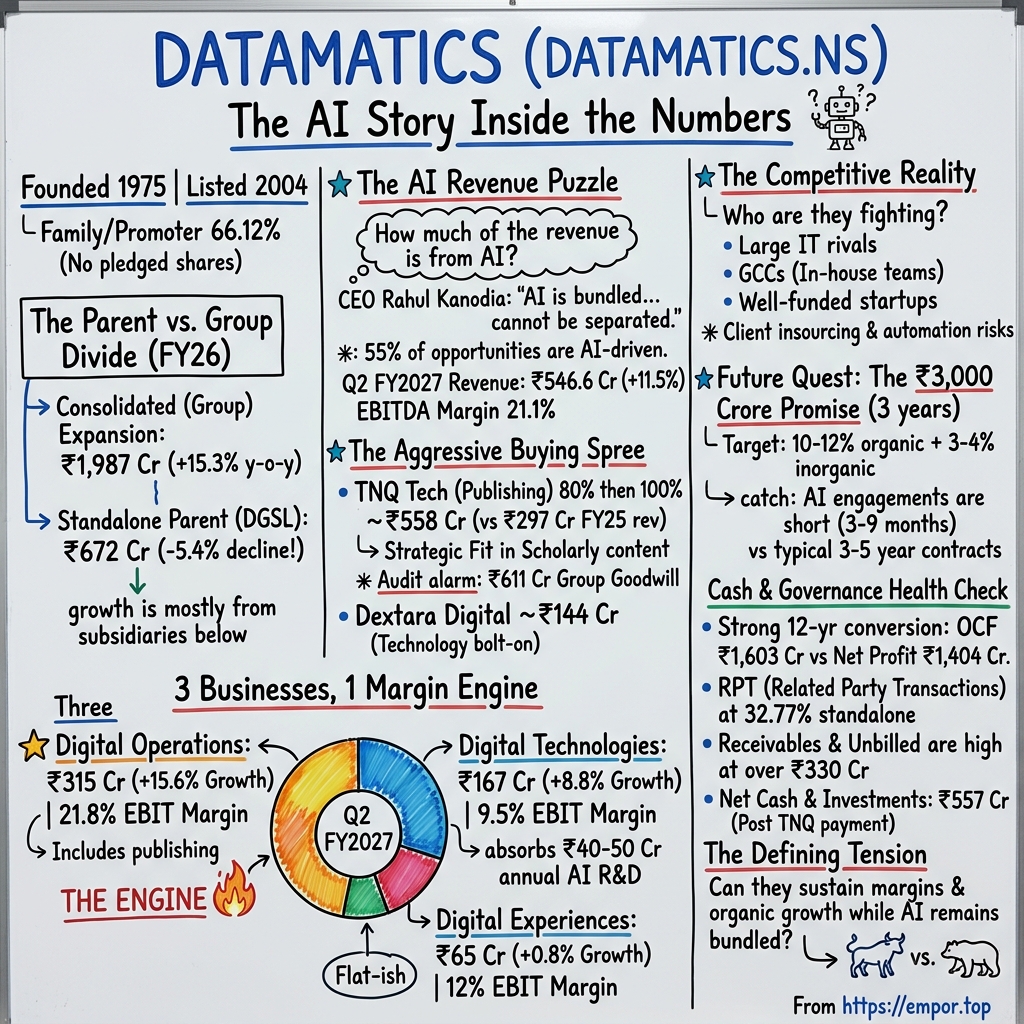
In early November 2026, a few days after Datamatics Global Services published its September-quarter results, an analyst on the earnings call asked the question that now hangs over every Indian services company. How much of the revenue comes from the company's AI products? It is a simple question, the kind a listener could answer with one number. Rahul Kanodia, the Vice Chairman and Chief Executive, did not give one. The AI work, he explained, is bundled into the services Datamatics sells, and it cannot be separated out. What he could offer was a different number: about 55% of the opportunities the company was chasing were heavily AI-driven.1
That exchange is the whole story in miniature. Datamatics can tell investors how much of its pipeline smells of AI. It can name the products it has built and the customers who have signed. What it cannot, or will not, tell them is the one figure that would settle the argument: how much customers actually pay for AI. An opportunity is a conversation. A share of opportunities is a share of conversations. Neither is a rupee of revenue, and the distance between the two is where the investment case for this company lives.
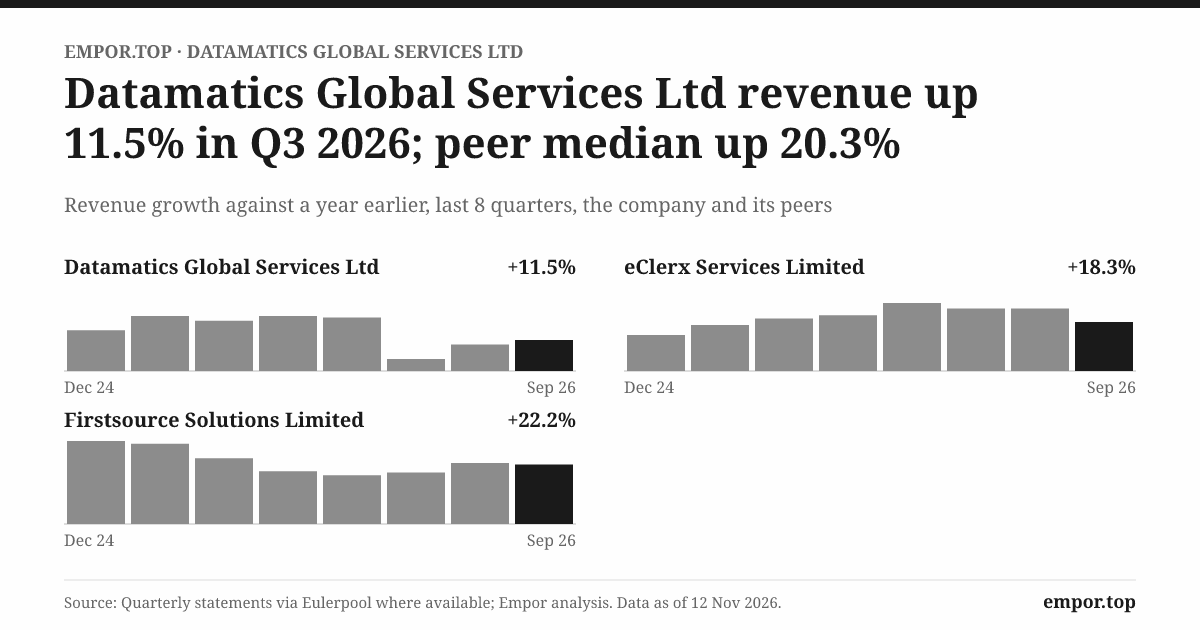
The frustrating part, for a skeptic, is that the rest of the quarter looked genuinely good. Revenue for the three months to September 2026 was about ₹547 crore, up 11.5% on a year earlier, and the margin before interest, tax, depreciation and amortisation reached about 21%.2 Operating profit grew roughly a third faster than the year before, so the improvement was not a rounding error.2 Management also had a destination in mind. It wanted the group to reach ₹3,000 crore of revenue within three years, which from where the company stood implied growing about half as large again.1
So the growth is real, and so is the margin progress. The question is what is producing them. AI is a credible explanation for some of the new demand, because customers everywhere are paying to rebuild document processing, claims handling, publishing workflows and customer support around new models. But a credible explanation is not the same thing as a measured one, and a company that cannot count its AI revenue is asking investors to take the label on trust.
Three questions follow, and they run through every section of this story. The first is how much of the group's growth is organic, earned from existing businesses selling more, rather than bought through acquisitions. The second is whether the AI work Datamatics is winning renews and expands, or whether it arrives as short projects that end and must be replaced. The third is whether the acquisitions that lifted the growth line in the last two years will earn an adequate return on the money spent on them.
Those questions matter more for Datamatics than for a typical services firm because the company sits on both sides of the AI trade. It sells automation, and it sells the human labour that automation replaces. A quarter of strong growth can therefore mean two very different things: that AI is opening new budgets, or that customers are still buying the old work while they wait to automate it.
Before any of those can be answered, a listener needs to know which Datamatics is being discussed, because there are two. The consolidated group, which includes every subsidiary the listed company controls, booked about ₹1,987 crore of revenue in the year to March 2026, up a little over 15%.3 The listed parent company on its own, the entity whose name is on the share certificate, booked about ₹672 crore, and that figure fell 5.4%.3 These are not two ways of measuring the same thing. They are two different businesses sitting inside one story, one shrinking while the other grows. Understanding why is the first step to understanding what an investor in Datamatics actually owns.
 Subscribe on LinkedIn
The listed company and the businesses beneath it
The annual report for the year to March 2026 opens on the split already visible in the results: standalone revenue went backwards, while consolidated revenue had one of its best years in a decade.3 A first-time reader could be forgiven for wondering whether they are looking at the same company.
They are, in the sense that the listed parent owns and controls everything below it. But the parent is closer to a holding company with an operating business attached than to a single factory of services. Its consolidated results include Lumina Datamatics, the publishing and digital-content arm, TNQ Tech, the scholarly-publishing business Lumina bought, and a string of technology and process subsidiaries abroad.3 When the group grows, it can grow anywhere in that tree, and the parent's own revenue line tells an investor only about one branch.
The deep history is worth only a paragraph, because the investment case today is shaped by recent changes in the mix of businesses rather than by the founding legend. Datamatics was founded in 1975 by Dr. Lalit Kanodia, who still chairs the board, as one of India's early independent computing and data-services firms.3 It listed on the National Stock Exchange and the Bombay Stock Exchange in 2004, in an offering that sold 85 lakh new shares and 18 lakh existing shares at ₹110 each and raised about ₹113 crore in total.4 For most of the two decades since, it has been a mid-sized, family-run Indian services company, never large enough to be mentioned in the same breath as Infosys or Wipro, and never small enough to disappear.
The turning point that matters for this story came in 2014–15. That year the group moved its publishing-services work into a separate structure under the Lumina Datamatics name, giving the content business its own identity, its own management and its own place in the corporate tree.5 At the time it looked like housekeeping, the kind of reorganisation services groups do to give a unit a cleaner pitch to customers. In hindsight it was the moment the business that would later become central to the group's growth was set up to grow on its own, and eventually to go shopping.
Tracking the consolidated revenue line over the decade gives a picture of steady but unspectacular expansion. Over the ten years to March 2026, group revenue compounded at a little over 9% a year in rupees.3 Over the most recent three years it ran slightly faster, at a little under 11%.3 On the surface, that is a company finding a second wind. Underneath, the perimeter changed. The year to March 2026 was the first full year to include TNQ Tech, and it also included the acquisition of Dextara Digital, a technology consulting firm.3 ICRA, the credit-rating agency, observed in March 2026 that education and publishing had jumped from about 15% of group revenue to about 26% in a year, partly because of TNQ.6 That is not organic growth. It is bought growth, perfectly legitimate, but different in kind.
The parent's falling revenue is the mirror image. Some of the decline reflects where work is booked and which entity bills which customer, and the company does not publish a reconciliation that would let an outsider separate genuine weakness from internal reshuffling. That is exactly the point. When the listed company shrinks while its subsidiaries swell, a shareholder needs segment-level disclosure of organic growth to know whether the core is healthy. Without it, the consolidated number is a sum of different stories, some of them purchased.
There is one thing that has not changed through any of this: who controls the company. At the end of September 2026 the promoter group, the Kanodia family members and a family trust, held about 66% of the shares, with none of them pledged as collateral for loans.7 That stake has drifted down from a little over 74% in early 2022, and the change of perimeter beneath it has been dramatic, but the family's grip on the vote has been constant. Every acquisition in this story was a family decision, made with family capital at stake. The largest of them came through the publishing arm, and it is the deal that most shaped the recent growth line.
Publishing left, then came back through TNQ
Chennai is not the place most people would look for one of the quiet engines of global science publishing. But for years, a large share of the journal articles that researchers around the world read, cite and argue about passed through Indian typesetting, editing and production houses before they reached a reader's screen. TNQ Tech was one of those houses, a scholarly-publishing technology and services company that took manuscripts from academic publishers and turned them into finished, tagged, searchable articles. In December 2024 Lumina Datamatics agreed to buy 80% of it.8
The strategic logic was easy to state. Lumina already worked for publishers and e-commerce companies on content production. TNQ brought deep relationships with scholarly publishers, a workforce trained on the peculiar demands of academic content, from mathematical notation to reference linking, and a technology platform for running that work at scale.8 Put together, the group could offer publishers a larger menu and, in theory, sell Lumina's other services into TNQ's customer list and vice versa. Management has since described the combined digital-content business as one of the top three globally.9 That is a claim worth testing rather than repeating, because no independent market-share study is attached to it and the company does not publish the share figures behind it.
Now the price. For the initial 80%, the group paid about ₹348 crore; press coverage on the day of the announcement put the headline figure at about ₹336 crore before adjustments.310 The remaining 20% was not free. The acquirer carried a liability for it, valued at about ₹210 crore at March 2026 and payable on completion of the integration.3 Add the two pieces and the total implied consideration comes to roughly ₹558 crore. Against that, TNQ's own accounts for the year to March 2025 showed operating revenue of about ₹297 crore and profit before tax of about ₹60 crore, with earnings before interest, tax, depreciation and amortisation of roughly ₹70 crore.11
Work that through and the deal values TNQ at a little under twice its revenue and about eight times its operating earnings before depreciation, before adjusting for whatever cash or debt came with it. For a profitable, specialised services business with long publisher relationships, that is not obviously an excessive price. It is also not obviously a bargain. There is no closely comparable public transaction that establishes what scholarly-publishing services businesses change hands for, so an investor cannot say with confidence that Datamatics bought cheaply. The honest verdict is that the price was defensible on the seller's own numbers, and that defensible prices still have to be earned back.
The accounting shows how much of the price was paid for things that do not appear on a balance sheet. About ₹350 crore of the consideration was recorded as goodwill, the accountant's word for the premium paid above the fair value of identifiable assets.3 Goodwill is, in effect, a bet expressed in rupees: it represents the buyer's belief that the customer relationships, the people and the combination with Lumina will produce profits beyond what the assets alone could. If those profits arrive, the goodwill sits quietly on the balance sheet. If they do not, it gets written down, and shareholders learn after the fact that they overpaid.
The cash story did not end at signing. Because the payment for the remaining stake depended on how TNQ performed, the liability had to be revalued as results came in. TNQ did well enough that the expected payout rose, and the group booked about ₹41 crore of charges in the year to March 2026 for changes in the fair value of acquisition contingent consideration, recorded as an exceptional item.3 Here is an accounting irony worth pausing on. Under these rules, an acquisition that performs better than expected produces a loss in the buyer's income statement, because the buyer now owes the sellers more. The charge is a sign of success and a cost of it at the same time.
Then the final payment came due. By September 2026, after the payout for the rest of TNQ, the group's cash and investments net of debt had fallen to about ₹557 crore, from about ₹710 crore at the end of June.2 Roughly ₹150 crore of liquidity left the building in one quarter. That is not a crisis for a group with this much cash, but it marks the moment the TNQ deal stopped being a liability on paper and became money spent.
Datamatics did one other notable deal in the period, and it belongs in proportion. It bought Dextara Digital, a technology consulting business, for about ₹144 crore for the whole company, paid across tranches, and later proposed merging the Dextara subsidiaries into the listed parent.3 Dextara is a technology bolt-on, meant to deepen the group's capabilities in enterprise software implementation. It is not the main explanation for the group's scale, and treating it as a second TNQ would overstate it.
What would tell an investor the TNQ deal worked? Three things, none of them visible in a press release. Customers have to stay, because scholarly publishers can and do move production work between vendors. Cross-selling has to show up as revenue that neither business would have earned alone. And earnings have to survive the amortisation of acquired intangible assets, the slow annual expensing of the customer relationships and technology that the purchase price capitalised. Management told analysts in the June and September quarter calls that TNQ was growing healthily, but it has not broken out TNQ's revenue or margin since the acquisition.91
The auditors, for their part, flagged the risk in plain language. They identified the group's roughly ₹611 crore of goodwill as a key audit matter, because whether any of it needs to be written down depends on management's assumptions about future revenue and profits.3 A key audit matter is not a warning of wrongdoing. It is the auditor saying: this is where the judgment is hardest, and where the numbers could be most wrong. For a group whose recent growth leaned on acquisitions, that sentence is the falsification test. If TNQ's growth fades, the first place it will show up is in the goodwill impairment testing, long before it shows up in a management presentation.
That leaves the question of where TNQ and the rest of the group actually earn their money. The answer, it turns out, is not where the AI story would suggest.
Three businesses, one margin engine
When Datamatics reported its September 2026 quarter, it presented the group as three businesses. Digital Operations, which runs outsourced business processes and digital content production and now includes the publishing work of Lumina and TNQ, booked about ₹315 crore of revenue, up almost 16%, at an operating margin of almost 22%.12 Digital Technologies, the software, implementation and AI products unit, booked about ₹167 crore, up about 9%, at an operating margin of about 9.5%.12 Digital Experiences, the customer-experience and analytics business, booked about ₹65 crore, essentially flat on a year earlier, at a margin of about 12%.12
Translate those into weight and the picture sharpens. Digital Operations supplied a little under three-fifths of the quarter's revenue. Because its margin was more than double that of Digital Technologies, it supplied about three-quarters of the group's segment operating profit. Digital Technologies, the segment most associated with AI and products, contributed roughly a sixth of the profit. Digital Experiences contributed less than a tenth. Put simply, Datamatics today is an operations and content business with a technology business attached, not the other way round.
It helps to picture the work itself. In Digital Operations, teams of trained staff process documents, manage back-office workflows, and produce and tag digital content for publishers and online retailers. Increasingly, the software does a first pass and humans check, correct and handle the exceptions. In Digital Technologies, consultants and engineers implement enterprise software, build automation and sell Datamatics' own products. In Digital Experiences, staff handle customer contact and analytics work. Across all three, the company bills in familiar services ways: time and material, where the customer pays for hours worked; fixed price, where Datamatics carries the risk of overruns; and milestone billing, where payment arrives as stages are completed.3 Fixed-price work is recognised as revenue by percentage of completion, which requires estimating how far along a project is, and the auditors listed that estimation as a key audit matter too.3
The economics are labour economics. The listed parent alone had 4,025 permanent employees at March 2026; the company does not publish a comparable group headcount trend, so an outsider cannot tell how fast the labour base is growing relative to revenue.3 A services business like this makes money on the gap between what a client pays for a unit of work and what it costs Datamatics to staff it. Automation changes that gap. If software lets one person do the work of three, the company can either pass the saving to the client, keep it as margin, or, most commonly, share it. Digital Operations' strong margin suggests the group has so far kept a healthy portion of its productivity gains, and its September-quarter growth suggests the publishing businesses are pulling their weight.
Digital Technologies' lower margin has a specific cause that management has been willing to explain. Datamatics spends approximately ₹40–50 crore a year on AI research and development, about 2–2.5% of the group's annual revenue, and management told analysts in August 2026 that spending would stay at a similar level for the year.9 Much of that spending is booked in Digital Technologies, even though the products and capabilities it builds support work in the other two segments.9 The effect is like a restaurant charging the entire cost of its test kitchen to the dessert menu. Desserts look unprofitable, the main courses look brilliant, and neither picture is quite true.
So what is the R&D buying? The company lists 32 proprietary products in its annual report, spanning intelligent document processing, automation, analytics and industry-specific tools.3 Management has pointed to specific proof points. TruAI Underwriting, an AI product for insurance underwriting, has its first customer, and the company cites other AI-enabled wins across its businesses.91 First customers matter. They show a product can be deployed in a real workflow and paid for. But a first customer is a beginning, not a business, and Datamatics gives no separate revenue figure for TruAI, for its product portfolio as a whole, or for AI-enabled work generally.
This is where the gap from the opening scene reappears in a more precise form. Breadth of product is not evidence of material revenue. A catalogue of 32 products can coexist with a business where almost all the money still comes from people doing work by the hour or by the task. Until the company says how many paying deployments each product has and how much revenue they produce, the honest reading is that the products are capability, which helps win services work, rather than a separate software business with its own economics.
The tension inside the segment structure is worth hearing aloud. On the calls, management has described Digital Technologies as strategically central to where the group is headed.9 Yet in the September quarter its margin was less than half that of Digital Operations, and its growth was slower. Management's explanation, that R&D weighs on the reported result, is plausible and partly verifiable from the size of the AI budget. But it also means the segment's true standalone economics are unknown. If the R&D were allocated across the segments that benefit, Digital Technologies might look healthier and Digital Operations a little less spectacular. Investors are left to take the allocation on trust.
The Digital Experiences number deserves a sentence of its own. Flat revenue in a quarter when the group grew at double digits is a signal, and in a customer-experience business it is the signal one would expect if AI is beginning to absorb some of the routine contact work clients used to outsource. The company has not attributed the stagnation to AI, and a single quarter does not make a trend. But it is the segment most exposed to the risk that automation shrinks the work, and it was the one that did not grow.
The conclusion is that Datamatics' margin engine is the unglamorous one. Process and content operations, enlarged by publishing acquisitions, produce most of the profit. The AI and product story lives mainly in the segment that earns the least. That does not make the AI bet wrong. It makes it unproven, and it raises a sharper question about the businesses that are already working: what keeps their customers from doing the work themselves?
The vendor competing with the client's own AI team
On the August 2026 call, an analyst asked about competition and named two Indian IT companies, Persistent Systems and Coforge, both larger and faster-growing mid-tier players. It was a reasonable guess about who Datamatics fights in the market. Kanodia's answer pointed somewhere else. The competitors Datamatics more often meets, he said, are the client's own technology teams, the global capability centres that multinationals have built in India to do work in-house, and well-funded automation start-ups.9
It was a candid answer, and a revealing one. A services company that competes mainly with other services companies is in a familiar fight over price, talent and delivery quality. A services company that competes with its own customers is in a different fight entirely. The customer that builds a capability centre in Bengaluru or Pune does not need to outsource the work at all. The start-up that automates a single workflow with a well-trained model does not need an army of operators behind it. Both threats aim at the same thing Datamatics sells: people doing process work, increasingly assisted by software.
Start with the customers themselves. Datamatics serves more than 300 significant customers.6 In the September quarter, its five largest supplied about 29% of revenue and its twenty largest supplied about 53%.1 Those are moderate concentrations for a services group of this size, neither alarming nor comfortable. They have also edged up. ICRA put the top-five share at about 26% for the nine months to December 2025, and management's own figures in the June quarter were about 30%.69 Some of that rise reflects the deliberate strategy of growing larger accounts and some reflects the publishing acquisitions bringing big publisher customers. Either way, a few relationships now carry more weight than they did, which gives those customers more leverage when contracts come up for renewal.
Next, the industry around it. Large IT services and business-process firms can bid for any adjacent work Datamatics does, and most of them are much larger. Specialist content houses compete for publishing work. Start-ups compete for individual automated workflows. To give a sense of relative scale, Datamatics' roughly ₹1,987 crore of revenue in the year to March 2026 compares with about ₹4,100 crore of operating revenue at eClerx and about ₹9,600 crore at Firstsource, two listed Indian process and analytics firms.1314 These are not like-for-like competitors; their customers and service mixes differ. But they show that Datamatics is a smaller player in an industry where scale buys investment capacity, sales reach and the ability to absorb pricing pressure. Reliable market-share data for Datamatics' particular niches is not published.
The moat question should be argued once, carefully, and the place for the full argument is the bull and bear case later in this story. The short version is this. Customers have alternatives and can build internally, which keeps buyer power high. What might hold them is customer-specific process knowledge: the years Datamatics' teams have spent learning exactly how a particular insurer handles claims or a particular publisher tags its references. That accumulated workflow knowledge is real, and it makes switching annoying and risky. But annoying and risky is not the same thing as prohibitive, and the public evidence on renewal rates, win and loss rates and price realisation is thin, because the company does not publish them.
The product claim deserves a direct test against commercialisation. The annual report lists 32 products.3 Management says AI is bundled into services and cannot yet be isolated.1 Both statements can be true at once, and together they suggest that the products are, for now, mostly tools that make Datamatics' services more competitive, not stand-alone software sales with their own recurring licence revenue. The right measure of a product moat is paid deployments and expansion revenue: how many customers pay, and whether they pay more each year. Neither product names nor the share of AI-heavy opportunities tells an investor that.
The deeper tension is that the technology Datamatics sells can shrink the market it sells into. Every efficiency it delivers to a customer reduces the hours, the headcount or the outsourced spend that customer needs. If Datamatics captures that value through outcome-based pricing or new work, it wins. If the customer captures it by reducing the contract, Datamatics loses revenue even as it does exactly what was asked. And if the customer decides that, having seen how the automation works, it would rather run it in-house, Datamatics loses the account. Kanodia's own answer about client captives and start-ups is the strongest evidence that this risk is not hypothetical. The company's AI-first framing is a strategy for riding the wave. It is not a guarantee that the wave lifts rather than swamps.
None of this means Datamatics lacks defensible ground. Customer relationships that run for years, a delivery base in India with deep domain experience in publishing and insurance processes, and a credit rating that reflects real financial strength all count for something.6 But the evidence supports a narrower claim than the AI narrative implies: Datamatics is a competent, experienced operator whose advantage lies in knowing its customers' workflows, and whose biggest competitor may be the customer itself. The next question is whether that operator can grow fast enough to reach the target management has set.
The ₹3,000 crore promise meets a shorter contract
When management laid out the path to ₹3,000 crore on the November call, it gave the arithmetic. The target implied roughly 15% annual growth over three years, made up of 10–12% organic growth and 3–4% from acquisitions.1 Fifteen percent a year compounds to about half as much again in three years, which, from the March 2026 base of about ₹1,987 crore, lands almost exactly at ₹3,000 crore. The plan is coherent. Whether it is achievable depends on the organic piece, because the inorganic piece is, by definition, a matter of buying.
The company's own history is the right yardstick. Over the three years to March 2026, group revenue grew a little under 11% a year, and that period included the TNQ and Dextara acquisitions.3 Over ten years it grew a little over 9%.3 So the plan asks the business to grow organically at roughly the rate it has recently grown in total, including acquisitions, and then add bought growth on top. That is not impossible. It is ambitious, and it requires the organic engine to run faster than it ever has for a sustained period.
The current year is a better test than any long-run average. Management's guidance for the year to March 2027 has been for high-single-digit revenue growth.9 In August, after a June quarter with almost 10% growth, management kept that guidance rather than raising it.9 In November, it said growth for the first half had been about 10.7%, and suggested the full year might come in around 9–9.5%.1 Do the subtraction. If the first half grew at nearly 11% and the full year lands below 10%, the second half has to slow to around 8%. That is a careful company managing expectations, which is to its credit. It is also a company whose current-year trajectory is running below the pace its three-year target requires.
The margin story in that June quarter was more striking than the growth. Operating margin before interest and tax rose by a little over three percentage points from a year earlier, so profit grew far faster than revenue.9 That is operating leverage: revenue rising on a cost base that rises more slowly, helped by the higher-margin publishing work now inside the group. Operating leverage is real, but it is also the part of a growth story most vulnerable to a slowdown, because the same fixed costs that magnify profit on the way up magnify the squeeze on the way down. A second half growing at around 8% will test how much of the margin gain was structural efficiency and how much was simply volume.
The guidance pattern says something about management's style. Kanodia's team has preferred to under-promise for the year and leave room to beat, while setting a bigger, longer-dated ambition for the three-year horizon. That combination is common in Indian mid-cap services. The near-term guidance is the more credible of the two, because it is shorter and more frequently tested. The ₹3,000 crore figure is a destination that will be judged in 2029, and investors should notice that the first year of the journey is already guided below the required speed.
The second problem is the shape of the new work. On the August call, management said many of the new AI engagements last three to nine months.9 Traditionally, it said, Datamatics' business was built on annuity contracts of three to five years, where a customer handed over a process and paid for it month after month.9 Management added that deal sizes were increasing, which is encouraging.9 But a short engagement changes the arithmetic of growth. An annuity contract signed this year is revenue next year and the year after. A six-month project signed this year is revenue that must be replaced by next year. A business shifting towards shorter projects has to win more work just to stand still, and its revenue becomes harder to forecast.
There is a hopeful reading. Short projects can be the way customers try AI before committing, and if Datamatics converts a pilot into a larger, longer programme, the short contract becomes the front door to an annuity. There is also a sceptical reading. A short project that automates a process can end the need for the longer contract that would otherwise have followed. Which reading is right will show up in renewal and expansion revenue from AI-led work, a figure the company does not publish.
The sales strategy has changed alongside the contracts. Management said Datamatics had moved from adding fifteen to eighteen new clients a quarter to a more selective approach that hunts fewer new accounts and farms existing ones harder.1 In the first half of the year to March 2027, it added roughly six or seven new clients.1 Fewer, larger relationships can raise revenue per customer and improve margins, because selling more to someone who already trusts you is cheaper than winning a stranger. The risk is the one visible in the customer figures: account farming raises concentration. The test is whether revenue per existing client rises without the top-five share climbing much further.
The analysts on the November call pressed exactly where a sceptic would. They asked for AI revenue. They asked for TNQ's contribution. They asked what was driving the margin in Digital Operations. Management declined to split out AI revenue or provide a finer segment breakdown, while citing healthy TNQ growth and operating leverage as the reasons for the margin.1 Those answers were not evasive in tone, and declining to disclose is a choice many companies make. But each refusal leaves the investor with one less way to tell organic from acquired, and AI from ordinary services.
What would prove the plan? Organic growth in constant currency, segment by segment, so that the rupee's movements and the acquired businesses do not flatter the line. Renewals and expansions on AI contracts after their first short terms. Revenue per existing client. And acquisition contribution shown separately, every quarter. Until those numbers appear, the ₹3,000 crore target is a credible ambition resting on an unproven engine. And the engine has to do more than book revenue. It has to turn that revenue into cash.
When profit becomes cash—and when it does not
Every services company has a moment of truth that never appears in its marketing: the day the invoice is paid. Profit in an income statement is an opinion, built from estimates of how far a project has progressed, what an acquisition is worth and how much of a bill will eventually be collected. Cash in the bank is a fact. For a group like Datamatics, which books fixed-price work by percentage of completion and carries acquisition liabilities that move with performance, the gap between the two is where an investor learns the most.
The long record is reassuring. Over the twelve years to March 2026, the group reported about ₹1,404 crore of cumulative net profit and generated about ₹1,603 crore of cash from operations, roughly 114% of the profit figure.35 In plain terms, for every rupee of profit Datamatics reported across a decade, more than a rupee arrived as operating cash. That is the hallmark of a services business that is not, over time, flattering its profits with aggressive revenue recognition, because aggressive recognition eventually shows up as receivables that never turn into cash.
The record also shows how conservative the family has been with what that cash produced. Across those twelve years, dividends consumed only about 12% of cumulative free cash flow, the cash left after capital spending.35 The company's dividend payout has ranged from nothing in the pandemic year to about a third of profit, with a typical level around a tenth.3 Meanwhile, cash and short-term investments rose by about ₹454 crore over the period.3 The family chose to accumulate rather than distribute. That decision built the treasury that later paid for TNQ, which is either prudent preparation or an argument that minority shareholders funded acquisitions rather than receiving dividends, depending on whether TNQ earns its keep.
Narrow the lens to the year to March 2026 and the picture becomes more textured. Operating cash flow was about ₹324 crore, strong in absolute terms.3 But look at where the working-capital movements came from. Trade receivables, money customers owed for billed work, used about ₹34 crore of cash as they grew. Trade payables, money Datamatics owed its own suppliers, added about ₹36 crore. Other liabilities added about ₹24 crore.3 In other words, part of the year's cash came from the group paying its own bills more slowly or accruing obligations, offsetting the cash tied up in customers. That is not a red flag; it is common, and payables fluctuate. But it means the year's cash conversion was not entirely a story about customers paying faster.
The receivables themselves look clean. At March 2026 the group had about ₹346 crore of trade receivables, and almost all of the undisputed amount, about ₹341 crore, was less than six months old.3 Credit-impaired balances, the amounts the company considers unlikely to be collected, fell from about ₹4 crore to about ₹3 crore.3 Debtor days, the number of days of revenue sitting in receivables, fell from 96 in the year to March 2015 to 64 in the year to March 2026, peaking at 106 along the way.35 Customers, on this evidence, are paying, and paying on time.
The billed receivables are only part of the claim on customers, however. The group also carried about ₹207 crore of unbilled revenue, work done but not yet invoiced, and about ₹128 crore of contract assets, revenue recognised on contracts with major customers ahead of the billing milestones.3 Together those two balances exceeded ₹330 crore, almost as large as everything already billed. Unbilled revenue is normal in services; teams work all month and invoice at month-end or at a milestone. But it is also the part of the balance sheet built most heavily on estimates, which is exactly why the auditors made fixed-price revenue recognition a key audit matter. The contract-asset balance barely changed during the year, which is mildly reassuring. The test is whether those balances convert into billed invoices and then into cash over the following quarters, rather than growing quietly as revenue grows.
Then there is the line between operations and treasury. Datamatics' large cash pile does not sit idle. At March 2026 it was spread across mutual funds, bonds and debentures, fixed deposits and other instruments, with the mutual funds marked to market through the income statement.3 In the year to March 2026, other income, much of it from those investments, came to about ₹56 crore, equivalent to more than a fifth of profit before tax.3 Against that, exceptional expenses of about ₹65 crore, mostly the TNQ-related contingent-consideration charge and about ₹24 crore for higher liabilities under India's new labour codes, pushed in the other direction.3 When a fifth of pre-tax profit comes from investment income and another large slice is knocked off by one-off items, reported net profit becomes a blurry measure of how well the service business is doing.
That blur explains a striking contrast in the year's headlines. Management reported earnings before interest, tax, depreciation and amortisation of about ₹372 crore for the year to March 2026, up about 62%.15 Net profit attributable to shareholders fell about 5%.3 The operating business improved sharply. The bottom line went down, dragged by exceptional charges, a higher tax rate and the amortisation of acquired intangibles. An investor reading only one of those two numbers would draw the wrong conclusion either way.
Currency adds a final layer. Datamatics earns much of its revenue in dollars, euros and pounds while reporting in rupees, and it hedges roughly 70–85% of forecast revenue for the following two years with forward contracts.3 Hedging smooths the ride but does not remove it. The group booked an unrealised foreign-exchange loss of about ₹29 crore in the year to March 2026, after a small gain the year before.3 Reported earnings will move with the rupee, sometimes in ways that have nothing to do with how many documents were processed or articles typeset. The year before had its own distortion in the other direction: the year to March 2025 included an exceptional exchange gain of about ₹40 crore when a subsidiary, Lumina Datamatics Inc., bought back its own shares.3 Strip both years of their one-offs and the comparison of underlying profit looks rather better for the year to March 2026 than the headline decline suggests, which is precisely why the headline is a poor guide.
The debt side of the balance sheet is modest but not trivial, and it changed character with the acquisitions. At March 2026 the group had about ₹141 crore of borrowings, almost all of it variable-rate term loans costing a little over 9%, plus about ₹80 crore of lease liabilities for offices and delivery centres.3 Roughly ₹55 crore of the borrowings fell due within a year, with the rest spread over the following five.3 Separately, the roughly ₹210 crore owed to TNQ's sellers sat as a current financial liability, which is the obligation the September-quarter payment discharged.3
For a group holding several hundred crore of cash and investments, none of this is a refinancing worry, and ICRA described liquidity as strong.6 But it is worth noticing the shape of the decision. A company with ample cash chose to borrow at around 9% to fund an acquisition while keeping much of its treasury invested in mutual funds and bonds. That can be sensible, preserving liquidity and flexibility, but it also means part of the investment income flattering profit before tax is earned on a balance sheet partly funded by debt.
The TNQ payment closed the circle. As the final payout went out, net cash and investments less debt dropped from about ₹710 crore in June to about ₹557 crore in September 2026.2 The group remains comfortably net-cash, and ICRA's A+ rating with a stable outlook reflects that strength.6 But the payment is a reminder that the cash record is not a fixed endowment. It is a resource the family decides how to spend, and the people who decide control the vote.
The family owns the vote—and the audit committee owns the explanation
There is a page in the business responsibility and sustainability report, the section of Indian annual reports that covers governance and social metrics, that rewards close reading. It asks every listed company what share of its sales went to related parties. For the year to March 2026, Datamatics answered about 33%.3 A year earlier the figure had been about 23%.3 A first-time reader might assume that a third of the company's business was done with insiders. That reading would be wrong, and understanding why is the key to the governance question at this company.
Start with the people. Rahul Kanodia, the Vice Chairman and Chief Executive, belongs to the founding family and has run the company through the whole period this story covers. On the calls he comes across as a careful operator rather than a showman: he answers a question about competition with a broader frame than the analyst offered, and he declines to give numbers he regards as misleading rather than dressing up a partial one. His reappointment for a further five years from February 2027 was put to shareholders as a special resolution.3 The finance chair is newer. Ankush Akar joined as Chief Financial Officer in November 2024, so he has overseen the TNQ integration and the restructured disclosures from the start.3 Dr. Lalit Kanodia remains Chairman, and another family member, Sameer Kanodia, sits on the board as an executive director.3
Precision matters on ownership. The promoter group's roughly 66% stake is held across family members and a family trust; it is not the chief executive's personal holding, and attributing the whole stake to him would misdescribe how control is held.7 At September 2026 there were about 47,800 public shareholders, foreign institutions held only about half a percent of the company, and domestic institutions about a tenth of a percent.7 Datamatics is, in practice, a family company with a public float of retail holders and almost no institutional voice.
That ownership structure has a real benefit. A family with two-thirds of the equity loses more than anyone else if the company is badly run, and it has every reason to think in decades rather than quarters. Its capital-allocation record fits a long-horizon owner. The cost of that structure is the flip side: minority shareholders cannot remove management, block an acquisition or change a capital-allocation policy they dislike. Their protection rests on disclosure, on independent directors and on the auditors.
Now the related-party number. The 33% figure is a standalone disclosure, covering the listed parent only. The parent sells services to its own subsidiaries, which then serve end customers abroad, and buys services from them in return. Those intercompany dealings count as related-party transactions in the parent's accounts but disappear entirely in the consolidated accounts, because a group cannot sell to itself.3 So the figure does not mean that an outside related company supplied or bought a third of the group's revenue. It mostly means that a growing share of the parent's revenue passes through its own subsidiaries, which, given that the parent's own revenue fell while the group's rose, is consistent with work being billed through the subsidiaries.
That explanation clears the most alarming reading, but not the important questions. Intercompany pricing decides where profit is booked, and therefore how much of it the listed parent's shareholders see directly in standalone accounts, and how much tax is paid where. The company says its related-party transactions were in the ordinary course, at arm's length and approved by the audit committee, and that none crossed its materiality threshold.3 The auditors treated related-party transactions as a key audit matter and reviewed the transfer-pricing support, including an independent professional's letter confirming arm's-length terms.3 There is no evidence in the record of misconduct. There is a governance question, which is simply whether the people who approve these terms have the information and independence to challenge them.
Remuneration offers a second lens. Managerial pay at the listed parent rose about 16% in the year to March 2026, to about ₹10.3 crore, while the average salary of other employees rose about 6%.3 Rahul Kanodia's pay, as reported in the group's related-party note, rose from about ₹4.7 crore to about ₹5.4 crore; Lalit Kanodia's was roughly flat at about ₹2.2 crore.3 A year in which group operating profit surged is a defensible year for a raise. A year in which net profit fell and standalone revenue declined is a less comfortable one, and the gap between executive and employee pay increases is the kind of number independent directors exist to scrutinise.
The auditors' broader verdict is worth stating plainly, because it is the strongest piece of independent assurance a minority holder gets. Their opinion on the consolidated accounts was unqualified, and they reported that internal financial controls were operating effectively.3 The disputes and contingent items on the books are small relative to the group: about ₹11 crore of income-tax claims and well under ₹1 crore of indirect-tax claims not acknowledged as debt. The group also had about ₹54 crore of bank guarantees.3 The tax claims rose during the year, which bears watching, but nothing in the record suggests a legal or regulatory overhang large enough to change the investment case. Equity discipline has also been tidy: the company issued about a hundred thousand shares in the year to March 2025 and none in the year to March 2026, and it had no convertible instruments or depositary receipts outstanding.3
The board's composition, on paper, is reasonable. Six of nine directors were reported as independent, and during the year one independent director completed his term while another resigned.3 The group also uses share-based compensation and share-appreciation rights for employees, tying some staff rewards to the share price.3 The dividend for the year to March 2026 was ₹5 per share, a payout of about 15% of profit, slightly above the long-run median.3
The voting arithmetic tells a minority shareholder how much their voice weighs. A special resolution, such as the one for the chief executive's reappointment, needs votes in favour to be at least three times the votes against. With the family holding two-thirds of the shares and able to vote them on a director's reappointment, the resolution's passage depends little on public votes, so long as the family votes. The informative number in the scrutinizer's report is therefore not whether the resolution passed but how public institutions and non-promoter holders split, and the company publishes those category-wise results through its announcements.16 For a shareholder base with almost no institutions, even that signal is faint.
A sceptical investor would ask three things here, and none of them accuses anyone of anything. Are the prices on intercompany services comparable to what an independent party would pay, benchmarked regularly rather than once? Are the balances between parent and subsidiaries settled on schedule, rather than accumulating? And do the independent directors have the information and authority to challenge a founding family that owns two-thirds of the company? The disclosures answer the first in principle and the second only partly. The third can only be judged by behaviour over time. That makes the governance verdict the same as the AI verdict: plausible, not yet proven. Which brings the story to the question that sits behind all the others, whether the business as a whole has a reason to win, and whether the market price already assumes it does.
Analysis & Bear vs. Bull Case
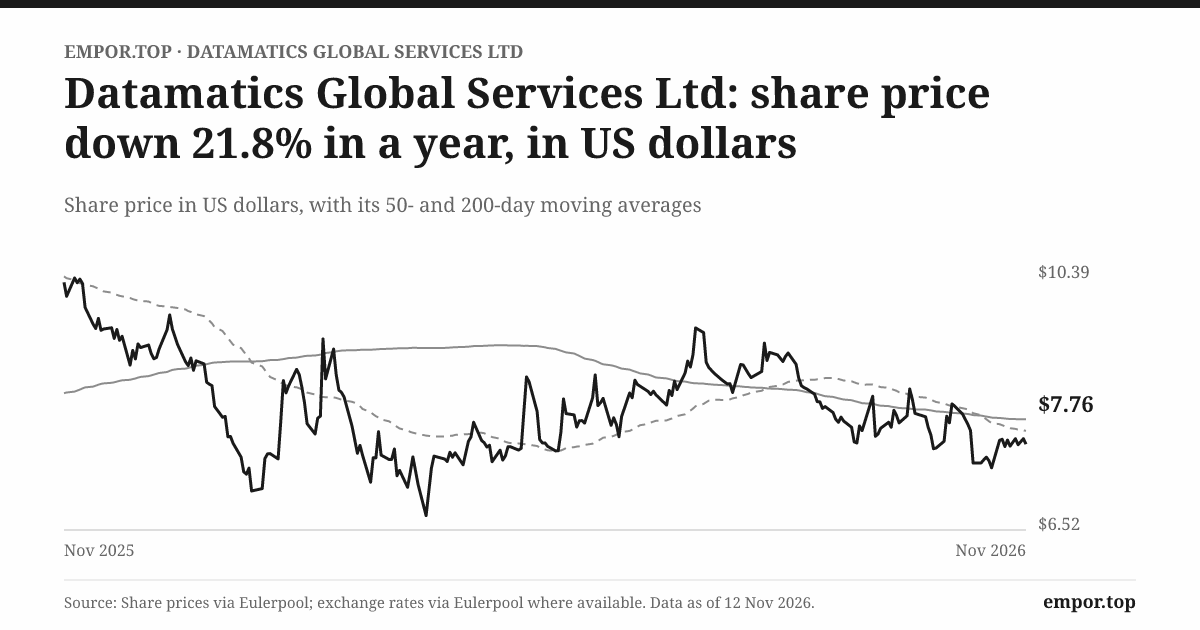
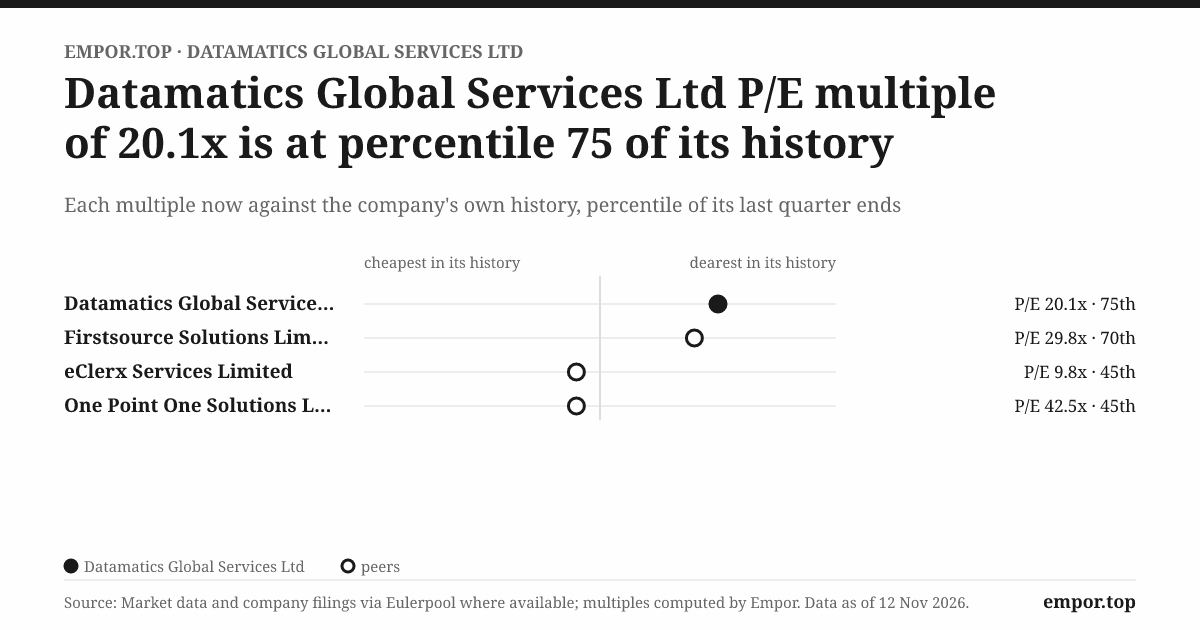
On 12 November 2026, the day before this story was written, a Datamatics share changed hands at about ₹730.17 That was roughly a fifth below its high of the previous twelve months, about ₹901, and comfortably above its low of about ₹637.17 At that price the whole company was worth about ₹4,340 crore on the stock market, and about ₹4,035 crore once its net cash was subtracted.17 The market was paying about 20 times the last twelve months' earnings, against a median of about 17.6 times over the past five years, and about 10 times operating earnings before depreciation.17 Flip the earnings multiple over and an investor buying the shares was getting an earnings yield of about 5%.
So the market is not pricing Datamatics as a distressed services company, nor as an AI winner. It is pricing it a little above its own recent history, which is another way of saying it expects the recent improvement in margins and growth to hold, and perhaps to continue. The question for this section is whether the evidence supports that expectation, and what would break it.
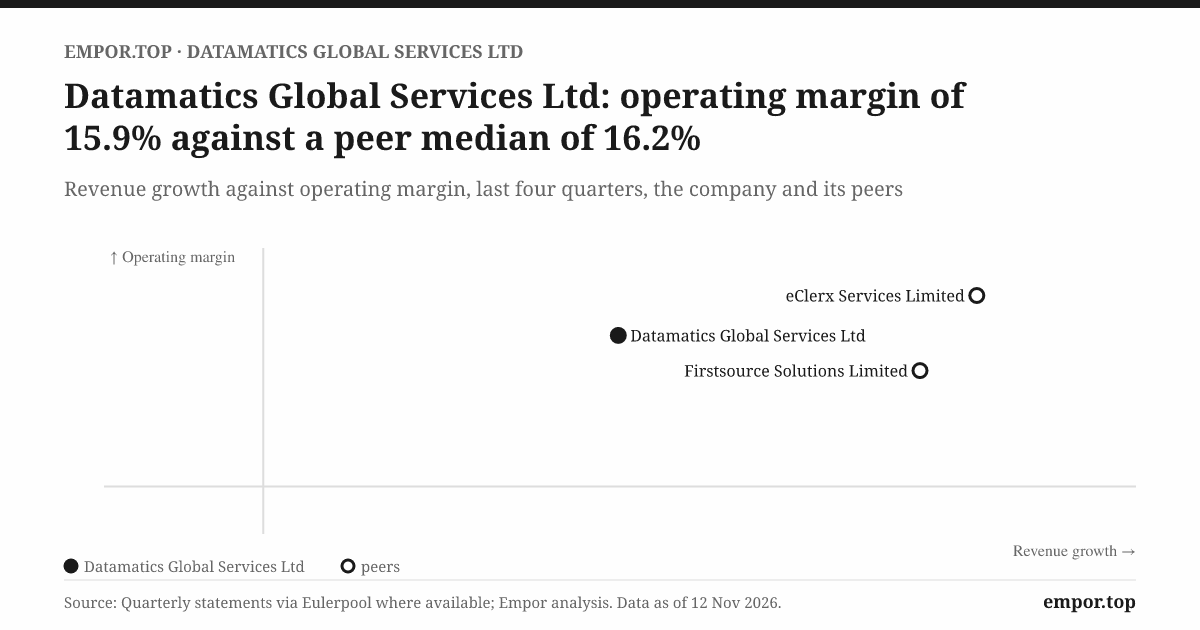
The bull case deserves its strongest form. Revenue grew about 11.5% in the September quarter, and the operating margin before interest and tax expanded to about 16.9%, the best level in the recent record.2 Digital Operations grew almost 16% at a margin above 21%, which is the profile of a business with real pricing room and real productivity gains, not one being squeezed.12 Over twelve years, cumulative operating cash flow exceeded cumulative profit, so the earnings are backed by money.3 The balance sheet is net-cash even after paying for TNQ, which gives the family the capacity to keep investing in AI at ₹40–50 crore a year and to make bolt-on acquisitions without diluting shareholders.29
Return on capital employed was about 17% over the last twelve months and return on invested capital about 18%, respectable figures for a group that has just added a large slab of goodwill.32 And the publishing franchise, enlarged by TNQ, puts Datamatics in a niche where specialised knowledge and long publisher relationships are genuinely hard to replicate. On this view, AI is a tailwind for a capable operator, and the market's slight premium to history is modest for a business on the cusp of faster growth.
The bear case deserves equal weight. The listed parent's own revenue fell about 5% in the year to March 2026.3 Over the three years to that date, net profit grew less than 1% a year even as revenue compounded at almost 11%, so very little of the top-line growth reached shareholders' bottom line.3 Return on equity has slipped from about 18% in the year to March 2022 to under 13% in the year to March 2026, as acquisitions and cash added equity faster than they added profit.3 AI revenue is not reported.
Digital Experiences was essentially flat in the September quarter.12 Management's own guidance implies the second half of the current year will grow more slowly than the first. And the biggest single driver of recent group growth was an acquisition, whose earnings now have to clear the amortisation of the intangibles it brought and justify a goodwill balance the auditors single out for scrutiny. On this view, the market is paying a premium multiple for growth that was partly bought, and for an AI story that cannot be measured.
The structure of the industry helps decide between them. Run through the five forces that Michael Porter used to describe how much profit an industry lets its players keep, and the picture for Datamatics' core work is mixed. Buyer power is high, because customers are large enterprises with alternatives, the top twenty supply over half of revenue, and the customer can build a capability centre or buy a start-up's tool. The threat of substitutes is the force that has changed most, because AI itself is a substitute for human process work.
Rivalry is intense, with larger IT and process firms able to bid for adjacent work. The threat of new entrants is moderate: starting a services firm is easy, but winning the trust of a global publisher or insurer takes years. Supplier power is mostly the power of labour, and Indian technology talent costs keep rising, with AI skills commanding a premium. This is not an industry that hands out fat profits by default; the profits have to come from execution and specialisation.
Hamilton Helmer's seven powers ask a narrower question: what, specifically, would let this company earn returns above its cost of capital for a long time? Scale economies are weak, because Datamatics is smaller than its main rivals. Network effects are absent. Brand matters at the margin but is not why customers buy process work. Cornered resources are hard to identify; no unique licence or patent protects the business. Counter-positioning, the power an insurgent has when incumbents cannot copy it without hurting themselves, is an interesting possibility in reverse: larger outsourcing rivals that live on headcount may be slow to embrace automation that shrinks their revenue, and a smaller firm willing to cannibalise itself could win.
But Datamatics also lives on headcount, so the advantage is not clearly its own. That leaves switching costs and process power, the embedded knowledge of how a particular customer's workflows run and the organisational habits that make delivery reliable. Those are the strongest candidates, and they are real. They are also the ones the company gives the least public evidence for, because it does not publish renewal rates, win-loss ratios or price realisation.
The calibrated verdict, then, is that the strongest possible advantage is domain experience embedded in customer operations and content workflows. The evidence leaves that claim intact but unproven, and narrower than the AI-first narrative. Datamatics may well be harder to replace than a generic vendor. It has not shown that it can raise prices, that customers renew at high rates, or that its products produce revenue on their own.
The risks run through specific mechanisms rather than generic macro worries. AI could reduce the volume of labour customers buy, so that every successful automation shrinks a contract unless it is repriced on outcomes. Client-owned teams and start-ups can take work in-house, as Kanodia himself said. Acquisition-heavy growth strains integration and puts the goodwill balance at risk if acquired growth fades. Foreign-currency movements and the fair value of a large treasury portfolio can swing reported earnings by amounts that have nothing to do with operations. And customer concentration, while moderate, is rising.
For an investor trying to track the story without drowning in data, three measures carry most of the weight. The first is organic constant-currency revenue growth by segment, which the company does not yet publish in that form; the nearest current reading is about 11.5% group growth in the September quarter, including acquired businesses. The second is segment operating margin with the amortisation of acquired intangibles shown separately, so that Digital Operations' roughly 22% margin can be judged on its own merits. The third is billed collections alongside unbilled revenue and contract assets, the clearest signal of whether recognised revenue is turning into cash; today, billed debtor days stand at about 64 and falling over the long run, while unbilled and contract-asset balances together exceed ₹330 crore.
It helps to ask what the price assumes in plain arithmetic. An earnings yield of about 5% means that, if profit never grew again, a buyer would earn roughly five rupees a year for every hundred invested, with all the risk of an equity attached. Nobody buys a services company on that basis. The buyer is implicitly assuming that profit grows, and grows faster than it did over the last three years, when it barely moved. If net profit compounded at around 10% a year, in line with management's organic ambition, the yield on today's price would rise above 7% within four years, which begins to look like a fair return for the risk. If profit kept trailing revenue as it has, the yield would barely move, and the multiple would have to fall to compensate. The market price, in other words, is a bet that the gap between revenue growth and profit growth of the last three years closes.
The valuation hurdle is simple to state. At about 20 times earnings, against a five-year median of about 17.6, the market is paying a little more for each rupee of Datamatics' profit than it has done on average in recent years. That premium is earned only if the business shows durable organic growth, not just acquired scale or an AI-labelled pipeline. If organic growth reaches the 10–12% that management describes and margins hold, the premium looks reasonable. If growth settles back to the decade's 9% and profit continues to trail revenue, the market will have paid for a change that did not arrive.
Business & Investing Lessons
The split between the listed parent and the consolidated group is the first lesson Datamatics teaches, and it is the one most likely to catch a casual investor. Each number answered a different question. The lesson for any investor in a holding-company structure is to decide which entity's economics they are buying, and then to demand the disclosure that separates organic performance from purchased perimeter. For founders, the lesson is the inverse: a corporate tree gives freedom to build and buy, and it also gives investors reasons to discount what they cannot see.
An acquisition earns its price after the seller leaves. The TNQ deal's price and the seller's accounts made it defensible. Neither proved the deal would work. The proof lies in the years that follow: whether TNQ's publishers stay, whether cross-selling produces revenue that neither business would have earned alone, and whether earnings justify the goodwill. A deal is not a success at signing, nor at the first exceptional loss. It is a success when it pays back.
AI adoption is not AI monetisation. Datamatics' AI-heavy pipeline and product catalogue still do not show that AI has changed its economics. For investors, the lesson is to price evidence of repeatable revenue, renewals and expansion, not the vocabulary of a pipeline. For founders, it is that the most persuasive AI story is a number, and the companies that can publish one will be valued differently from those that cannot.
A good cash record buys options; it does not prove the next option is good. Datamatics' long record of cash generation and a growing treasury gave the Kanodia family the means to buy TNQ outright. That record is a genuine strength, and it is also a temptation, because a family that accumulates cash will eventually spend it. The TNQ payout was the record being converted into a bet. Whether that bet was wise will be judged by what TNQ earns, not by how reliably the cash was accumulated in the first place.
The final lesson is about the opening question itself. When management said the most important number could not be counted, that was information. It may mean the work genuinely blends together, as Kanodia says. It may mean the number would be small. It may mean both. The disciplined response is neither to dismiss the AI story nor to buy it, but to ask what the company would have to show to make it real, and to wait for it.
Epilogue
Tonight Datamatics stands at an interesting point. The TNQ acquisition is paid for, leaving the group with about ₹557 crore of net cash and investments.2 Management's growth target, shift in sales strategy and AI investment now face their first tests.19
The next moments that will decide the story are not dramatic. They are results days. The December quarter will show whether the second-half slowdown management guided towards is as mild as it suggested, or whether the shorter AI engagements are starting to leave gaps in the revenue line. The March 2027 results and the annual report that follows will show the first full year of the enlarged publishing business with the remaining-stake payment behind it, and the goodwill impairment test will show whether management still believes TNQ's future profits justify the price, subject to auditor scrutiny. In February 2027, Rahul Kanodia's new five-year term begins, which makes the next annual report his first public accounting of the ₹3,000 crore ambition.
Each outcome has a clear meaning. If AI-heavy opportunities convert into renewals and larger recurring engagements, and the company starts to publish that conversion, the AI story will have become an AI business. If the ₹3,000 crore target is reached mostly through organic growth, with acquisition contribution disclosed separately, the family will have proved that the group's engine runs faster than its decade-long history. If Digital Operations holds its margin after TNQ's purchase accounting, and Digital Technologies grows without its economics being hidden inside the other segments, the margin engine will be shown to be durable rather than a one-time lift from acquired publishing. And if working capital and goodwill stay proportionate as the group expands, the cash record will have survived the shift to a more acquisitive strategy.
The opposite outcomes are equally clear. Short AI projects that end without follow-on work, growth that relies on the next acquisition, margins that slip as acquired intangibles amortise, or unbilled balances that grow faster than revenue would each say that the improvement of the last two years was more about perimeter than progress. The thesis stays open until organic segment growth, AI renewals and post-acquisition cash returns become visible, and the company controls whether that visibility arrives.
Outro
The November call returned to the question of how much of the business is AI. The answer was that AI is already inside the service, mixed into the work and impossible to pull apart. It is a perfectly honest answer about how modern process work is delivered. It is also a description of the company's defining tension. Datamatics may be using AI to sell more work, even as AI makes its revenue harder to classify and its customers more capable of doing the work themselves.
What remains is whether those capabilities become durable customer economics. The next chapter will decide whether the cash proves just as inseparable from the story.
References
-
Q2 FY2027 Earnings Call — Earnings Call Transcripts, Datamatics Global Services Limited, 2026-11 ↩↩↩↩↩↩↩↩↩↩↩↩
-
Q2 FY2027 Results — Datamatics Global Services Limited, 2026-11-03 ↩↩↩↩↩↩↩↩
-
Annual Report 2025–26 — Datamatics Global Services Limited, 2026-08-26 ↩↩↩↩↩↩↩↩↩↩↩↩↩↩↩↩↩↩↩↩↩↩↩↩↩↩↩↩↩↩↩↩↩↩↩↩↩↩↩↩↩↩↩↩↩↩↩↩↩↩↩↩↩↩↩↩↩↩↩↩↩↩
-
Annual Report 2014–15 — Datamatics Global Services Limited ↩↩↩↩
-
Shareholding Pattern Filings, September 2026 — National Stock Exchange of India ↩↩↩
-
TNQ Tech Acquisition Disclosure under Regulation 30 — NSE, 2024-12-09 ↩↩
-
Q1 FY2027 Earnings Call Transcript — Datamatics Global Services Limited, 2026-08-06 ↩↩↩↩↩↩↩↩↩↩↩↩↩↩↩↩
-
Datamatics subsidiary to acquire Chennai-based TNQ Tech for Rs 336 crore — Moneycontrol, 2024-12-09 ↩
-
TNQ Tech Financial Statements, FY2024–25 — Datamatics Global Services Limited ↩
-
Investor Presentation, Quarter Ended 30 September 2026 — Datamatics Global Services Limited ↩↩↩↩↩
-
FY2026 Results: Revenue up 15.3% YoY to ₹1,987.2 crore, EBITDA at ₹371.6 crore up 62.1% — Datamatics Global Services Limited, 2026-05-21 ↩
-
Announcements: Voting Results and Scrutinizer Reports — Datamatics Global Services Limited ↩
-
Datamatics Global Services Ltd Equity Quote — National Stock Exchange of India, 2026-11-12 ↩↩↩↩
 LinkedIn
 WhatsApp
 Reddit
 Hacker News
 Email
 Kindle
 RSS Feed
 Spotify
 Apple Podcasts
 Amazon Music
 Audible
 YouTube