Info Edge: The Marketplace That Became an Investor
I. A Jobs Website, a Startup Portfolio and a Founder’s Return
On the evening of 28 October 2026, the board of Info Edge (India) Limited released news that its own employees had probably never expected to read. Hitesh Oberoi, the managing director and chief executive, would step down at the close of business on 2 December, after nearly 27 years with the company.1 He would not leave entirely. From the next day he was to sit on the board as a non-executive director in the promoter category, subject to shareholder approval.1 The person stepping back into day-to-day command was the man who had started the company in the first place: Sanjeev Bikhchandani, the founder and executive vice chairman, who would become Executive Vice Chairman, Managing Director and Group CEO from 3 December.2
On the earnings call that followed, Oberoi said that it had not been an easy decision.2 Bikhchandani, asked about a successor, said there would be "nothing in a hurry" and that the first priority would be to give internal people a chance to grow.2 It was a calm handover, delivered in the flat cadence of a company that has spent three decades refusing to be dramatic. Yet it reopened a question that has followed Info Edge for most of its listed life: what exactly is this company?
Outside India, the name barely registers. Inside India, its brands are part of ordinary life. Naukri, a word that means employment in Hindi, is where a large share of the country's white-collar workers keep a resume.3 99acres is where families browse flats and brokers post listings. Jeevansathi, "life partner", is a matchmaking site. Shiksha helps students choose colleges. And alongside those portals, the same listed company owns stakes in startups it backed when they were small, including two that later listed on the stock market: Zomato, now called Eternal, and PB Fintech, the parent of Policybazaar.4 Those two are not Info Edge subsidiaries. They are investee companies, run by their own founders and boards. But their share prices flow into Info Edge's accounts, and sometimes they overwhelm everything else.
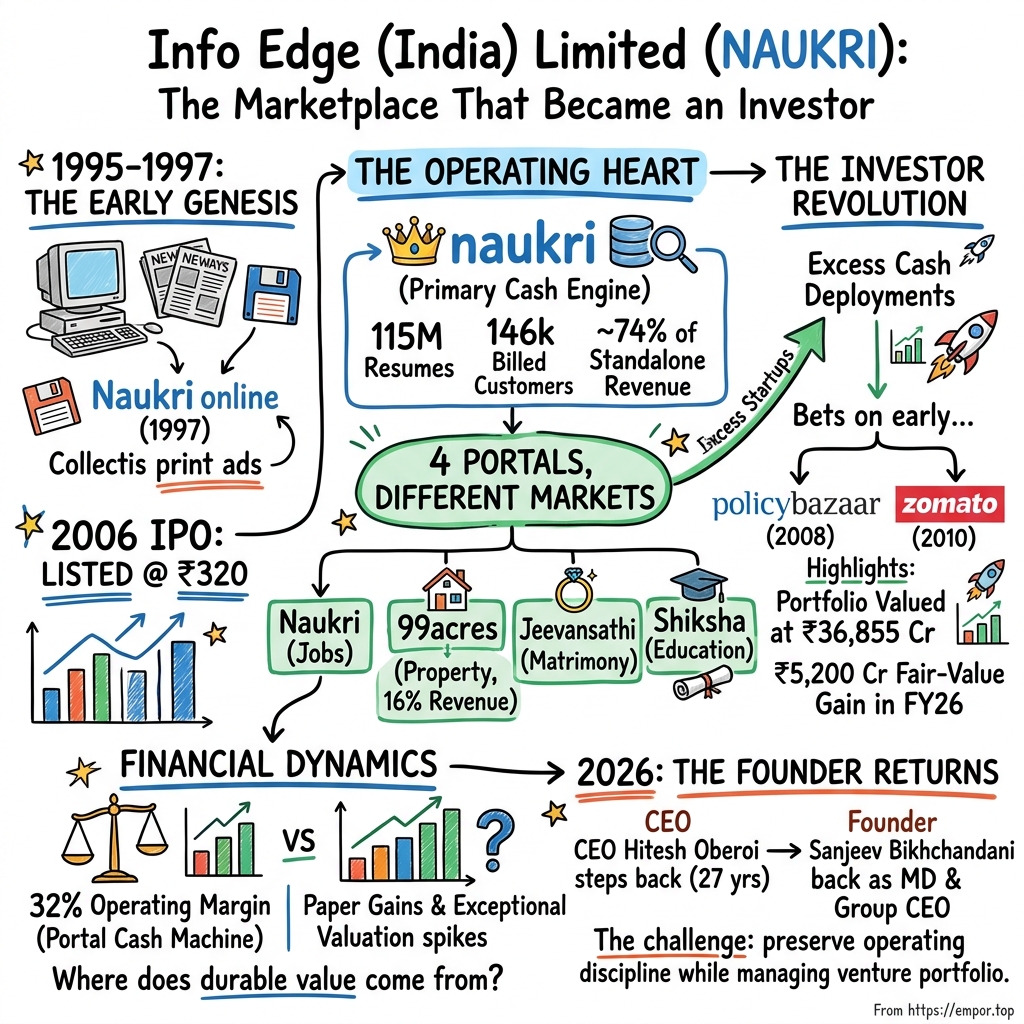
The scale of the operating business is real. In the year to March 2026, Naukri held about 115 million resumes and billed about 146,000 recruitment customers.5 Recruitment brought in roughly three of every four rupees of standalone revenue, and 99acres about one in six.5 Standalone revenue from operations grew 15% that year.6 Those are the numbers of a mature, still-growing marketplace.
Now look at the earnings line. In the same year, standalone earnings per share were ₹85.49 after exceptional items and ₹17.04 before them.7 The gap came from a single entry: a ₹5,200 crore fair-value gain on a non-current investment, which the company booked as exceptional.7 In other words, about four-fifths of what the headline said shareholders earned in FY26 came from re-marking a holding, not from selling job listings, property ads or matchmaking memberships. Nothing about that is improper. It is simply how accounting treats a company that is part operator and part investor. But it means a casual reader of Info Edge's profit line learns more about the stock prices of other companies than about the health of Naukri.
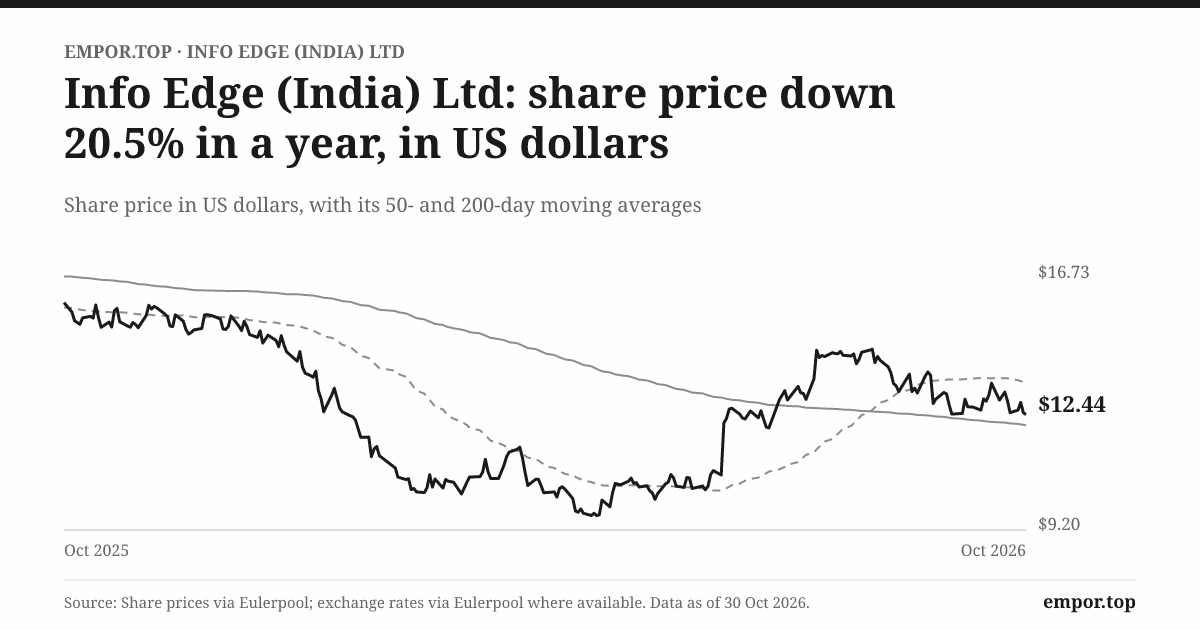
So there are two engines here. One is a set of classified marketplaces that sell access: employers paying to reach candidates, brokers paying to reach buyers. The other is a portfolio of startup stakes, funded over the years largely by the cash the first engine produced. The stock market values the whole at about ₹77,000 crore. The question this story sets out to answer is where that value is actually made. Is it the portals Info Edge operates, the stakes it owns, or the way the two feed each other: a marketplace that throws off cash and founder access, and a portfolio that turns that cash into options?
The short answer, which the rest of the story tests, is that the operating business is still led by recruitment. The portfolio has changed the company's value and its reported earnings, but it does not run the portals, and its gains are not portal cash. The longer answer involves a floppy-disk-era database, a dot-com crash survived on a shoestring, a string of new portals with very different fates, two of the best early-stage bets in Indian internet history, an earnings statement that needs translating, and now a founder who is taking the controls again.
The investigation has three threads. The first is durability: will employers keep paying Naukri more each year, even as LinkedIn, Indeed and artificial intelligence offer other routes to candidates? The second is breadth: can the company build a second business as strong as the first, or does the Naukri model only work for jobs? The third is accounting and capital: can an investor see the portals clearly through the fog of portfolio revaluations, and will the founder's return change how the company spends its money? To answer any of them, the story has to start where Bikhchandani did, with a pile of newspaper job advertisements and a market that did not yet exist.
 Subscribe on LinkedIn
II. The Jobs on the Floppy Disk
India in the early 1990s did not have a jobs market so much as a jobs rumour mill. A graduate looking for work scanned the classified pages of the big newspapers, asked relatives, wrote letters and waited. An employer who wanted to hire paid a newspaper to print a few lines of type and then sorted through envelopes. The information that mattered, who was hiring and for what, lived in scattered print columns and in people's heads. Whoever could gather it in one place would hold something valuable.
Sanjeev Bikhchandani was well placed to notice. He had studied economics at St. Stephen's College in Delhi, graduating in 1984, and then earned a management diploma from the Indian Institute of Management Ahmedabad in 1989.3 Before and around business school he had worked in advertising at Lintas, in marketing at HMM, the company later known as GlaxoSmithKline's Indian consumer arm, and in senior management at the company that owned The Pioneer newspaper.3 It was an unusual résumé for a technology founder because it had almost no technology in it. What it did have was an understanding of how brands reach people and how newspapers make money from classified advertising.
On 1 May 1995 he incorporated Info Edge (India) Private Limited.3 The company's founding charter tells you what he thought he was building. Its main objects were the business of "gathering, accumulating, organizing, tabulating" information, data and databases, and preparing reports, profiles and surveys.3 This was not a website company. It was an information company looking for a format. In those first years the work was the unglamorous kind: compiling data, selling research, keeping the lights on with services that paid now rather than later.
The format arrived in March 1997, when the company launched Naukri.com.3 The idea was simple to describe and tedious to execute. Take the jobs that were already being advertised in print, collect them, type them into a database and let people search them on a screen. In effect, the founders moved the classified page online and made it searchable. It is easy to forget how small the audience was. India had about 1.6 million personal computers in March 1997, fewer than two for every thousand people.3 As late as 2001 the country had under seven million internet users.3 Naukri was a website for a country that was only beginning to go online, built on the bet that the audience would arrive before the money ran out.
The name was part of the bet. Naukri translates to employment in Hindi, India's most widely spoken language, so the address explained the product to anyone who heard it.3 The company would later choose Jeevansathi, meaning life partner, for its matchmaking site on the same principle.3 Generic names are cheap to remember and expensive to copy, because a rival has to spend money teaching people a new word.
What the founders learned over the next decade was that "classifieds" was not one business. It was a family of businesses that looked alike on the screen and behaved differently underneath. In jobs, the payer was the employer or the recruitment consultant, a professional buyer who hired again and again and could be sold an annual package. In matchmaking, the payer was usually a family or an individual, buying once, emotionally and urgently, and leaving the moment the search succeeded. In property, the payer was a broker or developer, with lumpy demand that rose and fell with the housing cycle. Education would bring yet another customer: the college or advertiser trying to reach students during a short admissions season. The same database-plus-search format sat on top of all of them, but the economics of each depended on who paid, how often and why.
Info Edge still took its format into new markets. Jeevansathi went live in December 1998, and the company became its full owner in September 2004.3 In November 2000 it acquired an offline executive search business called Quadrangle.3 In September 2005 it launched 99acres for property.3 By March 2006, the company had 896 employees spread across 41 branch offices in 29 Indian cities, along with an office in Dubai for its Gulf business.3 That branch network is a detail worth keeping. A website that needed salespeople in 29 cities was not selling software that sold itself. It was selling to employers, face to face, in a country where many of them were still new to the internet.
By then the business had a shape. In FY2006, Naukri had more than five million registered job seekers and resumes, over 80,000 live job listings and about 20,000 corporate customers.3 The company earned about ₹82 crore of revenue that year and about ₹13 crore of net profit.3 Recruitment accounted for more than nine-tenths of total income, and had accounted for more than 95% in every one of the four previous years.3 The other portals were promising, but they were rounding errors.
Before the listing, the company attracted a pair of notable American backers. In April 2006, Kleiner Perkins Caufield & Byers and Sherpalo, a Silicon Valley venture firm, agreed to buy 5% of the company's shares from existing holders.3 It was a secondary purchase, so no new money reached the company, but it signalled that Silicon Valley investors saw something in an Indian classifieds business that had already turned a profit. Bikhchandani, meanwhile, still owned more than half the company.3
In November 2006 Info Edge listed on the Indian stock exchanges, with an issue price of ₹320 a share.8 The prospectus filed with regulators that autumn was unusually candid about the risks.9 It warned that the company was "highly dependant" on recruitment services.3 It warned that a large part of that business came from information technology and outsourcing employers, so a cut in their hiring would hurt results.3 And it warned of something that would matter for the next twenty years: the content of the database was provided by users who were "not bound by any exclusivity" and were free to post the same information elsewhere.3
That last sentence is the question the IPO raised. A job seeker could put the same resume on Naukri, on Monster and on a newspaper's site. An employer could post the same opening everywhere. If neither side was locked in, was Naukri a durable platform, or simply the classified page moved to a screen, waiting for a richer rival to move it somewhere else? The answer had already been tested once, in the years when the money almost did run out.
III. The Dot-Com Crash Tested the Classifieds Bet
The worst time to be a small Indian internet company was the moment just after everyone wanted to be one. In April 2000, near the peak of the global dot-com boom, Info Edge raised about ₹7.3 crore from ICICI's information technology venture fund.3 A month earlier it had hired a Hindustan Lever manager in his twenties named Hitesh Oberoi.3 Then the boom ended.
Oberoi came from the most practical corner of Indian consumer business. He held a computer science degree from IIT Delhi and an MBA from IIM Bangalore, where he had made the director's merit list, but his job before Info Edge had been regional planning and distribution for Hindustan Lever's ice cream division in north India.3 That is a job about routes, stock, retailers and whether the freezer cabinet is full on a hot afternoon. It was, as it turned out, good training for selling job listings to employers across a large country. He set up Naukri's sales and marketing operation, launched new products and helped start the Jeevansathi and 99acres businesses, which all reported into him by the time of the IPO.3 Bikhchandani was the founder with the information instinct. Oberoi became the operator who built the machine that turned it into revenue.
The crash did not arrive as a single event so much as a drought. Advertising budgets shrank, venture money disappeared, and the global job sites that had promised to conquer India had far deeper pockets than a Delhi startup with a few crore in the bank. Info Edge's own accounts from the period show how thin the line was. In the year to March 2002, the company had revenue of about ₹3.6 crore and lost about ₹1.1 crore.3 A year later revenue had more than doubled to about ₹9 crore and the company scraped a small profit.3 Naukri, by one later account, had broken even within two years of launch and turned profitable in 2002.10 The money from ICICI was not a war chest. It was oxygen.
The clearest evidence of how the company survived sits in its marketing budget. Advertising and marketing absorbed about 11% of total income in FY2002 and only about 5% in FY2003, the depths of the bust.3 Then, as India's internet audience began to grow, the company opened the taps: marketing climbed to about 22% of income by FY2006.3 That sequence is the survival strategy in miniature. Spend little when the audience is not there and every rupee is precious; spend heavily once the market starts forming, so that the brand is the one people remember when they finally go online. Internet users in India grew from under seven million in 2001 to about 53 million in 2005.3 Naukri was waiting for them with a name that explained itself and a budget to make sure they heard it.
The popular version of what happened next is that Naukri won because its rivals failed. That is partly true and largely beside the point. Competitors did come and go, and some of the international players lost interest in India. But a competitor's failure is not proof of a moat; it may only prove the competitor ran out of patience first. The more useful question is what Naukri built while others were retreating, and whether that still explains the business today.
What it built was a two-sided marketplace, and the easiest way to understand one is to stand in a recruiter's chair. Imagine a hiring manager at a Pune software firm who needs five Java developers with three years' experience. She can post an advertisement and wait. Or she can log into a database of millions of resumes, filter by skill, city, notice period and salary, and start calling people that afternoon. The second option is worth paying for, and the more resumes there are, the more it is worth. Now sit in the job seeker's chair. He uploads a resume once, for free, because that is where the recruiters are searching. The more recruiters there are, the more reason he has to keep his profile current. Each side's presence makes the platform more useful to the other. That is a network effect, and it is the core of the Naukri thesis.
Naukri's products tracked that logic from early on. By 2006, listing a resume was free, while job seekers could pay for display, resume-writing help or alerts.3 Employers bought tiered job-posting packages with names like Hot Vacancies and Best Places to Work, and the higher tiers came with access to the resume database and screening software.3 That database had its own brand, Resdex, and an employee who joined in 2001 was credited with developing it.3 This was the turn from listing site to paid recruitment business. A listing site charges for an advertisement. A recruitment business charges for access, workflow and speed, and it can sell more of each to the same customer every year.
The growth since then is the visible result of that history. Naukri went from about five million resumes and 20,000 corporate customers in 2006,3 to 57 million resumes and 76,000 clients by 2018,10 to about 115 million resumes and 146,000 billed customers in FY26.5 Over the same span, the share of the company's revenue coming from recruitment fell from more than nine-tenths to about three-quarters, not because recruitment shrank but because the other portals finally grew.5 Recruitment is still the engine, and in the September 2026 quarter it ran at an operating margin of about 59%.2 For each ₹100 an employer paid, nearly ₹60 was left after the costs of running the segment. Businesses without some advantage rarely keep margins like that for long.
Now the test. A resume count measures supply. It does not by itself prove that employers keep coming back, or that they accept higher prices each year. Those are the things that would show the strength of the marketplace, and Info Edge does not publish them in a clean form. It does not disclose customer retention rates, renewal rates by cohort or price realization per customer, and it gives no aggregate share of revenue that is contractually recurring.5 The nearest proxies are billings, the amount customers commit to pay before the revenue is recognised, and the count of billed customers. On those, the record is steady rather than spectacular. Recruitment billings grew about 13% in the September 2026 quarter, and management told analysts the underlying rate was about 14% to 15%, saying the 17.5% posted in the June quarter "was not the real number" because of renewal timing.2 It is to management's credit that it talked the stronger figure down. It also means growth is now in the mid-teens, not the forties of the post-pandemic rebound.
The mix inside that growth is the more revealing clue. In the September quarter, billings from IT, technology and outsourcing employers grew only about 3%, while billings from global capability centres rose about 7% and from other sectors about 18%.2 Oberoi described hiring as steady and "led mainly by replacement demand".2 The IT dependence that the 2006 prospectus warned about has not disappeared; it has been diluted by a broader employer base. A hiring downturn in technology still shows up quickly, but it no longer decides the whole year.
Competition sits in the same frame. LinkedIn offers recruiters a global professional network and its own paid search tools. Indeed aggregates listings and sells sponsored visibility. Foundit, the former Monster India, competes head-on in the Indian resume market. Each is an alternative route to candidates, and recruiters routinely use several at once. Naukri's claimed edge is narrower and more specific: an India-focused resume base that is deep in the mid-level and mass white-collar segments, combined with recruiter workflow tools built around how Indian companies hire. That claim is plausible given the scale and the margins. It is not proven in the way a market share number or retention series would prove it, and the company publishes neither for the full hiring market.
Which brings the story to the unresolved question of the moment. Info Edge now says its AI and data products run at an annualized rate of about ₹240 crore, a high single-digit share of recruitment revenue, and that clients who bought those offerings paid on average at least 10% to 15% more.2 Oberoi put the challenge in one line: "Building an AI product is getting easier, getting it adopted at scale is not."2 There are two ways to read that. If AI makes matching sharper, a company with the biggest database and the most recruiter behaviour to learn from should benefit most. If AI makes resumes easier to parse, summarise and source from anywhere, the database may become easier to substitute. The answer will show up in the same numbers as before: billed customers, retention and price. For now, the AI revenue is real but small, and it is too early to say which reading wins.
What is clear is that the Naukri model worked for jobs. The harder test was whether it would work anywhere else.
IV. Four Portals, Four Different Markets
Picture four customers on the same morning. A recruitment consultant in Bengaluru renews an annual Naukri package because she fills dozens of roles a quarter. A broker in Noida pays to promote twenty flats on 99acres and checks whether the inquiries are real buyers or idle browsers. A mother in Jaipur buys a premium Jeevansathi membership so she can contact the families of promising matches for her son, and hopes she will never need to buy it again. An admissions officer at a private college pays Shiksha to put the college in front of students comparing engineering programmes, for a few months a year. All four are buying the same basic thing, attention from the other side of a marketplace. They could hardly be more different as customers.
Info Edge took its classifieds thesis into each of these markets on the assumption that the playbook would travel: build the database, rank in search, sell access to the side that pays. Twenty years later the outcome is uneven, and the unevenness is the lesson.
Property was the most natural second act, because like jobs it involves a professional intermediary who lists again and again. 99acres launched in September 2005, when its main competition was print newspapers.3 It is now the clearest material second operating platform in the group, at about 16% of standalone revenue in FY26, with about 1.27 million paid listings that year.5 The competition is fierce and well funded. Magicbricks, owned by the Times group, has long been its closest rival, Housing.com has fought for the same buyers and brokers, and NoBroker built a model around cutting brokers out entirely, which attacks 99acres' paying customer at the root.
For most of its life 99acres has been the property business that earned attention without earning much profit. That has started to change. In the September 2026 quarter its billings rose about 21%, revenue rose about 17%, and its operating loss fell by more than nine-tenths, from about ₹23 crore a year earlier to under ₹2 crore.211 Cash from operations improved to about ₹22 crore from about ₹2 crore.2 Management said inquiries rose about 33% while marketing spending fell about 13%, and that it expected the unit to generate positive operating cash in FY27.2
The company also cites traffic leadership, saying 99acres held about half of web time spent among the top three property portals.2 That is a meaningful clue, but it is not revenue share and it is not profit. A portal can lead on time spent and still lose money if brokers will not pay more for the leads. The test for 99acres is whether paid listings and repeat advertiser spending keep growing now that the marketing cushion is being withdrawn. One quarter of near-breakeven after two decades is a turning point worth watching, not yet a business on par with Naukri.
It is worth pausing on why property took so long. A recruiter typically has one main database to search, and if that database has the most candidates, the recruiter's choice is easy. A property broker has no such loyalty. The same flat can be listed on every portal at once, and brokers judge each one by a single number, the quality of inquiries per rupee spent. That makes property a market in which no portal can easily become the default, so rivals keep spending on advertising to win buyers' attention, and margins suffer for everyone. 99acres' recent improvement came, by management's account, from more inquiries on less marketing spend.2 If that holds, it suggests the portal is finally earning a position rather than renting one. If marketing has to rise again to defend traffic, the improvement will prove cyclical.
Matchmaking is a different animal. Jeevansathi competes with Shaadi.com and Matrimony.com, the listed parent of BharatMatrimony, which were already its named rivals in 2006.3 The economics are hard by design. A successful match removes two paying customers, and the decision to pay is emotional and episodic rather than professional and recurring. Info Edge has nevertheless grown the business: matchmaking billings rose about 23% in the September 2026 quarter, with Jeevansathi up about 18% and Aisle, a dating app the group owns, up about 40%.2 The segment is close to operating breakeven, with Jeevansathi earning about ₹2 crore and Aisle losing about ₹3 crore in the quarter.2 That is a respectable recovery, and it should be kept in proportion. Matchmaking is a small option inside a recruitment company, not a peer of Naukri.
Education is where the playbook has been tested hardest. Shiksha, launched in 2008,10 helps students discover colleges and courses and earns money from institutions that want to reach them. Its model depends on a chain that runs through search engines: a student types a question into Google, a Shiksha page ranks near the top, the student clicks, and Shiksha passes interest on to colleges. In the September 2026 quarter Shiksha's billings fell about 27% and its revenue about 9%, and the unit lost about ₹16 crore of cash from operations.211 Management's explanation was direct: "AI-driven changes in search behavior have reduced the referral traffic Shiksha relied on."2 When the search engine answers the student's question itself, the student no longer needs to click through.
That sentence deserves more weight than its place in a quarterly call might suggest. It is the first time in this story that a portal's decline has been blamed not on the economy or on competitors but on a change in how people find information. Shiksha is responding with AI voice-based counselling and an expansion into study-abroad markets such as the UK, the UAE and continental Europe.2 Those are plausible moves. They are not yet revenue. The broad claim that every Info Edge portal benefits from India's digital growth does not survive Shiksha's quarter, and the reason it fails is one that could, in principle, touch any business that relies on being found through search.
Underneath all four portals lies a question about how predictable the revenue is. Info Edge describes its deferred revenue, the cash customers pay in advance for services not yet delivered, as reflecting "the subscription nature" of a large part of its business.6 Billed customers and paid listings help explain the model, because they show a base of buyers who commit before the service is used. But the company does not disclose a consolidated share of recurring revenue, a standard contract length or minimum commitments across the four portals.5 Investors can see that money arrives early. They cannot see how much of it is contractually certain to come back.
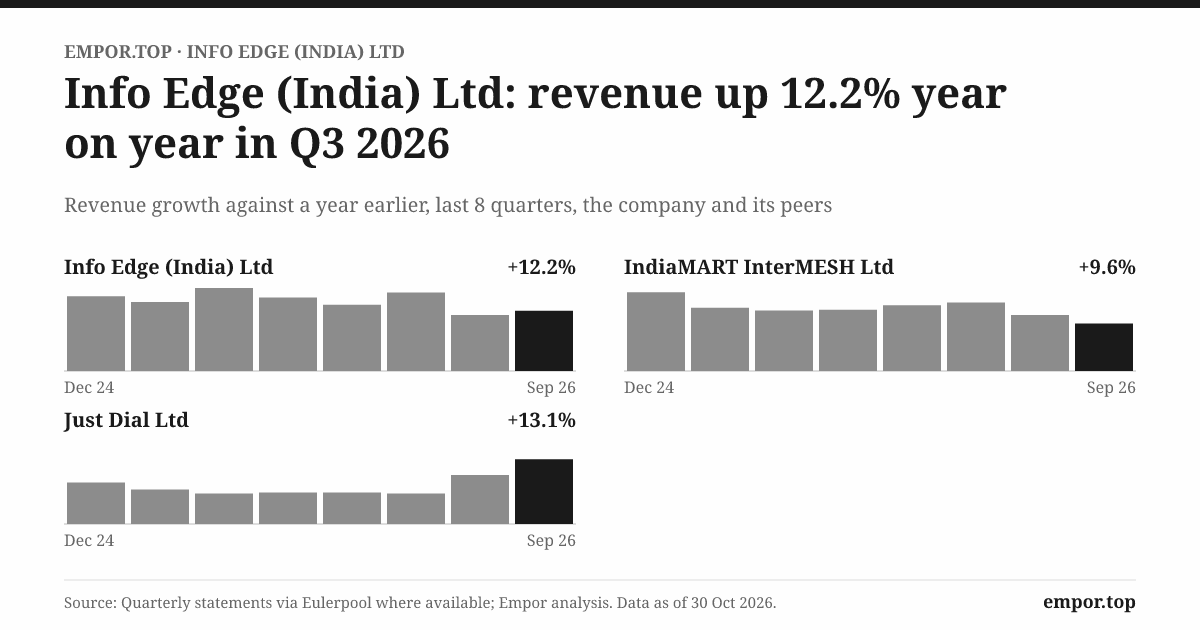
Put the four together and the picture is of a company whose diversification is real in name and partial in substance. Excluding Shiksha, standalone billings grew more than 14% in the September quarter.2 Including it, they grew about 13%.2 Recruitment remains the engine, property is finally improving, matchmaking is stabilising and education is shrinking. The repeatable format did not produce repeatable businesses.
Which raises an obvious question. If the cash from Naukri could not be fully redeployed into portals as good as Naukri, where else could it go? Info Edge's answer, starting in 2008, was to back other people's companies.
V. The Bet That Made the Listed Company a Venture Investor
In 2008, a listed jobs company in Delhi wrote a cheque of about ₹20 crore to a young insurance comparison website called Policybazaar, and took a 49% stake.10 Two years later it began investing in a restaurant listings startup called Zomato.10 Neither looked like an obvious bet for a company whose shareholders had bought into Naukri. Insurance comparison and restaurant menus have nothing to do with recruitment. Yet those two decisions would eventually reshape Info Edge's balance sheet more than anything its own portals did.
Why would an operating company do this at all? The logic begins with Naukri's economics. A recruitment marketplace that runs at high margins and asks customers to pay in advance produces more cash than it can sensibly spend on itself. A jobs website does not need factories or warehouses. Its main costs are people, technology and sales. After paying them, the cash piles up. A company in that position can return the money to shareholders, hold it, or try to find new uses. Info Edge did a little of the first, a lot of the second and, increasingly, the third.
The company also had something a conventional venture fund lacks. Bikhchandani and his colleagues had built an internet business in India through a crash, which gave them credibility with founders and a practical sense of what early-stage companies need. They could offer patience, because they were not managing a fund with a ten-year clock. And they could offer an operator's view on hiring, pricing and selling to Indian customers. Bikhchandani described the posture in 2018: "We are primarily an operating company. So our focus is going to be on the businesses we run."10 The investments, in that framing, were a sideline. The numbers would argue otherwise.
By the time of a 2018 profile, Info Edge had invested about $25 million in Zomato and held about 31% after a funding round that February.10 Over the following years both investee companies grew into major listed businesses. Zomato, later renamed Eternal, and PB Fintech, the parent of Policybazaar, are now public, and Info Edge holds stakes in both.4 Their market prices pass through Info Edge's accounts as fair-value changes, which is why the reported profit line moves so violently. The fact pattern is visible in the consolidated record: a net profit of about $1.7 billion in FY2022, the year of Zomato's market debut, followed by a consolidated net loss in FY2023 when values fell back.12 There had also been a consolidated loss in FY2020.12 The portfolio can giveth and taketh away within a year.
By the time of its FY25 shareholder letter, Info Edge reported that it had invested about ₹3,959 crore across its platforms and that the portfolio was then valued at about ₹36,855 crore.1314 Read that carefully. It is a historical snapshot, valued on a particular date at particular share prices, not a current valuation. It also mixes listed stakes, which can be sold at market prices if the market will absorb them, with unlisted holdings valued by estimation. And it is a paper figure. Much of the gain has not been turned into cash.
That distinction is the heart of how to think about this engine. There are four different things an investor could mean by "returns" here. There are realized proceeds, the cash Info Edge actually received from selling shares. There are carrying values, what the stakes are worth on the balance sheet today. There are fair-value gains, the change in that value that runs through profit or other comprehensive income. And there is the future market value of the remaining shares, which no one knows. A paper gain is not portal cash flow, and it is not yet shareholder cash either. Until the stakes are sold or distributed, their value depends on other companies' share prices.
The other side of the record matters just as much. Info Edge has not made two investments. Management said on the October 2026 call that the portfolio spans about 135 companies, with about ₹5,000 crore invested through the balance sheet and through alternative investment funds it sponsors.2 Some of those companies have done well, and some have gone to public markets. Others have been written down, wound down or sold at modest values. The company does not publish a clean, comparable account of every investment's outcome, with cost, proceeds, write-downs and current value side by side. Without that, two breakout winners can stand in for the whole portfolio, and that is exactly the error a careful investor should avoid. In venture investing, a few winners usually carry the rest; the question is whether those winners were luck or a repeatable process, and the evidence available cannot settle it.
There is also a structural shift worth noticing. Early on, Info Edge invested directly from its balance sheet. More recently, part of the new money has gone through alternative investment funds that Info Edge sponsors, alongside the balance-sheet investments.2 That makes the investment engine look more like a fund manager with the listed company as anchor investor. It may be a more professional structure. It also adds another layer between portal shareholders and the cash those bets eventually produce.
The investment discipline claim can also be tested on acquisitions closer to home. In May 2019, Info Edge agreed to buy 100% of Highorbit Careers, the owner of iimjobs and hirist, for about ₹80.82 crore in cash.15 Iimjobs, founded by Tarun Matta, served premium management roles and had about 23,000 job postings and 1.8 million applications a month; hirist focused on technology jobs.15 Oberoi pitched the logic plainly: "Given our massive customer base in Naukri, together we are confident of taking this business to the next level."15 The deal made strategic sense. It brought premium and specialist hiring capabilities next to Naukri rather than letting a rival own them. But no purchase multiple or comparable valuation was disclosed, so there is no reliable basis to call the price cheap or expensive. The same is true of later adjacent purchases in recruitment and HR technology, such as the employer-review platform AmbitionBox, which sit inside the recruitment business as capability extensions.5 Their prices, where undisclosed, limit any benchmarking of how well the company buys.
So the verdict on this engine is mixed in a specific way. The early bets on Policybazaar and Zomato were genuinely consequential, among the most valuable early-stage investments any Indian company has made. They do not by themselves prove repeatable venture returns. The record that would prove it, a full distribution of outcomes across all 135 or so companies, is not published.
The capital-allocation test for the next decade is therefore not whether Info Edge can find another Zomato. It is whether the company will disclose realized returns and impairments alongside new commitments, and whether portfolio value becomes cash that reaches shareholders or funds the portals. Until then, the investment engine will keep complicating the earnings statement.
VI. The Margin Machine Has an Earnings Problem
Open Info Edge's FY26 annual results and the headline looks like a company that quintupled its earnings overnight. Standalone earnings per share came in at ₹85.49.7 Then read one line further. Before exceptional items, the figure was ₹17.04.7 The difference was a ₹5,200 crore fair-value gain on a non-current investment, recognised because a holding was re-marked to a higher value.7 No employer paid a rupee more for it. No broker renewed a listing because of it. It was the stock price of another company, translated into Info Edge's accounts.
This is the earnings problem in a sentence: the portals produce one kind of profit, the portfolio produces another, and the headline number adds them together. To see the machine underneath, an investor has to take the accounts apart.
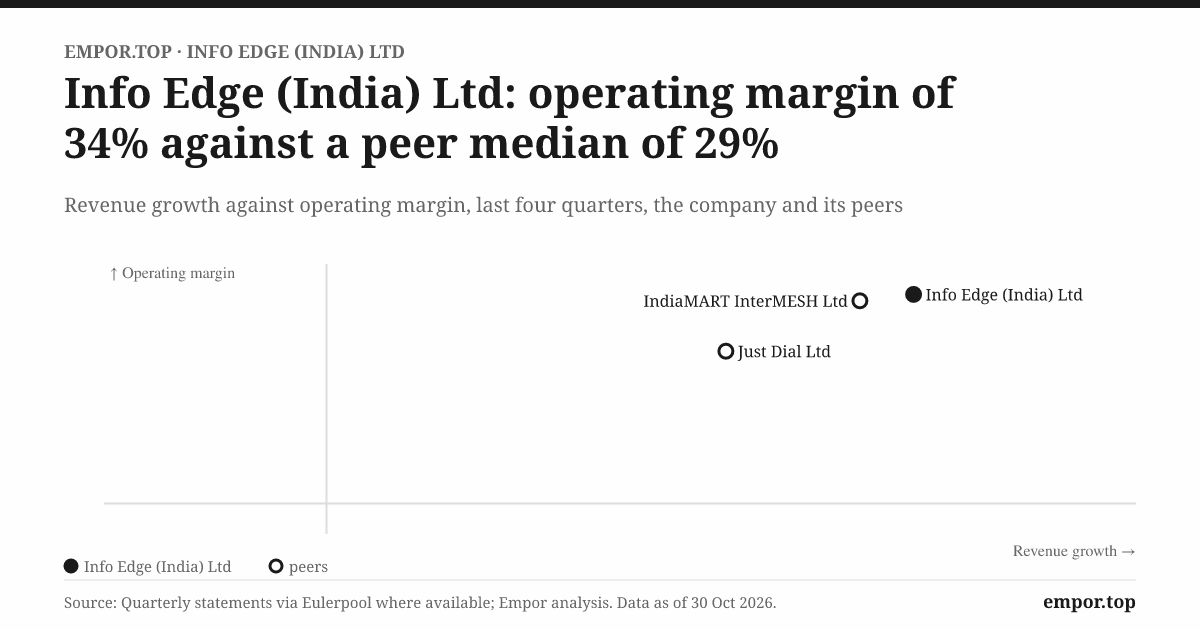
Start with the part that is genuinely strong. On the consolidated measure, Info Edge's operating margin in FY26 was about 32%, up from about 21% five years earlier and from single digits a decade ago.12 Over the four most recent quarters, operating profit grew faster than revenue: in the September 2026 quarter, consolidated revenue was up about 12% on a year earlier while operating profit rose about 29%.7 On the standalone portal business, Oberoi reported revenue of ₹842 crore for the quarter, up 13%, and operating profit of ₹347 crore, up 30%.2 That is operating leverage, the happy situation in which each extra rupee of revenue arrives with less than a rupee of extra cost, so margins widen as the business grows.
Why does that happen here? Because the business has almost no physical assets to feed. In the first half of FY27, standalone spending on property, equipment and intangible assets was about ₹21 crore, against revenue of about ₹1,666 crore.7 The company says its research and development is not capital intensive and is expensed within operating costs, without a separately stated amount.4 The real inputs are people, product and the sales force, and even headcount is not rising: the company reported 5,878 permanent employees at March 2026, against 6,065 a year earlier, though the definitions may not be strictly comparable.413 A marketplace that grows billings in the low teens while holding its workforce flat will widen its margins, at least until it decides it needs to hire again.
Now the cash. Over the twelve years from FY2015 to FY2026, Info Edge reported cumulative consolidated net profit of about ₹18,069 crore but cumulative cash from operations of only about ₹5,371 crore, around 30% of profit.12 On first reading, that looks alarming. A business that says it earned ₹18,000 crore but collected only ₹5,000 crore in operating cash would normally prompt questions about whether customers are paying.
Here the explanation runs the other way. The gap is mostly the portfolio, not the portals. Fair-value gains on stakes like Eternal and PB Fintech enter net profit without any cash changing hands. Interest on fixed deposits and gains on treasury instruments also lift profit, but in Indian cash-flow statements the interest and investment proceeds sit under investing activities, not operating cash. The years when investment marks surged, such as FY2022, inflate the profit total; the years when marks fell drag it down. None of that says the portals failed to collect. It says profit is the wrong yardstick for this company's operating cash.
The cash story that does belong to the portals is healthier. Free cash flow, operating cash after capital spending, totalled about ₹4,296 crore over the same twelve years.12 Dividends absorbed about ₹1,854 crore of that, a little over two-fifths.12 Cash and short-term investments rose by about ₹3,857 crore.12 It is tempting to add those up into one tidy bridge, but they describe different pools of money. The rise in cash was helped by external capital as well as operations: in FY2021 the company raised ₹1,875 crore through a qualified institutional placement, a share sale to large investors.13 Some of the free cash, meanwhile, went into startups. A reader who adds free cash flow to dividends and the cash build will double count. The honest summary is that the portals generate solid, growing cash, and that cash has gone into a mix of dividends, investments and the treasury.
The distinction between the standalone and consolidated accounts makes this sharper. The standalone accounts largely show the operating portals and the investments Info Edge holds directly on its balance sheet. The consolidated accounts add controlled subsidiaries, employee and investment trusts, and the group's share of joint-venture results.4 When analysts compare Info Edge's multiples with those of other internet companies, they are usually using consolidated earnings, which are the noisiest version.
The FY26 standalone income statement shows just how much of the "pre-exceptional" profit was itself treasury income. Standalone profit before tax and exceptional items was ₹1,473 crore.4 Of that, ₹335 crore was other income, about 23%, including ₹239 crore of fixed-deposit interest and ₹80 crore of net gains on investments carried at fair value through profit or loss.4 On the consolidated side, other income was about ₹1,059 crore.4 So even the cleaner earnings figure is not purely the portals. About a quarter of standalone pre-tax profit came from the company being a large holder of cash. At the end of September 2026, that cash and treasury pile stood at about ₹4,976 crore.2
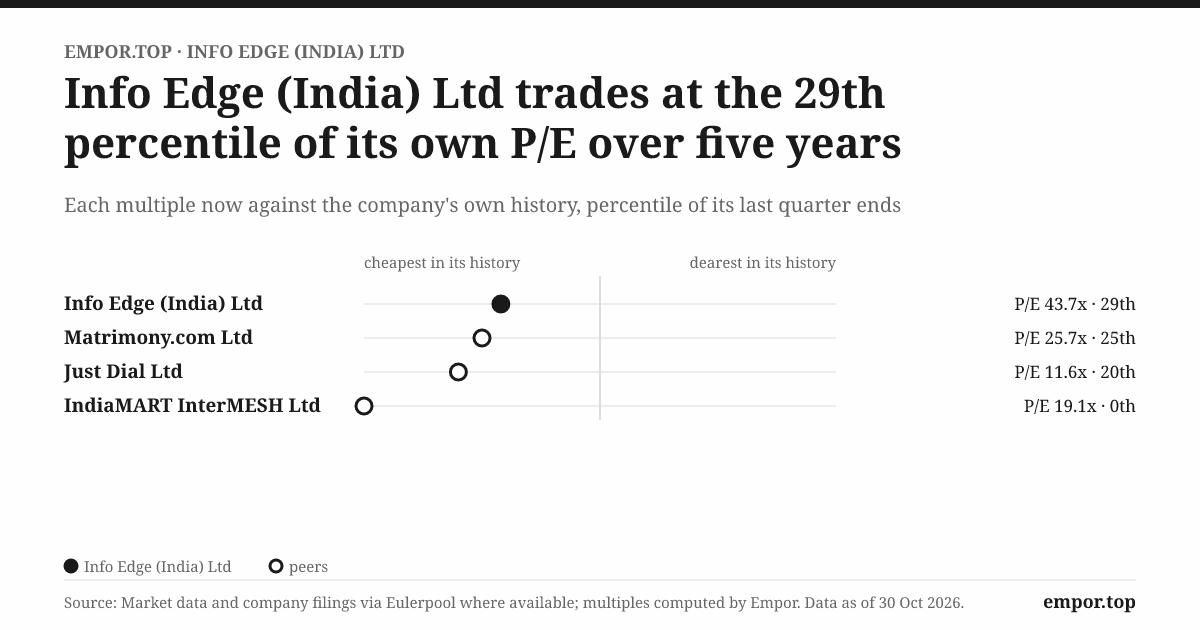
That treasury helps explain the valuation multiples, which are themselves clues rather than conclusions. At the end of October 2026, the shares traded at about 44 times trailing earnings, compared with a five-year median of about 64 times.12 A casual reading says the stock is cheaper than usual. A careful reading asks what is in the "E". Trailing earnings include investment gains, so the multiple swings with the portfolio as much as with the share price. On measures that look only at revenue, the shares are still priced for a great deal: about 22 times sales on an enterprise-value basis, an earnings yield of about 2.3% and a free-cash-flow yield of about 0.4%.12 Those figures imply that the market expects either decades of strong portal growth, substantial value in the portfolio, or both.
The working-capital picture fits the advance-payment model. Customers often pay before they receive the service, so Info Edge holds more of its customers' money than they hold of its own; on the consolidated measure, working capital has run at a large negative number of days of revenue for a decade.12 Receivables are a small item. Customers are generally given 30 to 90 days to pay.4 Debtor days rose to about 20 in FY26 from about 2 in FY25, which looks dramatic but has swung within that range before, peaking at about 21 in FY24.12 At standalone level, trade receivables were only about ₹10.8 crore net at March 2026.4 About ₹3.4 crore of invoices were classified as showing a significant increase in credit risk, most of them six to twelve months overdue, and a further ₹0.2 crore was credit-impaired.4 The company reports no disputed receivables and calls concentration risk low.4 For a business with revenue measured in thousands of crores, these are small, watchable items, not a collections problem.
The number an investor needs next is one the company does not publish: a multi-year bridge from portal operating profit to collected operating cash, with investment gains and treasury income stripped out. Without it, outsiders have to build it themselves from segment results and cash-flow lines. With it, the market would be able to price the two engines separately. That choice, more transparency or less, now belongs to a founder who is about to take the controls again.
VII. The Founder Takes the Helm Again
When the 2006 prospectus introduced Info Edge's leadership, Bikhchandani was 42 and the chief executive, and Oberoi was 33 and the chief operating officer.3 Twenty years on, the roles have come full circle. Oberoi is stepping down from the managing director and chief executive role and joining the board as a non-executive, non-independent director in the promoter category.1 Bikhchandani is returning to the executive role.2
The prospectus also recorded a small detail that says a lot about how the partnership worked. In FY2006, the founder-CEO's gross compensation was about ₹55 lakh, while the COO he had hired six years earlier received about ₹73 lakh.3 Founders who pay their operators more than themselves are usually signalling where they think the value is being made, and Bikhchandani's own wealth was always in his shares, of which he held more than half before the listing.3 That same year he was named a finalist for an Ernst & Young entrepreneur award, the first of many public honours.3 He became the face of Indian internet entrepreneurship, a frequent speaker on bootstrapping and patience, while Oberoi stayed largely behind the business.
For most of the listed company's life, these two men split the work in a way outsiders found easy to read. Bikhchandani was the founder, the public face, the storyteller of Indian entrepreneurship and the instinct behind the early investments. Oberoi was the operator, the engineer-turned-salesman who ran the portals day to day and kept margins rising. In practice the boundary was porous, but the shorthand held: one man thought about what to build and back, the other made sure the businesses delivered.
That shorthand matters because the person now taking the executive role is the one most associated with the investment engine. The transition therefore makes capital allocation a central governance question. Will the founder's return mean more ambitious startup commitments, larger acquisitions or a different appetite for spending on new products? Or will it mean more continuity, with the same operating managers running the portals and the founder overseeing strategy? The company has said little so far beyond continuity language, and Bikhchandani's own comment on succession, "nothing in a hurry", suggests an interim arrangement rather than a new decade-long plan.2
The finance chair has also changed in the same stretch. Chintan Thakkar, who had served as chief financial officer, ceased in that role in November 2025, and the company appointed an interim replacement.4 Two changes at the top in a year are not alarming in themselves. They do mean the team that will explain the next operating plan is newer than the one that explained the last one.
The October 2026 call offered an early read on how that team talks. In the prepared remarks, management stressed steady recruitment demand, the improvement at 99acres and the growth of new products. Naukri 360, a higher-tier offering for recruiters, grew billings about 37%, and the share of monthly users who pay for it rose to about 2.7% from about 1.3% in January 2025.2 JobHai, the group's platform for blue-collar and entry-level jobs, grew billings about 86% with investment levels "broadly unchanged".2 In the analyst questions, the conversation turned to the mechanics underneath: how annualized AI revenue was measured, whether AI products were being bundled into existing packages, and how sales targets were set. Oberoi's answer on the last was that the company was setting sales targets at 14% to 15% growth, below the June quarter's headline.2
There is a pattern in that exchange worth naming. Management is good at reporting launches: AI tools for recruiters, voice-based counselling at Shiksha, premium tiers at Naukri. It is more cautious about reporting what those launches earn. The AI figure, about ₹240 crore annualized, was calculated by multiplying a single quarter's revenue by four.2 JobHai's billings growth is impressive but comes off a small base and the business is still investing. The gap between product announcements and revenue is not a sign of bad faith. It is the normal state of a company trying new things. But the new leadership's credibility will rest on narrowing it.
Ownership is the strongest alignment argument. The promoter group held about 37.2% of the company at the end of September 2026.16 That stake has drifted down over the years from about 42.4% at the end of FY2017, through share sales, the FY2021 placement and employee share allotments.1716 The exchange filings show no promoter pledge.16 Founders who still own more than a third of a ₹77,000-crore company have every reason to care about long-term value. They also have the power to shape it with limited outside resistance.
Pay is modest relative to the ownership. In FY26, Oberoi received remuneration of about ₹3.8 crore, up about 8%, and Bikhchandani about ₹3.9 crore, up about 4%.418 For executives running a company of this size, those are restrained numbers, and their real economic interest lies in their shares. The company does not publish a multi-year series that links pay to portal performance, nor a complete record of how its past targets compared with outcomes, so the governance test has to rest on behaviour rather than formal scorecards. The dividend record helps. The payout ratio has varied widely, from nothing in FY2021 to more than 100% of profit in FY2015, with a median of about 28% and a latest reading of about 38% for FY26.12 That is a company that pays out a portion of its earnings without committing to a fixed share.
Related-party dealings are limited in the ways that matter most. Info Edge is not a subsidiary of another group, so there is no parent extracting a brand royalty or management fee.4 In its FY26 sustainability disclosures, the company reported related-party transactions as about 13.5% of purchases and about 2.2% of sales, mostly services with its own subsidiaries and the trusts and entities through which it invests.4 Those intercompany flows are eliminated on consolidation, and the company reported no related-party loans or advances in that schedule.4 The structure is complex because the investment engine runs through trusts and funds, but complexity is not the same as leakage.
The auditor's opinion on the FY26 accounts was unmodified.4 The auditor did note limitations in the daily backup of electronic books of account at one subsidiary and one joint venture, a control and documentation point rather than a qualification of Info Edge's own financial statements.4 Legal disclosures include provident-fund interpretation uncertainty, intellectual-property and consumer suits, and small unacknowledged claims against a real-estate subsidiary, none of which management expects to cause material liability.4 The company has no credit rating and carries almost no debt beyond lease obligations on its offices.4
So the transition's test is concrete. The new leadership will be judged on three things it can measure and publish: portal growth, investment commitments and cash conversion. If the first full plan under Bikhchandani sets explicit targets for each, the founder's return could make the company more legible. If it simply promises continuity, investors will have to keep reading two engines through one set of accounts. The next step is to ask what those engines are really worth, and how strong the moat around the first one is.
VIII. Analysis & Bear vs. Bull Case
Picture two screens. On one, a recruiter in Gurugram types "data engineer, Spark, five years, Hyderabad, immediate joiner" into Naukri's resume search and gets a long list of real candidates to call. On the other, an investor tries to decide how much of Info Edge's ₹77,000 crore market value belongs to that search box and how much belongs to shares of Eternal and PB Fintech. The two screens describe one company, and they rarely agree on what it is.
Start with the structure of the recruitment market, using Michael Porter's five forces once and properly. Buyer power is moderate to high. Employers and recruitment consultants are professional buyers who can and do use several channels at once, so they can resist price increases by shifting budget to LinkedIn, Indeed, specialist sites or consultants. The threat of substitutes is real and rising: referrals, professional networks, company career pages and, increasingly, AI tools that find and assess candidates from scattered public information. Supplier power, here meaning job seekers, is low in money terms because they pay little or nothing, but high in a different sense, because they multi-home freely, exactly as the 2006 prospectus warned when it noted that users were not bound by exclusivity.3 Rivalry is intense in the premium and technology segments, where LinkedIn is strongest, and in the blue-collar segment, where many apps compete. The threat of new entrants is moderated by the scale Naukri has built over years.5
That structure leaves Naukri with one main defence, which is scale on both sides of the marketplace. In Hamilton Helmer's language of seven powers, the plausible ones are scale economies and network economies, supported by process power, the accumulated know-how of a sales and product organisation built over nearly three decades. Scale economies show in the high recruitment margins.2 Network economies show in the size of the resume pool and customer base. Process power shows in the recruiter workflow tools layered over the database since the Resdex days. Recruiter lock-in remains unproven.5 The resume database is valuable, but it is not exclusive.
The historical test of the moat cuts both ways. Naukri survived the dot-com bust, outlasted well-funded rivals and kept growing its paying customer base roughly sevenfold between 2006 and FY26, on the company's own counts, which are not defined identically across the years.35 That is strong affirmative evidence of a durable position. The disconfirming evidence is the IT dependence. In the September 2026 quarter, billings from IT and technology employers grew only about 3%, while the overall recruitment figure was held up by other sectors.2 Naukri's revenue is still tied to hiring cycles, and the moat has never been tested against a substitute as general-purpose as AI search. The segment map adds texture. At the premium end, where senior managers and experienced engineers live, LinkedIn's global network is the strongest substitute, which is partly why Info Edge bought iimjobs and hirist rather than leave that ground undefended. At the mass end, where delivery riders, sales staff and entry-level workers look for jobs on their phones, many apps compete for attention, and JobHai is Info Edge's bet that the Naukri playbook can work there too. Abroad, Naukri Gulf grew billings about 9% in the September quarter at a margin of about 36%, a useful business that shows the recruitment model can travel to a market with a large Indian diaspora, but at margins well below the home franchise.2 Naukri's core strength, in other words, is in the broad middle: the millions of Indian white-collar professionals who are neither global executives nor gig workers.
The calibrated verdict is that the moat is real but narrower than "unassailable": a scale-based leadership in Indian white-collar recruitment that has withstood competitors and cycles, unproven against a structural shift in how candidates are found.
The bull case follows from that. Naukri's recruiter base and resume pool are larger than anything a challenger can build quickly. Operating margins are high and rising. Billings are growing in the mid-teens without a rising headcount. The company says its AI products are lifting customer spend. 99acres is nearing breakeven, with management guiding to positive operating cash.2 And the portfolio holds listed stakes with further upside, plus a pipeline of private companies that could become future listings.
The bear case starts from the same facts. A downturn in hiring would expose recruitment demand quickly, because billings depend on employers' budgets. AI and alternative networks could weaken the value of a database that is not exclusive. Shiksha's AI-driven search decline shows how quickly a product built on being found can lose relevance.2 Portfolio marks can swing earnings without equivalent cash.12 And the company spends a meaningful share of its attention and capital on businesses it does not control.
Valuation is where the two engines collide. The shares remain demanding on sales and earnings-yield measures, despite a trailing earnings multiple below its five-year median.12 Peer multiples give some descriptive context. In late October 2026, IndiaMART, an online business-to-business marketplace, traded at about 19 times earnings, Just Dial at about 11 times and Matrimony.com at about 25 times.19 Those are not like-for-like comparisons. None of those peers holds a portfolio like Info Edge's, and their growth and margins differ.
A rough decomposition makes the point clearer, though it should be read as arithmetic, not a valuation. If the portfolio were still worth about what the FY25 shareholder letter reported, around ₹37,000 crore,13 and the treasury about ₹5,000 crore,2 then the market would be paying roughly ₹35,000 crore for the portals. Against trailing consolidated operating profit of about ₹1,200 crore, implied by the enterprise-value multiples,12 that is around 30 times pre-tax operating profit. The calculation ignores taxes on any future sale of stakes, the holding-company discount investors often apply, and changes in the portfolio's value since FY25, all of which matter. But it shows why the question of how to separate the engines is not academic. Depending on how much the portfolio is worth today, the portals are either richly or moderately priced.
Three measures would track the investment case better than any headline. The first is recruitment billings growth and billed-customer growth, with retention if the company ever discloses it; the latest reading is about 13% billings growth in the September 2026 quarter, with management guiding its sales force to 14% to 15%.2 The second is 99acres' operating result alongside paid listings; the latest reading is an operating loss of under ₹2 crore in the quarter, down from about ₹23 crore a year earlier.2 The third is portal operating cash conversion with investment income separated out; the latest reading is first-half standalone cash from operations of about ₹598 crore, up about 27%.2
A skeptical shareholder or activist would press on three questions. What share of the market value rests on operating portals, and would the company publish the bridge to prove it? What can actually be realized from the portfolio, after taxes and market impact, and on what timetable? And what return threshold governs new deployments, whether into startups, acquisitions or new portals? Those questions have no hostile intent. They are simply the ones the current disclosures leave unanswered, and the founder's return makes them more pressing.
IX. Playbook: Business & Investing Lessons
Go back to 1997: a small team in Delhi typing newspaper job advertisements into a database for a country with fewer than two personal computers per thousand people.3 Then follow the money. The listings become a resume pool. The resume pool becomes a paid recruitment marketplace. The marketplace throws off cash, the cash funds new portals, and then it funds stakes in other people's startups, two of which grow larger than the company that backed them. Each step made sense when it was taken. Together they form a playbook that belongs to Info Edge and to no other company, and each step teaches something that the next step forgets.
The first lesson is that a database becomes a marketplace only when both sides come back. In 2006 Naukri had about five million resumes, and its own prospectus admitted that none of them was exclusive: any job seeker could post the same profile on any rival site the same afternoon.3 What turned a pile of profiles into a business was not the count but the habit, recruiters searching every morning because candidates were there, and candidates updating profiles because recruiters were searching. The count is now about 115 million, and the open question is unchanged, because the company still does not publish how many recruiters renew. For founders, the line to remember is this one: a resume anyone can copy is not a moat; a recruiter who logs in every morning is.
The second lesson is that a repeatable format is not a repeatable business. Info Edge carried the same database-and-search idea into property, matrimony and education and got three different companies. 99acres needed two decades to approach breakeven against rivals who were just as willing to spend. Jeevansathi learned that in matchmaking, a satisfied customer is a lost customer. Shiksha learned that a business which lives on being found can be undone when the search engine stops sending visitors and starts answering the question itself. The screens looked alike. The customers did not. Who pays, how often and why will always matter more than what the product looks like.
The third lesson is that a paper win is not a cash return. In FY26, the ₹5,200 crore revaluation that lifted reported earnings per share to five times the pre-exceptional figure never reached a bank account, and the portals that actually collected cash from employers grew at a fraction of that pace.7 Investors who treat portfolio marks as profit will overrate Info Edge in boom years and mistrust it in bust years, and they will be wrong both times about the business that sells job listings. The habit worth building is simple: every time an investment gain appears, ask how much has been sold, how much is still at the mercy of someone else's share price, and what the portals earned on their own. At Info Edge, the profit line tells you about Eternal; the billings line tells you about Naukri.
The fourth lesson is to buy adjacency when it strengthens the core, and to show the receipt. The iimjobs and hirist deal put premium management and technology hiring next to Naukri's main database, ground that LinkedIn would otherwise have been happy to hold.15 Strategically, it was the right kind of purchase: a defence of the core rather than a leap into an unrelated market. Financially, about ₹80.82 crore bought a business whose revenue and profit were never published alongside the price, so no outsider can judge whether it was a bargain.15 Adjacency deals are the easiest to defend in a boardroom and the hardest to grade afterwards, which is precisely why they need disclosure.
The fifth lesson is that patient capital still needs a scorecard. Policybazaar and Zomato were extraordinary bets, made by a listed jobs company that could wait longer than almost any fund and that had the operator's credibility founders wanted. But a portfolio of about 135 companies is not two companies.2 The winners are famous; the write-offs are footnotes, when they appear at all. Anyone hoping to copy Info Edge's investing record should remember that a venture portfolio is judged on every shot taken, not on the two that went in, and that a company which publishes only the highlights is asking to be trusted rather than measured.
X. Epilogue
At the end of October 2026, Info Edge sits in the last weeks of one leadership era, with the next yet to begin. Its recruitment engine is growing in the low-to-mid teens. Its property portal is a rounding error away from breakeven. Its education business is shrinking. Its treasury holds about ₹5,000 crore, and its portfolio holds stakes in some of India's best-known listed internet companies.2 On 3 December the founder will take the executive chair, and the first full reporting year that follows will show whether Info Edge remains a portal operator first, or drifts toward being an investment company with portals attached.
The first moment to watch is the hiring cycle. Recruitment carried about three-quarters of standalone revenue in FY26,5 and the roughly 13% billings growth of the September 2026 quarter is a starting point, not a verdict. Technology employers are already barely growing their spend. If other sectors slow as well, billings will show it within two quarters, because employers stop committing before they stop hiring. If billed customers keep rising and AI products keep lifting spend per customer, the case for Naukri as a durable franchise grows stronger with every soft quarter it survives. If customer counts stall while prices rise, the business is squeezing more from a fixed base, which works for a while and then stops.
The second moment is 99acres' first full year of positive operating cash, if it arrives. Management expects it in FY27.2 Delivered, it would be the first sustained proof in thirty years that Info Edge can build a second profitable marketplace, and it would change the arithmetic of the whole company. Missed, it would suggest that property, with its brokers who multi-list everywhere and rivals who refuse to quit, is simply a harder market than jobs.
The third is Shiksha. Stabilising billings and real revenue from AI counselling and study-abroad services would show that a portal can adapt to a search world that no longer clicks. Another year of decline would make Shiksha the first clear casualty of AI in the group, and would force a decision about how long to fund it. Either way, a product launch is not a recovery until it shows up in billings.
The fourth is the capital plan. The new leadership could set explicit targets for capital deployment, portfolio realization and portal cash conversion, and publish the outcomes. Or it could keep the present pattern, in which the portals and the portfolio arrive in the same set of accounts and investors untangle them alone. The annual report due in 2027 will show which way the founder has chosen.
Two questions will remain open as long as the company leaves them open: how many recruiters renew each year, and what the whole portfolio has returned, losers included. Until those numbers appear, a revaluation gain and a billings growth rate will keep competing for the headline, and the market will keep pricing Info Edge as two companies it can only partly see.
XI. Outro
On 28 October 2026, Info Edge’s founder was asked to run it again. In the years between, Naukri became the career marketplace for India’s office workers, while the cash it produced helped fund stakes in companies that grew larger than it did.
Info Edge’s next chapter depends on keeping both engines visible, accountable and valuable on their own terms, so that one day an investor can read how Naukri is doing without first checking the price of Eternal.
References
-
Hitesh Oberoi to Step Down as MD and CEO of Info Edge (India) — Capital Market, 2026-10-28 ↩↩↩
-
Info Edge (India) Limited (NAUKRI) Q2 FY2027 Earnings Call Transcript — AlphaStreet, 2026-10-28 ↩↩↩↩↩↩↩↩↩↩↩↩↩↩↩↩↩↩↩↩↩↩↩↩↩↩↩↩↩↩↩↩↩↩↩↩↩↩↩↩↩↩↩
-
Draft Red Herring Prospectus — Info Edge (India) Limited via SEBI, 2006 ↩↩↩↩↩↩↩↩↩↩↩↩↩↩↩↩↩↩↩↩↩↩↩↩↩↩↩↩↩↩↩↩↩↩↩↩↩↩↩↩↩↩↩↩↩
-
Annual Report 2025–26 — Info Edge (India) Limited, 2026-05-22 ↩↩↩↩↩↩↩↩↩↩↩↩↩↩↩↩↩↩↩↩↩
-
Q4 FY26 Earnings Presentation and Data Sheet — Info Edge (India) Limited, 2026-05 ↩↩↩↩↩↩↩↩↩↩↩↩
-
Info Edge (India) Ltd Management Discussions — India Infoline ↩↩
-
Q2 FY27 Unaudited Financial Results — Info Edge (India) Limited, 2026-10-28 ↩↩↩↩↩↩↩↩
-
Info Edge (India) Limited: Red Herring Document Filed with ROC — SEBI, 2006-10-18 ↩
-
Q2 FY27 Billings Release — Info Edge (India) Limited, 2026-10-08 ↩↩
-
Annual Report 2024–25 — Info Edge (India) Limited, 2025-08-01 ↩↩↩↩
-
Info Edge Sitting on Nearly 10x Gains by Betting Rs 3,959 Crore on Zomato, Policybazaar, Naukri and Others — Moneycontrol, 2025 ↩
-
Naukri.com Acquires Recruitment Portals iimjobs.com and hirist.com — IBEF, 2019-05-28 ↩↩↩↩↩
-
Shareholding Pattern Filings: NAUKRI — NSE India, 2026-09-30 ↩↩↩
 LinkedIn
 WhatsApp
 Reddit
 Hacker News
 Email
 Kindle
 RSS Feed
 Spotify
 Apple Podcasts
 Amazon Music
 Audible
 YouTube