Matrimony.com: The Story of a Rishta Machine That Sells Time
I. Introduction & Episode Roadmap
Picture a Sunday morning in a middle-class Indian home. The newspaper is open to the matrimonial classifieds, dense columns of abbreviations that read like a coded language: community, sub-caste, height, education, "fair," "convent-educated," "horoscope must match." An aunt circles three ads with a ballpoint pen. A father makes phone calls. Somewhere a broker, a professional matchmaker, is collecting a fee for knowing which families are looking. For generations, that was how India's arranged-marriage market cleared. It was slow, opaque, local and run on trust.
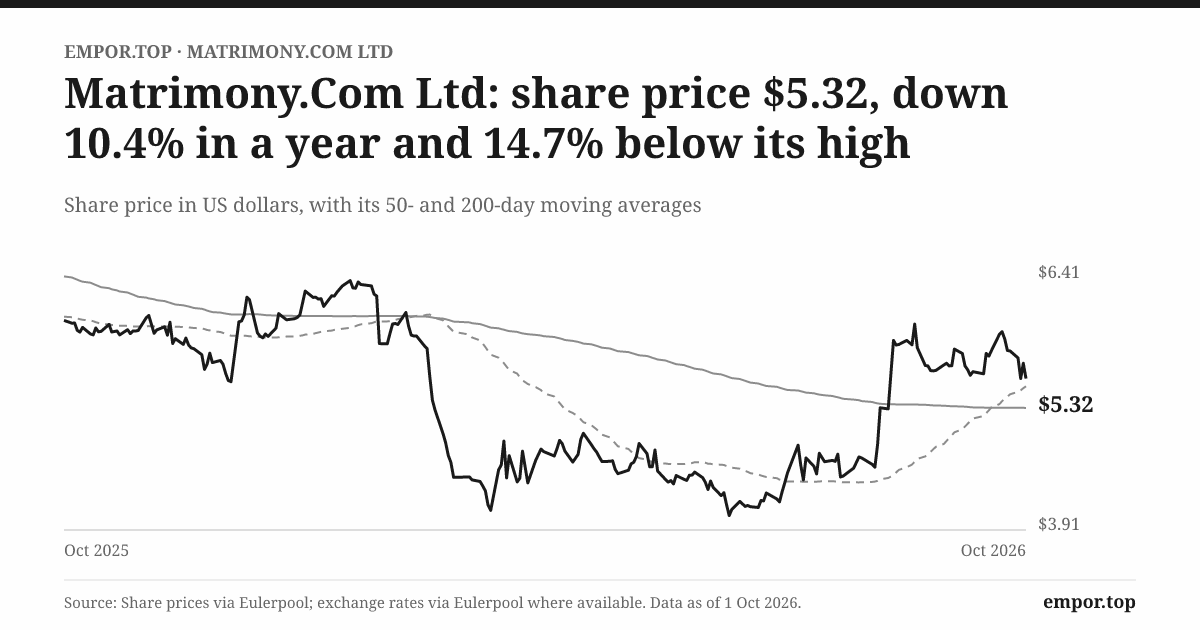
Matrimony.com is the company that took that column of the newspaper and turned it into a subscription business. Through BharatMatrimony and a family of community and regional sites, it runs India's largest paid matchmaking platform, and it has been listed on the NSE since 2017.15 On the first day of October 2026, the market valued the whole thing at roughly ₹1,105 crore, about $115 million, at a share price of ₹512.70.1
That price sits on top of a puzzle. In the first quarter of fiscal 2027, the three months to June 2026, net profit jumped about 126% while revenue grew a more modest 13%.23 The stock rose on the news. Yet step back and look at the full-year record: net profit in fiscal 2026 was roughly a third of what the company earned in fiscal 2018, its first full year as a listed company.16 So which is it? A franchise waking from a long slump, or a single good quarter flattered by the arithmetic of how subscriptions are booked?
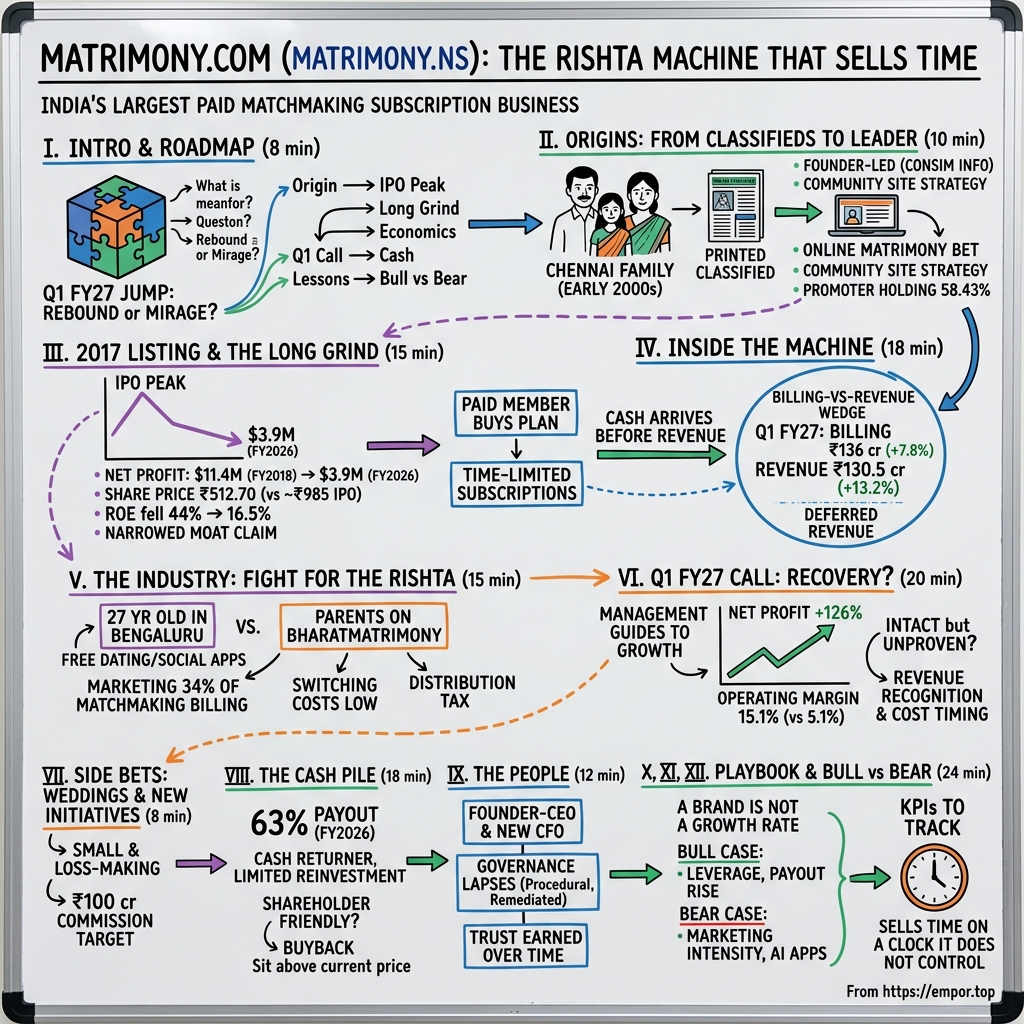
This story carries four questions from beginning to end.
First, is the Q1 FY27 jump a durable recovery, or a one-quarter effect of revenue recognition and cost timing?
Second, is billing growth coming from more customers, or only from higher prices and longer plans?
Third, is the earnings base a business or a cash pile? A meaningful share of profit comes from interest on money the company holds rather than from matchmaking.
Fourth, the board paid out about 63% of fiscal 2026 profit in dividends, the highest ratio in its listed history. Is that confidence, or the behaviour of a business with nothing to reinvest in?
The route runs through the founder's origin, the 2017 listing at the top of the cycle, the long grind that followed, the unusual economics of a subscription that is paid up front, the Q1 FY27 call, the side bets, the cash, the governance record, and then the bull and bear cases. The business turns out to be a machine that sells time: three months, six months, a year of access to a pool of prospective spouses. Customers pay for the clock before it starts. Whether they get what they paid for is a different question, and the investment case rests on it.
To understand why this one company came to own the category, start with the man who bet that the newspaper column would move online.
 Subscribe on LinkedIn
II. Origins: From Consim Info to a Category Leader
In the late 1990s, a young Tamil software engineer named Murugavel Janakiraman was working in the United States. Like many Indians abroad, he noticed how hard it was for diaspora families to find matches back home. The newspaper classified did not travel, and the community networks that powered arranged marriages were stuck in neighbourhood temples and relatives' living rooms. He started a community portal in his spare time, and the matrimonial section turned out to be the part people actually used. That side project became BharatMatrimony, and the company behind it was Consim Info, later renamed Matrimony.com.54
The insight was not that marriage could be digitized. It was that Indian marriage is segmented. A Tamil Iyer family in Chennai is not searching the same pool as a Gujarati Jain family in Ahmedabad or a Malayali Christian family in Dubai. So the company built not one site but a constellation: regional brands by language, community sites by religion and caste, and specialized portals for divorcees, doctors, and people with disabilities.5 Each was a narrower pool that felt like our people, which is exactly what a parent scrolling through profiles wants.
That design solved the hardest problem in matchmaking, which is trust. In arranged-marriage India, the family is the customer as much as the bride or groom. Parents create profiles, screen candidates and make the first call. An online service has to replace the broker, the aunt and the temple notice board at once, and it has to feel safe doing it. Paid membership was part of that trust. Charging money filtered out time-wasters and signalled seriousness, so the paywall worked as a feature as well as a source of revenue.
The road was not smooth. Before listing, the company went through a venture-backed phase, and in fiscal 2016 it booked a net loss of about $11 million with negative shareholders' equity.6 That loss did not come from collapsing demand: revenue was roughly flat that year, at around $39 million.6 The size and sign of the hit, against an operating result close to break-even, point to a financing-related charge rather than an operating crisis. Pre-IPO companies in India with investor preference shares often booked fair-value charges on them, and the company's offer document is the place where that history is laid out.7 By fiscal 2017 the business was solidly profitable again, and in 2017 it went public.
Today the founder's family still controls the company. Promoters held 58.43% at June 2026, and the register counted about 20,000 shareholders.1 Revenue grew from about $39 million in fiscal 2015 to about $58 million in fiscal 2024.6
That is the category-creation story, and it is real. But history only gives context here. The important fact about the origin is that by 2017 the company had already won the land grab. It had the brands, the community pools and the paying base. The IPO priced in what came next, and what came next was much slower.
III. The 2017 Listing and the Long Grind
The listing in September 2017 was the company's moment in the spotlight. The IPO was priced at about ₹985 a share, and the market bought into a clean story: India's leading paid matchmaker, profitable, cash-generative and riding the arrival of cheap smartphone data.71
The first full year of results seemed to confirm it. In fiscal 2018, net profit reached about $11.4 million on an operating margin of about 21%.6 Return on equity was about 44%.1 That was the high-water mark, and nobody knew it yet.
Here is the long grind in a single sentence. Over the following eight years, revenue grew about 6% a year over a decade, about 4% a year over five years and essentially flat, about 0.3% a year, over the last three, while net profit fell to about $3.9 million by fiscal 2026.6 The share price on 1 October 2026, ₹512.70, sits nearly half below that ₹985 IPO price nine years earlier.1
The margin slide
The profit path was not a smooth decline. It lurched. Net profit fell about 42% in fiscal 2019 and another 32% in fiscal 2020, recovered with gains of 38% and 31% during the pandemic years, then faded again.6 Return on equity drifted from 44% to about 16.5%.1 Revenue went into reverse in fiscal 2025, falling about 5%, and quarterly revenue growth stayed negative from the September 2024 quarter through December 2025.6
There is a data trap here worth naming. Some third-party databases show fiscal 2025 operating profit near $15 million, a 27.6% margin, which would make it a record year.1 It was not. Pre-tax profit that year was about $6.8 million and EBITDA about $6.9 million.6 An operating profit larger than EBITDA is impossible, so that figure is a classification error, likely a one-off item counted in the wrong line, and the same is true of an apparent 26.5% margin in the March 2024 quarter. The honest reading of fiscal 2025 is a year in which revenue fell and margins compressed.
Myth vs. reality: the market leader with pricing power
The consensus label on Matrimony.com is "market leader with pricing power." The leadership half survives scrutiny: the company's brands and community depth have kept it at the centre of the paid category for two decades. The pricing-power half does not. A business with real pricing power raises prices faster than inflation and sees margins widen as it scales. Matrimony.com did the opposite for most of a decade: real revenue barely moved, and margins narrowed as marketing costs grew.
The verdict is that the history narrows the moat claim to a smaller version. The brand preserves position. It has not delivered growth. That revised claim can be tested quarter by quarter through billing growth, and later sections will.
The institutions walked
The shareholder register tells the same story from the other side. Domestic institutions, the mutual funds and insurers who had bought into the IPO, held about 24% of the company in March 2018. By June 2026 they held about 5%.1 Foreign holders roughly held steady at around a fifth, retail investors rose from under 4% to about 17%, and the promoters rose from about 50% to 58%.1 The institutions that priced the IPO quietly sold out over the long grind.
So the business never grew into its listing valuation. Yet it never stopped producing cash either. To understand why, follow the money of a single subscriber.
IV. Inside the Machine: How a Subscription Pays Up Front
Imagine a family in Coimbatore, the daughter now 26, deciding it is time to get serious. The mother has been browsing free profiles for weeks, but she can only see so much. She wants to contact families directly, see full horoscopes and phone numbers, and maybe have a relationship manager do the shortlisting. So she buys a plan. Increasingly, that plan runs a full year, and with the assisted tier a human matchmaker calls candidates on the family's behalf.
She pays the whole amount on day one. That one decision explains most of what is unusual about Matrimony.com's financial statements.
Billing versus revenue
Two different numbers describe the same sale. Billing is the cash collected when the plan is bought. Revenue is that cash spread across the months of service. If the mother buys a twelve-month plan, the company bills the full price immediately but recognises only one twelfth of it as revenue each month. The unearned portion sits on the balance sheet as deferred revenue, a liability that means "we owe this customer eleven more months."
Now look at Q1 FY27. Billing was about ₹136 crore, up about 7.8% year on year. Revenue was about ₹130.5 crore, up about 13.2%.2 In the core matchmaking business, billing grew about 8% to ₹135.3 crore while revenue grew about 13.6% to ₹109.5 crore.2 Revenue grew faster than billing because the shift to longer plans in earlier quarters pushed cash collected then into revenue recognised now.3
This is the most important analytical point in the story. Billing is the cleaner signal of demand. Revenue in Q1 FY27 was partly catching up on billing from previous quarters. An investor who reads the 13% revenue line as the business's real growth rate is reading a lagged indicator. The current one is closer to 8%.
Volume or price?
Decompose that 8% billing growth and it splits into two parts. Paid subscriptions added in the quarter were about 2.72 lakh, up about 3.7% year on year.2 Average revenue per user rose about 4.2% year on year.2 So roughly half the growth came from more paying customers and half from higher price or richer plan mix.
The quarter-on-quarter view is less flattering. Paid additions rose about 16% sequentially, which is seasonal, but ARPU fell about 6.7% from the prior quarter.2 Volume of roughly 4% a year is not a growth franchise. It is a mature one being nudged along by pricing and plan length. The company does not publish renewal rates, so investors cannot tell how much of the paid base is returning customers and how much is first-time buyers who will marry and leave. In a business whose best customers churn on success, that is a real gap in disclosure.
Profit into cash
Up-front billing makes the cash-flow statement look better than the income statement. Over the twelve years from fiscal 2015 to fiscal 2026, cash from operations totalled about ₹645 crore against net profit of about ₹382 crore, or about 169%.6 In fiscal 2026 alone, operating cash flow was about 121% of EBITDA.6 Customers barely owe the company anything: debtor days were about one.1 Working capital is negative, about minus 47 days of revenue, which means the company's suppliers and its prepaid customers are funding operations.1
Some of that is real economics. A business paid in advance is a better business than one that waits ninety days to get paid. But some of it is structural, and some is presentation:
- Structural: when customers move to longer plans, deferred revenue grows and cash flow runs ahead of profit. That is a one-time lift during the transition, not a permanent rate. If plan lengths stop lengthening, the effect stops too.
- Presentation: under Indian accounting standards, the principal portion of lease payments for offices sits in financing cash flow, not operating cash flow. A business with dozens of offices and assisted-service centres therefore reports operating cash flow that excludes part of its real rent bill.
The verdict is that the cash conversion is real but flatters the economics. Cash up front is a feature of the model, but it is not growth, and the wedge between billing and revenue can run in reverse if customers shift back to shorter plans. The next question is who else wants this customer, and what it costs to win her.
V. The Industry: Who Is Fighting for the Rishta
Now picture a different home: a two-bedroom flat in Bengaluru. A 27-year-old product designer is on Hinge after dinner, swiping. In the next room, her parents are logged into BharatMatrimony, filtering by community, profession and city. Both generations are shopping in the same market for the same outcome, using entirely different tools. That split screen is the competitive landscape.
The players
The paid matrimony category has three Indian names. Matrimony.com's BharatMatrimony is the largest by paid base. Shaadi.com, run by the privately held People Group, is the best-known rival, especially in north India and among the diaspora.9 Jeevansathi is owned by Info Edge, the listed parent of Naukri, and appears in Info Edge's filings as part of a loss-making or marginal segment that the parent funds from a much larger jobs business.8 That matters: a rival backed by a deep-pocketed group can keep spending on marketing even when the category returns are thin.
Then come the dating apps: Tinder and Hinge from Match Group, and Bumble.1011 They are not matrimony services, but they compete for the same young adults' attention and, increasingly, for the "serious relationship" positioning that once belonged only to matrimony sites. They also set price expectations. A young user who pays a few hundred rupees a month for a dating app looks differently at a multi-thousand-rupee matrimony plan.
None of the domestic players publishes comparable market-share data, so leadership is clear in reputation but under-evidenced in numbers.
The marketing tax
The single figure that best describes the industry's economics is marketing spend. In Q1 FY27, matchmaking marketing was about ₹46.5 crore, up from about ₹43.5 crore in the previous quarter.2 Against matchmaking billing of ₹135.3 crore, that is roughly 34 rupees of every 100 billed spent on acquiring customers. Before marketing, the matchmaking segment's EBITDA margin runs at about 63%.2 After marketing, it was about 26.9%, up from about 17.6% a year earlier.2
Read those two margins together. The underlying service, the database, the search and the assisted calls, is highly profitable. What eats the profit is the cost of finding the next customer. And because successful customers get married and leave, the company has to keep refilling the funnel every year. A franchise that has to re-buy a third of its billings in advertising is closer to a leaky bucket than a fortress.
Part of that spend is a toll to two companies. Most users arrive through Google search or download the app from Google Play or Apple's App Store, and both platforms take fees on in-app subscriptions. The company does not disclose how much of its billing passes through those channels or how much it pays in platform fees, so the size of this supplier power is unknown. Its direction is not.
The AI claim
Management presents AI as a tailwind: automated profile and photo validation to catch fake accounts, and chatbots that handle customer service.2 Those are sensible cost and trust tools. But no disclosed figure shows that AI has raised conversion, lowered marketing cost per paid user or lifted retention. Meanwhile, AI-led matching is exactly the capability that could let a new, free or cheap app replicate the "curated introductions" that assisted service sells. On current evidence, AI is a cost tool for the company and a possible entry ramp for its rivals.
The full moat argument, forces and powers, waits for the bull and bear section. For now the competitive picture is set: a brand-led leader in a market where customers leave on success and every new one has to be bought. Against that backdrop, Q1 FY27 arrived.
VI. The Q1 FY27 Call: Recovery or Mirage?
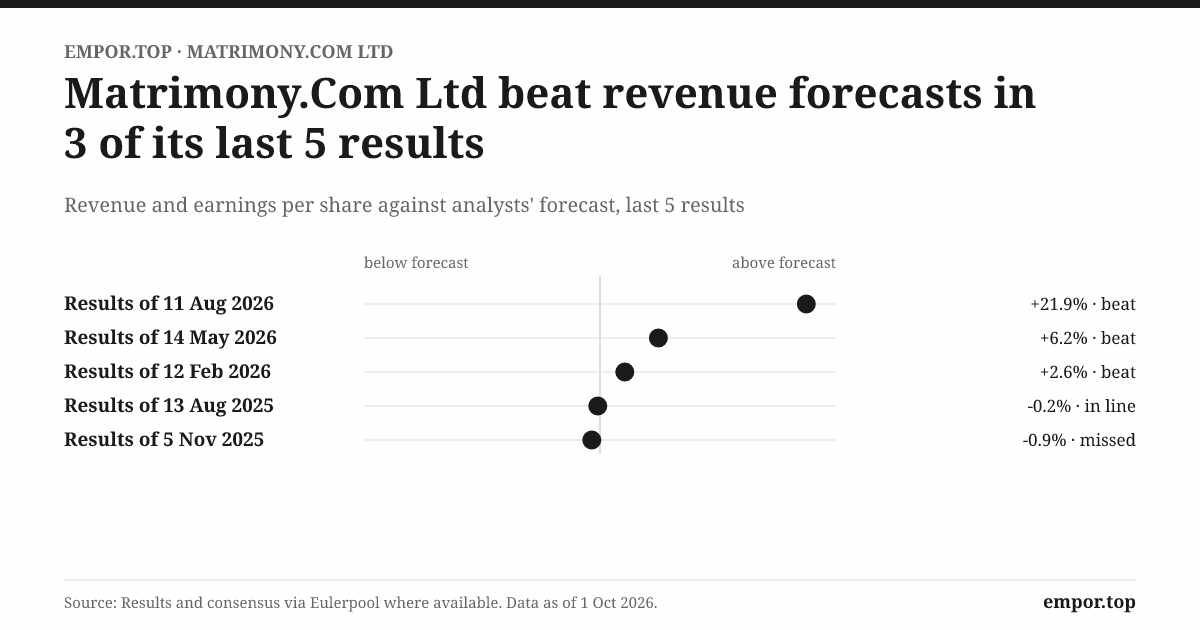
The results came out in late July 2026, and the headline did the work on its own: net profit up about 127% to ₹19.1 crore.23 The stock rose sharply on the day.2 On the call, management struck an optimistic tone and guided to double-digit revenue growth and triple-digit profit growth again in the second quarter.2
After almost two years of negative revenue growth, it was the first quarter in a long time that felt like momentum. The question is whether it was.
What actually changed
The quarterly operating margin rose to about 15% from about 5% a year earlier.6 That is a large swing on a revenue base that grew only 13%, and it comes from operating leverage: most of the cost base, the technology, the offices and the assisted-service staff, is fixed in the short run. When revenue rises, nearly all of the increment drops to profit.
But recall the billing-versus-revenue wedge from the previous section. Revenue grew faster than billing because the company was recognising earlier long-plan billings. Some of the margin jump therefore reflects revenue catching up, not demand accelerating. Revenue recognition and cost timing explain part of the jump.
Here is the counterpoint, and it matters. The margin recovery did not come from cutting marketing. Marketing spend rose quarter on quarter.2 A company that rescues its margin by slashing advertising is borrowing from next year's customers. One that improves its margin while spending more is showing that its revenue is growing faster than its acquisition cost. That is a point in favour of quality.
Prepared remarks versus analyst questions
In the prepared remarks, the emphasis was on revenue, profit and the matchmaking margin. In Q&A, analysts focused on the gap between billing and revenue and on how much of the growth would persist.2 Management's answer leaned on the shift to longer plans, which is consistent with the numbers but is also the explanation that most flatters the near term.
The comparison with the fiscal 2025 calls is useful. When revenue was falling through late 2024 and 2025, management framed the decline as a deliberate trade-off: shorter-term pain from changes to plans and pricing in exchange for better-quality customers.2 The Q1 FY27 narrative presents the recovery as the payoff of the same strategy. The story has been consistent across both phases. Consistency is not proof, but a management team that explained its slump in advance and then delivered an improvement on the same terms has earned some credibility.
On guidance, the record is mixed. The company has repeatedly set an ambition of about ₹100 crore of run-rate revenue for its wedding-services business, and that business remains far from it.2 For the core, management has not published multi-year growth or margin targets that can be scored.
The verdict
The recovery is real in margin terms but not yet demonstrated in subscriber volume. The core claim, that the business has turned, is intact but unproven. It will be confirmed if three things happen in the September and December 2026 quarters: billing growth stays at or above roughly 8%, paid subscription additions keep growing year on year, and the operating margin holds above 10% even as the revenue catch-up from longer plans fades. If billing slips back toward low single digits while revenue keeps growing, the jump was mostly accounting.
Before the cash, one smaller piece of the operation needs examining: the businesses the company built to grow beyond matchmaking.
VII. The Side Bets: Weddings, Luv.com and ManyJobs
Somewhere in Chennai, a couple who met through a community site is now planning the wedding. A wedding-services desk at Matrimony.com helps them book a venue, a photographer and a caterer, and takes a commission from the vendors. It is a logical idea: the company knows exactly who is getting married, months before they start spending.
The logic has been obvious for years. The execution has not caught up. The company groups its non-matchmaking ventures into a "marriages and other" segment that includes wedding services, the dating app Luv.com and the jobs site ManyJobs.24 In Q1 FY27, new initiatives billed about ₹0.74 crore, a fraction of 1% of the company.2 The segment lost about ₹3.8 crore at EBITDA level, an improvement on the ₹5.7 crore loss of the prior quarter.2
Put those numbers side by side. The side bets bill less than a crore a quarter and lose about four to six crore. Management's stated aim is a commission-based wedding business with a ₹100 crore run rate.2 That is more than a hundred times the current quarterly billing of all new initiatives combined.
The record argues for caution. Over two decades the company has launched a range of adjacent services, from wedding planning and wedding-photography brands to vendor directories and the jobs and dating apps, and none has become a material revenue line.4 A launch is a technical milestone, not commercial proof, and this company's conversion rate from one to the other has been low. The ₹100 crore target should be read as an aspiration until the segment shows revenue in the tens of crores and a path to break-even.
The subsidiaries named in the annual report, Sys India, Consim Info USA, Bangladeshi Matrimony, Matrimony DMCC in Dubai and Boatman Tech, are small relative to the core.4 The associate, Astro Vision Futuretech, an astrology and horoscope software business, fits the matchmaking use case.4 None of them moves the economics.
The verdict is that the side bets are an option, not a strategy, and a small and costly one. They matter mostly for what they say about the cash: the money is not going into growth ventures, because there are not many credible ones to fund. So where is it going?
VIII. The Cash Pile, the Buybacks and the 63% Payout
The boardroom scene is a buyback. The company offered to repurchase about 8.93 lakh shares at ₹655 each, a total of about ₹58.5 crore, through a tender.4 Shareholders who tendered got a premium to the market price of the day. The company returned cash it could not usefully deploy, and the promoters, who did not sell proportionately, saw their stake rise.
Then in fiscal 2026 the board went further on dividends, paying out about 63% of the year's profit, the highest ratio in its listed history and well above the ten-year median of about 17%.6
How much cash is there?
Two numbers seem to conflict. On the Q1 FY27 call, management cited cash of about ₹342 crore.2 Standard databases show cash and short-term investments of only about ₹136 crore at the end of fiscal 2026.6 The reconciliation is in the classification. The same filings show separate investments of about $22 million, which are mostly longer-dated deposits and debt instruments, on top of about $15 million of cash and short-term holdings.6 Together, at fiscal-2026 exchange rates, they come to roughly ₹330 crore, close to management's figure. The difference between the two numbers is maturity, not missing money.
So the company holds about ₹340 crore against a market value of about ₹1,105 crore, about 31%.12 That cash earns interest. Other income was about ₹24 crore over the latest year, against trailing pre-tax profit of roughly ₹55 to 60 crore.16 So something like two-fifths of pre-tax profit comes from treasury income rather than from matchmaking. That is the clearest answer to the third central question: a large part of the earnings base is a cash pile, not a business.
Where the free cash went
Over the twelve years to fiscal 2026, free cash flow totalled about ₹463 crore.6 Dividends took about ₹79 crore, about 17%.6 The cash and short-term balance rose by about ₹99 crore.6 The rest went to buybacks, longer-term investments and lease payments.
Meanwhile, shareholders' equity shrank, from about $41.6 million in fiscal 2022 to about $23.4 million in fiscal 2026.6 A company paying out more than it earns through buybacks and dividends will see its book value fall. That is not a sign of distress here. Debt is small, about ₹49 crore, and most of it reflects office leases rather than bank borrowing.1 Debt to equity was about 0.24.1 The company has not needed to raise equity since the IPO, and there is no sign of liquidity strain. It does mean the reported return on equity is partly a product of a shrinking denominator.
The promoter's rising stake
Promoter holding rose from about 50% to 58.43% between 2022 and June 2026.1 Buybacks explain a large part of that: when the company retires shares that outsiders tender, the promoter's unchanged holding becomes a larger fraction. That is a mechanical increase, not a vote of confidence. There is no reported pledging of promoter shares.1
The activist's questions
A skeptical long-short investor would press on three points. First, the buyback price. Buying back stock at ₹655 is a good use of cash only if the business is worth more than ₹655. The stock now trades at about ₹513, roughly a fifth below.1 In hindsight, that buyback overpaid relative to where the market priced the business afterwards. Second, why hold about ₹340 crore in a business that needs little capital and has no large acquisitions in view? A larger buyback at current prices, or a special dividend, would hand back the treasury income the market does not value. Third, why keep funding a segment that loses ₹4 to 6 crore a quarter without a dated plan to break even?
The verdict is that Matrimony.com is a cash returner with limited reinvestment. Its capital allocation is shareholder-friendly in form, but it has not compounded the cash it generates. The 63% payout looks less like confidence than an admission that the best use of the money is outside the company. That is not a criticism in itself, since returning cash beats wasting it. It just changes what the stock is. Whether the people deciding these things have earned trust is the next question.
IX. The People Running It: Incentives, Governance and Credibility
On 17 February 2025, Matrimony.com's chief financial officer resigned.4 The replacement, Harigovind Krishnasamy, joined on 8 July 2025, almost five months later.4 Indian listing rules require a listed company to fill a CFO vacancy within three months. Matrimony.com did not.
That is the opening fact of the governance file. It is not dramatic, but it is the kind of small fact that investors use to judge whether a company runs its compliance as tightly as its marketing.
The secretarial audit
The secretarial auditor, the independent firm that reviews compliance with company and securities law, flagged three lapses.4 The first was the late CFO appointment, a breach of Regulation 26A(2). The second was late disclosure, under Regulation 30, of orders issued by GST authorities. The third was a clerical error in reporting an employee stock option allotment.4
Weigh these on scale, recency and remediation. All three are procedural. None involved misstated accounts or money leaving the company. The CFO post was filled; the disclosures were eventually made. The statutory auditor issued an unqualified opinion on the financial statements for the reported year.4 The verdict is that the lapses are small and remediated and do not decide the investment case, though the GST disclosure delay leaves a minor overhang. The company has not quantified the GST demands in its public summaries, so investors should watch the contingent-liabilities note in the next annual report for their size.
The founder at the centre
Murugavel Janakiraman, the founder, remains chairman and managing director, and his family controls the company.14 Founder control cuts both ways. It brings continuity of vision: the community-site strategy, the push to assisted service and the cash-return policy all bear his stamp. It also means minority shareholders have little influence over capital allocation. With promoters at 58% and domestic institutions down to about 5%, few holders are left who could force a debate over pay or strategy.1
The key unanswered governance items are executive pay relative to profit, the design of the ESOP plan and the level of dissent in AGM votes. These are disclosed in the remuneration annexure and scrutinizer reports filed with the exchanges, and they are the right place for a shareholder to look before trusting the board's capital allocation.6
Related parties
Related-party transactions run between the listed company, its wholly owned subsidiaries and the Astro Vision associate. They are approved by the audit committee and described as at arm's length.4 There is no brand royalty or similar payment to the promoter family, a structure that has damaged minority shareholders at other Indian promoter-led companies.4
The company does not disclose a credit rating in its annual report summary, which is unsurprising for a business with almost no bank debt.
Governance, in short, is adequate rather than exemplary: a clean audit opinion, no royalty leakage, a few procedural slips, and a founder with uncontested control. With the full story told, the lessons follow.
X. Playbook: Business & Investing Lessons
"Cash arrives before revenue, but cash up front is not growth." Recall the Coimbatore mother paying for a full year on day one. That payment makes the cash-flow statement glow and the balance sheet lean. But when customers move to longer plans, the company enjoys a one-time cash lift, and revenue catches up for a few quarters after. For investors, the lesson is to measure a subscription business by what customers commit to today, its billing, and not by what the accountants release from last year's deferred revenue. For founders, a prepayment is a promise to deliver, not proof that you did.
"A brand is not a growth rate." BharatMatrimony kept its name, its leadership and its community pools for a decade after the 2017 listing. It did not keep its growth. Real revenue barely moved, profit fell by about two-thirds, and the institutions left. A brand can defend a position for a very long time while the economics around it erode. The test of a moat is price realization and margin, not recognition.
"Buy back at a price the business can defend." The ₹655 tender returned cash to shareholders and lifted the promoters' stake. With the stock now near ₹513, the company paid well above what the market later decided the business was worth. Buybacks are only as good as the price paid. A disciplined allocator buys more when the stock is cheap than when it is fashionable.
"A margin recovered by spending more is a better signal than one recovered by spending less." The Q1 FY27 margin jump came while marketing rose. That is the one fact that keeps the recovery from being dismissed as accounting. When a company with a fixed cost base can grow margin and acquisition spend at the same time, its revenue engine is working. When it grows margin only by cutting advertising, it is spending next year's customers.
"Side bets earn their place by revenue, not by launches." Wedding services have been a stated ambition for years, now with a ₹100 crore target. They bill less than a crore a quarter. A company's history of turning launches into revenue is the best predictor of whether the next launch will matter. Here that history says: wait for the revenue.
XI. Analysis, Bull vs. Bear & KPIs
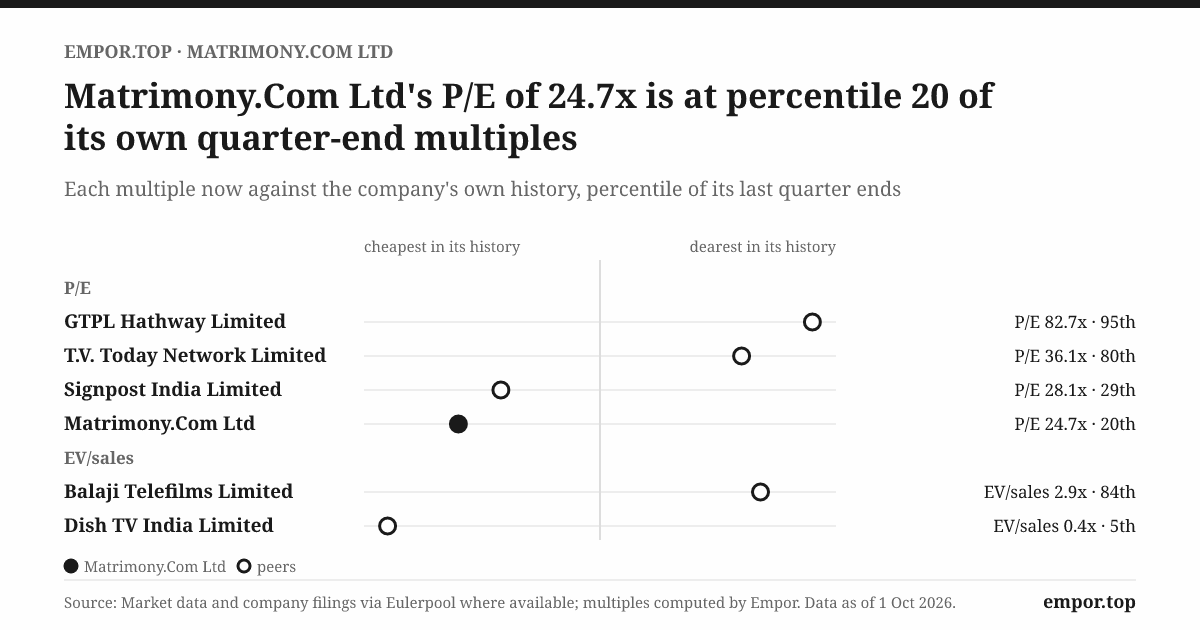
Set the price against the story. At ₹512.70 the stock trades at about 24.7 times trailing earnings, below its five-year median of about 27.6 times.1 Enterprise value, market value minus net cash, is about 11.2 times EBITDA.1 The free cash flow yield is about 2.1%, the dividend yield about 1%, and price to book about 5 times.1
Those trailing earnings still include the depressed quarters of fiscal 2026. If Q1 FY27's profit run rate holds, the forward multiple is meaningfully lower. The market, in other words, is not pricing a trough. It is pricing a recovery, on one quarter of evidence. Netting out the roughly ₹340 crore of cash, the operating business is valued at about ₹770 crore, and part of the earnings that support even that comes from treasury income. The valuation is fair only if billing growth holds above about 8% and margins hold.
Porter's five forces
- Buyers: no customer concentration; millions of households each pay a few thousand rupees. But switching costs are low, since any family can list on Shaadi.com, Jeevansathi or a community WhatsApp group at the same time.98 Buyer power is moderate.
- Suppliers: Google and Apple are the real suppliers, controlling discovery and taking a share of in-app payments. The company does not size this dependence, but the direction is unfavourable. Supplier power is high.
- New entrants: AI-led matchmaking apps can now build a curated-introduction product cheaply. The barrier is trust and a large verified pool, not technology. The threat is moderate and rising.
- Substitutes: free dating apps, social media and family networks. For the younger generation the substitute is often the default. The threat is high.
- Rivalry: Shaadi.com and a group-funded Jeevansathi compete on marketing spend, which explains why roughly a third of billing goes to advertising. Rivalry is intense on cost, if not on price.
Helmer's seven powers
- Network effects and brand: credible. A larger pool attracts more members, and in community niches the depth of the pool is the product. Brand is the trust signal that justifies a paywall.
- Scale economies: limited. The 63% pre-marketing margin shows scale in the core service, but the marketing bill rises with billing, so the advantage does not compound.
- Counter-positioning against dating apps: a claim, not a proven power. Dating apps are moving toward "serious relationships," and the family-centric model is a difference that has not yet been shown to keep young users.
- Switching costs, cornered resource, process power: weak or absent.
The moat is real but narrow: brand and pool depth hold position; they do not prevent a large and recurring acquisition cost.
The bull case
Billing and revenue both turn up together for several quarters, showing that the recovery is demand, not recognition. Plan mix tilts permanently to year-long plans, raising lifetime value per customer. Operating leverage on a largely fixed cost base pushes margins back toward the high teens. The payout rises further, and a larger buyback at current prices shrinks the share count. The wedding segment narrows its losses toward break-even.
The bear case
Volume growth of about 4% is the ceiling, not the floor. ARPU falling quarter on quarter suggests pricing is already stretched. Marketing at about a third of billing is rising, not falling. AI-led and free apps erode the young-adult funnel just as platform fees take a larger cut. The side bets keep losing money. Institutional selling has already removed most of the natural long-term buyers, so the stock's support rests on a recovery narrative that one weak quarter could break.
Three KPIs
- Billing growth. Latest: about 7.8% year on year in Q1 FY27, after a long stretch near zero or negative.2 Direction: improving.
- Paid subscriptions added, with ARPU. Latest: about 2.72 lakh, up about 3.7% year on year, with ARPU up about 4.2% year on year but down about 6.7% sequentially.2 Direction: volume flat to slightly up; price mixed.
- Matchmaking EBITDA margin after marketing. Latest: about 26.9%, against about 17.6% a year earlier.2 Direction: sharply improving.
Material risks
The main risks are demand and competition from free and AI-led apps; distribution costs set by Google and Apple; execution in shifting wedding services to a commission model; and cyber and data-privacy risk. On the last point, the company holds unusually sensitive personal data: family background, caste, income, horoscopes, photographs and phone numbers. A breach would damage the trust that justifies the paywall, and India's new data-protection law brings the risk of regulatory penalties on top of reputational harm.
XII. Epilogue
Tonight, Matrimony.com stands where it has stood for most of its listed life: a leader in its category, profitable, cash-rich and widely doubted. The difference is that for one quarter the numbers moved the right way at the same time. Margin, profit and billing all improved, and marketing rose rather than fell.
The next moments that decide the story are close. The September 2026 quarter results, due within weeks, will show whether billing growth holds near 8% or slips back once the seasonal peak passes. The December 2026 quarter will show whether paid additions can grow faster than the 4% that has been the recent pattern, and whether the operating margin stays above 10% as the revenue catch-up from longer plans fades. Across fiscal 2027, the board's choice between dividends, buybacks and acquisitions will show what it believes the business is worth. And the marriages segment will either narrow its losses or keep consuming a slice of the core's profit.
Each outcome speaks to a central question. If billing holds near 8% while margins stay above 10%, the recovery is demand-led and the first question gets a yes. If paid additions accelerate, the second question is answered in favour of customers rather than pricing. If operating profit grows fast enough to shrink treasury income's share of earnings, the business starts to outweigh the cash pile. And if the board buys back stock at prices below its last tender, the high payout reads as confidence rather than resignation.
If billing fades while revenue keeps rising, the reverse holds on every count. The Q1 FY27 jump will then look like what skeptics suspect: deferred revenue released from the balance sheet, flattering one quarter's arithmetic.
The tension that remains is simple to state. The company gets paid up front, and that structure makes every recovery look better at first than it may prove to be.
XIII. Outro
Go back to that Sunday morning: the newspaper on the dining table, the aunt with her pen, the column of abbreviations. The newspaper has gone. The phone in the father's hand now holds a filtered list of a thousand profiles, verified by software and ranked by an algorithm. What has not changed is that a family still has to trust a stranger with the most important decision it will make.
Matrimony.com built the trust machine for that decision and has kept it running for more than two decades. It sells time on a clock it does not control, because every success walks out of the door married. It is the one company that gets paid before it delivers the match, and has to keep proving the match was worth it.
References
-
Matrimony.com Ltd consolidated financials, shareholding and ratios — Screener ↩↩↩↩↩↩↩↩↩↩↩↩↩↩↩↩↩↩↩↩↩↩↩↩↩
-
Earnings call transcript: Matrimony.com Q1 2026 profit jumps 127% — Investing.com ↩↩↩↩↩↩↩↩↩↩↩↩↩↩↩↩↩↩↩↩↩↩↩↩↩↩
-
Matrimony.com Q1 FY27 PAT jumps 127.5% to Rs 19.1 Cr — Whalesbook ↩↩↩
-
Matrimony.com Ltd Directors' Report extract — IndiaInfoline ↩↩↩↩↩↩↩↩↩↩↩↩↩↩
-
NSE corporate filings and announcements (annual reports, results, shareholding) — NSE India ↩↩↩↩↩↩↩↩↩↩↩↩↩↩↩↩↩↩↩↩↩
-
SEBI public issues archive (Matrimony.com 2017 offer documents) — SEBI ↩↩
 LinkedIn
 WhatsApp
 Reddit
 Hacker News
 Email
Email Kindle
 RSS Feed
 Spotify
 Apple Podcasts
 Amazon Music
 Audible
 YouTube