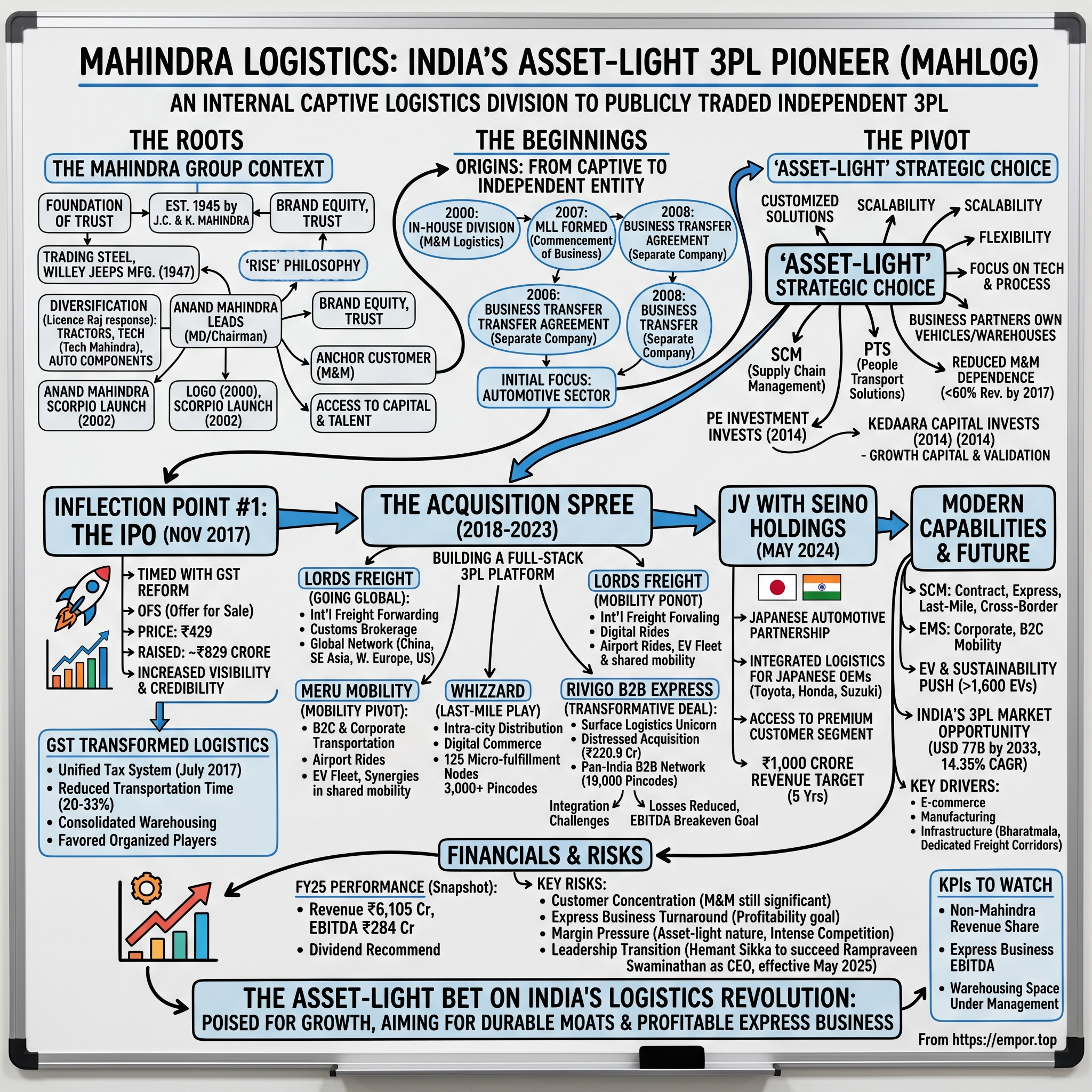
Mahindra Logistics: India's Asset-Light 3PL Pioneer
I. Introduction & Episode Roadmap
Picture a warehouse manager in Chennai in 2006, coordinating the shipment of Scorpio SUVs across state lines. At every border crossing—Maharashtra to Gujarat, Gujarat to Rajasthan—his trucks waited, sometimes for eight or twelve hours, caught in a labyrinth of paperwork, entry taxes, and checkpost bureaucracy. His fleet's trucks covered barely 250-300 kilometers daily, while their counterparts in the United States cruised 800 kilometers in the same timeframe. The manager worked for Mahindra & Mahindra's internal logistics division—a captive operation that existed primarily to serve the tractor and automotive giant's own supply chain needs.
Today, that same operation has transformed into Mahindra Logistics Limited, a publicly traded company that serves over 400 corporate customers across industries like automobile, engineering, consumer goods, and e-commerce. Founded in 1945, the Mahindra Group is now one of the largest and most admired multinational federations of companies with 260,000 employees in over 100 countries. It enjoys a leadership position in farm equipment, utility vehicles, information technology and financial services in India and is the world's largest tractor company by volume.
The central question of this deep dive: How did an internal captive logistics division of a tractor company become one of India's largest third-party logistics providers?
The answer lies in Mahindra Logistics' "asset-light" business model, pursuant to which assets necessary for its operations such as vehicles and warehouses are owned or provided by a large network of business partners. This technology-enabled, asset-light approach allows for scalability of services as well as the flexibility to develop and offer customized logistics solutions across a diverse set of industries.
The company's journey from captive division to publicly listed 3PL pioneer encapsulates several broader themes: the transformative impact of India's 2017 GST reform on logistics, the strategic debate between asset-light and asset-heavy business models, the role of inorganic growth through targeted acquisitions, and how the "Mahindra Group halo" provides both competitive advantage and concentration risk.
Looking at the market opportunity, India's third party logistics (3PL) market size reached USD 21.8 billion in 2024. IMARC Group expects the market to reach USD 77.0 billion by 2033, exhibiting a growth rate (CAGR) of 14.35% during 2025-2033. Mahindra Logistics sits at the intersection of this explosive growth trajectory.
For investors, the key question isn't just whether India's logistics sector will grow—that's almost a foregone conclusion. The question is whether Mahindra Logistics' particular strategic choices—its asset-light model, its acquisition-heavy growth strategy, and its persistent reliance on parent company revenues—position it to capture disproportionate value from this structural transformation.
 Subscribe on LinkedIn
II. The Mahindra Group Context: Foundation of Trust
The story of Mahindra Logistics cannot be told without first understanding the sprawling industrial empire that birthed it. Mahindra & Mahindra was incorporated as Mahindra & Mohammed in 1945 by the brothers J. C. Mahindra and K. C. Mahindra, and Malik Ghulam Muhammad in Ludhiana, Punjab to trade steel. Following the Partition of India in 1947, Malik Ghulam Muhammad left the company and emigrated to Pakistan, where he became the first finance minister of the new state (and later the third Governor General in 1951).
What happened next would define the company's DNA for decades. Building on their expertise in the steel industry, the Mahindra brothers began trading steel with UK suppliers. They won a contract to manufacture Willys Jeeps in India and began producing them in 1947. This pivot from trading to manufacturing—from importing to making in India—would become a recurring theme in Mahindra's evolution.
By 1956, the company was listed on the Bombay Stock Exchange, and by 1969 the company became an exporter of utility vehicles and spare parts. Like many Indian companies, Mahindra responded to the restrictions of the Licence Raj by expanding into other industries. Mahindra & Mahindra created a tractor division in 1982 and a tech division (now Tech Mahindra) in 1986.
The diversification wasn't merely opportunistic—it was a studied response to the regulatory constraints of pre-liberalization India. The company has continued to diversify its operations through both joint ventures and greenfield investments. By 1994, the group had become so diverse that it undertook a fundamental reorganization, dividing into six Strategic Business Units: Automotive; Farm Equipment; Infrastructure; Trade and Financial services; Information Technology; and Automotive Components (known internally as Systech).
The transformation accelerated under Anand Mahindra, the current Chairman. Anand Gopal Mahindra (born 1 May 1955) is an Indian billionaire businessman, and the chairman of Mahindra Group. The group operates in aerospace, agribusiness, aftermarket, automotive, components, construction equipment, defence, energy, farm equipment, finance and insurance, industrial equipment, information technology, leisure and hospitality, logistics, real estate and retail. Mahindra is the grandson of Jagdish Chandra Mahindra, co-founder of Mahindra & Mahindra.
He is an alumnus of Harvard University and Harvard Business School. The new managing director, Anand Mahindra, followed this reorganization with a new logo in 2000 and the successful launch of the Mahindra Scorpio (a wholly indigenously designed vehicle) in 2002. Along with an overhaul in production and manufacturing methods, these changes helped make the company more competitive, and since then the Group's reputation and revenues have risen noticeably.
In January 2011, Anand Mahindra unveiled the "Rise" philosophy that would become the group's corporate identity. The Mahindra Group launched a new corporate brand, Mahindra Rise, to unify Mahindra's image across industries and geographies. The brand positions Mahindra products and services as aspirational, supporting customers' ambitions to 'Rise.'
Why does this corporate context matter for Mahindra Logistics? Three reasons.
First, the brand equity. In a sector plagued by unorganized players and trust deficits, the Mahindra name carries weight. When a consumer goods company or an e-commerce startup evaluates 3PL providers, the association with a trusted industrial house provides implicit credibility.
Second, the anchor customer relationship. Mahindra & Mahindra's automotive and tractor operations provide a guaranteed base of business—a strategic advantage that also represents a double-edged sword, as we'll examine later.
Third, access to capital and talent. As part of a $19 billion conglomerate, Mahindra Logistics can draw on group-wide resources for expansion, technology investments, and acquisitions—capabilities that smaller 3PL players simply cannot match.
Understanding this foundation sets the stage for examining how a logistics division, initially created to serve the group's internal needs, began its transformation into an independent, publicly-traded enterprise.
III. Origins: From Captive Division to Independent Entity (Pre-2008 to 2017)
The Captive Era
After having started its journey way back in 2000 as an in-house division of the Mahindra group, to meet the logistics and other transportation needs of the group companies, Mahindra Logistics Ltd (MLL) became a separate company in 2008, when the group transferred its logistics business to the new entity. While the initial years of MLL continued to remain focussed on offering logistics services to the group companies, in the last five years the company has taken a conscious decision to move beyond its group territory.
The original rationale was straightforward: Mahindra & Mahindra manufactured tractors and vehicles across India. Getting these products from factories in Nagpur, Nashik, and Zaheerabad to dealers and customers across the country required sophisticated logistics coordination. Rather than rely entirely on fragmented third-party trucking companies—a notoriously unorganized sector in India—Mahindra built its own captive logistics capability.
Mahindra Logistics' journey began with the logistics division of Mahindra & Mahindra, which was formed in 1994. In 2007, this division was separated and formed into a separate company, Mahindra Logistics Limited, with a vision to become a leading integrated logistics provider. The company's initial focus was on providing supply chain management solutions to the automotive sector, a core business of the Mahindra Group.
The Corporate Spinoff (2007-2008)
Founded on 24th August 2007 as a division of Mahindra & Mahindra, Mahindra Logistics became a wholly owned subsidiary before going public in 2017.
The Company was granted the Certificate for Commencement of Business on 15th October, 2007 by the Registrar of Companies. The Promoter, Mahindra & Mahindra Limited, through its logistics division, Mahindra Logistics - undertook the business of providing logistics solutions, warehousing, freight forwarding and supply chain services. Pursuant to a Business Transfer Agreement dated September 11, 2008 between the Promoter and Mahindra Logistics Limited, the entire Logistics Business was transferred to Mahindra Logistics Limited.
The decision to corporatize the logistics division reflected a broader strategic insight: logistics wasn't merely a support function—it was a business in its own right, with significant growth potential in India's rapidly modernizing economy.
The Pivot: From Captive to External Customers
While the initial years of MLL continued to remain focussed on offering logistics services to the group companies, in the last five years the company has taken a conscious decision to move beyond its group territory. In fact, the company has been in transition mode, looking to diversify itself not only in terms of clientele but also in terms of the sectors/industries it caters to and the overall offering. The company, a part of the $20.7 billion Mahindra group, with a presence in over 100 countries and a large workforce of over 200,000 employees, has emerged as one of the leading integrated third-party logistics (3PL) solutions providers in the country.
The asset-light model became central to this expansion strategy. Mahindra Logistics, 72.36% subsidiary of tractor maker Mahindra & Mahindra (M&M), offers logistics solutions through 2 business segments - supply chain management and people transport solutions - accounting for 89% and 11% of Rs. 2,667 crore FY17 revenue, respectively. Managing over 10 mn sq ft of warehousing space across India, it follows 'asset-light' business model, wherein ownership of fleet / warehouse does not rest with the company.
This model represented a deliberate strategic choice. Rather than owning thousands of trucks and millions of square feet of warehouse space—assets that require heavy capital investment and carry fixed-cost risk—Mahindra Logistics chose to orchestrate a network of partners. The company provides technology, process expertise, and customer relationships while partners provide physical assets.
With all these capability-building efforts against the backdrop of diversification outside M&M and outside the auto segment, MLL managed to bring down the share of revenue from the Mahindra group to less than 60 per cent from over 80 per cent in 2014-15. From being focussed primarily on the auto and manufacturing space – that too within the Mahindra group – MLL has followed an asset-light model and built up its logistics capabilities significantly.
This reduction in parent-company dependence was crucial for establishing credibility as an independent 3PL provider. External customers needed assurance that Mahindra Logistics wouldn't prioritize M&M's shipments during peak periods or share competitive intelligence. Building this arm's-length credibility took years.
Building the Service Portfolio
The transition to external customers required expanding service offerings beyond automotive logistics. The company operates in two distinct business segments, supply chain management ("SCM") and corporate people transport solutions ("PTS"). The SCM business offers customized and end-to-end logistics solutions and services including transportation and distribution, warehousing, in-factory logistics and value added services to its clients.
In 2014, Kedaara Capital Alternative Investment Fund - Kedaara Capital AIF 1 and Normandy Holdings Limited, a wholly owned subsidiary of Kedaara Capital I, made investment in the company. During the year under review, Mahindra Logistics Limited entered e-commerce sector by starting operations for one of India's leading ecommerce companies. Mahindra Logistics Limited entered into a joint venture with IVC Logistics Limited pursuant to shareholders agreement dated August 28, 2014 to form 2X2 Logistics. 2X2 Logistics offers pan-India transportation services for finished automobiles.
The PE investment from Kedaara Capital was significant—it provided both growth capital and external validation of the company's trajectory. Private equity investors conduct rigorous due diligence; their willingness to invest signaled confidence in Mahindra Logistics' ability to compete as an independent 3PL provider.
By 2017, the company had built the foundation for its next major inflection point: a public listing timed to coincide with India's most transformative tax reform in decades.
IV. Inflection Point #1: The IPO (November 2017)
The Context: GST Transforms Indian Logistics
July 1, 2017. At the stroke of midnight, India's goods and services tax came into effect. The Goods and Services Tax (GST) overhauled the indirect taxation regime in India. Hailed as the biggest tax reform since independence, GST was implemented in India after decades of discussion in July 2017. A landmark reorganization, the new taxation system under GST brought substantial benefits to the logistics industry. Significantly, this coincided with the expansion of e-commerce in India, which also had a huge impact on the logistics sector and resulted in a significant increase in demand for logistics services in India.
The impact on logistics was transformative. The most noticeable impact of the GST was on the movement of goods across states and UTs. Prior to 2017, India's highways were filled with checkpoints where trucks would wait for hours to complete paperwork and pay entry taxes. This not only caused delivery delays but also increased logistics costs owing to fuel wastage and idle time. With GST removing these obstacles, average transportation times decreased significantly by approximately 20 to 33%.
Prior to GST, companies managed multiple warehouses in each state to avoid cross-border taxes, leading to an unorganized logistics sector and increased costs.
The tax reform significantly altered the landscape of the warehousing sector. Previously, companies were required to operate small warehouses in each state to circumvent entry taxes, a system that was inefficient, increased costs, and resulted in redundant inventories.
For Mahindra Logistics, GST wasn't just a policy change—it was a strategic inflection point. The unified tax system favored organized, technology-enabled 3PL players who could offer pan-India operations with consolidated warehousing. Companies that previously maintained fragmented state-by-state warehouses now wanted centralized distribution networks. Mahindra Logistics was positioned to deliver exactly that.
The IPO Execution
Mahindra Logistics IPO bidding started from Oct 31, 2017 and ended on Nov 2, 2017. The allotment for Mahindra Logistics IPO was finalized on Nov 8, 2017. The shares got listed on BSE, NSE on Nov 10, 2017.
The shares got listed on BSE, NSE on Nov 10, 2017. Mahindra Logistics IPO price band is set at ₹429.00 per share. The lot size for an application is 34. The minimum amount of investment required by an retail is ₹14,450 (34 shares).
Mahindra Logistics has entered the primary market on Tuesday 31st October 2017 with an offer for sale (OFS) of up to 1.93 crore equity shares of Rs. 10 each, by promoter M&M and PE investor Kedaara Capital, in the price band of Rs.425 to Rs. 429 per share. Representing 27.17% of the post issue paid-up share capital at the upper end, issue will raise Rs. 829 crore and will close on Thursday 2nd November.
Mahindra Logistics IPO is a main-board IPO of 1,93,32,346 equity shares of the face value of ₹10 aggregating up to ₹828.88 Crores. The issue is priced at ₹429 per share.
Several aspects of the IPO deserve attention.
First, the timing was deliberate. The company went public just four months after GST implementation, capitalizing on market enthusiasm for logistics plays positioned to benefit from the reform.
Second, the structure was an Offer for Sale (OFS), not a fresh issue. This meant the company didn't raise new capital—instead, existing shareholders (M&M and Kedaara Capital) sold down their stakes. Post listing, M&M's stake in the company will drop to 58.77%, from 72.36%, while PE investor Kedaara's stake (comprising Normandy and AIF) will decline to 9.40%, from 22.99%.
Third, the valuation reflected growth expectations. At Rs. 429, company's market cap will be Rs. 3,052 crore, which implies PE multiple of 67x and of 51x based on FY17 reported and adjusted net profit respectively. This premium valuation signaled investor confidence in the logistics sector's growth trajectory.
The stock debuted at Rs 432 on BSE on 10 November 2017, a premium of 0.69% compared to IPO price of Rs 429 per share.
Strategic Significance
The IPO provided Mahindra Logistics with three strategic advantages.
First, visibility and credibility. Public company status brought analyst coverage, regulatory disclosure requirements, and institutional investor interest—all of which enhanced the company's standing with potential corporate customers.
Second, acquisition currency. Public company shares could be used for stock-based acquisitions, enabling inorganic growth without diluting cash reserves.
Third, discipline and accountability. Public market scrutiny imposed performance pressure and governance standards that could accelerate professionalization.
Founded on 24th August 2007 as a division of Mahindra & Mahindra, Mahindra Logistics became a wholly owned subsidiary before going public in 2017. Since then, the company has demonstrated robust growth, attracting clients from diverse industries.
The IPO marked the transition from a subsidiary focused on group logistics to a diversified 3PL provider with independent market standing. What followed was an ambitious acquisition strategy to build capabilities across the logistics value chain.
V. The Acquisition Spree: Building a Full-Stack 3PL (2018-2023)
If the IPO represented Mahindra Logistics' declaration of independence, the acquisition spree that followed was its strategy for achieving scale and capability at speed. Over five years, the company executed a series of deals that transformed it from a domestic 3PL provider into an integrated logistics platform spanning international freight, corporate mobility, last-mile delivery, and B2B express.
Inflection Point #2: Lords Freight Acquisition – Going Global
In 2015, the Company acquired shares aggregating to 60% of the paid-up share capital of Lords Freight (India) Private Limited for Rs 8 crore dated July 14, 2014.
LORDS, specializes in international logistics solutions, and is based out of Mumbai with a presence in most major cities in India. Founded in 2011 by a group of Industry professionals, LORDS brings together some of the best minds in the Indian logistics industry, with the executive management team having over 100 years of cumulative experience in various aspects of the logistics business including freight forwarding, customs brokerage, transportation and warehousing. In 2009, the Mahindra Group identified logistics as a key focus area, and since then MLL has been part of the Mahindra Partners division, the US$ 900 million quasi private equity division of the Mahindra Group.
The initial stake was progressively expanded. The Board of Directors of Mahindra Logistics at its Meeting held on 2 August 2018 approved additional investment in Lords Freight (India) Private Limited, a Subsidiary Company (Lords) by way of purchase of 2.05 lakh equity shares of Lords (representing 8.69% of equity share capital of Lords) from the existing shareholders of Lords. Consequently, Share Purchase Agreement and other related documents have been executed between the company and respective selling Shareholders of Lords.
Lords Freight (India) Private Limited (Lords), our 99.05% subsidiary, provides international freight forwarding services for exports and imports, customs brokerage operations, project cargo services and air charters. With an established global network of agents in China, South Korea, Southeast Asia and Western Europe, Lords has developed capabilities in providing end-to-end cross-border services, including freight movement through ocean and air, custom clearance, transportation to transit warehouses and mother warehouses.
Headquartered in Mumbai, Mahindra Logistics Limited is an Indian multinational with a global network spanning China, South Korea, Southeast Asia, Western Europe and US through Lords - MLL's freight forwarding arm. Lords, excels in end-to-end cross-border services encompassing ocean and air freight, custom clearance, and transportation to transit and mother warehouses. To further international expansion, the company, through wholly-owned subsidiaries V-Link Freight Services and MLL Global Logistics, has established branch offices in DAFZA, United Arab Emirates, and the United Kingdom.
The Lords acquisition represented MLL's first significant step beyond domestic logistics, providing capabilities in international freight that would become increasingly important as India's manufacturing exports grew.
Inflection Point #3: Meru Mobility & V-Link Acquisitions (2021-22) – The Mobility Pivot
In continuation of its strategic intent to grow its presence in the shared mobility space, Mahindra and Mahindra Ltd. (M&M) today announced that it has entered into definitive agreements with shareholders of Meru Travel Solutions Private Limited (Meru) to buy their respective stakes in Meru. It would acquire 44.14% shares from Private Equity investor, True North and others for an amount not exceeding Rs. 76.03 crores and 12.66% shares from Mr. Neeraj Gupta and Mrs. Farhat Gupta, for an amount not exceeding Rs. 21.63 crores. With this arrangement, M&M will enhance its current shareholding in Meru from 43.20% to 100%.
Meru Cabs, a ridesharing company founded in 2006 revolutionised the way people travelled in cabs by offering AC cabs at their doorstep with a single call. Today, Meru has a significant presence in the airport transfer business, operating in the ride hail segment and providing employee transportation services to corporates in India.
During the financial year 2021-22, Company acquired 100% paid-up share capital of Meru Mobility Tech Private Limited (MMTPL), V-Link Automotive Services Private Limited (VASPL) and V-Link Fleet Solutions Private Limited (VFSPL), fellow subsidiaries of the Company from Meru Travel Solutions Private Limited (MTSPL), and 100% paid-up share capital of MTSPL from Mahindra & Mahindra Limited (M&M), Holding and Promoter Company of the Company and post completion of the acquisition, MMTPL, VASPL, VFSPL and MTSPL became wholly-owned subsidiaries of the Company. It acquired 60% of the paid-up share capital of ZipZap Logistics Private Limited.
The acquisition complements our mobility services portfolio with an expansion in airport ride-hailing and on-call services. We anticipate significant synergies by leveraging the combined capabilities in supply, technology management and Electric mobility.
MLL Mobility Private Limited (Formerly known as Meru Mobility Tech Private Limited) is a wholly owned subsidiary of the Company. It is in the business of providing B2C transportation services and corporate transportation solutions to companies in various sectors such as BPOs, Banking, IT, and ITeS in ride hail segment. MLL Mobility also has a large number of Electric Vehicles in its fleet.
The Meru acquisition was strategic on multiple dimensions. It expanded MLL's Enterprise Mobility Services segment, provided access to an EV fleet at a time when sustainability was becoming a corporate priority, and brought technology capabilities in ride management.
Inflection Point #4: Whizzard Acquisition (2022) – The Last-Mile Play
Mahindra Logistics, a third-party logistic solutions provider said it has acquired a majority stake in ZipZap Logistics, a last-mile logistics service provider that operates under its brand 'Whizzard.' Mahindra will acquire 60 per cent in the Hyderabad-based firm for Rs 71.73 crore through primary and secondary purchases in two phases. It would also buy out the reminder of the stake at a later stage and make it a fully-owned subsidiary.
Hyderabad-based Whizzard operates an intra-city distribution network for digital commerce and last-mile delivery. Whizzard currently enables seamless handling of 60 million packages per year across diverse segments. Led by a strong founding team of Ankit Mandhania and Arun Rao, Whizzard has grown 10 times in the last three years.
ZipZap Logistics Private Limited (Whizzard), an associate company, is a tech-enabled last-mile delivery logistics company, which operates an intracity distribution network for digital commerce and last-mile delivery services. With its full-stack digital capabilities and over 125 micro-distribution centres, Whizzard caters to 3,000+ pincodes across India.
The Whizzard acquisition filled a critical gap in MLL's service portfolio. As e-commerce exploded in India—particularly in Tier 2 and Tier 3 cities—last-mile delivery became the make-or-break capability for logistics providers. Whizzard's technology platform and micro-distribution network provided instant entry into this high-growth segment.
Inflection Point #5: Rivigo B2B Express Acquisition (November 2022) – The Transformative Deal
This was the deal that fundamentally reshaped Mahindra Logistics' competitive positioning.
Founded in 2014 by Deepak Garg and Gazal Kalra, Rivigo was once hailed as a disruptor in the B2B logistics space and the company also became the first unicorn in the trucking or B2B logistics space. It has raised around $300 million across multiple equity and debt financing rounds to date.
Surface logistics unicorn Rivigo was looking for a merger and acquisition deal for quite some time as the company hadn't managed to raise an external round. The cash-strapped logistics unicorn had already sold 80% of its truck fleet and its attempt to switch to an asset-light model also didn't work out.
Mahindra Logistics announced that the company's wholly owned subsidiary, MLL Express Services (formerly known as Meru Travel Solutions) has completed the acquisition of the B2B express business from Rivigo Services for cash consideration of Rs. 220.9 crores (post adjustments as per the terms of the Business Transfer Agreement) at end of day on 9 November 2022.
Rivigo's B2B express network currently covers over 19,000 pin-codes across the nation adding to Mahindra Logistics' existing reach. Their 250+ processing centres and branches, spanning an area more than 1.5 million sq. ft. will add strength to MESPL's operations.
The Rivigo deal exemplified opportunistic acquisition strategy. MLL bought a unicorn's B2B express business at distressed valuation—roughly ₹225 crore for a business that had raised $300 million. The acquisition brought B2B express logistics services under the brand name 'Rivigo by Mahindra Logistics'. It has a pan-India network of operations currently covering over 19,000 pin codes across the nation.
However, integration proved challenging. The group's arm Mahindra Logistics Ltd (MLL) acquired the B2B express business of Rivigo in September 2022 and brought it under the MLL Express Services. MLL saw its consolidated profit after tax declining 33 per cent to Rs 10.7 crore in the September quarter from Rs 15.9 crore in the same quarter of the last year. The losses for the Express business were reduced by 32 per cent on a year-on-year basis, driven by continuous cost optimisation, while Ebitda losses came down by 10 per cent on a sequential basis. The growth in volumes continues to be a key priority for the business as it progresses towards an Ebitda breakeven.
"The revenue growth is there. What we have not met expectations is in our profit performance and that is primarily driven by the acquisition of Rivigo, now the express business," stated Amarjyoti Barua, Group Chief Financial Officer at M&M Ltd.
The express business continues to work toward profitability, with management focused on volume growth and cost optimization.
VI. Building the Modern Business: Service Lines & Capabilities
Service Portfolio Expansion
The acquisition spree transformed Mahindra Logistics from a focused 3PL provider into a diversified logistics platform. Being part of the Mahindra group, Mahindra Logistics Limited (MLL) is India's leading integrated supply chain & mobility solutions provider, focused on Igniting Success by orchestrating every element of supply chain and people mobility solutions. The company seamlessly integrates various tech-enabled logistics solutions for complex requirements across diverse industries including Automobile & Auto Components, Engineering, Consumer Goods, Pharmaceutical, E-commerce & D2C, Telecom, and more.
The company operates through two primary segments:
Supply Chain Management (SCM): This includes contract logistics (warehousing, in-factory logistics, distribution), B2B express services (via Rivigo by Mahindra Logistics), last-mile delivery (through Whizzard), and cross-border logistics (through Lords Freight).
Enterprise Mobility Services (EMS): Corporate employee transportation and B2C mobility services through the Meru and Alyte brands.
Current Scale & Operations
Mahindra Logistics Limited (MLL) is an integrated third-party logistics (3PL) service provider, specializing in supply chain management and enterprise mobility. MLL serves over 400+ corporate customers across various industries like Automobile, Engineering, Consumer Goods and E-commerce. The Company pursues an "asset-light" business model, providing customised and technology enabled solutions that span across the supply chain and people mobility services.
For FY25, the financial picture showed meaningful progress. Revenue Rs.6,105 crores as compared to Rs.5,506 crores. EBITDA Rs.284 crores as compared to Rs.229 crores.
Mahindra Lifespaces recorded INR 334 crore in residential pre-sales, though down 25%, while Mahindra Logistics revenue increased 14% to INR 1,594 crore.
Warehouse space under management in the 3PL business stood at over 22.3 million square feet, with an addition of 0.7 million square feet in Q3FY25. Warehousing and Solutions revenue grew by 14% on YoY basis.
EV & Sustainability Push
Sustainability has become a strategic differentiator. Mahindra Logistics stands out for its focus on sustainable logistics practices and the integration of electric vehicles into its fleet. With a pan-India presence and a strong network in both urban and rural areas, the company is well-positioned to serve businesses across the country.
The company has deployed over 1,600 electric vehicles across its last-mile delivery network, positioning it as a leader in sustainable logistics.
Global Expansion
Headquartered in Mumbai, Mahindra Logistics Limited is an Indian multinational with a global network spanning China, South Korea, Southeast Asia, Western Europe and US through Lords - MLL's freight forwarding arm. Lords, excels in end-to-end cross-border services encompassing ocean and air freight, custom clearance, and transportation to transit and mother warehouses. To further international expansion, the company, through wholly-owned subsidiaries V-Link Freight Services and MLL Global Logistics, has established branch offices in DAFZA, United Arab Emirates, and the United Kingdom.
The subsidiary structure reveals the geographic expansion strategy:
- Lords Freight (India) Private Limited: 99.05% subsidiary handling international freight forwarding
- V-Link Freight Services Private Limited: Wholly-owned subsidiary for air charter and international supply chain
- MLL Global Logistics: UK branch office
- DAFZA operations: UAE presence
VII. Inflection Point #6: Seino Holdings JV (May 2024) – The Japan Connection
Seino Holdings Co. Ltd. – a prominent Japanese logistics firm, is entering into the Indian market through a partnership with Mahindra Logistics Limited. This partnership aims to offer Integrated logistics solutions to leverage Seino's global relationships with Japanese Automotive customers and serve their logistics requirements in India.
The size of the joint venture entity, JVCo. will be reflected in its initial paid-up capital, which is set to be ₹4 crore. JVCo.'s ownership structure will be divided equally, with Mahindra Logistics Limited holding 50% and Seino Holdings Co., Ltd holding the remaining 50%.
Seino Holdings, which began operations in 1930, has a mission of "Transportation Nation." The group's total sales amount to approximately 6420.8 billion yen, with around 760 locations nationwide, making it the largest company-to-company logistics provider in Japan.
This JV will focus on providing Japanese automotive & strategic non-auto customers with integrated logistics solutions covering Auto Outbound, Warehousing & Transportation, and a comprehensive technology suite. Leveraging Mahindra Logistics' vast capabilities and strong network, Seino Holdings can now deliver optimized logistics solutions and extend its reach to customers across India with a strong focus on technology, process innovation, operational excellence, and sustainability.
The strategic rationale is compelling. The Indian auto industry has witnessed strong growth and has emerged as the third-largest automotive market in the world. With a strategic focus on electric vehicles and programs such as "Make In India", the industry is estimated to see continued growth from Japan-based OEMs and auto component manufacturers.
We envision this partnership contributing to the creation of a sustainable Rs. 1,000 Crore business model over the next five years, further reinforcing the "Make in India" initiative and fostering local manufacturing and economic growth.
For investors, the Seino JV represents several important signals:
-
Validation of Capabilities: A 94-year-old Japanese logistics giant chose Mahindra Logistics as its India partner—a significant endorsement of operational capabilities.
-
New Customer Access: Japanese automotive OEMs like Toyota, Honda, Suzuki, and their suppliers represent a large, premium customer segment. The JV provides preferential access to this business.
-
Technology Transfer: Japanese logistics companies are known for operational excellence and process discipline. The partnership should bring best practices that can be applied across MLL's broader operations.
-
Revenue Diversification: The JV's ₹1,000 crore revenue target over five years would represent meaningful diversification beyond traditional customers.
VIII. India's 3PL Market: The Macro Opportunity
Market Size & Growth
The structural opportunity underpinning Mahindra Logistics' growth is India's logistics transformation.
India third party logistics (3PL) market size valued at USD 21.8 Billion in 2024, is projected to reach USD 77.0 Billion by 2033, CAGR of 14.35% (2025-2033). Looking forward, IMARC Group expects the market to reach USD 77.0 Billion by 2033, exhibiting a growth rate (CAGR) of 14.35% during 2025-2033.
The India logistics market size was valued at USD 228.4 Billion in 2024 and is projected to reach USD 428.7 Billion by 2033. The market in India is estimated to grow at a CAGR of 6.50% from 2025-2033.
Key Growth Drivers
E-commerce Explosion: The e-commerce sector in India has been experiencing robust growth due to rising internet penetration, which currently stands at around 51% of the population, equating to over 700 million internet users in 2024. The increasing popularity of online shopping, particularly from Tier 2 and Tier 3 cities, has fueled the demand for third-party logistics (3PL) services.
Rapid growth in online shopping has shifted freight from bulk B2B pallets to millions of B2C parcels that demand precise last-mile execution. Quick-commerce platforms now promise two-hour delivery windows, compelling 3PLs to install micro-fulfillment nodes and AI-enabled sorters that compress cycle times.
Manufacturing Growth: The growth of domestic production, spurred by the "Make in India" program and Production Linked Incentives (PLI) schemes, is heavily driving logistics demand. The Indian manufacturing industry is expected to add $1 trillion to the economy by 2025, propelling the demand for effective supply chain networks.
Asset-Light Model Dominance
By logistics model, asset-light operators held 42% of the India third-party logistics market share in 2024; hybrid models exhibit the highest growth at a 6.90% CAGR to 2030.
This market structure validates Mahindra Logistics' strategic choice. Asset-light orchestration has become the dominant model, enabling providers to scale without the capital intensity of owning fleets and warehouses.
Infrastructure Revolution
India is witnessing infrastructure development such as dedicated freight corridors, free trade warehousing zones, logistics parks, and container freight stations, further accelerating the India third-party logistics (3PL) market growth. The Bharatmala project launched in 2017, aims to construct 83,677 km of highways by 2024.
The infrastructure investments compound the benefits of GST reform. Better highways mean faster transit times; dedicated freight corridors reduce rail congestion; logistics parks enable efficient hub-and-spoke distribution. All of these trends favor organized 3PL providers over fragmented trucking operators.
IX. Competitive Landscape & Strategic Positioning
The Competitive Arena
India's 3PL market features a mix of domestic and international players. India's logistics landscape is vast and complex, with each company excelling in specific areas like e-commerce fulfillment, cross-border shipping, multimodal freight, or contract logistics. While giants like Delhivery, XpressBees, and Ecom Express dominate the e-commerce last-mile segment, players like Allcargo, TCI Express, and CONCOR serve large-scale B2B and freight-focused needs.
Key Competitors:
-
Delhivery: Founded in 2011 in Delhi (currently headquartered in Gurugram), Delhivery is one of India's fastest-growing logistics & supply chain companies. It offers parcel delivery, trucking (LTL/FTL), freight forwarding, warehousing, cross-border and reverse logistics. Delhivery went public in 2022 and counts SoftBank, Fidelity, and SBI Funds among its major investors.
-
TCI Supply Chain Solutions: TCI Supply Chain Solutions (TCI SCS) is a leading 3PL provider in India, known for its extensive logistics network and customised supply chain solutions. TCI SCS has a strong presence across key industrial hubs and operates over 12 million square feet of warehousing space. Its focus on industry-specific logistics solutions, particularly in automotive, retail, and manufacturing, makes it a preferred partner.
-
Allcargo Logistics: Known for its third-party logistics (3PL) services and container freight terminals across India, Allcargo serves industries ranging from automotive to pharmaceuticals. Mahindra Logistics offers a wide spectrum of logistics solutions, such as inbound and outbound logistics, warehousing, and transportation services.
Porter's Five Forces Analysis
Threat of New Entrants (Moderate): While capital requirements are lower in asset-light models, building customer relationships, technology platforms, and network density takes years. The GST transformation favored established players with pan-India capabilities.
Bargaining Power of Buyers (High): Large corporate customers have significant negotiating leverage. Contract renewals are competitive, and switching costs are moderate once a 3PL's integration is complete.
Bargaining Power of Suppliers (Moderate): The asset-light model means MLL depends on partner truckers and warehouses. However, the fragmented nature of trucking in India means no single supplier has excessive power.
Threat of Substitutes (Low): While companies can choose to manage logistics in-house, the trend is toward outsourcing. The complexity of modern supply chains favors specialized 3PL providers.
Competitive Rivalry (High): Multiple well-funded players compete for the same customers. Price competition is intense, particularly in express delivery. Differentiation comes through technology, network density, and service quality.
Hamilton Helmer's 7 Powers Framework
Scale Economies: Limited in asset-light models, but present in technology platforms and customer acquisition costs.
Network Effects: Moderate—denser pickup/delivery networks improve service quality and costs.
Counter-Positioning: The asset-light model represents counter-positioning versus traditional trucking companies, but competitors have adopted similar approaches.
Switching Costs: Present but not overwhelming. Integration with customer systems creates some lock-in.
Brand: The Mahindra brand provides trust and credibility, particularly with risk-averse corporate customers.
Cornered Resource: No unique assets, but the Mahindra Group relationship provides preferential access to automotive logistics volumes.
Process Power: Still developing. Japanese partnership may enhance operational excellence over time.
Assessment: Mahindra Logistics' competitive position rests primarily on brand equity, network density, and the group relationship—advantages that are meaningful but not insurmountable. The company lacks the dominant scale economies or network effects that would create durable moats.
X. Financial Analysis & Investment Considerations
Recent Financial Performance
Mahindra Logistics Ltd. (MLL), one of India's integrated logistics & mobility solutions providers, announced its audited consolidated financial results for the quarter and year ended 31st March 2025. Q4 FY25 (Consolidated) performance compared with Q4 FY24: Revenue Rs. 1,570 crores as compared to Rs. 1,451 crores. EBITDA Rs.78 crores as compared to Rs.57 crores.
Commenting on the performance, Mr. Rampraveen Swaminathan, Managing Director and CEO of Mahindra Logistics Ltd. said, "During the quarter, we saw positive trend of revenue growth, with YoY growth of 8% driven by growth in 3PL contract logistics and Express. For the full year, revenue grew by 11% driven by account additions, new offerings and new launches. The B2B express business demonstrated volume recovery in the quarter, combined with cost management.
The Board of Directors has recommended a final dividend of ₹2.50 per equity share of face value ₹10 each (25%) for FY25. The company stated that the proposed dividend is subject to shareholder approval at the upcoming 18th Annual General Meeting.
Key Risks
Customer Concentration: While Mahindra Group revenue dependence has declined, it remains significant (approximately 40% of revenues come from non-Mahindra customers). A slowdown in M&M's automotive or tractor businesses would directly impact MLL.
Express Business Turnaround: The Rivigo acquisition continues to drag on profitability. "So, we expect by the end of the year, once these volume actions bear fruit, you will see the express business also profitable. And that should help drive the overall profitability of the logistics business."
Margin Pressure: The asset-light model means limited fixed costs but also limited operating leverage. Intense competition keeps pricing pressure high.
Leadership Transition: Rampraveen Swaminathan has decided to move on to pursue other professional interests and his last day of employment at the Company would be 20 July 2025. In the 18th Annual General Meeting of the Mahindra Logistics Limited for the financial year ended 31 March 2025 on 21 July 2025, the company announced Resignation of Mr. Rampraveen Swaminathan as a Managing Director and CEO of the Company with effect from close of 4 May 2025.
Mahindra Logistics Limited (MLL) has appointed Hemant Sikka as Managing Director and Chief Executive Officer (MD & CEO), effective May 5, 2025. He succeeds Rampraveen Swaminathan, who led MLL since February 2020 and is stepping down to pursue other professional interests. Sikka is the President of the Farm Equipment Sector (FES) at Mahindra & Mahindra Ltd and a member of its Group Executive Board.
Bull Case
- India's 3PL market grows at 14%+ CAGR through 2033, with organized players capturing share from unorganized sector
- Express business achieves EBITDA breakeven and scales
- Seino JV delivers ₹1,000 crore revenue by FY29
- Cross-border logistics benefits from China+1 manufacturing shift
- Mahindra Group halo enables continued customer wins
Bear Case
- Intense competition compresses margins despite revenue growth
- Express business continues to drain profitability
- Parent company relationship becomes a constraint rather than advantage as external customers seek pure-play 3PL providers
- Leadership transition disrupts execution
- Economic slowdown reduces logistics demand
XI. KPIs to Watch
For investors tracking Mahindra Logistics' ongoing performance, three metrics deserve particular attention:
-
Non-Mahindra Revenue Share: This measures the company's progress in diversifying beyond group revenues. Progress toward 50%+ non-Mahindra revenues would signal credibility as an independent 3PL provider.
-
Express Business EBITDA: The Rivigo acquisition's success hinges on achieving profitability. Monthly tracking of EBITDA losses reduction and volume growth indicates integration progress.
-
Warehousing Space Under Management: This measures network expansion in the contract logistics business. Growth in managed space indicates customer wins and market share gains.
XII. Conclusion: The Asset-Light Bet on India's Logistics Revolution
Mahindra Logistics' journey from captive division to publicly traded 3PL provider encapsulates the broader transformation of Indian logistics. The company bet on asset-light orchestration at a time when GST reform was eliminating the tax-driven inefficiencies that had fragmented the industry.
That bet has positioned MLL as one of India's leading 3PL providers—but questions remain about durable competitive advantage. The asset-light model that enables capital-efficient growth also means limited moats. The Mahindra Group relationship that provides brand credibility and anchor revenues also creates concentration risk.
The acquisition strategy has built a comprehensive service portfolio, but integration challenges—particularly in the express business—have pressured profitability. The Seino JV offers a new growth vector, but execution remains to be proven.
For investors, Mahindra Logistics offers exposure to India's structural logistics opportunity through a professionally managed platform with group-level backing. The stock price reflects both the growth potential and the execution risks.
The company's trajectory over the next five years will answer the key strategic questions: Can the express business achieve profitability? Will non-Mahindra revenues continue to grow? Can the Seino JV achieve its ₹1,000 crore revenue target?
The answers will determine whether Mahindra Logistics becomes a dominant force in India's 3PL market—or remains a well-positioned but margin-constrained participant in a highly competitive industry.
 LinkedIn
 WhatsApp
 Reddit
 Hacker News
 Email
Email Kindle
 RSS Feed
 Spotify
 Apple Podcasts
 Amazon Music
 Audible
 YouTube