 Chat with
this content: Summary, Analysis, News...
Chat with
this content: Summary, Analysis, News...
 Subscribe on LinkedIn


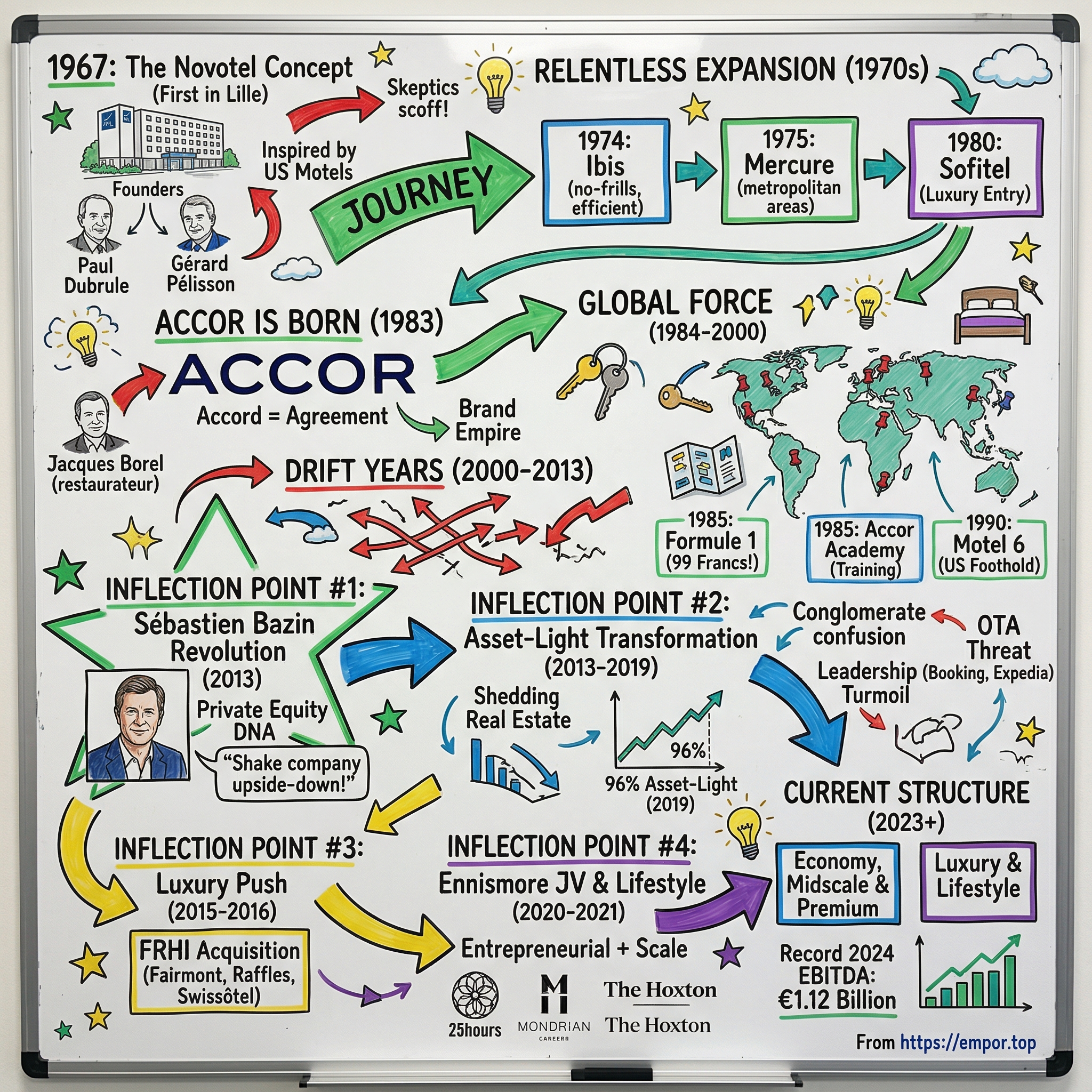
Accor: Europe's Hospitality Titan Goes Asset-Light
The Dawn of Modern French Hospitality
On a gray autumn day in 1967, in a muddy field just off the motorway outside Lille in northern France, a small hotel opened its doors. Sixty-two rooms. Air conditioning. A grill restaurant. Ample parking. And—comble du luxe, as the French would say—a private bathroom in every room.
"The Novotel model was a truly revolutionary concept which was years ahead of its time. It offered guests a modern bedroom with en-suite bathroom and desk, a grill restaurant, swimming pool and breakfast, all for one rate. Something most hotels of the time did not provide."
The doubters were everywhere. "Realistic hotels in the suburbs, on former beetroot fields along the motorway? That makes nobody dream," scoffed skeptics.
Gérard Pélisson, co-founder of what would become Accor, had studied at the Massachusetts Institute of Technology and worked at IBM, where he gained valuable insights into U.S.-style entrepreneurship. He left IBM after developing a fascination with America's standardized model of hotel businesses, to start something similar in France.
His partner, Paul Dubrule, had traveled to the United States as a young man, observing the Holiday Inn phenomenon sweep across American highways. Paul Dubrule (33 years old at the time) and Gérard Pélisson (35 years old at the time) partnered at the end of the 60s to create Novotel SIEH, the hotel investment and operating firm that in 1967 launched a new concept inspired by American motels.
The first night? One customer. The second night? Nobody.
But then something remarkable happened. In November 1967, the UNR, the party of General de Gaulle, held its meetings in Lille. The hotel was full for the first time since its opening. Political figures were delighted to take refuge away from the city center and onlookers. Brigitte, Paul's sister, took the opportunity to hand out flyers to journalists present for the occasion. The hotel's reputation was launched.
What followed was one of the most remarkable entrepreneurial stories in European business history. Accor S.A. is today a French multinational hospitality company that owns, manages and franchises hotels, resorts and vacation properties. It is the largest hospitality company in Europe, and the sixth largest hospitality company worldwide. Accor operates 5,700 locations in over 110 countries.
This is the story of how two French entrepreneurs copied an American idea, reinvented it with Gallic flair, and then—through one of the most dramatic business model transformations of the 21st century—remade their company into a 96% asset-light global powerhouse.
The Founders: Engineer Meets Hospitality Visionary
To understand Accor, you must understand the remarkable partnership at its core. "We managed to create all the great projects because we were in agreement," Pélisson once said about the business couple. Their biographer, Henry Lang, said the two men enjoyed "a great complicity and extraordinary mutual respect."
For Gérard Pélisson, the hospitality industry wasn't initially his calling. A brilliant engineer from Centrale who continued his training at the prestigious Massachusetts Institute of Technology, the co-founder of Novotel SIEH—which became Accor in 1983—first worked at IBM, the global emblem of computing, before meeting Paul Dubrule and evoking memories of the great American spaces.
Dubrule decided to build American-style highway hotels in the medium price range and collaborated with Pélisson, a former head of market research at IBM-Europe. The partnership was symbiotic: under the dual influence of a rigorous manager, shrewd financier, and skilled negotiator, paired with an inspired communications and marketing man, Novotel experienced exponential growth during the years of accelerated development in travel, tourism, and international exchange.
Pélisson and Dubrule developed their expanding company with a philosophy of decentralized management and a unique dual chairmanship. Although to comply with French law the partners took turns holding the official position of chairman, they made all decisions jointly and generally shared responsibilities, immersing themselves in all aspects of the business.
This complementary partnership—the engineer's rigor meeting the marketer's vision—would prove essential through decades of expansion, acquisition, and ultimately, transformation.
Building the Brand Empire: From Novotel to Sofitel (1967-1983)
The 1970s were a period of relentless expansion. In 1973, Sphere S.A. was created as a holding company for a new chain of two-star, no-frills hotels, called Ibis; the first Ibis was opened the following year. The Ibis concept represented something revolutionary—a stripped-down, efficient hotel that democratized travel for the emerging European middle class.
During this time, the company also acquired Courte Paille, a chain of roadside steakhouses founded in 1961, which reflected many of the same priorities as Novotel: practicality, easy parking, consistent quality, and quick service. The acquisition of the Mercure hotel chain in 1975 pushed the company into metropolitan areas and the business traveler market.
By the end of the 1970s, Novotel had become the premier hotel chain in Europe with 240 establishments in Europe, Africa, South America, and the Far East.
Then came the pivotal move into luxury. In 1980, Accor's acquisition of the Sofitel brand marked its entry into the luxury segment, a pivotal moment in its history. This signaled Accor's ambition to become a comprehensive hospitality provider across all segments.
The creation of the Accor name itself came through acquisition. In 1980, Novotel invested in Jacques Borel International, which owned restaurants and luxury Sofitel hotels. Jacques Borel had begun his career with the establishment of one restaurant in 1957, and by 1975, when he took over Belgium's Sofitel chain, he was Europe's top restaurateur. After losses in the hotel business forced Borel to sell the Sofitel chain to Pélisson and Dubrule in 1982, Novotel and its holdings were incorporated under the name Accor and became one of the top ten hotel operators in the world.
The name "Accor" derived from the French word "Accord," meaning "agreement"—a fitting tribute to the partnership that built it. The merger doubled the partners' holdings and infused new talent into senior management, as Bernard Westercamp became vice-president and general manager of Accor.
What made Accor distinctive was its segmentation strategy—a deliberate decision to cover every tier of the market. What distinguished Accor from its rivals was its broad coverage of the hospitality and leisure market with establishments for all budgets, from one- to five-star properties. Formule 1, Etap, Motel 6, and Red Roof were bargain priced with few amenities; Ibis and Suitehotel offered more services at a reasonable price; Mercure and Novotel offered travelers midscale accommodations with comfort and a measure of sophistication; and Sofitel served the luxury market with gourmet restaurants and upscale architecture in major international locations.
The Golden Era of Expansion (1984-2000)
The mid-1980s marked Accor's emergence as a truly global force. For more than 40 years, Pélisson worked to expand Accor's portfolio and achieved major milestones, including establishing ibis in 1974, acquiring Mercure in 1975 and Sofitel in 1980, leading the merger with Jacques Borel in 1982, launching Formule 1 in 1985, integrating Lenôtre in 1990 and purchasing Compagnie Internationale des Wagons-Lits et du Tourisme in 1991.
Their disruptive marketing methods included campaigns such as "A room for 99 francs" (15 euros) at the low-cost Formule1 chain, now known as hotelF1. This aggressive pricing strategy shocked traditionalists but captured the imagination of budget-conscious travelers across Europe.
The American adventure, however, proved more challenging. Accor's initial expansion into the American market, which began in 1979 with the opening of a hotel in Minneapolis, was not as successful as its ventures in Europe, due to a saturated market in the United States and Accor's slow development. The company brought Novotel, Ibis, and Sofitel hotels to the United States, as well as a chain of eateries in California called Seafood Broiler, but all operated at a loss.
Rather than retreat, Accor adapted. Nonetheless, Pélisson and Dubrule made American-style service culture fundamental to their business in Europe. After visiting training schools at McDonald's Corporation and Disneyland, they opened Accor Academy at the company headquarters in Évry in 1985. The academy offered seminars in topics ranging from phone etiquette to team-building skills and the exploration of new technologies. Accor spent a reported two percent of its annual payroll on training.
The 1990 acquisition of Motel 6 gave Accor a genuine U.S. foothold. By 1997, Accor operated 2,605 hotels with 289,200 rooms around the world. Sales from its hotel operations rose 16.6 percent in 1997, to FFr 18.6 billion. The company had placed its hotels in two groups: the business and leisure group, which comprised Mercure, with 43,000 rooms, Novotel, with more than 50,000 rooms, and Sofitel, with 20,500 rooms, and the economy group, which comprised Motel 6, with 84,500 rooms, Ibis, with 45,000 rooms, Formule 1, with 22,000 rooms, and Etap Hotel, with 13,000 rooms.
Pélisson and Dubrule left Accor's executive management in 1997 after an acquisition spree that began to weigh on the group's finances, but co-led the supervisory board until 2005. Their departure marked the end of an era—but also the beginning of Accor's drift years.
The Drift Years & Leadership Turmoil (2000-2013)
If the 1990s represented Accor's golden age, the 2000s exposed fundamental strategic confusion. The company had diversified far beyond hotels—into casinos, travel services, employee vouchers, catering, and even thalassotherapy spas. The conglomerate structure masked a lack of strategic focus.
The digital revolution posed an existential threat. Online Travel Agencies (OTAs) wielded an incredible influence in today's travel sector. Recent estimates suggest that two companies (Booking Holdings and Expedia Inc. respectively) control over ninety percent of the indirect online travel market in the U.S. market, making them incredibly powerful.
In the new, enlarged ecosystem, OTAs, metasearch sites, and lodging platforms take a chunk out of the value chain through hefty agency fees typically reaching 20% to 30% of the price of the room. For Accor, which had built its reputation on direct customer relationships, this represented a fundamental disruption.
Leadership churned. In 2005, Gilles Pélisson—nephew of co-founder Gérard—became chairman and CEO. Colony Capital invested €1 billion in Accor, signaling activist pressure for change. The company sold its shares in Club Med and Red Roof Inn, beginning a divestiture that would accelerate dramatically.
In 2010, Accor made a crucial decision: splitting its hotel activities from its voucher services business, which became Edenred and was listed separately on the stock exchange. This was the first step toward the asset-light transformation that would define the company's future.
But the pace of change remained contentious. Denis Hennequin replaced Gilles Pélisson in November 2010, but reports suggested major shareholders—Eurazeo and Colony Capital controlling 21% of Accor—pushed Hennequin out because he disagreed with the pace of implementing Accor's asset-light strategy.
By 2013, Accor had cycled through four CEOs in eight years. The company needed a new leader with a different perspective—someone who understood both private equity discipline and hospitality operations.
INFLECTION POINT #1: The Sébastien Bazin Revolution (2013)
In August 2013, Europe's largest hotel chain made an unconventional choice. Sébastien Bazin had spent 16 years at Colony Capital, a private real estate investment firm, heading up its European branch and leading several acquisitions, principally in the hospitality sector (Générale des Eaux, Club Méditerranée, Lucien Barrière, Fairmont & Raffles, Buffalo Grill, Château Lascombes, Stadia Consulting and others). He joined Accor's Board of Directors in 2005 and, via Colony Capital, became a Paris Saint-Germain shareholder in 2006 and the club's Chairman in 2009. In August 2013, he resigned from his duties at Colony Capital and was appointed Chairman and CEO of Accor.
Bazin had been chairman and CEO of Accor since August 2013, following 16 years at Colony Capital where he led European operations for the private real estate investment firm. He was famously offered the Accor job after writing a paper about where the hospitality giant should go next.
The paper—essentially an unsolicited strategic analysis—demonstrated both audacity and vision. "I had a clear idea about what Accor needed – I wanted to shake this company upside-down in terms of business model, segments and geographies," he said. "I've done that. Now that that transformation is behind me – it took three years longer than expected – I feel serene."
What made Bazin different was his private equity DNA. He understood capital allocation, return on invested capital, and the strategic value of asset-light models. From finance, he says, "I learned the cost of a dollar and how to assess the risk of a dollar being invested." At Accor, he learned that executing on a vision takes time. "You need to put it on paper, share it with your board of directors and once you have their blessing, you need to actually explain it to your management team, so that they understand where you're going."
His management philosophy was direct, almost provocative. "Always be an actor in your own life; never a spectator," he says. "Anybody who's waiting for the day after tomorrow is just an idiot, because a decision made later is usually worse than one made today."
In terms of his personal management style, Bazin revealed that he travels "all the time – around 300 days a year." This peripatetic approach—constantly visiting properties, meeting owners, understanding local markets—became a hallmark of his leadership.
"In this industry, those who master digital will win. We see digital not as a threat but as a massive opportunity," Bazin said. "In the 14 months I have been at Accor, we have split the company into its HotelServices and HotelInvest divisions, underlined our key performance indicators, expanded our brands, involved employees and created cash flows."
INFLECTION POINT #2: The Asset-Light Transformation (2013-2019)
The transformation Bazin orchestrated was nothing short of revolutionary. For fifty years, Accor had owned hotels. Now it would shed them systematically, becoming a pure-play hotel management and franchise company.
In May 2018, Accor opened the share capital of AccorInvest through a sale of 57.5% of the company's shares to several sovereign funds (Public Investment Fund (PIF) and GIC), institutional investors (Colony NorthStar, Crédit Agricole Assurances and Amundi), and multiple private investors. This transaction enabled the group to generate €4.6 billion in gross cash.
As he began Accor's full-year 2019 earnings presentation, Chairman/CEO Sébastien Bazin announced that the company's "transformation" into an asset-light company was essentially complete, having sold off 50 years' worth of real estate. "We are 96 percent asset-light," Bazin told the crowd, and emphasized the company would be "tackling" that remainder. "Accor is, today, a pure asset-light company."
In line with its communicated strategy and timeline, Accor announced the completion of its asset-light roadmap with the disposal of Orbis and the sale & management back of the Mövenpick leases.
The company restructured Mövenpick Hotels' lease portfolio through a sale-and-management-back agreement with HR Group, a German private fund, with the hotels to be managed by Accor under a 20-year agreement. This resulted in a €429 million reduction of Accor's consolidated debt, predominantly related to IFRS 16 lease liabilities. It also agreed to sell its 85.8 percent stake in Orbis to AccorInvest for €1.06 billion.
The rationale was straightforward: Hotel companies' business models range from asset-heavy, where companies own and manage hotels directly, to asset-light, where they charge fixed fees for brand usage, with minimal operational involvement. Asset-heavy lodging companies tend to exhibit higher operating leverage than asset-light lodging companies, which translates, on average, into lower return on capital and free cash flow generation over the cycle. The leading hotel brand operators have been moving toward asset-light business models and key players have been disposing many assets over the past few years to improve the stability of their earnings.
Accor's business model strengthened over the past few years. The company has made significant progress in its transition to an asset-light business model and moved from a fixed to a leaner cost structure.
The transformation wasn't universally applauded. Critics questioned whether Accor was simply liquidating assets to dress up short-term returns. But Bazin had a clear response: "Accor has now become a fully asset-light group."
The financial implications were profound. After the repurchase of 7.5% of its share capital for €850m over the last 18 months, Accor announced a €1.0bn return to shareholders, to be executed over the next 24 months.
INFLECTION POINT #3: The Luxury Push—FRHI Acquisition (2015-2016)
Alongside the asset-light transformation, Bazin pursued a parallel strategy: aggressive expansion in luxury hospitality. The landmark deal was the acquisition of FRHI Hotels & Resorts.
AccorHotels, Europe's largest hotel operator, received antitrust clearance approvals in all relevant jurisdictions, allowing it to proceed with its $2.9 billion acquisition of FRHI Holdings, the parent company of the Fairmont, Swissotel, and Raffles hotel brands.
Following the approval of shareholders at the General Shareholders Meeting on July 12, 2016, AccorHotels Group officially announced the acquisition of FRHI Hotels & Resorts (FRHI) and its three prestigious luxury hotel brands: Fairmont, Raffles and Swissôtel. This addition of three remarkable brands instantly positioned AccorHotels as a leading player in the global luxury hotel market, increases long-term growth potential and profitability, and significantly expands the company's footprint in North America.
The transaction with Qatar Investment Authority (QIA) and Kingdom Holding Company (KHC) of Saudi Arabia provided $840 million (€768 million) cash payment and the issuance of 46.7 million AccorHotels shares in consideration for the contributed FRHI shares.
Joining AccorHotels' global network was a portfolio of globally admired brands, which includes management of many of the world's most iconic and historic hotels located in key strategic cities around the world, including: The Savoy in London, Raffles Singapore, Fairmont San Francisco, New York's The Plaza, Fairmont Le Château Frontenac in Quebec City, and Le Royal Monceau Raffles Paris.
AccorHotels planned to generate approximately €65 million in revenue and cost synergies thanks to the combination of brands, the maximization of hotel earnings, the increased efficiency of marketing, sales and distribution channel initiatives, and the optimization of support costs. Significant enhancements would also be made in terms of customer data, thanks to the integration of FRHI's customer base that included three million loyalty members, of which 75 percent were in North America. The vast majority of Fairmont, Raffles and Swissôtel's 154 hotels and resorts (of which 40 were under development) and 56,000 rooms spanning 34 countries and five continents were operated under long-term management contracts, with an average term of nearly 30 years.
The deal wasn't without skeptics. During a 2017 full-year earnings presentation, Bazin responded to critics who said AccorHotels spent too much on FRHI Holdings: "I heard it all; 90% of people had doubts or were extraordinarily aggressive. 'Your synergy is total rubbish.' All of those of you who said that to me, come back and see me; we'll have a glass of wine together; it's on me."
INFLECTION POINT #4: The Ennismore JV & Lifestyle Strategy (2020-2021)
The most recent strategic pivot came through Accor's partnership with Ennismore—a deal that positions the company at the forefront of the lifestyle hospitality revolution.
Founded in 2011 by entrepreneur Sharan Pasricha, Ennismore and Accor entered a joint venture in 2021 creating the world's fastest growing lifestyle hospitality company, bringing together an unrivalled portfolio of global brands, with Ennismore's know-how in building brands with creative storytelling, design, and authentic experiences, and with Accor's wealth of knowledge in delivering scale, network growth and distribution.
Accor SA and Sharan Pasricha acquired Ennismore Holdings Limited on October 1, 2021. Under the terms, Accor SA acquired 66.67% stake and Sharan Pasricha acquired 33.33% stake in Ennismore Holdings Limited.
Sharan Pasricha, Founder & Co-CEO and Gaurav Bhushan, Co-CEO, lead the asset-light entity which runs autonomously, comprising 14 hotel & co-working brands and a collection of over 150 culturally relevant and diverse restaurants and nightlife destinations. The portfolio includes 87 operating properties globally, with an additional 141 hotels in committed pipeline across different regions, operating under unrivalled brands including 21c Museum Hotels, 25hours, Delano, Gleneagles, Hyde, JO&JOE, Mama Shelter, Mondrian, Morgans Originals, SLS, SO/, The Hoxton, TRIBE and Working From_.
The beauty of Ennismore and this joint venture with Accor allows for something fundamentally very unique, whereby you get the best of both worlds. On one hand, you get an entrepreneurial, young, agile, founder-led company. But then you also get the scale, the might and the distribution of Europe's largest hotel company. The brilliance of Ennismore is to be able to sit between that because very few small founder-led companies have scaled past 10, 12, 15 hotels. They either get fully acquired, in which case they get integrated into the larger entities, or they remain autonomous, which is what Ennismore has managed to do with Bazin's support.
The company's Ennismore division, which includes 17 luxury and lifestyle brands, grows 25% to 45% annually, Bazin said.
Accor confirmed that its board is evaluating a possible stock market listing for Ennismore. In its release, Accor said an IPO "would enhance liquidity and flexibility to support Ennismore's growth platform," and added that Accor would remain the brand's controlling shareholder, should a public offering be made.
In 2024, Ennismore posted a net unit growth of 17.6% and an EBITDA of €170 million, according to Accor's statement.
Digital Transformation & The OTA Battle
At the International Hotel Investment Forum in Berlin, Accor's CEO Sébastien Bazin threw down the gauntlet in the struggle of hotel versus online travel agency, saying his company was in a position to regain ground from such disruptive booking initiatives. His comment was that "reclaiming that space is about measurement, risk and pricing. OTAs are a great innovation, but if you are big enough, and Accor is, you have to control your destinations."
The biggest move was when Accor announced in 2015 that it would allow independent hotels to be listed on its website AccorHotels.com. Accor offers these hotels lower commissions than the rates demanded by Online Travel Agents, serving as a distribution channel in an effort to reduce OTAs' bargaining power and encouraging more direct bookings. The digital platform is facilitated by Accor's acquisition of Fastbooking, a European-based digital services provider for the hospitality industry. In addition, these independent hotels also have access to Accor's loyalty program.
The crown jewel of Accor's digital strategy is its ALL (Accor Live Limitless) loyalty program. Accor announced its global loyalty and reward program, ALL, has welcomed its 100 millionth member demonstrating its attractiveness and rapid growth. One of the top-performing loyalty programs globally, ALL provides exclusive access to hotel rooms at the best price, unique experiences, and an all-in-one booking platform designed to enhance premium and lifestyle experiences both during and beyond the hotel stay. Its mission is to boost traffic and direct revenues for hotel owners while providing unrivalled choice to Accor guests.
French hotel giant Accor's loyalty program ALL, or Accor Live Limitless, has reached its 100-millionth member, making it the fifth hotel firm to reach the milestone and first non-U.S. company to cross the line. ALL began in 2019, and in the following years, Accor saw membership thrive, with the program adding 11 million new members in 2024.
Since its inception in 2019, ALL has established itself as a powerful performance engine and key business driver, enhancing brand visibility, guest engagement and financial performance for the Group and its hotel owners. ALL members were multiplied by 2 in five years, 2024 saw membership grow by another 11 million of new members.
Accor's goal is to shift repeat guests to direct channels. That means using AI to target true acquisition spend and ensuring that guests know they'll get the best price and experience by booking direct. The company uses AI to personalize guest interactions across multiple channels. On websites and mobile apps, they personalize search results and content recommendations. They also tailor marketing communications, using AI to generate email content in each brand's tone of voice and to determine the best frequency and format for each guest.
The Current Structure & Recent Performance (2023-Present)
In 2023, Accor restructured into two distinct business units: "Economy, Midscale & Premium" unit (Ibis, Novotel, Mercure, Swissôtel, Mövenpick, Pullman, TRIBE from October 2023) and the "Luxury & Lifestyle" organized in four brand collections (Raffles & Orient Express, Fairmont, Sofitel & MGallery, Ennismore).
Accor Group reported a revenue of €5.606 billion ($5.873 billion) in 2024, up 11% from 2023, while consolidated recurring EBITDA came to €1.12 billion, a new record for Accor and up 12% versus FY 2023. In 2024, Accor opened 293 hotels, corresponding to more than 50,000 rooms, i.e., net network growth of 3.5% in the last 12 months. At end-December 2024, the Group had a hotel portfolio of 850,285 rooms (5,682 hotels) and a pipeline of more than 233,000 rooms (1,381 hotels).
Sébastien Bazin, Chairman and Chief Executive Officer of Accor, said: "Ambition, discipline and high standards are the three pillars that have guided Accor's actions in 2024. They have once again enabled us to post record results, in line with each of the objectives we have set for the Group."
Consolidated Recurring EBITDA came to €1,120 million for 2024, a new record for Accor and up 12% versus FY 2023. This performance is due to the resilience of RevPAR, portfolio growth, margin improvement in the M&F business, strict cost discipline in Services to Owners and the development of the Hotel Assets & Other business (particularly in the Luxury & Lifestyle division) combined with a number of acquisitions.
The Luxury & Lifestyle division generated recurring EBITDA of €427 million, up 21% versus FY 2023. Management & Franchise (M&F) posted recurring EBITDA of €333 million, up 12% versus FY 2023 thanks to solid RevPAR growth, strong portfolio growth and operating leverage.
Looking ahead, Accor confirmed its medium-term growth prospects: Annualized RevPAR growth of between 3 percent and 4 percent (CAGR 2023-27); Average annual network expansion of between 3 percent and 5 percent (CAGR 2023-27); M&F revenue growth of between 6 percent and 10 percent (CAGR 2023-27); A positive Recurring EBITDA contribution from Services to Owners; Recurring EBITDA growth of between 9 percent and 12 percent (CAGR 2023-27); Recurring free cash flow conversion in excess or equal to 55 percent; A shareholder payout of around €3 billion over 2023-2027.
The board reaffirmed its confidence in Bazin for a new three-year term. This trust is based not only on the strong performance delivered since the post-COVID recovery—marked by significant double-digit growth in gross margin, net profit, and royalty value—but also on his ability "to finish the job."
The "job" translates into five major initiatives: Enhancing operational performance by further reducing costs where possible and maximizing contractual commitments by prioritizing value over volume; Accelerating geographical expansion in high-growth regions by aligning the right brands with the right markets. Bazin highlighted that he now spends three-quarters of his time exploring Latin America, China, India, and the Middle East—his top priorities for Accor's short-term growth.
Finalizing the sale of Accor's remaining 31% stake in AccorInvest is a key task that has been assigned to Jean-Jacques Morin, Accor's representative within AccorInvest. The process, expected to take 12 to 18 months, is now irreversibly underway.
Bull Case vs. Bear Case
The Bull Case
Brand Moat: Paris-based Accor is Europe's largest hospitality group, bringing European flair to its vast spectrum of luxury and lifestyle brands. With over 40 brands under its name, Accor has the largest brand portfolio of its competitors. Its 5,500+ properties represent over 820,000 rooms spanning 110 countries. This breadth—from economy to ultra-luxury, from standardized to lifestyle—creates an unmatched ability to capture travelers across segments and occasions.
Asset-Light Leverage: The transformation to 96% asset-light has fundamentally changed the company's risk profile. Most of the company's portfolio is now split between managed and franchised hotel contracts, which represent 54% and 44%, respectively, of total rooms. This model generates high-margin fee income without the capital intensity and cyclical exposure of owning real estate.
Lifestyle Positioning: The company's Ennismore division, which includes 17 luxury and lifestyle brands, grows 25% to 45% annually. Lifestyle hospitality is one of the fastest-growing segments globally, and Accor's Ennismore joint venture positions it at the forefront of this trend.
Loyalty Scale: ALL Accor has seen dynamic growth, achieving the 100-million-member milestone in 2025, with membership doubling in five years. This extraordinary growth demonstrates the program's unrivaled value in strengthening guest connections, driving customer retention, and driving business impact for partners and owners.
Geographic Diversification: Unlike American competitors heavily weighted to the U.S. market, Accor is the largest hotel chain in Europe, Latin America, Africa, and the Middle East and has a strong presence in Asia-Pacific. This provides exposure to some of the world's fastest-growing travel markets.
The Bear Case
OTA Dependency: Despite digital investments, in the new, enlarged ecosystem, OTAs, metasearch sites, and lodging platforms take a chunk out of the value chain through hefty agency fees typically reaching 20% to 30% of the price of the room. The structural power of Booking.com and Expedia remains a persistent margin drag.
Management Concentration: Accor's share of managed contracts is higher than that of IHG, meaning Accor has a relatively higher fixed-cost base. This results in higher operating leverage for Accor. Accor experienced more pressure than IHG during the pandemic due to the company's relatively larger fixed-cost base, which resulted in EBITDA turning negative €278 million in 2020 and remaining break-even in 2021.
U.S. Weakness: Despite the potential, Accor's India business currently accounts for just 2% of the company's global operations. Similar underexposure exists in the world's largest and most profitable hospitality market—the United States.
Brand Proliferation Risk: Today, some groups manage 20, 30, even 40 different brands. A proliferation so dense that even hospitality professionals are starting to lose track. Can anyone clearly explain the difference between a Sofitel, an Intercontinental, an MGallery, and a Le Méridien? For guests, the confusion is even greater. Studies show that most newly launched hotel brands have close to zero brand recognition—even several years after their debut.
Porter's Five Forces Analysis
Supplier Power (Low to Moderate): Hotel operators don't face significant supplier concentration. Labor is the primary input, and while shortages exist, the global footprint allows geographic flexibility.
Buyer Power (Moderate to High): Both OTAs and sophisticated corporate travel buyers exert significant pressure. Loyalty programs partially offset this, but Booking Holdings and Expedia Inc. control over ninety percent of the indirect online travel market in the U.S. market.
Threat of Substitutes (Moderate): Airbnb disrupted the industry but has proven more complementary than substitutional for business and luxury travel—Accor's core segments. Extended stay and serviced apartments represent ongoing substitution risk.
Threat of New Entrants (Low): Brand building, loyalty scale, and distribution systems create substantial barriers. Regional competitors exist but lack global reach.
Competitive Rivalry (High): Marriott International maintains its position as global leader for the ninth consecutive year, now nearing 1.7 million rooms. Jin Jiang and Hilton complete the podium, supported by steady growth and strong ambitions in the upscale segments. Competition for management contracts and franchise agreements is intense.
Hamilton Helmer's 7 Powers Framework
Scale Economies: Moderate. Central reservation systems, loyalty programs, and marketing benefit from scale, but hotel operations remain largely property-level.
Network Effects: Limited direct network effects, but the loyalty program creates weak indirect effects—more members make the program more attractive to hotel owners, which adds properties, which attracts more members.
Counter-Positioning: Accor's lifestyle and European heritage positioning creates differentiation versus American competitors, but this isn't true counter-positioning.
Switching Costs: Moderate for franchise/management relationships (multi-year contracts), low for end consumers despite loyalty programs.
Branding: Strong. With over 40 brands under its name, Accor has the largest brand portfolio of its competitors. Individual brands like Raffles, Fairmont, and Sofitel carry genuine premiums.
Cornered Resource: The Orient Express brand represents a true cornered resource—an iconic name with irreplaceable heritage value. The group announced the launch of Orient Express Silenseas, a luxury cruise built with Chantiers de l'Atlantique and planned for delivery March 2026.
Process Power: Not evident. Hotel operations remain standardized across the industry.
Key KPIs to Watch
For long-term investors tracking Accor's ongoing performance, three metrics matter most:
1. RevPAR Growth (Revenue per Available Room) This single metric captures both pricing power and demand trends. RevPAR increased by 5.7%, driven by both prices and occupancy. Sustained RevPAR growth above inflation signals healthy demand and pricing power. Watch for divergence between segments—luxury and lifestyle RevPAR typically leads, while economy can be a leading indicator of broader economic conditions.
2. Net Unit Growth (NUG) For an asset-light company, unit growth drives long-term earnings power. Net network growth was 3.5% in the last 12 months. The quality of additions matters as much as quantity—signings in high-growth markets (Middle East, Asia-Pacific) and higher-margin segments (luxury, lifestyle) deserve more weight.
3. Loyalty Member Growth & Direct Booking Share ALL members were multiplied by 2 in five years, 2024 saw membership grow by another 11 million new members. But quantity matters less than quality—track the share of bookings coming through direct channels versus OTAs. Higher direct booking share means lower distribution costs and stronger customer relationships.
Regulatory & Accounting Considerations
Investors should monitor several regulatory and accounting issues:
AccorInvest Relationship: Accor and AccorInvest have a long-term management contract, by which Accor generated about 9% of its revenues for the year ended Dec. 31, 2023. Accor still holds a 30.5% equity stake in AccorInvest. The eventual sale of this stake will generate proceeds but also eliminate a significant related-party revenue stream.
IFRS 16 Lease Accounting: The 2019 adoption of IFRS 16 brought operating leases onto balance sheets, affecting leverage metrics. The asset-light transformation reduced this impact, but investors should examine both IFRS and pre-IFRS-16 metrics when analyzing leverage.
Ennismore Consolidation: The treatment of minority interests and potential IPO will affect earnings presentation. Accor said an IPO "would enhance liquidity and flexibility to support Ennismore's growth platform," and Accor would remain the brand's controlling shareholder.
Geopolitical Exposure: Operations in Russia were affected by sanctions following the Ukraine invasion. In December 2020, Accor announced that it would be opening a new hotel in Moscow, next to the Kremlin. However, in March 2023, it was confirmed that the new hotel was cancelled due to the Russian invasion of Ukraine.
Conclusion: From Beetroot Field to Global Titan
On that gray day in 1967, when Paul Dubrule and Gérard Pélisson opened their first Novotel in a former beetroot field outside Lille, they could scarcely have imagined what would follow: a hotel portfolio of 850,285 rooms across 5,682 hotels, with a pipeline of more than 233,000 rooms in 1,381 hotels.
Their vision—democratizing travel through standardized, accessible hospitality—proved remarkably durable. But what distinguishes Accor today is its willingness to reinvent itself. From family-run startup to European leader, from asset-heavy conglomerate to asset-light platform, from traditional hotelier to lifestyle hospitality pioneer—each transition required courage and conviction.
Sébastien Bazin said Pélisson "was an entrepreneur par excellence. A true revolutionary of our industry who, together with Paul Dubrule, made Accor a global force to be reckoned with. With courage and determination, they fearlessly challenged conventions, reinvented hospitality, and forever altered the industry's trajectory, making a global impact."
The transformation is not complete. The board's trust is based not only on the strong performance delivered since the post-COVID recovery but also on Bazin's ability "to finish the job." That job now includes completing the AccorInvest exit, potentially listing Ennismore, and capturing growth in the world's fastest-growing travel markets.
For investors, Accor presents a compelling case study in strategic transformation. The asset-light model has fundamentally improved the company's return on capital, cash flow generation, and resilience through cycles. The luxury and lifestyle push positions Accor in the industry's highest-margin, fastest-growing segments. And the digital investments—particularly the 100-million-member loyalty program—create competitive moats that become stronger over time.
But challenges remain. The OTA duopoly continues to extract value from the distribution chain. American competitors dominate the world's largest market. And brand proliferation risks confusing both consumers and hotel owners.
What began as a French entrepreneur's dream to bring American hospitality efficiency to Europe has become something different and perhaps more interesting: a European champion teaching the world a new model for hospitality—one where brands, technology, and customer relationships matter more than bricks and mortar.
The story of Accor, in the end, is not just about hotels. It's about adaptation, transformation, and the courage to reinvent a fifty-year-old business model when circumstances demand it. As Bazin himself put it: "Always be an actor in your own life; never a spectator. Anybody who's waiting for the day after tomorrow is just an idiot, because a decision made later is usually worse than one made today."


 RSS Feed
 Spotify
 Apple Podcasts
 Amazon Music
 Audible
 YouTube