Mahindra Lifespaces: The City Builder's Cash Test
I. The Bookings That Don't Become Revenue
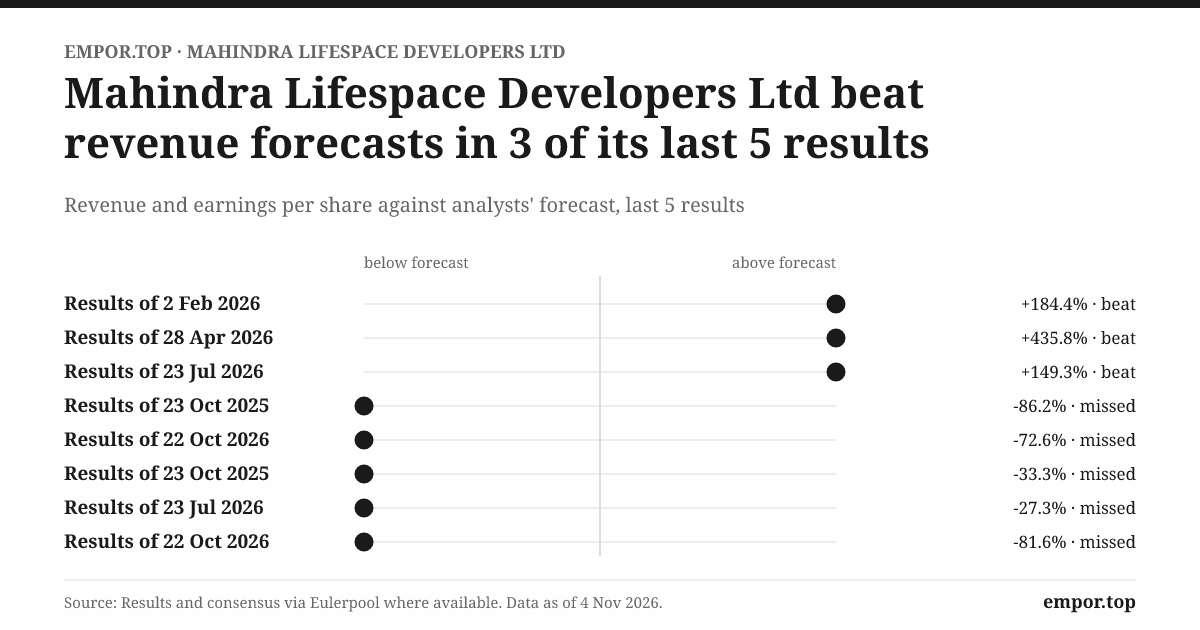
On 22 October 2026, Mahindra Lifespace Developers reported the kind of half-year a property developer hopes for. Between April and September, customers had booked ₹1,988 crore of homes, two-thirds more than in the same six months a year earlier.1 Managing director Amit Kumar Sinha opened the press release by calling it "a great H1."1 That afternoon, analysts on the earnings call asked about launches, approvals, land deals and the pace of the second half, in the tone people use when they think a business is speeding up.2
Then came the other numbers. Profit after tax for the September quarter was ₹16 crore, a third of the ₹48 crore earned a year earlier.1 Revenue swung from close to ₹900 crore in the June quarter to about ₹30 crore in September.3 Nothing had collapsed. No project had been cancelled and no buyers had fled. The swing comes from an accounting rule Mahindra Lifespaces states at the bottom of every results release: under Ind AS 115, it recognises residential revenue "on completion of contract."1 A flat booked in 2026 can reach the income statement in 2029, when the building gets its occupancy certificate and keys are handed over. Until then the sale exists only as a booking, a stream of instalments, and a liability on the balance sheet.
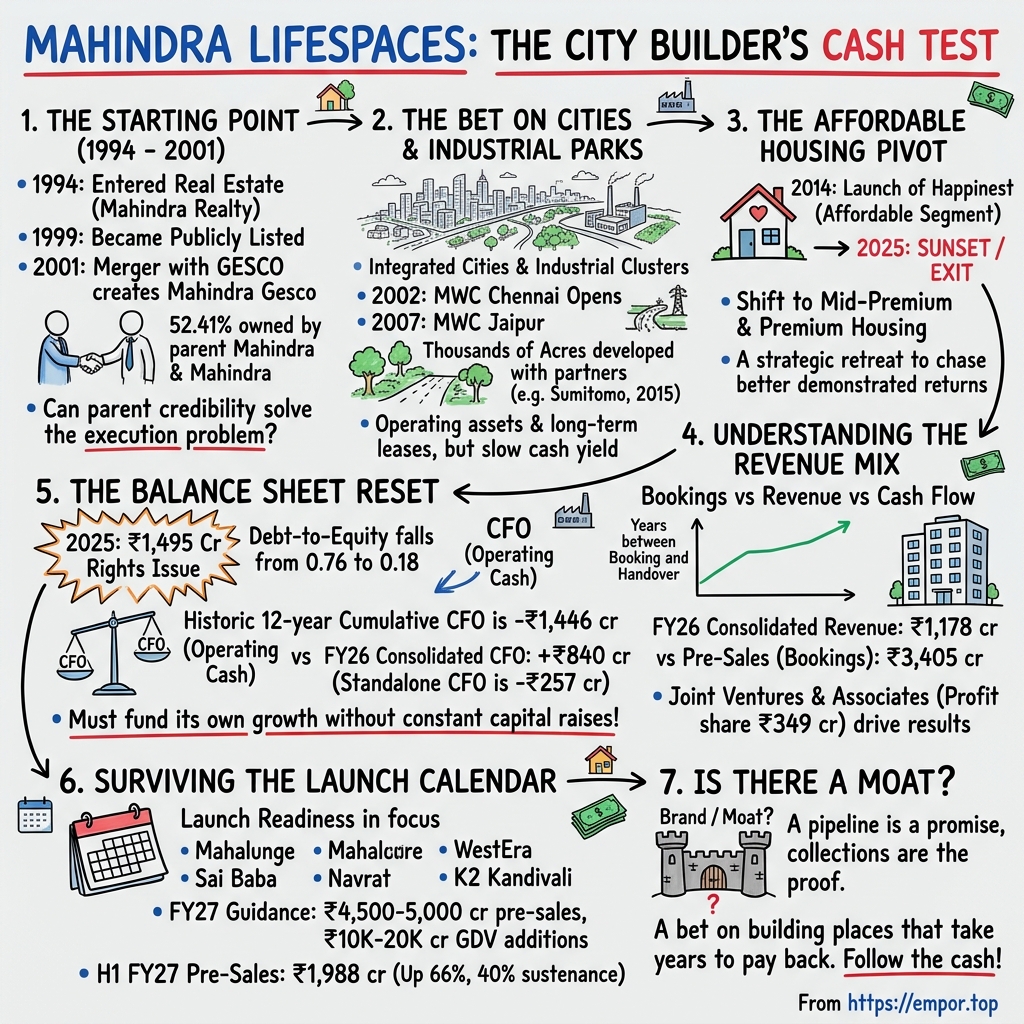
So the company keeps three sets of books, in effect, and each tells a different story. The first is bookings: homes customers have signed for, which management calls pre-sales. These reached a record ₹3,405 crore in FY26.4 The second is recognised revenue, which runs years behind. FY26 consolidated revenue from operations was about ₹1,178 crore, roughly a third of that year's pre-sales.5 The third is cash, which arrives in instalments as construction milestones are reached and leaves in large amounts whenever the company buys land or pours concrete. A developer can look excellent on one of these measures and poor on the other two, sometimes for years.
That gap is what this story is about. Mahindra Lifespaces has grown its bookings fast since 2023 and raised fresh equity in 2025. It has also said, publicly and in detail, how large it intends to become.6 The question is whether that growth is turning into a durable development business, one that books homes, collects the money, completes the buildings and recycles the cash into the next project without going back to shareholders. The alternative is that it still depends on a few marquee launches, the timing of completions and outside capital.
Three questions run under that one. First, can a business built on projects lasting years produce reliable cash, rather than profits that show up on paper while the cash goes into land and construction? Second, can a portfolio that began with whole cities and industrial parks earn its cost of capital, given that some of those assets were assembled two decades ago? Third, has the current management team, which arrived in 2023 with a consultant's view of capital allocation, actually fixed the execution problems that dogged the company for a decade, or has it only described the fix convincingly?
Before going further, one boundary needs to be clear. The listed company, Mahindra Lifespace Developers Limited, is not the whole Mahindra Group. Mahindra & Mahindra, the tractor and SUV maker, owns 52.41% of it, and the rest is held by the public.7 The parent's AAA credit, its brand and its board connections all matter here, but they are not the listed company's revenue or profit. Inside MLDL, the boundary blurs again. Many projects sit in subsidiaries and joint ventures with partners such as state industrial corporations, Japanese trading houses and global real-estate investors. Pre-sales, collections and gross development value, or GDV, are reported across that whole system, not only on MLDL's own consolidated revenue line.5
The present-day tension follows from that. Residential bookings are rising, but first-half profit after tax was ₹102 crore, almost unchanged from ₹99 crore a year earlier.1 The industrial business, which leases land in the company's integrated cities and has been the steadiest profit engine for years, earned ₹113 crore of revenue in the first half against ₹219 crore a year before.1 Bookings were up, profit was flat, industrial income had halved and revenue swung wildly from quarter to quarter. All of these are true together, and none of them settles the question by itself.
To see why the company looks like this, and why its cash has behaved the way it has for most of the past decade, the story has to go back to a takeover fight in Bombay at the turn of the millennium.
 Subscribe on LinkedIn
II. A Merger Made the Company, Not a Shipping Division
In the autumn of 2000, a small Bombay property company became the target of a rare Indian hostile takeover attempt. The company was GESCO, which held the real estate of the Sheth family, a prominent industrial family best known for shipping.8 Renaissance Estates, a Delhi company owned by the financier Abhishek Dalmia, had quietly bought just over 10% of GESCO's shares in the market. It then launched an open offer for another 45% at ₹27 a share, at a time when minority shares had been trading around ₹10.8 The Sheths owned only about 13%, which is why the raid was possible.8
The defence came from Mahindra. In November the Sheths, "along with the Mahindras," as Euromoney put it, countered with an offer for a third of the company at ₹36 a share. HDFC financed the Mahindra side of the purchase, and under the counter-offer's terms Mahindra would end up owning more of GESCO than the founding family.8 The price kept rising: the Sheths bought a 6.3% block from the International Finance Corporation at ₹44 a share, and GESCO closed at ₹45 that day.8 A company that had traded at ₹10 was suddenly worth fighting over, because its land was worth more than its share price implied.
This is where the common telling of the company's origin goes wrong. Indian market commentary often describes Mahindra Lifespaces as a shipping company's property division that Mahindra later took over. The listed entity was indeed born that way: the company was incorporated as GESCO Corporation in 1999, the year identified in its corporate registration and its credit rating rationale.910 But the business that became Mahindra Lifespaces came from Mahindra itself.
The group had entered real estate in 1994 as Mahindra Realty & Infrastructure Developers Limited, a venture with its own team and its own ambitions.11 In 2001, after the takeover battle, Mahindra Realty and GESCO merged to form Mahindra Gesco.11 GESCO contributed the stock-market listing and a land bank. Mahindra contributed the management, the brand and the strategy. The name changed again to Mahindra Lifespace Developers in fiscal 2008.9
So the company was made by a merger, not handed down as an inherited division. It also arrived at the listed-company stage as a white knight's prize, which says something about the Mahindra posture that has run through this business ever since. The group did not set out to build a public real-estate company from scratch. It used a contested listed shell as the vehicle for an ambition it had already formed.
The setting explains why that ambition was not easy. Indian real estate in the late 1990s and early 2000s was fragmented and local, and its reputation was poor. Land titles could be murky. Approvals depended on municipal and state authorities whose timelines nobody could predict. Buyers routinely paid for flats that arrived years late, or not at all, and there was no national regulator protecting them until the Real Estate (Regulation and Development) Act took effect in 2017.12 An organised developer had to win trust one project at a time, in one city at a time, against local builders who knew the officials, the landowners and the shortcuts.
In that market a famous parent mattered. Mahindra's name told a homebuyer that the developer would still exist when the building was finished. It told a bank that the borrower had a balance sheet behind it, and a state government that the partner had been around for decades. CRISIL still makes the point in 2026: its AA rating for MLDL rests partly on "expectation of need-based support" from M&M, which is rated AAA, and on M&M's description of the developer as one of its "growth gems."9 But parent backing does not make the business profitable. It lowers the cost of capital and opens doors, while the listed company still has to show a return in its own accounts. Over the long run, it mostly has not.
The first strategic choice the merged company made was its most distinctive. It would not just build apartment towers. It would build cities: whole urban ecosystems with factories, offices, housing, schools and roads, planned together on thousands of acres. That bet defined the company for twenty years.
III. The Bet on Cities Took Longer Than a Housing Cycle
In September 2002, on the highway running south-west from Chennai toward Chengalpattu, Mahindra World City opened for business.12 The company calls it India's first integrated city developed through a public-private partnership.11 Mahindra held 89% of the developing company and the Tamil Nadu Industrial Development Corporation held 11%.12
The plan was ambitious for a country where industrial estates usually meant a fence and some plots. It included sector-specific Special Economic Zones for IT, apparel and auto components, a domestic tariff area for companies selling inside India, and a residential and social zone where workers could live, shop and send their children to school.12 By 2018 the Chennai project covered about 1,524 acres.12
Jaipur followed in 2007.11 This time the partner was Rajasthan State Industrial Development & Investment Corporation, which held 26% against Mahindra's 74%.12 Jaipur was planned on an even larger scale, and by 2018 it was being developed as a multi-product SEZ with dozens of industrial customers.12 In 2015, the Jaipur project became, the company says, Asia's first to earn C40's Climate Positive Development Stage 2 certification.11
The city model works roughly like this. The developer assembles a large block of land, often with a state government partner that helps with acquisition and approvals. It then builds the trunk infrastructure of roads, power, water and drainage, and markets plots to companies that want to build factories or campuses.
Industrial tenants typically take land on very long leases, often 99 years, and pay a large up-front premium plus continuing operations and maintenance charges.4 Once enough employers arrive, the land set aside for housing and retail becomes more valuable, because thousands of workers now need somewhere to live. In theory, the industrial anchor creates the residential demand, and the residential development captures the value the developer created.
By 2018 there was real evidence that the cities had attracted employers. Companies in the two world cities had combined exports of ₹12,739 crore that year and directly employed about 50,000 people.12 Jaipur alone had 81 industrial customers, 49 of them already operating.12 Those are real communities, not drawings.
The industrial platform then expanded. In 2015, Mahindra World City and 住友商事 Sumitomo Corporation formed a joint venture to build an industrial park in North Chennai.11 In 2017 the company launched an industrial-cluster brand, Origins by Mahindra, for smaller parks of roughly 250 to 600 acres. The first, Origins Chennai, was a 264-acre project developed with Sumitomo.1112
The International Finance Corporation came in as partner for a 268-acre Origins cluster at Jansali near Ahmedabad.12 The logic was sound. Japanese manufacturers setting up in India want a trusted landlord, clear titles and ready infrastructure, and a partner like Sumitomo can bring them as a group. On the April 2026 call, Sinha said the three largest customers of the newest Chennai phase were all Japanese companies.13
The clock problem
The economics depend on time, and time is where the model gets hard. A city takes decades to fill. The land has to be bought and serviced up front, but tenants arrive at the pace of industrial investment cycles, not the developer's schedule. In 2017-18, a year the company described as strong, the two world cities leased 62 acres between them, fewer than the 74 acres leased the year before.12 At that pace, thousands of acres take many years to monetise. Meanwhile the land has a carrying cost: interest on the debt used to buy it, the opportunity cost of equity, and the infrastructure spending needed before anyone signs a lease.
In 2025, Sinha said plainly on an investor call that this industrial land "was acquired 20 years back, 15 years back."6 He was explaining why the industrial business is now so profitable. The same fact also shows the cost: an asset bought in the mid-2000s producing its best results in the mid-2020s has tied up capital for a very long time. Rising realisations help. Management says industrial land realisation rose from about ₹2.8 crore an acre in FY23 to about ₹4.6 crore an acre in FY26.5 In FY26 the industrial and commercial business generated ₹713 crore of revenue on 138.4 acres leased, a 44% increase.144 On the April 2026 call, Sinha guided that the business "will give us 400 to 500 crores every year."13
There is a further complication: much of this profit never appears as MLDL's own revenue. The world cities and Origins parks sit in subsidiaries and joint ventures, so their earnings reach MLDL's consolidated accounts partly as a "share of profit" from joint ventures and associates, and in cash only when those entities pay dividends. The company does not report what share of its consolidated income is recurring lease or maintenance income, and it does not publish a project-by-project return series for the cities.5 An investor can see the acres, the tenants and the realisations, but cannot see a clean figure for what the twenty-year investment in Chennai and Jaipur has earned on the capital put into it.
Weighing all this, the city strategy produced real operating assets: two functioning integrated cities, an industrial-cluster brand with credible Japanese and multilateral partners, and long-term lease relationships with manufacturers. That is more than most Indian developers can show. But the strategy also locked capital into assets that matured over decades, not housing cycles. The company's long-run financial record, from FY15 onward, shows what that cost.
Return on equity was in single digits in most years and negative in two, and return on capital employed has stayed below about 3.5% in every year since FY17.5 The city model gives a developer something to build on, but those returns are not yet proof that it creates value. The proof would be recurring lease and maintenance income, plus cash distributions from the project entities, running reliably above the cost of the capital tied up in them.
The FY26 pipeline makes this question more pressing. The company added ₹18,060 crore of GDV during the year, including ₹7,500 crore from unlocking a large land parcel it already owned in Thane.4 GDV is the estimated total value of homes that could eventually be sold on that land. It is a measure of potential, not cash. Thane shows the gap clearly. In April 2025, Sinha told analysts that the parcel needed three separate approvals and that only the first had been secured.6 A year later, on the FY26 call, he said the company had "finally" received the zoning approval and was in "advanced stages of design."13 Land the company had owned for years was only now becoming something it could sell.
That raises a capital-allocation question that has followed the company from its first city onward. When a platform takes this long to mature, which adjacent bets should management keep funding while it waits? In 2014, the company placed one.
IV. Happinest's Retreat Changed the Growth Story
In 2014-15, Mahindra Lifespaces launched a brand with a name that was hard to forget: Mahindra Happinest.12 It was aimed at a buyer the organised industry had largely ignored, the first-time homeowner on a modest salary, living on the edge of a metro region and paying rent for a room. The first two projects were at Boisar, on the far northern fringe of the Mumbai Metropolitan Region, and at Avadi, outside Chennai.12 The company's timeline describes Happinest as "a new business vertical focused on value housing."11
The reasoning was easy to follow. India's housing shortage was concentrated at the bottom of the market. Government policy was moving the same way: the Pradhan Mantri Awas Yojana and the "Housing for All" programme offered interest subsidies to low-income buyers, which the company itself said "further improved the viability and outlook for the segment."12 A Mahindra brand could offer buyers something valuable in that market, the confidence that the building would actually be finished. And a company already accustomed to industrialised construction in its cities thought it could build cheaper, faster and greener than small local contractors.
At first, the execution looked good. By March 2018 more than 75% of the launched phases at Avadi and Boisar were complete, and the company had handed over about 1,155 units to customers since construction began in 2014-15.12 In the chairman's welcome to that year's annual report, he wrote that he was "particularly proud" of the two projects.12
The company launched a third Happinest project at Palghar, with about 1.05 million square feet of saleable area.12 It also set up a ₹500 crore affordable-housing platform with a fund managed by HDFC Capital Advisors, capable, it said, of delivering 5 to 10 million square feet of development.12 The 2017-18 report described the company as "confident of scaling up its presence in this space as a part of its future growth strategy."12
Seven years later, the same company decided to stop.
What the 2025 call actually said
On 28 April 2025, Sinha presented the company's long-term strategy to analysts and investors in Mumbai.6 Among his "six building blocks" was a portfolio choice: "exiting affordable segment or sunsetting that part."6 His explanation was unusually blunt for a prepared remark: "Affordable hasn't done well for us and that's what something we want to sunset over a period of time. We have to fulfil our customer commitments which we will do over time."6 The existing Happinest commitments at Palghar, Kalyan and in Chennai would be completed by FY28-29, he said, so that "our mix in FY30 will have 0 affordable."6
He gave reasons, and they addressed economics directly. "Affordable they are tough from a customer experience but also financially it doesn't cover our cost of equity," he said.6 Later, answering a question from Axis Capital's Pritesh about project returns, he put numbers on it: the affordable portfolio's internal rate of return had been about 9%, against 18% for premium projects.6
When another participant asked what had diluted returns in the past, Sinha went through the causes one at a time. "Velocity has never been an issue for us," he said, but "pricing was an issue for affordable segment." Costs had been poorly estimated. And "the remote location affordable has given us the most pain, because it's very difficult to manage those sites."6
The answer is worth taking seriously, because it is more candid than most managements manage. It went beyond a vague mention of "strategic realignment" to name the IRR, the cost-of-equity comparison and the operational problem of managing distant construction sites. Sinha also told a story against the brand. Asked how a company that had moved from affordable to mid-income would now persuade premium buyers, he said, "many times I have been called the CEO of Mahindra Affordable Housing."6 He compared the situation to the parent company: Mahindra is known for SUVs, he noted, and had "even tried two-wheelers ... and it has not been very successful."6
Discipline or a late admission?
A strategic exit is not proof of failure by itself. Pulling capital out of a segment that earns 9% when equity costs more than that is what a disciplined allocator should do. The Happinest years also left something useful behind: the company did build and deliver low-cost homes at scale, on schedule in the early phases. Executing the work was not the problem. The model's economics were.
But the retreat is still meaningful counterevidence on two points. First, it weakens the claim that the Mahindra brand alone creates a durable advantage. If the brand had allowed Happinest to charge more than local rivals, or to sell faster in a way that paid for its higher standards, the economics would have worked. Sinha's own diagnosis was that pricing, not demand, was the problem.
Customers bought Mahindra's affordable homes, but they would not pay enough extra for the name to cover the cost of building them the Mahindra way, far from the company's main cities. Second, the reversal gives investors a reason to examine the next strategy closely. The 2017-18 report said the company was "confident of scaling up" in affordable housing.12 The 2025 strategy said it would have none by FY30.6 The confident language attached to today's premium push deserves the same scrutiny.
The test, then, is whether capital and people actually moved toward segments with better demonstrated returns. The early evidence is mixed but moving in the right direction. Management has narrowed its focus to three cities, Mumbai, Pune and Bengaluru, after exiting Nagpur and Hyderabad and pausing new projects in the National Capital Region.6 It has redefined its target as mid-premium and premium homes priced roughly between ₹1 crore and ₹10 crore.6 And it says it has tightened its underwriting, raising return thresholds on new deals to the 20-22% range and loading cost contingencies into project budgets in a way Sinha called, half-apologetically, "padding."6 Those are disciplined inputs. The outputs, meaning premium projects completed at the promised IRR, will not be fully visible until the projects acquired since 2023 reach completion later this decade.
That brings the story to the man presenting the new plan. Amit Kumar Sinha took over as MD and CEO in May 2023.5 He is an electrical engineer from the Birla Institute of Technology in Ranchi with an MBA from Wharton. He started his career at Tata Motors, worked in technology at iGate Patni in India, Singapore and the US, and then spent eighteen years at Bain & Company, rising to senior partner and advising clients in infrastructure, real estate and construction.5 He joined the Mahindra Group in November 2020 as President of Group Strategy, where he worked on "growth, transformation, and capital allocation across Group companies."5 In other words, Mahindra sent its in-house strategist to run the developer. His style shows on the calls: frameworks, numbered building blocks, IRR tables, and a willingness to say a former bet "hasn't done well."
But by the time he arrived, the reset had already begun. The company had already been moving toward mid-premium housing, and the affordable experiment was winding down rather than expanding. Sinha formalised and accelerated a turn that was underway. To judge whether that turn is working, the next step is to look at how the business actually makes money, because its income statement does not show it simply.
V. The Listed Company Is a Project Portfolio, Not a Homebuilder P&L
Picture two customers on the same afternoon. In a sales lounge in suburban Mumbai, a family signs for a three-bedroom flat in a tower that does not yet exist. They pay a booking amount, sign an agreement registered with the state's real-estate regulator, and commit to a schedule of instalments tied to construction stages: foundation, slabs, brickwork, finishing. Six hundred kilometres away, a Japanese components maker signs a long lease on an industrial plot at an Origins park in Chennai, paying a large premium for land that a Mahindra joint venture has spent years assembling and servicing.
Both are sales. But they appear in completely different places, at completely different times, in Mahindra Lifespaces' accounts.
Take the residential chain first. It begins long before the sales lounge, with land. The company acquires land in one of three ways: an outright purchase, which is expensive but gives full control; a joint development agreement, in which the landowner contributes land in exchange for a share of the proceeds; or, increasingly in Mumbai, a society redevelopment, in which the residents of an old building agree to let the developer rebuild it, giving them new flats and allowing the developer to sell the extra floor space.6 Then come approvals, which in Indian cities can take months or years and which management repeatedly names as the main cause of launch delays.613 Only after the regulator registers the project can the company launch it and take bookings.
From that point, four measures matter, and each records a different stage. Pre-sales count the value of homes customers have agreed to buy. That is the clearest signal of current demand. Collections count the cash those customers actually pay, which follows construction milestones and so lags bookings. GDV estimates the total value of everything the company could eventually sell on its land, launched or not. It measures potential, not demand. Recognised revenue counts only contracts the company has completed, meaning the building is finished, the occupancy certificate received and the flat effectively transferred.1 A single flat passes through all four stages over roughly three to five years.
That is why the FY26 figures look so disconnected. Residential pre-sales were ₹3,405 crore and residential collections were ₹2,107 crore, up from ₹1,831 crore.4 But consolidated revenue from operations was only about ₹1,178 crore, even though it had more than tripled from ₹372 crore a year earlier because several projects reached completion.5 The company received the eight occupancy certificates it had planned for the year.
Six arrived by 31 March, and the last two came on 1 and 7 April, which Sinha described as achieving the plan "within the 372 days."13 It is a revealing detail. The claim is broadly fair, but those seven days moved two projects' worth of revenue from one fiscal year into the next. In a completion-accounting business, even small timing slips change the annual figure.
The second engine and the earnings mix
The industrial engine runs on a different clock and through a different structure. Its leases are booked when the land changes hands, and its operating charges trickle in for decades. Because the cities and parks sit mostly in joint ventures and subsidiaries, a large part of their profit reaches MLDL not as revenue but as a single line, the share of profit of joint ventures and associates. MLDL does not publish a single group-wide figure for recurring lease and maintenance income, so investors have to piece the engine together from segment disclosures and call commentary.5
That structure is why the consolidated income statement looks nothing like a typical homebuilder's. In FY26, after paying for construction, staff, interest and overheads, the consolidated company earned less than it spent on its own operations: it reported a loss of about ₹69 crore before exceptional items and before counting its share of joint-venture profits.5
An exceptional gain of about ₹26 crore narrowed that loss to about ₹43 crore.5 Then came the line that changed the picture: ₹349 crore of share of profit from joint ventures and associates, almost double the ₹186 crore of the year before.5 That turned a loss into a profit before tax of about ₹306 crore and a profit after tax of ₹298 crore, nearly five times FY25's ₹61 crore.5
Put simply, most of FY26's reported profit was earned inside entities MLDL owns jointly with others, not on its own consolidated revenue line. That is not a problem in itself, because much of it reflects the industrial cities that MLDL controls in substance. But it changes what an investor is looking at. The headline profit depends on completion timing at the joint-venture level, on industrial lease closings, and on accounting for entities whose cash MLDL does not fully control. In FY26, MLDL received about ₹101 crore of dividends from joint ventures, less than a third of the ₹349 crore of joint-venture profit it booked.5 Profit attributed is not the same as cash received.
The parent-only accounts add one more distinction worth keeping separate. MLDL's standalone accounts, which exclude the subsidiaries, reported ₹317 crore of other income in FY26, including ₹228 crore of interest and dividend income, against a standalone profit before exceptional items and tax of only ₹92 crore.5 In parent-only terms, treasury and intra-group income was much larger than operating profit. That reflects how MLDL works: the listed parent raises money, lends it to project subsidiaries through inter-corporate deposits, and earns interest and dividends back. It says something about how the group is financed. It is not a measure of how profitable the group's operations are, and should not be read as one.
So what is the right way to read this business? A single quarter's revenue, or a single year's margin, is close to useless as a guide to the health of the pipeline. The September 2026 quarter showed this: with few completions, revenue fell to about ₹30 crore and the reported operating margin became deeply negative, while bookings rose 41%.13 Profit is more informative but is driven by joint-venture earnings and one-time gains.
The more useful scoreboard has three parts. Residential pre-sales show whether customers want what the company is building. The ratio of collections to bookings shows whether those customers are actually paying, and whether construction is keeping up. And the conversion of GDV additions into launches, then into completed projects, shows whether the land pipeline is real or only potential.
Even with those three measures, a fourth question remains: does the whole system generate more cash than it consumes? For most of the past decade, it has not. In June 2025, the company asked shareholders for ₹1,495 crore to change that.
VI. The Rights Issue Bought Room to Grow
On Monday, 2 June 2025, Mahindra Lifespace Developers opened a rights issue.10 Every eligible shareholder could buy three new shares for every eight they held, at ₹257 a share, a price that included a ₹247 premium over the ₹10 face value.10 Subscriptions closed on 17 June. When the rights issue committee met on 18 June, valid applications covered about 142% of the shares on offer.10 The committee allotted 5,81,53,156 new shares, roughly 58 million, raising about ₹1,495 crore.10
The biggest buyer was the parent. Mahindra & Mahindra subscribed for its full share, in proportion to its holding, which kept its stake at about 52%.9 That matters for interpreting the issue. A rights issue in which the controlling shareholder subscribes in full is a vote of confidence, and also a way of funding growth without diluting control. Minority shareholders who did not subscribe were diluted. Those who did bought into a company that had just told them, in detail, how it planned to use their money.
The plan had been laid out two months earlier. On the April 2025 call, CFO Avinash Bapat explained that the company had waited to launch the issue until it had full-year results: "We didn't really want to go to the market with 9 month numbers."6 Sinha described the use of proceeds: "the immediate thing is we will cut down this long-term debt as much as possible and keep a lot of money remaining for us to fund our growth aspiration."6 He also set a guardrail. The company did not "want to go beyond 0.6" in debt to equity, he said, describing the then ratio of 0.39 as "one of the lowest in the industry."6
The balance-sheet effect was immediate and large. By March 2026, the company reported a net debt-to-equity ratio of minus 0.27, meaning it held more cash than debt, with group net cash of about ₹1,127 crore against gross debt of about ₹383 crore.13 Reported debt to equity fell from 0.76 at March 2025 to 0.18 at March 2026, and shareholders' equity nearly doubled to about ₹3,600 crore.513
CRISIL, reaffirming its AA/Stable rating in April 2026, said debt had fallen from about ₹1,400 crore to about ₹406 crore by December 2025, and credited the rights issue for the improvement.9 The company also let its ₹300 crore commercial-paper programme lapse; CRISIL withdrew that rating at the company's request because no paper was outstanding.9
That is the bull case for the issue in one sentence: the company swapped expensive, short-term funding for new equity just as its land-buying programme was speeding up.
The longer cash record
The bear case starts with a longer view of the cash. Over the twelve fiscal years from FY15 to FY26, the company reported cumulative net profit of about ₹1,130 crore. Over the same period, its consolidated cash flow from operations was a cumulative outflow of about ₹1,446 crore.5 After capital spending and investments, free cash flow over those years was negative by more than ₹4,400 crore.5 Over twelve years, then, the company reported a profit and still consumed cash, year after year, funded by borrowing, partners and, in 2025, shareholders.
Some of that is structural rather than a failure. A developer in growth mode must buy land and pay for construction before customers finish paying, so operating cash flow, which under Indian accounting includes land bought as inventory, will be negative while the business expands. A homebuilder that is shrinking often generates plenty of cash. But twelve years is longer than one cycle. A long-cycle business should, at some point in a decade, show a stretch where completions and collections exceed reinvestment. This one has not done so since FY19.5 On the evidence of its own record, profit alone has not funded the company's expansion.
FY26 shows the problem precisely. On the April 2026 call, CFO Sriram Kumar, who joined in November 2025, reported that "the operating cash flow for the year FY26 is about 840 crores, compared to 832 last year."135 That ₹840 crore is a management measure. It counts collections from customers less construction and operating spending, and Kumar said the year's land outflows of about ₹900 crore were tracked separately.13
The audited consolidated cash-flow statement, which treats land as inventory, shows the other side: net cash used in operating activities of about ₹545 crore in FY26, almost exactly the ₹542 crore used in FY25.5 Receivables absorbed about ₹428 crore and inventories about ₹433 crore, partly offset by higher payables and customer advances.5 Both figures are accurate. They answer different questions. The management figure shows that existing projects throw off cash. The statutory figure shows that the company as a whole, once it pays for new land, still does not.
The parent-only account shows the same pattern. Standalone MLDL reported an operating cash outflow of about ₹257 crore in FY26, as receivables and inventory absorbed cash.5 Meanwhile the parent sat at the centre of a web of intra-group financing. At year-end it had lent about ₹992 crore to subsidiaries and about ₹51 crore to joint ventures through inter-corporate deposits, and had borrowed ₹300 crore from M&M in the same form.5 The company says those transactions were on arm's-length terms.5 Even so, they mean that a large share of MLDL's capital sits inside project entities, where its return depends on each project's progress rather than on the listed company's headline results.
The improved balance sheet also has limits that the headline ratio hides. CRISIL's figures for December 2025 showed about ₹700 crore of cash and equivalents, but only about 15% of it was unencumbered.9 The rest was largely held in project escrow accounts, which Indian real-estate law requires so that buyers' money is spent on their own buildings. The cash is real, but most of it is spoken for. The rating agency also noted what its rating assumes: committed receivables from ongoing projects of about ₹3,900 crore, and expected residential collections rising above ₹2,500 crore a year over the next two fiscal years.9 Its downgrade triggers included "higher-than-expected, debt-funded land acquisition."9
By September 2026, the picture had shifted. System-wide cash was about ₹1,036 crore, and borrowings were "steady at the INR 600 crore level, which includes the ICDs from M&M," Kumar said on the October call. That is higher than the ₹383 crore of gross debt reported in March.2 The company still described itself as cash-surplus, with net debt to equity of minus 0.28.1 But the direction is worth noticing. Six months after the balance-sheet reset, gross debt had started rising again as land spending resumed.
Two accounting judgments sit underneath all of this, and both deserve a sentence. The first is inventory. At the parent level, MLDL carried about ₹3,500 crore of real-estate inventory, ongoing and completed projects held at the lower of cost and net realisable value, and Deloitte, the statutory auditor, flagged that valuation as a key audit matter because it rests on estimates of future selling prices and costs to complete.5 Deloitte's reports on both the standalone and consolidated accounts were unmodified, without qualification or adverse remark.5 But in a business where profit is recognised only on completion, an optimistic estimate of what unfinished buildings are worth can carry a project's apparent margin for years before the final accounts show the truth. The second is litigation. The group disclosed about ₹227 crore of claims it does not acknowledge as debt, from a local authority's energy-dues demand and a welfare association's claim to consumer-forum and RERA cases and tax appeals, and the consumer and arbitration cases in one category rose to about ₹41 crore from under ₹4 crore a year earlier.5 Management says the claims are not sustainable and has made no provision.5 At around 6% of net worth, they are not a threat to the company, but they are a reminder that every delayed building carries a customer who can sue.
The first big test: K2 Kandivali
The clearest example is a single land deal. On the October 2026 call, Sinha described "a greenfield acquisition of K2 in Kandivali," a Mumbai suburb, with an estimated GDV of ₹5,600 crore.2 "The K2 transaction closure happened last week, which was another INR 400 crore," he added, so first-half land spending was really "closer to INR 750-odd crore, rather than just INR 300 crore."2 At about ₹400 crore of outlay against ₹5,600 crore of potential sales, the land cost is roughly 7% of headline GDV.
That ratio is easy to misread. GDV is not profit. It is the estimated sale value of homes not yet approved, launched or built, and the gap between ₹400 crore and ₹5,600 crore will be filled by years of construction costs, approval charges, marketing, interest and the developer's margin, if any remains. Comparing this with other corporate acquisitions makes no sense, because it is a project purchase, not the purchase of a business. Whether 7% is a good price depends on Kandivali land values, the eventual price per square foot and the approval path, none of which the company discloses for this deal. Sinha's own comment on the same call is the right caution: "land prices have run up quite a lot."2
Incentives matter here as well. FY26 remuneration for key managerial personnel rose to about ₹36 crore from about ₹11.6 crore. Most of the increase came from about ₹26.8 crore of perquisite value on M&M stock options granted to Sinha while he worked at the parent, alongside his own reported pay of about ₹9.2 crore.5 MLDL bears an estimated ₹5.25 crore of the cost of his unvested M&M options over his tenure, which the company describes as arm's length.5 The FY26 AGM notice sought a special resolution for his remuneration through May 2028, including performance pay of up to 250% of annual basic salary and MLDL stock options of up to 0.3% of the share capital.5
His direct holding is modest: 45,096 shares at March 2026, worth roughly ₹1.4 crore at today's price.5 A large part of his potential reward still runs through the parent's stock rather than MLDL's, and performance pay is decided by the board's nomination committee based on "Company's performance and individual performance" without published quantitative targets.5 A sceptical shareholder would want the performance metrics tied to the measures that have been weak, cash flow and return on capital, not to pre-sales and GDV, which have been strong.
The rights issue bought the company room to grow. Whether the bet pays off depends on what it builds in that room. Validation requires a full project cycle in which growth funds its own land, construction and working capital, and that test is now being run quarter by quarter on the launch calendar.
VII. The New Pipeline Has to Survive the Launch Calendar
The October 2026 call ran like a status meeting for a construction programme, because that is largely what it was. Trisha Bhatia of Anand Rathi asked for the second-half run rate, then went straight to specific projects: Sai Baba, Navrat, WestEra.2 Parikshit, a regular on these calls, asked whether the company could reach the top of its guidance and what had happened to Thane.2 Vimalendra Singh, the chief business officer for residential, answered project by project in the vocabulary of Mumbai approvals: IODs, PAAAs, RERA.2 For a developer whose bookings depend on launches, these acronyms decide whether the year's numbers get made.
Start with what was achieved. First-half pre-sales of ₹1,988 crore were up 66%, and second-quarter pre-sales of ₹1,063 crore were up 41%.1 Including industrial sales, the combined figure was ₹2,101 crore for the half.1 The company added ₹7,100 crore of GDV, against ₹5,200 crore in the first half of FY26, and Sinha said the total pipeline "continues to be at a healthy INR 50,000 crore."12
Composition matters as much as the total. Sinha said sustenance sales, meaning bookings in projects launched in earlier periods, "contributed 40% of sales this time," and Singh put the first-half figure at 41%.2 That is a deliberate change. Six months earlier, Sinha had said that in FY26 the split was about 60-40 in favour of new launches, adding: "in the past, we have always been dependent on one or two marquee launches. They make or break for us for the year."13 He hoped to reverse that split.13
Sustenance sales are a better signal of a project's quality than launch-weekend sales, because launch demand can be bought with early-bird pricing and broker incentives, while steady sales months later show real demand. A 40% share means the reversal has not happened yet, although sustenance now accounts for a larger slice of a much larger total.
Guidance against delivery
The guidance is clear. For FY27, management expects residential pre-sales of ₹4,500 crore to ₹5,000 crore, and Sinha said on the October call that the target is the midpoint, about ₹4,750 crore.2 Having done ₹1,988 crore in the first half, the company needs about ₹2,760 crore in the second, roughly 40% more than it achieved from April to September. That is achievable only if the launches land on time.
Here the track record matters, and it is mixed. In April 2025, Sinha laid out a long-range path: from ₹2,804 crore of FY25 pre-sales to roughly ₹9,500 crore of residential pre-sales by FY30, which he told analysts to model as a straight line of about 27.6% annual growth.6 In the same presentation he admitted the target had already moved: "In the past we talked about 8K to 10K in FY28 we have taken it to 2 years hence."6 He also explained why he avoided short-term guidance: "I wish I can predict when the approvals will come."6
FY26 then delivered growth of 21.4%, below the line he had drawn.4 The largest single launch, Mahindra Rainforest at Bhandup, a project with a full GDV of more than ₹12,000 crore, slipped out of FY26 into FY27.13 In April 2026, Sinha acknowledged that collections were healthy "despite not having some of the launches like Bhandup happen in the time frame we expected."13
Management deserves credit for one thing: it does not hide these misses. Each was explained on the call that followed it, usually with a specific approval as the cause. But the pattern is that ambitions are set boldly, dates slip, and the explanations are credible yet recurring. FY27 guidance implies growth of 32% to 47%, faster than anything the company has delivered under this management. That makes the second-half launch calendar the most important near-term evidence about whether the plan is working.
The calendar, as described on 22 October, runs like this. Mahindra Rivenza at Mahalunge, in Pune, had its RERA registration and was targeted for launch "somewhere in the first half of December."2 WestEra, a redevelopment in Santacruz West, had its initial approval and was expected to reach the market in "next two to three months."2
Sai Baba Nagar in Borivali, a cluster of society redevelopments with about ₹2,800 crore of GDV, was still working through approvals involving "six societies," with completion expected "by the end of Q3 or latest by mid of Q4."2 Navrat, a greenfield project, was "in the approval process," as was a Bengaluru project; both were pencilled in for the second half.2 Thane, the ₹7,500 crore parcel that had taken years to unlock, was pushed to "the next fiscal year."2
So of the projects the second half depends on, only one had all its approvals in hand. The rest were somewhere in the approval queue, and the most important redevelopment depended on multiple housing societies agreeing on timelines. Singh argued on the April call that the company had become better at approvals. He said a RERA filing that used to take seven days now goes in the day after a commencement certificate arrives, and that the timely receipt of FY26's occupancy certificates was "kind of a proof that we have got better at what we do."13 That is plausible, and the eight certificates support it. But a company cannot control when a municipal body issues approvals.
Collections and cash
The call's most important tension was about cash rather than sales. Residential collections in the first half were ₹1,152 crore, only about 6% higher than the ₹1,086 crore of a year earlier, even though pre-sales had risen 66%.1 Kumar explained that billing milestones and launch collections had been "stacked up towards the end of the September," so the money would arrive in the third quarter.2 He put management's first-half operating cash flow at ₹341 crore and said it would pick up in the second half.2
That explanation is reasonable: collections lag bookings by design, and a burst of late-quarter sales will not be paid for until the next quarter. But the gap is wide. Collections were 58% of bookings in the first half, compared with about 62% for FY26 as a whole.14 If the second half brings the promised recovery, the ratio should rise. If it does not, the company will be booking homes faster than its customers are paying for them, which means the next phase of growth needs funding from somewhere other than customers.
The profit picture adds a further caution. First-half PAT was ₹102 crore versus ₹99 crore, but Q2 PAT fell to ₹16 crore from ₹48 crore.1 Of the half-year profit, ₹56 crore came from residential and ₹46 crore from industrial.2 The residential figure was helped by cost savings on projects completed more than six months earlier. When an analyst asked about a ₹25 crore reversal, Kumar said it reflected "the cost savings we realized from our existing projects."2
The company said the industrial figure included a profit on the sale of a stake in Ample Parks.2 Underneath those items, the industrial engine had slowed. Sinha said first-half industrial results were "slightly lower than our expectation" because some deals were still in the pipeline, and Kumar added that the land leased so far had been "outside boundary lands" whose "realization tends to be lower."2
There was also an admission about the wider market. Sinha acknowledged a "slight slowdown in the velocity side" and said costs had gone up "a tiny little bit" after the conflict between Iran and the United States.2 In April, Singh had said it was "too early" to see an impact and that only luxury housing, which the company does not sell, was affected.13 By October, the language was more cautious.
Finally, the spending. Land outflows in the first half were about ₹332 crore before the K2 closing.2 Management also said it intends to add ₹10,000 crore to ₹20,000 crore of GDV this year, "ideally on the higher side," while being "careful" because land prices have risen.2 Six months earlier, the same guidance had been "north of 10,000 crores."13 But at the top end of its stated ambition, land buying will consume a large part of the cash the rights issue provided, and collections will have to make up the rest.
Which brings the story to the question all this spending assumes has a good answer. Why should a homebuyer, or a Japanese manufacturer, choose Mahindra over someone else?
VIII. A Brand Is Not Yet a Moat
Imagine a buyer in Borivali with ₹2 crore to spend on a flat. Within a few kilometres there may be projects from Mahindra, from Godrej Properties or Lodha, from one or two well-known Mumbai mid-sized developers, and from a local builder who has worked the neighbourhood for thirty years. The buyer will compare carpet area, price per square foot, the view, the distance to the metro station and the possession date. Then they will ask the question every Indian homebuyer asks: will this developer actually finish the building on time?
In Chennai, a Japanese auto-parts maker is choosing between an Origins plot, a state-run industrial estate and land being assembled by another private park developer. It will compare land price, power reliability, water, road access, labour availability and how quickly it can start building.
These are different customers with different reasons to choose. The question is whether Mahindra Lifespaces has an advantage with either that rivals cannot easily copy.
In residential, the field is crowded and the company is not the biggest player. DLF and Godrej Properties are national listed developers that sell far more homes a year than Mahindra Lifespaces. In Mumbai, its most important market, it competes with Lodha and Oberoi Realty, both strongly established in the city, and with dozens of private developers competing for the same redevelopment deals. Management's FY26 figures show the concentration: of roughly ₹45,000 crore of GDV, about ₹35,000 crore is in Mumbai and roughly ₹5,000 crore each in Pune and Bengaluru.13 So the company's future depends heavily on the most competitive housing market in India.
The structure of the industry explains why winning is hard. Land and approvals constrain supply, which protects incumbents in a given micro-market. But buyers can compare projects and defer purchases, and before booking they face almost no switching costs. Once they book, they are locked in, but that loyalty is to a project, not to a developer. Suppliers of cement, steel and contract labour sell to everyone at broadly similar prices. And the cost of becoming a developer is low enough that new competitors keep appearing, especially in redevelopment, where the landowners are housing societies choosing among bidders. In this market, a developer's reputation is built from delivery records one project at a time, and it can be lost the same way.
What the name is worth
Management argues that its brand gives it an edge, especially when markets wobble. In April 2026, Sinha said that in a slowdown "there is a clear shift towards trusted developers, trusted brand," and that whatever the industry loses "in terms of few points of growth," the company "might be able to gain back in terms of share gain away from smaller developers."13 That is a reasonable hypothesis. RERA, in force since 2017, and the post-pandemic consolidation of Indian housing have clearly favoured organised developers with clean balance sheets.
But the evidence for an advantage specific to Mahindra is thinner than the claim. The company's sustainability credentials are real: it calls itself a pioneer in net-zero homes, it launched what it says was India's first net-zero-energy residential project, Mahindra Eden in Bengaluru, in 2022, and it was recognised by GRESB in 2025.11 Launches can sell fast. The company reports more than ₹800 crore of sales in three days at Mahindra Vista and ₹350 crore in two days at Mahindra Zen in 2024.11 Sinha claimed in 2025 that "whatever we launch, 30 to 40% will go away."6
Yet for those credentials to be an economic advantage, they would need to show up as buyers paying more, selling faster over a project's full life, or lower costs. The company does not publish price realisation against comparable nearby projects, and it does not disclose sustenance-sales velocity by project. The Happinest experience is direct evidence on this point: there, by Sinha's own account, the brand did not deliver enough pricing power to cover the higher cost of building to Mahindra standards.6
Sinha has also admitted that the brand is not yet what it needs to be in premium housing. People had called him "the CEO of Mahindra Affordable Housing," he said, and "we have to do a better job of getting our brand understood."6 The company appointed a chief marketing officer from the parent's automotive brand team specifically to change that perception.6 When management says it is still working on the brand, investors cannot treat the brand as a proven moat.
The industrial platform has a stronger claim. Building a large industrial park in India means assembling hundreds of contiguous acres from many small landowners, securing state approvals, bringing in power and water, and then convincing global manufacturers to commit. Mahindra has done this at Chennai and Jaipur with state partners, and at Origins Chennai with Sumitomo.
The Japanese tenant base Sinha described is the kind of relationship asset that takes years to build.13 The company also says it will not buy new industrial locations, only expand around existing ones, a strategy it calls "EN," for existing land locations and new contiguous parcels.6 That suggests management recognises where its advantage actually lies: in the parcels it already controls, not in its ability to win new ones.
Even so, the proof is in returns, not acreage. The industrial business had a strong FY26 and a weak first half of FY27. Ahmedabad, which has had its approvals for some time, was still "waiting for the right anchor client" in April 2026.13 Pune was still being assembled.13 Of six industrial locations, Sinha said, the company is "only firing, let's say, 3 to 4."13 An integrated industrial platform can be a genuine advantage, but this one earns well only where it is mature, and the company has not shown that it can make new parks profitable on a short timeline.
Finally, scale. At a market value of ₹6,544 crore on 4 November 2026, Mahindra Lifespaces is much smaller than the national developers it names as competitors.15 Its FY26 consolidated revenue was about ₹1,178 crore.5 In land auctions and redevelopment contests, a smaller balance sheet means fewer simultaneous bids, and in marketing it means less brand spending per city. Mahindra's parent support offsets part of that, though not all of it. The company does not publish its share of sales in any micro-market, and there is no published benchmark comparing its land-acquisition prices with peers'.
A useful sceptic's test is to ask what would explain the company's wins if the Mahindra name were removed from the hoardings. The answer from disclosed evidence would be some fast launch sales, a delivery record that has improved since 2023, a clean balance sheet and an industrial land bank with blue-chip tenants. What the disclosures do not show is superior margins, superior returns on capital, or market-share gains that persist. The advantage is plausible but unproven. That shapes how the market is pricing the company today.
IX. The Valuation Is Asking for Better Returns
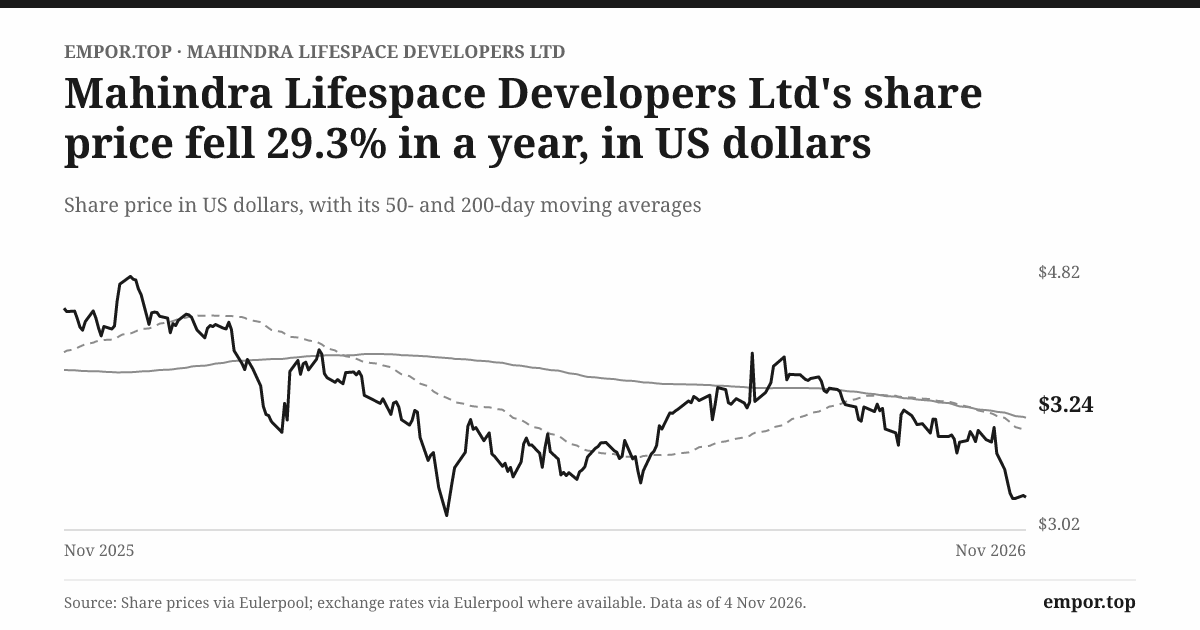
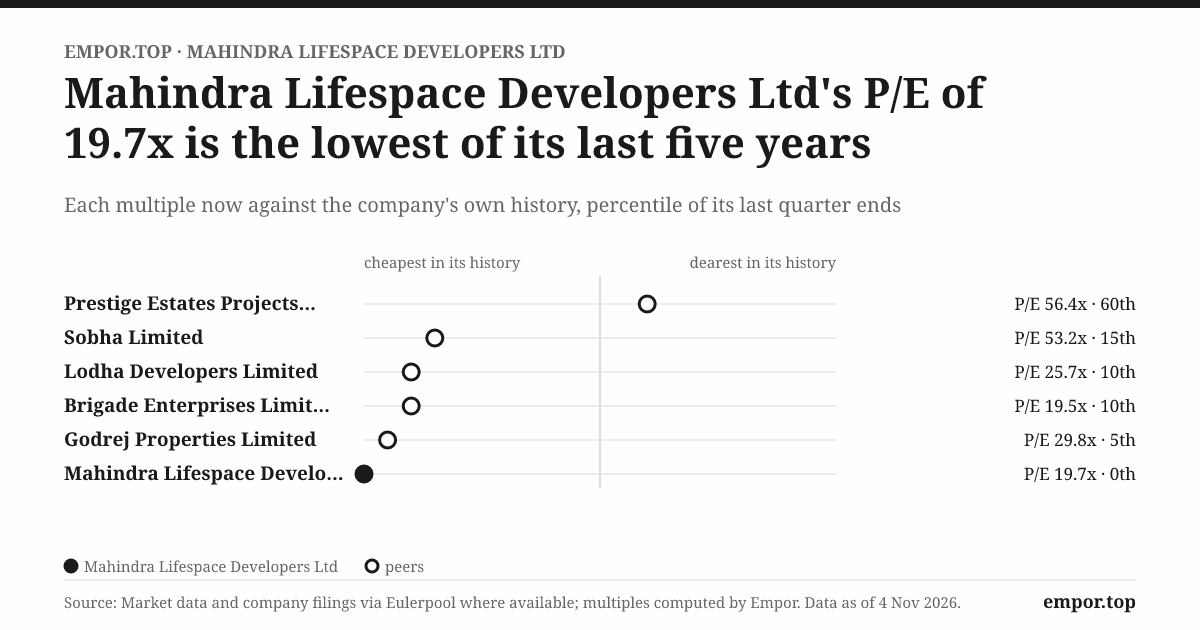
On 4 November 2026, Mahindra Lifespaces shares closed at ₹306.75.15 That is about 19% above the ₹257 rights price of June 2025, and about 27% below the 52-week high of ₹421.70.1015 On trailing earnings, the stock trades at about 19.7 times. Its five-year median is about 74.3 times.15
At first glance, that looks like a dramatic de-rating: a stock that once traded at more than seventy times earnings now trades below twenty. Does the market see something it dislikes, or is a bargain hiding in plain sight?
The comparison is less informative than it looks, for three reasons. First, the denominator changed. For much of the past five years, earnings were very low. In FY21 the company lost money, and in FY25 consolidated profit was only about ₹61 crore.5 A modest share price divided by tiny earnings gives a huge multiple. A P/E of seventy reflected depressed profits more than investor enthusiasm. Now that profit has jumped to around ₹298 crore, the multiple has fallen sharply even though the stock price has not.5
Second, the share count changed. The rights issue added about 58 million shares, so each rupee of profit is now spread across more shares, and the equity base nearly doubled.105 Price to book, about 1.8 times, is therefore measured against a book value swollen by new equity.15
Third, the earnings themselves are lumpy: completion timing, joint-venture profits and one-time gains make trailing earnings a shaky denominator.5 A multiple of twenty times trailing earnings, when those earnings depend on completions and joint ventures, is not the same as twenty times the stable earnings of a consumer company.
What the price assumes
Other measures give a less flattering picture. Earnings yield, the inverse of P/E, is about 5.1%, below what an Indian government bond pays.15 Enterprise value is about 29.6 times EBITDA, a high multiple because EBITDA in the consolidated accounts is weak; much of the profit sits below that line in joint-venture income.15 Free cash flow yield is negative, about minus 3.8%, because the company is spending more than it generates.15 And return measures are poor: FY26 return on equity was about 8.2%, while return on capital employed in the consolidated accounts was about minus 4%, because the consolidated operating line was a loss.155
Put together, the market is paying about 1.8 times book value for a business whose reported return on equity is about 8%. For that price to make sense, investors must believe returns will rise well above today's level, toward the 18-20% project IRRs management says it now targets.6 The market is not pricing in failure. It is pricing in improvement that has not yet appeared in the consolidated accounts.
A comparison with peers would sharpen the picture, but it has to be built carefully. Developers differ in project mix, geography, the share of business run through joint ventures, and accounting. A company that consolidates its projects will look different from one that reports them as joint-venture income. A headline P/E comparison across Indian developers without those adjustments would mislead more than it informs.
What would actually improve the valuation case is not a higher multiple but better underlying numbers. The first would be consolidated operating cash flow that stays positive after paying for land, the measure that has been negative for most of a decade. The second would be return on capital employed that turns clearly positive in the consolidated accounts, not just inside joint ventures. The third would be collections keeping pace with bookings, so that pre-sales growth turns into cash rather than receivables.
None of those depends on the stock market. They depend on whether this management team can complete the cycle it has set in motion. That suggests what this company teaches about the business of building before being paid.
X. Lessons from a Business That Builds Before It Gets Paid
In 2002, Mahindra opened a city outside Chennai on land that would take decades to fill. In 2014 it launched Happinest for first-time buyers, and in 2025 it told analysts the experiment had not covered its cost of equity. Between those two moments lies a whole philosophy of real-estate development: build first, at large scale, with patient capital, and be paid later. The lessons below belong to this company specifically.
The first lesson is that a pipeline is a promise, and collections are the first proof. Mahindra Lifespaces reports GDV of about ₹50,000 crore and bookings growing at a pace few Indian developers match.2 But in the first half of FY27, residential collections grew about 6% while pre-sales grew 66%.1 GDV is what the company hopes to sell, bookings are what customers have agreed to buy, and collections are what they have actually paid. The only figure that pays for the next plot of land is the cash. For founders and investors in any long-cycle business, whether infrastructure, defence or enterprise software with multi-year contracts, the order book is a forecast. Cash collected is what counts.
The second lesson is that a strategic retreat can be either discipline or a late admission, and only the returns on the replacement portfolio show which. Happinest delivered more than a thousand homes and was praised by its own chairman.12 Seven years later it was being wound down because it earned about 9% when premium projects earned 18%.6 That exit was rational. But it came only after a decade of capital and management attention, and after an annual report had promised to scale the segment up.
The lesson is not that pivoting is wrong. It is that a pivot should be judged on what the new strategy earns, not on how convincingly the old one is criticised. If the premium projects acquired since 2023 deliver the IRRs management has underwritten, the pivot was discipline. If not, it will look like the first of two late admissions.
The third lesson is that a balance-sheet reset buys time, not success. The ₹1,495 crore rights issue moved the company from net debt to net cash in a single year.1013 It also removed the most immediate constraint on growth. But the twelve-year cash record shows that the business, as run so far, has consumed more capital than it generated. The fresh equity resets the starting line without changing the underlying economics. The lesson for investors in any company that has just raised capital is to judge the raise by what happens to cash flow in the three years after it, not by the leverage ratio the day after it closes.
The fourth lesson is particular to how this company is built: the city is the product, but the project entity is where the money goes. Mahindra Lifespaces sells homes and leases plots, but its capital sits in subsidiaries, joint ventures and associates, financed by inter-corporate deposits of more than ₹1,000 crore from the parent and by partners from Sumitomo to 三井不動産 Mitsui Fudosan.513
Most of FY26's profit arrived as a share of joint-venture income, and less than a third of it came back as dividends.5 To understand a company like this, an investor has to follow the money into the entities where it is actually spent and see what comes back. The headline income statement describes a company that, in practice, operates through other entities.
These lessons point to a simple test for the future, which the bull and bear cases now have to address.
XI. Bull Case, Bear Case and the Proof Points
Set two numbers side by side. Management's guidance says customers will book between ₹4,500 crore and ₹5,000 crore of homes this year.2 The company's own audited accounts show that, across twelve years, it has never generated enough cash from operations to fund its growth without outside money.5 The investment case is a bet on which of those two numbers better describes the next five years.
The bull case starts with a company that has finally been given the tools to grow. The rights issue cut leverage sharply, and the company enters its biggest launch year with net cash, an AA rating, a AAA-rated parent that the rating agency expects to support it, and a Japanese residential partner, Mitsui Fudosan, which management says is committed beyond its first project.913 Residential bookings have grown every year under Sinha and accelerated in the first half of FY27.14 The delivery record has improved: eight occupancy certificates were received, essentially on plan, in FY26.13 Underwriting is stricter, with management targeting project IRRs of 20-22% and building cost contingencies into budgets.6
Behind the residential business sits a second engine few rivals have. The integrated cities and industrial clusters hold thousands of acres of land assembled years ago, at costs far below today's values, leased to manufacturers on very long terms. Industrial realisation per acre rose from about ₹2.8 crore to about ₹4.6 crore in three years.5 Sinha has said that the industrial land the company already owns could eventually produce about ₹1,500 crore of profit attributable to MLDL.6 If even part of that arrives on schedule, it would fund a large share of the residential expansion. In the bull case, the company is three years into a turnaround that its accounts will only reflect once the projects acquired since 2023 are completed.
The bear case starts with the cash. Over FY15 to FY26, cumulative operating cash flow was negative by about ₹1,446 crore against about ₹1,130 crore of reported profit.5 In FY26, the best profit year in a decade, audited consolidated operating cash flow was still an outflow of about ₹545 crore.5 The ₹840 crore operating cash flow management highlights excludes land, and land buying is the part of the business that keeps growing.13 Consolidated earnings depend heavily on joint-venture income, which MLDL does not fully receive as cash, and at the parent level on treasury income. Consolidated return on capital employed was negative in FY26.5
The management record supports the bear case in specific ways. Long-range targets have moved: the ₹8,000-10,000 crore ambition moved from FY28 to FY30 within a single presentation.6 FY26 growth came in below the straight line management told analysts to draw.46 The year's largest launch slipped into the next.13 The industrial engine had a weak half-year.1 And the Happinest reversal shows that the company has confidently pursued a strategy, scaled it and then abandoned it once before.126 None of this proves the current plan will fail. It does mean the plan's confident language has, in the past, been a poor predictor of results.
Michael Porter's five forces give a sobering picture of the residential business. Buyer power is meaningful: homebuyers face no switching costs before booking, can compare projects easily and can wait, and in Mumbai redevelopment the "suppliers" of land are housing societies that run competitive bids among developers. Supplier power in construction materials and labour is moderate and affects every competitor similarly. The threat of new entrants is moderate.
Capital and approvals are barriers, but the redevelopment market keeps attracting new developers. Substitutes, including resale flats and renting, are always available. And rivalry is intense, especially in Mumbai, where the company's pipeline is concentrated. The industrial business looks better on most counts: assembled land is genuinely scarce, state partners and approvals are high barriers to entry, and once a factory is built, a tenant is very unlikely to move.
Hamilton Helmer's seven powers sharpen the point. Scale economies are limited for a mid-sized developer in a fragmented market. Network effects do not apply to individual buildings, although an integrated city does have a weak version: each new employer makes the next one, and the housing nearby, more attractive. Counter-positioning does not apply to anything the company does today. Switching costs exist for industrial tenants after they build, but not for homebuyers before they book. Brand is the power management claims most often, but, as the evidence on pricing and Happinest shows, it is unproven as an economic advantage that earns higher prices.
A cornered resource is the strongest candidate: contiguous, approved industrial land in Chennai and Jaipur, assembled with state partners, plus a long-standing relationship with Sumitomo and its Japanese clients. Process power, the ability to execute better and more cheaply than rivals, is what management is trying to build in approvals, costing and delivery, and FY26's occupancy certificates are early evidence. It is not yet proven across a full cycle. The conclusion is that the company's durable advantage is narrower than its marketing suggests. It is strongest in industrial land and weakest in the residential brand, which is where most of the new capital is going.
Three measures will settle the argument better than any narrative. The first is residential pre-sales: ₹1,988 crore in the first half of FY27, up 66%, against a full-year target of ₹4,500 crore to ₹5,000 crore.12 The second is collections relative to bookings: about 58% in the first half, down from about 62% in FY26, and something to watch closely as management's promised second-half recovery does or does not arrive.14 The third is audited consolidated operating cash flow, which remained negative at about ₹545 crore in FY26 even as profit hit a decade high.5 If the first rises, the second recovers and the third turns positive, the bull case is working. If bookings rise while the other two stall, the bear case is.
The next twelve to twenty-four months will provide specific evidence. The FY27 launch calendar, especially Mahalunge in December, WestEra in early 2027 and the Sai Baba Nagar approvals, will show whether the guidance was realistic. The K2 Kandivali project will show what a ₹400 crore land purchase actually earns once it is approved, launched and built. Second-half collections will show whether late-September billing was the full explanation for the gap. And over the coming years, the most telling evidence will be whether the company needs another capital raise, from shareholders, from M&M or from partners, to keep the pipeline growing.
XII. Epilogue
As of 4 November 2026, Mahindra Lifespaces is a company waiting for a few specific events.
The first is in December, when Mahindra Rivenza at Mahalunge in Pune is due to launch.2 It is the only second-half project that management said had its regulatory registration in hand on the October call. If it launches on time and sells in the 30-40% first-quarter range Sinha has described as the company's norm, it will be the first proof that the second half of the guidance is realistic.62 If it slips, the full-year target begins to look like the long-range targets that moved before it.
The second set of events will play out over the January and April results. Management has promised a pickup in collections in the third quarter, as late-September billing turns into cash.2 If collections in the second half grow noticeably faster than in the first, the gap between bookings and cash will have been a timing effect, as management says.
If they do not, the gap reflects something more lasting, either slower customer payments or construction running behind sales. The FY27 annual cash-flow statement, due with the results in April 2027, will be the clearest evidence of all. It will show whether a year of record bookings, a net-cash balance sheet and an expanding land programme produced positive statutory operating cash flow, or a third consecutive outflow of around ₹500 crore.
The third event is the land. Management wants to add between ₹10,000 crore and ₹20,000 crore of GDV this year.2 At the top of that range, with land prices that Sinha himself has said "have run up quite a lot," the company will be spending heavily just as it needs its cash to fund launches.2 Gross borrowings were already back near ₹600 crore by September.2 If the company stays net-cash while hitting its GDV target, the rights issue will have done its job. If it moves back toward net debt, the next question will be how the gap is filled, and whether M&M, Mitsui Fudosan or public shareholders are asked to fill it.
Across the past three calls, the tone of the story has shifted in small but revealing ways. In April 2025, management talked about long-range ambition, a ₹10,000 crore pre-sales target and the decision to exit affordable housing.6 In April 2026, it talked about execution, approvals received and the start of the Mitsui partnership, while admitting that the largest launch had slipped.13 In October 2026, it talked about specific approval stages, a pickup in collections still to come, and a "slight slowdown in the velocity side."2 None of those calls contradicted the others. But the language moved from vision, to delivery, to caution about the timing.
The central questions remain open, and that is the honest conclusion. The rights issue reset the balance sheet, and the new pipeline is the largest in the company's history. Neither has yet been tested across enough completed projects to show what they earn. The pressing question is how much of the ₹50,000 crore pipeline can become completed homes, collected cash and real returns without another round of fresh capital. That answer will come from the cash-flow statement, not the bookings.
XIII. Outro
Go back to the family in the Mumbai sales lounge, signing for a flat in a tower that does not yet exist.
The years between that signature and the finished home are where the whole story of Mahindra Lifespaces plays out. That interval helps explain the timing gaps and cash strain already visible in the numbers. It is also why the company deserves attention: a builder of cities, backed by one of India's best-known groups, now trying to show that patient capital can earn more than its cost. Mahindra Lifespaces is a bet on building places that take years to pay back, and on whether this management can make those years count.
References
-
Healthy sales growth, BD additions and PAT delivery continue (Q2 and H1 FY27 results release) — Mahindra Lifespaces, 2026-10-22 ↩↩↩↩↩↩↩↩↩↩↩↩↩↩↩↩↩↩↩↩
-
Q2 FY27 earnings call transcript — Stock Analysis, 2026-10-22 ↩↩↩↩↩↩↩↩↩↩↩↩↩↩↩↩↩↩↩↩↩↩↩↩↩↩↩↩↩↩↩↩↩↩↩
-
Q2 FY27 unaudited financial results filing — NSE India, 2026-10-22 ↩↩
-
FY26 Financial Results: ₹18,060 Crore GDV Additions and 25% Sales Growth — Mahindra Group, 2026-04-28 ↩↩↩↩↩↩↩↩↩↩
-
Integrated Annual Report FY 2025–26 — Mahindra Lifespaces, 2026-07-02 ↩↩↩↩↩↩↩↩↩↩↩↩↩↩↩↩↩↩↩↩↩↩↩↩↩↩↩↩↩↩↩↩↩↩↩↩↩↩↩↩↩↩↩↩↩↩↩↩↩
-
Q4 FY25 earnings call and investor meet transcript (call held 2025-04-28) — NSE India, 2025-05-05 ↩↩↩↩↩↩↩↩↩↩↩↩↩↩↩↩↩↩↩↩↩↩↩↩↩↩↩↩↩↩↩↩↩↩↩↩↩↩
-
Corporate Filings: Shareholding Patterns, MAHLIFE — NSE India ↩
-
Hostile predator prowls the subcontinent — Euromoney, 2001-01-01 ↩↩↩↩↩
-
Rating Rationale: Mahindra Lifespace Developers Limited — CRISIL Ratings, 2026-04-27 ↩↩↩↩↩↩↩↩↩↩
-
Rights Issue Basis of Allotment — Mahindra Lifespace Developers, 2025-06-19 ↩↩↩↩↩↩↩↩
-
Our Story: company history and timeline — Mahindra Lifespaces ↩↩↩↩↩↩↩↩↩↩
-
Annual Report FY 2017–18 — Mahindra Lifespace Developers (BSE India), 2018 ↩↩↩↩↩↩↩↩↩↩↩↩↩↩↩↩↩↩↩↩↩↩↩
-
Q4 FY26 earnings call transcript (call held 2026-04-28) — NSE India, 2026-04-30 ↩↩↩↩↩↩↩↩↩↩↩↩↩↩↩↩↩↩↩↩↩↩↩↩↩↩↩↩↩
-
Mahindra Lifespace files FY26 Integrated Annual Report and BRSR with stock exchanges — Mahindra Group, 2026-07-11 ↩
-
MAHLIFE (BOM: 532313) market statistics and valuation — Stock Analysis, 2026-11-04 ↩↩↩↩↩↩↩↩↩
 LinkedIn
 WhatsApp
 Reddit
 Hacker News
 Email
 Kindle
 RSS Feed
 Spotify
 Apple Podcasts
 Amazon Music
 Audible
 YouTube