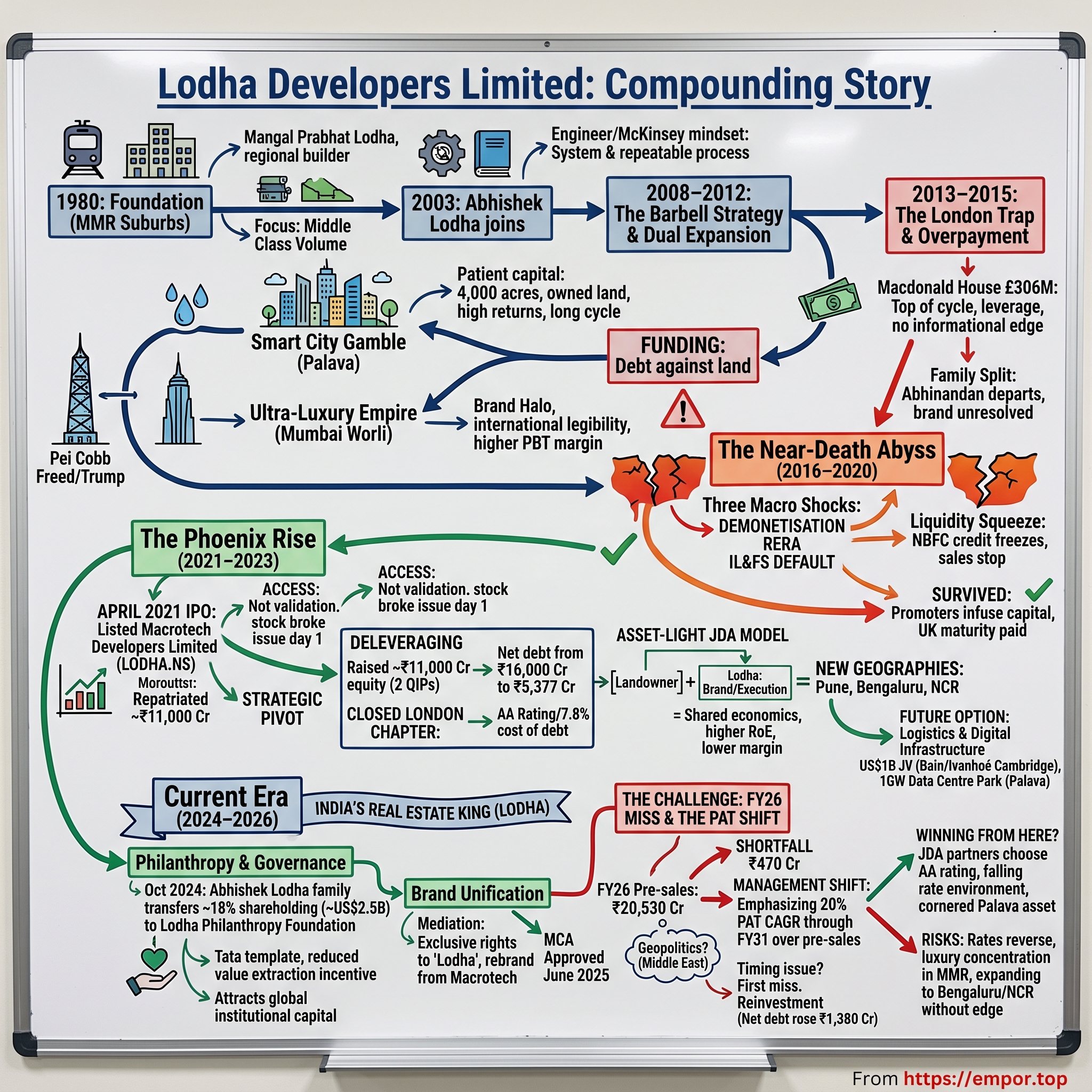
Lodha Developers: The Compounding of India's Real Estate King
I. Introduction & Episode Roadmap: The Compounding of Mumbai's Real Estate King
In November 2019, a credit analyst at Moody's sat down to write one of the least pleasant sentences in the ratings business. The subject was a Mumbai property developer that, five years earlier, had been the most swaggering name in Indian real estate — the company that bought the Canadian government's Mayfair mansion, licensed the Trump name for a Worli skyscraper, and marketed a residential tower it called, without evident embarrassment, World One.
The sentence downgraded that company's corporate family rating to Caa1, with a negative outlook.1
Caa1 is not a warning. It is a diagnosis. In Moody's taxonomy it means obligations of poor standing, subject to very high credit risk — the neighbourhood where restructurings and defaults live. Fitch had already cut the same borrower to B- three months earlier, citing liquidity management concerns and flagging that further downgrades were plausible.2 The proximate trigger was a US$325 million dollar bond maturing in March 2020, issued by the company's international arm and guaranteed by the Indian parent, against a backdrop in which India's shadow-banking system had seized solid and London's prime property market had gone quiet.3 Consolidated net debt was somewhere north of ₹16,000 crore. Two attempts to go public had already been abandoned. The company had, in the polite language of credit committees, limited refinancing options.
Skip forward to the morning of April 24, 2026. The same company — now legally named Lodha Developers Limited, trading on the NSE under LODHA — reported its financial year. Pre-sales of ₹20,530 crore, up 16%. Revenue of ₹16,680 crore, up 21%. Profit after tax of ₹3,431 crore, up 24%, crossing a 20% net margin for the first time in its history. Net debt of ₹5,377 crore against a net debt-to-equity ratio of 0.23x, and an average cost of borrowing of 7.8% — down about 90 basis points in a year.4 CRISIL and ICRA both rate it AA with a stable outlook, a rating band that in Indian real estate is rare air.5[^6] Market capitalisation sits near ₹1.2 lakh crore, making it one of the two or three most valuable listed residential developers on earth by market value.
That is a genuinely remarkable arc: from the edge of a credit event to investment-grade-equivalent domestic ratings in roughly six years, without a restructuring, without a haircut to lenders, and without the promoter family losing control.
It is also an arc that invites some hard questions, and this article is going to ask them rather than applaud.
How much of the rescue was strategy and how much was the market? Lodha listed in April 2021, at the very beginning of the most powerful Indian residential upcycle in fifteen years. Every large listed developer deleveraged in that window. Distinguishing operator skill from a rising tide is the central analytical problem here.
Does the asset-light model actually earn what management says it earns? The Joint Development Agreement — landowner brings the land, developer brings brand and execution — is the mechanism Lodha credits for its returns. But management's own numbers show JDA projects earn lower profit margins than owned-land projects. The claim is that they earn higher returns on equity. That is a real distinction, and it deserves scrutiny rather than acceptance.
What actually happened to net debt in FY26? The reported figure of ₹5,377 crore is a Q4-end snapshot, and it fell ₹800 crore during that quarter.4 Across the full year, net debt rose by roughly ₹1,380 crore as the company poured ₹6,790 crore into land and approvals. Several secondary outlets reported the quarterly move as an annual one. The distinction matters, because it tells you whether this is a business generating surplus cash or one reinvesting faster than it generates.
And what does it mean that the founding family gave away eighteen percent of the company? In October 2024, Abhishek Lodha and his family committed roughly 180 million shares — around US$2.5 billion of value — to a philanthropic foundation explicitly modelled on the Tata Trusts.6 That is either the most significant governance event in Indian real estate in a generation, or an elegant piece of structuring. Probably it is both.
The road ahead runs through a Rajasthani migrant's first Mumbai project in 1980; a Georgia Tech engineer's arrival from McKinsey; a 4,000-acre township built on farmland; a tower named for the world; a £306 million cheque written to the Canadian government at what turned out to be almost exactly the top of the London cycle; three simultaneous macro shocks that nearly ended the story; a hard-fought IPO that broke issue on day one; a war in the Middle East that cost the company its FY26 guidance by ₹470 crore; and a family feud over a surname that ended in mediation and a corporate rebrand.
It begins, as these stories often do, with someone getting off a train.
 Subscribe on LinkedIn
II. From Regional Builder to Premium Powerhouse (1980–2007)
Mangal Prabhat Lodha arrived in Mumbai from Jodhpur in the early 1980s, a Marwari Jain from a family with no particular property lineage, into a city that was in the middle of absorbing millions of people it had no room for.7 He founded his firm in 1980. The business he started was not glamorous and was not meant to be: mid-market and affordable residential buildings in the outer suburbs — Thane, Dombivli, the districts along the commuter rail lines where Mumbai's working population actually lived because Mumbai proper had priced them out decades earlier.
To understand why that was a good place to start, you have to understand the peculiar physics of Mumbai. The city is a peninsula. It cannot grow outward in three directions, only north. Its land supply has been further constricted for most of the post-independence period by rent control, by the Urban Land Ceiling Act, by mill land locked in litigation, and by a floor space index regime — the ratio governing how much you may build on a plot — that has historically been among the most restrictive of any major world city. Demand grew relentlessly; supply was rationed by law. That is a recipe for permanently high prices and permanently frustrated buyers, and it made the suburbs and satellite towns the only place where an ordinary family could buy a home with a title deed.
So the early Lodha business model was straightforward: buy land far enough out to be cheap, build reasonably, sell to people migrating up from rented rooms into ownership. It was a volume business with local relationships at its core, in an industry where "local relationships" carried a specific and widely understood meaning. Indian real estate through the 1980s and 1990s was an industry of cash transactions, opaque land titles, discretionary approvals, and developers who were as much political operators as builders. Mangal Prabhat Lodha himself became a significant figure in Maharashtra politics, eventually rising to serve as a state minister — a fact that is simply part of the record and part of how the company's early advantages should be understood.
The engineer arrives
The pivot came around 2003, when Abhishek Lodha — the founder's elder son — joined the business. His formation was almost the opposite of his father's. He had studied at the Georgia Institute of Technology and had worked at McKinsey & Company in the United States before returning to Mumbai.8
That combination matters more than it might sound. An industrial engineer thinks in flows, bottlenecks, cycle times, and standardisation. A McKinsey consultant thinks in market structure, competitive positioning, and organisational design. Neither of those is how Indian real estate was run in 2003. Indian real estate was run on instinct, land arbitrage, and relationships — a business where the founder knew every plot and every official personally, and where the company was essentially an extension of the founder's memory.
What Abhishek began building instead was a system. Standardised project management. Formal sales organisations rather than broker networks. Design and specification benchmarks that repeated across projects, so that a Lodha building in Thane and a Lodha building in Kalyan shared a recognisable quality signature. Central procurement. And, most consequentially, a brand — the notion that the developer's name on the hoarding should itself be worth something to the buyer.
That last idea was more radical than it appears. In a market where the dominant buyer anxiety was will this building ever actually get finished, and will I get what I was shown, a developer who could credibly promise delivery held enormous latent pricing power. Most Indian developers could not make that promise. The industry's default outcome was delay.
From builder to institution
The second half of the transformation was about capital. A family builder funds itself from customer advances, private lenders, and the founder's balance sheet. An institutional developer funds itself from banks, bond markets, private equity, and eventually public equity — and those providers demand audited accounts, consolidated reporting, independent directors, and a management team that is not simply the family.
Through the mid-2000s the company built toward that standard, and management passed decisively to Abhishek and a professional team as his father's political career absorbed more of his time. The narrative the company would later tell institutional investors — that it had evolved from a family builder with local connections into a professionalised developer accessing global capital — was, in its broad strokes, true. It is also worth noting what such a narrative is for: a company preparing to raise foreign capital has strong incentives to emphasise the distance between itself and the industry's reputation.
For an investor looking back from 2026, the most useful thing about this early era is not the buildings. It is that the company acquired, early and cheaply, two assets that later proved almost impossible to replicate: enormous quantities of suburban land bought before Mumbai's growth reached it, and an operating culture built around repeatable execution rather than opportunistic dealmaking. Both would be tested severely. But by 2007, with the Indian economy running hot and global capital hunting for emerging-market real estate exposure, the company had the platform to attempt something considerably more ambitious than suburban apartments.
It attempted two things at once, at opposite ends of the market.
III. The Smart City Gamble & The Rise of the Ultra-Luxury Empire (2008–2012)
Picture the site in 2008: several thousand acres of agricultural land near Dombivli, roughly forty kilometres from South Mumbai, reachable by a road that did not deserve the name and a suburban rail line running at several times its design capacity. There was no municipal water supply worth relying on, no sewage treatment, no fibre, no schools of any quality, and no reason for anyone with a choice to live there.
Lodha's proposition was to build a city on it.
Palava: patient capital, or a very long bet
Palava's first phase launched around 2010, and the ambition was genuinely unusual for an Indian developer.9 Rather than sell apartments and leave residents to negotiate with the state for infrastructure, Lodha would build the infrastructure itself: internal roads, water treatment and distribution, sewage processing, power distribution, fibre-optic connectivity, schools, retail, and a private management layer running the whole thing. The company's investor materials describe a land reserve in excess of 4,000 acres.10 (The 4,500-acre figure that circulates in property marketing is not what the company's own IR documents state, which is a small but instructive example of how developer scale gets rounded upward in the retelling.)
The economics of this are worth sitting with, because they are the single most important thing to understand about Lodha's balance sheet history.
Buying agricultural land at agricultural prices and converting it into urban residential land is one of the highest-return transformations available in any economy. The gap between what a farmer will accept and what a Mumbai family will pay for a two-bedroom flat is enormous. But capturing that gap requires three things the buyer does not have to worry about: regulatory conversion of land use, physical infrastructure, and — crucially — time. You must hold the land, often for years, financing it the whole way, before a single rupee of revenue arrives. And you must build roads and water plants before you can sell the apartments that pay for the roads and water plants.
This is why land banking has bankrupted so many developers. It is a business where the cash goes out first, in size, and comes back later, unpredictably. In an up-cycle the returns look magnificent. In a down-cycle the carrying cost of the land eats the company.
Palava eventually became exactly what it was designed to be — a durable, high-volume cash engine selling to Mumbai's aspiring middle class, and today the site of one of the region's largest warehousing parks. But for its first several years it was a capital sink, and the debt that funded it was still on the books when the storm arrived.
The other end of the barbell
While the Palava earthmovers ran, Lodha executed a strategic move that is easy to describe and very hard to pull off: it went simultaneously downmarket in volume and violently upmarket in price.
The centre of gravity was Lower Parel and Worli — the former mill districts of central Mumbai, where defunct textile mills sat on some of the most valuable undeveloped land in Asia, tied up for decades in labour litigation and redevelopment rules. As those parcels came loose in the 2000s, they became the site of a genuine architectural arms race.
Lodha's entry was the World Towers complex, anchored by World One, a tower announced around 2010 and designed by Pei Cobb Freed & Partners — the successor firm to I.M. Pei, which is to say a name meant to be recognised in New York and Hong Kong, not just Mumbai. Interiors for the project were developed with Giorgio Armani's Armani/Casa.11 Then, in September 2013, Lodha licensed the Trump name for a tower within its Worli development, making it one of the Trump Organization's Indian brand licences.12
Read those three moves together and the strategy becomes legible. Lodha was not selling square footage. It was selling legibility to a global elite — the proposition that a Mumbai apartment could carry the same signifiers as a Manhattan or Mayfair one. Pei Cobb Freed signalled architectural seriousness. Armani signalled taste. Trump, in 2013 and in that market, signalled international luxury branding. The buyer was an Indian ultra-high-net-worth individual who wanted an address that his peers in London and Singapore would recognise, and who would pay a premium in the mid-teens percentage over comparable nearby product to get it.
What the barbell was really for
The strategic logic of running affordable townships and ultra-luxury towers simultaneously is better than it first appears, and worse.
Better, because the two businesses have different cycles and different capital profiles. Palava sells steadily, in volume, at low ticket sizes to mortgage-financed buyers whose demand tracks employment and interest rates. Ultra-luxury sells lumpily, at enormous ticket sizes, to buyers whose demand tracks wealth effects and sentiment. In principle the volume business funds the luxury business's working capital, and the luxury business supplies the brand halo that lets the volume business charge more.
Worse, because both ends were, at that moment, being financed with debt against land, and both were exposed to precisely the same thing: the availability of credit in India. Diversification across price points is not diversification if the funding source is identical.
There was one further consequence that the company was slower to appreciate. Having spent five years persuading itself that it could compete on the same field as global luxury developers, Lodha's management drew the natural conclusion. If the brand could command global-elite pricing in Mumbai, why should it not compete for global-elite buyers in the city where they actually lived?
That reasoning was about to cost a great deal of money.
IV. The London Foray: A $1 Billion M&A Overpayment Trap (2013–2015)
On November 28, 2013, contracts were exchanged for the sale of Macdonald House at 1 Grosvenor Square in Mayfair. The seller was the Government of Canada, which had used the building as its High Commission since the 1960s. The buyer was Lodha. The price was £306 million — approximately C$564.5 million — and the sale completed on March 27, 2014.[^14]
It is worth pausing on the symbolism, because symbolism was substantially the point. Grosvenor Square is the most storied address in Mayfair. The US Embassy sat on its west side. An Indian developer, thirty-three years after its founding by a migrant to Mumbai, was buying a sovereign government's London property at a price that made headlines in three countries. For a company that had spent half a decade telling Indian buyers it belonged in the global luxury conversation, this was the proof.
Lodha followed with a second central London site — New Court at 48 Carey Street, in Holborn, which became the Lincoln Square development, launched in 2016 with around 221 apartments.13
The valuation error
Prime central London property between 2009 and 2014 had been one of the great one-way bets in global real estate. It absorbed capital fleeing the euro crisis, Russian and Middle Eastern wealth, Chinese diversification, and a sterling that had fallen sharply in the financial crisis. Prices ran hard for five straight years.
Lodha underwrote at the end of that run. The pattern is one of the most reliable errors in capital allocation: extrapolating a trend that has already been extrapolated by everyone else, and mistaking a five-year price series for a structural property of the asset. Every buyer at the 2014 peak believed they were paying up for scarcity. What most were actually paying for was five years of accumulated momentum.
Two other misjudgements compounded it. First, execution friction: developing a super-prime scheme in central London means navigating planning, heritage constraints, and a construction-cost environment entirely unlike Mumbai's, with a labour market Lodha had no relationships in. Second, and more subtly, Lodha was entering a market where it had no informational edge. In Mumbai, the company knew every parcel, every official, every competitor's cost structure. In Mayfair it was a price-taker bidding against people who knew more.
The leverage that made it dangerous
An overpriced asset bought with equity is a disappointment. An overpriced asset bought with debt is a threat to the enterprise.
The Grosvenor Square scheme was financed with a £517 million whole loan arranged by M&G Investments — at the time one of the largest single real estate loans written in the UK.14 Lincoln Square was financed with US$375 million (approximately £290 million) of construction finance from Cain Hoy, later Cain International.15 These were not cheap bank facilities; they were development loans priced for development risk, carrying interest that accrued from day one against assets that would produce no revenue for years.
(A note for the record: the £340 million Cale Street Partners facility that circulates in some accounts of this period could not be verified against any primary source. The documented lenders on the two London schemes were M&G and Cain Hoy/Cain International.)
The total UK debt burden ran into the high hundreds of millions of pounds. And it sat, through a guarantee structure, connected to the Indian parent — which meant that a problem in London was not going to stay in London.
The family split
Against this backdrop, 2015 brought a second complication: the brothers separated. Abhinandan Lodha departed the family real estate business, with the separation formalised through a family settlement agreement in 2017.16 He went on to found the House of Abhinandan Lodha, building a distinct business focused largely on branded plotted-land developments.
Abhishek assumed undivided control of the main enterprise — a clarification that was, in operating terms, useful. But the settlement left behind an unresolved and eventually expensive question: who owned the surname. That question would take a decade and a ₹5,000 crore lawsuit to answer.
For now, the immediate issue was simpler. The company had spent five years acquiring assets that generated no cash, in two countries, funded with debt that generated interest immediately. That structure works fine as long as credit remains available and prices keep rising.
Between June 2016 and September 2018, neither condition held.
V. The Near-Death Experience: Liquidity Squeeze & The Debt Abyss (2016–2020)
At 8:15 on the evening of November 8, 2016, the Prime Minister of India announced on national television that the ₹500 and ₹1,000 notes then in circulation — the overwhelming majority of the country's currency by value — would cease to be legal tender at midnight.
For Indian real estate, this was not a policy adjustment. It was a solvent poured on the industry's plumbing.
Three shocks, stacked
Demonetisation did to property transactions what a power cut does to a factory. The land market in particular had long involved substantial cash components, and while a listed developer's own accounting sat on the formal side of that line, the counterparties — landowners, intermediaries, a portion of the buyer base — did not all operate that way. Transaction volumes collapsed. Luxury sales, where discretionary buyers can simply wait, collapsed hardest. Prices in many micro-markets stopped rising, which is a serious problem when your business model assumes appreciation on held land.
RERA arrived on the heels of it. The Real Estate (Regulation and Development) Act, 2016 came into force in stages, with the bulk of its provisions effective from May 1, 2016 and the remainder from May 1, 2017.[^19] Its intent was consumer protection and its effect was largely admirable: mandatory project registration, standardised disclosure, penalties for delay, and — the provision that mattered structurally — a requirement that a defined majority of customer advances be held in project-specific escrow accounts, usable only for that project.
Consider what that did to the industry's operating model. For decades, the Indian developer's working capital engine had been cross-subsidy: take advances from buyers of Project A, use them to buy land for Project B, sell Project B, use those advances for Project C. It was, functionally, a rolling internal float — cheap, unregulated, and dependent on perpetual expansion. RERA severed it. Overnight, land acquisition had to be funded with actual capital: equity, or borrowed money.
Which was fine, right up until the moment borrowed money stopped existing.
IL&FS defaulted in September 2018. Infrastructure Leasing & Financial Services was a systemically significant lender that missed payment on obligations including a ₹1,000 crore SIDBI loan, and the shock propagated through India's non-banking financial company sector with astonishing speed.17 NBFCs had become the principal source of developer finance, because banks had grown cautious on real estate. Those NBFCs funded themselves short — commercial paper, mutual fund debt schemes — and lent long. When mutual funds stopped rolling their paper, the NBFCs stopped lending. Developers who had been comfortably refinancing short-term facilities every ninety days discovered there was nothing to refinance into.
This is the mechanism worth internalising, because it recurs: a developer with excellent long-term assets can die from a funding-duration mismatch in a matter of months. Solvency and liquidity are different problems, and only one of them kills quickly.
And meanwhile, in London
On June 23, 2016 — five months before demonetisation — the United Kingdom voted to leave the European Union. Sterling fell hard. That should, in theory, have helped a developer selling to dollar-referenced international buyers. In practice, prime central London had already been cooling under successive increases in stamp duty on high-value and additional properties, and Brexit added a layer of political uncertainty that international ultra-high-net-worth buyers responded to by waiting.
So Lodha's two large London schemes — carrying accruing development debt — were selling into a market that had gone quiet, at exactly the moment the Indian business could offer no support because it was dealing with three shocks of its own. The company announced in November 2018 that it intended to exit the UK entirely, initially by selling the two London projects for a reported figure of around ₹4,200 crore.18
That sale did not happen on those terms. Which meant Lodha had to sell its way out, apartment by apartment, through a downturn.
The abyss
Consolidated net debt peaked at a level the company itself later characterised as roughly ₹16,000 crore around the time of its listing, having been materially higher at its worst.19 Two attempts to go public — a filing in 2009, shelved after the global financial crisis, and another in 2018 — had both been abandoned in weak markets.
The ratings agencies moved in sequence. Moody's had cut the corporate family rating to B2 in early 2017. Fitch downgraded to B- in August 2019, explicitly citing liquidity management.2 Business Standard's coverage of the Moody's action that month framed it plainly as evidence of a liquidity crunch.20 Then, on November 12, 2019, Moody's cut to Caa1 with a negative outlook, applying it both to the parent's corporate family rating and to the dollar bonds issued by the international arm, citing refinancing uncertainty.1
The bond in question was US$325 million, carrying a 12% coupon, maturing March 2020.
Twelve percent, in dollars, tells you everything about where the company sat in the capital markets' estimation. And a March 2020 maturity date, in hindsight, is almost darkly comic — that is the month the world shut down.
Lodha got it paid. The UK arm cleared the obligation with approximately US$345 million including interest, funded through a combination of promoter capital infusion, commercial asset sales, and refinancing raised against the London inventory.3 It was, by any reading, a close-run thing: a company hitting a hard maturity in a frozen credit market, in the same fortnight that global markets entered free fall.
The company survived the maturity. It did not survive it with a balance sheet that could support a business. What it needed was equity, in size, and equity requires a functioning market.
Extraordinarily, one appeared within a year.
VI. The Phoenix Rise: The 2021 IPO & Asset-Light Deleveraging Pivot (2021–2023)
The initial public offering opened for bidding on April 7, 2021, and it was not a triumphant occasion.
The company listed as Macrotech Developers Limited — not Lodha — because the rights to the family name remained unresolved following the brothers' separation. That is an unusual thing to explain to institutional investors: the brand you are underwriting is not the brand on the share certificate.
The issue was entirely fresh capital: ₹2,500 crore, priced at ₹486 against a band of ₹483 to ₹486, with bidding through April 9, allotment on April 15, and listing on April 19, 2021 on both the BSE and NSE.21 It was subscribed roughly 1.14 times including anchor participation — which, in a market where hot Indian IPOs were routinely covered dozens of times over, is the numerical equivalent of a shrug.
The debut was worse. The stock closed its first day at ₹463.15 on the BSE, approximately 4.7% below the issue price.21
What the weak listing actually tells you
It is tempting, from 2026, to describe the IPO as the moment the turnaround began. That is true operationally and misleading emotionally. Public markets in April 2021 did not believe this story. They saw a highly levered developer with an unresolved brand, a stranded foreign portfolio, an aborted listing history, and a Caa1 rating eighteen months in the rear-view mirror. The pricing and the break reflected genuine scepticism, and the scepticism was reasonable on the information available.
What the IPO delivered was not validation. It was access. Once listed, the company could tap institutional equity repeatedly and quickly — and it did, with a speed that suggests the plan was in place before the shares ever traded.
In November 2021, seven months after listing, Macrotech raised ₹4,000 crore in a qualified institutional placement, allotting 3,41,88,034 shares at ₹1,170 — roughly 2.4 times the IPO price.22 The market that had shrugged in April was, by November, willing to pay well over double.
In March 2024, the promoters sold approximately ₹3,547 crore of stock through an offer for sale, primarily to satisfy the regulatory requirement that listed companies maintain at least 25% public shareholding.23 Then in early July 2024 the company raised a further ₹3,300 crore through a second QIP — reportedly oversubscribed around three times within five hours, drawing in BlackRock, Invesco, Franklin Templeton, Norges Bank, and APG.24
Note the character of that investor list. These are long-duration global institutions with mandates that would not have permitted them near this company in 2019. Their arrival is the clearest external evidence that the credit story had genuinely changed — not because they are infallible, but because their internal risk processes are slow, conservative, and paper-heavy.
The deleveraging, honestly assessed
The capital raised went substantially to retiring expensive debt, and the effects showed up in the ratings. Lodha's investor materials cite seven rating upgrades since 2021, from A/Stable at the time of listing to the current AA. ICRA moved the rating to AA (Stable) on May 27, 2025, and CRISIL reaffirmed CRISIL AA/Stable/A1+ on August 1, 2025.[^6]5 Average cost of debt has fallen to 7.8%.4
That interest-cost reduction is not a footnote. For a business that carries inventory for years, the cost of money is close to the cost of goods sold. Every 100 basis points saved on several thousand crore of debt is straight profit, and it compounds through the willingness to underwrite projects that would not clear a higher hurdle.
But the honest version of the deleveraging story includes an asterisk. Roughly ₹9,800 crore of the debt reduction came from selling equity to institutions — the two QIPs. Deleveraging funded by equity issuance is real deleveraging, and it was almost certainly the correct decision. It is not, however, the same thing as a business paying down debt out of its own cash generation, and investors should keep the two mentally separate when assessing how much of the improvement is operating performance.
Closing the London chapter
The UK exit did not arrive as the clean sale announced in 2018. Instead, Lodha sold through its London inventory.
The FY22 annual report recorded UK pre-sales of £531 million for the year, of which Grosvenor Square alone accounted for £439 million, and stated that these proceeds completely covered the debt associated with the UK projects, with the surplus to be repatriated to India partly in FY23 and the balance in FY24.25 The Q3 FY24 corporate presentation confirmed repatriation had begun in Q2 FY23, with roughly ₹5,500 crore returned through March 2023 and a similar amount to follow — a total in the region of ₹11,000 crore.10
So: the London adventure ended around FY24, through liquidation of inventory rather than a portfolio sale, with the debt extinguished and capital repatriated. It is worth being precise about what that means, because the outcome is genuinely ambiguous. Lodha got its money out. It did not, on any reasonable reckoning, earn an attractive return on a decade of tied-up capital, management attention, and interest expense during the single greatest property upcycle in Indian history. The opportunity cost of that decade is invisible in the accounts and enormous in reality.
Management's stated conclusion — a domestic-only strategy with a fortress balance sheet — is the right lesson drawn from an expensive tuition. Whether it holds when the next glamorous opportunity appears is the sort of thing that can only be judged over time.
Even as the London file closed, though, the company was opening another one — this time deliberately unglamorous.
VII. The Future Option: Logistics & Digital Infrastructure
On May 11, 2022, Lodha announced a partnership with Bain Capital and Ivanhoé Cambridge — the real estate arm of Quebec's pension manager — to build what the parties called green digital infrastructure in India.2627
The structure was deliberately asset-light for Lodha. Roughly US$1 billion of total investment. Each of the three partners holding about a third of the equity. Lodha leading development, operations, and management — which is to say, earning fee income for doing the work while partner capital carried most of the land and construction burden. The stated target was around 30 million square feet of logistics parks, light industrial estates, and in-city fulfilment centres.26
Why warehouses, for a luxury developer
The strategic logic is sound and worth explaining plainly, because "warehousing" sounds like a distraction.
A residential developer's earnings are lumpy and cyclical. Revenue arrives when apartments are sold and recognised; it depends on interest rates, employment, sentiment, and approval timing, none of which the developer controls. An investor valuing that stream applies a cyclical multiple to it.
Rental income from industrial property behaves in the opposite way. Tenants sign multi-year leases with contractual escalations. Occupancy is sticky because relocating a distribution centre is genuinely disruptive. The cash flow is boring, visible, and — critically — valued off a yield rather than an earnings multiple. Building a meaningful annuity stream inside a development company changes what the whole enterprise is worth, because part of the business stops being cyclical.
And the demand driver was real: e-commerce penetration, formalisation of Indian retail supply chains post-GST, and multinational manufacturers diversifying supply chains toward India all pointed to structural growth in modern warehousing.
The uncomfortable scorecard
Four years on, the honest assessment is that this platform has grown far more slowly than announced.
As of FY26, Lodha's warehousing and industrial portfolio totalled 5.1 million square feet, of which 2.2 million square feet was completed and 2.6 million square feet leased, with net leasing of 0.5 million square feet during the year.4 Against an original ambition of roughly 30 million square feet, that is a fraction — and the completed portion is smaller still. Tenants added include Tesla, GXO Logistics, DP World, FM Logistics and Compass, and Skechers operates what the company describes as India's largest warehousing facility.4 The tenant roster is genuinely blue-chip. The square footage is not yet material.
Total annuity income across retail, offices, warehousing and data centres was about ₹290 crore in FY26, with a stated target of roughly ₹1,000 crore by FY31.4 Against ₹16,680 crore of FY26 revenue, annuity income is presently under 2% of the top line. This is optionality, not a segment.
There is, however, a newer and considerably larger version of the same idea. Lodha has moved to develop a data centre park at Palava spanning roughly 400 acres, approved under Maharashtra's green integrated data centre park policy. On the Q4 FY26 call, management described a target of around one gigawatt of powered shell capacity, incremental cost in the range of ₹10,000–11,000 crore, roughly 100 acres retained as owned annuity assets with the remaining 300 acres monetised through land sales to fund the build, and income commencing around FY29.28
That is a serious commitment of capital to a business Lodha has never operated. The bull framing is that the company owns cheap, large, contiguous, power-connected land near Mumbai — genuinely the scarcest input in Indian data centre development — and can monetise most of it immediately while retaining exposure to the rest. The bear framing is that a residential developer is committing ten-thousand-crore-scale capital to an infrastructure asset class with different tenants, different technical requirements, and different competitors, having recently learned an expensive lesson about entering markets where it lacks an edge. That the structure front-loads land sales and limits retained ownership to a quarter of the site suggests management has internalised at least some of that lesson.
For now, the investment case does not rest on any of it. It rests on selling homes in western India — and there, the model has changed fundamentally.
VIII. Current Strategy: How Lodha Wins in MMR, Pune, and Bengaluru
graph TD
    A[Landowner] -->|Provides Land| B(Joint Development Agreement - JDA)
    C[Lodha] -->|Provides Brand, Execution, Sales Engine| B
    B --> D{Project Revenues}
    D -->|Developer Share| C
    D -->|Landowner Share| A
    C -->|Higher RoE, Lower Margin| E[Shareholder Value]
Imagine a family in suburban Mumbai that has owned six acres for three generations. On paper they are wealthy. In practice they are stuck. Developing it themselves requires capital they don't have, approvals they can't navigate, a sales organisation they'd have to build, and a construction capability they lack. Selling outright means a single payment, taxed, at a price that captures none of the value creation.
A Joint Development Agreement solves this. The landowner contributes the land into the project. The developer contributes everything else — approvals, design, capital for construction, brand, and the sales machine — and the two share the economics, either as a revenue share or a division of the built units. The developer typically pays only a modest refundable deposit upfront, in the range of a few percent of the project's gross development value, rather than buying the land outright.
The consequence for the developer's balance sheet is transformative. Under the old model, land was bought with cash raised as debt and sat as inventory for years. Under a JDA, the developer's capital goes almost entirely into construction — which is spent progressively and substantially recovered from customer advances as the project sells. The capital cycle shortens dramatically.
The unit economics, without the marketing
Here is where an investor should read management's own numbers carefully, because they contain a trade-off the enthusiastic version of this story tends to skip.
Management has described a steady-state target of roughly 60% of pre-sales from owned land and 40% from JDA. Owned-land projects carry profit-before-tax margins of about 27–30% and returns on equity of roughly 15–20%. JDA projects carry PBT margins of about 17–19% — materially lower, because the landowner takes a share — but returns on equity above 30%, because so little capital is committed. Blended, management targets around 20% RoE at roughly 30% margins. The current mix runs around 35% JDA.28
So the JDA is not a free lunch. It is a deliberate exchange: give away roughly a third of the margin in return for tying up a fraction of the capital. That is an excellent trade if you can redeploy the freed capital into more projects — the return comes from velocity, not richness. It is a poor trade if you cannot, because you have simply sold a third of your profit to a landowner for nothing.
Which means the entire model depends on one thing: a continuous supply of landowners who want to partner. And that, in turn, depends on Lodha being the partner they want.
Where the business actually is
FY26 pre-sales of ₹20,530 crore broke down roughly as follows.4 The Mumbai Metropolitan Region contributed about ₹15,550 crore — roughly three-quarters of the total. Within that, South and Central Mumbai alone delivered about ₹7,920 crore at an average realisation of ₹44,225 per square foot, making the ultra-premium heartland by far the largest single contributor. Thane, the Western Suburbs, the Eastern Suburbs and the Extended Eastern Suburbs made up the balance. Pune contributed roughly ₹2,260 crore. Bengaluru — entered as a pilot in FY23 — reached about ₹2,400 crore at an average realisation of ₹12,594 per square foot, and has now overtaken Pune. The National Capital Region was entered during FY26 via two Gurgaon JDA parcels carrying about ₹3,300 crore of GDV, with contribution starting FY27.428
Two observations follow. First, the geographic diversification narrative is real but early: MMR still drives three-quarters of the business. Second, the price gap between Mumbai and Bengaluru realisations — roughly 3.5 times — means Bengaluru requires far more volume to move the needle. Diversification by geography is not diversification by revenue until it is much larger.
Testing the moat
Applying Hamilton Helmer's framework honestly:
Scale economies — plausible and partially evidenced. Lodha's procurement volume in steel, cement and finishing materials should lower per-square-foot construction costs relative to smaller developers, and its FY26 adjusted EBITDA margin of 34% is respectable.4 But the margin fell from 36% in FY25, which the company attributed to lower contribution from land sales.4 Cost advantage that moves with mix is a weaker form of advantage than one that shows up consistently.
Branding — the strongest of Lodha's claims, and the one with a genuine mechanism. In post-RERA India, the binding buyer anxiety is delivery risk, and buyers pay to reduce it. A developer with a demonstrated completion record can charge more for identical physical product. Lodha's own like-for-like FY26 price growth was around 5%, roughly in line with the broader MMR market's 4–6% — which suggests the brand supports a level of pricing rather than an accelerating premium.
Cornered resource — the strongest structurally. The Palava land, assembled at agricultural prices before Mumbai's growth reached it, cannot be recreated at any price today. The same is true of the roughly 400-acre contiguous, power-connected parcel now earmarked for data centres. In a land-constrained metropolitan region, this is a genuinely irreplicable asset.
Switching costs and network effects — essentially absent. A homebuyer buys once. There is no lock-in.
Counter-positioning — worth considering. The asset-light JDA model is one that leveraged, land-heavy incumbents find awkward to adopt wholesale, since it dilutes reported margins. But it is not proprietary: Godrej Properties built its entire franchise on it long before Lodha pivoted.
Through Porter's lens, the industry is structurally difficult. Rivalry is intense — Godrej Properties, DLF, Prestige Estates, Oberoi Realty and a long tail of regional developers all compete for the same JDA partners and the same buyers. Supplier power sits with landowners, and it is rising as more developers chase the same partnership model. Buyer power is meaningful in a market with substitutes and mortgage-sensitive demand. Barriers to entry at the top end are real — brand, balance sheet, and approval capability — but they protect the top tier collectively rather than Lodha specifically.
The competitive scoreboard is a useful corrective to the "real estate king" framing. In FY26, India's listed developers collectively booked roughly ₹1.95 lakh crore of pre-sales, up about 17%.29 Within that, Godrej Properties led with roughly ₹34,171 crore and Prestige Estates followed at roughly ₹30,024 crore — both ahead of Lodha's ₹20,530 crore. DLF booked roughly ₹20,143 crore, and by market capitalisation DLF remains larger than Lodha.
So Lodha is the second-most-valuable listed Indian developer and the third-largest by pre-sales, and it grew slightly slower than the industry in FY26. That is a strong position. It is not dominance, and any framing of Lodha as India's clear number one does not survive contact with the peer table.
The more defensible claim is about quality of growth: Lodha's 20% net margin and 0.23x leverage are unusually good in a sector where growth has often been purchased with balance sheet. Whether that discipline persists is partly a question of governance — which changed dramatically in 2024.
IX. The Corporate Governance Metamorphosis: Philanthropy & Family Peace (2024–2025)
In October 2024, Abhishek Lodha and his family announced that they would transfer approximately 180 million shares in the company — around US$2.5 billion of value at the time, representing roughly 18% of the equity — to the Lodha Philanthropy Foundation, a non-profit that applies all its income and assets to social and national causes.6
Abhishek Lodha was explicit about the template. About a century earlier, the Tata family had transferred a major part of their shareholding in their enterprise to the Tata Trusts, and he cited the impact of that decision on India as the inspiration.6 The foundation's income is directed toward initiatives for women and children, the environment, and Indian culture.
What this does, and what it does not
For an Indian promoter family to permanently divert the dividend stream from nearly a fifth of a listed company is a substantial act. Whatever else it is, it is not costless, and it removes a large block of future personal cash flow from the family's balance sheet.
The governance argument in its favour is straightforward. The chronic concern with Indian promoter-controlled companies is value extraction — related-party transactions, opaque promoter entities, and capital allocation that serves the family rather than the minority shareholder. A promoter who has permanently assigned the economics of 18% of the company to a charitable structure has less incentive to extract, and a highly visible reputational stake in the company being run cleanly. For global institutions with ESG and governance screens — the BlackRocks, Norges and APGs who came in through the 2024 placement — that is a meaningful signal.
The sceptical reading deserves equal airtime. Transferring economic interest is not the same as transferring control. Foundations hold voting rights, and those rights are exercised by trustees. The Tata structure that Lodha explicitly invoked is itself the subject of continuing debate in Indian corporate governance precisely because it concentrates control in a trust that is not accountable to public shareholders. Depending on how the foundation's trusteeship is constituted, this transfer can be simultaneously a genuine act of philanthropy and a durable entrenchment of family influence over the voting register. Both can be true. An investor should watch trustee composition and voting behaviour, not the headline number.
Ending the war over a surname
The second governance event was messier and, in commercial terms, arguably more consequential.
The brothers' 2015 separation had never definitively resolved who could use the Lodha name. In January 2025, Macrotech filed suit in the Bombay High Court seeking ₹5,000 crore in damages, alleging that the House of Abhinandan Lodha had violated settlement terms by continuing to use the family name.30
Consider what that litigation actually threatened. Lodha's entire premium positioning rested on a brand that buyers trusted for delivery. If a second, unaffiliated company with a different risk profile could market itself under the same surname, every rupee of that trust premium was exposed to a failure Lodha did not control. This was not a vanity dispute. It was existential to the pricing power.
It was resolved on April 14, 2025 through mediation rather than judgment. The settlement gave Macrotech exclusive rights to "Lodha" and "Lodha Group," while Abhinandan Lodha retained exclusive rights to "House of Abhinandan Lodha."31
The corporate consequence followed quickly. On June 16, 2025, the Ministry of Corporate Affairs approved the change of name from Macrotech Developers Limited to Lodha Developers Limited, and the company received a fresh certificate of incorporation.32
After four years of explaining to investors that the listed entity and the consumer brand had different names, the two were finally the same thing. That is not a cosmetic change: it means marketing spend, corporate reputation and equity-market identity all now compound into a single asset instead of being split across two.
Governance improved, brand unified, balance sheet repaired. Which raises the question a sceptical investor should always ask when everything looks resolved: what is left to go wrong?
FY26 supplied a partial answer.
X. The Investment Story Spine: Bull vs. Bear, Skeptical Stress Test, and KPIs
In April 2025, management guided to ₹21,000 crore of FY26 pre-sales, implying about 19% growth.33 Twelve months later the company delivered ₹20,530 crore.4 A shortfall of roughly ₹470 crore — about two percent.
In most industries a two percent miss is noise. For Lodha it mattered, because the company had built its post-IPO credibility substantially on hitting its numbers, having beaten a raised guidance of ₹17,500 crore in FY25 with ₹17,630 crore.
What management said, and how they said it
On the Q4 FY26 call held on April 27, 2026, Abhishek Lodha attributed the shortfall to geopolitics: "March, which was the peak of the Middle East news cycle, did see select deferral of closures," with the impact concentrated among NRI buyers based in the Gulf and in the luxury segment.28 Pressed by Pritesh Sheth of Axis Capital on the shortfall, management held that the deferrals were temporary and not segment-specific "unless there is a persistent energy shock."28 Management also quantified a secondary effect: Middle East-driven construction cost inflation of roughly 3–5% of construction cost, which would translate to roughly a 1.7% margin impact if sustained through a full three-year cycle, or about 0.35% of sales value if limited to six months.28
That is a credible explanation and a specific one — which counts for something. Vague attributions to "market conditions" are a warning sign; quantified sensitivity analysis under analyst questioning is the opposite.
But the same call contained something an investor should weigh more carefully. Management announced a shift in emphasis away from pre-sales guidance toward profit after tax, targeting 20% PAT CAGR through FY31 and PAT above ₹8,500 crore by FY31. The framing was that "presales as a guidance tool has been something which is probably less reflective of the underlying health of the business."28 Later, responding to Murali Krishnan of Sundaram Mutual Fund on the emphasis on phase launches over new projects, the message was to think about the business "as one focused on profitability and ROE resilience rather than headline sales."28
There is a genuine intellectual case for this. Pre-sales is a bookings metric, not revenue; it can be inflated by launching aggressively at thin margins, and profitability is what shareholders ultimately own. Analysts on the call engaged with the argument seriously.34
There is also an obvious pattern-recognition problem: a company changes its headline metric in the same quarter it misses that metric for the first time in years. That timing is not proof of anything. It is exactly the kind of thing a sceptical investor files away and checks against behaviour. The test is simple and will be observable within a few quarters — if FY27 pre-sales come in strong, does pre-sales return to prominence in the narrative? If it does, the shift was convenient. If PAT remains the anchor through good years and bad, it was principled.
The activist's brief
A hostile analyst preparing a short thesis would build it around five points.
One: this is a Mumbai company. Roughly three-quarters of FY26 pre-sales came from the MMR, and a substantial slice from South and Central Mumbai alone.4 Mumbai residential is exposed to a specific and non-diversifiable set of risks: Maharashtra state policy, municipal approval processes, local stamp duty and premium regimes, and a luxury segment whose demand is a function of financial-market wealth effects. Bengaluru and Pune are growing but remain roughly a tenth each of the business.
Two: net debt did not fall in FY26. The widely-reported ₹800 crore reduction was a Q4 movement. Across the full year, net debt rose approximately ₹1,380 crore, as growth investments of ₹6,790 crore in the development business plus ₹680 crore in the rental business and ₹420 crore of dividends exceeded operating surplus.4 The company generated ₹7,120 crore of operating cash flow in FY26 and spent more than that on growth.4 The leverage ratio of 0.23x remains comfortable and well inside the stated 0.5x ceiling — but the direction of travel in FY26 was reinvestment, not deleveraging, and describing FY26 as a year of debt reduction is not accurate.
Three: land is getting more expensive to source. Lodha added 12 projects with roughly ₹60,000 crore of GDV in FY26 — about 2.4 times its ₹25,000 crore annual guidance — bringing available unsold GDV to roughly ₹2 lakh crore.28 Management framed this as strength, saying it can now be choosier and reduce business development capex over the next two years, improving free cash flow.28 That is a testable promise, and it is the right one to test. If BD spend does not decline in FY27 and FY28 while the pipeline is already at ₹2 lakh crore, then the asset-light narrative and the actual cash behaviour are in tension. If it does decline and free cash flow steps up, management earns real credibility.
Four: reported returns are lower than the headline. The corporate deck shows FY26 RoE of roughly 16%, while a pro-forma trailing figure of around 20% also circulates in management commentary.428 Both are respectable; neither is the 30%+ that the JDA discussion invites readers to associate with the company. The 30%+ figure applies to the JDA project cohort in isolation, not to the enterprise. Conflating the two overstates the business by a wide margin.
Five: the growth math is demanding. Getting from ₹20,530 crore to the FY31 PAT ambition requires sustained high-teens compounding in a cyclical industry, while simultaneously entering NCR, scaling Bengaluru, and committing ₹10,000–11,000 crore to data centres. On the call, an analyst challenged the Extended Eastern Suburbs target of ₹8,000 crore by FY30 against a historical run rate of ₹2,000–2,500 crore per year; management conceded roughly a twelve-month deferral but held the target.28 Holding a four-fold target after conceding a delay is either conviction or anchoring, and only time separates them.
Why they win from here
The bull case does not rest on management rhetoric, and it is stronger than the bear case in three specific places.
The first is partner selection. In a JDA market, landowners choose. They choose on the probability of the project being completed, on the price per square foot the developer's brand can achieve, and on the developer's ability to fund construction through a downturn. A developer rated AA with 0.23x leverage and a 7.8% cost of debt can credibly promise all three; a thinly capitalised regional developer cannot. Lodha's balance sheet is therefore not merely a defensive asset — it is a commercial weapon in the competition for land. The 2.4x overshoot on business development is real evidence that this is working.
The second is the cost of capital itself. A developer's competitiveness is substantially a function of what money costs, because inventory is carried for years. Falling borrowing costs let Lodha bid for projects that competitors cannot make work.
The third is the macro. The RBI cut its policy rate by 125 basis points through 2025, from 6.50% to 5.25%, and held there through the February, April and June 2026 meetings.35 Mortgage rates follow. For the mortgage-financed buyer at Lodha's median household income level, that is a direct expansion of affordability.
Why they may not
Three mechanisms could break the case.
Rates reverse. The affordability tailwind runs both ways, and a developer's inventory becomes expensive to carry precisely when buyers become scarce.
The luxury concentration bites. South and Central Mumbai contributed the single largest slice of FY26 pre-sales at realisations above ₹44,000 per square foot.4 That cohort's demand is a wealth-effect function. Management pushed back on this directly when Vivek Ramakrishnan of DSP Mutual Fund raised sales sensitivity to equity markets, anchoring demand instead to 9–10% wage growth and employment confidence among a median buyer household earning around ₹50 lakh.28 That answer describes the mid-market buyer well. It describes the ₹44,000-per-square-foot buyer considerably less well.
Geographic expansion into markets without an edge. Bengaluru is Prestige and Brigade territory; NCR is DLF's. Entering both simultaneously, from a standing start, is precisely the shape of decision that produced the London outcome. The mitigating difference is that NCR entry is via JDA — minimal capital at risk — which is a meaningfully more disciplined way to test a market than buying a Mayfair mansion.
Three things to track
Pre-sales growth against the FY27 guidance of ₹24,000 crore. Management has guided to roughly 17% growth, with an embedded EBITDA margin of 32–34% and a launch pipeline of about ₹21,800 crore of GDV weighted to the second half — a plan that explicitly assumes Middle East conditions normalise by the end of the first quarter.2836 A second consecutive miss would say something quite different from the first.
Net debt and free cash flow together, not leverage alone. The 0.23x ratio is a comfort metric that will look fine for years. The informative number is whether operating cash flow exceeds growth investment — whether FY27 is the year the business self-funds. Management has promised reduced BD capex; this is where that promise is verifiable.
GDV added through JDA versus outright purchase, and at what developer share. This is the health check on the model's central claim. If Lodha is winning JDAs at favourable revenue shares, the partner-of-choice thesis is intact. If developer shares are compressing because every listed developer now wants the same deal, then landowner bargaining power is rising and the model's returns will quietly erode — long before it shows up in reported margins.
XI. Epilogue & Outro: Capital Allocation Lessons
There is a version of the Lodha story that reads as vindication: the family builder who became a global developer, stumbled, and came back stronger.
The more useful version is less flattering and more instructive.
Between 2008 and 2015, this company did everything the industry's conventional wisdom rewarded. It accumulated land ahead of demand. It built the tallest, most branded towers it could. It expanded internationally into the most prestigious market on earth. Each decision was defensible in isolation, and each was funded with debt against assets that would not generate cash for years. The company was not badly run in that period. It was run according to a model that worked beautifully in an up-cycle and had no answer for a down-cycle.
What nearly killed it was not any single mistake. It was the correlation of its exposures. Palava, the Worli towers, and Grosvenor Square looked like three different businesses in two countries. They were, functionally, the same trade: long-duration illiquid assets financed with short-duration credit, in an environment where credit availability could vanish faster than assets could be sold. When Indian NBFC funding froze and London went quiet within eighteen months of each other, diversification provided no protection because it had never actually existed.
The recovery came from unlearning that model rather than executing it better. The JDA pivot is, at its core, a decision to accept lower margins in exchange for shorter capital cycles — to trade a fatter slice for a faster one. The equity raises accepted dilution in exchange for survival and optionality. The domestic focus accepted a smaller addressable market in exchange for competing only where the company knows more than its counterparty. Every one of those is a trade that looks unambitious in a boom and saves the company in a bust.
The unresolved question, of course, is whether the lesson holds. FY26 offered the first small piece of evidence in the other direction — not the guidance miss, which was genuinely exogenous, but the pattern underneath it: growth investment running ahead of operating cash flow, business development at 2.4 times guidance, two new geographies opened at once, and a ten-thousand-crore-scale commitment to an infrastructure asset class the company has never operated. None of that is reckless. All of it is expansion, funded partly from the balance sheet, by a management team that spent the previous five years promising discipline.
The 2024 philanthropic transfer and the 2025 settlement over the family name closed a chaotic chapter with unusual finality. Lodha Developers enters the second half of the decade with its brand, its corporate identity, and its capital structure aligned for the first time in its history — and with a set of promises about capital allocation that are specific enough to be checked.
The record from 2016 to 2020 established what happens to this business when the promises are not kept. The record from 2021 to 2026 established that the current management understands that. The next few years will establish which of those records is the better guide.
References
-
Moody's downgrades Macrotech (Lodha) Developers on debt refinancing uncertainty — The Week, 2019-11-12 ↩↩
-
Fitch downgrades Lodha to 'B-' due to liquidity management concerns — Business Standard, 2019-08-16 ↩↩
-
Lodha Group's UK arm clears USD 325 million debt — Business Standard / PTI, 2020-03-12 ↩↩
-
Lodha Developers Limited Q4 FY26 Investor Presentation — Lodha Developers Investor Relations, 2026-04-24 ↩↩↩↩↩↩↩↩↩↩↩↩↩↩↩↩
-
CRISIL Ratings — Lodha Developers Limited rating rationale, 2025-08-01 ↩↩
-
Lodha Group owner Abhishek Lodha gives his substantial shareholding in Macrotech Developers for national and social service — Lodha Group press release, 2024-10 ↩↩↩
-
Abhishek Lodha — member profile, Global Risk Institute / GRI Institute ↩
-
Macrotech Developers Corporate Presentation Q3 FY24 — Lodha Group Investor Relations ↩↩
-
Armani/Casa to design interiors for Lodha's World One tower — CLAD Global ↩
-
Donald Trump launches Trump Tower Mumbai with Lodha Group — PRWeb, 2014 ↩
-
Lodha to check out of UK market, sell 2 London projects for Rs 42 billion — Business Standard, 2018-11-28 ↩
-
M&G funds invest in £517m Lodha UK loan for Grosvenor Square — IPE Real Assets ↩
-
Lodha UK raises USD 375 million (GBP 290 million) construction finance from Cain Hoy for London development Lincoln Square — Cain International ↩
-
Lodha brothers legal dispute over trademark infringement — Business Standard, 2025-01-22 ↩
-
How India's NBFC crisis deepened from IL&FS defaults to Covid-19 — Quartz India ↩
-
Lodha to exit UK property market; to sell 2 projects in London for Rs 4,200 cr — Zee Business, 2018-11-28 ↩
-
Macrotech Developers Limited FY22 Annual Report — BSE India ↩
-
Rating downgrade by Moody's shows liquidity crunch at Lodha Developers — Business Standard, 2019-08-02 ↩
-
Macrotech Developers Limited — post-issue monitoring report, JM Financial ↩↩
-
Macrotech Developers Limited FY22 Annual Report (QIP disclosure) — BSE India ↩
-
Macrotech Developers promoters raise Rs 3,547 cr via share sale to meet 25% public shareholding norm — Devdiscourse, 2024-03 ↩
-
Macrotech Developers raises Rs 3,300 crore through QIP — Devdiscourse, 2024-07 ↩
-
Macrotech Developers Limited FY22 Annual Report (UK pre-sales and repatriation) — BSE India ↩
-
Lodha announces US$1 billion green digital infrastructure partnership with Ivanhoé Cambridge and Bain Capital — Bain Capital, 2022-05-11 ↩↩
-
Lodha announces US$1 billion green digital infrastructure partnership with Ivanhoé Cambridge and Bain Capital — Ivanhoé Cambridge, 2022-05-11 ↩
-
Lodha Developers Ltd Q4 2026 earnings call transcript — Alpha Spread, 2026-04-27 ↩↩↩↩↩↩↩↩↩↩↩↩↩↩
-
India's top realtors sell Rs 1.95 lakh cr homes in FY26 — HDFC Sky, 2026-06 ↩
-
Lodha brothers legal dispute: Macrotech seeks Rs 5,000 crore damages from HoABL — Business Standard, 2025-01-22 ↩
-
Macrotech rebrands as Lodha Developers after trademark dispute settled — Business Standard, 2025-06-16 ↩
-
Macrotech Developers renamed as Lodha Developers after dispute resolution — Business Standard, 2025-06-16 ↩
-
Macrotech Developers targets Rs 21,000 crore property sales in FY26, up 19% annually — Outlook Business, 2025-04 ↩
-
Lodha Developers to focus on audited revenues and PAT — ScanX, 2026-04 ↩
-
RBI keeps repo rate unchanged: will this fasten recovery of Indian real estate — 99acres ↩
-
Lodha Developers targets 17% pre-sales growth in FY27 at Rs 24,000 crore — Business Standard, 2026-04-25 ↩
 LinkedIn
 WhatsApp
 Reddit
 Hacker News
 Email
Email Kindle
 RSS Feed
 Spotify
 Apple Podcasts
 Amazon Music
 Audible
 YouTube