LTIMindtree Limited: The Merger That Had to Become a Growth Story
The company changed its name. Did the business change with it?
On the evening of October 16, 2026, Venu Lambu opened the second-quarter earnings call of a company that, as far as the stock exchange was concerned, no longer existed under its old name. The ticker LTIMindtree, the name that had stood for Larsen & Toubro's biggest bet in software since 2022, had been retired. The company was now LTM Limited. Lambu, its chief executive for barely a year and a half, had a number he plainly wanted the analysts on the line to hear first: revenue from artificial intelligence had reached 13.4% of the company's sales, and it had grown 40% from a year earlier.1
That is the kind of number a new name is built to carry. A services business that keeps the lights on in bank data centres and retail supply chains does not usually get to talk about itself as an AI company. Yet here was management saying that roughly one dollar in every seven and a half now came from AI work. The rest of the quarter was solid rather than spectacular. Revenue grew 5.1% in constant currency, which strips out the flattering or punishing effect of exchange rates, and the operating margin, measured as EBIT over revenue, was 15.6%.12
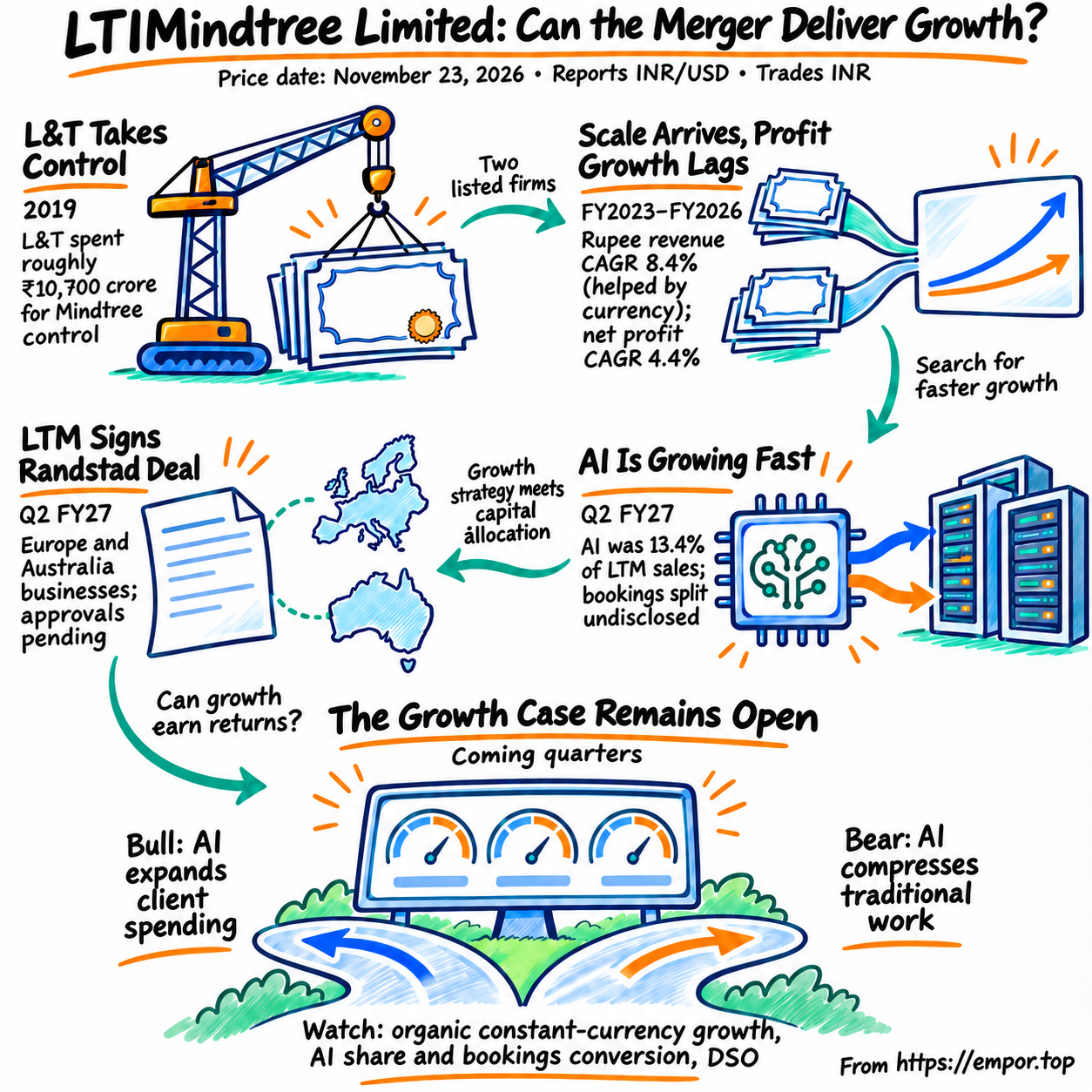
Hold those two facts side by side and the whole story of this company comes into focus. One of them says something new is happening. The other says the core business is still growing at roughly the pace of a mature industry. The question this story tries to answer is which of those two facts describes the company investors will own five years from now.
First, the boundary, because this company is easy to confuse with its parent. LTIMindtree Limited became LTM Limited effective March 17, 2026, and the National Stock Exchange changed the name in its own records the following month.34 Nothing else about the legal entity changed.
It is the same listed company, with the same shareholders, and it is still controlled by Larsen & Toubro, the engineering and construction conglomerate that owned 68.53% of it at March 31, 2026.4 L&T reports its own technology segment, which is larger than LTM and includes other businesses. Those figures belong to L&T. Every number in this story belongs to LTM alone.
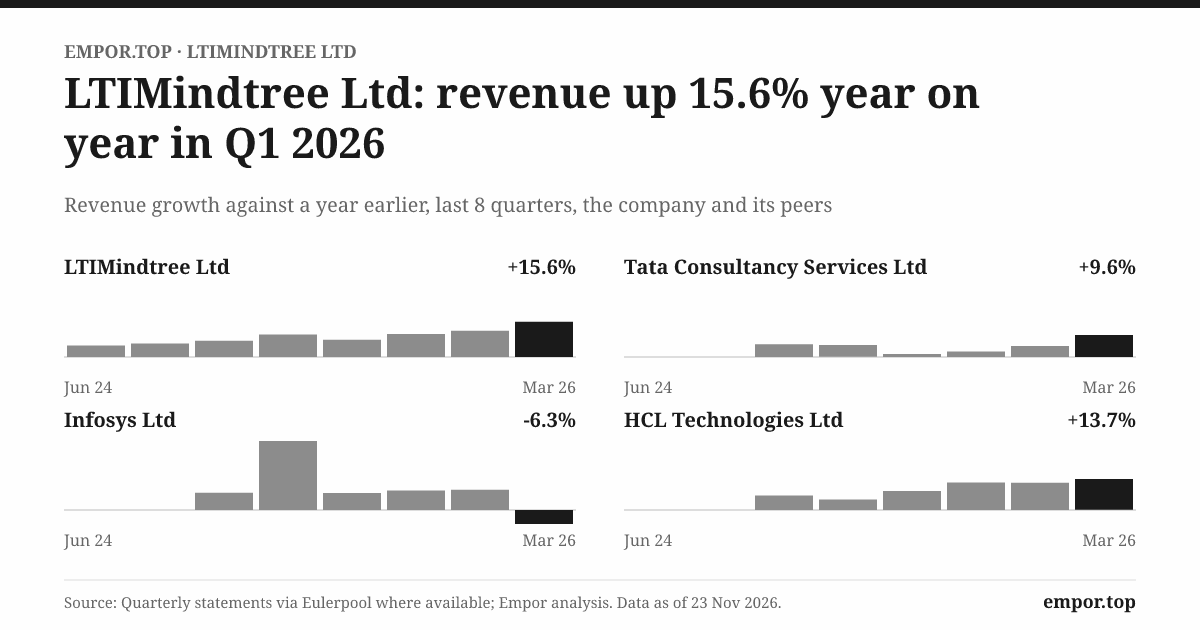
The stakes are easy to state. In the year to March 2026, LTM booked about ₹42,300 crore of revenue, a little under $4.8 billion.4 That makes it one of the larger technology-services companies in the world, with something like 88,000 permanent employees. But size has not translated into speed. From the first full year after the merger, fiscal 2023, to fiscal 2026, revenue compounded at 8.4% a year and net profit at only 4.4% a year.4 Profit growing at about half the rate of revenue is the signature of a business that is getting bigger without getting better paid for each unit of work.
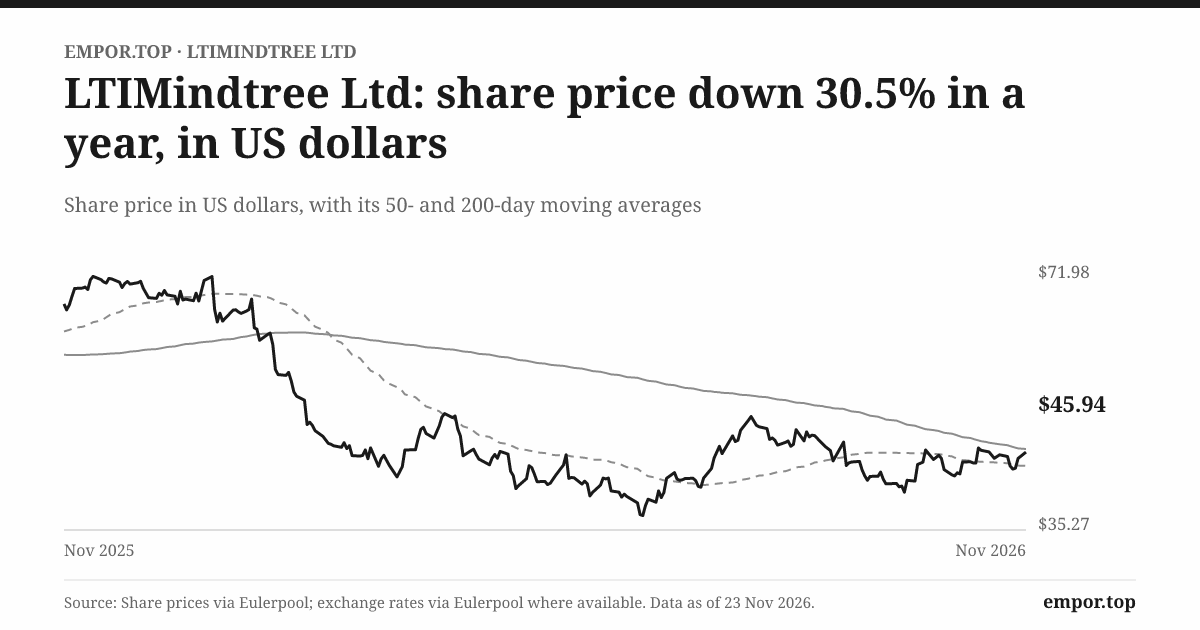
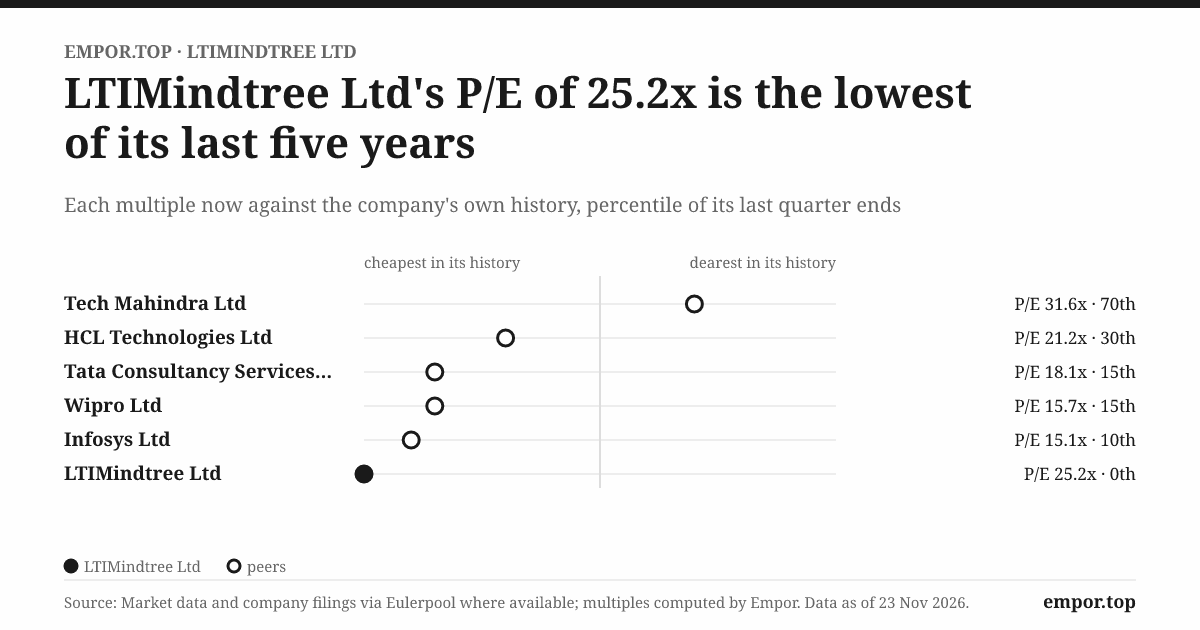
The market has noticed. On November 23, 2026, LTM's shares closed around ₹4,268, about a third below their 52-week high, and the company was valued at about 25 times its trailing earnings, against a median of roughly 38 times over the previous five years. That is a market that has stopped paying for the growth story and is waiting to see it.
So five questions run through everything that follows. Did the merger that created this company create durable value, or just a larger reported number? Can a $4.8 billion company win against Indian rivals several times its size? Will AI bring LTM genuinely new revenue, or compress the traditional work that pays most of its bills today? Is the company's newest acquisition, and its habit of paying out a large slice of profit as dividends, a disciplined use of cash? And does the lower valuation compensate investors for slower growth, or merely reflect it?
The October call itself gave an early hint of how hard the third question will be to settle. When analysts asked how the company's AI deal wins would show up as revenue, and how much of the quarter's bookings were AI work versus traditional outsourcing, management said it needed more time before it could give a clean split between the two kinds of deal.1 In other words, the most important new number in the company's story did not yet come with the supporting detail an investor would need to check it.
That is not a scandal. It is a reasonable answer from a company still learning how to measure a new kind of business. But it frames the challenge for anyone trying to judge LTM today. The name has changed. The evidence that the business has changed is still coming in, one quarter at a time. To understand why the bar is so high, the story has to go back to a bitter fight in 2019, when L&T decided it wanted a company whose founders did not want to be bought.
 Subscribe on LinkedIn
The takeover that made the merger possible
In March 2019, the founders of Mindtree found themselves in a position few Indian technology entrepreneurs had ever faced: a hostile takeover. Mindtree was a Bengaluru-born services firm founded in 1999 by a group of industry veterans that included Subroto Bagchi, Krishnakumar Natarajan, N.S. Parthasarathy and Rostow Ravanan. It had built a reputation as a thoughtful mid-sized player, admired for its culture and its founders' public commitment to running a professional, independent company.5
The trouble was that the founders did not own enough of it. The largest single shareholder was V.G. Siddhartha, the founder of the Café Coffee Day chain, who had backed Mindtree early and held roughly a fifth of the company. Siddhartha needed cash. Larsen & Toubro, which already owned a listed software business in L&T Infotech, wanted to grow its technology arm faster than it could grow on its own. When L&T agreed to buy Siddhartha's block, it gained a foothold large enough to make an open offer for control, whatever Mindtree's founders thought about it.5
They thought very little of it. The founders argued publicly that a forced combination would damage the culture, alienate clients and destroy value, and they explored ways to fend off the bid.5 India's takeover rules gave them few tools. Once L&T crossed the threshold that triggers a mandatory offer, it had to offer to buy shares from the public, and minority shareholders, not founders, would decide whether to sell.
The price L&T put on the table was ₹980 a share.6 Measured against Mindtree's closing price before rumours of the deal began moving the stock, that was a premium of about 12%, which is modest by the standards of contested takeovers anywhere in the world.7 A contemporary analysis in the Financial Express estimated that the offer valued Mindtree at about 21 times its forward earnings, roughly in line with what investors were paying for Tata Consultancy Services, the sector's bellwether, at the time.7
That comparison is worth handling carefully. It is a rough benchmark, not a full study of comparable acquisitions. It suggests L&T did not pay a wildly inflated price for a mid-sized firm, because it paid roughly the multiple the market already gave the sector leader. It does not prove that the price was cheap, because the buyer was paying a leader's multiple for a company without a leader's scale. And a premium paid for control is not, by itself, evidence of value created. Value is created only if the buyer later earns more from the asset than it paid.
L&T kept buying. Through its purchase of Siddhartha's block, open-market purchases and the open offer, the parent spent roughly ₹10,700 crore to secure control of Mindtree.68 By the time the offer closed in mid-2019, L&T owned a majority of the company.8 The founders who had fought the deal soon left their executive roles, and L&T put its own management in charge.
It matters, for the rest of this story, who wrote that cheque. The ₹10,700 crore came from Larsen & Toubro, the parent. It was not spent by the listed company that today calls itself LTM. When the two software businesses were later merged, the listed company paid nothing in cash; it issued shares. That distinction keeps the accounting honest. LTM's balance sheet does not carry a giant goodwill figure from 2019, and its returns on capital are not depressed by the takeover price. The cost of control sits with L&T's shareholders.
The founders' warning, though, belongs squarely in LTM's story. They predicted that a forced integration would hollow out Mindtree's capabilities and push away the clients who had chosen Mindtree precisely because it was not a giant. That is a testable claim. If they were right, the combined company should show weak growth in the client base and verticals Mindtree brought, an exodus of talent, and margins that slide as the integration drags. If they were wrong, the merged company should grow faster than either business could have alone.
Seven years later, the evidence is mixed rather than damning. The combined company did not collapse, did not lose its large clients in a visible rush, and kept operating margins in the mid-teens. But it also did not deliver the acceleration that would prove the integration added something. Profit growth since the combination has been slow enough that the founders' fear of value destruction cannot simply be dismissed as sour grapes. It has been narrowed, from a prediction of collapse to a question about whether the combination ever earned its premium.
And L&T did not stop at control. Owning two listed software companies, with overlapping clients, competing sales teams and two sets of public shareholders, was an awkward structure. In 2022 the parent decided to fold them together, and the price of that second step would be paid not in rupees but in shares.
One listed company, two different growth rates
The mechanics of the 2022 merger were simple, which was the point. The boards of L&T Infotech and Mindtree approved a plan under which Mindtree would be absorbed into L&T Infotech. For every 100 Mindtree shares they owned, Mindtree shareholders received 73 shares of L&T Infotech.9 No cash changed hands at the listed-company level. The combined business took the name LTIMindtree in November 2022, and on November 25, 2022 it allotted 120.4 million new shares to former Mindtree shareholders.49
Think of the exchange ratio as the price of the merger expressed in a different currency. Instead of paying for Mindtree with cash, L&T Infotech paid with a slice of its own future. Every new share issued to a Mindtree holder was a claim on the combined company's profits. Whether that was a good trade for L&T Infotech's original shareholders depends on whether the merged business earned more per share than L&T Infotech would have earned alone. It is the same question as the takeover, asked of a different set of owners.
The first thing the merger did was distort the record. Before the combination, the listed company's revenue was L&T Infotech's revenue. After it, the listed company's revenue was L&T Infotech's plus Mindtree's. So in fiscal 2023, reported revenue jumped by more than 100%, because the comparable period now contained two companies. Any long-term growth rate that spans the merger inherits that step. The ten-year revenue growth rate, a flattering 22% a year, is mostly a measure of a merger, not of organic demand.4
The honest starting line is fiscal 2023, the first year the combined company reported as one. From there to fiscal 2026, revenue compounded at 8.4% a year.4 That is respectable for a business of this size, but it includes a currency tailwind: the rupee weakened against the dollar over the period, and because most of LTM's revenue is billed in dollars, each dollar of work translated into more rupees. In fiscal 2026 alone, rupee revenue grew 11.3% but dollar revenue grew about 6%, and CRISIL, the rating agency, put constant-currency growth at about 5%.10
Profit tells a slower story still. Net profit compounded at just 4.4% a year from fiscal 2023 to fiscal 2026.4 The operating margin slipped from about 16.3% in the merger year to about 15.4% in fiscal 2026, and the net margin fell from about 13.3% to about 11.9%. For every ₹100 of revenue, the combined company now keeps roughly ₹1.40 less as profit than it did three years ago. That is not a collapse. It is a steady leak, and it compounds.
Part of the leak is outside operations. The tax rate rose from about 24% to about 27% over the period, which alone accounts for a meaningful slice of the gap between profit growth and revenue growth. Part of it is the operating margin, which reflects wage inflation, pricing pressure and the cost of building new capabilities. And part of it is simply that integration is expensive and slow. The point for an investor is not to assign blame to any single line, but to recognise that scale alone did not produce operating leverage. A company twice as large did not become more profitable per rupee.
The merger's original promise was broader than size. Combining the two firms was supposed to give the company a wider client base, a more balanced mix of industries, and a larger platform from which to bid for the very big deals that tend to go to the largest vendors. L&T Infotech brought deep relationships in banking, insurance and manufacturing. Mindtree brought strength in technology, media, travel and retail. On paper, the overlap was small and the complementarity was large.
That promise is a hypothesis, not a result, and it can be checked. If the combination produced a better-balanced portfolio, it should show up in segment results that grow more evenly and in margins that hold up when one industry weakens. If it produced a larger platform for big deals, it should show up in order wins. Both tests have yielded partial results: the company does win large deals, but its largest segment, financial services, barely grew in the most recent quarter.
What the merger unambiguously created was a larger listed company, with more liquid shares, a bigger balance sheet and a seat at more negotiating tables. What it has not yet created is a faster-growing one. That leaves the value-creation question open, which means the answer must come from the business itself. So what exactly does this larger company sell, and where does its bargaining power come from?
The work behind the “digital transformation” label
Picture the client first. A large American insurer wants to retire a thirty-year-old policy administration system, move its customer data into the cloud and rebuild the process by which a claim travels from a phone call to a cheque. It does not have the thousands of engineers that job requires, and it does not want to hire them permanently.
So it signs a contract with a services company, which promises to staff the work, run it to a timetable and deliver it at an agreed price. The services company now has to find, train and keep the people, and it has to finish on budget, because the price is already fixed.
That, stripped of the slogans, is what LTM sells. "Digital transformation" is the label on the box. Inside the box are people, organised into teams, billed to clients under contracts that allocate risk in different ways. Understanding those contracts is the key to understanding the company's economics.
There are three basic shapes. Under a time-and-materials contract, the client pays for hours worked, more or less like hiring a law firm; if the job takes longer, the client pays more. Under a fixed-price contract, LTM quotes a price for an outcome, and if its estimate of the effort was wrong, LTM eats the difference. Maintenance contracts, where the company keeps an existing system running, are usually priced for a period of time and recognised as that time elapses.11
In fiscal 2025, the parent company's standalone revenue was about 69% fixed-price and maintenance work, about 29% time-and-materials, and only about 2% products.11 The accounting follows the risk. Time-and-materials revenue is recognised as the work is performed. Fixed-price maintenance is recognised over the elapsed period. Other fixed-price work is recognised by comparing the costs incurred so far with the estimated total cost of the project, which means the company's profit on those contracts depends partly on how good its own estimates are.11
It is tempting to read "fixed-price and maintenance" as a synonym for recurring revenue, the kind of predictable income that earns a software company a premium valuation. It is not. LTM does not disclose the average length of its contracts, any minimum commitments clients have made, or the share of revenue that recurs from year to year.114 A maintenance contract may run for five years, or it may be re-bid after one. A large share of fixed-price work gives the company some time-based repeat revenue and deepens its integration into clients' operations, but it also shifts estimation and execution risk from the client onto LTM.
The scale of the business in fiscal 2026 was ₹42,308 crore of revenue.4 With products at about 2% of the total, this is a people-led services business, not a software company with a high-margin product base hiding inside it. Its factory is its workforce. Permanent headcount rose from about 84,300 to about 88,000 during fiscal 2026, an increase of a little over 4%, and the total workforce including subcontractors grew to about 92,700.4
Here is the more interesting relationship. In fiscal 2026, revenue grew 11.3% in rupees, while employee expense grew only 6.8%.4 Each employee, in other words, generated more revenue. Some of that is the currency tailwind, since salaries paid in India do not rise when the rupee weakens while dollar revenue translated into rupees does. Some is genuine productivity: better utilisation, more offshore work, perhaps early automation. Either way, the company improved its labour economics in the year. But the improvement does not change the model. To grow, LTM still needs to hire, retain and keep its people busy.
That last phrase, keeping people busy, has a precise name in this industry: utilisation. It measures the share of billable employees' available time that is actually billed to clients. On the October call, management reported utilisation of 86.4% and a headcount of 88,835.1
Utilisation that high is near the top of what services firms typically sustain, which is good for margins today but leaves limited slack. If demand rises, the company has to hire ahead of revenue, and new hires cost money before they bill. If demand falls, idle benches eat profit. Quarterly margins in this business are, to a large degree, a story about how well management balances hiring against demand.
The other side of the contract is the customer. LTM reports serving more than 700 active large-enterprise clients.2 That breadth sounds reassuring, and in one sense it is: no single disclosed account dominates the picture. But the company does not publish the share of revenue from its top five or top ten clients, nor does it say whether any client contributes more than a tenth of sales.411
Breadth of the client list is not the same as breadth of revenue. Many services firms derive a large share of revenue from a small number of very large relationships, and without the distribution, an investor cannot tell whether LTM is one of them.
One example from the October call showed both the opportunity and the danger in this business. Management described a banking client that had consolidated its technology vendors from more than 50 providers to about five.1 For the five survivors, that is a windfall: more work, deeper integration, a larger share of the client's budget. For the forty-odd losers, it is a lost account. And for every vendor, it is a reminder of who holds the power. The bank chose to consolidate. It could, in principle, consolidate again.
That is the central tension in LTM's model. Its contracts embed it deeply in clients' operations, which creates some friction against switching. But its clients are large, sophisticated buyers with many alternatives, and they periodically use vendor consolidation to extract better prices. Whether LTM's position in any given client is defensible depends on what it knows about that client's industry and how hard it would be to replace. That brings the story to the four industry segments where LTM earns its money, and the rivals it meets in each.
The scale gap between LTM and its rivals
Imagine the meeting at a global bank that has decided to cut its technology vendors to a handful. In the room, on the shortlist, are names every Indian services executive knows by heart. Tata Consultancy Services. Infosys. HCLTech. Perhaps Accenture or Cognizant. And LTM. The bank is choosing a primary partner, the vendor that will run the largest share of its applications for the next several years. Every firm on the list claims domain expertise, delivery excellence and an AI platform. The bank's procurement team knows this, and it will use the competition to negotiate the price down.
Now look at the scale of the firms in that room. In fiscal 2026, LTM's revenue was about $4.8 billion.4 TCS reported roughly $30 billion.12 Infosys reported about $20 billion.13 HCLTech reported about $14.7 billion.14 LTM is a meaningful global supplier, with a workforce near 90,000, but TCS alone is more than six times its size, and even HCLTech is three times larger. In a business where the biggest clients increasingly want vendors who can staff thousands of people across continents at short notice, size is not vanity. It is capacity, and capacity is a selling point.
That said, LTM is not only losing these contests. In fiscal 2026, its order wins totalled about $6.6 billion, a record for the company and well above its annual revenue.10 A book of new orders larger than a year's sales suggests that clients are willing to commit multi-year work to the company. The caveat, which matters for everything that follows, is that order wins are counted at their total contract value over several years, and only become revenue as the work is performed. A $100 million five-year deal adds $20 million a year, not $100 million.
Where does LTM earn its money? In fiscal 2026, financial services, which includes banking and insurance, was the largest segment at about ₹14,900 crore, a little over a third of revenue. Consumer businesses such as retail, travel and media contributed about ₹10,900 crore. Production, which covers manufacturing, energy and similar industries, brought in about ₹8,500 crore. And technology, media and services clients contributed about ₹8,000 crore.4 Financial services was also the most profitable segment by reported segment result.4 This is the company's centre of gravity: if LTM has a franchise, it is in financial services.
Which makes the most recent quarter uncomfortable. In fiscal 2027, the company revised its segment labels, so the new categories are not perfectly comparable with the old names. With that caveat, the second quarter's constant-currency growth from a year earlier was about 0.4% in financial services, 8.6% in consumer, 7.4% in production and 7.0% in technology and services.21 The segment that pays the most bills barely grew. The others grew at respectable mid-to-high single digits. One quarter does not establish a trend, but a franchise that stalls is the place investors should look first.
Step back and run the competitive forces once. The buyers are large enterprises with multi-vendor options and procurement teams that can, and do, consolidate suppliers; rivalry is intense, because every competitor sells similar services from similar labour pools in India and elsewhere. The main supplier is skilled labour, and the cost of that labour, and the ability to retain it, determines margins. New entrants face barriers in scale and client trust, but specialist and AI-native firms can win specific projects. Substitutes, increasingly, include AI tools that let clients do some work with fewer people.
The friction that protects incumbents is switching cost. Once a vendor runs a bank's core systems and holds the knowledge of how they work, replacing it is costly and risky, so embedded work tends to stay embedded. That friction is real, and it is the best argument that LTM's relationships are durable. But LTM does not publish client retention rates, revenue concentration, or price realisation on renewals.4 Without them, the strength of the lock-in cannot be measured. The bank that consolidated its vendors is evidence that switching happens.
LTM's own claimed differentiators are domain expertise, the ability to execute large deals, and cross-selling across the combined client base. Each can be tested against what the company discloses. Large-deal execution has support in the record of order wins. Cross-selling is partly visible in the growth of consumer, production and technology segments. Domain expertise is hardest to evaluate, because the segment where it should matter most, financial services, is the one that slowed. The proof, in short, is partial: the company names wins, but it does not publish the customer-level economics that would show whether those wins are priced better than its rivals'.
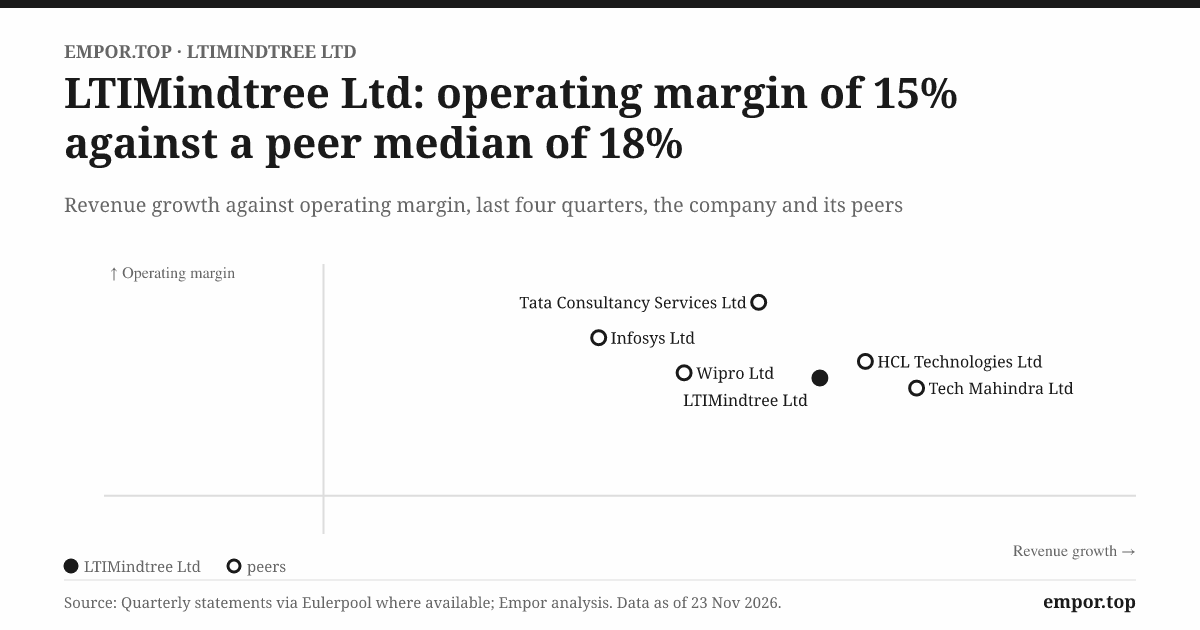
Margins give one more clue. LTM's operating margin was about 15.4% in fiscal 2026.4 The largest Indian rivals report higher operating margins on their own definitions, with TCS in the mid-twenties and Infosys and HCLTech around the high teens to low twenties.121314 Accounting definitions differ, so the gap should not be read to the decimal. But the direction is clear: the larger firms convert each rupee of revenue into more operating profit. Scale gives them better utilisation of senior talent, more negotiating leverage with clients and lower overhead per employee.
The investment implication is uncomfortable but simple. LTM is a capable challenger, not a proven moat. To close the gap with larger rivals, it must either grow faster than they do, which it has not done consistently since the merger, or improve margins, which has been slipping. Order wins matter only if they convert into revenue and cash at decent prices. Management's answer to all of this is AI, which it says changes the shape of the contest. That is the claim the next part of the story has to test.
AI is growing. The harder question is what it replaces.
On the October call, Lambu described how AI engagements move differently from the outsourcing deals the industry grew up on. A traditional outsourcing deal often began with months of transition, as the vendor learned the client's systems before taking them over. AI projects, he suggested, tend to begin with a prototype, prove a use case quickly, and then move into deployment across more of the client's operations faster than an old-style transition would.1 The pitch was that AI shortens the path from first meeting to first invoice.
The numbers behind that pitch are real: AI revenue continued to grow far faster than total revenue.1 Two parts of the AI business, which the company calls Enterprise AI and Business AI, together grew 47%.1 The quarter's order inflow was about $1.3 billion and, management said, included shorter-tenure AI-led deals.1 At 13.4% of a company with quarterly revenue of about $1.2 billion, AI work runs at something like $600 million a year on an annualised basis. That is no longer an experiment.
It is worth pausing on what "AI revenue" means here, because the label can stretch. For a services company, AI work can include building and deploying machine-learning models, integrating generative AI tools into client workflows, data engineering that prepares a client's information for AI systems, and the use of AI inside LTM's own delivery to do traditional work more efficiently.
LTM's platform for this work is called BlueVerse, which the company presents as an ecosystem of AI agents and tools. A platform with a brand is a strategic asset. The stronger proof is what clients pay for, how many of them deploy it at scale, and how many renew.
Here the deal shape becomes important. Management said that the majority of the quarter's order inflow was oriented toward annual contract value, meaning contracts measured by what they bring in each year rather than by a multi-year total.1 That is a meaningful change. Traditional outsourcing deals are often announced at total contract value, a big number that will be earned over five or seven years. Shorter AI-led deals start billing sooner and can expand if they work, so they can accelerate revenue. When analysts asked for a split between annual-value AI bookings and traditional total-value bookings, management said it needed more time to provide one.1
The trade-off is visibility. A five-year maintenance contract is a predictable stream. A one-year AI engagement must be renewed, or expanded, or replaced. If the work proves its value, the renewal is easy and the client spends more. If it does not, or a competitor offers the same capability more cheaply, the revenue can disappear at the end of the year. Shorter contracts give LTM the chance to grow faster, and the client the chance to leave sooner.
The deeper question is substitution. AI is not only a new product LTM can sell. It is also a tool clients can use to need fewer people for the work LTM already does. If an AI agent can write test scripts, maintain code or answer routine service tickets, the client may pay LTM less for maintenance, or demand that savings be passed through in the price. CRISIL explicitly identified AI-led disruption as a constraint on the company's growth in its June 2026 rating rationale.10 So the honest framing is that AI revenue is growing inside a traditional business that AI may simultaneously be shrinking.
Analysts pressed on exactly this point during the October call, asking whether AI engagements expanded clients' overall spending with LTM or replaced traditional work. Management's position was that AI expands the client relationship, opening new functions and budgets beyond IT. But the company did not disclose the numbers that would settle it: no separate margin for the AI business, no renewal rate for AI engagements, and no figure for how much traditional revenue the company itself has cannibalised through AI-driven productivity.1 The claim may well be right. It remains, for now, an assertion supported by growth rates rather than by unit economics.
A comparison with a rival helps calibrate the scale, though it must be handled carefully. HCLTech reported annualised revenue of about $620 million from what it calls Advanced AI in its fiscal 2026 results.14 On the surface, that is roughly comparable to LTM's AI revenue, which would make LTM's AI business similar in absolute size to that of a rival three times larger.
But the labels and measurement bases differ. HCLTech's "Advanced AI" and LTM's "AI revenue" are not defined the same way, and neither company publishes enough detail to reconcile them. The comparison suggests LTM is not behind; it does not prove LTM is ahead.
What would move AI from promising to proven? Three things, tracked over several quarters. AI revenue as a share of the total should keep rising, consistently defined, rather than appearing in one quarter's narrative and fading from the next. AI bookings should convert visibly into revenue, which requires the split management deferred.
And the AI business should show a margin contribution at least as good as traditional work, because growth that comes at a lower margin would help revenue but not profit. If those disclosures arrive and confirm the story, LTM's AI pivot would be one of the most important changes in its history. If they do not, the claim will remain commercially promising and difficult to verify.
Meanwhile, management has been doing something else with its cash, something that can be judged more concretely. In the same quarter, it agreed to buy a business, and the business it chose has an unusual connection to the man running the company.
A €160 million acquisition tests the new capital-allocation story
In January 2025, when LTIMindtree named Venu Lambu as its chief executive designate, the press release described his previous job: chief executive of Randstad Digital, the roughly $3 billion digital arm of the Dutch staffing giant Randstad.15 Before that, he had been president and executive director at Mindtree, and earlier still he had held leadership roles at Cognizant, HCL Technologies and IBM.15 Less than two years later, in the second quarter of fiscal 2027, LTM reported that it had signed an agreement to acquire Randstad Digital's businesses in Europe and Australia, subject to regulatory approvals.21
There is nothing improper about a chief executive buying businesses he knows well. Arguably, it is an advantage: Lambu presumably understands the quality of the people, the clients and the operations better than any outside bidder. But it also raises the question that every investor in a controlled company should ask about any deal led by an executive with prior ties to the seller. Investors would reasonably want to know how the board and its independent directors evaluated the transaction apart from the chief executive's familiarity with the seller, because a clear answer would strengthen confidence in the price.
The boundaries of the transaction are clear. This is an acquisition by LTM, through its subsidiaries, not a transaction by the L&T group. At September 30, 2026, it remained subject to approvals, and management said it expected those approvals in the third quarter of fiscal 2027.21 The enterprise value is up to €160 million.2 The phrase "up to" usually means part of the price depends on future performance or adjustments, so the final amount may be lower.
Benchmark the size against the buyer. At the end of fiscal 2026, LTM held about ₹15,380 crore in cash, investments and other bank balances, roughly $1.7 billion.4 Its annual revenue was about $4.8 billion. A deal worth up to about $185 million, at prevailing exchange rates, is around a tenth of the company's cash and well under 5% of its annual revenue. This is a bolt-on, not a transformation. It does not stretch the balance sheet, and it adds digital-services capacity in geographies where LTM already operates and, by management's account, has "white space" to fill with additional clients and capabilities.1
What cannot yet be said is whether the price is attractive. To calculate a purchase multiple, an investor would need the target's revenue, its operating profit or cash flow, the overlap of its clients with LTM's, its retention rates and the expected cost of integration. LTM has not disclosed those figures for the Randstad businesses.2
Without them, the valuation cannot be benchmarked reliably against comparable transactions, and any peer comparison would be invention rather than analysis. The honest answer is that the deal is small enough not to matter much if it disappoints, and too opaque to prove good if it succeeds, at least until post-close results arrive.
The contrast with the earlier transactions is instructive. The 2019 takeover was L&T's cash purchase of control, while the 2022 merger was paid in shares. The Randstad deal is the first sizeable acquisition this management team has made with the listed company's own cash.
That makes it the first real test of the capital-allocation discipline management describes: in the October call, executives said the company would pursue acquisitions only where they were strategic and could be done at value-adding prices.1 Those words are easy to say and only verifiable afterwards.
The longer record of how the company has used its cash provides context. Over the twelve years from fiscal 2015 to fiscal 2026, the listed company generated about ₹24,850 crore of free cash flow, meaning operating cash after capital expenditure.4 It paid out about ₹11,540 crore of that as dividends, about 46%. And its stock of cash and short-term investments grew by about ₹14,530 crore, to roughly ₹14,850 crore.4 The median payout ratio over those twelve years was about 37% of net profit, and in fiscal 2026 it was about 40%.
Read that record plainly. This is a company that has paid a steady, substantial dividend, made almost no debt-funded bets, and accumulated a large cash pile rather than spending it on acquisitions. That cash is not idle: it earned other income of about ₹1,090 crore in fiscal 2026, equal to roughly 14% of profit before tax, mostly from investment returns.4 But it also means that a meaningful slice of reported earnings comes from treasury income rather than from operations, and that the company's return on equity is diluted by holding so much cash.
So the question for capital allocation is not whether the company has been reckless. It has not. The question is whether a large and growing cash pile, invested in short-term instruments, is the best use of shareholders' money in a business that needs to accelerate growth. One answer is more acquisitions; Randstad suggests management leans that way. Another is to return more cash. In the second quarter, the board raised the interim dividend to ₹25 per share, and analysts asked how management balanced payouts, cash reserves and acquisitions.21 Management's answer kept all three options open, which is reasonable but not yet a framework.
The test for Randstad is straightforward. Within a year or two of closing, the acquired businesses should show up in LTM's revenue in Europe and Australia, ideally growing faster than before the deal, and the company should be able to point to clients won or expanded because of the combination.
If the deal adds revenue but dilutes margins and produces no measurable cross-selling, it will have bought size, which is the same thing the merger bought. And size, as this story keeps finding, is not the same as returns. Before that test arrives, though, there is a more immediate question about the quality of the cash the company already earns.
The cash is strong. The receivables still need watching.
Every services company runs the same quiet race. It pays its engineers every month. It invoices clients for the work afterwards, sometimes weeks later, and then waits for the clients to pay. In between, the work done but not yet paid for sits on the balance sheet as receivables, and work done but not yet even invoiced sits there as unbilled revenue. If clients slow their payments, or dispute bills, profit can look healthy while cash lags behind. That is why the gap between earnings and cash is one of the first places a careful investor looks.
On the long record, LTM passes this test convincingly. Over the twelve years to fiscal 2026, its operating cash flow totalled about ₹30,750 crore, against net profit of about ₹29,650 crore, or 104% conversion.4 Over a long span, profit has turned into cash at least one for one. Individual years vary, because working capital swings, but there is no cumulative gap of the kind that signals aggressive revenue recognition.
The latest year, though, shows a build-up worth watching. At March 31, 2026, the company's trade receivables, net of allowances for bad debts, were about ₹7,120 crore, and unbilled revenue was about ₹1,910 crore.4 The company's own measure of days sales outstanding, which combines billed and unbilled amounts, rose to 84 days from 79 a year earlier.4 A separate, simpler calculation of debtor days, using receivables alone, shows 82 days against 74. The two figures are different measures, not a contradiction, and both point the same way: clients are taking a little longer to pay, or the company is taking longer to bill.
The ageing schedule adds texture. About ₹95 crore of receivables were more than three years past due at the end of fiscal 2026.4 Of that, about ₹83 crore was classified as undisputed and considered good, which means the company expects to collect it despite its age. About ₹18 crore was classified as credit-impaired.4 These are small amounts relative to total receivables, but balances that old, still classed as good, are the kind of item an auditor and an investor should both want to see resolved.
The allowance for expected credit losses was about ₹220 crore, small against the receivables balance.4 During fiscal 2026, the company added about ₹49 crore to allowances, net of reversals, and wrote off about ₹43 crore of receivables it no longer expected to collect.4 Write-offs of that scale are routine for a business with hundreds of large clients. They do not indicate a credit problem. They do indicate that some fraction of billed work never becomes cash, and that the fraction is worth monitoring as receivables grow.
The cash-flow statement explains how the year's working capital moved. In the parent company's standalone accounts, higher receivables and unbilled revenue absorbed about ₹1,850 crore of cash in fiscal 2026, partly offset by about ₹2,470 crore from higher payables and other liabilities.4 So the receivables build was more than covered by the company paying its own suppliers and obligations more slowly or accruing larger liabilities. That is a normal pattern, but it is also a reminder that strong operating cash flow in a given year can rest on both sides of the working-capital ledger.
The second quarter of fiscal 2027 added a further wrinkle. Management said cash conversion was lower in the quarter, attributing it to advance payments and to funding a one-time gratuity provision related to India's new labour laws.1 Gratuity is a statutory lump-sum payment owed to employees on leaving; changes in how wages are defined under the new labour codes increased the liability many Indian employers had to recognise. That explanation is plausible and specific. It is also the kind of one-off that should not recur, which makes the next few quarters' cash conversion a clean test of whether it really was one-off.
Put it together and the verdict is balanced. The long record supports strong aggregate profit-to-cash conversion, and nothing in fiscal 2026 indicates a broad failure of cash quality. But the direction of the latest receivables figures is the wrong one, the oldest balances deserve resolution, and the latest quarter's conversion leaned on explanations.
The test is to watch three things together: combined billed and unbilled DSO, the size of unbilled revenue, and the aged tail of receivables. If collections bring DSO back toward the high seventies and the oldest balances shrink, the fiscal 2026 build will have been timing. If not, it will be a signal.
Watching those numbers falls, ultimately, to management. And management, at LTM, is new enough that its own record is still being written.
A new CEO inherits the growth promise
Venu Lambu took over as chief executive and managing director on May 31, 2025, succeeding Debashis Chatterjee, the executive who had run Mindtree after L&T's takeover and then led the merged company.4 Lambu arrived as something between an insider and an outsider. He had worked at Mindtree before the merger, as president and executive director responsible for global markets, and then left to run Randstad Digital before returning.15 L&T's chairman, in the appointment announcement, described it as Lambu's homecoming to L&T.15
His background is that of a sales-and-markets executive rather than a delivery engineer. An electronics engineering graduate of the University of Mysore, he spent more than thirty years in technology services, with leadership roles at Cognizant, HCL Technologies and IBM before Mindtree and Randstad.15 He was based in London when appointed, a choice that signals where the company's growth must come from: the large clients of North America and Europe.15 His task was not to fix a broken company. It was to make a stable one grow faster.
The team around him has been reshaped. CFO Vipul Chandra became a whole-time director in April 2026, bringing the finance function onto the board.4 Nachiket Deshpande, a long-serving executive who had been a whole-time director, resigned in October 2025.4 At the end of fiscal 2026, six of the nine directors were independent; the board expanded to ten after Chandra's appointment.4
Pay tells part of the story. Lambu's reported remuneration for fiscal 2026 was about ₹27.3 crore, for a part year, because he took over in May.4 Chatterjee received about ₹15.8 crore for his own part year, and Deshpande about ₹9 crore.4 The very large percentage increase in Lambu's pay reported in the annual report is not meaningful, because it compares a part-year appointment with a different role. And the company does not provide a multi-year, like-for-like series that would let investors compare CEO pay against outcomes over time.4
What would alignment look like? The remuneration structure the annual report describes separates fixed pay, variable pay tied to performance, and equity-based awards. The questions an investor should ask are what the variable scorecard actually rewards, whether its goals can be tied to measurable outcomes such as constant-currency growth, margins and cash conversion, and how much of the chief executive's wealth depends on the share price over several years.
LTM's disclosure of the specific metrics and their weights is limited.4 Shareholder dissent has been minimal: in fiscal 2025 postal ballots, less than 1% of votes were cast against the relevant CEO appointments and the director-pay resolution.4 That reflects L&T's controlling vote as much as anything else.
The most important test of a new chief executive is promises against outcomes, and Lambu's record is short. In fiscal 2026, his first year, rupee revenue grew 11.3%, which looks strong, but constant-currency growth was about 5%, and the difference was largely currency.410 On the October call, management again said growth should strengthen through the year, with the second half of fiscal 2027 expected to be stronger than the first.1 That is a specific, falsifiable statement, and it is to management's credit that it is specific. It is also a familiar refrain in this industry, where second-half recoveries are frequently promised and less frequently delivered.
The October Q&A was revealing in what analysts chose to push on. They asked about the duration of AI deals, how bookings convert into revenue, how clients' vendor consolidation affects LTM, where margins are heading and how the company plans to return cash.1 On some of these, management gave concrete answers: the utilisation level, the drivers of cash conversion, the structure of the dividend. On others, most importantly the split between AI and traditional bookings, it deferred to future quarters.1 A management team that defers a disclosure once is being careful. One that defers it repeatedly is choosing not to be measured.
Then there is the controlling shareholder. L&T held 68.53% of LTM at March 31, 2026, the same number of shares as a year earlier; the percentage moved only because employee stock options added a few shares to the total.4 Life Insurance Corporation of India held 9.80%, up from 7.78% a year earlier, making it the largest minority holder.4 The annual report lists no pledge of shares by the promoter.4 Control by a large and well-regarded industrial group brings stability, a strong brand in India and access to the group's clients. It also means minority shareholders depend on the parent's restraint.
The related-party evidence suggests that restraint is being exercised, within bounds. In fiscal 2026, sales to related parties were about 1% of the company's sales, purchases from related parties about 6% of purchases, and related-party loans were nil.4 Shareholders approved transactions with L&T of up to ₹1,500 crore, of which about ₹508 crore was used during the year.4
The company states that all related-party transactions were in the ordinary course of business and at arm's length, reviewed quarterly by the audit committee.4 What the company does not provide is a multi-year breakdown of parent-specific flows as a share of LTM's revenue and costs, which would let investors confirm that the boundary is holding.4
The verdict on management is necessarily provisional. Lambu's strategy has early commercial evidence: AI revenue is real and growing, and client expansion is visible in several segments. But a year and a half is not a full cycle, his first year's headline growth was flattered by currency, and the disclosures that would prove the AI pivot are still promised rather than delivered. The questions he inherited are the same ones the market is asking. Whether the market is pricing those questions sensibly is where the story turns next.
Analysis & Bear vs. Bull Case
On November 23, 2026, the market valued LTM at about ₹1.26 lakh crore, roughly $13.6 billion. Its enterprise value, which nets out the company's cash, was about 14 times EBITDA, and its free-cash-flow yield was about 3.4%.
What does that price assume? A rough way to read it is that the market has stopped paying for LTM as the fast-growing mid-tier challenger it once was, and has started pricing it closer to a steady, mature services company. A 25-times multiple is still not cheap in absolute terms; it implies investors expect earnings to grow for many years. But it is far below the premium the company commanded when it was growing faster. The discount to history is real. It is not, by itself, evidence that the shares are mispriced, because the history it is discounted against belonged to a faster-growing business.
The bull case starts with AI, which the company says is growing much faster than its business overall.1
The bull adds that record order wins point to a large pipeline of future work.10 The company also has a large, debt-free cash pile with which to invest, acquire and keep paying dividends.
The bull would go further. LTM is small enough that a handful of large wins can move its growth rate in a way they cannot for TCS or Infosys. Its consumer, production and technology segments grew faster than financial services in the second quarter, concentrating weakness in one segment.2 If financial services recovers, the whole company accelerates. And a management team with direct experience of the European digital-services market, now buying a business there, may be better placed than most to expand outside North America.
The bear case starts with the post-merger record: revenue and profit growth have been modest, and constant-currency growth remained subdued.410
Profit has lagged revenue, and the largest segment barely grew in the most recent quarter. Larger rivals have far more scale, higher margins and their own AI programmes. And customers, as the bank that cut fifty vendors to five shows, can consolidate suppliers and negotiate price.
The bear's sharpest point concerns AI. If AI makes engineers more productive, clients will want to pay for fewer engineers, so the traditional work that generates most of LTM's revenue may shrink or reprice even as AI revenue grows. The company has not disclosed the margin of its AI business, the renewal rate of its shorter AI deals or the split between AI and traditional bookings.1
So a bear can argue that the 40% growth rate is partly relabelling: work the company would have done anyway, now described as AI. Without the disclosure, neither side can prove its case, and the burden of proof sits with the company making the claim.
Run the industry forces once, carefully. Buyer power is high: LTM's clients are large enterprises with procurement teams, multi-vendor strategies and the ability to consolidate, and the company does not publish customer concentration that would show how dependent it is on its largest accounts.4 Rivalry is intense, with TCS, Infosys, HCLTech, Wipro, Accenture and Cognizant all chasing the same budgets.
Supplier power, which in this industry means skilled labour, is moderate but rising for scarce AI skills. The threat of substitution is the newest and most serious force, because AI tools can replace some of the work services firms sell. The threat of new entrants is moderate: scale and trust protect the largest contracts, but AI-native specialists can win projects.
Hamilton Helmer's seven powers framework asks a narrower question: what, specifically, would let LTM earn returns above its cost of capital over time, even against strong competitors? Scale economies favour its larger rivals, not LTM. Network effects are largely absent in services. Counter-positioning is possible in theory, if AI-led delivery cannibalises incumbents' labour-based revenue faster than it does LTM's, but every rival is pursuing the same strategy. A cornered resource would be unique talent or intellectual property; LTM's product base is small. Brand matters in enterprise services but mainly as a proxy for trust, which all the large firms possess.
That leaves switching costs and process power as the plausible sources of durable advantage. Switching costs exist wherever LTM runs a client's core systems and holds the knowledge of how they work. Process power, the hard-to-copy way an organisation delivers, may exist in its domain teams in insurance, banking or manufacturing.
But the evidence that would establish either is not published: there are no retention rates, no revenue concentration figures, no data on price realisation at renewal.4 The honest conclusion is that the moat is plausible but unproven, a set of relationships rather than a structural advantage. The bank that cut its vendors is a reminder that relationships can be renegotiated.
Return on capital offers a partial check. LTM earned about 21% on equity and about 25% on capital employed in fiscal 2026, and its return on invested capital, which strips out the cash pile, was above 40%. Those are strong numbers that say the operating business generates far more than it costs to fund. But return on equity has fallen from the high twenties in the merger year, because profit growth has been slow while equity and cash have kept growing. High returns on a capital-light business are typical of the industry, not a distinctive moat.
Some non-operating risks deserve mention in proportion. About 73% of fiscal 2026 revenue came from North America, about 15% from Europe and the rest from elsewhere, so US demand and US policy, including visa and protectionist pressure that CRISIL flagged, matter enormously.410 Currency moves affect reported growth and margins; the company hedges with forwards and options, and its foreign-exchange gain fell to about ₹66 crore in fiscal 2026 from about ₹125 crore a year earlier.4
The annual report also lists disputed tax demands, including an income-tax demand of about ₹440 crore for assessment year 2022–23 that remained unpaid and under appeal, and indirect-tax disputes including GST.4 These are exposures, not established losses, and the auditor's opinion for fiscal 2026 was unmodified.4
Credit strength belongs in its proper place. CRISIL reaffirmed its highest ratings, AAA/Stable for long-term and A1+ for short-term, in June 2026, citing LTM's scale, strong liquidity and net-debt-free position.10 That supports the balance-sheet case: this is not a company at any meaningful risk of financial distress. But the same rationale named modest constant-currency growth and AI disruption as constraints.10 A AAA rating says the company will pay its debts. It says nothing about whether its growth will recover.
Three measures will carry most of the evidence from here. The first is organic constant-currency revenue growth, which needs to rise visibly and stay there, net of the Randstad contribution.101 The second is AI revenue share and its conversion from bookings, with the bookings split still undisclosed.1 The third is combined billed and unbilled DSO, which rose in fiscal 2026 alongside a small but aged tail of receivables.4
What would change the view? Repeatable improvement in constant-currency growth, published AI economics that show margins and renewals, and stable or improving collections would strengthen the bull case considerably, because they would turn a narrative into a record. Missed growth expectations in the second half, AI revenue that stalls or is redefined, or rising aged receivables would weaken it. The valuation already discounts some disappointment. It does not discount a business that never accelerates.
Lessons from a merger that still has to prove itself
The first lesson begins in March 2019, with Mindtree's founders watching L&T buy the shares of a coffee entrepreneur who needed cash. L&T paid ₹980 a share and spent roughly ₹10,700 crore to win control, and then merged its prize into its own software company through a share swap.68 Seven years on, the combined company's profit has grown at about 4% a year since the merger.
Buying control is the opening scene; earning the premium is the plot. Acquirers in services businesses often treat the closing of the deal as the climax. In LTM's case, the deal was the easy part. The hard part, turning two companies into one that grows faster than either, is still under way, and the founders' warning about value destruction has been neither confirmed nor refuted.
The wider lesson for founders is that independence in a public company is only as durable as its shareholder register. Mindtree's culture and reputation did not protect it when a single large shareholder chose to sell. For acquirers, the lesson is the inverse: control can be bought in weeks, but the people who make a services company valuable can leave just as quickly, and the clients follow the people.
The second lesson lives in the October 2026 call, when analysts asked how AI bookings would become revenue and management asked for more time. The company's order wins hit a record $6.6 billion in fiscal 2026, and its AI deals are increasingly short and measured in annual value.101 A bigger order book is not the same as a better business.
Order wins are promises of work, counted at their total value over years, and they turn into revenue only as engineers deliver and into profit only if the price was right. For investors in services companies, the order book is the beginning of the analysis, not the end; the conversion rate is what matters, and LTM has not yet published it for the business it says matters most.
The third lesson is visible in the utilisation figure: 86.4% of billable capacity in use, with 88,835 people on the payroll.1 In a people business, the balance sheet is talent in motion. LTM's real assets are not its offices or its cash; they are its engineers, its client knowledge and the relationships that keep them working.
Every quarter, those assets walk out of the door and must choose to walk back in. Margins depend on keeping them busy, growth depends on hiring more of them, and AI threatens to change how many of them clients need. Investors who study the cash and the receivables without studying the workforce miss half the business.
There is one more lesson, which belongs to this company more than any other. A new name is a question, not an answer. LTIMindtree became LTM to signal that the merger was finished and a new company had begun. But a name change does not move revenue, and the market's verdict, a multiple far below its five-year median, is that it has heard the new name and is waiting for the new numbers. The specific test for LTM is not branding or scale. It is whether integration, vendor consolidation and AI commercialisation show up in customer economics and in cash.
The next few quarters decide whether the pivot is working
Tonight, LTM stands at a point where its story is unusually easy to test. Management has reiterated its second-half growth outlook, after first-half constant-currency growth of about 5.4%.1 It says AI revenue will keep rising.1 The Randstad acquisition is awaiting the approvals management expects in the third quarter.1 Management has also deferred the AI and traditional bookings split until it has enough history to provide one.1 Each of those statements will be checked against reported numbers within months.
The first moment comes with the third-quarter results. If constant-currency growth rises above the first-half pace, and financial services shows signs of recovery from its near-flat second quarter, the second-half promise will look credible. If growth stays near 5%, the market will have reason to treat the guidance as hope. Once Randstad closes, the numbers will need to be separated: organic growth tells investors about the business, and acquired revenue tells them only about the cheque.
The second moment is disclosure. The AI share of revenue needs to be reported consistently, quarter after quarter, on a stable definition. The bookings split will show whether short AI deals are adding to the order book or replacing longer contracts. If management publishes the split and it confirms that AI work is expanding client spend, the AI pivot will have its first piece of hard proof. If the disclosure keeps being deferred, investors will draw their own conclusions.
The third moment is margins. AI work, the annual wage cycle and acquisition accounting will all flow through the income statement in coming quarters. If the operating margin holds near the second quarter's 15.6% while these pressures arrive, the company will have shown that it can grow without giving up profitability.1 If it slips back toward the fourteen percent range seen in late fiscal 2025, the old pattern of revenue growing faster than profit will have reasserted itself.
The fourth moment is cash. The next interim and annual reports will show whether the fiscal 2026 build-up in receivables and unbilled revenue has been collected, whether DSO has returned toward the high seventies, and whether the oldest receivables have been paid or written off. Alongside that, the related-party disclosures will show whether transactions with L&T remain small relative to LTM's revenue, and post-close financials will eventually show whether Randstad earns a return.
Set against the five questions this story began with, the next few quarters will not answer all of them. They will answer the one that matters most: whether this company, larger after a takeover and a merger, can grow faster than the industry it competes in. The tension that remains is that management is asking investors to believe in an acceleration it has promised before, using a business line it has not yet fully disclosed.
Outro
Go back to the name on the exchange screen. For most of its public life, the company's ticker carried the names of the two firms that built it: L&T Infotech and Mindtree, one born inside an engineering conglomerate and the other inside a group of founders who fought to stay independent. Now it reads simply LTM. The merger is finished. The question it was meant to answer is not.
Two numbers capture the unfinished story. AI revenue is 13.4% of sales today, growing fast enough to change the company if it continues.1 Net profit has grown about 4.4% a year since the merger, slowly enough to explain why the market is waiting.4 LTM has built a larger platform and an AI business worth measuring. Whether it has built a faster-growing company is the next chapter, and the company will write it in quarterly results, one at a time.
References
-
Q2 FY27 Earnings Call Transcript — LTM Limited, 2026-10-16 ↩↩↩↩↩↩↩↩↩↩↩↩↩↩↩↩↩↩↩↩↩↩↩↩↩↩↩↩↩↩↩↩↩↩
-
Consolidated Financial Results, Q2 FY27 — LTM Limited, 2026-10-16 ↩↩↩↩↩↩↩↩↩
-
Change in Name Circular — National Stock Exchange of India, 2026-04-10 ↩
-
Integrated Annual Report 2025–26 — LTM Limited, 2026-05 ↩↩↩↩↩↩↩↩↩↩↩↩↩↩↩↩↩↩↩↩↩↩↩↩↩↩↩↩↩↩↩↩↩↩↩↩↩↩↩↩↩↩↩↩↩↩↩↩↩↩↩↩↩↩↩↩
-
How Mindtree Became the Object of a Hostile Takeover Battle — The Economic Times, 2019-03 ↩↩↩
-
Detailed Public Statement on L&T’s Mindtree Offer — Securities and Exchange Board of India, 2019-03 ↩↩↩
-
L&T’s Hostile Bid for Mindtree: Does the Deal Compute? — Financial Express, 2019-03-26 ↩↩
-
Open Offer Post-Offer Advertisement for Mindtree — Securities and Exchange Board of India, 2019-07 ↩↩↩
-
Change of Name Intimation — LTIMindtree Limited, 2022-11-15 ↩↩
-
Integrated Annual Report 2024–25 — LTIMindtree Limited, 2025-05 ↩↩↩↩↩
-
TCS Integrated Annual Report 2025–26 — Tata Consultancy Services, 2026 ↩↩
-
LTIMindtree Announces Venu Lambu as CEO (Designate) — LTIMindtree, 2025-01-24 ↩↩↩↩↩↩
 LinkedIn
 WhatsApp
 Reddit
 Hacker News
 Email
 Kindle
 RSS Feed
 Spotify
 Apple Podcasts
 Amazon Music
 Audible
 YouTube