Kolte-Patil Developers: The Bookings Are Not the Business
I. The Quarter When Sales Hit a Record and Profit Nearly Vanished
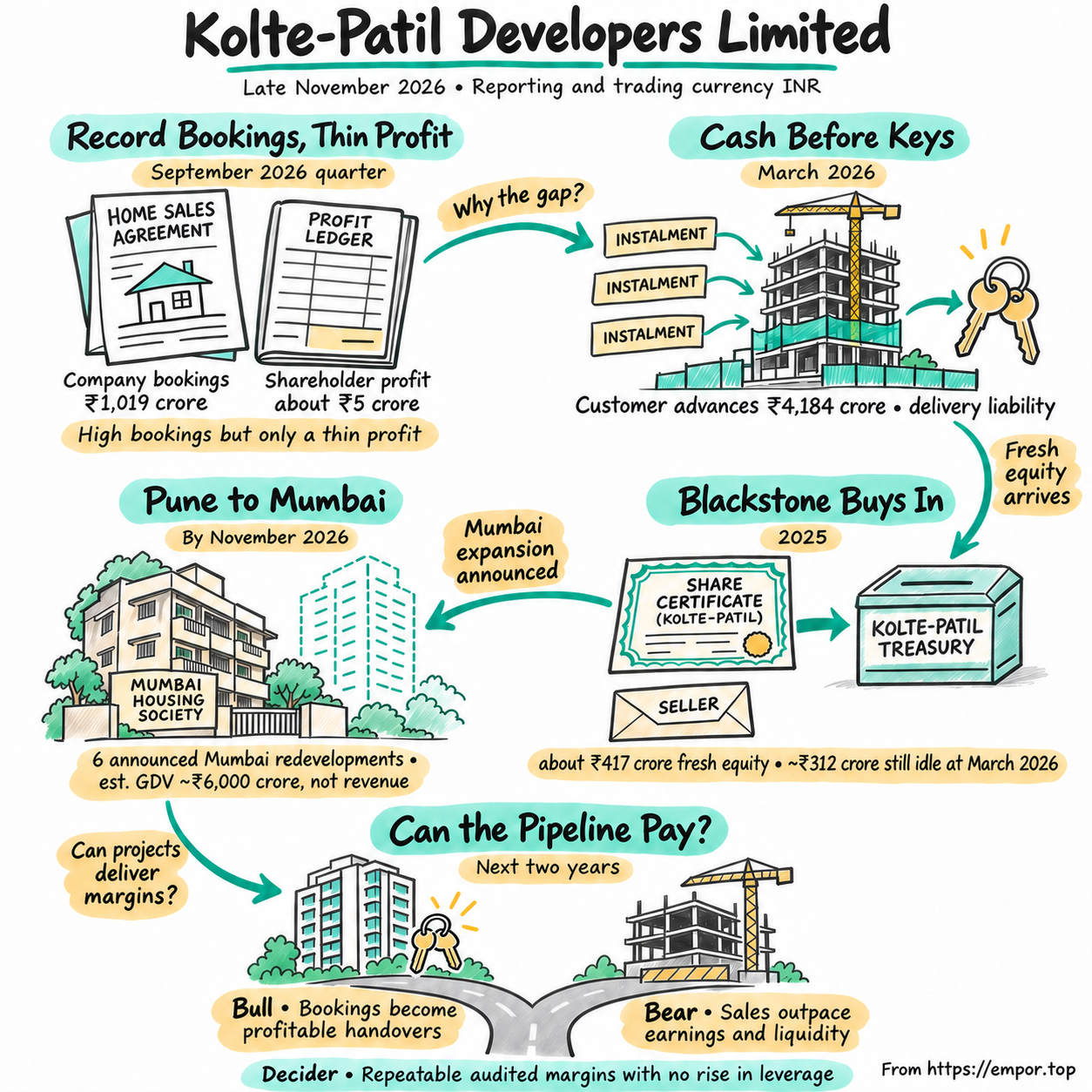
In the second week of October 2026, Kolte-Patil Developers put out a short operational update, and the headline was the kind every property developer dreams of writing. In the three months to September, the company had sold homes worth ₹1,019 crore, the best quarter in its history.1 For a Pune developer that had spent the previous year explaining delayed launches, it read like a turning point.
Three weeks later, on 3 November, the same company published its quarterly accounts. Revenue for the quarter came in at roughly ₹310 crore, and the profit that belonged to shareholders was about ₹5 crore, a net margin of under 2%.2 The quarter that sold more homes than any other had earned almost nothing.
For listeners outside India, one unit will do most of the work in this story. A crore is ten million rupees, so ₹1,000 crore is ten billion rupees, a little over $100 million at late-2026 exchange rates. Kolte-Patil is a mid-sized company by global standards and a substantial one in its home city.
Neither number was wrong. That is the whole puzzle of Kolte-Patil, and it is the puzzle of Indian residential development more generally. A buyer who signs for an apartment is counted as a sale the day the agreement is signed. The money starts arriving in instalments.
But the accounts only record the home as revenue when the finished flat is handed over, which can be years later. So the most exciting number in a developer's quarter and the number that reaches the profit line can sit in entirely different years.
Look at the half-year and the gap widens rather than closes. From April to September 2026, Kolte-Patil booked ₹1,636 crore of sales, up 27% on a year earlier, and collected ₹1,509 crore in cash from buyers, up 32%.1 Those are vigorous numbers.
Set them beside the year that ended in March 2026, when the company recognised just ₹735 crore of revenue and reported a consolidated loss of about ₹38 crore.3 The company sold and collected well over twice what it reported as revenue that year.
And just to make the profit line harder to read, the June 2026 quarter swung the other way. In those three months, when a batch of completed projects was handed over, the company recognised more revenue than in the whole of the previous financial year and reported a profit of well over ₹100 crore.2
One quarter of feast, one quarter of famine, while the sales engine underneath ran steadily faster. Anyone valuing this company off a single quarter is reading the weather, not the climate.
This story is built around four questions. The first is the one the October and November announcements posed side by side: can record bookings and collections turn into durable reported earnings? The second is about ownership. In 2025 Blackstone bought 40% of the company, and investors need to know whether that changes how projects are executed, or only how they are financed.3
The third is geography: Kolte-Patil is a Pune business that has decided to grow in Mumbai, and Mumbai is where many regional developers have discovered that ambition and returns are different things. The fourth is the quality of the cash that funds all of this.
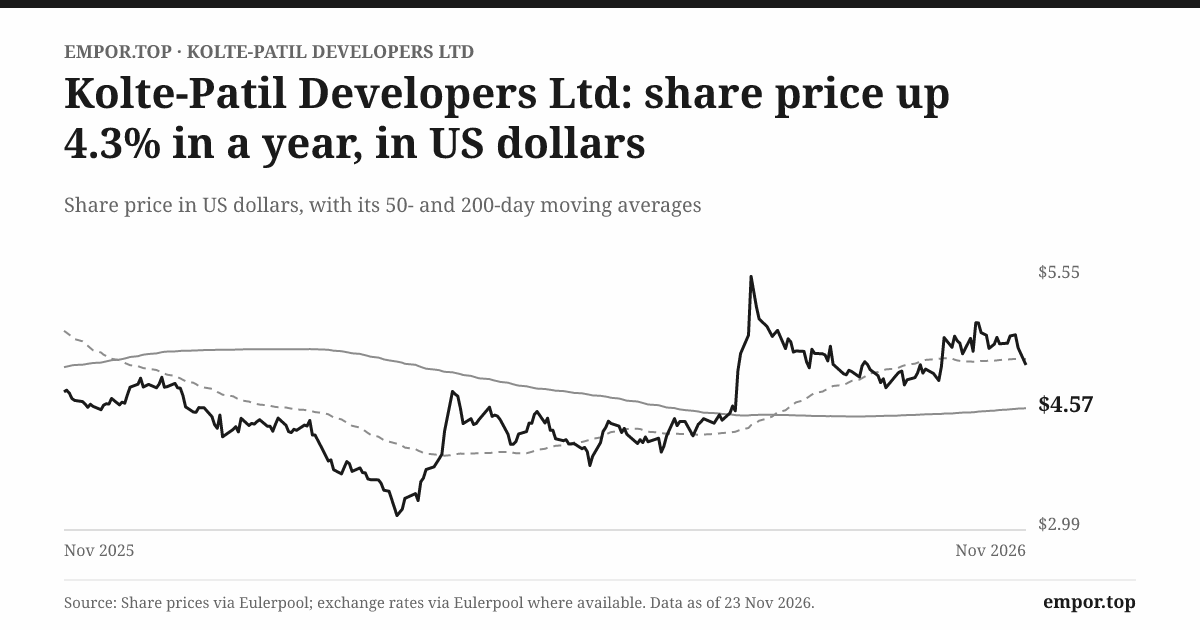
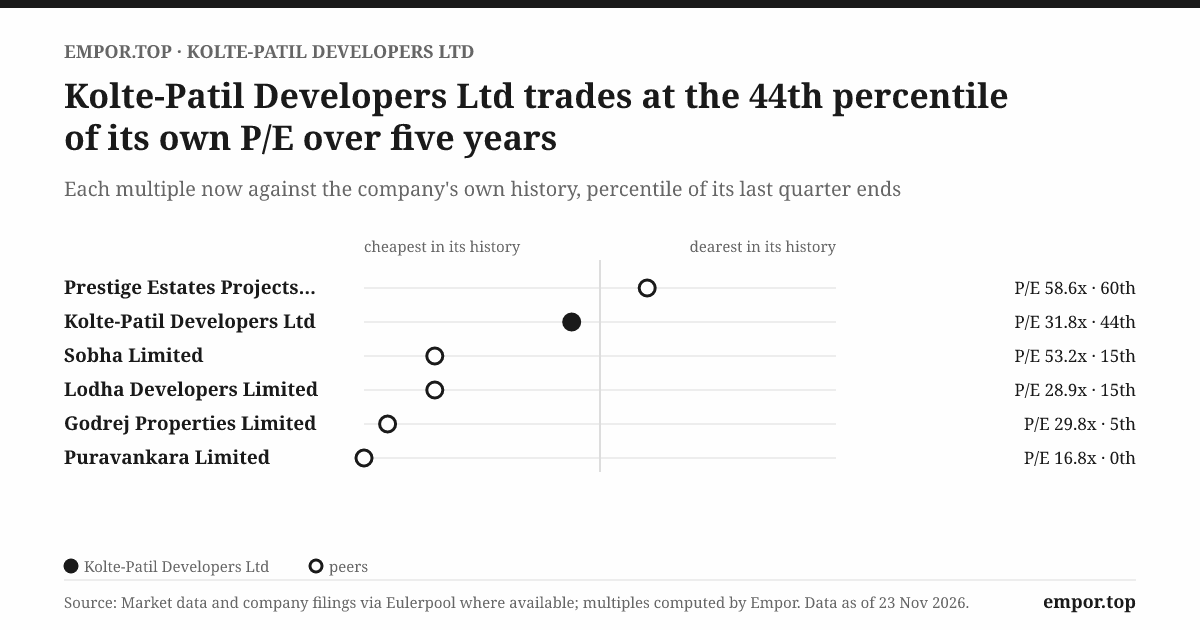
The stakes are visible in the share price. At about ₹424 a share in late November 2026, the market valued the company at a little under ₹4,000 crore, or roughly 32 times its earnings over the previous twelve months.
That multiple sounds rich for a business that lost money in its last full year, and it is fragile for exactly that reason: the denominator is a few lumpy quarters of handovers. Change the timing of one project and the multiple changes with it.
Which brings the story to the single image that runs through everything that follows. At the end of March 2026, Kolte-Patil was holding ₹4,184 crore of advances from customers.3 That money is real. It sits in bank accounts and pays contractors.
But every rupee of it is also a promise: a flat that has to be built, finished and handed to a family that has already paid. To understand whether this company is getting richer or merely getting bigger, it helps to start with the clock that turns those promises into revenue.
 Subscribe on LinkedIn
II. A Pune Developer Builds Its Business Around the Project Clock
Picture a young software engineer in Hinjewadi, the IT corridor on Pune's western edge. She visits a sample flat in a Kolte-Patil project that has just launched, likes the layout, and signs an agreement for sale. On that day the company records a booking.
She pays an initial amount and then agrees to pay in stages as the building rises: plinth, slabs, finishing. For three or four years she makes payments toward a flat she cannot live in. Then one day she gets the keys.
From her side this is one purchase. From the company's side, it is a sequence of bookings, collections and handover, each arriving at a different time.
That is how Indian accounting standards treat the sale of a finished home: revenue is recognised when control transfers, which for this company generally means possession or legal title.
In the year to March 2026, of ₹735 crore of revenue from operations, ₹660 crore was recognised at a point in time, on handover, and only about ₹75 crore was recognised gradually over time.3 Nine-tenths of the income statement, in other words, depends on when buildings are finished and keys are handed over.
Inside the company's own standalone accounts the picture is similar. Sales of property made up about ₹640 crore, and project-management fees, money earned for running projects owned by related entities, contributed about ₹13 crore.3 There is no subscription base, no annuity contract, no recurring fee stream large enough to steady the numbers. This is a business that lives project by project.
That timing explains Kolte-Patil's uneven quarters. The underlying business has not suddenly improved and then collapsed. The clock has simply struck at different times.
There are therefore three numbers to keep separate whenever this company reports. Pre-sales tell an investor about demand: whether people want what Kolte-Patil is building, at the price it is asking. Collections tell an investor about cash: whether buyers are paying on schedule, and whether construction is advancing far enough to trigger the next instalment.
Recognised revenue tells an investor about completion: whether the company is finishing what it sold. A healthy developer needs all three to move together over time, even if they never move together in any single quarter.
The cash side of the clock is what makes the model attractive. Because buyers pay as the building rises, a developer can fund a large part of construction from its customers rather than from banks. In the year to March 2026, Kolte-Patil reported collections of roughly ₹2,680 crore against construction spending of about ₹1,330 crore.4 Customers, in effect, are a cheap and patient source of working capital.
But the money arrives with strings attached. Under India's real-estate regulator, the RERA regime, a large share of customer money for a registered project must sit in a designated account and be spent on that project.
And each rupee collected is also a liability on the balance sheet, recorded as an advance until the flat is delivered. At March 2026, those advances stood at ₹4,184 crore, more than five times the revenue the company recognised that year.3 That is the size of the promise the company is carrying.
What can break the clock? Mostly things that happen before the first brick is laid or while the last ones are going in. A launch needs planning approvals and, for larger projects, environmental clearances; a delay there pushes back every later step. Construction costs are not fixed upfront either.
As of March 2026, the group disclosed only about ₹26 crore of capital-account contracts still to be executed, but it also described landowner agreements whose payments depend on milestones and construction contracts whose final amounts depend on measured work and negotiated rates.3 In plain terms, the real cost of finishing a project is only fully known when the project is finished.
Technology is not a meaningful threat to this model in the way it is for a software or media company. No app substitutes for a flat. Digital tools may change how homes are marketed and designed, and they may trim some costs, but the drivers of this business remain land, approvals, construction and the patience of buyers. Currency risk is similarly small: the company says it has no material foreign-currency transactions.3 The risks that matter are local, physical and slow.
So the funding loop runs like this. Buyers pay in advance. The advances finance construction. Construction leads to completion. Completion converts the advance from a liability into revenue, and only then into profit.
If every link holds, the model is a beautiful machine that grows with relatively little shareholder capital. If a link slips, because approvals are late, costs rise or buyers stop paying, the company finds itself holding customer money that is already spoken for and buildings that are not yet finished.
That raises the harder question this story keeps returning to. If customer money funds a good part of the growth, how much of the cash on Kolte-Patil's balance sheet is actually free, once the commitments to finish existing projects and to repay secured lenders are met? Before answering, it is worth asking a simpler one: over the long run, has this machine actually grown?
III. The Company Grew Its Pipeline Faster Than Its Earnings Base
The year that ended in March 2026 had two faces. On one side, Kolte-Patil described a development pipeline of about 37 million square feet and said it had added new projects with an estimated gross development value of ₹2,250 crore during the year.3
Gross development value, or GDV, is the developer's estimate of what all the homes in a project would fetch if sold at expected prices. On the other side, the company's revenue fell to ₹735 crore from about ₹1,717 crore the year before, less than half.3
The pipeline was getting larger while the income statement was getting smaller. Management's explanation was that the slowdown came from delayed launches and environmental clearances rather than weak demand, a view CRISIL shared when it reviewed the company's credit in March 2026.5
That explanation fits the project clock: if launches slip, there is less to sell, and a year or more later there is less to hand over. But an investor is entitled to ask a tougher question. Is the FY26 trough a one-off timing gap, or one more turn in a cycle that has never quite produced growth?
The long record answers more bluntly than most investors would like. Kolte-Patil listed on the Indian exchanges in 2007, with an IPO that raised ₹275 crore.3 It was then, and remains now, a developer rooted in Pune, a city whose IT and manufacturing jobs created a steady market for mid-priced and premium housing. The company built its name on residential projects and townships across the city's growth corridors.
Since then the reported revenue line has climbed and fallen repeatedly. Over the ten years to March 2026, consolidated revenue grew at about 0.7% a year. Over five years, about 1.2% a year. Over three years, because FY26 was so weak, it shrank at about 21% a year.3
Revenue peaked around FY18, fell sharply the next year, recovered, fell again in the pandemic year, rose, dipped, rose, and then halved in FY26. A ten-year chart looks less like a growth story than an electrocardiogram.
Profit tells the same story with more drama. In the twelve years from FY15 to FY26, the company reported net losses in three of them, FY21, FY24 and FY26, and its best return on equity in that whole stretch was a little under 13%.3
For a developer that has existed through two decades of Indian urbanisation, a booming Pune IT economy and the post-pandemic housing upcycle, that is a modest record. The widely held picture of a Pune champion compounding steadily on its home turf does not survive contact with the accounts.
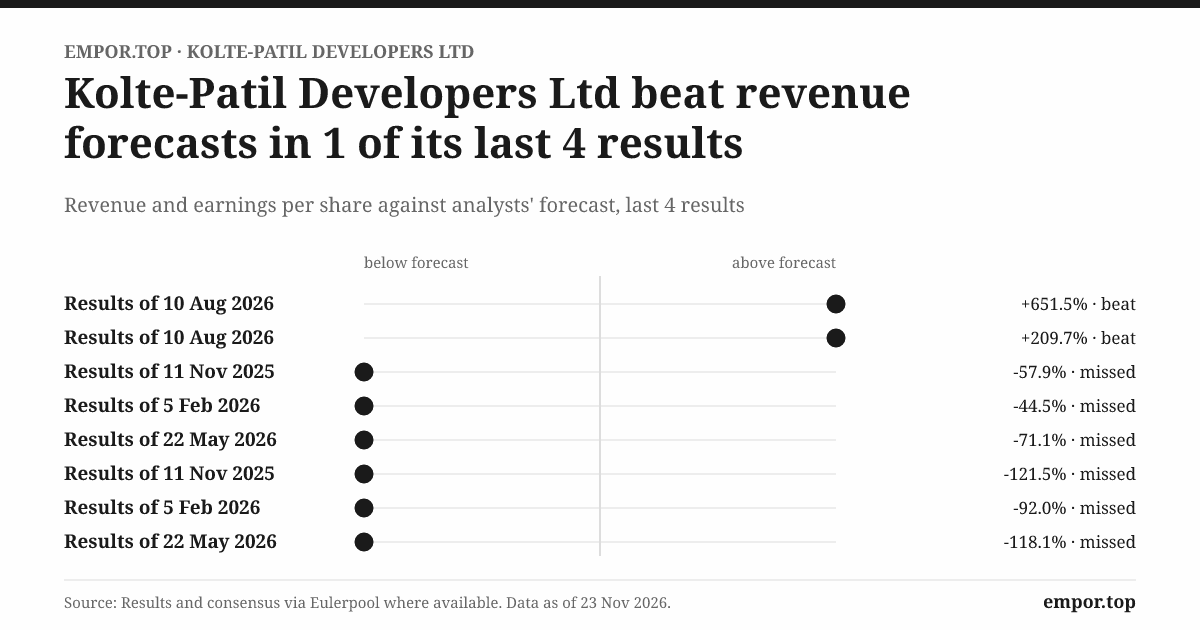
FY26 itself was not one bad handover that slipped across a year-end. Every quarter of the year was weak. The company lost money at the shareholder level in three of its four quarters, and in the one profitable quarter, to December 2025, it earned only a few crore.4
A single delayed tower can distort a quarter. A full year of thin revenue says the whole pipeline was between cycles, with old projects largely handed over and new ones not yet ready.
That does not prove the business is poor. Some of the volatility is genuinely the project clock, and some reflects changing consolidation as the company bought out partners and folded in subsidiaries. But it does falsify the simplest bullish story, which is that a large land bank turns automatically into growth. Kolte-Patil has had a meaningful pipeline for most of its listed life. What it has not done is convert that pipeline into a rising stream of reported revenue.
It helps to understand what reinvestment means here. A manufacturer reinvests by building factories, and its capital spending shows up as property, plant and equipment. A developer reinvests by buying land or development rights, paying approval costs and pouring concrete, and almost all of that sits in inventory rather than fixed assets.
Kolte-Patil's standalone capital work in progress, the account for unfinished fixed assets, closed FY26 at a trivial ₹3.6 crore after about ₹37 crore of additions were capitalised during the year.3 That number tells an investor almost nothing about the real reinvestment bill. The true bill is in land and work-in-progress inventory, which is why inventory, not fixed assets, dominates the balance sheet.
Through 2025 the company was also reshaping its portfolio around the edges. In August 2025 it exited stakes in four entities as part of a reorganisation.6 In October 2025 it acquired a 7.5-acre land parcel at Bhugaon, on Pune's south-western fringe.7 Neither move was large on its own. Together they show a company pruning some old structures while adding new land for the next cycle.
Outside capital has passed through Kolte-Patil's projects before. In 2011 the American developer Portman Holdings bought ICICI Venture's stake in one of its Pune projects, a reminder that the company has long used partners to fund and share large developments.8 What changed in 2025 was that the partner came in at the level of the listed company itself, which is the subject of the next chapter.
The organisation, meanwhile, grew sharply. Permanent employees rose from 521 at March 2025 to 878 at March 2026, and other workers counted in the company's sustainability report rose from about 1,680 to about 2,950.3 Read naively, that is a company tooling up for a much bigger pipeline.
Read carefully, part of the jump reflects the merger of the wholly owned township subsidiary into the parent, which changed what the parent company's numbers include. Headcount went up; so did the boundary around it.
So the honest reading of the long record is this. The pipeline is expanding, the organisation is expanding, and the first half of FY27 is a promising break from the trend in sales and collections. None of that yet proves a new earnings regime.
Land additions and launches create value only if projects sell, collect, finish and earn an acceptable margin, and that last step is exactly where the reported history has been weakest. The company's answer to that challenge, in March 2025, was to bring in one of the largest property investors in the world.
IV. Blackstone Buys In—and the Listed Company Changes Shape
On 13 March 2025, Indian financial television ran a headline that sounded like the end of an era: Blackstone to take over Kolte-Patil, with shares to be issued to it at ₹329 each.9 For a family-founded Pune developer, the arrival of the world's largest alternative asset manager was a moment of validation. It was also, depending on which way the deal was read, a sale by the founders, a capital raise by the company and a governance experiment.
The word takeover is where the popular version and the filings start to diverge. What actually happened had three distinct parts, and it pays to keep them apart because each one sends money to a different place.
The first part was fresh capital. Kolte-Patil issued about 1.27 crore new shares to BREP Asia III India Holding Co VII, a Blackstone fund vehicle, at ₹329 apiece, raising about ₹417 crore for the company.3 That money went into the listed company's bank account. It increased the share count from about 7.60 crore at March 2025 to about 8.87 crore a year later, so existing shareholders were diluted by roughly a sixth in exchange for a stronger balance sheet.3
The second part was a secondary sale. Blackstone also bought shares from the existing promoters, the Kolte and Patil families and their entities. That money went to the sellers personally, not to the company. The arithmetic shows how large this leg was.
Blackstone ended up with 40% of the enlarged company, roughly 3.5 crore shares, of which only about 1.27 crore were new, so it must have bought roughly 2.3 crore from existing holders.3 By September 2026 the Indian promoter group held about 34% of the company, down from roughly 70% of a smaller company before the deal.10
The third part was the open offer. Indian takeover regulations require an acquirer that crosses the 25% threshold to offer to buy additional shares from public shareholders, and Blackstone's entry triggered that process. The end result is that Blackstone holds 40% and sits inside the reported promoter and promoter-group category, which totalled about 73.8% at September 2026.10
Why would founders sell so much of a company their families had built? The filings do not give the families' reasons, and it would be wrong to invent them. The structure of the deal does point to what each side received. The company got fresh equity at a moment when leverage had climbed and launches were slipping.
The selling shareholders got liquidity on a large block at a negotiated price. Blackstone got a 40% position, a seat at the table in a listed Pune platform and a vehicle for Indian residential development without having to build one from scratch. Each side's gain is clear. Whether minority shareholders gained depends entirely on what the company now does with the money.
What Blackstone did not become is a parent company in the accounting sense. Kolte-Patil is not a subsidiary of Blackstone. Blackstone's global portfolio, its office parks, logistics warehouses and hotels in India and elsewhere, does not belong in Kolte-Patil's accounts, and Blackstone's scale is not Kolte-Patil's scale.
The listed company remains a mid-sized Pune developer with a powerful new shareholder. The distinction matters because a good deal of commentary has treated the investor's reputation as if it were the company's operating capability.
Where did the ₹417 crore go? The most telling answer comes from the auditor. At March 2026, about ₹312 crore of the preferential-issue money was still parked in liquid investments, because, as the auditors put it, it was not immediately required.3 At its peak during the year, all ₹417 crore had been sitting idle.3
There is nothing improper about holding cash until it is needed. But it is a striking detail for a company whose story is about growth: the year it received a large cheque to expand was also the year its revenue halved and most of the cheque stayed in the bank.
The same year brought a second structural change, this one internal. Kolte-Patil merged its wholly owned subsidiary Kolte-Patil Integrated Townships Limited into itself, with an appointed date of 1 April 2024.3 This was not an acquisition. No outside seller was paid, and no premium was struck. It was a simplification of a group structure, folding a township business the company already owned completely into the parent.
Even simplification took longer than planned: the company first sought a fast-track route, the Regional Director rejected that application, and the merger then had to go through the National Company Law Tribunal.3 That detour is minor in money terms, but it is a small example of a theme that recurs in this story: in Indian real estate, approvals set the pace.
Was the Blackstone deal cheap or expensive? There is no clean way to say. The internal merger carried no purchase price at all, so there is no multiple to benchmark. The ₹329 issue price was a negotiated price for a block that came with board influence and promoter-group status, and there is no credible set of comparable transactions on which to call it generous or stingy.
The useful question is not what Blackstone paid but what its money and presence enable. Has the capital bought land or redevelopment rights on better terms? Has it shortened the time from acquisition to launch? Has it improved margins or governance?
The early evidence is mixed. On the positive side, project additions continued, the company moved into Mumbai redevelopment at scale, and the credit-rating agencies explicitly cited Blackstone's stake as a strength.3
On the other side, the capital that was raised mostly sat in liquid funds. The investor arrived during a trough, which may make it a well-timed bet on recovery. It may also mean the bet has not yet been tested.
The strategic promise should therefore be scored against outcomes, not adjectives. The relevant scorecard is launches against plan, sales and collections from new projects, completions and handovers, and eventually return on capital for the shareholders who were diluted to bring the new capital in. A company does not become a better developer because a famous name appears on its shareholder list. It becomes better if approvals come through faster, construction finishes on time and the margins on finished projects improve.
That is the tension Blackstone has bought into. Its capital can buy time, and perhaps capability: better processes, better land underwriting, better access to debt. What it cannot do is make a municipal approval arrive sooner or a tower top out faster by itself. Nowhere is that limit more relevant than in the market the company chose for its biggest bet, Mumbai.
V. Pune Is the Home Base; Mumbai Is the Test of the Model
Mumbai redevelopment begins with an old building and a room full of residents. A housing society, often decades old, with leaking roofs and no lift, votes to hand its plot to a developer.
In exchange, the residents get new and usually larger flats in a modern tower on the same land, and the developer gets to build additional units to sell on the open market. Everyone's fortune depends on persuading a few dozen households to agree, and then on keeping that agreement intact through years of approvals, temporary rent and construction.
This is the business Kolte-Patil chose for its expansion. The company announced six Mumbai redevelopment projects with an estimated gross development value of about ₹6,000 crore.11 Set against the company's FY26 revenue, that GDV is about eight times a full year's recognised income. It is a big number for a Pune-rooted developer, and it is designed to be.
Redevelopment has obvious appeal. Land in established Mumbai neighbourhoods is scarce and expensive to buy outright. Redevelopment lets a developer enter those neighbourhoods without paying the full price of land upfront; much of the cost is paid in kind, through the new flats delivered to existing residents. In principle, that means less capital tied up before the first sale and access to locations that would otherwise be out of reach.
The burden is just as clear. A redevelopment project involves negotiating with every household, securing a society resolution, obtaining municipal and sometimes environmental approvals, paying rent to residents during construction, and hitting milestones that the residents can enforce. The developer is not just building for buyers. It is building for neighbours who already own part of the plot and who can delay the project if they lose faith. Execution risk does not disappear in this model; it changes shape.
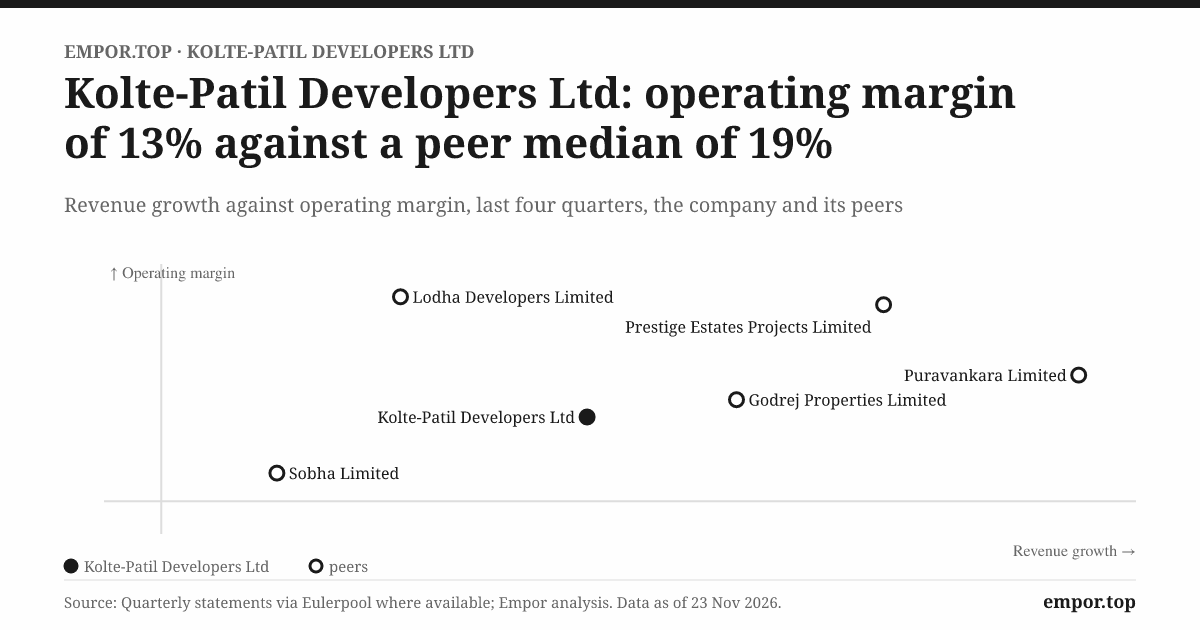
The competitive map makes the test sharper. In Pune, Kolte-Patil competes with large multi-city listed platforms such as Godrej Properties, along with many local developers who know the micro-markets as well as it does.
In Mumbai the field is even more crowded: Lodha Developers is the home champion, Godrej Properties and Prestige Estates are aggressive bidders for land and redevelopment deals, and dozens of specialist redevelopment firms have been working society by society for years. Kolte-Patil enters Mumbai as a credible regional name with new institutional backing, not as a dominant force.
What does it have to bring? Pricing is one clue. In FY26 Kolte-Patil's average selling price was about ₹8,314 per square foot, and in the first half of FY27 its average realisation rose about 10% year on year to ₹8,368.31
Rising realisations can mean genuine pricing power, a richer mix of premium projects, or both. The company does not break out how much of the increase came from like-for-like price rises in the same projects, so the honest reading is that prices are firm and the mix is moving upmarket.
The best proof point in the recent record is a single launch. Vyana at The Reserve, a project of about one million square feet, was launched and generated about ₹616 crore of sales.1 That is a genuine demonstration that the company can put a large project in front of buyers and sell a meaningful share of it quickly.
It is also, by itself, one launch. A developer that can sell one big project well has shown it can sell. It has not yet shown that it can do so repeatedly across cities, or that the margins on those sales are attractive once construction is complete.
That distinction matters for the question every investor eventually asks about a developer: does it have a moat? Kolte-Patil's Pune brand has value. Buyers trust a name that has delivered homes in their city for decades, and lenders cite the same track record.5
But a homebuyer can choose among many developers in the same corridor, and once she buys there is no recurring relationship and nothing locking her into the next purchase. The company's own disclosures show no long-term contracts, no switching costs and no evidence of a cost advantage over larger rivals. Brand helps the company sell. It does not stop a competitor from building next door.
It is worth pausing on why Pune was such a good home market to begin with, because it explains both the company's strengths and its ceiling. Pune's growth over the past two decades was powered by software parks, automotive plants and universities, which produced a steady flow of salaried buyers looking for mid-priced and premium flats on the city's expanding edges.
A developer that knew which corridors would get roads, schools and offices next could do well by buying early and building in phases. That knowledge is local by nature. It travels badly to Mumbai, where the scarce asset is not peripheral land but consent inside crowded, already-built neighbourhoods.
Mumbai, then, is optionality rather than a franchise. The company is buying the right to build in a deeper market, and redevelopment lets it buy that right with less land capital upfront. But GDV is not revenue, not profit and not cash.
The six Mumbai projects will create value only if they launch on schedule, sell at the expected prices, collect on time and deliver margins at least as good as the Pune portfolio's.
The macro risks that matter here are few and specific. Construction-cost inflation can erode the margin on a project whose selling prices were locked in at launch, years before the last floor is poured. Interest rates matter twice: once for the company, whose borrowings are mostly at floating rates, and once for its buyers, whose mortgage payments decide what they can afford.
And approvals, the slowest variable of all, are more complex in redevelopment than in a greenfield Pune township, because a society's consent and a city's sanction both have to stay in place. None of these is unusual for an Indian developer. All of them are larger for a developer learning a new city.
The rival platforms in Mumbai publish project-level economics in more depth than Kolte-Patil does, and the company does not disclose comparable figures for margin, land cost or sales velocity on its Mumbai projects. That makes a direct comparison impossible for now.
What the record does allow is a warning from the company's own history: in Pune, where it has deep roots, a large pipeline still produced a flat ten-year revenue line. There is no particular reason to expect a new city to be easier than the home market.
The key falsifier is concrete. If the Mumbai projects launch roughly when promised, sell through at prices consistent with the GDV estimates and produce collections that keep pace, the expansion will have raised the company's ceiling.
If launches slip, or if collections lag because resident negotiations stall, the Mumbai bet will consume management attention and capital without lifting returns. Either way, the bridge between Pune and Mumbai is built from the same material as everything else in this business: customer cash collected in advance, and the inventory it has to pay for.
VI. The Sales Machine Runs on Advances, Inventory and Timing
By the end of March 2026, Kolte-Patil's balance sheet carried two numbers that look like opposites. One was ₹4,184 crore of customer advances, a liability, money owed in the form of homes still to be delivered.3
At the same date, about ₹205 crore sat in escrow accounts earmarked for specific RERA projects, cash that the company held but could not spend freely.3 Together, they show how much of the cash is tied to project delivery.
Over the long run, this machine has generated far more cash than profit. From FY15 to FY26, Kolte-Patil reported cumulative net profit of about ₹657 crore and cumulative cash from operations of about ₹2,005 crore, roughly three times as much.3
In most industries a gap like that would suggest exceptionally conservative accounting or a business that collects before it delivers. In this case it is mostly the second. Customer advances and the timing of collections against construction spending push cash ahead of reported profit.
That is genuinely good news, with a caveat. The good news is that the company has not been reporting profits it could not collect. The caveat is that much of the operating cash remains tied to homes still to be delivered. Treating it as distributable earnings would be like a wedding caterer counting every deposit as profit before the weddings have been cooked.
The inventory clock explains why the bill is so long. In FY26, the company's inventory amounted to about 3,000 days of its cost of revenue, and its cash conversion cycle, the time from spending money on a project to collecting it, stretched to about 2,650 days.3
Those figures are distorted by the revenue trough, because a year of few handovers makes inventory look enormous against the cost of what was sold. But even in normal years the company carried well over two years of inventory. Land bought today may not turn into recognised revenue until the next decade.
The machine does not always run forwards. In FY24, the company's operating cash flow turned negative, the only year in the twelve-year span when the business consumed cash from its operations, and borrowings roughly doubled to about one and a half times equity.3
That was the same year the company reported a loss. It is the clearest evidence in the record that customer advances are not a guaranteed cushion. When land purchases, construction spending and slower collections line up the wrong way, the developer has to go to its lenders.
Customer advances are what make that long cycle survivable. In FY26 alone they rose from about ₹2,562 crore to ₹4,184 crore, an increase of roughly ₹1,600 crore.3 That increase is the cash equivalent of a busy sales year whose handovers have not yet come. It funds construction. It also means the company owes more completed homes than it has ever owed before.
Where did the free cash go over those twelve years? After capital spending, Kolte-Patil generated about ₹1,755 crore of free cash flow from FY15 to FY26. It paid about ₹211 crore of that, roughly an eighth, to shareholders as dividends, and its cash and short-term investments rose by about ₹891 crore over the same period.3 The rest went into the long arc of land, inventory and debt repayment. The balance sheet, in other words, absorbed most of what the business produced.
Dividends have followed the earnings rather than the cash. Over the decade to FY25 the company typically paid out around a quarter of its profit, with a range from nothing in FY22 to about seven-tenths in FY16, and it paid about 29% of FY25's profit.3
In FY26, the loss year, it paid no dividend at all.3 That pattern is sensible for a developer whose cash is largely spoken for. It also confirms that management itself does not treat the operating cash flow as freely distributable.
The debt side needs careful handling, because the company reports two boundaries. On a consolidated basis, which includes subsidiaries, borrowings were about ₹1,242 crore at March 2026; the parent company's own borrowing note shows about ₹1,142 crore.3 The company's own operating highlights put net debt at about ₹503 crore.3
Leases, about ₹41 crore, sit separately and should not be mixed into project financing.3 The broad shape is a company with moderate leverage that rose sharply in FY24, when debt was roughly one and a half times equity, and then fell back below one times after the Blackstone money arrived.3
The structure of that debt is more interesting than its size. Almost all of the parent's borrowings, about ₹1,119 crore, carry variable interest rates, so the company is exposed to rate rises.3 Some of its project-level non-convertible debentures are repaid from collections on specific projects and secured on earmarked units, development rights and receivables, with security cover in the disclosed examples ranging from about 1.2 to 2.1 times.3
That structure reduces the risk of a single large repayment date. It also means some of the cash flowing from those projects is already pledged to lenders before it reaches shareholders. In 2026 the company also redeemed some unlisted debentures early and in full.12
Then there is the treasury. At March 2026, consolidated cash and cash equivalents were about ₹165 crore, bank deposits of three months to a year were about ₹104 crore, and escrow balances were about ₹205 crore.3 Add the idle Blackstone proceeds in liquid funds and a headline number for cash looks comfortable.
But the escrow money belongs to specific projects, and part of the company's treasury income comes from loans to related project entities, on which about ₹8 crore of interest had accrued.3 The whole balance is not freely available cash. Other income, about ₹68 crore in FY26, was larger than the pre-tax loss of about ₹28 crore, which means treasury and interest income kept a bad year from looking much worse.3
Below the balance sheet sit the claims that have not yet become liabilities. At March 2026, the group reported contingent claims of about ₹144 crore, made up of about ₹8 crore in legal cases, about ₹60 crore in income-tax demands and about ₹77 crore in indirect-tax demands, down from about ₹213 crore a year earlier.3
These are disputes the company is contesting rather than amounts it expects to pay, and the total is falling. But they are equal to roughly five years of the dividends the company paid before FY26, and an adverse tax ruling would land on a profit line that has very little room to absorb it.
Lenders, for their part, are relaxed. In March 2026, CRISIL reaffirmed its AA-minus rating with a stable outlook on the company's long-term debt and its top short-term rating, A1-plus.5 The agency cited the Pune brand, the track record and Blackstone's stake.
It also cited geographic concentration in Pune and the cyclicality of real estate as constraints, and it noted that FY26 sales and collections had stagnated because of delayed launches and environmental clearances, while projecting collections growth of 25% to 30% a year over FY27 and FY28.5 CARE Ratings had made a similar assessment in October 2025 and reaffirmed its AA-minus rating on the listed debentures in September 2026.1314
A rating, though, answers a lender's question: will the company repay its debt? It does not answer a shareholder's question: will the company earn a good return on the equity it already has? A developer can be perfectly creditworthy and still earn single-digit returns for a decade, which is close to what Kolte-Patil's history shows.
The single most useful liquidity measure is the one the company does not publish in a clean form: cash that is truly unrestricted after setting aside what is needed to finish projects already sold, the customer advances those projects represent and the secured debt that has first claim on their collections.
Without that number, investors are left to estimate how much of the cash pile is surplus and how much is simply other people's money waiting to be spent. The same caution applies to a smaller, older corner of the balance sheet: the money that customers and partners owe and have not paid.
VII. The Receivables Are Small; the Oldest Ones Still Tell a Story
Most of a developer's buyers pay because they have to. A flat is the largest purchase of most families' lives, the agreement ties payments to construction milestones, and a buyer who stops paying risks losing the home.
So trade receivables, amounts billed but not yet received, are usually small for a residential developer, and at Kolte-Patil they are. But tucked into the FY26 ageing schedule is a line that deserves a second look: about ₹11 crore owed for more than three years.3
Start with the scale. At March 2026, consolidated trade receivables were about ₹82 crore gross, against ₹4,184 crore of customer advances.3 For every rupee customers owed the company, they had already paid about fifty in advance. That is the right way to think about collection risk in this business. Homebuyer instalments and advances drive project funding; the receivables book is a rounding error by comparison.
The customer base behind those numbers is broad. The company says its credit risk is limited because it sells to a large number of buyers, its stated terms are generally between zero and thirty days, and it identifies no single customer that accounts for 10% or more of revenue.3 There is no corporate client whose failure could sink a quarter.
Now the oldest items. Of the ₹11 crore outstanding for more than three years, about ₹10 crore was either classified as credit-impaired or disputed.3 Across the whole book, about ₹18 crore was credit-impaired and fully provided for, down from about ₹89 crore a year earlier as old balances were written off or resolved.3 The company has, in other words, already accepted that most of the old money will not come back, and it has marked the accounts accordingly.
The year's charge, however, moved the wrong way. The impairment expense on receivables rose to about ₹13 crore in FY26 from well under ₹1 crore in FY25, partly offset by about ₹4 crore recovered or reversed.3 And debtor days, the receivables balance measured against a day's revenue, climbed from 13 to 31.3 Some of that increase is arithmetic, since revenue halved while receivables did not. Some may reflect genuinely slower payment. The filings do not separate the two.
There is a second, larger number that needs its own explanation because it is easy to misread. The group reported about ₹268 crore of receivables from related parties, largely credit-impaired.3 Related parties here means project companies, associates and joint ventures in which Kolte-Patil has an interest, not the founding families personally.
The figure is about project-level funding arrangements that have gone sour or been written down over time, not homebuyers failing to pay. Separately, an associate called Snowflower Properties owed the company about ₹27 crore in trade receivables.3 Mixing these balances with ordinary homebuyer debt would exaggerate one risk and hide another.
So what does the receivables story say? Net exposure is contained, because provisions already cover the worst of it, and the book is small next to the long inventory cycle. Nothing in the numbers suggests the collection system is failing. But the jump in impairment charges and debtor days is a signal worth watching, especially as the company scales into new projects and a new city.
The next annual report will settle much of it: if debtor days fall back toward their recent norm and impairment charges shrink as new bookings scale, the FY26 rise was the revenue trough talking. If they keep rising, it was not. Either way, how a company handles its old receivables says something about the people running it, and at Kolte-Patil those people changed a great deal in a short time.
VIII. The Leadership Reset Is Part of the Blackstone Bet
On 1 February 2026, Rajesh Patil's salary changed. The Managing Director of a company with a market value of several thousand crore, a member of one of the two families whose names are on the door, began drawing remuneration of ₹1 a month.3 A year earlier he had been Chairman and Managing Director, and in FY26 his total remuneration for the year was about ₹1.8 crore.3
The token salary is a gesture that can be read several ways: a founder signalling that his reward now comes through the share price, a cost-saving symbol after a loss year, or a sign of a reshaped role inside a company with a powerful new co-owner.
The reshaping was wide. Naresh Patil, the Vice Chairman, ceased office on 11 May 2025. On 11 August 2025, Milind Kolte, Joint Managing Director Yashvardhan Patil and Nirmal Kolte also ceased office, and Rajesh Patil's designation changed from Chairman and Managing Director to Managing Director.3
Within three months, much of the family leadership that had been on the board for years stepped off it. That is what a governance reset looks like when an institutional investor arrives with a 40% stake.
The professional management layer turned over too. Atul Bohra, who had served as Group CEO, held the role until 11 November 2025.3 The company announced the appointment of Hrishikesh Parandekar as Chief Executive Officer in 2026.12
On the finance side, CFO Khiroda Jena's tenure ended in August 2024 and Ravi Porwal took over in October 2024.3 In roughly two years, the company changed its CEO, its CFO, its chairmanship and most of its executive directors. Investors who are betting on execution are betting on a team that has had very little time together.
Ownership, by contrast, looks tightly aligned. The summary shareholding pattern showed no shares pledged.10
Foreign portfolio investors held about 11% and domestic institutions about 3%, with about 40,600 shareholders on the register.1011 The free float available to everyone else is narrow, which can make the share price volatile: in the year to November 2026 the stock traded between about ₹296 and ₹517.
Alignment through ownership is not the same as alignment through incentives. A large promoter stake means the founders care about the share price. It does not tell an investor whether the people running projects day to day are paid for launching on time, controlling costs or converting sales into recognised profit.
The company does not set out a clear performance-linked incentive structure for its current executives in a way that connects pay to those operating measures. With the Managing Director on ₹1 a month and a new CEO in the seat, the incentive story is unusual and largely undisclosed.
The governance record before Blackstone's arrival deserves equal weight. In FY25, the company was fined by the stock exchanges for not meeting board-composition requirements in the quarters ending September and December 2024, and for a filing-timing lapse.15 In FY23 it settled a matter with SEBI for about ₹42 lakh without admitting or denying the findings.3 Neither episode was large in money. Both show that the basic machinery of a listed company's governance had gaps.
The postal ballot in 2025 added a small but telling data point. Shareholders were asked to approve the appointment of Avani Davda as an independent director and to approve remuneration for independent directors.16 Both resolutions passed, but about 26.5 lakh votes were cast against her appointment and about 26.2 lakh against the remuneration resolution.17
In a company where the promoter group controls nearly three-quarters of the shares, any meaningful dissent comes mostly from institutions in the minority. It is not a crisis. It is a reminder that "institutional governance solved" is a claim to be tested, not assumed.
Related-party dealings need to be kept in proportion. In FY26, project-management fees earned by the parent from related parties were about ₹13 crore, roughly 2% of consolidated revenue.3 The larger flows were loans to project entities, including about ₹126 crore to Kolte-Patil Smart Spaces, about ₹149 crore to Ankit Landmarks and about ₹85 crore to Kolte-Patil Real Estate, alongside repayments.3
These are the plumbing of a developer that runs projects through separate companies, and the company says the transactions were at arm's length.3 There is no evidence of royalty or management fees flowing to Blackstone. But the scale of intra-group lending means that the quality of project entities' finances matters to the listed company's balance sheet, and the earlier ₹268 crore of largely impaired related-party receivables is the warning of what happens when those entities struggle.
Put the reset against the record and the verdict narrows. The new structure has real strengths: a large aligned shareholder base, no pledges, a professionalised management layer and a financially strong co-owner.
But the record it inherits includes a decade of volatile earnings, frequent changes in directors and executives, governance fines and dissent, and, most recently, largely undeployed fresh capital. Credibility in this business is not conferred by titles or by an investor's reputation. It is earned project by project.
The behavioural test is straightforward. Does the management team give measurable guidance on launches, collections and completions? When launches slip, does it say which ones, why, and what has changed? Does it reconcile, every quarter, the gap between the sales it celebrates and the revenue it reports? The team's answers over the next two years will matter more than anything in the press releases about the Blackstone partnership, because those two years will decide whether the pipeline pays.
IX. The Next Two Years Will Decide Whether the Pipeline Pays
When CRISIL reaffirmed the company's rating in March 2026, it put a number on the recovery it expected: collections growing 25% to 30% a year through FY28.5 Six months later, the first half of FY27 delivered collections growth of 32% and sales growth of 27%.1
For once in this story, a forecast and an outcome lined up. The question for the next two years is whether the outcomes keep lining up further down the chain, where collections become revenue and revenue becomes profit.
The bull case has a coherent shape. Demand is visible in record sales. Cash is visible in record collections. The pipeline is large, about 37 million square feet. The Pune brand helps sell homes, Blackstone's capital has reduced leverage and should make land acquisition easier, and Mumbai redevelopment gives the company a route into a much deeper market. If those pieces fit, Kolte-Patil could become a larger, steadier developer whose earnings finally track its sales.
The bear case is built from the company's own history. Reported revenue has barely grown in a decade. FY26 showed how quickly earnings can collapse when launches slip. Inventory cycles are long, so capital committed today will not be tested for years. Mumbai redevelopment adds a new kind of execution risk in a city full of stronger incumbents. And the management team that must deliver all of this is new.
The industry structure explains why both cases are plausible. Start with buyers. Individual homebuyers have little bargaining power one at a time, but collectively they have enormous choice, since every growth corridor in Pune and Mumbai has several credible developers competing for the same buyer. Suppliers are stronger than they look: landowners and housing societies can extract a large share of a project's value, and construction contractors and material costs can squeeze margins when inflation runs ahead of prices.
The threat of new entry is moderate, because approvals, land access and track record are real barriers, but capital is plentiful in Indian real estate and large platforms enter new cities regularly. Substitutes, renting or buying a resale flat, are always available to a buyer who dislikes the price. And rivalry is intense, especially in Mumbai.
Run the company through Hamilton Helmer's seven sources of lasting advantage and the picture is thin. Scale economies are weak, because a developer's costs are mostly project-specific and Kolte-Patil is smaller than the multi-city platforms it faces. Network effects and switching costs are absent, since one buyer's purchase does not make the next buyer's more valuable and nobody is locked in. Counter-positioning does not apply.
Brand is the strongest candidate, and it is real in Pune, where buyers and lenders both cite the track record, but it has not translated into pricing power strong enough to lift the company's returns on equity much above low double digits in any year since FY15. Cornered resource might describe a well-located redevelopment mandate, but each mandate is project-specific and contestable. Process power, an organisation that executes better than others, is the advantage the Blackstone bet is really about, and it is precisely the one the record has not yet shown.
So the moat claim is narrowed rather than rejected. Kolte-Patil has a regional brand that helps it sell in Pune, and a capital partner that strengthens its balance sheet. It does not have a demonstrated structural advantage that protects returns. Its future, like most developers', depends on execution.
Three measures will tell investors whether execution is improving. The first is sales and collections, which show demand and funding. Both are rising, at ₹1,636 crore and ₹1,509 crore in the first half of FY27, up 27% and 32%.1 The second is reported operating profit and the conversion of completed area into recognised revenue, which show whether the company is actually finishing and earning.
That measure has been weak: operating margin was negative in FY26, then turned positive in the first half of FY27 as handovers resumed.32 The third is a capital-quality measure, unrestricted cash after customer advances, committed construction and secured debt, which the company does not report in a clean form.
A skeptical investor, the kind who reads notes before headlines, would press on one point above all. Why commit more capital to new projects, including a large new city, when the existing portfolio has not yet produced a durable reported margin?
The answer management would give is that new projects are the source of future margins and that FY26 was a timing trough. That is a reasonable answer. It is also the answer every developer gives, and the burden is on the company to show audited margins on completed projects that justify the expansion.
The rating deserves the same perspective. An AA-minus rating with a stable outlook says the company's debt is safe. It says nothing about whether shareholders will earn an attractive return on the much larger equity base created by the Blackstone issue. Equity investors are the residual claimants in a business where customers and secured lenders are paid first.
An activist reading the same record would push on three further points. The first is idle capital: if ₹312 crore of the Blackstone money was not needed for a year, should it have been raised at ₹329 a share, diluting existing holders, or should the deal have been structured with more of the primary capital arriving as projects required it?
The second is disclosure: a company asking investors to value it on sales and pipeline should publish project-level margins, cost to complete and a clean figure for unrestricted cash, so that shareholders can test the conversion themselves. The third is concentration of control: with nearly three-quarters of the shares in the promoter group, minority investors depend on the board's independence, and the recent history of board-composition fines makes that dependence uncomfortable.
Then there is the valuation. At roughly 32 times trailing earnings, the stock trades below its own five-year median of about 37 times, with an earnings yield of about 3%. It is valued at about 2.9 times book value and about 2.2 times trailing sales, and enterprise value is about 19 times trailing EBITDA. Those multiples imply that the market is already looking through FY26 to a recovery in earnings.
The trailing P/E is a fragile anchor, though: the earnings in its denominator come largely from one strong handover quarter, and a single delayed completion would swing it substantially. In the last five years the share price has also fallen by as much as 56% from a peak, a reminder of how violently the market can reprice a developer when the clock slips.
The live version of the story will be told on the earnings calls. The most useful exercise for an investor is to compare management's prepared remarks with its answers to analysts across several quarters, especially around the Blackstone investment, the CEO transition, the delayed launches of FY26 and the Mumbai expansion.
The questions that matter are about launch slippage, cost to complete, the conversion of collections into revenue, margins and unrestricted liquidity. Specific numbers given and later met are evidence. General reassurance is not.
The verdict can be stated in falsifiable form. The bull case strengthens if the next two years show launches converting into collections, and collections converting into margin-positive audited revenue, without leverage rising. It weakens if sales keep climbing while recognised revenue, margins or free liquidity do not. Everything in between is noise, and this business generates plenty of it.
X. Playbook: Business & Investing Lessons
The October and November announcements offered the cleanest lesson in the whole story: in real estate, bookings are a claim on future earnings, while revenue records the past. Founders and investors in any business with long delivery cycles, from shipyards to software implementations, should learn to read the sales line as a claim on the future and the revenue line as the verdict on the past.
The second lesson lives in the customer advances. They let Kolte-Patil build with buyers' money instead of shareholders' money, which is the most elegant feature of Indian residential development. But that money comes with a delivery obligation and a fence around it, and it can turn into a trap if construction falls behind. The broader principle is simple: cash received before work is done is a loan from the customer, repayable in product, and it should be valued that way.
The third lesson is about the pipeline. A larger pipeline is an option, and returns arrive only when projects launch, collect and finish. The rate at which a company converts that opportunity set into realised returns is what matters.
The Mumbai GDV is the newest version of the same option. For investors in any asset-heavy business, the size of the opportunity set is not the point. The rate at which a company converts that set into realised returns is.
The fourth lesson belongs to March 2025. A new investor can change a company's resources faster than its operating record. Blackstone's stake changed the balance sheet, the board and the management team. It did not change the long, flat history of reported revenue, and most of the fresh capital remained in liquid funds at March 2026. Founders who bring in a powerful partner and investors who follow one should both remember that a famous name on the register is an input. The outputs are launches, handovers and margins.
There is a fifth lesson, and it belongs to the rating agencies' offices. A good credit rating is a statement about the lender's safety, not the owner's return. Kolte-Patil kept an AA-minus rating through a year in which it lost money and its revenue halved.
Lenders were right to stay calm: collections were strong, debt was secured on projects and a deep-pocketed shareholder had just arrived. Shareholders, who stand behind both the customers and the lenders, needed a different reassurance altogether, and the rating could not give it.
XI. Epilogue
Tonight, in late November 2026, Kolte-Patil stands between two kinds of evidence. Behind it is the operating momentum already visible in sales and collections. Ahead of it is the evidence that matters more, the audited conversion of all that activity into durable earnings, which has not yet been shown.
The nearest checkpoint will come within weeks. After the December quarter closes, the company will publish its next operational update and then its third-quarter accounts. Those will show whether recent momentum continues and handovers become steadier.
The bigger checkpoint is the FY27 annual report. It will show whether the conversion into revenue and operating profit is taking hold, and whether the company reconciles completed area with recognised revenue in a way that lets investors see the clock working. A year in which revenue rises sharply and margins hold would be the strongest evidence yet that FY26 was a timing trough.
The second checkpoint is the relationship between collections and advances. If collections keep growing while the advance balance grows more slowly, that may indicate homes are being handed over and promises are being kept. If advances keep swelling faster than handovers, the company is selling more than it is finishing, and the delivery bill is getting bigger.
The third is Mumbai. Each launch will test the expansion, from resident agreements and approvals to pricing and margins. Investors should listen carefully to how management describes any delays, separating approvals genuinely outside its control from slippage in its own planning and execution.
The fourth is capital allocation. Every new project added should be weighed against the returns of the projects already under construction, the cash that is truly unrestricted and the level of debt. A company that keeps adding to its pipeline while its existing projects earn thin margins is not compounding. It is accumulating.
What would change the verdict is easy to name. Repeatable conversion from bookings to margin-positive revenue over two or three years would show that the new ownership and management have made the machine run better than the old one did.
Another year in which the pipeline grows faster than the reported economics would suggest the opposite: that the company has become bigger without becoming better. For now, the outcome is open, and it is open for a specific reason. The front of the machine is accelerating. The back has not yet caught up.
XII. Outro
Somewhere in Pune this month, a buyer's instalment arrived in a Kolte-Patil escrow account, counted on the day it landed as part of a record-breaking half year. Somewhere else, a tower was waiting for its final approvals before it could be handed over, the point at which a set of promises can at last become revenue. Those two events, the payment and the handover, sit years apart, and the whole company lives in the space between them.
The record sales quarter and the near-empty profit line were the same business seen at two moments on its clock. Kolte-Patil is a bet on whether the homes it has sold can arrive in the accounts as reliably as they arrive at the site.
References
-
Operational Update Q2 & H1 FY27 — Kolte-Patil Developers Limited, 2026-10-13 ↩↩↩↩↩↩
-
Unaudited Consolidated Financial Results Q2 & H1 FY27 — NSE, 2026-11-03 ↩↩↩
-
Annual Report FY 2025–26 — Kolte-Patil Developers Limited, 2026 ↩↩↩↩↩↩↩↩↩↩↩↩↩↩↩↩↩↩↩↩↩↩↩↩↩↩↩↩↩↩↩↩↩↩↩↩↩↩↩↩↩↩↩↩↩↩↩↩↩↩↩↩↩↩↩↩↩↩↩↩↩↩
-
Kolte-Patil Developers Exits Stakes in Four Entities — ETRealty, 2025-08-08 ↩
-
Kolte-Patil Acquires 7.5-Acre Pune Land Parcel — ETRealty, 2025-10-10 ↩
-
US Realtor Portman Holdings Buys ICICI Venture Stake in Local Project — The Economic Times, 2011-11-22 ↩
-
Blackstone to Take Over Kolte-Patil; Preferential Allotment at ₹329 a Share — CNBC-TV18, 2025-03-13 ↩
-
Shareholding Pattern, Quarter Ended 30 September 2026 — Kolte-Patil Developers Limited ↩↩↩↩
-
Postal Ballot Notice: Avani Davda Appointment — Kolte-Patil Developers Limited ↩
-
Postal Ballot Voting Results — Kolte-Patil Developers Limited, 2025 ↩
 LinkedIn
 WhatsApp
 Reddit
 Hacker News
 Email
 Kindle
 RSS Feed
 Spotify
 Apple Podcasts
 Amazon Music
 Audible
 YouTube