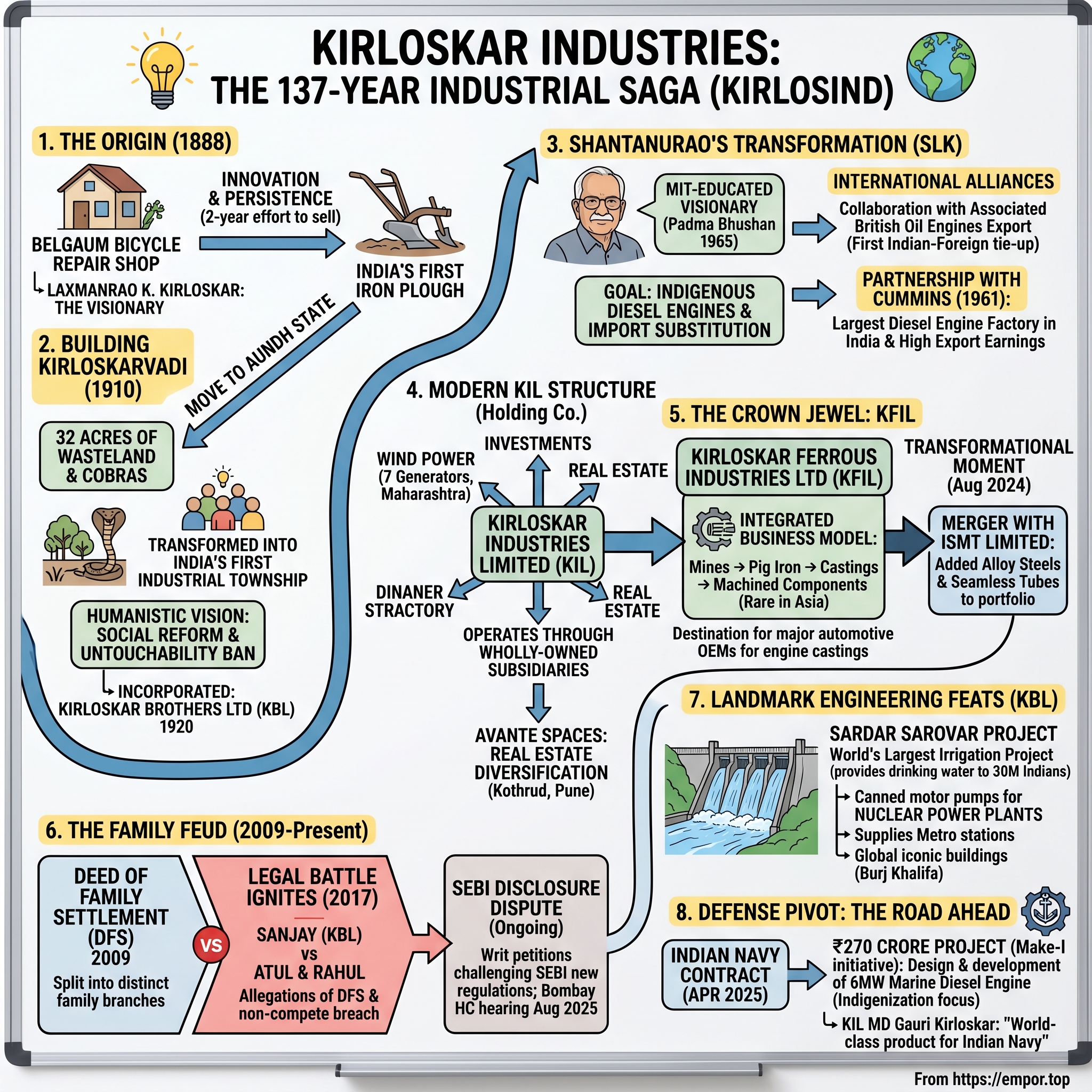
Kirloskar Industries: The 137-Year Industrial Saga of India's Engineering Pioneer
The Origin of an Empire Built on Iron and Vision
Picture Belgaum in 1888—a colonial-era town in the Bombay Presidency, dusty roads winding past temples and bazaars, the clatter of horse-drawn carriages punctuating the humid air. On a street that would one day bear his name, a young man of barely nineteen opened a modest bicycle repair shop. His name was Laxmanrao Kashinath Kirloskar, and though he couldn't have known it then, he was laying the foundation for what would become one of India's most storied industrial dynasties.
Born on June 20, 1869, in Gurlahosur, a village in Belgaum district, Laxmanrao came from a family of Karhade Brahmins. His father Kashinathpant was a Ved Pandit, and society expected Laxmanrao to follow in his father's footsteps. However, he broke away from tradition and entered the field of engineering and technology. His passion lay not in ancient scriptures but in mechanical objects—a fascination that would reshape India's agricultural and industrial landscape.
Against his father's wishes but with financial support from his eldest brother Ramuanna, Laxmanrao joined the JJ School of Art in Bombay in 1885. Unfortunately, he had to quit after two years when he was found to be partially color-blind. He gave up painting but continued to study mechanical drawing at the institute. This twist of fate—being denied one artistic path only to discover another—would prove fortuitous. His skill in mechanical drawing led him to a position as Assistant Teacher at Victoria Jubilee Technical Institute (VJTI) on a salary of Rs. 45 per month.
In the early 1890s, Laxmanrao started a bicycle dealership—he would buy bicycles in Bombay and send them to his brother Ramuanna in Belgaum where he would sell them. For a cycle priced at Rs. 700 to 1000, Ramuanna would also charge Rs. 15 for teaching how to ride. This entrepreneurial side hustle, combining commerce with education, foreshadowed the family's later approach to business: sell the product, but also build capability around it.
The Kirloskar saga truly began when Laxmanrao set up his bicycle repair shop in Belgaum on a road that would later be named after him. Strongly believing that agricultural implements must fit the milieu they are used in, he manufactured India's first iron plough, which was also the first Kirloskar product, along with chaff-cutters.
The iron plough story reveals both Laxmanrao's determination and the challenges of introducing innovation in a traditional society. In the early days, Laxmanrao met with opposition from farmers who believed that iron ploughs would poison the land and make it infertile. These superstitious farmers were extremely hard to convince, and Laxmanrao took two years to sell his first iron ploughs. Imagine the persistence required—two years of rejection, two years of demonstrating that metal would not curse the earth, two years of fighting deeply held beliefs with the simple logic of superior design.
India's first iron plough from the Kirloskar Group not only became an instrument of wealth for the entire society but also kick-started an industrial revolution in India.
 Subscribe on LinkedIn
Building Kirloskarvadi: India's First Industrial Township
The next chapter in the Kirloskar story reads like a fable of determination meeting providence. In January 1910, the Municipality of Belgaum ordered Laxmanrao to vacate Belgaum to make room for a new suburb. He struggled to find a suitable place until the Raja of Aundh offered help, not just as a friend, but also as a ruler concerned for his state's industrial development.
The Raja offered Laxmanrao a loan of ten thousand rupees, without interest, and 32 acres of arid wasteland near a railway station called Kundal Road. This became Kirloskarwadi and the factory for Kirloskar Brothers Limited. Laxmanrao Kirloskar set foot on 32 acres of barren land strewn with cacti and infested with cobras. Driven by his faith in human ability, Laxmanrao banded together 25 workers and their families and succeeded in transforming the barren expanse into his dream village.
He had read about industrial townships in Europe and America where the owners of industries had built communities for employees. His dream was to build his own industry and community for his employees; he realized this dream with Kirloskarwadi.
What made Laxmanrao remarkable wasn't just his engineering acumen but his humanistic vision. Driven by his faith in human ability, Laxmanrao had an uncanny ability to unlock potential in seemingly ordinary people. His judgment of character and indifference to superficial social, economic, and educational qualifications led him to even hire two ex-convicts who became the night guards of Kirloskarwadi.
Laxmanrao was not only an industrialist but also a great social reformer. When blind orthodoxy was rampant in rural areas, he advocated the removal of untouchability. He banned untouchability in the township that he had established at Kirloskarwadi.
On January 15, 1920, the company was officially incorporated as Kirloskar Brothers Limited—a milestone marking the transition from a family workshop to a formal corporate entity. At a grand function on March 10, 2020, in Pune to celebrate the centenary milestone, the descendants of early supporters like the Ginde family, who had provided crucial funding during difficult times, were specially invited.
The MIT-Educated Visionary: Shantanurao's Transformation
If Laxmanrao planted the seed, his eldest son Shantanurao Laxmanrao Kirloskar transformed it into a mighty banyan tree. Shantanurao (28 May 1903 – 24 April 1994) was instrumental in the rapid growth of the Kirloskar Group. He earned a Bachelor of Science degree in mechanical engineering from MIT in Cambridge, Massachusetts, and was among the first Indians to graduate from MIT. He also became a reserve officer in the US Army at the same time.
SLK, as he was popularly known, often said, "I never wanted to be an industrialist. Our goal was to start a movement to make our country a strong, industrial nation." This wasn't mere rhetoric—it was a philosophy that guided every strategic decision, from product development to international partnerships.
Building on his father's foundations, SLK developed the small venture of Kirloskar Brothers (KBL), incorporated in 1920, into a group of companies with branches all over the world.
The move into diesel engines was particularly transformative. Shantanurao moved to Pune to initiate a new aspect of the group's activities—diesel engines. His experience trying to secure land for the factory was quite different from his father's in Kirloskarwadi. He had to face the tangle of red tape and public resistance to land acquisition for industrial purposes. Finally, after arguing that "factories have a longer life than human beings," Shantanurao Kirloskar won a place for Kirloskar Oil Engines Ltd.
He signed an agreement of collaboration with Associated British Oil Engines Export Ltd. of UK. This collaboration was the first of its kind between an Indian and a foreign company, signifying a bridging of the technological gap between east and west.
The partnership with Cummins represents perhaps SLK's most consequential international alliance. He established an engine company which became the largest diesel engine factory in India with the highest export earnings. He was also responsible for bringing Cummins to India through his close ties with Robert Huthsteiner, who was the president of Cummins, USA at the time. Kirloskar Cummins Ltd. (KCL) was established in 1961, and the partnership allowed Cummins to further their global manufacturing strategy.
This collaboration was the first between an Indian and a foreign company, bridging the technological divide between east and west.
In 1940, SLK founded Mysore Kirloskar Ltd. to manufacture machine tools. In 1946, he established Kirloskar Electric Company and Kirloskar Oil Engines Limited at Bangalore and Pune, respectively. He is credited with developing the manufacture of the diesel engine indigenously as an import substitute after India attained independence.
Kirloskar was awarded Padma Bhushan in 1965 for his contribution to trade and industry. On February 26, 2003, Prime Minister Atal Bihari Vajpayee released a commemorative postage stamp marking the 100th anniversary of Kirloskar's birth.
The Modern Kirloskar Structure: Understanding the Holding Company Web
Today, Kirloskar Industries Limited (KIL) operates as something quite different from the manufacturing juggernaut of its predecessors. Kirloskar Industries is a public limited company on the Bombay Stock Exchange and National Stock Exchange. The company is engaged in wind power generation and has diversified into real estate development activities through its wholly-owned subsidiary, Avante Spaces.
KIL is a Holding Company of Kirloskar Ferrous Industries Limited (KFIL) and has diversified into real estate development activities through its wholly owned subsidiary - Avante Spaces Limited (ASL).
Understanding KIL requires understanding its revenue composition. The company earns 92% of revenues via its subsidiary (51% stake) Kirloskar Ferrous Industries Limited, with Tube contributing approximately 4% and Investments in Securities and Properties at 1%. Kirloskar Industries is engaged in the business of iron castings, investments (securities and properties), wind power generation, and real estate. The company owns lands, buildings, apartments, and offices in Pune, New Delhi, and Jaipur. It has given most of these properties on a lease and license basis to the group and other companies.
Kirloskar Industries Limited, incorporated in 1978 and based in Pune, was formerly known as Kirloskar Oil Engines Limited. The company transitioned to its current name in March 2010.
The company operates across various sectors including agriculture, manufacturing, food and beverage, oil and gas, infrastructure, and real estate. Its segments include Wind power generation, Investments (securities and properties), Real Estate, Iron casting, Tube and Steel. The Wind Power Generation segment includes the sale of generated wind power units to third-party consumers. The company has approximately seven wind energy generators in Maharashtra with a total installed capacity of 5.6 megawatts.
The Kirloskar Group as a whole maintains significant scale. Kirloskar Group is an Indian conglomerate, headquartered in Pune with manufacturing in Kirloskarvadi. The group exports to over 70 countries across Africa, Southeast Asia, and Europe.
The Crown Jewel: Kirloskar Ferrous Industries
For investors in KIL, understanding Kirloskar Ferrous Industries Limited (KFIL) is paramount—this subsidiary drives the overwhelming majority of consolidated results.
KFIL, incorporated in 1991, is a part of the Pune-based Kirloskar Group. KFIL manufactures pig iron and ferrous castings such as cylinder blocks, cylinder heads, and transmission parts, as well as different types of housings required by automobile, tractor, and diesel engine industries. It is one of the leading players in foundry-grade pig iron manufacturing and ferrous castings in the domestic market.
Kirloskar Ferrous Industries Limited is one of the fastest growing companies in the business of Pig Iron and Iron Castings. Their skilled workforce and the best infrastructure in the industry give them the unique capability of producing highly customized products that include single piece Grey Iron castings weighing up to 300 kg. They are the destination of choice for the largest automotive manufacturers in the world who come to them for engine castings.
Over the years, they have grown to become one of India's largest manufacturers of pig iron and castings, with cutting-edge facilities in Koppal, Hiriyur, and Solapur.
The ISMT merger represents a transformational moment for KFIL. The recent merger with ISMT Limited marked a new chapter in their journey. As the only company in Asia with an integrated business model spanning from mines to machined castings, and now mines to steel and seamless tubes, they are uniquely positioned to serve customers with unmatched quality and efficiency. This merger expands their portfolio to include alloy steels and seamless tubes, which have become indispensable in industries like bearing, automotive, and boiler applications. With this merger, their manufacturing footprints have extended to Jejuri, Ahmednagar, and Baramati.
Kirloskar Ferrous Industries Limited and Indian Seamless Metal Tubes Limited (ISMT) began operations as a merged entity starting August 9, 2024. KFIL's Board of Directors approved the merger in their meeting on November 5, 2022. The NCLT's approval on July 24, 2024, marked the successful culmination of this process.
ISMT, one of the largest integrated specialized seamless tube manufacturers in India, announced the scheme of arrangement and merger to amalgamate its entire undertaking with Kirloskar Ferrous Industries Limited. The appointed date of the proposed scheme was April 1, 2023.
ISMT shareholders received KFIL shares at a ratio of 17 KFIL shares for every 100 ISMT shares, with the Record Date set as August 6, 2024.
Kirloskar Ferrous Industries Limited is expanding its manufacturing capacities in pig iron and casting. The company has 3D printing facilities, enabling fast development of new products and capability ramp-ups. The company supplies fully machined castings and has added a coke oven manufacturing facility with waste-heat recovery power. With the merger, KFIL's product range now extends to ISMT Steel and seamless tubes.
The 2009 Deed of Family Settlement: Seeds of Discord
Every great industrial family eventually faces its moment of reckoning—the transition from unified purpose to divided interests. For the Kirloskars, that moment crystallized in 2009.
In 2016, a dispute emerged involving members of the Kirloskar family over the interpretation and enforcement of a Family Settlement Agreement (FSA) signed on September 11, 2009.
The genesis of the dispute is the Deed of Family Settlement (DFS) dated September 11, 2009, entered into among the different constituents of the Kirloskar clan involving the distribution of shares in various Kirloskar entities to achieve economic parity in the distribution of wealth among all of them.
In 2009, the family made the DFS to divide ownership and control of their businesses among different family branches. Under the DFS, Sanjay Kirloskar got control of Kirloskar Brothers Ltd.
The feud involves three key family members: Sanjay Kirloskar, Chairman and Managing Director of Kirloskar Brothers Limited (KBL); Atul Kirloskar, Executive Chairman of Kirloskar Oil Engines Limited (KOEL); and Rahul Kirloskar, Executive Chairman of Kirloskar Pneumatic Company Limited (KPCL).
The Kirloskars are fighting a legal war over group assets with Sanjay Kirloskar, the Chairman of Kirloskar Brothers Ltd (KBL), on one side, and his brothers Atul and Rahul on the other. The three are sons of Chandrakant Kirloskar and grandsons of noted industrialist S.L. Kirloskar.
The Family Feud Ignites: 2017 to Present
The dispute transformed from a simmering disagreement into an open legal battle in 2017.
The dispute began in 2017 when Sanjay Kirloskar accused Atul Kirloskar-led KOEL of breaching the DFS. He cited two violations: KOEL's acquisition of La Gajjar Machineries, a pump manufacturer (allegedly violating the non-compete clause, since pumps were KBL's core business), and KOEL's sale of KBL shares to Kirloskar Industries without adhering to the agreed transfer rules.
Sanjay Kirloskar said this confused customers and hurt KBL's business.
The legal escalation that followed reads like a procedural chess match. In 2018, KBL asked SEBI to step in, accusing KOEL of not disclosing the DFS. SEBI dismissed the complaint, and KBL took the matter to SAT in 2021. SAT upheld SEBI's decision, but KBL escalated to the Supreme Court in 2022. Then came a twist in 2023 when SEBI introduced new rules requiring listed companies to disclose any agreements that could affect their management or shareholders. SEBI argued that since the DFS outlined restrictions and conditions affecting KOEL, it qualified as crucial information that investors must know.
SEBI, in a letter dated December 30, 2024, directed four Kirloskar Group companies to disclose the agreement under listing obligations and disclosure requirements. In response, the companies declared their intent to challenge SEBI's directive.
Four Kirloskar companies said they are preparing to legally challenge a letter by markets regulator SEBI asking them to disclose the deed of family settlement that was signed by members of the Kirloskar family on September 11, 2009. In separate regulatory filings, Kirloskar Ferrous Industries Ltd (KFIL), Kirloskar Industries Ltd (KIL), Kirloskar Pneumatic Company Ltd, and Kirloskar Oil Engines Ltd maintained they are not bound by the DFS nor does it have any impact or create any restriction or liability on them.
Kirloskar Oil Engines Ltd (KOEL), Kirloskar Ferrous Industries Ltd, Kirloskar Pneumatic Company Ltd, Kirloskar Industries Ltd, and GG Dandekar Properties Ltd have filed writ petitions challenging SEBI's new disclosure regulations. These petitions contest Regulation 30A, Clause 5A of Para A of Part A of Schedule III of the SEBI (Listing Obligations and Disclosure Requirements) Regulations, 2015, along with SEBI circulars dated July 13, 2023, and November 11, 2024.
The 2009 split agreement is at the center of a legal dispute between SEBI and a group of listed Kirloskar companies led by Atul Kirloskar. The matter was scheduled for hearing at the Bombay High Court on August 20, 2025.
Meanwhile, KBL has filed an intervention application highlighting that several listed companies—including Hikal Ltd, DCM Ltd, TVS Motor Co. Ltd, and Adani Wilmar Ltd—have already complied with SEBI's rules without challenging them. KBL argued that since the regulation has already been implemented widely, there's no valid reason for other Kirloskar companies to challenge its constitutional validity at this stage. The Sanjay Kirloskar-led company has already disclosed its part of the family agreement.
Whatever the verdict, it could have implications for Kirloskar businesses. And it could set a big example for how family agreements are treated under corporate law in the future.
Landmark Engineering Achievements
Despite the family discord, the Kirloskar companies have achieved remarkable engineering feats that have shaped modern India.
Kirloskar Brothers Ltd created the world's largest irrigation project, which was commissioned in March 2007—the Sardar Sarovar Dam project for the Gujarat Government. This was done for Sardar Sarovar Narmada Nigam, and on March 14, 2008, they commissioned the world's second largest water supply system, with the world's highest head in Andhra Pradesh.
Besides executing the largest pumping scheme at the Sardar Sarovar Narmada Nigam in Gujarat, which provides drinking water to more than 30 million Indians, KBL's critical pumps are also used in the country's nuclear fusion program.
Their pumps at Sardar Sarovar Narmada Nigam Limited, Gujarat, provide drinking water to 30 million people and irrigate 540,000 hectares of land. More than 10,000 pumps have been supplied to Metro stations across India. Their pumps are used in all of India's Nuclear Power Plants.
Kirloskar Brothers is associated with India's nuclear program and has made canned motor pumps for pumping heavy water which are deployed at Indian Nuclear Power Plants. One of the group companies is a major component supplier for the Indian Arihant Nuclear Submarine program.
Kirloskar Brothers has been closely associated with India's nuclear program. Kirloskar Brothers Ltd received the ASME N-STAMP in 2012 and is the first Indian company in rotating equipment to receive this, as well as among a few companies in the world to have this accreditation.
Global iconic buildings like the Sydney Opera House, the Burj Khalifa in Dubai, and many others in London and Egypt use Kirloskar pumps for critical applications.
Today, KBL provides drinking water to more than 35 percent of India's population while pumping water to more than 60 percent of irrigable land for turnkey projects that include river linking, river lifting, water treatment, and irrigation projects.
Recent Strategic Developments: The Navy Contract and Defense Pivot
The most significant recent development for the broader Kirloskar ecosystem came in April 2025.
In a landmark step toward achieving self-reliance in defense manufacturing, the Indian Navy signed a ₹270 crore project sanction order with Kirloskar Oil Engines Limited (KOEL) on April 2, 2025, for the design and development of a 6MW medium-speed marine diesel engine.
The prototype diesel engine with indigenous content of over 50 percent will be developed at a cost of Rs 270 crore with 70 percent funding from the Government of India. The order also includes development of detailed design for 3-10MW diesel engine. The developed engines will be used for Main Propulsion and Power Generation on ships of the Indian Navy and the Indian Coast Guard.
The project falls under the Ministry of Defence's Make-I initiative, a key element of India's broader strategy to indigenize critical defence technologies and reduce dependency on foreign imports. The contract represents a significant milestone for Kirloskar Oil Engines, which has been selected as the development partner for one of the most ambitious naval propulsion programs undertaken by the Government of India in recent years. Under this project, Kirloskar Oil Engines will design and develop medium speed engines scalable from 3MW to 10MW entirely in-house.
Historically, India has depended on international Original Equipment Manufacturers (OEMs) for marine diesel engines with substantial power capacities. For instance, as recently as 2024, the Brahmaputra-class frigate INS Beas was refitted with imported 6MW engines from Caterpillar. The new agreement with Pune-based Kirloskar Oil Engines signifies a determined shift towards developing critical propulsion technology within India. The project will see the Government of India funding 70% of the development costs, aiming to produce a prototype 6MW engine with over 50% locally sourced components.
Gauri Kirloskar, Managing Director of KOEL, expressed pride in the collaboration, stating, "This is a proud moment for all of us at Kirloskar Oil Engines, and I am sure that with the technical and R&D strength that we have, we will be able to deliver yet another world-class product to the Indian Navy."
Financial Performance: Reading the Numbers
Kirloskar Industries' financial profile reflects its nature as a holding company—modest standalone operations with meaningful consolidated results driven primarily by KFIL.
Annual revenue for Kirloskar Industries Ltd (standalone) decreased by 9.69% to ₹120.57 crore in FY 2025 from ₹133.51 crore in FY 2024. Annual net profit for Kirloskar Industries Ltd increased by 4.06% to ₹77.67 crore in FY 2025 from ₹74.64 crore in FY 2024.
Kirloskar Industries Limited reported its Q3 FY25 financial results, showing a 4.2% year-on-year growth in consolidated revenue from operations, reaching ₹1,613.5 crore compared to ₹1,548.2 crore in Q3 FY24. However, net profit saw a significant decline of 52.4% YoY, falling to ₹24 crore from ₹50.5 crore in the same quarter of the previous year.
For the year ended 2024, Kirloskar Industries Ltd. reported a consolidated profit of ₹360.72 crore on a total income of ₹6,395.55 crore. For the quarter ended March 2024, the company posted a profit of ₹24.11 crore on a total income of ₹1,625.95 crore.
For FY 2025, EPS stood at ₹146, down from ₹203 in FY 2024.
Promoter holding in Kirloskar Industries Ltd. has increased to 72.57% as of December 2024, up from 71.51% as of March 2024. There is no promoter pledging recorded for Kirloskar Industries Ltd.
KFIL, the primary value driver, showed resilience in recent quarters. Kirloskar Ferrous Industries Ltd (KFIL), castings and pig iron manufacturer, reported an 11 percent rise in consolidated profit at Rs 86.28 crore in the quarter ended September 2025.
KFIL Q2FY26 results reflect steady performance, with revenue from operations increasing 4% year-on-year to ₹1,728 crore and standalone net profit growing 9% to ₹92 crore. Commenting on the results, Managing Director R V Gumaste said, "Q2 has been a mixed bag for KFIL. We saw strong demand for castings from the tractor and automotive industries, while also managing margin pressures in iron and steel." The company's standalone EBITDA rose 9% year-on-year to ₹213.6 crore, with an EBITDA margin improvement to 12.4%.
Real Estate Diversification: Avante Spaces
Avante Spaces, owned by Kirloskar Industries, is developing its first land parcel at Pune with a mix of commercial and retail real estate. As part of the plan, the companies will also expand their leadership teams and get professional executives on board. Atul Kirloskar stated, "We are going from a solid, engineering-driven firm to a future-ready firm, geared for an enhanced customer experience. We are looking at the adoption of new-age technology solutions and digitization."
Avante Spaces Limited (ASL), a wholly-owned subsidiary in the real estate business, has recognized revenue from its inaugural project, "One Avante" in Kothrud, which is now reflected in the consolidated performance. ASL is currently focused on the timely execution of its second project, despite challenges in the labor market and approval delays.
Avante Spaces Limited, established on July 17, 2020, in Pune, Maharashtra, engages in real estate builders and developers within the real estate and construction sector.
Porter's Five Forces Analysis
Threat of New Entrants: MODERATE-LOW
KFIL is the only company in Asia with an integrated business model spanning from mines to machined castings. This unique positioning creates significant barriers for potential entrants. The capital requirements for integrated steel and casting operations are substantial, requiring blast furnaces, foundries, and machining facilities. Technical certifications, quality accreditations, and decades-long relationships with automotive OEMs create additional moats. A 137-year brand legacy generates trust that cannot be replicated overnight.
Bargaining Power of Suppliers: MODERATE
The addition of a coke oven manufacturing facility with waste-heat recovery power exemplifies their sustainable approach to growth. The commissioning of a third oxygen plant at the Koppal mill will utilize oxygen to enrich the hot blast in the mini blast furnaces. This initiative is expected to increase the consumption of pulverized coal injection beyond current levels, thereby reducing the consumption of coke and lowering the overall manufacturing cost.
This backward integration significantly reduces supplier dependency. Iron ore sourcing from the Karnataka belt provides proximity advantages, and multiple supplier relationships reduce concentration risk.
Bargaining Power of Buyers: HIGH
They are the destination of choice for the largest automotive manufacturers in the world who come to them for engine castings.
While this speaks to KFIL's quality reputation, major automotive OEMs wield significant negotiating leverage. Long-term contracts provide some stability, and qualification processes create switching costs, but the concentrated customer base means buyers retain considerable power.
Threat of Substitutes: LOW-MODERATE
Iron castings remain essential for automotive and industrial applications. However, the electric vehicle transition could reduce demand for traditional engine components long-term. Alternative materials like aluminum and composites are emerging but remain limited for heavy-duty applications requiring the thermal and structural properties of cast iron.
Industry Rivalry: HIGH
Q2 has been a mixed bag with strong demand for castings from the tractor and automotive industries, while also managing margin pressures in iron and steel.
The cyclical, commodity-linked nature of the business creates intense price competition during downturns. Differentiation through quality, integration, and customer service remains the primary competitive strategy.
Hamilton's 7 Powers Framework
Scale Economies: PRESENT
Over the years, they have grown to become one of India's largest manufacturers of pig iron and castings, with cutting-edge facilities in Koppal, Hiriyur, and Solapur.
Integrated operations from mines to machined castings create cost advantages that smaller competitors cannot match. Multiple blast furnaces and foundries enable volume efficiencies, while the ISMT merger adds further scale in seamless tubes.
Network Effects: LIMITED
This is not a network-effects business in the traditional sense. However, some value accrues from group synergies across Kirloskar companies sharing customers, distribution channels, and the brand halo effect.
Counter-Positioning: MODERATE
The integrated business model—from iron ore mines to machined automotive components—is difficult for pure-play competitors to replicate without fundamentally restructuring their operations. The investment holding structure also allows capital allocation flexibility that operating companies lack.
Switching Costs: MODERATE-HIGH
OEM qualification processes for engine castings typically require 12-24 months of testing and certification. Custom casting specifications create technical lock-in, as each engine block design is specific to the customer's requirements. This creates meaningful friction for customers considering alternatives.
Branding: PRESENT
The Kirloskar name carries substantial weight in Indian industrial circles after 137 years. This brand equity enables premium positioning in certain segments and facilitates customer acquisition, though it may be somewhat diluted by the family disputes playing out in public.
Cornered Resource: LIMITED
While the proximity to Karnataka's iron ore belt provides geographic advantages, these resources are not exclusively controlled. The primary competitive advantage lies in operational integration rather than resource ownership.
Process Power: DEVELOPING
To fulfill customer requirements for rapid prototype castings, KFIL decided to reduce NPD time by setting up a 3D Core/Mold printing facility in Koppal Plant. The objectives include reducing new product development time from 9 months to less than 25 days.
This suggests investment in process improvements that could create sustainable advantages over time, though whether these rise to the level of true "process power" remains to be demonstrated.
Key Investment Considerations
Bull Case
Integrated Model Creates Structural Advantages: The mines-to-machined-castings integration is genuinely rare in Asia, providing cost advantages and supply chain control that competitors lack.
Automotive Demand Resilience: Despite EV concerns, India's automotive industry continues growing, and ICE vehicles will remain dominant for at least another decade. KFIL's position with major OEMs provides stable demand.
ISMT Synergies: The merger creates a diversified metals platform spanning pig iron, castings, alloy steels, and seamless tubes—reducing single-product concentration risk.
Real Estate Optionality: Land holdings in prime Pune locations could unlock significant value through Avante Spaces development, providing upside not fully reflected in current valuations.
Defense Tailwinds: KOEL's Navy contract signals potential for broader defense sector participation across Kirloskar companies as India pursues indigenization.
Bear Case
Family Dispute Overhang: The ongoing legal battle between Kirloskar siblings creates uncertainty around governance, strategic direction, and potential forced asset sales or restructurings. Resolution timing remains unclear.
Commodity Exposure: Pig iron and casting businesses are inherently cyclical and exposed to steel prices, iron ore costs, and automotive industry fluctuations. Margin pressure has been evident in recent quarters.
EV Transition Risk: Engine blocks and transmission housings face structural decline as EVs gain market share, threatening KFIL's core casting business over the next decade.
Low Return on Equity: The company has a low return on equity of 4.65% over the last 3 years. This reflects the holding company structure and suggests capital may not be efficiently deployed.
Concentrated Customer Base: Heavy reliance on automotive OEMs creates revenue concentration risk and limits pricing power.
Regulatory Risk: The SEBI disclosure dispute could result in forced revelation of family agreement terms, potentially creating new complications or investor concerns.
Key Performance Indicators to Monitor
For investors tracking Kirloskar Industries, three metrics deserve particular attention:
1. KFIL EBITDA Margins: Given that KFIL drives 92% of consolidated revenue, its operating margin trajectory is the single most important indicator of business health. The Q2 FY26 margin of 12.4% represents improvement, but sustaining this amid commodity volatility will determine earnings power.
2. Casting Volume Growth: With automotive OEMs as primary customers, casting volumes serve as a leading indicator of underlying demand. Monitor volume trends separately from pricing to understand fundamental demand dynamics versus commodity-driven revenue fluctuations.
3. Avante Spaces Revenue Recognition: As the real estate subsidiary ramps up, project completion and revenue recognition will signal whether diversification is creating genuine value or consuming capital. Track development pace against projections.
The Road Ahead
Kirloskar Industries stands at a fascinating inflection point. The company carries the weight of 137 years of industrial heritage—from a bicycle shop in Belgaum to infrastructure projects powering modern India. Yet it also carries the burden of an unresolved family dispute that casts uncertainty over governance and strategy.
The investment case ultimately rests on whether the structural advantages of KFIL's integrated business model can overcome the challenges of commodity cyclicality, EV transition, and family discord. The real estate pivot through Avante Spaces offers optionality but remains early-stage.
What Laxmanrao Kirloskar built from barren wasteland more than a century ago has touched the lives of millions—providing drinking water through pumps at Sardar Sarovar, powering nuclear facilities, irrigating farmland across India. Whether the fourth generation can honor that legacy while charting a path through contemporary challenges remains the central question for investors.
The iron plough that once defied superstition to transform Indian agriculture has given way to cylinder blocks and seamless tubes. The bicycle lessons that supplemented early income have evolved into complex financial engineering and holding company structures. Through it all, the Kirloskar name endures—a testament to persistence, engineering excellence, and the complicated dynamics that emerge when family and business intertwine across generations.
For long-term investors willing to weather near-term uncertainty, Kirloskar Industries offers exposure to India's manufacturing renaissance at valuations that embed meaningful risk discount. The key question isn't whether Kirloskar companies will continue to matter—they clearly will—but whether Kirloskar Industries specifically captures fair value from its holdings, and whether the family can find resolution that unlocks rather than destroys value.
As Shantanurao Kirloskar once observed, "I never wanted to be an industrialist. Our goal was to start a movement to make our country a strong, industrial nation." That movement continues, even as its stewards debate its direction in courtrooms across India.
 LinkedIn
 WhatsApp
 Reddit
 Hacker News
 Email
Email Kindle
 RSS Feed
 Spotify
 Apple Podcasts
 Amazon Music
 Audible
 YouTube