IndusInd Bank: Can the Bank Rebuild Trust?
I. The Quarter That Looked Like a Recovery
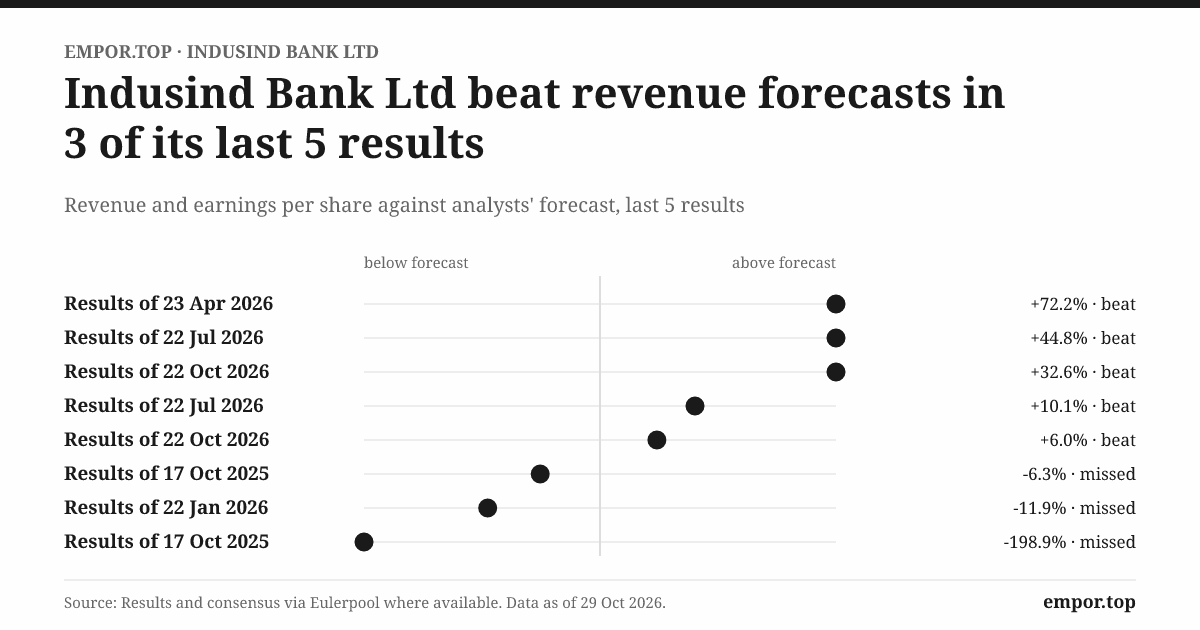
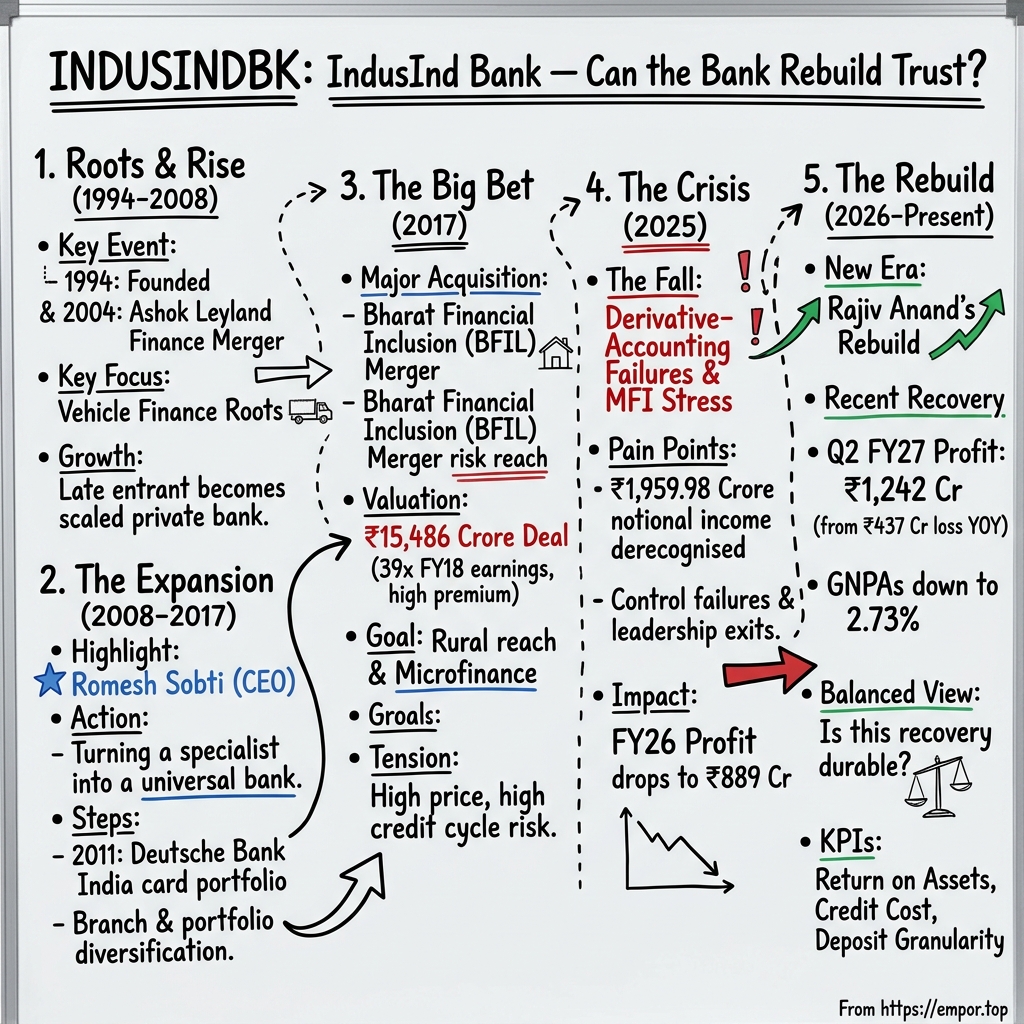
On October 23, 2026, IndusInd Bank put out a results release that, on its face, read like the end of a long nightmare. For the quarter to September, the bank had earned ₹1,242 crore. In the same quarter a year earlier it had lost ₹437 crore.1
A swing of more than ₹1,600 crore in twelve months is the kind of number that makes a headline write itself: the bank that had spent 2025 confessing to accounting failures was back in the black, and comfortably so.
Rajiv Anand, the managing director and chief executive who had arrived fourteen months earlier, chose his words for the occasion. The quarter, he said, reflected "the growing strength of the IndusInd Bank franchise," and the bank was "entering the second half with confidence."1
On the analyst call that followed, he pointed to the measure he had staked his first full year on: a normalised return on assets of 0.87%, up from 0.63% three months earlier, and what he called clear progress toward the 1% exit rate he had promised for the year.2
Underneath the headline sat a bank of real size. At the end of September, IndusInd held deposits of ₹4,28,832 crore and advances of ₹3,63,104 crore, both about a tenth larger than a year before.1
It served roughly 42 million customers through 3,139 branches and banking outlets, and its rural arm reached into about 1.54 lakh villages.1 Few lenders in India can put a tractor loan, a microloan, a working-capital line and a dollar deposit from a non-resident Indian on the same balance sheet. IndusInd can.
So what, exactly, has been repaired? The honest answer begins with the comparison. The year-ago quarter was not a normal quarter. It was the moment the new management chose to write off ₹1,579 crore of microfinance loans and push provisions sharply higher, which is why that quarter showed a loss at all.3
Measuring the recovery against that base is a little like measuring a patient's recovery against the day of surgery. The patient looks dramatically better. The question is whether the patient is well.
The longer record is less flattering. In the year to March 2024, IndusInd earned ₹8,950 crore on a standalone basis. In the year to March 2025, after the derivative and microfinance corrections that this story will spend much of its length on, that fell to ₹2,643 crore.4
In the year to March 2026, the group earned ₹889 crore, a return on assets of about 0.2%.56 Even the strong September quarter, annualised, would leave the bank earning well under two-thirds of what it made in FY24. A rebound has happened. A recovery to the old earnings power has not.
That gap frames the three questions this story is really about. The first is whether IndusInd bought lasting growth when it paid a premium in 2017 for Bharat Financial Inclusion, the microlender that became its rural engine and then its most painful source of losses.
The second is whether the accounting failures of 2023 to 2025 are fully understood: what happened, who knew, and whether the controls that failed have truly been rebuilt. The third is whether the current team can restore earnings without quietly loosening the two things that sink banks, which are the quality of the loans and the stability of the money that funds them.
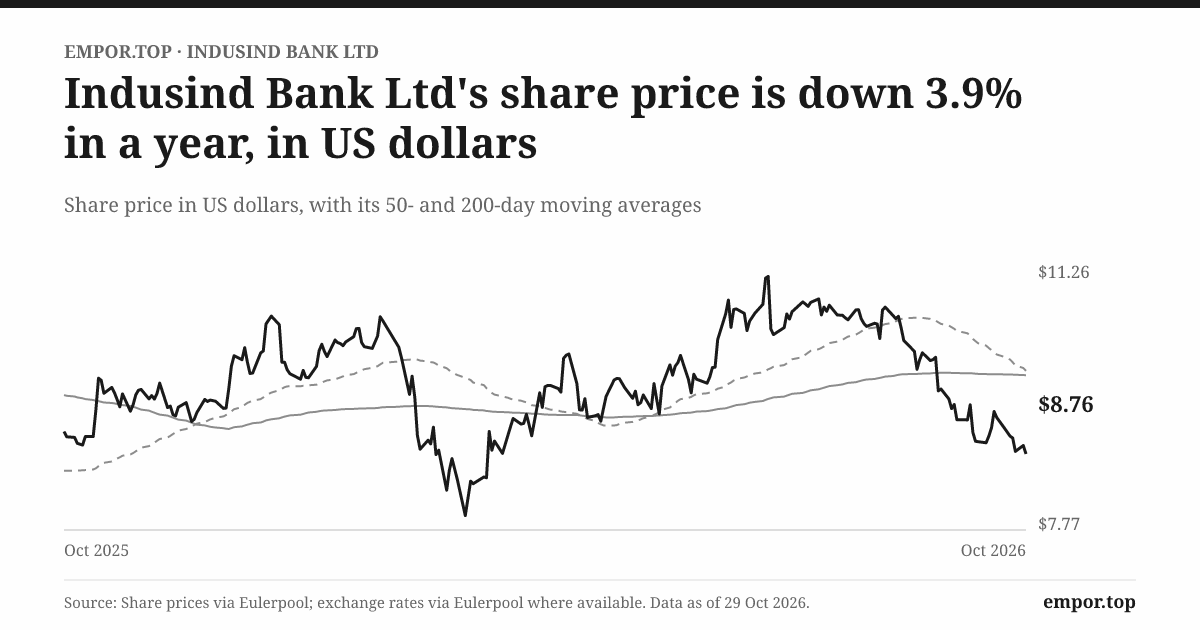
The stakes are not abstract. Shareholders watched the stock fall 27% in a single session in March 2025, the day after the bank first disclosed discrepancies in its derivative accounts.7 Depositors, who lend the bank most of its money, have options at much larger rivals. Regulators have shown, through the leadership exits of 2025, that they will act. And the bank's own management has set public markers that can be checked quarter by quarter.
What follows is the story of how a small post-liberalisation bank built on truck loans became a ₹5.8 lakh crore balance sheet,1 how its most ambitious acquisition and its treasury both turned into sources of doubt, and what the evidence says about whether this rebound quarter is a new floor or only a reprieve. It starts, as so many Indian banking stories do, in 1994.
 Subscribe on LinkedIn
II. A New Bank Built on Vehicle Finance
In April 1994, India's finance minister, Manmohan Singh, formally opened a new bank in Mumbai. Its first branch was at Opera House, in the old commercial heart of the city, and it began life with about $35 million of capital.8 The bank was called IndusInd, and the idea for it had come from Srichand P. Hinduja, head of the Hinduja Group, the family conglomerate whose interests already spanned trucks, oil, finance and media across several continents.8
The timing was everything. Three years earlier, India had been forced into a balance-of-payments crisis and a programme of economic liberalisation. One of the reforms that followed was a decision to license a handful of new private banks to compete with the state-owned giants that dominated deposits and lending.
IndusInd was part of that first wave. The incumbents had the branches, the government accounts and the trust of households who had banked with them for generations. The newcomers had capital, speed, and the freedom to choose their customers.
The Hindujas brought a distinctive kind of capital. The bank was conceived as a vehicle partly for non-resident Indian money, and the promoter group's holding at the founding was above 90%.9 That figure matters for what came later.
Over three decades, in line with Reserve Bank rules that cap and dilute promoter control of private banks, the group's stake fell to roughly 15%.9 IndusInd today carries the Hinduja name in its history, but it is a listed bank with a widely held share register. The group's other businesses, its debts and its disputes are not the bank's results, and this story keeps them apart.
The bank listed its shares in November 1997, raising about $30 million in its initial public offering.8 By the late 1990s it had built a modest network, 18 branches and 11 ATMs in 1996–97, and marketed itself on "anywhere banking," a then-novel idea that a customer could transact at any branch rather than only at the one where the account was opened.8 It was a respectable start, but not a distinctive one. Several of the new banks were offering the same promise.
What gave IndusInd its identity was a merger inside the family. In 2003–04 the bank absorbed Ashok Leyland Finance, the lending arm associated with the Hinduja-controlled truck and bus maker, along with another group finance company, IndusInd Enterprises and Finance.8 Overnight, a young bank with an urban branch network acquired a seasoned business lending to truck operators, fleet owners and small transporters across India's highways.
Vehicle finance is a particular craft. The borrower is often a first-generation entrepreneur with one or two trucks and an irregular income tied to freight rates, diesel prices and the harvest. The collateral moves, sometimes across state lines. A good lender in this business knows the resale value of a ten-year-old truck in a district town, knows which dealers can be trusted, and has collection staff who can find a vehicle when the instalments stop.
Those skills cannot be bought off a shelf, and the bank's own account is that its vehicle franchise has held leadership positions across vehicle categories for more than 35 years, a claim that dates the expertise to well before the bank itself existed.5
The heritage still shows. At the end of September 2026, the vehicle finance book stood at about ₹1,06,500 crore, roughly 29% of all advances, and disbursements in the quarter were 17% higher than a year earlier.2 No other single business in the bank is as large. When management describes what makes IndusInd different, vehicle finance comes first.
But the early bank also showed the limits of a single engine. A lender concentrated in commercial vehicles rides the freight cycle; when diesel spikes or the economy slows, truck operators miss payments together. Its funding was expensive, because a young bank without a deep base of savings and current accounts has to pay up for term deposits and wholesale money.
And it was small. By the time the global financial crisis approached, IndusInd had assets of about ₹25,000 crore and a return on assets of just 0.34%, which meant that for every ₹100 of assets the bank was earning about 34 paise a year.10 For a bank, that is barely clearing the bar.
The Hinduja Group had concluded by early 2007 that the bank needed new leadership, and it went looking outside.11 The person it found would spend twelve years trying to turn a specialist truck lender into something much broader, and the question of whether that broadening made the bank stronger or simply harder to control runs through everything that followed.
III. Sobti's Bet: Turn a Specialist Lender into a Universal Bank
Romesh Sobti came from ABN Amro, where he had run the Dutch bank's Indian operations, and he did not come alone. He brought key colleagues with him, a ready-made management team transplanted from a foreign bank into a struggling Indian one.11
He was a chartered accountant by training, and in interviews he spoke about banking the way an engineer speaks about a machine: ratios, targets, productivity, the plumbing of funding. He later described the chief executive's job with a baker's metaphor. A CEO, he said, "is never a fully baked item that comes out of an oven and sits on the seat. Half the baking is done on the job."10
His timing was terrible. He took charge in 2008, as the global financial crisis spread from New York and London into emerging markets. The first years were, by his own account, a restructuring story: recapitalise the bank, re-staff it, reorganise it and rebalance a balance sheet that carried problems from the past.11 Branch managers were told to think like chief executives of their own small businesses, accountable for profitability as well as hygiene.11
Sobti liked slogans with numbers in them. The first was "3-3-3," a plan to triple return on assets, return on equity and net interest margin. Once that was within reach, it was replaced by "3-2-1": reach first place among peers on those ratios, and double profits, customers and branches within three years.11
One target stood out because it addressed the bank's weakest spot. Current and savings accounts, the cheap deposits that every bank wants, made up about 27% of IndusInd's deposits in 2011, and Sobti wanted that share above 35% within three years.11
The plan was to wrap a universal bank around the vehicle-finance core: consumer loans, cards, wealth products, corporate and commercial lending, transaction banking. Some products the bank chose to rent rather than build; it sold another lender's home loans to its customers for a fee rather than taking the risk on its own books.11 Other capabilities it bought.
The clearest purchase came in April 2011, when IndusInd agreed to take over Deutsche Bank's Indian credit-card business. The deal brought almost 200,000 cardholders and, more importantly, the entire operating platform of the German bank's card franchise, its systems and its people.12
Deutsche Bank, for its part, wanted out of unsecured retail lending in India to focus on deposits, wealth management and secured loans.12 For IndusInd, it was a shortcut. Building a card business from scratch means years of underwriting models, processing systems and fraud controls. Buying one gave the bank what its consumer-banking head called a head start.12
It is worth being precise about what such a purchase proves. It proves the bank could acquire a capability and a customer book. It does not prove that the capability would earn good returns through a credit cycle.
Fifteen years later, the cards book is still a modest part of the bank, and in the September 2026 quarter it shrank by 3% as management said it was prioritising risk-adjusted returns over volume.2 A head start is not the same thing as a lead.
Taken as a whole, though, the Sobti decade was a striking success on the numbers that banks are judged by. In roughly ten years, assets grew about thirteen-fold, from about ₹25,000 crore to ₹3.07 lakh crore. Return on assets rose from 0.34% to 1.82%, net interest margin from about 1.5% to above 4%, and the share of cheap current and savings deposits from about 15% to 42%.10
By early 2020 the market valued the bank at about 2.4 times its book value, close to Axis Bank and not far behind ICICI Bank.10 A sleepy truck lender had become one of the most admired mid-sized private banks in the country.
The diversification was real, but it had a particular shape. At the end of 2019, commercial vehicle loans were about 28% of the book, corporate loans about 46%, microfinance about 10% and other retail lending only about 16%.10
In other words, the bank had grown largely by adding big corporate exposures and a fast-growing rural lending arm to its vehicle base, rather than by building the broad, granular consumer lending business that sustains the largest private banks. And the money funding all this was not as granular as the headline deposit ratio suggested.
March 2020 tested the structure. When the Reserve Bank took control of Yes Bank in early March, nervous state governments and other institutions began pulling money out of private lenders. At IndusInd, deposits fell 10–11% from their December level, with two state governments accounting for about two-thirds of the drawdown.13
CRISIL had noted that the bank's top 25 depositors held 24% of its deposits, the highest concentration among its peers, and that it relied on government savings accounts for part of its low-cost funding.14
The shares fell about 76% between the start of 2020 and the end of March.13 Sobti himself had said that year he wanted to cut dependence on bulk deposits from about 30% to 15% over three years.10 The crisis showed why. Cheap deposits from a handful of large institutions can look like a CASA franchise right up until the day they leave.
Sobti retired in March 2020, as he turned 70, and handed over to Sumant Kathpalia, the head of consumer banking, a fellow chartered accountant and former foreign banker whom the board had groomed for about five years across risk, operations, treasury and asset-liability management.10 The new chief executive inherited both the growth machine and its ambitions.
Those ambitions reached their high point at an investor day in November 2022. Under what the bank called Planning Cycle 6, management targeted loan growth of 23–25% a year, a return on assets of about 2%, a current and savings deposit share above 45%, 3,500 branches, and a microbanking book of ₹60,000 crore.15 "This bank was not about 10%-12% growth," Kathpalia told investors. "This bank is about 23%-25% with sustainability metrics in place."15 He added a line that would age badly: "Quality of earnings is more important than the quantity of earnings."15
Set those targets beside September 2026 and the gap is stark. Loans grew 11% in the latest year. The current and savings share was about 28%. The bank had 3,139 branches and outlets, and its microfinance book was about ₹17,600 crore, less than a third of the target.12
Some of that shortfall reflects a deliberate retreat by new management, and some reflects a credit cycle no one controls. But the history narrows the claim that IndusInd successfully became a universal bank. It became a broad lender with distinctive specialist engines. It did not become a bank with the cheap, sticky funding base that would let those engines run safely at the speed it promised.
The biggest of those engines had been bolted on five years earlier, in a deal that management described as a natural progression and that critics called expensive. That deal is where the bank's growth story and its control story first become the same story.
IV. BFIL: Was ₹15,000 Crore the Price of a New Growth Engine?
On October 14, 2017, the boards of IndusInd Bank and Bharat Financial Inclusion met in Mumbai and approved a merger. Shareholders of the microlender would receive 639 IndusInd shares for every 1,000 of their own, an all-stock swap that implied a 12.6% premium to Bharat Financial's two-week volume-weighted share price.16
Romesh Sobti called the deal "a natural progression of a long-standing relationship and mutual admiration between the two institutions."16 M.R. Rao, Bharat Financial's chief executive, said his company would gain "the benefit of a large universal bank from day 1."16
To understand why IndusInd wanted this company, and why the price mattered, it helps to know where Bharat Financial had been. It began in 1998 as Swayam Krishi Sangam, a non-profit founded by Vikram Akula, and became SKS Microfinance, a lending company, in 2005.17 In August 2010 it became India's only listed microfinance lender, through an IPO subscribed almost 14 times.17
Within months, Andhra Pradesh, then its largest market, enacted a law that severely restricted microfinance after a spate of borrower suicides allegedly linked to coercive collection.17 The founder left, the Reserve Bank turned down the company's application to become a small finance bank, and it rebuilt itself, later under a new name, as a more profitable but still standalone lender.17 By 2017, some observers saw a merger with a bank as its best path forward.17
The two companies already knew each other well. For more than five years, Bharat Financial had acted as a business correspondent for IndusInd, originating loans on the bank's behalf; 99 of its branches worked exclusively for the bank, against limits of about ₹1,100 crore.18 In a business-correspondent model, the field organisation finds the borrower, checks the paperwork, disburses the loan and collects the weekly instalments, while the bank provides the money and holds the loan on its balance sheet.
What IndusInd was buying, in scale terms, was impressive. Bharat Financial brought 6.8 million borrowers, 1,408 branches across 347 districts and a footprint in about 100,000 villages across 16 states.16 IndusInd at the time had about 1,210 branches, roughly 250 of them rural, and around 10 million customers.16 Together, the bank said, they would have more than 3,600 banking points.16
The strategic logic was laid out in the merger presentation. Microloans qualify in full for India's priority-sector lending rules, which require banks to direct a share of credit to agriculture, small business and weaker sections; a bank that over-achieves can sell the surplus to banks that fall short, and IndusInd estimated a fee of 1–1.5% on any excess.18
The bank's lower cost of money would cut Bharat Financial's funding cost by about three percentage points, and microloans would carry a lighter 75% risk weight inside a bank.18 The rural branches might gather deposits. And the slide that summed it up carried an exclamation mark: "Transaction Accretive to All Key Vectors on Day 1!"18
Now the price. The deal valued Bharat Financial at roughly ₹15,500 crore. Contemporaneous analysis put that at about 39 times estimated FY18 earnings and about 5.5 times estimated book value.[^19] Bharat Financial's own figures make the point vividly: in June 2017 it had a net worth of about ₹2,420 crore and a non-Andhra loan book of about ₹9,630 crore, against IndusInd's loans of ₹1,16,407 crore.18
IndusInd was paying more than six times the target's mid-2017 net worth for a loan book about one-twelfth the size of its own. A buyer pays that kind of multiple for a business whose returns are expected to stay very high for a very long time.
That is the crux. Microfinance can earn spectacular returns in good years, because the interest rates are high and well-run lenders historically collected nearly every rupee. But the business has a known pattern: it runs well for years and then breaks suddenly, through a state law, a natural disaster, demonetisation, a pandemic, or simply over-lending as too many lenders chase the same borrowers.
Andhra Pradesh in 2010 was that pattern playing out in this very company's history. A premium price assumed, in effect, that the next break would be manageable. Nothing in the record of Indian microfinance justified treating that as a safe assumption.
The merger took a long time to close. It became effective on July 4, 2019, with an appointed date of January 1, 2018; IndusInd issued about 8.96 crore shares to Bharat Financial's holders, and the promoter group took 1.58 crore warrants at ₹1,709 each as part of the capital arrangements.19
That timing means IndusInd's FY19 and FY20 accounts are not cleanly comparable with earlier years. Bharat Financial's assets and liabilities moved onto the bank's balance sheet, while its operations were placed in a new wholly owned subsidiary, which kept the old name and became the bank's business correspondent.18
That structure deserves a moment, because it shapes how investors should read the bank. The microloans sit on IndusInd's books, and the credit losses land in its profit and loss account. The people who originate and collect those loans work for the subsidiary, which the bank pays for its services.
In its FY25 annual report, the bank described transactions as ordinary-course and at arm's length, reported services received from related parties of about ₹14 crore, and noted that detailed disclosures were withheld where a category had only one related party, under Reserve Bank guidance.4
The bank does not publish a complete figure for what it pays the subsidiary as a share of its costs, so an investor cannot fully trace the economics of the rural engine from the outside.
The first public crack came in November 2021. IndusInd admitted that about 84,000 microloans had been disbursed in May that year without customer consent being recorded, which it blamed on a technical glitch caught by field staff within two days.20 By the end of September, only about 26,000 of those borrowers still had loans outstanding, totalling about ₹34 crore, roughly 0.12% of the portfolio.20
The bank called whistleblower allegations that Bharat Financial had evergreened loans, lending fresh money to borrowers who could not repay so the old loans looked current, "grossly inaccurate and baseless," made biometric authorisation mandatory, and ordered a review of the subsidiary.20
The shares fell more than 10% in a day.20 The sums were small. The signal was not: a bank's controls over its subsidiary's front line had failed long enough for tens of thousands of loans to go out wrongly.
At the 2022 investor day, Kathpalia was confident. Microfinance was 13–15% of the book, he said, and its delinquency was better than the market's; "I do not believe we have a high-risk, high-return book."15 The bank expected microbanking returns on assets of 4.5–5% and kept contingent provisions to smooth volatility.15
Then the cycle turned. In 2024, microfinance repayments began to slip, with management later pointing to stress in states including Karnataka.21 At IndusInd, gross non-performing microloans were about 4.5% in March 2024, 14.6% a year later, and 19.9% by March 2026.6 In plain terms, by the spring of 2026 roughly one rupee in five of the remaining microfinance book was in default.
Worse, part of the deterioration had been hidden in the bank's own accounts. In reviewing the portfolio, the bank found microfinance loans wrongly classified as standard assets, with interest still being accrued on them.
Correcting that added ₹1,885 crore of non-performing loans; the bank provided for 95% of them, and together with reversed interest the hit to the March 2025 quarter was about ₹1,969 crore.4 Separately, the internal audit team found that about ₹674 crore of interest income and ₹173 crore of fee income had been incorrectly recorded on microloans in the first nine months of FY25, and reversed it.4
New management then chose speed over gradualism. In the September 2025 quarter alone, the microfinance book was cut by about a quarter from about ₹28,300 crore.3 By June 2026, microfinance was about 5% of the bank's advances.6
So did ₹15,500 crore buy a durable growth engine? The history narrows the claim sharply. The deal did buy reach, a rural collection machine and a real capability; the September 2026 quarter showed that machine restarting, with net slippage down to about 2.2% from 14.1% a year earlier.2 But the engine produced one of the worst credit episodes in the bank's history within six years of closing, and the accounting around it failed.
A business that needs a guarantee scheme to cover most new lending, as this one now does, is not the self-sustaining high-return franchise that a 39-times-earnings price implied.2 The bank's long-run return on that premium now depends on earning through the next cycle, not on the branch count it acquired.
And that raises a bigger question than one acquisition. To judge whether IndusInd can earn its way back, one has to understand how the bank makes money in the first place, and where, if anywhere, it holds an edge over rivals many times its size.
V. How This Bank Makes Its Money—and Where It Has an Edge
Picture a single loan: say ₹15 lakh to a transporter in Namakkal buying a second-hand truck. For IndusInd to earn its keep on that loan, three things have to go right. The bank has to fund the ₹15 lakh at a cost well below what the transporter pays.
It has to collect every instalment, or recover enough from the truck if the instalments stop. And it has to set aside enough capital against the loan that, when some loans in the portfolio do go bad, it can absorb the loss and still lend again. Banking is that sequence repeated millions of times.
In the September 2026 quarter, the arithmetic looked like this. The bank earned net interest income, the gap between what it collected on loans and investments and what it paid depositors and lenders, of ₹4,569 crore. As a share of its interest-earning assets, that spread was 3.23%.1
On top of that came ₹2,248 crore of fees and other income: loan processing charges, insurance commissions, foreign-exchange sales to clients, transaction-banking fees and some treasury gains.1 Running the bank, its staff, branches and technology, cost ₹3,943 crore, leaving ₹2,874 crore of operating profit before provisions.1 Provisions for bad loans then took ₹1,223 crore of that, and tax took a share of what was left.1
Translate those numbers into a simple picture. Of every ₹100 of net revenue the bank generated, about ₹58 went to running costs, about ₹18 to covering bad loans, and the remainder, before tax, was profit. Two years earlier, in the bank's best years, costs took a smaller share and bad loans a far smaller one. The road back to the old earnings power runs through those two lines.
The September quarter also flattered fees slightly. The finance chief said about ₹100 crore was one-off, including a gain on selling investments and unusually high foreign-exchange sales income, though Anand insisted the core run-rate was sustainable.2 And the spread was under pressure: the 3.23% margin was 12 basis points below the previous quarter's normalised level, mostly because of a large inflow of foreign-currency deposits that this story will come back to.2
Where does the bank lend? Vehicle finance, at about ₹1,06,500 crore, remains the largest single book. The traditional consumer book, home loans, loans against property, small business banking, cards and personal loans, was about ₹59,800 crore. Microfinance was about ₹17,600 crore, merchant loans in rural markets about ₹8,700 crore, and the wholesale book of corporate and mid-market loans grew 10% in the year.2
It is a genuinely mixed portfolio, and the mix is shifting. In FY26, home loans grew 45%, the gold-loan book crossed ₹1,000 crore, and small-business loans reached about ₹44,300 crore, while the bank shrank large corporate exposures and microfinance.5 Management's stated aim is to raise small-business lending to 10–15% of the book over time.6
The other side of the balance sheet matters just as much. Deposits were ₹4,28,832 crore in September, and current and savings accounts made up 27.9% of them.1 Retail deposits, as the Reserve Bank measures them for liquidity purposes, were about ₹2,01,780 crore.1
The top 20 depositors held about 15% of deposits in 2026, still meaningful but well below the 24% held by the top 25 in early 2020.614 That is real progress on the vulnerability that nearly broke the bank in March 2020.
But progress is not parity. Put IndusInd beside the largest private banks and the scale gap is enormous. HDFC Bank ended September with deposits of about ₹33.3 lakh crore, nearly eight times IndusInd's; ICICI Bank had about ₹20.5 lakh crore and Axis Bank about ₹14.5 lakh crore.222324 More striking is the pace.
Those three grew deposits between 19% and 27% in the year, helped in part by the same foreign-currency deposit scheme, while IndusInd grew 10%.2223241 On loans, ICICI grew 30% and Axis 23%, against IndusInd's 11%.23241 Anand attributed the lag to the base effect of two quarters of shrinking in FY26 and said he expects to grow in line with the market from here.2 Even so, in the most recent year the bank lost share.
The cost of that funding is where the competitive gap shows most clearly. On the July 2026 call, management said its cost of funds was about 150 basis points above its closest peer, and that narrowing the gap was a medium-term aim.25 One and a half percentage points sounds small.
On a deposit base of more than ₹4 lakh crore, it is the difference between a bank that can price a home loan competitively and one that has to earn its spread by lending to riskier borrowers. That is why IndusInd's loan book leans toward vehicles, rural lending and unsecured products: the bank has to earn higher yields because it pays more for its money.
Think of the industry's competitive forces in banking terms. Customers have strong bargaining power on both sides of the balance sheet: a salaried saver can move money to a bigger bank with a better app in minutes, and a creditworthy company can play five lenders against one another for its working-capital line.
Rivalry is intense, because the largest private banks, the state-owned banks and the non-bank finance companies all chase the same vehicle, home and small-business borrowers, and microfinance competes with small finance banks and specialist lenders.
The threat of new entrants is moderated by regulation, since bank licences are scarce, but fintech lenders and digital payment apps chip away at fees and customer relationships. Substitutes are rising too: mutual funds and market products compete for household savings, which raises the cost of deposits for every bank. And the "supplier" that matters most, the depositor, is exactly where IndusInd is weakest. Regulation and capital requirements set the outer limits on how fast any bank can grow.
Against that backdrop, what does IndusInd actually do better? The evidence supports two specific capabilities. Vehicle finance is one: a large book, a long record, and a franchise that management says leads across vehicle categories, with disbursements growing faster than the book in the latest quarter.25 Rural distribution is the other, through the business-correspondent network that reaches about 1.54 lakh villages.1 Both are genuine skills that a new competitor could not copy quickly.
Both, however, have been tested by stress, and both showed cracks. Vehicle loan non-performing assets rose from about 1.7% to about 3.0% between March 2025 and March 2026.6 Microfinance went from a showcase to a write-off programme.
And neither capability has protected the bank's pricing: there is no evidence that IndusInd charges vehicle borrowers more than rivals because of its expertise, only that it is willing to lend to segments others serve less. A capability that requires taking more risk to earn its return is an advantage in distribution, not a proof of pricing power.
Fees offer some support but also a warning. Wholesale fees grew 37% in the year, with transaction banking more than half of them, which suggests the bank is winning more of its corporate clients' day-to-day business.2
But insurance distribution brought in about ₹960 crore in FY26, roughly 15% of fees, and Anand told analysts that draft insurance-regulator rules on commissions could have a material impact on an as-is basis, though it was too early to quantify.2 Fees that depend on a commission schedule set by another regulator are not a moat.
Technology is the other place where banks like to claim an edge, so it deserves a sceptical look. IndusInd reported 4.8 million registered users on its unified mobile platform in FY26, with about 58% active each month, and said its digitally acquired asset book grew 19% in the year.5 By October 2026, more than half its employees were using AI chatbots, and six conversational AI programmes had gone live.2
These are sensible investments, and they may lower the cost of serving a customer. They are also investments every large bank is making, most of them with bigger budgets. A mobile app that customers use is table stakes; it becomes an advantage only if it wins deposits more cheaply than rivals can, and on the cost-of-funds evidence that has not happened yet.
What the bank does not publish also matters. IndusInd does not disclose top-borrower concentration in a form comparable across years, or a full breakdown of what it pays its business-correspondent subsidiary. The investor is left to judge the rural engine's profitability from segment summaries and management commentary.
So the economic engine works, and it has real parts. But the central test of a bank is not whether it can generate revenue. It is whether it can produce acceptable returns without taking risks that only become visible later. In 2025, IndusInd learned in the most public way possible what happens when the risks that become visible later are not in the loan book at all, but in the accounts themselves.
VI. The Accounting Failure That Broke the Growth Story
At 6:34 in the evening on March 10, 2025, after the stock market had closed, IndusInd Bank posted a short statement on the exchanges. During an internal review of the "other asset" and "other liability" accounts of its derivative portfolio, it said, the bank had noted some discrepancies.
Its detailed internal review estimated an adverse impact of about 2.35% of the bank's net worth as of December 2024. An external agency had been appointed to validate the findings. "The Bank's profitability and capital adequacy remain healthy to absorb this one-time impact."7
Two point three five percent of net worth worked out to about ₹1,530 crore.7 The next morning, investors did not treat it as a rounding error. The shares fell from ₹900.60 to ₹655.95, a drop of 27.2% in a single session.7 For a large private bank in India, a fall like that is almost unheard of. It was not the size of the number that frightened the market. It was what the number implied about everything else.
Three days earlier, there had already been a warning. On March 7, the Reserve Bank had approved Kathpalia's reappointment as chief executive for only one year, though the board had recommended three. It had done the same thing two years earlier, granting two years when the board asked for three.26 When a regulator repeatedly gives a bank's chief executive a shorter leash than his own board wants, it is telling the market something without saying it.
To understand what went wrong, start with what a derivative desk does. A bank's treasury helps clients hedge risks, such as an exporter wanting to lock in a dollar exchange rate, and manages the bank's own risks, such as the mismatch between foreign-currency borrowings and rupee lending. Some of those hedges are trades with outside banks. Others are internal trades between the bank's own desks, a way of moving risk from one part of the balance sheet to another.
Here is the problem with internal trades. A bank cannot make money by trading with itself, any more than a household gets richer by moving cash from one pocket to another. Whatever one desk gains, the other loses, and in the bank's overall accounts the two should cancel. At IndusInd, according to the investigation the board later commissioned, the accounting for these internal trades from FY16 to FY24 was improper.
It resulted in the recognition of notional income in the profit and loss account, with a corresponding balance building up in "other assets" year after year.4 Income that should never have existed was booked, and the evidence of it accumulated in a corner of the balance sheet that few people examine.
The final figure was larger than the March estimate. The bank wrote off ₹1,959.98 crore of accumulated notional profits, recorded as a reduction of FY25 other income.4 That is almost nine years of phantom earnings, removed in one year.
How did it come to light, and when? Here the SEBI interim order, issued on May 28, 2025, supplies a timeline that the bank's March statement did not. On September 12, 2023, the Reserve Bank issued new directions on how banks classify and value investments and derivatives, effective April 2024.7 By September 26, 2023, IndusInd had formed an inter-departmental team to implement them, and its first meeting dealt with derivative accounting.7
By November 2023, SEBI's examination found, internal emails were discussing the impact of discrepancies, and the regulator inferred that the matter had reached the chief executive no later than December 4, 2023.7 By mid-December 2023, the figure being circulated among senior executives was ₹1,572 crore of discrepancies up to September 2023. Later figures put it at about ₹1,776 crore by December 2023 and about ₹2,362 crore by March 2024.7
The bank stopped internal derivative trades from April 1, 2024.21 It did not tell the market until March 10, 2025. In between, the board recommended a three-year term for the chief executive in September 2024.26 SEBI, for its part, concluded prima facie that the information was price-sensitive and unpublished from December 4, 2023, until the March 2025 disclosure.7
That brought the trading allegations. SEBI's interim order found, on a prima facie basis, that five people sold IndusInd shares during that period while in possession of the unpublished information and bought none. The largest seller was Arun Khurana, the deputy chief executive, who sold about 3.49 lakh shares; Kathpalia sold about 1.25 lakh.7
SEBI calculated the loss avoided, using the 27% fall after disclosure, at about ₹14.4 crore for Khurana and about ₹5.2 crore for Kathpalia, and impounded a total of about ₹19.8 crore across all five, while barring them from the securities market until further orders.7
The order is explicitly interim and ex parte: it records prima facie findings, the people named had not yet been heard, and SEBI also noted it had never given a "clean chit," contrary to some media reports.7 It is an allegation by a regulator, not a final finding.
Khurana resigned on April 28, 2025, and Kathpalia the next day.5 The bank kept both on its payroll for the time being, then initiated disciplinary proceedings and suspended both on June 18, 2025, pending their completion.5 The bank was run in the interim by a two-person committee of executives under the oversight of a board committee.5
The derivative hole was only the first of several. The board's wider review, and the internal audit team's work, found more. Incorrect manual entries had inflated other assets and other liabilities by ₹595 crore, which had to be set off.4 Microfinance interest and fees had also been wrongly recorded. Microloans had been misclassified as standard.
And a further list of smaller items surfaced: about ₹100 crore of interest on borrowings that had not been recognised in earlier years, a ₹133 crore provision against other assets not expected to be realised, and prior-period expenses of ₹206 crore.4 One error is a mistake. A list like that is a description of a control environment.
The auditors said as much. In their report on the FY25 accounts, the joint statutory auditors wrote that the investigation findings revealed the involvement of senior bank officials, including former key managerial personnel, in overriding key internal controls, and a concealment of the wrongful accounting practices from the board and the statutory auditors.4
Because of the likely involvement of senior management, they reported suspected offences involving fraud to the central government under section 143(12) of the Companies Act, through the formal Form ADT-4 route.4 The board itself said it suspected fraud against the bank involving employees with a significant role in accounting and financial reporting, and told the exchanges so on May 21, 2025.4 The auditors did not qualify their opinion; they drew attention to the matters in an emphasis paragraph.4
The cumulative effect on reported earnings was brutal. FY25 standalone profit fell to ₹2,643 crore, from ₹8,950 crore the year before.4 And the derivative correction and the microfinance clean-up were not the same problem, even if they landed in the same year.
The derivative issue was about income that never existed. The microfinance issue was about real loans going bad faster than the accounts admitted. One questions the integrity of the numbers; the other questions the quality of the underwriting. Investors had to price both.
The call on May 21, 2025, is worth revisiting because of what it did and did not explain. The chairman, Sunil Mehta, led it himself, an unusual step for a non-executive chair.
He said the external reports had found an impact "broadly similar" to the internal estimate, that staff accountability would be pursued "without fear or favor," and that "all issues have been duly identified."21 Asked whether any more one-offs were coming, the executive answering said, "There is nothing that is outstanding today to our understanding."21
But when an analyst asked how large the suspected fraud was, the answer was that it was "still not yet conclusive."21 No one explained on the call how improper accounting could run for close to nine years without the board, the audit committee or the auditors catching it, beyond the statement that the board had not been informed. Questions about legal recourse and clawbacks went unanswered.21
The prepared message was closure; the questions pointed to unfinished business. And the business stayed unfinished. In late December 2025, the Serious Fraud Investigation Office, acting on orders from the Ministry of Corporate Affairs, opened an investigation into the bank's affairs under section 212 of the Companies Act, covering the internal derivative trades, the unsubstantiated balances and the microfinance income.527
By March 2026, the SFIO had reportedly summoned the former chief executive, the former deputy chief executive and the former finance chief, while the Mumbai police's economic offences wing was reported to be preparing to close its own preliminary inquiry after finding no evidence of siphoning.27 The former leaders' side of the story, and the final legal findings, remain to be determined.
The bank's own description of the aftermath has grown more confident. Its FY26 annual report says a board-mandated project group finished implementing enhanced controls over reconciliations, manual entries and internal reporting, that the auditors gave an unmodified opinion, and that accountability processes were concluded for the majority of officials involved.5
It calls this "governance closure." The phrase runs ahead of the facts. The auditors' FY26 opinion still carried an emphasis of matter on these issues, the SFIO investigation is open, and SEBI's order is interim.5
There is one more uncomfortable detail. At the 2022 investor day, IndusInd described its treasury as the third-largest in Indian banking and its global markets group as best in class.15 At that moment, according to the later investigation, the notional profits from internal trades were already piling up in other assets. The bank's treasury was large. That was never the question. The question was whether anyone could explain what it was earning.
Which leaves investors with an awkward analytical problem. If years of reported earnings included income that should not have been booked, and the following years included an outsized credit clean-up, which period is a fair base for judging what this bank can earn?
FY24's ₹8,950 crore was inflated by things that were later reversed. FY26's ₹889 crore was depressed by a deliberate clean-up. The truth sits somewhere between, and the job of finding it fell to a banker from Axis.
VII. Rajiv Anand's Rebuild: Growth After the Clean-Up
On August 4, 2025, IndusInd's board met and appointed Rajiv Anand as managing director and chief executive for three years from August 25.5 The Reserve Bank had already approved him in a letter dated July 30.5 For a bank that had been run for four months by a committee, the speed of the regulator's approval was itself a message. Ashok Hinduja, speaking for the promoter group, offered "full support" and praised the regulator's "expeditious approval."28
Anand was a known quantity in Indian banking. He had spent the previous decade and a half at Axis Bank, where in 2009 he set up Axis Asset Management as its founding chief, later ran retail banking, and finally served as deputy managing director overseeing wholesale banking, until he retired from the Axis board on August 3, 2025.29 His career covered exactly the businesses IndusInd needed to strengthen: retail deposits, corporate relationships and fee products. What he had not done was run a bank in crisis.
Shareholders confirmed his appointment at the August 2025 annual meeting.5 At the same meeting, they sent a different signal to the promoter. A proposal that would have let the Hinduja group nominate an extra director was rejected by 54% of votes cast.9 Minority investors were happy to back a professional chief executive; they were less keen to hand the promoter more seats in the boardroom.
Anand's first earnings call, on October 18, 2025, set the tone. The quarter showed a ₹437 crore loss, and he owned it: the loss came from accelerated microfinance provisions and write-offs, not from damage to the core, he argued, and core operating profit was stable.3 "I'm not in a great hurry to push the growth lever," he said, "because I think it's important for us to first stabilize the platform."3 He cut the microfinance book by about a quarter in one quarter, exited costly wholesale and certificate-of-deposit funding, and tightened underwriting with income checks on every microloan and additional field verification.3
His strategic diagnosis was candid. The bank's growth engines, vehicle finance, microfinance and corporate lending, were cyclical. Home loans, loans against property, small business, gold and agricultural lending were, in his words, subscale.3
He wanted a more granular, more secured, less cyclical book, and he wanted home loans not just for their yield but as a way to win the customer's salary account and deposits.3 That is a coherent strategy. It is also the same broad ambition, a more balanced universal bank, that Sobti and Kathpalia had set out before him.
He also set markers. A medium-term return on assets of 1%. Net non-performing assets in the vicinity of 0.5–0.6%. A fee-to-assets ratio of about 1.5% over time.3 By the time of the FY26 annual report, the plan had become a three-year roadmap: the first year to rebuild foundations and reach an exit return on assets of 1% in FY27, the second to scale, the third to outperform in chosen segments.5
How has delivery compared with those promises? The return-on-assets path is real and documented. It was about 0.45% in the March 2026 quarter, 0.63% normalised in June, and 0.87% in September.30252 The June quarter's reported profit had been flattered by a ₹284 crore interest receipt on a tax refund, which management itself stripped out, and that willingness to present normalised numbers is a modest credit to its candour.25
The finance chief said most of the improvement so far had come from lower credit costs, and that further credit-cost gains would "not be the big driver" from here.2 In other words, the easy part of the recovery, provisions falling after a clean-up, is largely done. The harder part, growing operating profit, is what remains.
On asset quality, the headline is better. Gross non-performing assets fell to 2.73% in September 2026 from 3.60% a year earlier, and net non-performing assets to 0.83%.1 Annualised gross slippage, the rate at which healthy loans turn bad, fell to 1.8% from 3% a year earlier.2 But net NPAs remain above the 0.5–0.6% target, and provision coverage slipped to 70.2% from 71.8%.1 A bank cleaning up its book should ideally be raising its cushion, not trimming it.
The microfinance turn is the most closely watched decision. On the October 2026 call, Anand reported that the microloan book had returned to growth after about eight quarters of decline, rising 8% in the quarter to about ₹17,600 crore, with disbursements up 25%.2 Net slippage in the book had fallen to about 2.2%, early-stage delinquencies were 0.4%, and about 89% of the book was covered by the government's credit guarantee fund for microloans.2
About 73% of borrowers had three years or more of history with the bank, and just over half had only one loan.2 Those are the right indicators to watch, and they are moving in the right direction. Management also flagged drought-affected pockets in Karnataka, Maharashtra and Andhra Pradesh as areas under close watch.2
The pattern of Indian microfinance is that the indicators look best just before they do not. The guarantee cover reduces the bank's loss if borrowers default; it does not reduce the probability that they will.
Funding is where the record is weakest. In FY26 deposits fell about 3%, and in the March 2026 quarter retail deposits shrank about 2% from a year earlier, a point analysts pressed hard and management acknowledged as a constraint on growth.530 The September quarter's deposit growth of 10% owed a great deal to a single source: $3.51 billion of foreign-currency non-resident deposits raised under a Reserve Bank swap window, equal to about 6.3% of the quarter's average deposits.2
IndusInd captured about 2.75% of that window against what it called a natural share of about 1.5%.2 Those inflows let the bank pay down expensive certificates of deposit, which is sensible, but they also lowered the margin and meant that savings balances fell about 5% in the quarter as some non-resident customers moved money into the dollar product.2 Excluding that one-off, underlying deposit growth was far slower than the headline.
The leadership team around Anand has been almost entirely rebuilt: a new finance chief, head of internal audit, chief risk officer, technology chief, head of retail and head of global markets, among others.330 That is the right response to a control failure. It also means the team has little shared history and no track record together through a downturn.
The bank is also spending again. In the September 2026 quarter it added 124 outlets and about 4,300 employees, mostly in sales and sourcing roles, and planned around 100 more branches in the second half.2 Operating expenses rose 7% from the previous quarter as a result.2
That is what a bank does when it believes the clean-up is behind it. It is also the point at which cost discipline, the second lever behind the return-on-assets target, starts to be tested, because new branches and new staff cost money long before they bring in deposits.
Pay and ownership provide context rather than proof. Anand's fixed pay was set at ₹6 crore a year, about 64 times the median employee's fixed pay, with variable pay for FY26 submitted to the Reserve Bank for approval.5
The promoter group owned about 15% of the bank in March 2026, through IndusInd International Holdings at about 11.5% and IndusInd Limited at about 3.6%, and more than half of the promoter shares were then encumbered before IndusInd Limited's pledged stake was released later that month.31
The group has long had Reserve Bank approval in principle to raise its stake toward 26%.28 CRISIL counted the promoter's stated commitment to inject equity if needed as a strength.6 A pledged 15% stake is a credit consideration, not evidence of management alignment.
CRISIL's August 2026 view is the most useful outside read. It reaffirmed the bank's AA+ rating and revised the outlook from negative to stable, citing strong capital, improving earnings and better deposit granularity, while calling asset quality average, the funding profile modest and the current and savings share below peers.6
Creditors care whether the bank will repay its bonds, and on that question the answer is reassuring. Shareholders need something more: proof that returns can climb back toward the 1.75–1.8% range that Anand himself cited as the bank's historical level and medium-term ambition, while declining to give guidance for FY28.2
Anand has done most of the obvious things right and has been open about the numbers. But fourteen months is short, the evidence of success so far is mostly a reversal of the damage, and the next phase requires something the bank has struggled to prove for a decade and a half: profitable growth funded by cheap, sticky deposits. That is the real test of whether the market is pricing a recovery the evidence can support.
VIII. Analysis & Bear vs. Bull Case
The September 2026 numbers show both cases at once. Profit and asset quality improved. Yet the net interest margin stood at 3.23%, the liquidity coverage ratio averaged 127% against 132% a year earlier, and deposit growth leaned on a one-off foreign-currency drive.12 A bull and a bear can read the same release and both feel vindicated.
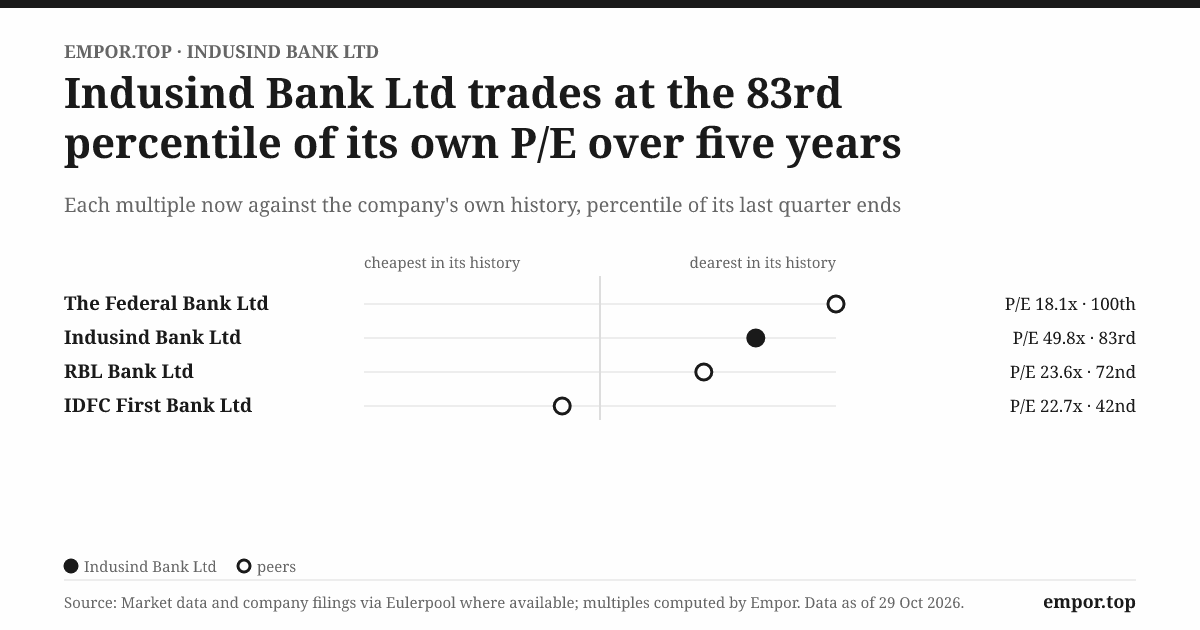
Start with what the market is paying. In late April 2026, with the shares around ₹850, analysts at one brokerage noted that the stock traded at about one times its estimated FY27 book value.32 In early 2020, before the pandemic panic, the market had paid about 2.4 times book, roughly in line with Axis Bank.10 The bank's net worth stood at about ₹66,000 crore in September 2026.1
Paying one times book for a bank says, in effect, that investors expect it to earn roughly its cost of equity and no more, and that they discount the reported book value for the possibility of further surprises. One brokerage at the time projected FY27 return on assets of about 0.7% and return on equity of about 5.6%, well below what investors typically demand.32 The price, in other words, assumes the recovery stays partial.
The bull case begins with the franchise. IndusInd has a vehicle-finance business with decades of underwriting history, a rural distribution machine that few banks could build, a growing wholesale business with transaction-banking fees rising strongly, and about 42 million customers.12 Capital is strong: total capital adequacy was 16.59% and Tier 1 capital 15.55% in September.1 Profit has rebounded, overall bad loans have fallen, and deposits returned to double-digit growth.1
The microfinance book, now smaller, better covered by guarantees and more carefully underwritten, could become a useful source of yield again rather than a source of fear.2 If normalised return on assets reaches 1% and then climbs toward the bank's historical level, a stock trading near book value would be pricing a bank that earns far less than it eventually could. The leadership team is new, the controls have been rebuilt, and the worst of the clean-up is in the accounts.
The bear case begins with the record. FY26 profit was about a tenth of FY24's.54 Microfinance non-performing loans were close to 20% in March 2026.6 Accounting failures ran for close to nine years and were, according to the auditors, concealed from the board and auditors by people at the top.4 Investigations by the SFIO and SEBI are unresolved. The bank is losing deposit share to much larger rivals and pays about 150 basis points more for funding than its closest peer.25
And several new pressures are coming: a transition to expected-credit-loss provisioning, which Anand estimated would carry a one-time pre-tax impact of about 1.1% of loans, roughly ₹4,000 crore at today's book; draft insurance commission rules that could hit a fee line worth about 15% of fees; and his own acknowledgement that the bank will "look at a capital raise at an appropriate time."2 A bank trading at book that raises equity dilutes existing holders at a price that offers them no premium.
There is also a funding detail a sceptic would circle. To deploy the foreign-currency deposits, the bank took on short-term foreign-currency borrowings that, the finance chief said, are "not fully hedged on a tenor basis."
Asked whether that could create losses, Anand replied, "Not really," and said the gaps sat within board-approved limits.2 That may well be right. But for a bank whose last crisis began in the accounting for foreign-exchange-related hedges, investors will want more than a two-word reassurance.
To weigh these against each other, apply the framework that asks where durable power comes from. Scale economies are the most important power in banking, because a larger deposit base spreads technology, compliance and branch costs and lowers funding costs; IndusInd lacks them relative to HDFC Bank, ICICI Bank and Axis Bank, which are three to eight times its size by deposits.222324
Network effects barely apply to lending. Switching costs exist for salary and transaction-banking clients, but the bank's low current and savings share says it has not yet captured enough of them. Brand, in banking, means trust, and IndusInd's has been damaged by the events of 2025.
Counter-positioning does not apply; the bank's strategy is to look more like its larger rivals, not less. Cornered resources are absent, since no licence, data set or relationship is exclusive. That leaves process power: the embedded, hard-to-copy way an organisation does something. Vehicle-finance underwriting and rural collection are the bank's best claim here, and the evidence partly supports it.
The latest vehicle net slippage of about 1.7% shows the craft working, but the rise in vehicle non-performing assets in FY26 and the microfinance collapse show it does not insulate the bank from a cycle.26 The verdict: IndusInd has process advantages in two niches and no structural power across the bank as a whole. Its returns will depend on execution, not on a moat.
The bank's industry position, set out earlier, reinforces the point. In a market where depositors can leave and borrowers can shop, the bank with the cheapest funding sets the price, and IndusInd is not that bank.
Three measures will decide which case wins. The first is normalised return on assets, which was 0.87% in September and rising, against a 1% exit target for FY27.2 The second is segment-level slippage and collections, especially in microfinance and vehicles; microfinance net slippage was about 2.2% and vehicle net slippage about 1.7% in the latest quarter, both falling.2
The third is the growth of granular retail deposits against their cost: retail deposits were about half of total deposits on the regulator's definition, and cost of deposits ticked up to 5.96% as the current and savings share fell.2 If the first rises without the third deteriorating, the bull case gains ground. If return on assets stalls once provisions stop falling, or deposit costs rise as the bank chases growth, the bear case will have been right.
Valuation should be judged against normalised earnings after the FY25 corrections and against the bank's own history, not against a single quarter. At one times book, the market is not asking IndusInd to become HDFC Bank. It is asking whether the bank can earn its cost of capital consistently. That is a lower bar than the bank used to clear, and a higher bar than it has cleared in any recent year.
IX. Playbook: The Cost of Growth Without Control
In October 2017, a vast rural network joined IndusInd in a deal priced at a premium.16[^19] The merger deck promised it would add value from day one. By March 2026, the same franchise had become a source of severe credit losses and accounting corrections.64
The first lesson belongs to that arc: a premium buys a starting position, not a moat. The rural franchise was real. Its returns depended on microfinance behaving better than it ever had in India. Investors weighing any acquisition priced on peak-cycle earnings in a cyclical lending business should ask what the deal looks like after the next break, because there is always a next break.
The second lesson is about time. By December 2023, according to SEBI's interim order, the bank's chief executive knew there was a problem with the derivative accounts.7 The market learned on March 10, 2025.
When it did, the disclosure wiped out more than a quarter of the bank's market value overnight, far more than the estimated loss itself.7 The gap between those two numbers is the price of fifteen months of silence. When the numbers need years to explain, trust is part of the capital base, and a bank that spends it has to rebuild it at a much worse rate.
The third lesson is the hardest for a growth bank to hear. In November 2022, the chief executive told investors that "quality of earnings is more important than the quantity of earnings."15 He was right. At that moment, notional profits from internal trades were accumulating while the microfinance book was growing.
The sentence was true and the earnings were not. Strategy decks describe intentions; control environments determine what actually lands in the profit and loss account. A board, an auditor or an investor that judges a bank by its targets rather than by the reconciliations behind them is reading the wrong document.
The fourth lesson is the one the current management is living through. After a weak FY26, the latest quarter looked better.51 A recovery is a pattern, not a quarter.
The bank's own data show that most of the improvement so far came from bad-loan provisions falling after a clean-up, which is the easiest kind of profit growth and the least repeatable.2 The proof will come in the quarters after provisions normalise, when only better lending, cheaper funding and higher fees can move the number.
Beneath all four sits one distinction. IndusInd has genuine lending capabilities, in vehicles and in rural India, that took decades to build. But capabilities are not the same as durable advantage. The proof of advantage is returns that survive stress, and so far, for this bank, stress has found every seam.
X. Epilogue
Tonight IndusInd stands at a curious point. Its microloan book is growing again for the first time in about two years, its bad loans are falling, its profit has rebounded, and its regulator-approved chief executive has more than a year and a half left on his first term.25
At the same time, the SFIO investigation remains open, the SEBI matter has not reached a final order, and the leaders who ran the bank through the accounting failure have yet to have their cases decided.57
The next moments are easy to name. The December 2026 and March 2027 quarters will show whether normalised return on assets clears the 1% exit target Anand promised for FY27.5 If it does, with credit costs stable and microfinance slippage staying low as the book grows, the claim that the bank has found a new base will look credible. If it falls short, or gets there only on the back of further one-off gains, the market will conclude that the clean-up has been mistaken for a recovery.
Funding will be the quieter test. The foreign-currency deposits raised in 2026 will need to be retained or replaced, and the savings accounts that moved into the dollar product will need to be won back. Anand has said deposit rates are likely to rise in the second half and that, as a relatively smaller player, the bank must stay competitive on price.2
Growth that is funded by paying up will show in margins. Growth funded by more granular customer relationships will show in a rising current and savings share. The direction of that ratio, now below 28%, may say more about the bank's future than any profit figure.1
Then there are the investigations. A final SEBI order, an SFIO report and the conclusion of the bank's own disciplinary process will either confirm that the problems were confined to a few people and a few accounts, or reveal that they were wider. The bank has said accountability processes are concluded for most of the officials involved.5 A clean, independent audit trail for derivatives and manual entries, year after year, will matter more than any statement of closure.
Return to October 23, 2026, and the ₹1,242 crore profit. For that number to mark a new floor rather than a brief relief, three things must hold together over several quarters: returns must rise as provisions stop falling, the rural book must grow without its losses returning, and deposits must grow without becoming more expensive. Each is achievable. All three at once is what IndusInd has not yet shown.
XI. Outro
There is an image that captures IndusInd's test. On one side sits the latest quarterly profit, ₹1,242 crore, real money earned from truck loans, microloans, corporate fees and the spread on ₹4.3 lakh crore of deposits.1
On the other side sits ₹1,959.98 crore of profit that was never there at all, booked over nine years and then erased in one.4 The two numbers are almost the same size, and that is the point. A bank can rebuild its earnings much faster than it rebuilds belief in them.
IndusInd was built on the idea that it understood risks other banks would not touch: the second-hand truck, the village borrower, the dollar hedge. Its recovery now depends on proving something simpler. The next profit matters. The explanation behind it matters just as much.
References
-
Q2 FY27 Results Release — IndusInd Bank, 2026-10-23 ↩↩↩↩↩↩↩↩↩↩↩↩↩↩↩↩↩↩↩↩↩↩↩↩↩
-
Q2 FY27 Earnings Call Transcript — IndusInd Bank, 2026-10-23 ↩↩↩↩↩↩↩↩↩↩↩↩↩↩↩↩↩↩↩↩↩↩↩↩↩↩↩↩↩↩↩↩↩↩↩↩↩↩↩
-
Q2 FY26 Earnings Call Transcript — IndusInd Bank, 2025-10-18 ↩↩↩↩↩↩↩↩↩
-
Integrated Annual Report 2024–25 — IndusInd Bank ↩↩↩↩↩↩↩↩↩↩↩↩↩↩↩↩↩
-
Integrated Annual Report 2025–26 — IndusInd Bank ↩↩↩↩↩↩↩↩↩↩↩↩↩↩↩↩↩↩↩↩↩↩↩
-
Rating Rationale: IndusInd Bank Limited — CRISIL Ratings, 2026-08-19 ↩↩↩↩↩↩↩↩↩↩↩
-
Ex-Parte Interim Order in the Matter of Insider Trading in the Scrip of IndusInd Bank — SEBI, 2025-05-28 ↩↩↩↩↩↩↩↩↩↩↩↩↩↩↩
-
IndusInd Bank Shares in Focus as Shareholders Reject Promoters' Push for Extra Board Seat — Outlook Business, 2025-09-01 ↩↩↩
-
The Growth Agenda: IndusInd Bank MD & CEO Romesh Sobti — Business Today, 2020-03-03 ↩↩↩↩↩↩↩↩
-
Interview: Romesh Sobti, IndusInd Bank — Business Today, 2011-11-09 ↩↩↩↩↩↩↩
-
Deutsche Bank to Sell Indian Credit Card Unit to IndusInd Bank — Retail Banker International, 2011-04-12 ↩↩↩
-
IndusInd Bank Stock Loses 20% on Falling Deposits, Asset Quality Woes — Business Today, 2020-03-31 ↩↩
-
Rating Rationale: IndusInd Bank Limited — CRISIL, 2020-03-27 ↩↩
-
Investor Day 2022 Transcript — IndusInd Bank, 2022-11-22 ↩↩↩↩↩↩↩
-
IndusInd Bank and Bharat Financial Inclusion Announce Merger — IndusInd Bank, 2017-10-14 ↩↩↩↩↩↩↩
-
The Tumultuous Journey of Bharat Financial Inclusion — NextBillion, 2017-09-12 ↩↩↩↩↩
-
IndusInd Bank and Bharat Financial Inclusion Merger Presentation — IndusInd Bank, 2017 ↩↩↩↩↩↩
-
Why IndusInd Bank's Stock Fell Over 10% — The News Minute, 2021-11-08 ↩↩↩↩
-
Q4 FY25 Earnings Call Transcript — IndusInd Bank, 2025-05-21 ↩↩↩↩↩↩
-
HDFC Bank Q2 Advances Rise 16.3% to ₹32.20 Lakh Crore, Deposits Up 18.8% — Sahi, 2026-10-05 ↩↩↩
-
Axis Bank Reports 38% Surge in Q2 FY27 Profit — Free Press Journal, 2026-10-17 ↩↩↩↩
-
Q1 FY27 Earnings Call Transcript — IndusInd Bank, 2026-07-22 ↩↩↩↩
-
IndusInd Bank CEO Reappointed, But Only for a Year – Here's Why — Outlook Business, 2025-03-08 ↩↩
-
IndusInd Bank Fraud Probe: SFIO Tightens Screws on Ex-CEO, CFO Over ₹1,979-Cr Accounting Lapse — Outlook Business, 2026-03-30 ↩↩
-
Rajiv Anand to Help Realise Full Potential of IndusInd Bank, Says Promoter Ashok Hinduja — The Week (PTI), 2025-08-05 ↩↩
-
IndusInd Bank Appoints Rajiv Anand as MD and CEO for 3 Years — The Week (PTI), 2025-08-04 ↩
-
Q4 FY26 Earnings Call Transcript — IndusInd Bank, 2026-04-24 ↩↩↩
-
Promoter Encumbrance Disclosure — IndusInd Bank via NSE, 2026-03-30 ↩
-
IndusInd Bank Shares: Buy, Sell or Hold After Q4 Profit Beat — Business Today, 2026-04-27 ↩↩
 LinkedIn
 WhatsApp
 Reddit
 Hacker News
 Email
 Kindle
 RSS Feed
 Spotify
 Apple Podcasts
 Amazon Music
 Audible
 YouTube