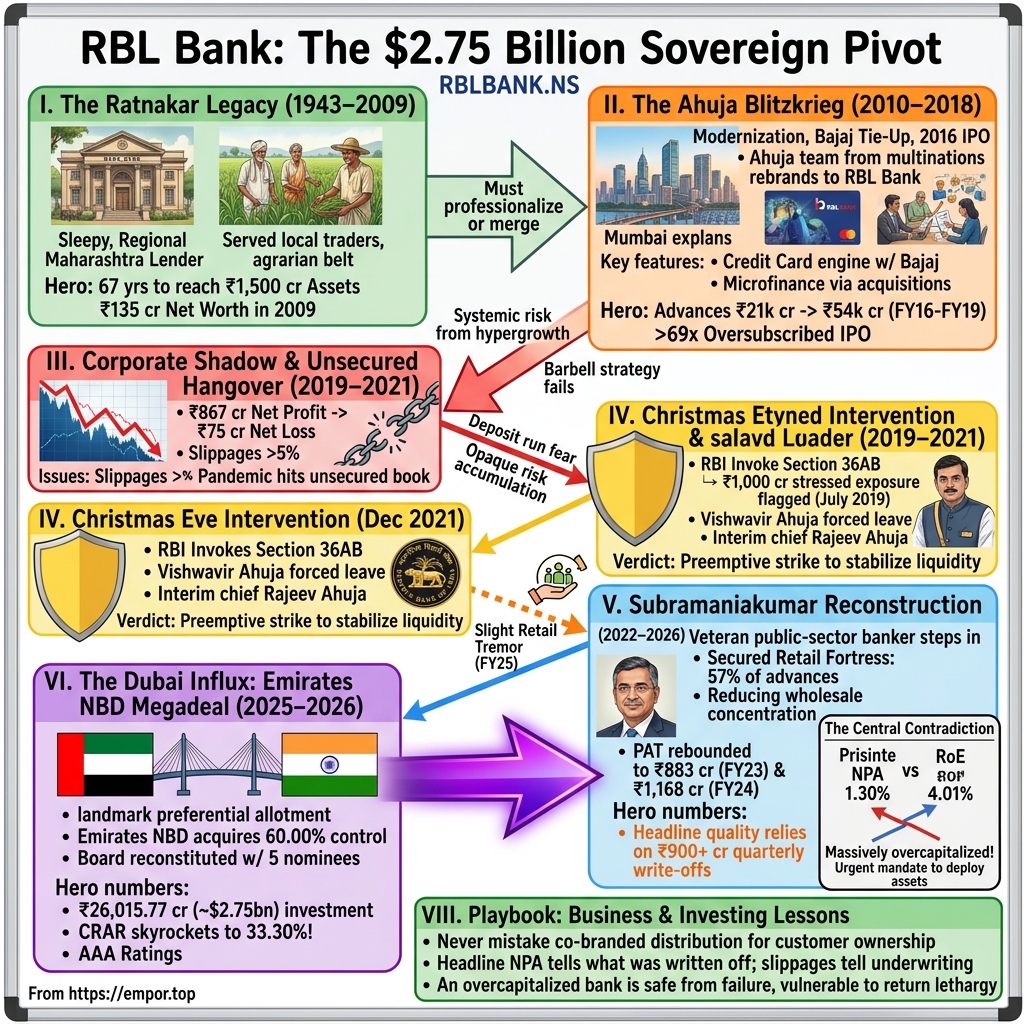
RBL Bank: The $2.75 Billion Sovereign Pivot
I. Introduction & Episode Roadmap (00:00–08:30)
On June 18, 2026, a bank that began life in Kolhapur, a town of sugar mills, wrestling grounds and textile looms in southern Maharashtra, received about ₹26,016 crore in a single day. The money came from Emirates NBD Bank (P.J.S.C.), Dubai's largest banking group. It paid ₹280 a share for 60% of RBL Bank Limited and, in one allotment, turned a listed Indian lender with no promoter into the controlled subsidiary of a Gulf bank12. Management and the financial press called it the largest foreign direct investment in Indian banking history3. Whatever the exact league-table ranking, the scale is not in doubt. Roughly $2.75 billion went into a bank whose entire net worth three months earlier was about ₹16,000 crore14.
This is the third time in a decade that RBL Bank has been rescued by new capital. It is also the first time the new capital came with a new owner. The question is what that owner bought.
On paper, it bought a fortress. At the end of June 2026 RBL Bank reported net worth of about ₹42,300 crore and a capital adequacy ratio (CRAR, the regulator's measure of how much equity cushion a bank holds against its risk-weighted loans) of 33.3%. The regulatory floor is roughly 11.5%4. Gross non-performing assets, meaning loans more than 90 days overdue, were 1.30% of advances. Net NPAs after provisions were 0.37%4. All three major Indian rating agencies moved the bank to AAA within a month of the deal closing567.
The same quarterly results tell a less comfortable story. Return on equity, the profit the bank earns on each rupee of shareholder capital, was 4.01% annualised. That is less than a fixed deposit pays4. And the clean NPA ratio is not what it looks like. During the same quarter the bank wrote off about ₹943 crore of bad loans, mostly credit cards and microfinance. New defaults over the period came to about ₹940 crore4. Bad loans enter the books and leave almost as fast. The ratio stays low because the bank keeps clearing them out.
So this is a bank with too much capital, too little return, and an asset-quality record that needs reading in two directions at once. Three questions run through the story that follows:
- Can RBL Bank put roughly ₹26,000 crore of surplus capital to work without weakening its underwriting, or will return on equity stay stuck in the mid-single digits?
- Is the turnaround in credit cards and microfinance real, or is it the accounting result of steady quarterly write-offs?
- Will control from Dubai speed up cross-border transaction banking, or create friction inside a domestic retail bank?
The arc runs from a regional lender in princely Kolhapur, through a decade of growth under a former Bank of America chief, a Christmas Eve intervention by the Reserve Bank of India, a slow rebuild under a public-sector veteran, and finally the cheque from Dubai. Each chapter left something in the bank's DNA, and each still shows up in the numbers investors are trying to price today.
The story starts with the one stretch of RBL's history in which almost nothing happened, which is exactly why it matters.
 Subscribe on LinkedIn
II. The Ratnakar Legacy: From Kolhapur to Old Private Bank (1943–2009) (08:30–18:00)
Kolhapur in August 1943 was a princely state under a Maratha ruling house, a long way from the war consuming the British Empire. Its economy ran on groundnut, jaggery, sugarcane and handloom cloth, and on the traders who moved those goods between villages and markets. Those traders needed somewhere to keep their money and someone to lend against their stock. Ratnakar Bank was founded in Kolhapur that year to fill that local gap[^8].
For roughly six decades it did just that and little else. The bank stayed concentrated in its home districts of Maharashtra and Karnataka for most of its existence, and was only later licensed and operated as a scheduled commercial bank[^8]. That small scale is what saved it during India's bank nationalisations of 1969 and 1980. The government took over the large private banks. The small regional ones, too minor to matter, were left alone. Ratnakar became part of an informal group of Indian lenders known as "old private sector banks": community-rooted institutions such as Karur Vysya, City Union, South Indian Bank and Federal Bank. They survived nationalisation, then were overtaken by the licences of the 1990s.
That second change is the real hinge of the early story. From 1994, the Reserve Bank of India licensed a new generation of private banks. HDFC Bank, ICICI Bank and Axis Bank built branch networks, technology stacks and corporate franchises at a speed no old private bank could match. They hired from multinational banks, raised capital from global investors and went after the urban salaried customer: the person whose current account balance is the cheapest funding a bank can get.
The old private banks had no answer for this. Their ownership was spread across local families and community shareholders, so they could not raise large sums quickly. Their branches sat in small towns. Their technology was usually years behind. Ratnakar was one of the smallest of them. By the late 2000s, according to the offer document, it was still a sub-scale lender with a network concentrated in western India and a balance sheet that reflected decades of cautious lending to local businesses[^8].
There is a lesson here that bears directly on 2026. Ratnakar's conservatism kept it solvent through every cycle from Independence to the global financial crisis. But conservatism plus small scale is not a business model in a consolidating banking market. A sub-scale bank has no cost advantage, no brand advantage and no funding advantage. It survives as long as nobody bothers to compete with it.
By 2009 the board faced a plain choice. Capital rules were tightening, the new-generation banks were taking the best urban deposits, and a small Kolhapur bank had two options. It could professionalise and grow fast enough to matter, or wait to be absorbed by someone bigger. It chose growth, and it chose a banker from Bank of America to deliver it.
For investors, the first chapter matters for one reason. RBL Bank has never had a natural deposit franchise in India's richest cities. Everything that followed, the borrowed distribution, the high-yield lending, the repeated capital raises, can be read as attempts to make up for a starting point with no cheap money behind it.
III. The Ahuja Blitzkrieg: Modernization, the Bajaj Tie-Up, and the 2016 IPO (2010–2018) (18:00–35:00)
Vishwavir Ahuja had spent his career at the top of foreign banking in India, most recently as country head of Bank of America. He knew how global banks run treasury, transaction banking and corporate relationships, and he knew how to recruit people who did those things well. In 2010 he took over a bank with a Kolhapur head office, a regional brand and almost no presence in the corporate boardrooms of Mumbai[^8].
What followed was a reinvention more than a renovation. Ahuja brought in a senior team from multinational and new-generation private banks. Ratnakar Bank became "RBL Bank." The centre of gravity moved to Mumbai[^8]. The new team needed capital to grow, and it raised it from private equity and development-finance investors that had never looked at a small old private bank before. Its shareholder base included investors such as Norwest Venture Partners, Gaja Capital and CDC Group in the years before listing[^8].
Wholesale first, because wholesale is fast. A new bank with no retail franchise can build loan volume quickly in only one place: corporate lending. Mid-sized companies, structured deals and working-capital lines can each add hundreds of crores in a single transaction. RBL's early growth leaned heavily on this. It built transaction banking, cash management and trade finance alongside the loan book, which gave the corporate business some fee income and stickier balances, not just loans.
Then the shortcut to retail. Corporate loans grow volume but earn thin margins. The money in Indian banking sits in retail, and especially in unsecured retail: credit cards and small loans to borrowers with no collateral, priced to reflect their risk. Building that business organically means branches, brand, data and years of patience. RBL took two faster routes.
The first was credit cards. RBL partnered with Bajaj Finance, India's most aggressive consumer lender, to issue co-branded cards. Bajaj owned millions of customer relationships from its point-of-sale consumer-durable loans. RBL had a banking licence, which a card issuer in India needs. The arrangement put cards into the hands of Bajaj's customers on RBL's balance sheet. Card growth was extraordinary, and by the early 2020s co-branded cards sourced through Bajaj made up the majority of RBL's cards in force1.
The second route was microfinance. RBL acquired Swadhaar FinServe, a microfinance company, which later became its wholly owned business-correspondent subsidiary, RBL FinServe Limited1. Through it the bank lent to joint liability groups (JLGs): groups of mostly rural women who borrow small sums and guarantee one another's repayments. Yields are high. So is sensitivity to anything that disrupts village cash flows, whether a drought, an election-season loan-waiver promise or a pandemic.
The growth numbers were dramatic. Net advances went from about ₹21,200 crore in FY16 to about ₹54,300 crore in FY19, a compound rate of more than 35% a year18. Profit followed, peaking at about ₹867 crore in FY191.
The IPO. In August 2016 RBL went public, issuing fresh shares at ₹225 each to raise about ₹1,213 crore[^8]. Investors were buying a story that Indian markets had paid well for before: a modern private bank, run by multinational-trained professionals, compounding in the 20s or 30s. In the years after listing the stock traded at roughly 2.5 to 3 times book value, a multiple the market reserved for banks it expected to become the next generation of franchises9.
What the market missed. The Ahuja model had a structural problem that a premium multiple hid. RBL's growth was assembled from borrowed parts. The card customers belonged to Bajaj before they belonged to RBL. The microfinance customers came through a field force paid per loan. The corporate book was built at speed in segments where the large private banks were cautious. Each engine was profitable in good times. None was anchored by RBL's own low-cost deposits.
A bank that lends at high yields to risky borrowers and funds itself with expensive deposits does fine as long as losses stay low. It has much less room for error than a bank funded by cheap current accounts. RBL in 2018 was a high-margin, high-velocity machine without a shock absorber.
The verdict on the Ahuja years needs two halves. He built a real modern bank, with real technology, treasury, transaction banking and talent, out of a regional lender that might otherwise have been absorbed. But the speed came from distribution RBL did not own and credit it had not seen through a downturn. That second half was about to be tested.
IV. The Corporate Shadow and Unsecured Hangover (2019–2021) (35:00–52:00)
In July 2019, on the first-quarter FY20 earnings call, Vishwavir Ahuja did something unusual for a growth-bank CEO. He told analysts the bank was watching a list of stressed corporate exposures and expected elevated provisions. Within weeks the names behind the warning became clear: borrowers linked to Café Coffee Day, whose founder's death that summer exposed a web of promoter-level debt, the real-estate lender Altico Capital, and the housing finance company DHFL. The shares fell sharply. The idea of RBL as a disciplined, multinational-grade risk manager cracked in a single session.
The mid-market trap. To see why RBL got hurt, consider what kind of corporate lending was left for a new bank in 2017–2018. The best corporates borrowed from the largest banks or the bond market at very tight spreads. A challenger needing volume and yield ended up lending to mid-sized companies, holding-company structures and real-estate-adjacent borrowers, exactly the segments the big private banks had stepped back from. When India's non-bank lending crisis began in late 2018 with the collapse of IL&FS, these were the first borrowers to fail.
Then COVID hit the other side of the barbell. RBL's strategy was effectively a barbell. Thin-margin corporate loans sat on one end and very high-yield unsecured retail on the other, with cards and microfinance making the bank's overall return look excellent. That works as long as both ends do not break together. In 2020 they did. Corporate stress was still working its way through the book when India's lockdowns shut down the informal economy, the world of shopkeepers, gig workers and village enterprises that microfinance and entry-level credit cards serve. Card defaults rose. Microfinance collections fell apart in some states.
The capital treadmill. The bank responded the only way a bank can when provisions swamp earnings: it raised equity. Between 2019 and 2020 it ran preferential allotments and a qualified institutional placement to rebuild its capital buffer1. Each raise was sensible in isolation. Together they told shareholders something uncomfortable. Book value per share stalled, because new equity was being raised to absorb losses, not to fund growth. The shareholders who bought at the IPO and at the 2017–2018 peak were diluted.
Profit fell from about ₹867 crore in FY19 to a net loss of about ₹75 crore in FY221. Gross NPA reached about 4.4% at the end of FY221. And the market multiple that had once been nearly three times book fell to well below book value, roughly 0.5 to 0.8 times, at the worst point of the cycle9.
Bad luck or bad underwriting? This is the central question for the period, and the honest answer is both, in different proportions on each side of the book. The corporate losses were concentrated in names that larger, more cautious banks had avoided or kept small. That points to underwriting choices, not just the cycle. The retail losses were heavily affected by a once-in-a-century shock, and every Indian card and microfinance lender suffered in 2020–2021. But RBL's exposure to those segments was outsized relative to its deposit base, and the size of a bet is an underwriting decision too.
The deeper finding is that the barbell had a hidden correlation. Corporate stress and retail stress were supposed to diversify each other. In an economy-wide shock they arrived together, and RBL had no cheap deposit franchise to cushion the double hit. A bank with HDFC Bank's funding cost could have absorbed the same losses with a dip in profit. At RBL they produced a loss year, a string of capital raises, and a regulator that was paying close attention.
By late 2021 the stress showed up somewhere more serious than the income statement. It reached the boardroom.
V. The Christmas Eve Intervention: RBI Steps In (December 2021–June 2022) (52:00–1:08:00)
Friday, December 24, 2021. Most of Mumbai's financial district was heading into a long Christmas weekend. That afternoon the Reserve Bank of India used Section 36AB of the Banking Regulation Act, 1949, a power that lets the central bank put its own nominee on a private bank's board when it considers it necessary in the interest of the bank or its depositors. It appointed Yogesh Dayal, a Chief General Manager at the RBI, as an additional director on RBL Bank's board10. The RBI disclosed the appointment in a terse press release the next day10.
On the same day, RBL's board said Vishwavir Ahuja would go on leave with immediate effect and that executive director Rajeev Ahuja (no relation) would take charge of the bank's operations as interim head. The man who had built the modern RBL left without a farewell. His departure was never fully explained in public.
The weekend scramble. Indian depositors had learned in 2020 what a supervisory intervention can lead to. Yes Bank, a much larger new-generation private bank, had been placed under a moratorium that capped withdrawals before being rescued by a State Bank-led consortium. Lakshmi Vilas Bank, an old private bank, was put under moratorium and merged into DBS Bank India later that year. Any depositor reading that the RBI had put a nominee on RBL's board could fairly ask whether a moratorium came next.
RBL's management and the RBI both moved to make sure the answer was no. On Sunday, December 26, the bank held a press briefing stressing that capital and liquidity were comfortable. The RBI also publicly said the bank was adequately capitalised and its financial position was satisfactory. Interbank counterparties, corporate treasurers and retail depositors were all being reassured at once.
When markets opened on Monday, the shares fell by around a fifth during the session. Investors were trying to price a risk that neither the RBI nor the bank would fully describe: the unknown reason for the intervention.
Why did the RBI act? The record supports a narrower answer than the panic suggested. The bank was not insolvent. Its capital ratio was above requirements, its liquidity coverage was adequate, and the RBI's own statement said so. Section 36AB is not a resolution tool. It is a governance tool. The RBI uses it to put eyes inside a boardroom when it is dissatisfied with how the bank is being run.
The most plausible reading is a combination of three concerns that had built up over the previous two years: the concentration of unsecured retail growth and the co-branded card model; the size and handling of stressed corporate exposures; and leadership succession at a bank whose CEO had been in charge for over a decade. Neither the RBI nor the bank has published a full account of the supervisor's reasoning. Investors should treat any single explanation, including this one, as inference rather than fact.
What is not inference is what the episode shows about Indian bank regulation, a theme the playbook returns to. The RBI did not wait for a capital breach or a depositor run. It moved on the strength of its own supervisory judgment, over a holiday weekend, and the market accepted that it could.
The caretaker months. Rajeev Ahuja's job for the next six months was unglamorous: keep deposits steady, slow down risky growth, and give the board time to find a permanent chief. The FY22 results recorded the net loss already noted. The CASA ratio, the share of deposits held in low-cost current and savings accounts, came under pressure as some depositors moved money to larger banks.
The interim period mattered because it set the terms for what followed. Whoever took the job next would be running a bank under close supervisory watch, with a damaged franchise and no room for a second governance surprise. The board picked someone who had already cleaned up a much bigger mess.
VI. The Subramaniakumar Reconstruction: Secured Pivot and the FY25 Unsecured Tremor (2022–2026) (1:08:00–1:26:00)
R. Subramaniakumar took over as Managing Director and CEO on June 23, 20221. His career had been spent almost entirely in public-sector banking. He had been MD and CEO of Indian Overseas Bank, and he served as the RBI-appointed administrator of DHFL, the failed housing finance company whose bankruptcy had helped trigger RBL's own corporate losses three years earlier. Few people in India had a closer view of what a broken lender looks like from the inside.
His style was the opposite of his predecessor's. Ahuja built and recruited and expanded. Subramaniakumar audited, rebalanced and slowed down. He was a banker of process, not of vision statements, which was exactly what a supervisor-watched bank needed.
The restructuring playbook. Three changes defined his first four years.
The first was cutting wholesale concentration. Advances to the 20 largest borrowers fell to about 5.7% of total advances by March 2026, from about 6.6% a year earlier and well above that in the bank's pre-crisis years1. Lending to the largest names was spread more widely. A single bad borrower can no longer hurt the bank the way Café Coffee Day and Altico did.
The second was building secured retail. Home loans, loans against property, commercial-vehicle loans, tractor finance and agricultural loans grew to about ₹36,600 crore by June 2026, roughly 57% of the retail book4. Unsecured lending, cards at about ₹19,700 crore and microfinance at about ₹7,900 crore, now makes up about 43% of retail and about a quarter of the bank's total loans4. That is a different bank from the one that went into the pandemic.
The third was reducing partner dependence. The bank added co-brand partners including BookMyShow, Paisabazaar and Indian Oil, so the card book no longer depends on one origination channel14. Cards in force stood at about 4.65 million by June 2026, with quarterly card spend of about ₹20,900 crore4.
The earnings rebound. For a while, the rebuild looked like it was working. Net profit recovered to about ₹883 crore in FY23 and about ₹1,168 crore in FY24, a new high18. Gross NPAs kept falling. Subramaniakumar's reappointment for a second term, running to June 2028, was approved by shareholders in April 2025 with nearly 99.9% of votes in favour111.
The FY25 tremor. Then the unsecured book reminded everyone it was still there. In late 2023 the RBI raised risk weights on unsecured consumer credit, which made credit cards and personal loans more expensive in capital terms for every bank. Through 2024 India's microfinance sector went through a wave of over-indebtedness: borrowers in several states had taken loans from too many lenders, and collections weakened across the industry. RBL's profit fell to about ₹695 crore in FY25, down about 40% from the year before, before recovering partly to about ₹822 crore in FY261.
The cause is clear from how the money moved. In FY26 the bank earned pre-provision operating profit, the profit before setting money aside for bad loans, of about ₹3,300 crore. Provisions took about ₹2,260 crore of it, roughly two-thirds1. The core business makes money. Credit losses take most of it.
Myth vs. reality: the clean NPA ratio.
The claim: RBL has fixed its asset quality. Gross NPA has fallen from about 4.4% in FY22 to 1.30% by June 2026, net NPA is 0.37%, and provision coverage is 72%, or about 95% counting technical write-offs14.
The disconfirming evidence: An NPA ratio is a stock, not a flow. It measures how many bad loans are sitting on the balance sheet at a given date, not how many are being created. In the June 2026 quarter alone, credit cards and personal loans produced about ₹739 crore of new bad loans, close to four-fifths of the bank's total new NPAs of about ₹940 crore4. Microfinance added about ₹57 crore more. Wholesale added almost nothing: about ₹3 crore4. Over the same quarter the bank wrote off about ₹943 crore, about ₹697 crore of it in cards and personal loans and about ₹210 crore in microfinance4.
Think of a bathtub where the water level stays low only because the drain is open as wide as the tap. The NPA ratio is the water level. The write-offs are the drain. What matters for investors is the tap: how fast new bad loans are being created. Annualised, unsecured retail is generating new defaults of roughly ₹3,000 crore or more a year, against an unsecured book of under ₹28,000 crore. Write-offs are not hiding losses: they go through the income statement as provisions, and that is exactly why provisions take two-thirds of operating profit. But they mean the headline ratio says almost nothing about underwriting quality.
The verdict: The history narrows the claim rather than rejecting it. The wholesale clean-up is real. Wholesale slippages are now negligible, and borrower concentration is genuinely lower. The secured-retail pivot is real too, though those books are young and have not yet been through a downturn. The claim that unsecured retail has been "turned around" is not supported. It is still a high-loss business that the bank chooses to run, and its economics depend on whether yields keep covering losses of this size. The KPI that would confirm a real turnaround is a sustained fall in quarterly card and microfinance slippages, not a lower NPA ratio.
Even so, by early 2026 RBL was a safer bank than at any point since its IPO. It was not yet a very profitable one, and it still lacked the cheap deposit base that would let it be both. That gap is what the buyer from Dubai offered to fill.
VII. The Dubai Influx: Emirates NBD's $2.75 Billion Megadeal (2025–2026) (1:26:00–1:44:00)
The closing on June 18, 2026 was, in mechanical terms, a share allotment. RBL Bank issued about 929 million new equity shares to Emirates NBD Bank (P.J.S.C.) at ₹280 each, raising about ₹26,016 crore21. Paid-up share capital rose from about ₹618 crore to about ₹1,549 crore2. In one transaction, a bank that had had no promoter for years, since its founding families gave way to institutional owners, acquired a controlling shareholder holding 60% of the enlarged equity9.
What Dubai wanted. Emirates NBD is one of the Gulf's largest banking groups, majority owned by the Investment Corporation of Dubai, the emirate's sovereign investment arm. It had operated in India for years, but only through a small branch presence. Foreign banks in India face a hard choice. Branches are easy to open but limited in scale and often in the business they can win. Building a full retail franchise from scratch takes decades. Buying a listed private bank outright is rarely allowed. For RBI to approve a foreign bank taking 60% of an Indian private bank was itself a signal of regulatory openness, and Emirates NBD took the opening.
The strategic logic is about the corridor between India and the UAE. The UAE is one of India's largest trading partners and home to one of the largest Indian diaspora populations in the world, a major source of inward remittances. Emirates NBD knows the Gulf side of that corridor: the employers, the trading houses, the remittance flows. RBL gives it the India side: a full banking licence, about 628 branches, a card business, a microfinance network and a corporate book14. Management's pitch is that the combined bank can take a share of trade finance, foreign exchange and remittances that neither could reach alone9.
Governance changes. On July 17, 2026, five Emirates NBD nominees joined RBL's board: Shayne Nelson, Emirates NBD's group CEO, together with Patrick Sullivan, Neeraj Makin, Manoj Chawla and Marwan Hadi2. They sit alongside part-time chairman Chandan Sinha, a former RBI executive director whose own reappointment the central bank approved for three years from May 2026, and MD and CEO Subramaniakumar1. Executive Director Jaideep Iyer succeeded Rajeev Ahuja in February 2026, and Bhavin Lakhpatwala became CFO112.
A separate step is still pending. Emirates NBD's own Indian operations, its three branches, are to be merged into RBL Bank under Section 44A of the Banking Regulation Act. Shareholders approved the scheme in November 2025. The RBI's final sanction is still awaited1.
The ratings follow the money. Rating agencies treat a strong parent as a source of support, and they moved fast. CRISIL assigned AAA/Stable to RBL's fixed deposits and infrastructure bonds on June 22, 20265. ICRA upgraded its rating on RBL's Tier II bonds and its issuer rating to AAA (Stable) on July 76. CARE followed with AAA; Stable on July 107. Their rationales cite the same strengths: parent support, very high capital and adequate liquidity. They also list the same constraints: modest return ratios, seasoning risk in the new secured books, and continuing exposure to cards and microfinance567.
The capital-deployment dilemma. This is where the deal's arithmetic bites. Capital adequacy rose from about 14.3% in March 2026 to 33.3% by June. Common equity tier 1 went from about 12.8% to about 32.2%14. Net worth increased about 164%4.
The cash has to sit somewhere until it is lent out. For now most of it is in interbank placements and government securities, which earn far less than loans. The effect on margins was immediate. Net interest margin, the spread between what the bank earns on assets and pays on liabilities, fell from 5.12% for FY26 to 4.13% in the June 2026 quarter, about 1 percentage point lower than a year earlier14. Yield on advances fell from about 12.5% to about 11.2% over the year, which also reflects the move toward lower-yielding secured and wholesale loans4.
There is an upside on the funding side. External borrowings fell about 42% in a single quarter, to about ₹9,800 crore, as the bank used the new equity to retire costly wholesale funding4. Cost of funds fell 44 basis points to about 6.09%4. Those are real benefits, and they will grow as AAA ratings bring in cheaper institutional deposits.
A worked calculation: how much does RBL need to grow? Start with roughly ₹42,000 crore of equity. Suppose the bank wants to return to a CRAR of about 16–18%, a comfortable but normal level for an Indian private bank. That equity could support risk-weighted assets of around ₹2.3–2.6 lakh crore. Today's loan book is only about ₹1.17 lakh crore4. So the bank would need to add, very roughly, another ₹1.5 lakh crore or more of risk-weighted assets. In plain terms, it would need to approximately double the balance sheet before the new capital is fully working. At 20% annual growth that takes about four years. At 30% it takes about three. And RBL has done 30%-plus growth before. That was 2016–2019, and the result was the corporate losses and capital raises described above.
This is the deepest tension in the deal. Emirates NBD has removed the risk that RBL fails. In doing so it has created the risk that RBL grows too fast to earn back its cost of capital. The return-on-equity problem is not a sign of weakness. It is the arithmetic of having more money than loans. But the pressure to solve it by lending faster is exactly the pressure that has gone wrong at this bank before.
The next section asks what lessons that history should teach anyone watching the experiment.
VIII. Playbook: Business & Investing Lessons (1:44:00–2:00:00)
Lesson 1: "A co-brand partner rents you its customers; it never sells them."
The Bajaj Finance tie-up was RBL's most brilliant shortcut and its most expensive one. In a few years it put millions of cards on RBL's balance sheet, cards that a regional bank with no consumer brand could never have issued through its own branches. But the customer walked into a Bajaj showroom, signed up under a Bajaj relationship and thought of the card as a Bajaj product. When the partnership's terms changed and co-branding rules tightened, RBL found it had financed growth whose loyalty lay elsewhere. For founders, the general point is simple. Distribution you rent compounds the partner's moat, not yours. For investors, any lender whose growth is mostly sourced through a third party should be valued as if that party can walk away, because eventually it can.
Lesson 2: "The NPA ratio tells you how fast the bank empties the bin. Slippages tell you how fast it fills."
In the June 2026 quarter RBL reported one of the cleanest NPA ratios in mid-sized Indian banking and also wrote off nearly ₹950 crore of bad loans. Both are true. Only one tells you how well the bank lends. Any bank can produce a low NPA ratio by writing off aggressively, and good banks do this deliberately to keep their books clean. What cannot be engineered is the rate at which new loans go bad. Investors who track gross slippages and credit costs as a share of operating profit, rather than the headline ratio, see the economics. The rest see the photo.
Lesson 3: "Excess capital makes a bank unsinkable and impatient at the same time."
A 33% capital ratio means RBL could lose a large part of its loan book and still meet regulatory minimums. It is about as safe from failure as an Indian private bank can be. But every rupee of idle equity drags on return, and a 4% return on equity is a standing invitation to grow faster. That is how a sovereign-backed fortress could become the setting for a repeat of 2017–2019. Safety from collapse and safety from bad decisions are different properties, and a balance sheet can have one without the other.
Lesson 4: "In India, the regulator doesn't wait for the capital ratio to fall."
Christmas Eve 2021 rewrote how investors should price Indian bank risk. The RBI acted while RBL's capital and liquidity were above minimums, on supervisory judgment alone, and it moved in a day. Its power under Section 36AB is broad, quick and largely immune to market pushback. For investors in any Indian bank, the risk model has to include not only credit and liquidity risk but the supervisor's view of governance, and the supervisor does not always explain that view in public.
Lesson 5: "Every crisis at RBL ended with a cheque. The question is what the cheque is for."
The 2016 IPO funded growth. The 2019–2020 placements funded losses. The 2026 Emirates NBD allotment funds the future and buys control. RBL Bank has shown an unusual ability to find new capital when it needs it. That is a real strength, but it has also meant that original shareholders absorbed dilution in each cycle. The test of this latest capital is not whether it was raised. It is whether, for the first time, the money compounds instead of repairing.
IX. Analysis & Bear vs. Bull Case (2:00:00–2:18:00)
On the earnings call of July 17, 2026, the first since Emirates NBD took control, analysts kept returning to a single question in different forms: how quickly could RBL put the new capital to work, and what would it do to margins along the way12? Management pointed to strong wholesale growth, with wholesale advances up about 38% year on year to roughly ₹52,000 crore, falling funding costs and a pipeline of corridor business with the new parent412. It talked about growth well above the industry, but it did not commit to a specific return-on-equity date. That hesitation was the most informative part of the call. A management team confident of a fast re-rating usually names the year.
How the market prices it. At the Emirates NBD price of ₹280, RBL is valued at roughly book value: about 1.02 times post-infusion book value per share of about ₹2739. On trailing FY26 profit it looks expensive, more than 50 times earnings, but that multiple is distorted by an equity base that nearly tripled overnight9. The useful comparison is price to book against return on equity. Federal Bank, another old private bank that modernised, trades at roughly 1.3–1.4 times book while earning about 13–14% return on equity. IDFC First Bank, another high-growth retail challenger, trades at roughly 1.4–1.6 times book on about 10–11% ROE. Bandhan Bank, which has its own microfinance history, sits around 1.1–1.2 times9. RBL at about 1.0 times on a 4% ROE is priced as a bank that the market does not yet believe will earn its cost of capital, while giving modest credit for the possibility.
Put differently, the price implies neither a failure nor a success. It is a market waiting for proof.
Porter's Five Forces, briefly.
- Rivalry is intense. Indian banking includes giant state banks, large private banks, nimble small-finance banks and digitally native lenders. RBL competes in each of its segments against players with far larger networks.
- Buyer power is high on the deposit side. Retail depositors switch for a quarter-point of rate, and RBL's top 20 depositors hold about 16% of deposits, up from about 14% a year earlier1. Borrower concentration has fallen, so buyer power on the lending side is moderate.
- Supplier power, meaning the power of those who provide funding, is falling. AAA ratings and a deep-pocketed parent reduce what wholesale lenders can charge.
- Threat of substitutes is real in cards. UPI-linked credit lines and buy-now-pay-later products target exactly the entry-level card customer RBL serves. RBL has issued about 1.1 million UPI handles in response4.
- Threat of entrants is moderate. Bank licences are scarce, but fintech-partnered non-bank lenders compete hard for unsecured borrowers.
Hamilton Helmer's 7 Powers, tested.
- Scale economies: weak in distribution, strong in capital. About 628 branches against the thousands run by HDFC Bank or ICICI Bank means RBL's cost per rupee of deposits will stay structurally higher1. Its capital scale is now top tier, but capital is not an operating advantage until it is lent out.
- Network effects: essentially none. A depositor's account is no more valuable because others hold one.
- Switching costs: modest. Salary accounts and card rewards create some stickiness. The bank's average CASA ratio of about 25% in the June 2026 quarter, against about 34% at the end of FY26, shows how much of the deposit base is rate-sensitive and seasonal14.
- Counter-positioning and brand: not material. RBL's brand is still recovering from 2021.
- Cornered resource: the one power with a credible case. Emirates NBD's position in UAE banking, combined with RBL's Indian licence, gives the bank an exclusive bridge for India–UAE trade finance and remittances that no domestic competitor can easily copy. The evidence is still prospective. Foreign operations, mainly the GIFT City unit, earned about ₹550 crore of revenue in FY26, which is meaningful but small1. A cornered resource that has not yet produced numbers is an option, not a moat.
- Process power: unproven and, in cards, contradicted by history. Credit underwriting in unsecured retail has been through repeated stress cycles. Until the slippage rate falls and stays down through a downturn, process power should be treated as a claim.
The overall verdict on the moat: RBL does not have one today in the classical sense. It has a capital advantage, a funding advantage that is building, and one plausible future advantage in the Gulf corridor. None of these has yet shown up as excess returns.
The bear case.
The ROE trap. Even at strong growth, it takes three to four years to put the capital to work. Until then ROE stays in the mid-single digits, return on assets stays near 0.5–0.6%4, and the stock stays anchored around book.
Unsecured losses never fade. If card and microfinance slippages keep running at today's pace, annual write-offs stay in the thousands of crores, and credit costs keep taking most of operating profit even as the book grows.
Growing into the old mistakes. The quickest way to deploy ₹26,000 crore is large corporate lending. Wholesale is already growing near 40% a year4. A skeptical investor would ask why this time is different from 2017, when the same strategy produced Café Coffee Day and Altico.
Parent friction. Integrating a Dubai head office's risk appetite, compliance systems and reporting lines with a Mumbai management team serving rural microfinance borrowers is complicated. Foreign banks have a mixed record in Indian retail. Several large multinational banks have scaled back or sold Indian retail businesses over the past fifteen years.
An activist's questions. Why is the bank still running a microfinance book that produced repeated losses? What is the plan for the 43% of retail that is unsecured, given the regulator's rising capital charges? And will minority shareholders, now holding 40%, get a clear deployment framework with measurable targets, or only general statements about the corridor?
The bull case.
The AAA funding arbitrage. A AAA bank borrows more cheaply, attracts institutional deposits that would never have sat with an A-rated lender, and can bid for large corporate business at better margins. The 44-basis-point fall in cost of funds is an early sign4.
The corridor. If even a modest share of India–UAE trade finance, foreign exchange and remittance flows passes through RBL, the result is fee income that uses little capital, exactly what a bank with a low ROE needs.
Re-leveraging. If the bank brings capital adequacy down from 33% toward the high teens over four years while keeping credit costs stable, earnings would rise much faster than the balance sheet. A bank that gets ROE back into the low teens has historically traded well above book in India.
The weighing. The bull case needs three things to go right at once: fast, disciplined loan growth, falling unsecured losses and real corridor business. The bear case needs only one to fail. That asymmetry, more than any single number, explains why the market is pricing RBL at about book.
The KPIs that will decide it.
- Quarterly gross slippages in cards and microfinance. Most recent reading: about ₹800 crore in the June 2026 quarter, combined4. This is the true test of retail underwriting.
- Return on equity. Most recent reading: 4.01% annualised, down from about 5.1% for FY2641. Its path shows whether the capital is working.
- Net interest margin. Most recent reading: 4.13%, down about 1 percentage point year on year4. It shows whether growth is coming at a price.
X. Epilogue (2:18:00–2:26:00)
Tonight RBL Bank is in a strange position. It has never been safer and never been less productive. It has about ₹42,000 crore of equity, a controlling shareholder backed by a Gulf sovereign, AAA ratings from every major domestic agency, and the cleanest headline NPA ratio in its modern history4. It has also never earned less per rupee of shareholder money. In September 2026 management was back on the road, meeting institutional investors and explaining the deployment plan in person13.
Three moments over the next 18 months will settle the questions this story opened with.
The amalgamation. The RBI still has to approve the merger of Emirates NBD's three Indian branches into RBL1. Approval would bring the parent's Indian corporate relationships onto RBL's balance sheet and make the corridor strategy operational rather than aspirational. A long delay would suggest the regulator wants to see more before deepening the foreign parent's footprint.
The quarterly loss line. Every results day from now on carries one figure that matters more than the rest: new bad loans in cards and microfinance. If that line falls steadily while the books grow, the second central question gets a clear answer, and the write-off machine was cleaning up the past rather than hiding the present. If it stays near today's level, the turnaround was a reclassification, and the extra capital will mostly be absorbing losses again.
The deployment pace. The first full year under Emirates NBD, FY27, will show how management balances speed and discipline. Loan growth in the high teens with stable credit costs would suggest discipline. Growth near 30%, driven by large-ticket wholesale, would echo 2017 too closely to ignore.
Above all of these sits a leadership question. Subramaniakumar's term runs to June 20281. His successor will be chosen by a board where Emirates NBD holds five seats, and that choice will show whether Dubai sees RBL as a fully independent Indian bank or as the Indian arm of a Gulf group.
The core tension is unresolved. The new parent has removed the risk of failure. It has not removed the risk of mediocrity, and the quickest way out of mediocrity is the same road that led to the last crisis.
XI. Outro (2:26:00–2:30:00)
Eighty-three years ago, a small bank opened in Kolhapur to lend to farmers and traders who brought groundnut and jaggery to market. It survived nationalisation by being too small to matter, survived its own growth spurt by raising capital, and survived a regulator's Christmas Eve intervention by bringing in a banker who had already cleaned up a bigger wreck. Each time the crisis ended the same way: someone wrote a cheque.
The cheque from Dubai is the largest yet, and it is different. It does not cover a loss. It creates an obligation. For the first time, RBL Bank's problem is not finding capital. It is deserving it.
References
-
Integrated Annual Report 2025-26 — RBL Bank Limited, 2026-07-10 ↩↩↩↩↩↩↩↩↩↩↩↩↩↩↩↩↩↩↩↩↩↩↩↩↩↩↩↩↩↩↩
-
Board Meeting Outcome and Financial Results for Q1 FY27 — RBL Bank Limited, 2026-07-17 ↩↩↩↩
-
Emirates NBD to acquire 60% controlling stake in RBL Bank for Rs 26,000 crore — The Economic Times, 2026-06-18 ↩
-
Investor Presentation Q1 FY27 — RBL Bank Limited, 2026-07-17 ↩↩↩↩↩↩↩↩↩↩↩↩↩↩↩↩↩↩↩↩↩↩↩↩↩↩↩↩↩↩↩
-
Rating Rationale: CRISIL AAA/Stable for Fixed Deposits & Infrastructure Bonds — CRISIL Ratings, 2026-06-22 ↩↩↩
-
Rating Rationale: [ICRA]AAA (Stable) for Tier II Bonds and Issuer Rating — ICRA Limited, 2026-07-07 ↩↩↩
-
Rating Rationale: CARE AAA; Stable for Tier II Bonds — CARE Ratings, 2026-07-10 ↩↩↩
-
Financial Results & Investor Presentation Q4 FY24 / FY24 Full Year — RBL Bank Limited, 2024-04-27 ↩↩
-
Investor Presentation August 2026 — RBL Bank Limited, 2026-08-18 ↩↩↩↩↩↩↩
-
Appointment of Additional Director under Section 36AB of Banking Regulation Act — Reserve Bank of India, 2021-12-25 ↩↩
-
Scrutinizer Report and Voting Results for Postal Ballot (Re-appointment of MD & CEO) — RBL Bank Limited / BSE, 2025-04-09 ↩
-
Q1 FY27 Earnings Conference Call Transcript — RBL Bank Limited, 2026-07-17 ↩↩↩
-
Intimation of Investor Meet September 2026 — RBL Bank Limited, 2026-09-23 ↩
 LinkedIn
 WhatsApp
 Reddit
 Hacker News
 Email
Email Kindle
 RSS Feed
 Spotify
 Apple Podcasts
 Amazon Music
 Audible
 YouTube