HDB Financial Services: The Lender That Went Public Without Leaving Home
I. A Public Company With One Powerful Owner
On the morning of July 2, 2025, the first trade in HDB Financial Services crossed the National Stock Exchange at ₹835 a share, about 13% above the ₹740 price at which the shares had been sold days earlier.13 By the standards of Indian finance it was a giant debut. The offer had raised ₹12,500 crore, which made it one of the largest public issues the country had seen, and investors had bid for almost seventeen times the shares on offer.23 Television anchors called it a coming-of-age moment for one of the country's biggest non-bank lenders.
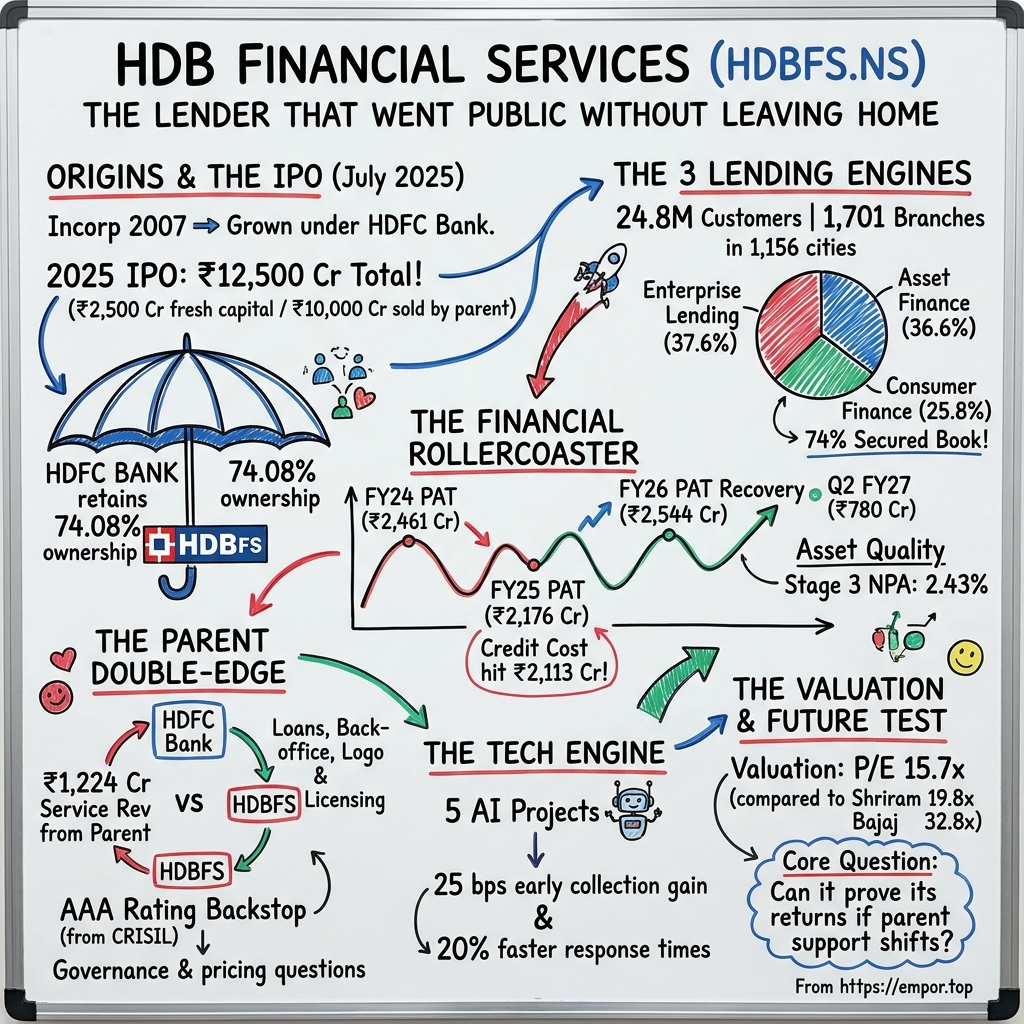
Look closely at who was paid, though, and the ceremony becomes more interesting. Only ₹2,500 crore of that money went to HDB Financial Services. The other ₹10,000 crore went to HDFC Bank, the company's parent, which sold part of its stake in an offer for sale.12 Four rupees out of every five raised that week left the company. The listing did not hand HDBFS to the public. It turned a wholly controlled subsidiary into a listed one, with HDFC Bank still holding the keys. Fourteen months later, in September 2026, the bank still owned 74.08% of the shares.4
That split is the right place to start, because it frames the two questions running through this story. The first is a lending question: can a diversified retail lender, serving millions of Indians whom banks often find too small, too informal or too risky, grow profitably through a full credit cycle? The second is a governance question: how independent is the listed business from the bank that owns three-quarters of it, funds part of it, buys services from it, and lends it a famous name? A public shareholder in HDBFS is buying an answer to both.
The boundary matters. HDFC Bank is one of the largest private-sector banks in Asia, and it is tempting to borrow its scale when describing the subsidiary. This story does not. The subject here is HDBFS's own loan book, its own branches and staff, its business-process-outsourcing arm, and its own financial statements. Where the parent appears, it appears as what it is to HDBFS: an owner, a lender, a customer, a supplier and a source of credit-rating support.
On its own terms HDBFS is big. At the end of September 2026 its gross loan book stood at about ₹1.24 lakh crore, spread across 24.8 million customers.67 That customer count is larger than the population of most countries, and every one of those customers is a small, retail borrower. The company describes its book as entirely retail, with an average exposure of roughly ₹1.66 lakh per customer.12 This is a lender that wins or loses one two-wheeler, one refrigerator and one truck at a time.
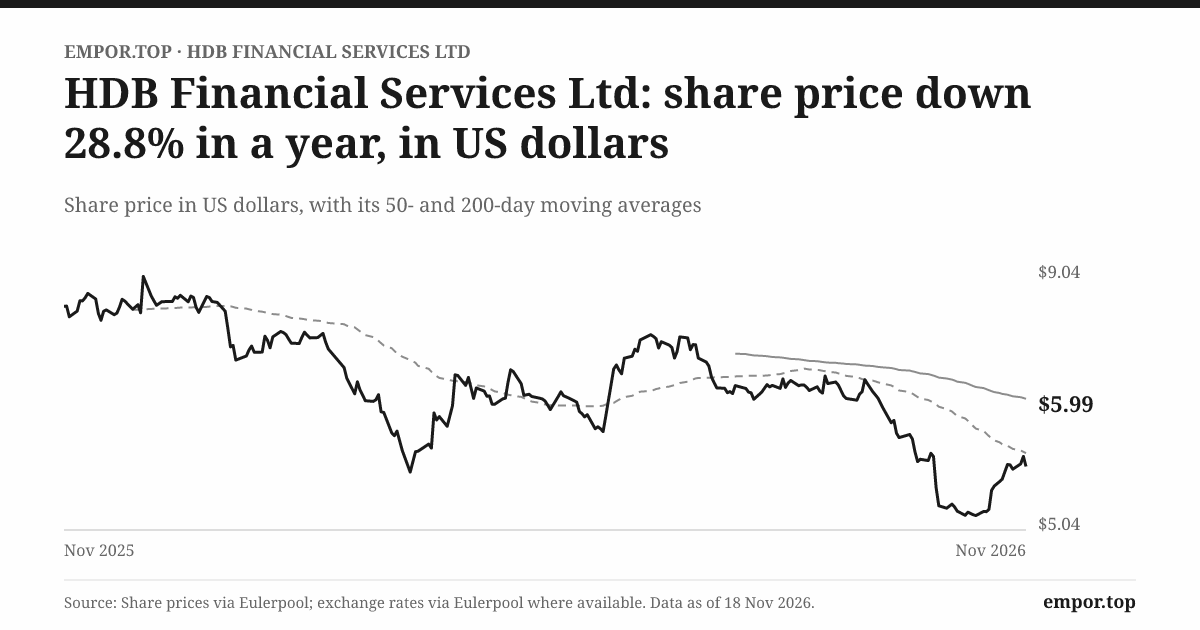
The stock market, meanwhile, has had a cooler reaction than the debut suggested. On November 18, 2026, the shares closed at about ₹559, roughly a quarter below the IPO price and about 29% below their 52-week high of ₹792, which put the company's market value at about ₹46,300 crore, or around $5 billion.13 For investors who bought in the unlisted market before the IPO the ride was harsher still: by one count close to 50,000 early holders were sitting on notional losses of up to 48% soon after listing, because grey-market prices had run far above the price the bankers eventually set.8 The public-market history is only about sixteen months long, which is too short to say much about how the market values this lender through good years and bad. It is long enough, however, to show that a famous parent does not guarantee a rising share price.
A brief word on the figures. Some data providers show HDBFS earning nothing at all in the September 2025 quarter, a quarter in which the company itself reported a profit of roughly ₹580 crore.69 The provider row is an error, and this story uses the company's own reported results throughout.
So the stage is set: a large, granular lender with a public listing, a powerful parent, and a share price that has gone the wrong way since day one. To understand what investors are really being asked to underwrite, it helps to go back to how this lender was built, and how much of that building happened under someone else's roof.
 Subscribe on LinkedIn
II. From a HDFC Bank Subsidiary to a Nationwide Lender
HDB Financial Services was incorporated in 2007, with its registered office in Ahmedabad, as a non-bank lender owned by HDFC Bank.5 The logic was simple and, for an Indian bank of that era, quite common. A bank's regulator, its cost structure and its credit culture are built around customers who show up with salary slips, tax returns and tidy collateral. India's vast middle—the truck owner with two vehicles, the shopkeeper whose income arrives in cash, the first-time buyer of a washing machine in a small town—often did not fit that template. A separately capitalised non-bank finance company could take those customers on with different underwriting, a different distribution model and different pricing, while the parent supplied capital, funding relationships and a trusted name.
G. Ramesh, who has run the company as chief executive since 2010 and as managing director since 2012, later described what lending looked like when the business opened its doors in 2008.1712 A sales officer would collect an application and a sheaf of supporting papers from a customer, carry the file back to the branch at the end of the day, and hand it to a credit officer who would only then begin to assess it. Ramesh, an MBA from Mumbai's Jamnalal Bajaj Institute who came up through transaction banking and operations roles rather than through a single lending product, has built the company's identity around the idea that this process could be industrialised without losing judgment.17 By April 2026, he told analysts, the customer's documents were scanned in real time on an app the salesperson carried, and in most of HDBFS's product lines the credit decision was made in the field, at the point of sale, rather than in an office.12
That change in process is the hidden engine behind the growth that followed. The customer franchise, which Ramesh put at about 5 million in 2020, reached 24.8 million by September 2026.127 Over the three years to March 2026, gross loans grew from about ₹70,000 crore to about ₹1.18 lakh crore, an increase of roughly 70%.1012 HDBFS was not merely riding a parent's coattails; it was signing up close to a million customers a month by management's own reckoning.12
Yet the most revealing number in that period is not the size of the loan book but what it earned. Revenue rose from about ₹12,400 crore in FY2023 to about ₹18,430 crore in FY2026, which works out to about 13.5% a year. Net profit rose from about ₹1,960 crore to about ₹2,540 crore, or only about 9% a year.109 Every year the book got bigger, but a smaller slice of each rupee of revenue reached shareholders. Growth in the loan book did not translate into equal growth in profit, and the reasons for that gap, rising funding costs and a painful credit year, will occupy much of this story.
The longer record makes the same point more sharply. In FY2021, the first pandemic year, HDBFS earned just ₹391 crore; in FY2022 profit recovered to about ₹1,011 crore.5 A lender that would later earn more than ₹2,500 crore in a year had, five years earlier, seen its earnings almost wiped out by one shock. That history belongs at the front of any discussion about "resilience."
Then came the event that defines the company's current form. India's central bank had designated HDBFS an upper-layer non-bank lender, a category reserved for the largest and most systemically important NBFCs, and that classification carried a requirement to list on the stock market.5 The 2025 IPO was the result, but it did not change control.12
Since the listing, ownership has barely shifted. HDFC Bank's stake eased from 74.19% in September 2025 to 74.08% a year later, mostly as employee options were allotted.114 Foreign institutions edged up from about 3.2% to about 4.0% of the shares over that time, a modest vote of interest from global funds. The number of individual shareholders moved the other way, falling from about 1.16 million to about 881,000.114 In plain terms, roughly a quarter of the retail investors who arrived for the IPO had left within a year, many of them, presumably, at a loss.
It is worth being precise about how HDBFS deployed its capital over this period, because it rules out a familiar story. There was no transformational acquisition. The company's spending on fixed assets such as offices, computers and software ran at about ₹120 crore to ₹210 crore a year between FY2024 and FY2026, about 1% of revenue.109 Almost all of its capital went into one thing: loans. The growth story is organic, which is reassuring in one sense, because there are no goodwill write-downs waiting in the wings, and demanding in another, because it means the quality of the franchise depends entirely on the quality of the lending.
The strongest evidence of independence, then, is the breadth of the loan book itself, not any separation from the parent's money, brand or relationships. Which raises the obvious next question: what exactly is HDBFS lending against, and to whom?
III. Three Lending Engines, One Credit Cycle
Picture a Saturday evening at a consumer-electronics shop in a mid-sized Indian town. A family has picked out a television. The retailer opens an app, keys in a few details, and within minutes a loan is approved. Ramesh has said that the bulk of HDBFS's consumer-finance business happens between five and eight in the evening, often at weekends, and that those three hours decide how many customers a salesperson can turn around.7 Across town, a truck owner who wants to add a second used vehicle is sitting with a dealer. On the highway outside, a small manufacturer is pledging the deed to his workshop to borrow for new machinery. All three applications may end up at the same company, routed through one of its 1,701 branches across 1,156 cities and towns.6
Those three scenes are HDBFS's three engines. Enterprise lending, which finances small businesses through loans against property, unsecured business loans and gold loans, made up about 38% of the gross loan book in September 2026. Asset finance, which pays for commercial vehicles, construction equipment and tractors, made up about 37%. Consumer finance, which covers durables, digital products, two-wheelers, cars and personal loans, was about 26%.6 Roughly three-quarters of the book was secured by some kind of collateral.7 No single product defines the company, and that diversification is the first thing to understand about its economics: when one engine sputters, the others can keep the plane in the air.
The engines run at very different speeds. Average loan tenors at the time of the IPO were about six years for enterprise lending, four for asset finance and two for consumer finance.5 That matters more than it sounds. A two-year consumer loan pays itself down quickly, so the consumer book must be refilled constantly just to stand still; a six-year loan against property compounds the book for longer but ties up capital for longer too. When management talks about "repayment rates hurting growth," as it did in October 2026, it is describing exactly this treadmill.7
The engines have also been running in different directions. In FY2026 the gold-loan book doubled and consumer finance grew about 19%, led by durables and car loans, while asset-finance disbursements actually fell about 3% for the year as the company pulled back from stressed corners of the used-vehicle market.127 By the September 2026 quarter consumer-durable loans were growing about 49% a year and gold-loan disbursements more than 60%, while the commercial-vehicle book was growing only about 8%.7 The ticket sizes show how different these businesses are: an average loan against property of about ₹46 lakh and an enterprise business loan of about ₹14 lakh sit beside consumer loans worth a small fraction of that.7 Ramesh is careful to say HDBFS does not do the very small property loans the market calls micro-LAP.7 The mix shift matters because the fastest-growing engines are the shortest-tenor ones, so they lift disbursements faster than they lift the book, and because consumer and gold loans carry different loss patterns from trucks. Diversification is protecting HDBFS's growth today. It is also quietly changing what kind of lender HDBFS is.
Lending is the economic core. In FY2026 interest income was about ₹15,800 crore of total revenue of about ₹18,430 crore.9 The rest came from fees such as processing charges, collections income and insurance commissions, and from services, chiefly business-process work performed for HDFC Bank. That services business brought in about ₹1,224 crore, or roughly 6.6% of revenue.9 That services line is real money, but it is not why investors own this company. They own it for the spread between what HDBFS charges borrowers and what it pays to borrow.
The spread has had an eventful few years. Between FY2023 and FY2025 HDBFS managed to lift its average yield on loans only modestly, from about 13.6% to about 14.0%, while its average cost of borrowing climbed much faster, from about 6.8% to about 7.9%, as India's interest rates rose.510 The squeeze showed up in the net interest margin, the lender's equivalent of a gross margin, which fell from about 8.3% to about 7.6%. Then funding costs eased. The company's chief financial officer, Jaykumar Shah, explained in April 2026 that the last of HDBFS's older borrowings had reset by late 2025 and that the treasury had refinanced more expensive debt; the margin recovered to about 8.0% for FY2026 and about 8.2% in the September 2026 quarter.127 By October 2026 Shah put the company's borrowing cost at about 7.04%.7 In other words, a large part of the margin recovery came from the liability side, not from any newfound pricing power with borrowers.
Shah's own explanation supports that reading. He told analysts that the company had "held on to our rates" across products for three quarters, and that a small dip in yields was a matter of product mix, because the higher-yielding unsecured business book had not been growing.12 Holding rates in a falling-rate market is a sign of discipline, or of customers who are not very price-sensitive. It is not the same as being able to raise prices. That test arrived on October 7, 2026, when India's central bank raised its policy rate by 25 basis points.7 Shah said the floating-rate property-loan book would reprice and that other products would follow "in a calibrated manner."7 Whether HDBFS can pass higher funding costs on to customers without losing volume is one of the cleanest pricing-power tests the company has faced as a listed business.
The competition is formidable, and it differs by engine. In consumer lending, the obvious rival is Bajaj Finance, which pioneered point-of-sale consumer durable loans in India and operates at much greater scale. In vehicles and small-business credit, Shriram Finance has decades of relationships with used-truck owners that HDBFS is still trying to match; Shah conceded in April 2026 that HDBFS was "much smaller today than a lot of established players" in used vehicles.12 Cholamandalam Investment and Finance, Tata Capital and L&T Finance compete across overlapping products. None of these companies has the same mix, so market-share comparisons are rough at best.
Behind the named rivals sits a structural contest. Banks have cheaper deposits and existing customer relationships, and they keep moving down-market. Specialist NBFCs compete on product knowledge, dealer relationships and underwriting judgment in niches banks find awkward. Fintech lenders and informal moneylenders squeeze particular channels, especially small-ticket unsecured credit. HDBFS sits in the middle: not as cheaply funded as a bank, not as specialised as a single-product NBFC, and therefore dependent on two things, reach and discipline.
Reach is the claim management makes most forcefully. Ramesh told analysts in April 2026 that HDBFS's network of more than 1.6 lakh retail and dealer touchpoints let it offer manufacturers coverage of "1,000+ cities" rather than a hundred or two, and he called that "a strong moat" that "is not easily replicable."12 He also said the do-it-yourself digital channel, through which existing customers take new loans on the app, had multiplied disbursements by about 2.2 times in FY2026.12 Those are genuine operating capabilities. The evidence that they create a moat is thinner. The company's 20 largest borrowers were only about 0.33% of loans in September 2026, which shows how granular the book is, but granularity is a statement about risk, not loyalty.6 HDBFS does not publish repeat-borrowing rates, customer-acquisition costs per loan or the share of disbursements going to existing customers, the metrics that would show whether reach translates into cheaper growth.
There is also a revealing tension inside the reach story. The branch count fell from 1,730 at March 2026 to 1,701 by September, and headcount fell too.127 Management presents this as productivity: consolidating small offices, moving decisions to the field, letting technology carry more of the load.127 That is plausible. It also means the "physical network" moat is being deliberately thinned, which suggests the company itself sees branches as a cost to be optimised rather than an untouchable advantage.
The trade-off, then, is clear. A wider, mostly secured book across three engines can support growth for years. But growth only creates value if the spread survives two expenses: the cost of running the network, and the cost of borrowers who do not pay. HDBFS learned how expensive the second one can be in the year just before it went public.
IV. The Margin Recovery Came After a Costly Credit Year
FY2025 should have been a triumphant year. The loan book grew about 18.5%.10 The IPO paperwork was being prepared. And yet net profit fell about 12%, from about ₹2,460 crore to about ₹2,180 crore, as the cost of bad loans rose.10 HDBFS went into its listing with a profit decline in its most recent full year, which is not how investment bankers usually like to tell a story.
The full record is uneven rather than steadily rising. Profit grew about 26% in FY2024, fell about 12% in FY2025, and then rose about 17% in FY2026 to about ₹2,540 crore.109 Over the whole span from FY2023 to FY2026 profit grew about 9% a year, well behind revenue growth of about 13.5%. In the September 2026 quarter HDBFS earned ₹780 crore, up 34% from a year earlier, and the company's annualised return on equity reached 14.4%.7
The mechanism behind the FY2025 drop was not mysterious. As the book expanded, the expected-credit-loss charge, the accounting provision lenders book for loans they expect to go bad, rose to about ₹2,110 crore.10 That is almost exactly the same size as the year's profit. Put simply, for every rupee HDBFS kept for shareholders in FY2025, it set aside roughly another rupee to cover borrowers who would not repay. In FY2026 the impairment charge rose again, to about ₹2,820 crore, but profit recovered anyway, because the book was larger, margins had widened and costs were better controlled.9 The recovery was therefore not a return to low credit costs. It was the business growing into a higher, apparently more normal, level of credit cost.
Asset quality tells the same story with a lag. Gross non-performing assets, which HDBFS reports as Gross Stage 3 and defines as loans more than 90 days overdue, were about 2.7% of loans in FY2023, improved to about 1.9% in FY2024, and then deteriorated to about 2.3% in FY2025.510 The stress kept building after the IPO, peaking at about 2.8% in the September and December 2025 quarters, before improving to about 2.4% by March 2026.127 Since then the ratio has drifted in a narrow band: 2.3% in June 2026 and 2.4% in September.7 The worst moment of this cycle arrived just after HDBFS became a public company, and the improvement since has been real but has stalled rather than continued.
The segment numbers show where the damage was concentrated. In asset finance, gross Stage 3 jumped from about 3.1% to about 4.3% over the course of FY2026 before easing to about 3.8% by March 2026.12 Shah described the recovery as "slightly K-shaped": newer delinquencies were being cured quickly, but accounts that had soured around mid-2025 were recovering poorly.12 In enterprise lending, management had deliberately slowed unsecured business loans to repair asset quality; Shah declared in April 2026 that the company was "completely over it."12 Six months later the unsecured business book had only just returned to sequential growth, up 0.2% on the previous quarter after six quarters of shrinkage.7
There is a deeper test of the resilience claim, and it is older. In FY2021, when the pandemic closed India's roads and shops, HDBFS's gross NPA ratio climbed to about 4.5%.5 That is almost double the current level. It came from an extraordinary shock, and the company's underwriting, collections technology and book mix have changed since. But it is the strongest disconfirming evidence in HDBFS's own record against any claim that granular retail lending is safe because it is granular. Diversified small loans protect a lender from one big borrower going bust. They do not protect it from millions of small borrowers being hit by the same event at once. The pandemic narrows the resilience claim to a smaller, more defensible version: HDBFS's book can absorb ordinary cycles with profit dented but intact, and it took a severe shock to push earnings close to zero.
The cushion against losses is moderate rather than lavish. Provision coverage on Stage 3 loans was about 55% at both March and September 2026, meaning the company had already set aside about 55 rupees for every 100 rupees of bad loans.127 Net write-offs, loans given up as uncollectable, were about ₹2,530 crore in FY2026.9 Because three-quarters of the book is secured, the remaining 45% is backed in part by trucks, property and gold, though repossessed trucks rarely fetch what the loan was worth.
The October 2026 earnings call offered a useful window into how management handles hard questions. Ramesh's prepared remarks were confident: disbursements up 18%, profit up 34%, festive demand ahead, "a strong H2."7 The analysts were less interested in the headlines. Raghav Garg of Ambit Capital asked why Stage 2 loans, those 30 to 90 days overdue and the pipeline for future bad loans, had built up faster than in the same quarter of the previous two years. Shah answered that the stretch was in commercial vehicles, that it was "seasonal," and that he expected it to revert "in the coming quarter," without giving a figure.7 Shreepal Doshi of Equirus pressed on the rise in Stage 2 plus Stage 3 in asset finance; Shah said a nine-basis-point rise was in line with seasonality and partly a "denominator impact" of slower book growth, and that he was "not completely stressed about it."7
That pattern is worth noting without overstating it. Management did answer, and it gave one firm benchmark: credit costs managed in a range of about 2.3%, plus or minus, over the medium term.127 On that measure the record is consistent. Credit cost was about 2.3% in the March 2026 quarter, June and September.127 Where the answers became less concrete was the forward path of Stage 2 and the used-vehicle book, which management has been promising to fix for several quarters. In April 2026 Shah said he was "very hopeful" of reporting progress in used vehicles within three months; in October he said the used segment still faced "certain challenges" and that the longer-dated delinquent book had not yet turned.127 Missing one self-imposed checkpoint is not damning. It is a reminder to judge the recovery by the numbers, not the adjectives.
One measurement caution belongs here too. Generic operating-margin and net-margin figures, the kind data providers compute for industrial companies, say little about a lender, because interest costs are its cost of goods. The measures that matter are the ones above: net interest margin, credit cost, Stage 2 and Stage 3, the cost-to-income ratio, and return on assets and equity. On those measures HDBFS ended FY2026 with a return on assets of about 2.2% and return on equity of about 13.9%, and by September 2026 the quarterly figures had improved to about 2.4% and 14.4%.127 Management's stated aim is a return on assets of 2.5% "reliably" on an annual basis.7
The verdict is therefore a cautious one. The recovery is real: profit is growing, credit costs have stabilised near guidance, and margins are higher. But one good year and one strong quarter do not establish through-cycle earnings power, especially when the gross bad-loan ratio has crept back up and the Stage 2 pipeline is building. The crucial tests are still ahead. And they will be taken by a company whose most important relationship is not with any borrower at all.
V. The Parent Relationship Is Both a Backstop and a Bargaining Question
Turn to the related-party note in HDBFS's FY2026 annual report and the parent appears on both sides of the ledger at once. HDFC Bank is a customer, paying HDBFS for back-office and collections work. It is a supplier, receiving fees from HDBFS for sales support, back-office services and the right to use its logo. And it is a lender, charging interest on term loans and overdrafts it has extended to its own subsidiary.9 Few listed companies have a single counterparty that is simultaneously their largest service customer, a meaningful lender and their controlling shareholder.
Take the flows one at a time. HDFC Bank paid HDBFS about ₹1,224 crore in FY2026 for services, about 6.6% of HDBFS's revenue.9 Money also flowed the other way. HDBFS paid the bank about ₹737 crore for sales support, about ₹207 crore for back-office services, about ₹39 crore in logo licence fees, about ₹568 crore of interest on term loans and overdrafts, and about ₹10 crore of interest on debentures the bank held.9 At year-end, HDFC Bank's term loans and overdrafts to HDBFS stood at about ₹8,770 crore.9 Net the services against the fees and the relationship looks roughly balanced in cash terms; add the interest and HDBFS pays the bank more than it receives. None of that is unusual for a subsidiary. What it means is that the "independent" economics of the listed company cannot be cleanly separated from the terms it negotiates with its owner.
The relationship goes well beyond these lines of the income statement. HDFC Bank is the controlling shareholder, which means it controls the shareholder vote on board appointments and, in practice, has the final say on strategy. It is a source of funding, which matters for an NBFC that must borrow constantly. And it is a source of credit strength: CRISIL, the rating agency, explicitly builds expected support from HDFC Bank into its rating analysis.14 CRISIL has long described HDBFS as strategically important to the bank, with shared branding and management oversight.16
The company describes all of its related-party transactions as in the ordinary course of business and at arm's length.9 That description belongs alongside the figures, not in place of them. In March 2026, HDBFS asked shareholders by postal ballot to approve a ceiling for FY2027 related-party transactions with the parent of about ₹48,200 crore.15 That number is large, roughly two-fifths of the loan book, but it is an authorisation ceiling covering every type of transaction, including borrowing, investment and service flows, rather than a forecast of turnover. The resolution passed easily. About 2.3% of votes cast opposed it, and about 2.4% of institutional votes.15 Because HDFC Bank, as a related party, would not normally vote on such a resolution under Indian rules, the dissent came from a narrow pool of minority holders, which makes even a small "no" vote a signal worth noting. Most institutions were comfortable; a few wanted the board to know they were watching.
What the evidence shows is bounded. HDFC Bank is HDBFS's largest disclosed service customer, but the lending business, which generates most of the money, is extraordinarily granular. Where concentration exists, it exists in the services business and the funding mix, not in the loan book. HDBFS does not disclose its top-five or top-ten service customers, so the degree to which its BPO arm depends on the parent beyond the headline ₹1,224 crore is not visible.9
A skeptical public shareholder would ask a simple set of questions. What would an independent lender of HDBFS's size pay for funding, branding and sales support? Is the logo fee a fair price for the HDFC name's effect on borrowing costs and customer trust, or a royalty a stand-alone company would never agree to? Are the services HDBFS sells to the bank priced at what an outside BPO provider would charge? The annual reports disclose the amounts. They do not provide an external pricing benchmark against which a minority holder could judge the terms.9 That is not evidence of unfairness. It is evidence that the fairness question cannot yet be settled from public documents.
The tension cuts both ways, and both edges are real. Parent support helps HDBFS borrow cheaply and maintain a top-tier credit rating, which is a genuine economic advantage over many independent NBFCs. The same support makes the quality of governance, and the terms of dependence, more important than they would be at a stand-alone lender. The value of the parent is not in doubt. The question is how much of that value accrues to the 26% of shareholders who are not the parent. That question becomes most concrete in the place where the parent's support shows up most visibly: the balance sheet that funds the loans.
VI. A AAA Rating Built on Lending—and on the Parent
At March 31, 2026, HDBFS owed about ₹99,230 crore to its lenders, not counting leases.9 That is almost a lakh crore of borrowed money, a mix of bank loans, bonds and debentures, external commercial borrowings, securitised loans and subordinated debt. In October 2026 CRISIL reaffirmed its top rating, AAA with a stable outlook, on the long-term debt, and its highest short-term rating, A1+, on commercial paper.14 For a lender whose raw material is borrowed money, that rating is close to the most valuable asset it owns.
Start with the cash flows, because they look alarming to anyone used to reading the accounts of a manufacturer. HDBFS reported negative operating cash flow every year in the recent record: about ₹13,600 crore of cash used in FY2025 and about ₹8,600 crore in FY2026.109 For an industrial company, that would be a red flag that profits were not turning into cash. For a lender, it is closer to the opposite. When HDBFS makes a loan, the cash leaves through the operating line of the cash-flow statement, because lending is its operation. In FY2026 the increase in loans consumed about ₹14,100 crore, more than the entire operating outflow.9 The money to fund that came from the financing line, where HDBFS raised a net ₹10,700 crore or so from lenders and bondholders.9 Negative operating cash flow here is the shadow of a growing loan book, not evidence that earnings are failing to convert.
The implication is that the real cash-flow question for HDBFS is not "does profit become cash?" but "can the company keep borrowing on good terms, and do its loans repay on schedule?" That is why the funding structure matters so much. Shah told analysts in October 2026 that bank loans were about 43% of borrowings, and that 55% to 60% of those bank loans were linked to the central bank's repo rate, so they would reprice quickly when rates rose.7 He also pointed to a positive cumulative maturity match in every time bucket up to five years, meaning HDBFS expected more money to come in from loan repayments than it owed to lenders in each period.7 And he highlighted that commercial paper, the shortest and most fickle form of funding, remained a small part of the mix, "dry powder" in his phrase.12
CRISIL's reasoning is the most important outside view of this structure, and it should be read carefully. The agency cites HDBFS's franchise, its distribution, its capital position and its ownership by HDFC Bank as strengths, and it flags moderate asset quality and the sensitivity of earnings to credit costs as constraints.14 At September 2026, it noted a gross NPA ratio of about 2.4%, capital adequacy of about 21.4%, and gearing, debt relative to net worth, of about 4.7 times.14 The capital number is comfortable: HDBFS holds well over the regulatory minimum, partly thanks to the IPO's fresh equity. The gearing number is moderate for a retail NBFC. And then comes the line every shareholder should underline: CRISIL lists a weakening of HDFC Bank's support, or of the bank's own credit profile, as a factor that could lead to a downgrade.14 The rating, in other words, partly reflects HDFC Bank's support.
There is a reassuring historical fact here, bounded to its period. HDBFS's auditor gave an unmodified opinion on the FY2026 accounts, and the statutory audit report recorded no default in repaying lenders during the year.9 Management reported eight instances of fraud, together worth about ₹4.6 crore, small against a book of more than a lakh crore but a reminder that a lender of this scale fights leakage every day.9 Contingent claims not acknowledged as debt, chiefly provident-fund, bonus, tax and borrower-related cases, were about ₹130 crore, modest relative to the company's size.9 These are facts about one year. They are not a guarantee about future refinancing.
Currency adds a quieter layer of risk. HDBFS earns almost entirely in rupees, but it had about ₹12,300 crore of external commercial borrowings in March 2026, up from about ₹9,000 crore a year earlier.9 It uses cross-currency swaps and forward contracts to hedge those loans back into rupees.9 Hedging removes most of the direct exchange-rate risk, but it does not make the funding free of risk: the cost of the hedge can rise, counterparties must perform, and the economics of borrowing abroad depend on conditions in two markets at once. HDBFS does not disclose a standalone annual foreign-exchange gain or loss, so the residual sensitivity after hedging is not visible in its reports.9
The October 2026 rate increase is the live test of all this. Shah acknowledged that new bond issues were pricing around 8.2% to 8.25%, well above the company's blended borrowing cost of about 7.04%.7 When a Kotak analyst asked whether rising rates would inevitably push that cost up, Shah answered that the company would manage the mix of instruments and benchmarks to keep the increase "as low as possible," and that the aim was "not to lose NIM."7 That is a reasonable treasury answer. It is also an admission that the tailwind which rebuilt the margin in FY2026, falling funding costs, has turned.
The key investor test, then, is simple to state and hard to answer in advance. If asset quality weakens at the same time as funding costs rise, can HDBFS's funding sources and maturities keep pace with its collections and its loan growth? So far the answer has been yes, helped considerably by the parent's name. Management's plan for making the business more efficient regardless of the funding cycle rests heavily on a word now heard on every Indian earnings call: AI.
VII. Five AI Projects, One Early Proof Point
In the first months of 2026, a borrower somewhere in India missed an instalment by a few days. Not long ago the next step would have been a call from a human collections agent working through a list. In the March 2026 quarter, for more than half of the customers who needed that kind of early nudge, the call came instead from a bot.12 Ramesh reported the result to analysts in April: collection efficiency in the early overdue buckets improved by about 25 basis points.12 He was careful to call it "still an early stage."12
The early stages of collections are where small gains matter most. A loan that slips from a few days late to a few months late is far more expensive to recover, and every account cured early is one that never reaches the provisioning line. Across a book of 24.8 million customers, a quarter of a percentage point of better collection efficiency is a lot of rupees that do not have to be chased later. The same April call described a second measurable result: an in-house language model that sorts customer-service queries automatically had cut response times by about 20%.12 Ramesh said the company was running five large AI initiatives in all, under a programme it calls Shikhar, and by October 2026 he reported that more than one in five telecalling calls to early-stage overdue customers went through an AI-powered bot, and that an AI-led onboarding project had started in consumer finance.127
Those are specific, sourced, operating claims, and they deserve credit for being specific. They also deserve proportion. Twenty-five basis points of early-bucket improvement in one quarter is a promising signal, not a cost advantage. A 20% faster response time is a service improvement, not a profit line. Neither has yet shown up in a disclosed, sustained series for cost per account or credit loss per customer, which are the numbers that would prove the technology changes the economics. HDBFS has not disclosed an AI-derived revenue stream, and it has not published a multi-quarter series of collection or cost metrics attributable to these tools.
The spending is rising, which is at least consistent with the ambition. Information-technology expense rose to about ₹171 crore in FY2026 from about ₹128 crore a year earlier, an increase of about a third.9 Fixed-asset purchases, which include hardware and software, have run at around ₹140 crore to ₹210 crore a year.109 Those amounts are modest relative to revenue of more than ₹18,000 crore, so the technology programme is not a financial gamble; it is an operating bet.
The clearest early sign that technology is doing real work is not in the AI announcements at all. It is in the cost-to-income ratio for the lending business, which improved from about 43% in FY2025 to about 39% in the September 2026 quarter.127 At the same time, branches and headcount fell while customer numbers kept growing. When a Nirmal Bang analyst asked in October whether lower costs reflected productivity or a retreat from some regions, Ramesh said the number of towns served had not fallen and that dealer and retailer touchpoints had grown about 10% to about 1.65 lakh; the company simply needed "lesser headcount on the field to service customers."7 In April, Ramesh had already explained the logic: in an era when a salesperson no longer carries files or collects cash, he could work remotely and visit a branch once a month, so a small office in a location that a neighbouring branch could serve was no longer worth keeping.12 That is a coherent explanation. It is also exactly what an investor would want to verify over several more quarters, because cutting branches and staff can lower costs for a while before it starts to hurt origination or collections.
Analysts did push on the practical payoff. When Shreya Shivani of Nomura asked for guidance on operating-cost ratios for FY2027 and the following two years, given the AI investment, management declined to give a number and pointed instead to the goal of a 2.5% return on assets, promising that AI spending would not be allowed to "balloon where it hurts us."7 Ramesh's broader answer, in April, was that every technology project carries metrics for time, cost and quality, and that the company tracks them.12 The metrics themselves are not published.
The fair verdict is that HDBFS has early, real proof points in collections and service, and that the bigger "AI-powered" framing outruns them. The question that leads back to the core business is the right one to keep asking: does technology help HDBFS underwrite and collect better than Bajaj Finance, Shriram or the banks, or does it mainly help it operate a huge, granular book at a tolerable cost? The second outcome is valuable. Only the first would be a moat. And whether it becomes one depends heavily on the people running the programme.
VIII. What the Record Says About the People Running It
When Ramesh began FY2026, he did so as a chief executive whose company had just reported a fall in annual profit, with an IPO less than three months away. He has been the face of HDBFS for most of its life, so the growth, the FY2025 stumble and the recovery all happened on his watch.17 His style on earnings calls is that of an operator rather than a salesman: he talks in process details, the 600-square-foot branch, the dealer in Jorhat who should get the same credit turnaround as one in Mumbai.127 Much of the financial detail is left to Jaykumar Shah, the chief financial officer, who handles analysts' questions on margins and credit with a mix of numbers and reassurance. Both men remained in their roles through the October 2026 call.7
The medium-term ambition that management has repeated since the listing is loan growth of nominal GDP plus 6% to 7%, which in today's India implies something in the high teens.12 Measured against that ambition, the record so far falls short. Gross loans grew about 11% in FY2026 and about 12% in the year to September 2026.127 Viral Shah of IIFL Capital put the point bluntly in October: this would be the second year in which growth would probably not reach 17% to 18%, so could management be confident of getting there in FY2028? The CFO replied that he was "very hopeful that we should be moving pretty much in that direction."7 It was candid, and it was not a commitment.
Other promises have fared better. Management said it wanted credit costs of about 2.3%, plus or minus, and quarterly credit costs have landed between about 2.3% and 2.4% since.127 It called an 8%-plus margin "non-negotiable" in April 2026, and the margin has remained above 8% since.127 Disbursement growth, which analysts said would need to reach 18% to 20% to lift book growth, reached about 18.7% in the September 2026 quarter.127 The cost-to-income ratio improved, as did the margin, which rose from about 7.6% in FY2025 to about 8.0% in FY2026.12 On the things management controls most directly, pricing, costs and the speed of disbursement, it has largely done what it said. On the things it controls least, used-vehicle demand and borrower behaviour in a stressed segment, it has been slower than its own hopes.
Pay is a second lens. Ramesh received about ₹9.61 crore for FY2026, including a bonus of about ₹1.22 crore and about ₹2.85 crore in the reported value of stock options he exercised.9 His remuneration rose about 7% in the year in which the company's FY2025 profit had fallen about 12%; profit then recovered about 17% in FY2026.9 The exercised-option figure is a perquisite value under Indian tax rules, not cash paid by the company in that year, and it reflects options granted in earlier years, so it overstates how much of his pay depended on FY2026 alone. Even so, a raise in a year of falling profit invites scrutiny, and the board's disclosures do not explain the link between the pay outcome and the profit outcome in detail.
The incentive structure is the more important point. HDBFS is not a founder-led company. Its controlling owner is HDFC Bank.4 Ramesh's alignment with public shareholders comes through stock options, not through a large personal stake built over decades. That is a perfectly normal structure for a bank subsidiary, but it shapes the governance question. A founder-owner's wealth rises and falls with the share price; a professional chief executive inside a bank group answers, ultimately, to the parent's board. Where the interests of the parent and minority shareholders coincide, growth, good credit and a strong rating, that difference does not matter. Where they could diverge, in the pricing of intra-group services or funding, it might.
The board reported a majority of independent directors.9 The institutional dissent on the related-party ceiling was limited but real.15 It is best read as a signal to track alongside the actual transaction disclosures, not as a verdict.
Comparing the two most recent calls shows a management team that acknowledges problems and describes plans, but rarely attaches numbers to the timing. In April 2026 Shah called the enterprise-lending and commercial-vehicle problems "over" and promised growth.12 In October the enterprise book was indeed growing again, while used commercial vehicles still lagged. The recovery narrative is broadly supported by the operating results. It is less well supported by the pace of loan growth, which is the one number the market seems most focused on. That gap is visible in the share price.
IX. The Price of a Still-Young Listing
On November 18, 2026, HDBFS shares closed at about ₹559, almost 30% below their 52-week high and about a quarter below the price at which the IPO was sold.13 At that price the market valued the company at about 15.7 times its trailing twelve-month earnings of about ₹35.7 a share, and at about 2.6 times its revenue.13 Against the book value of about ₹267 a share that HDBFS reported for September 2026, the shares traded at roughly 2.1 times book.7
Those numbers only make sense when read against what the business earns. A lender with a return on equity of about 14%, the figure HDBFS reported for the September quarter, that trades at about twice its book value is being priced as a solid, moderately growing franchise rather than a high-growth compounder.7 The market is not assuming that HDBFS will match the returns of India's best NBFCs. It is also not pricing it as a lender in distress. It is, in effect, waiting for evidence.
Peers provide some context, though not a controlled experiment. In mid-October 2026, Shriram Finance traded at about 19.8 times earnings and Bajaj Finance at about 32.8 times.13 HDBFS trades below both. But the comparison is loose. Bajaj Finance has a longer listed record of high returns on equity and a larger, more consumer-heavy book, and it commands a premium partly for that history. Shriram is the specialist in used commercial vehicles, the very segment where HDBFS is still trying to catch up. The dates of the peer snapshot and the HDBFS quote are a month apart. And the multiples say nothing about how each company's credit costs will behave in the next downturn.
The more honest observation is what the valuation cannot show. HDBFS has no five-year median multiple, because it has been listed for only sixteen months. A price-to-earnings ratio of about 1.7 times its growth rate, the so-called PEG ratio, rests on a growth history that includes both the FY2025 profit decline and the strong FY2026 rebound, which makes it a fragile guide.13 A simple piece of arithmetic shows what the price assumes. If an investor pays about 2.1 rupees for every rupee of book value and the company earns about 14 paise a year on each rupee of equity, the investor's starting earnings yield is a little under 7%, roughly the inverse of the price-to-earnings ratio. That return is respectable but not generous for a lender exposed to Indian credit cycles, at a time when the company's own new bonds yield around 8.2%.7 For the price to look cheap in hindsight, HDBFS needs either to lift its return on equity towards the high teens, by reaching its 2.5% return-on-assets goal, or to grow the book fast enough that each year's earnings are meaningfully larger than the last. For it to look expensive, a renewed rise in credit costs of the kind seen in FY2025 would be enough, because a lender at about 2% return on assets has little room before a bad year cuts profit sharply.
Capital return is only beginning. HDBFS paid no dividends in the three years before listing, keeping every rupee of profit to fund the loan book, and in October 2026 its board declared an interim dividend of ₹2 a share.107 Against quarterly earnings of about ₹9.4 a share, that is a token payout, and it signals that the company still sees growth, not distribution, as the main use of its capital. For a lender with capital adequacy above 21%, that is a choice rather than a necessity, and it puts the onus on management to show that retained profit earns more inside the business than it would in shareholders' hands.7
What the market seems to need is evidence that growth can turn into durable returns without relying on unusually benign credit costs or the parent's support. That is the evidence the final sections of this story weigh.
X. Analysis & Bear vs. Bull Case
Every quarter, HDBFS faces the same three-sided decision. It can push harder on growth and risk weaker credit. It can tighten underwriting and give up volume. Or it can try to fund the gap between the two more cheaply. At September 2026 the scoreboard read as follows: a loan book of about ₹1.24 lakh crore growing about 12% a year, gross Stage 3 of about 2.4%, a margin of about 8.2% and an annualised return on equity of about 14.4%.7 The bull and bear cases are two readings of the same record.
The bull case starts with scale that is hard to replicate. HDBFS reaches 24.8 million customers through about 1,700 branches in more than 1,150 towns and over 1.6 lakh dealer and retailer touchpoints.67 Three-quarters of the book is secured. No single product, region or borrower dominates. Costs are falling as a share of income, margins are back above 8%, and credit costs have held near guidance for a year. Funding is cheap relative to most independent NBFCs, capital is ample, and the AAA rating gives the company a cost of debt many rivals would envy. If loan growth accelerates to the high teens that management targets while credit costs stay near 2.3%, return on assets could move towards management's 2.5% goal, and return on equity towards the high teens.
The bear case uses the same facts. Profit fell 12% in the year before the IPO. Asset quality deteriorated sharply after listing and has stalled, not continued to improve, in 2026. The pandemic showed that a granular book can still see gross bad loans approach 5%. Loan growth has lagged management's ambition for two years. The margin recovery owed a great deal to falling funding costs, which have now turned. The company's fee income faces a regulatory question: insurance distributors' commissions are under review, and Shah said in October that HDBFS earned about ₹455 crore in such fees in the latest year, roughly 0.3 percentage points of return on assets.7 And the strongest single support for the company's funding, its AAA rating, is partly a function of a parent that is also its biggest counterparty.
The industry structure explains why neither case is a slam dunk. Rivalry is intense. Banks keep moving down-market with cheaper deposits, specialist NBFCs such as Shriram and Bajaj have deeper roots in particular niches, and fintech lenders compete hard for small unsecured loans. Suppliers of capital—banks and bond investors—have real bargaining power over an NBFC that must borrow continuously; HDBFS's parent relationship softens that power without eliminating it. Borrowers have many alternatives, especially for consumer and vehicle loans, which limits pricing. HDBFS's borrower base is too fragmented for any one customer to bargain, but fragmentation does not create switching costs, and a borrower can take the next loan from a rival. The threat of substitutes is real in digital lending and in gold loans. And regulation, the capital, provisioning and listing rules that come with upper-layer NBFC status, shapes returns for everyone in the industry and pulls HDBFS's economics closer to a bank's, as Shah himself observed.12
Hamilton Helmer's seven powers framework sharpens the moat question. Scale economies are the most credible power HDBFS has: a nationwide distribution and collections infrastructure spreads fixed costs across millions of small loans, and the falling cost-to-income ratio suggests the effect is real. Cornered resource is the second candidate, in the form of the HDFC name and parent support, which lowers funding costs. But it is shared with, and controlled by, the parent, and it comes with the related-party terms already described. Switching costs are weak in retail lending. Network effects are essentially absent. Counter-positioning does not apply; HDBFS is doing what its rivals do. Brand helps, but the brand belongs to the parent. Process power, a superior underwriting and collections machine, is the power that would matter most. The evidence for it is so far incomplete, given the FY2025 stress, the K-shaped asset-finance recovery and the absence of published repeat-borrowing or loss-rate comparisons.
The moat conclusion is therefore narrower than management's. Ramesh calls the distribution network "a strong moat" that "is not easily replicable."12 The network is concrete, and reproducing it would take years. But public evidence on customer retention, acquisition cost per loan and price realisation is thin, and HDBFS's own branch consolidation suggests the physical footprint is a cost to be optimised as much as a barrier to entry. The parent link is concrete too, and it is double-edged: funding advantage and support on one side, related-party dependence on the other. The claim that survives the evidence is that HDBFS has a scale advantage in distribution and a support advantage in funding. The claim that is not yet proven is that it underwrites better than its peers.
A skeptical activist would focus on three things. The first is disclosure: publish actual related-party flows against the approved ceiling, with pricing benchmarks, and show what an independent lender would pay for the same funding and branding. The second is the loss engine: publish segment-level credit costs and vintage curves, so investors can see whether newer loans perform better than those that soured in 2025. The third is growth: explain, with numbers, why loan growth has lagged disbursement growth for two years, and when the treadmill of short-tenor consumer loans will stop absorbing the gains. Underlying all three is a stress test. If growth slows, credit costs rise and parent funding becomes less attractive at the same time, can returns remain acceptable without loosening underwriting? HDBFS's record says it can survive such a period. Whether it can earn a good return through one is unproven.
Three numbers will decide the case. The first is gross Stage 3 together with credit cost, now about 2.4% and about 2.3% respectively, with the bad-loan ratio drifting slightly up from June.7 The second is the net interest margin set against the borrowing cost, now about 8.2% and about 7.0%, with funding costs starting to rise after the October rate increase.7 The third is loan-book growth set against return on assets, now about 12% and about 2.4%, with growth below management's ambition and returns below its 2.5% target.7 If all three move in the right direction at once, the bull case gains evidence. If any of them moves sharply the wrong way, the bear case does.
The valuation is not a verdict; it should be read against delivered, risk-adjusted earnings.
XI. Playbook: Business & Investing Lessons
Go back to the bell on July 2, 2025, and to the split at the heart of that day: ₹2,500 crore for the company, ₹10,000 crore for the parent, and a parent that walked away from the ceremony still owning about three-quarters of the business.14 The IPO separated the share price from the business without separating the business from its owner. That one image contains most of what HDBFS has to teach.
The first lesson is about customers. HDBFS's most quoted asset is its customer count, nearly 25 million people reached through 1,700 branches and a lakh and a half dealer counters. Yet the year before the IPO, that same machine grew the book by almost a fifth while profit fell, because too many of the new loans in commercial vehicles and unsecured business credit went bad. A large customer count is a distribution asset only when the next loan is priced and collected well. For founders, the lesson is that reach is a cost until underwriting turns it into a return. For investors, it is that the branch footprint is the question, and the credit-cost line is the answer.
The second lesson is about parents. HDFC Bank gives HDBFS a AAA rating, cheap funding, a brand and a steady services customer, and CRISIL says plainly that weaker parent support could cost it that rating. HDFC Bank also sells HDBFS sales support and a logo licence, lends it money and controls its board. A parent can be both a funding advantage and a governance question, and the minority shareholder owns only the advantage the terms let through. The wider lesson for anyone investing in a listed subsidiary, in India or anywhere else, is to read the related-party note before the strategy section.
The third lesson is about cash. An investor who opened HDBFS's cash-flow statement without context would see years of negative operating cash flow and a balance sheet with nearly a lakh crore of debt and conclude the business was bleeding. In fact, it was lending. In lending, cash burn can be growth, but only if each loan earns more than the money it was funded with. The real test is not whether operating cash flow turns positive. It is whether, through the next downturn, the loans funded in good years repay well enough to justify the borrowing behind them.
The fourth lesson is about technology. In early 2026, bots began calling more than half of the customers who needed an early collections nudge, and early-bucket collection efficiency rose by about a quarter of a percentage point. It is a real result, and a small one. A technology pilot is a proof point, not a moat. The pilot becomes a moat only when it shows up, quarter after quarter, in a lower cost per account and lower losses than rivals that have access to the same software vendors. Until then it is good management, which is valuable but not unique.
XII. Epilogue
Tonight HDBFS stands at the September-quarter baselines that its next few results days will either confirm or undo.7 Between now and the middle of 2027, the company will report its December and March quarters and publish its FY2027 annual report, each of which will settle part of the story.
The first thing to watch is the migration of overdue loans. Management told analysts in October that the Stage 2 build-up in commercial vehicles was seasonal and should reverse in the coming quarter.7 If the December quarter shows Stage 2 falling and Stage 3 easing back towards the 2.3% range, with credit costs staying near 2.3% and coverage holding around 55%, the 2025 stress will look like a cycle that ended. If Stage 2 keeps building and the used-vehicle book still has not turned, it will look like a weakness the company has not yet fixed.
The second is the spread, now under pressure from both sides. The October rate increase will start to flow through bank borrowings that are largely repo-linked, while new bond issues already cost more than the company's blended borrowing rate.7 On the asset side, the property-loan book reprices monthly, but consumer and vehicle loans are mostly fixed, and the review of insurance commissions could take a slice out of fee income.7 If the margin holds above 8% while growth accelerates, it will be the strongest evidence yet of pricing power. If it slips, the FY2026 recovery will look more like a gift from the bond market than an achievement of the business.
The third is the parent relationship, which investors can assess against the ceiling shareholders approved in March 2026.15 When the FY2027 annual report arrives, investors will be able to see how much of that authorisation was actually used, in which categories, and at what balances. A relationship that stays proportionate and transparent will narrow the governance discount. One that grows faster than the business would raise it.
The fourth is whether the AI programme produces recurring, reported gains in collections, cost per account and customer service, or whether it remains a line in the chief executive's prepared remarks.
Behind all four lies the question that started this story: can a lender built with the support of a bank prove its own returns in public view? HDBFS has shown that it can grow, that it can recover from a bad credit year, and that its parent will stand behind it. It has not yet shown that it can earn a top-tier return through a full cycle on its own merits. The next few results days will not settle that entirely. They will show which way it is leaning.
XIII. Outro
The image from July 2025 still holds. HDBFS rang the bell as a public company while its parent retained a three-quarters stake.4 Since then, the franchise has kept reaching further and borrowing to do it, with its strongest backstop also its controlling shareholder.79
Its borrowers are scattered across the country, while its most important relationship remains concentrated in one counterparty. HDBFS went public; the question is how much of its future it can make its own.
References
-
IPO Opens June 25 With Fresh Issue and HDFC Bank Offer for Sale — The Economic Times, 2025-06-20 ↩↩↩
-
HDB Financial shares list at 13% premium on BSE, beats GMP estimates — Business Standard, 2025-07-02 ↩↩
-
September 2026 Shareholding Pattern — HDB Financial Services, 2026-10-16 ↩↩↩↩↩↩
-
Red Herring Prospectus — HDB Financial Services, 2025-06-19 ↩↩↩↩↩↩↩
-
Q2 FY2027 Investor Presentation — HDB Financial Services, 2026-10-14 ↩↩↩↩↩↩
-
Q2 FY2027 Earnings Call Transcript — HDB Financial Services, 2026-10-14 ↩↩↩↩↩↩↩↩↩↩↩↩↩↩↩↩↩↩↩↩↩↩↩↩↩↩↩↩↩↩↩↩↩↩↩↩↩↩↩↩↩↩↩↩↩↩↩↩↩↩↩↩↩↩↩↩↩↩↩
-
Annual Report 2025–26 — HDB Financial Services ↩↩↩↩↩↩↩↩↩↩↩↩↩↩↩↩↩↩↩↩↩↩↩↩↩↩↩↩↩↩↩
-
Q4 FY2026 Earnings Call Transcript — HDB Financial Services, 2026-04-15 ↩↩↩↩↩↩↩↩↩↩↩↩↩↩↩↩↩↩↩↩↩↩↩↩↩↩↩↩↩↩↩↩↩↩↩↩↩↩↩↩↩↩
-
Rating Rationale: Portfolio Mix and Parent Linkage — CRISIL, 2023-06-13 ↩
 LinkedIn
 WhatsApp
 Reddit
 Hacker News
 Email
 Kindle
 RSS Feed
 Spotify
 Apple Podcasts
 Amazon Music
 Audible
 YouTube