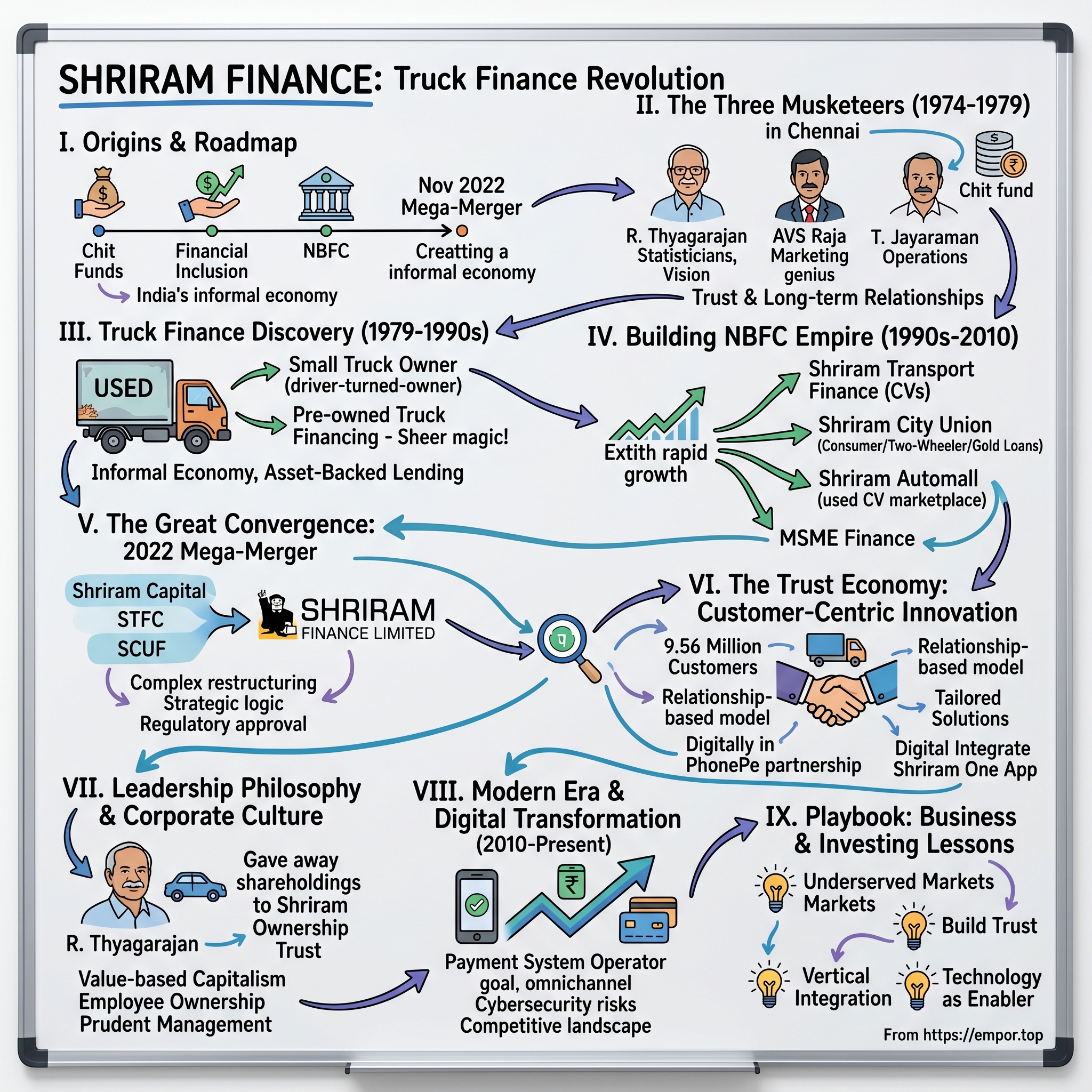
Shriram Finance: The Invisible Empire of Indian Credit
I. Introduction & Episode Roadmap (00:00 – 06:30)
The man who gave it all away, and then negotiated the biggest cheque in Indian finance
In April 2026, a Japanese bank wired ₹39,618 crore — roughly $4.4 billion — into a Chennai-headquartered lender that finances seven-year-old commercial vehicles driven by operators who cannot produce a formal tax return.12
MUFG Bank acquired a 20% stake in Shriram Finance on a fully diluted basis, subscribing to 471,121,055 shares at ₹840.93 apiece — the largest foreign direct investment ever completed in an Indian financial services company.1 On the other side of that transaction sat an 88-year-old former statistician who holds no equity in the business. R. Thyagarajan transferred his entire shareholding — valued at more than $750 million at the time — to an employee welfare trust in 2006. He does not use a smartphone and drives a car that cost roughly ₹6 lakh.3
That convergence — a global financial institution writing a record cheque to an enterprise whose founder deliberately divested his personal ownership — frames the central story of Shriram Finance.
The paradox of underwriting the unbankable
Mainstream credit underwriting in developed markets relies on verifiable documentation: salary slips, audited tax filings, and formal credit bureau profiles built over years of banking activity.
India's road transport economy operates largely outside those parameters. A single-truck operator typically earns in cash, pays operating expenses in cash, maintains no audited financial records, and frequently has no credit bureau record. When Thyagarajan began financing these operators in 1979, commercial banks routinely rejected them, leaving informal moneylenders to fill the gap at annual interest rates as high as 48%.4
Shriram built an alternative underwriting architecture grounded in physical proximity rather than formal paperwork. Field officers work directly out of local trucking hubs, assessing which freight corridors yield reliable cash flows, which transport contracts are genuine, and what specific vehicle vintages fetch in the resale market. Thyagarajan framed the operating philosophy simply: "Trust begets trust. If you trust a truck operator and lend him money, he will trust you in return."4 While notable as a founding principle, it is an assertion that warrants rigorous analysis. The central question is whether this relationship-driven field network continues to produce superior credit selection, or whether it has evolved into a high-cost operating model whose structural frictions are masked by balance sheet expansion and recent credit rating upgrades.
Where the company stands today
As of the June 2026 quarter, the company operates at a scale far exceeding its initial footprint. Assets under management reached ₹3.14 lakh crore, an increase of 15.26% year on year.5 The lender maintains 3,225 branches, employs 78,902 people, and serves 10.30 million customers.6 Its equity trades on India's benchmark Nifty 50 index, which it joined in March 2024.7
Quarterly profit after tax rose 59.79% to ₹3,452.77 crore, while net interest margin expanded to 9.04% from 8.11% a year earlier.58 However, those headline figures require important analytical context. A substantial portion of the earnings growth and margin expansion resulted from unallocated primary capital from the MUFG transaction sitting temporarily in liquid investments; management acknowledged this temporary yield boost and guided toward a normalised net interest margin of approximately 8.5%.8 Meanwhile, return on equity fell to 12.76% from 14.69%, reflecting dilution from the sudden expansion in the equity base.8
What this piece examines
Four structural themes define the institution's trajectory. The first is its origin: chit funds in Madras, an initial personal commitment of ₹5 lakh, and the insight that a pre-owned commercial vehicle represents a productive cash-generating asset when appraised accurately.4 The second is institutional endurance — surviving the 2018 IL&FS liquidity contagion that collapsed non-bank lenders such as DHFL and Reliance Capital, navigating an aborted merger with IDFC Bank, and managing the departure of a major strategic partner. The third is structural consolidation: the November 2022 three-way merger that formed Shriram Finance, the divestment of its housing finance subsidiary, and the equity recapitalisation from MUFG.
The fourth theme — and the primary driver of future returns — is whether a specialist lender built on high-yield informal credit can deploy $4.4 billion in fresh capital, sustain 18% annual growth, expand into new vehicle financing across northern India, and preserve its underwriting discipline without eroding the risk-adjusted margins that established the franchise.
That operational journey began in a Madras office in 1974.
 Subscribe on LinkedIn
II. The Genesis: Chit Funds to Second-Hand Trucks (1974–1990s) (06:30 – 18:00)
A statistician who chose the wrong career, twice
R. Thyagarajan was born into a farming family in Tamil Nadu and trained for three years at the Indian Statistical Institute in Kolkata, one of the country's premier quantitative institutions.3 After completing his studies in 1961, he entered the insurance industry with New India Assurance, and later held positions at Vysya Bank and the reinsurance broker JB Boda & Co.3
Two decades across insurance and commercial finance shaped his perspective on managing pools of small, individually volatile risks. In actuarial terms, underwriting diversified risk portfolios relies on statistical predictability across broad populations rather than certainty on any single policyholder — a mathematical principle that mirrors high-yield informal lending.
While at New India Assurance, Thyagarajan established small finance units lending to truck owners, initially conceived not as standalone operations but as a commercial channel to sell more motor insurance policies.4 When loan-level data demonstrated that vehicle financing generated higher risk-adjusted returns than the underlying insurance policies, he shifted his focus. On 5 April 1974, at age 37, he co-founded the Shriram Group in Chennai alongside A.V.S. Raja and T. Jayaraman, starting with Shriram Chits.3
Why chit funds were the perfect training ground
A chit fund operates as a rotating savings and credit association. Members contribute a fixed monthly instalment into a common pot, and each month one participant receives the pool through an auction discount or a lottery, with all members continuing contributions until the full cycle concludes. It represents one of South India's oldest informal financial instruments.
Managing chit funds provided essential operational training for unsecured credit. Because chit organisers held no physical collateral and possessed limited formal legal recourse, loan performance depended on local social architecture. Repayment discipline was maintained through peer accountability and community reputation rather than institutional enforcement. The organiser's primary capability lay in evaluating borrower character within local networks and assembling groups where mutual accountability ensured timely collection.
Shriram's subsequent commercial vehicle lending platform institutionalised these informal mechanisms at scale. This framework explains why the company recruited staff directly from local transport hubs, mandated existing borrowers as guarantors for new applicants, and collected monthly payments in cash rather than through formal banking mandates.4
1979: the truck that banks would not finance
Shriram Transport Finance was established in 1979, with Thyagarajan putting in ₹5 lakh of his own money.4 The venture targeted a distinct structural imbalance in commercial transport credit. While manufacturers such as Tata Motors and Ashok Leyland expanded chassis production, commercial banks restricted their lending to fleet operators owning ten or more vehicles with audited balance sheets. Individual drivers seeking to finance a second vehicle or a five-year-old pre-owned truck had few formal credit options, leaving them reliant on informal moneylenders charging annual interest rates of up to 48%.4 Incumbent non-bank financiers, such as Chennai-based Sundaram Finance, similarly catered to fleet operators,4 leaving small, unorganised operators to the informal credit market.
Thyagarajan approached the underwriting problem by evaluating asset productivity rather than borrower balance sheets. Under this methodology, creditworthiness was determined by the vehicle's revenue-generating capacity on specific freight corridors. Provided the transport route remained economically viable and the operator maintained the vehicle, freight earnings generated sufficient cash flow to service the debt.
The mechanics that made it work
Three operational principles enabled Shriram to translate this underwriting thesis into a scalable enterprise. First, the company prioritised physical field density over traditional branch offices. Field officers were embedded directly inside trucking hubs, maintaining a ratio of 20 to 30 field officers for every 3,000 trucks financed.4 Former chief executive R. Sridhar noted that establishing a presence in a trucking hub created a self-reinforcing network: financing an initial operator encouraged referrals across the hub.4
Second, the lender instituted a mandatory guarantor structure. Requiring new borrowers to secure endorsements from existing, performing customers served multiple functions: it established a pre-screening filter, created peer pressure for repayment, and turned the customer base into an organic origination channel.4
Third, Shriram adopted a cooperative default resolution model rather than relying on aggressive repossession squads. When an operator faced insolvency, field officers worked to find a new buyer for the vehicle rather than intimidate the defaulter.4 This facilitated debt recovery, preserved residual asset value, and protected relationship capital within local transport associations. Historically, roughly 85% of the loan book financed used vehicles aged five to twelve years.4 This asset vintage offered structural advantages: because the vehicles had already passed their period of steepest depreciation, loans originated at 65% to 75% loan-to-value ratios were supported by stable resale prices.
Credibility purchased in instalments
Financing unbanked borrowers without an established credit rating presented a fundamental liability challenge: securing competitive wholesale funding. Shriram spent decades establishing institutional credibility with wholesale capital providers. A 1984 public issue raised ₹20 lakh.4 A major institutional breakthrough came in 1990, when Tata Motors and Ashok Leyland each took 20% stakes — the manufacturers whose trucks Shriram financed, validating the lender to the entire ecosystem.4 Institutional backing broadened over the following decade, with Citicorp Finance acquiring a 19.9% stake in 2002 and the entity that became Axis Bank investing ₹7 crore in 2004.4
By 2005, under Sridhar's leadership, assets under management reached ₹3,000 crore to ₹4,000 crore, accompanied by a strategic repositioning of the company's profile: management framed used-vehicle financing not as high-risk subprime credit, but as a distinct, defensible niche category.4 This institutional narrative proved essential for broadening access to wholesale debt markets.
The rate compression that reveals the real story
The historical evolution of Shriram's lending yields highlights both its operational success and its long-term margin trajectory. In the company's early years, lending rates averaged approximately 39% on pre-owned commercial vehicles and 25% on new vehicles; by 2014, those yields had compressed to roughly 20% and 15%.4 Thyagarajan actively encouraged competitors into the market specifically to drive rates down,4 a dynamic that also expanded the formal market and helped Shriram secure cheaper institutional liabilities.
From an underwriting and valuation perspective, this historical yield compression demonstrates that Shriram's pricing power is not static. As commercial banks and rival non-bank lenders gradually enhance their underwriting capabilities in semi-urban and rural markets, the spread between informal credit and organised finance continues to contract.
Concurrently, the group established a secondary lending franchise — Shriram City Union Finance — applying the same high-touch, relationship-based underwriting model to two-wheelers, consumer durables, and small-enterprise credit across southern and western India. This retail-focused portfolio would eventually serve as a foundational pillar in the group's corporate consolidation decades later.
III. Surviving Shocks & Institutionalizing the Machine (2000s–2018) (18:00 – 34:00)
The arbitrage that global capital could see
By the mid-2000s, a distinct structural arbitrage emerged: Shriram was originating loans at yields exceeding 20% to informal borrowers who maintained negligible default rates, while funding itself at borrowing costs set by an Indian wholesale market that still viewed informal-sector credit as an exotic risk.
Global private equity took notice. TPG, ChrysCapital, and the South African insurer Sanlam all acquired equity stakes across the Shriram corporate structure during this period, building on Citicorp's earlier entry.4
What stands out analytically is what these institutional investors chose not to do. Rather than importing centralised credit scorecards, replacing the branch organisation with automated screening, or pursuing urban consumer banking, they preserved the company's high-touch operating architecture. Foreign capital lowered funding costs and strengthened corporate governance while leaving the decentralised field model intact.
This approach reflected a fundamental operational reality: Shriram's underwriting edge was not a codified algorithm that could be readily optimised through software. It rested on distributed tacit knowledge held by tens of thousands of local field officers. Centralising that credit approval mechanism risked dismantling the primary source of underwriting accuracy.
The Piramal alliance and the merger that died over arithmetic
In 2013, Piramal Enterprises invested ₹1,636 crore for just under 10% of Shriram Transport Finance.4 Ajay Piramal subsequently built positions across Shriram Capital and Shriram City Union Finance, aiming to assemble an integrated financial conglomerate.
In July 2017, IDFC Bank and Shriram Capital entered 90-day exclusive negotiations to merge, aiming to create a retail financial institution valued at more than ₹65,000 crore.9 On paper, the strategic rationale appeared compelling: combining a commercial banking licence and low-cost retail deposits with an extensive informal-credit distribution network.
However, the initial 90-day window expired without an agreement. In October 2017, the parties extended exclusivity to 8 November,10 but talks collapsed before month's end. The companies attributed the termination to an irreconcilable disagreement over the share swap ratio, prompting mixed market reactions across both groups' listed entities.11
Beyond valuation friction lay a deeper cultural and operational divide. Mainstream commercial banking relies on credit committees, standardised documentation, and formal regulatory capital frameworks. In contrast, Shriram's model depended on frontline field officers evaluating driver freight contracts at transport hubs. Integrating those opposing operating cultures risked imposing heavy administrative overhead while diluting the local underwriting responsiveness that generated the franchise's returns.
Piramal eventually wound down its exposure. By March 2023, the conglomerate was preparing to divest its 20% stake in Shriram General Insurance Holdings alongside a 9.5% stake held by TPG.12
For public market investors, the failed merger served as an indicator of board discipline. Rather than accepting dilutive terms to secure a banking charter, Shriram's leadership walked away from the transaction over structural valuation concerns — a precedent that proved relevant during subsequent equity negotiations with global partners such as MUFG.
September 2018: the reckoning that killed the neighbours
In June 2018, Infrastructure Leasing & Financial Services defaulted on commercial paper and inter-corporate deposits worth ₹450 crore,13 triggering a severe liquidity crisis across India's shadow-banking sector.
The underlying structural fault line was classic asset-liability mismatch. IL&FS had financed illiquid, long-gestation infrastructure assets using short-term commercial paper, continuously rolling over obligations in the wholesale market. When mutual funds and institutional lenders refused to refinance maturing paper, the institution faced an immediate solvency crisis.
The resulting contagion stemmed from funding structures rather than asset-side credit quality. Mutual funds, which had served as the marginal buyer of short-term non-bank paper, abruptly halted purchases across the sector. Non-banking financial companies relying on short-term wholesale debt faced an immediate liquidity freeze, regardless of underlying loan performance.
The structural contraction reshaped the industry: non-convertible debentures and commercial paper fell from 54% of non-bank borrowing in FY18 to 47% in FY19, eventually contracting to 34% by September 2020.13 Heavily mismatched lenders, including Dewan Housing Finance Corporation (DHFL) and Reliance Capital, entered bankruptcy.
Why Shriram did
Shriram navigated the shock through a liability profile that had long appeared conservative compared to its peers.
First, the company maintained a dedicated retail fixed-deposit franchise. Built over decades across South India, this granular depositor base provided a stable source of domestic funding that proved resilient during wholesale market turmoil.
Second, the lender relied extensively on loan securitisation. Because its vehicle loans qualified as priority sector lending under Indian regulatory mandates, commercial banks maintained structural demand to purchase Shriram's securitised pools to fulfil their mandatory lending quotas. This statutory demand provided a reliable liquidity avenue even as private debt markets seized.
Third, Shriram's bank borrowings were weighted toward multi-year term loans rather than short-term instruments, limiting immediate rollover risks.
The broader institutional lesson remains fundamental to financial intermediation: while asset yields drive earnings during economic expansions, liability stability determines institutional survival during liquidity contractions. Shriram had spent decades constructing a diversified, long-duration liability base while rivals prioritised cheaper short-term wholesale debt.
That structural discipline would soon face a different test — not from market stress, but from organizational consolidation, as the group initiated a sweeping internal merger to unite its disparate lending arms into a single balance sheet.
IV. The Core Engine: Underwriting the Informal Economy (34:00 – 54:00)
What the ₹3.14 lakh crore is actually made of
Disaggregating the ₹3.14 lakh crore balance sheet as of the June 2026 quarter reveals both the historic foundation of the franchise and its evolving product mix.8
Commercial vehicles remain the core engine, accounting for ₹1,47,034 crore or 46.86% of total assets under management, expanding 19.41% year on year. This book reflects the company's traditional specialisation in pre-owned heavy, medium, and light commercial vehicles. Passenger vehicles have expanded into the second-largest exposure, reaching ₹68,650 crore or 21.88% of AUM with 21.22% annual growth, applying the same field-based underwriting methodology to utility vehicles, rural passenger taxis, and used passenger cars. Micro, small, and medium enterprise (MSME) finance represents ₹41,962 crore or 13.37% of the book, though its growth moderated to 8.08%. The remaining portfolio comprises two-wheelers at ₹17,814 crore (5.68%, up 12.35%), construction equipment at ₹12,373 crore (3.94%), personal loans at ₹11,421 crore (3.64%), gold loans at ₹7,514 crore (2.39%, up 45.78%), and farm equipment at ₹7,031 crore (2.24%).
Within that distribution, two asset classes illustrate management's capital reallocation. Gold loans expanded nearly 46% year on year, supported by management's target to double the portfolio within three years.14 Conversely, construction equipment financing contracted 25.17% — a deliberate run-off in a category where the company's gross Stage 3 non-performing ratio reached 7.12%, substantially above the broader group average.8
Pruning an underperforming asset class rather than attempting to outgrow impaired loans represents sound risk management, but it also reflects an implicit acknowledgement that underwriting standards deteriorated during the prior infrastructure cycle.
The unit economics, explained simply
The fundamental unit economics of pre-owned vehicle lending derive from asset depreciation dynamics.
A brand-new commercial vehicle experiences its steepest depreciation over its initial three to four years of service. By years five through ten, the depreciation curve flattens considerably. Lending at 65% to 75% loan-to-value ratios against that flatter portion of the curve provides a durable collateral cushion, whereas new-vehicle financing exposes lenders to immediate negative equity if the vehicle depreciates faster than loan principal amortises.
Asset yields in the secondary commercial vehicle segment remain in the mid-to-high teens because informal borrowers lack access to prime bank financing and face local moneylenders charging rates twice as high.
The spread between asset yield and liability cost determines overall profitability. In the June 2026 quarter, net interest margin reached 9.04%, up from 8.11% a year earlier, though management noted that this expansion was temporarily elevated by unallocated primary capital from the MUFG transaction and guided toward a normalised level of approximately 8.5%.8 In the December 2025 quarter, prior to the capital injection, net interest margin stood at 8.58%, compared with 8.48% in the prior-year period — representing the cleaner baseline run-rate.15
Credit costs registered at 1.66% of total assets in the June 2026 quarter, with loan loss provisions increasing 13.81% to ₹1,463 crore.8 For the December 2025 quarter, credit costs had moderated to 1.62% from 1.85% a year prior.15
Generating roughly 8.5% to 9% in net interest margin against credit costs below 2% establishes the fundamental operating spread supporting the franchise.
The people who actually make the credit decision
Maintaining that margin profile depends on the operational execution of the field network.
While Shriram operates 3,225 branches, employs 78,902 people, and serves 10.30 million customers,6 credit evaluation occurs outside the physical branch infrastructure. Field officers recruited directly from transport corridors, driver networks, and rural markets evaluate variables unavailable in standard credit files: mechanical engine condition, physical wear, the validity of local freight contracts, and regional corridor freight rates.
On the December 2025 earnings call, management outlined how it evaluates borrower creditworthiness. Rather than relying exclusively on public bureau scores, the lender uses proprietary internal customer ratings developed from longitudinal repayment records, enabling it to price loans competitively and retain prime borrowers when institutional rivals enter local hubs.15
This proprietary repayment history across four decades represents an extensive alternative dataset on informal borrowers historically omitted from formal credit bureaus.
The cost of running an army
That operational model also defines the company's primary structural vulnerability.
A high-touch, decentralised field architecture imposes a substantial operating cost base that digital lending models avoid. Shriram's cost-to-income ratio fell to 25.48% in the June 2026 quarter from 29.29% a year earlier,8 against a medium-term management target of 26% to 27%.16 However, this recent cost-ratio improvement was partly amplified by the temporary liquidity yield that boosted headline income, and management indicated that operating expense ratios would normalise higher as operational spending resumes.
The strategic risk is asymmetric. Shriram's high operating cost structure requires elevated asset yields to remain viable. If lending yields compress due to competitive pressure from commercial banks, regulatory caps, or internal portfolio shifts, operating expenses cannot be reduced proportionately. Physical branch density and field staffing represent fixed operating burdens rather than flexible variable costs.
This tension is evident in management's plan to increase new-vehicle financing from roughly 16% of disbursements to 20%–25% over a two-to-three-year horizon, an expansion that management acknowledged will exert downward pressure on portfolio yields and margins.8 New-vehicle lending carries lower interest spreads, faces direct price competition from commercial banks, and shifts the institution toward a volume-driven model in a business historically built on spread extraction.
Myth versus reality: the Automall moat
One persistent market misconception surrounds Shriram Automall India Limited (SAMIL).
SAMIL is frequently characterised as Shriram's captive asset-liquidation platform: a nationwide physical and digital vehicle auction platform conducting more than 3,000 bidding events monthly across India.17 Under this narrative, Shriram's ability to auction repossessed commercial vehicles at market-clearing rates supposedly insulates the lender from credit loss upon borrower default.
While the auction infrastructure is substantial, Shriram Transport Finance divested control of the business years ago. On 24 January 2018, CarTrade's MXC Solutions agreed to acquire a controlling interest in SAMIL for ₹156.37 crore.1819
Shriram maintained an ongoing commercial partnership and a minority equity holding, but SAMIL has not operated as a captive subsidiary for more than eight years. Evaluating the auction platform as a proprietary corporate moat mischaracterises the group's current asset base.
What Shriram retains is granular pricing expertise — decades of transaction records tracking secondary asset values across vehicle vintages and geographic corridors — alongside the field recovery capabilities of its ground personnel. That logistical and analytical capability provides operational value, but it does not equate to proprietary ownership of the trading exchange.
The central corporate consolidation of the franchise occurred not through the auction exchange, but through a comprehensive structural merger in 2022.
V. The Landmark 2022 Mega-Merger & Rationalization (54:00 – 1:12:00)
Three companies, one balance sheet
For most of its operating history, the Shriram Group functioned through a fragmented corporate architecture. Shriram Transport Finance focused exclusively on commercial vehicles. Shriram City Union Finance originated retail credit, including two-wheelers, gold loans, and small-enterprise financing. Shriram Capital sat above both entities as an unlisted holding company. Public market investors held exposures to overlapping customer bases across separate listed vehicles, with holding-company discounts, inter-entity arrangements, and cross-holdings obscuring underlying group economics.
A comprehensive corporate restructuring dismantled this multi-tier structure. Shriram City Union Finance and Shriram Capital amalgamated into Shriram Transport Finance, which was subsequently renamed Shriram Finance Limited. Under the approved scheme, the share swap ratios were established at 1.55 Shriram Transport shares for every share of Shriram City Union Finance, and 0.09783305 shares for each share of Shriram Capital.2021 The transaction took effect with a record date of 30 November 2022.20
The unified entity began operations with assets under management exceeding ₹1.5 lakh crore, a customer base of more than 20 million borrowers, and a distribution network spanning over 3,500 delivery points — creating India's largest retail asset-financing non-banking financial company.21
The synergy thesis, and why analysts doubted it
The strategic premise underpinning the consolidation was branch-level cross-selling. Shriram Transport had spent four decades assembling an extensive branch network dedicated solely to commercial vehicle financing. Those locations maintained entrenched relationships with millions of transport operators who utilized only a single credit line. Conversely, Shriram City Union possessed a diverse product suite — spanning two-wheelers, gold loans, MSME lending, and unsecured personal credit — but operated through a substantially smaller geographic footprint.
The merger thesis proposed converting single-product commercial vehicle branches into diversified retail lending hubs, lifting revenue per branch without generating a proportional increase in operational overhead.
Market analysts expressed immediate scepticism regarding the transaction, anticipating limited near-term operating synergies.22 Those reservations reflected genuine structural execution hurdles. A branch footprint built around transport corridors with personnel trained specifically in vehicle inspection and corridor freight economics cannot be reoriented into a multi-product retail lending platform by executive mandate. Product cannibalisation, complex IT migration across legacy core-banking systems, and cultural friction between two lending organisations with distinct underwriting workflows presented substantial operational risks.
What the evidence now shows
Nearly four years post-merger, operational data presents a nuanced picture of cross-sell execution.
Key elements of the consolidation thesis have materialised. Total assets under management doubled from approximately ₹1.5 lakh crore at the time of the merger to ₹3.14 lakh crore by the June 2026 quarter.5 Product lines historically housed within Shriram City Union, particularly passenger vehicles and gold loans, expanded rapidly once distributed across the broader vehicle-branch network.8 Operating cost-to-income ratios also contracted over the period.
However, portfolio performance in the small-enterprise segment reveals significant operational strain. MSME financing — the core lending competency inherited from Shriram City Union and the central testing ground for distributing enterprise credit through transport branches — expanded just 8.08% year on year, roughly half the aggregate balance sheet growth rate. Concurrently, gross Stage 3 impaired assets within the MSME portfolio surged 36.64% to ₹2,166 crore.8
Subdued portfolio growth alongside accelerating asset quality stress in the primary integration segment indicates that cross-selling unsecured or semi-secured enterprise credit through vehicle-focused field personnel proved more difficult than initial projections suggested. Management's guidance targeting 13% to 15% MSME growth for FY27 relies on an operational turnaround in underwriting execution.14 That target represents a concrete metric against which the long-term industrial logic of the merger can be evaluated.
Selling the housing business
The second phase of structural rationalisation involved strategic divestment.
On 13 May 2024, Shriram Finance agreed to sell its housing finance subsidiary, Shriram Housing Finance, to private equity firm Warburg Pincus in a transaction valuing the business at ₹4,630 crore across equity and convertible instruments.23 The Competition Commission of India granted regulatory approval on 20 August 2024.24 The divestment closed in December 2024, with Shriram Finance selling its entire 84.44% equity stake to Warburg affiliate Mango Crest Investment for total consideration of ₹3,929 crore.25
The strategic rationale centred on portfolio margin discipline. Prime housing finance is a capital-intensive, lower-yielding asset class dominated by commercial banks with structurally lower costs of capital. The business generated approximately half the net interest margin of used-commercial-vehicle financing while absorbing comparable regulatory capital.
The divestment achieved three operational objectives: it monetised the subsidiary at a private equity valuation premium, freed regulatory capital for redeployment into higher-yielding informal lending segments, and eliminated an exposure where the institution lacked a structural underwriting moat.
Shriram's competitive advantage resides in assessing non-standard cash flows where formal documentation is absent. Urban mortgage origination, by contrast, represents a standardised, highly documented credit market. Management acknowledged this dynamic, with executive vice chairman Umesh Revankar characterising the divestment as a deliberate refocusing on high-margin core lending operations.26
Joining the index
On 28 February 2024, the National Stock Exchange announced that Shriram Finance would replace UPL in the benchmark Nifty 50 index effective 28 March 2024, having recorded the highest average free-float market capitalisation among eligible candidates over the qualifying six-month period.727 Market analysts estimated that index inclusion generated approximately $217 million in passive institutional capital inflows.27
Benchmark index inclusion is a mathematical outcome of market capitalisation rather than an operational milestone, attracting passive tracker funds that neither validate nor interrogate underlying underwriting quality.
Nonetheless, the inclusion marked a significant institutional transition. A specialist lender built on financing pre-owned commercial vehicles for unbanked operators had entered India's premier corporate equity benchmark — bringing heightened regulatory scrutiny, expanded institutional research coverage, and extensive governance visibility to an organisation historically managed through decentralised field operations.
That institutional visibility directly brought into focus the unconventional governance architecture that oversees the business.
VI. Leadership, Governance, & The Shriram Ownership Trust (1:12:00 – 1:26:00)
The founder who deliberately made himself irrelevant
In 2006, R. Thyagarajan transferred his entire shareholding — valued at more than $750 million at the time — to the Shriram Ownership Trust, establishing the group's executive leadership as its primary beneficiaries.3
Thyagarajan established no family succession within the business, received the Padma Bhushan award for trade and industry in 2013,3 and maintained a modest personal lifestyle.
While corporate profiles frequently romanticise this divestment, the relevant institutional question is structural: whether replacing conventional family-promoter ownership with an internal employee trust produces superior governance and capital allocation for public minority shareholders.
How the trust actually works
The Shriram Ownership Trust was constituted in 2006 as a private discretionary trust structured to make current and future leadership cohorts its economic beneficiaries.28 Formed as a perpetual entity, eligible senior employees are inducted during their operational tenure and exit upon retirement with pre-determined terminal compensation.28 Legal and operational promotership resides entirely with the trust rather than with any founding family or individual promoter.28
In November 2021, the group formalised institutional succession through a four-member Board of Management comprising D.V. Ravi, then managing director of Shriram Capital; Umesh Revankar; Jasmit Gujral of Shriram General Insurance; and R. Duruvasan, former head of Shriram City Union Finance.2829 This executive body sets long-term strategy across the operating companies and oversees balance-sheet execution, while the trust board continually assesses internal leadership pipelines and inducts successors to preserve perpetual ownership.2829
This architecture establishes distinct structural incentives. Senior executives accumulate equity wealth through trust units linked to multi-decade institutional value rather than annual disbursement volume targets — an incentive framework that mitigates the volume-chasing lending practices that destabilised competing non-bank financiers. Leadership cohorts are groomed internally over decades, eliminating dynastic family succession disputes.
The governance questions a sceptic would ask
Alongside those structural merits, the trust framework introduces specific governance challenges.
A private discretionary trust is, by design, non-transparent to public capital markets. The criteria governing beneficiary selection, the valuation methodologies applied to units upon entry and exit, and individual executive pay-outs remain outside standard listed-company disclosure norms. Public minority shareholders must rely on a self-perpetuating administrative body whose members select and evaluate their own successors.
Self-perpetuating governance structures face well-documented institutional risks: leadership can become insular, resist external strategic challenge, and prioritise internal consensus over performance accountability. While Shriram's operational record reflects stable execution, that protection has historically relied on organisational culture and reputational norms rather than external checks and balances.
This context highlights why MUFG's contractual right to nominate two non-independent directors to the Shriram Finance board represents a meaningful institutional change beyond the primary capital injection.1 For the first time, a major global strategic shareholder holds formal board representation, providing an external counterweight within the boardroom.
The operators
Umesh Revankar, Executive Vice Chairman, exemplifies the institution's internal promotion model. Joining Shriram as an executive trainee in 1987, he spent his entire career — spanning nearly four decades — within the group.30 He holds a bachelor's degree in business management from Mangalore University, an MBA in finance, and attended Harvard Business School's Advanced Management Program.30 Revankar led the expansion of Shriram Transport into India's largest commercial vehicle financier and was appointed chairman of the Finance Industry Development Council (FIDC) in August 2023.31
Following the MUFG transaction, Revankar outlined the partnership's strategic objectives in direct operational terms: reducing incremental borrowing costs, repricing existing wholesale liabilities over an eighteen-month horizon, and accelerating portfolio expansion across northern, central, and eastern India, where the company's retail franchise had historically lagged its southern presence.32
Parag Sharma was appointed Managing Director and Chief Executive Officer on 5 December 2025, succeeding Y.S. Chakravarti following the conclusion of his term.33 Sharma, 56, graduated in commerce from Delhi University and qualified through the Institute of Cost and Works Accountants of India. Having spent over three decades within the group, he had served as Managing Director and Chief Financial Officer since 1 June 2024.3334
Elevating a long-serving chief financial officer to the chief executive role ahead of a major equity recapitalisation reflects a conservative capital-management choice — placing a balance-sheet specialist in charge of asset-liability governance and credit rating transitions rather than an aggressive origination executive.
This leadership transition demonstrated the trust model's succession mechanics in practice: an insider developed over thirty years assumed the leadership role without public succession friction, ensuring operational continuity.
However, relying entirely on internal lifers carries corresponding strategic limitations. Executives whose entire careers evolved within a single institutional culture may be slower to challenge historical operating assumptions. As the lender deploys $4.4 billion in primary capital into non-southern geographies and competitive product categories, balancing internal continuity with external strategic oversight becomes a key governance test, reinforcing the operational importance of independent and strategic board representation.
Capital allocation as revealed preference
Historical capital allocation decisions provide a concrete indicator of management discipline.
The company divested its housing finance subsidiary rather than maintaining a capital-intensive, lower-margin business. In construction equipment, management curtailed disbursements as asset quality deteriorated rather than attempting to outgrow rising delinquencies.8 Similarly, unsecured personal loans remained restricted to vetted existing vehicle and two-wheeler borrowers with proven repayment histories, avoiding open-market digital sourcing channels that generated elevated credit losses across the broader consumer lending and fintech sectors.
Reflecting balance-sheet profitability, the board declared a final dividend of ₹6 per share for FY26, bringing total distributions for the fiscal year to ₹10.80 per share.35
Crucially, the lender refrained from large-ticket corporate and infrastructure project lending — segments that caused the collapse of peers such as DHFL, Reliance Capital, and SREI Infrastructure Finance during prior credit cycles.
Sustained underwriting and capital discipline over multiple economic cycles provides tangible evidence of operational restraint. The central forward-looking question is whether that capital allocation discipline can be maintained as the institution deploys a substantially expanded equity base across more competitive lending segments.
VII. Strategic Analysis: 7 Powers & Porter's 5 Forces (1:26:00 – 1:44:00)
Process Power: the moat that lives in people's heads
Under Hamilton Helmer's 7 Powers framework, Process Power arises from complex, embedded operational routines that competitors cannot easily replicate, even when the mechanics are visible from the outside.
Shriram's execution of this power is literal. Determining the residual value of a 2014-model sixteen-wheel commercial truck in rural Uttar Pradesh, assessing which regional freight corridors generate viable cash flows, and identifying which unbanked driver is creditworthy without a formal bureau file is tacit knowledge distributed across tens of thousands of field staff. Accumulated over more than four decades of ground operations, this capability cannot be readily licensed, acquired, or reverse-engineered from public credit registries.
This operational capability represents the franchise's primary underwriting moat, reflected in an aggregate gross Stage 3 asset ratio of 4.64% across an informal-borrower portfolio.8
However, Process Power grounded in human capital faces three structural constraints:
First, tacit knowledge remains vulnerable to staff attrition and dilutes when branch expansion outpaces internal training cycles.
Second, maintaining physical field density creates a substantial operating cost structure that scorecard-based, automated lenders avoid.
Third, broader market formalisation is gradually eroding this informational asymmetry. As India's pre-owned vehicle ecosystem incorporates digital registration databases, telematics, and structured auction venues, data that was once proprietary to field networks is becoming commercially accessible.
Cornered Resource: physical presence and institutional memory
Shriram's second competitive advantage lies in its entrenched position across India's road transport infrastructure — including transport hubs, driver associations, rural mandis, and multi-generational lending relationships established over decades.
The lender's 3,225-branch network represents the physical footprint of this advantage.6 A competing institution opening an adjacent branch cannot immediately replicate the informal community trust and referral networks built over generations.
Yet this cornered resource remains geographically uneven. Management has acknowledged that northern, central, and eastern India represent historical areas of relative underpenetration compared to its southern and western stronghold.32 Because primary capital from the MUFG transaction is designated to accelerate expansion into these less-penetrated regions, the company is deploying balance-sheet capacity outside its established relational moats, introducing execution and underwriting risks distinct from its core southern operations.
Scale Economies: the rating upgrade changes the equation
Scale economies have historically represented the group's weakest structural power, but recent capital developments have materially altered its liability economics.
Following MUFG's equity subscription on 8 April 2026, domestic credit rating agencies upgraded Shriram Finance's long-term issuer rating to AAA — with ICRA upgrading the rating on 9 April, alongside CRISIL and India Ratings resolving their prior positive watch status.3637
In financial intermediation, a top-tier credit rating broadens wholesale borrowing access, lowers debt issuance coupons, and strengthens fixed-deposit pricing power.
Management's commentary on the resulting cost-of-funds benefit has shifted over time. On the December 2025 earnings call, leadership projected that borrowing costs would contract by approximately 100 basis points over a two-year horizon following the strategic partnership and rating upgrades.15 In subsequent disclosures, that target was revised to a 50 to 75 basis point reduction over time.32
Closing that spread represents a critical operational variable for incremental margin expansion, making it a key metric for evaluating post-recapitalisation execution.
The remaining powers, briefly
Switching costs are moderate and asymmetric. Existing borrowers with proven internal repayment records receive preferential loan pricing relative to initial terms from competing lenders, providing an effective retention incentive.15 However, vehicle loans amortise over fixed tenures, meaning every completed contract effectively exposes the customer to competitive refinancing.
Branding operates effectively within its core niche but carries limited reach elsewhere. The Shriram name holds high brand equity among regional transport operators while maintaining negligible pull among urban, prime salaried borrowers.
Network economies do not meaningfully apply to bilateral vehicle lending. Counter-positioning, which provided an early operational moat in 1979 when traditional banks avoided pre-owned commercial vehicles, has largely run its course as major non-bank peers now compete directly across the used-vehicle asset class.
Porter's Five Forces: where the pressure actually comes from
Threat of new entrants remains structurally low. Mainstream private commercial banks have repeatedly attempted to enter the used-commercial-vehicle lending market and subsequently scaled back operations, as the high operating overhead of physical field origination and corridor-level asset recovery cannot be effectively managed from centralised urban credit desks.
Bargaining power of buyers is low. Informal-economy borrowers prioritise quick turnaround times, flexible repayment workflows aligned with irregular freight receipts, and overall credit access over marginal rate concessions. While this dynamic preserves high portfolio yields, it reflects limited formal borrowing alternatives and faces gradual erosion as semi-urban credit channels mature.
Bargaining power of suppliers — the liability and wholesale funding side — was historically the franchise's primary constraint but has eased substantially. As of June 2026, the funding mix was distributed across retail public deposits at 30.98% (up from 25.95% a year prior), bank term loans at 19.36%, external commercial borrowings at 14.56%, securitisation at 14.23%, non-convertible debentures at 14.19%, and external commercial bonds at 5.63%.8 The company demonstrated diversified offshore debt access in December 2024 by closing a $1.27 billion multi-currency syndicated social loan — the largest by an Indian private non-bank lender, comprising $1.15 billion, AED 275 million, and EUR 50 million tranches.38 A granular retail deposit base funding nearly a third of liabilities, combined with AAA domestic credit ratings and backing from a global banking group, provides substantial liability resilience relative to prior liquidity cycles.
Threat of substitutes remains contained. Local moneylenders charge significantly higher interest rates, while purely digital fintech platforms lack the physical infrastructure required to assess asset quality or repossess commercial vehicles across transit corridors.
Competitive rivalry is moderate and intensifying. In FY26, Cholamandalam Investment and Finance expanded assets under management by 21% to ₹2,42,630 crore, increasing annual profit after tax by 23% to ₹5,220 crore while recording a fourth-quarter net interest margin of 8.4%.39 Sundaram Finance expanded standalone AUM by 16% to ₹59,908 crore, delivering a consolidated profit of ₹2,059 crore.40 Mahindra Finance grew AUM by 12%, reporting a fourth-quarter net interest margin of 7.5% and a 19% increase in full-year earnings.41
Against this peer group, Shriram delivered FY26 AUM growth of 14.85% alongside a net interest margin of 8.38%.3542 While Shriram maintains superior portfolio yields supported by its pre-owned vehicle mix, faster balance-sheet expansion at Cholamandalam is compressing the relative growth and margin differentials across the sector. As the scale leader rather than the fastest-growing franchise, deploying primary capital to accelerate market share across non-southern markets represents management's primary strategic priority.
Whether that expansion can be achieved without compromising underwriting discipline remains the core question facing the institution.
VIII. Transcript Deep Dive & Analyst Stress Tests (1:44:00 – 1:58:00)
The margin question that will not go away
Across consecutive earnings calls, one central theme dominates analyst questioning: the durability of Shriram's reported net interest margin.
The analytical scepticism is understandable. In the June 2026 quarter, reported net interest margin expanded to 9.04% from 8.11% a year earlier — a substantial jump for an asset-backed lender.5 Management did not attempt to present the full increase as structural, clarifying that the elevated margin benefited from unallocated primary capital parked temporarily in liquid investments and guiding toward a normalised level of approximately 8.5%, with full-year FY27 NIM expected around 8.5%.816
That transparency provides clear guidance, but the underlying challenge for analysts lies in isolating three concurrent forces. First, surplus primary capital from MUFG sitting in liquid assets creates a temporary yield lift that will unwind as funds are disbursed. Second, lower borrowing costs from the AAA credit rating upgrades should provide a durable tailwind to funding spreads. Third, a deliberate portfolio shift toward new vehicles will structurally reduce asset yields. The first factor represents transitory noise, while the second and third exert opposing long-term pressures. The steady-state margin that emerges once all three dynamics settle will require several quarters of operational data to confirm.
Asset quality: the number management would rather not discuss
The June 2026 disclosures also revealed underlying asset quality pressures that warrant close scrutiny.
Gross Stage 3 non-performing assets edged up to 4.64% of the loan book, or ₹14,478 crore, compared to 4.53% a year earlier.8 While the headline ratio appeared stable, gross Stage 3 assets grew 18.68% year on year, outpacing total AUM growth of 15.26%.8 Impaired assets expanded faster than the underlying portfolio.
Segment-level data highlights specific points of friction. Construction equipment recorded a gross Stage 3 ratio of 7.12%, while MSME gross Stage 3 assets surged 36.64%, and gold loan gross Stage 3 jumped 81.26%, albeit off a low base.8
Management attributed the increase to seasonal collection patterns and portfolio mix shifts, while acknowledging that a prolonged rise would signal deeper structural concern.8
However, seasonal factors do not fully explain a 36.64% increase in MSME impaired assets within a segment expanding at just 8.08%. The operational reality is that the small-enterprise book — the central growth pillar of the 2022 merger — experienced decelerating origination alongside accelerating credit stress.
At the same time, counterbalancing risk mitigants remain in place. Net Stage 3 assets remained contained at 2.33%, while provision coverage expanded to 50.99% from 44.30%.8 Management increased provisioning ahead of credit migration rather than deferring charges. Furthermore, the longer-term trajectory showed prior recovery: gross Stage 3 assets had improved to 4.54% in December 2025 from 5.38% a year earlier, with net Stage 3 at 2.38% compared to 2.68%.15
The latest quarter reflects an uptick in delinquencies against a broader multi-year recovery trend — presenting a critical operational metric that requires ongoing monitoring.
Growth guidance and the monsoon hedge
During the June 2026 earnings call, management reiterated its full-year FY27 disbursement growth target of 18%, while noting that second-quarter disbursements could moderate to 15%–16% due to monsoon-related disruptions.16 First-quarter disbursements expanded 19.51% to ₹49,974 crore.14
Sub-segment targets were specific: commercial vehicles at approximately 18%, passenger vehicles above 20%, MSME credit between 13% and 15%, and gold loans exceeding 30%.16
Maintaining an 18% annual target while pre-warning of a second-quarter slowdown to 15%–16% establishes a clear benchmark: achieving the annual target will require a meaningful acceleration in disbursements during the second half of the fiscal year.
Management also cited broader macroeconomic headwinds, including geopolitical friction in West Asia, erratic rainfall distribution, a lowered national GDP growth forecast of 6.6%, and retail inflation at 4.38%.14 Transparently identifying external risks provides helpful context, but it also establishes the operational framework against which full-year delivery will be measured.
The unsecured lending question
Analysts have also closely tracked personal loan origination, mindful of the severe credit deterioration experienced across India's unsecured consumer lending and fintech sectors in 2023–24, where open-market digital sourcing led to elevated default rates.
Shriram's personal loan portfolio stood at ₹11,421 crore, or 3.64% of total AUM, in June 2026.8 Management reiterated its policy of restricting unsecured credit exclusively to vetted, existing vehicle and two-wheeler borrowers with established repayment histories, avoiding open-market customer acquisition.
Underwriting unsecured loans to existing borrowers with years of verified repayment data carries a fundamentally different risk profile than cold digital customer acquisition. The proprietary internal rating framework described by leadership provides a structured underwriting filter for this cross-sell.15
The governance test is whether this origination discipline holds as the company deploys its substantial primary capital base, as small, high-yielding portfolios often face internal pressure to scale rapidly when capital is abundant.
Where the hardest questions land
Three strategic issues represent the primary focus of analyst stress tests.
The first is geographic expansion into northern and eastern India — regions where management has acknowledged historical underpenetration and where primary capital from MUFG is being deployed.32 Scaling rapidly in territories where the franchise's relational field moat is less entrenched introduces higher execution risk.
The second is the trajectory of return on equity. Dilution from the MUFG transaction caused RoE to contract to 12.76% from 14.69%, as balance sheet leverage dropped to 2.14x from 3.82x.8 Rebuilding returns will require efficient balance-sheet re-leveraging, with external research estimates projecting that AUM must compound at roughly 18% annually over FY25–FY28, compared with a 16.5% baseline run-rate.43 Closing the gap between the 15.26% growth recorded in June 2026 and that 18% requirement remains the central financial hurdle.
The third issue centres on heavy commercial vehicle demand, which management noted in December 2025 remains closely tied to the pace of public infrastructure spending.15 That linkage serves as an operational reminder that the company's core asset-financing engine remains exposed to broader cyclical infrastructure investment cycles beyond its direct control.
IX. Bull vs. Bear Case & The Risk Radar (1:58:00 – 2:12:00)
The bull case, stated at its strongest
The investment thesis supporting Shriram Finance rests on four distinct structural pillars.
The first is liability transformation. Achieving domestic AAA credit ratings across all three major rating agencies, securing a 20% equity backing from MUFG, expanding retail public deposits to nearly 31% of total funding, and executing multi-currency offshore syndicated facilities point toward a durable compression in borrowing costs.36838 If management's projected 50 to 100 basis point reduction in borrowing costs materialises, the resulting spread expansion flows directly to pre-tax earnings across a ₹3.14 lakh crore balance sheet.1532 In financial intermediation, few operational levers offer comparable earnings sensitivity.
The second is balance-sheet capacity. A capital adequacy ratio of 34.17%, supported by Tier I capital of 33.40% and a leverage ratio of 2.14x, provides multi-year expansion headroom without requiring additional dilutive equity raises.8 While growth across most non-banking financial peers remains constrained by regulatory capital thresholds, Shriram possesses substantial underwriting headroom.
The third is branch cross-selling potential. With gold loans accounting for just 2.39% of AUM while expanding 46% annually, passenger vehicles reaching 21.88% of the book at 21% growth, and an active base of 10.30 million customers historically reliant on single-product credit lines, the multi-product branch thesis still has runway to increase revenue per location.86
The fourth is systemic transport demand. India's freight volumes expand alongside infrastructure execution and manufacturing output, supporting underlying commercial vehicle replacement cycles. Shriram occupies an entrenched position where commercial vehicle demand meets informal credit origination.
The bear case, stated at its strongest
The counter-thesis highlights significant cyclical exposure and near-term operating frictions.
The primary vulnerability is asset concentration. Commercial vehicles continue to represent nearly half of total assets under management.8 Management acknowledged that heavy commercial vehicle demand remains closely tied to public infrastructure outlays, which had experienced periods of moderation.15 A broader slowdown in industrial production or infrastructure spending directly impairs corridor freight rates, fleet utilisation, and borrower repayment capacity across both Stage 2 and Stage 3 assets. Because passenger vehicle and small-enterprise credit are exposed to the same rural and semi-urban commercial cycles, product diversification offers limited insulation against a broad economic slowdown.
The second challenge centres on asset quality trends. Impaired assets expanded faster than total balance-sheet growth in recent quarters, with gross Stage 3 assets in the MSME book surging 36.64% and the construction equipment portfolio recording an elevated gross Stage 3 ratio of 7.12%.8
The third issue is return-on-equity dilution. Return on equity fell to 12.76% following the equity injection.8 Restoring returns to mid-to-high-teens levels requires either re-leveraging the balance sheet through substantial debt issuance or deploying primary capital into high-yielding assets. Both paths carry operational trade-offs: re-leveraging diminishes the solvency buffer provided by fresh capital, while rapid asset deployment risks relaxing underwriting standards across less familiar product lines and newer geographic markets.
Fourth, structural yield compression is built into management's strategy. Raising new-vehicle financing to 20%–25% of disbursements voluntarily shifts the portfolio toward lower-yielding, volume-driven credit where commercial banks compete aggressively.8
Finally, the company carries a rigid operating cost structure. A ground network employing nearly 79,000 personnel is structured for high-touch informal lending with elevated spreads, but becomes structurally uncompetitive in lower-margin, standardised lending segments.6 Expanding into lower-yielding asset classes without reducing branch and personnel overhead risks compressing operating margins from both sides.
The activist stress test
From an activist or institutional governance perspective, several operational choices invite scrutiny:
Capital allocation efficiency. Shriram was not capital-constrained prior to the MUFG transaction. Introducing 20% equity dilution to fund an 18% disbursement target when the balance sheet was growing at 15% raises the question of whether the capital injection prioritised balance-sheet size over minority return optimisation. While achieving AAA credit ratings delivered tangible liability benefits, those upgrades might have been accessible with a more modest capital raise.
Governance transparency. Operating under a private discretionary trust as promoter, without public disclosures detailing beneficiary selection criteria or unit valuation formulas, represents an unconventional governance structure for an index-listed financial institution.28 While leadership points to four decades of conservative capital allocation under this framework, the arrangement relies on cultural continuity rather than public market transparency.
Disclosure granularity. While the company reports segment-level AUM and aggregate Stage 3 asset ratios, it does not publish vintage-level loan cohort performance, limiting the ability of independent analysts to track credit migration across underwriting vintages.
The Automall narrative. Characterising the vehicle auction platform as a proprietary captive moat overlooks the fact that Shriram divested majority control of the business in 2018, retaining only an ongoing commercial partnership and a minority holding.18
Group entity arrangements. The broader Shriram ecosystem maintains separate insurance and chit-fund entities under the shared trust architecture. Inter-entity arrangements within conglomerate structures represent an ongoing governance consideration for public minority shareholders.
The risk radar, mechanism by mechanism
Regulatory oversight. Shriram Finance is classified within the Reserve Bank of India's Upper Layer of non-banking financial companies, a tier expanded to 17 institutions for FY27 under a revised ₹1 lakh crore asset threshold framework.4445 The central bank did not publish an Upper Layer classification list for 2025–26 while reviewing its identification criteria, and supervisory mandates now operate under the Scale Based Regulation Directions of 2025.4446 Upper Layer classification imposes bank-grade compliance: stricter capital adequacy requirements, differential asset provisioning, heightened governance standards, and mandatory listing obligations — establishing a permanently higher compliance and capital floor.
Liability pricing dynamics. If regulatory authorities sustain higher risk weights on bank lending to non-bank financiers, Shriram must rely more heavily on public retail deposits and foreign-currency borrowings. While retail deposits fund nearly a third of liabilities, they command competitive deposit rates, and external commercial borrowings representing over 14% of the funding mix require currency hedging that offsets a portion of nominal interest savings.8
Territorial execution. Integrating operational IT systems and maintaining field collection discipline across northern and eastern territories represents a major execution test. Underwriting discipline within informal transport hubs relies on entrenched local relationships that cannot be rapidly duplicated in new markets.
Asset concentration. Nearly half the aggregate loan book remains exposed to the commercial transport cycle within a single domestic market.
The two or three numbers that actually matter
For institutional investors monitoring operational execution, three core metrics serve as the primary scorecard:
First, normalised net interest margin. Management guided to a full-year FY27 net interest margin of approximately 8.5%.16 The 9.04% reported in the June 2026 quarter was elevated by unallocated primary capital, making the 8.58% recorded in December 2025 a cleaner operational baseline.815 The degree to which AAA-driven funding cost savings offset the margin drag from expanding into lower-yielding new vehicles will be reflected directly in this metric.
Second, the growth rate of impaired assets relative to total AUM. In the June 2026 quarter, gross Stage 3 assets expanded 18.68% year on year against AUM growth of 15.26%.8 If impaired asset formation continues to outpace portfolio growth over successive quarters, credit stress extends beyond seasonal variations; if that divergence contracts, management's attribution to temporary seasonality will be validated.
Third, the trajectory of return on equity. At 12.76%, current return on equity reflects the dilutive effect of primary capital on the balance sheet.8 Rebuilding returns toward mid-teens levels requires sustained AUM growth of approximately 18% annually alongside steady credit costs.43 Managing portfolio expansion without relaxing underwriting standards remains the fundamental operational challenge for executive leadership over the medium term.
Equity markets have reflected significant optimism regarding these operational catalysts. Shares traded near ₹1,122 in mid-August 2026, representing a market capitalisation of approximately ₹2,66,428 crore, a price-to-book multiple of 2.5, and a price-to-earnings ratio of 23.5, against a 52-week trading range of ₹566.4 to ₹1,153.7.47 The equity roughly doubled from its cyclical low, reaching an all-time high following the MUFG transaction announcement in December 2025.48
Current market valuations reflect substantial expectations for lower funding costs and accelerated geographic expansion. The central test facing the institution is whether operational delivery matches the scale of its recapitalised balance sheet.
X. Playbook Lessons & Epilogue (2:12:00 – 2:24:00)
Lesson one: underwrite the cash flow, not the document
The founding insight remains the most transferable operational lesson of the institution's history: where formal documentation is absent, the primary underwriting substitutes are ground-level proximity and the ability to appraise and recover the underlying physical asset.
Shriram's field personnel do not evaluate creditworthiness in the abstract. They assess whether a specific vehicle operating on a specific freight corridor can generate predictable cash flow. In practice, this functions closer to micro-project finance than conventional consumer credit, executed at ticket sizes of a few lakh rupees tens of thousands of times every month.
The broader strategic principle is clear: in markets where formal information infrastructure is lacking, physical presence is the information infrastructure. Institutions that establish local field density early build an operational advantage that subsequent, better-capitalised competitors struggle to replicate.
Yet that advantage carries an inherent structural constraint: it erodes as formal market infrastructure develops. Shriram's success in institutionalising used-vehicle financing — alongside its founder's deliberate policy of encouraging competitor entry — helped compress lending yields from roughly 39% to 20% over three decades.4 Moats built on structural market absence inevitably narrow as organized capital arrives.
Lesson two: the liability side is where institutions die
Every major Indian non-bank lender failure of the past decade — including IL&FS, DHFL, Reliance Capital, and SREI — was fundamentally a liability and funding collapse rather than a pure asset-side credit failure. While underlying loan books were frequently impaired, the fatal vulnerability was funding long-duration assets with short-term wholesale debt and facing an abrupt closure of wholesale liquidity.13
Shriram's multi-decade investment in a granular retail public deposit franchise, priority-sector loan securitisation, and multi-year bank term lines appeared to be a drag on equity returns during periods of easy wholesale credit. During the September 2018 liquidity contraction, however, that diversified liability structure made the difference between institutional continuity and insolvency.
The MUFG recapitalisation reflects the same principle at greater scale. A capital adequacy ratio of 34.17% alongside leverage of 2.14x appears conservative to the point of return dilution under standard financial engineering frameworks.8 Yet it ensures that future credit contractions remain manageable operational events rather than existential solvency threats.
In financial intermediation, the optimal capital structure for maximizing short-term returns and the resilient structure required for multi-cycle survival are fundamentally distinct. Institutions that consistently prioritize balance-sheet durability over peak leverage compound capital over longer horizons.
Lesson three: incentives determine longevity
The Shriram Ownership Trust represents the institution's most distinctive and debated structural mechanism.28 Executives build long-term wealth through units tied to multi-decade institutional value rather than annual disbursement targets. The absence of a founding family eliminates dynastic succession disputes, with leadership cohorts developed internally over decades.
Historical execution aligns with this structural design: the lender avoided speculative corporate project finance, resisted unsecured digital lending bubbles, divested its lower-margin housing subsidiary, and curtailed lending in stressed construction equipment rather than attempting to outgrow impaired exposures.
However, the structural limits of this governance model are equally clear. Unlisted, self-perpetuating trust architectures carry inherent risks of insularity, reluctance to challenge legacy assumptions, and the conflation of institutional tenure with executive capability. In this context, MUFG's contractual right to nominate two board directors provides the first structured external strategic counterweight in the company's history.1 That boardroom dynamic represents a governance evolution that warrants as much analytical attention as operational earnings metrics.
Epilogue: the circulatory system
At its operational core, Shriram Finance functions as an intermediation bridge, channelling capital from India's organized financial sector — commercial banks, mutual funds, retail depositors, and global institutions — into cash-flow-generating operators who remain underserved by conventional banking channels.
Financing a commercial truck establishes a productive transport enterprise, just as a used passenger vehicle loan supports a regional transport operator. This mechanism forms the foundation through which a ₹3.14 lakh crore balance sheet generates its operating earnings.5
As of 2026, the institution occupies an unprecedented structural position: recapitalised with record primary equity, rated AAA by domestic agencies, included in the benchmark Nifty 50, led by career insiders, and backed by a 20% strategic stake from a global banking group.136733
The strategic question is no longer whether relationship-based informal underwriting functions at scale; decades of operations across multiple credit cycles have demonstrated that capability. The decisive forward-looking test is whether deploying $4.4 billion in primary capital into less-penetrated northern markets and lower-yielding vehicle categories can be accomplished without diluting the underwriting discipline that established the franchise.
Substantial capital injections frequently tempt financial institutions to relax credit filters. While Shriram's operational history suggests structural resistance to volume-driven compromise, the coming quarters — reflected in normalised net interest margins, impaired asset trajectories, and the return on its enlarged equity base — will determine whether that underwriting discipline endures.
References
-
MUFG Bank acquires 20% stake in Shriram Finance for Rs 39,618 crore — Business Standard, 2026-04-08 ↩↩↩↩↩
-
MUFG to Invest Rs 39,618 Cr in Shriram Finance for 20% Stake — PL Capital ↩
-
Who is Ramamurthy Thyagarajan, founder who gave away his entire stake to employees — Storyboard18 ↩↩↩↩↩↩
-
Shriram Transport Finance Has Brought Credibility To Itself And Its Customers — Forbes India, 2014 ↩↩↩↩↩↩↩↩↩↩↩↩↩↩↩↩↩↩↩↩↩↩
-
Shriram Finance Q1 Net Profit Up 59.79% To ₹3,452.77 Crore; AUM Rises 15.26% — Free Press Journal, 2026-07-24 ↩↩↩↩↩
-
Replacements in Indices w.e.f. March 28, 2024 — National Stock Exchange of India ↩↩↩
-
Shriram Finance Q1 FY27 slides: profit surges 60%, asset quality concerns emerge — Investing.com, 2026-07 ↩↩↩↩↩↩↩↩↩↩↩↩↩↩↩↩↩↩↩↩↩↩↩↩↩↩↩↩↩↩↩↩↩↩
-
IDFC Bank, Shriram Capital enter 90-day merger talks — Business Standard, 2017-07-08 ↩
-
IDFC-Shriram merger deadline extended to Nov 8 — Business Standard, 2017-10-05 ↩
-
Shriram, IDFC Group shares trade mixed after merger deal called off — Business Standard, 2017-10-31 ↩
-
Piramal, TPG on verge of exit from Shriram General Insurance Holdings — Business Standard, 2023-03-28 ↩
-
IL&FS crisis: For NBFCs, India's 'Lehman moment' has meant reset of future — Business Standard, 2021-02-25 ↩↩↩
-
Shriram Finance Ltd Q1 2027 Earnings Call Highlights — Yahoo Finance, 2026-07 ↩↩↩↩
-
Shriram Finance Ltd Q3 2026 Earnings Call Highlights — Yahoo Finance, 2026-01 ↩↩↩↩↩↩↩↩↩↩↩
-
Shriram Finance Q1FY27 net profit surges 59.79% YoY, beats estimates — ScanX, 2026-07 ↩↩↩↩↩
-
Auto Classifieds Portal CarTrade Acquires Majority Stake In Shriram Automall India Limited — Inc42, 2018-01 ↩↩
-
PE-backed CarTrade to acquire Shriram Automall for Rs 1.56 billion — Business Standard, 2018-01-24 ↩
-
Shriram Transport Finance Company fixes record date for scheme of arrangement and amalgamation — Business Standard, 2022-11-16 ↩↩
-
Shriram Group announces merger of three finance companies — Moneylife ↩↩
-
Shriram Transport: Analysts see limited near-term synergy post merger — Business Standard, 2021-12-14 ↩
-
Shriram Finance Limited Announces Sale of its Housing Subsidiary Shriram Housing Finance to Warburg Pincus — Warburg Pincus, 2024-05-13 ↩
-
CCI Clears Rs 4,630-Crore Deal Between Warburg Pincus, Shriram Housing Finance — Outlook Business, 2024-08-20 ↩
-
Shriram Finance completes sale of housing finance arm to Warburg Pincus — Business Standard, 2024-12-11 ↩
-
Shriram Finance will focus more on its core business: Umesh Revankar — Business Standard, 2024-05-14 ↩
-
NBFC major Shriram Finance to replace agro chemicals firm UPL in Nifty50 — Business Standard, 2024-02-28 ↩↩
-
Shriram Group draws up succession plan via trust route, forms management board — Business Standard, 2021-11-30 ↩↩↩↩↩↩↩
-
Shriram Group announces Succession Plan — Board of Management to oversee Promoters Interest — EquityBulls ↩↩
-
Shriram Finance's Umesh Revankar takes charge as chairman of FIDC — Business Standard, 2023-08-28 ↩
-
"We'll be able to grow the business much faster in the next 5 years": Umesh Revankar of Shriram Finance — Business Today, 2025-12-23 ↩↩↩↩↩
-
Shriram Finance Limited Announces CEO Changes, Effective December 5, 2025 — MarketScreener India ↩↩↩
-
Shriram Finance Limited — corporate filing on appointment of Managing Director & CEO — BSE India ↩
-
Shriram Finance Limited Q4FY26 Net profit Soars 41% to Rs 3,014 crore, declares Rs 6 final dividend for FY26 — Global Prime News, 2026-04-25 ↩↩
-
Shriram Finance's long-term credit ratings upgraded to AAA by CRISIL, ICRA and India Ratings — Global Prime News, 2026-04-11 ↩↩↩
-
CRISIL upgrades Shriram Finance to AAA, Sammaan Capital to AA+ rating — Business Standard, 2026-04-10 ↩
-
Shriram Finance raises $1.27 bn in multi-currency syndicated loan — Business Standard, 2024-12-18 ↩↩
-
Cholamandalam Investment FY26 PAT Rises 23% to ₹5,220 Cr, Dividend Declared — ScanX, 2026-04 ↩
-
Sundaram Finance Slips 2.21% Despite Strong FY26 Results; PAT Up 19%, AUM Crosses ₹59,908 Cr — HDFC Sky, 2026 ↩
-
Financial Results – Quarter 4 and Full year FY26, Standalone & Consolidated Results — Mahindra & Mahindra, 2026 ↩
-
Shriram Finance FY26 Profit Rs 9,998 Cr, AUM Rs 3,02,274 Cr; MUFG Takes 20% Stake — Whalesbook, 2026-04 ↩
-
MOFSL on Shriram Finance: MUFG deal to aid growth — Business Standard, 2026-06-03 ↩↩
-
RBI expands Upper-Layer NBFC list to 17 for FY27; retains Tata Sons status — The Statesman, 2026 ↩↩
-
RBI proposes Rs 1 lakh crore asset mark for classifying upper layer NBFCs — Business Today, 2026-04-10 ↩
-
RBI releases list of NBFCs in upper layer under scale-based regulations — Business Standard, 2023-09-14 ↩
-
Shriram Finance Share Price — Live NSE: SHRIRAMFIN — Kotak Neo, 2026-08 ↩
-
Shriram Finance shares touch all-time high on MUFG deal — Business Standard, 2025-12-22 ↩
 LinkedIn
 WhatsApp
 Reddit
 Hacker News
 Email
Email Kindle
 RSS Feed
 Spotify
 Apple Podcasts
 Amazon Music
 Audible
 YouTube