Deepak Nitrite: The Import Substitute That Became a ₹11,700 Crore Bet
I. A Record Quarter, and Four Questions Behind It
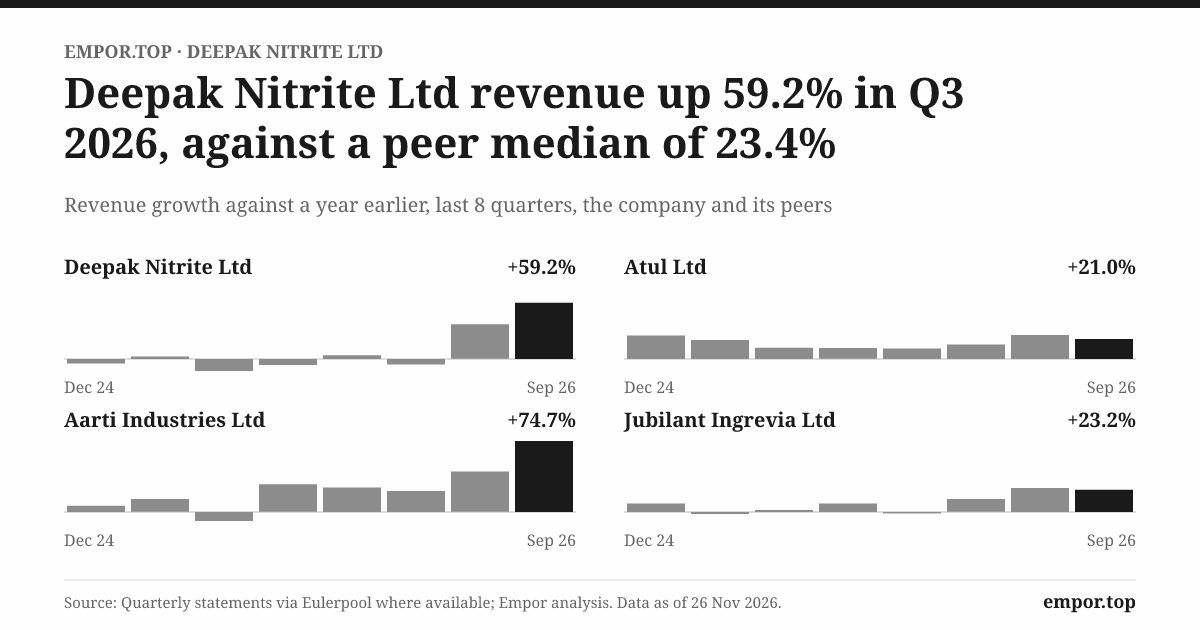
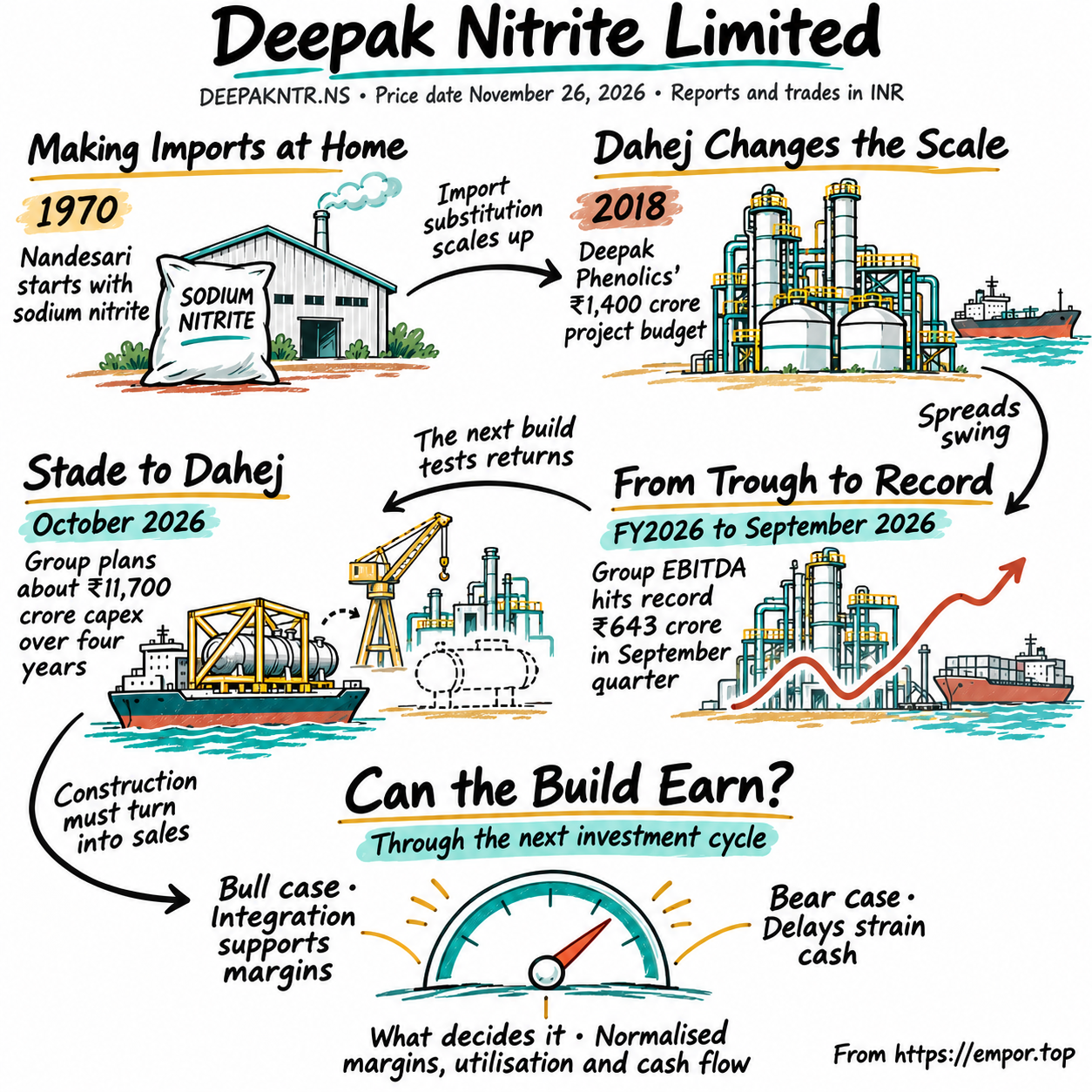
On the evening of October 29, 2026, Deepak Nitrite put out a results presentation that read almost like a correction to the year before it. In the three months to September, the group had booked revenue of ₹3,091 crore, up 61% on the same quarter a year earlier, and EBITDA of ₹643 crore, up 187%.1 Both were records. The next day, on the call with analysts, management walked through the reasons it saw: plants running harder, sharper buying of raw materials, and strong demand at home.2
What made the quarter startling was the year that came before it. In the twelve months to March 2026, consolidated revenue had slipped about 5%, to ₹7,887 crore from ₹8,282 crore, and profit after tax had fallen about 21%, to ₹551 crore from ₹697 crore.3 Returns on capital had been sliding for three years. Cash from operations had stopped covering the money the group was pouring into new plants.
Six months later, the same company was posting the best quarter in its history, and its profit after tax for the first half of FY2027, ₹743 crore, already exceeded everything it had earned in the whole of the previous year.2 Maulik Mehta, newly titled Deputy Managing Director, called it the best performance in more than five decades of operating history.2 Anyone who owned the stock through both moments had good reason to ask which version of the company was the real one.
This is a story about a manufacturer whose fortunes were remade by one large bet. In 2018, through a subsidiary, Deepak Nitrite built an integrated plant at Dahej in Gujarat to make phenol and acetone, two basic chemicals that India had mostly imported.4 That plant turned a mid-sized maker of industrial intermediates into the dominant domestic supplier of both products, and it now generates most of the group's segment profit.3
Now the group is asking investors to back a much larger cycle of investment. Management put total capital spending across four years at about ₹11,700 crore on the October call, including a polycarbonate plant to be built around equipment and technology bought from a German site.2
Before going further, it helps to be clear about what an investor in Deepak Nitrite actually owns. The listed company, Deepak Nitrite Limited, sits on top of a group. Phenolics revenue and earnings come principally from Deepak Phenolics Limited, a wholly owned subsidiary, and the big new projects, including polycarbonate, sit in another, Deepak Chem Tech Limited.3
On a standalone basis, the parent carried only ₹13 crore of borrowings at March 2026, while the consolidated group carried about ₹1,638 crore of financial debt.3 So the standalone accounts badly understate both the earnings engine and the financing load. The rating agency ICRA looks at the group on a consolidated basis for exactly that reason, and this story does the same.5
The record quarter therefore raises four questions, and the rest of this episode is an attempt to answer them. The first is what actually gives Deepak an edge, if anything, in businesses where buyers can import the same molecule from Asia or the Middle East. The second is how much of the latest rebound is cyclical, a function of import disruptions and wide spreads between what raw materials cost and what finished chemicals fetch, rather than a new, permanently higher baseline.
The third is whether the next wave of capital spending can earn an adequate return before cash and borrowing capacity become the binding constraint. The fourth is quieter but no less important: whether customers are paying on time as sales accelerate, because a chemicals business that books profits faster than it collects cash can look healthier than it is.
The short version of the verdict is that the rebound is real, but its quality is mixed. Phenolics is booming, posting record segment profit in the September quarter, while the Advanced Intermediates business, the older and more diversified half of the company, is still under pressure.1 The story turns on what persists once supply disruptions fade and spreads return to something like normal. To see why that matters so much, it helps to go back to how a company named after a single salt ended up as India's largest phenol producer.
 Subscribe on LinkedIn
II. From Nitrite to a Broader Chemical Company
The name gives away the origin. In 1970, a chemicals trader named Chimanlal K. Mehta, known as C. K. Mehta, set up a private company at Nandesari, an industrial estate outside Vadodara in Gujarat.4 He had spent his career buying and selling other people's chemicals, and he had noticed how many of them India had to import.
So the company he founded was built around a single idea that would echo, almost word for word, through the next half century: make at home what the country was buying from abroad.4 The salt in its name, sodium nitrite, is an unglamorous inorganic chemical used by dye makers and other manufacturers, and it was still part of the company's basic chemicals line nearly five decades later.4
The company made a public issue in 1971, a small Indian chemical maker in an era when the country's industrial economy was heavily licensed and protected.6 It listed on the Bombay Stock Exchange that year and, much later, on the National Stock Exchange in 2011.4
Over the following decades it added organic intermediates, the kind of chemistry most people never see, sold not to consumers but to other manufacturers who turned them into dyes, pigments, crop protection products, medicines and paper chemicals.3 By FY2017, the colour industry still accounted for about 62% of revenue, agrochemicals about 21%, and fuel additives about 11%.4 It was, in other words, a supplier to India's dye houses with a growing sideline in crop chemistry.
For most of its first four decades, Deepak Nitrite was a steady, unglamorous supplier of building blocks. It had no brand that a shopper would recognise and no single end market that defined it. What it built instead was process capability, meaning the know-how to run hazardous reactions such as nitration and hydrogenation safely, consistently and at a cost customers would accept, plus a book of industrial customers who trusted it to deliver on specification.
That is not a glamorous moat, but in chemicals it is the price of admission. A dye maker or an agrochemical formulator that receives an off-specification batch can lose an entire production run, so reliability matters as much as price.
The breadth of the portfolio is the part of the old business that still explains the company investors own today. By FY2026, the group said it made more than 36 products serving dyes and pigments, agrochemicals, pharmaceuticals, paper, personal care and other chemical value chains.3 A snapshot from FY2017, just before the phenol plant, shows what that breadth looked like in practice. The company ran three businesses. Basic Chemicals, which included nitrotoluenes, fuel additives and the original sodium nitrite, brought in about ₹635 crore of revenue at an EBIT margin of about 14%.4
Fine and Specialty Chemicals, molecules such as xylidines, oximes and cumidines sold into agrochemicals and pigments, brought in about ₹359 crore at a margin near 24%.4 And Performance Products, optical brighteners and their DASDA precursor used in detergents, textiles and paper, brought in about ₹240 crore and lost money, posting an EBIT loss of about ₹14 crore.4 So even the old Deepak was not one business but several, with very different economics: a solid commodity franchise, a genuinely profitable specialty niche, and a troubled unit that was losing money.
Breadth like that spreads exposure across different cycles. A slump in textile dyes need not coincide with a slump in crop chemicals. But breadth is not the same as smoothness, as the next chapters show. When the whole Indian chemical industry faced cheap Chinese supply and weak global demand at the same time, the diversified portfolio sagged together.
The other thing the history established is the family. The Mehta family has controlled the company throughout its listed life. C. K. Mehta steered it from the top until August 2016, when he retired from the board on account of his age, and his eldest son, Deepak Mehta, already vice chairman and managing director, was elevated to chairman and managing director.4 Deepak Mehta had by then spent more than 35 years in the business and was credited with diversifying it across products, segments and geographies.4
His son Maulik, from the third generation, had come up through business development and a role as product head.4 That continuity matters for the investment case in two directions. It gives the company a long-horizon owner willing to make bets that take years to pay off. It also means the people approving the next ₹11,700 crore of spending are, in large part, the same people who will be judged by it.
There is one more piece of structure to set down before the story accelerates. Those subsidiaries' results flow into the consolidated accounts.3
In FY2026 the parent sold ₹153 crore of goods and services to Deepak Chem Tech and bought ₹148 crore from it, intra-group flows that disappear on consolidation.3 For a minority shareholder in the listed parent, the subsidiaries are simply where most of the money is made and most of the new money is being spent.
By the middle of the 2010s, then, Deepak Nitrite was a respectable mid-cap with a broad portfolio and modest profitability. In FY2016 it earned an operating margin of about 6.5% on revenue of roughly ₹1,360 crore, and its debt exceeded its shareholders' equity.[^7] Even as late as March 2018, the parent and its subsidiaries employed only about 1,400 people across five manufacturing sites in Gujarat, Maharashtra and Telangana, and ICRA rated its long-term debt A+, a respectable but not top-tier grade.4
It was the kind of company that could plod along indefinitely. The question that hung over it was whether decades of process knowledge and customer relationships could travel into something bigger, something that would change the company's scale rather than just add another product to the list. The answer turned out to be a plant on the Gulf of Khambhat.
III. The Dahej Bet That Changed the Company
Dahej sits on the Gujarat coast, a petrochemical and port cluster where ships unload feedstock and tank farms line the estuary. In the mid-2010s, it was where Deepak Nitrite decided to make the largest wager in its history. Through Deepak Phenolics, it would build an integrated complex to make cumene, phenol and acetone, three chemicals India consumed in growing quantities but largely bought from abroad.4 The project was budgeted at about ₹1,400 crore, a staggering sum next to a parent company whose entire annual revenue was then roughly that size.4
The numbers that justified it were stark. India's phenol consumption had grown at about 7–8% a year, from roughly 200,000 tonnes in FY2011 to about 280,000 tonnes in FY2016.4 Over the same years, imports had grown at about 15% a year, because domestic installed capacity had been stuck at about 80,000 tonnes a year with no additions for seven or eight years.4
Demand was rising, local supply was frozen, and the gap was being filled entirely by ships. Deepak's plan was to build 200,000 tonnes a year of phenol, 120,000 tonnes of acetone, and 260,000 tonnes of the cumene that feeds them, which, together with existing capacity, would more than triple the country's domestic capacity.4 It was C. K. Mehta's import-substitution idea, scaled up to a size the founder's Nandesari plant could never have imagined.
To understand why the bet made sense, it helps to understand the chemistry, which is simpler than it sounds. Start with benzene and propylene, two products of oil refining. Combine them and you get cumene. Oxidise cumene with air and split the result, and out come two products at once: phenol and acetone, in a roughly fixed ratio of about six parts acetone for every ten parts phenol.
Phenol goes into resins, laminates, plywood adhesives, pharmaceuticals and, importantly for this story, bisphenol-A, the building block of polycarbonate plastic. Acetone goes into solvents, pharmaceuticals and the same bisphenol-A. The process is a little like a butcher's shop: you cannot sell the steak without also producing the other cuts, so the economics depend on finding a home for every product the process throws off.
The industrial logic was import substitution. Indian buyers of phenol and acetone were paying for a long supply chain: product made in East Asia, the Middle East or Europe, shipped in tankers, landed at an Indian port with freight and duty, and stored against the risk that the next cargo arrived late.
A domestic producer with integrated cumene capacity could offer shorter lead times, smaller and more frequent deliveries, and freedom from shipping disruptions, while capturing some of the freight and logistics cost the importer had to bear. That is a real advantage, but it is a bounded one. A domestic plant can price at roughly the landed cost of imports. It cannot price much above it for long, because buyers will simply call a trader.
The decision was risky, and the company said so. The 2018 project disclosures laid out a funding plan of roughly 60% debt and 40% equity, and set out execution risks to investors before the plant had produced a tonne.4 Part of the equity came from the market. Across three qualified institutions placements, in January 2016, March 2017 and January 2018, Deepak Nitrite raised a combined ₹383 crore, all of it earmarked for the phenol project, and a meaningful dilution for a company of its size at the time.478
Raising equity three times in barely two years is not what a company does when it is comfortable. It is what a company does when it has committed to a project larger than its balance sheet and needs to keep the lenders on side. Debt rose too. By March 2018, consolidated borrowings exceeded shareholders' equity, and debtor and inventory days were swollen as the group carried a construction project and an operating business at once.[^10]
The plant came on stream in the second half of 2018.8 What happened next is the hinge of the whole story. Consolidated revenue grew about 48% in FY2019 and about 54% in FY2020, as the new complex ramped up, and the group's operating margin climbed from under 8% in FY2018 to above 21% in FY2020.[^7]
Return on capital employed, which had sat in single digits during construction, more than tripled.[^7] A company that had needed outside equity to fund the plant was, within two years, earning more than enough to start paying down the debt it had taken on. Borrowings fell sharply from FY2020 to FY2023, and debt to equity dropped close to zero.[^7]
Today Phenolics is the group's largest business by a wide margin. In FY2026, the segment recorded revenue of ₹5,401 crore and EBIT of ₹695 crore.3 Deepak Phenolics estimates that it holds more than 50% of the Indian market for phenol and acetone.3 It is worth being careful about that number.
It is the company's own estimate, not an independent market study, and in a commodity market share is a measure of physical presence, not of pricing power. Still, the direction is not in dispute. Before Dahej, India's phenol supply was overwhelmingly imported. After it, a single domestic producer supplies a large share of the market.
What the record does not show is a guaranteed margin moat. Phenol and acetone prices move with oil, with global capacity additions, and with the spread between feedstock and finished product. ICRA has flagged phenolics spreads as volatile, and noted that some of the group's products are sold on formula-linked prices.9 FY2026 is a good test case.
Global oversupply pressed down realisations, and Phenolics EBIT fell by ₹88 crore from the year before.3 Yet even in that weak year, the segment still earned close to ₹700 crore. That is the strongest evidence for an operating advantage: the plant stayed solidly profitable through a down year in its own cycle, not just through the boom.
So the historical test of the Dahej claim comes out like this. The project required equity raises and pushed leverage up, and it could easily have become a stranded asset if the market had turned against it during commissioning. It did not. Its subsequent scale and segment earnings show commercial conversion rather than a stranded project.
The claim that survives is a narrower one than "moat": Deepak built a scale, integrated, domestic supply position that earns through the cycle, but whose margins remain hostage to import prices and spreads. The KPI that would confirm or erode it is Phenolics EBIT margin across a full normal year, neither boom nor glut.
That leaves the question that defines everything after 2018. If the first large bet worked, what is management now asking the listed group to fund next, and is it the same kind of bet? Before answering that, there is a detour the company took through a once-in-a-generation boom, and the hangover that followed.
IV. When the Pandemic Boom Faded
The popular memory of Deepak Nitrite's run is that it was a pandemic stock. Hand sanitiser flew off shelves in 2020, chemical prices spiked, and Indian specialty chemical companies became market darlings. There is truth in that version, but the timing tells a more interesting story.
Deepak's largest step-up arrived before the pandemic. FY2020, which ended in March 2020 just as lockdowns began, was the Dahej plant's first full year, and net profit that year rose by roughly three and a half times.[^7] The pandemic did not create the earnings base. It amplified a base that the new plant had already built.
The amplification was real, though. Deepak Phenolics had begun forward-integrating into isopropyl alcohol, the solvent at the heart of hand sanitiser, and management told analysts in February 2021 that this derivative was adding to profits.10 In the December 2020 quarter, the phenol complex ran at more than 115% of its rated capacity, consistently, and earned an EBITDA margin of about 25.5% even as input prices rose.10
Tight global supply chains and strong chemical spreads did the rest, and through FY2021 and FY2022 the group produced exceptional profits. The group's operating margin peaked at about 25% in FY2021, and net profit crossed ₹1,000 crore in FY2022.[^7] Return on capital employed approached 39%, a level rarely sustained in commodity-linked chemicals.[^7] For a business that had earned a 6.5% operating margin six years earlier, it was a transformation, and investors priced it accordingly, paying multiples that treated the peak as the new normal.
It was not the new normal. From FY2023 onward, the conditions that had flattered results unwound together. Chinese chemical producers, facing weak domestic demand, pushed product into export markets. Global phenol capacity grew. Spreads narrowed. Over the three years to FY2026, the group's own-currency revenue shrank by about 0.8% a year, and net profit fell by about 13.5% a year.3
Return on capital employed slid from about 26% in FY2023 to about 11% in FY2026.3 The long-run record is still formidable: revenue grew about 19% a year over the decade to FY2026, multiplying almost six times.3 But the shorter record rejects any notion of a smooth compound-growth story. Deepak is a company with a powerful step change in its past and a cyclical business in its present.
FY2026 was the low point of that reversal. It was the year of falling sales and profit that made the record quarter look so startling. The decline was concentrated in the two businesses that matter. Phenolics EBIT fell by ₹88 crore and Advanced Intermediates EBIT by ₹69 crore, together accounting for nearly all of a ₹157 crore drop in segment profit.3
The Advanced Intermediates fall is the more telling of the two in proportion: that business went from about ₹176 crore of EBIT to ₹107 crore, a decline of roughly 40%, while Phenolics fell about 11%.3 The diversified half of the company, the half supposed to smooth the cycle, was the half hit hardest.
There is an older promise worth bringing back here. In February 2021, at the height of the boom, an analyst asked Maulik Mehta to put numbers on the company's three-to-five-year capex plan. He declined to give a figure.
Instead, he described a screen the company called "Deepak's right-to-win": any new product had to offer a payback of three years and a good reason for Deepak to own it, whether upstream or downstream integration, process competency or customer synergy.10 He added that the company had quintupled its research spending in two years and that the pipeline would lean toward agrochemicals and pharmaceuticals, backed by long-term contracts with anchor customers.10
When another analyst asked what return on capital that implied, he was blunt: a three-year free cash flow payback is a three-year free cash flow payback.10 That is a demanding hurdle. A three-year payback implies a free cash flow return of more than 30% a year on the capital invested, a level the group's own return on capital employed matched only at the top of the cycle.
It is a useful yardstick precisely because management set it. The fair test of the investments made since 2021 is not whether management still believes in them, but whether they meet the discipline management described.
The evidence so far is incomplete. The group kept investing straight through the downturn. Consolidated spending on property, plant and equipment, including capital work in progress, reached ₹1,122 crore in FY2025 and ₹1,185 crore in FY2026, about 14–15% of revenue in each year.3
Some of that money went into Advanced Intermediates capacity that only recently began producing, and some went into a new research centre at Savli.3 Investing through a trough can be a sign of conviction or a sign that a capital program has momentum of its own. Which one it was will be visible only when the new assets have a full year of commercial operation.
What the downturn revealed, in the end, is that the company's earnings power has two layers. One is the Dahej step change, which looks durable. The other is the cycle, which can add or subtract several hundred crore of profit in a year without any change in what the company actually does. The record quarter of September 2026 has to be judged against that second layer. And while it was absorbing the downturn, management was preparing a bet larger and more complex than Dahej itself.
V. Why Deepak Is Taking Polycarbonate From Germany to Dahej
Stade is a small town on the Elbe, west of Hamburg, home to a chemical complex where Trinseo, the American plastics and latex maker, produced polycarbonate. In November 2024, Trinseo announced that it would sell the polycarbonate technology license and the Stade production assets to Deepak Chem Tech Limited, as Trinseo exited virgin polycarbonate production.11
The same day, Deepak Nitrite told the Indian exchanges that its subsidiary had agreed to the purchase.12 The plan was audacious in a very literal way: take apart a working plant in Germany, ship it to India, and rebuild it on the Gujarat coast as part of an integrated chain running from benzene all the way to engineering plastic.
To see why, return to the butcher's shop. Phenol and acetone, the two products Dahej already makes, react together to form bisphenol-A. Bisphenol-A, polymerised, becomes polycarbonate: the tough, clear plastic in car headlamp covers, electrical housings, safety glazing, medical devices and electronics casings. Each step up that chain adds value and narrows the field of competitors.
Anyone with a tanker can sell phenol. Far fewer companies can make polycarbonate grades that an automotive supplier will qualify for a headlamp. If the plan works, Deepak would move from selling bulk intermediates at landed-import prices toward selling a higher-value material into industries that care about specifications and consistency.
The deal economics need careful separation, because two very different numbers are attached to it. The Trinseo transaction was reported at about US$52.5 million for the equipment and license, and Trinseo said it expected roughly US$30 million of that in milestone payments.11 That is the price of a technology license and a set of used but functional assets. The full Dahej project is something else entirely.
Management has budgeted roughly ₹5,000 crore for a polycarbonate plant of about 165,000 tonnes a year, with the resin plant's commissioning expected in FY2028–29.32 That larger figure includes dismantling, shipping and re-erecting the equipment, greenfield infrastructure, utilities, and the broader plant investment around it, including new upstream capacity to feed it.
It is tempting to call the Trinseo purchase a bargain. US$52.5 million is a small number next to ₹5,000 crore, and a polycarbonate license from an established producer is not easy to obtain. But the honest answer is that the available evidence does not establish whether the price was cheap.
Price per installed tonne on a used plant is not comparable to the cost of a turnkey greenfield project, and no sufficiently like-for-like public transaction exists to benchmark it. What can be said is that the asset purchase is a small fraction of total project cost, so even a generous price would not decide the project's returns. Those will be decided by everything that comes after the purchase.
By October 2026, the project was visibly underway on two continents. Management told analysts that dismantling and relocation work was progressing in Germany alongside construction at Dahej, and that customers were already qualifying the group's polycarbonate compounds across several applications.2 Those are genuine milestones. They are also the easy part.
That "everything" is a long list of things that have to go right, and each one is a place where projects of this kind go wrong. The equipment must be relocated without damage and recommissioned in a different climate and regulatory regime. The feedstock chain must be integrated, with new phenol and acetone capacity coming online in step with the polycarbonate line.
Customers must qualify the product, which in automotive and electronics can take many months of testing. And then the plant must run at high utilisation, because a polycarbonate plant running at half capacity carries the full burden of its capital cost on half the volume. Technical capability is not commercialisation. A plant that starts up on schedule but takes three years to fill is a very different investment from one that is sold out within a year.
The strategic case, if it comes off, is significant. Integration from cumene to polycarbonate would make Deepak harder to displace than a pure phenol seller, because its phenol would have a captive home rather than depending entirely on the merchant market. It would also give the group exposure to India's growing demand for engineering plastics, much of which is currently imported. But that is future optionality. Until the plant commissions and sells at attractive margins, it is a claim about value, not value.
The Dahej project is the best evidence for management's ability to deliver. That is relevant precedent. It is not proof. Polycarbonate is a more demanding product than phenol, the project is several times larger in rupee terms, and the group is executing it alongside a wider capex program while its own cash generation is below its spending. The precedent narrows the risk; it does not remove it.
The people making the bet have strong reasons to get it right. The promoter group held 49.39% of the company at September 2026, with no shares pledged.13 At the same time, executive pay did not track the downturn. FY2026 remuneration was broadly stable to higher for the senior team even as group profit fell, though the auditor reported that director pay complied with the Companies Act.3 That combination, large ownership and pay insensitive to a weak year, means the strongest alignment runs through the shareholding, not the compensation.
The October call offered an early glimpse of how timelines can drift. One analyst noticed that the investor deck now seemed to put commissioning in FY2030, a year later than the FY2029 he remembered, and asked why.2 Maulik Mehta said he had anticipated the question. The polycarbonate resin plant, he explained, remained on track for FY2029, but would run for a while on bought-in bisphenol-A; the fully integrated chain from propylene to polycarbonate, which depends on a new propane dehydrogenation plant to supply propylene, would follow in line with feedstock availability.2
He expected the polycarbonate asset to be close to optimally utilised by FY2031.2 That is a coherent explanation, and it may well prove accurate. But it means the integrated economics that justify the project, the captive phenol finding a captive home, are now an FY2030-and-beyond story, with full utilisation further out still.
Management has, in effect, set its own exam. On the October 2026 call, it laid out a capital spending schedule stretching to FY2030.2 In 2021, it described a three-year free cash flow payback screen for new products.10 Those two statements can be held against what actually happens: milestones met or missed, cost estimates revised or held, and eventual returns on the capital deployed.
If the polycarbonate plant commissions on time, within its budget, and fills quickly, the group will have moved into a genuinely higher-value business. If it slips, costs more, or ramps slowly, a large, leveraged build will have compounded capital before demand was proven. That fork is still ahead. Meanwhile, the businesses already operating have to earn their keep every day.
VI. A Chemical Plant Has to Win Every Day
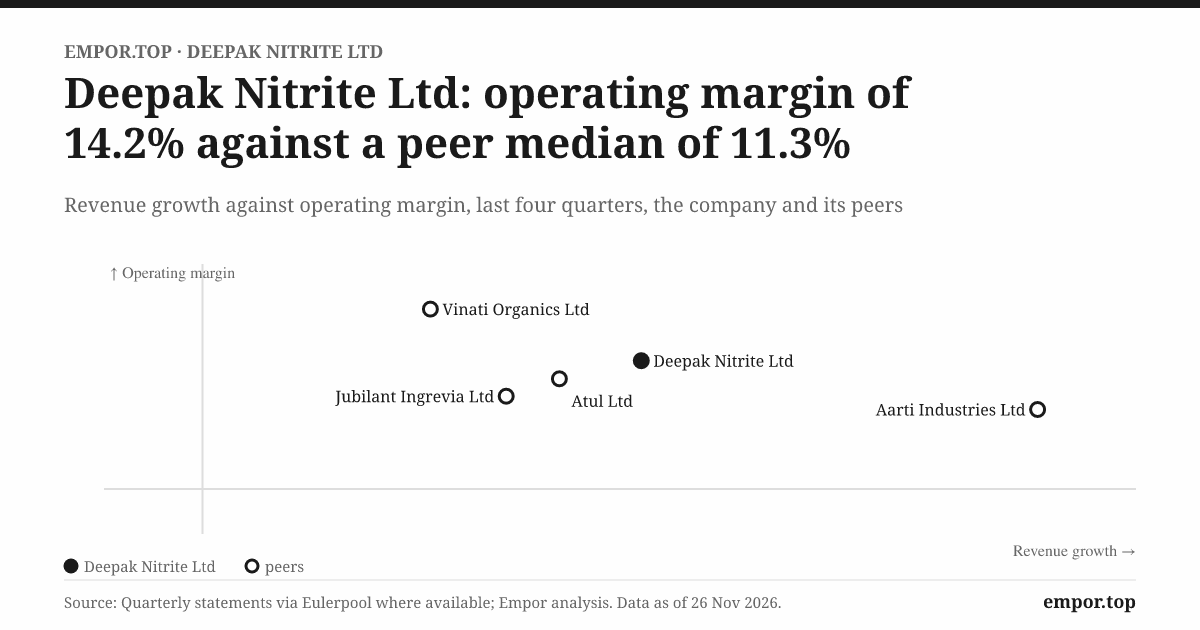
The September 2026 quarter showed the group's two businesses moving in opposite directions. Phenolics posted revenue of ₹2,291 crore and EBIT of ₹515 crore, a segment margin of about 22%.1 Advanced Intermediates posted revenue of ₹811 crore and EBIT of just ₹49 crore, a margin of about 6%.1 One business earned more than ten times the profit of the other in the same three months. That gap is the clearest picture of where Deepak's competitive position is strong today and where it is not.
Start with Phenolics, which deserves the deepest look because it drives most segment profit. In FY2026, it earned ₹695 crore of EBIT against ₹107 crore for Advanced Intermediates.3 Its competition comes from two directions. The first is imports: phenol and acetone shipped from producers in China, South Korea, Taiwan, the Middle East and Europe, landed at Indian ports. The second is domestic.
Haldia Petrochemicals, the eastern Indian petrochemical producer, has added phenol capacity, giving Indian buyers a second local option.3 Behind both sits the global supply-demand balance. China has built enormous phenol capacity in recent years, and when Chinese domestic demand weakens, the surplus flows into export markets, pressing down landed prices everywhere, including India.
Management's own reading of the market differs in one important respect. On the October call, Maulik Mehta said he did not see China really participating in India's phenol market, and did not expect it to in the short to medium term; phenol and acetone, he said, typically arrive from East Asia, and Indian demand of roughly 600,000 tonnes a year is growing at about 6–7%, spread across a long tail of small and mid-sized buyers making laminates, solvents and other chemicals.2
That matters, because a fragmented customer base buying in small lots is exactly the kind a domestic producer with trucks at the gate serves better than an importer with tankers at the port. An analyst pushed back with the question that hangs over the next few years: if new domestic capacity starts up without its own downstream use for acetone, will the surplus drag down spreads for everyone?2 It is the right question, and the answer will only show up in the margins.
As the Dahej experience showed, Deepak Phenolics may hold more than half of the Indian market, but if a cargo of Chinese phenol lands in Kandla at a low price, Deepak's customers will use that price in negotiation.
That is why FY2026 Phenolics profit fell even though the company's market position did not change. And it is why the September 2026 quarter, when import flows were disrupted and domestic demand was firm, produced record profit.2 Share protected volume in both cases. It did not protect margin.
Advanced Intermediates is a different animal. It is the descendant of the original business: a portfolio of nitration, hydrogenation and other chemistries that feed dyes, agrochemicals, pharmaceuticals and specialty uses. It brings strategic breadth, and some of its products feed the group's own integration plans.
Management also told analysts that some newly commissioned agrochemical-intermediate assets are linked to annualised customer procurement contracts, though it did not say what share of revenue those cover.2 But in proportion, it is now the smaller and less profitable half. Its 6% margin in the September quarter shows a business still exposed to imports and input costs, still waiting for the recovery that Phenolics already got.
Management's explanation was candid and specific: in the June quarter, demand was so strong that Deepak could not fully meet it, so customers worried about rising ammonia and raw material prices imported product themselves, and those cargoes landed in July, leaving some of Deepak's plants underused just as input costs eased.2
In other words, when the domestic supplier could not keep up, buyers switched to imports without hesitation. That is a small but revealing data point about switching costs in this half of the business. Management expects FY2028 to look like a normalised year for Advanced Intermediates, with the new assets running at optimised utilisation.2
Run the competitive forces honestly, and the picture is mixed. Buyers have real power: an industrial customer can usually compare supply from several qualified vendors, domestic and imported, and can switch on the next order if price or delivery disappoints. Suppliers matter too, because feedstock prices, benzene and propylene above all, swing with oil and refinery economics and can squeeze producer margins when product prices do not move in step.
The threat of new supply is constant in phenol, where global capacity additions and import flows constrain domestic pricing. Substitution is less of a threat, because there are few practical replacements for phenol or acetone in their main uses. Deepak's defences are technical process capability and integrated, scaled assets, which plausibly lower its cost per tonne and raise reliability. What is thin is evidence of switching costs or customer retention, the things that would turn an operating advantage into pricing power.
The company does not disclose its top customers' share of revenue, the duration of its customer contracts, or the share of revenue covered by annual procurement arrangements.3 Its sustainability reporting shows that sales through dealers and distributors were only about 8% of total sales, and that the top ten of those 66 dealers accounted for 88% of that channel, but that says little about concentration among direct industrial buyers.14 Without those disclosures, investors cannot test the most important question about any B2B chemical supplier: whether customers come back because they have to, or simply because the price was right this time.
The October call was a useful credibility test. Analysts pressed management on Chinese competition, on volatility, and on whether the Phenolics performance would last.2 The numbers they were reacting to were extraordinary. In the first half of FY2027 alone, Phenolics earned EBIT of ₹933 crore, more than its previous best full year, ₹867 crore in the boom year of FY2022, and the finance director predicted a new annual record.2
Asked whether this was a cycle, Maulik Mehta pushed back on the premise. A true super cycle, he argued, needs consistent demand running ahead of new capacity, and the capacity announced years ago in China and Southeast Asia had already come online; what investors were seeing instead was buoyant domestic demand plus geopolitical disruption to material flows.2
He described paying, in many cases, close to double the index price for propylene to keep the plants fed, and argued that the ability to do that at scale and keep customers supplied is what separates a specialty position from a commodity one.2 Those explanations are credible as far as they go.
Running a plant above its usual rate does lower unit costs, and buying feedstock well does widen margins. But a record quarter that coincided with disrupted imports cannot by itself prove through-cycle margins. The quarter shows what the plant can earn when conditions are favourable. It does not show what it earns when the next Chinese cargo lands cheaply.
So the moat question resolves to something measurable. The single most important number to watch is Phenolics segment EBIT margin, which ran about 13% for FY2026 and about 22% in the September 2026 quarter.31 If margins hold in the high teens once import flows normalise, the case for a real cost and reliability advantage strengthens considerably.
If they fall back toward the low teens, the September quarter was the cycle, not the company. Volumes and utilisation, alongside realisations relative to import prices, would tell investors which force is winning. Whatever the answer, both businesses need to generate cash, and that is where the record gets more complicated.
VII. The Cash Test: Growth Is Already Spending Ahead
Here is a number that looks almost too neat to be true. Across the twelve fiscal years from FY2015 to FY2026, Deepak Nitrite reported cumulative net profit of about ₹5,829 crore. Over the same years, its cash from operations added up to about ₹5,831 crore.3[^7] Within a rounding error, every rupee of reported profit eventually arrived as a rupee of operating cash. In an industry where profits can hide in swelling inventory or slow-paying customers, that is a genuinely good record, and it is the strongest single piece of evidence that the group's accounting earnings are real.
But operating cash is only half the cash story. The other half is what the company spends to stay in business and to grow, and there the picture changes sharply. In FY2026, cash from operations was ₹539 crore, while spending on property, plant and equipment was ₹1,185 crore.3 The group spent more than twice what its operations generated, leaving free cash flow deeply negative for the second year in a row.3
Over the full twelve years, free cash flow summed to only about ₹197 crore, while dividends paid came to about ₹651 crore, more than three times as much.3[^7] Put plainly, Deepak has paid its dividends and built its plants with a mix of operating cash, borrowed money and the equity raised for Dahej. That is not unusual for a company in a heavy investment phase. It does mean the next investment cycle will need external funding, because operating cash alone cannot carry it.
Look inside FY2026's operating cash, and the reason it fell short of profit becomes visible. Before working capital movements, the group's operating profit in the cash flow reconciliation was about ₹1,000 crore.3 Then working capital took its share. Receivables, money owed by customers, absorbed ₹221 crore, and other assets absorbed another ₹182 crore, partly offset by movements in inventory and liabilities.3 In other words, a meaningful slice of FY2026's profit was sitting on customers' books rather than in Deepak's bank account at year-end.
That is why debtor days deserve attention. The measure, receivables expressed as days of revenue, rose from about 56 in FY2025 to about 73 in FY2026.3 It is worth putting that in a longer frame. In the years before Dahej, debtor days ran in the high 80s and low 90s, so 73 is not alarming by the company's own history.[^7] But the direction matters, and so does the timing. Debtor days rose in a year when sales were falling, which suggests customers were taking longer to pay, not just that the company was selling more on credit at year-end.
The ageing of receivables offers some reassurance. At the parent level, trade receivables were ₹594 crore at March 2026, net of a ₹9 crore allowance for expected credit losses.3 Of that, ₹446 crore was not yet due, ₹146 crore was overdue by less than six months, and only ₹8 crore was older than six months, with about ₹3 crore more than three years old.3
None was classified as significantly credit-impaired, and the loss allowance actually fell during the year after a small reversal.3 So the evidence does not point to a pile of bad debts. It points to slower collection on a book that is still mostly current.
Why does this matter so much in chemicals? Because credit terms are long and varied. The parent discloses credit periods that range from 30 to 180 days depending on business and market.3 When sales accelerate sharply, as they did in the September 2026 quarter, receivables grow before customers pay, and cash can lag profit by months. A business that books a record quarter can therefore consume cash in the very period it reports its best results. The test of FY2027 will be whether debtor days fall back as sales rise, or whether faster growth is bought with looser terms.
The debt picture needs similar care, because two different pictures are available depending on where one looks. The listed parent's standalone borrowings were only ₹13 crore at March 2026.3 The consolidated group's financial debt, excluding about ₹110 crore of lease liabilities, was about ₹1,638 crore.3 Against cash and short-term investments of about ₹462 crore, net debt was a little under ₹1,200 crore, only slightly more than one year of FY2026 EBITDA.
That is manageable. But the trend is steep. Consolidated borrowings were close to zero in FY2023 and have since risen several times over as the investment cycle gathered pace.[^7] The parent also stands behind a ₹47 crore corporate guarantee for a subsidiary's term loan in Oman, and the group reported ₹686 crore of capital commitments net of advances at year-end, connecting the listed company's balance sheet directly to subsidiary projects.3
Credit ratings are a useful constraint indicator here, though not a guarantee. In August 2026, ICRA reaffirmed the group's AA (Stable) long-term and A1+ short-term ratings and assigned them to an enhanced borrowing amount.15 In its most recent detailed rationale, from August 2025, ICRA credited the group's operating history, product diversity, technical capability and established market positions, but flagged volatile raw material costs and phenol-acetone spreads, sizeable capex, execution risk and an expected moderation in credit metrics through FY2028.5 It assessed liquidity as adequate.5
For context, ICRA had rated the company's long-term debt A+ in 2018, before Dahej was in full production, so today's AA reflects a genuine upgrade earned by the phenol plant's cash flows.4
On the October call, the finance director said the group had spent roughly ₹700 crore of capex cash in the first half of FY2027 and expected another ₹800–900 crore in the second half; equity contributions were largely done, with only about ₹50 crore left, so from here the banks, with whom financing was already tied up, would fund the build.2 The company does not disclose covenant headroom or refinancing terms.
The first half of FY2027 brought mixed signals on this front. On management's own measure, consolidated net debt stood at about ₹1,657 crore at the end of September 2026, a little lower than three months earlier, against net worth of about ₹6,521 crore, a net debt-to-equity ratio of about 0.25.2
Management also said its net cash conversion cycle had shortened to 53 days from 57 in the June quarter.2 Those are encouraging readings, though the comparison with March is sobering: even in two record quarters, net debt was higher than it had been at the end of the weak year, because capex ran ahead of the cash the plants threw off.
Dividends have been modest throughout. The company has typically paid out between about a tenth and a fifth of its profit, paying nothing in FY2021 and about 19% of profit in FY2026, and the shares yield only about half a percent.3[^18] That is consistent with a business that sees better uses for its cash in new plants than in shareholders' pockets, and it means the investment case rests almost entirely on whether those plants earn their keep. The company issued no fresh equity in FY2026, and the share count stood at about 136 million.3
The verdict on cash is therefore two-sided. Long-run profit conversion is excellent, and the receivables book shows no sign of serious credit stress. Recent free cash flow is negative, receivables are absorbing more cash, and the coming investment cycle depends on lenders. The watchlist writes itself: consolidated net debt, operating cash flow, debtor days, and project spending against schedule. All of those numbers ultimately trace back to the decisions of one family, and it is worth looking at the people making them.
VIII. The Family That Owns the Bet
At the top of Deepak Nitrite sits Deepak Mehta, executive chairman and managing director, the figure who has steered the company through the Dahej build, the boom and the downturn.3 Beside him is his son, Maulik Mehta, the third generation, whose term as chief executive ended in May 2026.34 Ahead of the August 2026 annual meeting, shareholders were asked to approve his elevation to Deputy Managing Director, with fixed remuneration of ₹5 crore for FY2027 plus performance-linked pay, and by the October call he was introduced in that role.32
On calls he is the voice of the company's strategy: fluent in chemistry, quick to anticipate a hostile question, and inclined to reframe rather than concede, as when he answered a question about the phenol cycle by arguing that there was no super cycle at all.2 It was a succession signal, not a sudden change: the family's next leader moving one step closer to the top job while the current chairman remains in place.
Around them is a finance team that matters a great deal in a capex-heavy phase. Sanjay Upadhyay continues as Director (Finance) and Group CFO, and Somsekhar Nanda is CFO.3 These are the people who will negotiate the bank financing, track project budgets and report to the board when costs move. Family members also sit on the board as non-executive directors, alongside six independent directors among twelve before the August changes, when Dileep Choksi's second term as an independent director ended and two new independent appointments were proposed.3
The promoter group still held just under half the company, with no pledge or encumbrance reported.13 That holding had risen over time, from about 45.7% in March 2022 to about 49.1% in March 2023, a shift that appeared alongside a corporate restructuring involving promoter-group holdings rather than clear open-market buying.16
Domestic institutions held about 22.5% and foreign institutions about 6.4% at September 2026, and the company had more than 381,000 shareholders.13 So the family owns roughly half the company, institutions own about three-tenths, and a broad base of retail investors owns the rest.
It is also worth noticing who has been buying alongside the family. Domestic institutions, mostly Indian mutual funds and insurers, raised their combined stake from about 15% in March 2023 to about 23% by March 2026, even as earnings fell.16 By September 2026, foreign institutions held only about 6%.13 Indian fund managers, in other words, were accumulating the stock through the downturn, a bet on recovery that the September quarter has so far rewarded.
That concentration cuts both ways. It aligns the family with every other shareholder, because the family's wealth rises and falls with the share price. It also concentrates control. With nearly half the votes, the promoter group can carry almost any ordinary resolution with modest support from others, so minority investors' main protection is the independence and quality of the board rather than their own votes.
Pay is where alignment looks weakest. In FY2026, Deepak Mehta received ₹8.6 crore, Maulik Mehta ₹5.4 crore and Sanjay Upadhyay ₹6.5 crore; a year earlier, the figures were ₹8.6 crore, ₹5.0 crore and ₹6.0 crore.3 So pay was flat to higher in a year when consolidated profit fell by about a fifth.
The auditor's finding of legal compliance is a floor, not an endorsement of the pay structure.3 In the disclosures available, remuneration does not look strongly sensitive to performance. The new FY2027 structure for Maulik Mehta, with a performance-linked component, at least creates the possibility of a tighter link.
Related-party dealings, often a concern in promoter-led Indian companies, look mostly benign here. The parent's FY2026 related-party transactions were largely intra-group: ₹219 crore of purchases from related entities and ₹188 crore of sales and services to them, mainly with subsidiaries, all eliminated on consolidation.3 The parent also lent ₹68 crore to subsidiaries during the year.3 The annual report says the transactions were reviewed by the audit committee and conducted at arm's length, and the notes describe no royalty, brand or management fee flowing to promoter entities.3 Deloitte, the auditor, gave an unmodified opinion.3
Shareholders have not signalled discontent. At the August 2026 annual meeting, all resolutions passed, and the vote on adopting the standalone accounts drew only 1,555 votes against out of about 106 million cast.17 That is not evidence of broad dissent, though it is also what one would expect when the promoter group alone holds nearly half the votes.
An activist looking at this board would ask a pointed question. The family holds roughly half the votes, family members fill the chair, the deputy managing director's seat and non-executive seats, and the man who set the three-year payback screen in 2021 is now the person steering the largest capex program in the company's history.
Who, inside the boardroom, is positioned to say no? The answer, formally, is the independent directors and the audit committee. The record offers no public instance of them stopping or resizing a project, which is not evidence that they would fail to, but is also not evidence that they would.
The most important evidence on management, in the end, is behaviour rather than structure. The Dahej project worked commercially, and that is a meaningful execution precedent. The current plan is larger and more complex, and it is being pursued while free cash flow is negative.
The open tests are concrete: whether project milestones arrive on schedule, whether cost estimates hold, whether new capacity ramps to high utilisation, and whether management explains any misses with specific, measurable course corrections. Those tests will play out over the next few years. In the meantime, the market has already put a price on them.
IX. The Investor's Case: A Lower Multiple, a Higher Execution Bar
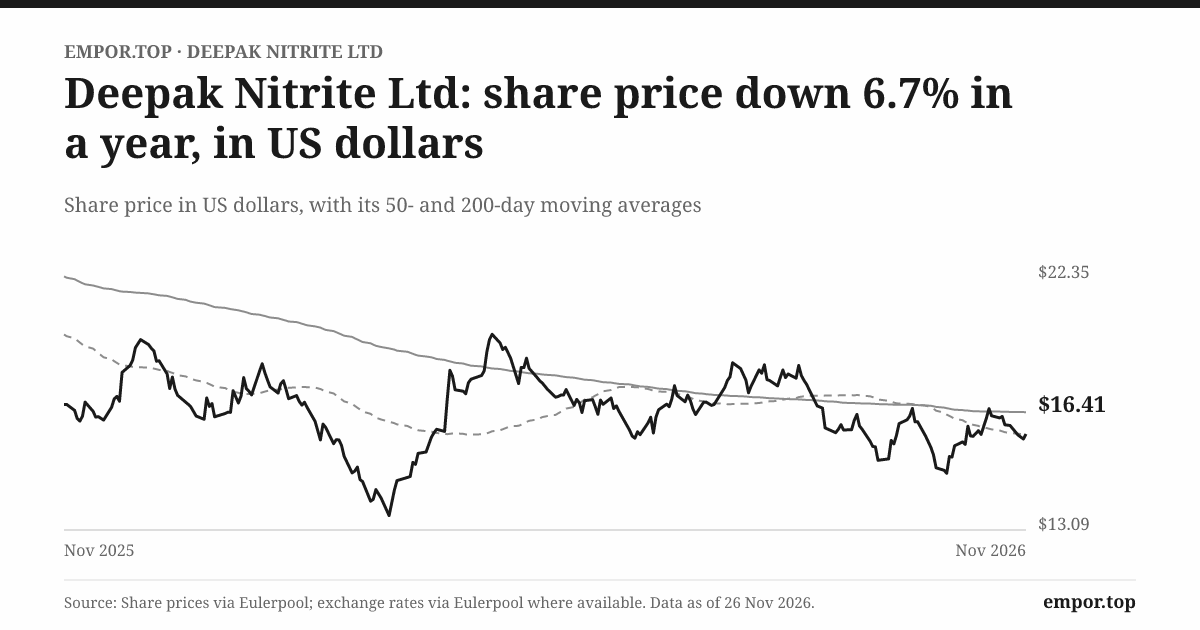
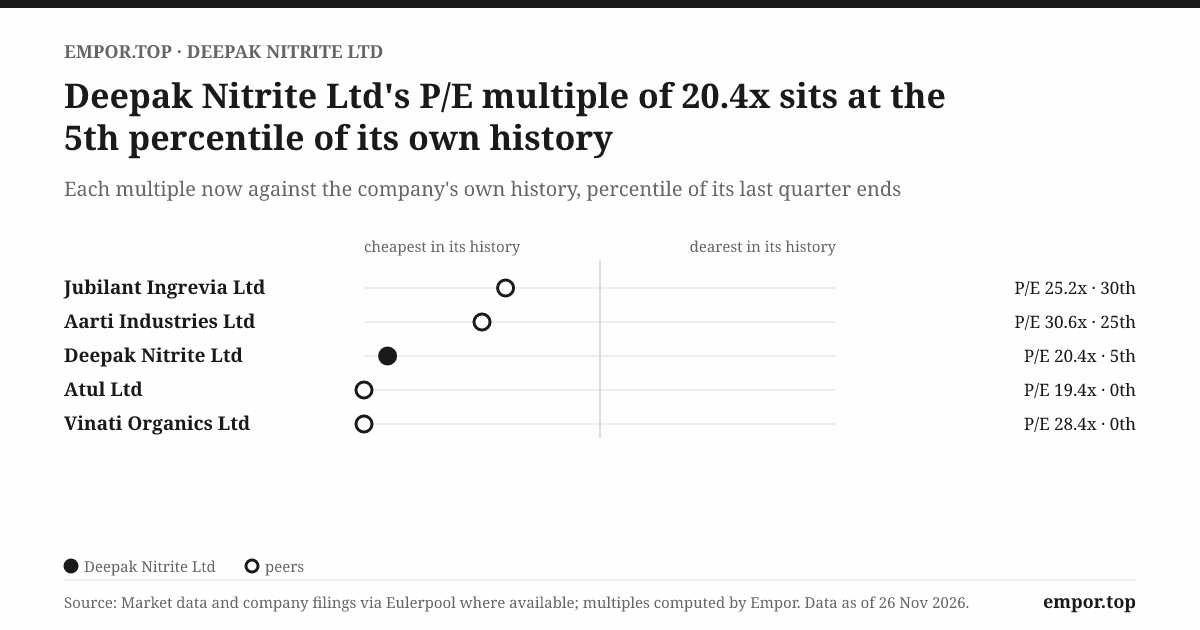
On November 26, 2026, Deepak Nitrite's shares closed at about ₹1,522, roughly 19% below their 52-week high.[^18] The market valued the company at about ₹21,700 crore, or about ₹23,100 crore including net debt.[^18] On the last twelve months of earnings, the shares traded at about 20 times profit, against a median of about 36 times over the previous five years.[^18] The enterprise value was about 13 times EBITDA. To a casual observer, that looks like a stock that has become cheap relative to its own history. The more useful question is what the price assumes.
There is a simple way to see how much the answer depends on which year one believes. The market value of about ₹21,700 crore is roughly 20 times the last twelve months of profit, a period that includes two record quarters. Set the same market value against FY2026's profit of ₹551 crore, and the multiple is nearer 39 times.[^18]3
The stock is cheap on boom earnings and expensive on trough earnings. What the price seems to assume is something in between: that a good part of the recent recovery sticks, but not all of it. The earnings yield on the trailing figures is about 4.9%, which leaves room for modest growth expectations but not for a repeat of the boom.[^18]
The comparison with history needs a large asterisk. The five-year median multiple was set during a period that included peak-cycle earnings and peak-cycle enthusiasm for Indian specialty chemicals. The fact that investors once paid 36 times earnings does not mean that multiple was justified, or that it will return. Returns on capital tell the same story.
In FY2026, return on capital employed was about 11% and return on invested capital about 7%, down from close to 39% and 34% at the FY2022 peak.3[^7] On the last twelve months, helped by the record quarters, return on capital employed recovered to about 18%.1 The multiple has fallen alongside returns, which is exactly what a rational market would do with a cyclical business coming off its peak.
Peer comparisons are equally imperfect. In late November 2026, Aarti Industries traded at about 27 times earnings and Fine Organic at about 34 times, with EV/EBITDA multiples of about 14 and 25 times respectively, compared with Deepak's 13.4 times.[^18] Deepak looks cheaper on those measures. But Aarti has a different product mix, heavier in benzene-based specialty intermediates, and Fine Organic sells oleochemical additives with different margins and growth. Neither is a phenol producer. The comparison says Deepak is priced at a discount to some Indian chemical peers. It does not say whether that discount is unwarranted.
The bull case is built from real evidence. Deepak owns a scaled, integrated domestic phenol and acetone position that stayed solidly profitable even in a down year. It serves broad industrial end markets in a country whose chemical consumption is growing. It has a research centre, new Advanced Intermediates capacity and a polycarbonate project that, if delivered, would extend the value chain into higher-value plastics. And it has a management team that has done this once before, at Dahej, turning a leveraged construction project into a business earning hundreds of crore a year.
The bear case uses the same record. FY2026 earnings and returns declined sharply. Advanced Intermediates, the supposedly diversifying half, is much less profitable and was hit harder in the downturn. The Phenolics rebound coincided with disrupted imports and strong domestic demand, conditions that may not last. Free cash flow is negative, debt is rising, and the next investment cycle is larger than anything the company has attempted. The bull case needs durable segment economics and good returns on new capital. The bear case needs only persistent spread pressure, a delay or two, or weak cash conversion.
Hamilton Helmer's framework of seven durable powers helps sort which of the company's advantages can last. Scale economies are the clearest: a large integrated cumene-phenol-acetone complex spreads fixed costs over more tonnes than smaller rivals and gives the group a cost and reliability edge over importers who must carry freight and inventory. Process power, the embedded know-how that lets a plant run hazardous chemistry efficiently, is plausible given decades of operating history, but hard to prove from outside. Counter-positioning and network economies do not apply.
Switching costs are weak in commodity phenol, though they may be stronger in qualified specialty intermediates and would be much stronger in automotive-grade polycarbonate. Branding is irrelevant. A cornered resource is absent: Deepak has no exclusive feedstock or protected technology, and imports and rival domestic capacity remain available to every customer. So the defensible power is scale, plus some process know-how. That is a real but cyclical advantage.
A skeptical activist would focus on capital allocation. Management has described about ₹11,700 crore of capital spending over four years.2 What return must that program earn, and by when? Using the company's own 2021 yardstick of a roughly three-year payback, the program would need to generate several thousand crore of annual cash returns within a few years of commissioning. Measured against FY2026 EBITDA of roughly ₹1,000 crore, that is an enormous bar.
Even a far more modest hurdle, say a return on capital of 15%, implies about ₹1,750 crore of operating profit a year from the new assets alone, well above anything the group has ever earned in total. An activist would ask which projects management would defer if cash or leverage tightened, whether the schedule has explicit return thresholds, and whether the board would stop a project that was running over budget. The company has not publicly published project-by-project return targets.
The forward case can be made falsifiable with three numbers. The first is segment EBIT and margin, especially for Phenolics, through a normal year. The second is net debt against operating cash flow. The third is commissioning-to-utilisation progress on the new assets, above all polycarbonate. Rising margins, controlled debt and rapid ramp-ups would support a higher multiple. Compressed margins, rising leverage and slow ramp-ups would explain why the market already pays less than it once did. The price, in short, is a bet on execution, and the record offers lessons about how that bet tends to go.
X. Lessons From Dahej to Polycarbonate
The first lesson comes from the Gujarat coast in 2018, when tankers stopped being the only way to get phenol into India. Dahej showed the distinction: import substitution creates a market; integration decides whether you keep the economics.
For founders and investors anywhere, the point is that replacing imports gives you customers, but only cost position and integration let you keep a margin once those customers can call a trader for the next cargo.
The second lesson is the one Deepak is living through now. A good project is not a license for an unlimited capex cycle. The next polycarbonate plant sits inside a multi-year program several times larger than the first plant.
Success at Dahej earned management credibility, and credibility is exactly what makes a much larger bet possible. Every company that pulls off one transformational plant faces the temptation to treat it as a template. The discipline is to treat each new project as if the last one had never happened, and to prove its return before sizing the next.
The third lesson lives in the cash flow statement. Profit is a claim; cash is the collection. Deepak's long-run cash conversion is enviable, but the latest year showed how receivables and capex can leave growth dependent on lenders. A company can be honest in its accounting and still be short of cash. Investors who watch only earnings miss the moment when growth starts to be paid for by lenders.
The fourth lesson is about the quarter that opened this story. In chemicals, a record quarter is a data point, not a forecast. Phenolics' rebound came amid disrupted imports and firm domestic demand. What changed was the world outside the fence. The only way to know what a chemical plant really earns is to watch it through a normal year, and Deepak has not yet had one since its big rebound.
The fifth lesson belongs to the boardroom. A payback rule is only as strong as the person allowed to overrule it. In February 2021, Maulik Mehta gave analysts one of the crispest capital-allocation tests a chemical company can state in public: a three-year free cash flow payback for a new product, no ROCE gymnastics required.
Five years later, the same leadership is steering a much larger program whose flagship project will take years to reach full integration and utilisation. That does not mean the rule has been broken; polycarbonate may be judged on different terms. It means investors should ask which yardstick now applies, and who on the board enforces it.
XI. Epilogue
Tonight, Deepak Nitrite stands between two kinds of evidence. Behind it is a decade in which one plant multiplied the company's scale, a boom that made it a market darling, and a three-year hangover that more than halved its returns. Ahead of it is the most expensive stretch in its history.
On the October call, management sketched the schedule: about ₹1,500–1,600 crore of capex cash in the current year, then roughly ₹2,200–2,400 crore in FY2028, about ₹2,500 crore in FY2029, and ₹2,500–3,000 crore in the year after.2 The polycarbonate project is still on the construction schedule, newly commissioned Advanced Intermediates assets are ramping, and the Phenolics business is enjoying the best conditions it has seen in years.
The first moment that will decide the story is the Phenolics margin once import flows and spreads normalise. If the next few quarters show segment margins holding well above FY2026's level even as Chinese cargoes return, the case that Deepak's scale and integration give it a durable cost advantage strengthens. If margins slide back toward the low teens, the record quarter will look like what it may well have been: a favourable moment in a volatile market.
The second is Advanced Intermediates. This is where the newer capacity sits, including the agrochemical-intermediate assets tied to customer procurement arrangements. If its EBIT recovers as new capacity fills, the group's diversification becomes real rather than nominal. If it stays stuck at single-digit margins, the company will remain, in economic substance, a phenol business with a diversified sideline.
The third is polycarbonate, which has to be watched in stages, because each stage is a different kind of test. Construction tests project management and cost control. Commissioning tests whether relocated German equipment runs reliably at Dahej. Customer qualification tests whether automotive and electronics buyers accept the product. Commercial sales at high utilisation test whether the whole venture earns a return. Technical milestones along the way will make headlines. Only the last stage puts money in the bank.
The fourth runs underneath all the others: operating cash flow, debtor days, net debt and capex against schedule. If cash generation rises fast enough to keep leverage in check while the projects are built, management will have shown that it can fund a larger cycle without stretching the balance sheet. If debt climbs faster than earnings and projects slip, ICRA's warnings about credit metrics will have proven prescient, and the next cycle will look more like a strain than a step up.
These outcomes map onto the questions the story began with. Deepak has demonstrated that it can build a large import-substitution business. It has not yet demonstrated the returns or the cash profile of the next wave, and no amount of record quarters can settle that in advance.
XII. Outro
Go back to Dahej, to a plant that began as a ₹1,400 crore wager by a company that had to sell new shares to afford it. That plant now anchors a Phenolics business with more than ₹5,400 crore of annual revenue, and it is the reason a family-run maker of industrial salts became India's largest phenol producer.3 It is also the reason the same family now feels confident enough to dismantle a German polycarbonate plant, ship it across the world and rebuild it next door, at a cost of roughly ₹5,000 crore.
That is Deepak Nitrite's distinctive wager, repeated across half a century: turn chemical capability into domestic supply advantage, one plant at a time. The first big plant proved the family can build. The next one has to prove it can earn. Every steel column going up at Dahej is both a monument to the last bet and an invoice for the next one, and the only thing that will settle the bill is cash.
References
-
Q2 & H1 FY2027 Results Presentation — Deepak Nitrite Limited, 2026-10-29 ↩↩↩↩↩↩
-
Q2 & H1 FY2027 Earnings Conference Call Transcript — Deepak Nitrite Limited, 2026-10-30 ↩↩↩↩↩↩↩↩↩↩↩↩↩↩↩↩↩↩↩↩↩↩↩↩↩↩↩
-
55th Annual Integrated Report 2025–26 — Deepak Nitrite Limited, 2026-07-14 ↩↩↩↩↩↩↩↩↩↩↩↩↩↩↩↩↩↩↩↩↩↩↩↩↩↩↩↩↩↩↩↩↩↩↩↩↩↩↩↩↩↩↩↩↩↩↩↩↩↩↩↩↩↩
-
Deepak Nitrite FAQs: Corporate History and Phenol & Acetone Project — Deepak Nitrite Limited, 2018 ↩↩↩↩↩↩↩↩↩↩↩↩↩↩↩↩↩↩↩↩↩↩
-
Deepak Nitrite Limited: Ratings reaffirmed; outlook revised to Stable — ICRA, 2025-08-11 ↩↩↩
-
Deepak Nitrite Limited: Historical public issue record — SEBI ↩
-
Deepak Nitrite Limited: Ratings reaffirmed — ICRA, 2023-03-31 ↩
-
Q3 & 9M FY2021 Earnings Call Transcript — Deepak Nitrite Limited, 2021-02-16 ↩↩↩↩↩↩
-
Trinseo Announces Agreement to Sell Polycarbonate Technology License and Stade, Germany Polycarbonate Assets to Deepak Chem Tech Limited — Trinseo, 2024-11-13 ↩↩
-
DCTL Polycarbonate Project Filing — Deepak Nitrite Limited, 2024-11-13 ↩
-
Deepak Nitrite Limited: September 2026 shareholding record — The Raisina Post, citing NSE and BSE filings ↩↩↩↩
-
54th Annual Integrated Report 2024–25, BRSR — Deepak Nitrite Limited, 2025 ↩
-
Deepak Nitrite Limited: Ratings reaffirmed and assigned for enhanced amount — ICRA, 2026-08-27 ↩
-
52nd Annual Integrated Report 2022–23 — Deepak Nitrite Limited, 2023 ↩↩
-
Voting Results of 55th Annual General Meeting — Deepak Nitrite Limited, 2026-08-05 ↩
 LinkedIn
 WhatsApp
 Reddit
 Hacker News
 Email
 Kindle
 RSS Feed
 Spotify
 Apple Podcasts
 Amazon Music
 Audible
 YouTube