Aarti Industries: Betting the Balance Sheet on Benzene
I. Introduction & Episode Roadmap
Picture a drum of benzene at a chemical site on the Gujarat coast. It is a clear, sweet-smelling liquid, dangerous if handled carelessly, and worth very little on its own. Chlorinate it, nitrate it, reduce it, then run it through a dozen more reactions, and it ends up inside a herbicide sprayed on a Brazilian soybean field, a pigment in a German car coating, a pharmaceutical intermediate in an American generic drug, or an antioxidant that keeps a truck tire from cracking. You will never see the Aarti Industries name on any of those products. That is the business model. Aarti is the supplier behind the brands, and it works in some of the least glamorous and most hazardous chemistry in the industrial world.
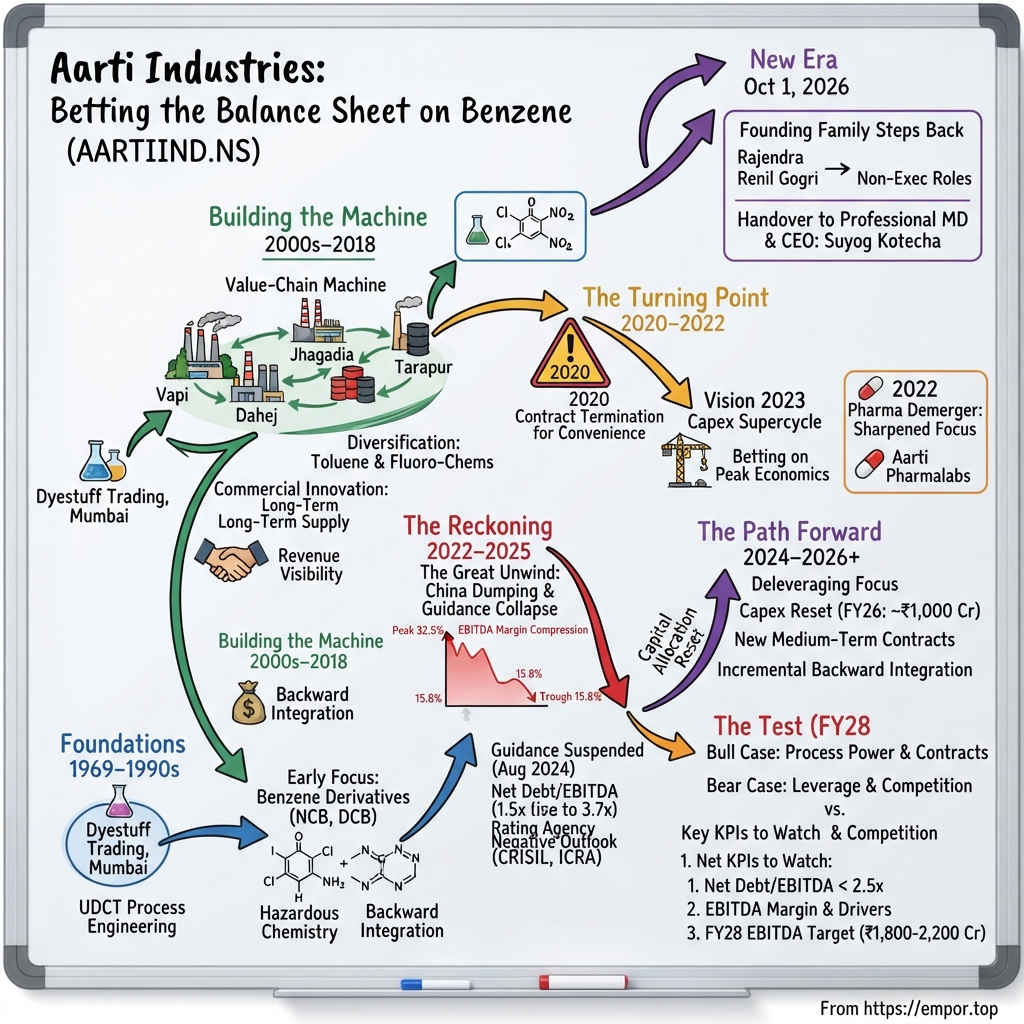
For most of its life, that obscurity came with steady compounding. Then, early in this decade, Aarti tried to become something bigger. Management set out to roughly double the company, committed thousands of crores of capital, and timed much of it to a pandemic-era pricing boom that turned out to be a peak. The results since then are uncomfortable. Revenue grew about 60% between FY22 and FY26, but net debt relative to EBITDA rose from about 1.5x to about 3.7x, and return on invested capital fell by roughly two-thirds1. Put simply, the company got bigger and became a worse business to own over the same period. The growth has not yet paid for the capital that bought it.
That tension runs through this story. Aarti has real capabilities: multi-step hazardous chemistry, environmental clearances that take years to secure, and global customers who spend years qualifying a supplier before switching to it. It also has a record that repeatedly tests how much those capabilities are worth when conditions turn. A marquee ten-year contract was cancelled for convenience in 2020. Chinese producers flooded Aarti's markets from 2023 onward. Management suspended its own guidance in 2024, and a rating agency moved to a negative outlook in 2025.
The episode follows the arc in order. It starts with the family's origins in benzene chemistry and the value-chain machine they built across Gujarat and Maharashtra. Next comes the 2020 contract termination, an early warning that went underappreciated, followed by the "Vision 2023" capex supercycle and the 2022 pharma demerger that left Aarti a near pure-play chemicals company. After that the story turns to the industry's structure and economics, the China-driven unwind, and capital allocation since the reckoning. It then covers an event only weeks away as this is written: on October 1, 2026 the founding Gogri family steps back from executive roles and hands the company to a professional managing director12. The episode closes with the bull and bear case and the few numbers that will settle it.
Aarti's recent history comes down to one question. Did the company build a durable franchise and simply hit a brutal cycle, or did it build capacity for a cycle that will not return? The answer starts with a trained chemist in Mumbai.
 Subscribe on LinkedIn
II. From Dyestuff Trading to Benzene Chemistry (1969–1990s)
In the late 1960s, Mumbai's chemical trade was a world of dye merchants, small reactors in suburban industrial estates, and chemists who had learned their craft at one institution: the University Department of Chemical Technology, UDCT, today's Institute of Chemical Technology. Chandrakant Gogri came out of that school. UDCT graduates were known for practical process engineering, not only textbook chemistry. They learned how to turn a reaction from a lab flask into something that could run safely at tonnage scale. That skill later became Aarti's entire identity19.
Gogri and his family started in dyestuff intermediates, a trade in which Indian entrepreneurs were replacing imported chemicals under the licence-raj import substitution policy. The venture that became Aarti Industries Limited was incorporated in 19843. Early on, it focused on a narrow family of molecules built on benzene: dichlorobenzene (DCB) and nitro-chloro-benzene (NCB).
A simple analogy explains why that choice mattered. Think of benzene as a blank six-sided Lego piece. Chlorination snaps chlorine atoms onto its sides. Nitration snaps on nitro groups. Depending on which sides get which attachments, you end up with different "positions," or isomers, and each one leads to a different family of downstream products. One isomer might lead toward a herbicide, another toward a dye, another toward a rubber chemical. A producer that can run these reactions, separate the isomers cleanly, and sell every stream, not just the most profitable one, has a real cost edge over one that has to discard or dump its by-products.
These are also hazardous processes. Nitration is exothermic, meaning it releases heat, and a runaway reaction can be catastrophic. Chlorination handles toxic gas. Effluent treatment is expensive, and environmental permits in India are slow and politically sensitive. That is why relatively few Indian entrepreneurs in the 1980s and 1990s wanted to do this work. It is also why the families who learned to do it well, the Gogris among them, built businesses that were hard to copy19.
By the 1990s, Aarti was supplying derivatives of NCB and DCB to domestic dye makers, agrochemical formulators and pharma companies. Its positioning was set early: an intermediate supplier sitting several steps upstream of the brands. Customers did not buy Aarti for marketing. They bought it because it could deliver a specific molecule at a specific purity, reliably and at a competitive cost.
For investors, the reason to know this history is that every later claim about Aarti's moat traces back to it. The case rests on backward integration, meaning ownership of the early steps of each chemical chain, and on the ability to handle dangerous multi-step chemistry that competitors avoid. Those are real advantages. They are also production advantages rather than pricing advantages, a distinction that becomes crucial once a larger and cheaper producer shows up. The next phase is the story of how the Gogris turned this chemistry into an industrial machine.
III. Building the Value-Chain Machine (2000s–2018)
Driving north from Mumbai along the Gujarat industrial corridor in the 2000s, you would pass the smokestacks of Vapi, then the sprawling estates of Dahej and Jhagadia near the Narmada estuary. Aarti's footprint spread across that corridor and into Tarapur in Maharashtra2. Each site added another link in a chain. Benzene came in at one end. At the other end came hundreds of intermediates, loaded into drums and ISO tanks bound for Europe, the United States, Japan and domestic customers.
The expansion logic was about breadth rather than depth in any one molecule. Aarti extended from the benzene chain into toluene, benzene's sibling feedstock with one extra carbon attached. That opened chlorotoluenes, nitrotoluene derivatives and, later, fluoro-specialty chemicals2. Each new chain reused the same core competencies: chlorination, nitration, hydrogenation and isomer separation. Each also created by-product streams that another Aarti plant could consume. Sulphuric acid, a by-product and input across many of these reactions, became a business in its own right2.
It works like a meatpacker. A packer that can sell the steak, the hide, the bones and the offal earns much more per animal than a butcher who sells only steaks. Integrated chemical producers work the same way. The more streams you monetize, the lower your effective cost on the main one. By the mid-2010s, management was describing Aarti as a top-five global producer across roughly three-quarters of its product portfolio3. That claim comes from the company itself and is not independently audited share data. It is plausible given Aarti's scale in niche intermediates, but it should be read as a marketing statement until proven otherwise.
The period also produced Aarti's most important commercial innovation: long-term supply agreements with global agrochemical and chemical majors. In place of spot sales of individual molecules, Aarti began signing multi-year contracts, often for custom intermediates, in which the customer committed volumes and Aarti committed dedicated capacity. Over time, some of these relationships widened from a single molecule to broader baskets of products2. For a supplier of intermediates, this looked like the holy grail: revenue visibility, capacity funded against a committed buyer, and deeper integration into the customer's supply chain.
Growth in this era was steady rather than spectacular. Revenue was around ₹3,100 crore in FY17 and moved toward roughly ₹4,100 crore by FY19–FY201. That is respectable mid-single-digit to low-double-digit compounding for a business that was also funding a pharma division alongside its chemicals franchise. Margins were healthy but not extraordinary. Aarti looked like a well-run industrial company with a slightly better-than-average mix.
What this era proves, and what it does not, is the useful takeaway for investors. It proves Aarti could build and operate a large, integrated, hazardous-chemistry footprint at scale. That capability is real and is not easily replicated in India. It does not prove that the footprint earns premium returns through a cycle. Through FY20 there had been no severe test. The long-term contracts were also untested. They had brought revenue in, but none had yet shown what happens when a customer wants out. That test came in 2020, and it was the first sign that "long-term" meant something narrower than the market had assumed.
IV. The 2020 Contract Termination: An Early Warning on "Moat"
On a Monday in mid-June 2020, with India still in the grip of its first COVID lockdown, Aarti's shareholders woke to an exchange filing that did not fit the story they had been told. A global agrochemical customer was invoking a "termination for convenience" clause on a supply contract Aarti had signed in 2017. The contract was worth about ₹4,000 crore over ten years and had been one of the flagship deals behind the long-term-contract thesis4.
The reason was not a quality failure or a dispute. The customer had changed its sourcing strategy. It decided to procure the active ingredient itself rather than have Aarti manufacture the intermediate for it4. The shares fell about 7% in a session and were about 29% below their all-time high4.
Aarti was compensated. Reports put the payout at roughly $120–130 million4, and management presented the episode as a clean exit that protected shareholders financially. That framing is partly fair. The contract had a break clause, the clause carried a fee, and the fee was paid. By the standards of commercial law, the contract worked exactly as written.
The mechanism matters more than the money, though. Termination for convenience means the buyer can walk away for its own reasons as long as it pays the agreed price for doing so. That is not what investors usually picture when they hear "ten-year take-or-pay contract." The popular version of the Aarti moat story said multi-year contracts locked customers in, justified dedicated capacity, and made future cash flows nearly bond-like. The 2020 termination showed a different picture. The customer held an option, it exercised that option when its own strategy changed, and Aarti was left with capacity built for a buyer who no longer needed it.
Myth vs. reality. The myth: long-term agrochemical contracts give Aarti contractual protection against customer power. The reality, on this evidence: they give Aarti priced protection. The customer can still leave, but leaving is costly. That is a real switching cost, and it created genuine revenue visibility while the contract ran. It is not unconditional, and it does not stop the largest customers from reorganizing their supply chains around Aarti when it suits them.
The evidence is strong because it is specific: the same business, the same kind of customer and the same contract structure that bulls cite today. It is one episode, and Aarti signed further long-term deals afterward, so it does not reject the contracting thesis outright. It narrows it. The defensible claim is that Aarti's contracts raise the cost of leaving and improve visibility, not that they guarantee volume. The test for the newer agreements covered in Section IX is whether they carry similar convenience clauses and how large the exit fees are relative to the capital committed. Those terms are largely not disclosed.
At the time, the market moved on quickly. Within months, the pandemic set off one of the most lucrative periods in the history of Indian specialty chemicals, and Aarti's management chose that moment to place the biggest bet in the company's modern history.
V. Vision 2023: The Supercycle Bet (2019–2022)
In 2020 and 2021, the specialty chemical world tilted toward India. Chinese chemical parks were already being shut or relocated under environmental crackdowns. Pandemic lockdowns then disrupted supply chains from Wuhan to Jiangsu. Western buyers, suddenly aware of how much they depended on a single country, began talking about "China plus one," a second source outside China for every critical intermediate. Indian producers with capacity, clearances and a record of reliable delivery were the obvious beneficiaries, and Aarti was near the top of that list.
Management had already laid out an ambition that fit the moment: a multi-year capital program, variously described in the range of ₹4,500–8,000 crore across phases, meant to roughly double revenue and EBITDA26. It was framed as "Vision 2023" and its successors. New plants were planned for chlorination and nitration capacity, for the toluene chain, and for specialty and custom-manufacturing assets, some tied to the long-term contracts. It was by far the largest capital-allocation decision the company had ever made, and it committed the balance sheet to the view that elevated demand and pricing would hold.
For a while, the numbers justified it. FY22 was the peak. Revenue reached about ₹5,190 crore and EBITDA about ₹1,690 crore, an EBITDA margin near 32.5%1. For a maker of intermediates, that margin is extraordinary. It is the kind of number usually earned by companies with branded or patented products, not by suppliers of chlorinated benzene derivatives. Return on equity was around 26%, return on invested capital around 17.5%, and net debt was a comfortable 1.5 times EBITDA1. On paper, Aarti could fund its expansion and still carry a conservative balance sheet.
The margin was not only a reflection of Aarti's skill. A large part of it was scarcity. When Chinese capacity was offline or disrupted, whoever could deliver set the price. Aarti's integration let it capture more of that windfall than a less integrated rival could, but the windfall itself came from outside the company. A 32% margin in a scarce market does not show what the business earns in a normal one.
FY22 is still the base year for much of the Aarti bull case today. It is the reference point for "normalized" margins, the evidence offered for pricing power, and the benchmark every later guidance miss is measured against. Anchoring on it is the central analytical risk in this story. Aarti sized its expansion to peak economics, and the capacity it built will be judged on the economics that actually came afterward.
The capex decision on its own terms. Management's argument for building aggressively was reasonable. Indian specialty chemicals were gaining share from China, customers were asking for capacity, and building takes years, so waiting would mean missing the window. The counterargument was that the window depended on Chinese capacity staying constrained, and Chinese producers had every incentive to come back. Management's documents from the period stress demand visibility and customer interest. They do not show capacity sized to trough-cycle profitability2. The distinction proved expensive.
One structural change was also underway. Aarti's pharma business, which made active pharmaceutical ingredients and intermediates, was being prepared for separation. After it left, specialty chemicals would be essentially the whole company, so the specialty chemicals economics examined in Section VII would carry the entire investment case. Before that, the family had to take the conglomerate apart.
VI. The Pharma Demerger: Sharpening the Focus (2021–2023)
In August 2021, at the height of the chemicals boom, Aarti's board approved a scheme to demerge its pharmaceutical undertaking into a wholly owned subsidiary, Aarti Pharmalabs10. Such schemes need regulatory and court approval in India. The National Company Law Tribunal at Ahmedabad approved it in September 2022, and it became effective on October 17, 202211. Shareholders received one Aarti Pharmalabs share for every four Aarti Industries shares, with a record date of October 20, 202211.
The strategic logic was clear. Pharma and industrial chemicals may share molecules and even plant know-how, but they are different businesses. Pharma customers audit against regulatory standards, value documentation and compliance history, and pay for quality systems. Industrial chemical customers buy on specification, cost and delivery. Capital intensity differs, and so do the investor audiences. Inside one listed company, the pharma unit's valuation was blurred by a much larger chemicals business, and its capital needs competed with a chemicals capex program that was about to absorb nearly everything. Separating them let each raise capital and be valued on its own economics10.
Aarti Pharmalabs listed on January 30, 2023 and hit its 5% lower circuit on debut11. A demerged company falling on day one is common. Index funds and generalist holders who received shares they never chose sell them quickly. It was still an inauspicious start, and it underlined that the separation, strategically sound as it was, created no value automatically.
The demerger stands out in Aarti's history because it simplified the company rather than extending it. Most of the Aarti story involves adding: more chains, more plants, more molecules, more contracts. Here management made the structure simpler and gave investors a cleaner look at each business. That deserves credit. It is also worth noting that separation reduced the diversification that might have cushioned the chemicals downturn that followed within months, although nothing suggests management expected that downturn.
What remained was, in effect, a specialty chemicals pure-play. The business Aarti investors own today is the benzene-and-toluene intermediates franchise and nothing else of material size. That makes the analysis cleaner and leaves investors more concentrated. If specialty chemical economics are good, Aarti is good. If they are not, nothing else offsets them. Understanding this company therefore means understanding that one industry closely: its structure, competitors and economics.
VII. The Core Business: Industry Structure, Competitors, and Economics
Walk into a Dahej control room and the product list on the screens reads like a chemistry exam. There are nitrochlorobenzenes, dichlorobenzenes, phenylenediamines, chlorotoluenes, nitrotoluenes, sulphuric acid and its derivatives, and fluoro-specialty compounds2. Behind those names sits a commercial footprint of more than 200 products sold to roughly 400 global and 700 domestic customers across agrochemicals, pharmaceuticals, dyes and pigments, polymers and additives, fuel additives and rubber chemicals23.
What Aarti actually sells
The business works like a tree. The roots are commodity feedstocks, mainly benzene and toluene, both derived from crude oil and priced off global petrochemical markets. The trunk is a small number of high-volume first-step intermediates such as NCB and DCB, where Aarti's scale is greatest. The branches are downstream derivatives, each sold into a particular end market. A single NCB isomer might end up in a herbicide, a dye and a rubber antioxidant, which spreads demand risk across industries. The same fact means one feedstock shock or one wave of cheap imports on the trunk can hit every branch at once.
Management claims a top-five global position on about 75% of the portfolio3. The evidence for that is Aarti's scale and customer breadth, not audited market-share data from an independent source, so it is thinly sourced. The more defensible version is that Aarti is a globally relevant producer in a set of niche benzene-derivative chains, large enough that global buyers treat it as a primary or secondary source.
The competitive map
Aarti's Indian peers each emphasize something different. SRF is broader and more diversified, spanning fluorochemicals, specialty chemicals, packaging films and technical textiles. Its scale and portfolio mix give it more ways to absorb a downturn in any one segment. Deepak Nitrite works in related nitration chemistry but has moved heavily toward phenol and acetone, larger-volume basic chemicals that are more commoditized. Navin Fluorine is a fluorine specialist: smaller, with a higher-margin niche and a growing custom-manufacturing book. PI Industries, with a market capitalization around ₹60,000 crore, is the purest custom-synthesis model among them. It manufactures patented agrochemical molecules for global innovators under long relationships, which is closer to a contract development and manufacturing organization (CDMO) than to Aarti's hybrid of catalogue intermediates and contracts. Vinati Organics and Atul are adjacent specialty players with their own niches.
The most important competitor has no single name: Chinese integrated petrochemical and chemical producers. Many of them run at a scale that dwarfs any Indian producer. They sit on subsidized or captive feedstock, face lighter permitting burdens, and can price for volume when domestic demand weakens. Against them Aarti is not choosing a strategy. It is taking a price. Whenever Chinese capacity floods a molecule, Aarti's realizations follow it down.
Porter's Five Forces, applied
Buyer power is high and concentrated. Global agrochemical and pharma majors buy in large volumes, qualify several suppliers where they can, and control the end-market brand. The 2020 termination was a direct demonstration of buyer power.
Supplier power is moderate. Benzene and toluene are crude-linked commodities, so Aarti takes feedstock prices as given. Backward integration helps inside the chain, but it cannot insulate Aarti from swings in crude or aromatics prices. When feedstock costs spike, Aarti passes them on with a lag, if it can pass them on at all.
Threat of new entrants is asymmetric. Inside India, environmental clearances, safety requirements and capital intensity are real barriers, and a new domestic nitration complex takes years to permit and build. In Aarti's export markets, and increasingly in India through imports, the relevant entrants are Chinese capacity additions that face no Indian permitting barrier.
Threat of substitutes depends on the chemistry and the route. A customer can sometimes reach the same final molecule by a different synthesis that bypasses Aarti's intermediate, which is in effect what happened in 2020. Regulatory changes that phase out an end product, such as a pesticide ban, can also erase demand for a whole chain.
Rivalry is intense and currently dominates everything else. Section VIII covers it in detail.
Hamilton Helmer's 7 Powers
Helmer's framework asks which of seven sources of durable advantage a business has. Aarti's strongest claim is Process Power, the embedded organizational skill that lets it run multi-step hazardous nitration and chlorination safely at scale, separate isomers efficiently, sell by-product streams, and hold environmental clearances competitors would need years to obtain. That is real. Aarti has run these processes for four decades, and the know-how lives in plant operators and process engineers as much as in documents.
The second claim is modest Switching Costs. Pharma and agrochemical customers usually spend two to four years qualifying a supplier's intermediate for a regulated product, so they rarely switch on a whim. That creates stickiness.
Neither power amounts to a Cornered Resource or durable pricing power. Aarti's own record shows the limits. Process Power lowers Aarti's costs but cannot stop a competitor with lower costs still, or one willing to lose money for years. Switching Costs slow customers down, but the 2020 episode showed a large customer will pay to leave when its strategy changes. The fair conclusion is that Aarti's powers are real, bounded and cyclical. They protect its position in the supply chain. They have not protected its margins.
Segment materiality
After the demerger, specialty chemicals is essentially all of Aarti. FY26 revenue was about ₹8,290 crore, EBITDA about ₹1,180 crore, and the EBITDA margin about 14.2%1. There is no hidden second segment large enough to change the valuation, and no emerging business that needs separate sizing. The case depends on one franchise and on how it fares against one very large competitor, which the next section covers.
VIII. The Great Unwind: China Dumping and the Guidance Collapse (2022–2025)
The first signs of trouble showed up in freight and price data, not in Aarti's own filings. Through late 2022 and into 2023, container rates from Shanghai collapsed and Chinese chemical plants that had been idle or constrained came back online. Much of China's domestic demand, especially in property-linked sectors, was weak, and Chinese producers did what overbuilt industries tend to do: they exported. Price sheets for chlorinated and nitrated benzene derivatives, which had risen for two years, started falling, and they kept falling.
At Aarti, the pricing windfall went into reverse. The EBITDA margin fell from about 32.5% in FY22 to about 15.8% in FY231. That drop removed more than half of what had looked like the company's earning power. It happened before much of the new Vision 2023 capacity was even running.
August 2024: the guidance suspension
The defining moment came in August 2024. On its earnings call, management suspended its FY25 EBITDA guidance of ₹1,450–1,700 crore partway through the year89. The explanation was stark. Aggressive Chinese exports, described as dumping, were affecting 70–80% of Aarti's product lines, with the agrochemical and dyes end markets hit hardest9. The stock fell about 15–16% in one session on heavy volumes89.
The episode matters because of who made the admission. This was not an analyst downgrade or a short-seller report. Management itself said it could not forecast the company's profits with confidence. The Vision 2023 capex rested on the idea that Aarti had enough visibility into demand and pricing to justify doubling its asset base. The guidance suspension was the company conceding that the visibility was gone. It is the single most important piece of evidence against the "doubling by capex" thesis.
The balance-sheet bill
The consequences built up over the following two years. Net debt to EBITDA rose from about 1.5x in FY22 to about 3.7x by FY25–FY261. Return on equity fell from about 26% to around 6–7%. Return on invested capital fell from about 17.5% to around 6%1, probably below the company's cost of capital.
The leverage number is easy to misread. Borrowing did not simply balloon. The problem is the combination of borrowing to fund capex and EBITDA falling at the same time. Leverage ratios have a numerator and a denominator, and Aarti's got worse at both ends together. The capex program meant to double the company nearly doubled its leverage ratio and cut its returns.
Rating agencies noticed. ICRA's February 2025 rationale discussed the pressure on profitability and leverage metrics7. In September 2025, CRISIL revised its outlook on Aarti's AA-category ratings from Stable to Negative, citing weaker-than-expected operating performance and elevated debt metrics relative to its earlier expectations5. Its January 2024 rationale had still carried a Stable outlook6, so the direction of travel is clear. More than one agency now carries a negative outlook. An outlook revision is not a downgrade, and AA is still a strong investment-grade category. It does mean the agencies have formally flagged that a downgrade is possible if metrics do not improve.
Weighing the evidence
This is not a one-off episode, and it should not be dismissed as stale. It spans more than three fiscal years, includes management's own guidance withdrawal and involves two rating-agency actions. It hits the same business, customers and management team that the bull case relies on. That makes it a structural test of the capex thesis. The verdict so far is that the capability was real but the economics it was sized for did not arrive.
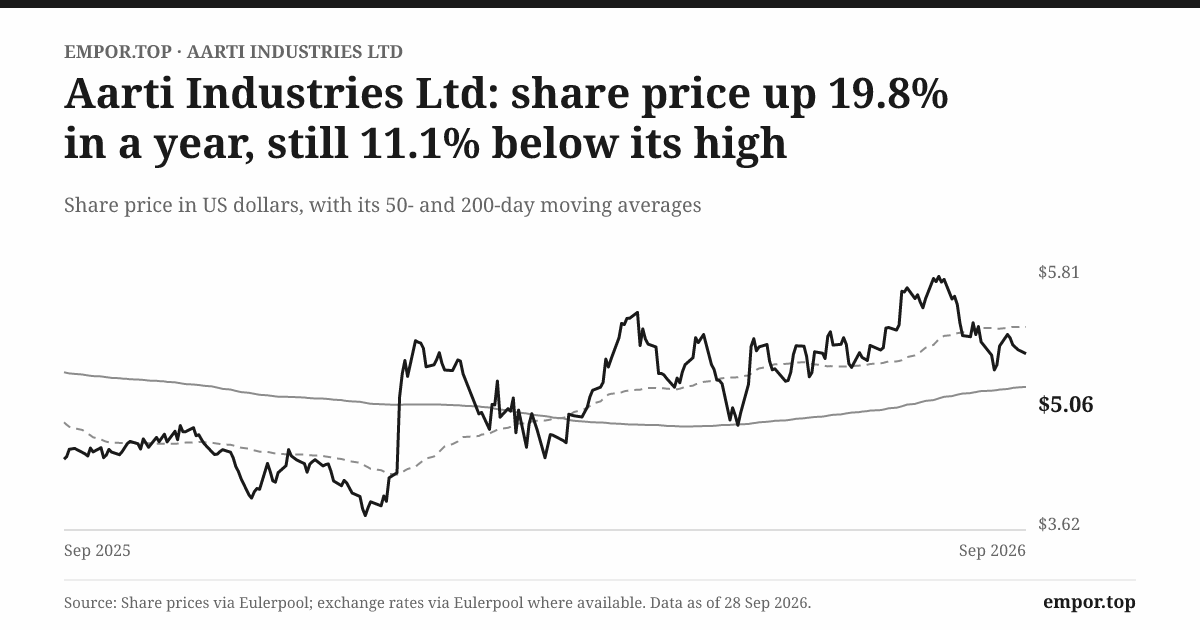
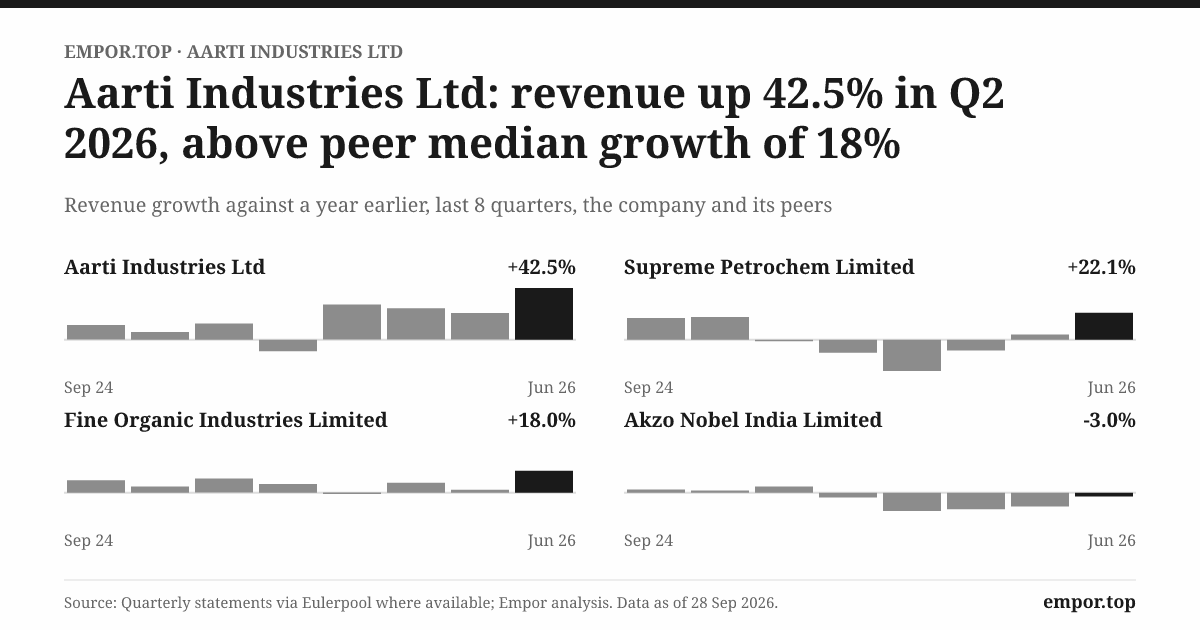
There is a counter-signal. FY26 EBITDA recovered about 15% year on year, with the margin back to around 14.2%1. In Q2 FY26, net profit roughly doubled from a weak base, and the stock rose on the result18. On the Q1 FY26 call, management described volume growth and an improving product mix1516.
The open question is whether FY26 marks the trough or is a cyclical bounce inside a balance sheet that is still weak. A margin of 14% is less than half the FY22 peak and roughly in line with the depressed FY23 level. Leverage has not yet come down meaningfully. Recovery in the income statement is necessary, but it is not enough, and the rest of the case depends on what management does with its capital from here.
IX. Capital Allocation Since the Reckoning (2024–2026)
Once a company has overbuilt, its next capital decisions reveal a lot. It can keep building and hope volumes arrive, or it can cut back and pay down debt. Aarti's leadership has mostly chosen the second path, with some notable exceptions.
The capex reset
Capex has come down from the peak. For FY26, management guided spending near or below ₹1,000 crore, well below the peak years of FY22–FY24, and said FY27 capex would step down further1517. This is the correct direction. The company already owns most of the assets it needs. What it lacks is utilization and pricing. Every rupee not spent on new capacity can go toward reducing debt.
New long-duration commitments
Aarti has kept signing long-term deals even during the slowdown. One is a binding term sheet with Deepak Fertilizers and Petrochemicals (DFPCL) for a 20-year nitric acid supply arrangement with reciprocal supply-or-pay and take-or-pay obligations17. Nitric acid is a key input for nitration, so the agreement is essentially about securing feedstock. Another is a medium-term supply contract worth about USD 150 million with a global agrochemical customer, running through FY3014.
Management presents these deals as the answer to the customer-power problem that surfaced in 2020: lock in multi-year offtake and input supply, and the business becomes more predictable. That framing needs to be tested against the 2020 record. The USD 150 million contract is modest relative to Aarti's revenue base, roughly ₹1,300 crore spread over several years against annual revenue above ₹8,000 crore. It adds visibility without changing the company's economics. Its termination provisions have not been publicly disclosed in detail14. Given what happened in 2020, investors should assume a large customer could exit if its strategy changed, at some price. The DFPCL arrangement is structurally different because it covers inputs rather than sales, and mutual take-or-pay obligations bind Aarti as well. Those obligations help if Aarti's nitration volumes grow, and they become a fixed-cost burden if they do not.
Incremental backward integration
In March 2026, Aarti approved a further ₹200–250 crore investment to make a key feedstock in-house17. At that size it is incremental, not transformational. It is consistent with a company that is still reducing leverage rather than restarting growth capex, and with Aarti's long-standing habit of taking over more of its own chain to capture margin.
The credibility test
Management has set explicit FY28 targets: EBITDA of ₹1,800–2,200 crore, ROCE above 15%, and net debt to EBITDA below 2.5x1517. From FY26's roughly ₹1,180 crore base, reaching them requires adding about ₹630–1,030 crore of annual operating profit in two years, an increase of roughly 50–85%.
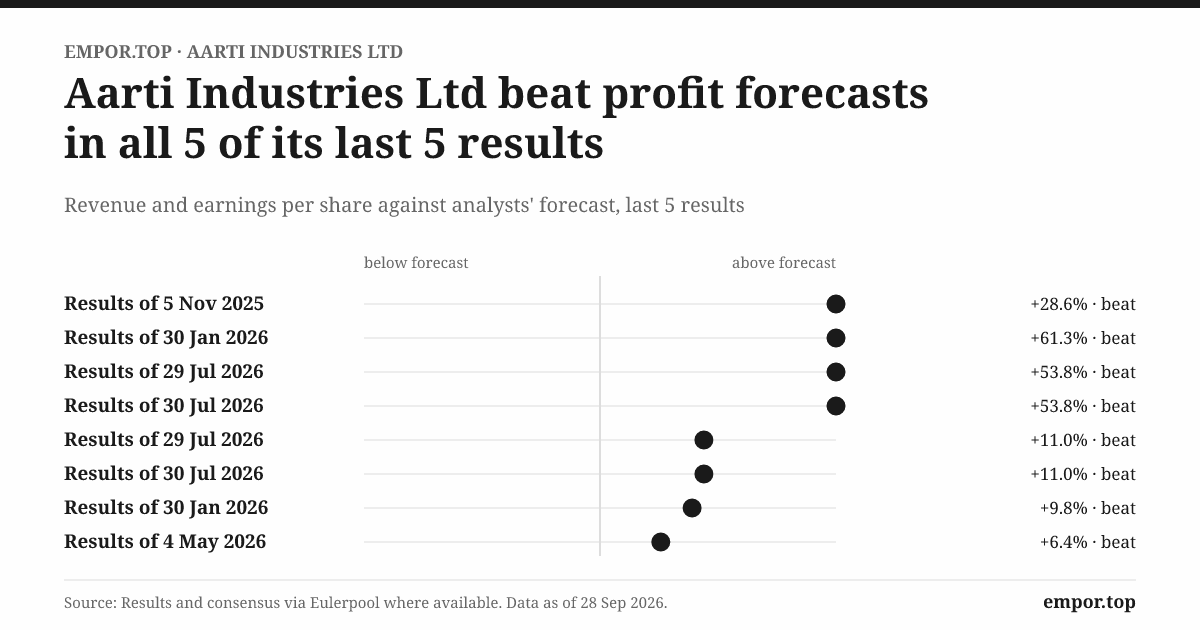
Analysts on recent calls have questioned whether that is realistic. Some pointed out that several recent quarterly beats relied on inventory gains and pricing rather than volume growth1617. That matters because inventory gains do not recur and pricing is set largely by Chinese supply decisions. Volume is the part Aarti controls. Skeptics also argue that consensus estimates may underprice the leverage risk while two rating agencies have negative outlooks.
The record so far should be stated plainly. Management suspended one major guidance, received one outlook downgrade, and has delivered a recovery that is not yet proven. The FY28 targets are specific and dated, which is to management's credit, because they give investors something to hold the company to. The last comparable ambition, Vision 2023, overshot. Aarti's capital-allocation credibility is being rebuilt, not yet demonstrated. And the people who will be accountable for the FY28 numbers are changing.
X. Current Management & Governance: The 2026 Handover
On July 31, 2026, a press release announced what would have been unthinkable for most of Aarti's history12. Effective October 1, 2026, Rajendra Gogri, Chairman and Managing Director and a 41-year veteran of the company, becomes Non-Executive Chairman. Rashesh Gogri, Vice Chairman and Managing Director, and Renil Gogri, from the next generation, move from executive to non-executive Vice Chairman roles1213. Suyog Kotecha, who joined as CEO in June 2024, is elevated to Managing Director and CEO13. For the first time since the company was founded, day-to-day execution will not rest with a member of the founding family.
The family
The Gogri family is still the controlling promoter group. Individual holdings are modest, with most family members in the low single digits, but together they control the company1. Rajendra Gogri has been the public face of the business for decades. In interviews he comes across as an engineer-operator who talks about process, safety and customer relationships far more than about markets or valuation19. Rashesh Gogri has been the other executive center of gravity. Next-generation members Renil and Mirik Gogri already hold senior roles12. The family's style has been consistent: patient, technical and focused on building. That style built the value-chain machine, and it also approved the capex program sized to peak economics.
The new CEO
Kotecha joined in mid-2024, close to the worst point of the downturn and just before the August 2024 guidance suspension13. His brief has mainly been operational turnaround: utilization, cost, mix and working capital. He also presented the FY28 targets15. The new structure makes him accountable for delivering them.
The unresolved question
This transition is unproven, and it should be described that way. It comes after the guidance suspension and the rating-outlook revision, not before them. There are two plausible interpretations. The generous one is that a family business is modernizing its governance, separating ownership from management as many Indian promoter companies say they aspire to, and choosing a new cycle to do it. The skeptical one is that responsibility for delivering a stretched set of targets is moving to a hired professional while control stays with the family. The evidence does not yet favor either reading, and it would be premature to pick one.
A few features deserve attention. The family keeps board control through the non-executive chair and vice-chair positions, so strategic direction and capital-allocation vetoes likely still sit with the promoters. How much authority the MD and CEO really has over capex, dividends and large contracts has not been fully disclosed. There is no activist shareholder in the register, and none has emerged. For Aarti the useful skeptical lens is not an activist campaign but insider succession under pressure: does the new structure produce different capital-allocation decisions from the old one, or is it the same family choices under a different job title?
The test will come in FY27 and FY28. If Kotecha delivers EBITDA in the ₹1,800–2,200 crore range with leverage below 2.5x, the handover will look like a well-timed transition. If the targets slip and the family returns to executive roles, it will look like something else. Either way, investors now need to weigh the whole case.
XI. Bull vs. Bear: The Investment Case
Picture an investment committee debating Aarti in September 2026. The bull brings maps of the plants, customer lists and the new supply contracts. The bear brings the balance sheet, the CRISIL rationale and a chart of Chinese export volumes. Both have real evidence. The question is which evidence carries more weight.
The bull case
Aarti has a genuine process-chemistry scale advantage in hazardous intermediates. It has decades of operating know-how, integrated chains that sell nearly every by-product stream, and environmental clearances that a new Indian entrant would need years to secure. It has credible, if self-reported, top-five global positions across much of its portfolio. It is building a wider base of multi-year arrangements, including the DFPCL nitric acid deal and new agrochemical supply contracts1417, designed to reduce the customer-power risk seen in 2020. Capex intensity is falling, so if volumes hold, earlier investment should turn into free cash flow and deleveraging. Finally, Chinese dumping episodes have historically been cyclical. Chinese producers face their own overcapacity economics, and loss-making exports cannot continue indefinitely.
The bear case
Vision 2023 already showed that plans to double the company can outrun demand and pricing. Leverage nearly tripled while the profit base fell by more than half at the trough1. Two rating agencies on negative outlook represent a real refinancing risk, and a downgrade would raise borrowing costs just as the company is trying to deleverage57. The 2020 termination showed that customer power can override "long-term" framing4. Chinese overcapacity has no clear end date, and much of it comes from integrated state-linked producers that do not follow normal return logic. The leadership handover adds execution risk at the moment balance-sheet discipline matters most.
Comparing with peers
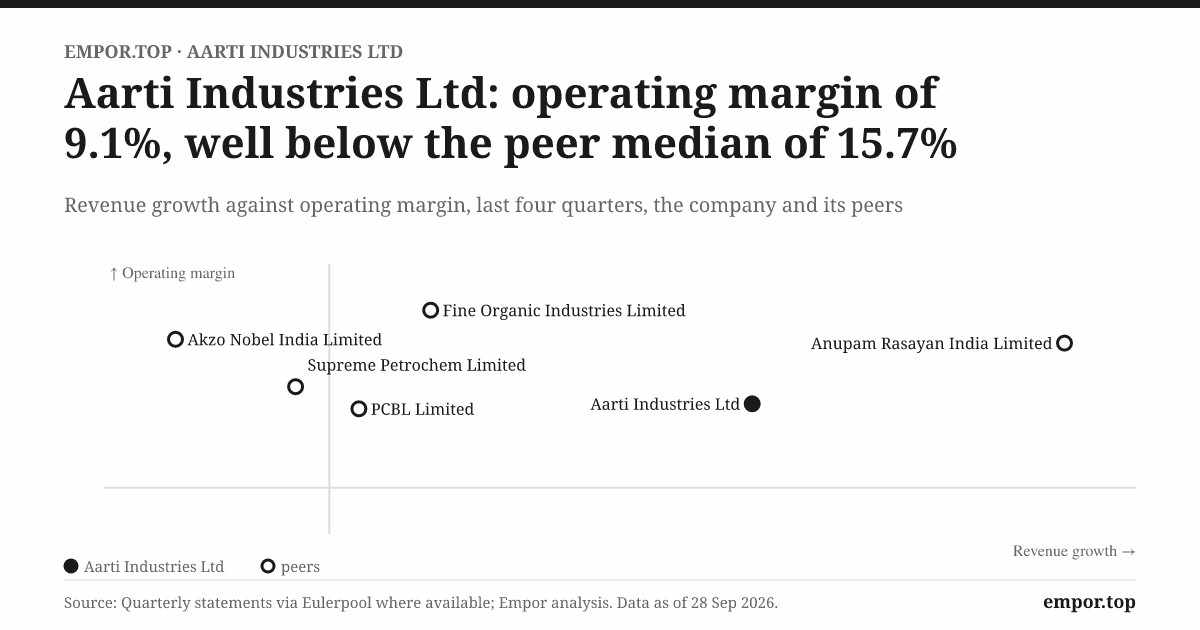
Peers show which parts of Aarti's struggles are industry-wide and which are specific to the company. All Indian specialty chemical makers suffered margin compression after FY22 as Chinese supply came back. Among the named peers, however, Aarti stands out for combining a large capex program with a sharp leverage increase. SRF's diversification gave it more segments to absorb the shock. PI Industries' custom-synthesis model, built around patented molecules for innovators, has historically been less exposed to catalogue-intermediate price wars. Navin Fluorine's fluorine niche carries different competitive dynamics. Aarti's hybrid model, partly commodity-like intermediates and partly contract manufacturing, left it exposed to Chinese pricing on the commodity side while it carried heavy fixed investment on the contract side.
Porter and Helmer, applied to the thesis
On the five forces, Aarti faces strong buyers, feedstock-linked suppliers, entrants protected at home but not abroad, route-specific substitution, and fierce rivalry from China. None of these works in its favor structurally. Its defense lies in the 7 Powers analysis: real Process Power and modest Switching Costs. The historical record, meaning the 2020 termination and the 2023–2025 margin collapse, narrows those powers without rejecting them. They keep Aarti in its customers' supply chains. They have not protected its margins. The revised claim is therefore that Aarti can hold volume and relationships through a downturn but cannot hold price. The KPIs in the epilogue are the way to test that.
The activist lens
A skeptical long-short investor would focus on a few questions. Why was capex sized to FY22 economics? Why was guidance offered and then withdrawn within one fiscal year? What are the real termination terms in the new contracts? How much authority does the new MD really have over capital allocation? What is the plan if the rating agencies downgrade rather than just revise outlooks? These are legitimate questions, and so far the answers are only partly disclosed.
Net assessment
The bull case rests on real chemistry and contracting advantages. Those advantages have repeatedly failed to protect margins and leverage in exactly the ways the bear case predicts. Aarti is a franchise with demonstrated capability and a recent history of stretching its balance sheet beyond what that capability could support. Whether the history repeats depends on management decisions still to come.
XII. Durable Lessons
Chemical plants stay in place for decades while the prices of what they make move month to month. The Aarti story is about that mismatch between permanent assets and temporary conditions, and it has lessons that apply well beyond one company.
First, backward-integrated, hazardous-process chemistry is a genuine barrier to entry. It does not protect a company from a determined competitor, especially one with state backing and subsidized inputs, that is willing to run at zero or negative margins for years. Barriers that keep out new domestic entrants do nothing against existing foreign capacity.
Second, "long-term contract" and "take-or-pay" describe a range of protection against customer power, not a guaranteed moat. The 2020 termination showed that a long-term contract can be a customer's option priced at an exit fee. Investors should ask how much capital was committed against each contract and how much the customer would pay to leave. Those numbers matter more than the headline contract value.
Third, a capex program sized to a cyclical peak becomes a leverage problem as soon as the cycle turns. The harder discipline is sizing growth capex to trough economics, which means asking whether a plant still makes sense at FY23 margins rather than at FY22 margins. Few companies do this, because peak years are when the balance sheet looks strongest and management confidence is highest.
Fourth, handing control to a professional CEO right after a guidance failure can be a sensible governance step. It should be judged on the results that follow, not on the intent announced. A succession announcement tells investors about a structure. Performance over the next two years will show whether the structure works.
XIII. Epilogue & What to Watch
As September 2026 ends, Aarti is in between two eras. The founding family's executive tenure closes in a few days. The new MD and CEO takes on a set of dated targets, a balance sheet under watch by the rating agencies, and a Chinese competitive environment that has eased somewhat without going away.
The three KPIs that matter most
1. Net debt to EBITDA, tracked against the FY28 target of below 2.5x. This is the clearest single signal of whether the capex bet is being paid down or getting worse. The number falling each year means the business is generating cash from assets it has already built. A number that stalls or rises means it is not.
2. EBITDA margin, and what is driving it. Investors should watch the margin and also whether management attributes changes to volume, mix, price or inventory. Skeptical analysts have already questioned whether the FY26 bounce was driven by pricing and inventory rather than volume1617. A recovery driven by volume would support the idea that Aarti's position in customers' supply chains holds up. A recovery driven only by price would support the view that Aarti remains a price-taker riding China's cycle.
3. Delivery against the FY28 EBITDA target of ₹1,800–2,200 crore. This is a concrete, dated commitment made by the management team now in charge15. It is the fairest scorecard for the new leadership era, and a second miss after the 2024 suspension would say a great deal about the forecasting and capital-allocation process.
Risks to track
The first is continued Chinese oversupply and dumping in agrochemical and dye intermediates, the markets management itself identified as hit hardest9. The second is refinancing risk. An actual downgrade, as distinct from an outlook revision, would raise the cost of debt when the company can least afford it5. The third is customer concentration. A small number of large agrochemical relationships account for much of the contract book, and the 2020 precedent shows those relationships can end. The fourth is execution risk from the leadership transition. The fifth is the safety and environmental-clearance risk that comes with hazardous chemistry. Scrutiny of this risk has increased across the industry since fatal chemical-plant incidents in Maharashtra in 2024, although those incidents were not Aarti Industries safety failures. For a company whose moat is partly its safety record and clearances, one serious incident could damage both.
Where this goes next
FY27 and FY28 will show which version of the story is true. In one, Aarti turns a decade of capital deployment into the returns it promised: utilization rises, margins recover on volume, debt falls, and the professional-management era starts with delivery. In the other, Aarti becomes a cautionary example of capacity built for a cycle that never returned, a capable chemistry company that owns more plant than its markets will pay for. The benzene keeps moving through the reactors either way, and the next two years of results will show what that chemistry is worth to shareholders.
References
-
Aarti Industries Ltd — Screener.in financial data ↩↩↩↩↩↩↩↩↩↩↩
-
Annual Report, Integrated Report and Financial Statements — Aarti Industries ↩↩↩↩↩↩↩↩
-
Aarti Inds slumps after early termination of contract — Business Standard, 2020-06-15 ↩↩↩↩↩
-
Aarti Industries Limited — Rating Rationale, CRISIL, 2025-09-11 ↩↩↩
-
Aarti Industries Limited — Rating Rationale, CRISIL, 2024-01-19 ↩↩
-
Aarti Industries stock tanks 16% on heavy volumes on margin concerns — Business Standard, 2024-08-13 ↩↩
-
Aarti Industries shares tank 15% amid concerns over EBITDA guidance, dumping from China — Upstox ↩↩↩↩
-
Scheme of Arrangement — Aarti Industries / Aarti Pharmalabs, 2021 ↩↩
-
Aarti Industries demerger: All you need to know — Zee Business ↩↩↩
-
Aarti Industries Announces Leadership Transition to Further Strengthen Governance and Long-Term Growth — PR Newswire, 2026-07-31 ↩↩↩↩
-
Aarti Industries elevates Suyog Kotecha as MD & CEO to drive next growth phase — Indian Chemical News ↩↩↩
-
Aarti Industries Limited Secures USD 150 Million Medium-Term Supply Contract — Aarti Industries ↩↩↩
-
Earnings call transcript: Aarti Industries posts strong Q1 2026 gains — Investing.com ↩↩↩↩↩
-
Q1 2026 Aarti Industries Ltd Earnings Call Transcript — GuruFocus ↩↩↩
-
Aarti Industries Ltd. Conference Calls and Earnings Call Transcripts — Trendlyne ↩↩↩↩↩↩↩
-
Aarti Industries jumps as Q2 profit doubles — Business Standard, 2025-11-07 ↩
-
Rajendra Gogri, Managing Director and Chair of Aarti Industries — The CEO Magazine ↩↩↩
 LinkedIn
 WhatsApp
 Reddit
 Hacker News
 Email
Email Kindle
 RSS Feed
 Spotify
 Apple Podcasts
 Amazon Music
 Audible
 YouTube