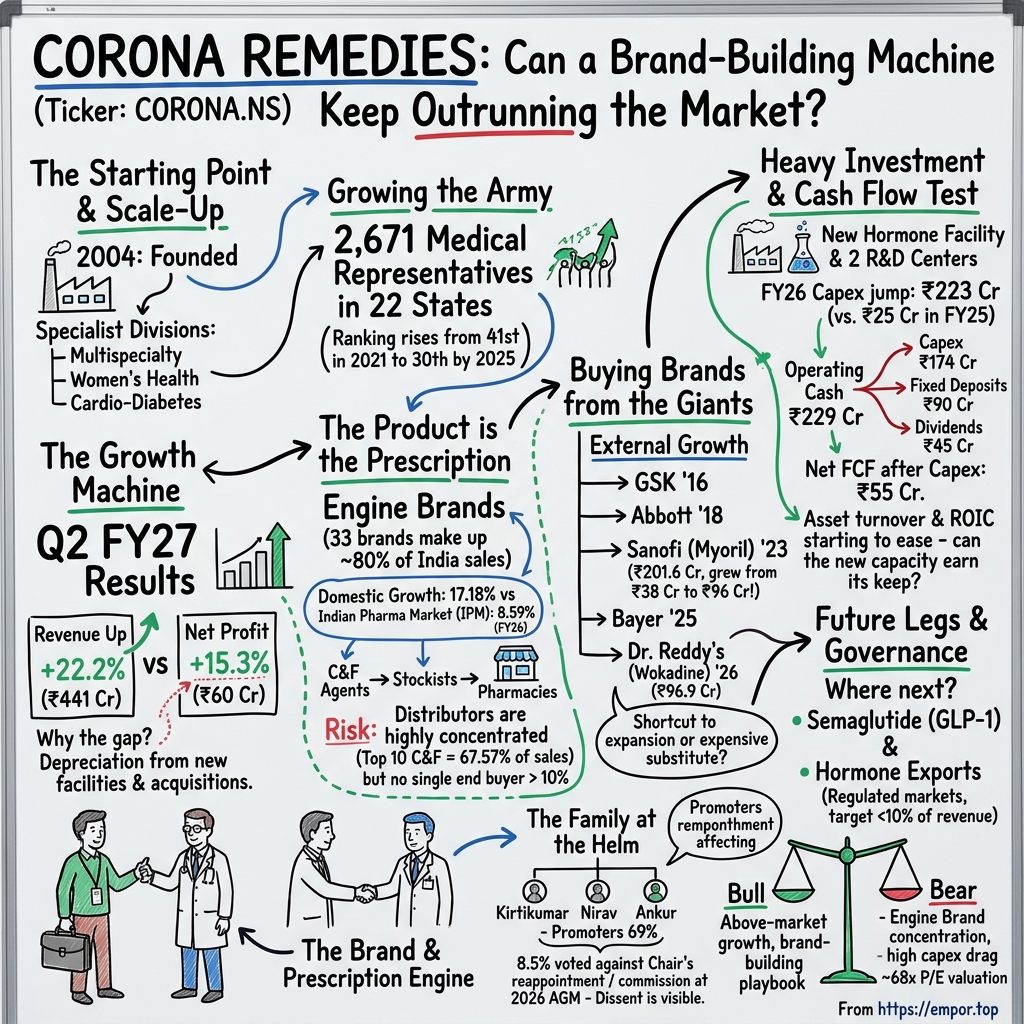
Corona Remedies: Can a Brand-Building Machine Keep Outrunning the Market?
I. The Quarter That Outgrew the Story
On the second of November 2026, a few days before Diwali, the management of CORONA Remedies dialled into its quarterly call with analysts and had, on the face of it, very little to apologise for. Chief financial officer Bhavin Bhagat read out the headline first. Revenue for the July-to-September quarter had come in at about ₹441 crore, up 22.2% from the same quarter a year earlier.1 India, which supplied 97% of that revenue, had grown even faster, at almost 23%, in a domestic pharmaceutical market that grew roughly 12%.1 Operating profit before depreciation had kept perfect pace with sales, up a little over 22%.1
Then came the line that every analyst on the call had already circled. Net profit for the quarter was about ₹60 crore, up 15.3%.1 The gap was not enormous, and the explanation was not mysterious. Bhagat attributed it "primarily" to higher depreciation and amortisation from newly commissioned facilities and from brands the company had bought.1 The machine that makes and sells medicines was running hotter than ever. The cost of the new machinery, and of the brand names Corona had purchased from far larger drugmakers, had simply started arriving on the income statement.
That seven-point gap between sales growth and profit growth is a small number with a large meaning. For most of its twenty-two years, Corona's story could be told in one direction: a young Ahmedabad company adding divisions, adding medical representatives, adding brands, and climbing the national rankings. The quarter that ended in September 2026 was the first time the public could see the other side of that ledger in motion. A company that grows by building and buying has to pay for what it builds and buys, and the question that now sits underneath every set of results is whether those investments earn their keep.
Managing director and chief executive Nirav Mehta, who co-founded the company with his brother Ankur, spent much of the call talking about the core business, and with reason. Thirty-three so-called Engine Brands, the products Corona chooses to push hardest in each of its divisions, contributed roughly 80% of India sales and were growing at about 22%.1 Analysts spent their questions elsewhere: on the slow integration of Wokadine, an antiseptic brand bought from Dr. Reddy's earlier in the year; on whether margins would keep rising after a burst of sales-force hiring; on semaglutide, the weight-loss and diabetes molecule that had just come off patent in India; and on a new hormone plant whose export ambitions are still mostly paperwork.1
Those questions frame the three tests that run through this story. The first is whether Corona's prescription engine—its army of medical representatives and its stable of focused brands—can keep outrunning the Indian market as the company gets bigger and the easy share gains get harder. The second is whether its capital, spent on factories and on brands bought from multinationals, produces returns above its cost rather than simply making the asset base larger. The third is whether a company in which the founding family still owns about 69% of the shares is run with the kind of stewardship that minority shareholders can trust without having to take management's word for it.2
Scale matters for all three. Corona is not a giant. Its revenue in the year to March 2026 was about ₹1,326 crore, and management estimates its share of the entire Indian pharmaceutical market at about 0.77%.31 The market leader, Sun Pharmaceutical, held 8.4% of that market at the end of 2025, more than ten times Corona's position.4 Yet Corona sits inside the top 30 Indian drug companies by domestic sales, having risen from 41st in the four years to mid-2025, with no blockbuster discovery and no meaningful export business to lean on.5 It listed on the stock exchanges only in December 2025, which means investors have less than a year of public trading history to judge it by.5
The market, meanwhile, has already formed a view. At about ₹2,409 a share on the fourth of November, Corona was valued at roughly ₹14,700 crore, and the National Stock Exchange's quote page put its trailing price-to-earnings multiple at about 68.6 That is the price of a company the market expects to keep outgrowing its industry for a long time. So the story has to begin with the thing that price is really paying for. What did the Mehtas build that lets a company one-tenth the size of the leader compete with drugmakers many times its scale?
 Subscribe on LinkedIn
II. From One Division to a National Sales Force
The company that became Corona was formed on the sixth of December 2004, in Gujarat, by two brothers who had grown up in a small town in the state.7 Nirav Mehta came to the venture with a pharmacy degree and a master's in management, and with a grounding in the most unglamorous and most important job in Indian pharma: sales promotion. Before Corona, he had worked in that role at Bayer and at Novartis India, learning how a multinational drug company turns a molecule into a prescription habit.7 His younger brother Ankur, who trained in science and management, would become the co-founder who handled capital, eventually steering the company through two private-equity rounds with Creador and ChrysCapital.7
Their father, Dr. Kirtikumar Mehta, brought something neither son could supply from a business school: decades in a doctor's chair. An MBBS physician, he had practised medicine in Dhrangadhra, a town in Gujarat, for more than three decades before joining the company's operations in 2008.7 Inside the company he is known affectionately as "Dr. SAB," and the board describes him as its chief mentor.7 For a business whose customer is, in practical terms, the doctor who writes the prescription, having a founding figure who had spent his life on the other side of that conversation was not a sentimental detail. It shaped how the company would think about selling.
Corona's first division launched in 2004 and was later renamed Pioneer.8 A "division," in Indian pharma, is less a corporate department than a sales army with a target list: a team of medical representatives assigned to a particular group of doctors, carrying a particular bag of brands. The second division, Xemx, followed in 2005 with a multispeciality focus.8 In 2007, Corona began production at its first manufacturing plant, in Solan, Himachal Pradesh, a state that had drawn drugmakers with tax incentives.8 In 2008 came Aarush, a gynaecology division, the first clear signal that women's health would become a specialty rather than a sideline.8 In 2013 came Wellness, aimed at cardiology and diabetes.8
Each of those steps maps directly onto the company that exists today. Corona does not win by owning a patent. It wins, when it wins, by deciding which doctors matter for which therapy, putting a specialised representative in front of them often enough to be remembered, and making sure the brand that doctor prescribes is on the pharmacy shelf the same afternoon. Splitting the sales force into therapy-specific divisions is how a mid-sized company gets the focus of a specialist without the overhead of a giant. A gynaecologist in Indore does not care how big Corona is overall. She cares whether the representative in her clinic knows her patients' problems and whether the brand works.
The divisions kept multiplying. Aura and Solis, in cardio-diabetes and gynaecology, arrived in 2018; Radiance and Solaris extended the same two franchises in 2022; and Blaze, a urology division, followed in 2023.8 By late 2026 the company described itself as running about eleven divisions, each with two or three brands singled out for concentrated effort.1 Production expanded too, with a second plant at Bhayla near Ahmedabad starting operations in 2021 and winning European Union good-manufacturing-practice accreditation in 2023.8
The factories had their own builder. Viral Sitwala, a whole-time director with more than 25 years in pharmaceutical manufacturing and marketing, joined from the specialty division of FDC and played a central role in establishing both the Himachal Pradesh and Gujarat facilities; he now oversees manufacturing and quality across the company's plants.7 Ankur Mehta, meanwhile, was the brother who went looking for outside money. He led two private-equity rounds, first with Creador and later with ChrysCapital, which gave the company growth capital in its private years and, eventually, a set of investors who would want an exit.7 That detail matters later in this story, because the public listing that came in 2025 was, at heart, the moment those investors and the family converted part of their stake into cash.
The sales force grew alongside. By June 2025, Corona employed 2,671 medical representatives spread across 22 states, a number that would have been unthinkable for the single-division company of 2004.5 By the November 2026 call, management put the count at 3,111.1 Its rise through the rankings tells the same story from the outside.5
It is worth being precise, though, about what this record proves. A growing field force and a rising rank show that the company scaled up and that doctors wrote more of its prescriptions. They do not, on their own, show that those doctors would stay loyal if a rival walked in with a cheaper equivalent, or that Corona could raise prices without losing volume, or that its share would hold if it stopped spending. Those are the questions that define a moat, and the rank table cannot answer them.
The history also has a time limit. Corona's website claims a compound annual growth rate of 16.8%, 1.9 times the market's, and the board page credits Nirav Mehta with a 25% compound growth rate between 2020 and 2025.87 Both are management's framing of a private-company record over a handful of years. The stock has traded only since the fifteenth of December 2025, and the company's audited public record of comparable annual results is short.5 There is no decade-long base rate here, no record of how the business behaved in a severe downturn, and no second management regime to compare against. The honest reading is that Corona has been a fast grower over the period the public can see, and that this is evidence of execution rather than proof of permanence.
The company even ran into trouble during the climb. In the year to March 2022, it changed how it reached the market, moving from super-distributors to carrying-and-forwarding agents, and the change in when revenue could be recognised contributed to losses that year.5 It was a reminder that a distribution-led company is only as smooth as its distribution. The point is not that Corona stumbled; most growing companies do. The point is that its strengths and its fragilities live in the same place.
Which raises the question that sits at the centre of the business. Corona has no patent to defend and no molecule nobody else can make. So when it sells a medicine brand, what exactly is it selling?
III. The Prescription Is the Product
Picture the morning route of one of Corona's representatives in a mid-sized Indian city. The first stop is a specialist's clinic before patients arrive, a ten-minute window in which the representative reminds the doctor of a brand, leaves samples, perhaps mentions a new strength or a combination pack. The doctor writes nothing that morning. But later that week, when a patient sits across the desk, the brand name that comes to mind is the one the representative put there. The patient walks to the chemist next door, the chemist reaches for the brand on the prescription, and the chemist's stock is replenished by a stockist, who in turn was supplied by one of Corona's carrying-and-forwarding agents. Weeks later, cash travels the same chain in reverse.
That chain is the whole business model. Corona sells branded generic medicines, products whose active molecules are off patent and can be made by many companies, but which Indian doctors prescribe by brand name. It sells them to pharmacies, hospitals, clinics and specialty treatment facilities, usually through stockists and agents, and typically against ordinary purchase orders rather than long contracts.5 Revenue repeats because prescriptions repeat, especially in chronic and sub-chronic conditions where a patient stays on a medicine for months or years. But the company does not quantify a recurring-revenue share or any minimum purchase commitments, because there aren't contractual ones.5 The recurring part of the revenue rests on habit, not on a signature.
The results of that habit-building were strong in the year to March 2026. Revenue grew about 17% to roughly ₹1,326 crore, and the operating margin widened to 19% from about 17.5%.3 Corona's domestic business grew about 17% in a market that grew about 9%, which means it took share at roughly twice the pace of the industry.3 The most recent quarter extended that pattern: about 23% India growth against a market that grew about 12%.1
On the November call, Nirav Mehta broke down where three years of outperformance had come from. Measured against the market, Corona's volume growth had run about 3.3 times the industry's, its growth from new introductions about 2.2 times, and its price growth only about 1.2 times.1 That split is the most revealing clue in this section. A company with genuine pricing power would show it in price. Corona's edge has come overwhelmingly from selling more units and launching more products, not from charging more for the same pill. Mehta himself described price as a "third pillar" of growth, and said historical price increases had run about 5–5.5% a year.1 In other words, the moat, such as it is, is made of reach and execution, not of a premium that doctors and patients are willing to pay.
The few brands that carry the many
There is another way to read Corona's portfolio, and it complicates the picture of a broad, diversified franchise. The company owns more than 75 brands, but it does not lean on them equally.8 At the time of its prospectus, 27 Engine Brands made up about 72% of domestic sales in the twelve months to June 2025.5 By the year to March 2026, 32 Engine Brands accounted for about 76%.3 By the November 2026 call, 33 brands made up roughly 80% of India business.1 CARE Ratings, looking at a narrower slice, noted that the top ten brands represented about 49% of turnover.9
This is not a flaw so much as a strategy. Corona chooses winners and concentrates its representatives' time on them, and management's stated ambition is for each of the 33 to become a ₹100-crore brand.1 But concentration cuts both ways. If a competitor launches an aggressive copy of one of Corona's largest brands, or if a regulator caps its price, the effect on the company is far larger than its count of 75 brands suggests. Breadth of portfolio does not eliminate reliance on a handful of winners. It hides it.
The risk is different on the customer side, and the distinction matters. No single customer accounted for more than 10% of Corona's revenue in any of the three years to March 2025 or in the June 2025 quarter.5 The buyers are thousands of pharmacies and hospitals, none of which can dictate terms. But the channel that reaches them is narrower. The top ten carrying-and-forwarding agents handled about 68% of revenue from operations in the year to March 2025, and the agreements behind that channel are loose: stockists can walk away on 30 days' notice and agents on 90.5 A dominant customer is a bargaining-power problem. A concentrated, easily terminated channel is an operating-continuity problem. Corona has the second, not the first, as the 2022 transition showed.5
The forces bearing on this business are not gentle ones. The big rivals bring broader portfolios, larger field forces and bigger promotional budgets. Doctors can substitute a competing brand of the same molecule with a stroke of a pen, and pharmacists sometimes do it at the counter. Distributors control the last mile and the timing of collections. The government's National Pharmaceutical Pricing Authority can cap prices on medicines in the national essential list; management said about 9% of its business falls under that list and that none of its top five products do.1 On the supply side, Corona had no long-term raw-material contracts and negotiated prices purchase by purchase, although its top ten suppliers accounted for less than half of total expenses.5
Set against all that, the affirmative evidence is real. A company that grows at twice its market's rate for several years, continues its climb in the national rankings, and does it with growth driven by volume rather than price is executing well in front of doctors. The company said its chronic portfolio, the part of the business with the stickiest prescriptions, grew about 29% in the latest quarter against a chronic market growing about 15%.1 The company says its share in the therapies it actually covers is about 2.3%, three times its share of the whole market, which suggests depth where it chooses to compete.1
What the record does not show is the evidence a long-term investor would most want: data on how long a patient stays on a Corona brand, how often a doctor who prescribes it switches away, how much real price Corona can take after the regulated increases, and whether its share in a given therapy persists once the promotional push moves on. The company does not publish prescription-retention or brand-level share data. So the fair conclusion is narrower than the growth numbers alone might tempt. Corona has demonstrated that it can build and extend brands in focused specialties faster than the market. It has not yet demonstrated that those brands would hold their ground if the spending stopped. The edge is an operating edge, and operating edges have to be re-earned every quarter.
The signals to watch are therefore simple and unforgiving: Engine Brand growth against the market, Corona's national rank, and debtor days, which measure how long the channel takes to pay. Debtor days crept up from 36 to 38 in the year to March 2026, a small move worth noticing in a company whose sales flow through agents and stockists.3
The rest of the working-capital picture is more comforting, and it reveals something about the business model. Branded pharma companies carry a lot of stock, because a doctor's prescription is worthless if the chemist cannot fill it, and Corona's inventory equalled roughly 175 days of its cost of goods at March 2026, down from about 200 days a year earlier.3 But it also takes a long time to pay its own suppliers, about 206 days on the same basis.3 Put the three together, receivables plus inventory minus payables, and the cash conversion cycle was only about a week, half what it had been the year before.3 In plain terms, Corona's suppliers finance most of the stock that its distributors eventually pay for. That is efficient, but it is also a dependency. A supplier base that tightened its terms, or a channel that slowed its payments, would show up in cash long before it showed up in profit.
Building a brand from scratch is slow, though, and Corona discovered early that there was a faster way. Some of the most familiar names in Indian medicine belonged to multinationals that were losing interest in them. The question was what they were worth in the hands of a smaller, hungrier owner.
IV. Buying Brands From the Giants
In June 2023, Sanofi's Indian arm sold Corona the Indian rights to Myoril, a muscle relaxant that orthopaedic surgeons and general practitioners had prescribed for years.10 On paper it looked like a large bet for a company of Corona's size. Including acquisition costs, Corona paid about ₹201.6 crore for a brand that was then selling roughly ₹38 crore a year, or about 5.3 times its annual sales.5 Nearly three years later, in March 2026, Corona did a second, smaller version of the same move, buying Wokadine, the povidone-iodine antiseptic, from Dr. Reddy's Laboratories for about ₹96.9 crore including costs.11
Between those two deals lies Corona's whole theory of acquisitions. Multinationals and large Indian drugmakers routinely trim their Indian portfolios, shedding brands that are too small to matter in a global budget or that no longer fit a shifting strategy. Those brands come with something money cannot easily buy: decades of doctor recognition. A smaller company with a focused sales force can, in theory, take such a brand, put dedicated representatives behind it, and grow it faster than its previous owner ever bothered to. It is a version of what an investor might call counter-positioning. The seller considers the brand a distraction; the buyer considers it a centrepiece.
The habit started long before Myoril. In 2016, Corona bought the Stelbid and Vitneurin trademarks from Glaxo Group.8 In 2018 it bought a cluster of Abbott India trademarks, including the Obimet range of diabetes brands and Thyrocab, a thyroid medicine.8 In 2020 it formed a strategic alliance with La Chandra Pharmalab, a maker of hormone active ingredients.8 Then came Myoril, then, in July 2025, seven brands from Bayer's Indian pharmaceutical business, including the cardiology brand Noklot and six women's-health products such as Fostine, Luprofact and Ovidac.812 There is a pleasing symmetry in that last purchase: Nirav Mehta began his career in sales promotion at Bayer.7 Two decades later, his company was buying Bayer's brands.
The clearest test of the playbook
Myoril is the deal on which the strategy can actually be judged, because enough time has passed and enough numbers have been disclosed. The brand that sold about ₹38 crore a year under Sanofi was selling about ₹96 crore in the twelve months to June 2025, making it one of Corona's largest brands.5 Sales roughly two and a half times higher in two years is a striking result. It is the strongest single piece of evidence that Corona's field force can add value to a brand after it changes hands.
The temptation is to stop there and declare the playbook proven. It is better to note what the Myoril record does not include. Corona has not published the brand's profitability, its promotional spending, or the extra representatives it took to drive that growth, so there is no way to calculate a return on the ₹200 crore invested. Higher sales are necessary for a good return; they are not sufficient. And one successful acquisition, however vivid, is a sample of one. What Myoril shows is that the model can work. It does not show that every brand Corona buys will behave the same way.
Wokadine is where that distinction becomes concrete. Corona described a ₹648 crore market for povidone-iodine and noted that Wokadine was the second-ranked brand in it.1113 What it did not disclose was Wokadine's own sales. That matters, because a ₹97 crore price paid for a brand in a ₹648 crore category says nothing about the multiple paid. A reader who divided one figure by the other would be dividing a price by a market, not by a revenue line. Without the brand's own sales, there is no honest way to say whether Corona paid a bargain or a premium.
The Bayer deal has the same blind spot in a different form. The company did not disclose what it paid, and the addressable markets it cited for women's health and anti-platelet medicines are the size of the pond, not the size of the catch.12 The strategic logic is clear enough, because the brands deepen two franchises Corona already serves. The financial logic cannot be judged from outside.
So the honest benchmark is thin. Myoril's entry multiple of roughly five times sales is a useful clue about what Corona has been willing to pay for an established brand. It is not a comparison with industry transactions, because comparable brand-deal terms in India are rarely disclosed. And for the two most recent purchases, there is simply not enough published information to reach an overpayment verdict either way.
There is one small relationship in this portfolio that deserves more attention than its size suggests. Corona owns a stake in La Chandra Pharmalab and treats it as an associate. In the year to March 2026, it bought about ₹4.67 crore of goods from La Chandra, roughly 0.4% of its total expenses.3 That is immaterial as a cost line. But La Chandra makes hormone active ingredients, and the prospectus describes a right of first refusal tied to those ingredients.5 For a company that has just built a dedicated women's hormone plant, a privileged relationship with an upstream hormone supplier is strategically meaningful. It is also a related-party relationship, which is why it reappears when the story turns to governance.
The November call brought the acquisition strategy back to earth. Asked about Wokadine, Nirav Mehta said the distribution and supply-chain integration was complete but that the business-model change was "little slower than the expected," and that the next two quarters would give more visibility.1 Management's own arithmetic implied the brand had added well under one percentage point to the quarter's growth, since sales excluding Wokadine grew 21.5% against 22.2% overall, and Mehta described base sales as merely "maintained."1 He nonetheless said the company was "very, very confident" of a 25% compound annual growth rate for Wokadine over three to four years.1
That combination, a slower-than-expected start paired with an undiminished long-term ambition, is exactly the kind of statement worth writing down and revisiting. Management deserves credit for naming the delay rather than burying it. But a 25% growth target for a brand whose current sales the company does not publish is a promise that outsiders can only partly check. The next two quarters are the first checkpoint management itself set. If Wokadine starts to grow the way Myoril did, the acquisition engine looks repeatable. If it stalls, the Myoril success starts to look less like a method and more like a fortunate pick.
Acquired brands are only half of Corona's recent spending, though. At the same time it was shopping for brand names, the company was pouring concrete.
V. The New Plant Meets the Cash Flow
In 2026, Corona inaugurated and began commercial production at a women's hormone manufacturing facility in Ahmedabad, and the plant received a series of regulatory approvals in quick succession: European Union good-manufacturing-practice certification, certification for the Eurasian Economic Union, and Brazil's ANVISA approval for its oral-solid and female-hormone facilities.8 Hormone medicines, used in fertility treatment, menopause care and contraception, are difficult to make. They demand segregated production lines and tight containment because tiny amounts of active ingredient are potent. A dedicated facility is a sign of seriousness about a specialty that Corona has been building since its first gynaecology division in 2008.
It is also expensive, and the bill shows up starkly in the accounts. In the year to March 2026, Corona's additions to property, plant, equipment and intangible assets were about ₹223 crore, against about ₹25 crore the year before, almost a ninefold jump.3 The cash actually paid out for plant, intangibles and construction in progress was about ₹174 crore, up from about ₹92 crore.3 Headcount rose from 4,508 to 5,686, including 111 people in research and development, and the company described two R&D centres alongside the new plant.3 Research spending, while rising, remained modest, at about 1.2% of total expenses in the year to March 2025.5
All of this is investment, and it is important to be clear about what investment is. A plant, a lab and a larger workforce are inputs. They show what management believes demand will be. They do not prove that demand exists, that the plant will be full, or that the extra people will be productive. Those answers arrive later, through utilisation, margins and cash.
Following the rupees
The first thing to say about Corona's cash is that it is genuinely good. In the year to March 2026, the business generated about ₹229 crore of cash from operations against reported net profit of about ₹185 crore.3 Operating cash also exceeded profit the year before.3 About 78% of EBITDA arrived as operating cash, which is healthy for a company that sells on credit through distributors.3 There is no sign here of profits that exist only on paper.
The second thing to say is where that cash went. Subtract the roughly ₹174 crore spent on plant and intangibles, and free cash flow after capital spending was about ₹55 crore.3 Dividends absorbed about ₹45 crore of that.3 So after building the plant and paying shareholders, only about ₹10 crore was left from a year in which the company reported ₹185 crore of profit. That is not a crisis. It is a company that has chosen, for now, to reinvest almost everything it earns and pay out most of the rest.
There is a trap in the investing line that is worth avoiding. Corona's total investing outflow in the year was much larger than its capital spending, because the company also placed about ₹90 crore, net, into fixed deposits that do not count as cash equivalents.3 That is treasury management, not factory building. Treat the whole investing outflow as capex, and the plant looks far more expensive than it was. Treat the cash balance as the whole of Corona's liquidity, and the company looks far poorer than it is: at March 2026 it held under ₹2 crore of cash and equivalents and about ₹42 crore of other bank balances, with the fixed deposits sitting on top.3 Other income, mostly interest, was about ₹11 crore, or around 4% of pre-tax profit, which is enough to notice but not enough to flatter the operating story.3
The same caution applies to debt. Borrowings rose to about ₹143 crore at March 2026, roughly double the year before, lifting debt to about a fifth of shareholders' equity.314 But nearly all of that was short-term bank borrowing, which the company explains includes overdrafts drawn against its own fixed deposits.14 Lease liabilities of about ₹22 crore sit separately and are not funded debt in the usual sense.14 A company borrowing against its own deposits is managing working capital and liquidity, not leaning on lenders. CARE Ratings, which reaffirmed its A+ rating with a stable outlook in February 2026, cited a comfortable capital structure and liquidity, and set its warning threshold at debt above 1.5 times operating profit, a level Corona is nowhere near.9
The same rating agency's list of weaknesses is a useful counterweight to the factory story. CARE named limited geographic diversification, dependence on third-party manufacturing, competition and regulation as the constraints on Corona's credit profile.9 The second of those is worth dwelling on. A company that relies partly on contract manufacturers can grow without building every plant itself, but it surrenders some control over cost, quality and supply. The new hormone facility moves Corona further toward making what it sells, which reduces that dependency in one specialty while adding fixed costs that must be covered whether or not the plant is full. Capacity is a trade: more control for less flexibility.
The harder question is about returns. Corona's asset turnover, the revenue generated by each rupee of assets, eased from about 1.3 to about 1.2 during the year, because assets grew faster than sales.3 Return on invested capital, which measures after-tax operating profit against the equity and net debt tied up in the business, slipped from about 26% to 24%.3 Yet return on capital employed, a measure that divides pre-tax operating profit by total assets less current liabilities, rose from about 30% to 31.5%.3 The two measures move in opposite directions because they define the capital base differently, and in a year with large short-term borrowings and fresh assets, those definitions diverge. The plain reading is the one that matters: the new assets have not yet earned what the old business earns, which is exactly what one would expect in the first year of a build. Both returns remain high by any standard. The test is whether they stay high once the new capacity is fully on the books.
That test has four parts, and none of them can be passed by announcement. The hormone plant needs to fill up. Margins need to hold after the depreciation it brings, which the September quarter showed is already biting. Cash from operations needs to stay comfortably above capital spending and dividends. And the acquired brands need to contribute enough growth to justify the intangibles on the balance sheet. If those four line up, Corona's investments will compound. If they don't, the company will simply have become larger without becoming more valuable.
Which leads to the question analysts kept circling on the November call. If the plant and the brands are the bets, where exactly is the next leg of growth supposed to come from?
VI. Thirty-Three Brands, a New Drug, and a Smaller Export Bet
The questions on the November 2026 call came in a pattern. Management's prepared remarks were confident and orderly: core therapies, brand building, operational discipline, investment for the future.1 Then the analysts took over, and each one pushed on a different soft spot. Alankar Garude of Kotak Institutional Equities asked about semaglutide and the company's ambitions in the newly generic market. Others asked about margins after the hiring spree, about Wokadine, about price growth, about how much of the business was exposed to price controls, and about which new therapy areas Corona intended to enter.1 The prepared story and the questioned story were not contradictory. But the Q&A revealed how much of the future rests on the same thing the past did.
The 33 Engine Brands remained the company's growth engine, growing about 22%.1 Their share of India business had risen from about 72% in mid-2025 to about 80% in late 2026.51 As Corona grows, it is becoming more dependent on its winners, not less. The figure that will matter most in future is not how many brands Corona launches, but how fast its biggest dozen grow.
Semaglutide was the question that carried the most heat. The molecule behind the world's most talked-about weight-loss and diabetes drugs lost patent protection in India in 2026, and dozens of Indian drugmakers rushed generic versions to market. Corona entered too, and Mehta said it was already among the top ten companies selling it.1 But his estimate of the opportunity was notably sober. He said Corona expected the first-year semaglutide market to be around ₹1,200–1,400 crore, while acknowledging that "people are talking about" ₹3,000, ₹4,000 or ₹5,000 crore.1 Those larger figures were market chatter, not management's own earlier guidance, but the contrast is telling. A first-year market of ₹1,300 crore split among many sellers is a modest prize for any single participant. Mehta framed it as a market where clinicians would build confidence over time, and said the Engine Brands remained the focus.1 That is the right instinct, and investors should hold the company to it.
The hormone exports deserve the same proportion. Corona said it was preparing about ten to twelve dossiers, the technical packages a regulator needs to approve a product, for regulated and semi-regulated markets in Europe, Brazil, Mexico, the CIS, Latin America and parts of Asia.1 Registration, management said, would take one to two years after partners received those dossiers.1 International revenue was about ₹25 crore in the first half of the year, and the company guided to ₹60–65 crore for the full year, which implies a sharp step up in the second half.1 Even then, management said, international would remain under 10% of revenue in two to three years.1 Corona's foreign-exchange earnings in the year to March 2026 were about ₹41 crore, slightly lower than the year before.3
That is the right way to size the bet: real, but small. A regulatory approval is a permission to try to sell, not a sale. A dossier is a step before even that. Corona has no long public record of turning export approvals into revenue, and its foreign earnings actually dipped last year. Until registrations convert into orders at a meaningful scale, exports are an option on the hormone plant, not a pillar of the investment case.
New therapy areas fall into the same category. Corona started an infertility taskforce of 46 people in 2026, and management said productivity was about ₹7 lakh per person per month, rising toward ₹8–9 lakh by year-end.1 Mehta named nephrology, neuropsychiatry, gastroenterology, spine and rheumatology as categories where the company was working on deals, while noting that no multinational had a suitable brand "on the desk" for them yet.1 That is an interesting admission. Corona's preferred entry route into a new therapy is to buy a brand, and in these five categories no seller has appeared. Organic entry would be slower and costlier.
The infertility push shows how the company thinks about building a franchise from scratch, and how carefully it is trying to meter the cost. Management said the taskforce already covered about 75–80% of its target market, that it planned no further representative expansion in calendar 2027, and that perhaps 150 more might be added sometime in the year to March 2028.1 That sequencing, prove productivity first and hire later, is the opposite of the 400-representative burst that weighed on margins in early 2026. The taskforce, hormone plant and La Chandra relationship are meant to connect the company's infertility sales force with its hormone medicines.1 It is an elegant design. Whether it becomes a profitable one depends on productivity per representative rising toward the ₹8–9 lakh a month management expects by year-end.1
Two regulatory questions surfaced in the same session. Asked about the share of sales under the national essential-medicines list, Mehta put it at about 9%, falling toward 7.5%.1 Asked about proposed caps on trade margins, the markups that distributors and chemists earn, he said Corona was "not being impacted" and declined to comment further on a matter he described as sub judice.1 Both answers suggest a company that has steered its portfolio away from the most regulated products. Neither removes the regulator from the story.
What management promised, and what it didn't
The margin conversation is where precision matters most, because it is where expectations can drift. After margin improvement in the year to March 2026,13 Corona added more than 400 medical representatives in the fourth quarter of that year, and the CFO said on the November call that this would slow margin improvement in the near term.1 When an analyst referred to a mid-20s margin target, Bhagat was blunt: "mid-20, what you are mentioning, we have not mentioned it."1 He said the company had never given operating-margin guidance, and that its guidance was for revenue growth of about 1.5 times the market, which he translated into roughly 15% revenue growth and about 20% profit growth.1
That exchange matters for two reasons. The first is that a mid-20s margin had evidently become part of the market's story about Corona without being part of management's. Investors who built a valuation on it were building on their own assumption. The second is that management, to its credit, corrected the record rather than letting a flattering number stand. Credibility is built in exactly these moments.
It also sets a measurable bar. Revenue growth of about 1.5 times the market is what management has asked to be judged on, and in the most recent quarter it delivered nearly twice the market. Profit growth of about 20% is the other half of the guidance, and the September quarter's 15% fell short of it, though the half-year as a whole grew about 22%.1 The depreciation from new plants and brands will not disappear next quarter. If profit growth keeps lagging revenue growth, the gap will need a better explanation than timing.
Price was the last revealing thread. An analyst noted that Corona's price growth had run around 8.5–9% in recent quarters, well above the historical 5–5.5% Mehta described, and Mehta called price a third pillar of growth.1 That is an interesting shift for a company whose outperformance has come mostly from volume. Higher price growth flatters revenue today but invites the attention of the price regulator, a point the company was reminded of the day after the call.
The questions about where growth comes from lead naturally to the people deciding where capital goes. In a family-controlled company, those are the same few names, and the most recent annual meeting showed that not every shareholder was comfortable with all of their decisions.
VII. The Family at the Helm—and the Votes Against It
In July 2026, Corona held its 22nd annual general meeting, its first as a listed company. Most of the resolutions were routine. Two were not. Because Kirtikumar Mehta was 75, Indian listing rules required a special resolution, which needs three-quarters of the votes cast, for him to continue as a non-executive director, and the board also asked shareholders to approve a commission of ₹1 crore for him for the year to March 2027.15 Both resolutions passed comfortably. But about 8.5% of votes cast opposed the chairman's continuation, and about 8.5% opposed the ₹1 crore commission.[^16]
With the family firmly in control, the outcome was never in doubt. That is precisely why the dissent is worth noticing. In a company where the promoters can carry any ordinary vote on their own, an 8% opposition means that a substantial share of the votes cast by shareholders other than the family went against the founder-chairman's terms. It is not a rejection, and it should not be described as one. It is a concrete, dated signal that some investors had reservations about the chair's tenure or his pay, and it gives future AGMs a baseline to compare against.
The structure itself is straightforward. Kirtikumar Mehta is non-executive chairman; Nirav Mehta is managing director and chief executive; Ankur Mehta is joint managing director.7 At March 2026 the board had eight members: the chairman, three executive directors and four independent directors.3 The independent directors bring relevant experience, including a former Adani Group CFO who also once ran mergers and acquisitions for Ranbaxy, a former senior Abbott executive in India, and a former head of Zydus Cadila's global manufacturing.7 A finance officer, Bhavin Bhagat, has been in place since October 2024.3
The public listing itself tells a capital-allocation story. Corona's December 2025 IPO raised about ₹655 crore, but every rupee of it was an offer for sale by existing shareholders, including promoters and investors.5 The company received nothing. The share count stood at about 61.2 million before and after.5 So the IPO did not pay for the hormone plant, the Bayer brands or Wokadine. It gave existing holders liquidity and created a public market for the stock. Since then, the ownership register has shifted in a revealing way. Domestic institutions more than doubled their holding, from about 7% in March to about 16.5% by September 2026, while non-institutional public holdings fell from about 22% to about 10%, and Sepia Investments, an early investor, cut its stake to about 8.6% in a September sale.2 The promoters stayed at 69%.2 Professional money has been replacing early holders, a short but encouraging sign of institutional confidence.
What the family is paid, and what it owns
Pay at Corona has grown with profit, though not faster. Key management personnel received about ₹10.4 crore in the year to March 2026, up from about ₹9.4 crore, an increase of about 11% in a year when net profit rose about 24%.3 Nirav Mehta's own remuneration was about ₹4 crore.3 The company also paid about ₹2.4 crore in lease rent to relatives of key managers, and the La Chandra purchases sit in the same related-party schedule.3 The accounts describe these transactions as ordinary-course and at arm's length, reviewed by the audit committee.3 None of these sums is large relative to a ₹185 crore profit. But a family that controls the company and also draws salaries, commissions and rent from it has several routes to value, and minority shareholders have only one. Alignment is strong; it is not perfect, and the AGM vote shows some investors drew that distinction.
The audit record offers reassurance on the basics. The FY26 auditor's opinion was unmodified, and the auditor's statutory report found no default on borrowings and no undisputed statutory dues overdue by more than six months.3 There is a modest income-tax dispute of about ₹2 crore, half of it paid under protest.3
Then, on the third of November 2026, a day after the earnings call, a regulator's letter arrived. The National Pharmaceutical Pricing Authority served Corona with a demand of about ₹4.88 crore, including interest and penalty, over alleged violations of the requirement to obtain prior price approval under the Drug Price Control Order of 2013.16 The company said it was evaluating the notice and did not expect a material financial impact.16 On the numbers, the company is right: ₹4.88 crore is less than 3% of a year's profit. The significance lies elsewhere. A company that has just told analysts price is becoming a "third pillar" of growth now has an open dispute with the price regulator, and how it resolves that dispute will say something about how it intends to use that pillar.
Trust, in the end, is earned through behaviour that outsiders can observe. Three tests are already on the calendar: whether management keeps reporting Wokadine's progress candidly against its own 25% ambition; whether it continues to correct, rather than encourage, margin expectations it has not set; and whether it discloses the outcome of the NPPA matter clearly. The family's stake ensures it cares about the outcome. These behaviours will show whether it cares about the minority shareholders who share it.
All of which brings the story to the number that hangs over the stock. A company with a family firmly in charge, a fast-growing core, an investment programme still proving itself and a short public record is carrying a premium valuation. Is that price a reasonable bet on the evidence, or a promise the business will struggle to keep?
VIII. Analysis & Bear vs. Bull Case
Imagine two investors reading the same Corona results on the morning of the fourth of November. The first sees a company growing almost twice as fast as its market, with high returns on capital, cash flow that exceeds its profit, and a founder-led management team that has climbed eleven places in the national rankings in four years. The second sees a stock priced at nearly 70 times earnings, a company whose profits just grew a third slower than its sales, a portfolio that leans ever harder on a few dozen brands, and a capital-spending programme that has not yet earned a rupee of proven return. Both are reading the record correctly. The question is which reading the price can afford.
The bull case begins with the evidence of outperformance. Corona's domestic sales grew about 17% in the year to March 2026 against a market that grew under 9%, and the operating margin widened to about 19%, while net profit grew about 24%.3 Cash from operations exceeded profit.3 Its growth has been driven by volume and new products rather than by price, which suggests that doctors are writing more Corona prescriptions rather than paying more for the same ones.1 Its divisions are focused, its Engine Brands are growing about 22%, and its field force has grown to more than 3,000 representatives.1 And Myoril, the clearest test of its acquisition model, more than doubled in sales after Corona bought it from Sanofi.5 A bull would argue that Corona has found a repeatable formula: identify neglected brands, buy them, push them through a focused sales force, and grow them faster than their former owners.
The bear case starts from the same facts and reads them differently. The market is crowded, and Corona's biggest rivals operate at ten times its scale. About four-fifths of India sales now come from 33 brands, and the share is rising.1 Debtor days edged up from 36 to 38, and receivables grew faster than revenue.3 Capital additions jumped almost ninefold.3 The Wokadine integration is running slower than management expected, and the company does not publish the brand's sales, so outsiders cannot measure its progress.111 The acquisition record has one clear success and several deals too recent or too opaque to judge. A bear would argue that Myoril is an anecdote, not a pattern, and that the investment cycle is arriving just as the share gains get harder.
Where the moat is, and where it isn't
A disciplined way to weigh those two readings is to ask what would actually protect Corona's profits if a determined rival came after them. Michael Porter's five forces and Hamilton Helmer's seven powers offer useful vocabulary, as long as each claim is tied to evidence.
Rivalry in Indian branded generics is intense. Hundreds of companies sell versions of the same molecules, and the largest carry far broader portfolios and bigger promotional budgets. The threat of substitutes is high and immediate: a doctor can switch brands with a single prescription, and many molecules Corona sells are available from dozens of makers. Buyer power, at the level of individual customers, is low, because no single pharmacy or hospital accounts for even a tenth of revenue.5 But channel power is real: the top ten agents carry about two-thirds of revenue and can walk away on 90 days' notice.5 Supplier power is moderate, with no long-term contracts but no dominant supplier either.5 And the regulator acts as a sixth force, capping prices on essential medicines and, as the November notice showed, policing how prices change.116 The threat of new entrants is the one force that works in Corona's favour, because building a national field force and doctor relationships from scratch takes years.
Helmer's framework sharpens the picture. Corona has no scale economies relative to the leaders, who are far larger. It has no network effects; one doctor's prescription does not make the brand more valuable to another. Switching costs are thin: the evidence on patient and doctor retention is not published, and the ease of substitution suggests they are modest. Branding is partial. Doctor familiarity with names like Myoril has value, which is why multinationals can sell them and Corona can buy them, but that value fades without constant promotion. There are glimmers of three powers. One is counter-positioning in brand acquisition: multinationals divesting small Indian brands they consider a distraction, while Corona treats them as a core business. Another is a possible cornered resource in its La Chandra relationship and hormone capacity, still unproven commercially. The third is process power, the accumulated know-how of running eleven focused divisions and relaunching acquired brands. Process power is the most plausible of the three. It is also the hardest to verify from outside, because it shows up only as sustained outperformance.
The verdict from that analysis is that Corona's advantages are real but operational. Brand and distribution are edges in execution, earned by spending and kept by spending. The evidence for structural switching costs or durable pricing power is thin, and the company's own breakdown, showing price contributing much less to its outperformance than volume, points the same way.1 That does not make Corona a weak business. It makes it a business whose returns depend on management continuing to execute well, rather than on a barrier that protects it when execution falters.
What the price assumes
Valuation has to be handled without inventing history that does not exist. At ₹2,409 a share, Corona was worth roughly ₹14,700 crore, and the NSE's snapshot put its trailing price-to-earnings multiple at about 68.6 There is no five-year median to compare against, because the stock has traded for less than a year. There is no full market cycle in which to see how investors priced the company during a downturn. A multiple of 68 means an investor pays about ₹68 today for each rupee of last year's profit. For that to make sense, profits must keep growing at high rates for many years, without the kind of stumble that has humbled many fast-growing Indian drug companies before. Management's own guidance, about 20% profit growth, would roughly double earnings in under four years. Even on that path, the stock would still be priced richly against today's earnings by the end of it. The price embeds sustained outperformance, not merely good results.
That framing gives the investment case its central measurements. The first is domestic growth against the Indian market, currently about 23% against about 12%, the clearest single measure of whether the prescription engine is still taking share.1 The second is the growth and contribution of the largest brands, with the Engine Brand share now around 80%; a slowdown there would matter more than any number of new launches.1 The third is cash left after capital spending and dividends, which was only about ₹10 crore in the year to March 2026, the most direct test of whether the build-out is paying.3 Debtor days, at 38 and rising slightly, are the guardrail on all three, the early warning that growth is being bought with looser credit.3
One caution about the returns that bulls like to quote. On the November call, the company presented first-half figures showing return on capital employed of about 50% and return on equity of about 33%.1 Those numbers are annualised and use management's own definitions, which differ from the year-end ratios calculated on total assets and closing equity, where the figures were closer to 31% and 25%.3 Both sets say the same thing qualitatively: Corona earns high returns on the capital it uses. But an investor comparing Corona with a peer should make sure the two numbers were built the same way, because the gap between the definitions is wider than the gap between many companies.
The NPPA demand belongs on the watch list, not at the centre of the thesis. At under ₹5 crore, it changes nothing about Corona's economics today.16 It would matter only if the amount grew, if it set a precedent for other products, or if it signalled that the company's newfound emphasis on price was running into the regulator.
The record, weighed honestly, supports a strong execution story. It does not yet prove a durable moat, and it does not settle whether a multiple of 68 is a fair price for that execution. Those are the questions the next few years of results will answer. In the meantime, the company's path already offers some lessons that reach beyond its own share price.
IX. Business & Investing Lessons
Two brands, bought from two of the world's best-known drugmakers, sum up what Corona has learned and what it is still learning. Myoril, bought from Sanofi for about ₹202 crore when it was selling about ₹38 crore a year, was selling about ₹96 crore a year two years later.5 Wokadine, bought from Dr. Reddy's for about ₹97 crore, is taking longer to fold into the business than management expected, and its own sales remain undisclosed.111 One deal shows what the model can do. The other shows how much depends on what happens after the contract is signed.
The first lesson is that a famous brand is an invitation to compete, not a moat. When Sanofi sold Myoril, it was not selling a protected franchise; it was selling a name doctors recognised, and the right to try to make that recognition pay. Corona's success came from what it added after closing: focused representatives, a division that cared, and a promotional push the previous owner had no reason to make. The broader point for founders and investors is that a legacy brand's value is not in its past sales or its category size. It lies in the gap between what the old owner was doing with it and what the new owner can do. Buy the gap, not the name, and measure the result in sales growth after the purchase, not in the prestige of the seller.
The second lesson is that a sales force is an asset only when prescriptions follow. Corona's climb from a single division to more than 3,000 representatives is the visible history.1 The invisible one is that every one of those representatives costs money every month, and only some of them generate enough prescriptions to pay for themselves. The 17% domestic growth against a market growing under 9% suggests the field force has been productive.3 But the company's own CFO warned that adding 400 representatives would slow margin gains, because new representatives take time to earn their keep.1 For investors, headcount is a cost line until growth against the market proves otherwise. The test is not how many doctors a company visits, but how many more prescriptions it collects than its rivals.
The third lesson is that the cash register is the final judge of a growth plan. Corona's year to March 2026 looked superb on the income statement: profit up almost a quarter, margins higher, returns above 24%. The cash told a more demanding story. Operating cash comfortably exceeded profit, which is a mark of good earnings quality, yet capital spending and dividends consumed nearly everything that was left.3 A company can report rising profit for years while its owners see none of it as spare cash, if every rupee is going back into plants and brands. That is fine when those investments earn their keep. It becomes a problem only if the returns never arrive. The lesson is to judge a growth plan by what it leaves behind after it has paid for itself, not by the profit line it produces along the way.
The fourth lesson is that a family stake aligns incentives, but it does not end the governance debate. The Mehtas own 69% of Corona, which means their wealth rises and falls with the share price far more than any salary could compensate.2 Yet at the first AGM after listing, more than 8% of votes opposed the founder-chairman's continuation and commission.[^16] Those shareholders were not questioning whether the family cared about the company. They were questioning the terms on which the family is paid and the chair's tenure, issues that ownership alone cannot settle. For investors in family-controlled companies, a large promoter stake is the beginning of the governance conversation, not the end of it.
X. Epilogue
Tonight, in early November 2026, Corona stands at the hinge of its story. The core business is growing faster than ever, with India sales up about 23% in the latest quarter.1 The hormone plant is running, and its approvals from European, Eurasian and Brazilian regulators are framed on the wall.8 Wokadine is integrated on paper but not yet growing the way management wants.1 Semaglutide is on the market, smaller than the hype but real. And the founding family, firmly in control, has just been reminded by a minority of its shareholders and by the price regulator that being watched is now part of the job.
The next moments that will decide the story are already visible. The quarterly results due in early 2027 will be the first of the two quarters Nirav Mehta said would give better visibility on Wokadine.1 If the brand begins to grow, the case for a repeatable acquisition model strengthens. If it remains flat, the 25% growth target for it will start to look like an aspiration rather than a plan, and the next brand purchase will deserve more scrutiny than the last.
The full-year results for the year to March 2027 will test three other promises. Revenue growth of about 1.5 times the market is the guidance; profit growth of about 20% is the other half.1 The September quarter's 15% profit growth fell short of that pace, and the depreciation that caused it will not shrink. If profits catch up with sales, the investment cycle will look well timed. If the gap widens, it will raise the question of whether the plant and the brands are earning their cost. The same results will show whether cash from operations still covers capital spending and dividends with room to spare, and whether debtor days stabilise or keep creeping higher as more sales flow through agents and stockists.
The export story will be judged not by dossiers but by registrations and orders. The company guided to ₹60–65 crore of international revenue for the year, with exports remaining below a tenth of the total for years to come.1 Hitting that figure would mean a sharp second-half acceleration. Missing it would not break the case, because exports are small, but it would say something about how management sets targets.
The NPPA demand will reach some resolution, and the company's description of it, whether still immaterial or something more, will be worth reading closely.16 And the next AGM will show whether the 2026 dissent was a one-off reaction to the founder's terms or the beginning of a pattern.
Each of those moments bears on the questions that opened this story. Can the prescription engine keep outrunning the market as Corona gets bigger? Do the plant and the brands earn returns above their cost? Can minority investors trust the family's stewardship on the evidence rather than on faith? None of those questions is yet answered. What is new is that, for the first time, the public will see the answers arrive in real time, quarter by quarter, at a price that leaves little room for disappointment.
XI. Outro
Somewhere tomorrow morning, a Corona representative will walk into a gynaecologist's clinic in a Gujarati town much like the one where Dr. Kirtikumar Mehta spent decades writing prescriptions himself. She will carry a bag of brands. The doctor will not know or care about the company's valuation or its export ambitions.
That is what makes Corona unlike most of the companies it competes with. Its bet is not on a molecule, a patent or a factory, though it owns factories. Its bet is that focus, field coverage and a sharp eye for neglected brands can make a smaller company move faster than the giants, one doctor at a time. So far the bet has paid. Whether that speed becomes a durable advantage, or remains an advantage Corona must buy again every quarter, will be decided in clinics like that one, by one prescription, one brand and one cash return at a time.
References
-
Q2 FY27 Earnings Call Transcript — CORONA Remedies, 2026-11-02 ↩↩↩↩↩↩↩↩↩↩↩↩↩↩↩↩↩↩↩↩↩↩↩↩↩↩↩↩↩↩↩↩↩↩↩↩↩↩↩↩↩↩↩↩↩↩↩↩↩↩↩↩↩↩↩↩↩↩↩↩↩↩
-
Annual Report 2025–26 — CORONA Remedies / NSE, 2026-06-15 ↩↩↩↩↩↩↩↩↩↩↩↩↩↩↩↩↩↩↩↩↩↩↩↩↩↩↩↩↩↩↩↩↩↩↩↩↩↩↩↩↩↩↩
-
Indian Formulation Market Share Presentation — Sun Pharmaceutical Industries, 2026-02-24 ↩
-
Red Herring Prospectus — CORONA Remedies, 2025-12-02 ↩↩↩↩↩↩↩↩↩↩↩↩↩↩↩↩↩↩↩↩↩↩↩↩↩
-
About Us and Company Journey — CORONA Remedies ↩↩↩↩↩↩↩↩↩↩↩↩↩↩↩
-
Corona Remedies Buys Myoril from Sanofi — BioSpectrum India, 2023-06-29 ↩
-
Wokadine Acquisition Press Release — CORONA Remedies / NSE, 2026-03-30 ↩↩↩↩
-
Corona Remedies Expands Portfolio with Seven Bayer Brands — ETPharma, 2025-07-17 ↩↩
-
Corona Remedies Acquires Wokadine from Dr. Reddy's — Business Standard, 2026-03-30 ↩
-
Annual Report and AGM Notice — CORONA Remedies / NSE, 2026-06-15 ↩
-
NPPA Demand Notice Intimation — CORONA Remedies / NSE, 2026-11-03 ↩↩↩↩↩
 LinkedIn
 WhatsApp
 Reddit
 Hacker News
 Email
 Kindle
 RSS Feed
 Spotify
 Apple Podcasts
 Amazon Music
 Audible
 YouTube