Ashoka Buildcon: The Road Builder That Has to Get Paid
I. The ₹2,324 Crore Exit
On the last business day of 2024, Ashoka Buildcon told the stock exchanges it was selling roads. It was not selling the road-building business that had carried its name for three decades. It was selling some of the roads themselves, or more precisely its stakes in 11 project companies, each a legal shell wrapped around a highway that Ashoka had built and was now entitled to be paid for over many years. The agreed price was ₹2,324 crore.1
At today's exchange rate that is about $250 million. The number becomes more striking beside the company's own price tag. On 20 November 2026 the whole of Ashoka Buildcon, every share of the listed parent, was worth about ₹3,146 crore on the market.2 A single portfolio sale, announced less than two years earlier, came to roughly three-quarters of that figure.
The easy way to tell this story is as a victory lap. Contractor builds roads, contractor sells roads at a profit, contractor pays down debt, everyone goes home happy. Parts of that story are true. Ashoka did book large gains on these disposals, and the debt on its consolidated balance sheet did fall.
But the sale was a decision, not a trophy, and decisions have reasons. A company that is flush with cash and confident in its pipeline does not usually need to sell its best income-producing assets. Ashoka sold them while it was still bidding for new projects, still putting equity into new ones, and still waiting to be paid for a great deal of work it had already done.
How much work? By March 2026, the company's receivables had stretched to 226 days of revenue.3 Put plainly, the average rupee Ashoka had billed or earned was taking around seven and a half months to arrive. In the year to March 2015, the same measure was about 90 days.3
Meanwhile the pipeline kept growing. At the end of September 2026, Ashoka reported an order book of ₹15,964 crore, a stack of signed contracts worth more than five times the company's stock-market value.4 On a call with analysts in November, management put the figure higher still, at ₹17,222 crore, once fresh awards and contracts where Ashoka was the lowest bidder were included.5
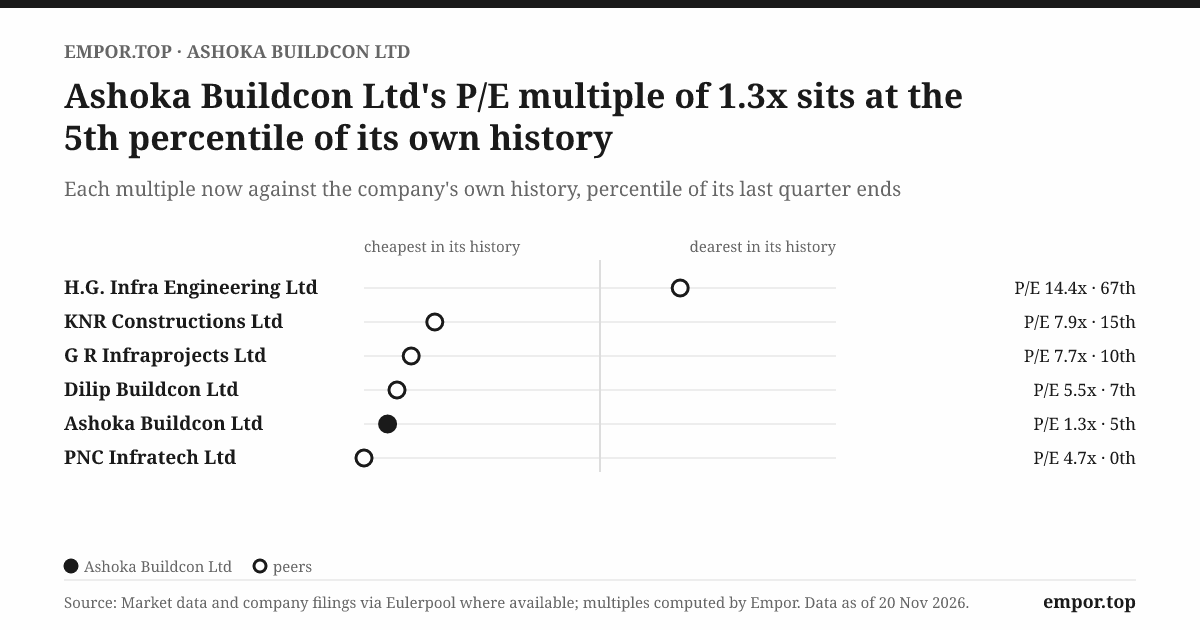
So the puzzle sits right at the start. Ashoka has more work than it has had for a while, it has sold billions of rupees of assets, and yet the market prices the company as if it doubted much of that value will reach shareholders. The shares trade at about 1.3 times trailing earnings, against a five-year median of 3.9 times, and at around half their book value.2
There are three questions inside that puzzle, and this story keeps returning to them. The first is whether the order book can become profitable cash, rather than just revenue on a slide. The second is whether new work in power transmission and railways can offset a softer road cycle. The third is whether the asset sales will produce lasting deleveraging, or simply buy time before the next round of project funding swallows the proceeds.
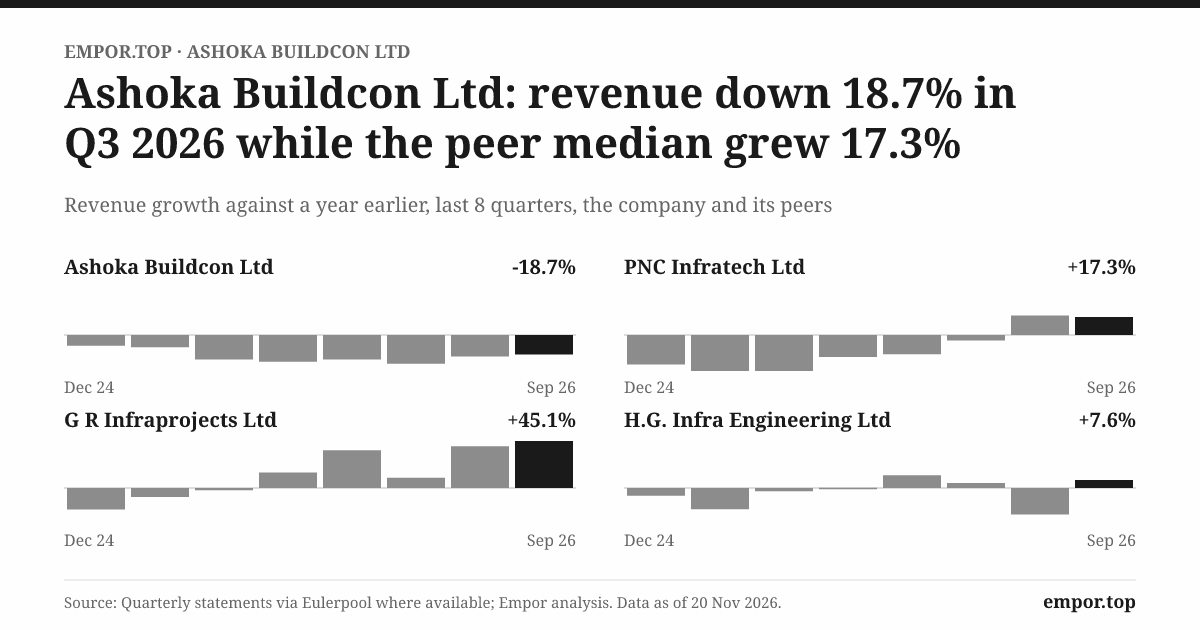
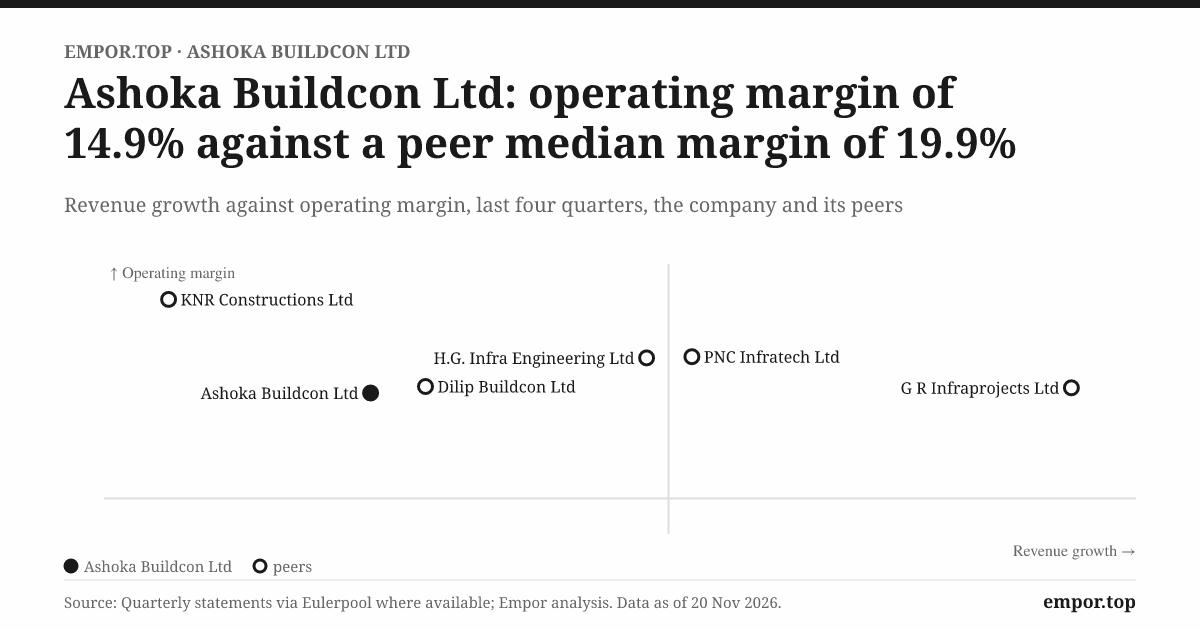
The stakes are visible in the latest numbers. In the quarter to September 2026, consolidated revenue fell about 19% from a year earlier, operating margin dropped to roughly 11% from about 29%, and the group swung to a net loss after exceptional charges.6 The promoter group, led by founder Ashok Katariya, still controls the company with 54.48% of the shares, none of them pledged.7 Whatever happens next, the people who built Ashoka will own most of the outcome.
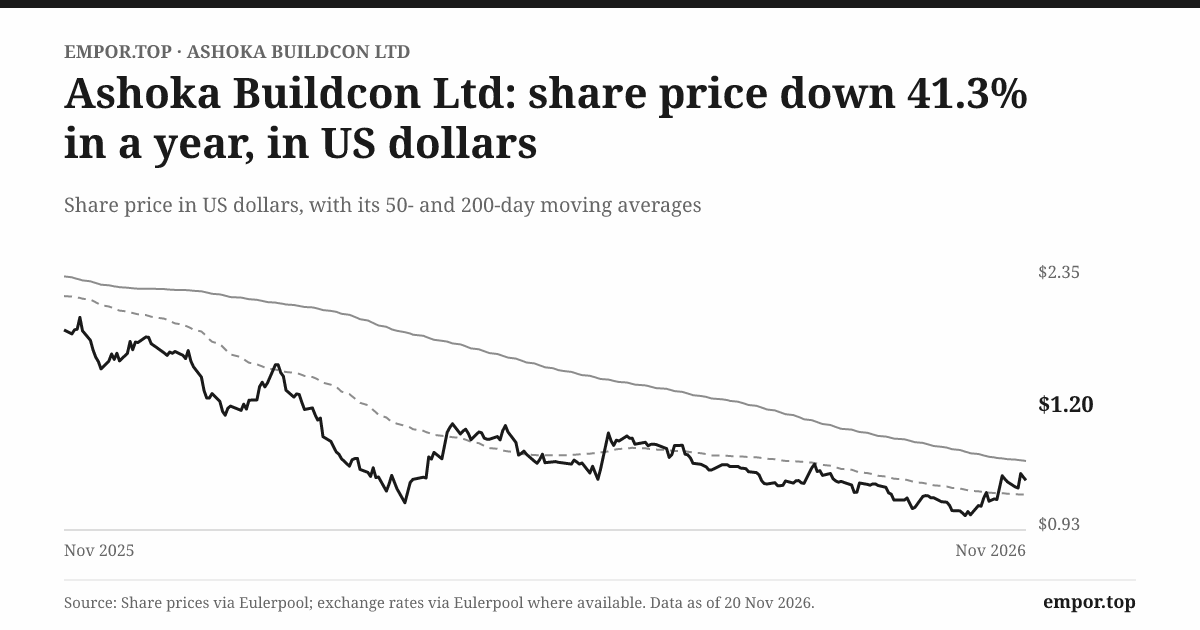
The share price has been telling the same story with more drama. At about ₹111 on 20 November 2026, the stock sat nearly 40% below its high of the previous twelve months, and over five years it has at one point lost almost 70% from a peak.2 Its one-year volatility, above 40%, is the sort usually associated with a turnaround, not a three-decade-old contractor.2 The market is not calm about Ashoka, and it has not been for some time.
The sale also changed what kind of company Ashoka is. Every toll road that leaves the group takes its traffic revenue with it, so the company that emerges from the disposals is more of a pure contractor than the one that went into them. That makes the questions about execution and collection more important, not less, because there is less steady concession income left to cushion a bad year on site.
To understand why a contractor would build roads, own them for a while, and then sell them, the story has to start with what Ashoka actually sells. And that starts in Nashik.
 Subscribe on LinkedIn
II. A Nashik Contractor Goes Public
Nashik is not where most Indian business legends begin. It is a pilgrimage city on the Godavari in Maharashtra, a few hours inland from Mumbai, better known for grapes and the Kumbh Mela than for corporate ambition. It is also where Ashok Katariya built a road-contracting business that the Economic Times, in 2014, described as a ₹1,700 crore company grown from seed capital of ₹5,000.8
Whether the exact seed figure matters is beside the point. What the founding legend captures is the kind of business this was: a local contractor that started small and grew one tender at a time, winning road and bridge jobs from public agencies that had to be convinced, again and again, that this firm could pour concrete on schedule.
That is the defining character of Indian infrastructure contracting. There is no brand loyalty from a state public-works department. There is a tender, a technical qualification, a price bid, and a winner. A contractor's real asset is not a patent or a product. It is a record: completed projects, of a certain size, in a certain category, that let it qualify for the next and larger tender.
Ashoka compounded that record for years before it touched public markets. By the time it filed its prospectus with the Securities and Exchange Board of India in September 2010, the company had a portfolio of road projects built for others and, increasingly, projects it owned and operated itself under concession agreements.9
The initial public offering opened on 24 September 2010, with a price band of ₹297 to ₹324 per share.10 It priced at the top. Ashoka offered 6,944,444 shares at ₹324 each, each with a face value of ₹10, raising about ₹225 crore.9 The shares began trading on the National Stock Exchange and the Bombay Stock Exchange on 14 October 2010.11
The IPO matters less as a listing story than as a financing milestone. Two hundred and twenty-five crore rupees was not enormous even then, but it gave the company equity it could lever into project companies, and it gave lenders and future partners the comfort of a listed, audited parent. The company has not issued new equity to the market since; in March 2026 the share count stood at about 280.7 million, unchanged through FY2025 and FY2026.3
The decade after the listing was a growth story by any measure. Consolidated revenue rose from roughly ₹2,300 crore in FY2015 to close to ₹10,000 crore at its FY2024 peak, a compound rate in the low double digits that outpaced India's economy.3 Then the curve bent. Over the three years to FY2026, revenue shrank by a little over 2% a year, so the company's recent performance sits well below its own long-run pace.3
Sixteen years later, the people at the top are strikingly familiar. Ashok Katariya is executive chairman. Satish Parakh, part of the same promoter group, is managing director. Sanjay Londhe serves as a whole-time director and chief executive of projects, and Ashish Kataria is another whole-time director; Paresh Mehta is the chief financial officer.3 Few listed Indian contractors of this size have been run by the same core group for so long.
That continuity cuts both ways. It means institutional memory of every tender, every lender, every dispute. It also means that the strategic choices of the past fifteen years, the shift into owning roads, the heavy borrowing, the sales, were made by the same hands now asking investors to trust the next cycle.
The promoter group's stake has not moved across the past year.7 In a sector where stressed founders have often pledged shares to fund projects, that is a genuine point in Ashoka's favour. Around them sit more than 204,000 shareholders, most of them small investors, with mutual funds holding about 12.75% and foreign portfolio investors about 4.18%.7
Both of those institutional holdings fell in the September quarter, from about 14.02% and 5.59% respectively in June.712 The company does not explain why, and none is needed: professional money trimmed while retail holdings rose.
What the origin story establishes is credibility with public buyers. A contractor that has executed for decades can qualify for large tenders that a newcomer cannot. What it does not establish is pricing power. A long record gets Ashoka into the room. It does not stop the next bidder from undercutting it.
The record also contains a warning. The same management, with the same qualifications, oversaw the revenue decline of the past two years. A track record explains why Ashoka is invited to bid; it does not explain why revenue fell by a quarter in FY2026. That answer lies in how the business actually turns a contract into money.
So the question the Nashik story cannot answer carries forward: in a market where governments award contracts competitively, what exactly lets Ashoka win work, and then make money on it?
III. The Certificate Is the Product
Picture a finished stretch of four-lane highway somewhere in central India. The asphalt is laid, the lane markings are painted, the crash barriers are in. Trucks could drive on it tomorrow. And yet, for the contractor that built it, the job is not yet finished in the way that matters most. Somewhere an engineer appointed by the client still has to measure the work, check it against the contract, and sign a certificate.
That certificate is the hinge of Ashoka's business. Without it, there is no invoice. Without the invoice, there is no payment. And without the payment, the contractor has spent its own cash, and often borrowed cash, on a road it does not get paid for.
The cycle runs in six steps. Ashoka bids for a tender. If it wins, it mobilises men and machines to the site. It builds. The work is measured and certified, either in monthly stages or at defined milestones. It then bills, and finally collects. Revenue in the accounts follows the work; the cash follows the certificate, and the certificate follows the client's process.
Each step carries its own failure mode. A bid priced too keenly loses money from the first day. Mobilisation can stall if the client has not acquired the land. Construction can slip with the monsoon or a shortage of materials. Certification can wait on inspections and paperwork. Billing can be disputed. Collection can be slowed by a client's own budget. A contractor's profit is what survives all six.
A useful analogy is a tailor who sews a suit in instalments for a customer who pays only when an inspector, chosen by the customer, confirms each sleeve and lapel. The tailor buys the cloth first. If the inspector is slow, or the customer's accounts office is busy, the tailor is financing the suit. Indian public-works contracting runs on a version of that arrangement, at the scale of thousands of crores.
Accounting rules allow Ashoka to recognise revenue as work progresses, before every certificate is in hand. The gap between work done and work billed sits on the balance sheet as a "contract asset", which is accounting language for "money we believe we have earned but cannot yet invoice". The gap between billing and payment sits as a trade receivable. Both are claims on future cash, not cash.
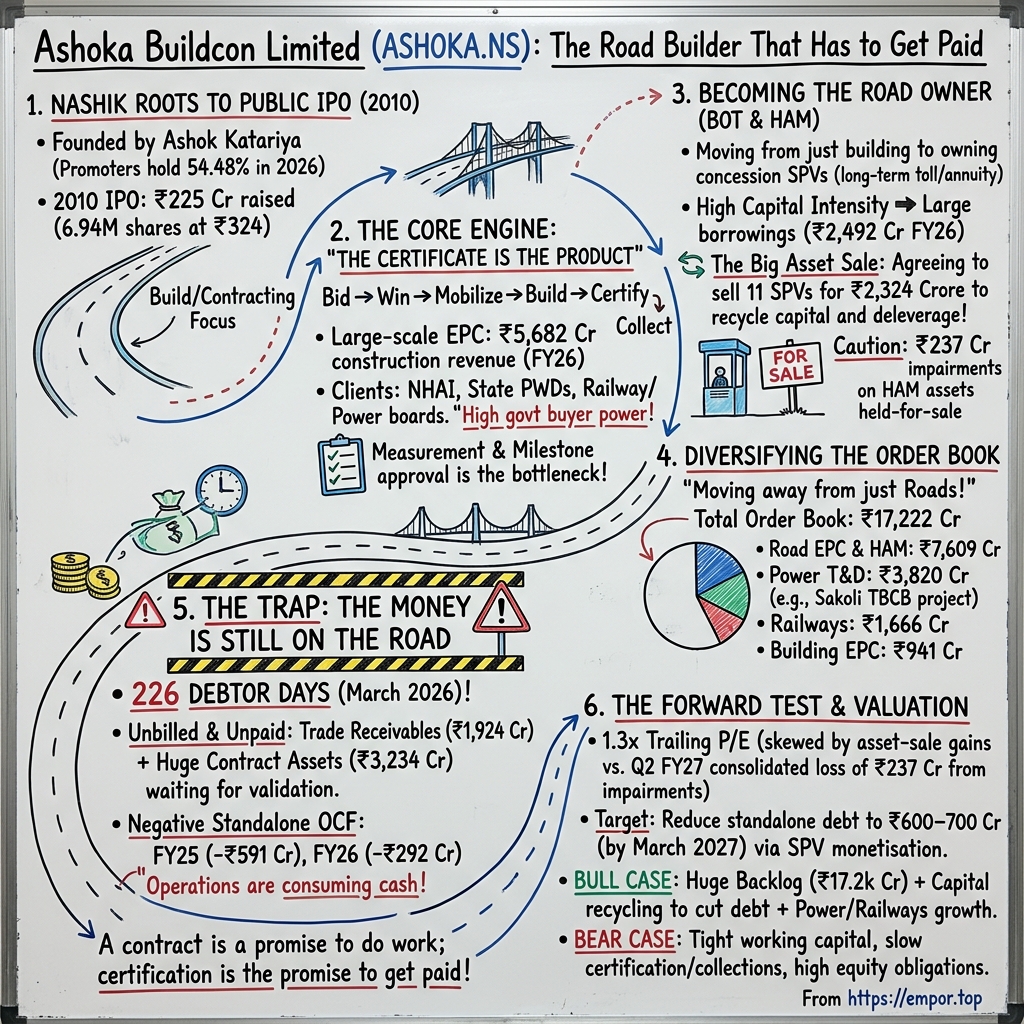
The scale of the engine is easier to hold once it is sized. In FY2026, the group's revenue from customer contracts was close to ₹7,000 crore. Construction contracts made up about ₹5,682 crore of it, toll collections from roads Ashoka operated about ₹1,047 crore, and sales of goods about ₹225 crore.3
So roughly four out of every five rupees came from building things for clients. About one in seven came from motorists paying at toll plazas on roads Ashoka owned. That second stream is the one the asset sales are dismantling, because when a toll road is sold, its toll revenue leaves the consolidated accounts with it.
Contracting is not recurring revenue, however large the backlog. At March 2026, Ashoka reported ₹17,249 crore of "remaining performance obligations", the accounting term for contracted work not yet performed, most of it expected to be recognised within three years.3 Rating agency CRISIL describes the typical engineering, procurement and construction project cycle as two to three years.13 The company does not disclose any share of revenue that recurs under minimum commitments.
That backlog has to be re-won constantly. A project finishes; the revenue it produced disappears unless a new tender replaces it. A year in which awards are slow, land is not handed over, or approvals stall becomes a year of falling revenue. That is exactly what FY2026 was: consolidated revenue fell by about a quarter, partly because standalone execution slowed and partly because sold projects and lower real-estate sales dropped out.3
The buyers are a short and powerful list. Ashoka's clients include the National Highways Authority of India, state public-works departments, state electricity boards, other government departments and municipal authorities.3 The company does not publish how much revenue comes from any single client, or what share its five largest customers provide.
Even without a number, the shape is clear. The buyer writes the specification, sets the tender terms, appoints the engineer who certifies the work, and controls the timetable for payment. CRISIL names dependence on payments from central and state governments as a central credit risk.13 In a negotiation with NHAI, a contractor has a fine track record and very little else.
A quick tour of the industry's five forces makes that structural. Buyer power is high, because public agencies tender competitively and can specify almost everything. Rivalry is intense; CRISIL lists intense competition among the company's weaknesses.13
Suppliers of steel, cement, bitumen and fuel can squeeze margins when contracts do not fully pass through cost increases. Switching costs barely exist once a project is tendered, because the next one is open to all qualified bidders. Entry is limited mainly by qualification thresholds and execution capability, which protect incumbents only against the smallest newcomers.
The rivals are well known. Larsen & Toubro competes at the top end across almost every infrastructure category. PNC Infratech, KNR Constructions, GR Infraprojects, HG Infra Engineering and Dilip Buildcon compete across overlapping road and engineering work. Ashoka's order book of ₹15,312 crore at March 2026 puts it in the same weight class as several of the focused road contractors.13 There is no consistent, published market-share data that would let anyone claim Ashoka leads a category.
So where is the edge? The honest answer is narrower than an investor deck would suggest. Decades of completed projects give Ashoka the qualifications to bid on large and technically demanding jobs. An existing order book gives it scale to spread equipment and overheads. Owning project companies has given it experience across the full life of a road. Those are real advantages in getting work.
What is missing is evidence of the things that let a contractor earn more than its rivals. There is no sign of pricing power over public buyers, no customer lock-in, and no disclosed cost position that would let Ashoka win tenders profitably where others cannot. The record supports "credible competitor". It does not, on the evidence available, support "moat".
There is one more property of this business worth noticing before moving on. The company reported no research and development spending in FY2026, and its standalone capital expenditure was about ₹67 crore.3 Ashoka, as a contractor, is relatively light on physical capital. Its money is tied up not in machines but in the gap between work done and cash received, and, for years, in the equity of roads it chose to own.
The workforce tells the same story. The company reported 1,857 employees and 541 workers at March 2026, a modest headcount for a business of its size, because much of the labour on site comes through subcontractors.3 That structure keeps fixed costs flexible, but it also means project margins depend on how well Ashoka manages others' crews, equipment and costs.
Technology is not the existential question here that it is for a software company. No algorithm will lay a bridge deck. Where digital tools and AI are likely to matter is in estimation, design, scheduling and project controls: the back-office disciplines that decide whether a bid is priced right and whether a site runs to plan.
A contractor that adopts them well could bid sharper; one that lags could find rivals undercutting it with better numbers. Ashoka does not disclose a specific technology programme beyond normal project execution.3
There is also a small international dimension. In FY2026 the parent earned about ₹394 crore in foreign currency against about ₹119 crore of foreign-exchange outgo, and carried foreign-currency bank guarantees of roughly ₹382 crore.3 The company describes its currency risk policies but does not disclose a hedge ratio. Overseas work is a minor part of the story, but it adds one more place where cash can be delayed.
This is the hidden hinge of the whole story. Winning a valid order and completing the work do not settle whether the contractor is paid on time. And when Ashoka went further, from building roads for clients to owning them itself, that gap between work and cash became much wider.
IV. When the Contractor Became the Road Owner
A contractor that builds a road for NHAI is paid, in principle, as it builds. A developer that owns a road is paid only after it opens, and then slowly, over years. In the BOT model, short for build-operate-transfer, the developer funds construction with its own equity and borrowed money, then collects tolls for a concession period before handing the road back to the government.
Under the hybrid annuity model, or HAM, the government pays part of the cost during construction and the rest in instalments after completion, so the developer earns a contracted stream rather than taking traffic risk.
For a contractor, either model is a double bet. Ashoka could earn a builder's margin on construction and then an owner's return on the finished asset. It could also tie up equity for years, take on project debt, and depend on traffic forecasts or government payment schedules over which it had no control.
Ashoka made that bet in size. Over the past decade, its consolidated balance sheet looked less like a contractor's and more like a toll-road developer's. In the year to March 2015, borrowings were around three times equity, and the group's total assets dwarfed its annual revenue.3 Asset turnover was about 0.16, meaning each rupee of assets produced only sixteen paise of revenue in a year.
Then the balance sheet buckled. Net losses arrived in FY2017, FY2018 and FY2019, and book equity collapsed in FY2018, sending reported borrowings above fifteen times equity for three years.3 Some of that was accounting: obligations to outside investors in the concession subsidiaries sat as liabilities, and their later reversal flattered profits. But the core lesson of those years was simple. Owning roads with borrowed money had made the consolidated company fragile.
Asset turnover tells the arc in one ratio. From about 0.16 in FY2015 it climbed to about 0.58 by FY2026, as the group shed concession assets and its balance sheet shrank back toward the size of its contracting business.3 Each rupee of assets now does more than three times the work it did a decade earlier. Much of that improvement came from selling assets, not from building more.
From that low point, Ashoka spent the next several years doing what overleveraged developers usually do: it sold. Consolidated borrowings, which were more than ₹6,000 crore at the start of the decade, came down in FY2022 and FY2023, rose again in FY2024 as new projects were funded, then fell sharply once the big disposals began closing.3 By March 2026 consolidated borrowings were about ₹2,492 crore, plus about ₹276 crore of acceptances and factoring liabilities.3
The 11-SPV sale was the centrepiece of that phase.1 So was a five-asset HAM transaction that the company presented as a sale for about ₹1,146 crore against roughly ₹590 crore of invested cost.14 On its face, that is nearly double the money in.
The phrase "on its face" is doing work there. Invested cost is not the same as total capital at risk over time, and the comparison ignores the years the equity was locked up, the construction margin already booked, and any guarantees or funding commitments Ashoka gave along the way. It is a reported gain on a specific portfolio, not a full return-on-capital calculation, and it is not a peer acquisition multiple that tells investors how buyers value Indian annuity roads generally.
What these deals were not is also worth stating. Ashoka's defining capital-allocation decisions have been project bids, SPV investments and asset disposals, not big corporate acquisitions. There is no headline takeover whose purchase price can be measured against what similar companies fetched. The capital-allocation record lives inside the project portfolio.
The portfolio's complexity shows up even in smaller corners. In June 2026, a subsidiary called Ashoka Purestudy Technologies issued shares to outside investors, cutting Ashoka Buildcon's stake from 59% to about 39%.6 It was a subsidiary-level event, not a capital raise by the listed parent, but it illustrates how many moving parts sit beneath the consolidated accounts, and why reading the parent's economics requires looking through the group structure.
By late 2026, rating agency ICRA counted five HAM assets and five BOT assets sold for about ₹2,960 crore in total, with six more HAM sales still pending.15 CRISIL, earlier in the year, had cited roughly ₹2,900 crore of asset-sale proceeds.13 The money was real. So was the backlog of transactions not yet closed.
And then came the falsification of the simplest version of the story. In the September 2026 quarter, Ashoka recorded an impairment of about ₹237 crore on HAM subsidiaries classified as held for sale.6 A portfolio marked for disposal was now worth less than its carrying value. Selling releases capital, but only if the price holds; this charge said that, for part of the remaining portfolio, it had not.
In the same quarter, the company booked about ₹82 crore of provisions for higher major-maintenance costs on its road assets.6 Major maintenance is the periodic resurfacing and repair that an operator must carry out over a concession's life. A higher estimate means the owned roads will cost more to keep, which is exactly the kind of long-tail obligation that makes owning infrastructure different from building it.
So did ownership create a valuable second engine? Partly. It gave Ashoka exposure to asset values and produced large disposal gains, which rebuilt book equity from the FY2018 trough to about ₹6,500 crore today.6 But asset rotation is not proof that every original investment earned an adequate risk-adjusted return, and the new impairment is evidence that some did not. The history narrows the claim: ownership was profitable on the assets sold so far, and less certain on the ones still waiting.
The redeployment question is what turns history into a live issue. Standalone capital expenditure was about ₹67 crore in FY2026, and management planned roughly ₹125 crore for FY2027.35 That is modest. The larger draw is HAM equity: Ashoka still had standalone funding commitments to group companies of about ₹179 crore at March 2026, and management has talked about further equity infusions into HAM projects.35
That sets the test for the next capital cycle. If sale proceeds reduce debt and the new commitments stay proportionate, the company emerges smaller in assets but sturdier. If renewed project commitments absorb the cash, Ashoka will have recycled capital without changing its funding problem.
The record gives reason for caution. Ashoka has deleveraged before. Borrowings fell sharply in FY2022 and FY2023, only to rise again in FY2024, when consolidated debt was back above ₹5,000 crore as new projects were funded.3 The second deleveraging has gone deeper than the first. Whether it lasts depends on whether the company resists the next round of attractive-looking concessions.
Management's own answer to that question has been to look beyond roads. And that is where the order book has started to point.
V. The Order Book Starts Pointing Away from Roads
On the November 2026 earnings call, the conversation turned to something new for Ashoka: a power transmission project won through tariff-based competitive bidding, or TBCB. In that format, developers do not just bid a construction price; they bid the annual charge they will accept for building, owning and operating the line, and the lowest tariff wins.5
The project, at Sakoli, carries a 24-month construction period and a 35-year operation and maintenance period.5 For a company that has spent years selling down long-dated road concessions, this was a striking choice. It is, in effect, a new long-dated concession in a different industry.
That irony is worth sitting with. Ashoka is exiting road ownership to reduce capital intensity, while entering a transmission asset that will require equity, debt and decades of operation. Management's case is that transmission brings a different risk profile and a fresh tender market. The economics of this first award will not be known until it is built and earning.
The order book shows how far the mix has already moved. At the end of September 2026, the ₹15,964 crore backlog included about ₹6,173 crore of road EPC work, ₹3,820 crore of power transmission and distribution, ₹1,666 crore of railways, ₹1,436 crore of road HAM projects and ₹941 crore of building work.4 On the call, management said roads and railways together made up about 58% of the order book, with power a substantial second leg.5
In plain terms, close to a quarter of Ashoka's contracted future work is now in electricity networks. Railways add roughly another tenth. A company that the market still thinks of as a highway builder is, in its backlog, becoming a broader infrastructure contractor.
The potential benefit is straightforward. Road awards in India come in waves, tied to budgets, NHAI's funding and the electoral calendar. Power transmission and rail tenders follow different cycles. A contractor that can qualify across all three has more chances to win and may smooth the gaps when one market goes quiet.
But diversification has a cost too. Each new segment needs specialist teams, different subcontractors and different qualifications. A contractor that is highly efficient at highways is not automatically efficient at laying transmission towers or railway track. The first projects in a new segment are where margins are most likely to disappoint.
Rating agency CRISIL had already seen the strain in the road business before the new segments arrived. Its June 2026 rationale tied the parent's 17% revenue fall in FY2026 to delayed execution, monsoon disruption and pressure on working capital.13 Those are road-contracting problems, and none of them is solved by winning a transmission tender. If anything, the new work adds fresh mobilisation costs at the moment the old work is slowest to pay.
The more telling detail from the November call is the gap between activity and results. Management acknowledged weaker construction activity in the quarter even as highway awards in the wider market picked up.5 Revenue fell about 19% year on year in the September quarter and about a fifth in the June quarter.6 The order book grew faster than near-term execution, which means more work was being added to the pile than was being taken off it.
One way to see that is to compare the backlog with the current pace of work. In the first half of FY2027, Ashoka's consolidated revenue ran at roughly ₹2,800 crore.6 At that rate, the September order book represents close to three years of work. A long backlog can signal security, but it can also signal a company that is winning contracts faster than it can turn them into revenue.
There is a further subtlety in the ₹17,222 crore figure. It includes projects where Ashoka was the lowest bidder but had not yet signed a contract.5 Being declared L1, the industry's shorthand for lowest bidder, is a strong position, but tenders can still be cancelled, delayed or re-bid, and the appointed date that starts the construction clock can slip for months while land and approvals are arranged. The headline backlog is therefore a slightly optimistic measure of what is firmly in hand.
Analysts on the call pressed on exactly those points: when the new orders would show up in revenue, how quickly the remaining asset sales would close, and how much debt would fall as a result.5 Management's answers were most concrete on debt, where the finance team gave a numerical target for March 2027, and least concrete on timing, where outcomes depended on bids being won, appointed dates being declared and buyers completing purchases.5
That pattern is not unusual for a contractor. But it means investors should treat the order book as a list of options, not a forecast. Each contract still has to clear that process. Ashoka's recent quarters show that the first of those steps has become easier than the last.
The forward test is therefore not the size of the backlog but the segment results. If power and railway revenue grow at healthy margins over the next several quarters, diversification will have moved from thesis to fact. If the backlog keeps swelling while revenue stalls, the new segments will simply have added more places for cash to get stuck.
And cash getting stuck is not a hypothetical risk for Ashoka. It is already happening.
VI. The Money Is Still on the Road
Go back to that finished highway waiting for its certificate. Now imagine dozens of them, plus transmission lines nearing completion, plus a railway section waiting for inspection. Each one is a pile of cash that Ashoka has already spent on cement, steel, fuel, wages and subcontractors. Each one sits in the accounts as an asset. None of them, until the certificate is signed and the client pays, can be spent on the next project.
That is the situation the balance sheet described at March 2026. Consolidated trade receivables, money already billed but not yet collected, were about ₹1,924 crore. Contract assets, work done but not yet billable, were about ₹3,234 crore.3 Together that is more than ₹5,000 crore of claims on public clients, larger than the company's entire market value today.
The trend is what makes it urgent. Debtor days, the number of days of revenue tied up in receivables, rose from about 118 in FY2024 to about 226 in FY2026.3 In two years, the average wait to be paid grew by roughly three and a half months.
Some of that rise is arithmetic. When revenue falls, as it did by a quarter in FY2026, the same pile of receivables represents more days of revenue. But that explanation only goes so far, because a pile that stays the same size while new work slows is itself a sign that old claims are not converting.
It helps to separate the two kinds of claim, because calling all of it "late" would be wrong. Ashoka says its trade receivables generally carry terms of 90 to 180 days.3 A receivable of 120 days is not overdue in that world; it is simply how public-sector contracting works. Contract assets are different. They are waiting for a project milestone to be certified before anything can be billed at all.3
So who holds up the clock? Mostly the client's process. CRISIL pointed to two specific sources of strain: retention money and warranty provisions on power projects, which clients hold back until the work has proven itself, and near-complete road projects whose value sits in unbilled revenue until final certification.13 Neither is a default. Both are cash Ashoka has spent and cannot yet use.
The ageing of those balances is where the risk flags appear. Among contract assets classified as good, about ₹342 crore was between one and two years old at March 2026. A further ₹367 crore of contract assets was classified as having a significant increase in credit risk.3 That is accounting language for "we still expect to collect, but less confidently than we did".
Trade receivables carried their own warnings. About ₹57 crore showed a significant increase in credit risk and about ₹64 crore was classified as credit-impaired, with allowances against current receivables of about ₹177 crore.3 During FY2026 the group wrote off about ₹87 crore of receivables and charged about ₹769 crore of expected-credit-loss allowances through the income statement.3
That last figure deserves a pause. An expected-credit-loss charge of that size, in a year when construction revenue was under ₹6,000 crore, is a reminder that a contract's stated value is not the same thing as cash. Some of what Ashoka booked as earned in earlier years is now being provided for as possibly uncollectable.
The cash-flow statement tells the same story from the other side. Over the twelve years from FY2015 to FY2026, consolidated cash from operations was about ₹6,652 crore, slightly more than cumulative net profit of about ₹6,245 crore.3 On the long view, Ashoka's profits have turned into cash, which is a respectable record for a contractor with a heavy concession portfolio.
The recent view is very different. The listed parent's own operations consumed about ₹591 crore of cash in FY2025 and another ₹292 crore in FY2026.16 In FY2026, higher receivables absorbed about ₹158 crore, and a fall in contract liabilities, which are mostly advances from clients, absorbed about ₹294 crore.16 Put simply, clients were paying less up front, and paying more slowly afterwards.
The fall in contract liabilities deserves a closer look, because it is the less obvious half of the problem. When a contractor wins a new project, clients often pay a mobilisation advance so that work can start. As the order book ages and older projects near completion, those advances are used up and are not replaced until new projects mobilise.
A slowdown in new starts therefore drains cash twice: once through slower billing, and again through the disappearance of the advances that used to fund the next site. If the new power and rail orders mobilise on schedule, that second drain could reverse.
At the consolidated level, operating cash flow in FY2026 was less than 4% of EBITDA, after more than half in FY2025.3 The long-run conversion record and the current conversion record are telling two different stories, and for anyone looking at the next two years, the current one matters more.
Cash on hand softens the picture but does not change it. The group held about ₹591 crore of cash and equivalents at March 2026, plus about ₹72 crore of other bank balances, with banks and financial institutions it describes as well rated.3 It also holds mutual funds, government bonds and investments in project companies. Those last items are not money the contractor can spend on next month's payroll, and the distinction matters when receivables are stretching.
There is a further layer of cash that never shows up as revenue: money Ashoka lends to its own subsidiaries. The listed parent sits atop a web of project companies, joint ventures and associates, and it funds them. In FY2026, standalone contract billings to related parties were about ₹481 crore, around 8% of standalone revenue, and purchases from them were about ₹346 crore.3 Those billings are eliminated in the consolidated accounts and are not the core revenue engine.
The more material item is the lending. At March 2026 the parent held about ₹221 crore of perpetual debt instruments issued by subsidiaries, and it recorded impairment of about ₹37.5 crore on loans to subsidiaries in FY2026, up from about ₹9 crore the year before.3 The company describes its related-party dealings as ordinary-course and at arm's length.17 The investor's question is not whether the transactions are proper but whether the money comes back, and at what return.
That matters because interest from subsidiaries is a large part of the parent's reported earnings, a point that becomes important when valuing the company. A loan to a struggling SPV can produce interest income on paper while the cash stays inside the project.
Out of all this, three measures are worth carrying forward. The first is debtor days, which stood at 226 in FY2026 and has been rising. The second is the listed parent's cash from operations, negative for two years running. The third is the collection of the aged and risk-flagged contract assets, especially that ₹367 crore flagged for credit risk. If those three improve together, the order book is turning into cash. If they do not, growth will deepen the funding need.
And that brings the story to the strangest number in Ashoka's file: a valuation so low it looks like a typo.
VII. A 1.3 Times P/E with a Moving Denominator
Any investor scanning Indian construction stocks in November 2026 would have stopped at Ashoka. A price-to-earnings ratio of about 1.3 times. An earnings yield, the inverse, of nearly 80%. Enterprise value of about 1.2 times EBITDA. Shares at roughly half of book value, and nearly 40% below their 52-week high of about ₹184.2
Taken literally, those numbers say the market would pay for the whole company with little more than one year of its profits. Either the market has made one of the more obvious mistakes in Indian equities, or the profits are not what they appear to be.
The answer begins with what went into the denominator. Ashoka's FY2026 consolidated profit included about ₹2,149 crore of gains on selling BOT and HAM subsidiaries.3 That one line was equal to about two-thirds of the company's entire market value today. Strip it out and the trailing earnings shrink dramatically.
Then the denominator moved again. In the September 2026 quarter, the group swung to a consolidated net loss, after the roughly ₹237 crore impairment on held-for-sale HAM subsidiaries and the ₹82 crore provision for higher major-maintenance costs.6 A quarter earlier, profit had been positive. A year earlier, it had been positive and the operating margin was close to 30%.6
This is why the P/E is not a clean signal. When one-off gains inflate the trailing twelve months and one-off charges deflate the next quarter, the ratio describes the accounting calendar more than the business. The more useful questions are what Ashoka earns from building things, and how much of that arrives as cash.
On that, the evidence is mixed at best. CRISIL put the parent's FY2026 EBITDA margin at about 8.5%, with interest coverage of about 2.03 times.13 The parent's other income was about ₹141 crore against profit before exceptional items of about ₹225 crore, meaning roughly three-fifths of its pre-exceptional profit came from interest on loans to subsidiaries and other non-operating sources.3 The core contracting engine, on its own, earned considerably less than the headline suggests.
Valuation against peers needs the same care. A peer snapshot on 20 November 2026 showed Ashoka at about 1.4 times earnings, against roughly 7.5 times for KNR Constructions and 5.3 times for PNC Infratech.2 On the surface that is a deep discount. In substance, the three companies have different earnings bases and different mixes of contracting, concessions and one-off gains, so the comparison says more about the noise in Ashoka's profits than about its relative cheapness.
What the price appears to assume is more interesting than the multiple. At about half of book value, the market is treating a large portion of Ashoka's assets, concession investments, receivables, contract assets and loans to subsidiaries, as worth considerably less than their carrying value, or as unlikely to turn into cash for shareholders soon. The September impairment showed that this skepticism is not baseless.
Enterprise value adds a second clue. At about ₹4,433 crore, it exceeds market value by roughly ₹1,300 crore, the market's estimate of the net debt and other claims sitting ahead of shareholders.2 Against that, Ashoka carries several thousand crore of receivables, contract assets and concession investments. The market is in effect saying that those assets will either take a long time to turn into cash, or will turn into less cash than the books suggest.
Since price alone cannot settle the case, management's behaviour has to. The record here has real strengths. The promoter group holds 54.48% with no pledge.7 The listed company has not diluted shareholders since the IPO. It issued ₹300 crore of non-convertible debentures in November 2024 and redeemed all three ₹100 crore series in April 2026.3
The record also has features that a skeptical investor would push on. Executive pay in FY2026 was about ₹5.43 crore for managing director Satish Parakh, ₹4.53 crore for chairman Ashok Katariya, ₹4.88 crore for Sanjay Londhe and ₹3.53 crore for Ashish Kataria, part of which came from the subsidiary Ashoka Concessions.3 Each received a commission of 0.25% of net profit.3 Together the four packages came to about ₹18 crore, against a parent profit before exceptional items of about ₹225 crore.
Pay tied to profit sounds aligned with shareholders. It is aligned only if the profit measure reflects value created. A year in which asset-sale gains swell reported earnings is a year in which profit-linked pay deserves close reading.
Shareholders noticed. In a March 2026 postal ballot, about 25.6% of the non-promoter votes cast opposed the resolution on Ashok Katariya's reappointment and remuneration.18 The resolution passed comfortably because the promoters hold a majority. But a quarter of outside votes against the founder is not routine dissent in Indian corporate governance; it is a message that a meaningful group of minority investors wanted a different deal.
The contrast with other resolutions makes the point. In the same ballot, only about 7% of votes cast opposed the reappointment of independent director Shilpa Hiran.18 Investors were not protesting the board in general. They were targeting the founder's terms.
The heavier overhang is legal. The Central Bureau of Investigation filed a chargesheet alleging bribery of NHAI officials and deviations in work quality on a Bihar highway project in which Ashoka was involved.3 Alleged irregularities in road construction were the subject of a government answer in the Lok Sabha in January 2026.19 The company disputes the allegations, says the work was completed and certified, has sought to have them quashed, and has made no provision pending the court's decision.3
The auditor did not qualify its FY2026 opinion, but it added an Emphasis of Matter drawing attention to the proceeding, and the interim auditor repeated it in November 2026.36 That is not a finding of guilt.
It is a signal that the matter is material enough to put in front of every reader of the accounts, and that its outcome is genuinely uncertain. For a company whose main customer is the agency named in the allegations, the commercial risk matters as much as the legal one.
Two other exposures shape the picture. A Karnataka royalty demand revised to about ₹383 crore is being challenged by Ashoka and its concessionaires, and management describes an outflow as remote.3 Tax-related contingent liabilities at the parent totalled about ₹229 crore.3 "Remote" is management's assessment, not a court's ruling.
An activist looking at all this would not argue that the stock is cheap. They would argue that it is opaque. They would ask for a cash-backed plan to reduce debt or return capital, and the company has paid no dividend since FY2020.3
They would ask for clean disclosure of every rupee lent to subsidiaries and what it earns. And they would ask for proof that the asset sales are creating durable value rather than disguising weak returns on the contracting core.
The activist would also question the structure itself. A listed parent that builds for clients, owns and sells concessions, lends to dozens of project companies and holds minority stakes in others is hard to value from the outside. Every additional layer makes it harder to see where returns are earned and where they leak. Simplifying that structure, through the sales already under way, is the single change that would most help minority holders judge the business.
Those demands lead straight to the question the whole story has been building toward: from here, what would prove Ashoka can win, and what would prove it cannot?
VIII. Analysis & Bear vs. Bull Case
Put two numbers side by side and the whole debate about Ashoka comes into focus. On one side is a cited order book of ₹17,222 crore, the largest pile of contracted work the company has described in some time.5 On the other is 226 debtor days, the longest wait for payment in the past twelve years.3 Between them sits a consolidated revenue line that fell by about a quarter in FY2026.3
Bulls read the first number as the future. Bears read the second as the present. The useful work is to test which reading the evidence supports.
Why Ashoka could win from here
The bull case starts with something genuinely hard to replicate: a multi-decade execution record across roads, bridges, concessions and now power and rail. In Indian public tenders, qualification is not a formality. Bidders must show completed projects of a certain size and type, and Ashoka has accumulated a long list of them.13 CRISIL itself listed the company's established record in EPC and BOT projects among its strengths.13
The second leg is the backlog. Roughly three years of work at the current pace provides visibility that many smaller contractors lack, and the shift toward power transmission and railways widens the tender pool beyond the national highway cycle.45 If road awards strengthen while the power and rail books execute, Ashoka could grow revenue from several markets at once.
The third leg is the balance sheet repair. Consolidated borrowings have fallen from more than ₹6,000 crore early in the decade to about ₹2,492 crore at March 2026.3 On the narrowest measure, debt is about a quarter of equity.
Management told analysts that the parent's debt owed to outside lenders was about ₹1,169 crore, with the rest of its ₹2,086 crore of borrowings owed within the group, and forecast standalone debt of ₹600 to ₹700 crore by March 2027, conditional on further asset monetisation.56 If that happens, the company that nearly drowned in project debt in FY2018 would be carrying very little.
Here the bull must confront history. This is the same company whose reported borrowings ran above fifteen times equity in FY2018 and FY2019, and whose debt rose again in FY2024 after an earlier round of sales.3
The current repair is real and deeper than the last one, but the company's own record says deleveraging is a habit it has started before and then reversed. The claim survives in a narrower form: Ashoka has shown it can sell assets to cut debt, not yet that it can keep debt down through a full project cycle.
The fourth leg is price. At half of book value and with promoters holding a majority unpledged, the market is already pricing in a great deal of disappointment. A bull does not need Ashoka to be exceptional; only for the receivables to come in, the sales to close and the core margin to stabilise.
Why it may not
The bear case starts with the buyer. Every one of Ashoka's major customers is a public agency with the power to set specifications, appoint certifiers, delay payment and re-tender work. There is no evidence that Ashoka can charge more than rivals for the same job, and the company does not disclose customer concentration or market share in a way that would show otherwise.
The second problem is that competitive tenders compress returns. When L&T, PNC, KNR, GR Infraprojects, HG Infra and Dilip Buildcon can all qualify for the same highway package, the winning bid tends to be the one that assumes the least margin for error. A large order book won in that environment may contain thin margins, and thin margins leave little room for delays in land handover, approvals or certification.
The peer group offers a useful mirror here. Several of Ashoka's rivals went through the same road boom, carried their own concession portfolios and faced the same public clients. The market's willingness to pay several times more for their earnings suggests investors see those earnings as more repeatable, not that their businesses are structurally different.2 For Ashoka, closing that gap requires no new strategy; it requires a few years of profit that does not depend on selling something.
The third is cash. The parent consumed cash in its operations for two straight years, receivables are aging, credit-loss charges are large, and loans to subsidiaries have started to be impaired.163 Operating cash flow covered less than 4% of EBITDA in FY2026.3 A backlog that grows faster than collections is not a buffer; it is a funding requirement.
The fourth is the debt picture rating agencies actually use. CRISIL counted about ₹2,847 crore of debt at the parent in FY2026 once interest-bearing acceptances were included, noted weak interest coverage and an elongated working-capital cycle, and kept a negative outlook before withdrawing its ratings at the company's request.13 ICRA, in October 2026, expected deleveraging but noted six HAM sales still pending.15 A withdrawal of ratings at the issuer's request does not mean the risks the agencies flagged have gone away.
The withdrawals carry their own message about funding. CRISIL's withdrawn ratings covered about ₹6,306 crore of bank facilities and a ₹200 crore commercial-paper programme, and ICRA's covered a ₹100 crore commercial-paper line.1315 Commercial paper is the cheapest short-term money a company of this kind can raise, and it requires a rating.
A contractor that steps away from rated paper is either confident it no longer needs that market or has decided the market is not worth the scrutiny. Either way, the cost and source of its short-term funding becomes something investors should watch.
The final problem is the fragility of the earnings base. Return on equity of about 34% over the past twelve months looks spectacular, but it is driven by unusual gains rather than repeatable contracting profit.6 The September quarter's loss is the more honest picture of what happens when the gains stop and the charges arrive.
Weighing the two cases through a broader lens sharpens the judgment. On the five forces, Ashoka faces high buyer power, intense rivalry, moderate supplier pressure, weak switching costs and only modest entry barriers. That is the profile of an industry where the average company earns its cost of capital in good years and less in bad ones, and where a company's fortunes depend more on execution and the cycle than on structural advantage.
Hamilton Helmer's seven powers framework asks a harder question: what lets a business earn persistently above-average returns? Ashoka has some scale economies, because a larger order book spreads equipment and overheads, but its rivals have similar scale. It has no network effects; one more NHAI contract does not make the next one more valuable. Switching costs are negligible for its buyers.
It has no meaningful brand power with procurement officers who must pick the lowest qualified bid. Its counter-positioning, entering power transmission as a contractor-owner, is available to any rival willing to take the same risk. There is no cornered resource. The closest thing to a power is process power: an accumulated ability to execute complex projects reliably. Ashoka's recent execution slowdown is the evidence that tests even that.
The verdict that follows is narrower than either camp would like. Ashoka has the record to keep winning work, and that is valuable. It does not have a demonstrated moat, and the recent history of slowing execution, aging receivables and an impairment on assets marked for sale argues against treating its advantages as structural. The moat claim is plausible but unproven.
The three measures that will decide it have already appeared in this story. Debtor days stood at 226 in FY2026 and were rising. The parent's operating cash flow was negative in both FY2025 and FY2026. And the ₹367 crore of contract assets flagged for higher credit risk is the clearest single test of whether old work becomes cash. Movement in those three will say more about the moat than any new order.
What would confirm the better version of Ashoka? FY2027 revenue stabilising and then growing, with segment margins holding as power and railway work ramps. The parent's debt actually falling to near the guided range once remaining sales close. Cash from operations turning positive, with debtor days falling from their peak. Each of those is measurable within the next two reporting cycles.
What would falsify it? Further slippage in disposals, more impairments on assets awaiting sale, new equity commitments to HAM or transmission projects that absorb the proceeds, and a backlog that keeps growing while revenue does not.
The decision rule is simple to state and hard to meet. Backlog growth matters only if it produces operating profit and cash without another round of balance-sheet strain. Ashoka has, at various points in its history, done each of those things. It has rarely done all three at once.
IX. Playbook: Business & Investing Lessons
Return one last time to that finished stretch of road, its lanes painted and its barriers bolted, waiting for an engineer's signature. Somewhere else in the group, a project company that owns another road waits for a buyer to complete the purchase. Ashoka's story lives in those two waiting rooms. The lessons it teaches are about the distance between winning work and earning cash.
The first lesson: a contract is a promise to do work; the certificate is the promise to get paid. Ashoka's order book is real, and so are the more than ₹3,234 crore of contract assets waiting for milestones to be certified.3 The rise in debtor days to 226 is what happens when the second promise lags the first.
Founders building any business that sells to governments should design for the certificate, not the contract: budget the working capital, staff the billing function, and track certification as tightly as construction progress. Investors should treat unbilled revenue as a loan the company has made to its client, with all the risk that implies.
The distinction is easy to forget because the two promises are made by different people. The procurement officer who awards the contract wants the road built. The engineer who certifies it and the finance department that pays for it have their own budgets, schedules and incentives. A contractor that treats them as one counterparty will be surprised every time; Ashoka's balance sheet is the record of those surprises.
The second lesson: owning the road can multiply the upside and the funding bill. Ashoka's decision to become a concession owner gave it gains when assets were sold, and helped rebuild equity from the near-wipeout of FY2018.
It also took the company to the edge of balance-sheet distress, and it left a tail of obligations: major-maintenance provisions, equity infusions, and an impairment on HAM assets that were supposed to be the next source of proceeds.6 Vertical integration in infrastructure is not free optionality. It is a second business with a different capital profile, and it should be judged on its own returns, not on the gains booked in the year it is sold.
The third lesson: a larger order book is only better if the business can build it and collect for it. Ashoka's backlog rose even as its revenue fell and its parent's operations consumed cash. That combination is common in contracting and almost always misread. A rising order book can signal strength, but when execution and collection fall behind, it becomes a list of future working-capital demands. The useful ratio is not backlog to revenue but cash collected to revenue booked.
The fourth lesson: discipline is measured after the proceeds arrive. Ashoka has sold assets for thousands of crores and has promised lower debt.155 The test of that promise is not the announcement of a sale; it is what the balance sheet looks like after the money comes in and the next round of commitments has been made.
Companies that recycle capital well tend to say no to good-looking projects when the core business needs the cash. Whether Ashoka will do that is the question its next year will answer.
There is a wider lesson for investors in Indian infrastructure, and Ashoka illustrates it with unusual clarity. In this industry, the income statement records ambition and the cash-flow statement records reality. A cheap multiple built on asset-sale gains is not the same as a cheap business. And management that controls the majority of the votes can pass any resolution it likes; what it cannot do is make public clients pay faster.
A fifth lesson belongs to the stock rather than the company: a low multiple describes the denominator before it describes the business. Ashoka's 1.3 times earnings looks like a bargain until the gains on selling subsidiaries are removed and the next quarter's impairment is added. For any company that sells pieces of itself, the right question is what the remaining pieces earn, every year, in cash.
X. Epilogue
Tonight, Ashoka Buildcon stands at a peculiar midpoint. It is smaller in assets than it was two years ago, carrying less debt and more equity, holding a backlog of ₹17,222 crore that it says reaches across roads, railways, buildings and power lines.5 It is also coming off a loss-making quarter and still faces the asset-sale, collection and CBI risks described in the latest results.6153
The next twelve months contain the events that will decide which of those descriptions matters more.
The first is the remaining disposals. ICRA counted six HAM sales still pending in October.15 When they close, investors will see the proceeds actually received, the gains or further impairments booked, and how much debt is repaid. Management's March 2027 debt target remains the test.5
Meeting that target would be a concrete sign that asset recycling has turned into lasting deleveraging. Missing it, especially because sales slipped or proceeds were redeployed into new projects, would revive the oldest worry in this story.
The second is working capital. The results for the December 2026 and March 2027 quarters will show whether the risk-flagged contract assets are being collected, whether debtor days are falling from their peak and whether the parent's operations start generating cash again. If those three move together, the bull case gains real evidence. If they do not, more of the balance sheet will start to look like a list of claims rather than a store of value.
Interest is part of that test. On the November call, management acknowledged that debt owed within the group continues to carry interest.5 That means the parent's interest bill does not fall to zero simply because outside lenders are repaid, and it means interest income from each subsidiary that owes the parent money will continue to flow through the parent's accounts, provided the subsidiary can pay.
The third is execution in the new segments. Power transmission and railway work are already a large share of the backlog. Over the coming quarters, the question is whether they show up as revenue, at margins comparable with roads, or merely as awards. The Sakoli transmission project's 24-month construction clock will give the first clear read on whether Ashoka can build and operate an asset in a business it is only beginning to learn.5
The fourth is governance. The CBI proceeding will move through the courts on its own timetable, and any outcome would matter both legally and commercially. At the next shareholder votes on appointments and pay, minority investors will show whether the dissent of March 2026 was a one-off or the start of a pattern.18
Each of these events can go either way. Completed sales, falling debt and improving collections would make the case that Ashoka has reshaped itself into a leaner, more diversified contractor. Delayed sales, weak collections or margin erosion in the new segments would suggest that the company has simply rearranged its capital without solving its central problem.
The calendar is short. The December quarter's results will arrive early in 2027, and the full-year accounts for FY2027 will follow a few months later, with the audited cash-flow statement that matters most. By the time the FY2027 annual report is published, investors will know whether the guided debt figure was met, whether the remaining HAM sales closed, and whether the parent's operations produced cash. Few companies offer such a clear set of near-term tests of a management promise.
Ownership will offer quieter signals. That September-quarter selling by mutual funds and foreign portfolio investors712 may reverse as collections improve and debt falls, suggesting institutions see the turn. If retail holders keep absorbing the selling, the market's skepticism will have deepened.
The backlog will not settle that. Cash and delivery will.
XI. Outro
Every road Ashoka has built goes through the same life. It begins as a tender document and a bid. It becomes a construction site, then a finished stretch of asphalt. For some of those roads, the company stayed on as owner, collecting tolls or government annuities. Then, when it needed the capital, it sold them, using the proceeds to reduce debt and fund new projects.
But somewhere in that cycle, there is always a road that is finished and not yet paid for. A certificate unsigned. An invoice outstanding. A retention held back. That road is the whole of Ashoka's story in miniature: a business that knows how to build, trying to make its capital move as quickly as its projects.
It is a contractor that learned to be an owner, then learned to be a seller, and is now learning to be a transmission developer. Through every change, one thing has stayed the same: the money arrives after the work, and the gap between them decides the company's fate.
The company can build the next project only if the last one becomes cash.
References
-
Sale of Stakes in 11 SPVs — Ashoka Buildcon Limited, 2024-12-31 ↩↩
-
Ashoka Buildcon Peer Comparison and Valuation — QuarterMark, 2026-11-20 ↩↩↩↩↩↩↩↩
-
Annual Report FY2025–26 — Ashoka Buildcon Limited, 2026-09-02 ↩↩↩↩↩↩↩↩↩↩↩↩↩↩↩↩↩↩↩↩↩↩↩↩↩↩↩↩↩↩↩↩↩↩↩↩↩↩↩↩↩↩↩↩↩↩↩↩↩↩↩↩↩
-
Q2 and H1 FY2027 Investor Release — Ashoka Buildcon Limited, 2026-11-05 ↩↩↩
-
Q2 FY2027 Earnings Call Transcript — Ashoka Buildcon Limited, 2026-11-13 ↩↩↩↩↩↩↩↩↩↩↩↩↩↩↩↩↩↩
-
Q2 FY2027 Results and Limited Review Report — Ashoka Buildcon Limited, 2026-11-05 ↩↩↩↩↩↩↩↩↩↩↩↩↩↩
-
Shareholding Pattern, 30 September 2026 — Ashoka Buildcon Limited ↩↩↩↩↩↩
-
How Ashok Katariya Built Ashoka Buildcon from a Seed Capital of Rs 5,000 — The Economic Times, 2014-03-27 ↩
-
Prospectus — Ashoka Buildcon Limited, Securities and Exchange Board of India, 2010-09-29 ↩↩
-
Ashoka Buildcon IPO Opens September 24, Price Band at Rs 297–324 per Share — The Economic Times, 2010 ↩
-
Shareholding Pattern, 30 June 2026 — Ashoka Buildcon Limited ↩↩
-
Rating Rationale: Ashoka Buildcon Limited — CRISIL Ratings, 2026-06-12 ↩↩↩↩↩↩↩↩↩↩↩↩
-
Q4 and FY2026 Investor Release — Ashoka Buildcon Limited, 2026-05-22 ↩
-
Rating Rationale: Ashoka Buildcon Limited — ICRA, 2026-10-30 ↩↩↩↩↩↩
-
Audited Standalone and Consolidated Results for the Year Ended 31 March 2026 — Ashoka Buildcon Limited, 2026-05 ↩↩↩
-
Related Party Transactions Statements — Ashoka Buildcon Limited ↩
-
Postal Ballot Voting Results — Ashoka Buildcon Limited, 2026-03-09 ↩↩↩
-
Lok Sabha Annexure on Alleged Irregularities in Road Construction — Government of India, 2026-01-29 ↩
 LinkedIn
 WhatsApp
 Reddit
 Hacker News
 Email
 Kindle
 RSS Feed
 Spotify
 Apple Podcasts
 Amazon Music
 Audible
 YouTube