Sivers Semiconductors: The Chip Company Priced for Its Next Act
The stock that got ahead of the business
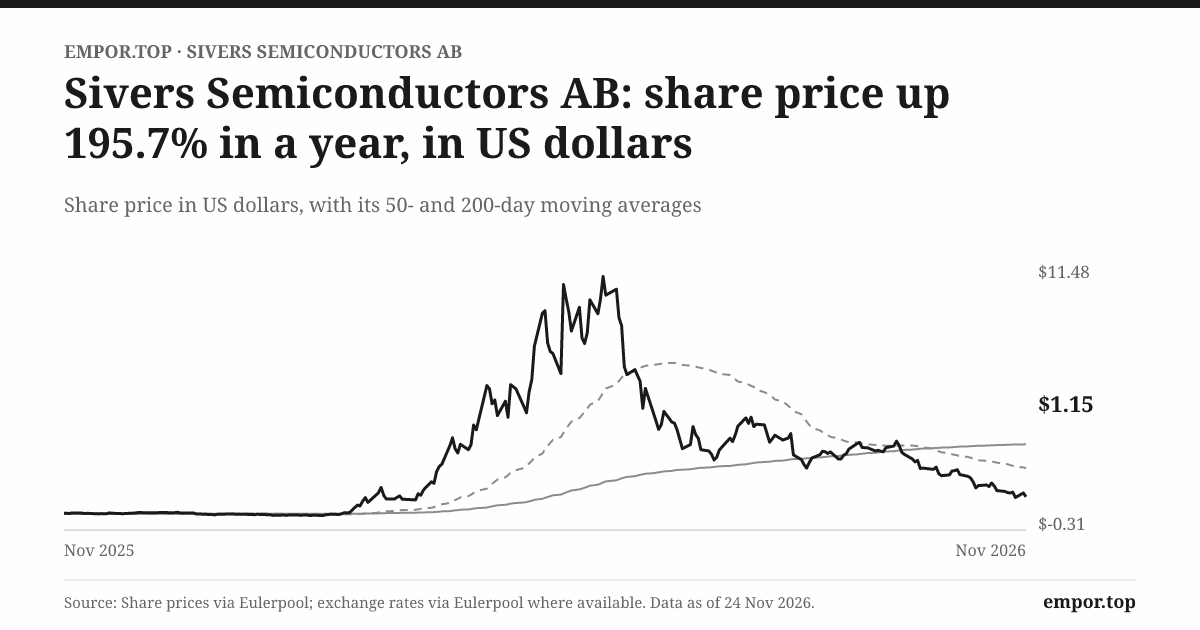
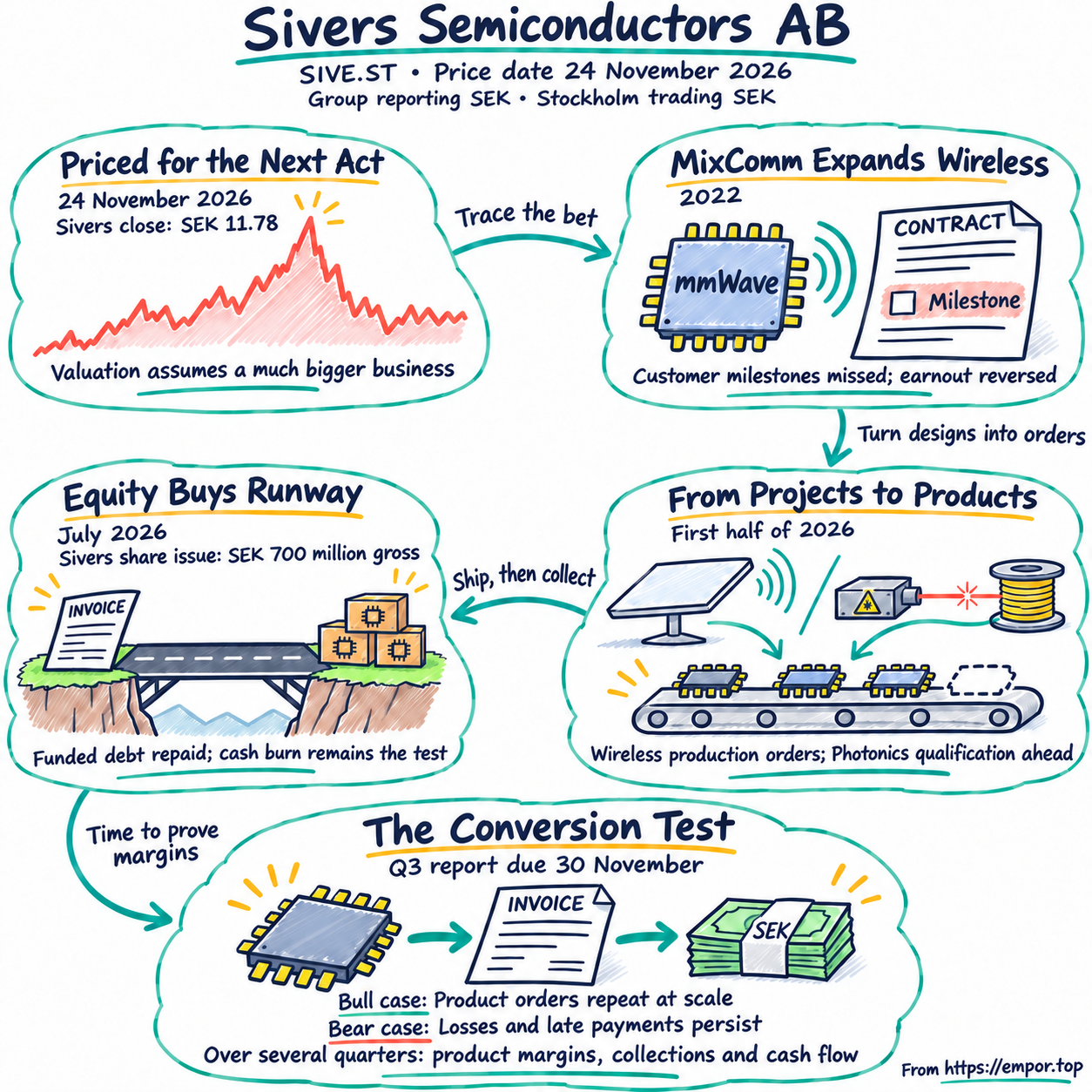
On the evening of November 24, 2026, Sivers Semiconductors closed in Stockholm at SEK 11.78 a share.1 Anyone who had watched the stock over the previous year would have had trouble calling that number either good or bad, because the stock had been almost everything. Within the past twelve months it had traded as low as SEK 2.90 and as high as SEK 101.90.1 On that Tuesday it sat about 88% below the peak, yet still four times above the trough. It had been one of the most violent charts on Nasdaq Stockholm, with one-year volatility of about 170%, and the press had noticed. In May, Svenska Dagbladet ran a piece on why Sivers shares were soaring and why experts were warning about it.2
Beneath all that motion sits a small company. Sivers employed about 130 people at the end of 2025.3 Its full-year revenue was SEK 306.6 million, roughly $31 million, which is less than a large semiconductor company books in an afternoon.3 It has reported a loss in every year of its financial record back to 2014.34 And yet, even after the collapse from the peak, the market valued the equity at about SEK 4.2 billion and the whole enterprise, debt included, at about SEK 4.4 billion.1 That is roughly 16 times the revenue of the last twelve months. Investors are not paying for a business that exists today. They are paying for one they hope will exist in a few years.
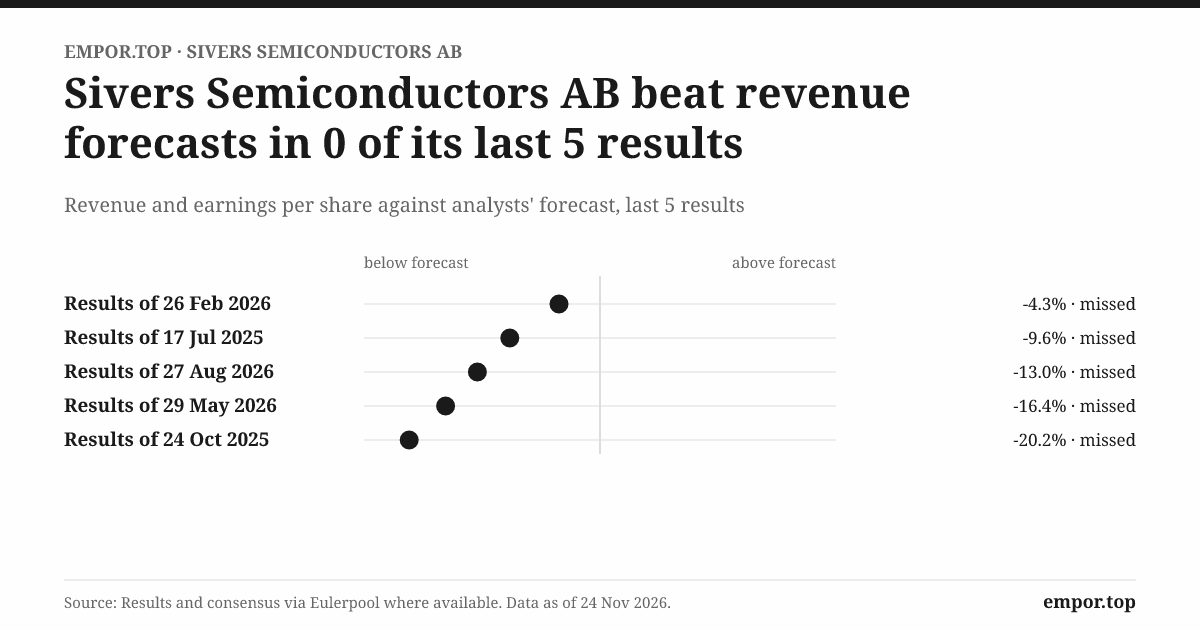
The direction of travel makes the gap sharper. Revenue in the first half of 2026 fell about 20% from the year before, with the second quarter down 26%.5 So the market is paying a growth-company multiple at a moment when the reported top line is shrinking. That is not automatically irrational. Semiconductor companies often look worst just before a product ramp, when development spending is high and production shipments have not yet started. But it does mean the price contains a forecast, and the forecast is the thing to test.
This episode is about that test. Sivers is a story about conversion: whether years of engineering work, customer-funded development projects, acquisitions and design wins can turn into chips that ship in volume, at a profit, to customers who pay on time. Five questions run through it. Can customer projects become repeat production orders, or will the company keep living from one engineering contract to the next? Are the losses the cost of building capacity, or a sign that the unit economics are weak? Can a small supplier with a handful of large customers collect its cash? Has the large share issue of 2026 bought enough runway to reach production? And does a valuation of this size leave any room for the execution risk that the company's own history keeps showing?
A word on boundaries before the story begins. Sivers Semiconductors AB is the Swedish parent listed in Stockholm, and every figure here describes its consolidated group.3 That group has two operating businesses. Sivers Wireless designs millimeter-wave chips, modules and antenna systems, mostly from Sweden and the United States. Sivers Photonics designs and manufactures laser components and arrays in Scotland.3 The group also owns 29.63% of an associate company, III-V EPI, which is not consolidated.3 In September 2026 a registration for American Depositary Shares was filed with the SEC, part of the company's preparation for a possible US listing, but that filing was not an IPO prospectus and the Stockholm listing remains the home market.6
The calendar matters too. On November 25, 2026, the latest reported quarter is still the second quarter, covering April to June. The company moved its third-quarter report to November 30, with the release and a webcast scheduled after the Stockholm close.7 So the market is pricing Sivers on evidence that is five months old, with a fresh data point days away. That makes it a good moment to go back to the beginning and ask how a Swedish microwave business ended up here, carrying a valuation that assumes it will become something much larger.
 Subscribe on LinkedIn
From microwave instruments to two semiconductor bets
The company carries the name of a person. In 1951, Carl von Sivers founded Sivers Lab in Sweden to make microwave products.8 This was the early postwar world of radar and radio links, when microwave engineering was a specialist craft practised by small workshops and big electronics groups alike. Sivers Lab sat in the first category. Over the following decades it built components and instruments for signals at frequencies most people never thought about, and it passed through the hands of Philips before a management buyout brought it back under independent ownership.8
That early history is worth one paragraph, not ten, because the business that investors own today was largely assembled in the last decade. What the old company gave the new one was a culture of radio-frequency engineering in Kista, outside Stockholm, and a habit of building things that work at very high frequencies. It did not give it a scaled product franchise. The financial record that starts in 2014 shows a company with annual revenue of a few tens of millions of kronor and losses every year.4
The turn came in two acquisitions. The first, in 2017, was Compound Semiconductor Technologies, a Scottish developer and manufacturer of compound-semiconductor lasers, which became Sivers Photonics.38 The second, in 2022, was MixComm, an American millimeter-wave chip designer, which this story will examine closely in a moment. Between them, they changed what Sivers was. It stopped being only a Swedish radio-frequency house and became a two-legged group with one leg in wireless chips and the other in light.
A brief explanation of the two technologies helps here, because they are very different businesses that happen to share a parent. "Millimeter wave," or mmWave, refers to radio signals at very high frequencies, roughly 24 gigahertz and above. Those signals carry huge amounts of data but travel poorly: they are absorbed by rain and walls and spread out quickly. The trick that makes them useful is beamforming, in which a chip drives many tiny antennas at once and adjusts the timing of each so that their signals add up into a narrow, steerable beam. Think of a crowd of people clapping in carefully staggered rhythm so the sound lands loudest in one spot across a stadium. Sivers designs the chips that do that steering, for satellite terminals, fixed wireless broadband and defense systems.3
Photonics is the world of lasers. Sivers Photonics makes laser chips from indium phosphide, a compound semiconductor that, unlike silicon, can emit light efficiently.3 Those lasers matter for optical communication, sensing and, increasingly, the links that move data between processors in AI data centers. Silicon is excellent at computation and poor at producing light, so many next-generation optical designs pair silicon chips with separate laser sources. Sivers says it wants to be one of the companies supplying those lasers.
The capital to build this two-legged group came from public markets. In June 2021 the company moved its listing to Nasdaq Stockholm's main market, backed by a Swedish-language prospectus, with trading beginning on June 10.83 It is tempting to read a main-market listing as a sign that a technology has found its market. The record argues otherwise. The listing financed a wider portfolio, but the revenue line at the time was still around $10 million a year and the operating losses were larger than that.4 The listing was a financing platform, not a commercial verdict.
By the end of 2025, the result was a group spanning Wireless and Photonics.3 More than seventy years after Carl von Sivers opened his lab, the investment case no longer rests on that heritage. It rests on whether the capabilities bought and built over the past decade can carry commercial scale. And the largest single bet behind that case was made in early 2022, when Sivers wrote its biggest cheque and asked shareholders to accept a large slice of dilution in return for an American chip designer.
The MixComm bet: strategic fit, uncertain return
On February 22, 2022, Sivers announced that it had completed the acquisition of MixComm.9 The target was a young company, founded in 2017, headquartered in Chatham, New Jersey, with design centers in Oregon and California.9 Its technical roots ran back more than a decade into research at Columbia University, led by co-founder and chief technology officer Harish Krishnaswamy.9 Its sellers included its founders and employees, the venture firm Kairos Ventures and the contract chipmaker GlobalFoundries.9 Kairos became a significant Sivers shareholder, and Todd Thomson of Kairos joined the Sivers board, where he still sits.910
The logic was easy to explain to shareholders. Sivers said the deal would strengthen its position in 5G, satellite communications and radar, adding a larger customer base, more engineering capacity and a broad patent portfolio.9 It would also give a Swedish company a real foothold in the United States, the largest market for both defense electronics and satellite ground terminals. The company quantified the commercial promise in a way that is worth remembering: it said the combination would lift its Wireless design wins by about 70% to 44, and double its expected volume-production wins from eight to 16.9 In other words, the pitch was not only technology. It was a pipeline.
What the money bought
The price came in two currencies. Sivers paid about USD 22.6 million in cash and issued shares valued at SEK 440.9 million, while the stated total consideration of SEK 731.9 million also included SEK 78.7 million of contingent consideration.11 The share component was large for a company of Sivers' size: about 39.2 million new shares, roughly 18% dilution for existing holders.9 Half of those consideration shares were locked up for twelve months and the rest for eighteen.9
The contingent part is the most revealing piece of the deal. Up to about 7 million additional shares were payable if MixComm hit commercial customer milestones within nine months of signing.9 Earnouts like this are how buyers and sellers bridge a disagreement about the future. The seller says the customers are coming; the buyer says, then prove it, and we will pay you more when they do. In MixComm's case, the milestones were not met, and the SEK 78.7 million contingent consideration was reversed.11
That outcome deserves careful handling, because it is easy to overstate in both directions. It is not proof that MixComm's engineering was worthless or that every acquired capability failed. Sivers still sells mmWave beamformers that draw on the combined design teams, and its Wireless segment is now the larger part of the group.3 But it is direct evidence on the one question that mattered most: whether specific commercial wins would arrive on the timeline the sellers and buyer had agreed. They did not. When a deal is structured so that part of the price depends on customers showing up, and they do not show up in time, the market has been given a clean, dated test of commercialization. Sivers failed that test, at least for the window the contract specified.
The missing benchmark
The natural next question is whether Sivers overpaid. Here the honest answer is narrower than either a critic or a defender would like. The company did not publish MixComm's standalone revenue or EBITDA at the time of purchase in a form that allows a clean transaction multiple.119 Without that, any claim that Sivers paid "X times sales" would be invented precision. What can be said is that the purchase price, at roughly SEK 650 million after the reversed earnout, was more than twice the group's entire revenue in 2025, three years after closing.113
Context makes the deal look less like a one-off and more like a pattern. The CST purchase in 2017 had already established that Sivers would buy capability rather than wait to grow it.3 Both acquisitions brought real engineering into the group. Neither has yet produced a group that earns a profit: the financial record shows annual losses in every year since 2014, before and after both deals.43 That does not condemn the acquisitions, because capability purchases in semiconductors often take many years to pay. It does mean that the burden of proof remains on the future.
The balance sheet still carries the past. At the end of 2025, goodwill and other intangible assets, including capitalized development spending and acquired technology, remained a substantial part of a balance sheet of about $136 million in total assets.34 Those carrying values are an accounting statement of expected future benefit. To support them, Sivers' products need to earn real gross profit for years. The 2025 accounts already show the cost of expectations not met: impairment and write-off charges were part of the SEK 84.4 million in depreciation, amortization and impairment that year.3 Every future impairment test will ask the same question that the MixComm earnout asked in 2022: are the customers arriving at the pace the numbers assume?
The deal belongs to the era of former chief executive Anders Storm, who led Sivers through the MixComm acquisition and the main-market listing before handing over in August 2024.12 His successor inherited the asset and the question. The new leadership's answer was not another acquisition. It was a change in how Sivers would make money, away from bespoke engineering and toward chips that ship from a catalog.
The pivot from engineering projects to chips that ship
Vickram Vathulya arrived at Sivers on August 19, 2024, with more than 25 years in the semiconductor industry.12 He holds a PhD in electrical engineering from Lehigh University and an MBA from Berkeley Haas, and before Sivers he had been president of Nuvotronics, a US maker of high-frequency components.12 The line on his résumé that Sivers' board chose to highlight was that he had "revitalized the standard products business" at Maxim, after earlier RF and wireless roles at Maxim Integrated and NXP Semiconductors.12 That phrase was a mission statement. Standard products, sold to many customers from a catalog, are the opposite of the custom engineering projects that had kept Sivers alive.
Vathulya has described the strategy since as a shift from an engineering-led company to a product-led semiconductor business.13 To see why that matters, it helps to understand how Sivers actually earns its revenue today.
There are three kinds. The first is hardware: chips, modules and antenna systems, recognized as revenue when they are delivered.3 The second is non-recurring engineering, or NRE, which is customer-funded development work. A customer pays Sivers to design or adapt a chip for its system; Sivers recognizes the revenue as the project progresses and bills the customer when agreed milestones are hit.3 The third is support contracts, with fixed terms and prices, recognized over the service period.3 The company does not disclose a typical contract length, minimum purchase commitments or the share of revenue that recurs.3
NRE is the key to the whole model, and it cuts both ways. Picture a satellite-terminal maker that wants a beamforming chip tuned for its antenna. It will not commit to buying a million chips before it knows the design works, so it pays Sivers to build and test the design first. If the design succeeds and the terminal goes into production, the customer then orders chips in volume, and those repeat orders are where semiconductor companies make their money, because the design cost has already been paid. NRE is, at its best, a customer-funded doorway into a production stream.
At its worst, it is something else: a consultancy wearing a chip company's clothes. NRE revenue depends on project progress and milestone billing, not on end-market demand. A company can report rising revenue for years from engineering projects that never become products, and each new project needs fresh engineers and fresh overhead. That is why the end of 2025 balance sheet needs careful reading. Sivers carried SEK 100.4 million of NRE contract liabilities, which are advance payments for development work still to be performed.3 That figure is a third of a year's revenue, and it is real money already received. But it is not a backlog of guaranteed product sales. It is an obligation to do engineering, and it may or may not lead to production orders.
Who pays the bills
The segment split shows where Sivers lives today. In 2025, Wireless generated SEK 213.1 million, about 70% of the group, and Photonics SEK 93.4 million, about 30%.3 Both lost money before head-office costs: Wireless reported adjusted EBITDA of about SEK -48.5 million and Photonics about SEK -11.2 million.3 So the pivot is not a story of one profitable business funding another. Both legs are still in the building phase.
Concentration sharpens the picture. Three customers each accounted for more than 10% of 2025 revenue, together SEK 183.4 million, or about 60% of group sales.3 The largest, which Sivers calls Customer A, contributed SEK 79.4 million, more than a quarter of the entire group, and the next two SEK 55.2 million and SEK 48.7 million.3 All three were Wireless customers, and Sivers does not name them.3 So the group that describes itself as moving toward standard products sold to many buyers still got three-fifths of its revenue from three buyers in one segment. That is not a contradiction, because every product company starts with a few anchor customers. But it means the transition is still a plan, not yet a description.
The strategy for 2026 makes the tension explicit. Management said it would deliberately reduce near-term NRE activity, freeing engineers to support future product ramps.5 That is a sensible trade for a company that wants to become a product business. It also means that one of the revenue streams that had been propping up the top line would shrink before the replacement stream arrived.
When the line turned down
The quarterly revenue line tells that story in miniature. Through 2025 revenue grew: the first quarter was up about 39% year on year, the second 39%, the third 24%, and the fourth 5%.34 Then the line broke. The first quarter of 2026 fell about 22% from a year earlier, and the second quarter fell about 26%.5
On the calls, management explained the declines as timing. The company pointed to the planned reduction in NRE projects, delays in defense budgets that pushed out orders, and the long qualification cycles of customers who must test a chip inside their own systems before ordering in volume.14155 It also emphasized a better signal underneath: in the second quarter, product revenue grew about 18% year on year in constant currency.5 Those explanations are plausible and partly verifiable, since the NRE reduction was announced in advance. But they all share a feature: they ask investors to accept lower reported revenue now in return for higher product revenue later. Until the later part arrives, the explanation and the excuse look identical from outside.
The losses in the second quarter were also inflated by charges that will not recur in the same form. Sivers attributed SEK 62.7 million of one-off costs to the quarter, including SEK 50.3 million of social charges on share options, which in Sweden rise with the share price, and SEK 12.4 million for US-listing preparation.5 Strip those out and the quarter looks less disastrous. But the adjusted figures were still poor: first-half 2026 adjusted EBITDA was about SEK -49.3 million and operating cash flow about SEK -119.2 million.5 And the year before, in 2025, cost of sales exceeded revenue, which means Sivers made a gross loss before paying for any research, sales or administration.53 A product company with a negative gross margin is not yet a product company in economic terms.
So the pivot has a coherent logic and a short, mixed record. The bridge from customer-funded engineering to repeat product orders is real in principle, and it is how many successful chip companies were built. The evidence that Sivers is crossing it would be several consecutive quarters in which product revenue grows, gross margin turns positive and then rises, and the share coming from the top three customers falls. None of those has yet been shown. There is a useful way to think about what success would look like in the accounts. In a healthy product-led chip company, NRE becomes a small and shrinking share of revenue, because the engineering is amortized across many units sold. Gross margin rises as volumes climb, because the fixed cost of the fab, the test equipment and the design team is spread over more chips. And the customer list lengthens, because a standard product can be sold to the fifth and tenth customer with little extra design work. Each of those changes leaves fingerprints in the reported figures: a falling NRE share, a rising gross margin, and a falling share for the largest customers. Sivers has not yet published a sustained run of any of them, which is why the pivot remains a hypothesis rather than a result.
Which raises the harder question underneath the business model: once a customer has qualified Sivers' chip, what stops it from qualifying someone else's?
Two chip markets, two different commercialization tests
Imagine two engineers on opposite sides of the world, each with a problem Sivers wants to solve. The first works for a company building satellite terminals. Low-orbit satellite constellations move across the sky at thousands of kilometers an hour, so the ground terminal must track them electronically, with no motor swinging a dish around. It needs a flat panel of antennas and chips that can steer a beam in microseconds while using little power and staying cheap enough to fit on a ship, a truck or a rooftop. The second engineer works in an AI data center. Thousands of processors must exchange data constantly, and the copper cables that once linked them are reaching their limits on distance and power. The answer is more light: optical links, each needing a laser that is reliable, efficient and available in volume.
Sivers sells into both rooms. That is its opportunity and its complication, because these are two separate commercialization tests with different customers, different competitors, different timelines and different economics.
Wireless: the business that exists
Wireless is the present. In 2025 it produced SEK 213.1 million of revenue, the larger part of the group.3 Its products are mmWave beamformers and transceivers, plus modules and antenna systems that package them, sold for satellite communications, fixed wireless access, which delivers home broadband by radio rather than cable, and defense.3 Every one of those markets runs through system manufacturers. Sivers does not sell to the airline that wants in-flight internet or the army that wants a secure radio link. It sells to the company that builds the terminal, which in turn sells to that end customer. That layering means long qualification paths: the chip must work in the terminal, the terminal must pass the end customer's tests, and the end customer must fund deployment.
Two names have become proof points in that chain. ALL.SPACE, which builds multi-orbit satellite terminals, and Tachyon Networks, which builds wireless networking equipment, both placed production-related orders with Sivers that the company highlighted in the first half of 2026.5 Those are meaningful because "production order" is a higher bar than "development agreement." But they are still announcements. Sivers does not disclose the value of each customer's orders over time, so outsiders cannot yet see whether these programs are growing into repeat, rising shipments.
The competitive field in wireless is crowded with much bigger companies. Established RF and mmWave chip suppliers such as Qorvo and Analog Devices sell into the same broad markets with far larger engineering teams, manufacturing partnerships and customer relationships. Sivers does not publish a market-share figure, and there is no reliable public estimate of its share in beamformers specifically. What can be said is scale: Sivers' entire Wireless segment is a fraction of a percent of what its largest competitors book. In a market where large customers want suppliers that will still exist in ten years, small size is itself a competitive cost.
The economics of a beamforming chip explain why this matters so much. A flat-panel satellite terminal may contain dozens or hundreds of antenna elements, and every few elements need a beamformer chip to drive them. So the chip count per terminal is large, and the chip cost is a big share of the terminal's bill of materials. That is the attraction for a supplier: one terminal design, if it ships in volume, can consume a great many chips. It is also the trap. Because the chips are such a large share of cost, terminal makers push hard on price, design their panels to accept parts from more than one vendor where they can, and treat every price increase as a reason to look elsewhere. The supplier that wins is usually the one that can promise the lowest cost per element for years, which favors the company with the biggest volumes and the best foundry terms. For Sivers, the winning path is to be good enough technically that a customer accepts the risk of a small supplier, and then to grow alongside that customer fast enough that the cost gap closes.
Photonics: the business that might become material
Photonics is smaller and more speculative, and its pull on the share price has been far larger than its revenue. In 2025 it generated SEK 93.4 million.3 Its products are indium-phosphide laser chips and arrays used in communications and sensing, and the company now pitches them heavily at AI data-center interconnects, where demand for optical capacity and for lower power per bit is rising fast.35
The partnership that best illustrates the opportunity and the gap is Jabil, the large contract manufacturer. Sivers has described a collaboration in which Jabil would run beta builds and production qualification of optical products using Sivers lasers.5 Beta builds are trial production runs; qualification is the process of proving that a product meets reliability standards over thousands of hours. Both are necessary steps toward volume orders, and neither is a volume order. Sivers has also announced other optical partnerships and demonstrations aimed at the data-center market.1315 The difference between those milestones and recurring revenue is the difference between being invited to the audition and getting the role.
The photonics competitors are the same companies whose share prices have been lifted by AI: Lumentum and Coherent, both large established suppliers of lasers and optical components with production lines, customer relationships and qualification histories that Sivers is only beginning to build. A useful illustration of how the market treats them came on November 17, 2026, when Lumentum traded at about 15.7 times enterprise value to sales and Coherent at about 5.5 times.16 Those are much larger businesses with different mixes and profitability, so their multiples are context rather than a direct yardstick. But they show what Sivers' valuation implicitly compares it to: a premium AI-optics name, priced before it has the revenue of one.
Where the edge would come from
The case for a durable Sivers edge rests on a few mechanisms, and each can be tested. Technical capability is the clearest: Sivers' engineers have designed beamformers and lasers that serious customers chose to test and, in some cases, order. Qualification is the second: once a chip has been designed into a satellite terminal or an optical module and passed reliability testing, swapping it out means redoing that testing, which costs time and money. That is a real switching cost while a program lives. Intellectual property, including the patent portfolio brought in with MixComm, is the third.9
Against those sit two strong counterweights. The first is buyer power. When three customers provide about 60% of revenue, as they did in 2025, those customers set the terms.3 They can negotiate price, delay orders, stretch payment and, crucially, insist on a second source. Large equipment makers routinely qualify two suppliers for critical parts precisely so no single vendor can hold them hostage. Sivers does not disclose retention rates, price trends or whether its key customers multi-source the same parts. Without that data, the switching cost is plausible but unproven. The second counterweight is the company's own conversion history. The MixComm earnout missed its customer milestones, and the volume-production wins promised at that deal's closing have not, so far, produced a profitable Wireless segment.113 Patents and technical firsts do not, on their own, create what strategists call a cornered resource; a competitor with a hundred times more engineers can design around a patent or simply out-qualify a smaller rival.
Pipeline versus shipments
The calls show management leaning on the pipeline. On the fourth-quarter 2025 audiocast, management described an opportunity pipeline of about $453 million and stressed that the path from development to production in these markets is long.13 That is a large number against annual revenue of about $31 million. In later calls, management described the pipeline growing further and pointed to the second quarter's product revenue growth as evidence of conversion.1415 Analysts on those calls pushed on what counted as "pipeline" and how much was weighted for probability.1415
Pipeline is a lead indicator, not booked business. It is a list of opportunities a company believes it could win, and its value depends entirely on the conversion rate. Here the record offers a cautionary datum from within the company itself. For 2025, Sivers reported product revenue growth of about 80% in reported terms, but only about 13% in constant currency, meaning the same year's product growth looked dramatically different depending on how it was measured.133 In the second quarter of 2026, constant-currency product growth was about 18%.5 Those are real improvements, but they are growth rates on a small base, not the step change that a $453 million pipeline would imply.
So the verdict on the two markets is lopsided. Wireless is the bigger current business, with named production customers and a clear but long qualification road. Photonics has credible future relevance to AI infrastructure, but its pipeline and partnerships are not yet equivalent to scaled revenue. Across both, Sivers' technical capability is evident. Its durable pricing power, switching costs and share gains are not yet visible in the numbers. The stronger evidence, when it comes, will be disclosed product revenue by segment, gross margin, and repeat shipments to the same customers, not a bigger pipeline total. And even shipments are only half the test. The other half is getting paid.
The receivables that turned sales into a cash question
At the close of 2025, Sivers' accountants sorted the company's unpaid invoices by age, as every company does at year-end. The pile was SEK 56.7 million gross.3 Normal credit terms at Sivers are 30 to 45 days: a customer receives the goods or the milestone invoice and pays within six weeks.3 But SEK 17.3 million of that pile, almost a third, was more than 120 days overdue.3 Some invoices had been sitting unpaid for four months or more. Sivers says plainly that some of its customers have a history of paying late.3
That sentence would be unremarkable at a large company with thousands of customers. At Sivers, where revenue is concentrated among a few customers, it is a strategic fact. When a few buyers dominate a supplier's revenue, they hold the bargaining power not only on price but on payment timing. A small supplier chasing a large customer for an overdue invoice has to weigh the cash against the relationship, and the relationship usually wins. The chain runs from concentration to bargaining power, from bargaining power to overdue invoices, from overdue invoices to swollen working capital, and from working capital to the need for outside financing.
The allowance for credit losses shows how far the problem went in 2025. It rose from SEK 0.7 million to SEK 14.0 million, driven by a SEK 13.0 million impairment charge, and the company also reported SEK 13.0 million of contractual receivables written off.3 Management's description of historical credit losses as limited sits uneasily beside a twentyfold jump in the allowance in a single year. Sivers does not identify which customer or customers were involved, so no outsider can assign those balances to a named company, and nobody should.
There is an earlier clue in the related-party notes. In 2024, two members of Sivers' board bought trade receivables from the company totaling about USD 1 million, less a discount, and the receivables were fully settled in January 2025.3 The company described the transaction as arm's length and on market terms.3 It is not evidence of impropriety. It is evidence of need: a company does not usually sell its invoices to its own directors unless it wants the cash before the customer is ready to pay.
The number that kept rising
Debtor days measure how many days of revenue are sitting in unpaid receivables, a rough gauge of how long it takes to collect. At Sivers the figure was 114 days in 2014, spiked to 348 in 2015, and by 2025 had climbed to 269 days.43 A company on 30-to-45-day terms collecting in something like nine months on average has a structural cash problem, whatever the income statement says.
There is a reasonable counterpoint. Gross trade receivables actually fell during 2025, from SEK 79.0 million to SEK 56.7 million.3 Management can point to that and argue that collections improved. But a balance at one date is a snapshot, and the write-offs explain part of the decline: invoices that are written off leave the receivables balance without ever turning into cash. The longer history, in which collection times drifted upward over a decade, does not disappear because one year-end balance looked better.
Contract assets add a further layer. Under NRE accounting, Sivers recognizes revenue as project work progresses, but it can only invoice when a milestone is reached. In the gap, the revenue sits on the balance sheet as a contract asset: earned in the accountants' view, but not yet billed, let alone collected. At the end of 2025, contract assets were SEK 11.6 million, including a small loss allowance.3 In the 2025 cash-flow statement, changes in contract assets absorbed about SEK 62.2 million of cash, and contract liabilities a further SEK 21.0 million, partly offset by movements in receivables and accruals.3 That is the mechanics of a business whose revenue arrives before its cash. It is also why a growing NRE business can be a cash trap: the faster the project book grows, the more work is done ahead of the invoice, and the more working capital the company must finance before a single krona arrives. A shift toward standard products should, in principle, shorten that cycle, because a chip shipped against a purchase order is invoiced on delivery. That is one of the less obvious reasons the product pivot matters, and one of the clearest ways to tell whether it is happening.
Put together, late collection at Sivers is a demonstrated cash-conversion risk, not a hypothetical one. It sits alongside cash burn and product gross margin as one of the few measures that will tell investors whether the business is changing. And it was precisely because operating cash was leaking out this way, year after year, that the auditor's warning in the 2025 annual report carried such weight. The question it raised was simple: how long could Sivers keep funding its development before the model started paying for itself?
The equity raise bought runway; it did not prove the model
The 2025 annual report, published in May 2026, contained a sentence no management team wants to read. The auditor gave an unmodified opinion on the accounts, but drew attention to a material uncertainty that could cast significant doubt on the group's ability to continue operating as planned without additional capital or financing.3 In plain English, the business plan did not work without more money. The year had produced a net loss of SEK 222.6 million and an operating cash outflow of SEK 38.5 million, with investment spending on top.3 At the end of June 2026, Sivers reported available cash of SEK 62.7 million.5 With operating cash flow of about SEK -119 million in the first half alone, that cushion was thin.5
Then, in a matter of weeks, the picture changed. On June 30, 2026, Sivers resolved on a directed share issue of about SEK 700 million gross.17 The shares were priced at SEK 57, a 9.7% discount to the previous close, and the issue was multiple times oversubscribed.175 Because the share price had risen so far in the preceding months, that large sum represented only about 3.3% dilution on a fully diluted basis.5 Investors who had watched the stock climb from under SEK 3 were now buying at nearly twenty times that level. Shareholders who bought into the raise have since seen the price fall to SEK 11.78, about 80% below the issue price.1
The long cash story
The raise makes sense only against the full record. Across the twelve years from 2014 through 2025, Sivers' cumulative net losses came to about SEK 1.1 billion, while its operating cash outflow totaled about SEK 616 million.34 The gap is explained largely by non-cash charges: amortization of acquired and capitalized assets, depreciation, impairments and share-based pay. In 2025 alone those non-cash items included SEK 84.4 million of depreciation, amortization and impairment and SEK 8.5 million of share-based payment expense.3 So the accounting losses overstate the cash burned from operations. But that is not comforting, because investing outflows came on top. Free cash flow, operating cash less capital spending, was negative about SEK 1.2 billion over the same twelve years.34 Dividends were zero, and the company's cash balance at the end of 2025 was only about SEK 43 million higher than at the end of 2013.34 Every krona of that SEK 1.2 billion gap was filled by shareholders and lenders.
The pace of capital raising accelerated as the funding gap tightened. In 2025, two directed share issues raised SEK 202.8 million before costs.3 In February 2026, Sivers refinanced its debt with Bootstrap Europe: a USD 5 million term loan at 12% interest and a USD 12 million convertible loan at 10.85%, with security over group companies and assets and a USD 350,000 maturity fee on the term loan.18 Those are expensive rates, the kind charged to borrowers with limited alternatives. In April 2026 a further directed issue raised SEK 125 million.35 Then came the July raise. After it, Bootstrap converted the convertible loan into shares in July, the company repaid the remaining term loan in August, and Bootstrap's warrants were exercised in August.5 Sivers reported that it had no outstanding interest-bearing debt.5 IFRS 16 lease liabilities on offices and production facilities remain on the balance sheet, so "no debt" means no funded borrowing, not zero obligations.3
Note the distinction between gross proceeds and cash on hand. The July issue brought in SEK 700 million before costs, but the business has been consuming cash at an accelerating rate, with capacity and research investment planned for the coming ramps.5 The amount remaining after the third quarter will appear in the November 30 report; until then, the honest statement is that Sivers has much more cash than it had in June, and much less than SEK 700 million plus the June balance would imply.
What the money cannot do
Set the raise against the acquisition record and a pattern emerges. CST and MixComm expanded the group's capabilities, and the main-market listing financed them. Neither the acquisitions nor the listing produced sustained positive operating cash flow.34 The 2026 raise fits the same pattern, though with an important difference: this time the proceeds paid off expensive debt and gave the company a much larger cushion to reach production, rather than buying another company.
That is a genuine improvement. The auditor's warning was about 2025 and the period immediately after; the raise addressed the immediate funding need, and with no interest-bearing debt the near-term risk of a lender forcing decisions is much lower.35 But the core condition the auditor described, an operating model that does not generate enough cash to fund its own development, has not been resolved by a share issue. It can only be resolved by gross profit.
Runway is a bridge, not a destination. The proof that the bridge leads somewhere will be in quarterly operating cash flow through the production opportunities management expects in 2027, and in whether Sivers needs another share issue, another loan or a large warrant exercise before then. And because investors are funding that bridge partly on trust, the next question is about the people steering it.
The new CEO inherits a credibility test
When the board announced in July 2024 that Vickram Vathulya would take over, it attached a gesture to the appointment. Alongside a new incentive plan with stock options, Vathulya committed to buy or subscribe for 2 million Sivers shares, worth up to about $1 million, subject to shareholder approval.12 A new chief executive putting personal money into a loss-making company before his first day is a signal, and the board wanted it read as one. The shares came through a directed issue to the CEO of about SEK 6.9 million in 2024.3
That transaction is worth distinguishing from what Vathulya owns today. A 2024 subscription is a historical purchase; current beneficial holdings move with option exercises, sales and further issues, and the latest figures belong to the company's most recent insider and governance filings rather than to a two-year-old press release.10 What the filings do show is his pay. In 2025, Vathulya's remuneration totaled SEK 5.1 million: SEK 3.4 million in salary, SEK 1.3 million in share-based pay and SEK 0.3 million in other benefits.3 Total senior-executive remuneration rose from SEK 23.8 million in 2024 to SEK 27.3 million in 2025, while the group lost more money.3 For a company of 130 people, executive pay of that scale is not outlandish by international semiconductor standards, but it is a meaningful share of a cost base that the products do not yet cover.
He also inherited a reporting problem, and in some ways that is the more important part of the story. In September 2025, Lottie Saks, chief financial officer since 2021, handed over to Heine Thorsgaard, who joined from the Danish network-acceleration company Napatech, where he had been CFO since 2018.19 Thorsgaard holds a PhD and a master's degree in finance from Copenhagen University and took responsibility for global finance, investor relations and IT.19 He arrived in the middle of the period that the next annual report would scrutinize.
The corrected year
That report was not comfortable reading. The 2025 figures published in the annual report differed from those in the initial year-end report, and the net loss was revised to SEK 222.6 million.3 Prior-period figures for 2024 were also corrected, and the company changed how it presented expenses by function, restating prior-year comparisons.3 The auditor treated revenue recognition as a key audit matter and identified significant deficiencies in internal control over financial reporting, along with errors; management described the weaknesses as material and said remediation was underway under the oversight of the board and audit committee.3
What the corrections were matters more than the fact of correction. Some were presentation changes, reshuffling costs between lines without changing the bottom line. Others were errors that changed reported results. Neither category is evidence of fraud, and the auditor did not suggest any. But revenue recognition was the key audit matter, and revenue recognition is exactly where a company built on NRE projects, milestone billing and contract assets has the most judgment to exercise. When the area of greatest judgment is also the area where controls were found weak, investors are entitled to apply a discount to reported figures until several clean quarters have passed.
The 2025 accounts carried other signs of a company under strain. A cyberattack that year caused SEK 8.5 million of non-recurring cost, though the company reported no material disruption to operations.3 Currency swings did more damage: the group has USD revenue against SEK and GBP costs, discloses no hedging policy, booked large net exchange losses in finance costs, and took a SEK 121.8 million translation loss on foreign subsidiaries in other comprehensive income.3 None of those is the CEO's fault in isolation. Together they describe a small company whose reported results are vulnerable to forces beyond its operations.
Promises against outcomes
The fair way to judge Vathulya is to separate what he inherited from what he has delivered. He inherited MixComm and its missed earnout, a balance sheet that needed refinancing, and a revenue line dependent on engineering projects. He has delivered a clear strategic message, a new CFO and other senior operating hires, a refinancing, an equity raise that removed all funded debt, and preparations for a US listing.518176 Those are real accomplishments, and the strategy itself, moving from custom projects to standard products, matches the experience he was hired for.
On operating outcomes the record is thinner. Revenue fell in each of the first two quarters of 2026; the company recorded impairments and receivable write-offs in 2025; and both segments remained loss-making.53 On the calls, management's prepared remarks emphasized pipeline growth, product revenue growth in constant currency and production timing, while analysts returned repeatedly to how pipeline was defined, how concentrated customers were, why defense revenue had slipped, when production would actually ramp and how long the cash would last.131415 The answers were consistent across calls in direction: the inflection was described as coming, with the fourth quarter of 2026 and 2027 named as key periods.515 Consistency of narrative is a positive sign. Delivery against it is the test, and the window for it is still open.
Shareholder oversight offers little counterweight. Turnout at the 2025 annual general meeting was only about 12% of shares, and the authorization to issue new shares was reported as passing unanimously.20 Low turnout is common where most shares sit in nominee accounts, and at the end of 2025 about 98% of Sivers' shares were nominee-registered.3 By June 2026 the company reported no shareholder with 5% or more and about 30,000 shareholders in total.5 Its register at the end of October 2026 was topped by custodians such as Clearstream, National Financial Services, Charles Schwab and Interactive Brokers, each holding around 11–14% on behalf of others.21 Sivers gave inconsistent accounts of its largest holders in the 2025 annual report, naming board member Erik Fällström at about 14% of votes in one place and Avanza Pension as largest in another.3 A company with no anchor owner, a dispersed and largely retail-and-broker base, and low meeting turnout is one where the board answers to the market price more than to any engaged shareholder. The board itself is chaired by Bami Bastani, whom the company identifies as not independent of management.10
The verdict on leadership, then, is narrow. The strategy is coherent and the financing shows an ability to execute in capital markets. But corrected results, material control weaknesses and a short operating record under the current CEO mean that management credibility remains something to be earned in the reported numbers, not assumed from the plan. That brings the story to the question every investor in Sivers must answer: what would have to be true to justify the price?
Analysis & Bear vs. Bull Case
Return to the closing price on November 24: SEK 11.78, a market value of about SEK 4.2 billion, about 15.9 times sales and about 16.4 times enterprise value to sales.1 The company's operating margin in 2025 was about -46.5%, revenue in the first half of 2026 fell about 20%, and free cash flow has been negative across the entire record.354 Price-to-earnings is meaningless for a company with losses, and the sales multiple is the only crude valuation measure available. So the question is not whether Sivers is cheap or expensive on earnings. It is what the next several years of revenue and margin must look like for 16 times sales to make sense.
A rough way to see the size of the assumption: a mature, profitable chip company might trade at perhaps three to six times sales, which is where Coherent sat in mid-November.16 For Sivers to grow into its current enterprise value at a multiple like that, revenue would need to rise several times over, perhaps to well over a billion kronor a year, and the business would need to make healthy gross and operating margins on it. That is not impossible for a company with genuine design wins in growing markets. It is a large leap from SEK 306.6 million of revenue and a gross loss in 2025.3
The bull case
The bull case starts with capability. Through CST and MixComm, Sivers assembled engineering teams in Scotland, Sweden and the United States that can design mmWave beamformers and indium-phosphide lasers, two technologies that matter for the next decade of connectivity.39 It has named customer programs, including production-related orders from ALL.SPACE and Tachyon in Wireless and a production-qualification path with Jabil in Photonics.5 Its markets are growing: satellite broadband constellations need cheap electronically steered terminals, defense budgets are rising across Europe and the United States, fixed wireless access is expanding, and AI data centers need far more optical bandwidth per watt. A strategy that concentrates engineers on standard products rather than custom projects would, if it works, let revenue grow faster than costs. And after the 2026 raise the company carries no funded debt, so it can pursue that strategy without a lender's clock running.5
The bull would add that the share price itself has become an asset. A company able to raise SEK 700 million at a high valuation with only modest dilution can fund several years of development, hire talent with stock options and, if the US listing proceeds, reach a deeper pool of semiconductor investors.176 Many chip companies that are now large went through years of losses before a single program ramped and changed their economics.
The bear case
The bear case starts with the record. Sivers has lost money every year since at least 2014, through two acquisitions, a main-market listing and a change of CEO.43 Its largest acquisition missed the commercial milestones that would have triggered its earnout.11 Three customers supply about 60% of revenue.3 Collections are slow and in 2025 required a large write-off.3 The 2025 accounts needed correction and the auditor found material control weaknesses.3 The pipeline is non-binding, and the revenue line fell sharply in the two most recent reported quarters.135 Product economics have not yet covered even the cost of making the products, let alone group overheads. The valuation already assumes a successful transition, so even good news may be priced in, and the share price's 170% volatility shows how violently the market reprices the story.1
The forces on the business
Porter's five forces help organize the evidence. Buyer power is high: a handful of system manufacturers dominate Sivers' revenue and can set price, payment terms and sourcing. Rivalry is intense, because Sivers competes for designs against suppliers many times its size, from Qorvo and Analog Devices in RF to Lumentum and Coherent in optics. Supplier power is meaningful: Sivers depends on foundries, specialized materials and complex inputs, and it flags potential supply constraints in its risk disclosures.3 The threat of substitutes is real in both markets, because a customer can choose a different antenna architecture or a different optical approach, such as alternative laser sources or integrated designs. The threat of new entrants is the one force that favors incumbents: mmWave and compound-semiconductor laser design require years of specialized know-how, and qualification takes time. On balance, the industry structure favors the large customers and large competitors, not the small specialist.
Hamilton Helmer's seven powers offer a stricter test, because each power must deliver both a benefit and a barrier. Scale economies belong to the giants, not to Sivers. Network economies do not apply. Counter-positioning is possible but unproven: a small, focused supplier might move faster on niche beamformer or laser designs than a large competitor willing to protect its existing lines, but there is no evidence yet that incumbents are declining to compete. Switching costs exist while a program is in production, because requalifying a chip is expensive, but Sivers does not disclose retention or multi-sourcing data, and customer concentration suggests the switching cost may bind Sivers to the customer as much as the customer to Sivers. Branding is minimal in components. A cornered resource could exist in specific patents or engineering teams, but patents alone have not yet translated into pricing power or profits. Process power, the accumulated manufacturing know-how that lets a company make better products at lower cost, might develop in Photonics' laser fab over time, but the 2025 gross loss argues it is not there yet. The honest conclusion is that Sivers has capabilities, not yet powers. A capability becomes a power only when it produces repeat business on better terms than rivals can offer.
Testing the transformation claim
Management has described 2025 as a year of structural transformation toward a product-led company.13 The evidence narrows that claim. Product revenue did grow in 2025, but by about 13% in constant currency rather than the 80% reported headline.133 Both segments reported losses.3 In 2026 the overall revenue line fell for two quarters, partly by design as NRE shrank, while constant-currency product revenue grew about 18% in the second quarter.5 That is the outline of a transition beginning, not one that has happened. The word "structural" will be earned when product revenue is the majority of sales, gross margin is positive and rising, and the largest customer is no longer providing more than a quarter of the group.
The material risks follow from the mechanisms already described. A delayed customer program, such as a defense budget slipping or a satellite operator postponing deployment, removes shipments directly, and with concentrated customers a single delay moves the group's numbers. Supply and manufacturing constraints can delay a ramp just when demand arrives. Currency moves affect revenue, costs and equity, with no disclosed hedging.3 Capitalized development spending, SEK 18.4 million in the first half of 2026 alone, will need to be written down if the products it funded do not sell as forecast.5 And the 2025 cyberattack showed that a small company's IT exposure can carry real cost.3
There are also reassurances worth recording accurately. The company reported no contingent liabilities at the end of 2025, and the auditor's opinion was unmodified.3 No material tax demand, litigation or regulatory action appears in the 2025 annual report or the second-quarter 2026 report.35 The auditor's going-concern and internal-control observations stand, but they do not amount to a qualified opinion.
Three numbers that will settle it
Three measures will settle the argument faster than any pipeline update. The first is product revenue and gross margin by segment: in 2025, the group made a gross loss, and the latest reported quarter showed about 18% constant-currency product growth.35 The second is receivable quality, measured by overdue invoices and debtor days, which stood at SEK 17.3 million more than 120 days overdue and 269 days at the end of 2025, the worst level in a decade apart from 2015.34 The third is operating cash flow and remaining runway: about SEK -119 million in the first half of 2026, before the July raise.5 If those three move the right way together for several quarters, the bull case becomes evidence. If they do not, the sales multiple rests on hope.
On valuation history, there is little to lean on. A reliable historical price-to-earnings series does not exist for a company that has never made a profit, and the 2026 share issues changed the share count enough that past price-to-sales comparisons need adjustment. Lumentum's similar EV-to-sales multiple shows that the market will pay 16 times sales for a photonics company with scale, profits and AI exposure.16 Sivers has the exposure and is still building the rest.
Business & Investing Lessons
Go back to the autumn of 2022, nine months after MixComm closed. The contract said that if commercial customer milestones were hit, up to about 7 million more Sivers shares would go to the sellers.9 The engineers were in the group. The patents were in the group. The deadline came, the milestones had not been reached, and the contingent consideration was reversed.11 Nothing exploded. A line in the accounts changed. But in that quiet adjustment was the whole Sivers story in a single sentence: the technology had arrived, and the customers had not, yet.
The first lesson is that a design win is a doorway, not a destination. In semiconductors, a customer choosing your chip for its next product is the beginning of a multi-year journey through qualification, beta builds, low-volume production and only then, maybe, volume. Sivers' $453 million pipeline, its 44 design wins at the MixComm closing and its partnerships with Jabil and others are doorways.1395 The destination is a production line that keeps reordering. Investors who price the doorway as the destination will always pay too much, and companies that report doorways as achievements will always disappoint.
The second lesson is that a milestone that never pays is evidence. Earnouts exist because buyers and sellers disagree about the future, and they resolve that disagreement with a date. When the date passes without the milestone, the market has learned something specific about the pace of commercialization, and the lesson should not be discarded because the acquired engineers are still good at their jobs. Both can be true: MixComm's capability may still prove valuable, and the timeline that justified its price was wrong. For Sivers, every future claim about production timing should be weighed against that one dated, contractual test.
The third lesson is that revenue can arrive before cash. Sivers recognizes NRE revenue as work progresses, invoices at milestones and then waits, sometimes for months, for concentrated customers to pay. At the end of 2025 it carried a third of a year's revenue in unpaid receivables, nearly a third of them more than four months overdue, after writing off SEK 13 million.3 A company can show rising revenue and still be running out of money, and the gap between the two is where small suppliers to big customers get squeezed. For any chip company living on development contracts, debtor days tell the truth that the income statement softens.
The fourth lesson is that runway buys time, but only margins buy independence. The July 2026 raise was a triumph of timing: SEK 700 million at a price nearly twenty times the 52-week low, with modest dilution, used to clear every krona of interest-bearing debt.1751 But a share issue resets the clock; it does not stop it. Across twelve years Sivers consumed about SEK 1.2 billion of free cash flow, all of it funded from outside.34 Independence arrives only when the business can fund its own development from its own gross profit. Until then, the company remains dependent on the mood of the market, and as the stock's fall from SEK 101.90 to SEK 11.78 showed, that mood can change quickly.1
The wider lesson for founders and investors is that in deep technology, capability is the cheapest part to acquire and the hardest part to monetize. Sivers proved it could buy and build world-class engineering. It has not yet proved it can sell that engineering as products, repeatedly, at a margin, to customers who pay on time. That is the conversion record, and it is what the price should be measured against.
Epilogue
On the night of November 25, 2026, Sivers stands between two reports. The second-quarter report from August is the latest word: total revenue fell, even as product revenue grew in constant currency; the summer raise replenished cash and Sivers repaid its funded debt.5 Five days from now, on November 30, the third-quarter report and webcast will arrive after the Stockholm close.7 It will be the first full quarter after the SEK 700 million raise, and the first in which investors can see how quickly that money is being spent.
The story's central questions now have dates attached. In Wireless, the test is whether ALL.SPACE, Tachyon and other production programs show up as rising product revenue, and whether the top three customers' share of sales begins to fall. A quarter in which product revenue grows strongly while concentration eases would be the first concrete sign that the product-led model is working. A quarter in which revenue depends again on one or two large orders would show the business is still where it was in 2025.
In Photonics, the test is whether the Jabil collaboration and the other optical partnerships turn into repeat product shipments rather than additional development programs and announced market opportunities.5 The AI data-center market will not wait for a small supplier; if Sivers' lasers are qualified and shipping in the 2027 window management has described, Photonics could become the more valuable leg. If qualification slips, the window may go to the larger suppliers who are already shipping.
On cash, the test is whether operating cash use falls now that the one-off option and listing costs of the second quarter have passed, and whether overdue receivables shrink.53 Management has pointed to the fourth quarter of 2026 as an inflection and 2027 as the year of production ramps.515 The November 30 report will be the first chance to compare those dates with what was said on the fourth-quarter 2025 call and in the first two quarters of this year.131415 Unchanged dates with improving numbers would build credibility. Moved dates would deepen the doubts the 2025 accounts left behind.
No single quarter will settle the case. A good third quarter would update the trajectory; a durable answer needs several quarters of shipments, margins and cash moving together. Sivers has bought the time to produce that evidence. The question it carries into November 30 is whether the evidence arrives before the time runs out.
Outro
At SEK 11.78, the stock remained well below its high and above its low.1 Both numbers were judgments about an unfinished company, and both were wrong in the way that judgments about unfinished things usually are.
What lies underneath them is simpler than the chart. The work is real and the markets are real. For Sivers to become the company its valuation describes, three things must happen in order: the chip has to ship, the customer has to pay, and the business has to keep enough of the proceeds to fund whatever comes next. The company is still trying to complete that sequence.
References
-
Därför rusar Sivers Semiconductors – experter varnar — Svenska Dagbladet, 2026-05-06 ↩
-
2025 Annual Report — Sivers Semiconductors, 2026-05-13 ↩↩↩↩↩↩↩↩↩↩↩↩↩↩↩↩↩↩↩↩↩↩↩↩↩↩↩↩↩↩↩↩↩↩↩↩↩↩↩↩↩↩↩↩↩↩↩↩↩↩↩↩↩↩↩↩↩↩↩↩↩↩↩↩↩↩↩↩↩↩↩↩↩↩↩↩↩↩↩↩↩↩↩↩↩↩↩↩
-
Interim Report Q2 2026 — Sivers Semiconductors, 2026-08-27 ↩↩↩↩↩↩↩↩↩↩↩↩↩↩↩↩↩↩↩↩↩↩↩↩↩↩↩↩↩↩↩↩↩↩↩↩↩↩↩↩
-
Form F-6 Registration Statement for American Depositary Shares — SEC, 2026-09-29 ↩↩↩
-
2021 Listing Prospectus (Swedish) — Sivers Semiconductors, 2021 ↩↩↩↩
-
Sivers Semiconductors Completes Acquisition of MixComm — Sivers Semiconductors, 2022-02-22 ↩↩↩↩↩↩↩↩↩↩↩↩↩↩↩
-
Board of Directors and Executive Management — Sivers Semiconductors ↩↩↩
-
Sivers Semiconductors Appoints Vickram Vathulya as New President & CEO — Sivers Semiconductors, 2024-07-22 ↩↩↩↩↩
-
EV/Sales Comparison: Coherent, Lumentum and Peers — FinanceCharts, 2026-11-17 ↩↩↩
-
Sivers Semiconductors Has Resolved on a Directed Share Issue of Approximately SEK 700 Million — Sivers Semiconductors, 2026-06-30 ↩↩↩↩↩
-
Sivers Semiconductors Refinances Group Debt Facilities with Bootstrap Europe — Sivers Semiconductors via Cision, 2026-02-24 ↩↩
-
Sivers Semiconductors Announces the Appointment of Heine Thorsgaard as Chief Financial Officer — Sivers Semiconductors, 2025-08-08 ↩↩
 LinkedIn
 WhatsApp
 Reddit
 Hacker News
 Email
 Kindle
 RSS Feed
 Spotify
 Apple Podcasts
 Amazon Music
 Audible
 YouTube