MilDef Group AB: The Company Behind the Battlefield's Digital Nervous System
I. A Record Order Book, and a Cash Question
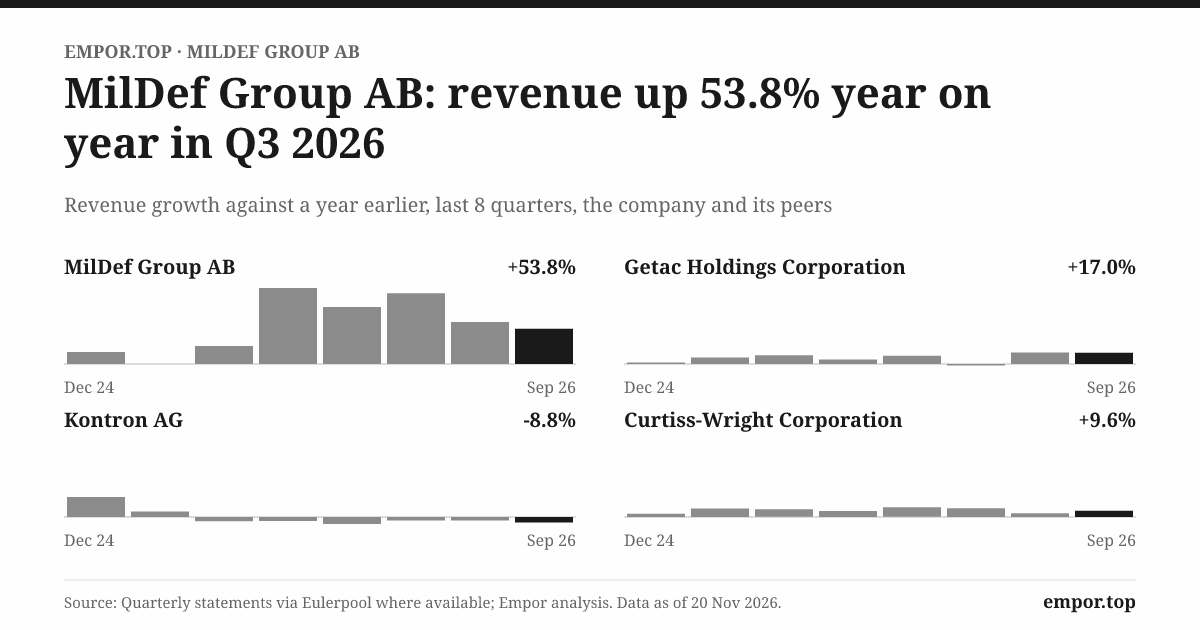
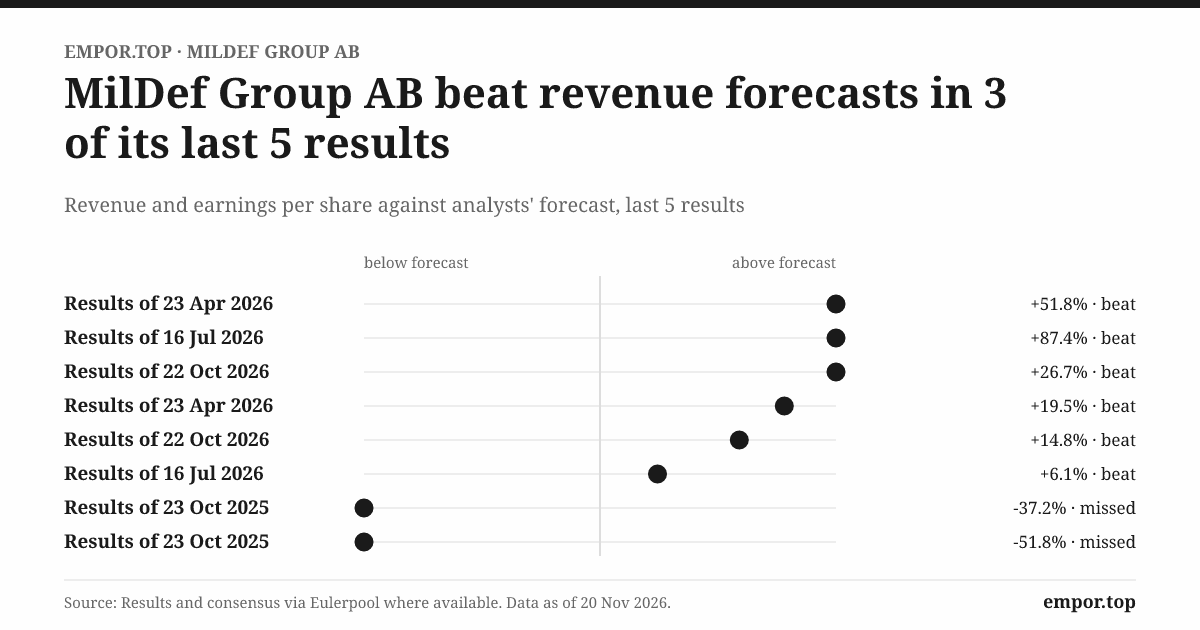
On the morning of October 22, 2026, Daniel Ljunggren had the kind of quarter most chief executives wait a career for. MilDef, the Swedish maker of rugged computers, displays and tactical IT systems for armed forces, had just booked the biggest three months in its history on almost every line that a growth investor watches. Sales came in at SEK 829 million, up 54% from a year earlier, and none of that growth came from acquisitions.1 Order intake more than doubled, rising 130% to about SEK 2.1 billion, the first time the company had ever taken in more than two billion kronor of orders in one quarter.12 The order backlog, the stack of signed work still waiting to be built and shipped, reached SEK 5.65 billion, 61% higher than twelve months before.1
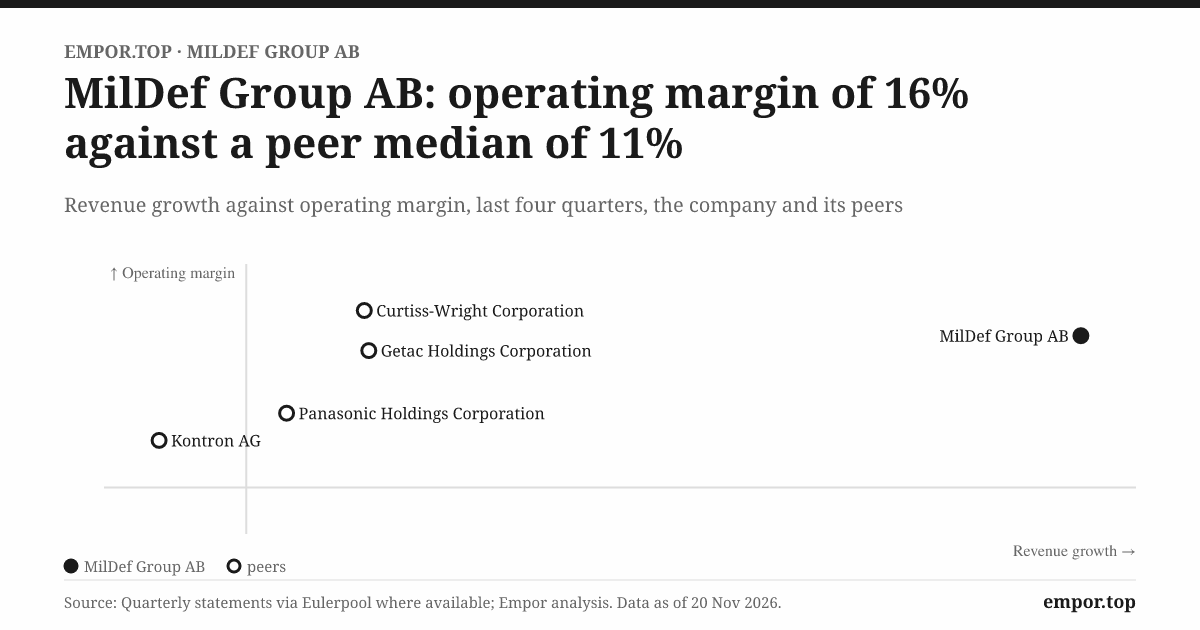
Margins told the same story. Adjusted EBITA, the profit measure MilDef uses before acquisition-related amortization and one-off items, reached SEK 180.5 million, a margin of 21.8% against 15.7% a year earlier.2 For a company that had spent much of its life earning single-digit operating margins, that is a different animal. The board's own long-term target is 15%; the business was running well above it for the first nine months of 2026, at 18.5%.1
The growth came from the places MilDef has spent a decade trying to build. Ljunggren said the quarter was driven mainly by the Nordic home markets and by Germany, and over the trailing twelve months sales had risen about 76% to roughly SEK 2 billion.2 Johnsson added a detail that mattered even more to anyone trying to value the company: about SEK 3.3 billion of the backlog was already booked for delivery in 2027.2 A company that had sold barely SEK 1.2 billion in all of 2024 already had nearly three times that much work lined up for a year that had not yet begun.3 For a business whose revenue used to depend on which quarter a handful of contracts happened to ship, that kind of forward visibility is new.
And yet, buried a few pages into the same report, was a number pointing the other way. Free cash flow for the quarter was negative SEK 112 million.1 In the best quarter MilDef had ever had, more cash left the company than came in. Chief financial officer Viveca Johnsson explained it plainly on the call: the company was building inventory ahead of fourth-quarter deliveries, and the record sales of the third quarter had become receivables, money customers owed but had not yet paid.2
That contrast is the story of MilDef in miniature. Demand is not the question. European rearmament, Russia's war on Ukraine and the push to digitize armies have turned a once-sleepy niche of military procurement into one of the fastest-growing corners of the defense market. The question is what that demand turns into. A soldier's computer has to survive mud, cold and vibration. A defense supplier's business model has to survive something less dramatic but just as unforgiving: customers who set their own calendars, components that arrive late, and working capital that has to be funded long before any cash comes back.
Three questions run through what follows. The first is whether MilDef's growth is truly organic and repeatable, or whether the headline growth rate of the last five years was mostly the arithmetic of buying other companies. The second is whether MilDef's long relationships with defense buyers amount to real competitive power, the ability to win work and hold price, or simply to a seat in a fast-rising market where many suppliers are doing well. The third is whether the growth earns attractive returns once inventory, receivables, factory expansion and the cost of acquisitions are counted.
A boundary is worth drawing at the start. MilDef Group AB, listed on Nasdaq Stockholm, is the Swedish parent company; the operating businesses in Sweden, Norway, Denmark, the UK, the US and, since 2025, Germany and Austria sit beneath it.4 Every figure in this story describes that consolidated listed group. There is no larger parent above it whose economics need to be separated out, and no shareholder holds a controlling stake.4
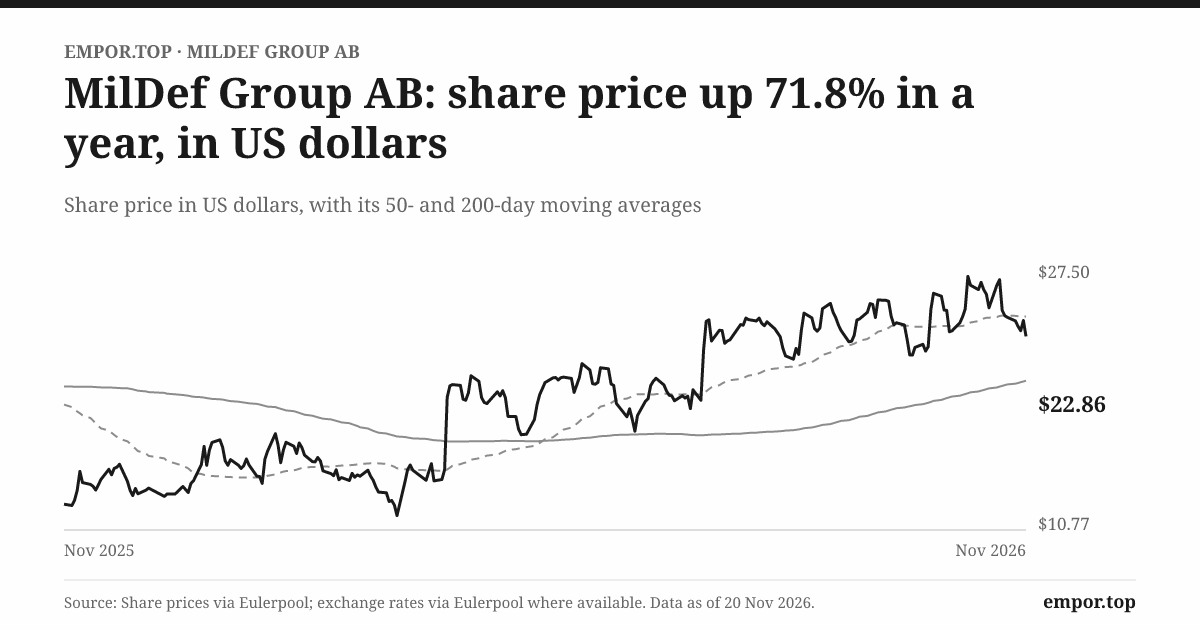
The market has already made up part of its mind. At about SEK 234 a share on November 20, 2026, MilDef was worth roughly SEK 11.4 billion, and the share price had more than doubled from its low of the previous twelve months.5 The price assumes that the record order book will be converted into deliveries, profit and, eventually, cash. To judge whether that is reasonable, it helps to begin where MilDef began: as a small Swedish company reselling someone else's computers.
 Subscribe on LinkedIn
II. The First Customer Was Also the Supplier
In 1997, in Helsingborg on Sweden's southwest coast, two founders, Tomas Odelid and Marianne Trolle, started a small company called Login.67 It did not invent a rugged computer. It sold one. Login's product came from Crete Systems, a Taiwanese manufacturer of hardened laptops and computers built to survive environments that would kill an ordinary office machine.6 The founders' bet was that Nordic military and industrial buyers needed someone close to them who understood their requirements, could adapt the equipment and would still be there when it broke.
The bet found its anchor customer quickly. In 1998, Login began working with FMV, the Swedish Defence Materiel Administration, the agency that buys equipment for the Swedish Armed Forces.6 For a company of Login's size, that relationship was everything at once: revenue, credibility and a schooling in how a defense procurement agency thinks. Defense buyers do not purchase a laptop the way a company buys a fleet of office PCs. They specify, test, qualify and then expect the product to be supported for many years. A supplier that survives that process once has learned something that is hard to teach.
For about a decade, Login's identity was essentially that of a specialist distributor with engineering skills. The turning point came in 2007, when the company launched its own product concept, known as 19-inch/2.7 The name refers to a standard: military vehicles and shelters often mount electronics in 19-inch racks, and MilDef's idea was to design computers and displays to half that width, so they could be fitted flexibly into the tight spaces of armored vehicles, command posts and ships. It was a modest-sounding idea with large consequences. A company that designs to a mechanical standard used by vehicle integrators becomes part of the vehicle's design, not just a box bolted on later.
In 2011, the company took the name MilDef, and in the same year it bought Terralogic in the UK, its first foothold outside the Nordics.7 In 2016, it bought AMREL, a US maker of rugged computers, giving it a presence in the world's largest defense market.7 Then, in 2020, systems integration became one of its main offerings: instead of only supplying hardware, MilDef would take responsibility for making a customer's network of computers, displays, radios and software work together.7 The reseller had become a product company, and the product company was trying to become a systems company.
That evolution built something genuine. MilDef accumulated years of experience inside the specification and qualification routines of defense customers, and engineers who understood what it takes to make electronics survive a tracked vehicle crossing frozen ground. But the origin story also left an inheritance that the listed company still carries: the Crete relationship never went away.
By 2020, products from the Taiwanese partner, by then operating as MilDef Crete, still represented about half of MilDef's sales.8 Crete was also MilDef's largest shareholder, holding 28.97% before the 2021 stock market listing.8 The 2021 prospectus described an exclusive distribution agreement running to April 2026, which would automatically extend for five more years unless cancelled.8 In other words, the first supplier was also the company's most important owner and the source of half its product revenue.
Five years later, the ownership has largely unwound. Crete's stake fell to 6.40% in 2024 and to 3.24% at the end of 2025.49 The supply relationship has not unwound nearly as far. In 2025, MilDef bought SEK 307.8 million of goods from MilDef Crete, about 27% of its cost of goods sold and the equivalent of about 15% of group revenue.4 It sold Crete only SEK 0.5 million of goods and services in return, and the annual accounts describe no other related-party transactions.4
That is a material dependency, and it has two faces. On one side, a long partnership with a capable Taiwanese manufacturer gives MilDef access to a mature product line and engineering base it did not have to build. On the other, more than a quarter of what MilDef pays for its goods flows to a single supplier located across the Taiwan Strait from the People's Republic of China, at a moment when defense buyers increasingly ask where every component in their supply chain comes from. The prospectus said management considered the historical transactions to be on commercial terms.8 The 2025 accounts do not state the pricing terms, and MilDef has not published whether the exclusive agreement was extended in April 2026, renegotiated or replaced, nor what alternate-source arrangements exist if Taiwanese production were disrupted.4
So the founding scene leaves an unresolved question for today's investor. The relationship that gave Login its first product is still large enough that its terms affect MilDef's gross margin and its continuity of supply. As Crete has stepped back as an owner, the interests of supplier and shareholder are no longer as tightly bound as they once were. Whether that makes the relationship more ordinary and arm's-length, or simply leaves MilDef with less leverage over a key supplier, is something the company's disclosure does not settle. What it does settle is that MilDef did not grow up as a self-sufficient manufacturer, and to understand why customers buy from it anyway, it helps to look at what exactly it sells.
III. Why a Military Computer Is More Than a Tough Laptop
Picture the inside of an armored personnel carrier. The commander has a screen showing a digital map with the positions of friendly and hostile units. The driver has another screen. A radio links the vehicle to a command post, and a computer somewhere in the hull runs the battle management software that ties it all together. The vehicle vibrates constantly; its temperature swings from Arctic cold to engine-bay heat, and its power supply is far less clean than the outlet in an office. If any piece of that chain fails, the crew goes blind.
That chain of screens, computers, networking and software is what the military calls tactical IT, and it is the business MilDef is in. The phrase "battlefield's digital nervous system" is not just marketing poetry. Modern armies are trying to share data between sensors, vehicles, soldiers and headquarters in real time, and every node in that network needs hardware that will not fail when it is shaken, soaked or frozen. MilDef's revenue in 2025 was SEK 2.05 billion, and its two largest markets were Germany, at about SEK 608 million, and Sweden, at about SEK 579 million.4 Germany's position at the top reflects the roda acquisition that this story will turn to shortly; Sweden reflects the old home base.
It is tempting to think of a rugged computer as an ordinary laptop with a thicker case. The reality has three layers, and each one makes it harder for a general computer maker to compete. The first is the hardware itself, designed to meet military environmental and electromagnetic standards so that it survives shock, dust, water and temperature extremes, and does not leak radio signals that could betray a unit's position. The second is integration: the computer has to fit the physical space of a particular vehicle or shelter, connect to the customer's existing radios and command systems, and be certified as part of that platform. The third is lifecycle support. A vehicle program can run for decades, and the customer expects spare parts, repairs and upgrades long after the consumer electronics world has moved on.
The way MilDef records revenue reflects that mix. Hardware and software orders generally have a fixed price and are recognized when control passes to the customer, usually at delivery; some integration and system projects are recognized over time as work progresses.4 This matters for how the business should be understood. MilDef is not a subscription company. It does not publish what share of its revenue is recurring, how long its contracts run, or whether customers commit to minimum volumes.4 Framework agreements, like the large German contract discussed later, give customers the right to order, not the obligation. So when a quarter is lumpy, that is not a malfunction of the model; it is the model.
The competitive field is fragmented and awkward to map. MilDef does not publish a peer list or market-share figures in its filings. At one end are rugged-device makers such as Taiwan's Getac and Panasonic's Toughbook line, which sell hardened laptops and tablets to police, utilities and militaries at large scale. At the other are defense electronics and systems suppliers such as Curtiss-Wright and Leonardo DRS, which build mission computers and vehicle electronics as part of far larger portfolios. Both groups are much bigger and more diversified than MilDef, so their scale is not a like-for-like comparison. MilDef's position is in the middle: more specialized and more integration-heavy than the rugged-laptop makers, smaller and more nimble than the defense primes.
Now run the business through the forces that shape its profits. The buyers are powerful. Governments and defense prime contractors write the specifications, control the timing and often deliberately keep more than one qualified supplier. In 2025, two customers each accounted for more than 10% of MilDef's revenue, buying about SEK 258 million and SEK 236 million respectively, and MilDef does not name them.4 A year earlier, only one customer crossed that threshold.4 Concentration of that size means a single program delay or re-tender can move the group's results, as the next chapter of this story would show.
Suppliers have power too, and not only Crete. Electronic components are a seller's market again. On the October 2026 call, Ljunggren described ongoing challenges in electronic components "both in terms of lead times and also price levels."2 Substitutes are limited at the high end, because a consumer tablet cannot be qualified for an armored vehicle, but they are real at the lower end, where commercial rugged devices can often do the job. New entrants face a slow, expensive qualification path, which protects incumbents, but large defense groups can enter adjacent segments whenever they choose.
What, then, might make MilDef win? The plausible advantages are specialist engineering, a long record of passing defense qualification, physical proximity to Nordic and now German customers, and the ability to integrate across platforms rather than sell a single box. Its 19-inch/2 concept embeds it in vehicle design. Its software and services businesses add a layer of integration that a pure hardware vendor cannot offer. And once a product is qualified on a platform, a customer has reasons, such as retraining, re-certification and spare-part logistics, to stay with it for the life of that platform.
The evidence limit is just as important. MilDef does not disclose customer retention, win rates against competitors, or the price it realizes on renewals. Those are the measures that would turn plausible advantages into a proven moat. Without them, the honest verdict is that MilDef competes on purpose-built hardware, integration and lifecycle support in a niche where relationships and delivery record matter, but where buyers retain strong bargaining power and the company has not shown the software-style lock-in that would justify calling its position protected. On the Q3 2026 call, Ljunggren said the company wanted to grow software but that its share was not currently rising because hardware demand was so strong.2 That is a reminder that, for now, MilDef's fortunes ride on equipment.
The tailwind is real. European rearmament and the digitization of land forces are pushing up demand for exactly the kind of equipment MilDef makes. But broad defense budgets do not guarantee the timing, margin or award of any particular MilDef contract. To capture that tailwind at scale, MilDef needed more reach than a Nordic specialist could build alone, and its answer was the public market.
IV. The Listing Made Acquisition a Growth Engine
In 2021, MilDef Group AB listed on Nasdaq Stockholm.87 The prospectus that accompanied the offering presented a company with SEK 398.5 million of sales in 2020, a relatively small customer base and a heavy reliance on products from its Taiwanese partner.8 It also presented a strategy: expand internationally, move up from hardware to systems, software and services, increase the share of long-term contracts and framework agreements, and use acquisitions to get there faster.8 Public capital and a listed share were the tools that would make the strategy affordable.
The record since then is one of rapid expansion. Revenue rose from about SEK 470 million in 2021 to SEK 2.05 billion in 2025, more than a fourfold increase in four years.4 Measured from 2020, revenue grew at a compound rate of almost 39% a year over five years.4 On a slide, it looks like a defense technology rocket ship. Look closer and the rocket has two engines, one organic and one bought.
The acquisitions came in a steady sequence. In 2021, the year of the listing, MilDef bought Sysint in Norway, adding software and services, and Defcon in Sweden.67 In 2022, it bought Handheld, a Swedish maker of rugged handheld computers and tablets, which brought a broader civilian and industrial customer base.6 In 2024, it added the smaller AVT assets.4 Each deal had a logic: more capabilities, more countries, more channels into customers.
Not all of them worked as planned, and the clearest test of MilDef's acquisition record is the fate of Handheld. In its year-end report for 2024, published in February 2025, MilDef announced that Handheld would cease operations, with its defense-relevant products folded into the rest of MilDef and its other sales segments wound down.3 The company booked a restructuring charge of SEK 310 million in the fourth quarter of 2024.3 Ljunggren explained the decision directly: after agreeing to buy roda, "it became clear to us that MilDef needs to prioritize being an important actor in the defense capacity build-up."3 That charge is why MilDef reported a large operating loss for 2024 despite adjusted EBITA rising to about SEK 150 million.3
It is worth pausing on what that write-off means. The Handheld acquisition, made two years earlier, was a bet on diversifying beyond defense into rugged devices for industry, logistics and other civilian markets. When defense demand exploded, MilDef decided the diversification was a distraction and largely shut it down. That can be read as decisiveness, a willingness to cut losses rather than defend a past decision. It can also be read as evidence that the 2022 thesis was wrong, and that MilDef's acquisition judgment, at least once, failed to survive contact with changing markets. Both readings are fair. Neither supports describing the company's capital allocation as flawless.
The timing also matters. 2024 was the year the underlying business stalled. Sales rose only about 4%, to roughly SEK 1.2 billion, even as order intake jumped 49% and the backlog swelled by more than half to about SEK 2.1 billion.3 Customers were committing, but deliveries were not keeping pace. Into that gap MilDef placed its largest bet ever, buying a company that would add more revenue in a single year than the whole group had produced as recently as 2022.43 Seen that way, roda was both a strategic move into Germany and a way to change the shape of the income statement at a moment when organic delivery was lagging orders. Neither motive is illegitimate. But investors who read 2025's growth rate as a sign of a business hitting its stride were partly reading the consolidation of someone else's sales.
The deal that would define the listed company, though, came next. On November 13, 2024, MilDef announced an agreement to buy roda computer GmbH, a German supplier of rugged IT to the military and other demanding customers.10 The company called it transformative, and in scale it was. roda gave MilDef a major channel into Central Europe and a stronger position in Germany, the country whose rearmament after 2022 had become one of the largest defense spending stories on the continent.1011
The price had three parts: EUR 70 million in cash, 1,374,047 newly issued MilDef shares handed to the sellers, and up to EUR 4 million of contingent consideration.10 On roda's 2023 earnings, MilDef said the initial enterprise value was about eight times EBITDA; by completion, roda's stronger 2024 results brought the multiple down to roughly six times.1112 The deal closed in March 2025.12
Was that cheap? It is tempting to say so, because six to eight times EBITDA looks modest next to the multiples at which listed defense companies trade. But the comparison is loose. A reliable set of comparable private transactions for German rugged-IT suppliers is not public, and the lower completion multiple partly reflects the fact that roda's earnings rose in a year when the whole sector was booming. The honest verdict is that MilDef did not obviously overpay for roda's earnings at the time, but whether those earnings were peak or sustainable is a question only post-deal results can answer.
The financing of the deal shaped the company that emerged. In late 2024 MilDef raised SEK 500 million before costs through a directed issue of about 5.4 million new shares, and bank debt funded the rest of the cash portion.3 The sellers' shares added to the dilution. Share count rose 12.5% in 2024 alone, and by the end of 2025 there were 47.11 million shares outstanding.49 Net debt rose as well. Each existing shareholder owned a smaller slice of a larger company, and whether that trade was worth it depends on what the larger company earns per share over time.
The impact on reported growth was immediate. In 2025, MilDef's sales rose 70%, but roda contributed SEK 768 million of that increase, leaving organic growth at just 6%.4 In other words, in the year investors celebrated as a breakout, almost the whole growth rate came from consolidating a German company. The underlying Nordic and international business had grown modestly, and in one quarter had actually gone backwards.
The UK acquisition of Westek Technology in 2025 added rugged IT capability and reach in Britain.7 It matters strategically for a market where MilDef had been present since Terralogic, but the company has not disclosed figures that would make it a separate thesis. roda is the acquisition that matters.
So the listing did turn MilDef into a consolidator, and the consolidation broadened its reach. But headline growth has at times overstated organic progress, and the record includes at least one acquisition largely written off within three years. The best test of what MilDef really is would come not in a year of big deals but in a quarter when its own deliveries went wrong.
V. The Quarter When the Delivery Calendar Slipped
In July 2025, a few months after completing the roda deal, MilDef published a second-quarter report that its chief executive described as a disappointment.13 The problem was simple to state and painful to read. Major deliveries that had been planned for the second quarter had slipped into the third. Organic sales, the business excluding roda, fell 36% compared with a year earlier.13 Reported sales still rose 27%, to about SEK 383 million, but only because roda was now in the numbers.14
The irony was hard to miss. In the same quarter, order intake grew 116%, and the backlog reached a record of about SEK 3.2 billion.1314 Customers were placing more orders than ever; MilDef simply had not shipped what it had promised to ship that quarter. For a stock priced on growth, a sharp organic decline was the kind of headline that makes momentum investors sell first and read later.
What had gone wrong? The interim report pointed to two sizable deliveries that moved because of technical issues in integration and late changes in final assembly.13 On the call, Ljunggren was emphatic about what the problem was not. "It's nothing about component issues," he said. "It's nothing about our general lack of capacity in deliveries."14 The products had to connect with other systems, and "the whole chain needs some extra time to make sure that everything will work as expected."14 He described the shift as "quite undramatic," agreed with the customer and the end user, and kept the full-year outlook unchanged.14
This is exactly the risk that the integration business model carries. When MilDef sells a box, the box ships when it is built. When MilDef takes responsibility for making its equipment work inside a customer's system, the delivery depends on everyone else's equipment working too. The deeper the integration, the stronger the customer relationship can become, but the less control MilDef has over its own delivery calendar.
The analyst Q&A added texture. When Hugo Lisjö of DNB Carnegie asked about the risks to deliveries, Ljunggren said he was "quite comfortable" with capacity and people, and named one recurring source of past postponements: "technical challenges in the R&D department."14 That was candid, and it was also revealing. It suggested that delivery slips were not a one-time accident but a known pattern linked to engineering work on new or customized products. What the call did not describe was a specific new control, a quality gate or a change in project management to prevent the next slip. Management explained the cause; it did not lay out a remedy beyond confidence.
The call also showed the financial pressure the miss created. Net debt stood at 2.9 times EBITDA, above the company's long-term ceiling of 2.5 times, partly because roda had just been bought with borrowed money and partly because the delayed deliveries meant the earnings had not yet arrived.14 Free cash flow in the quarter was nonetheless positive at about SEK 33 million.14 Ljunggren said about SEK 1.5 billion of the backlog was scheduled for delivery in the second half of 2025.14
One number from that call deserves a second look, because it cuts against the gloom. Excluding the acquisition, MilDef's gross margin in the quarter was almost 58%, a record, while group gross margin was about 47% because roda's products earned considerably less.14 When Lisjö asked whether that was the new level, Ljunggren pushed back on his own good news: 58% was "not the new normal," he said, though the underlying business was moving toward something above 50%.14 That small exchange says a lot about how this management talks. In the middle of a disappointing quarter, the chief executive volunteered that his best number was flattered by product mix rather than letting it stand as a trend. Investors who later saw the group's margins jump in 2026 had at least been warned which parts of the business earn the most, and which dilute the average.
Then came the test of the explanation. In the third quarter of 2025, sales rose 116% from a year earlier, and order intake kept climbing.1516 The deliveries that had slipped appeared to have shipped, as management had said they would. The orders had moved, not disappeared. On that narrow point, management's account held up.
But the full year carried a sting in the tail. Even with the third-quarter rebound and a strong fourth quarter, MilDef finished 2025 with organic growth of only 6% and negative operating cash flow.4 The second-quarter slip had not destroyed demand, but it had shown how a single pair of delayed projects could swing a quarter's organic growth from positive to sharply negative, and how much working capital MilDef had to carry while waiting for customers to accept its systems.
A year later, the risk had changed shape rather than gone away. On the Q3 2026 call, Ljunggren said MilDef was buying and stocking critical parts, signing supplier agreements and talking with customers about who would absorb price increases.2 He said those increases are handled either by building them into quotes or through open-book clauses, and added that he was "more afraid of the access to the components" than of price.2 That is a real mechanism. Buying components early protects deliveries but ties up cash; failing to buy early protects cash but risks another slipped quarter.
Asked whether MilDef could guarantee the roughly SEK 923 million of deliveries scheduled for the fourth quarter of 2026, Ljunggren declined to guarantee it but called capacity "quite comfortable."2 That answer was consistent with July 2025: confident about demand and capacity, careful not to promise timing. The credibility test going forward is therefore measurable. It lies in how much of the backlog converts to delivered revenue each quarter, what margin that delivered work earns, and whether any future misses come with specific explanations and corrective actions rather than reassurance. The slipped quarter of 2025 left investors with one more question, bigger than timing: once the deliveries happen, does the cash follow?
VI. Can the Backlog Become Cash?
Imagine a company that sells more, earns more and still finishes the year with less cash than it started. That was MilDef at the end of 2025. Sales had risen 70%, the business had swung from a reported loss to a profit, and the order book was at a record. Yet operating cash flow for the year was negative SEK 3 million.4 Every krona of profit, and then some, had been absorbed before it reached the bank.
Over the long run, the picture is less alarming. From 2018 through 2025, MilDef generated about SEK 144 million of cash from operations against SEK 83 million of cumulative net profit.48 On that measure, operating cash flow exceeded reported profit by a wide margin over eight years, partly because large non-cash charges such as the Handheld restructuring depressed profit without consuming cash. But the same eight years produced cumulative free cash flow, after capital spending, of slightly below zero, about negative SEK 3 million, while the company paid out about SEK 100 million in dividends.4 Over the whole period, the dividend was effectively funded by the balance sheet, not by surplus cash from operations.
That aggregate hides wild swings from year to year, and 2025 is the year to examine closely. Start with the cash the business generated before any change in working capital. After paying interest and taxes, it was already negative, at about minus SEK 57 million.4 That is partly the cost of carrying the roda debt: MilDef paid SEK 54 million of interest in 2025, against SEK 11 million of interest income.4 Then working capital consumed a further SEK 283 million. Inventory rose by about SEK 107 million and operating receivables by about SEK 170 million.4 In plain terms, MilDef bought components and built products for deliveries it had not yet made, and it delivered a lot of products in the fourth quarter that customers had not yet paid for.
The acquisition is a separate story and should be kept separate. The roda purchase added SEK 701 million of net cash outflow to investing activities in 2025.4 That was a one-time capital decision, funded by shares and debt. It tells investors about capital allocation, a question that deserves separate examination. It says nothing about whether the ongoing business converts profit into cash. Mixing the two would make the operating picture look worse than it is.
Receivables deserve precision rather than suspicion. At the end of 2025, trade receivables were about SEK 514 million, up from SEK 330 million a year earlier, broadly in line with the jump in fourth-quarter sales.4 About SEK 67 million was past due, most of it by less than a month, and only about SEK 5 million was more than 90 days overdue.4 MilDef recorded no credit losses in 2025 and judged that no impairment was needed.4 That is what one would expect when the customers are governments and defense contractors: they pay slowly, but they pay. The risk here is the timing of collection, not a hidden bad-debt problem that the company has failed to disclose.
The deeper structural point is how much capital MilDef's business model needs. Its receivables equaled about 117 days of sales in 2025, and its inventory about 173 days of cost of goods.4 Offset by what MilDef owes its own suppliers, the cash conversion cycle, the time between paying for components and collecting from customers, was about 234 days. That is roughly eight months during which MilDef has to fund each order. When sales are flat, that cycle is a fixed cost of doing business. When sales are growing quickly, it is a cash furnace, because every new krona of annual sales requires a fresh layer of inventory and receivables before any cash comes back.
The first half of 2026 suggested the furnace could cool. For the first nine months of the year, free cash flow recovered to a positive SEK 55 million, compared with negative SEK 93 million in the same period of 2025.1 Some of the 2025 working capital had unwound as deliveries were completed and customers paid. The third-quarter outflow reversed much of that improvement.12 Johnsson said working capital stood at about 31% of sales and would "go back to around the 30%" over time.2
There is a second, quieter drain below the operating line. MilDef's financial items for the first nine months of 2026 were a net cost of about SEK 44 million, and the company named two causes: less favorable currency revaluation and higher interest expense on the debt taken on for roda.1 Currency is a structural feature of this business rather than a passing irritation. In 2025, about 35% of MilDef's invoicing was in euros and the rest spread across Swedish, Norwegian, Danish and British currencies and the US dollar, while the company normally does not hedge its operating currency exposure, relying instead on currency clauses and on quoting in the currency of its own costs.4 MilDef estimated that a 10% move in the euro alone would shift earnings by about SEK 41 million.4 For a company whose customers pay months after delivery, that exposure lands on exactly the receivables that are already the slowest-moving part of the balance sheet.
So which story is true: the company whose long-term operating cash flow exceeds its profits, or the company whose growth keeps consuming cash? Both are true, and the gap between them is the key insight. MilDef's profit does eventually become cash, but with a lag of months, and the faster it grows, the longer the cash stays tied up. A defense supplier growing 50% a year cannot simultaneously expect to generate large free cash flow unless it can persuade customers to pay advances, which MilDef does not disclose doing at scale.
That makes three measures more important than any others. The first is free cash flow itself, over a full year rather than a quarter, because quarterly swings are dominated by delivery timing. The second is working capital as a share of sales, now about 31%, which tells investors whether growth is getting more or less capital-hungry.2 The third is backlog conversion, how much of the SEK 5.65 billion order book becomes delivered revenue on schedule, because that is what releases the cash already tied up in inventory.1 If MilDef delivers the roughly SEK 923 million it had scheduled for the fourth quarter of 2026, the inventory built in the third quarter should start to turn into receivables, and those receivables into cash in early 2027.2
The backlog, then, is a promise of work, not yet a promise of cash. And part of that backlog, increasingly, comes from the German business MilDef paid so much to acquire.
VII. Does roda Earn Its Place in the Story?
In 2026, the roda and Westek operations began trading under the MilDef name.1 Rebranding is a small act with large symbolic weight. It tells customers in Germany and the UK that they are now dealing with a single group, and it tells employees of the acquired businesses that their old identity is fading into the new one. It is also the moment when an acquisition stops being an acquisition and starts being simply part of the company, which makes its performance harder for outsiders to isolate.
The strategic rationale for roda was access to Central Europe and Germany, where the Bundeswehr was rebuilding after decades of underinvestment.1011 In 2025, roda made Germany MilDef's largest single market in its first year of ownership.4
The more important evidence came in 2026. In the third quarter, MilDef reported a seven-year framework agreement extension with BAAINBw, the German federal procurement agency, with a potential value of up to EUR 527 million.12 The first call-off under it was EUR 95.4 million.1 Ljunggren called it a "strong testament" to MilDef's role in the German defense ramp-up, and said "the lion part" of the deliveries would come in 2027.2
This is commercial proof, and it deserves to be weighed properly. A seven-year framework signals that the German buyer considers MilDef, through the former roda, a qualified and preferred supplier for a long period. It positions MilDef for repeated orders and makes it harder for a newcomer to displace it in that category. But the framework explicitly carries no guaranteed volume.1 The headline EUR 527 million is a ceiling, not a commitment. The buyer controls how much it calls off, when, and on what technical specification. That is the bargaining counterweight built into every defense framework: the supplier gets visibility; the customer keeps leverage. The first call-off of about EUR 95 million is the only part that is firm.
There is also a margin wrinkle. On the Q3 2026 call, Johnsson agreed with an analyst that strong sales from the old roda business weighed on gross margin, because roda's mobile product portfolio carries a lower margin than MilDef's legacy products.2 In the Q2 2025 call, Ljunggren had said roda's gross margin was around 35%, against an underlying MilDef gross margin of nearly 58% that quarter.14 So the faster roda grows, the more it can dilute group gross margin even as it lifts absolute profit. Johnsson said she expected the current geographic mix, and therefore gross margin, to stay near current levels.2 That is a reasonable expectation, but it also means investors should not expect roda's growth to push group margins higher by itself.
The people side of the integration shows up in the headcount. MilDef ended 2024 with 327 employees and 2025 with 479, an increase of almost half in a year when revenue rose 70%.4 Most of that jump was roda and Westek arriving rather than new hiring, which is why the ratio of revenue per employee says little about productivity across the deal. What it does show is the scale of what MilDef took on: in one year, roughly a third of its workforce came from companies with different systems, cultures and customers. Rebranding them as MilDef in 2026 was the visible step. Harmonizing their product lines, purchasing and engineering is the invisible one, and its payoff will only show up over time in margins and cash.
The capital structure is where roda's cost shows most clearly. At the end of 2025, MilDef had about SEK 550 million of interest-bearing liabilities, plus about SEK 223 million of lease liabilities, against cash of about SEK 149 million.4 Management reported net debt including leases at 2.0 times adjusted EBITDA, below its ceiling of 2.5 times, a significant improvement from the 2.9 times it had reported in the middle of 2025.414 The bank debt carries variable rates that reset every one to three months, so a one-percentage-point rise in rates would cut annual earnings by about SEK 4 million.4 That sensitivity is modest relative to current profits. In the third quarter of 2026, MilDef replaced its existing facility with a new one from SEB and reported borrowing headroom of about SEK 509 million, including an unused revolving facility of SEK 120 million.1
The refinancing removes the near-term liquidity question. It does not remove the underlying point: roda was bought partly with borrowed money and partly with new shares, and both have a cost. The debt costs interest; the shares cost every existing shareholder a share of future profits.
Then the skeptical investor's question. If roda is truly strengthening MilDef's competitive position, where should that show up? Not only in sales and backlog, which an acquisition mechanically adds, but in returns. Return on invested capital, operating profit after tax divided by the equity and net debt in the business, was about 8% for 2025 as a whole and about 16% over the twelve months to September 2026.41 That improvement is real and significant. It suggests that the combined company is now earning a return comfortably above any reasonable estimate of its cost of capital. But it is also measured over a period of exceptional demand, and it reflects one strong year rather than a cycle.
So roda's verdict is a qualified one. The strategic case was specific and the German framework provides genuine commercial evidence. The return case is improving but unfinished. What will settle it is whether the former roda business keeps growing organically after the post-acquisition boost has passed, whether it earns margins and generates cash on its own, and whether the returns on the combined capital base hold up when defense demand eventually normalizes. Those outcomes depend on execution, which brings this story to the people responsible for it.
VIII. The CEO's Growth Promise Meets the Delivery Record
Daniel Ljunggren is not a showman on earnings calls. Listen to him explain a bad quarter and the striking feature is understatement. A pair of slipped deliveries is "quite undramatic." Net debt is on track. Asked to guarantee deliveries, he points to capacity instead. When the news is good, the language warms only a little: record orders are a "strong testament," and he said most deliveries under a German contract would come next year.214 It is the voice of an engineer-manager who has learned that defense customers punish overpromising more than they reward ambition.
He leads a small, long-serving team. Viveca Johnsson is chief financial officer, and the board is chaired by Björn Karlsson, the former chief executive, who moved to the chair in 2023.4 The board considers all its members except Karlsson independent of the company and management, and all of them independent of major shareholders.4 Six other senior executives sit alongside Ljunggren in group management, responsible for operations, sales regions and the integration of acquired businesses.4
The evidence on Ljunggren's credibility comes from comparing what he said with what happened. The July 2025 delivery slip played out as he said it would.1415 He explained the cause in specific terms, integration testing and R&D technical challenges, and did not blame customers or suppliers.14 That is a good record on candor. On prevention, the record is thinner: the company did not describe concrete process changes to stop the next slip, and in 2026 the risk simply shifted from integration to components.2
The way management talks about costs is another consistency check, because a company in a demand boom is tempted to let overhead run. In July 2025, Ljunggren said operating expenses outside the acquired business had been flat year on year but would rise as capacity was added.14 Fifteen months later, they had risen, by 21% in the third quarter of 2026, but far more slowly than sales.2 Johnsson's guidance for the longer run was that operating expenses should grow roughly in line with sales from here.2 Read carefully, that is a modest promise: it implies that the big jump in operating leverage of the past year will not repeat indefinitely, and that future margin gains have to come from mix and gross margin rather than from overhead shrinking as a share of revenue. That is a more conservative message than a growth story usually carries, and it is the kind of statement investors can hold management to.
Ljunggren has been similarly measured about seasonality and the order pipeline. On the October 2026 call he said MilDef "could flatten out the seasonality a little bit in 2027" as the large German and Nordic orders deliver, but he also told analysts that order volatility would stay high and that visibility on 2028 orders would only improve during late 2026 and 2027.2 A management team eager to talk up its stock would lean on the record backlog and stop there. This one keeps reminding listeners that its quarters will remain uneven.
The larger test is strategic. Ljunggren's growth plan, broadening from Nordic hardware into international systems, software and services, has been consistent across years of filings. But the plan has also included Handheld, largely shut down within three years at a cost of SEK 310 million.3 And in 2025, the year roda arrived, organic growth was just 6%.4 The acceleration to 54% organic growth in the first nine months of 2026 is impressive.1 It is also only a few quarters old, and it coincides with the strongest defense procurement environment in Europe in a generation. It would be premature to call it durable.
How management is paid shapes what it chases. In 2025, executives' variable pay was linked to sales and EBITA, capped at half of fixed salary.4 Ljunggren's total pay that year was about SEK 3.3 million, of which variable pay was only about SEK 0.3 million.4 That is modest by international standards, but its design matters more than its size. A bonus tied to sales and EBITA rewards growth and profit, not cash conversion or return on capital. For a company whose central challenge is turning profit into cash, that is a gap.
The new long-term incentive plan approved for 2026 to 2029 partly closes it. It is cash-based, not dilutive, and links rewards to earnings per share, a sustainability rating and total shareholder return relative to peers, with a maximum cost of about SEK 21 million including social charges.417 Earnings per share is a better measure than sales because it penalizes dilution: if MilDef issues shares to fund acquisitions, EPS must rise despite the extra shares. But the plan still contains no direct cash-flow or working-capital metric. Investors should read the targets for what they are, statements of what the board wants, not evidence of what management will achieve.
Ownership provides a second form of alignment. Ljunggren held 2.12% of MilDef at the end of 2025, down from 3.50% a year earlier.49 At the current market value, that stake is worth more than SEK 200 million, a meaningful personal exposure to the share price. The reduction from 2024 is not explained in the annual report, and part of it may reflect dilution from new shares rather than sales. Either way, he remains a significant individual owner. The largest shareholder is now Swedbank Robur's funds, at 9.48%, and the ten largest shareholders together hold just over a third of the company, among more than 44,000 shareholders in total.4 Notably, Svolder, which held over 10% in 2024, had dropped out of the top ten by the end of 2025, while Swedbank Robur rose from about 2% to nearly 10%.49 The shareholder base has shifted from specialist small-cap holders toward large institutional funds as the company has grown.
At the 2026 annual general meeting, shareholders approved the remuneration report and elected two new directors.17 They also authorized the board to issue up to 10% of outstanding shares, including without pre-emption rights, for acquisitions or to strengthen capital.17 The company did not publish vote totals or dissent. That authorization is worth watching. It means further dilutive deals are possible without returning to shareholders for approval.
So has management earned confidence? It has earned credibility on candor and on demand forecasting. It has earned a share of the credit for the recent margin and growth acceleration. It has not yet earned confidence on cash discipline or on acquisition judgment across a full cycle, given Handheld and a year of negative operating cash flow. The record is simply too short. The judgment will rest on whether roda and the capacity expansion produce sustained returns and cash, not on how persuasively the strategy is described. That is the question the market is pricing today.
IX. Analysis & Bear vs. Bull Case
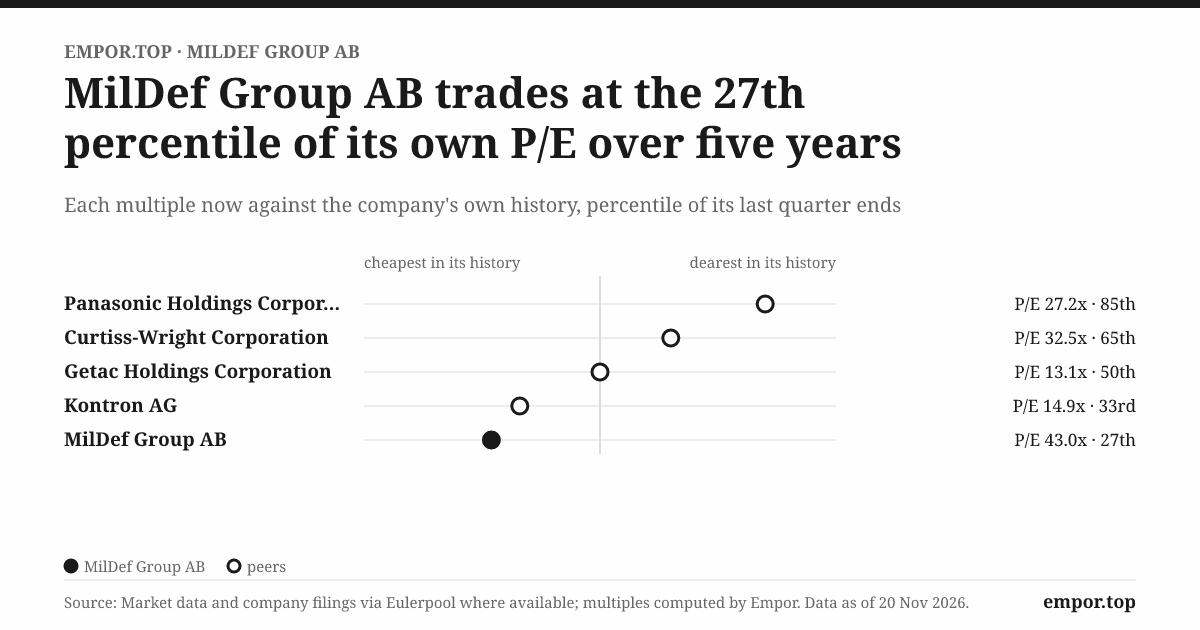
At SEK 233.70 on November 20, 2026, MilDef's shares stood about 11% below their 52-week high of SEK 262.90, but more than double their 52-week low.5 The company was worth about SEK 11.4 billion, and including net debt about SEK 12.0 billion. On the last twelve months of earnings, the shares traded at 43 times. That sounds expensive, and it is, but it is far below MilDef's own five-year median of about 74 times.51 Other measures tell a similar story: about 19.6 times EBITDA, about 25 times operating profit, and a free cash flow yield of just 1.6%.5
The falling multiple is not a sign that the market has lost faith. It is mostly a sign that earnings have caught up with the share price. MilDef's historical P/E was inflated by years of thin profits; when earnings per share jumped, the ratio fell even as the price rose. For context, Saab, Sweden's defense champion, traded at about 39.5 times trailing earnings in November 2026, and INVISIO, the Swedish maker of tactical communications headsets, at about 40 times expected 2026 earnings.1819 Those businesses are different in scale and model, so the comparison is a reference point, not a like-for-like valuation. It does show that MilDef is priced in line with the Swedish defense-technology group rather than at a discount for its smaller size or lumpier history.
What does that price assume? An earnings yield of about 2.3% and a free cash flow yield of 1.6% mean an investor today is accepting very little current return in exchange for growth. To justify the price, MilDef needs to keep growing earnings quickly for several years and then convert those earnings into cash. A prolonged slowdown, or a long period in which growth keeps consuming working capital, would leave little room.
The case for durable growth
The bull case begins with demand. European armies are rebuilding and digitizing simultaneously, and the equipment MilDef sells, rugged computers, displays and tactical networks, sits at the junction of both trends. In the first nine months of 2026, organic growth and backlog reached records, with substantial deliveries already booked for 2027.12 In the third quarter alone, MilDef signed a SEK 553 million hardware contract with a European NATO country, separate from the German framework, for delivery in 2027.2 Ljunggren also said MilDef is not dependent on any single large platform program.2 That combination, broad demand from several countries, a deep backlog and products already qualified with major buyers, gives MilDef more visibility than it has had at any point in its history.
The bull case then adds operating leverage. In the third quarter of 2026, operating expenses grew 21% while sales grew far faster, so opex fell from 33% to 26% of sales.2 That is the mechanism behind the margin expansion: MilDef's engineering, sales and administration costs do not need to scale one-for-one with revenue. If that continues, margins could remain above the 15% target even as gross margin is diluted by roda's lower-margin products.
The case for caution
The bear case begins with lumpiness. The second quarter of 2025 showed the delivery-timing risk.13 Component constraints add another source of timing risk.2 Customer concentration and dependence on Crete further limit MilDef's bargaining power.4 Cash conversion remains a constraint, as the long-run record shows.4
Porter's five forces point to an industry that can be unusually profitable during a procurement surge but structurally favors buyers.
Helmer's seven powers point to switching costs as MilDef's most credible source of advantage: qualification and re-certification can make replacing integrated equipment difficult over a platform's life.
Without disclosed retention rates, win rates or price realization, the switching-cost advantage remains plausible but unproven.
Four further tests complete the picture. The acquisition test asks whether roda delivers post-deal organic growth, integration benefits and cash returns; the German framework is encouraging but not yet decisive. The balance sheet is comfortable for now, with refinancing and headroom in place.14 But debt remains elevated, and variable rates and currency exposure leave it vulnerable to financing and exchange-rate moves.4 The capital-allocation test asks whether reinvestment earns its keep: R&D of SEK 112 million in 2025, a planned 7,600-square-meter expansion of the Rosersberg plant that will double its production area, and the roda outlay all need to show returns.124 And the valuation test is simply that today's price leaves little room for disappointment.
What would change the verdict? Three things, in order. The first is full-year 2026 organic growth and margins, which will show whether the acceleration holds through the strong fourth quarter MilDef has scheduled. The second is whether the backlog converts on schedule through 2027, especially the German framework call-offs. The third is whether full-year cash flow improves as deliveries are completed, bringing working capital back toward management's 30% of sales target.2 Those three measures, more than any defense budget headline, will decide whether MilDef is a durable specialist riding a long procurement cycle or a cyclical supplier priced for unusually smooth execution.
X. Playbook: Business & Investing Lessons
Go back to July 2025, to the quarter that disappointed. Integration delays pushed deliveries, revenue and profit to the right, while the cash tied up in those products stayed tied up. Nothing about that quarter was a disaster, and nothing about it was trivial. It is the cleanest single illustration of what it means to build a business around customers whose calendars are not your own.
The first lesson is that a backlog is a promise of work, not a promise of cash. MilDef's record order book sat beside negative free cash flow in the third quarter of 2026.1 Both numbers are true, and both describe the same success. For founders, the lesson is that growth in this business has to be funded before it is collected. For investors, it is that the most exciting number in a defense supplier's report, the order intake, is the one furthest from shareholder value. Somewhere between a signed order and a cash receipt lie engineering, components, integration, acceptance and collection, and each stage can stretch.
The second lesson is that the supplier you grew up with can become the risk you have to manage. Twenty-nine years after Login began as the Nordic face of a Taiwanese manufacturer, that manufacturer still supplies a material share of MilDef's goods, even as its ownership stake has shrunk.48 When a supplier is also a large owner, its interests and yours are bound together. When it steps back as an owner but stays as a supplier, you keep the dependency and lose some of the alignment. The broader lesson for any company built on a partner's product is to treat that relationship as a strategic asset to be renegotiated deliberately, not an inheritance to be assumed.
The third lesson is that an acquisition is a thesis until the acquired earnings turn into returns. Handheld was a diversification thesis that MilDef later abandoned.3 roda is a thesis about German access, with the framework agreement providing early evidence.1 But the proof of an acquisition is not the strategic logic on the day it is announced, nor even the contracts it brings. It is whether the money paid in cash, debt and new shares comes back as cash returns, after the first flush of consolidated growth has passed.
The fourth lesson is that in a long-cycle market, credibility is built in the bad quarter. Anyone can sound confident when orders are flowing. MilDef's management gained credibility in the July 2025 setback and recovery. It will keep or lose that credibility in the next bad quarter, which, in a business this lumpy, will come. The investor's job is not to predict when it comes but to judge, when it does, whether the explanation is as specific and the recovery as real as the last time.
XI. Epilogue
Tonight, MilDef stands at the high-water mark of its history. It has a backlog of about SEK 5.65 billion, a new financing facility, an expanded factory plan and the strongest margins it has ever reported.1 It also has an inventory buildup to deliver, receivables to collect, and electronic components that remain scarce and expensive.12 The next few months will show which of those facts dominates.
The first moment will come on February 4, 2027, when MilDef publishes its year-end report for 2026.2 That report will answer the questions investors most need answered. Did MilDef ship the roughly SEK 923 million of deliveries it had scheduled for the fourth quarter?2 Did organic growth for the full year stay near the 54% it reached in the first nine months?1 And above all, did the inventory and receivables built in the third quarter turn into cash, so that full-year free cash flow ends positive? A strong fourth quarter with healthy cash would support the argument that 2025's cash drain was the cost of a growth spurt, not a permanent feature. A strong quarter with weak cash would suggest that MilDef's growth keeps consuming its own profits.
The second set of moments will arrive through 2027 with the German framework. Ljunggren said the bulk of the first call-off would be delivered in 2027.2 Each additional call-off under the EUR 527 million ceiling will be a vote of confidence by the Bundeswehr in the roda acquisition; the absence of new call-offs would be a reminder that a framework's headline value is not revenue.1 Investors should track actual call-offs and deliveries, not the ceiling.
The third moment is physical. MilDef plans to open the next expansion of its Rosersberg facility in early 2028, adding 7,600 square meters and doubling its production area.12 Ljunggren tied the decision to a Swedish FMV framework agreement signed in June 2026, which he expects to generate call-offs.2 A factory expansion is a bet that demand will still be there when the doors open. If it is, MilDef will have the capacity to grow further without the kind of bottlenecks that slip deliveries. If procurement slows, it will have fixed costs to carry.
Through all of this, investors should watch a few things in the right way. Organic growth should be separated from acquired growth, because the latter can disguise a slowing core. Adjusted EBITA margin should be read alongside free cash flow, inventory and receivables, because a margin story without cash is only half a story. The 2027 delivery schedule, component lead times and the working capital they require will show whether MilDef can scale without stalling. And leverage and returns on capital will show whether the next acquisition, which the AGM's share authorization makes possible, is likely to strengthen or weaken the company.17
The central tension remains. MilDef has shown that it can win orders and grow profit. It has not yet shown, over a full year at this new scale, that it can turn that profit into cash at the pace the market's price implies.
XII. Outro
Return to the armored vehicle, where this story began. The commander's screen is still glowing, the map is still updating, and the radio link still holds, because a computer designed in Sweden and built to survive cold, shock and vibration is doing exactly what it was designed to do. That reliability is the whole of MilDef's promise to its customers. It is why defense buyers specify its products, why they sign seven-year frameworks, and why a reseller from Helsingborg became a company worth more than ten billion kronor.
But reliability in the field is only half of what MilDef has to prove. The other half is reliability on paper. The rugged computer is built to stand firm when everything around it is moving. The listed company still has to show that it can do the same when its customers' calendars move, its components run late and its growth outpaces its cash.14
References
-
Interim Report January–September 2026 — MilDef Group AB, 2026-10-22 ↩↩↩↩↩↩↩↩↩↩↩↩↩↩↩↩↩↩↩↩↩↩↩↩↩↩↩↩
-
MilDef Q3 2026 Earnings Call Transcript — Stock Analysis, 2026-10-22 ↩↩↩↩↩↩↩↩↩↩↩↩↩↩↩↩↩↩↩↩↩↩↩↩↩↩↩↩↩↩↩↩↩↩↩↩
-
Year-End Report January–December 2024 — MilDef Group AB, 2025-02-06 ↩↩↩↩↩↩↩↩↩↩
-
Annual and Sustainability Report 2025 — MilDef Group AB, 2026-04-15 ↩↩↩↩↩↩↩↩↩↩↩↩↩↩↩↩↩↩↩↩↩↩↩↩↩↩↩↩↩↩↩↩↩↩↩↩↩↩↩↩↩↩↩↩↩↩↩↩↩↩↩↩↩↩
-
Annual and Sustainability Report 2022 (MilDef History 1997–2022) — MilDef Group AB, 2023 ↩↩↩↩↩
-
MilDef Group AB Prospectus — MilDef Group AB, 2021-05-24 ↩↩↩↩↩↩↩↩↩
-
Annual and Sustainability Report 2024 — MilDef Group AB, 2025 ↩↩↩↩
-
MilDef Significantly Expands Its Presence in Central Europe — Enters into Agreement to Acquire roda — MilDef Group AB, 2024-11-13 ↩↩↩↩
-
Acquisition of roda Investor Call — MilDef Group AB, 2024-11-14 ↩↩↩
-
Interim Report Q1 January–March 2025 — MilDef Group AB, 2025 ↩↩
-
Interim Report January–June 2025 — MilDef Group AB, 2025-07-18 ↩↩↩↩↩
-
MilDef Q2 2025 Earnings Call Transcript — Stock Analysis, 2025-07-18 ↩↩↩↩↩↩↩↩↩↩↩↩↩↩↩↩↩
-
Year-End Report January–December 2025 — MilDef Group AB, 2026-02-05 ↩↩
-
Annual General Meeting of MilDef Group AB (publ) — MilDef Group AB, 2026-05-21 ↩↩↩↩
-
INVISIO Investment Case: US recovery lifts Q3 orders, margins lag behind — Inderes, 2026-11-10 ↩
 LinkedIn
 WhatsApp
 Reddit
 Hacker News
 Email
 Kindle
 RSS Feed
 Spotify
 Apple Podcasts
 Amazon Music
 Audible
 YouTube