Melexis: The Chips Inside the Car—and the Cycle Around Them
The quarter the design wins reached production
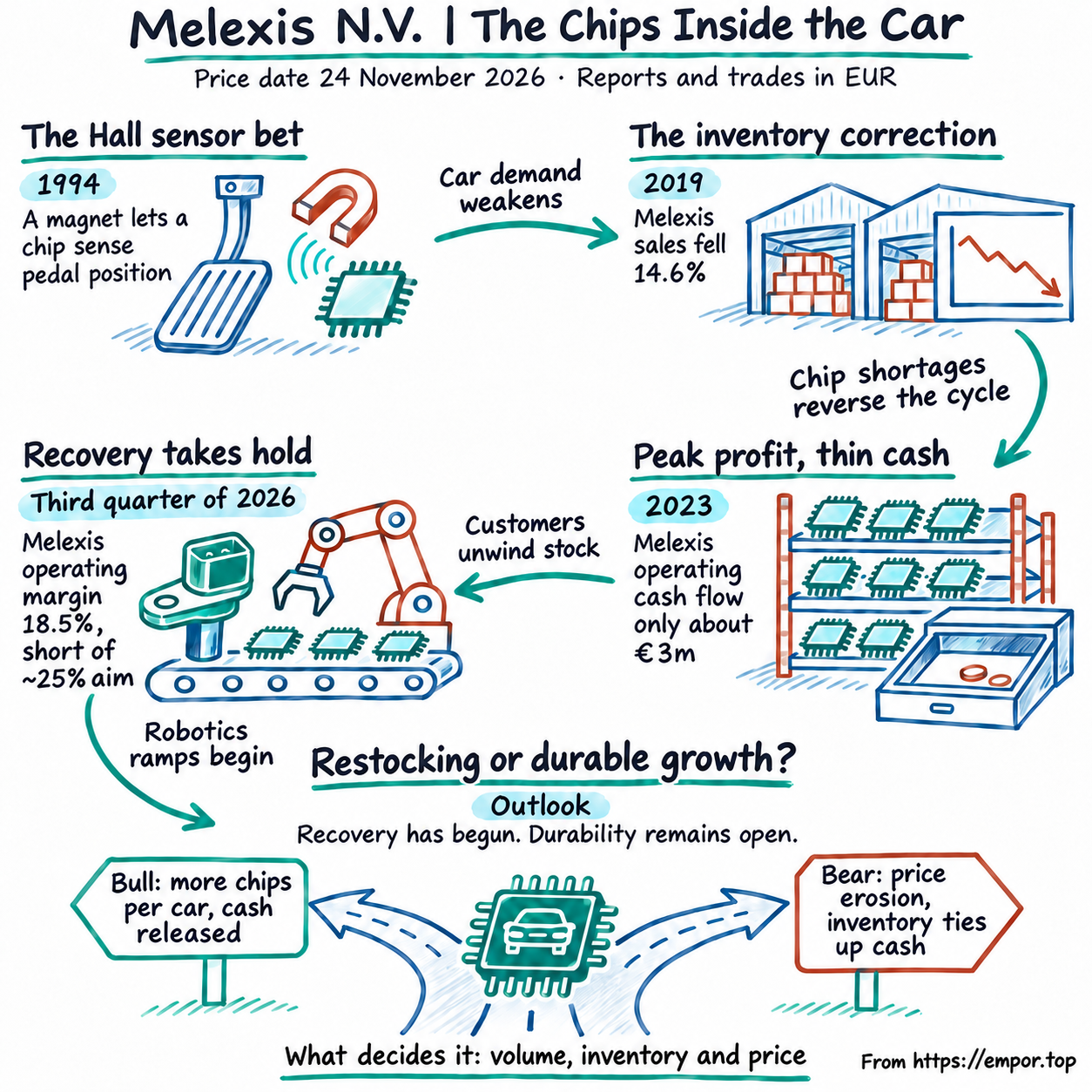
On the morning of 28 October 2026, Marc Biron had good news to share, and he had waited a long time to share it. The chief executive of Melexis, a Belgian chip company most drivers have never heard of, told analysts that something the company had been promising for a couple of years was finally happening. Its robotics design wins, the deals in which a robot maker picks a Melexis chip for a product it has not yet built, were "translating into active customer production volume," and those ramps came with "solid order already placed for 2027."1 In the same breath he reported that sales in China had hit a record that quarter, and that the order book pointed to more growth in the fourth.1
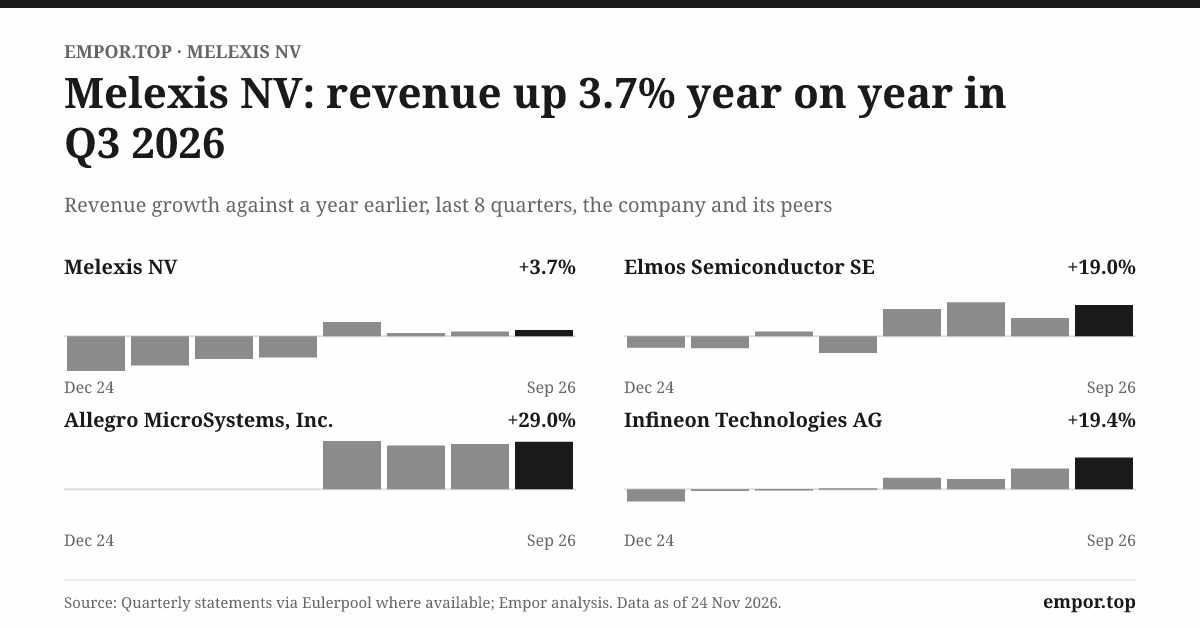
The headline numbers were modest. Third-quarter sales came to €223.7m, up 4% on a year earlier, and operating profit for the first nine months of 2026 was up 10%.21 In a booming chip stock, figures like that would get a polite nod. For Melexis they carried more weight, because of what came before them. In 2025 the company's sales fell 10% to €839.6m and its operating profit fell 39% to €134m.3 For a business that had spent most of its history earning operating margins in the mid-twenties, the slump was a real shock. Every quarter since then has been read for one thing: was the bottom in?
Q3 2026 offered the clearest answer yet that it was. It also raised a harder question. Is Melexis coming out of a cyclical slump with a growth engine that will last, or is it only bouncing back as car-parts makers restock shelves they had let run down? The two can look identical for a few quarters. A customer rebuilding inventory and a customer putting a new chip into a new car both place orders. Only one of them is still ordering two years later.
Melexis has faced that ambiguity before, and this story keeps coming back to it. The company sits deep inside the modern car. Its chips sense where a pedal is, how much current is flowing to a battery, how hot a motor is getting, and they drive the small motors that move vents, valves and headlights. It is a specialist that has spent more than three decades designing itself into vehicles, and it has the scale to prove the strategy worked. It also has a record of two sharp downturns in seven years, each of which showed that being inside the car does not protect a supplier from the car industry's moods.
So the stakes are on the table from the start, and there are four of them. The first is whether Melexis can get back to the growth and margins it used to earn through a full cycle; management's own ambition is high-single-digit sales growth and an operating margin of about 25%.45 The second is whether its place inside customers' designs gives it real pricing power, or only a seat at an annual negotiation it does not control. The third is whether cash generation can keep paying a generous dividend and a buyback programme now that the company carries much more debt than it used to. The fourth is whether the share price, at €52.95 on 24 November 2026, already assumes the recovery has been won.
First, some facts about the company itself. Melexis N.V. is the listed parent of the Melexis Group. Its shares trade on Euronext Brussels and it is supervised by Belgium's Financial Services and Markets Authority.6 The annual report consolidates the parent and all its subsidiaries, so the sales, debt, cash and headcount in this story belong to the listed company and nobody else.4 At the 24 November price the market valued the whole company at about €2.3bn, with an enterprise value, which adds net debt, of about €2.5bn. That is a mid-sized European technology company, small next to the semiconductor giants it competes with.
The robotics news needs to be kept at its proper size. Biron's comments were about production ramps, mostly at one US customer plus a group of smaller ones, many of them in China, and mostly for the position sensors and motor drivers Melexis already sells to car makers.1 Three months earlier, on the second-quarter call, management had said a robotics revenue contribution was possible in 2027 but that it was "a bit early to say."7 Melexis does not report robotics as its own revenue line. Nothing it has published so far makes robotics a material part of sales. It is an option worth watching, and the early evidence suggests it is a real one. The core of this story is still cars.
To see why cars ended up at the core, and why that choice has been both the making of Melexis and the source of its swings, the story has to go back to a small Belgian electronics firm in the early 1990s, and to the decision that turned it toward sensing.
 Subscribe on LinkedIn
The sensor bet that turned a chip maker toward cars
The company that became Melexis did not start as a car-chip specialist. Fred Bulcke founded it in 1988, at a time when Belgium's chip industry was a tight network of engineers, many of them shaped by the electronics programmes of Flemish universities and research institutes.8 For its first few years the business was one of many small design houses looking for a niche that would let a European minnow survive next to American and Japanese giants.
The niche arrived with a change of owners. In 1994 new shareholders took control, renamed the business from Elex Sensors to Melexis, began developing Hall sensors, and made sensor chips the centre of the company.8 The owners were tied to the Elex group, and the families and partners involved in that takeover are still at the top of the shareholder register more than thirty years later: Sensinnovat, controlled by Rudi De Winter and Françoise Chombar, and Elex, associated with Roland Duchâtelet, each hold about a quarter of the company.49 That continuity is part of the Melexis character. It is a listed company with an owner's memory.
A Hall sensor sounds obscure, but the idea behind it is simple. When a magnet moves near a strip of semiconductor carrying a current, the electrons get pushed sideways and a small voltage appears across the strip. Measure that voltage and you know where the magnet is. Put a magnet on a throttle pedal, a steering column, a gear selector or a seat rail, put a Hall chip next to it, and the car knows exactly where that part is without anything touching or wearing out. It is the electronic equivalent of a fingertip that never gets tired.
That fingertip turned out to be what the automobile needed as it went electronic. Over the following decades Melexis widened the idea into a family of products. Some of its chips sense position, as the original Hall sensors did. Others measure current, which matters a great deal in an electric car whose battery and motor carry hundreds of amps. Others sense pressure, temperature, or infrared heat. A second family does not sense at all: it drives small motors, such as the ones that open a grille shutter, turn a coolant valve or move an air vent, and it controls lighting.4 In the plainest terms, Melexis sells the nerve endings and small muscles of the car.
By 2018 the company could put a number on how far that strategy had spread. Melexis said that the average new car carried 11 of its chips.10 It is a striking figure, and a useful one, but it needs to be read for what it is. It is the company's own estimate of its presence. It shows breadth of adoption. It does not show how long a customer stays, what price the chip commands, or how hard it would be for a rival to replace it in the next model.
What makes this business different from selling chips into phones or laptops is the qualification process. An automotive chip has to keep working through years of heat, vibration, moisture and electrical spikes, inside an engine bay that can run from deep winter cold to engine-block heat. A car maker or a Tier 1 supplier, the companies such as Bosch or Continental that build modules for car makers, will test a part for a long time before committing to it, and once it is designed into a vehicle platform, changing it means redoing the testing. Melexis describes automotive product life cycles of roughly five to ten years.4 A successful design can therefore keep shipping for years after it was won.
That is the bull case in its most basic form, and it is a real mechanism. It is also where the first caution belongs. A long product life does not guarantee exclusive supply, stable pricing, or recurring revenue at a fixed rate. Melexis does not disclose customer retention rates, how long its contracts run beyond the agreements it has described, or any minimum purchase commitments.4 It did disclose long-term agreements with customers covering 2023 to 2025, but the length of contracts beyond those, and the share of revenue they lock in, are not published.4 When the company signed a master purchase agreement with 比亚迪 BYD in 2026, Biron was candid about what it was and was not: "There is no LTA, there is no volume or price commitment. It's a pure purchasing agreement."1 Even the most important new customer relationship of the year came with no promise that a single unit would be bought at a single agreed price.
The way Melexis recognizes revenue tells the same story. It books a sale when control passes to the customer on shipment or delivery, or, for chips held in consignment at a customer's site, when the customer reports using them.4 Melexis gets paid when chips leave the shelf, not when a design is won. Meanwhile the company says its average selling prices erode over time, and demand rises and falls with vehicle production and customer inventory.4
So two forces have shaped Melexis from the moment it chose cars, and they still do. The first works in its favour: every year the car contains more electronics, more motors, more sensors and more batteries, and so more places a Melexis chip could go. That is the content story. The second force is the one that decides actual sales in any given year: how many cars get built, how much stock the parts makers decide to hold, and what price the company agrees in its annual negotiations. That is the cycle story. For a long time, in the years before 2018, the content story seemed to be winning so steadily that the cycle story barely registered. Then, in 2019, the cycle came back.
The 2019 correction broke the smooth-growth story
At the start of February 2019, Melexis published results for a record year, and for a company that had grown by double digits for most of the decade, the record was nothing new. Sales in 2018 grew 11%, to about €570m, and the operating margin was 24.3%.10 The line that mattered sat in the outlook. For 2019, management guided to an operating margin of around 13% at the midpoint of its range.10
That was a reset of about eleven percentage points, announced before the year had really started. A company that had kept about a quarter of every euro of sales as operating profit was telling investors it expected to keep about an eighth. Behind the number was a recognition that the orders had stopped arriving at the old pace. Vehicle demand was weakening, especially in China, trade tensions between the United States and China were making customers nervous, and the parts makers that bought Melexis chips had decided they held too many of them.11
The year turned out about as badly as the guidance implied. Sales fell 14.6%, to a little under €490m, and the operating margin came in at 14.5%.11 Management's own explanation was revealing. Worldwide car sales fell about 5% in 2019, but customer inventory corrections hit Melexis's sales almost three times as hard.11
Why would a 5% dip in car sales become a near-15% drop for a chip supplier? Think of a long supply chain as a row of warehouses between the chip factory and the car showroom. When a car maker expects to build more cars, every warehouse along the row orders a little extra to be safe, and the chip maker at the far end sees demand rising faster than car production. When the car maker builds fewer cars, the opposite happens. Every warehouse decides it already holds enough and stops ordering until its shelves empty. The chip maker sees demand fall much faster than car production. Engineers call this the bullwhip effect, because a small flick at the handle becomes a violent crack at the tip. In 2019 Melexis was standing at the tip.
The episode does a precise job in the investment case: it disproves the simple version of the thesis. The idea that "more chips per car means steady growth" did not survive 2019. More content per vehicle may well support Melexis's long-run growth, and the decade's growth record suggests it did. But it did not prevent a steep annual decline when car demand softened and inventory unwound. Structural demand and annual volume are different things, and an investor who treats one as the other will be surprised every few years.
The clue to how management reads the cycle is what it chose not to cut. In 2019 research and development stayed high: it was 16.3% of sales.11 Part of that ratio was simple arithmetic, because sales fell while the engineering bill did not. But it was also a decision. In a design-in business, cutting engineers during a slump means having fewer products to put into the platforms that will launch when the cycle turns. Melexis treated the downturn as a period to keep filling the pipeline. Later results suggest the bet had some effect: the company's rate of new product launches more than doubled, from roughly seven a year in 2015–19 to about sixteen a year in 2020–24, and nineteen in 2025.12 Launches are not revenue, and a launch count says nothing about a product's margins. But the pipeline the company protected in 2019 is visible in what came after.
The slump also taught something about the industry's power structure, which later disclosures make explicit. Melexis negotiates prices with its customers each year, it faces competitors in every product category, and a significant slice of its revenue comes from a small number of large buyers.4 In a good year those features stay in the background. In a year like 2019, when every buyer is cutting orders, they come to the front. A supplier whose customers hold too much stock has little room to hold its price.
The dividend, too, showed the company's priorities. In 2019 Melexis paid out about 147% of that year's net profit in dividends, the highest ratio in a decade.11 The payment reflected a policy set on the previous year's earnings, and it was a sign that the owners and the board saw the downturn as temporary, not a reason to cut what shareholders received. That choice comes back later in this story, when the same pattern repeated on a larger scale.
The 2019 correction ended the illusion of a smooth growth line, but it did not end the growth story. The pandemic year that followed was flat, and then the most powerful upswing in Melexis's history arrived. Between 2020 and 2023 revenue and margins came back faster than almost anyone expected. The question was whether that upswing proved the long-run model, or simply cracked the same whip in the other direction.
The €1 billion peak—and the cash conversion that vanished
The years after the pandemic were a strange time to make chips for cars. In 2020 car factories shut, car makers cancelled their chip orders, and then demand for vehicles came back faster than anyone had planned. By 2021 the industry was short of semiconductors on a scale nobody alive had seen. Assembly lines stopped, half-finished vehicles waited in car parks for a missing part worth a few euros, and car makers that had once dictated terms to their chip suppliers were suddenly begging for allocation.
For Melexis it was a boom. From 2020 to 2023 revenue grew about 10.6% a year, and in 2023 it came close to €1bn.4 The operating margin, which had fallen to under 15% in 2019 and 2020, climbed back to 27.1% in both 2022 and 2023, higher than at the 2018 peak.4 In the language of the chip industry, this is operating leverage: once the engineers, the test equipment and the offices are paid for, each extra chip sold carries most of its price down to profit. A design-in business that has kept investing through a slump has a lot of finished design work waiting for volume, and when volume came, profit grew much faster than sales.
On the income statement, the post-pandemic years looked like proof that the long-run model was intact. Electrification was adding current sensors and motor drivers to every battery-electric car, the company's launch rate was rising, and 2019 looked like a passing storm.
The cash flow statement told a different story, and it is the most interesting puzzle in the Melexis record. In 2023, the year revenue peaked and the operating margin matched its best, cash from operations was only about €3m.4 That was not a typo, and it was not a loss. Net profit that year was about €210m. Almost none of it arrived as operating cash. After capital spending, free cash flow was clearly negative, at roughly minus €90m.4
Working the puzzle means reading the balance sheet rather than smoothing it away. The first clue is inventory. Melexis measures its stock in days of cost of sales, and inventory days rose from 142 in 2022 to 177 in 2023.4 During a shortage, an automotive chip supplier has good reasons to build stock: customers are desperate for parts, wafer supply is uncertain, and running out costs more than storing too much. But every extra day of inventory is cash tied up in chips on a shelf. The second clue is in the balance-sheet lines that are not working capital in the everyday sense. In 2023 Melexis borrowed heavily for the first time in its history, taking debt from almost nothing to roughly €185m, and a block of investments of similar size appeared on its balance sheet before shrinking again the following year.4 In 2025, the company's operating cash flow included an €80.8m release from "other non-current assets", which means long-dated assets that had absorbed cash in earlier years were turning back into cash.4 Melexis does not break out in its summary disclosures exactly what those long-dated assets were in 2023, but the pattern of cash going out in the peak year and coming back later points toward timing and balance-sheet build rather than a collapse in the underlying earnings.
The rebound supports that reading. In 2024, with profit lower than in 2023, operating cash flow came back to roughly €175m.4 Over the twelve years from 2014 to 2025, Melexis converted about 93% of its net profit into operating cash, a respectable figure for a manufacturer that has to carry inventory.4 So the verdict on earnings quality is reassuring over the long run. The verdict on any single year is not. A company that can turn a €210m profit into €3m of operating cash in its best year has shown that working capital can overwhelm its long-run average for a full year at a time. Investors who valued Melexis on annual earnings alone in 2023 were valuing profit that, for the moment, sat in a warehouse and on the balance sheet.
The stock built up in the boom did not leave quickly. Inventory days, already at 177 in 2023, rose to 180 in 2024 and then to 213 in 2025, as sales fell and the company kept producing.4 The cash conversion cycle, the number of days between paying for materials and collecting from customers, went from about 174 days in 2022 to 235 days in 2025.4 Some of that was deliberate: management has said it intends to keep a high level of inventory to support growth, and on the third-quarter call in 2026 the finance chief explained that much of the recent fall in inventory value came from cheaper wafer prices from its supplier rather than from fewer chips.1 Even so, it means that the company was carrying about seven months of stock as it entered the recovery.
The boom also left a lesson about content that is easy to miss. Melexis's chips were in more cars than ever, and electrification was increasing the number of chips per car. But much of the extraordinary demand of 2021–23 was the same bullwhip at work in reverse: car makers and Tier 1s that had been burned by shortages were ordering more than they needed, and holding it. When the shortage ended, they would stop ordering until they had used it up. That is exactly what happened next.
The same automotive exposure that magnified the recovery would magnify the correction. By the end of 2024 quarterly sales had dropped by about a fifth from a year earlier, and the operating margin had fallen from the mid-twenties to 14%.4 Melexis had built a near-€1bn business on an industry upswing, and now it had to find out how much of that business was durable.
The recovery began before the margin target returned
The quarter that defined the slump was the last one of 2024. Sales fell about 21% from a year earlier, and the operating margin dropped from 26% in the third quarter to 14% in the fourth.4 Through 2025 the decline continued, but more gently. Full-year 2025 sales fell 10% to €839.6m and EBIT fell 39% to €134m.3 Over the three years to 2025, revenue growth was close to zero, about 0.1% a year, while net profit fell about 17% a year.4 For a company whose ten-year record still showed revenue growth of about 7.7% a year, the three-year figure was a reminder of how quickly a cycle can wipe out a peak.
By the end of 2025 Melexis was a smaller and less profitable business than it had been two years earlier, but it was not a shrunken one. Sales were still well above the 2019 trough, and the company's long-run growth was still intact on a five- or ten-year view. The question was what its margins would look like when the inventory hangover ended.
The recovery, when it came, came in small steps. The first quarter of 2026 brought sales of a little over €200m, up about 2% on a year earlier, and an operating margin of about 16%.13 The second quarter brought sales of €217.3m, up 3%, a gross margin of 40.5% and an operating margin of 17.8%.714 On the second-quarter call, Biron said customer orders had increased as the quarter progressed and that inventories at distributors and direct customers were "low and flat."7 Management guided third-quarter sales to €220m–225m and second-half sales to €445m–455m, with a gross margin of around 41% and an operating margin of around 18%.7
That guidance was a useful test of management's credibility, because the third quarter landed squarely inside it. Sales were €223.7m, the gross margin was 40.7%, and the operating margin was 18.5%, against 17.6% a year earlier.21 Net profit was €31.3m, up 14%.1 The company reaffirmed its second-half range, now at a less favourable dollar exchange rate, which implies fourth-quarter sales of roughly €221m–231m.1 Biron added that inventory at distributors and at the main customer had been "flat" for six months, and that he saw no push-outs toward the end of the year.1 On this evidence, the cycle has turned: customers have stopped running down their stock and are ordering closer to what they actually use.
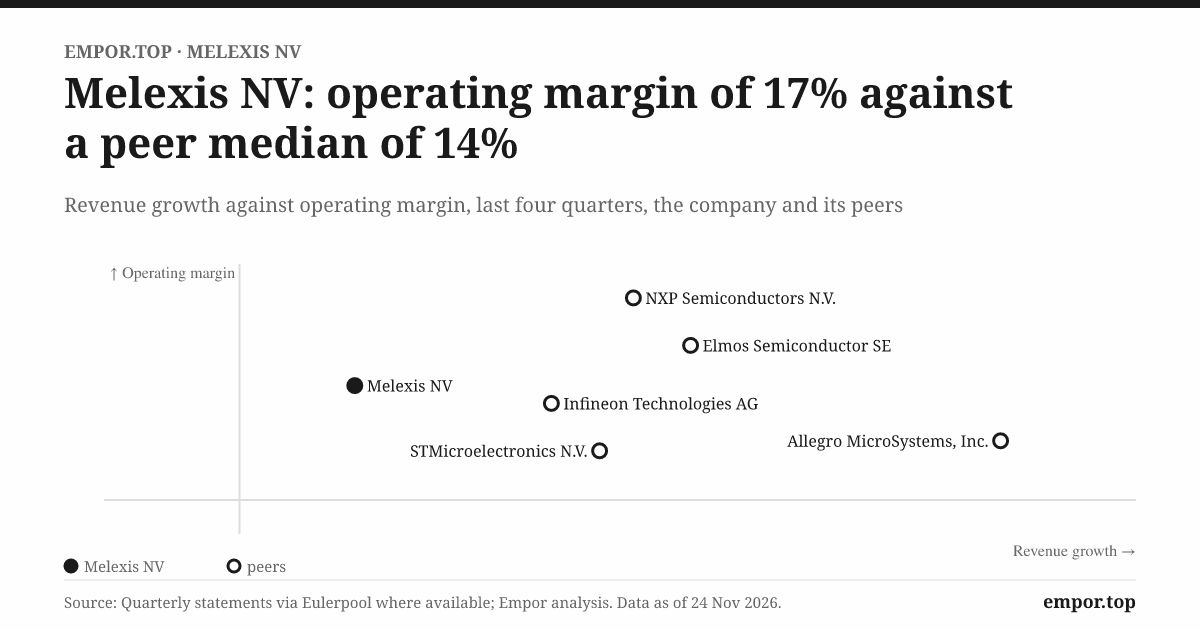
What the recovery has not yet done is restore the old earnings power. An 18% operating margin is a long way from the 27% of 2022–23 and still well short of the roughly 25% Melexis set out as its through-cycle ambition at its 2025 Capital Markets Day.5 The gap can be traced through the cost lines. In the third quarter of 2026 gross margin, what is left after the cost of making the chips, was about 41%. Research and development took about 13.6% of sales, administration about 6.5%, and selling about 2.2%.1 To get from 18% to 25%, Melexis needs some combination of a higher gross margin and much more revenue spread over its fixed engineering costs. Management has said it expects gross margin to improve further in 2027 because of cost-of-goods and yield gains, with the price of gold, used in chip packaging, a headwind.1 On the second-quarter call, when a Bernstein analyst observed that the gross-profit guidance was ahead of consensus but the operating profit guidance less so, the finance chief pointed to wage inflation as a brake on operating leverage.7 That is an honest answer, and it is also a limit. The margin recovery depends on volume, and volume depends on a car industry that has not yet returned to growth in most of the world.
The present investment choice says a lot about how management sees the gap. In 2025, as sales fell, R&D rose to €115.9m, or 13.8% of sales, up from €110.3m.4 Capital spending, by contrast, fell to €28.5m from €53m, and headcount eased slightly to 1,995 at year-end.4 Management guided to about €40m of capex in 2026.13 The pattern repeats the 2019 decision: keep the engineers, trim the hardware, and wait for the products to find volume. Whether that is the right choice depends on whether the products being designed now earn better margins than the ones they replace, and that will only show up over several years.
The new markets need the same careful sizing. Robotics is the most talked about. Melexis sells position sensors and motor drivers into robot joints, and it is developing a tactile sensor that would come later.1 Outside robotics, energy applications such as solar inverters and heat pumps are growing, a new office in Pune is aimed at Indian two-wheelers, electric vehicles, solar and smart meters, and a component called a snubber, used in AI servers and battery systems, is expected to enter first production in the summer of 2027.1 Half of the company's recent product launches have been outside automotive.1 Strategically these matter, because they take Melexis's sensing and motor-control know-how into markets that do not move in step with car production. Commercially they are still small, and the record of converting them into material revenue is short.
The automotive mix shows how far there is to go. Automotive represented 89% of Melexis's sales in the second quarter of 2026.14 Electrification, driver-assistance systems and premium features such as ambient interior lighting do add content, and Biron pointed to steering, braking and thermal management as the drivers of core automotive demand.1 But more content per car does not remove exposure to vehicle builds, to price erosion, or to the next inventory correction. In 2019 and again in 2024–25, rising content did not stop sales from falling.
China is where the recovery looks most structural, and also most complicated. Biron told analysts that Melexis had won more design wins in China than in Europe for two years, had run local assembly and test there for a year, had launched its first fully localized product, a current sensor, and had built an autonomous Chinese sales team.1 The BYD agreement made Melexis a direct supplier inside the world's largest electric-car maker's purchasing system, with new business in magnetic and inductive position sensors and latch switches starting in 2027.1 That is a real commercial step. It also means Melexis's growth is increasingly tied to Chinese car makers who are known as hard negotiators, and to a policy environment in which Chinese buyers have reasons to favour local suppliers. Biron acknowledged that Chinese car makers prefer non-Chinese chips in their export models, and also that Melexis does not know where its parts end up.1
The 2025 Capital Markets Day set out management's longer case: high-single-digit growth through the cycle and an operating margin of about 25%.5 A year later, the guidance and results point in that direction but are well short of it. On the third-quarter call Biron declined to give 2027 figures, saying it was "too early to give some accurate figures."1 That is a reasonable answer in November, and a reminder that the recovery Melexis has shown so far is a recovery in direction, not yet in level. Q3 supports the claim that the slump is over. Only 2027, a full year of normal ordering, can show whether the company is back on its old curve or operating at a lower new normal.
What decides between those two outcomes is not only the car industry. It is Melexis's position against the competitors who sell similar chips to the same customers. That position is the subject of the next part of the story.
A fourth-place sensor supplier in a crowded field
When Melexis presented its full-year 2025 results to investors in February 2026, one slide placed the company in a league table. Using data from the research firm TechInsights, it ranked the world's automotive sensor suppliers by 2024 sales. At the top sat onsemi with about $1.16bn, then Bosch with about $1.10bn, then Infineon with about $800m. Melexis came fourth, with about $655m, ahead of NXP at about $460m, and behind it a long tail of specialists.12 On the same slide, Melexis showed that its automotive sensor sales had grown about 12% a year between 2019 and 2024.12
The chart is worth reading carefully, because it is both flattering and honest. It is flattering because it shows a company with a fraction of its rivals' total size competing with them at scale in one of the most demanding parts of the chip market. Onsemi, Infineon and NXP each sell many billions of dollars of chips a year across power, microcontrollers and connectivity; Bosch is one of the largest car-parts makers in the world. In automotive sensors, Melexis is not a niche player hanging on at the edges. It is a top-five supplier. It is honest because it shows the company is fourth, not first, in a market where its larger competitors can bundle sensors with the processors, power chips and modules that customers also buy.
The chart is also only about sensors. It is not a proxy for the whole semiconductor market, and it does not cover the motor-driver and lighting chips that make up much of the rest of Melexis's business, where the cast of competitors is different again.
Here is how the field works, explained once. An automotive chip has to meet demanding reliability requirements and earn its way into a vehicle program through a long development and qualification process, which favours suppliers with a record of parts that do not fail. But each product category has its own competitors and its own pricing, and the cast changes from magnetic position sensors to current sensors to motor drivers and lighting. Across those categories the names include onsemi, Bosch, Infineon, NXP, Analog Devices, Allegro, STMicroelectronics, Texas Instruments, TDK and a growing group of Chinese suppliers. Melexis's own annual report names Allegro, Infineon, NXP, STMicroelectronics, onsemi and Texas Instruments among its competitors.4 There is no category where Melexis is alone.
So what does Melexis do better? The best evidence is the growth on that slide. Growing automotive sensor sales by about 12% a year over five years, in a period that included a pandemic and a shortage, suggests Melexis won designs at a faster rate than the market as a whole and faster than several of its listed peers.12 The rising product-launch rate fits the same picture. A plausible explanation is that a company focused on sensing and small motor control can bring application know-how that a generalist cannot match: engineers who understand exactly how a magnet behaves on a steering column at minus forty degrees, and who can help a Tier 1 design the module around the chip. That is a real capability, and it is the kind that lives in people and processes rather than patents.
The war-game question is how hard that edge is to defend, and the honest way to test a moat is through the mechanisms that would break it. There are five of them. Customers could multi-source, qualifying a second supplier for the same part so they can play the two against each other. Customers could expand their vendor base, bringing in new, often cheaper, competitors. Melexis could lose bids on the next generation of a platform. Its market share could fall. Or its prices could weaken faster than its costs.
On most of these, Melexis publishes very little. It does not disclose customer retention rates, lost bids, or its share of individual platforms.4 What it does disclose is suggestive. On the second-quarter call in 2026, a Morgan Stanley analyst asked about pricing pressure in lighting, and a Jefferies analyst asked why Melexis's growth was lagging its peers.7 Those questions show that the people who follow the company most closely see competitive pressure in parts of the portfolio. In China, Melexis's response to local competition has been to localize: assembly and test in China, a fully localized current sensor, and a Chinese sales organization.1 That is a sensible response. It is also an admission that a non-Chinese supplier needs to look more Chinese to keep winning there.
The switching cost created by qualification is real but bounded. Once a chip is designed into a platform, replacing it mid-life is costly, so Melexis's revenue from existing designs is fairly sticky for the life of the program. At the next platform, though, every supplier gets to bid again. The moat, in other words, renews every five to ten years, and there is no public evidence that Melexis's win rate at those renewals is unusually high. The switching-cost strength is plausible but unproven.
Buyer power is the next test. In 2025 Melexis's largest customer accounted for 13% of sales and its top ten customers for 43%, almost unchanged from 13% and 42% a year earlier.4 That is meaningful concentration without dependence on a single customer. Losing the largest customer would hurt badly, but it would not end the business. Melexis does not name its customers, but the structure of its industry means its biggest buyers are large Tier 1 suppliers and car makers with procurement departments whose job is to push prices down every year. Those annual negotiations are the clearest window into pricing power, and the window shows a contest rather than a tollbooth. In mid-2026, Biron said Melexis did not plan to raise prices before the end of the year, to honour commitments to customers.7 In October, he said the 2027 negotiations were still underway, that prices are set each year on a price-versus-volume matrix, and that the price increases other chip makers were announcing applied mainly to AI and memory products, not to the parts Melexis sells.1 A company with true pricing power sets its price. Melexis negotiates it.
Supplier risk sits on the other side of the business. Melexis does not own its chip factories. Its FY2024 annual report says one supplier provides most of its wafers, alongside additional wafer fabs and multiple, mainly Asian, packaging suppliers.15 Outsourcing manufacturing keeps capital spending low, which is one reason Melexis could cut capex to under €30m in 2025, but it concentrates risk. A disruption at the main foundry, or a decision by that foundry to give its capacity to larger customers, could constrain deliveries or raise costs. The 2021 shortage showed how fast that can happen. The arrangement also cuts the other way: the main reason Melexis's inventory value fell in 2026 was that its supplier cut wafer prices.1 The supplier has pricing power over Melexis, just as Melexis's customers do.
Put together, the evidence supports a specific claim and rejects a broader one. Melexis's product breadth, its automotive qualification history and its application expertise are real capabilities, and its growth record against larger rivals shows they have won designs. The evidence supports a strong specialist position in a contested market. It does not support a monopoly, an exclusive supply position, or a guaranteed moat. Which raises a question about money. A specialist that has to win its business again every few years, against larger competitors, through annual price negotiations, needs cash to keep investing. How much of its cash has it been handing back?
Dividends kept rising as cash and margins fell
If there is one line in Melexis's 2025 accounts that a skeptical investor would circle in red, it is the dividend payout ratio: 131% of that year's net profit.4 In a year when sales fell 10% and operating profit fell 39%, Melexis paid shareholders more in dividends than it earned. It also spent €45.6m buying back its own shares.4 And it did both while carrying borrowings that had grown from almost nothing at the end of 2022 to €314.3m at the end of 2025.4
None of this was an accident. Paying generous dividends is part of the Melexis identity. The company has paid regularly for many years, and its payout ratio over the twelve years from 2014 to 2025 ranged from about 48% at its lowest to about 147% at its highest, in 2019, with a median of about 73%.4 When profits fell, the dividend did not fall as fast. The two large shareholder blocs, each holding a quarter of the company, receive a quarter each of every euro paid out, and public shareholders have come to treat the dividend as part of the reason to own the stock. At the November 2026 share price the dividend yield was about 4.5%.
The trouble shows up when dividends are compared with the cash the business actually generated. Over those same twelve years, Melexis produced about €835m of free cash flow, which is cash from operations after capital spending. It paid out about €1.1bn in dividends.4 Dividends exceeded free cash flow by about €265m, roughly 132% of it. Meanwhile, cash and short-term investments barely moved: about €31.5m at the end of 2013 and about €34.6m at the end of 2025.4 In plain terms, the business did not build a cash pile over the cycle; it distributed more than it generated and funded the gap, most visibly since 2023, with debt.
Separate the two kinds of shareholder return, because they answer to different logic. The dividend is a policy, signalled in advance and hard to cut without upsetting shareholders. The buyback is a choice made year by year. Melexis spent €45.6m on repurchases in 2025, ending the year with 878,291 shares in treasury, and in December 2025 it launched a new programme to buy up to 850,000 more shares, or up to €50m, by December 2026.416 Buying back shares can be a good use of cash when the stock is cheap relative to the company's long-run earnings. It is a harder case to make when the company is paying more in dividends than it earns, while inventory absorbs cash and debt rises.
The debt itself deserves context, not alarm. At the end of 2025 borrowings were €314.3m, all unsecured and at floating interest rates, with a separate €7.7m of lease liabilities and €34.6m of cash.4 The loans carry two covenants: net debt must stay no more than 3.5 times EBITDA, and tangible net worth must be at least 30% of assets. Melexis reported compliance with both.4 The maturities are staggered, with about €13m falling due in 2026 and more spread through 2032.4 With EBITDA in 2025 of roughly €190m, net debt was under 1.5 times EBITDA, comfortably inside the covenant. The company does not, however, publish its exact covenant headroom, and it has said it does not use interest-rate derivatives.4 The ratio of debt to equity rose to 0.66, from close to zero three years earlier.4 So the balance sheet is more leveraged than it was, it is exposed to interest rates, and it is not stretched.
It also helps to avoid treating low cash as a solvency verdict. A company with about €35m of cash and €314m of debt can sound fragile, but Melexis's operating cash flow in 2025 was €126.3m, before any of the working-capital release that a recovery could bring.4 The relevant test is not the cash balance on 31 December. It is whether free cash flow through a full cycle, after working capital, can cover dividends, buybacks and debt service together.
On that test, the record is mixed. In good years, such as 2021 and 2022, free cash flow covered the dividend. In 2019, 2023 and 2025, it did not, or barely did. The 2023 cash collapse showed that a single year of working-capital build can turn a comfortably funded dividend into a borrowed one.4
On acquisitions, there is little to say, and that is itself informative. Melexis's 2025 disclosures do not show a material acquisition-led expansion.4 Its visible capital choices are product R&D, capital spending on test equipment and facilities, dividends and buybacks. That is a simpler and more legible capital allocation story than most chip companies offer: no expensive deals to write down, no goodwill hiding in the balance sheet. It also means the question of capital discipline comes down to one trade-off: how much to hand back now versus how much to keep for the next cycle.
So here is the question a skeptical investor would put to the board. Should Melexis keep buying back shares, while paying a dividend above earnings, when inventory days stand at about 213 and the margin recovery is incomplete? The bull answer is that the shares are well below their 52-week high, that working capital will release cash as sales recover, and that the balance sheet has room. The bear answer is that the company has spent twelve years distributing more than its free cash flow, that it has borrowed to keep doing so, and that a third downturn arriving before debt comes down would leave less room than the first two did. Both answers are reasonable. The record shows the company has chosen the first one, and it is worth asking who is making that choice.
A new CEO, with targets tied to revenue and EBIT
For almost two decades, Melexis had one face. Françoise Chombar was chief executive from 2003 to 2021.4 She was also one of the people who had taken over the business in the 1990s, and through Sensinnovat she and Rudi De Winter still control a quarter of the shares.49 Under her leadership Melexis grew into one of the world's leading automotive sensor suppliers. In 2021 she handed the role to Marc Biron and moved to the chair, a position she still held in 2026.
Biron is a Melexis insider, not an outside turnaround specialist, and his public style on earnings calls is the engineer's: detailed about products and applications, cautious about numbers more than a few months ahead. In 2025 Biron also covered the chief operating officer's duties for nine months on an interim basis.4 Karen van Griensven is the chief financial officer.14
The leadership change matters because it marks a change in operating leadership at a company where the shareholders who founded the modern business still sit on, or chair, the board. Chombar's transition from CEO to chair means the person who built the strategy now oversees the person running it. That can be a source of stability. It can also make it harder for the board to judge the CEO with an outsider's eye.
The pay structure shows what management is rewarded for. Melexis's remuneration policy ties variable pay to company performance and team objectives, including revenue and EBIT growth, and it provides no share-based remuneration.17 There are no stock options and no restricted shares. Biron's 2025 compensation, paid through his consulting company, was €481,615, up from €441,198 the year before, and included a €20,000 discretionary bonus for his interim COO duties.4 Total compensation for the rest of executive management fell from €1.83m to €1.23m.4 By the standards of the global chip industry, where chief executives of much larger rivals are paid tens of millions of dollars, these are modest sums.
Two features stand out. First, without equity awards, the executive team's financial interest is tied to annual operating results rather than to the share price over many years. That is unusual for a technology company and has both a virtue and a cost. It avoids paying for share-price swings that management does not control, but it gives executives less direct exposure to the long-run outcome that shareholders care about. Melexis does not publish personal shareholdings for Biron or other executives in the material reviewed here, so how much skin they hold through ownership is not clear.
Second, the CEO received a discretionary bonus in a year when sales fell 10% and EBIT fell 39%. The amount was small, and the stated reason, nine months of covering a second senior role, is understandable. But a discretionary payment in a down year is the kind of thing shareholders notice. At the annual meeting in May 2026, 486,696 votes were cast against the 2025 remuneration report.18 For comparison, the vote against approving the annual accounts drew 183,219 votes.18 With about 40 million shares outstanding and half of them held by two blocs that would be expected to support the board, the dissent was a signal from some public shareholders, not evidence of a wider revolt.
Ownership gives this context its meaning. As of March 2026, Sensinnovat held 25% plus one share, Elex held 25%, treasury shares accounted for 2.59%, and the public held 42.25%.919 The two blocs together control half the votes. Neither can act alone, but together they can carry most resolutions, and the board includes people associated with both: Chombar as chair, and Roland Duchâtelet as a non-executive director.4 Related-party transactions with these shareholders are tiny, about €74,000 of revenue and €566,000 of purchases in 2025, and the company describes them as arm's length.4 Governance at Melexis is not about leakage of value to insiders. It is about whether a company controlled by its founding families holds its management to account as firmly as a widely held company would.
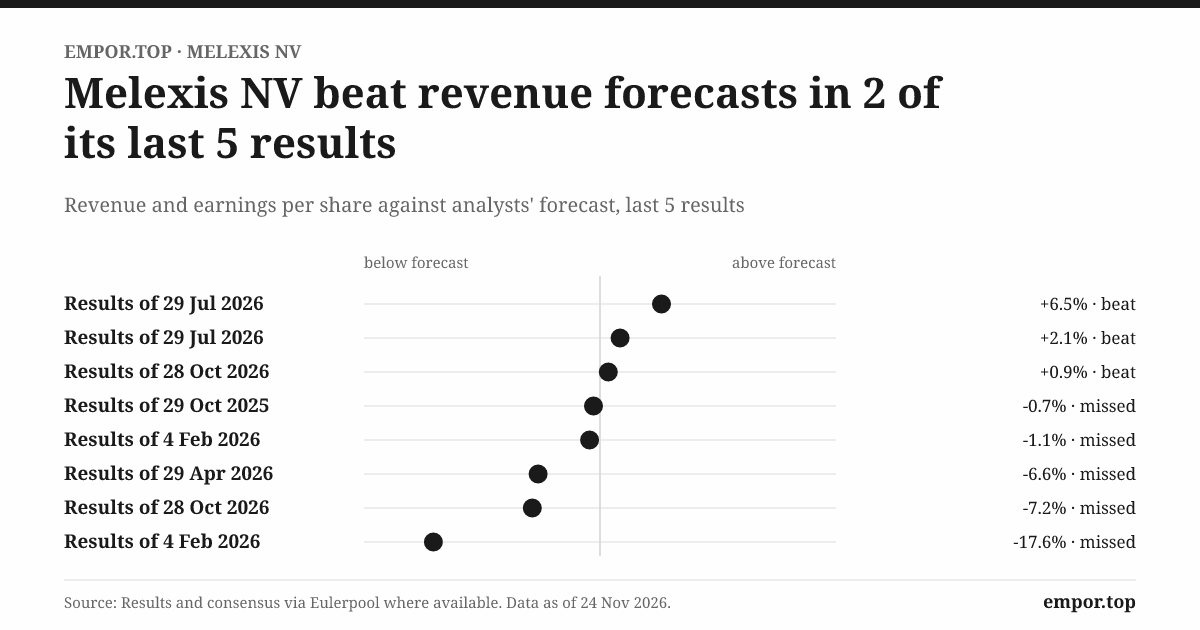
The best way to judge management's credibility is through behaviour over time, and here the record since 2025 is reasonably good. Guidance for the second half of 2026 was given in July and met, so far, in October.27 The third-quarter numbers landed inside the range management set. On the calls, Biron has been specific where he could be: the BYD agreement came with a plain explanation that it carried no volume or price commitment, robotics was described with customers, applications and timing, and when asked about 2027 he declined to guess.1 That is the language of a management team that prefers to under-promise.
The harder test is the downturn itself. Melexis has explained the 2024–25 slump mainly as an industry inventory correction, and the evidence of 2019 suggests that is a fair description of how this business behaves. But a company that grew more slowly than some of its peers during the recovery, as one analyst pointed out, also needs to explain the company-specific part of the story.7 Did Melexis lose share in some categories? Did lighting prices fall faster than expected? Did China's local suppliers take business? Management's answers so far have focused on what it is doing about those pressures, such as localizing in China, rather than quantifying them.
The next calls will be a useful test. Investors should watch whether management gives the same specificity on ramp sizes, pricing outcomes, customer orders and the path to a 25% margin as it did on BYD and robotics in October. The next annual report will show whether the incentive scheme, tied as it is to revenue and EBIT, paid out on a recovery that shareholders also felt. With leadership, pay and ownership on the record, the remaining question is the one the market answers every day: what is all of this worth?
The case turns on volume, inventory and price
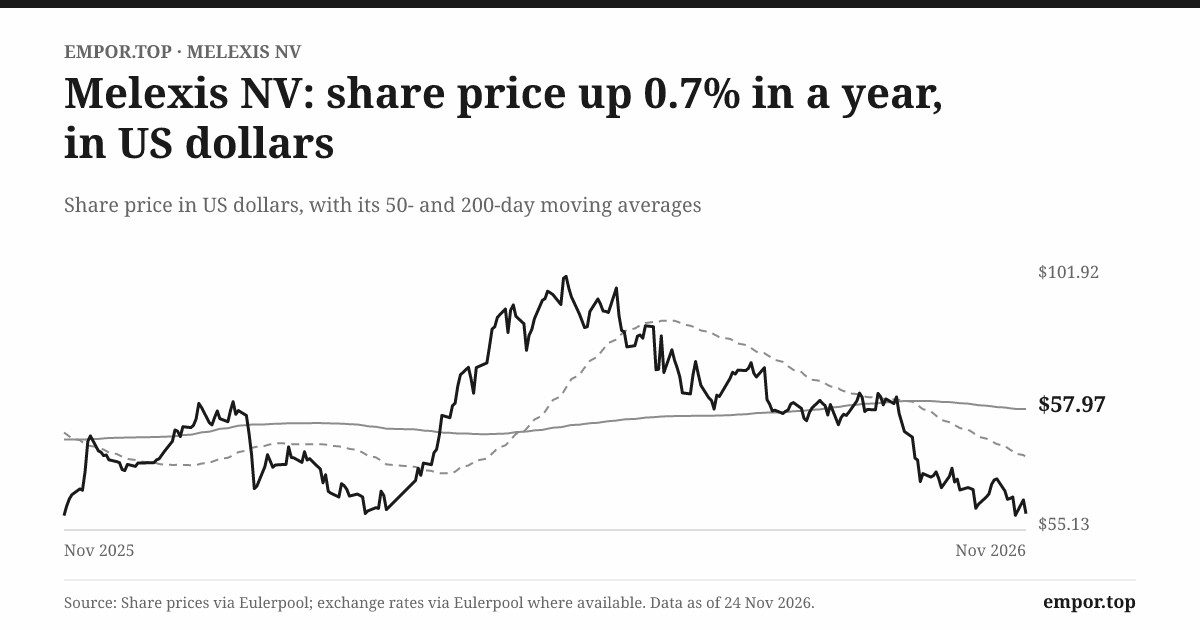
On 24 November 2026, Melexis shares closed at €52.95. That was about 38% below their 52-week high of €85.60, and only a few euros above the 52-week low of €49.86. Over five years the stock had at one point fallen almost 60% from peak to trough, and its one-year volatility was about 40%, high for a European industrial technology company. Anyone who held Melexis through the cycle described here has had a rough ride.
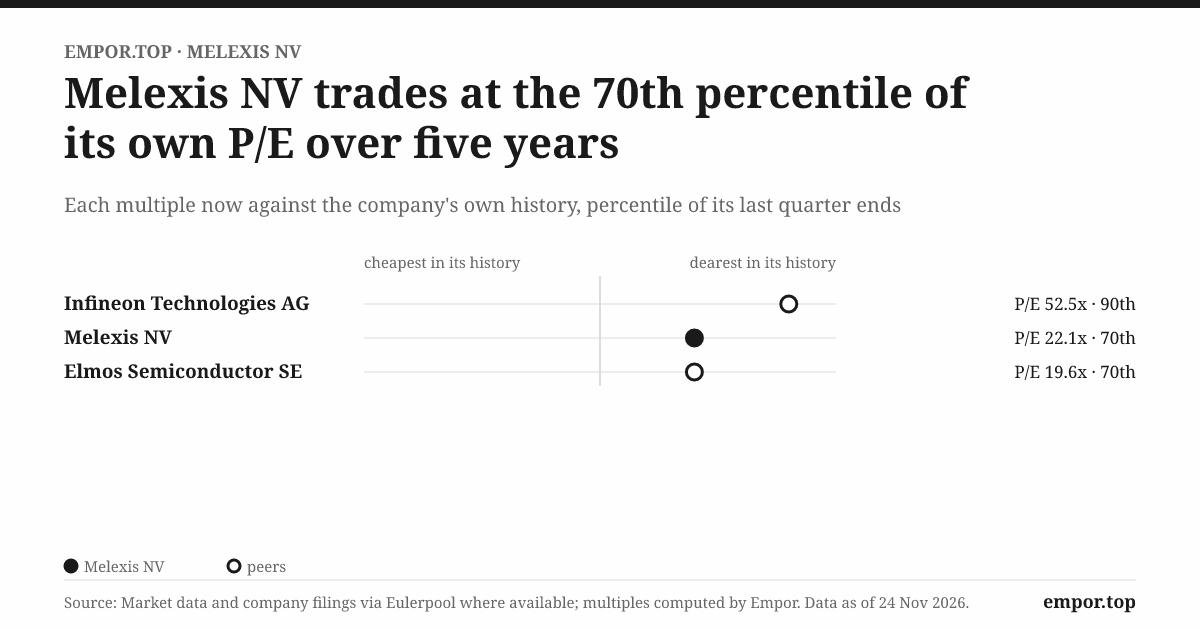
And yet, by one measure, the stock is not cheap. At that price it traded at about 22 times its trailing twelve-month earnings, above its own five-year median of about 18 times. On sales it traded at about 2.7 times, and on enterprise value at about 13 times EBITDA and about 17.6 times operating profit. The free-cash-flow yield, on the most recent twelve months, was close to 10%, helped by the cash that working capital has started to release.
The way to reconcile a share price far below its high with a price-to-earnings ratio above its median is to remember what the "E" is. Trailing earnings are depressed: the 2025 operating margin was 16.0%, against about 24% in 2018 and 27% in 2022–23.4 A stock that trades at its median multiple of depressed earnings would be priced as if the slump were permanent. A stock that trades above its median multiple of depressed earnings is priced for some recovery. The market is not paying for the old Melexis, but it is not assuming that the old Melexis is gone either. The recovery thesis has to be delivered, not merely described.
Comparisons with peers help only a little. Around 20 November 2026, Infineon traded at about 43 times trailing earnings, NXP at about 18.5 times, STMicroelectronics at about 69 times and Allegro at about 160 times.[^20]20[^22]21 Those numbers reflect very different points in each company's earnings cycle, different business mixes and, in Allegro's case, very depressed earnings. They are not like-for-like. What they show is that the whole automotive and industrial chip group is being valued on expected recovery earnings, not on what it earns today. Melexis sits at the less demanding end of that range, which suggests investors are paying for a recovery but not for a dramatic one.
So the question is not whether Melexis is cyclical. It is. The question is what the cycle will leave behind.
Why Melexis may win, and why it may not
The case for Melexis rests on four pieces of evidence. The first is the long automotive qualification cycle, which means designs won in 2024 and 2025 will keep shipping into the end of the decade. The second is the breadth of the portfolio: position, current, pressure, temperature and infrared sensors, motor drivers and lighting controllers, which gives the company many places to win in each new vehicle. The third is its fourth-place position in automotive sensors in 2024 and its faster-than-market growth since 2019.12 The fourth is the product pipeline, which has gone from roughly seven launches a year before 2020 to about nineteen in 2025, with half of recent launches outside cars.112
The case against rests on the company's own record. The downturns of 2019 and 2024–25 showed that more content per car does not cancel inventory corrections, unit-price erosion or competition. The 2025 operating margin was about nine points below the 2018 level, and even the recovering third quarter of 2026, at 18.5%, was about six points below it.24 The best year in the recent history, 2023, was also the year cash nearly vanished.
In the bull case, inventories have normalized and stay that way, semiconductor content keeps rising with electrification and driver assistance, the BYD relationship and other Chinese design wins add volume from 2027, and gross margin keeps improving with cost and yield gains. Sales growth returns to high single digits, the operating margin moves back toward the mid-twenties, inventory unwinds and releases cash, debt comes down, and the dividend is once again covered by free cash flow. Robotics becomes a credible adjacent market if its production ramps turn into material revenue, giving Melexis a second growth engine that does not move with car production.
In the bear case, auto production stays weak in Europe and North America, Chinese car makers squeeze prices and bring in local suppliers, and customers multi-source more of the parts Melexis now supplies alone. Price erosion keeps gross margin stuck near 41%, wage inflation absorbs the benefit of higher volume, and the operating margin settles around 18–20% rather than 25%. Working capital keeps absorbing cash because the company holds high inventory to support growth that comes slowly. Robotics and the other multi-market products stay too small to compensate. In that world, a dividend above earnings and buybacks funded partly by floating-rate debt reduce the company's flexibility at exactly the moment it might need it.
A specialist's edge, not a fortress
The framework thinkers give a useful vocabulary for that weighing. Through Michael Porter's lens of five forces, the picture is mostly challenging. Rivalry is high: Melexis faces larger, well-funded competitors in every product category, plus a growing group of Chinese specialists. Buyer power is high: the top ten customers take 43% of sales and negotiate prices every year.4 Supplier power is meaningful, because one foundry supplies most wafers.15 The threat of new entrants is moderated by qualification requirements, but not eliminated, as the rise of Chinese suppliers shows. The threat of substitutes, one sensing technology replacing another, is real at each new platform, and Melexis's broad technology menu is partly a defence against it.
Through Hamilton Helmer's seven powers, the case is narrower. Melexis lacks scale economies relative to onsemi, Infineon or Bosch. It has no network effect and no brand that drivers recognize. Its strongest claim is to switching costs, because qualification makes it costly to replace a chip within a platform's life, but that power renews at every platform and its retention effect is not quantified. Its other claim is to something like process power: the accumulated know-how of applying sensing chips in harsh automotive environments, visible in its launch rate and its growth against rivals. A durable cost advantage and genuine pricing power are not established. The evidence leaves Melexis with a specialist's edge, real but contestable, rather than a moat that shields its returns from the cycle.
That leads to the three measures worth tracking. The first is the operating margin against the roughly 25% ambition; its latest reading was 18.5% in the third quarter of 2026, rising from about 14–15% in late 2024 and early 2025.24 The second is inventory days and the cash conversion cycle, which rose to about 213 and 235 days at the end of 2025 and have to fall if the recovery is to fund the dividend.4 The third is growth in automotive sensors alongside the share of sales from robotics and other markets, since that is where the content story and the diversification story will be proven or not. None of these is a forecast. Each is a test.
Playbook: Business & Investing Lessons
Put three moments side by side. In early 2019, Melexis told the world that the average new car carried 11 of its chips, and in the same results it guided to an operating margin that would halve.10 Five years later, in its best year ever, it turned a profit of about €210m into about €3m of operating cash.4 And in October 2026, its chief executive announced that robotics design wins were finally becoming production volume, while warning that it was too early to talk about 2027.1 Those three moments contain the lessons.
The first lesson is that a chip inside the car is a foothold, not a tollbooth. The 11-chip figure was proof of reach: Melexis had designed itself into almost every modern vehicle. But reach did not stop the 2019 correction, and it did not stop annual price negotiations in which customers that account for 43% of sales sit across the table. Founders building a component business often believe that being designed in is the same as being indispensable. Melexis shows that a design win buys a place on the bill of materials. It does not buy the right to set the price.
The second lesson is that a good product cycle can still be a bad cash year. Over twelve years, Melexis converted about 93% of its profit into operating cash, which is a solid record. In one of those years, its best by revenue and margin, the conversion was close to zero, because the inventory and the balance-sheet build that made the boom possible absorbed the cash. Investors who value cyclical manufacturers on annual earnings learn this lesson the hard way. The quality of a company's earnings is measured over a cycle, but its ability to pay a dividend, buy back shares or service debt is measured year by year.
The third lesson is to pay the dividend from the cycle you have, not the one you hope for. Melexis's long record of generous dividends is part of what its shareholders signed up for, and the founding families have every reason to keep it. But over twelve years the company paid about 132% of its free cash flow as dividends and ended with roughly the same cash it started with, financing the difference in recent years with debt. A payout above free cash flow is a bet that the next upswing will arrive before the next downturn. So far it has. The lesson for boards everywhere is that a dividend policy is also a balance-sheet policy, and it quietly sets how much room the company will have when the next shock comes.
The fourth lesson is that a design win becomes strategy only when production follows. Robotics has been part of the Melexis story for several years. It matters now because production ramps have begun and orders for 2027 have been placed. The next proof is not another announcement or another design-win count. It is revenue that repeats, at margins that justify the engineers who built it. For investors watching any company with a promising new market, the rule is the same: count shipments, not slides.
Epilogue
Tonight, at the end of November 2026, Melexis stands in the middle of the most important stretch of its recovery. Its third quarter landed inside guidance, its customers' inventories have been flat for six months, its Chinese order book is at a record, and its robotics customers have placed orders for next year.1 Its share price sits near the bottom of its 52-week range, and its trailing earnings multiple sits above its five-year median. Each of those facts points in a slightly different direction, and the next few months will decide which of them matters most.
The first moment comes on 3 February 2027, when Melexis reports its full-year results.1 The fourth quarter will show whether the second-half guidance of €445m–455m in sales, a gross margin of around 41% and an operating margin of around 18% held through the quarter.7 If it did, the recovery will have survived the season in which car-parts makers traditionally cut orders to tidy their year-end balance sheets. If it did not, the story of 2019 will come back to mind quickly.
The same report will answer a quieter question: what happened to cash. Investors will be able to see whether inventory came down as sales rose, whether operating cash flow funded the year's dividends and buybacks, and how much of the €40m capex plan was spent.13 A recovery that shows up in profit but not in cash would look uncomfortably like 2023.
The second moment is the outcome of the 2027 price negotiations, which were still underway in late October.1 Melexis does not publish the result of those talks, but it will show up in gross margin through 2027. If the gross-margin gains management expects from lower costs and better yields survive the price round, the path to a 25% operating margin gets shorter. If customers take those gains back in lower prices, the path gets longer.
The third moment is the start of new business with BYD in 2027, and the first full year of robotics production.1 Neither comes with a promised volume. Both will show whether Melexis's growth outside traditional European and American car makers can turn design wins into sales at a scale that matters. Investors should watch whether Melexis ever discloses robotics revenue on its own; a company proud of a new market tends to want to show it.
Behind all of these sits the capital return. The test is not the dividend yield, which at about 4.5% will always look attractive at a depressed share price. It is the comparison between dividends and buybacks on one side and free cash flow on the other, and the direction of net debt against EBITDA. If those move the right way through 2027, the central question of this story, whether Melexis can return to its through-cycle growth and margins, will have a provisional answer. If they do not, the company will face its next downturn with a heavier balance sheet than it has had at any point in its history.
Outro
Picture the car again, the ordinary one parked outside. Under the bonnet and behind the dashboard, a dozen or so small chips are quietly at work: sensing where the pedals sit, measuring the current into the battery, nudging a coolant valve open, dimming a light. In the company's 2018 telling, the average new car carried 11 of them made by a Belgian firm few of its drivers have ever heard of.10 That is Melexis's particular achievement. It built itself into the machinery of modern mobility, one qualified part at a time.
And yet the same car tells the other half of the story. Its maker builds more or fewer of it depending on demand, its suppliers hold more or less stock depending on fear, and every year someone in a procurement office asks for a lower price. Melexis's largest customer accounted for 13% of its sales in 2025.4 Melexis can be present in more systems than ever and still wait for customers to order, to agree a price, and to pay. The next design win, in a car, a robot or a solar inverter, will be worth exactly as much as the production and cash that follow it.
References
-
Q3 2026 earnings call transcript — StockAnalysis, 2026-10-28 ↩↩↩↩↩↩↩↩↩↩↩↩↩↩↩↩↩↩↩↩↩↩↩↩↩↩↩↩↩↩↩↩↩
-
Annual Report 2025, full text — FinancialFilings, 2026 ↩↩↩↩↩↩↩↩↩↩↩↩↩↩↩↩↩↩↩↩↩↩↩↩↩↩↩↩↩↩↩↩↩↩↩↩↩↩↩↩↩↩↩↩↩↩↩↩↩↩↩↩↩↩↩↩↩↩↩
-
Capital Markets Day 2025 presentation — Melexis, 2025-11-05 ↩↩↩
-
Q2 2026 earnings call transcript — Investing.com, 2026-07-29 ↩↩↩↩↩↩↩↩↩↩
-
Launch of a new share buy-back program — Melexis, 2025-12-10 ↩
-
Minutes of the 2026 shareholders' meeting — Melexis, 2026-05-12 ↩↩
 LinkedIn
 WhatsApp
 Reddit
 Hacker News
 Email
 Kindle
 RSS Feed
 Spotify
 Apple Podcasts
 Amazon Music
 Audible
 YouTube