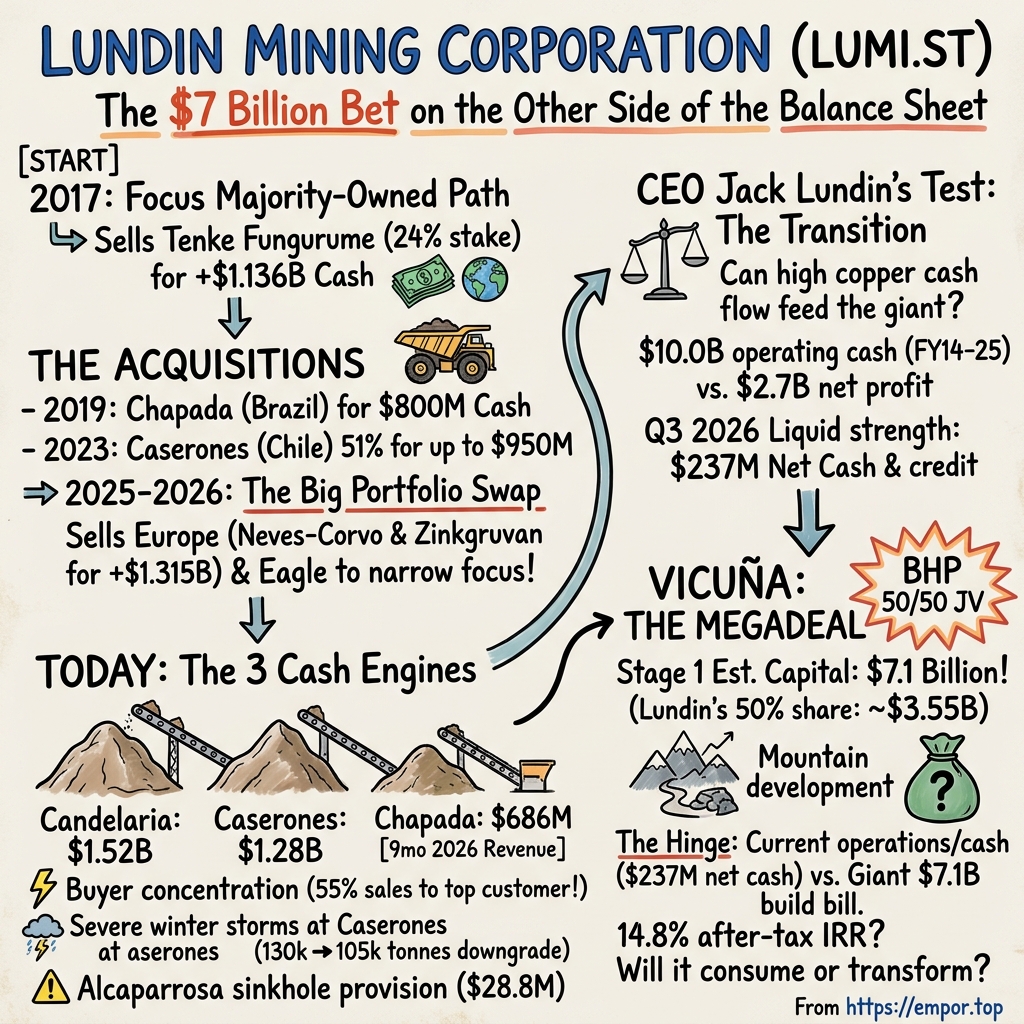
Lundin Mining Corporation: The $7 Billion Bet on the Other Side of the Balance Sheet
I. Three Mines, One Megaproject, and a Buyer With 55% of the Sales
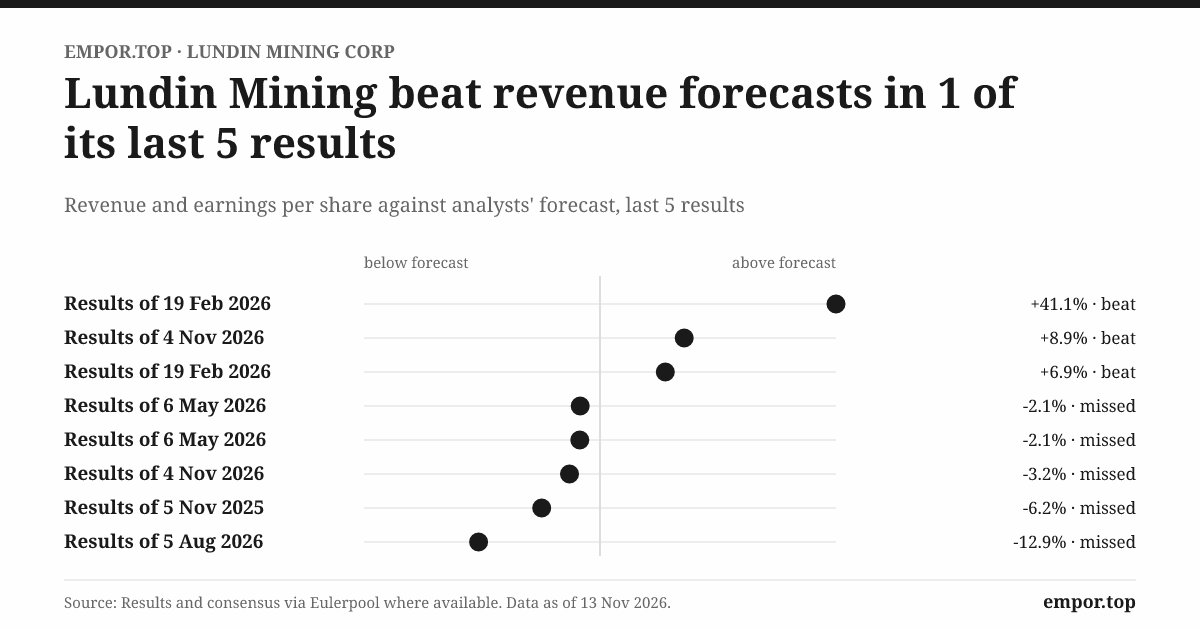
On November 4, 2026, Lundin Mining published a quarterly report that, read from the top, looked like a victory lap. Revenue for the three months to September was about $1.1 billion, the third quarter in a row above the billion-dollar line.1 The company sold copper at a record realized price of about $6.85 a pound, generated roughly $418 million of free cash flow from its operations, and finished the quarter holding about $237 million more in cash than it owed.1 Operating margin in the quarter was the highest of any quarter in the past three years.2 For a company that had spent most of the previous decade buying, selling and rearranging mines, the numbers had the feel of a business that had finally arrived.
Read from the bottom, the same report told a more complicated story. Deep in the notes sat a mine in the Chilean Andes, Caserones, that had been shut twice by blizzards and had just cut its production forecast for the second time in three months.1 Elsewhere sat a line showing that a single customer, unnamed, had bought about 55% of everything Lundin sold in the first nine months of the year.3 And running through the whole document was a project that produces nothing at all: Vicuña, a copper, gold and silver district straddling the border between Argentina and Chile, still consuming money ahead of a construction decision that management hopes to take before the end of 2026.1 The first stage of that project carries an estimated capital bill of about $7.1 billion.14
That is the shape of the story. Lundin Mining today is two companies sharing one ticker. The first is a mid-sized copper producer with three operating mines, two in Chile and one in Brazil, that converts high copper prices into cash. The second is half of a joint venture with BHP, the world's largest miner, that intends to build one of the largest new copper districts anywhere. The first company pays the bills. The second company is the reason many investors own the shares.
Copper provides a powerful backdrop. Electrification, power grids, data centres and electric vehicles all consume it, and new mines take a decade or more to find, permit and build. But a strong commodity story is not the same as a strong investment in any particular mine. Copper is sold at a global price that no single producer sets. The miners that earn excellent returns are the ones that own good rock, run it well, and avoid spending more to build a mine than the mine will ever give back. History is full of companies that were right about copper and wrong about their projects.
So this story asks three questions. Does Lundin's portfolio of operating mines have a genuine edge, or does it simply ride the copper price? Does its long record of buying and selling assets give reason to trust it with something as large as Vicuña? And can management fund its share of that project without weakening the existing business that pays for it?
Start with what the listed company actually owns. Candelaria, in Chile's Atacama region, is the oldest and largest piece of the portfolio, a big open-pit and underground copper operation Lundin bought in 2014.56 Caserones, in the high Andes of the Atacama, came in 2023.57 Chapada, in the Brazilian state of Goiás, produces copper with a meaningful gold credit and came in 2019.58 And there is the 50% interest in Vicuña, which Lundin holds alongside BHP and which is managed as an independent joint arrangement.59 That is the whole list. The zinc and copper mines in Portugal and Sweden, and the Eagle nickel mine in Michigan, are gone.53
Then look at the mismatch that makes the story. On November 13, 2026, the stock market valued Lundin at about $15.7 billion, with enterprise value at almost exactly the same figure because the company carries very little net debt.3 Vicuña's first stage, at roughly $7.1 billion, is close to half of that entire valuation. Lundin's simple half-share, about $3.55 billion before any project financing, is more than five times the free cash flow the whole company generated in 2025.5 It is a bet sized not against what Lundin earns in a quarter, but against what it earns over many years.
That is not automatically a reason for alarm. Big mines are always built with tomorrow's money. But it means the story of Lundin Mining is no longer mainly about how well its existing mines run. It is about whether the cash from those mines, plus debt, plus a partner, can carry a construction project of a size this company has never attempted, without forcing it to sell assets, issue shares or cut distributions at the wrong moment in the cycle. The answer to that question begins with a sale that, nine years ago, decided what kind of company Lundin wanted to be.
 Subscribe on LinkedIn
II. The $1.1 Billion Sale That Changed What Lundin Wanted to Be
In April 2017, Lundin Mining closed the sale of its interest in Tenke Fungurume, one of the richest copper and cobalt deposits on earth, in the Katanga copper belt of the Democratic Republic of Congo.10 The company held an effective 24% of the mine through TF Holdings. It walked away with about $1.136 billion in cash.10
It is worth pausing on how unusual that decision looked at the time. Tenke was the kind of asset mining executives talk about for decades: enormous, high-grade, long-lived, with cobalt by-product exposure just as battery demand began to excite investors. Most companies do not sell a piece of a world-class mine voluntarily. Lundin did, and it explained why in a single idea. A 24% minority stake in a Congolese mine run by someone else gave Lundin exposure to the economics, but no control over the operation, the capital spending, the dividends or the political relationships. The company said the sale would let it focus on majority-owned operations and projects it could run itself.10
That is a strategy, not just a transaction. It says Lundin's management believed their edge lay in operating mines, not in holding passive stakes in other people's. A minority stake earns returns only when the operator decides to distribute them. A controlled mine lets you decide the mine plan, the pace of stripping, the timing of an expansion. For a company that thought of itself as an operator, Tenke was a valuable asset in the wrong format.
The cash arrived at a good moment. Lundin had spent the previous two years in the copper slump that followed the end of the China-driven commodity super-cycle, reporting net losses in both 2015 and 2016.2 By 2017 copper had recovered, Lundin's own mines were producing more cash, and the company's free cash flow that year reached about $425 million.2 Add the Tenke proceeds and the balance sheet was transformed. Borrowings fell from roughly $1 billion at the end of 2016 to about $450 million a year later, and then to almost nothing by the end of 2018, while the cash pile briefly topped $1.5 billion.2
To understand why Lundin had a Tenke stake to sell in the first place, it helps to know the company's earlier life, briefly. Lundin Mining was a creation of the Lundin family, the Swedish-Canadian dynasty founded by the late Adolf Lundin, whose family trust, through a vehicle called Nemesia, still owns about a fifth of the company today.11 The Lundin group's method has always been opportunistic: find assets, often in difficult jurisdictions, list a company around them, and buy or sell as prices allow. Lundin Mining grew from a small listed miner into a diversified base-metals producer largely by acquisition, adding European zinc and copper operations and the Tenke interest along the way, then the Eagle nickel project in Michigan.12
The decisive move before Tenke's sale came in late 2014. Lundin paid about $1.8 billion in cash for an 80% stake in Candelaria and the neighbouring Ojos del Salado operations from Freeport-McMoRan, with Japan's Sumitomo group keeping the other 20%.6 The financing shows how stretched the company was willing to get. It raised a billion dollars of secured notes, about $600 million of new equity, and sold a long-term stream on part of Candelaria's gold and silver to Franco-Nevada for an upfront payment of $648 million.6 A stream is a kind of pre-sale: the buyer pays cash today in exchange for the right to buy a portion of future precious-metal output at a low fixed price. It funds a deal, but it permanently hands away part of the mine's by-product value. Revenue nearly doubled the following year, from under $1 billion to about $1.7 billion, because Candelaria was now in the accounts.2
So by 2017 the pattern was visible. Buy a controlled operating mine with a mix of debt, equity and creative financing. Sell a minority stake you cannot control. Use the proceeds to strengthen the balance sheet and fund the next step. The Tenke sale put real money behind the "majority-owned operator" strategy.
It also raised an uncomfortable question that the rest of this story keeps returning to. When a company sells a producing asset for cash, it has converted future production into present money. That money only creates value for continuing shareholders if it is redeployed into something that earns more than what was sold. Selling Tenke was not a return in itself; it was a promise to find a better one. Lundin's subsequent years would be spent trying to keep that promise, and the shopping list it drew up would take it from Brazil to the high Andes.
III. The Acquisitions That Built the Portfolio and Set the Bar for Vicuña
In April 2019, Lundin announced it would buy the Chapada copper-gold mine in central Brazil from Yamana Gold for $800 million in cash, plus contingent payments tied to gold prices and to a possible pyrite roaster at the site.8 Four years later, in March 2023, it announced a deal to buy 51% of Caserones in Chile from JX Nippon Mining & Metals for $800 million upfront and another $150 million deferred.7 Between those two cheques sat a third deal, smaller in price but far larger in consequence: in April 2022 Lundin closed its acquisition of Josemaria Resources, a Lundin-group development company sitting on a copper-gold deposit in Argentina's San Juan province, for consideration worth roughly C$630 million.1314 And in January 2025, Lundin and BHP jointly completed the purchase of Filo Corp. for total consideration of about $4 billion, splitting the bill and creating the Vicuña joint arrangement.9
Lay those deals side by side and a progression appears. The first two bought producing mines. The second two bought geology that would take years and billions to turn into mines. Lundin was moving from buying cash flow to buying optionality.
What Chapada and Caserones were supposed to deliver
Start with Chapada. Lundin's rationale in 2019 was straightforward: $800 million bought a long-life producing operation with copper and gold output, expansion potential and exploration upside, in a country where Lundin had no previous presence.8 The contingent payments meant the seller would share in upside if gold prices rose, which partly protected Lundin from overpaying in a weak gold market and partly guaranteed it would pay more if gold rallied. Gold did rally.
What did Chapada deliver? It remains a material producer. In the first nine months of 2026 it generated about $686 million of revenue, roughly a fifth of the group's total.3 Its unit cash costs sit well below the group's other mines because the gold by-product is credited against copper costs, and management kept its 2026 production guidance intact through the third quarter even as Caserones faltered.15 Yet the accounting tells a more cautious tale. In its report on the 2025 accounts, Lundin's auditor singled out the impairment test on Chapada's goodwill as a key audit matter, which means the judgment about whether the mine is still worth what Lundin carries it at was among the most significant in the whole audit.5 The auditor's opinion was clean, and no impairment was recorded on that line in 2025. But goodwill exists only because Lundin paid more than the fair value of the identifiable assets, so the annual test is a recurring question about whether that premium has been earned. Chapada's record supports a narrower claim than "great deal": a useful, lower-cost producing asset whose purchase premium still requires annual justification.
Caserones is the larger test. When Lundin signed in 2023, it told investors the mine would lift its pro forma 2022 copper production by about 50%, with Caserones producing roughly 120,000 to 130,000 tonnes of copper a year on a 100% basis.7 That is the benchmark. The thesis was not that copper was cheap in 2023. It was that Lundin's operating teams, already experienced at Candelaria a few hours away, could run Caserones better than its Japanese owner had, extracting more cash from an asset with a history of operational difficulty.
The early evidence was encouraging, and Lundin raised its guidance for the mine to 130,000 to 140,000 tonnes for 2026.1 Then the weather intervened, and the 2026 forecast now sits at 105,000 to 115,000 tonnes, below even the range Lundin had promised at signing.1 One bad winter does not invalidate an acquisition. Mining operations at 4,000 metres in the Andes are always one storm away from a lost month. But it does narrow the conclusion. Caserones has proved it can produce at the rates the deal assumed, and it has proved it can fall well short of them. Its value to Lundin depends on which of those two facts dominates over the next five years.
There is also an accounting layer. In 2025 Lundin recognised a deferred tax asset of about $517 million connected to Caserones, essentially a bet that the mine will earn enough future taxable profit to use up past tax losses.5 Recognising that asset added a large one-off gain to 2025 earnings. It also embedded a forecast about Caserones' future profitability in the balance sheet. The auditor called it a key audit matter, noting the Caserones asset made up about $665 million of Lundin's $720 million deferred tax asset at year-end.5 If Caserones disappoints for long enough, that number is exposed.
From buying cash flow to buying geology
Josemaria and Filo belong to a different category of risk. A producing mine has a known output, a known cost structure and a known customer list; the main uncertainty is price and execution. A development project has none of those things yet. It has a resource estimate, a study, a permit trail and a capital bill. Between the purchase and the first shipment of concentrate lie years in which the owner pays engineers, builders and governments while receiving nothing.
When Lundin bought Josemaria in 2022, it was buying a project whose environmental and social impact assessment had just been approved by San Juan province's mining authority.13 It was also buying into a family relationship: Josemaria had been part of the Lundin group of companies. The Filo transaction carried the same feature in larger form. Nemesia and other interested parties were involved, so Lundin's conflicted directors abstained, and a special committee of independent directors recommended the deal.11 Lundin paid its share partly in its own stock, issuing about 94.1 million new shares.5 Those safeguards are what good governance requires. They do not settle whether the price was right.
Here the honest answer is that no simple comparison settles it. Chapada and Caserones each cost about $800 million upfront, but one bought a whole mine with a gold credit and the other bought half of a larger copper operation with higher costs and a history of trouble. Josemaria and Filo bought resources measured in billions of tonnes but producing nothing. Comparing price per tonne of annual production between a producing mine and a development project is like comparing the price of a house to the price of a plot of land with planning permission: the second always looks cheap until the construction bill arrives. Industry transaction benchmarks exist, but the assets are rarely like-for-like enough to prove overpayment or bargain-hunting. The fairer verdict is that Lundin's deal record shows it can buy and integrate producing mines; it does not, on its own, show that the company buys systematically cheaply.
That distinction matters because of what comes next. Every earlier acquisition was large relative to Lundin, but each could be digested within a few years: pay, integrate, operate, collect cash. Vicuña's first stage, on a whole-project basis, costs more than all of Lundin's earlier mine purchases added together, and its cash flows begin years after construction starts. A respectable acquisition record is evidence of judgment about rock. It is not evidence that Lundin can build a multi-billion-dollar mine on time and on budget, because the company has never had to. Before Lundin could start on that test, it first had to make room on its own balance sheet, and that meant selling the mines that had started the story.
IV. A Mine Portfolio Sold Down to Make Room for a New One
In April 2025, Lundin Mining handed the keys to Neves-Corvo in Portugal and Zinkgruvan in Sweden to Boliden, the Swedish smelting and mining group.5 The European mines had been part of Lundin since its early years, mining copper and zinc for decades. The sale brought in net proceeds of about $1.3 billion.5 Less than a year later, in early 2026, the company sold Eagle, its nickel-copper mine in Michigan.3
The sequence of 2025 is easiest to understand as three moves on one board. In January, Lundin and BHP completed their joint acquisition of Filo, while Lundin simultaneously sold half of Josemaria to BHP; the two partners combined the projects into a single 50/50 joint arrangement around the district now called Vicuña.9 In April, the European sale closed. And through the year, Lundin repositioned itself as an Americas-only copper company with a giant development project attached.
This is the Tenke pattern again, but in reverse geography and at larger scale. Instead of selling a minority stake to focus on control, Lundin sold controlled mature mines to focus on a shared growth project. The logic is defensible. Neves-Corvo and Zinkgruvan were long-lived but heavily zinc-weighted, and zinc is a smaller, less favoured market than copper. Eagle was approaching the end of its life. Selling them traded declining or less strategic production for cash at a time when Lundin needed to show it could afford Vicuña.
Cash in, shares out
It is important to keep three different flows of value apart, because the headlines tend to blend them.
The first is cash proceeds. The European sale delivered about $1.3 billion, and that, along with strong operating cash flow, explains why borrowings fell from about $2 billion at the end of 2024 to about $450 million a year later.5 By September 2026 debt had shrunk further to about $107 million, all of it short-term loans at Candelaria and Chapada due in October and November 2026.3
The second is acquisition consideration. Lundin's share of the Filo price was paid partly in cash and partly in new Lundin shares.
The third is dilution. Those 94.1 million shares added roughly 11% to Lundin's share count at the time.5 So in the same year Lundin received cash for its old mines, it gave away a slice of the whole company to buy into the new project. Every existing shareholder now owns a smaller percentage of Candelaria, Caserones and Chapada than before, in exchange for a share of Vicuña.
The Lundin family trust ended up with more, not less. Nemesia's stake rose from about 15% in March 2024 to about 20% by March 2026, an increase that coincided with the Filo transaction and the shares it issued.1611 That does not make the deal unfair. It does mean the family that controls the largest block of votes was also on the selling side of one of the assets Lundin bought, which is why the independent committee process carried real weight.
There is a structural boundary to understand as well. Vicuña is not a Lundin subsidiary. It is independently managed by the joint arrangement, and Lundin accounts for its share rather than consolidating the entire project as its own.5 When investors read "Vicuña," they should think of half a project with a powerful partner, not a wholly owned mine that Lundin controls alone. That has advantages: BHP brings capital, technical depth and negotiating weight with governments. It also has costs: decisions require agreement, and Lundin cannot set the pace by itself.
Why the headline growth rates mislead
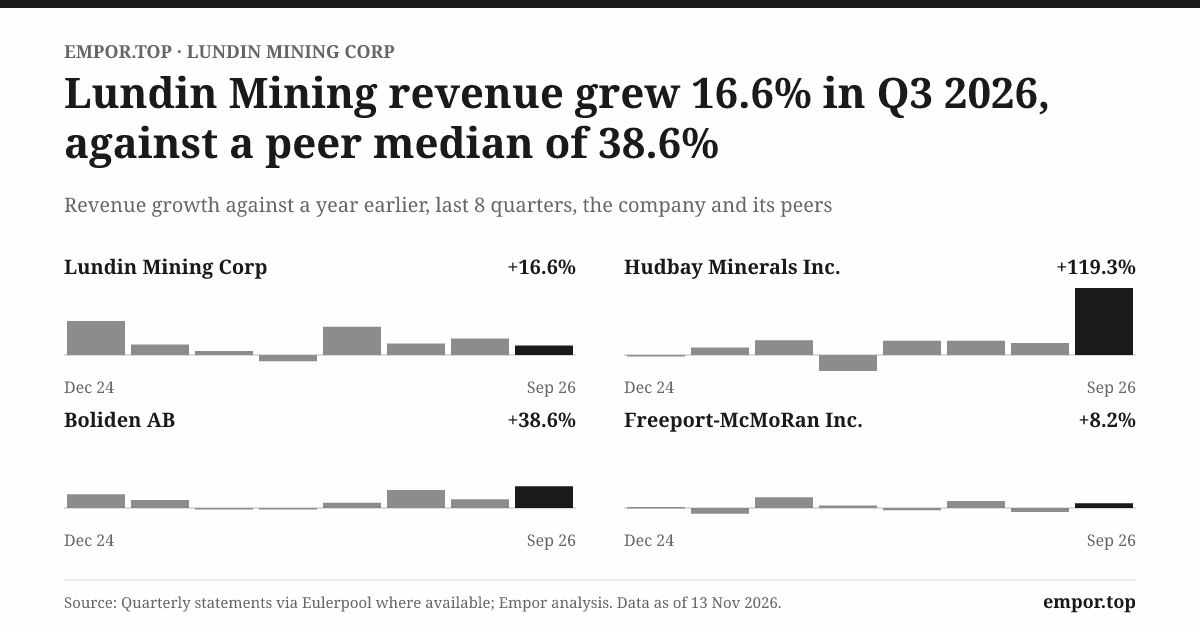
All of this rearrangement makes Lundin's historical numbers treacherous. On paper, revenue grew about 13% a year over the five years to 2025 and about 8% a year over ten years.2 Net profit in 2025 was about $1.3 billion, a dramatic recovery from a loss the year before.5 Taken at face value, it looks like a company accelerating.
But the 2025 accounts include the European mines for four months before they were sold, earnings of about $236 million from discontinued operations, and the $570 million deferred tax recovery tied largely to Caserones.5 Continuing operations revenue of about $4.05 billion in 2025 still included the European assets through April.5 Strip those effects out and the underlying story is a business riding a sharply higher copper price with a smaller set of mines. That is not bad, but it is different. Growth built on asset swaps and tax recognition does not tell an investor how fast today's three mines can grow when copper stops rising.
The cleaner test will only arrive after several quarters in which the portfolio holds still. Until then, the honest reading is that Lundin has become simpler, more copper-focused and less indebted, at the cost of a larger share count and a heavier dependence on just three operating mines. Those three mines now carry the whole weight of the current business, and the case for the stock depends heavily on how well they convert copper prices into cash.
V. The Three Mines That Have to Carry the Story
Picture the journey of a single truckload of rock at Candelaria. A shovel loads it at the bottom of an open pit that has been worked for decades. The truck climbs the ramp and dumps it at a crusher. The rock is ground finer than sand, mixed with water and chemicals in flotation cells, and the copper-bearing minerals float off as a froth that is skimmed, thickened and dried. What emerges is copper concentrate, a grey powder that is perhaps a quarter to a third copper, carrying traces of gold and silver. It is trucked to a port, loaded onto a ship and sent to a smelter, often in Asia, where it will be melted into metal.
Lundin does not sell copper the way a retailer sells shoes, at a price it chooses. It sells concentrate (and some cathode, the finished metal) whose value is calculated from a formula. The buyer pays for the copper content, minus a deduction for the portion that cannot be recovered, minus treatment and refining charges that compensate the smelter for its work, plus credits for gold and silver.312 And the price itself is often provisional at shipment, then adjusted to the market price weeks or months later when the sale finally settles.3 So revenue moves with two things Lundin controls—how much metal it produces and at what cost—and one thing it does not: the copper price on the London Metal Exchange.
That formula answers the question this section starts with. What can Lundin control when the price of copper is set by the world? It controls tonnes, grade, recovery and cost. Grade is how much copper sits in each tonne of rock. Recovery is how much of that copper the plant actually captures. A mine that moves rock cheaply, mines the highest-grade parts of its deposit at the right time and recovers a high share of the metal will earn more on every pound than a rival selling at the same price. That is the whole game for a copper producer.
In the first nine months of 2026, Candelaria generated about $1.52 billion of revenue, Caserones about $1.28 billion and Chapada about $686 million.3 Candelaria is the anchor. Caserones, before the storms, was a close second. Chapada is smaller but the lowest-cost of the three thanks to its gold credit. The third quarter alone showed the storm damage vividly: Candelaria sold about $586 million, Chapada about $268 million, and Caserones only about $255 million, slipping behind the smaller Brazilian mine.17
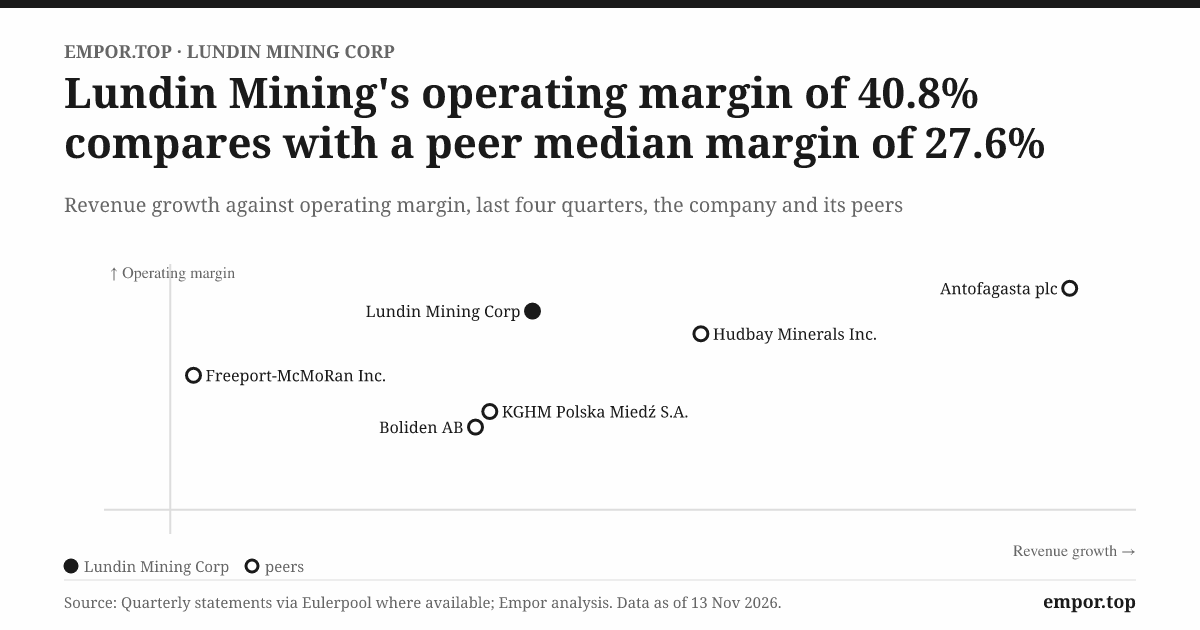
A word of caution on mine-level profits: Lundin's segment earnings are distorted by tax, depreciation and one-off items such as the Caserones deferred tax asset, so they cannot be read as a clean ranking of which mine is cheapest to run. The better guide is cash cost per pound, the measure the industry uses to compare mines. Lundin guided to consolidated cash costs of $1.95 to $2.15 a pound for 2026 and reported about $2.01 in the third quarter, before stripping out Caserones' standby charges.115 Against a realized copper price of about $6.85, that is an extraordinary margin, the gap between costs and price on which every operating dollar depends.1
Where does that leave Lundin in the industry? In 2025 the company produced about 331,000 tonnes of copper.5 First Quantum Minerals, with large mines in Zambia and the stalled Cobre Panamá, produced about 396,000 tonnes.18 Antofagasta, the Chilean producer controlled by the Luksic family, produced about 654,000 tonnes.19 BHP, Lundin's partner at Vicuña, operates on a scale several times larger again through Escondida and its other copper assets. Lundin is a meaningful intermediate producer, not a price-setter. Even after the European sale, the global copper market measures its supply in tens of millions of tonnes; no single company with output in the hundreds of thousands can move the price.
Where an edge could hide
So is there an operating advantage? The observable evidence points both ways. On the favourable side, Lundin has run Candelaria for more than a decade and integrated two acquired mines, and its consolidated costs sit at levels that are competitive within the industry. Candelaria and Chapada both held their 2026 production guidance through the third quarter while Caserones was cut.15 The company has demonstrated it can operate several mines across two countries without catastrophic failure.
Against that, the record contains the Caserones guidance cuts of 2026, an $88 million inventory write-down in 2025, and a history of uneven returns: return on invested capital averaged in the low-to-mid teens over the past decade, swinging from about 9% to more than 30% with copper prices and portfolio changes.2 A durable cost advantage would show up as returns that stay high in weak years; Lundin's returns have instead tracked the cycle closely. The filings support a claim of operating competence. They do not establish a moat that protects returns when copper falls.
There is also a structural cost exposure that Lundin cannot fully hedge away. In 2025 about 55% of Candelaria and Caserones costs were in Chilean pesos, and about 75% of Chapada's costs were in Brazilian reais.5 When those currencies strengthen against the dollar, Lundin's dollar costs rise even if nothing changes at the mine. The company uses currency forwards and options for part of this exposure, but because they are not designated as accounting hedges, their swings pass straight through earnings; over the first nine months of 2026 its derivative contracts produced a combined loss of about $10.5 million.3
The customer who bought 55%
Then there is the most unusual figure in the latest filing. In the first nine months of 2026, Lundin's three largest customers accounted for about 55%, 15% and 11% of total sales, together about 81%.3 A year earlier, the largest had been about 16%, and the top three together about 45%.3 In nine months, one buyer went from a minor share to the majority of the company's revenue.
What does that mean? First, what it does not obviously mean. The trade receivables at September 30, 2026 were about $592 million, of which about $553 million were provisionally priced, meaning they await final settlement at future metal prices rather than sitting overdue.3 The company says it checks the credit of customers and requires full provisional payment upfront, or a letter of credit, from buyers that do not meet its criteria, with final settlement taking up to six months after shipment.5 Nothing in the filings suggests the large customer is failing to pay. Concentrate sales are also lumpy: a few large shipments, or a shift in where a mine's output is routed, can move these percentages sharply.
But the filings do not answer the questions an investor would most like answered. Lundin does not name the customer, does not disclose contract length or minimum purchase commitments, and does not say whether this concentration reflects a new multi-year agreement or a temporary shipping pattern.35 The company describes long-standing strategic relationships with its buyers. That may be true, and in concentrate markets a large offtaker is common. Still, a single counterparty taking more than half of revenue gives that counterparty bargaining power over treatment charges, payment terms and delivery schedules, and creates a credit and logistics exposure that did not exist a year ago.
The fair conclusion is that copper's commodity character limits Lundin's pricing power, and the customer concentration, until explained, slightly worsens rather than improves its bargaining position. Lundin's plausible edge lies in operating its specific mines well and in having access to attractive deposits, not in any power over buyers. That edge is real but unproven as durable. The things to watch are production and costs against guidance at each mine, and whether the 55% customer remains 55%. Those are numbers management must answer for, which brings the story to the people who run the company.
VI. Jack Lundin's Test: Guidance, Incentives, and the Cash Left Over
When Jack Lundin became chief executive in December 2023, succeeding Peter Rockandel, the Lundin Mining he inherited was a company in the middle of a transformation.11 Caserones had been bought months earlier. Josemaria was a development project in Argentina. Filo was a listed company next door. Within about eighteen months, the new CEO presided over the Filo deal, the creation of Vicuña with BHP and the sale of the European mines. Few chief executives reshape a company so completely so quickly.
He carries one of the most famous surnames in mining. The Lundin group of companies, built by the family of the late Adolf Lundin, spans oil, gold, copper, diamonds and more, and its playbook of discovering and recycling assets has made the family very wealthy. That name cuts both ways for a public-company CEO. It brings relationships, access to capital and long-term ownership alignment. It also invites the obvious question of whether a family-connected CEO, at a company where a family trust holds about a fifth of the shares and a family member chairs the board, will be held to account like any other.11 Adam Lundin is the non-executive chairman; Jack Lundin sits on the board as well, making them the only two non-independent directors out of nine.11
Around him sits a team that has to make the numbers work. Teitur Poulsen, the chief financial officer, is the architect of the funding plan that Vicuña will require. Juan Andrés Morel, the chief operating officer, runs the three producing mines whose cash pays for it.1115 Their test is not charisma. It is whether the promises they make about production, costs and capital show up in the following year's results.
Skin in the game
Start with incentives, because they predict behaviour better than mission statements. According to the 2026 proxy circular, Jack Lundin held about 1.34 million Lundin shares, and together with his performance share units, his equity exposure was valued at about C$56.5 million.11 His performance share units alone were worth roughly C$9.4 million at target.11 About 80% of his target total compensation was at risk, meaning it depended on performance rather than being paid as salary.11 The performance share units vest based on Lundin's total shareholder return relative to peers over three years; stock options make up the other half of his 2025 equity award.11
That design rewards outperformance of other miners, which is sensible in a commodity business where an absolute share-price target would mostly reward the copper price. But options and relative returns also share a well-known bias: they pay handsomely for upside and cost the holder little for taking risk. A CEO compensated this way has every reason to pursue a large growth project, because if Vicuña succeeds the payoff is enormous, and if it fails the options simply expire worthless.
His pay has risen quickly. Jack Lundin's total compensation went from about $2.2 million in 2023 to about $5.3 million in 2025, and the CFO's from about $1.9 million to $2.9 million, partly because of one-time bonuses tied to the European sale.11 In absolute terms this is modest for a company of Lundin's size: named executives' total pay amounted to about 0.36% of consolidated revenue.11 Shareholders largely accepted it, with about 95% supporting the advisory vote on compensation in May 2026.20
To judge capital allocation, investors first need to know what the business actually earned. Here Lundin's record shows a gap that confuses many first-time readers of mining accounts. Over the twelve years from 2014 to 2025, Lundin reported cumulative net profit of about $2.7 billion. Over the same period, its operating activities generated about $10 billion of cash, almost four times as much.2
That is not an accounting trick; it is how mining works. A mine is a giant asset that is consumed as it is dug up, so accountants charge depreciation and depletion against profit every year, often hundreds of millions of dollars, even though no cash leaves the company. Provisions for future closure costs, write-downs and deferred taxes push in the same direction. Net income in a mining company therefore understates cash generation in most years, and occasionally overstates it.
2025 was one of those occasional years. Net income was flattered by a deferred tax recovery of about $570 million, most of it from the Caserones tax asset.5 That was a real accounting recognition, but it was not cash, and it will not repeat. Meanwhile a large chunk of that operating cash is not free: it must be reinvested to keep the mines running. After capital spending, free cash flow over those twelve years was only about $2.9 billion, of which roughly 45% went out as dividends.2 The rest, together with asset-sale proceeds, debt and new shares, funded the acquisitions.
The verdict on cash generation is therefore balanced. Lundin's mines throw off substantial cash in good copper markets. But the business has also consumed most of what it generated in sustaining its operations and buying the next mine, and its free cash flow has swung between negative in years like 2018 and 2019 and almost $1 billion in 2021.2 This is a cyclical cash engine, not a steady annuity.
The recent choices show a shift in shareholder returns. In 2025 Lundin generated about $616 million of free cash flow, paid about $108 million in dividends and spent about $150 million buying back 15.5 million shares.5 Under an updated distribution policy, it lowered the regular dividend and committed up to $150 million a year to buybacks. Then in August 2026, the board approved up to another $100 million of repurchases beyond the policy, and by the end of September the company had bought back about 6.1 million shares for about $159 million.1
Buybacks make sense when shares are cheap relative to intrinsic value. They are harder to justify when a company is about to embark on a multi-billion-dollar construction project and has just issued 94 million shares to fund an acquisition. Repurchasing a fraction of those shares at higher prices than they were issued would be a costly round trip. A skeptical activist would ask management a simple question: if Vicuña needs billions of dollars of Lundin's capital, why return cash now rather than preserve it? A plausible answer is that management sees the shares as undervalued and believes the project can be funded mostly with debt and project-level structures. Whether that answer is right depends on the sanction plan that has not yet been published.
What the call revealed
The third-quarter call of November 2026 was a useful window into management's credibility. In prepared remarks, Jack Lundin emphasised that "these are deferred tonnes rather than lost production" at Caserones, framing the cut as timing rather than lost value.1 Morel gave detail rather than generalities: about 1.4 metres of snow fell in October, muddy pits cut truck haulage speeds by about 20%, and some access to higher-grade ore had moved into 2027, though he did not expect major changes to the long-term mine plan.15 Poulsen explained that about $66 million of standby costs had been excluded from cash costs and adjusted earnings, that the stoppages were too short to trigger business interruption insurance, and that he did not expect further standby charges in the fourth quarter.15
That is a quantified explanation, which counts in management's favour. But the record of guidance is also part of the picture: Caserones was guided up, then cut in August, then cut again in November.1 Two cuts in a single year, even for weather, tell investors that the margin of safety in the original forecast was thin. The most revealing exchange came when an analyst asked whether Vicuña's first-stage cost could face inflationary pressure above the previous estimate. Lundin called that a fair concern, pointing to diesel prices and Argentine inflation, but gave no new figure.1521 It was an honest answer. It was also a reminder that the biggest number in the investment case is still moving. That number is where the story now has to go.
VII. Vicuña: The Project That Could Change Lundin's Scale
High in the Andes, on the border between Argentina's San Juan province and Chile's Atacama region, lies a cluster of deposits that geologists have come to regard as one of the most significant copper discoveries of the century. Josemaria was the first to be defined as a development project. Next to it, Filo del Sol, a deposit Filo Corp. had kept drilling deeper and wider, turned out to be connected to a much larger mineralised system.9 When Lundin and BHP combined the two into Vicuña in January 2025, they were not buying a mine. They were buying a district.
The path to that moment ran through every stage of this story. Lundin sold Tenke to focus on projects it could control. It bought Josemaria in 2022 to own a development project outright. Then, realising that Filo's deposit and its own were part of the same geological system, it chose to give up half of Josemaria and partner with BHP to own the combined prize.9 It traded sole control of a medium-sized project for a 50% stake in a much larger one. Strategically, that is the opposite of the Tenke logic, and it is the clearest sign of how highly Lundin rates Vicuña.
Vicuña matters because of scale. In February 2026 Lundin and BHP published an integrated study of the district's first stage.14 The study estimated Stage 1 capital at about $7.1 billion, an after-tax internal rate of return of about 14.8% and a payback of 8.4 years after production begins, at a long-term copper price assumption of $4.60 a pound.1 At that price, the after-tax net present value at an 8% discount rate was estimated at about $9.5 billion for the project.1 At a copper price of $6.00, the numbers looked far more spectacular: a net present value of about $28.8 billion, a 25.5% return and payback in about 5.4 years.1
For a company producing a little over 300,000 tonnes of copper a year, a new district of this kind could change what Lundin is, from an intermediate producer into a much larger one with a long-life asset base in copper, gold and silver. That is why Vicuña sits at the centre of the investment case even though it produces nothing today.
Reading the numbers correctly
Three things are worth understanding about those headline figures before anyone gets too excited.
The first is ownership. The $7.1 billion is the project's estimate, not Lundin's bill. A simple half-share is about $3.55 billion, and the actual amount Lundin must fund depends on how much is borrowed at the project level, how contributions are timed, and whether partner arrangements shift costs between the two owners. The study timed initial capital from the start of 2027 and payback from the start of 2030, which means the heaviest spending would come in the next few years.1
The second is sensitivity. The difference between a 14.8% return and a 25.5% return is entirely the copper price assumption. The base case uses $4.60; recent realised prices are far higher. A financial model's return is highly sensitive to the price used, so the honest framing is that Vicuña's base economics at a conservative price are solid but not extraordinary, while at today's prices they look exceptional. A 14.8% return on a multi-year construction project in two countries, with inflation risk, is respectable rather than a margin of safety. If costs rise by a quarter, or the schedule slips by two years, the base-case return falls materially. And the study is preliminary and relies partly on inferred resources, the lowest-confidence category of mineral estimate.1
The third is that the cost estimate may already be stale. On the third-quarter call, management acknowledged inflationary pressure and said an updated capital estimate, execution plan and schedule were undergoing independent peer review before the sanction decision.15 The number investors anchor to may not be the number shareholders are eventually asked to fund.
The funding puzzle
So how will Lundin pay? Today it has about $237 million in net cash and an undrawn revolving credit facility of $2.25 billion, which can rise to $3.5 billion and then $4.5 billion as Vicuña reaches specified milestones, and which matures in February 2031.3 That facility was clearly designed with Vicuña in mind. At the end of September 2026, Lundin had reported capital commitments of about $507 million, with about $347 million expected within a year.3 Lundin's own 2026 capital budget, cut by $50 million to about $980 million, included about $395 million for Vicuña.15
Lay those figures together and the puzzle comes into focus. The credit facility could, at its largest, cover something like Lundin's simple half-share of Stage 1. But using it fully would take a company with essentially no net debt today to several billion dollars of debt during construction, just when the asset being built produces no revenue. If copper prices fell during that window, the cash flow from the three operating mines would shrink exactly when the funding need peaked. That is the classic way mining companies get into trouble: not by building bad mines, but by building good ones at the wrong point in the cycle with too much debt.
Lundin's alternative tools all have costs. It could issue shares, diluting existing holders again. It could sell a stream or royalty on Vicuña's gold and silver, as it did at Candelaria in 2014, trading future by-product value for upfront cash. It could cut buybacks and dividends. Or it could rely on BHP to carry more of the early spending in exchange for other terms. Lundin has not yet published which combination it intends to use.
Vicuña also carries risks that no spreadsheet captures. The project spans Argentina and Chile, so it needs permits, infrastructure, power, water and tax arrangements from both. Argentina's history of currency controls, export taxes and policy reversals has made many miners wary. The current government's incentive regime for large investments, RIGI, approved Vicuña's application in June 2026, providing a framework of tax, customs and currency stability.1 In the third quarter, the partners also signed a provincial agreement with San Juan that capped royalties at 3% of gross revenue for the life of mine, set a 1.5% gross-revenue contribution to an infrastructure trust, provided a five-year payment holiday from first production, and committed $250 million to infrastructure works, of which $125 million is attributable to Lundin.1 Argentina's electricity regulator approved construction of the high-voltage power line the operation will need.1 In April 2026, Lundin also bought a 30.9% interest in Los Helados, a neighbouring deposit, extending its footprint in the district.1
Those are genuine milestones, and they reduce political risk on paper. But stability agreements in Argentina have been tested before, and the project's life will be measured in decades, across many governments. The infrastructure commitments are promises of future spending, not money already invested.
Vicuña's public milestones show a clear trajectory. At the 2025 capital markets day, Lundin emphasized the size of the resource and the strategic logic of combining districts.4 By February 2026 there was a study with costs, returns and a schedule.1 At the June 2026 capital markets day, Lundin turned toward execution and funding.4 By November, management said sanction could come "as early as the end of 2026," contingent on finalising the updated capital estimate and schedule.1 Each step has added specificity. None has yet answered the central question: exactly how much Lundin will pay, from which sources, and when.
That is the proof point to watch. A sanctioned plan naming Lundin's attributable capital, the partner contributions, the debt draw schedule and the remaining funding sources would turn Vicuña from optionality into a defined commitment. Until then, it is a very large and very promising resource whose cost to Lundin shareholders is still being written. And in the meantime, the mines expected to fund it have been reminding investors how fragile operating plans can be.
VIII. The Storm at Caserones, the Sinkhole at Alcaparrosa
In July 2026 a winter storm swept across the high Andes and hit Caserones with heavy snowfall and strong winds. Power lines failed. Transmission towers were damaged. The mine stopped. Then it happened again in August. In total, power outages suspended operations for about 30 days during the third quarter, and every restart was followed by a slow ramp-up as equipment and crews returned to full speed.115 Lundin attributed the disruption to severe winter weather and the effects of an exceptionally strong El Niño season.1
The production guidance followed the weather down. In August, Lundin cut Caserones' 2026 forecast from 130,000–140,000 tonnes to 120,000–130,000 tonnes, and raised its expected unit cash cost.1 In November it cut again, to 105,000–115,000 tonnes, after October's snowmelt turned haul roads to mud and limited the ore that could be delivered to the mill.115 From the original midpoint to the latest, the forecast fell by roughly a fifth.17 Consolidated copper guidance for the company fell to 285,000–310,000 tonnes from 300,000–325,000.1
How a storm reaches the accounts
It is worth tracing exactly how a storm becomes a financial loss, because it shows why high copper prices do not protect a single mine. When Caserones stops, its fixed costs keep running: workers are paid, equipment is maintained, camps are supplied. Lundin booked about $66 million of these “standby” costs.15 Meanwhile, output that would have been sold at record copper prices simply did not exist. In the third quarter, Caserones produced only about 15,000 tonnes of copper.1 At about $6.85 a pound, each lost tonne of copper represents roughly $15,000 of revenue that never arrived.
Management argues that the tonnes are deferred, not lost: the ore is still in the ground and will be mined later. That is geologically true. Economically, deferral has a cost. Revenue moves into later years, possibly at different prices, and some higher-grade ore has been pushed into 2027.15 Time is money in a capital-intensive business, so a tonne deferred is worth less than a tonne delivered on schedule.
Is this evidence of poor guidance discipline? Not on its own. Weather at 4,000 metres is not something management controls, and the explanations offered were quantified and specific. But two cuts in three months show that the guidance carried little cushion for disruption at a mine with a known exposure to severe weather. The fair verdict is that Caserones' 2026 production was a genuine operating setback whose cost will be measured by how quickly the mine returns to its earlier run-rate and whether the deferred higher-grade ore arrives as promised in 2027.
The hole in the ground at Tierra Amarilla
The second story is older and quieter. In 2022, a sinkhole opened above Lundin's Alcaparrosa underground mine near the town of Tierra Amarilla, close to Candelaria, and regulators moved quickly to investigate.22 Chile's environmental regulator fined the company about $3.3 million, ordered the mine's definitive closure and required remediation.5 A legal notice followed in January 2025, and a civil claim in September 2025 extended the matter into the courts.2223 At the end of September 2026, Lundin still carried a provision of about $28.8 million for the sinkhole.3
These figures are small relative to Lundin's revenue, and the auditor's opinion on the 2025 accounts was unmodified.5 But Alcaparrosa belongs in the execution record because it shows how a local operational failure can turn into closure orders, litigation and reputational damage in a country where Lundin's two largest mines sit. In Chile, a mining company's relationship with communities and regulators is part of its licence to operate. A second incident of this kind would be judged far more harshly than the first.
The Caserones deferred tax asset remains exposed to any prolonged shortfall in future profits.5 Canada's tax authority has reassessed Lundin's 2017 tax year, the same year as the Tenke sale, proposing about $114 million of tax plus about $46 million of interest; Lundin filed an objection in January 2026 and has recognised no provision.53 A class action in Ontario remains outstanding after a parallel action in Québec was discontinued.12 None of these is large enough on its own to change the investment case, but together they show that the company carries meaningful contingent liabilities that its headline earnings do not reflect.
Two questions often worry investors in resource companies: are customers paying, and is money leaking to insiders? On the first, Lundin's disclosed customer balances show no sign of payment stress, and the company says customers that fail its credit review must pay upfront or provide letters of credit.53 The company does not publish an ageing schedule, so investors cannot see how long any balance has been outstanding, but nothing disclosed suggests stress.
On the second, related-party payments are small. In the first nine months of 2026, Lundin paid about $4.3 million for services, mainly office rental and transportation, to companies owned by members of key management, and about $1.8 million to the Lundin Foundation, together about 0.18% of continuing revenue.3 The company describes them as ordinary-course and on arm's-length terms.3 The more important related-party matter remains the Filo transaction, in which the independent committee process and director recusals were the safeguards.11
Shareholders have noticed the family's influence. At the May 2026 annual meeting, about 22% of votes opposed the re-election of Adam Lundin as chairman, a substantial protest by the standards of Canadian board elections, even as compensation won about 95% approval and a shareholder proposal drew about 16% support.20 Nemesia's 20% stake means the family's influence is significant but not controlling.11 The dissent does not signal a governance crisis; it signals that a meaningful minority of investors want the board's independence to be visible as Vicuña's decisions grow larger. Those decisions will determine whether today's share price is a bargain or a fair price for the risks, and that is where the analysis must now turn.
Analysis & Bear vs. Bull Case
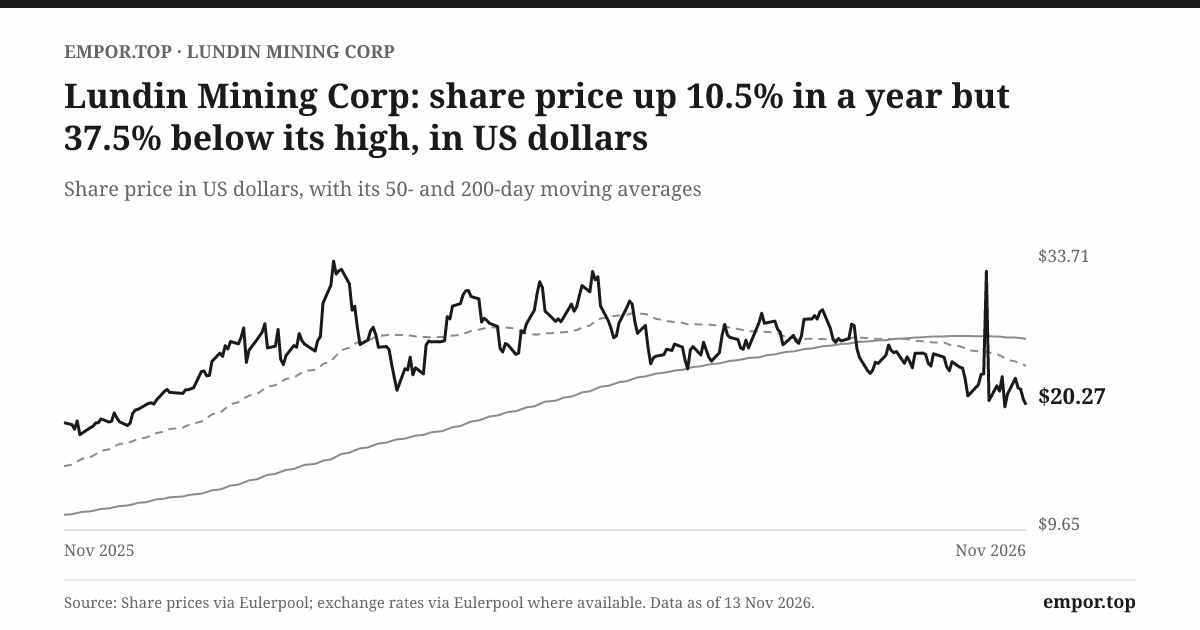
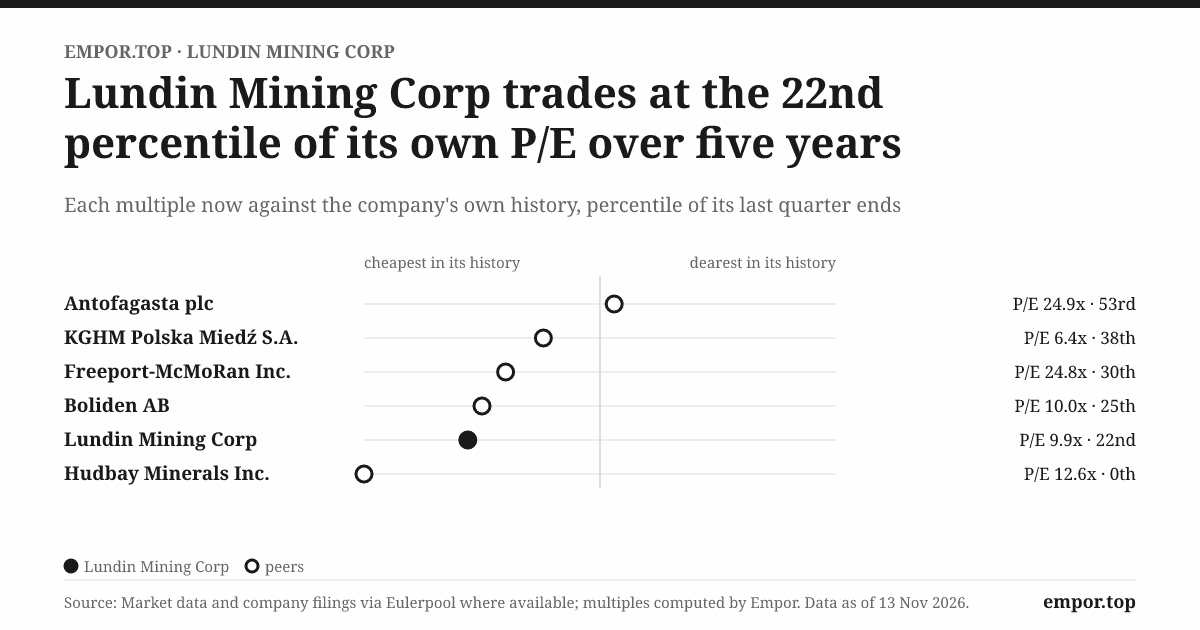
On November 13, 2026, Lundin's shares traded at about $20.27, some 37.5% below their 52-week high.2 They had fallen by more than a tenth on the day after the November results,17 in a year in which one-year volatility reached about 78% and the shares had at one point, over five years, fallen by more than half from peak to trough.2 On a trailing basis the stock traded at about 9.9 times earnings, against a five-year median of about 15 times; at about 6.8 times enterprise value to EBITDA; and with a free-cash-flow yield of about 8%.2 For context only, MarketScreener's estimates for Boliden, the European buyer of Lundin's old mines, showed about 10.8 times 2026 earnings and 5.7 times EV/EBITDA, though those are forward estimates rather than trailing figures and not a like-for-like comparison.24
At first glance, a discount to its own history looks like a bargain. The problem is that the history is distorted. The five-year median P/E includes years when earnings were depressed, so a high multiple of low earnings set the benchmark. The latest trailing earnings include record copper prices and benefit from a large deferred tax recovery in late 2025. A low multiple of peak earnings is not necessarily cheap. The market appears to be pricing Lundin as a producer whose current profits are elevated by copper and whose growth project carries real risk, not as a company it has overlooked.
The bull case starts with cash. The three mines generated about $3.48 billion of revenue in the first nine months of 2026, and the company ended September with net cash and a large undrawn credit line.3 Its low operating costs have left a wide margin at current copper prices.1 Even after the storms, it is generating free cash flow at a rate that funds buybacks, dividends and Vicuña's early spending at the same time.
Then there is the growth option. Vicuña, if built close to plan, could make Lundin a much larger producer with a decades-long resource base, with BHP as a partner bringing technical and financial weight. Recent Argentine approvals and the San Juan agreement have reduced some political risk. And the company has shown, at its operating mines, that it can run multiple mines across Chile and Brazil.
The bear case starts with the copper price, the single largest driver of Lundin's earnings, which management does not control. Current profits rest on prices well above Vicuña's own base-case assumption of $4.60 a pound. If copper returns toward that level, earnings, free cash flow and the funding capacity for Vicuña all shrink at once.
Then come the specific weaknesses: Caserones' two guidance cuts in a year, the unexplained 55% customer concentration, and Vicuña's scale, inflation pressure and respectable rather than outstanding returns at conservative prices. The history of asset sales and acquisitions makes it hard to measure organic performance. And the company has both issued shares for growth and bought them back, which can destroy value if the timing is wrong.
The competitive map
Seen through Michael Porter's five forces, Lundin's industry is structurally tough. Buyers have meaningful power: concentrate is a standardised product priced off a global benchmark, and smelters negotiate treatment charges hard. The single buyer taking 55% of sales intensifies that power. Suppliers, especially labour, power, diesel and equipment providers, can push up costs, which are also exposed to currency swings in Chile and Brazil. The threat of new entrants is low in the short term because new copper mines take a decade or more and billions of dollars to build, which is the industry's real barrier. Substitutes and recycling limit pricing power over the long term: aluminium replaces copper in some wiring when prices spike, and scrap supply rises with price. Rivalry among existing producers is muted only because no one controls price; everyone is a price-taker.
Hamilton Helmer's seven powers framework sharpens the question of what, if anything, protects Lundin's returns. Scale economies exist in mining, but Lundin is an intermediate producer, not a scale leader. Network effects, switching costs and brand are essentially irrelevant in a commodity sold by formula. Counter-positioning does not apply. Process power, the idea that an organisation's embedded know-how lets it operate more efficiently than rivals, is the most plausible candidate, given Lundin's operating experience; uneven returns through the cycle and the Caserones setback leave it unproven. The one power with real substance is access to Vicuña, a world-scale deposit that is genuinely scarce. Even that power only becomes valuable if the resource is built into a mine at a reasonable cost.
Lundin's operating edge remains unproven as durable.
The three numbers that decide it
Three measures will tell investors more than any others. The first is production and cash costs against guidance at each mine. The latest reading shows Caserones lagging the other mines.115 The direction at Caserones is down; the question is whether 2027 restores the run-rate. The second is free cash flow after sustaining capital and distributions, which varies with copper prices and capital allocation.51 The third is Lundin's attributable funding, cost and schedule for Vicuña, with the updated estimate pending.1
The valuation test that matters is not the trailing P/E. It is what Lundin's earnings and free cash flow would look like at a copper price closer to Vicuña's study assumption, after sustaining capital and after Lundin begins funding its share of construction. If the shares still look reasonably priced on that basis, the discount is meaningful. If not, the low multiple simply reflects peak earnings. The lessons from Lundin's history help explain which of those is more likely.
Business & Investing Lessons
The first lesson comes from Chapada and Caserones: a good mine is not yet a good acquisition. The test is whether the cash a mine returns over time exceeds the price paid and the capital it later consumes. Investors who praise a company for buying "great assets" should ask the second question, not the first.
The second lesson comes from Tenke and the European mines: selling an asset can create value; it cannot replace a return. Both sales were defensible, but the value created depends on what the cash buys next. For Lundin, the answer is increasingly a single project in the Andes. Shareholders who cheered the proceeds are now, in effect, being asked to accept Vicuña as the return on those sales. The test of a disposal is not the price received; it is what the buyer of your next asset receives from you.
The third lesson belongs to Vicuña: a resource estimate is a promise written in geology. Rock is not revenue. Between a study and a shipment lie years of construction and risks that no resource estimate can settle. Mining history is littered with companies that owned world-class resources and destroyed value building them. The size of the prize is the reason to care about Vicuña. It is not the reason to believe it.
The fourth lesson comes from the storms and the sinkhole: in mining, the price is global; the mistakes are local. Lundin's 2026 production cuts and the unresolved Alcaparrosa matter because no amount of global demand can compensate for failures at individual mines. For investors in miners, the macro thesis tells you the size of the tide. The local execution tells you whether the boat floats.
And the last lesson is particular to this company. Lundin's buy-and-build history produced a portfolio of cash-generating mines and a seat at one of the best development projects in the world. But Vicuña is a different order of commitment: the first time the company will have to build rather than buy, and the first time the growth asset is larger than the business that pays for it. The skill that built Lundin was portfolio judgment. The skill that will define it next is construction discipline. Those are not the same thing, and a company can excel at one while failing at the other.
Epilogue
Tonight, Lundin Mining stands at a hinge. Its mines in Chile and Brazil are producing copper at costs a fraction of the price it sells for. Its balance sheet holds more cash than debt. Its shares trade well below their highs. And somewhere in the offices of Lundin and BHP, engineers and financiers are finishing a capital estimate that will determine how much the next decade costs.
The first moment to watch is the sanction decision for Vicuña's first stage, which management has said could come as early as the end of 2026.1 If the plan arrives with a capital figure close to the $7.1 billion study estimate, a clear split of Lundin's share, a debt schedule within the limits of its credit facility and no need for significant new equity, it will mark the moment Vicuña moves from promise to programme. If instead the cost rises sharply, the schedule slips, or the funding plan relies on share issuance or large streams, investors will learn that the price of the future is higher than they assumed. Either outcome will reset the investment case.
The second moment is the first quarters of 2027 at Caserones. Management has promised that the lost tonnes are deferred, that higher-grade ore will arrive, and that standby costs will not recur. Each of those claims can be checked against quarterly production, costs and grades. A clean recovery would restore confidence in the guidance process. Another weather-driven miss would raise the question of whether the mine's forecasts need a permanent weather discount.
The third moment is quieter: the next disclosure of customer concentration. If the 55% customer fades back toward the historical pattern, the episode will look like a timing quirk. If it persists, investors will want to know who the buyer is, what the contract says and what happens if it ends.
And beyond those, there is the slower test that only time provides: several quarters in which Lundin's portfolio does not change.
Outro
Go back to the November 4, 2026, quarterly report. It captured the distance between the cash-generating mines Lundin runs today and the project it hopes to build.
Lundin’s history has repeatedly turned one kind of value into another. Vicuña is its largest and hardest-to-reverse conversion yet.
Today’s mines create the cash. Over the next decade, Lundin must show it can turn that cash into a larger business without letting construction consume the value it is meant to create.
References
-
Lundin Mining Reports Third Quarter 2026 Results, Delivering Strong Financial Performance Amidst Record Copper Prices — Lundin Mining, 2026-11-04 ↩↩↩↩↩↩↩↩↩↩↩↩↩↩↩↩↩↩↩↩↩↩↩↩↩↩↩↩↩↩↩↩↩↩↩
-
Investor Relations: financial reports and stock information — Lundin Mining ↩↩↩↩↩↩↩↩↩↩↩↩↩
-
Q3 2026 MD&A and Financial Statements — Lundin Mining, 2026-11-04 ↩↩↩↩↩↩↩↩↩↩↩↩↩↩↩↩↩↩↩↩↩↩
-
Presentations and Webcasts, including Vicuña technical report and Capital Markets Day materials — Lundin Mining ↩↩↩↩
-
2025 Annual Report — Lundin Mining, 2026-04-28 ↩↩↩↩↩↩↩↩↩↩↩↩↩↩↩↩↩↩↩↩↩↩↩↩↩↩↩↩↩↩
-
Lundin Mining Announces Closing of Acquisition of 80% Ownership Stake in Candelaria/Ojos del Salado — Lundin Mining, 2014-11-03 ↩↩↩
-
Lundin Mining to Acquire a Majority Interest in the Caserones Copper Mine — Lundin Mining, 2023-03-27 ↩↩↩
-
Lundin Mining to Acquire Chapada Copper Mine in Brazil — Lundin Mining, 2019-04-15 ↩↩↩
-
Lundin Mining Completes Joint Acquisition of Filo With BHP and 50% Sale of Josemaria to Form Vicuña Corp. — Lundin Mining, 2025-01-15 ↩↩↩↩↩
-
Lundin Mining Announces Completion of Sale of Interest in TF Holdings for $1.136 Billion — Lundin Mining, 2017-04-19 ↩↩↩
-
2026 Notice of Annual Meeting and Management Proxy Circular — Lundin Mining ↩↩↩↩↩↩↩↩↩↩↩↩↩↩↩
-
Lundin Mining Announces Closing of Acquisition of Josemaria Resources and Provides Update on Josemaria Project — Lundin Mining, 2022-04-28 ↩↩
-
Josemaria Announces Completion of Plan of Arrangement with Lundin Mining — Josemaria Resources via Cision, 2022-04-28 ↩
-
Lundin Mining Q3 Earnings Call Highlights — MarketBeat, 2026-11-08 ↩↩↩↩↩↩↩↩↩↩↩↩↩↩
-
Lundin Mining Cuts Caserones Copper Guidance as Record Prices Drive $648M EBITDA — Business News Today, 2026-11-11 ↩↩↩
-
First Quantum Announces 2025 Preliminary Production and 2026–2028 Guidance — First Quantum Minerals ↩
-
2026 Annual Meeting Voting Results — Lundin Mining, 2026-05-07 ↩↩
-
Lundin Mining Reports on Legal Notice Pertaining to the 2022 Sinkhole at the Alcaparrosa Mine — Lundin Mining, 2025-01-30 ↩↩
-
Lundin Mining Reports on Civil Claim Pertaining to the 2022 Sinkhole at the Alcaparrosa Mine — Lundin Mining, 2025-09-07 ↩
 LinkedIn
 WhatsApp
 Reddit
 Hacker News
 Email
 Kindle
 RSS Feed
 Spotify
 Apple Podcasts
 Amazon Music
 Audible
 YouTube