JSC National Atomic Company Kazatomprom: The Uranium Giant That Learned to Leave Pounds in the Ground
The biggest producer chooses not to produce
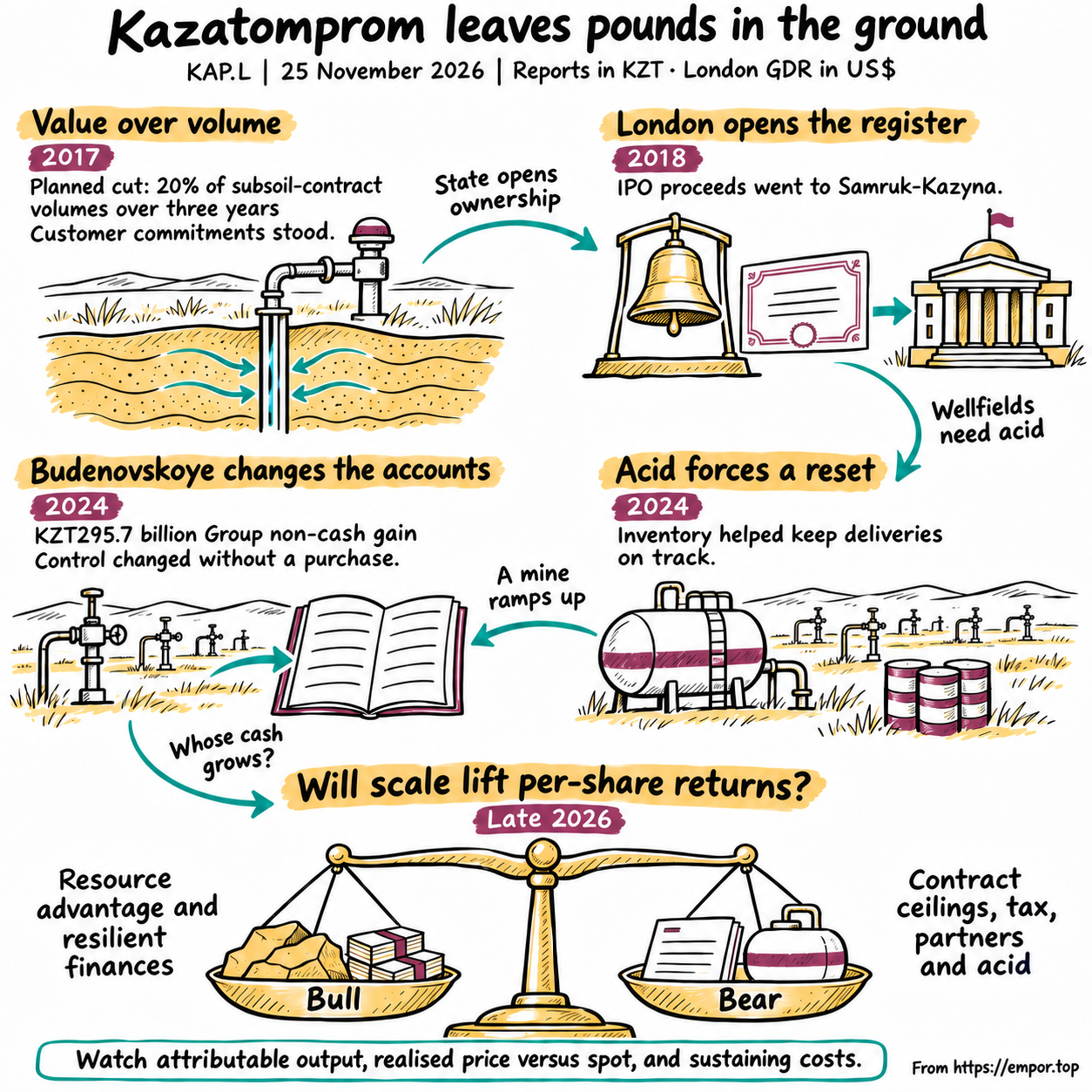
On 21 December 2017, in a briefing room in Astana, the chief executive of the world's largest uranium miner stood up and promised to make less of the thing his company existed to sell. Galymzhan Pirmatov (Галымжан Пирматов), who ran Kazatomprom (Қазатомөнеркәсіп), said the company intended to reduce uranium production by 20% of its contracted subsoil volumes over the next three years.1 Then he added the sentence that would define the decade that followed: the cuts would not affect the company's existing supply obligations to customers.1
Think about how strange that is. Most miners are built to dig. Their engineers are paid to hit tonnage, their bankers lend against output, and their governments count royalties by the truckload. A miner that deliberately leaves ore in the ground is usually a miner in trouble. Kazatomprom was not in trouble. It was the low-cost leader in a market that had been falling for six years, and it had concluded that every extra pound it produced was pushing the price down on all the other pounds it sold.
The uranium market in 2017 was a sad place. The Fukushima accident in 2011 had shut Japan's reactor fleet, Germany had decided to leave nuclear power, and utilities that had signed long-term contracts at higher prices were sitting on inventories they did not need. Producers kept producing anyway, because a mine has fixed costs and a government partner who wants revenue. The result was a glut. Kazatomprom, which says it has supplied at least a fifth of the world's uranium since 2011, decided to be the one to blink first.2
Nine years later, the company is still the biggest producer in the business. Its attributable output in 2025 was about 20% of global primary uranium supply, according to industry consultant UxC, and the wider Kazakh industry it leads accounted for roughly 39% of the world's mined uranium.3 Uranium made up about 91% of its 2025 Group revenue, which means this is not a conglomerate with a mining division. It is a uranium company, almost pure.4
That purity is the reason the 2017 decision matters so much. A company that controls a fifth of global supply has a lever that most commodity producers do not: it can change the market it sells into. The question this story tries to answer is whether that lever turns into durable returns for the people who own the shares, or whether it is a lever that works only in certain kinds of markets, at certain moments, for certain owners.
There are four ways that question breaks down. The first is about profit. Kazatomprom's net profit grew about 31% a year in its own currency over the decade to 2025, which sounds extraordinary, but over the last three years the figure was closer to 5.5% a year.4 One reason is that 2024 included a large one-off accounting gain that flattered the base year.
The second is about cash: can higher uranium demand become more cash profit for this company, given contract ceilings, partners who own pieces of its mines and a government that keeps adjusting the tax? The third is physical: can its wellfields actually deliver the volumes and costs its strategy assumes, when a chemical as humble as sulphuric acid has repeatedly forced the company to rewrite its plans? The fourth is political: does state ownership protect minority investors or constrain them?
Before going further, it is worth being precise about what a London investor actually owns. The security that trades on the London Stock Exchange under the ticker KAP is a global depositary receipt, and each one represents one ordinary share in the Kazakh company.2
The financial statements are those of the Kazatomprom Group, meaning the company and the subsidiaries it controls, with joint ventures and associates generally accounted for as a share of their profits.4 That Group sits inside a much larger state holding company, Samruk-Kazyna (Самұрық-Қазына), Kazakhstan's sovereign wealth fund, but Samruk-Kazyna's other businesses are not part of this story.
There is one more distinction a listener needs to carry through the episode, and it is the one that trips up almost everyone who looks at this company for the first time. Kazatomprom reports production three different ways. There is production on a 100% basis, which counts every tonne mined at every operation in which it holds a stake. There is attributable production, which counts only Kazatomprom's ownership share of each operation.
And there are Group sales, which include the sales of consolidated subsidiaries even where partners own nearly half. In 2025 the company produced about 25,800 tonnes of uranium on a 100% basis, but only about 13,500 tonnes on an attributable basis.3 Roughly half of the uranium that comes out of the ground with the Kazatomprom name on the wellfield belongs, economically, to somebody else.
So the story begins with a paradox and ends with a tension. A producer can protect the value of its resource by restricting supply. But it must still make, and deliver, the pounds its customers have already contracted for. In 2017 holding back was a choice. Later in this story it would become something the company could not avoid. To see why both matter, it helps to start with the moment ordinary investors were invited in.
 Subscribe on LinkedIn
A national uranium champion goes public
On 16 November 2018, the bell rang in London for a company that had never answered to outside shareholders. Kazatomprom's global depositary receipts began trading on the London Stock Exchange's International Order Book, alongside a listing on the new Astana International Exchange at home.5 Pirmatov called it "a historic moment."5 For Kazakhstan, it was also a statement of intent: the country's most strategic export business was opening its books to the scrutiny of international capital markets.
The company that went public had been assembled over two decades. Kazatomprom was set up in 1997, in the turbulent years after the Soviet collapse, as the national operator for the uranium industry the Soviet system had left behind in the steppe of southern Kazakhstan; in August 2026 its chief executive described the company as having spent 29 years as a primary supplier to global utilities.6 Its legal status still reflects that origin. It is the national operator for the export and import of uranium, nuclear fuel and related technologies in Kazakhstan.7
Its assets are a patchwork of partnerships. The company today operates 14 mining assets across 27 deposits or blocks, all in Kazakhstan and all mined by in-situ recovery.7 Only two of those mining companies are wholly owned.
The other twelve are shared with partners, including foreign utilities and fuel-cycle companies that took stakes in exchange for capital, technology or guaranteed offtake in the years when Kazakhstan was building itself into the world's largest uranium supplier.7 That structure explains why the attributable numbers matter so much: Kazatomprom is less a single mining company than the senior partner in a web of joint ventures.
Jon Dudas chaired the board at the time of the listing.5 A London listing brings disclosure rules, independent directors and the scrutiny of international analysts into an institution born in the post-Soviet 1990s. Whether those habits would carry real weight against a controlling state shareholder was a question the listing could open but not answer.
What did the London buyers actually get? The offer raised about $451.3 million and valued the whole company at roughly $3 billion.5 But none of that money went to Kazatomprom. Samruk-Kazyna was the selling shareholder, and the prospectus described a sale of its existing shares, not the issue of new ones.2 The wellfields did not get a single new tenge from the listing. The money went to the state.
That is a detail worth pausing on, because it shapes the incentives on both sides of the table. In a primary listing, management raises money to build something, and investors judge whether the something gets built.
In a sell-down, the state is monetising a slice of an asset it continues to control, and the question for investors is whether the controlling owner will run the asset for the benefit of all its shareholders or for its own wider priorities. Samruk-Kazyna sold further shares in secondary placements in 2019 and 2020; those were also sell-downs rather than capital raises.8
The ownership changed shape again in July 2024, though not in a way that helped the free float. An about 12% block moved from Samruk-Kazyna to the Ministry of Finance, held for the National Fund.9 One arm of the state handed shares to another arm. By the end of 2025, Samruk-Kazyna held about 63%, the Ministry of Finance about 12% and the public 25%.10 The issued share count stayed at 259,356,608 throughout; there have been no rights issues, buybacks or new equity since the listing.4
Eight years on, the market has rewarded those who bought in. By late November 2026 Kazatomprom was valued at about $14.3 billion, close to five times the IPO valuation, after years of dividends that consumed most of its free cash. Between 2014 and 2025 dividends absorbed about three-quarters of the company's cumulative free cash flow, with the payout typically around 45% of net profit and 57% in 2025.4
But the price of that access is plain. Public investors own a quarter of the economics and almost none of the decisive votes. The state, through two entities, holds three-quarters. That is the bargain of the listing: a liquid way into the world's most important uranium producer, on the condition that the producer's strategy is ultimately set by the government of Kazakhstan. And the most important strategy the company had, by the time it listed, was the one Pirmatov had announced eleven months earlier.
The supply cut that became the strategy
To understand why a producer would announce a cut at all, imagine a bakery that supplies a fifth of a town's bread. If the town is drowning in loaves, the bakery can keep baking and watch prices fall for everyone, including itself. Or it can bake less, keep its flour in the store, and hope the other bakers do not fill the gap. The second option only makes sense if the bakery is big enough that its restraint changes the price, and patient enough to wait.
Kazatomprom decided it was both. The December 2017 announcement framed the 20% reduction against the volumes in its subsoil use contracts, the production levels the Kazakh state had licensed each deposit to deliver.1 It was not a cut against actual production in the prior year, which meant the headline "20%" was always measured against a theoretical ceiling rather than a past output. Investors who missed that nuance would overstate how much uranium was actually withdrawn.
The company later gave its own tally. By its account, Kazatomprom removed more than 130 million pounds of primary production from the market between 2017 and 2025.11 For scale, total global reactor requirements in 2025 were around 170 million pounds a year, according to management on the full-year call.11 On the company's own numbers, it withheld the equivalent of most of a year's global demand over eight years.
Management gave this policy a name, "value over volume," and kept extending it. The cut was meant to last three years; it became an ongoing posture. On the March 2026 full-year call, chief executive Meirzhan Yussupov (Мейржан Юсупов) said the company was "strictly following" the strategy and would develop assets "at a pace that matched the real market demand and long-term customer commitments."11 By August 2026 his language had hardened: "We will not sell our pounds underpriced."6
Did it work? The consensus narrative says yes. Prices recovered from the trough, the spot price crossed $100 a pound at the end of January 2024 for the first time since 2007, and long-term contract indicators reached about $96.50 a pound by the end of August 2026, above their 2007–08 peak.12 Kazatomprom's management draws a straight line from its discipline to that recovery.11
The record is more complicated. Many forces moved the uranium price after 2017: Cameco's own mine suspensions, Russia's invasion of Ukraine and the scramble by Western utilities for non-Russian supply, financial funds buying physical uranium, and a political rehabilitation of nuclear power as a source of clean baseload electricity. Kazatomprom's restraint was one of these forces, and possibly an important one, but the company's claim that its discipline caused the recovery is a claim, not a measured fact. A producer cannot run the counterfactual in which it kept digging.
There is a sharper test, and it comes from the company's own history. "Value over volume" assumes that Kazatomprom chooses its volume. Between 2023 and 2025 that assumption broke. On the March 2024 full-year call, Yussupov conceded that the year's reduction was "not fully attributable to our strategy, but was partially a forced measure" caused by sulphuric acid shortages and construction delays at new deposits.13 A strategy of restraint became, for a while, a description of what the company could physically manage.
That distinction matters for investors because supply discipline and execution are two different strengths. The first is a commercial decision that boardrooms can make in an afternoon. The second depends on acid deliveries, drilling rigs, design approvals and the chemistry of buried sandstone.
Kazakhstan's subsoil rules give producers room to flex output up or down by about 20% around licensed levels, as chief financial officer Marat Tulebayev explained in March 2026, which is what makes the strategy legally possible.11 But the room to flex down is not the same as the ability to go up when you want to.
There is a second subtlety. When Kazatomprom restrains output, its partners restrain too. On the March 2026 call, an analyst asked whether there were negotiations with joint-venture partners following "the decision not to return to 100% subsoil use level production." Yussupov answered that the company was "still in negotiations with our partners to find the right volume of production for this year."11 That is an admission that the policy is negotiated, asset by asset, with partners whose interests are not always identical to Kazatomprom's.
So the verdict on the strategy narrows rather than collapses. The record supports the claim that Kazatomprom has been willing to forgo volume when prices were weak, and that it has held the line for nearly a decade. It does not prove that the company controls price, and it does not prove that the company can turn the volume back on at will.
The way to test the claim is not to listen to management's description of the strategy but to watch four things over time: production against guidance, sales against delivery schedules, realised prices against spot, and attributable profit against reported Group growth. Each of those numbers tells you whether the strategy is a choice or a constraint.
And to understand why the choice can become a constraint, you have to go underground, to a wellfield in the Kazakh steppe where uranium is not dug at all.
The advantage is in the wellfield, not a subscription
Picture a flat, dry plain in southern Kazakhstan, dotted in neat grids with plastic wellheads and pipes. There are no open pits, no headframes, no trucks hauling rock. Below the surface, between layers of clay, lies a porous sandstone soaked in groundwater that carries tiny amounts of uranium.
Operators drill wells into that sandstone, pump down a weak solution of sulphuric acid, and let the acid dissolve the uranium as it moves through the rock. Then they pump the uranium-bearing solution back up through other wells, strip the uranium out at a processing plant, and turn it into a yellow powder called uranium concentrate, or U3O8.
This is in-situ recovery, or ISR, and it is the reason Kazatomprom exists in its current form. Of the roughly 37,800 tonnes of uranium the world extracted by ISR in 2025, about 68% came from Kazakhstan.7 Compared with conventional hard-rock mining, ISR needs no blasting, no crushing, no tailings dams and far fewer people per tonne. In the right geology it is cheap. Kazakhstan has a lot of the right geology.
The best analogy is a coffee machine rather than a quarry. You do not dig up the coffee; you run hot water through the grounds and collect what comes out. The quality of the cup depends on the grounds, the water and the plumbing.
In Kazatomprom's case, the grounds are the deposit, the water is sulphuric acid, and the plumbing is the wellfield, which has to be drilled, piped and acidified months before it produces anything. That last point is easy to miss and central to everything that follows: an ISR mine cannot simply be switched on. New wellfield blocks must be prepared continuously to replace old ones as they deplete.
The resource base behind those wellfields is enormous. At the end of 2025 Kazatomprom's attributable proved and probable ore reserves were about 283,000 tonnes of uranium, under the JORC reporting code used by Australian and international miners.7 At current attributable production of around 13,500 tonnes a year, that is roughly two decades of output on reserves alone, before counting the much larger resource base behind it.3
The company has also said it tripled its spending on geological exploration and began work on six new blocks covering more than 1,000 square kilometres, while warning that whatever it finds now will not produce until the late 2030s or early 2040s.11
How a pound becomes revenue
The commercial side of the business is simpler than the geology but no less important. Kazatomprom sells uranium products, overwhelmingly U3O8, and it recognises revenue when it delivers. In 2025, about KZT1,791 billion of its KZT1,803 billion revenue was recognised at a point in time.4 There is no subscription, no recurring licence fee, no software-style annuity. Customers, overwhelmingly nuclear utilities, buy repeatedly under long-term contracts with their own delivery schedules, and those schedules can shift by quarter at the customer's request.7
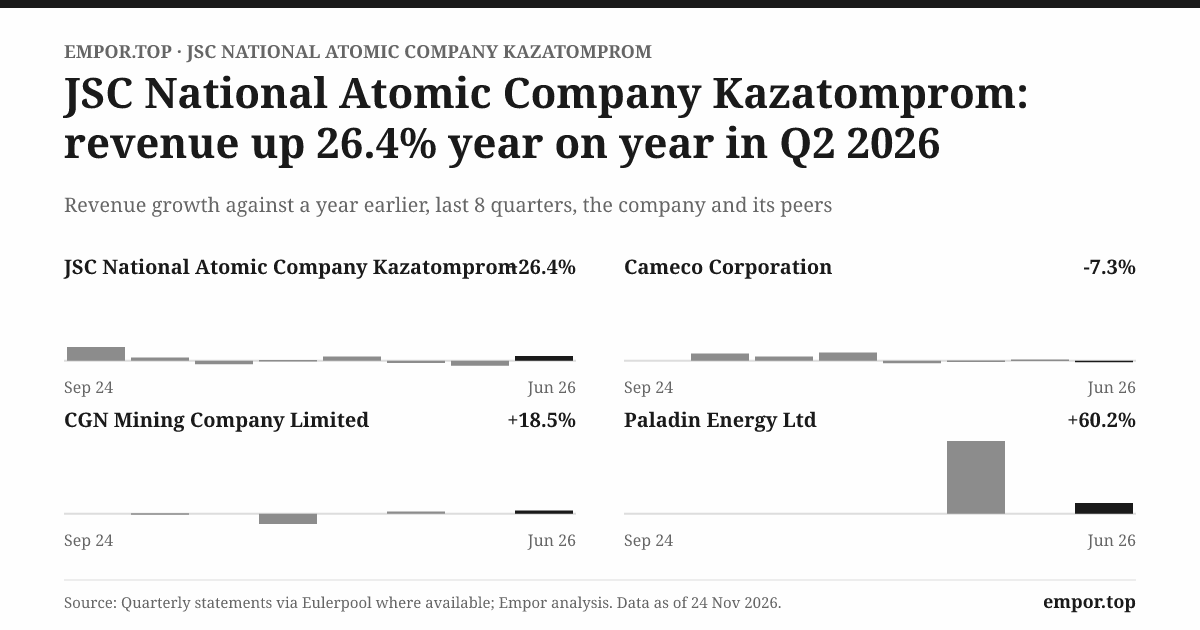
That lumpiness shows up in the quarterly numbers. In the first quarter of 2026, Kazatomprom recorded revenue of only about $313 million and a small net loss attributable to shareholders, before revenue jumped to about $1.2 billion in the second quarter.7 Nothing broke between those quarters. Utilities simply took their deliveries later in the year. The company itself warns that quarterly metrics in uranium "are rarely representative of annual expectations."7 Anyone tracking this company quarter to quarter is tracking delivery calendars as much as business performance.
Pricing is the most misunderstood part of the model. Most of Kazatomprom's long-term contracts link the price to the spot market at or near delivery, but some deliveries carry fixed-price components, including ceilings negotiated, as the company puts it, "during a different pricing environment."7 The effect is visible in the company's own sensitivity table.
If the spot price averaged $100 a pound, management estimates its Group realised price would be about $80 in 2026, rising toward about $93 by 2030 as older contracts roll off.7 At $80 spot, the 2026 realised price would be around $74.7 Put simply, Kazatomprom captures most but not all of a price rally, and less of it in the short term.
The protection works the other way too. In 2025, when the average month-end spot price fell 14%, the Group's average realised price fell only 6%, to about $65 a pound.3 Ceilings that cost the company upside also come bundled with structures that soften the downside. That is the nature of a long-term contract book: it trades volatility for predictability. The company describes the correlation between its annual realised price and spot as "moderate."7
Who has the leverage
The low-cost position is the first half of the moat argument. In 2025, Kazatomprom's attributable C1 cash cost, the direct cost of producing a pound before capital spending, was about $18 a pound; its all-in sustaining cash cost, which adds the capital needed to keep production steady, was about $30.3 Set that against a Group realised price of about $65, and each attributable pound produced in 2025 left roughly $35 of margin after sustaining costs.3 That is the kind of spread most mining companies only see at the top of a cycle.
But the cost lead is not fixed, and the direction is the story. C1 cost rose 9% in 2025 and all-in sustaining cost rose 7%; management attributed the C1 increase mainly to a higher mineral extraction tax rate and inflation in materials and supplies, while higher well construction and drilling costs raised capital spending.3 Then 2026 arrived.
Kazakhstan introduced a differentiated mineral extraction tax from 1 January, linking the rate to each licence's annual production and to the uranium price. The tax had been 6% in 2024 and a flat 9% in 2025; in the first half of 2026 it averaged 12.4%.37 The tax alone rose from about $6 to about $10.60 per attributable pound, and it now accounts for 43% of the company's cash cost.7
The design of that tax deserves a moment, because it changes the shape of the upside. The company's own sensitivity table shows the blended rate climbing with both price and volume: at a $60 spot price and the low end of 2026 production guidance, the rate would be about 11.2%; at $110 and the top of the range, about 14.3%.7
In effect, the Kazakh state has written itself a call option on the uranium price. The higher prices go, and the more Kazatomprom produces, the bigger the government's slice of each pound. For an investor, that means the operating leverage that makes a low-cost miner exciting in a bull market has been partly transferred to the treasury.
In August 2026 management raised its full-year guidance for C1 cost to $25.50–$27 a pound and all-in sustaining cost to $39–$40.50, up from earlier ranges of $23.50–$25 and $35–$36.50.7 Now compare that with prices. Over the first nine months of 2026, the Group's average realised price was about $73.50 a pound, up 17% from a year earlier.14
Subtract an all-in sustaining cost near $40, and the margin per pound is roughly $34. In other words, prices rose by about $8 a pound and costs rose by roughly the same amount. The rally went, in large part, to the Kazakh treasury and to the acid suppliers.
That is the most important single relationship in this story, and it overturns the simplest bull narrative. "Uranium goes up, Kazatomprom earns more" is true only to the extent that the state does not capture the increase through taxes, the contract book does not cap it, and inputs do not inflate with it.
In 2026, all three happened at once. Care is needed when comparing these cost figures with rivals: Kazatomprom's C1 and AISC are reported on an attributable basis using its own definitions, and peers use different scopes, so precise cost league tables across producers are not reliable without aligning methodology.
Who else supplies the world's uranium? The named rivals are Canada's Cameco, France's Orano, China's 中国核工业集团 China National Nuclear Corporation, Uzbekistan's Navoi, and the uranium businesses of Russia's state nuclear corporation, Росатом Rosatom, including its international subsidiary Uranium One. Cameco is also Kazatomprom's partner in JV Inkai, where Kazatomprom holds 60%.715 Chinese and Russian groups own equity in mines across Kazakhstan, Niger, Namibia, Uzbekistan and Canada.12 That overlap is a defining feature of the industry: Kazatomprom's competitors are frequently its partners and its customers at the same time.
Geography adds a twist that most commodity businesses never face. Kazakhstan is landlocked, wedged between Russia and China, and its uranium must travel thousands of kilometres to reach Western conversion plants. Kazatomprom has leaned increasingly on the Trans-Caspian International Transport Route, the so-called Middle Corridor across the Caspian Sea, alongside its traditional northern route.6 In the first half of 2026 selling expenses rose 23%, which management attributed to changes in delivery destinations and transport mix, including greater use of that route, rather than to the conflict in the Middle East.6 Logistics is a cost of being neutral between East and West, and it is one competitors in Canada or Australia do not pay.
The customer side is concentrated. Nine main customers accounted for about 75% of 2025 Group revenue and 80% of year-end trade receivables, and a single group of customers under common control generated about KZT781.5 billion, more than 10% of Group revenue.4 By country of domicile, China was the largest market at about KZT797 billion, followed by Russia and the United States at about KZT218 billion and KZT204 billion.4
Kazatomprom does not name its concentrated customers, nor does it publish a standard contract length, a minimum purchase commitment or a recurring-revenue percentage.4 Industry-wide, the World Nuclear Association notes most trade runs under three-to-fifteen-year term contracts.12
Put these pieces into Michael Porter's frame and the shape of the moat emerges. Supplier power is low on the core resource, because Kazatomprom holds priority access to the deposits, but high on inputs: acid and drilling services are the pinch points. Buyer power is real: a few large utilities and state fuel buyers account for most revenue, they deliberately multi-source, and they negotiate price ceilings.
Substitutes are weak in the short run, since a reactor cannot run on anything else, but new mines elsewhere are the long-run threat. In Hamilton Helmer's language, Kazatomprom's strongest powers are scale economies and a cornered resource: the geology and the licences. It lacks switching costs, brand power or network effects. Its customers are loyal to supply security, not to Kazatomprom.
That combination supports a strong production position, but not unlimited pricing power. Production share is evidence of scale. It is not proof that the company sets the price. The low costs of 2025 bought high margins; 2026 guidance shows those costs climbing just as uranium prices lift revenue. And the biggest threat to the low-cost position did not come from Saskatchewan or Niger. It came from a shortage of acid.
The acid shortage turns a supply strategy into an execution test
On 12 January 2024, Kazatomprom issued a warning that hit the uranium market like a shot. The company said it might cut its 2024 production plan because of difficulties obtaining sulphuric acid, and that current forecasts indicated it "may find it difficult to achieve 90% production levels" against its subsoil use contracts.16 Months earlier, the company had signalled ambitious growth: output of 25,000 to 25,500 tonnes in 2024 and 30,500 to 31,500 tonnes in 2025, up from 20,500 to 21,500 tonnes in 2023.16 Those numbers were about to be torn up.
Why acid? Return to the coffee machine. Sulphuric acid is the hot water. It is used twice in an ISR mine: first to acidify a new wellfield block before production, which consumes 20% to 35% of the total acid volume, and then to leach uranium during production, which consumes the rest.13 Because a large share of acid is used before any uranium appears, the relationship between acid and output is not linear. A company trying to grow needs a lot of acid up front, long before revenue arrives.13
Kazakhstan was short. For a couple of years its acid requirements had outrun domestic production capacity, after a long period in which the market had been in surplus.13 And acid has a powerful competing buyer: about 60% of the world's sulphuric acid goes into fertiliser production, so the farm economy has a large influence on availability.13
In 2023 Kazatomprom needed about 1.7 million tonnes of acid. Its two existing in-house plants were producing at full capacity, and its executives were frank that building new capacity was, in the words of Sultan Temirbayev on the March 2024 call, "easy to say, but hard to do."13
The second constraint was construction. At the newly developed deposits, the company said, mining entities risked falling below even the reduced production threshold because of delays building surface facilities and infrastructure, which were themselves caused by long timelines for preparing and approving project design documentation.13 It named the projects that mattered most: JV Budenovskoye, JV Katco and Ortalyk, where it planned to spend about KZT85 billion in 2024 to catch up.13
So in March 2024 management reset. In 2024, production at most operations would be about 20% below subsoil levels, and a swift return to 100% in 2025 "may be at risk."13 Management promised it remained "committed to its 2024 existing contractual obligations to all clients," and it leaned on inventory: year-end 2023 stocks of about 6,100 tonnes, comparable to roughly 10% of world supply.13 That inventory is the quiet hero of the period. It let Kazatomprom miss production plans without missing deliveries.
Now line up the promises against the outcomes. In 2024 Kazatomprom produced about 23,300 tonnes on a 100% basis, below the 25,000-tonne bottom of its original intention.3 In 2025 it produced about 25,800 tonnes, roughly 5,000 tonnes below the 30,500-tonne floor it had signalled before the acid shock.316 Then, in August 2025, a new competent person's report cut the company's nominal 2026 production level from about 32,800 tonnes to about 29,700 tonnes, a reduction of roughly 10%.3 The 2026 guidance of 27,500 to 29,000 tonnes sits below even that revised nominal level.3
To be fair to management, there is a distinction between targets. The 2025 result landed within the company's revised guidance, and the company met its sales guidance.11 Its customers got their uranium. What failed was the original growth intention, not the delivery promise. That is the right way to read the record: guidance discipline after the reset has been reasonable; long-range intentions before the reset were badly wrong.
The plant that keeps moving
The company's answer to the acid problem is a new sulphuric acid plant, Taiqonyr Qyshqyl Zauyty, or TQZ, built with the Italian engineering firm Ballestra, whose local partner bought a 60% stake, leaving Kazatomprom with an indirect 40%.3 The plant is designed for 800,000 tonnes a year. Combined with about 680,000 tonnes from the two existing plants, management has said it envisions around 1.5 million tonnes of in-house supply.3 That would still fall short of the 1.7 million tonnes the company needed in 2023, so TQZ reduces the dependence rather than ending it.13
The timing is where credibility gets tested. In March 2024, Temirbayev told analysts the plant had "already moved from 2026 to 2027."13 In the 2025 annual review, the company still spoke of in-house supply "starting from 2027."3 In March 2026, Tulebayev said the company would finish construction in 2027.11
Then, on the August 2026 call, Yussupov announced a regulatory work suspension at one of the TQZ construction sites after potential paleontological specimens were discovered.6 Commissioning, originally targeted for the first quarter of 2027, is now projected between the third quarter of 2027 and the first quarter of 2028.7 A plant meant to solve a 2023 problem may not run until 2028.
There is a partial offset, and it does not belong to Kazatomprom. Tulebayev told analysts in March 2026 that a second, third-party plant built by the fertiliser group EuroChem had been commissioned at the end of 2025, also with a capacity of about 800,000 tonnes, and that Kazatomprom had begun receiving acid from it.11 That is useful supply, but it is bought rather than owned, and its price follows the market. It eases the shortage without removing the company's exposure to acid costs.
Fossils are nobody's fault. But the pattern of slippage is the evidence that matters. Management has been candid about the delays, and it says it does not expect the latest one to have a material impact on mining, because it has supply channels from both domestic and cross-border producers.6 The investor's task is to keep both statements in view: the company explains its misses, but the misses keep arriving.
Meanwhile acid got expensive. Kazatomprom's weighted average acid cost rose about 43% in 2025 and another 39% in the first half of 2026, to about KZT97,300 a tonne, partly because global sulphur prices roughly quadrupled.37 Tulebayev noted that sulphur had gone from about $250 a tonne a year earlier to about $1,100, while Kazakh acid prices rose about 27%, because a large share of local acid comes from metal smelters rather than burned sulphur.6
Acid still represents only about 15% of uranium production costs, so the price shock hurts but does not dominate.7 When a UBS analyst asked in August whether 2027 acid was already contracted at higher prices, Tulebayev said the company did not yet have full coverage of its 2027 requirements and usually signs by October.6
Capital poured into the ground
The capital response has been heavy. Mining-entity capital spending on a 100% basis rose 25% in 2025 to about KZT398 billion, funding well construction and infrastructure at Katco, Ortalyk and Budenovskoye along with expansion at existing assets.3
The 2026 guidance was raised in August to KZT435–450 billion, partly because the company capitalises the acid used in initial well acidification, so acid inflation shows up as capex, and partly because drilling and well construction costs rose faster than forecast.7 Remember that these are 100%-basis figures, which include partners' shares; it would be a mistake to compare them directly with consolidated revenue as though all of it were Kazatomprom's own spending.
Set against that, direct research and development is tiny: about KZT1.46 billion in 2025, roughly 0.08% of Group revenue, across 30 projects.17 That is not a criticism. It simply tells investors what kind of company this is. There is no hidden technology platform here. The investment case rests on wells, pipes, processing plants and acid supply.
Kazatomprom's management has spoken about potentially moving into conversion and enrichment, and an analyst from Morgan Stanley pressed on it in August; the company said it had "several offers on the table" but nothing to announce.6 Until something is announced, that is optionality, not value.
Read across the three calls, from March 2024 to March 2026 to August 2026, and the management narrative has become more specific. In 2024 the explanations were general: shortages, delays, approval timelines. By 2026 they included quantified acid cost shares, tax rate sensitivity tables and a dated plant schedule.
Analysts in Q&A pushed hardest on two things: how much of the cost increase was currency rather than inflation, and whether 2027 acid was secured. On the first, the CFO said the currency and capex effects on the C1 revision were "pretty much equal" but could not be more precise.6 On the second, the answer was: not yet.
There is also a quieter reason the capex keeps climbing: some of the older mines are running down. On the August 2026 call, Tulebayev explained that output at JV Zarechnoye fell 29% in the first half because its subsoil agreement schedules declining production through 2028, after which the asset will close.6
Output at RU-6 and Semizbay-U was each down about 30% in the half, which management described as timing within an unchanged annual plan.67 An ISR miner is a treadmill. Every year, depleting blocks must be replaced by new ones simply to stand still, before any growth is possible.
Production is now rising again. In the first nine months of 2026, output rose 10% on a 100% basis to about 20,500 tonnes and 12% on an attributable basis to about 11,000 tonnes, and the company reiterated its full-year guidance in November.14 That is the live test. Higher output in 2026 creates value only if it arrives at costs and realised prices that leave attractive attributable returns. And the single biggest contributor to that growth is a mine whose accounting story is just as interesting as its geology.
Budenovskoye adds earnings without a new cheque
On 1 January 2024, nothing physical happened at JV Budenovskoye. No shares changed hands. No money moved. Kazatomprom still owned 51% of the company, as it had before. Yet from that date, Budenovskoye's revenues, costs and assets began flowing line by line into Kazatomprom's consolidated accounts, and the Group booked a non-cash gain of about KZT295.7 billion.418
What changed was a legal judgement. Following what management called significant changes to the venture's charter documents, Kazatomprom concluded that it now controlled Budenovskoye, rather than sharing control with its partner.134 Under international accounting rules, gaining control of a business is treated as an acquisition, even if you already owned the stake, and the previously held interest is remeasured at fair value. The difference between that fair value and the old carrying amount becomes a gain. It is real accounting, audited and properly disclosed. It is not cash.
That gain explains much of the strange shape of Kazatomprom's recent earnings. In 2024 the company's other income was about KZT402.7 billion, roughly 29% of profit before tax, most of it from the Budenovskoye remeasurement.3 In 2025 the comparable line was about KZT17.5 billion, under 2% of profit before tax.3 Net profit attributable to shareholders fell about 36% in 2025, from about $1.9 billion to about $1.1 billion, and headlines duly called it a slump.4 It was mostly the absence of 2024's one-off.
So what happened to the underlying business? Group revenue was roughly flat in 2025 at about KZT1.8 trillion, and attributable EBITDA rose about 11%, as joint ventures and associates sold more uranium.11 That is a more honest picture than either the 2024 surge or the 2025 fall.
The business grew modestly while prices dipped; the accounting made it look like a boom and then a bust. It also means the long-run net profit growth figures, the ones that look so spectacular over ten years, are flattered by the end-point. Strip out the one-off and the growth is lower.
There is a temptation to treat Budenovskoye as an acquisition and ask whether Kazatomprom overpaid. That question does not apply. There was no purchase price, no premium, no cheque. An acquisition multiple cannot be computed because nothing was bought. The right questions are different: what does Budenovskoye add to attributable production and cash, and who gets the rest?
Budenovskoye is the growth engine of 2026. Its output on a 100% basis rose 140% in the first half of 2026, to about 1,400 tonnes, as the mine ramped up.7 Management said the year-on-year increase in Group production was driven primarily by this ramp-up.11 But the entire 2024–2026 output of the mine is committed under an offtake contract at market-related terms, meaning Kazatomprom cannot sell those pounds into a rising spot market at its own discretion.37 And because Kazatomprom owns 51%, 49% of the economics belongs to its partner.
That partner share is now visible in the numbers. In the first half of 2026, Group adjusted EBITDA rose about 2%, but attributable EBITDA, the portion belonging to Kazatomprom's shareholders, fell about 12%, to roughly KZT265 billion.7 The reason, management explained, was "a higher share of sales and EBITDA of mining subsidiaries attributable to non-controlling partners."6 Profit attributable to non-controlling interests rose to about KZT84 billion for the half.7 The Group's growth accrued disproportionately to partners.
That is the moment the distinction set up at the start of this story stops being an accounting footnote and becomes the investment case. As the opening distinction makes clear, the Group's 9% production growth includes the partner's share; it does not mean Kazatomprom shareholders are 9% better off.
Then there is the question of cash. Across the twelve years from 2014 to 2025, Kazatomprom's cumulative operating cash flow was about 84% of its cumulative net profit.4 That is a decent long-run conversion rate, but it hides wild variation: in some years operating cash flow was barely a tenth of EBITDA, in others it exceeded it.4
Working capital, receivable collections, VAT refunds, taxes and non-cash gains all move the number. 2025 was a very strong cash year. Operating cash flow rose to about KZT810 billion from about KZT517 billion, mainly because receipts from customers rose by about KZT535 billion as sales volumes increased, and VAT refunds rose about KZT37 billion.3 Trade receivables halved over the year, from about KZT623 billion to about KZT312 billion.4
A big cash year after a big accounting year is not proof that the accounting year was repeatable; it is partly the 2024 receivables being collected. The right reading is that the 2024 profit included a gain that will never produce cash, while the 2025 cash included collections that belonged to the prior year's sales.
Over time, these effects wash out. Quarter to quarter, they mislead. In August 2026 an individual investor asked why free cash flow was close to zero in the second quarter despite higher prices; the company's financial controller pointed to lower sales volumes and the timing of deliveries.6
Capital deployment beyond the mines has been small. Kazatomprom invested in ANU Energy, a vehicle for long-term physical uranium storage, and holds stakes in fuel-cycle businesses including Ulba-FA, which makes fuel assemblies.4 These are strategically interesting and financially minor next to the mining capex. There is no transformative acquisition on the record against which to benchmark industry purchase multiples.
So the growth test for Budenovskoye, and for the wellfields alongside it, is easy to state and hard to pass: can new production add attributable cash profit after capex, rising costs, a higher tax take and the partners' share? The first half of 2026 suggests the answer depends heavily on which line of the income statement you read. And that leads to the shareholder who reads the whole statement, and owns three-quarters of it.
The state remains in the room
On 26 May 2026, Kazatomprom's annual general meeting approved its resolutions with more than 99% support from the voting shares represented.19 Of about 222.8 million voting shares, about 221.1 million were present.19 To an untrained eye, that looks like a unanimous vote of confidence. To anyone who knows the shareholder register, it looks like arithmetic. The state's 75% stake, held by Samruk-Kazyna and the Ministry of Finance, could pass any ordinary resolution without a single minority vote.10
That is the essential fact of governance at Kazatomprom. Overwhelming AGM support reflects the control structure as well as investor sentiment, and the published results do not separate the vote of the state from the vote of the free float. A minority investor cannot read the result as evidence that minority holders approved. They can only read it as evidence that nobody tried to block anything.
Ownership by the state is also not ownership by management. The chief executive, Yussupov, and the chief financial officer, Tulebayev, run the company as appointed managers of a state asset. The company does not disclose a meaningful personal shareholding by its executives that would make "skin in the game" a central part of the story.
Yussupov, who already led the company by March 2024, has the style of a sovereign operator: macro-heavy prepared remarks about global energy security, utilities shifting from "just-in-time" to "just-in-case" procurement, and Kazakhstan as a "trusted global partner," followed by firm, short statements of commercial discipline.613 Tulebayev, the first deputy CEO and CFO, is the one who takes the hard numerical questions on tax, acid and currency.6
How are they paid? Total remuneration for the Management Board and independent directors was about KZT1.05 billion in 2025, up from about KZT820 million in 2024.174 The annual performance bonus has a condition attached: positive consolidated net profit.17 That is a low bar. In 2024 it would have been comfortably cleared by an accounting gain; in most years it is cleared by the simple fact that a low-cost uranium miner tends to be profitable.
A measure that rewards consolidated profit, rather than attributable profit per share or return on capital, does not distinguish between growth that benefits the free float and growth that benefits joint-venture partners. The disclosed pay structure gives investors only a partial view of whether incentives reward per-share value creation.
Related parties are the second governance question, and here the company's disclosures answer most of it. In 2025 Kazatomprom's related-party sales were about KZT84.2 billion, roughly 4.7% of revenue.4 Related-party purchases were much bigger: about KZT405.6 billion, roughly 43% of cost of sales.4 That headline sounds alarming until you understand what it contains.
Kazatomprom buys much of its uranium from its own joint ventures and associates, principally at spot price less market-based discounts that vary by operation.7 Those purchases count as related-party transactions. So do dealings with other state-linked entities. The parent itself was not a reported goods-and-services counterparty in 2025, and the company says transactions are at normal commercial terms unless otherwise disclosed.4
Financing links are more direct. At the end of 2025, Kazatomprom had about KZT103.5 billion of borrowings from its controlling shareholder.4 It also guaranteed about KZT5.7 billion of debt at Ulba-FA and about KZT16.7 billion tied to the sulphuric acid plant project.4 None of this is large against a Group with over KZT1.8 trillion of revenue, but it is the kind of exposure a minority investor would want priced and disclosed consistently, year after year.
A newer flashpoint arrived in August 2026. The company called an extraordinary general meeting to approve new transactions with a Chinese counterparty, and an analyst asked whether a contract with Uranium One was of similar size. A sales executive explained that the deals required shareholder approval because the counterparties were partners in joint ventures where Kazatomprom has an interest, and because they exceeded a quarter of the book value of the standalone parent company.6
Asked for details, he declined, citing confidentiality.6 Large sales contracts with JV partners, approved by a meeting the state controls, with terms not disclosed: that is exactly the configuration in which minority investors have to trust the process rather than verify it.
There are other legal and accounting signals worth registering, though none is dramatic. The 2025 statements disclose an environmental fine of about KZT5.2 billion that remained upheld after partial court relief; management intended to appeal and recognised no liability.4 Inkai Block 3 production exceeded the permitted underproduction threshold, which the company attributed to delayed infrastructure and strategic materials, while saying it met its financial work-programme obligations.4 The Group does not carry full insurance cover for mining and production-facility risks.4 PwC gave an unmodified audit opinion for 2025.4
Against those concerns sits real financial strength. At the end of 2025 the Group held about KZT347 billion of cash and net cash of about KZT140 billion; borrowings were about KZT208 billion, and leases were immaterial.3
Moody's affirmed its Baa1 rating with a stable outlook in September 2026 and upgraded its standalone assessment, citing high profitability, robust liquidity, conservative financial policies and a net-cash position through the cycle.20 Fitch affirmed BBB, stable, in August, and notably rated the company on a standalone basis despite the state's 75% holding, citing limited ties with the state under its framework for government-related entities.21
The dividend record belongs in the same ledger: three-quarters of every dividend goes to the state.4 Management calls the company the highest dividend payer in the industry.11 For the free float, generous payouts are the clearest evidence that the controlling shareholder's appetite for cash and minority investors' interests can point in the same direction. They also mean the state has a powerful reason to keep the company profitable and liquid.
Those ratings reduce refinancing risk. They do not remove uranium-price, production or jurisdiction risk, and a rating agency's view that the state is not propping up the company is not the same as a minority investor's assurance that the state will not steer it. The state's strategic interests include domestic nuclear ambitions; Yussupov said in March 2026 that the company must "balance global needs with potential domestic demand" in line with national nuclear energy priorities.11 That sentence is both reassuring and a reminder of who sets the priorities.
The investor's practical question, then, is not whether state control is good or bad in the abstract. It is whether the state's strategic direction can coexist with transparent related-party terms and capital allocation that benefits the 25% free float. So far the evidence is mixed: dividends have been generous, the balance sheet is strong, and disclosure is detailed, but the most consequential contracts are approved without their terms being shown. And that is where the valuation debate begins.
Analysis & Bear vs. Bull Case
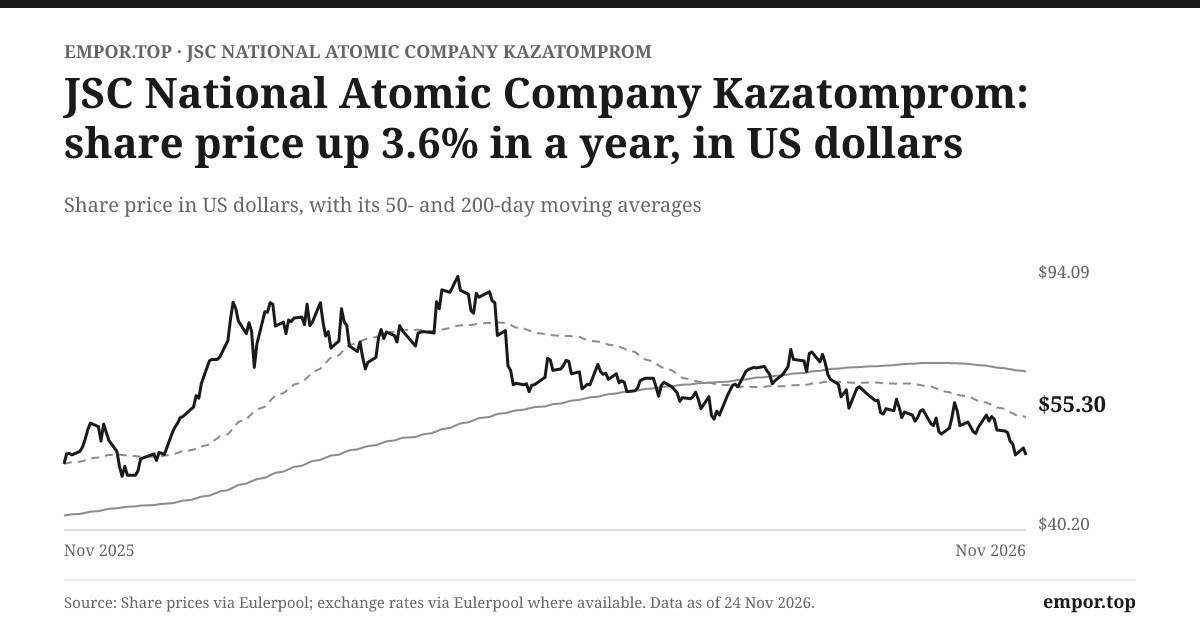
On 24 November 2026, Kazatomprom's London shares closed at about $55.30, almost 40% below their 52-week high of about $91.20. That fall came even as the company's November trading update showed nine-month realised prices up about 17% and production up about 10%.14 The market had seen good operating news and sold anyway. Why?
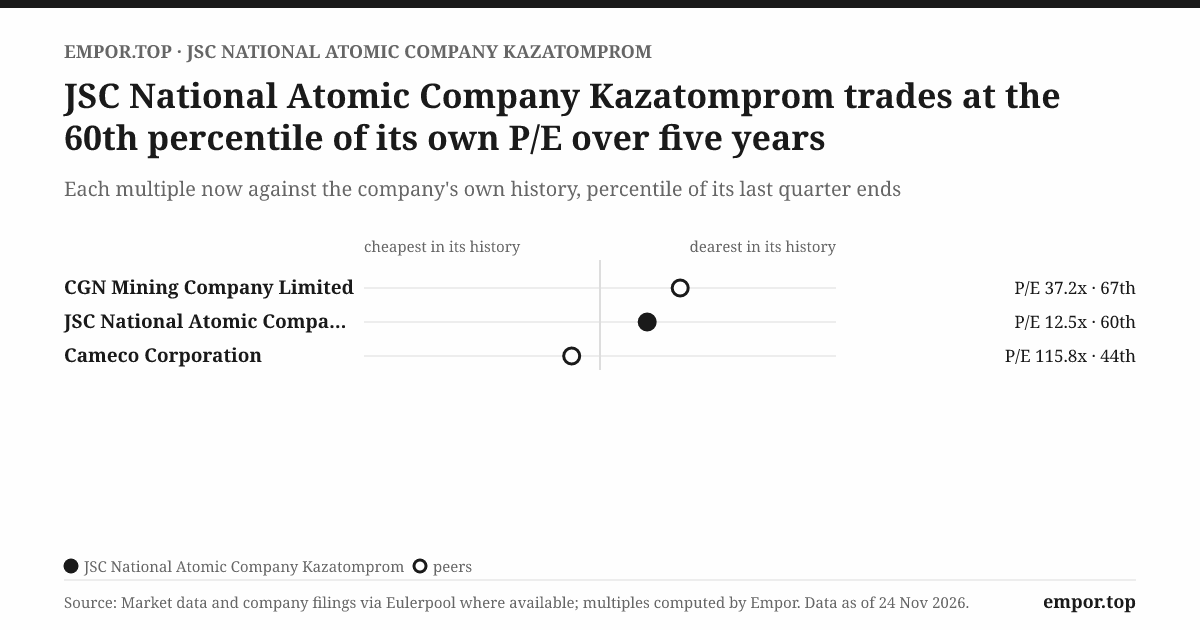
Start with what the price implies. At about $14.3 billion of market value and roughly $13.6 billion of enterprise value, the shares traded at about 12.5 times trailing earnings, against a five-year median of about 11.2 times, and at about 6.9 times EBITDA. The free cash flow yield was about 5.7%. That is not an extravagant multiple for a business earning a return on equity in the mid-20s.
It is also modestly above the company's own historical median, which means the market is not pricing in a collapse. A closest-peer multiple set for uranium producers is not established on a comparable basis here, so comparisons with Cameco or others would need methodology the filings do not supply. The price looks like a bet on a moderate, durable business rather than on a boom.
The case for the giant
The bull case begins with structure. Nuclear power has moved from debate to construction: more than 70 reactors are being built globally, 38 countries signed a pledge to triple nuclear capacity by 2050, and Western utilities, as Yussupov put it, are shifting from "just-in-time" to "just-in-case" inventory strategies.6 Total contracting in 2025 covered only about 77% of reactor requirements, by management's estimate, which implies years of under-contracting that must eventually be made up.11 The World Nuclear Association notes that mines supplied only about 90% of utility requirements in 2024.12
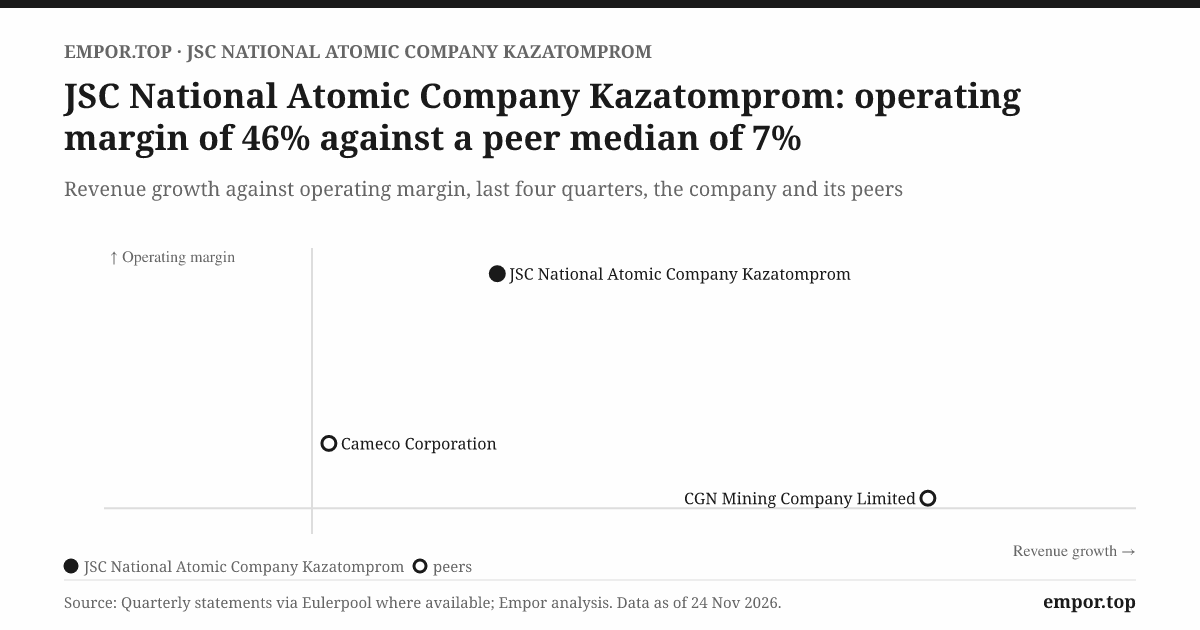
In that world, Kazatomprom has three things that are hard to replicate. It has the largest share of primary supply of any company. It has, through ISR geology, one of the lowest cost bases in the industry, even after recent inflation. And it has a balance sheet with net cash, investment-grade ratings and a long record of returning cash through dividends.32021
Its contract book is shifting toward spot-linked pricing as older ceilings expire, which, on management's own sensitivity table, means a $100 spot price would translate into a realised price rising from about $80 in 2026 to about $93 by 2030.7 Flexible sales timing and a large inventory, about 8,200 tonnes at Group level in June 2026, let it choose when to sell.7
The case against the giant
The bear case starts with a sentence that should be printed on every uranium investor's desk: commodity demand does not guarantee company earnings. The path from a higher spot price to more attributable cash at Kazatomprom runs through four toll gates. The contract book caps part of the upside. The Kazakh state takes a larger tax share as prices rise; its new differentiated tax rate increases with both price and volume.7
Partners take their share of every consolidated mine, and in 2026 that share grew faster than Kazatomprom's own. And inputs, acid above all, have inflated alongside the price. The 2026 arithmetic showed what happens when all four gates close at once: realised prices up about $8 a pound and all-in sustaining costs up about the same.147
The second strand of the bear case is execution. The company's history includes the production plans abandoned in 2024, a 2025 outcome about 5,000 tonnes short of earlier intentions, a 10% cut to nominal 2026 levels, and an acid plant whose start-up has slipped by well over a year.163713 None of these broke a customer contract, which is a genuine achievement. All of them narrow the claim that Kazatomprom can expand on demand.
Third, currency. About 93% of revenue is in US dollars or tenge linked to the dollar, while much of the cost base is in tenge.4 When the tenge strengthened in 2026, from a budgeted 540 per dollar to a revised 490, revenue guidance fell and dollar costs rose.7 Management's natural-hedge approach, generally without derivatives, cushions but does not neutralise that exposure.4
Put the competitive forces together and the moat becomes clearer, and smaller, than the bull narrative suggests. Rivalry is moderated by an oligopoly of state-linked producers, many of whom are partners in each other's assets. The threat of new entrants is low in the short run, because a new uranium mine takes a decade to permit and build, but higher prices raise that threat over time.
Buyer power is meaningful, since nine customers account for three-quarters of revenue and deliberately diversify supply. Supplier power is concentrated in acid, drilling and the state as licensor and tax collector. Substitutes for uranium inside a reactor do not exist.
On Helmer's seven powers, the case rests on two. The cornered resource is real: Kazakhstan's ISR geology and Kazatomprom's priority access to it are not replicable. Scale economies are real too, though they are being eroded by taxes and input inflation.
There is little evidence of switching costs, since utilities multi-source; Kazatomprom itself added new customers in Switzerland and the Czech Republic in 2025, a reminder that customers can and do move between suppliers.11 There is no brand power in a commodity, no network effect and no counter-positioning. Process power, if it exists, lies in ISR operating know-how, and it has been tested and found wanting during the acid crisis.
The verdict on the moat is therefore narrower than the bull case and stronger than the bear case. Kazatomprom has a durable cost and resource advantage that keeps it profitable across the cycle. It does not have pricing power in the sense of setting the price; it has supply influence, used with restraint. And its advantage is shared, in uncomfortable proportions, with the state treasury and its partners.
An activist with a short position would not attack the balance sheet; it is too strong. They would attack disclosure and allocation. Why are the largest sales contracts approved without their terms being shown? Why does the performance bonus hinge on positive consolidated profit rather than attributable return on capital?
Why do 100%-basis capex figures dominate guidance when shareholders own about half the output? And how much of the long-run profit growth survives if the 2024 remeasurement is stripped out? None of these questions implies wrongdoing. Each is a place where the free float's interests and the reported numbers can diverge.
The company has not raised primary equity since listing, and its debt has stayed modest through both cyclical troughs and the acid crisis.4 Its history includes sharp swings in earnings, a five-year maximum share price fall of about 47% and one-year volatility above 46%. That is the profile of a strong company in a volatile commodity, not a fragile one.
Three numbers will settle the thesis better than any framework. The first is attributable production against guidance: 14,500 to 15,500 tonnes for 2026, with about 11,000 delivered by September.14 The second is realised price per pound relative to spot, which narrowed to about 8% below spot at the Group level in the third quarter.14
The third is all-in sustaining cost per pound, now guided at $39–$40.50, rising from about $30 in 2025.73 If the gap between the second and the third widens, the strategy is working for shareholders. If it does not, the rally is working for someone else.
Material risks follow from mechanisms already described: uranium price and contract repricing, customer concentration and collection risk, acid and wellfield execution, tenge-dollar movements, Kazakh tax and regulatory changes, and state-related governance. The balanced answer is that Kazatomprom appears structurally important and financially resilient, but its advantage is not immune to operational bottlenecks, and the record does not yet establish that it can consistently convert sector growth into higher per-share returns.
Business & Investing Lessons
Go back to that briefing room in December 2017, when Pirmatov announced the production cut. Now jump forward six years, to a January morning when acid shortages constrained output. The two moments look like opposites. They are really the same lesson, told twice.
A producer can leave pounds in the ground; it cannot will the price higher. Kazatomprom's restraint was real, sustained and, by its own count, worth more than 130 million pounds of withheld supply.11 But the price recovery that followed had many fathers, and even at the top of the rally the company's contract book captured only part of it.
Market share gave Kazatomprom a voice in the market. It did not give it a veto. For any investor tempted to equate dominant share with pricing power, this company is the cautionary case: size buys influence, not control.
A tonne at the mine is not a tonne for every shareholder. The gap between Kazatomprom's 100%-basis and attributable production showed up in the first half of 2026, when Group EBITDA rose while attributable EBITDA fell.7 The ramp-up at Budenovskoye made the company bigger and its shareholders' share of the profits smaller. For founders building through joint ventures and investors valuing them, the lesson is blunt: always ask whose pound it is before you count it.
A one-off gain can change the year you compare against; it cannot pay the next dividend. The Budenovskoye remeasurement inflated 2024 profit without a tenge of cash, and turned an ordinary 2025 into an apparent slump.43 The decade-long profit growth rate looks spectacular partly because of where the line ends. Investors who look only at headline profit growth will misjudge the business in both directions.
The bottleneck is part of the moat's price. ISR mining is cheap because it uses chemistry instead of trucks, and that same chemistry made Kazatomprom dependent on a commodity that fertiliser makers also want. The cost increases described above show how tax and acid can narrow the cost advantage.37 A moat built on a cheap input is only as wide as the supply of that input. The investor who values a low-cost producer must also value its weakest supplier.
Inventory is the insurance that lets a strategy survive its own mistakes. When acid ran short in 2024, Kazatomprom missed its production intentions but kept its delivery promises, supported by its inventory of finished uranium.13
By mid-2026 Group inventory had grown to about 8,200 tonnes.7 Those stockpiles look like idle capital on a balance sheet. In a business where the customer is a reactor that cannot be allowed to run dry, they are the reason a production miss did not become a broken contract, and the reason utilities kept buying.
The discipline that ties these lessons together is simple to state. Track attributable volumes, realised price per pound and unit cost together, because any one of them alone will tell you a story the other two may contradict.
Epilogue
On 3 November 2026, Kazatomprom published its third-quarter trading update and reiterated every line of its full-year guidance.14 Production was up, sales were up, and the Group's realised price in the quarter, about $81.50 a pound, had risen faster than spot over the past year, narrowing a gap that had been about 16% for the first nine months to about 8% in the quarter itself.14
The company also secured a new licence for the Kyzyltu block, with a preliminary resource estimate of about 10,000 tonnes.14 Tonight, the company stands where its strategy wants it to be: producing more, selling at better prices, and having ended 2025 with a net-cash balance sheet.
The next few months will test whether that position is durable. The first moment comes with the year-end production figures. If attributable output lands within the 14,500-to-15,500-tonne range, management's reset guidance will have held for a second year, and the acid crisis can begin to be read as history rather than a recurring condition.7 A miss would reopen the question of whether value over volume is still a choice.
The second moment is confirmation of the 2027 acid supply. Tulebayev said in August that the company did not yet have full coverage of its 2027 needs and usually signed by October.6 With TQZ now not expected before the second half of 2027 at the earliest, next year's production depends on contracts signed with smelters and importers.7 Watch whether the full-year results confirm that supply was secured and at what price.
The third moment is the 2027 guidance itself. Management has already said it does not expect a material decrease in realised prices, and that the era of cheap uranium "is fading away."6 If the next year's guidance shows unit costs flattening while realised prices keep rising, the gap between them, the attributable margin per pound, will widen for the first time in two years. If costs again rise in step, the market's scepticism will look justified.
Beyond those numbers sit the governance questions that do not resolve on a single day. The next annual report will show whether customer concentration has risen, whether the large EGM-approved contracts with JV partners have changed the related-party picture, and whether the shareholder loans and guarantees have grown. When management next explains a deviation, the place to look is the gap between prepared remarks and analyst Q&A, and between this year's explanation and last year's promise on acid and wellfield construction.
Every one of those indicators points back to the four questions this story began with. Is profit growth durable once the one-off is stripped out? Does higher demand reach shareholders after tax, partners and costs? Can the wellfields deliver? And does the state's control serve the free float? The company can influence the supply of uranium. It cannot control every input, every partner, every tax rate or the terms on which all its pounds are sold.
Outro
Somewhere in southern Kazakhstan tonight, acid is moving slowly through buried sandstone, dissolving uranium that was laid down long before anyone imagined a reactor. On the surface, engineers decide how many new wells to drill, and in Astana, executives decide how many pounds to sell and at what price. The world's largest uranium producer is making two choices at once: how much it wants to pump, and how much it physically can.
Kazatomprom's power comes partly from restraint, as its supply cuts showed. Its limits are written in the wellfield, in a chemical it cannot always buy and a mine plan it cannot always keep, and in a shareholder register where three-quarters of the votes belong to the state. It is a resource giant that learned to hold back. What its owners will learn next is whether holding back, and then letting go, makes them richer.
References
-
Kazatomprom's 2017 Results and Production Cut Announcement — Kazatomprom, 2017-12-21 ↩↩↩
-
Operating and Financial Review for 2025 — Kazatomprom, 2026-03-20 ↩↩↩↩↩↩↩↩↩↩↩↩↩↩↩↩↩↩↩↩↩↩↩↩↩↩↩
-
Audited Consolidated Financial Statements and Independent Auditor's Report 2025 — Kazatomprom, 2026-03-19 ↩↩↩↩↩↩↩↩↩↩↩↩↩↩↩↩↩↩↩↩↩↩↩↩↩↩↩↩↩↩↩
-
Kazatomprom Starts Trading on London Stock Exchange — London Stock Exchange Group, 2018-11-16 ↩↩↩↩
-
1H2026 Results Conference Call Transcript — Kazatomprom, 2026-08-21 ↩↩↩↩↩↩↩↩↩↩↩↩↩↩↩↩↩↩↩↩↩
-
Operating and Financial Review for the Six Months Ended 30 June 2026 — Kazatomprom, 2026-08-21 ↩↩↩↩↩↩↩↩↩↩↩↩↩↩↩↩↩↩↩↩↩↩↩↩↩↩↩↩↩↩↩↩↩↩↩↩↩↩↩
-
Shareholding-Structure Change Notice — Kazatomprom, 2024-07-23 ↩
-
2025 Full-Year Results Conference Call Transcript — Kazatomprom, 2026-03-20 ↩↩↩↩↩↩↩↩↩↩↩↩↩↩↩↩↩
-
Uranium Markets — World Nuclear Association, 2026-10-23 ↩↩↩↩
-
FY2023 Results Conference Call Transcript — Kazatomprom, 2024-03-15 ↩↩↩↩↩↩↩↩↩↩↩↩↩↩↩↩
-
3Q26 Operations and Trading Update — Kazatomprom, 2026-11-03 ↩↩↩↩↩↩↩↩↩
-
Kazatomprom May Cut Uranium Production Plan — Reuters via Kitco News, 2024-01-12 ↩↩↩↩
-
FY2024 Audited Consolidated Financial Statements — Kazatomprom, 2025 ↩
-
Moody's Affirms Kazatomprom's Baa1 Rating, Stable Outlook — LSE RNS, 2026-09-09 ↩↩
-
Fitch Affirms Kazatomprom's BBB Rating, Stable Outlook — LSE RNS, 2026-08-26 ↩↩
 LinkedIn
 WhatsApp
 Reddit
 Hacker News
 Email
 Kindle
 RSS Feed
 Spotify
 Apple Podcasts
 Amazon Music
 Audible
 YouTube