Deutsche Bank AG: The Global Bank That Had to Become German Again
I. The Bank at the Crossroads
On the Taunusanlage in Frankfurt, two mirrored towers rise side by side over the city's banking district. Locals have long called them "debit and credit," and the joke works because the buildings were never just offices. They were a statement: Germany's biggest bank, a peer of the great houses of New York and London, looking down at the city that keeps the euro.
The address on every Deutsche Bank press release is still Taunusanlage 12.1 The question that has hung over those towers for most of the past two decades is a simpler one than the architecture suggests. Has the institution inside them finally found a business it can reliably earn money from?
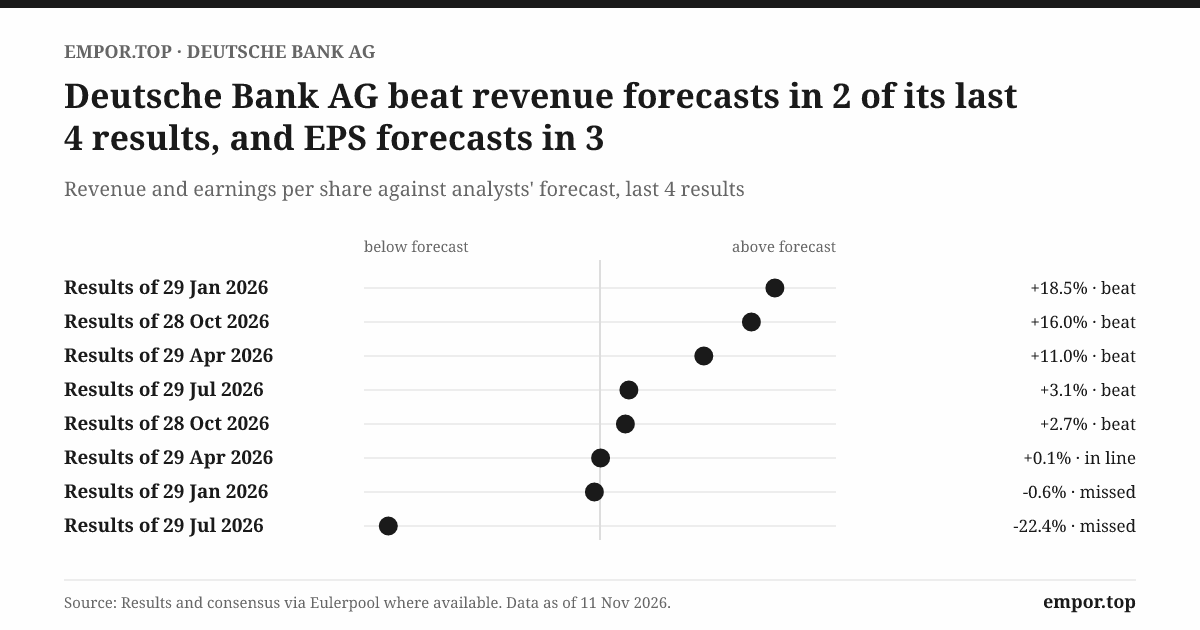
On October 28, 2026, the bank had its best case yet that the answer is yes. Christian Sewing, the chief executive, told investors that Deutsche Bank had just reported its third consecutive quarter of record profit.1 Revenue for the first nine months of the year came to about €25.5 billion, up 5%, and profit after tax reached about €5.9 billion, up 7%.1
Every one of its four businesses had grown its profit year on year, and Sewing said each was now earning a return on tangible equity above 12%.1 Then, on the analyst call that morning, he pointed somewhere else for the next leg of improvement. The further upside, he said, lay in things "largely in our control, particularly technology and process simplification and AI-led productivity gains," with more detail promised alongside the full-year results in January.2
That was the triumphant version. Tucked into the same release was a less comfortable number. Provisions for credit losses, the money a bank sets aside for loans it expects will not be repaid, rose to €501 million in the quarter, up 20% on a year earlier.1 Management blamed further clean-up of its commercial-property book and a single bad corporate exposure in Asia.12 Neither explanation is alarming on its own. Together, they remind the listener that a bank's record quarter is a snapshot of a machine whose biggest risks show up late.
This story is about four questions, and the record profits answer none of them by themselves. First, did the dramatic retreat Deutsche Bank announced in July 2019 actually create a stronger bank, or merely a smaller one? Second, can its web of corporate, wealth and markets relationships keep growing without the bank taking Wall Street-sized risks to feed it?
Third, are today's profits repeatable, or are they flattered by the absence of past legal bills and by accounting choices? And fourth, can it keep handing capital back to shareholders while leaving enough room for credit losses and for the investment its plan requires?
The scale of what is being judged matters. At the end of 2025, Deutsche Bank reported €31.4 billion of net revenues, operated in 55 countries and carried €1.44 trillion of assets on its balance sheet, making it the largest bank in Germany by a wide margin.3
It is also the top of its own tree. The listed company, Deutsche Bank AG, is the parent of the group, not a subsidiary inside someone else's empire. Its asset manager, DWS, is a listed company of its own, but it sits inside Deutsche Bank's consolidated accounts rather than above them.
One warning before the story starts. Banks do not fit the yardsticks used for factories and software companies. A bank's "operating cash flow" swings by tens of billions of euros as customers move deposits and traders change positions; its "debt" is mostly other people's money held in trust.
Standard screens that show near-zero free cash flow or a debt load four times equity say almost nothing about whether Deutsche Bank is healthy. The measures that matter are the bank's own: profit before tax as the group reports it, return on tangible equity, the cost-to-income ratio, credit-loss provisions and regulatory capital. This story uses those.
What it promises is a verdict, not a victory lap. The franchise is real: German companies, wealthy families and global institutions still route an enormous volume of business through these towers. Whether that franchise turns into returns comfortably above what shareholders could earn elsewhere, without the bank sliding back into the habits of risk and control failure that nearly broke it, is the open question. To see why the bar is set where it is, the story has to go back to the years when Deutsche Bank tried to be everything at once.
 Subscribe on LinkedIn
II. The World Bank That Reached Too Far
Deutsche Bank was born in Berlin in 1870 with a mission that sounds almost quaint now: to finance German industry and German trade with the rest of the world, so that German exporters did not have to depend on British banks.3
For more than a century it did exactly that, sitting at the center of the country's industrial relationships, holding board seats and stakes in great manufacturers, and following German companies abroad. It survived two world wars, the division and reunification of the country, and its own postwar breakup into three regional banks, which were merged back together under the Deutsche Bank name in 1957.3
That long arc left two assets that still matter today. One is the relationship web: a German treasurer, a family-owned Mittelstand exporter or a Frankfurt pension fund has very likely banked with Deutsche at some point. The other is ambition, the belief that a bank anchored in Europe's largest economy deserved to stand alongside the American giants.
From the late 1980s through the 2000s, Deutsche Bank acted on that belief. It bought its way into London and New York, hired armies of traders and built one of the world's largest derivatives businesses. By the eve of the financial crisis, it was no longer a German bank with a trading desk. It was a global trading house that also happened to own a German bank.
The strategic temptation was easy to understand. Investment banking and trading paid far better than lending to German companies at thin margins in a crowded, cooperative-heavy home market. A balance sheet the size of Deutsche's could be put to work in fixed income, currencies and structured credit, where scale and risk appetite produced enormous revenue. The flaw was equally easy to miss in good years. That revenue came with complexity, with capital that regulators would later demand much more of, and with conduct risk spread across thousands of traders in dozens of jurisdictions.
When the financial system cracked in 2008, the questions about Deutsche Bank were not only about its mortgage-backed assets. They were about trust. Counterparties wondered which banks could still be relied upon to settle trades, and a bank with a vast derivatives book is, by definition, deeply interconnected. Deutsche avoided the kind of state rescue that befell several European peers, which became part of its legend. But the decade that followed showed that surviving the crisis was not the same thing as being healthy after it.
The post-crisis years ran on a grim loop. Regulators raised capital requirements, which made the trading-heavy model less profitable. Legal and regulatory bills from the pre-crisis era kept arriving, covering mortgage securities, benchmark manipulation, sanctions breaches and money laundering. Each restructuring plan promised to fix the cost base, and each was overtaken by the next charge. The bank's annual results tell the story bluntly: net losses in 2015, 2016, 2017 and again in 2019, and both the capital raise of 2017 and the overhaul of 2019 arrived in the wake of loss-making periods.45 Global scale had turned into a poor proxy for shareholder returns.
By March 2017, under chief executive John Cryan,4 the bank had to do what its admirers would rather forget. It went back to its own shareholders and asked for about €8 billion of new equity through a rights issue, alongside a new set of financial targets and a plan to sell part of its asset-management arm to outside investors.4
Any claim today that Deutsche Bank's capital strength has been uninterrupted runs straight into that record. The capital raise was a rescue-era move, made because years of losses and settlement costs had eaten through the cushion. The buybacks of 2026 are a different animal, funded by profits the bank now generates itself. Both are true, and the difference between them is the measure of how far the bank has travelled.
Conduct problems were the thread that tied the losses together. In the late 2010s, German regulators at BaFin ordered Deutsche Bank to tighten its anti-money-laundering safeguards, appointed a special monitor in 2018 to watch it do so, and extended those orders several times, most recently in 2023 with a warning of fines if transaction-monitoring improvements were not delivered; the monitor's mandate ended only in October 2024.3 In the United States, the Federal Reserve entered into a further consent order with the bank in July 2023, alleging insufficient and delayed implementation of control improvements it had already promised under orders from 2015 and 2017.3
And the thread is not finished. In January 2026, German investigators searched Deutsche Bank's offices in a money-laundering investigation.6 The bank's own filings describe a Frankfurt prosecutor's inquiry focused particularly on allegations of late filing of suspicious-activity reports.3 It is an allegation under investigation, not a finding, and the bank has not been charged with anything in connection with it. But for an institution whose recovery rests on persuading clients and supervisors that it has finally mastered its controls, the timing was unwelcome.
Into this mess stepped Christian Sewing. He was not a star trader or a celebrity banker parachuted in from Wall Street. He had joined Deutsche Bank as an apprentice in 1989, spent his career in credit and risk, served as the bank's chief credit officer and deputy chief risk officer, and ran internal audit before joining the management board in 2015.3 He became chief executive on April 8, 2018.3 He was, in other words, a lifer who had spent years reading the bank's mistakes from the inside.
The choice in front of him was stark. He could keep defending a diminished global investment bank that was losing ground to the Americans, or he could shrink it and rebuild around the businesses where Deutsche Bank had a genuine reason to win. Before he made that choice, though, he inherited the consequences of a bet his predecessors had made on the other end of the bank: the German retail market, and a lender called Postbank.
III. The Postbank Bet That Stayed on the Books
In 2008, as the financial world wobbled, Deutsche Bank agreed to buy a stake in Deutsche Postbank,7 the retail bank that had grown out of the German postal service. The logic was straightforward and, on its face, sound. Postbank had millions of ordinary German customers and a large base of deposits, the cheapest and most stable funding a bank can have.
Deutsche Bank had corporate relationships, investment banking and wealth management, but its own retail network in Germany was modest by comparison. Bolting the two together would give the trading house a domestic anchor, and cheap deposits to fund its lending, at the exact moment wholesale funding markets were proving unreliable.
The deal was executed in steps. Deutsche first bought into Postbank from Deutsche Post, then in 2010 announced a voluntary takeover offer for the remaining shares at €25 each.3 About 48.2 million Postbank shares were tendered at that price.3 Over the following years the bank tightened its grip, signing a domination agreement in 2012 and squeezing out the last minority holders in 2015.3 It is important to be clear about whose deal this was. Postbank was not bought by some parent above the listed company; it belongs entirely to Deutsche Bank AG's own history, and so does everything that followed.
What followed was a lawsuit that refused to die. A large group of former Postbank shareholders who had accepted the €25 offer argued that Deutsche Bank had effectively gained control of Postbank earlier, by 2009 at the latest, through the structure of its first-stage purchase. Under German takeover law, gaining control triggers a mandatory offer at a legally determined minimum price.
The plaintiffs said that price should have been €57.25 per share, or even €64.25, more than double what they received.3 The case was never about whether Postbank was worth less than Deutsche paid. It was about whether Deutsche had complied with the rules that protect minority shareholders when control changes hands.
For years the bank treated the claims as defensible. Then, in April 2024, the Higher Regional Court of Cologne indicated during proceedings that it might side with the plaintiffs, and Deutsche Bank announced that it would book a large provision, on the order of €1.3 billion, as a result.7 It was a jarring moment: a fourteen-year-old acquisition reaching forward to wreck a quarter's earnings at the very moment the bank was trying to prove that its legal troubles were behind it.
Rather than gamble on a final ruling, the bank moved to settle. By August 2024 it announced settlements with a large share of the plaintiffs.8 By the end of 2025, it had settled with plaintiffs representing about 90% of the claims by value and held a remaining provision of €112 million for the rest.3
The legal tail has a second, smaller limb. Former shareholders in two separate appraisal proceedings, covering the 2012 domination agreement and the 2015 squeeze-out, have argued that the same €57.25 should set their compensation too. In December 2025, the Higher Regional Court in Düsseldorf rejected that argument in the domination-agreement case and proposed a settlement at €28 per share, below the €29.74 a lower court had set; Deutsche Bank consented in January 2026, but not every applicant did.3 The sums involved are small next to the original fight. The episode's lasting significance is not the money, which the bank can absorb. It is what it says about diligence, disclosure and the cost of a contested route to control.
Postbank's strategic value is real, and it is also hard to isolate. By the end of 2025, Deutsche Bank held €691.8 billion of deposits against €479 billion of gross loans.3 Postbank's millions of customers are part of that deposit base, but the group does not publish a standalone Postbank balance sheet that would show how much of it the acquisition supplies.
What the bank does disclose is how it now uses the brand. Its Private Bank runs Germany as two brands: Deutsche Bank as the "Hausbank" for financial advice, and Postbank as a digital-first provider for everyday banking.3 When management ran deposit campaigns in 2026, it ran them across both.2
Integration was its own saga. Merging Postbank's technology into Deutsche's took years, and the bank's 2025 annual report still referred to elevated "transitory effects" from Postbank integration in the Private Bank's credit performance.3 The more recent signal is that the Private Bank is still simplifying what it inherited: on the October 2026 call, Sewing said the division had selected its first cloud-based platform as it moves from 15 banking platforms to just two.2 Fifteen platforms, sixteen years after the takeover, says a great deal about how long it takes to make two banks into one.
So was Postbank a bargain or an overpayment? Neither verdict holds up without a proper peer valuation, which the record does not supply. The fairer benchmark is the one this story can actually measure: an offer of €25, a legal claim at €57.25, a settlement bill large enough to dent 2024 earnings, an integration that ran for over a decade, and a German retail franchise whose deposits now help fund the group.
The strategic fit was right. The price and the execution were contested and costly. And the hardest question Postbank posed was the one Sewing would face head-on in 2019: if Deutsche Bank wanted a durable home-market anchor, could it make a sprawling collection of businesses operate as one bank?
IV. July 2019: The Retreat That Became the Strategy
On Sunday, July 7, 2019, Deutsche Bank did something no one expected from a bank that had spent thirty years trying to be Goldman Sachs. Christian Sewing announced what the bank itself called a "radical transformation."5 Deutsche Bank would exit equities sales and trading entirely. It would shrink its fixed-income operations, particularly in rates.
It would move the businesses and assets it no longer wanted into a separate unit, the Capital Release Unit, and wind them down.5 The plan called for around 18,000 fewer jobs by 2022.5 For thousands of traders and salespeople in London, New York and Asia, the announcement meant their desks were closing.
The decision is easiest to understand as a doctor choosing amputation. The bank had been trying to defend every limb of its global investment bank, and the attempt was killing the patient. Equities trading in particular was a business where Deutsche had neither the scale of the American leaders nor a profitable niche, and it consumed capital, technology spending and management attention. Sewing chose to stop the bleeding and rebuild around four businesses where the bank had a more credible claim: the Corporate Bank, a focused Investment Bank built around fixed income, financing and advisory, the Private Bank, and Asset Management.5
The Capital Release Unit deserves its proper role in this story. It was not a hidden growth engine or a bad bank in the bail-out sense. It was a container. The bank moved about €288 billion of leverage exposure into it, assets and positions it intended to sell, run off or close.5
Every euro of capital the unit released could be redeployed into the businesses the bank wanted to keep, and every manager freed from defending a lost cause could focus on clients. The plan carried a price tag of about €7.4 billion in charges through 2022, and it promised no new equity raise to pay for it.5
Alongside the surgery came the promises. The bank targeted a reduction in adjusted costs of about 25%, to €17 billion by 2022.5 It aimed for a return on tangible equity of 8% in 2022, and it said it expected to return €5 billion of capital to shareholders starting in 2022.5
These were deliberately modest return targets for a bank of its size, which told investors how low the starting point was. In the first months, the market had good reason to be skeptical: the bank warned that the second quarter of 2019 alone would show a net loss of about €2.8 billion as the first restructuring charges landed.5
The promises, six years on
The useful way to judge Sewing's retreat is not by its rhetoric but by checking each promise against what happened. The record is mixed in an instructive way. The bank returned to profit in 2020 and has stayed profitable every year since. It wound down the Capital Release Unit and folded what remained into its Corporate & Other segment.
It made capital distributions that, for the financial years 2021 through 2025, add up to about €8.5 billion, comfortably above the €5 billion the 2019 plan pledged.3 It did not have to return to shareholders for emergency equity to fund the plan. On those dimensions, the retreat delivered what it said it would.
Costs are where the plan fell short. The €17 billion adjusted-cost target for 2022 was never met. By 2025, adjusted costs were €20.3 billion, roughly a fifth above the figure the bank had pledged for three years earlier.35 Inflation, a growing business and regulatory spending all played their part, and management repeatedly recalibrated its cost ambitions rather than claiming victory. But a listener who heard "25% cost reduction" in 2019 and checked the numbers in 2025 would not find it.
The second plan, laid out in 2022, gives an even sharper test because its finish line has now passed. For 2025, the bank targeted a return on tangible equity above 10%, compound annual revenue growth from 2021 of 5.5% to 6.5%, and a cost-to-income ratio below 65%.3 On its own reported figures for 2025, it posted a return on tangible equity of 9.4%, revenue growth of 5.3% a year, and a cost-to-income ratio of 66%.3 All three financial targets were missed, each by a narrow margin.
The capital objectives were met: the bank ended 2025 with a common equity tier 1 ratio of 14.2% and was paying out the promised share of profit.3 The narrow misses had a clear explanation, because 2024 carried €2.6 billion of nonoperating costs, mostly the Postbank and Polish mortgage litigation charges, that dragged on the period.3 But explanation is not achievement. A bank that misses by a little, every time, is still a bank whose targets need a discount.
The new bar
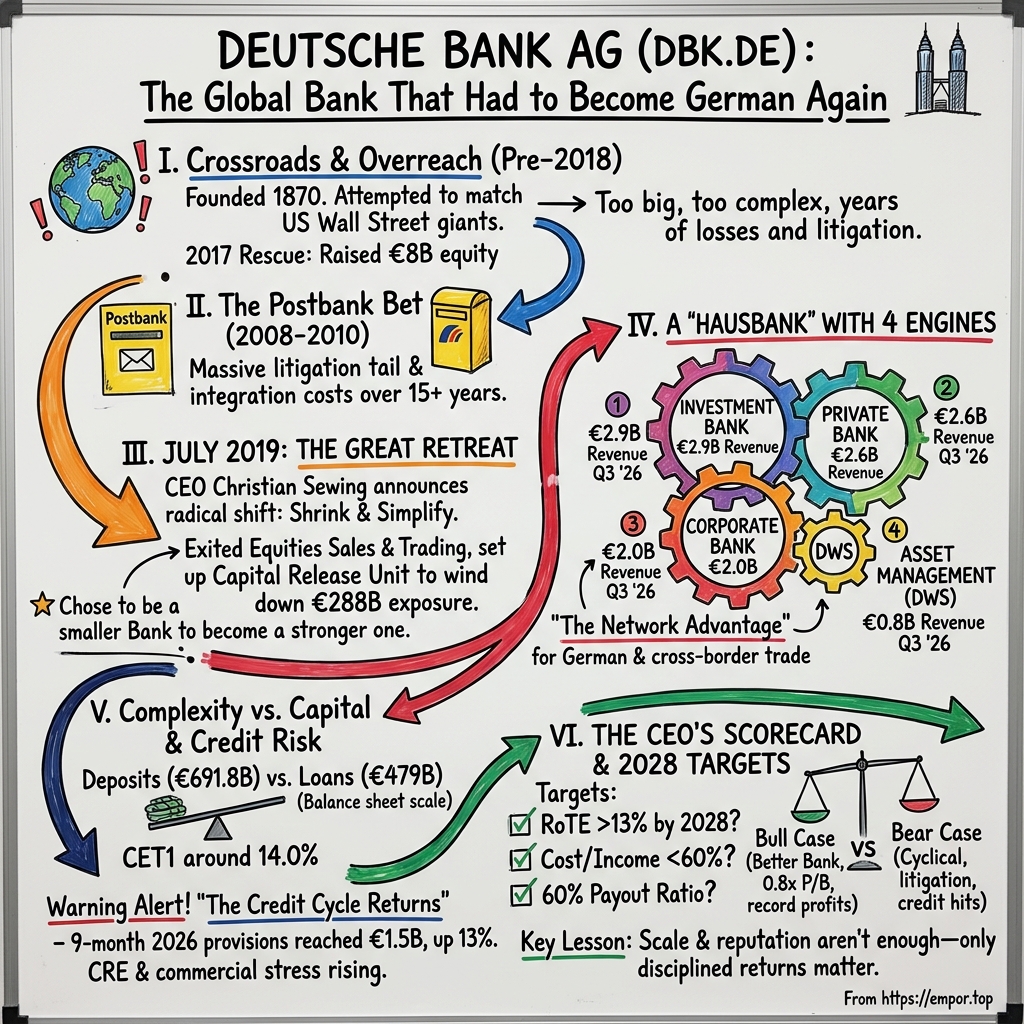
In November 2025, at an investor event the bank called its Investor Deep Dive, management reset the goalposts for 2028. It now targets a return on tangible equity above 13% and a cost-to-income ratio below 60%, while holding its common equity tier 1 ratio in a 13.5% to 14.0% operating range and paying out 60% of profit from 2026, plus any capital above 14% that it judges to be sustainably excess.3 Management calls the strategy "Scaling the Global Hausbank," a phrase that tries to capture both the German relationship bank and its global reach.3
On the October 2026 call, the tone was more confident than at any point in the past decade. Sewing said the path to 2028 had become clearer and that he now saw a 13% return "as a floor."2 Raja Akram, the new chief financial officer, went further, saying the bank could do "much better" than its stated target and promising a fuller update in January.2
One analyst, Tarik El Mejjad of Bank of America, gently pointed out that the bank had been calling itself a "beat and raise" story but had so far delivered the beats more than the raises; Sewing replied that the bank had just raised its revenue guidance, now pointing to more than €33 billion for 2026.12
Kian Abouhossein of JPMorgan landed the sharper blow. A 13% return, he told management, was in his coverage "the lowest RoTE of any bank either achieved this year or achieved by 2028."2 Sewing did not dispute it. "We are not yet there where we should be," he said.2 That exchange captures the state of the 2019 retreat more honestly than any slide.
The surgery saved the patient and made the bank simpler. It did not, on its own, make Deutsche Bank as profitable as its peers. The bank now asks investors to trust a third plan on the strength of a record that met its capital promises and narrowly missed its profitability ones. That is why the next question is not about the plan at all but about the businesses that have to deliver it.
V. A Hausbank, With Four Different Engines
The October 2026 results call opened with a sentence management had clearly rehearsed. "We are growing, particularly where we want to grow," Sewing said, ticking off the asset-gathering businesses, the Corporate Bank and the Investment Bank.2 Akram followed with the line that every chief financial officer wants to say: all four divisions had contributed to the year-on-year profit increase.2
Revenue for the quarter came to €8.3 billion, the twenty-first consecutive quarter of year-on-year revenue growth by the bank's count.12 The more revealing question is what kind of bank generates that revenue, and whether its four parts actually help one another or simply share a balance sheet and a logo.
The easiest way to understand the four businesses is through the problems their customers bring through the door. The Corporate Bank moves and finances company money. A German machine-tool maker that sells in forty countries needs to collect payments in dollars and yuan, pay suppliers in euros, hold cash overnight, finance shipments while goods are at sea and hedge the currency risk on all of it. The Corporate Bank handles that plumbing, through cash management, trade finance, lending and services for institutional clients.
The Investment Bank connects clients to markets and capital: it trades bonds and currencies for institutional investors, provides financing secured on assets, advises on mergers and helps companies issue shares and bonds. The Private Bank serves households and the wealthy, from a Postbank current account to a discretionary portfolio for a family-business heir. Asset Management, through DWS, invests money on behalf of pension funds, insurers and retail savers, increasingly through low-cost index funds.
In the third quarter, the Investment Bank brought in about €2.9 billion of revenue, the Private Bank about €2.6 billion, the Corporate Bank about €2.0 billion and Asset Management about €0.8 billion.1 But revenue is not a profit ranking, and the gap between the two is where the story gets interesting. Over the first nine months of 2026, the Investment Bank earned about €3.8 billion before tax, the Corporate Bank and the Private Bank each about €2.0 billion, and Asset Management about €0.7 billion.1
The Corporate Bank was the most profitable relative to the capital it uses, with a return on tangible equity of about 16% for the nine months, while the Private Bank, despite its size, earned about 12%, held back by its high cost base.1 Asset Management's return on tangible equity looks spectacular at above 40%, but that figure mostly reflects how little tangible equity an asset manager needs; on ordinary shareholders' equity it was closer to 16%.1
How the money is made
Underneath the divisional labels, Deutsche Bank earns its living in three ways, and each behaves differently. The first is net interest income, the spread between what the bank earns on loans and bonds and what it pays depositors. That depends on how much the bank lends and gathers, on interest rates, and on a structural hedge that locks in rates over several years so that income moves gradually rather than lurching with every central-bank decision.
Akram expected net interest income across the bank's main lending and deposit businesses to slightly exceed €14 billion in 2026, with the benefit of recent rate moves arriving "gradually and sequentially" and becoming more pronounced in 2027 and 2028 as old hedges roll off and new ones are struck.2
The second is fees: payments and trade-finance charges, advisory and underwriting fees, and management fees on assets held in funds and mandates. These depend on transaction volumes and on the value of assets under management, which is to say on markets.
The third is trading revenue, which depends on how actively clients trade and on market prices and volatility. The bank does not publish a single group-wide figure for "recurring revenue," and no standard contract length applies across its products; a corporate cash-management mandate may run for years, while a trading relationship can be repriced every day.
What management does publish is a rough proxy: in the third quarter, the businesses other than the Investment Bank accounted for around 65% of group revenue, a share that rose both sequentially and year on year.2 The direction matters more than the level. A bank whose earnings lean more on deposits, payments and fund fees is less exposed to a bad year in the bond markets.
Does the network actually win?
Management's central claim is that these engines reinforce each other. A Mittelstand exporter, the argument goes, wants a bank that can do its payments, foreign exchange, lending and capital-markets access in one place, in its own language, with a global network behind it.
On the call, Sewing put it in terms of the moment Germany is living through: "people are looking for a German bank, which has an international network and Deutsche Bank is the remaining one."2 He was responding to a question from Stefan Stalmann of Autonomous about whether the Commerzbank-UniCredit situation was sending clients Deutsche's way. Sewing said client conversations had intensified, but acknowledged that the impact on third-quarter numbers was "still minimal."2
The evidence for the network claim is real but partial. The Corporate Bank had its best quarter ever, with revenue up 9% and German revenue up 13%, deposits up 13% on the year to €346 billion, and loans up 8%, driven by trade finance.12 Akram insisted there were "no one-timers" in the growth.2
In investment banking, the bank's share of EMEA fees in investment banking and capital markets rose to 4.8% in the third quarter, from 3.2% a year earlier, according to Dealogic data the bank cites.1 And the asset-gathering businesses had their best stretch on record: about €103 billion of net inflows across the Private Bank and Asset Management in nine months.1
What none of these numbers proves is the thing the "Hausbank" label implies, which is that clients stay because switching would be painful and that the bank can therefore charge a premium. Deutsche does not publish client retention rates, share of wallet or price realization for its corporate clients. When UBS analyst Mate Nemes asked what share of new deposit clients stayed after a promotional campaign, Akram declined to give a number, saying only that retention was "in line with the model behavior," whether that meant 40%, 50% or 60% of clients staying.2
Sewing's own explanation for winning deposits in Germany leaned on "trust and long-term relationships" rather than price; he said the bank deliberately did not match the rates offered by new digital entrants.2 That is a coherent strategy. It is not yet evidence of pricing power, and trust is a word management uses, not a number it reports.
The competitive set is also worth naming accurately, because "global bank" invites the wrong comparisons. In investment banking and trading, JPMorgan and Goldman Sachs are vastly larger and more profitable; Deutsche competes with them selectively, in fixed income, financing and European advisory, not across the board.
In European corporate banking and markets, BNP Paribas, Barclays and UBS are the more natural rivals. In German retail and Mittelstand banking, Commerzbank and the country's dense network of savings and cooperative banks are the incumbents Deutsche fights every day. Total assets prove nothing here; what matters is whether Deutsche wins mandates in the specific arenas it chose to stay in.
The strongest disconfirming evidence is the bank's own history. Global reach did not save equities trading in 2019, and it did not save large parts of the rates business. The current claim is therefore narrower than the old one: not that Deutsche Bank can win everywhere, but that it can win in German corporate banking, cross-border cash and trade flows, European fixed income and financing, and wealth and fund management, where it has a credible client position.
The Investment Bank's 4.8% share is a single quarter's reading and the bank's history in investment banking is one of share gained and lost. A durable claim would need years of share, fee revenue and returns on allocated capital moving together.
Then there is artificial intelligence, which management increasingly mentions. The bank has started rolling out an AI-enabled tool called FarSight for its investment-banking coverage teams, designed to improve efficiency and give bankers more granular client insights.2 Sewing also cited AI as a possible source of upside to the 2028 targets.2
But the bank has not quantified what AI will save or earn, and it framed AI as productivity, not as a new business. For now, AI belongs in the cost line of this story, as a possible way to make a costly bank cheaper to run. Whether the four engines can produce returns that exceed what the bank spends to run them is the question that follows.
VI. Can the Franchise Earn More Than Its Complexity Costs?
The third quarter of 2026 had a quiet number that matters more than the record headline. Revenue grew about 4% year on year, while noninterest expenses, everything the bank spends on people, technology, buildings, levies and legal matters, stayed flat at about €5.2 billion.1 Bankers call that "positive jaws": revenue growing faster than costs, so that the gap between them, which is profit, widens.
For a bank that spent a decade watching costs swallow its revenue, a quarter of flat costs and rising income is the kind of moment that changes how investors think. Akram also flagged a caveat in the same breath. Part of the quarter's revenue came from valuation and timing gains in the Corporate & Other segment, which he expected to "partially reverse in the fourth quarter."2
Start with where 2025 ended, using the bank's own reported figures. Net revenues were €31.4 billion, essentially flat on 2024. Profit before tax was €9.1 billion, up 35%. Net profit, the profit of the whole group after tax, was €6.8 billion, up from €4.5 billion.
The cost-to-income ratio, the share of every euro of revenue consumed by costs, was 66%, and the return on tangible equity was 9.4%.3 Some data providers report the bank's revenue on a gross basis that adds interest income before interest expense, producing a figure more than twice as large, so the bank's own net measure is the one that makes sense for comparison.
The rebound in 2025 is worth taking apart, because its quality matters as much as its size. Revenue did not grow. Total noninterest expenses fell 10%, to €20.7 billion, but almost all of that drop came from one line: nonoperating costs, which fell from €2.6 billion in 2024 to €0.4 billion in 2025 as the Postbank and Polish mortgage litigation charges did not recur and restructuring costs eased.3
The bank's adjusted costs, the expense of actually running the business, fell only about 1%, to €20.3 billion.3 In plain terms, nearly all of the bank's €2.4 billion profit-before-tax improvement in 2025 came from no longer paying for old mistakes, rather than from earning more or spending less on operations. That is still real money for shareholders. It is not evidence of a structurally cheaper bank.
The evidence for structural improvement arrives in 2026. Over the first nine months, revenue rose 5%, costs rose 2%, and the cost-to-income ratio improved from 63% to about 61%.1 Management says it completed €0.5 billion of operating efficiencies in that period, largely through workforce reductions and operating-model changes, against €0.6 billion of incremental investment in technology infrastructure and in hiring wealth advisers and investment bankers.1
The bank is, in other words, funding its growth investments with its own savings, which is precisely what a disciplined bank should do. It still has about a point to go before reaching its below-60% target for 2028, and the full-year 2026 cost guidance of about €21.3 billion implies a heavier fourth quarter.2 Akram said his goal was "to undershoot that EUR 21.3 billion and not overshoot."2
Reinvestment deserves a moment, because a bank does not show up in the research-and-development line the way a technology company does. Deutsche Bank's version of capital expenditure is software. It capitalized about €1.5 billion of internally developed software in 2025, up from €1.3 billion in 2023, rising from roughly 4% to nearly 5% of net revenue.3
Headcount, meanwhile, was essentially flat at about 90,000 full-time employees over the three years to 2025, even as the bank absorbed more business.3 That is the picture of a bank still investing in its plumbing while trying to do more with the same number of people, not one harvesting its franchise.
Why cash flow tells you nothing here
A conventional screen will show Deutsche Bank with near-zero operating cash flow and free cash flow for 2025, which would be catastrophic for an industrial company. For a bank, it is noise. The audited cash-flow statement actually reports €47.1 billion of net cash from operating activities in 2025, after an outflow of €28.6 billion in 2024.3
Those swings come from movements in customer deposits, loans, trading assets and derivatives: if a corporate client parks an extra €10 billion with the bank on December 31, operating cash flow jumps by €10 billion without the bank having earned a cent. Comparing profit with operating cash flow, the standard test of whether earnings are real, simply does not work for a bank. The better test is whether profits turn into regulatory capital that the bank can either deploy or return, which is the subject of the next section.
The hedge-accounting puzzle
One accounting disclosure in the third-quarter release needs careful handling, because it is easy to misread. Deutsche Bank prepares its accounts under the European Union's version of international accounting standards, which includes a "carve-out" that lets banks apply hedge accounting to their core deposits and certain mortgages.1 The plain-English version: the bank uses interest-rate swaps to protect itself against rate moves on its deposit base.
Under the standard as issued by the international board, the swaps' changes in value would hit profit immediately while the offsetting change in the value of the deposits would not be recognized, producing large, artificial swings. The EU version lets both sides be recognized together, so the reported numbers reflect the economic hedge.
The bank discloses how much difference this choice makes, and in the third quarter of 2026 the difference was unusually large. Applying the carve-out had a positive impact of €3.0 billion on quarterly profit before tax, compared with €343 million a year earlier.1 That does not mean the record €2.6 billion quarterly profit contained a €3 billion one-off gain; the profit before tax was smaller than the carve-out effect itself.
It means that, had the bank reported under the international board's version of the rules, the quarter would have shown a pre-tax loss. The effect can run either way: in 2024 the carve-out reduced profit before tax by €1.4 billion, and in 2025 it added €0.7 billion.3 Regulatory capital is also calculated on the carve-out basis.1
The right conclusion is neither alarm nor dismissal. The carve-out is a long-standing, disclosed accounting choice used across European banking to align accounting with how banks actually manage interest-rate risk, and the bank has applied it since 2020.1 But it means Deutsche Bank's reported earnings rest on an accounting regime that the global standard-setter does not permit, and in a quarter when interest rates moved sharply, the gap between the two versions of the truth was larger than the whole quarter's profit. Investors comparing Deutsche with American peers, or judging whether a record quarter is a new run rate, should keep that sensitivity in mind and lean on the bank's operating bridge rather than the headline.
Analysts on the call pressed on exactly these issues of durability. Nicolas Payen of Kepler Cheuvreux asked why strong growth in the Investment Bank's financing business had produced only slightly higher net interest income; Akram attributed it to spread compression on refinanced deals, offset by strong volume growth.2
Thomas Hallett of KBW asked about the bank's exposure to data-centre and AI-related lending; Akram said it remained below €10 billion, mostly long-term single-tenant leases, about 70% in the United States.2 These were quantified answers, and that matters. A management team willing to put numbers on its exposures is easier to hold to account.
The scorecard that actually matters for this bank is narrow: quarterly cost-to-income ratio, return on tangible equity by segment and for the group, and credit costs. Provider measures such as operating margin, EBITDA or free-cash-flow yield do not describe how a bank creates value.
On the bank's own measures, the operating direction in 2026 is favorable and the improvement is no longer just the absence of legal bills. Group return on tangible equity reached 11.5% for the nine months.1 The gap to "above 13%" is real but no longer heroic. What could close it, or widen it, depends on the bank's capital: how much it has, how much it hands back, and how much it needs.
VII. Deposits Are Not Corporate Debt
Picture Deutsche Bank's balance sheet on the last evening of 2025 as a giant reservoir. On one side sat about €691.8 billion of deposits, money that companies, households and institutions had placed with the bank. On the other sat about €479 billion of gross loans, plus a vast portfolio of securities, trading positions and cash at central banks.3 The ratio between those two figures, loans divided by deposits, was 69.2%.3 In other words, the bank lent out only about seven of every ten euros that customers deposited with it, and held the rest in more liquid forms.
That single ratio dismantles the most alarming-looking figure a generic data screen produces for Deutsche Bank: a debt-to-equity ratio of around 4.6 times at the end of 2025. For a manufacturer, debt four and a half times equity would mean a company in serious trouble. For a bank, it describes the business model. Borrowings and deposits are the raw material a bank works with.
They fund its lending, its trading and its liquidity buffers, and customer deposits in particular are the cheapest and most stable funding available. Three distinct things get mashed together in that ratio: customer deposits, wholesale funding raised in bond markets, and regulatory capital. Only the last one is a buffer against losses, and regulators measure it directly.
The measures that test resilience are therefore the regulatory ones. The common equity tier 1 ratio, which compares the bank's highest-quality capital to its risk-weighted assets, was 14.2% at the end of 2025, up from 13.8% a year earlier.3 The liquidity coverage ratio, which asks whether the bank holds enough easily sellable assets to survive thirty days of severe outflows, stood at 144%, a surplus of about €80 billion over the regulatory requirement.3
The net stable funding ratio, which tests whether long-term assets are funded by stable sources, was 119%.3 By the end of September 2026, the CET1 ratio was 14.0%, at the top of the bank's 13.5% to 14.0% operating range but half a point lower than a year earlier.1
Moody's, which rates the bank's debt, offered an independent read in September 2026. It cited stronger capital generation, ample liquidity, a diversified loan book, the bank's position in Germany and a granular deposit base as credit strengths.9 Its constraints were execution against the bank's strategic milestones, the challenge of sustaining capital-markets revenues without a higher appetite for risk, and asset quality amid weak growth and commercial-property stress.9 It tied any upgrade to visible progress toward the 2028 plan and sustained improvement in core earnings.9 For a bank that spent much of the 2010s fighting off downgrades, that is a constructive verdict. It is also a conditional one.
There was one more piece of good news on capital on the eve of the October results. The European Central Bank lowered the bank's Pillar 2 requirement, the bank-specific capital add-on supervisors set on top of the minimum rules, by 25 basis points, the second such reduction in two years; Akram described it as supervisors acknowledging the shift in the bank's business model.2 A lower requirement increases the distance between the bank's actual capital and the level at which restrictions on dividends kick in. Akram said management would consider the operating range in January but was "very comfortable" with it for now.2
The distribution question
Capital returns are where the investment case gets genuinely contested. For the financial years 2021 through 2025, the bank's dividends and buybacks added up to about €8.5 billion.3 The dividend for 2025 was €1.00 per share, about €1.9 billion, up roughly 50% from the year before, plus authorization for up to €1 billion of further buybacks.3
By the third quarter of 2026, the bank had completed €1.5 billion of buybacks during the year.1 Its stated policy is now to pay out 60% of profit and to distribute any capital above 14% that it considers sustainable.3 In the third quarter, retained earnings added 43 basis points to the CET1 ratio while deductions for planned distributions took 26 basis points, a precise picture of the 60% payout in action.2
A skeptical investor could challenge this from two directions. The first: if the bank is still short of its own 2028 return target, and admits it is "not yet there where we should be," why is it returning capital rather than investing it in the businesses that would get it there? The second, the mirror image: if the bank cannot distribute generously while staying within a fairly narrow operating range, what does that say about how much capital its growth plans really consume?
Chris Hallam of Goldman Sachs put a version of this on the call, describing a coming "fork in the road" between higher distributions and deploying capital into growth.2 Akram answered that, for now, the bank's capital generation was "pretty self-sufficient," that it saw "tremendous opportunities" to deploy balance sheet in the Corporate and Private Banks, and that the decision would be addressed in January.2
The honest answer is that the 60% payout is a commitment the bank can meet only if three things keep working at once: earnings, risk-weighted asset discipline and the absence of regulatory surprises. The bank's own operating range was explicitly set to absorb known model reviews and regulatory changes, Akram said, but it is narrow.2
The thing to watch is not the payout headline but the CET1 ratio after dividends, buybacks, business growth and regulatory deductions. Akram expected it to finish 2026 inside the range, reflecting continued business activity and a year-end update to operational-risk capital that rises with revenue.2 Capital looks substantial today. It is also the cushion that has to absorb the risk a lender can never fully control, which is the borrower who stops paying.
VIII. The Credit Cycle Comes Back Through the Front Door
Somewhere in Asia in the summer of 2026, a corporate borrower of Deutsche Bank ran into trouble. The bank has not named the client or the industry, describing it only as an "idiosyncratic event" in the Corporate Bank.12 It was large enough to push the Corporate Bank's quarterly provisions from a small release a year earlier to €68 million, and Akram said the bank was now "fully reserved" for it, with some potential for recovery.2 At the same time, the bank was deliberately selling or writing down troubled commercial-property loans, mostly in the United States, to get them off its books. Together, the two pushed group provisions for the quarter to €501 million.1
For a lender, these are the numbers that matter in place of the receivables ratios a generic screen produces. A bank's "customers who owe it money" are its borrowers, and the relevant measures are gross loans, the allowance set aside for expected credit losses, how many loans have migrated into the riskier IFRS 9 stages, and where the exposures are concentrated.
IFRS 9 sorts loans into three buckets, a bit like a doctor's triage: Stage 1 loans are healthy, Stage 2 loans have seen a significant increase in credit risk, and Stage 3 loans are already impaired. The movement of loans between those buckets usually signals trouble long before the losses show up.
The 2025 picture was one of improvement. Provisions fell to €1.7 billion from €1.8 billion in 2024, equivalent to about 36 basis points of average loans, despite what the bank called ongoing headwinds in commercial real estate.3 The allowance for credit losses on loans stood at about €6.1 billion, up from €5.7 billion at the end of 2023.3 That is a reserve of roughly 1.3% of gross loans, a cushion that has grown slightly faster than the loan book.
Then 2026 turned the dial. Nine-month provisions reached about €1.5 billion, up 13% on the year.1 The increase is not evenly spread. The Investment Bank's provisions actually fell, because a year earlier it had absorbed the cost of adverse model changes; its third-quarter charge was driven by Stage 3 provisions, partly reflecting planned exits from legacy commercial-property loans.12
The Private Bank's provisions more than doubled in the quarter, but management attributed that mainly to the absence of favorable model updates that had flattered the prior year.1 It would be wrong to read the €501 million as broad-based deterioration. Management said leading indicators were "stable or improving" across most portfolios and that there was "no evidence of broader portfolio weakness."2
Commercial real estate is the specific, persistent problem. Akram said it was "the primary driver of the elevated Group provision run rate."2 The bank's higher-risk commercial-property book in the United States, where most of the stress has been, was down 42% since 2022 and about 20% in the past year.2
He described the change in approach bluntly: rather than "hope for things to either get better or deteriorate," the bank would take a hit to exit loans and free up capital, for example spending €100 million to get €1 billion of commercial property off its books.2
Management expects commercial-property provisions to decline gradually in 2027 and the group's provision run rate to normalize at around 30 basis points of loans in 2028.2 Giulia Aurora Miotto of Morgan Stanley asked whether the fourth quarter would look like the third; Akram said no, suggesting the second half of 2026 in total might resemble the first half, depending on whether more de-risking was done.2
That is a plausible plan, and the bank has started backing it with action. It is also exactly the kind of forecast that the credit cycle tends to mock. Moody's flagged asset quality amid weak growth and commercial-property stress as one of its three constraints on the rating.9
The investor's job is to check the evidence the bank publishes each quarter in its earnings report: the movement of loans into Stage 2 and Stage 3, the coverage of those loans by allowances, and the breakdown of provisions by portfolio, especially commercial real estate and whatever more the bank chooses to say about its Asian event.
The connection to strategy is uncomfortable but necessary. Management celebrates strong loan growth, up €22 billion or 5% year on year, and deposits up €53 billion or 8%.1 Volume is good for revenue. It is good for shareholders only if the bank prices and selects risk well.
Growing a loan book quickly in a slow-growing economy, with competitors chasing the same German corporate clients amid the Commerzbank uncertainty, is precisely how banks have historically sown the seeds of the next provision cycle. The evidence so far, a single large Asian exposure aside, does not suggest underwriting has slipped. It does suggest the bank is taking on more balance-sheet risk to hit its revenue goals.
One more set of figures sometimes alarms readers and should be kept in proportion. At the end of 2025, the bank reported about €79.1 billion of contingent liabilities, mostly guarantees, and €217.9 billion of irrevocable lending commitments.3 These are the maximum amounts clients could draw or call on, not losses the bank expects; an undrawn revolving credit line to a blue-chip industrial company shows up here in full.
They matter in a crisis, when everyone draws at once, which is why the liquidity ratios exist. They are not a hidden hole. The credit question, then, is live but bounded. The people responsible for keeping it bounded, and whether they are paid to do so, come next.
IX. The CEO's Scorecard
Christian Sewing has now been chief executive of Deutsche Bank for more than eight years, which in the bank's recent history makes him unusually long-serving. His contract runs to 2029.3 His style on calls is earnest rather than slick: long answers, frequent appeals to "trust" and "relationships," a willingness to talk about German politics at length, and a habit of mentioning that he has been in banking for 37 years.2
He is, recognizably, the apprentice who never left. That is both his advantage and his limitation. He also embodies continuity in a bank whose problem, for years, was that continuity meant repeating mistakes.
Beside him now sits a new kind of finance chief. Raja Akram joined Deutsche Bank in October 2025 from Morgan Stanley, where he was deputy chief financial officer; before that he spent fourteen years at Citigroup, including as controller and chief accounting officer.3 He joined the management board on January 1, 2026, and took over as chief financial officer in March.3
On the October call, approaching the end of his first year, he was noticeably blunter than the bank's traditional style. He said the bank "can and we should and we must run this bank structurally on a lower cost base," and that it was "playing for all the marbles in 2028."2 An accountant by training, he answered most questions with numbers. Whether that tone holds when the numbers turn against the bank is something no one can yet know.
Pay and alignment
Sewing's pay moved with the profit rebound. His total compensation for 2025 was about €10.49 million, up from €9.75 million for 2024.3 That comprised a €3.8 million base salary, a short-term incentive of about €3.09 million, paid at 129% of target, and a long-term incentive award of €3.6 million.3 The structure is fairly typical for a large European bank: much of the variable pay is deferred and delivered in shares, and regulatory rules require it to be subject to forfeiture and clawback.
Under the bank's shareholding guidelines, the chief executive must build and hold Deutsche Bank shares worth 200% of his annual base salary, other board members 100%, within four years, and all board members either met their obligations in 2025 or were still in the build-up period.3 That is a real, if modest, alignment mechanism: a requirement of about €7.6 million in shares for the CEO is meaningful money, but it is less than one year's total pay.
The pay increase looks reasonable against a profit that rose by half, but there is a subtler point. Much of the 2025 profit gain came from the non-recurrence of litigation costs, which is to say from the absence of bad news rather than from new operating success.
The short-term incentive was paid above target despite the narrow misses against all three 2025 financial targets.3 That is not unusual among European banks, whose incentive scorecards blend financial and non-financial objectives. It does mean pay and the headline targets are less tightly linked than a shareholder might assume.
Shareholders have shown little appetite to object. At the 2026 annual general meeting, they ratified the actions of the management board members with about 99.5% support and approved the compensation report.10 The bank's ownership is diffuse. BlackRock reported holding about 7.9% of shares in January 2026, Paramount Service Holding about 4.9% in June, and Amundi about 3.1% in November; no shareholder controls the bank.11
About 45% of share capital at the end of 2025 was held by some 510,000 registered shareholders resident in Germany.3 Such a register makes overwhelming votes likely almost by construction. High support is a data point; it is not evidence that anyone is challenging management hard.
The more searching governance evidence comes from the auditor. Its report on the 2025 accounts identified the areas involving the most complex judgments: loan-loss impairment, fair values of hard-to-value instruments, legal and regulatory contingencies, and deferred tax assets.3 These are the standard pressure points of a large universal bank, and the auditor did not qualify its opinion. But they map almost exactly onto the risks this story keeps returning to: credit costs, accounting sensitivity and the legal tail.
The final credibility test is consistency over time. The bank met its capital promises in 2019 but missed its cost target; under the 2022 plan, it narrowly missed its 2025 financial targets while delivering its capital objectives. The 2028 plan was set at a level that one analyst described as the lowest return target in his coverage, and management now calls it a floor.2 When the bank missed, management generally explained why, pointing to litigation, rates and investment, and the explanations broadly matched the reported numbers. It did not hide the misses.
But it also did not pretend they were hits. On the October call, the quantified answers on exposures and capital were concrete; the answers on AI, German stimulus and the gains from the Commerzbank situation were aspirational. Sewing has earned confidence that he can stabilize and simplify this bank. Confidence that he can make it as profitable as its peers is what the 2028 plan has to earn, which brings the story to the question of what, exactly, Deutsche Bank can defend.
X. What Can the Bank Actually Defend?
Imagine a corporate treasurer at a family-owned engineering company in Baden-Württemberg, with factories in Germany, Mexico and China. Every week she needs to pay suppliers in four currencies, collect from customers on three continents, finance inventory in transit and hedge the euro against the dollar and the yuan. She has at least four banks, because every sensible treasurer does.
Her savings bank lends to the German plant. A cooperative bank handles payroll. An American bank won the dollar cash-management mandate two years ago. Deutsche Bank has her trade finance and her currency hedging, and it badly wants the rest. The question of Deutsche Bank's moat is whether it wins that relationship on economics, or only on history.
Deutsche's footprint is substantial: 1,179 branches at the end of 2025, about 64% of them in Germany, and operations in 55 countries.3 But it competes in three quite different arenas, each with its own rivals and economics. German universal banking is crowded, fragmented and fiercely competitive, with public savings banks and cooperatives that do not answer to shareholders' return expectations. European corporate finance and cross-border cash management are concentrated among a handful of banks with genuine international networks. Global markets are dominated by American houses with far larger balance sheets and technology budgets.
A treasurer with four banks
Run the industry through the classic forces and the picture is sobering. Buyer power is high. Corporate clients deliberately multi-bank and run competitive tenders for mandates; there is no customer concentration problem for Deutsche, but there is constant price pressure.
Retail depositors are becoming more mobile, and on the call Morgan Stanley's analyst pointed to new entrants paying higher rates and zero-fee investment platforms squeezing margins in German savings products.2 Sewing said he saw no margin erosion so far.2 The threat of new entrants is limited by regulation and capital requirements in core banking, but fintechs and platforms can pick off profitable slices: payments, brokerage, consumer lending, fund distribution.
Substitutes are real in corporate finance, where private credit funds now compete to lend to mid-sized companies. And rivalry among existing banks is intense everywhere. Supplier power, in the form of skilled bankers and technology vendors, mostly shows up in compensation, which Stalmann of Autonomous raised when he asked whether highly profitable American rivals were bidding up pay; Akram said the bank did not need to materially increase spending because it no longer competes in equities, where much of the American spending goes.2
Against that backdrop, which of Hamilton Helmer's seven powers, the durable advantages that let a company earn returns above its cost of capital, can Deutsche Bank actually claim? Scale economies are the strongest candidate, specifically in transaction banking: cash management and payments are high-fixed-cost, low-marginal-cost businesses where a bank processing enormous volumes can undercut smaller rivals.
The Corporate Bank's €346 billion deposit base, whose recent growth the bank says came mainly from the sight deposits companies keep in their cash-management accounts, is consistent with that.2 A modest network effect may exist for multinational clients who value a single bank across many countries, though that advantage is shared with a handful of global rivals. Process power, the accumulated know-how of running trade finance and correspondent banking at scale, is plausible but hard to measure from the outside.
Switching costs are the power the "Hausbank" language implies, and the evidence is thinnest here. Cash-management mandates do take effort to move, because a company's systems are wired into its bank's. As the deposit campaigns showed, the bank has not disclosed enough to establish client stickiness.2
Branding, in the sense Helmer means, would require clients to pay more for the same product because it carries the Deutsche Bank name. After a decade of scandals, that is a hard case to make; the name opens doors, but it rarely commands a premium. Counter-positioning and cornered resources do not apply in any meaningful way.
The strongest disconfirming evidence is the bank's own retreat. In 2019, a franchise with one of the world's great trading networks concluded that reach alone could not make equities or large parts of rates trading pay. That is not a minor footnote; it is the clearest possible proof that "global network" is not, by itself, a moat. The defensible claim is therefore a narrower one.
Deutsche Bank has a relationship and network advantage in Germany and in selected cross-border flows, supported by scale in transaction banking, a strong position in European fixed-income financing, and an asset manager with real scale in passive products. That advantage looks real. Whether it amounts to durable pricing power is unproven.
The Investment Bank's recent share gain is a good example of how to read the evidence.1 It is also one quarter, in a business where share moves with individual large deals and where Deutsche has gained and lost position before.
The test is whether the bank can hold share over several years while fee revenue and returns on the capital allocated to the business rise with it. The Investment Bank's return on tangible equity for the nine months was about 13%, which is respectable but not dominant.1
DWS sits inside this picture in a specific way. It is a listed, consolidated subsidiary, so its earnings flow into Deutsche Bank's accounts but a share belongs to outside shareholders. Its third-quarter net inflows of €31 billion were a record, driven by its Xtrackers index funds, and assets under management passed €1.2 trillion.12 Inflows and assets are not revenue.
Passive funds earn thin fees, and the division's revenue rose only 4% in the quarter despite record inflows, because higher management fees were partly offset by lower performance fees.1 Asset Management is a valuable, capital-light business; it is also a modest contributor to group profit. Taken together, the businesses form a franchise with real but specific advantages. Whether the market is pricing those advantages correctly is the final argument.
XI. The Case for and Against the Rebuild
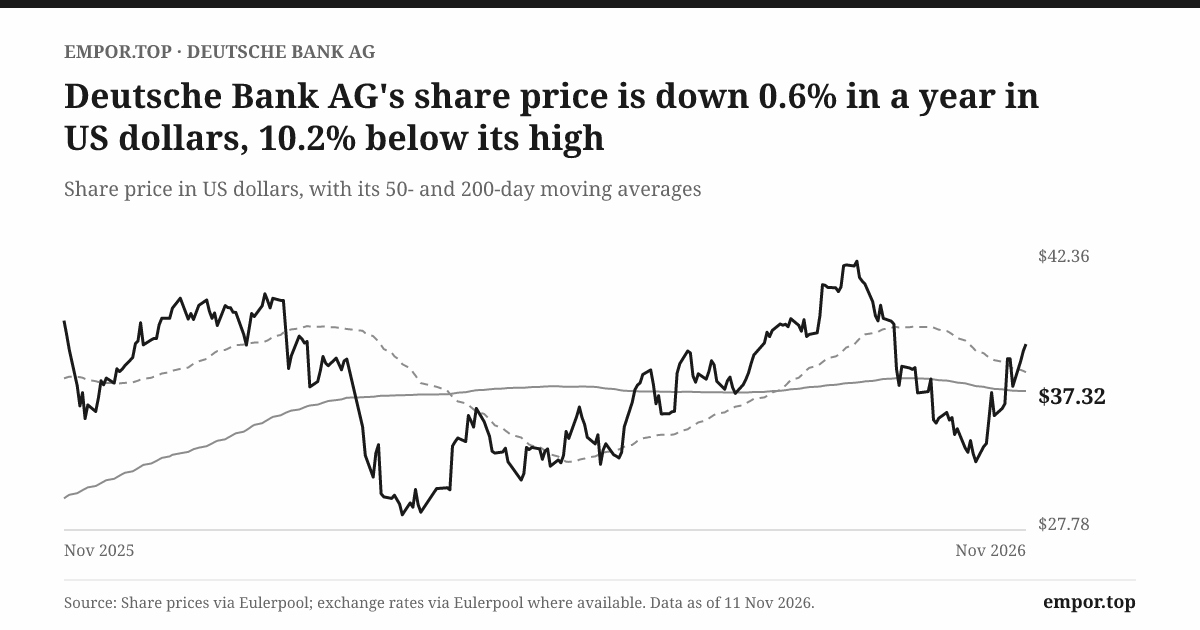
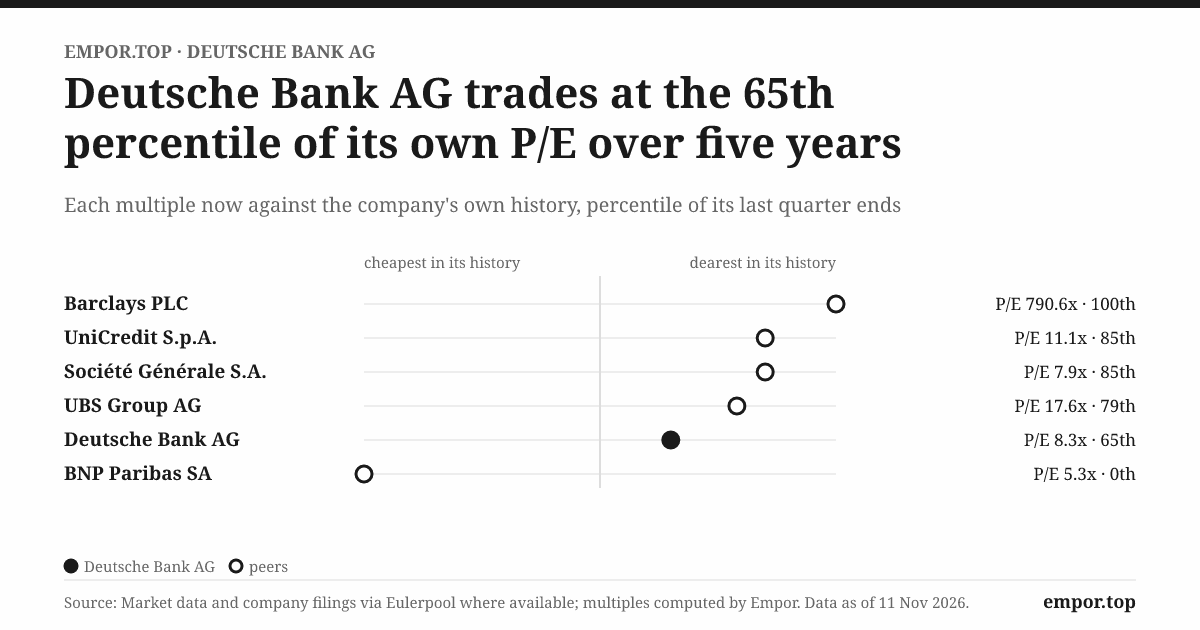
On November 11, 2026, Deutsche Bank's shares closed at about €33.65, giving the company a market value of about €64 billion. The price sat 5.9% below its 52-week high and well above its low of about €24.70. The stock traded at about 8.3 times the last twelve months' earnings, which is above its own five-year median of 7.1 times, and at about 0.8 times book value, with a dividend yield of around 3%. Those are not the numbers of a bank the market has given up on. They are also not the numbers of a bank the market fully believes.
The bull case is a chain of evidence, and each link is real. Revenue is growing in all four divisions, at about 5% for the nine months, with the bank lifting its full-year ambition above €33 billion.1 The Corporate Bank just had its best quarter in history, with no one-off items, management says, and German revenue rising faster than the rest.12 Fee income and asset inflows are at records, with €103 billion of net inflows in nine months.1
The cost-to-income ratio is improving while the bank invests. Capital generation is strong enough to fund both growth and a 60% payout. The deposit base is large, granular and growing. Germany's fiscal stimulus and pension reform could add tailwinds that management says are not yet in the numbers.2 And the disruption at a domestic competitor could send German corporate clients looking for an alternative.2
The bear case is an equally concrete chain. The 2025 profit rebound depended heavily on the non-recurrence of litigation charges, while adjusted costs barely fell.3 The third quarter's record came in a period when hedge accounting made an unusually large difference to reported profit, a reminder of how sensitive the numbers are to rates and accounting basis.1
Credit provisions are rising, commercial real estate is still the main drag, and a single Asian borrower was enough to swing the Corporate Bank's quarterly charge.1 The Investment Bank remains the largest single profit contributor, and global markets are cyclical. The bank narrowly missed every 2025 financial target, and a money-laundering investigation remains unresolved.36 The bear does not need any of these things to become a crisis. The bear only needs them to keep normalized returns below the cost of equity.
The valuation itself is a useful clue to what the market is assuming. For a bank, the price-to-earnings ratio is simply the price-to-book ratio divided by the return on equity. At 0.8 times book and a return on ordinary shareholders' equity of about 10% for the nine months, the arithmetic produces something close to eight times earnings, which is roughly where the shares trade.1
A bank trading below book value is, in effect, being told by the market that its return on equity is below what investors require. If Deutsche Bank reaches and sustains a return on tangible equity above 13%, the gap between price and book becomes hard to justify. If returns stall near 10% to 11%, the current price is about right. The market is not pricing a collapse. It is pricing doubt about whether the next leg of improvement will arrive.
Peer comparison sharpens the point, though it must use bank measures rather than industrial ones. Enterprise value and EBITDA multiples are meaningless for a bank, because its "debt" is its raw material. On return on tangible equity, which is the measure that matters, the bank's own analysts say it lags. JPMorgan's Abouhossein told management that its 2028 target was the lowest in his coverage, whether achieved this year or by 2028.2
On cost-to-income, a ratio around 61% remains high by the standards of the most efficient European banks. On capital, a CET1 ratio of 14% is solid and in line with large European peers. Deutsche Bank, in other words, is now a well-capitalized bank with below-peer profitability, trying to close the profitability gap. That is a much better place than it occupied in 2017. It is not yet a premium franchise.
The strongest disconfirming evidence deserves its full weight. The capital raises of the 2010s and the years of losses rebut any claim of uninterrupted financial strength. The post-2019 record narrows that concern considerably, with profitability and shareholder distributions restored.31
But six years is shorter than a full credit cycle, and the bank has not yet been tested by a severe European recession in its new form. Current capital and liquidity support resilience. Future distributions will compete with growth and buffers.
Three numbers, followed quarter after quarter, will tell investors more than any slide. The first is return on tangible equity against the cost of equity, which stood at 11.5% for the first nine months of 2026, up from 10.9% a year earlier, against the target of above 13% for 2028.1 The second is the cost-to-income ratio, at about 61% for the nine months, down from 63%, against the target of below 60%.1
The third is credit-loss provisions, together with the migration of loans into Stage 2 and Stage 3, which were up 13% in the nine months and are the number most likely to surprise.1 Market share and client inflows are supporting evidence. They are not substitutes for these three. What these numbers will say in the coming quarters is a matter for the future; what the story so far teaches is not.
XII. Playbook: Business & Investing Lessons
Go back to that Sunday in July 2019, when Christian Sewing announced Deutsche Bank's retreat from equities trading. It was, in a sense, the least glamorous decision a German banker could make: an admission that the dream of being a European Goldman Sachs was over. It was also the decision that made everything since possible. The lessons of Deutsche Bank's long rebuild belong to this bank, but they travel.
The first lesson is that a retreat can be a strategy when the old map keeps losing money. For a decade, Deutsche Bank's leaders treated every business as a position to be defended, because giving ground felt like admitting failure. The losses kept coming. Sewing's insight was that capital, talent and management attention are finite, and that a business with no path to adequate returns is not a franchise but a drain.
The Capital Release Unit was a machine for turning pride into capital. Every founder and every board that defends a failing line out of identity rather than economics should remember the Sunday a bank gave up a business it had spent billions building, and was stronger for it. Shrinking was the price of the right to grow.
The second lesson is that strategic fit still needs a clean price and clean execution. Postbank was the right idea: cheap deposits and millions of German customers for a bank that badly needed a domestic anchor. But the contested route to control and the long technology integration turned a sensible deal into a costly, drawn-out project.
The strategy deck said "complementary." The court in Cologne and the IT migration said "complicated." A good acquisition is not the one with the best logic; it is the one that is still a good acquisition after the lawyers and the engineers are done with it.
The third lesson is that for a bank, cash flow is a balance-sheet story before it is an earnings-quality story. Standard factory measures can mislead when applied to a bank, where deposits and trading books drive cash-flow swings. The real risks lie in credit migration and accounting sensitivity. For a bank, read the capital ratio, not the cash-flow statement.
The fourth lesson is that a target is a promise until the return arrives. Deutsche Bank has missed cost and profitability targets before. It has now set a 2028 return target that its own chief executive calls a floor.
None of this makes management dishonest; it explained its misses and delivered its capital pledges. But the market has learned to price Deutsche Bank's ambitions at a discount, and the only thing that removes the discount is the number on the page in the year the target falls due.
The fifth lesson is that controls are part of the product. A bank sells trust in a very literal way: clients hand it their money and their transactions on the assumption that it knows who else it is dealing with. Deutsche Bank's record of control failures and a current prosecutor's investigation is not a side issue to its franchise.
It is a direct tax on it, paid in fines, in remediation spending, in management attention and in the doubts of supervisors who set its capital requirements. The current case remains an allegation, not a finding. But a bank that wants to be the trusted alternative for German companies cannot afford to keep being the subject of searches. For this bank, compliance is not a cost center. It is the price of admission to its own strategy.
XIII. The Next Four Reports
The next big date on Deutsche Bank's calendar falls in January 2027, when it reports its full-year results for 2026. Management has promised that day will bring more than numbers. Sewing said the bank would lay out further detail on technology, process simplification and AI-led productivity, and Akram promised a "fully and a wholesome update" on a new and improved cost trajectory, along with the bank's capital path.2 Both executives strongly hinted that the 2028 targets will be raised. That makes January a genuine test of the story's central questions, because the bank will be setting its own bar in public again.
The first thing to watch is the bridge. The full-year results will show, for the first time, how 2026 profit splits between recurring operations and everything else: litigation, valuation and timing effects in Corporate & Other, and the hedge-accounting sensitivity that loomed so large in the third quarter. If the recurring operating profit is growing and the noise is shrinking, the case that the earnings are durable gets much stronger. If the year's record depends on items that will not repeat, the bear case gains ground.
The second is the path to the 2028 targets themselves. The bank needs to keep revenue growing at something like 5% a year while pushing the cost-to-income ratio below 60% and the return on tangible equity above 13%. Each quarter between now and 2028 will show whether costs are falling as promised as the heavy investment year of 2026 draws to a close and the productivity savings are supposed to accelerate.2 The promised AI benefits deserve particular scrutiny. Until the bank publishes concrete adoption figures and realized savings, AI remains an option, not an asset.
The third is whether the growth engines convert flows into profit. The Private Bank is aiming for €1 trillion of client assets by the end of 2028, and had reached €865 billion by September.12 Asset Management is taking in record inflows. The question is whether those inflows become fee revenue and profit, or whether they arrive in thin-margin products that swell the headline without moving returns. In the Corporate Bank, the test is the reverse: whether the loan and deposit growth it is celebrating holds up in its credit quality.
The fourth is credit. Investors should follow the commercial-property disclosures, the Stage 2 and Stage 3 balances, allowance coverage and provisions by portfolio each quarter, and see whether management's forecast of a gradual decline in 2027 and a normal run rate of around 30 basis points in 2028 is borne out.2 Any second "idiosyncratic event" would weaken the claim that the first was isolated.
The fifth is capital. The bank expects to finish 2026 inside its operating range and intends to keep its buyback cadence, subject to supervisory approval.2 The January plan will show whether it chooses to raise distributions, deploy more capital into growth, or revisit the range after the lower Pillar 2 requirement. Moody's has made its own view conditional on visible progress toward the plan; its next rating action will be a useful independent signal.9
Each outcome maps onto the questions this story opened with. A franchise that keeps growing, converts that growth into broad-based returns above its cost of equity and keeps its credit discipline would answer most of them in the bank's favor. Repeated adjustments for one-off items, returns stuck near 10% or a turn in credit migration would answer them the other way. The thesis is testable, and the tests are scheduled.
XIV. Outro
At dusk the twin towers on the Taunusanlage catch the last light and turn the color of old copper. After a decade of costly ambition, Deutsche Bank decided, one Sunday in July 2019, to become smaller so that it could try to become stronger.
Tonight the bank inside those towers is profitable, well capitalized and growing, with three consecutive quarters of record profit behind it and the fourth quarter still under way. It is also still short of the returns its rivals take for granted, still cleaning up its property loans, and still answering questions from prosecutors. Deutsche Bank spent a decade learning that being global is not the same as being valuable. Now it has to prove that focus can make the difference.
References
-
Q3 2026 Media Release — Deutsche Bank, 2026-10-28 ↩↩↩↩↩↩↩↩↩↩↩↩↩↩↩↩↩↩↩↩↩↩↩↩↩↩↩↩↩↩↩↩↩↩↩↩↩↩↩↩↩↩↩↩↩↩
-
Q3 2026 Analyst Call Transcript — Deutsche Bank, 2026-10-28 ↩↩↩↩↩↩↩↩↩↩↩↩↩↩↩↩↩↩↩↩↩↩↩↩↩↩↩↩↩↩↩↩↩↩↩↩↩↩↩↩↩↩↩↩↩↩↩↩↩↩↩↩↩↩↩↩↩↩↩↩↩
-
Annual Report 2025 on Form 20-F — Deutsche Bank, 2026-03-12 ↩↩↩↩↩↩↩↩↩↩↩↩↩↩↩↩↩↩↩↩↩↩↩↩↩↩↩↩↩↩↩↩↩↩↩↩↩↩↩↩↩↩↩↩↩↩↩↩↩↩↩↩↩↩↩↩
-
Deutsche Bank Intends to Raise Capital and Announces New Financial Targets — Deutsche Bank, 2017-03-05 ↩↩↩
-
Deutsche Bank Announces Radical Transformation — Deutsche Bank, 2019-07-07 ↩↩↩↩↩↩↩↩↩↩↩
-
German Investigators Search Deutsche Bank Offices in Money Laundering Probe — AP, 2026-01-28 ↩↩
-
Deutsche Bank Updates on Postbank Takeover Litigation Matter — Deutsche Bank, 2024-04-26 ↩↩
-
Deutsche Bank Reaches Settlements with a Large Share of Plaintiffs in Postbank Takeover Litigation — Deutsche Bank, 2024-08-21 ↩
-
Deutsche Bank: Update to Credit Analysis — Moody's Ratings, 2026-09-16 ↩↩↩↩↩
 LinkedIn
 WhatsApp
 Reddit
 Hacker News
 Email
 Kindle
 RSS Feed
 Spotify
 Apple Podcasts
 Amazon Music
 Audible
 YouTube