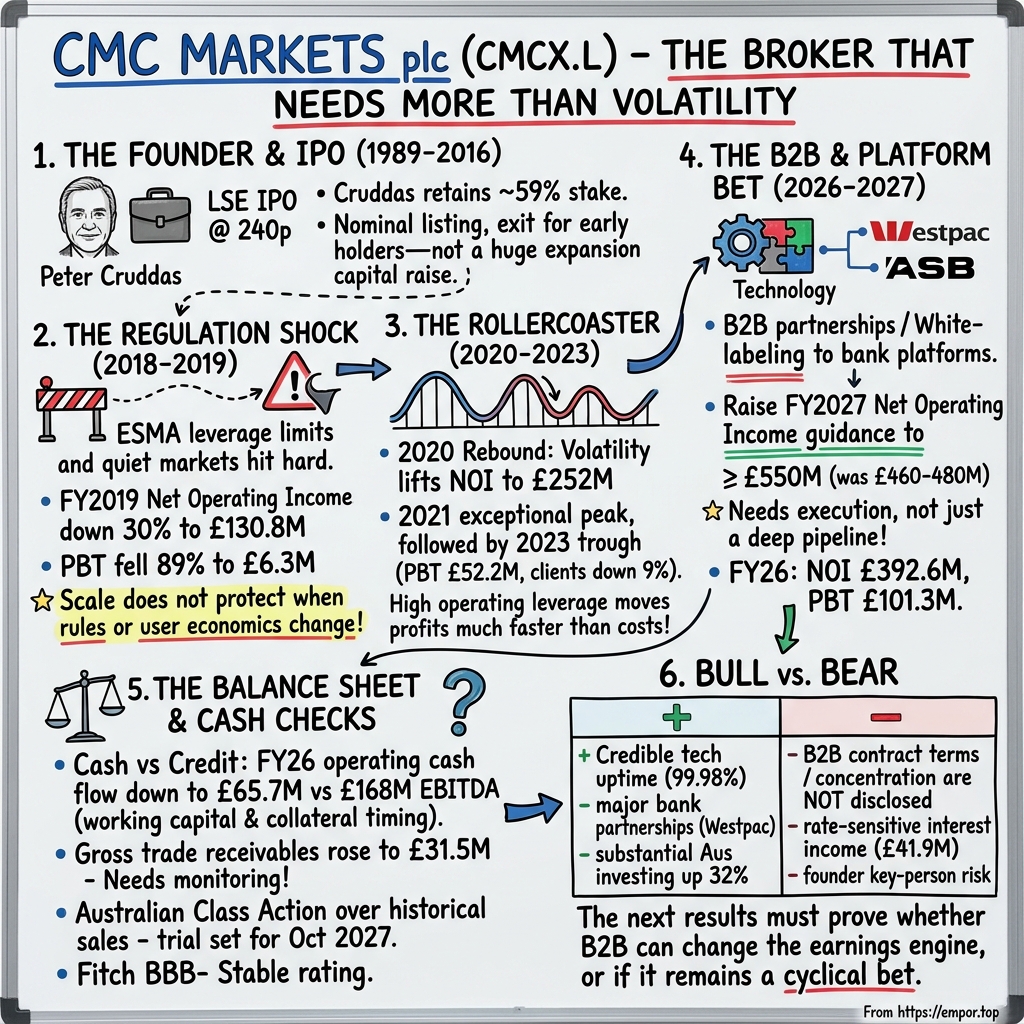
CMC Markets: The Broker That Needs More Than Volatility
I. The Price on the Screen
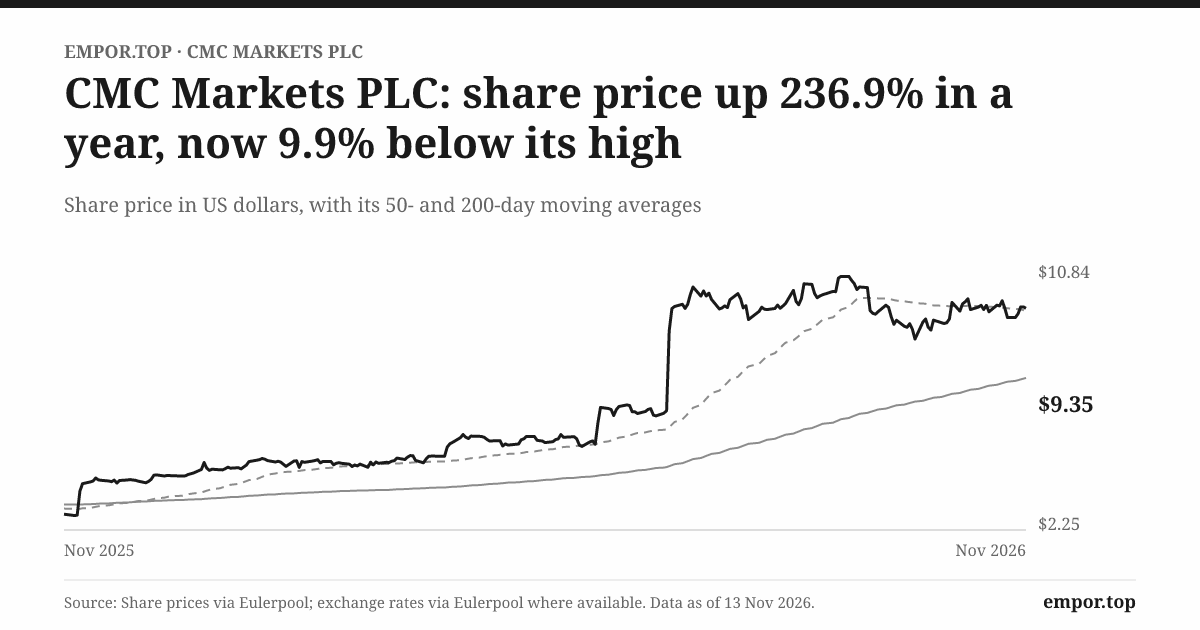
On Friday, 13 November 2026, CMC Markets closed at £7.08 a share.1 Twelve months earlier the same shares had changed hands for as little as £2.06, so anyone who bought near the bottom had more than tripled their money. The stock was sitting less than 8% below its 52-week high of £7.67.1 For a London-listed broker best known for contracts for difference and spread bets, the products traders use to bet on prices without owning the thing being priced, this was a run that belonged on a chart pinned to a trading-floor wall.
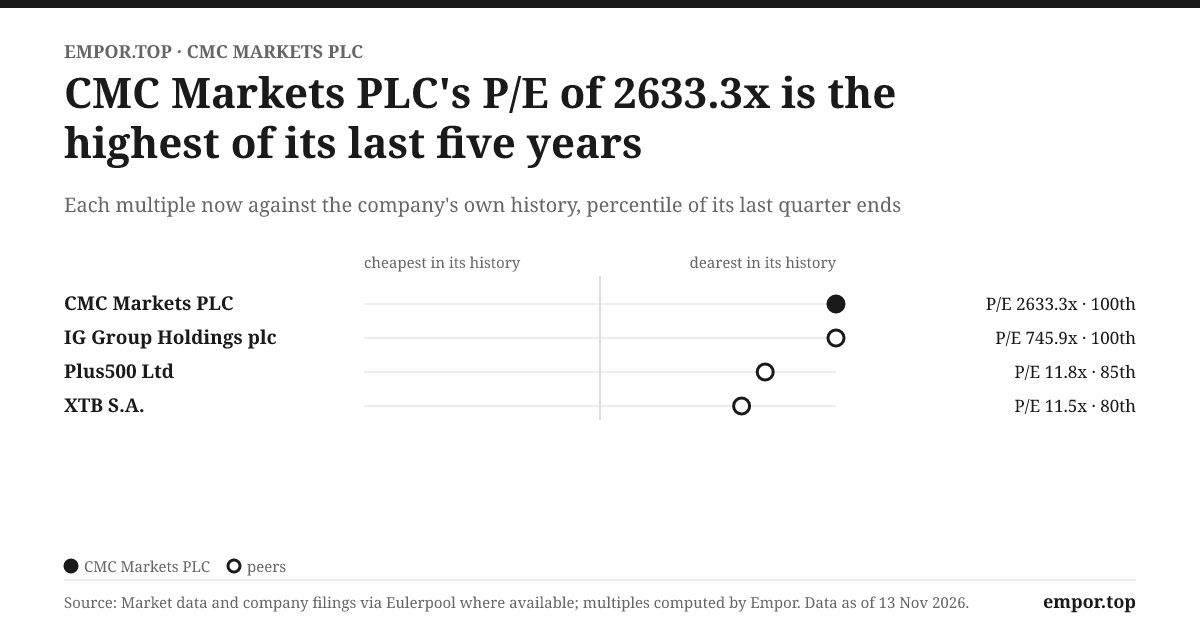
Then comes the strange part. Several market-data screens that carry the stock put CMC's market value at about £195 billion. That would make a broker with roughly 1,100 employees worth more than most of the FTSE 100.2 The same screens show a price-to-earnings multiple of more than 2,600 times. Taken at face value, investors would be paying about 26 centuries of current profit for each share.
The numbers do not survive a pocket calculator. CMC's annual report lists 279.8 million ordinary shares in issue.2 Multiply that by £7.08 and the company is worth roughly £2.0 billion, not £195 billion. Trailing earnings per share were about 27p, so the price is roughly 26 times earnings, not 2,633 times.2 Both errors come out to almost exactly a factor of 100, which is the signature of a classic data mistake: a share price quoted in pence somewhere in the pipeline and treated as pounds. A £2 billion company is still a substantial one, but it is a different animal from a £195 billion one, and the gap is a useful warning. In a story about a business whose profits can swing wildly, the first number on the screen was wrong by two orders of magnitude.
Strip the noise away, though, and something real is left. The share price has not tripled because of a data error. It has tripled because CMC told the market something surprising. On 1 July 2026, barely four weeks after it had guided investors to net operating income of £460 million to £480 million for the year to March 2027, the company raised that target to at least £550 million.3 It credited the upgrade to exceptional growth in its business-to-business arm, the part of CMC that lends its trading technology and market access to banks, brokers and fintech apps rather than selling directly to traders.3 Management also guided to about £250 million of EBITDA, the profit before interest, tax, depreciation and amortisation, which would be roughly double what the company earned on that basis in the year just ended.32
That is the story the market is paying for, and it is a story with three hard questions inside it. The first is whether partnerships with banks and other distributors can change the shape of CMC's earnings, so that a business historically driven by how much its retail clients feel like trading starts to look more like infrastructure that earns money whatever the mood. The second is how durable the advantage of CMC's platform really is, because a trading platform that partners can plug into is valuable only if they cannot easily plug into someone else's. The third is about the people making the promises. CMC has been run by the same founder since 1989, through regulatory shocks, pandemic booms and earnings troughs.4 What does that record say about how much weight to put on the latest guidance?
The stakes are clear enough. CMC is a regulated broker whose growth in the year to March 2026 was genuine: net operating income rose 15% to £392.6 million and profit before tax rose 20% to £101.3 million.5 It is also a company in which one man, Peter Cruddas, owns about 59% of the shares and holds the chief executive's job.2 And the engine that is supposed to carry it into a new era is described by the company in outline but not measured in its accounts. CMC does not disclose how much revenue comes from individual partners, how long their contracts run, whether they carry minimum commitments, or what share of income is recurring.2 Investors are being asked to price a transformation whose key ingredient is, for now, largely a matter of trust.
To understand why that trust is both earned and contested, the story has to go back to a founder, a foreign-exchange desk and a stock-market listing that changed less than it seemed to.
 Subscribe on LinkedIn
II. From a Founder's Trading Desk to a Public Company
Peter Cruddas founded the business in 1989 as a foreign-exchange dealer, and for the next quarter of a century it remained, in the most literal sense, his company.4 The name itself was a clue to its origins: CMC began life as Currency Management Corporation, a firm that let clients speculate on currencies at a time when doing so had been largely the preserve of banks and professional traders.4 What set it apart was not the idea of retail speculation, which was hardly new in London, but the bet that technology could make it cheap, fast and available to anyone with a screen.
That bet came early. In 1996 CMC launched an online trading platform for foreign exchange, which put it among the first firms to let private clients deal currency over the internet.4 Over the following years it added contracts for difference and spread bets across indices, shares, commodities and bonds, built its own technology rather than licensing someone else's, and opened offices across Europe, Australia and Asia.4 By the time it prepared to list, CMC described itself as a technology company that happened to be a broker, with a proprietary platform it had built and refined in-house.4 The identity matters, because the whole modern pitch, from bank partnerships to institutional distribution, rests on the claim that CMC's technology is good enough for other firms to put their own brand on it.
The founder's imprint was equally lasting. Cruddas had built CMC from nothing and kept a large majority of it through every stage of growth. When the company finally went to the London Stock Exchange, the question was not whether he would give up control. It was how much of his stake he would sell.
The answer came in early 2016. CMC published its price range prospectus on 26 January and priced the offer on 5 February at 240p a share, valuing the business at roughly £690 million.46 The offer comprised 90.6 million shares, and it was overwhelmingly a secondary sale: most of the money went to existing shareholders, Cruddas chief among them, rather than into the company.46 Only a small amount of net proceeds reached CMC itself.4 In plain terms, the listing was not a fundraising for an expansion plan. It was a way for the founder and other holders to turn part of their paper wealth into cash, and for the company to gain a public share price it could use for incentives and future flexibility.
That distinction sets up much of what follows. Companies that list to raise growth capital invite investors into a plan. Companies that list mainly so that owners can sell invite investors into an existing business, and ask them to accept that the people who know it best are reducing their exposure. CMC's IPO was the second kind, and the timing was not lost on the market, which watched the shares wobble in the quiet trading conditions of the following years.
In its capital structure, CMC has stayed simple since. Its ordinary shares carry a nominal value of 25p.2 The annual reports for the three years to March 2026 show no rights issue, no warrants and no preferential share issue.278 Rather than asking shareholders for money, CMC has more often handed it back. It started a share buyback in 2022 and has continued buying shares into its employee benefit trust, the vehicle that holds stock to settle staff awards; in the year to March 2026 those purchases cost £13.8 million.2 That is not quite the same thing as a buyback for the benefit of outside holders, because the shares are destined for employees, but it does soak up stock that would otherwise dilute them.
What the IPO did not change was who was in charge. At 31 March 2026, Cruddas held 59.03% of CMC's shares, a stake that had barely moved over the prior three annual reports.278 He was still chief executive, a role he had held since founding the company, and he had by then also become a member of the House of Lords, which is why the company's own documents now refer to him as Lord Cruddas.2 In October 2026 he announced that he had bought more shares and intended to buy up to £5 million more.9 A founder adding to an already dominant position after a tripling in the share price is an unusual signal, and it cuts in two directions at once.
On one side, the founder's stake can be a strategic asset. A controlling owner with most of his wealth tied to the company has every reason to think in decades rather than quarters, to keep the balance sheet conservative and to invest through downturns that would panic a board answerable to short-term holders. On the other side, a 59% holder can carry any ordinary resolution on his own. Minority shareholders can voice dissent, and as the story will show they sometimes do, but they cannot change the direction of the company without him. Succession is also concentrated: the person who built the platform, set the culture and now champions the partnership strategy is the same person whose eventual departure the company must one day manage.
The listing, then, gave CMC a public valuation and a broad shareholder register without giving those shareholders much power. Everything that happened afterwards, the regulatory shock, the pandemic windfall, the slump and the new partnership story, unfolded under the same controlling figure. The first real test of what that combination could withstand arrived barely two years after the IPO, when the regulators changed the rules of the game.
III. When the Rules Changed the Economics
In the summer of 2018, a new set of rules from the European Securities and Markets Authority came into force across the European Union and the United Kingdom, and the business of selling leveraged trades to ordinary people changed overnight.10 For years, retail clients had been able to trade CFDs with leverage of 100 times or more, meaning a £1,000 deposit could control a £100,000 position. The new rules capped that leverage for retail clients at 30 times on major currency pairs and at much lower levels for more volatile products, required firms to close out positions before losses wiped out a client's margin, and guaranteed that clients could not lose more than they had deposited.10
The regulators' logic was straightforward. Most retail CFD clients lost money, and high leverage made those losses faster and larger. For a broker, the logic of the rules translated into a simple equation. Lower leverage meant clients needed more cash to hold the same position, so many held smaller ones or traded less often. Smaller and fewer trades meant fewer spreads to earn and less financing income. And the rules arrived in a market that was not helping: through much of the 2018 financial year, prices drifted in narrow ranges, giving traders fewer reasons to open positions at all.10
The results for the year to March 2019 showed exactly how sharply those forces could bite. Net operating income, CMC's main measure of revenue after rebates and levies, fell 30% to £130.8 million, from about £187 million the year before.1011 Profit before tax fell 89% to just £6.3 million.10 The number of active trading clients fell 10%, but the more revealing figure was revenue per active client, which fell 30%.10 Fewer clients were trading, and the ones who stayed were worth far less to the company.
That combination exposed the nature of CMC's cost base. A trading platform has to pay for its technology, its compliance staff, its risk managers and its offices regardless of how much clients trade. When revenue fell by almost a third, costs did not follow, and nearly all of the profit disappeared. This is operating leverage, the property that lets a platform business turn extra revenue into outsized profit in good years and makes it painfully exposed in bad ones. CMC's operating margin, on the measure computed from its accounts, dropped from about 32% to about 5% in a single year.1011
Management's explanation at the time pointed to both the regulatory change and the quiet market, and both were real.10 What the disclosed measures add is a sense of proportion. This was not a change in how revenue was presented or a one-off accounting charge. Fewer people traded, each trader generated less income, and the fixed costs remained. The business shrank in the way that mattered.
CMC was already looking for ways to depend less on leveraged trading. Its most important move was in Australia, where it had won the job of running the stockbroking platform behind ANZ Bank's share-investing service.10 The arrangement put CMC's technology behind a major bank's brand, and its initial rollout lifted stockbroking revenue.10 In hindsight, the ANZ deal looks like the prototype for the B2B strategy that drives the current share price. At the time, though, stockbroking remained a small business next to trading, and it could not offset the collapse in CFD income. The diversification was real but small, a pattern that would recur.
Then the cycle turned, violently. In the final weeks of the 2020 financial year, the pandemic sent markets into one of the most volatile stretches in their history. Clients who had sat on the sidelines rushed back, new clients signed up in large numbers, and the quiet markets of 2018 gave way to daily swings that made trading irresistible. At the same time, CMC changed how it managed the risk of client positions, in particular how much of its clients' net exposure it hedged and how much it retained.12 Net operating income for the year to March 2020 rose 93% to £252 million.12 The same operating leverage that had crushed profit in 2019 now worked in reverse, with extra revenue flowing almost straight to the bottom line.
That rebound is easy to read as vindication, and the company did not hide its pleasure. But it is better read as the second half of a single lesson. In the space of two years, CMC's revenue fell by nearly a third and then almost doubled, and neither move was primarily about the quality of its technology, which was the same platform in both years. The decline came from regulators and quiet markets; the rebound came from a global crisis and the company's own risk choices. Neither was something management could promise to repeat.
There is a fair defence of CMC in this episode. It survived a rule change that forced smaller and weaker competitors to retrench, it kept investing in its platform, it seeded its first major bank partnership, and it was positioned to capture the volatility when it came. Those are real strengths. What the episode does not support is the idea that platform scale protects a broker from changes in the rules or in client behaviour. When leverage limits and calm markets cut the value of each client, CMC's scale did not prevent an 89% fall in profit.
That is the test the rest of the story keeps coming back to. A platform can scale beautifully when clients are busy. The real question is whether it can earn enough when activity fades and each client is worth less. To answer it, the next step is to look closely at what a CMC client is actually paying for.
IV. What a CMC Client Pays For
Picture a client in Singapore on a busy morning in early 2026, watching gold jump as precious metals make what CMC's own executives would later call an unprecedented move.13 She opens CMC's app and buys a contract for difference on gold. She does not own any gold. She has entered an agreement with CMC under which, when she closes the position, CMC pays her the difference if the price has risen and she pays CMC if it has fallen. She has put up a margin deposit, a fraction of the position's full value, because CFDs are leveraged.
From that single trade, CMC can earn money in several ways. The first is the spread, the small gap between the price at which she can buy and the price at which she can sell. On some products CMC also charges a commission. If she holds the position overnight, she pays a financing charge, because the leverage effectively means CMC is lending her the difference between her deposit and the full position. And because CMC is her counterparty, the outcome of her trade and of thousands of others also produces gains and losses that the company manages through its hedging, keeping some client exposure and passing some to brokers and liquidity providers.2 Spread bets, a UK product with the same economics but a different tax treatment, work in much the same way.
The closest everyday analogy is a bookmaker with a very good trading desk. A bookmaker sets the odds, takes bets from thousands of punters and earns its margin in the gap between what it pays out and what it takes in, laying off the bets it does not want to hold. CMC does something similar with financial prices. Because thousands of clients are buying and selling the same markets, many of their positions cancel each other out, and CMC only needs to hedge the net exposure that is left. How much of that net exposure it keeps, and how much it passes on, is a risk-management choice that can add to or subtract from income in any given year. That is why a broker's results can surprise in both directions even when client numbers barely move.
All of that adds up to what CMC calls trading income, and it remains the core of the business. In the year to March 2026, group net operating income was £392.6 million, with trading the largest source and investing and interest income adding material streams of their own.52 CMC reported 55,081 active trading clients, up from 52,290 a year earlier, a rise of about 5%.2 Its growth was also increasingly international: on the June results call, management said Asia and the Middle East together accounted for 54% of group CFD revenue, with Asia having more than doubled and the Middle East having grown 76%.13 By geography, the UK produced about £133 million of net operating income, Australia about £115 million and the rest of the world about £144 million.2
The important thing about every one of those trading income streams is that it begins with a client choosing to trade. As the FY2019 slump showed, that leaves income exposed to market activity.
The second business, investing, works differently. Here clients are not betting on price differences with leverage. They are buying and holding real shares, mostly through CMC's stockbroking operations in Australia, with smaller offerings in the UK, the United States and Singapore.2 CMC earns brokerage on each trade and related income on the balances clients hold. In Australia, where the ANZ arrangement first gave CMC scale, investing net operating income reached A$140.3 million in the year to March 2026, up 32%.2 Australian active traders rose 19% to about 279,000, and assets under management reached about A$89 billion.13 That is a meaningful business, and it is growing quickly. It is also still much smaller than trading.
The shift in mix becomes clearer over a longer span. In the year to March 2023, trading net revenue was £233.1 million, investing net revenue £37.9 million and interest income just £13.9 million.14 Three years later, the interest line had grown dramatically. Interest earned on CMC's own funds was £18.8 million and interest on client funds £23.1 million, a combined £41.9 million.2 Set against statutory profit before tax of £101.3 million, interest contributed the equivalent of about 41% of the year's profit.2
The mechanism is not complicated. CMC holds its own capital and liquidity buffers in cash, money-market funds and government bonds, and those earn more when interest rates are high. It also holds client money, the deposits and margin that clients leave with the firm, and under its client-money arrangements it can earn interest on parts of those balances. When the Bank of England and other central banks raised rates from near zero, both pools began to generate real income. If rates fall, part of that contribution will fall with them, depending on balances and conditions. A material part of CMC's recent profit, in other words, comes not from clients trading or investing, but from the price of money.
It is also important not to confuse those client balances with CMC's own wealth. At 31 March 2026, CMC held £1.149 billion of segregated client money.2 That money belongs to clients, sits in protected accounts and is not available to pay dividends or fund growth. CMC's own resources are a separate pool: about £276.5 million in cash at bank and money-market funds and £126.8 million of financial investments at the same date.2 The difference matters because a broker's balance sheet can look bigger and richer than the company really is.
Smaller items round out the picture. Treasury-related trading added about £5.5 million and CapX, CMC's investments in private-market assets, about £2.4 million, some of it unrealised and therefore exposed to valuation changes.2 These are not large enough to change the story, but they are reminders that CMC's income statement mixes several different kinds of money.
Which brings the analysis to the gap that matters most. The company describes its partner channels, including the banks Westpac and ASB, as growth drivers.2 No single customer accounts for 10% or more of revenue.2 But CMC does not disclose enough about its partners' contribution or contract terms to judge how much of group income is recurring rather than activity-driven.2 For a company whose new valuation rests on a B2B story, those are not technical details. They are the core facts an investor would need to judge whether the earnings mix is changing.
So the honest description of what a CMC client pays for is this: mostly the right to trade, priced in spreads and financing charges, plus a growing stream of investing fees and a large, rate-sensitive cushion of interest. CMC has widened the routes through which customers reach markets, but its core still moves with client activity. The next question is how much of the latest recovery reflects lasting execution, and how much reflects an unusually generous combination of volatility and interest rates.
V. The Shock That Made the Bear Case Concrete
There is a certain kind of year that every broker dreams of and every analyst learns to distrust. For CMC, it was the year to March 2021. Lockdowns, stimulus cheques and wild markets sent retail trading to levels the industry had never seen. CMC's profit before tax that year was more than double what it earned in the year to March 2026, and its net margin approached 40%.72 It was a spectacular result. It was also, as the next two years showed, not a base.
The comedown was steep. As volatility faded and pandemic traders drifted away, net operating income fell back. By the year to March 2023, it was £288.4 million and profit before tax was £52.2 million, roughly a quarter of the pandemic peak.14 Active trading clients fell 9%.14 CMC was still profitable, still paying dividends and still investing, but the business had reverted toward the earnings power of a normal market.
Taken over the long run, the numbers tell a more measured story than the most recent year suggests. Over the ten years to March 2026, CMC's revenue grew by about 9% a year and its net profit by about 6% a year.211 Profit has therefore grown more slowly than revenue across the full span, which means the business has, on average, become less profitable per pound of income as it has grown. Measured from the pandemic peak, the picture is worse: over the five years from March 2021, net profit fell by about 16% a year.2 Over the latest three years, it grew by about 22% a year, which sounds impressive until the reader remembers that the starting point was the 2023 trough.214
None of that undermines the reality of the latest result. Both net operating income and profit before tax rose.135 CMC described the year as its best outside the pandemic-affected FY2021.5 That was true. It was also achieved with costs rising nearly as fast as income: operating expenses grew 15%, and staff costs alone rose to £124.3 million.132 The results also absorbed a £5.2 million provision for remediating Australian clients affected by a margin-netting problem, a reminder that conduct issues have a habit of resurfacing in this industry.2
The more interesting question is how management explained the year, and whether it separated luck from strategy.
On the June 2026 results call, the executives told two stories at once. Laurence Booth, the executive director who heads capital markets, opened the financial review by citing an unprecedented move in precious metals, significant volatility across global markets and what he called blowout volumes across the platform.13 That is a clear acknowledgment that market conditions drove a large part of the year. Peter Cruddas, meanwhile, framed the business as something new: revenue, he said, was driven by B2B and wholesale, and CMC was no longer just a traditional retail CFD provider.13
Both claims can be true. Market volatility raises activity across every channel, including partners' clients. But the prepared remarks did not split income into the three buckets an investor would most want to see: the part that came from unusual market conditions, the part that came from interest rates and the part that came from structural growth in partners and investing.13 The interest contribution, worth the equivalent of about 41% of profit, was not given a prominent place in the narrative at all.132 The annual report contains the interest figures, but the story management told was about platform and partnerships.
That pattern has precedent. After the pandemic peak, CMC's results communications also emphasised its diversification and technology investment while income fell back toward pre-pandemic levels.14 The language of structural change has been consistent across the cycle. What has varied is the market backdrop, and the reported numbers have moved with the backdrop more than with the language.
The fair conclusion is a proportionate one. The latest year shows a genuine recovery: more clients, higher income, better profit and a growing investing business. But a recovery that coincides with an extraordinary commodity move and with interest rates that turned client balances into a meaningful profit source is not yet proof that CMC has escaped the cycle. The ten-year record, with its 2019 slump, 2021 peak and 2023 trough, is evidence that it has not done so before.
Which is precisely why the next chapter matters so much. If the earnings mix is going to change, it will be because of the partnership business, and on 1 July 2026 CMC made a claim about that business large enough to triple the share price.
VI. The Partnership Bet: Can CMC Grow Above Its Retail Trading Desk?
On 4 June 2026, CMC told investors to expect net operating income of £460 million to £480 million in the year to March 2027, about 20% growth at the midpoint, with operating expenses before variable pay of about £280 million.13 Its executives described the year ahead as a deliberate investment phase, including a deliberate push back into retail and direct-to-consumer growth.13 They also noted that revenue from a newly announced Premier League deal had not been included in the guidance.13
Twenty-seven days later, the guidance was obsolete. On 1 July 2026, CMC raised its income target to at least £550 million and guided to about £250 million of EBITDA, while keeping operating expenses at about £280 million excluding variable remuneration.3 It cited B2B growth.3
The arithmetic of that upgrade is the most important thing in this story. The income target rose by £70 million to £90 million, and the cost guidance did not change. Take £550 million of income, subtract £280 million of fixed operating costs, and about £270 million is left before variable pay; the £250 million EBITDA guidance implies roughly £20 million of bonuses and similar costs. In other words, management told investors that almost every extra pound of the upgrade would fall through to profit. Compared with the year to March 2026, when EBITDA was roughly £126 million, the new guidance implies earnings roughly doubling in a single year.23
That is the same operating leverage that gutted profit in 2019, now working in the investor's favour. A platform with largely fixed costs can, in principle, add a large new stream of income with little extra expense. It is exactly why the B2B story is so attractive, and exactly why it needs testing.
The opportunity itself is easy to explain. Banks, neobanks and online brokers want to offer their customers share trading and, in some markets, more sophisticated products. Building a trading platform from scratch is expensive, slow and regulated. Partnering with a firm that already has the technology, the market connections and the licences is faster. CMC's pitch is to be that firm: its platform runs behind the partner's brand, the partner brings the customers, and CMC earns fees, commissions or a share of income without paying to acquire each client itself.
The roster is impressive. CMC already runs ANZ Bank's share-investing service in Australia, the arrangement that first gave its investing business scale.13 On the June call, management also named Westpac, Revolut and New Zealand's ASB Bank as partners.13 The two banks are the headline wins. Westpac's share-trading business has about 500,000 customers and around A$39 billion of assets under administration, and CMC said it expects the migration to lift its domestic turnover by about 45%.13 ASB has about 150,000 share-trading customers.13 Both, Matthew Lewis, CMC's head for Australia and New Zealand, said, were on track to launch in 2027.13
That timing reveals something important. The guidance raise came in July 2026, when neither Westpac nor ASB had yet launched. Whatever exceptional B2B growth CMC saw in its first quarter, it cannot have come primarily from those two banks. It must have come from existing institutional clients, other partners or wholesale flows the company does not name. That does not make the growth less real, but it does mean the most recognisable names in the partnership story are not yet the ones producing the income. Investors who picture Westpac customers trading on CMC's platform as the source of the July upgrade are picturing something that had not yet happened.
Nor can outsiders measure what is happening instead, because CMC gives no partner-level figures. A large part of the upgrade may come from a handful of institutional relationships. If so, the income could be lumpy, and the counterparties could have considerable bargaining power, a point the competitive analysis will take up. The company has also not said how much of the B2B income is driven by its partners' clients trading, which would tie it back to the same activity cycle that drives the retail business.
There are other questions the guidance raises. Onboarding a large bank's customer base is not free: migrations need engineering time, compliance work, customer support and, often, upfront commercial concessions. Management's own description of an investment year suggests it expects to spend, but the cost guidance did not move when the income guidance did. Either the new income needs little extra spending, which would be a powerful result, or some costs will arrive later, perhaps when the Westpac and ASB migrations begin in earnest. Partner economics may also be renegotiated as partners grow and learn what else is available. A bank that brings 500,000 customers to a platform is not a passive buyer.
Investing, meanwhile, is the second and smaller growth engine. Its 32% income growth in Australia is substantial, and the Westpac and ASB migrations will add to it.213 But investing is still a fraction of the group, and it too is linked to client activity: brokerage fees rise when retail investors trade shares more often. It diversifies CMC's products more than it diversifies its exposure to market sentiment.
So the forward measures are clear. The first is B2B-derived income and its margin, if CMC begins to disclose them. The second is active trading clients and revenue per active client, which show whether the core is growing or simply riding volatility. The third is investing clients and assets, especially once the bank migrations start.
The first public check is close. CMC's interim results for the six months to September 2026 are due in late November.15 They will show whether the first-half numbers are tracking toward at least £550 million, whether costs are holding near the guided level, and how much of the growth management attributes to partners. Analysts will want answers on concentration, onboarding milestones and margins; how specifically management answers will say as much as the numbers. Until then, the partnership business is a powerful claim supported by a guidance upgrade, not yet a proven, recurring revenue stream.
Whether that claim holds depends on something more fundamental than a single half-year: whether CMC's platform is genuinely hard to replace.
VII. The Platform's Edge and Its Limits
Imagine two rooms. In the first, a trader in Dubai has CMC's app open on one screen and a rival broker's app on the other. She checks the spread on oil in both, picks the tighter one and places her trade. In the second, a technology committee at a large bank is deciding how to give its customers share trading. It can build a platform itself, buy one from a vendor or rent one from a partner like CMC. Both rooms are CMC's market. In both, the customer has choices.
CMC's case for its own platform is a serious one. In the year to March 2026, it reported group-wide platform uptime of 99.98%, meaning the system was unavailable for well under two hours across the whole year.2 It offers trading in thousands of instruments across asset classes, holds licences in multiple jurisdictions and has proven it can migrate a major bank's customers, as it did with ANZ.210 For a bank partner, those are exactly the capabilities that matter. A bank does not want to explain to half a million customers why their share-trading app went down on a volatile morning.
But reliability is a necessary condition, not a moat. Uptime tells an investor that the platform works. It does not show that customers stay longer, trade more or pay higher prices because of it. And the competitive forces around CMC are not gentle.
Start with the retail customer. Traders can and do hold accounts with several brokers, moving activity to whichever offers better prices, products or service. CMC does not disclose retention rates or switching costs, and there is no published evidence that its clients are locked in. Its active-client count has moved up and down with market conditions, suggesting that clients come and go with the cycle.1014 Buyer power at the retail level is diffuse, because no single trader matters, but it is real, because every trader can leave.
At the B2B level, buyer power is concentrated. A bank bringing hundreds of thousands of customers can negotiate hard on price and terms, and there are other platform providers it could use. As the partner business grows, the bargaining strength of a few large partners may grow with it. Without partner-level disclosure, investors cannot tell how much of CMC's income depends on any single relationship.
Supplier power is less visible but not absent. CMC relies on brokers and liquidity providers to hedge client exposure and settle trades, and at March 2026 it had £287.9 million due from brokers, one of the largest items on its balance sheet.2 Its auditor named amounts due from brokers as a key audit matter.2 CMC does not publish how concentrated those relationships are.
The threat of new entrants has been tempered by regulation. Licences in the UK, Europe, Australia and Asia take time and money to obtain, and the 2018 rules made the retail CFD business less attractive to newcomers. But new entrants in adjacent forms, neobanks, commission-free share apps and crypto platforms, compete for the same retail attention, and some of them could become partners or rivals. Substitutes are plentiful: a client who wants exposure to gold can buy an exchange-traded fund, a futures contract or a share in a mining company.
Rivalry is the force that shows most clearly in the numbers. IG Group, CMC's largest London-listed competitor, reported revenue of more than £1 billion for 2025, more than two and a half times CMC's net operating income.1617 Plus500, the other London-listed CFD specialist, is also a substantial rival with a large retail client base. Each has its own mix of trading, investing and other products, and each competes for the same clients and partners. CMC is a meaningful player, but it is not the scale leader in its own market.
Scale, in principle, is CMC's strongest structural argument. A platform's cost base is largely fixed, so every extra product, country or partner can be added at modest cost, and the July guidance assumes exactly that. If CMC can sign more partners onto the same technology, its unit costs fall and its margins rise. The test of whether that advantage is real is not the uptime figure. It is whether partner wins keep coming, whether partner income stays as the partners grow and whether the incremental margins match the guidance.
The 2018 rule changes showed that platform quality alone could not protect earnings when regulation and client economics changed.10 CMC's platform allowed the company to survive the hit and benefit when conditions improved.
Technology and AI add a final twist. AI could lower the costs of customer service, compliance monitoring and software development for CMC. It could also lower the cost for rivals and partners to build their own platforms, eroding one of CMC's selling points. CMC's filings do not quantify any AI-related revenue or savings, so any upside from it remains unproven.
The verdict is that CMC's moat is plausible as a technology and distribution capability, and the bank partnerships are real evidence that sophisticated buyers value it. What is not yet demonstrated is that the capability can earn superior returns through a full cycle, or that partners cannot eventually take their business elsewhere. That question will be answered by results, and those results will be shaped by the person who still makes the decisions.
VIII. A Founder Still Allocating the Capital
On 24 July 2026, CMC's shareholders gathered for the company's annual general meeting to vote on the usual slate of resolutions: the accounts, the directors' re-elections, the remuneration report, and an authority allowing the company to make loans to directors.18 Every resolution passed. Given that Peter Cruddas owns about 59% of the shares, the outcome was never in doubt. The interesting numbers were in the dissent.
Cruddas remains the controlling shareholder and chief executive; Fiona Cruddas holds a further 3.21% of the shares.2 The largest outside holders are Aberforth Partners at 5.27% and Schroders at 5.06%.2 The relationship between the controlling shareholder and the company is formalised in a relationship agreement, and the company reports no material trading with entities he controls and no royalties or management fees paid to him or a parent company.2 That is a cleaner structure than many founder-controlled companies, where the controller's other businesses sell to or license from the listed company.
The director loans are the exception that drew attention. A £400,000 loan made to a director in the year to March 2025 remained outstanding, with accrued interest, at March 2026.2 A further £287,850 was lent to a key management person on 1 April 2026, due in May 2031 and stated to be on normal commercial terms.2 These amounts are trivial against CMC's revenue and capital. But listed companies rarely lend money to their own senior people, and investors noticed: 10.53% of votes were cast against the loan authority.18 For a resolution that the controlling shareholder can pass on his own, a tenth of the votes against is a meaningful signal from outside holders.
Pay drew similar attention. Cruddas's total remuneration rose from £1.069 million to £1.679 million in the year to March 2026, as profit before tax rose from £84.5 million to £101.3 million.2 His annual incentive paid out at 65% of the maximum.2 For the year to March 2027, the board approved a 25% increase in his salary to £1.25 million, and a 50% increase for Laurence Booth, the head of capital markets, to £600,000.2 Measured against a 20% rise in profit, a 57% rise in the founder's pay is generous, and the forward salary increases came before the July upgrade that has since justified them in the market's eyes. At the AGM, 9.21% voted against the remuneration report.18
The sharpest signals came on the board. Because Cruddas controls the company, the UK listing rules require independent directors to be approved separately by independent shareholders. Among those independent holders, 32.26% voted against the re-election of Sarah Ing, the senior independent director, and 20.68% against the chairman, Paul Wainscott.18 Those are high levels of opposition for a UK company. The board itself acknowledged a temporary departure from a governance-code provision on board balance in mid-2025 and a continuing shortfall against the provision that calls for open advertising or external search when appointing non-executive directors.2
Then there is the finance seat. Chief financial officer Albert Soleiman left in February 2025, handing over through July, with departure terms including £150,000 in lieu of notice and a £110,200 discretionary payment.27 On the June 2026 results call, the speakers were Cruddas, Booth, David Fineberg, the head of strategic partnerships, who walked through the detailed financials, and Matthew Lewis from Australia; no chief financial officer took part.13 A company guiding to a doubling of EBITDA, raising debt and managing hundreds of millions of pounds of broker balances would usually present a finance chief to the market. The absence is not a sign of wrongdoing, but it is a gap a skeptical investor would ask about.
On capital allocation, the record is consistent with the stated strategy. CMC has spent on people and technology: headcount rose from 1,060 to 1,120 in the year to March 2026, and capitalised development rose from £5.9 million to £8.7 million.2 It paid a dividend of 13.8p per share, about half of profit after tax, and bought £13.8 million of shares for its employee trust.132 Notably, it did not buy companies. There was no major acquisition, so there is no M&A record to praise or criticise; the capital story is about organic investment, dividends and employee shares. The Premier League deal flagged on the June call is the most visible new commercial bet, and the company has not quantified its economics.13
The October purchase adds to the alignment signal.9 It does not, however, change the governance arithmetic. The more Cruddas owns, the less influence minority holders have, and the more the company's future depends on one person's judgment and, eventually, on his succession.
The verdict is therefore balanced. Founder control has its advantages. It has also produced generous pay decisions, unusual related-party loans, a governance code shortfall, an absence of a finance chief on the public stage and meaningful dissent from independent holders. Investors should judge those matters by their terms and votes, not wave them away because the sums are small. And the place where governance and financial risk meet most directly is the cash flow statement.
IX. The Cash, the Receivables and the Unpriced Tail
In the year to March 2026, CMC reported record-level profits outside the pandemic year. Its cash generated from operations, however, fell to about £47 million, a fraction of the £126 million or so of EBITDA it reported.2 A year earlier, operating cash flow had been well above EBITDA. On a standard screen, that looks like a sharp deterioration in cash conversion. For a broker, it may mean much less than it seems.
The reason is that a broker's working capital is not like a manufacturer's. CMC's balance sheet is full of money moving between clients, brokers, exchanges and settlement systems. When clients hold bigger positions, CMC posts more margin with its own brokers to hedge them; when share trades are awaiting settlement, money sits in transit. Those movements show up as changes in working capital, and they can swamp the profit figure in any single year.
That is exactly what happened. Amounts due from brokers consumed £151.5 million of cash, and trade receivables another £40.4 million.2 Most of that was offset by a £134.0 million increase in payables and £55.7 million of additional secured borrowing, mostly prime-broker financing and repurchase agreements.2 The pattern is consistent with a business that grew its trading volumes sharply during a volatile year and needed to post more collateral to support them. It is not, on its own, evidence that reported profit was fictitious.
Two points deserve attention all the same. The first is the trade receivables. Gross trade receivables rose to £31.5 million at March 2026 from £12.4 million a year earlier.2 Of that, £27.6 million was aged between one and three months, a large concentration in a bucket that is no longer fresh.2 The oldest balances, £2.6 million over 12 months, were fully provided for, the total loss allowance was £3.1 million and write-offs rose to £0.7 million from £0.4 million, small against revenue.2 Separately, stockbroking debtors were £120.6 million, largely paired with matching stockbroking creditors.2 The rise in trade receivables may simply reflect timing, but it is the sort of change worth checking against next year's ageing.
The second point is about the ratios themselves. Screens that compute debtor days put CMC above 400 days, which for an ordinary business would suggest customers paying more than a year late. For CMC, the figure is mostly a by-product of broker and settlement balances measured against revenue, and it says almost nothing about whether retail clients are paying. The better signal is the receivables ageing note.
Beyond the cash flow sits the legal tail. In May 2022, a class action was filed in Australia on behalf of retail clients who had acquired CFDs and binary products from CMC between November 2011 and April 2021.2 In March 2026, the claim was amended, narrowing the covered period to May 2016 to April 2021 and changing its causes of action; a trial is set for October 2027.2 CMC says the outcome and financial effect cannot yet be reliably estimated, so no cost is reflected in its guidance or its reported profit.2 That is a genuine, unquantified liability, and it sits in the same Australian market where CMC has already paid remediation and recently booked another £5.2 million charge.2 Its auditor, Deloitte, gave an unqualified opinion on the accounts, with trading revenue and amounts due from brokers as key audit matters.2 A clean audit, however, does not settle the cost of a lawsuit.
Financing has become a more active part of the story. Borrowings at March 2026 included £46.8 million of commercial paper, short-term debt with maturities measured in months, along with the £55.7 million of secured borrowing and £21.6 million of lease liabilities.2 CMC had no drawings on its £55 million revolving credit facility, which was renewed in March 2026, and it reported £300.1 million of unencumbered liquid assets.2 Commercial paper works like a very short-term IOU sold to money-market investors: cheap and flexible while markets are calm, but it has to be repaid or rolled over every few months, which is why a backstop facility matters if credit markets freeze at the same moment trading becomes hectic. Its regulatory capital was well above the minimum: common equity tier 1 capital of £390.3 million, or 292% of its own-funds requirement.2 After the year end, it established a £500 million medium-term note programme and outlined plans to raise about £200 million of debt.2
Fitch rated the programme BBB-, in line with CMC's BBB-/Stable issuer profile.19 The agency's reasoning is a neat summary of this story's tensions. It credited CMC's established franchise, sound risk management and moderate leverage, and it cited as constraints the reliance on over-the-counter leveraged trading, profitability that is sensitive to regulation and limited diversification.19 An upgrade, Fitch said, would require greater scale and diversification; a downgrade could follow if gross debt rose to about twice EBITDA or liquidity came under strain.19 It is an outside view, not a guarantee, but it frames the same question as the equity market: can the new business make CMC more diversified?
The cash and credit picture is therefore reassuring in its broad strokes and worth watching in its details. The commercial paper creates refinancing exposure, but the undrawn facility and liquid assets provide a cushion. The receivables need to come down or age well. And the class action is a risk the earnings do not price. With those pieces in place, the case for and against CMC can finally be weighed.
X. Analysis and Bear vs. Bull Case
Go back to the screen from the opening. The share price is still £7.08. Now use CMC's own numbers. At 279.8 million ordinary shares, the company is worth about £2.0 billion.21 Some of those shares sit in the employee benefit trust, so the figure for shares held outside the company is a little lower, but not enough to change the picture. Trailing earnings of about 27p a share put the stock at roughly 26 times last year's profit.2 For comparison, market-data snapshots in October 2026 put IG Group at about 10 times its expected earnings and Plus500 at about 11 times.2021 Those peer figures use forecasts, different dates and different definitions, so the comparison is indicative, not precise.
What the gap suggests is that the market is not pricing CMC on what it earned. It is pricing CMC on what it said in July. If the company delivers £250 million of EBITDA and something like that converts into net profit, earnings would roughly double, and the multiple on those future earnings would fall to levels much closer to its peers. In plain terms, the share price appears to assume that the guidance is met. Any valuation conclusion has to begin with that reconciliation, not with the multiples quoted on screens that are out by a factor of 100.
The bull case is clear. CMC grew income 15% and profit 20% in the year to March 2026, added active trading clients and grew its Australian investing business by nearly a third.52 Its platform is reliable at 99.98% uptime, and banks such as ANZ, Westpac and ASB have chosen to run their customers on it.213 Most importantly, management raised guidance to at least £550 million of income and £250 million of EBITDA with no increase in fixed costs, which, if delivered, would show that the platform's operating leverage can work in a structural way, not just in a volatile year.3
Hamilton Helmer's framework of seven sources of lasting advantage helps sort which of those strengths could last. CMC's best claim is scale economies: a largely fixed-cost platform that becomes more profitable as partners are added. The guidance is a direct bet on that power. Switching costs are weak for retail traders but potentially meaningful for bank partners, because migrating half a million customers is costly and risky, as the long run-up to the Westpac launch suggests. That cuts both ways: it makes partners sticky once onboarded, but it also means the partner chooses carefully and negotiates hard beforehand. Process power, in the form of decades of experience managing client risk and hedging, is plausible but hard to measure. Brand is moderate. There are no strong network effects, no cornered resource beyond licences that rivals also hold and no obvious counter-positioning. So CMC's advantage rests mainly on scale and partner switching costs, both of which are still being proven.
The bear case is equally concrete. Over ten years, net profit has grown only about 6% a year, and it remains below the pandemic peak.2 The 2019 slump showed how quickly regulation and quiet markets can cut profit.10 Interest on own and client funds contributed the equivalent of about 41% of last year's profit before tax, and that income will shrink if rates fall.2 The B2B business that underpins the guidance is not disclosed in enough detail to measure concentration, contract length or margins, and the best-known partners have not yet launched. Governance concerns, from the loans and pay to the independent dissent and the absent finance chief, add a discount that minority holders cannot vote away.
An activist looking at CMC would focus on disclosure first. If B2B is driving a near-doubling of profit, the company could report it as a separate segment with income, margins and concentration measures. Second, the activist would ask for a permanent chief financial officer and a clear succession plan. Third, they would ask why salaries rose so sharply before the upgrade was delivered, and why the board continues to fall short of the governance code on director appointments. These are not questions about whether CMC is a good business. They are questions about whether outside shareholders have the information and influence to judge it.
Management's credibility has to be tested against outcomes, not language. In 2019, CMC's earnings fell sharply despite its platform investment. In 2020 and 2021, they soared on volatility. In 2023 they fell again. In 2026 they recovered, and in July the guidance jumped. The narrative of diversification has been consistent across that cycle; the earnings have not. That does not mean the July guidance is wrong. It means the guidance needs to be checked against results before it is treated as a new base.
Three measures will decide the case. The first is B2B income and its realised margin, which CMC does not yet report separately; the latest reading is the guidance itself. The second is active trading clients and revenue per active client, which rose to 55,081 clients last year, up about 5%, and will show whether the core business is growing or merely riding a volatile year.2 The third is trade-receivable ageing and impairment, where gross receivables rose to £31.5 million from £12.4 million.2 If the first rises with healthy margins, the second holds up in calmer markets and the third normalises, the bull case strengthens. If not, the July guidance will look like another peak.
The interim results and their analyst Q&A will be the first chance to test management's answers on guidance, partner contribution, investment spending and the shape of B2B growth. Those answers, and the numbers behind them, will say whether the lessons of CMC's past have been absorbed or are about to be relearned.
XI. Lessons: The Broker That Has to Earn Its Cycle
Put three moments side by side. In 2019, profit before tax fell 89% as new rules and calm markets hollowed out the value of each client.10 A year later, net operating income rose 93% as the pandemic made markets wild.12 And in July 2026, a company that had just earned £392.6 million of income told investors to expect at least £550 million the following year.53 The same platform, the same founder, three very different outcomes. Those moments carry the lessons.
The first lesson is that a platform is an advantage only when customers keep using it. In 2019, CMC's technology did not stop clients from trading less or from being worth less when the rules changed. A platform's quality determines whether a business can serve demand; it does not create demand. Investors who equate technical excellence with earnings resilience will find, as CMC's did, that the two can come apart very quickly.
The second lesson is that a volatility windfall is not a new business model. The 2020 rebound and the 2021 peak were real profits paid in real dividends, but they were not a new base. The next two years proved that. Every time markets go wild, a broker looks like a growth company. The discipline is to ask what it earns when they calm down.
The third lesson is that a partnership is a channel until the economics are disclosed. Westpac's half a million customers and A$39 billion of assets are compelling. But until CMC shows how much those relationships earn, how long they last and how concentrated they are, the partnerships are a distribution promise, not a proven revenue stream. A bank logo on an investor slide is not an income line.
The fourth lesson is that founder ownership aligns the horizon and concentrates the vote. Cruddas's 59% stake gives CMC a long-term owner who has just bought more shares. It also means that the people who disagree with his pay, his loans or his board choices can register dissent but cannot change the outcome. In a founder-controlled company, minority holders are buying the founder as much as the business.
The fifth lesson is that guidance earns credibility when the next report shows the bridge. The July upgrade is a claim about the future. The interim results will show whether the income is arriving, where it comes from and what it costs. Until then, the upgrade is a statement of confidence, not a demonstration of change.
Taken together, CMC's history teaches that strong technology and committed ownership can help a business adapt, but neither removes the cycle. Its new lesson, still being written, is whether distribution partnerships can turn a capable trading platform into a steadier infrastructure business.
XII. Epilogue
Tonight, CMC stands at the edge of its most important test in years. The share price has tripled on a promise. That promise has precise numbers attached3, and the first check is only days away.
When CMC reports its interim results in late November, three outcomes are possible.15 In the first, the half-year numbers run comfortably ahead of the guidance pace, costs stay near plan and management gives a clearer account of where the B2B income comes from, perhaps with partner or segment detail it has not disclosed before. That would strengthen the case that CMC is changing its earnings engine, and it would make the July upgrade look like the start of something new.
In the second, the numbers are on track but the disclosure is not: income grows, but the company declines to break out partner economics. Investors would be left trusting the guidance without being able to verify its source. The share price might hold, but the debate about concentration and durability would continue.
In the third, the numbers fall short, perhaps because volatility cooled, partner income was lumpier than expected or onboarding costs arrived earlier. In that case, the operating leverage that makes the bull case so attractive would work in reverse, as it did in 2019, and the story would look less like a transformation and more like another peak in the cycle.
Beyond the interims, the calendar is full of decision points. Westpac and ASB are scheduled to launch on CMC's platform during 2027.13 Those migrations will show whether CMC can absorb a major bank's customers and turn them into measurable income without eroding margins. The Australian class action goes to trial in October 2027.2 The next annual report will show whether trade receivables have aged well, whether cash conversion has normalised and whether interest income holds up as rates move. And the next AGM will show whether independent shareholders remain uneasy about pay, loans and board appointments.
The tension remains where it started. CMC has a capable platform, a committed founder and a strategy that could make its earnings steadier. It also has a history of earnings that move with markets and rules, a growth engine it does not fully disclose and a governance structure that leaves outside holders with limited influence. The next set of numbers will not resolve all of that. But they will show which way the story is bending.
XIII. Outro
The opening screen's market-value error pointed to a more interesting question: whether CMC can become something more than a broker.
At one end of CMC's platform sits the trader in Singapore or Dubai, opening a position when gold moves and closing it when the excitement fades. At the other end sits a bank in Sydney or Auckland, deciding whether to trust CMC with its customers. For 37 years, CMC's fortunes have depended on the first. Its new chapter depends on the second.
References
-
CMC Markets Historical Stock Price Data — Stock Analysis / S&P Global Market Intelligence, 2026-11-13 ↩↩↩
-
Annual Report and Financial Statements 2026 — CMC Markets plc, 2026-06-16 ↩↩↩↩↩↩↩↩↩↩↩↩↩↩↩↩↩↩↩↩↩↩↩↩↩↩↩↩↩↩↩↩↩↩↩↩↩↩↩↩↩↩↩↩↩↩↩↩↩↩↩↩↩↩↩↩↩↩↩↩↩↩↩↩↩↩↩↩↩↩↩↩↩↩↩
-
Q1 FY2027 Trading Update — CMC Markets plc, 2026-07-01 ↩↩↩↩↩↩↩↩↩
-
Price Range Prospectus — CMC Markets plc, 2016-01-26 ↩↩↩↩↩↩↩↩↩
-
Preliminary results for the year ended 31 March 2026 — CMC Markets plc, 2026-06-04 ↩↩↩↩↩↩
-
Annual Report and Financial Statements 2025 — CMC Markets plc, 2025-06-20 ↩↩↩↩
-
Annual Report and Financial Statements 2024 — CMC Markets plc, 2024-06-24 ↩↩
-
CEO Share Purchase and Intention to Purchase Further Shares — CMC Markets plc, 2026-10-02 ↩↩
-
Final results for the year ended 31 March 2019 — CMC Markets plc, 2019 ↩↩↩↩↩↩↩↩↩↩↩↩↩↩↩
-
Annual Report and Financial Statements 2020 — CMC Markets plc, 2020 ↩↩↩
-
CMC Markets H2 2026 Earnings Call Transcript — Stock Analysis, 2026-06-04 ↩↩↩↩↩↩↩↩↩↩↩↩↩↩↩↩↩↩↩↩↩↩↩
-
Final results for the year ended 31 March 2023 — CMC Markets plc, 2023 ↩↩↩↩↩↩
-
Result of Annual General Meeting — CMC Markets plc, 2026-07-24 ↩↩↩↩
-
Fitch Assigns CMC Markets' EMTN Programme BBB- Rating — MarketScreener, 2026-08-13 ↩↩↩
 LinkedIn
 WhatsApp
 Reddit
 Hacker News
 Email
 Kindle
 RSS Feed
 Spotify
 Apple Podcasts
 Amazon Music
 Audible
 YouTube