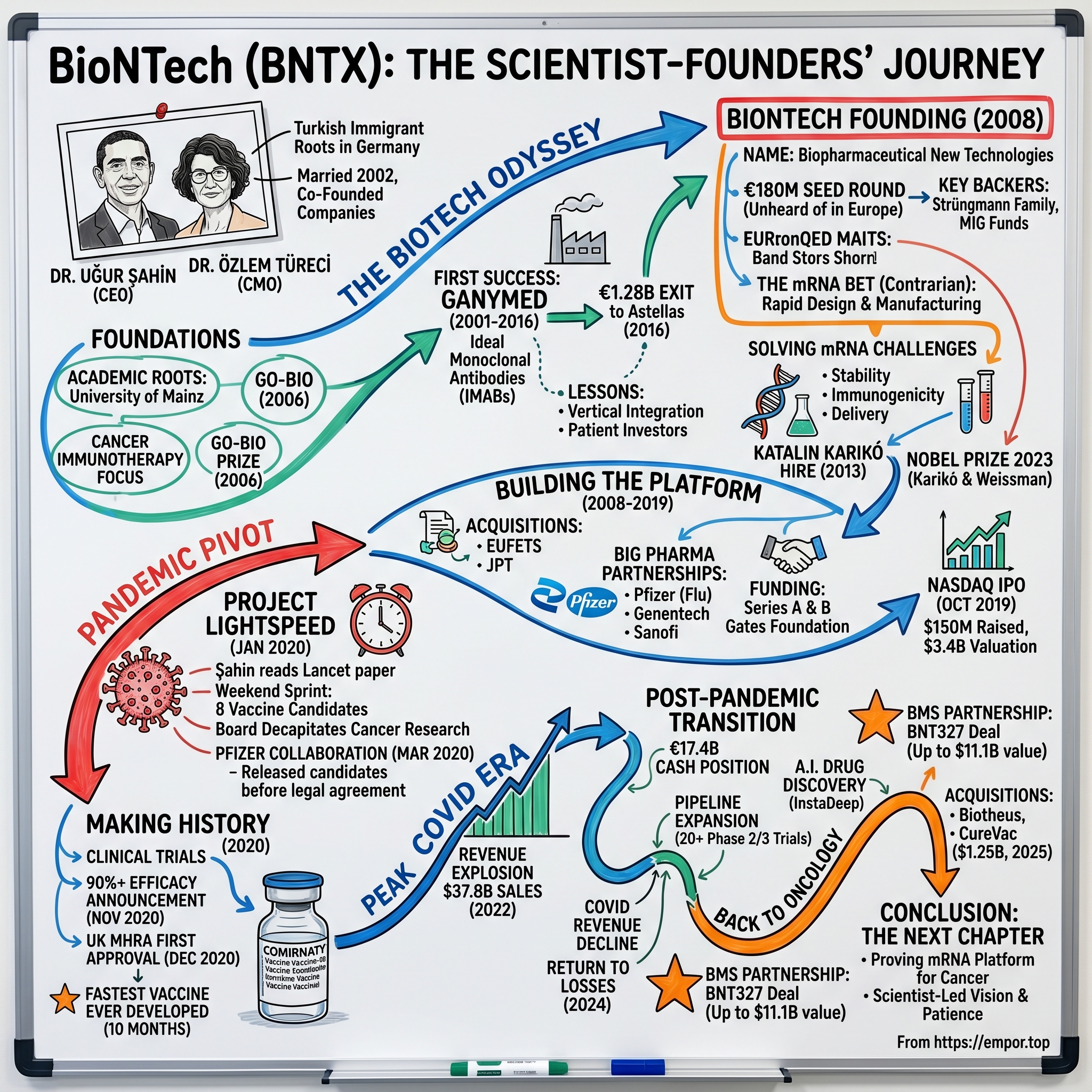
BioNTech: The Scientist-Founders Who Built a Pandemic-Ending Vaccine
Introduction: The Weekend That Changed Medicine
On a cold Saturday morning in late January 2020, Uğur Şahin sat in his study in Mainz, Germany, running calculations that would soon alter the trajectory of human health. The 54-year-old oncologist and CEO of BioNTech had just read a paper in The Lancet about a novel coronavirus spreading in Wuhan, China. Unlike most of his colleagues in the medical world, Şahin wasn't merely concerned—he was alarmed. Using quick back-of-envelope calculations based on Wuhan's population density and transport links, he concluded that if this virus could transmit from person to person, the mortality rate could range between 0.3% and 10% of those infected.
Şahin had a series of meetings with the company's few infectious experts and the leaders of most of the departments to discuss his concerns about the virus and to announce his decision to establish a new project called 'Lightspeed' that would use all of the company's available resources.
There were approximately 1,000 internationally confirmed cases at the time. Realizing the risk and believing that the company's proprietary mRNA technology was at the stage where they had the tools to create a vaccine, Şahin, after discussing it with his wife, spent that weekend outlining the technical construction of eight possible vaccine candidates based on the company's mRNA platforms.
Within ten months, this weekend sprint would yield history's fastest vaccine against a novel pathogen—a feat that traditionally took 10 to 15 years. BNT162b2 became the first mRNA drug approved for human use and the fastest vaccine developed against a new pathogen in the history of medicine.
But the story of BioNTech is not merely a tale of pandemic heroics. It is something rarer and more instructive: a case study of what happens when scientist-founders retain control, when platform thinking trumps product thinking, and when patient investors allow decades-long bets to compound. How did a German cancer-focused biotech with 11 years of losses pivot in a weekend to create one of the most consequential medical interventions in modern history?
The answer lies in understanding who built this company, why they built it, and how they structured it for an opportunity that hadn't yet emerged.
 Subscribe on LinkedIn
The Founders: From Turkey to German Academia
The Immigrant Story
The BioNTech story begins not in Mainz's gleaming laboratories, but in the working-class neighborhoods of Cologne, Germany, in the early 1970s. Uğur Şahin was born on September 19, 1965, in İskenderun, Turkey. He moved with his mother to Germany at the age of four to join his father, who worked in Cologne's Ford factories.
He grew up in rather humble conditions. "My teacher wanted me to go to a lower secondary school. It was only through the intervention of my German neighbor that I was able to get a higher education," the scientist states. The story of an elementary school teacher trying to consign a Turkish immigrant's son to vocational school rather than the gymnasium track that leads to university admission is familiar to many Germans of immigrant descent. Despite the circumstances, Şahin junior persistently pursued his childhood dream of studying medicine and becoming a doctor.
Özlem Türeci was born in Siegen, West Germany in 1967, the daughter of Turkish immigrants. Her mother was a biologist. Her father, a surgeon, was from Istanbul and worked at the Catholic hospital St. Elisabeth-Stift in Lastrup. Where Şahin's path to medicine required overcoming institutional skepticism, Türeci grew up in a household where science and medicine were the family trade.
Şahin and Türeci were married in 2002, six years before the establishment of BioNTech. Their partnership—both romantic and scientific—would become one of the most productive collaborations in modern biotechnology. The couple famously worked on scientific experiments even on their wedding day, an anecdote that perfectly captures their singular focus on translating science into medicine.
Academic Foundation
The scientific foundation of BioNTech traces back to the university halls of Mainz. Şahin studied medicine at the University of Cologne, completing a doctoral thesis in cancer immunotherapy—the field that would define his career and eventually enable the COVID-19 vaccine breakthrough.
Şahin's academic pedigree was formidable. He served as Head of the Tumor Vaccine Center at Johannes Gutenberg University Mainz from 2003 to 2015 and became W3 Professor at the University Medical Center Mainz in 2014. In 2010, he co-founded TRON (Translational Oncology at the University Medical Center of the Johannes Gutenberg University Mainz), a research institution dedicated to translating academic discoveries into clinical applications.
Based on the top-cited patent over the past five years, and H-index—a calculation of the impact of a researcher's publications over time—Sahin was ranked in Nature Biotechnology's Top 20 translational researchers in 2015, 2018, and 2019.
This academic grounding wasn't merely a career stepping stone—it was the intellectual workshop where the founders developed and refined the mRNA technologies that would later prove crucial. Unlike many biotech entrepreneurs who leave academia completely, Şahin maintained deep ties to the academic research ecosystem, creating a bidirectional flow of knowledge between university labs and commercial development.
The German government recognized the promise of Şahin's work early. A project he led for developing innovative vaccines against cancer was one of twelve projects awarded a sponsorship prize by the German Federal Ministry of Education and Research in 2006 as part of the biotechnology start-up offensive (GO-Bio). This early validation from the German scientific establishment provided both credibility and resources that would prove essential in the company's formation.
For long-term investors, this academic pedigree matters because it reveals the founders' approach to business: they weren't financial engineers looking for exits, but scientists seeking to translate discoveries into treatments. This orientation shaped every subsequent decision about fundraising, partnerships, and corporate governance.
Ganymed: The First Company and €1.28B Exit
Before BioNTech, there was Ganymed. Understanding this first venture illuminates both the founders' capabilities and the investor relationships that would prove crucial to BioNTech's unusual structure.
In 2001, while maintaining his position at the University of Mainz, Şahin began to engage in entrepreneurial activities, co-founding two pharmaceutical companies—in 2001 and 2008—with his partner and spouse Özlem Türeci.
Astellas Pharma planned to acquire Ganymed Pharmaceuticals for up to €1.282 billion ($1.4 billion), in a deal intended to expand the buyer's oncology portfolio. Founded in 2001 as a spinoff from the Universities of Mainz and Zurich, privately held Ganymed focused on developing a new class of cancer drugs called ideal monoclonal antibodies (IMABs) for the treatment of solid cancers.
Ganymed Pharmaceuticals AG—with Özlem Türeci as CEO—was a biopharmaceutical company located in Mainz, Germany, which focused on the development of antibodies against cancer.
Astellas announced that it had completed the acquisition of Ganymed Pharmaceuticals AG, and Ganymed became a wholly owned subsidiary of Astellas as of December 20, 2016. Under the agreement executed between Astellas and Ganymed's shareholders, Astellas paid EUR 422 million to acquire 100% of the equity in Ganymed. In addition, Ganymed's shareholders became eligible to receive up to EUR 860 million in further contingent payments based on progress in the development of IMAB362, Ganymed's most advanced clinical program.
The Ganymed experience taught the founders several crucial lessons. First, it demonstrated that the Şahin-Türeci partnership could translate academic science into commercial programs that attracted big pharma attention. Second, it established relationships with patient investors—particularly the Strüngmann family office and MIG Funds—who would become the foundational backers of BioNTech. MIG Fund leader Michael Motschmann noted that they first invested in Ganymed in 2007 alongside the Strüngmann family office, and after a phase of mutual relationship building, the founding of BioNTech followed in autumn 2008.
Third, and most importantly, Ganymed validated the concept of vertical integration—maintaining in-house capabilities from discovery through manufacturing—that would become BioNTech's defining characteristic.
The Ganymed sale also provided the founders with personal financial resources that reduced the pressure to maximize short-term value at BioNTech. This is the often-overlooked benefit of serial entrepreneurship: founders who've had a meaningful exit can afford to think longer-term because they've already de-risked their personal financial situations.
BioNTech's Founding: The €180M Seed Round
The Founding Story (2008)
In 2008, Türeci, her husband, and Christoph Huber founded the Mainz-based biotechnology company BioNTech, choosing a name derived from Biopharmaceutical New Technologies.
What made the founding of BioNTech unusual wasn't the scientific ambition—it was the capital structure. The company's founding involved seed financing of $180 million from Andreas and Thomas Strüngmann, the MIG Funds headed by Michael Motschmann, and Helmut Jeggle.
To appreciate how extraordinary this was, consider the context: in 2008, €150-180 million seed rounds were virtually unheard of in European biotech. Most startups launched with single-digit millions and spent years proving concepts before raising significant capital. BioNTech emerged fully capitalized with the resources to pursue multiple technology platforms simultaneously.
Andreas Strüngmann is a German physician and billionaire businessman who founded generic drug maker Hexal AG ($1.6 billion sales during 2004) in 1986. In February 2005, the Strüngmann brothers sold Hexal and their 67.7 percent of U.S. Eon Labs to Novartis for $7.5 billion, making its subsidiary Sandoz the largest generic-drug company in the world.
The Strüngmann twins—identical brothers who built a pharmaceutical empire and then redeployed the proceeds into biotech investing—were unique backers. They understood the pharmaceutical industry's economics intimately, they had the patience to wait for decade-long development timelines, and they had the resources to fund ambitious visions without constantly seeking external validation.
According to the IPO prospectus of BioNTech, the Strüngmanns' investment vehicle AT Impf invested almost $60 million in the Series A funding in February 2018, and almost $90 million in the Series B funding in June and August 2019. These investments led to AT Impf being the controlling shareholder at the time of the IPO at Nasdaq on October 10th, 2019, owning 50.2% of the company.
The brothers first provided BioNTech with €150 million ($186 million) in seed money when it was founded in 2008. This patient capital structure is worth studying. By giving BioNTech enormous initial resources, the Strüngmanns allowed the company to build capabilities before facing the pressure of fundraising. They didn't need to show quarter-by-quarter progress to new investors or bend their science to fit what venture capital markets wanted to fund.
The mRNA Bet
Why mRNA? mRNA was overlooked by most researchers for decades because it was considered too unstable for drug development due to the challenges of delivering it to the right cells and achieving adequate immune responses. Defying conventional beliefs, BioNTech co-founders Prof. Ugur Sahin, M.D., and Prof. Özlem Türeci, M.D., began researching mRNA technology early on and achieved a series of scientific and technological breakthroughs.
Originally, the company focused on the development and manufacturing of active immunotherapies based on Messenger RNA (mRNA) and other technologies for a patient-specific approach to the treatment of cancer and other serious diseases.
The bet on mRNA in 2008 looked contrarian to most industry observers. mRNA's instability—it degrades rapidly in the body—was seen as a fundamental limitation. The molecule triggered inflammatory immune responses that limited its therapeutic utility. And no one had successfully turned mRNA into approved medicine.
But Şahin and Türeci saw something others missed: these weren't insurmountable problems but engineering challenges. And if they could be solved, mRNA's advantages were extraordinary. Unlike traditional protein-based drugs, mRNA could be designed and manufactured rapidly once you understood the target. The same manufacturing process could produce vaccines against cancer mutations, infectious diseases, or protein deficiencies—you just changed the genetic sequence encoded in the mRNA.
This "platform thinking" distinguished BioNTech from most biotechs, which developed single drug candidates. BioNTech was building manufacturing and delivery capabilities that could address entire categories of disease once the core technology worked.
The mRNA Technology Journey (2008-2019)
Solving the Core Challenges
To develop an mRNA-based cancer vaccine, BioNTech co-founders Ugur Sahin and Özlem Türeci faced three major challenges that were previously considered insurmountable: The vaccine had to be capable of inducing billions of immune cells because small tumors consist of billions of cancer cells. The tumor characteristics that need to be recognized by the immune system are unique to each patient. Sahin and Türeci recognized that tailoring vaccines to each patient's antigen profile would require an individualized treatment. An individualized vaccine has to be manufactured very rapidly to halt the spread of cancer in patients.
These weren't incremental problems—they were fundamental barriers that had stymied mRNA drug development for decades. BioNTech's approach was to attack each systematically.
Over the next two decades, Sahin, Türeci, and their team achieved a series of scientific and technological breakthroughs to unlock the full potential of this molecule for cancer vaccination. They worked on discovering and engineering structural components of mRNA—the cap, the poly-A tail, and its untranslated regions—which increased the intracellular stability of mRNA.
The technical details matter because they explain why BioNTech could move so fast when COVID-19 emerged. Sahin and Türeci chose a different approach to address the problem of low immunogenicity: they achieved a series of scientific and technological breakthroughs to unlock the full potential of this molecule by discovering and developing a design for each of the structural components of mRNA. This approach increased the intracellular stability of synthetic mRNA as well as its translation especially in immune cells, leading to lower doses needed to induce a significant immune response.
The Katalin Karikó Factor
Along with researchers from TRON, they hired Katalin Karikó, who had developed a way to avoid triggering an inflammatory reaction when injecting an mRNA drug.
The hiring of Karikó in 2013 was a pivotal moment. Katalin Karikó is a Hungarian-American biochemist who specializes in RNA-mediated mechanisms, particularly in vitro-transcribed messenger RNA (mRNA) for protein replacement therapy. Karikó laid the scientific groundwork for mRNA vaccines, overcoming major obstacles and skepticism in the scientific community.
From 2013 to 2022, she was associated with BioNTech RNA Pharmaceuticals, first as a vice president and promoted to senior vice president in 2019.
Kati Karikó said that meeting BioNTech was "the first time in my life that I didn't have to explain that RNA is good, because all of the people who were there were believers." Ugur Sahin remembered the meeting: "We shared the excitement about mRNA and research. So, I simply asked her, 'Would you be interested in working together, here at BioNTech?'"
The Nobel Prize in Physiology or Medicine 2023 was awarded jointly to Katalin Karikó and Drew Weissman "for their discoveries concerning nucleoside base modifications that enabled the development of effective mRNA vaccines against COVID-19."
Ugur Sahin, Kati Karikó, and Özlem Türeci published the findings of their joint work already in 2014 in a comprehensive overview of the possibilities of mRNA in Nature Reviews Drug Discovery. The combination of their discoveries led to the successful development of the first ever approved mRNA vaccine, today known as the Pfizer-BioNTech COVID-19 vaccine.
Platform Development
The breakthrough wasn't just scientific—it was strategic. BioNTech developed multiple platform technologies for different applications:
With their Individualized Neoantigen Specific Immunotherapy (iNeST) platform, they developed a first-in-kind, on-demand manufacturing process for mRNA vaccines designed to target mutations that are unique to the patient's specific cancer, so-called tumor neoantigens. Their iNeST candidates contain mRNA encoding for an individually selected number of patient-specific tumor neoantigens aiming to induce a potent and precise immune response against the patient's unique tumor.
The key insight was that mRNA's "weakness"—its simplicity—was actually its greatest strength. Because mRNA vaccines can be easily designed to target any antigen, BioNTech could use the mutation fingerprint of cancers for engineering personalized neoantigen vaccines produced "on demand."
This platform approach meant that when COVID-19 emerged, BioNTech didn't need to invent new technology—they needed to redirect existing capabilities toward a new target. The decade of investment in manufacturing, delivery systems, and clinical development processes paid off when speed suddenly mattered most.
Building the Company: Strategic Moves (2009-2019)
Acquisitions and Vertical Integration
In 2009, the acquisition of EUFETS and JPT Peptide Technologies took place. These weren't flashy acquisitions but strategic infrastructure investments. EUFETS brought manufacturing capabilities that would prove crucial for clinical trial supply. JPT added diagnostic capabilities that complemented BioNTech's therapeutic development.
The acquisition strategy reflected the founders' philosophy: control the entire value chain. Most biotechs focus on discovery and rely on contract manufacturers for production. BioNTech wanted to own its manufacturing destiny—a decision that seemed expensive at the time but proved prescient when the company needed to scale COVID-19 vaccine production rapidly.
Big Pharma Partnerships
In August 2018, the company entered into a multi-year research and development collaboration with the US company Pfizer, Inc. to develop mRNA-based vaccines for prevention of influenza. Under the terms of the agreement, following BioNTech's completion of a first-in-human clinical study, Pfizer would assume sole responsibility for further clinical development and commercialization of mRNA-based flu vaccines.
This Pfizer partnership deserves particular attention because it laid the groundwork for the COVID-19 collaboration. The companies had already established working relationships, understood each other's capabilities, and developed trust before the pandemic created urgency.
BioNTech also signed agreements with Genentech, Eli Lilly, Sanofi, and Genmab. On top of equity investments, BioNTech received non-dilutive funding from seven deals with biopharmas. The largest was the German biotech's 2016 agreement with Genentech Inc. to develop personalized, mRNA-based neoantigen vaccines, which yielded $310 million in an upfront payment and near-term milestones.
This partnership strategy accomplished multiple objectives: it validated BioNTech's technology in the eyes of big pharma, it brought non-dilutive capital that preserved founder control, and it created options for commercialization without requiring BioNTech to build a massive sales force immediately.
Funding Rounds
In January 2018, BioNTech closed a US$270 million Series A financing round to further expand the company's immunotherapy research.
In July 2019, Fidelity Management & Research Company led a Series B investment round totalling US$325 million, with investments from new and existing investors, including Redmile Group, Invus, Mirae Asset Financial Group, Platinum Asset Management, Jebsen Capital, Steam Athena Capital, BVCF Management and the Strüngmann family office.
In September 2019, BioNTech received a contribution of US$55 million from the Bill & Melinda Gates Foundation.
BioNTech had already received the Series B round's remaining $225 million, one of at least four nine-digit sums it had received in its 11-year history. Counting both equity funding and non-dilutive cash from deals, BioNTech raised $1.3 billion to fund development of a pipeline that originally consisted of mRNA-based therapeutics, but now also spans CAR Ts and other cell therapies, bispecific antibodies and small molecule immunomodulators.
By the time BioNTech went public, it had assembled one of the deepest war chests in European biotech history—all while maintaining significant founder control. This wasn't the typical biotech story of progressively diluted founders fighting to maintain influence. The Strüngmanns' enormous initial investment, combined with strategic partnership revenues, meant BioNTech could be selective about later capital raises.
The Nasdaq IPO: October 2019
Going Public
On October 10, 2019, BioNTech announced the pricing of its initial public offering of 10,000,000 American Depositary Shares representing 10,000,000 ordinary shares at a public offering price of $15.00 per ADS, for gross proceeds of $150,000,000.
Since October 10, 2019, BioNTech has been publicly traded as American Depository Shares (ADS) on the NASDAQ Global Select Market under the ticker symbol BNTX. BioNTech was able to generate total gross proceeds of US$150 million from the IPO.
German immunotherapy developer BioNTech raised $150 million in a US IPO that values the company at $3.4 billion. Despite pricing below its last round, BioNTech was the third-largest biotech to list in the past decade.
Given the tenor of the market, BioNTech reduced its proposed market cap by 20% to $3.6 billion by cutting its filing range to $15 to $16 and the number of shares offered to 10 million.
The IPO came at a difficult moment for biotech listings, and BioNTech accepted a smaller raise at a lower valuation than initially planned. But the company had the luxury of not needing the capital desperately—the IPO was about establishing a public market presence and providing liquidity options for early investors, not about survival funding.
State of the Business Pre-COVID
What did investors actually own in October 2019? The answer helps explain why the COVID-19 pivot was possible.
BioNTech's immunotherapy pipeline had over 20 product candidates, with eight cancer therapies in clinical trials. Lead candidate BNT122 was an mRNA therapy for melanoma being co-developed with Genentech. It had five more mRNA programs, and three antibodies in development.
Post-IPO, the firm had more than $700 million in cash to develop its extensive pipeline. The company was backed by the family office of German billionaires Thomas and Andreas Strüngmann, holding a 49% post-IPO stake.
After 11 years and more than €400 million in accumulated losses, BioNTech had no approved products and no commercial revenue. It was a pure research operation betting that mRNA technology would eventually pay off in cancer treatment. Few could have predicted that the payoff would come not from oncology but from a pathogen that didn't yet exist in human populations.
Project Lightspeed: The COVID-19 Pivot
January 2020: Reading the Tea Leaves
BioNTech's project to develop a novel mRNA technology for a COVID-19 vaccine was called "Project Lightspeed," which started in mid-January 2020 at BioNTech's laboratories in Mainz, Germany, just days after the SARS-CoV-2 genetic sequence was first made public.
The German firm BioNTech started its vaccine development under the name 'Project Lightspeed' on January 27, 2020.
Şahin spent that weekend outlining the technical construction of eight possible vaccine candidates based on the company's mRNA platforms. He was assisted in his work by the SARS-CoV-2 genetic sequences having been previously published on January 11, 2020 by Edward C. Holmes on open-source website Virological.org.
What made Şahin see what others missed? As an oncologist who had spent decades studying the immune system, he understood how quickly viral spread could accelerate. And as someone who had spent years building mRNA manufacturing capabilities, he knew BioNTech was uniquely positioned to respond.
The Weekend Sprint
As other doctors working at BioNTech prepared to go on vacation to ski, Turkish doctors Sahin and Türeci quickly convened the board of directors to decapitate the firm's cancer research and focus all their work on coronavirus.
BioNTech called its COVID-19 project Lightspeed and told its hundreds of scientists that this would be a tough year. Many employees cancelled ski holidays and the company started running day and night shifts, as well as staying open on weekends, to speed up a project that normally takes many years to complete.
The decision to pivot required conviction that most executives wouldn't possess. BioNTech was abandoning its core cancer programs—the work that justified its existence and its $3.4 billion market capitalization—to pursue a vaccine against a virus that the WHO hadn't yet declared a pandemic. If Şahin's calculations proved wrong, he would have diverted his company into an expensive dead end.
The Pfizer Partnership
On March 3, Şahin was able to contact Kathrin Jansen, head of vaccine research and development at Pfizer, who by now was of the opinion that mRNA was the best means of creating a COVID‑19 vaccine.
At the time, BioNTech had 1,300 employees, Pfizer 70,000. When Pfizer showed significant interest in collaboration, one ethical leadership decision was highly unusual but vital to accelerating the vaccine development, namely BioNTech's decision to release vaccine candidates to Pfizer before a collaboration agreement had been finalized. The collaboration between BioNTech and Pfizer was officially announced on March 17, 2020, through a declaration of intent published at the Securities and Exchange Commission.
The legal departments at both companies were reportedly horrified when they realized what was happening. Without any formal agreement in place, BioNTech was sharing proprietary vaccine candidates with Pfizer. But Şahin and Pfizer CEO Albert Bourla understood that bureaucratic delays could cost lives. They proceeded on trust, sorting out the legal formalities while the science moved forward.
BioNTech partnered with Fosun Pharma for mainland China and the special administrative regions of Hong Kong and Macau, and Pfizer for the rest of the world, excluding Germany and Turkey, where BioNTech retained exclusive rights.
The deal structure reflected BioNTech's platform ownership. The company retained rights in its home markets while gaining access to Pfizer's massive clinical trial infrastructure and global distribution capabilities. BioNTech received significant upfront payments while remaining eligible for profit sharing on a product it had fundamentally developed.
Due to the global situation caused by the pandemic and the need for a vaccine, BioNTech received financial support from the European Investment Bank (a €100 million loan in June 2020) and the German Federal Ministry of Education and Research (a €375 million grant). BioNTech also received €250 million from Temasek Holdings (Singapore) in June 2020 via the purchase of ordinary shares and convertible notes.
Making History: Fastest Vaccine Ever
Development Timeline
With the emerging pandemic, BioNTech started the development of a COVID-19 vaccine based on decades of technological advancement and research and development in the field of mRNA therapies, an endeavor called Project Lightspeed. Within 10 months, the Pfizer-BioNTech COVID-19 vaccine was developed, evaluated in large clinical trials and received (emergency or conditional) approvals from authorities in multiple different countries and regions. This was not only the fastest vaccine development against a new pathogen in medical history, but also proof of concept for mRNA as a new drug class in medicine.
By March 2020, they had five vaccine candidates ready to test in humans, and by November 2020, results indicated that the vaccine was more than 90% effective.
The timeline defied everything the pharmaceutical industry thought it knew about vaccine development. The normal duration of vaccine development for newly emerging pathogens is estimated to range from 10 to 15 years. BioNTech compressed this into ten months.
The Efficacy Announcement
On November 8, 2020, the figures were clear. Ninety-four out of 43,538 healthy volunteers had contracted COVID-19: Ninety were in the placebo arm and only four in the vaccine arm of the study. This meant an approximate 90% efficacy of the BioNTech vaccine.
When Karikó heard that the vaccine study results were positive, she turned to her husband and said: "Oh, it works, I thought so." After decades of working on mRNA with limited recognition, the technology she had championed was about to help end a pandemic.
Historic Approvals
On December 2, the UK Medicines and Healthcare products Regulatory Agency (MHRA) became the first medicines regulator to approve an mRNA vaccine, authorizing the Pfizer–BioNTech vaccine for widespread use.
The vaccine was the first COVID‑19 vaccine to be authorized by a stringent regulatory authority for emergency use and the first to be approved for regular use. In December 2020, the United Kingdom was the first country to authorize its use on an emergency basis. On August 23, 2021, the Pfizer–BioNTech vaccine became the first COVID-19 vaccine to be approved in the US by the Food and Drug Administration (FDA).
On December 8, 2020, 91-year old UK resident Margaret Keenan received Comirnaty, also known as the BioNTech-Pfizer COVID-19 vaccine. The first person to receive an authorized mRNA vaccine in the world was a grandmother in Coventry. Within months, billions more doses would follow.
Peak COVID Era: Commercial Success
The vaccine, marketed as Comirnaty, generated annual sales of $37.8 billion at its peak in 2022.
This single data point understates the transformation. Between 2020 and 2021, annual revenue for BioNTech increased almost 40-fold, from 482 million euros to nearly 19 billion euros. In the course of 2020-2021, the company became profitable for the first time since its foundation. 2021 brought the company a massive profit of 10.3 billion euros, compared to only 15 million euros in the preceding year.
Approximately 2 billion doses of COMIRNATY® were invoiced in 2022, including approximately 550 million doses of Omicron-adapted bivalent COVID-19 vaccines. Fourth quarter and full year revenues of €4.3 billion and €17.3 billion respectively; full year net profit of €9.4 billion.
For context, BioNTech's 2021 revenue of €19 billion would have placed it among the top 20 pharmaceutical companies globally—a position achieved just over a decade after founding, in a company that had never generated product revenue before 2020.
In August 2021, thanks to a meteoric rise in its share price, BioNTech's market capitalization briefly exceeded US$100 billion, making it one of the most valuable companies in Germany.
The financial windfall was extraordinary, but the strategic implications were even more significant. BioNTech suddenly had the resources to pursue its original cancer-focused mission at a scale previously unimaginable. The COVID-19 success had validated mRNA technology for the entire pharmaceutical industry, de-risking BioNTech's pipeline and attracting partnership interest that would have taken decades to develop organically.
Post-Pandemic Transition: Back to Oncology
Revenue Decline
For the year ended December 31, 2024, revenues were €2,751.1 million, compared to €3,819.0 million for the prior year period. The decrease in revenues was primarily driven by lower sales of the Company's COVID-19 vaccines due to reduced market demand.
For the year ended December 31, 2024, diluted loss per share was €2.77, compared to diluted earnings per share of €3.83 for the prior year period.
The return to losses wasn't unexpected. COVID-19 vaccine demand has transitioned from pandemic emergency to seasonal endemic patterns. Since the COVID-19 vaccine is BioNTech's only profitable product, the company is under increasing pressure to diversify its portfolio.
But unlike companies that see revenue declines as existential threats, BioNTech entered this transition from a position of extraordinary strength. The company reported cash and cash equivalents plus security investments of €17.4 billion as of December 31, 2024.
BioNTech expects its revenues for the full 2025 financial year to be in the range of €1,700-€2,200 million. The guidance reflects continued COVID-19 vaccine revenue decline while the company ramps oncology development.
Pipeline Expansion
BioNTech is advancing an oncology pipeline including more than 20 active Phase 2 and Phase 3 clinical trials with a strategic focus on two priority pan-tumor programs: next-generation immunomodulator candidate BNT327 and mRNA cancer immunotherapies.
BioNTech has established a diversified oncology portfolio to develop novel treatment approaches for patients living with cancer. The Company is advancing its oncology pipeline across multiple solid tumor indications, including more than 20 active Phase 2 and 3 clinical trials.
The oncology strategy reflects lessons learned from the COVID-19 experience: platform thinking, combination approaches, and the importance of owning critical capabilities. BioNTech isn't developing individual drugs—it's building complementary therapeutic modalities that can be combined for greater effect.
Strategic Acquisitions
BioNTech completed its acquisition of InstaDeep Ltd., a leading global technology company in the field of artificial intelligence and machine learning. The acquisition was announced on January 10, 2023 and follows a track record of increasing collaboration between the two companies since 2019. The acquisition supports BioNTech's strategy, aiming to build world-leading capabilities in AI-driven drug discovery and development.
BioNTech's most recent acquisition, Biotheus, is a developer of antibody-based therapeutics for cancer treatment, founded in 2018 and located in Zhuhai. BioNTech acquired a 100% stake in November 2024 for a price of $800 million.
In June 2025, BioNTech acquired CureVac, a German biopharmaceutical firm and a former rival in the COVID-19 vaccine race. The deal was worth approximately $1.25 billion.
The CureVac acquisition is particularly notable. The Mainz pharmaceutical company BioNTech plans to acquire its competitor CureVac from Tübingen. Both companies had participated in the race for a coronavirus vaccine in 2020—BioNTech was successful. The consolidation of German mRNA competitors reflects both BioNTech's commanding financial position and its ambition to dominate the mRNA therapeutics space.
The Bristol Myers Squibb Partnership
On June 2, 2025, BioNTech SE and Bristol Myers Squibb announced that the companies have entered into an agreement for the global co-development and co-commercialization of BioNTech's investigational bispecific antibody BNT327 across numerous solid tumor types.
Under terms of the deal, BMS will make an upfront payment of $1.5 billion to BioNTech and commit an additional $2 billion in non-contingent payments through 2028, with potential milestone payments reaching up to $7.6 billion.
More than 20 clinical trials are currently ongoing or planned to evaluate BNT327 either as a monotherapy or in combination with other treatment modalities targeting different oncogenic pathways in more than 10 solid tumor indications. If successfully developed and approved, BioNTech aims to use this bispecific antibody candidate as a next-generation immuno-oncology backbone in combination with other treatment modalities targeting a broad range of cancer indications.
The BMS deal validates BioNTech's post-COVID strategic positioning. The company has evolved from a pure mRNA shop to a diversified oncology platform incorporating bispecific antibodies, antibody-drug conjugates, and cell therapies alongside its mRNA capabilities.
Competitive Landscape and Strategic Analysis
The mRNA Arms Race
BioNTech operates in an increasingly competitive mRNA landscape. There are currently two leading candidates in the melanoma mRNA vaccine race: Moderna and Merck's mRNA-4157 (V940) and BioNTech's BNT111.
Being tested in combination with Merck's blockbuster checkpoint inhibitor Keytruda, which loses patent protection in 2028, Moderna's mRNA-4157 has produced impressive results in clinical trials. In June 2024, Moderna and Merck reported that, after two and a half years, melanoma patients who received the combination therapy had an overall survival rate of 96%, compared to 90.2% with Keytruda alone.
Moderna and the BioNTech-Pfizer duo became heroes of the COVID-19 pandemic with vaccines that saved millions of lives and generated billions in revenue while also validating mRNA technology on a global scale. But as sales and political support for mRNA vaccines waver, market leaders now vie for dominance in mRNA's next act—therapeutics.
Porter's Five Forces Analysis
Threat of New Entrants: Moderate The mRNA field has high barriers including intellectual property portfolios, manufacturing know-how, and regulatory expertise developed over decades. However, the COVID-19 success has attracted new competitors and significant venture capital funding to the space.
Supplier Power: Low to Moderate BioNTech has invested heavily in vertical integration, including manufacturing capabilities. The CureVac acquisition further consolidates manufacturing expertise. Key inputs like lipid nanoparticle components have multiple suppliers.
Buyer Power: High Healthcare systems and governments are the primary customers, wielding significant negotiating power particularly for vaccines. The shift from emergency pandemic procurement to endemic seasonal purchasing has increased buyer leverage.
Threat of Substitutes: Moderate Traditional vaccine approaches (protein-based, viral vector) remain alternatives for infectious diseases. In oncology, mRNA cancer vaccines compete with checkpoint inhibitors, CAR-T therapies, and other immunotherapies.
Competitive Rivalry: High and Intensifying Moderna remains the primary mRNA competitor. In oncology, BioNTech faces established players like Merck, Bristol Myers Squibb, and Roche alongside emerging biotechs. The bispecific antibody space is crowded with competitors including Akeso's ivonescimab showing strong clinical results.
Hamilton Helmer's 7 Powers Framework
Scale Economies BioNTech's €17.4 billion cash position enables R&D investments that smaller competitors cannot match. The company can pursue multiple clinical programs simultaneously, spreading risk and accelerating learning.
Network Effects Limited in traditional sense, but BioNTech benefits from network effects in scientific talent acquisition. Success attracts top researchers, who enable further success.
Counter-Positioning BioNTech's platform approach represented counter-positioning against big pharma's product-by-product development model. This advantage has narrowed as competitors adopt platform strategies.
Switching Costs Limited for COVID-19 vaccines but potentially significant for personalized cancer vaccines, where treatment manufacturing is patient-specific and physician relationships matter.
Branding The Pfizer-BioNTech COVID-19 vaccine built strong brand recognition, though Pfizer captures most consumer awareness. BioNTech's brand is strongest among healthcare professionals and investors.
Cornered Resource BioNTech's founder-scientists represent a cornered resource—their specific combination of scientific expertise, platform vision, and execution capability is difficult to replicate.
Process Power BioNTech's manufacturing capabilities and speed-to-clinic processes, demonstrated dramatically during COVID-19, represent potential process power advantages.
Investment Considerations
Bull Case
-
Massive Cash Position: With €17.4 billion in cash, BioNTech can pursue ambitious R&D programs without dilution, acquire competitors (as with CureVac), and weather years of losses while developing oncology products.
-
Platform Optionality: mRNA technology could produce breakthrough therapies across cancer types, infectious diseases, and rare genetic conditions. Success in any area validates the entire platform.
-
Validated Partnerships: The Pfizer relationship proved capable of global-scale commercialization. The Bristol Myers Squibb deal for BNT327 provides up to $11.1 billion in potential value with a partner expert in oncology commercialization.
-
Founder-Led: Şahin and Türeci remain deeply involved, providing continuity of vision and scientific leadership that hired CEOs cannot replicate.
-
mRNA Cancer Vaccines Approaching Approval: Experts anticipate that the first commercial mRNA cancer vaccine could receive regulatory approval by 2029. If BioNTech's candidates succeed, the company captures years of accumulated investment.
Bear Case
-
COVID Revenue Cliff: COVID-19 vaccine revenue continues declining with no clear path to stabilization. The transition from pandemic hero to unprofitable oncology development company may take years.
-
Pipeline Execution Risk: No oncology candidates are yet approved. Phase 2/3 clinical development carries substantial failure risk regardless of platform quality.
-
Competitive Intensity: Moderna's melanoma vaccine candidate appears ahead in registration trials. The PD-1/VEGF bispecific antibody space is increasingly crowded with strong competitors.
-
Valuation Premium: Despite losses, BioNTech trades at a significant market capitalization reflecting pipeline optionality that may not materialize.
-
Regulatory and Political Risk: mRNA technology faces skepticism from segments of the public. Regulatory standards for personalized cancer vaccines remain evolving and uncertain.
Key Performance Indicators to Track
For investors monitoring BioNTech's progress, three metrics matter most:
-
Oncology Clinical Trial Readouts: The binary outcomes of Phase 2/3 trials—particularly for BNT327 and the mRNA cancer vaccine candidates—will determine whether BioNTech's post-COVID strategy succeeds. Track enrollment progress, data readout timing, and regulatory feedback.
-
R&D Productivity: Watch the ratio of clinical programs advancing versus failing, and the speed from Phase 1 to registration trials. BioNTech's ability to efficiently convert its cash into valuable clinical assets determines long-term value creation.
-
Partnership and Milestone Revenue: The BMS deal includes $3.5 billion in guaranteed payments through 2028, plus potential milestones. Partnership announcements and milestone achievements provide external validation of pipeline value and near-term cash flow visibility.
Conclusion: The Next Chapter
BioNTech's story is far from finished. The company that emerged from a €180 million seed round to deliver history's fastest vaccine now faces a different challenge: proving that its platform can transform cancer treatment as dramatically as it changed pandemic response.
The founders' approach—patient capital, platform thinking, vertical integration, and scientist-led governance—created an organization capable of seizing an opportunity that didn't exist when the company was founded. Whether that same approach can produce breakthrough cancer therapies remains to be seen.
What's clear is that BioNTech possesses unusual optionality. With €17.4 billion in cash, validated technology platforms, and proven execution capabilities, the company can pursue multiple paths simultaneously. The CureVac acquisition consolidates the mRNA landscape. The Bristol Myers Squibb partnership provides oncology commercialization expertise. The pipeline offers numerous shots on goal across different modalities and cancer types.
For investors, BioNTech represents a high-conviction bet on the future of immunotherapy delivered by founders with exceptional track records. The COVID-19 chapter validated the platform and generated the resources for the next phase. Whether that phase produces another breakthrough—or simply demonstrates the gap between infectious disease vaccines and cancer therapeutics—will define the company's legacy.
The scientist-founders who built a pandemic-ending vaccine in ten months are now working on therapies that could take a decade. That patience, backed by extraordinary resources and proven capabilities, makes BioNTech one of the most interesting companies in biotechnology today.
 LinkedIn
 WhatsApp
 Reddit
 Hacker News
 Email
Email Kindle
 RSS Feed
 Spotify
 Apple Podcasts
 Amazon Music
 Audible
 YouTube