 Chat with
this content: Summary, Analysis, News...
Chat with
this content: Summary, Analysis, News...
 Subscribe on LinkedIn


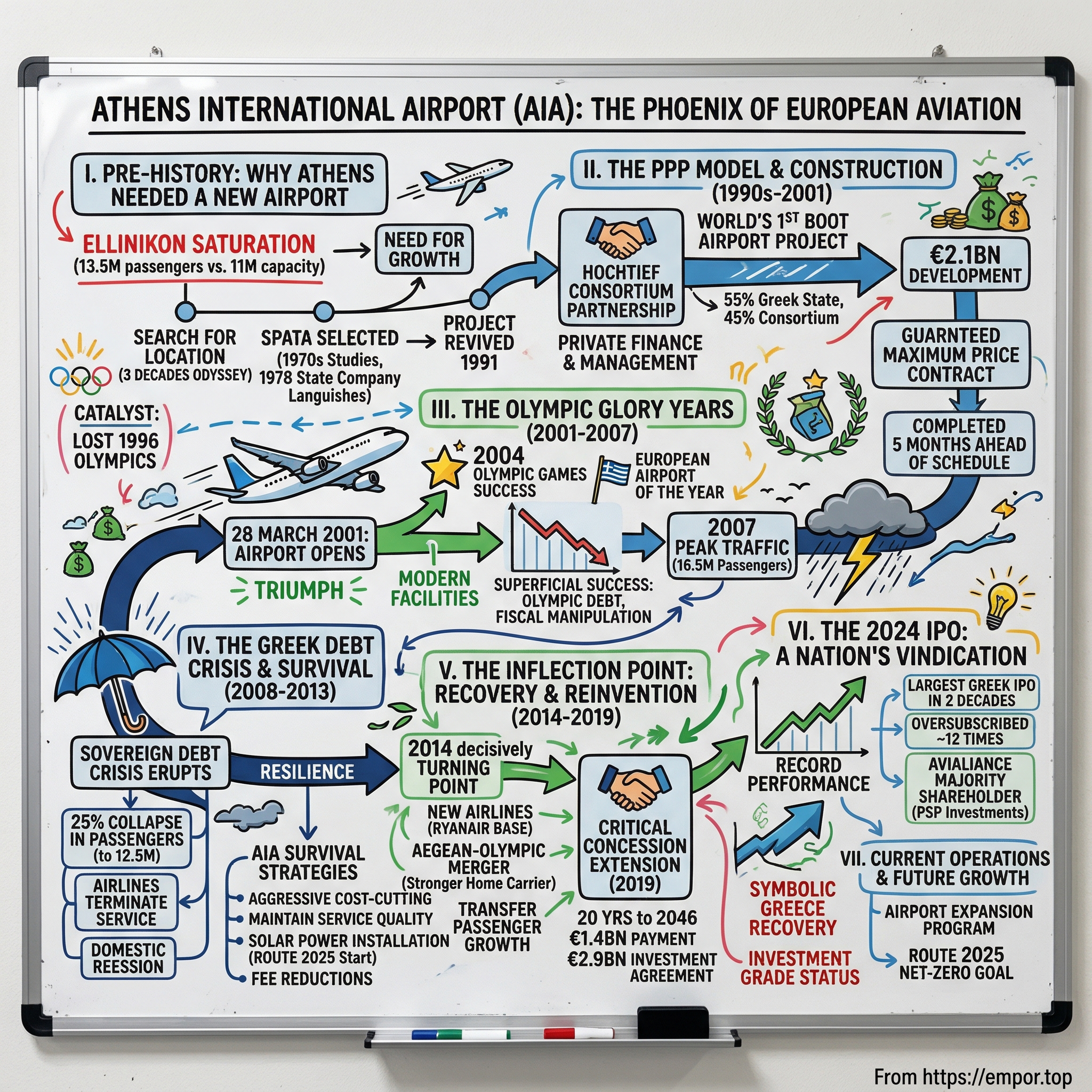
Athens International Airport: Greece's Gateway & The Phoenix of European Aviation
I. Introduction: The Improbable Journey
The morning sun rises over the Attic plain, casting golden light across one of Europe's most improbable success stories. Twenty kilometers east of the Acropolis, where ancient Athenians once gathered to debate democracy, a modern marvel hums with activity: Athens International Airport "Eleftherios Venizelos" processes thousands of passengers, connects Europe to the eastern Mediterranean, and generates hundreds of millions in annual revenue.
Athens International Airport Eleftherios Venizelos is the largest international airport in Greece, serving the city of Athens and region of Attica. It began operation on 28 March 2001 in time for the 2004 Summer Olympics and is the main base of Aegean Airlines.
By the end of 2024, it was the 16th-busiest airport in Europe and the second busiest and second largest in the Balkans, after Istanbul Airport.
But those statistics barely hint at the extraordinary journey that brought this airport into existence—or the near-death experience it survived along the way.
The central question that makes Athens International Airport worth studying: How did a €2 billion public-private partnership built for the Olympics become one of Europe's most successful airport concessions—surviving a sovereign debt crisis that nearly destroyed the country?
On June 11, 1996, HOCHTIEF signed the BOOT (Build-Own-Operate-Transfer) concession for Athens International Airport, the first privately financed airport project in the world consisting of a partnership between a public authority and a business company. This pioneering structure would prove prescient—creating an entity flexible enough to weather economic storms that capsized state-owned enterprises throughout Greece.
The AIA story touches every major theme in modern infrastructure investing: the power of public-private partnerships, the resilience of essential travel infrastructure, the interplay between national pride and hard-nosed capitalism, and ultimately, the vindication that comes when a country once teetering on the edge of eurozone expulsion launches the largest IPO in its history.
In February 2024, Greece's economic recovery story reached a symbolic crescendo when Athens International Airport debuted on the Athens Stock Exchange. Athens International Airport SA shares had a staggering start on the stock exchange in the Greek capital, following strong investor interest in what is being called the biggest initial public offering (IPO) in two decades in the country. The price soared by 15% at the start of the trading.
That moment represented something far more significant than a financial transaction. It marked the symbolic completion of Greece's long road back from the abyss.
II. Pre-History: Why Athens Needed a New Airport
To understand why Athens International Airport exists at all, one must first understand what it replaced—and the tortured decades of debate that preceded its construction.
Built in 1938, Ellinikon International Airport was originally called Kalamaki Airfield. Following the German invasion of Greece in 1941, Kalamaki Airfield was used as a Luftwaffe air base during the occupation. After World War II, the Greek government allowed the United States to use the airport from 1945 until 1993.
For sixty years, Ellinikon served as Greece's primary gateway to the world. Located approximately 7 kilometers southwest of Athens city center, the airport was a symbol of modernity and progress in Greece, particularly during the post-World War II era when international air travel became more accessible.
But by the late 20th century, Ellinikon had become an anachronism—as Athens grew and air traffic increased, the airport's facilities became insufficient. By the late 1990s, it was clear that a new airport was needed.
The airport had an official capacity of 11 million passengers per year, but served 13.5 million passengers during its last year of operations. The facility was bursting at the seams, with aircraft queuing on runways, passengers cramming into inadequate terminals, and neighboring residents increasingly furious about noise pollution.
The airport was constructed to replace the now-closed Athens (Ellinikon) International Airport, as the latter had reached its saturation point with no physical space for further growth. Studies for a new airport had been carried out from as early as the 1970s, with as many as 19 different locations being looked at.
The search for a new airport location became an odyssey that consumed Greek governments for three decades. A study was presented to the Greek Government in 1976 suggesting that the ideal location for a new airport would be Spata. However, as it was the time that Greece entered a period with many internal and external problems, the entire plan was given up.
Athens Airport SA, a state-owned company, was established in 1978 to proceed with the plans. But the project languished amid political instability and budgetary constraints.
The Olympic Dream Deferred—And Revived
The catalyst for finally building the airport came from an unexpected source: Olympic humiliation.
After delays and slow development, the project was revived in 1991, approximately 1 year after the city lost the right to host the 1996 Summer Olympics to Atlanta, USA.
The 1990 loss to Atlanta stung deeply. Athens had expected to host the centennial Games as a homecoming to the birthplace of the Olympics. Instead, the International Olympic Committee chose an American city, citing (among other concerns) Athens' inadequate infrastructure—including its antiquated airport.
That defeat lit a fire under Greek planners. However, the city presented the project that was eventually the winner for the 2004 Summer Olympic Games, with the then government launching an international tender for the selection of a build-own-operate-transfer partner for the airport project, with Hochtief of Germany being selected.
The Name: Honoring the Maker of Modern Greece
The airport would ultimately bear the name of one of Greece's most consequential political figures. Eleftherios Kyriakou Venizelos (23 August 1864 – 18 March 1936) was a Cretan Greek statesman and a prominent leader of the Greek national liberation movement. As the leader of the Liberal Party, Venizelos served as prime minister of Greece for over 12 years, spanning eight terms from 1910 to 1933.
Venizelos is often called "The Maker of Modern Greece" for his transformative role, and his legacy as the "Ethnarch" continues to endure.
Under his leadership, Greece underwent profound modernization through liberal-democratic policies. His diplomatic and military efforts expanded Greece's territory, marking a shift in the country's orientation from East to West.
Naming the airport after Venizelos carried symbolic weight. Just as the statesman had modernized Greece and expanded its horizons in the early 20th century, the new airport would connect a modernizing Greece to the world in the 21st.
III. The PPP Model & Construction: A German-Greek Partnership
The Hochtief Deal
By the early 1990s, Greek authorities recognized they could not build the airport alone. The project required expertise in airport design, construction financing, and long-term operations that the Greek government simply did not possess. The solution: bring in the private sector.
When the concession for Athens International Airport was awarded in 1996, HOCHTIEF, together with its consortium partners, assumed responsibility not just for the design and planning, financing and construction of the airport, but also, for the first time, for the management of an airport as well. It was the Athens project which, in 1997, prompted HOCHTIEF to set up HOCHTIEF AirPort, as a subsidiary to bundle all the Group's airport management activities.
At July 31st 1995, following an international competition, the German company Hochtief was selected for the construction and co-ownership of the airport with the Greek State.
In 1996, Athens International Airport S.A. (AIA) was established as a Public–private partnership with a 30-year concession agreement. That same year, the €2.1 billion development finally began with an estimated completion date of February 2001.
The ownership structure reflected the hybrid nature of the project: The Greek state has a 55 percent stake in this company. The consortium headed by HOCHTIEF holds the remaining 45 percent.
A German consortium under the leadership of Hochtief and under participation of ABB, Krantz-TKT, J&P, and the Frankfurt Flughafen AG (today: Fraport) planned, financed, and built the airport.
Building the Airport
What followed was the largest infrastructure project in modern Greek history.
HOCHTIEF has concluded a GMP - Guaranteed Maximum Price - contract on the planned construction costs of DM 3.204 billion. Under this, the company guarantees to keep to a set price for the project. If the final cost is lower, the difference is split between the client and HOCHTIEF on a basis agreed in advance.
The Guaranteed Maximum Price contract was crucial. It aligned incentives between the builder and the client, ensuring that construction overruns would be shared rather than dumped entirely on Greek taxpayers.
With this project, HOCHTIEF has for the first time not only assumed responsibility for design, construction and financing but also for operating an airport. In addition, the new airport is the first example anywhere in Europe of public/private partnership in the infrastructure sector.
The consortium moved with remarkable speed. The airport construction was completed five months before schedule, but was delayed opening a month due to surface connections to Attiki Odos not being completed. The airport officially opened on 28 March 2001.
Scale and Design
The new facility was massive—designed not just for current needs but for decades of future growth.
The new Athens Int'l Airport covers a huge expanse of 16,000 acres (25.0 sq mi), making the facility among the largest in Europe and in the world in terms of land area.
Its major features include two parallel runways being 4 km and 3.8 km long respectively. The airport has received approval from the European Aviation Safety Agency and the Federal Aviation Administration for take-offs and landings of the biggest passenger jet worldwide, the A380.
"Athens International Airport also has good chances of developing into a hub for international air traffic to Africa and the Middle East," said Dr. Wolfhard Leichnitz, a member of HOCHTIEF's Executive Board.
The investment thesis was straightforward: Greece's geographic position at the crossroads of Europe, Asia, and Africa made Athens a natural hub. Tourism was already a cornerstone of the Greek economy, and a world-class airport would amplify that advantage. The Olympics would showcase Athens to the world; the airport would ensure visitors kept coming long after the Games ended.
IV. The Olympic Glory Years (2001-2007)
A Perfect Launch
On March 28, 2001, Athens International Airport opened its doors. The airport was closed on 28 March 2001. The last aircraft to depart from Ellinikon was an Olympic Airways Boeing 737 bound for Thessaloniki. In a single day, Greece's entire aviation infrastructure leapt forward by half a century.
Athens Airport was immediately heaving with passengers and quickly became one of the most important gateways into the south-eastern region of Europe. In 2002, the airport served almost 12 million passengers and began to win a series of prestigious awards.
The facility immediately demonstrated the advantages of modern design. The single terminal concept with clearly organized zones minimized passenger confusion. The two parallel runways eliminated the traffic congestion that had plagued Ellinikon. And the expanded capacity allowed airlines to add routes that would have been impossible at the old facility.
The 2004 Olympics: Triumph and Hubris
Three years after opening, the airport faced its ultimate test: hosting the world for the Athens Olympics.
Before the opening ceremonies, Athens unveiled a new airport, metro system, trolley line, and sports facilities. The games brought in millions in revenue through tourism and further solidified Greece as a desirable vacation destination.
The 2004 Olympic Games were hailed as "unforgettable dream games" by then-IOC President Jacques Rogge, and left Athens with a significantly improved infrastructure, including a new airport, ring road and subway system.
The airport earned industry recognition: in 2004, Athens International Airport was declared European Airport of the Year.
But the Olympic success masked deeper problems. This success was superficial. At the close of the games, the Greek government notified the Eurozone that its deficit was much worse than initially anticipated. On top of that, the Greek taxpayer was set to foot an $11 billion bill to cover the cost of the games.
The 2004 Athens Olympics cost nearly $11 billion by current exchange rates, double the initial budget. And that figure does not include major infrastructure projects rushed to completion at inflated costs.
The 2007 Peak
By 2007, Athens International Airport had reached what would remain its traffic peak for nearly a decade. Passenger numbers climbed to approximately 16.5 million—a testament to Greece's booming economy and the airport's operational excellence.
Greece had adopted the euro in 2001, and cheap credit was flowing freely. Widespread investments in industrial enterprises and heavy infrastructure, as well as funds from the European Union and growing revenues from tourism, shipping and a fast-growing service sector raised the country's standard of living to unprecedented levels. The country adopted the Euro in 2001 and over the next 7 years the country's GDP per capita more than doubled, from $13,070 in 2001 to $28,660 in 2008.
But this prosperity was built on a foundation of government debt, fiscal manipulation, and eventually, outright fraud. The reckoning was coming.
V. The Greek Debt Crisis & Survival: Through the Storm
This section covers the most dramatic period in AIA's history—the near-death experience that defines the company's resilience.
The Crisis Erupts
Greece faced a sovereign debt crisis in the aftermath of the 2008 financial crisis. Widely known in the country as The Crisis (Greek: Η Κρίση), it led to impoverishment and loss of income and property, and forced the government to carry out a series of sudden reforms and austerity measures.
In all, the Greek economy suffered the longest recession of any advanced mixed economy to date and became the first developed country whose stock market was downgraded to that of an emerging market in 2013.
The numbers were staggering. The 2004 deficit came in at 6.1 percent of gross domestic product, more than double the euro-zone limit, while debt reached 110.6 percent of gross domestic product, the highest in the European Union.
Within weeks, Papandreou reveals that Greece's budget deficit will exceed 12 percent of GDP, nearly double the original estimates. The figure is later revised upward to 15.4 percent.
In April, following publication of GDP data which showed an intermittent period of recession starting in 2007, credit rating agencies then downgraded Greek bonds to junk status in late April 2010. This froze private capital markets, and put Greece in danger of sovereign default without a bailout. On 2 May, the European Commission, European Central Bank (ECB) and International Monetary Fund (IMF) launched a €110 billion bailout loan to rescue Greece from sovereign default.
Impact on Athens International Airport
The crisis devastated Greek aviation. The Greek government-debt crisis reduced the overall passenger traffic of the airport for six consecutive years. Many long-haul airlines outright terminated service to the airport, while others chose to operate on a seasonal basis only, opting to terminate service during the winter months. Moreover, these problems were further exacerbated by the closure of Olympic Airlines, which operated many long-haul flights to and from the airport.
In 2013, the airport handled just above 12.5 million passengers, 3.2% fewer than in 2012 and lower by approximately 25% when compared to 2007's traffic, which was the all-time-high at that time.
From 16.5 million passengers in 2007 to 12.5 million in 2013—a 25% collapse. Airlines fled. Business travelers stayed home. Greeks themselves, with their wages slashed and their disposable income evaporating, could no longer afford to travel.
Financial uncertainty, as well as the impact on the Athens city profile, has heavily affected outbound travel. Since the end of 2009, the country experiences the deepest financial and economic crisis in its modern history, which resulted in a number of austerity measures (driven by the EU/ECB/IMF Memorandum of Agreement with the Greek State). The latter are having adverse impacts on the disposable income (wages reduction, tax increases, etc) and hence on the Greek residents' propensity to travel.
The Human Toll
The social fabric of Greece was tearing apart. Unemployment reached 12% in 2010; for young people, that number was 30%. Riots broke out in the streets of Athens, and clashes between the police and protestors were commonplace.
The Sixth austerity package was passed by the Greek parliament amid violent protests. Many buildings in the centre of Athens were burned during the riots.
Unemployment fell, though, at 20 percent, it remains the EU's highest. The IMF, however, maintains that the Greek economy, which has shrunk by 25 percent since the beginning of the crisis, will likely require further debt relief.
The economy contracted by 2.3% in 2009, 3.5% in 2010, 6.9% in 2011, and 6.0% in 2012. Greece was experiencing its own Great Depression.
AIA's Survival Strategies
While the Greek state flailed and state-owned enterprises collapsed, Athens International Airport's public-private structure proved surprisingly resilient.
The airport pursued aggressive cost-cutting while maintaining service quality. Management invested in sustainability initiatives to reduce operating costs. In October 2012, AIA launched the largest unified photovoltaic installation at any airport worldwide—an 8 MWp project that would eventually provide 20% of the airport's annual energy consumption.
In March 2013, AIA reduced its airport fees in an attempt to stimulate traffic. Ryanair had publicly attacked the airport operator for having the highest fees in Europe, arguing that those fees were partly responsible for the drop in air traffic.
The airport's "dual-till" regulatory structure also helped. Revenue from non-aeronautical activities—retail, parking, food and beverage—had uncapped profitability, giving AIA an incentive to maximize commercial development even as airline traffic declined.
The Privatization Pressure
Throughout the crisis, European creditors pressured Greece to privatize state assets—including its stake in Athens International Airport—to reduce debt levels.
The irony was not lost on observers: the very public-private partnership that had made AIA more resilient than state-owned enterprises was now being targeted for full privatization. But Greece's desperation and its airports' lack of investor appeal (due to the same crisis conditions) meant the timing was never right.
VI. The Inflection Point: Recovery & Reinvention (2014-2019)
The 2014 Recovery
After six years of consecutive decline, 2014 marked a decisive turning point.
During 2014 the airport operators reported a passenger traffic volume of 15.1 million passengers, an increase of over 21%. This was the result of new destinations, and capacity increases on existing routes, such as the resumption of flights by Singapore Airlines and Gulf Air, and the decision by Emirates, Etihad Airways and Qatar Airways to fly more frequently to and from Athens. Delta Air Line resumed their weekly flights and American Airlines retained their seasonal schedules to/from USA with even more frequent connectivity.
More than ten new airlines started flights to and from Athens. Ryanair established a new base at the airport, adding eight destinations. After years of skepticism about Greek stability, international carriers were betting on recovery.
The Aegean-Olympic Merger
A crucial development occurred in the domestic airline market. On 21 October 2012, Aegean Airlines announced that it had struck a deal to acquire Olympic Air, and the buyout was approved by the European Commission a year later, on 9 October 2013. Both carriers continue to operate under separate brands.
The merger was approved by the European Commission on 9 October 2013, stating that "due to the on-going Greek crisis and given Olympic's own very difficult financial situation, Olympic would be forced to leave the market soon in any event".
On October 9, 2013, the Commission unconditionally approved the acquisition of Olympic Air by Aegean Airlines after having prohibited the first attempt of the companies to combine their operations in 2011.
The merger created a stronger home carrier with the scale to compete internationally. Aegean, now Star Alliance's Greek flag carrier, would become critical to AIA's hub strategy and connecting traffic growth.
Record-Breaking Growth
According to AIA published statistics, total traffic for 2015 achieved an impressive performance reaching almost 18.1 million passengers, an all-time-record for the airport at that time, increased by 19% on year-over-year basis and by 1.55 million (+9.4%) the previous best, which was the pre-crisis year 2007.
Moreover, in 2015 a significant rise (+38%) was recorded by transfer passengers, with the international to international transfer traffic marking an impressive increase (+60%) demonstrating the significant enhancement of the Athens airport connectivity.
2016 was a landmark year for the Athens International Airport, both for domestic and international destinations. Annual results reflected a solid performance for a third year in a row fueled by double-digit growth, this time passing the twenty million mark, increased by 10.7% on year-over-year basis.
The Concession Extension: A Critical Inflection Point
Perhaps the most significant development during this period was the extension of AIA's concession agreement.
Athens International Airport S.A. "Eleftherios Venizelos" (AIA) was established in 1996 for the construction, maintenance and operation of AIA for 30 years, under a relevant concession agreement. This concession was due to expire in 2026. In February 2019, the existing concession agreement was extended by a further 20 years, until 2046.
The procedure for the 20-year extension of the concession agreement of the Athens International Airport "Eleftherios Venizelos" was completed with Athens International Airport SA having paid a total consideration of EUR1.403 billion. The net proceeds of the extension amount to EUR1.132 billion.
The total benefit to the Greek State from the extension of the existing Concession Agreement up to 2046 is a multiple of the aforementioned price and is expected to exceed €6 billion. In parallel, it is anticipated that AIA will make total investments of approximately €2.9 billion.
AIA has also agreed to invest approximately EUR2.9 billion over the extension period. The investment will serve to expand the airport's capacity, with the aim of gradually increasing passenger churn from 26 million per year to 50 million passengers annually by the end of the concession period. It will include terminal extensions, new aircraft parking places and extension of the airport's road network.
The concession extension transformed AIA's investment thesis. With operations secured until 2046, the company could plan multi-decade capital investments. The deal also set the stage for an eventual IPO by providing visibility and regulatory certainty that public market investors require.
VII. The 2024 IPO: A Nation's Vindication
Context & Timing
By late 2023, Greece had made a remarkable journey. The country had completed three bailout programs totaling approximately €290 billion. It had regained investment-grade credit status. The Athens Stock Exchange had rallied 39% in 2023 alone.
The IPO on the ASE is one of the largest in over 15 years when the country fell into its debt crisis and marks a key milestone for AIA, Greece, and for local capital markets.
AIA, known also as "Eleftherios Venizelos Airport", is Greece's largest handling over 28.2 million passengers in 2023 while surpassing pre-Covid 2019 levels by 10.2 percent outperforming many of its European peers. The airport has repeatedly been awarded for performance in several key areas.
The Offering
Greece on Thursday launched an initial public offering (IPO) for a 30% stake in Athens International Airport, a sale which along with a company dividend could yield up to 1.2 billion euros for the state, according to sources. The country is selling 90 million shares, through a combined offering to Greek and foreign investors and existing shareholders, in its biggest IPO after its 2010-2018 debt crisis.
The price range for the IPO of Athens International Airport, the operator of Greece's biggest airport, was set at 7.0 to 8.2 euros per share, implying a market value of 2.1 to 2.46 billion euros.
The initial public offering of Athens International Airport, the main gateway for tourism in Greece, was set at the high end of the range amid bumper demand. The 90 million share public offering, the biggest since the turn of the century in Athens, is set to raise at least €738 million after investor interest in the sale of a 30% stake in the airport was so high that demand exceeded the deal size just hours after the books opened.
It was oversubscribed approximately 12 times with strong demand exceeding €8bn from local and international investors and with over 20,000 individual applications received for the Greek public offering leg of the combined offering.
Investor interest in the sale of a 30% stake in Greece's main tourist gateway was so great that demand exceeded the deal size just hours after the books opened. The state raised €784.7 million through the sale of its holding in the 23-year-old airport, known as Eleftherios Venizelos, with the IPO priced at €8.2 a share, the high end of the range.
Market Reception
The trade started at €9.40, which proved to be higher than the initial IPO price of €8.20.
Shares of Athens International Airport SA jumped 15% at the start of trading on the Athens Stock Exchange, in the country's biggest initial public offering in more than two decades.
Athens Exchange Group CEO G. Kontopoulos said the listing of Athens International Airport on the market was pivotal not only for the company and the stock market but for the Greek economy as well, and it sends a message about Greece's investment dynamism. He added that the listing is the largest in the last eighteen years, adding 2.5 billion euros to the market's capitalization.
The IPO, which priced at the top of the price range, is the largest in Greece for over two decades and the largest in Europe this year. AviAlliance (the airport investment platform of PSP Investments) is one of the world's leading airport investors and managers currently holding stakes in the airports of Athens, Budapest, Düsseldorf, Hamburg and San Juan (Puerto Rico).
As part of the IPO, AviAlliance acquired a further 10% of AIA's shares and obtained sole control over AIA.
Ownership Structure Post-IPO
Following the IPO, AIA's ownership structure reflects its hybrid public-private heritage:
In February 2024, within the framework of the IPO of the Greek capital's airport, AviAlliance increased its stake to just over 50 percent, making it the airport's majority shareholder. The Hellenic Corporation of Assets & Participations holds 25.6 percent, while just under 24 percent is free float.
The IPO represented not just a financial transaction but a statement about Greece's economic recovery and the success of its privatization program.
VIII. Current Operations & Financials (2023-2025)
Record Performance
AIA's operational and financial performance has reached new heights post-pandemic.
Mr. Yiannis Paraschis, Managing Director (CEO) of AIA, stated: "We are excited to announce another strong year for AIA, with 13% traffic growth reaching record levels of 31.9 million passengers. During fiscal year 2024 we realised revenues of €665.5 million, a 10% increase versus the prior year, and announced exciting new destinations for our passengers. We delivered Adjusted EBITDA of €424.8 million, maintaining our commitment to high quality service, safety and efficiency."
Adjusted EBITDA reached €424.8 million marking an increase of 15.7% compared to 2023; Adjusted EBITDA margin at 63.8%. Net Profit rose by €4.4 million to €235.9 million, marking an increase of 1.9% compared to €231.5 million in 2023.
Healthy Financial position with net Debt at €623.1 million corresponding to Net Debt / Adjusted EBITDA of 1.5x.
Business Model: The "Dual Till" System
Understanding AIA's economics requires understanding its unique regulatory framework.
The Airport Development Agreement establishes a "dual-till" system which separates regulated Air Activities from unregulated Non-Air Activities. Revenue generated from Aeronautical Charges and remaining Air Activities are intended to cover costs and generate after-tax returns not in excess of the Air Activities ROE Cap of 15%. Meanwhile, Non-Air Activities have uncapped profitability.
This structure creates important dynamics: - Air Activities (landing fees, parking, passenger charges): Regulated with capped returns, providing revenue stability - Non-Air Activities (retail, food & beverage, parking, real estate): Uncapped upside, incentivizing commercial development
The airport is, and will continue to be, the sole and exclusive airport operator for the wider Attica Area, as the ADA prohibits the creation of any new international airport within 50km from the center of Athens, until the number of passengers exceed the 50 million benchmark. The concession agreement provides for a Dual-Till regulatory framework that places a cap on the maximum annual cumulative regulatory return on equity (RoE) of air activities at 15%, while non-air activities enjoy uncapped upside.
Future Investment Plan: The Airport Expansion Program
AIA is embarking on its most ambitious expansion since the original construction.
IATA's 43.7m passenger-estimate by 2046 three investments cycles are planned, with the first cycle called 33MAP (MAP stands for Million Annual Passengers) starting in 2024. This cycle is expected to be completed by end-2028/beginning-2029. The 33MAP investment aims to expand the main terminal.
The 33MAP investment aims to expand the main terminal of the airport and will also to lead to a c. 63% increase in retail space (13,500 sqm to 22,000 sqm) and a c. 40% increase in parking spaces.
AIA announced in October 2024 that it has secured approximately €800 million of bank financing to support the AEP. The remaining funds will be secured through the funds raised from the increase in Air Activities Capital from the implementation of the Scrip Dividend Programme and complemented by additional debt financing.
The total investment plan (in 2024 prices) is estimated at approximately €1,280 million and will be deployed throughout 2025-2032, with up to 50% expected to be utilized until 2028.
2025 Outlook
On a quarterly basis, Q1 2025 passenger traffic reached 5.8 million, 11.4% higher than Q1 2024, with domestic and international segments increasing by 3.1% and 14.9%, respectively. In Q2 2025, total passenger traffic stood at 9.3 million, reflecting 5.3% increase. Domestic and international traffic grew by 1.7% and 6.8%, respectively.
The drivers supporting demand for travel to Greece remain intact and we continue to expect an attractive demand backdrop. We forecast passenger traffic during 2025 to grow in the mid-single digits while, longer-term, we expect growth to eventually converge to a low single digit long-term growth rate.
Sustainability Initiatives
Through the ROUTE 2025 initiative, Athens International Airport (AIA) aims to achieve net-zero carbon emissions for both its Scope 1 and Scope 2 emissions by the end of 2025, 25 years ahead of the aviation industry's target. The initiative is built around the full coverage of Airport Company's energy requirements through renewable energy self-generation and self-consumption within the Airport's perimeter, supported by large-scale battery storage.
In April 2023, the Airport Company completed the first phase of ROUTE 2025, commissioning Greece's largest self-production photovoltaic facility, a 16 MWp park that currently produces clean electricity equivalent to approximately 45% of the AIA's annual electricity demand.
IX. Strategic Analysis: Porter's Five Forces & Competitive Positioning
1. Threat of New Entrants: VERY LOW ⭐
The concession agreement provides that the airport is, and will continue to be, the sole and exclusive airport operator for the wider Attica Area, as the ADA prohibits the creation of any new international airport within 50km from the center of Athens, until the number of passengers exceed the 50 million benchmark.
Regulatory Barriers: AIA holds an exclusive concession until 2046—no competing airport can legally be built to serve Athens.
Capital Requirements: The €2+ billion original construction cost creates insurmountable barriers. Building a competing facility would require not just the capital but political will that does not exist.
Network Effects: Airlines, ground handlers, hotels, transportation services, and retail operations have all built infrastructure around AIA. Switching costs for the entire ecosystem are enormous.
Assessment: Near-zero threat. This is a regulated regional monopoly with legal protections extending two decades into the future.
2. Bargaining Power of Suppliers: LOW-MODERATE ⭐⭐
AIA's key suppliers include construction firms (for expansion projects), technology providers, utility companies, and service contractors. The airport's scale and long-term investment horizon give it negotiating leverage. The recent €800 million bond financing at competitive rates demonstrates access to capital markets.
However, during major construction phases, specialized contractors may have some bargaining power due to the technical complexity of airport infrastructure.
3. Bargaining Power of Buyers: MODERATE ⭐⭐⭐
Airlines: The buyers of AIA's aeronautical services are airlines. While no single airline dominates (Aegean is largest but not overwhelming), airlines can and do adjust capacity based on pricing. Ryanair's public criticism of high fees in 2013 demonstrated airlines' willingness to pressure the airport. However, Athens' geographic position and tourism demand limit airline alternatives.
Passengers: Individual passengers have virtually no bargaining power—Athens is a monopoly gateway for the Attica region.
Retail Concessionaires: The expansion of retail space will create additional capacity, potentially reducing concessionaire bargaining power.
4. Threat of Substitutes: LOW ⭐⭐
For long-distance travel to/from Athens, air transport has no practical substitute. Greece's geography—mountainous terrain, numerous islands—makes surface transport alternatives impractical for most journeys.
High-speed rail does not exist within Greece, and ferry services to islands actually complement rather than substitute for air travel (tourists often fly into Athens and ferry to islands).
5. Competitive Rivalry: VERY LOW ⭐
AIA faces no direct competition within its service area. The nearest international airports (Thessaloniki, regional islands) serve different geographic catchments.
Hamilton Helmer's 7 Powers Analysis:
-
Process Power: Strong. Decades of operational excellence have created institutional knowledge in managing complex airport operations during crises.
-
Cornered Resource: Strong. The exclusive concession until 2046 is a government-granted cornered resource impossible for competitors to replicate.
-
Counter-Positioning: Moderate. The dual-till regulatory structure positions AIA differently from fully privatized or fully state-owned airports.
-
Scale Economies: Strong. Fixed costs are spread across 30+ million passengers annually, creating cost advantages.
-
Network Effects: Moderate. As Athens' connectivity grows, it becomes more attractive to airlines, which adds more routes, creating a virtuous cycle.
-
Brand: Strong. Repeated awards and recognition have built AIA's reputation as a well-managed facility.
-
Switching Costs: Very Strong. Airlines cannot easily shift Athens traffic to alternative facilities—none exist.
X. Investment Considerations
The Bull Case
Tourism Structural Tailwind: Greece's tourism industry continues to grow, with the country targeting 40+ million visitors annually. Athens is the primary gateway, and tourism remains Greece's most important industry.
Monopoly Position with Long Runway: The 2046 concession provides visibility and protection. No competitor can emerge within the service area.
Capacity Expansion Creates Value: The €1.28 billion investment plan will increase capacity to 33 million passengers (initially) and eventually 50 million, unlocking revenue growth for decades.
Strong Balance Sheet: Net Debt / EBITDA of 1.5x provides flexibility for investment and shareholder returns.
Regulatory Certainty: The dual-till framework provides predictable returns on regulated activities while allowing upside capture on commercial operations.
The Bear Case
Geopolitical Risk: Eastern Mediterranean tensions (Turkey, Cyprus, Middle East) could disrupt tourism demand. The region's stability cannot be taken for granted.
Capacity Utilization Risk: The aggressive expansion assumes continued traffic growth. An extended downturn could leave expensive infrastructure underutilized.
Regulatory Risk: While the concession is secure until 2046, future Greek governments could seek to renegotiate terms, particularly the 15% ROE cap on air activities.
Tourism Concentration: Over-dependence on leisure tourism creates cyclicality. Economic downturns in Northern Europe (primary source markets) directly impact traffic.
Competition from Regional Airports: While AIA has a monopoly on Athens traffic, Greece's regional airports (many operated by Fraport) compete for point-to-point leisure traffic.
Key Performance Indicators to Monitor
For long-term investors evaluating Athens International Airport, two KPIs stand above others:
-
Passenger Traffic Growth Rate: The fundamental driver of both aeronautical and non-aeronautical revenue. Track not just annual growth but the mix between domestic/international and leisure/business. Mid-single-digit growth is the current expectation; sustained double-digit growth would signal upside, while flat or declining traffic would raise concerns.
-
Non-Aeronautical Revenue per Passenger: This metric captures AIA's ability to monetize traffic beyond regulated fees. With retail space expanding 63%, the potential for revenue capture increases—but execution matters. Rising non-aero revenue per passenger indicates effective commercial strategy; flat or declining figures suggest missed opportunities.
XI. Conclusion: A Phoenix Story
Athens International Airport's journey from concept to crisis to triumph encapsulates Greece's own modern saga. The airport was conceived in defeat—after Athens lost the 1996 Olympics to Atlanta. It was built through an innovative public-private partnership that was decades ahead of its time. It survived a sovereign debt crisis that nearly forced Greece out of the eurozone. And it emerged stronger, setting traffic records and completing the largest Greek IPO in over two decades.
Athens International Airport is not only the world's first BOOT project in the airport sector but also a prime example of a successful public-private partnership.
The IPO represented more than a financial transaction. It symbolized Greece's return from the economic wilderness—a country once unable to access capital markets now showcasing a world-class infrastructure asset to international investors.
For long-term investors, AIA offers a rare combination: monopoly economics, visible growth through expansion, and exposure to Mediterranean tourism trends. The risks are real—geopolitical instability, economic cyclicality, and execution challenges on the expansion program—but the fundamental asset quality is exceptional.
As Yiannis Paraschis, AIA's CEO, noted at the IPO ceremony: "The moment we've been working hard for all this time has arrived."
For Greece, for AIA, and for the investors who believed in both, that moment represented something profound: proof that even the deepest crises can be overcome, and that well-managed infrastructure assets can thrive through adversity.
The phoenix has risen from the ashes of Greece's debt crisis. Now the question is how high it can fly.
Disclosure: This article is for informational purposes only and does not constitute investment advice. Readers should conduct their own research and consult with financial advisors before making investment decisions. The author has no position in Athens International Airport S.A.


 RSS Feed
 Spotify
 Apple Podcasts
 Amazon Music
 Audible
 YouTube