 Chat with
this content: Summary, Analysis, News...
Chat with
this content: Summary, Analysis, News...
 Subscribe on LinkedIn


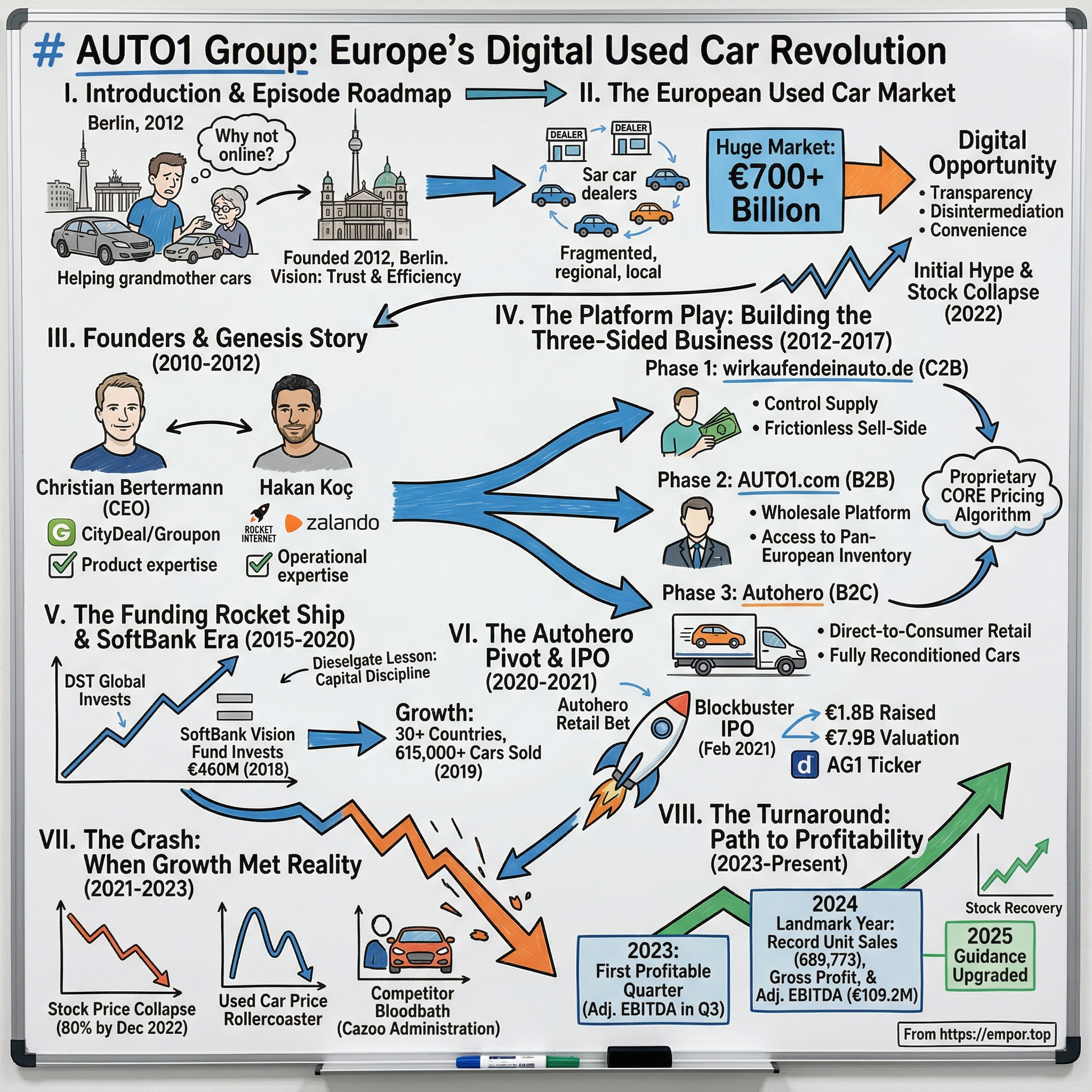
AUTO1 Group: Europe's Digital Used Car Revolution
I. Introduction & Episode Roadmap
Picture this: It's 2012 in Berlin. Christian Bertermann sits across from his grandmother, trying to help her sell two cars. The experience is a nightmare—unsolicited calls from shady dealers, wildly varying price quotes, and a process that feels stuck in the 1980s. For Bertermann, a product executive fresh from the Groupon explosion, this wasn't just a personal frustration. It was an epiphany. Why was buying a coffee online easier than selling a used car in one of the world's most industrialized nations?
Headquartered in Berlin and founded in 2012, AUTO1 Group developed into Europe's leading automotive platform connecting used car buyers and sellers all over Europe. Today, this company operates across more than thirty countries, and generated a revenue of EUR 6.3 billion in 2024.
The central question of the AUTO1 story is deceptively simple: How did two ex-Groupon employees build Europe's dominant digital used car platform in just twelve years—and what does their journey teach us about digitizing trillion-dollar offline markets?
The answer unfolds in phases that will feel familiar to students of platform economics. First, control the supply side by making it absurdly easy for consumers to sell their cars. Next, build a B2B wholesale network so dense that dealers have no choice but to participate. Then—and only then—venture into the high-margin but treacherous waters of direct-to-consumer retail. Along the way, survive a SoftBank injection that nearly burned the company during Dieselgate, execute Germany's largest tech IPO since TeamViewer, watch your stock collapse 80% alongside competitors like Cazoo, and somehow emerge in 2024 profitable for the first time.
AUTO1 Group reported record results across all key metrics in 2024, including an all-time-high in units sold, best-ever gross profit and record adjusted EBITDA—with record units sold of 689,773, up 17.7% year over year, record gross profit of EUR 724.7 million, up 37.3% year over year, and record adjusted EBITDA of EUR 109.2 million.
What follows is the full story: founders who learned hyper-local marketplace dynamics at CityDeal and Groupon; the Berlin ecosystem that incubated them; SoftBank's Vision Fund bet and the Dieselgate lesson it taught them; a €7.9 billion IPO that made headlines and then made investors wince; the competitor bloodbath that claimed Cazoo; and a remarkable turnaround to profitability that suggests AUTO1 may be one of the rare survivors in the "digital disrupt offline" playbook.
II. The European Used Car Market: Setting the Stage
Before understanding AUTO1, one must understand the market it sought to conquer. The Europe used cars market was valued at USD 725.3 billion in 2024—roughly equivalent to the GDP of Poland. This isn't a niche vertical. It's one of Europe's largest consumer categories, yet it operates with the sophistication of a flea market.
The European used car market enjoys a ratio of two to four used car transactions for every new car transaction, but uneven customer experiences made it ripe for disruption. In most categories, a 2:1 ratio of secondary to primary transactions would suggest a mature, efficient resale market. In used cars, it signals the opposite: a marketplace so fragmented that consumers endure wildly inconsistent pricing, opaque quality assessments, and logistics nightmares when crossing national borders.
Why Europe Was Uniquely Fragmented
Unlike the United States, where a handful of mega-dealers consolidated market share decades ago, Europe's used car trade remained stubbornly local. The Europe used car market is structurally fragmented: the five biggest retailers cover only 6% of B2C throughput, underscoring room for consolidation.
The reasons are cultural, historical, and regulatory. Europe has more OEMs per capita than any continent on Earth. Germany alone houses Volkswagen, BMW, Mercedes-Benz, Audi, Porsche, and Opel. France contributes Renault, Peugeot, and Citroën. Italy has Fiat. Spain has SEAT. The Czech Republic has Škoda. Each OEM cultivated loyal dealer networks that, over decades, calcified into geographic fiefdoms.
This fragmentation exists across all different markets. While both the US and UK have several listed used car dealerships, Europe has virtually none in the major economies—perhaps one in Finland, another in Sweden, but at the time of AUTO1's founding, none in Germany, Spain, Denmark, Portugal, or Switzerland. The UK probably has seven or eight publicly traded players; the US has twelve to fifteen.
Overall, the used car market is growing healthily. So far, Europe's car retailers are still highly fragmented, and most firms operate only in very confined local markets: Together, Europe's top 20 car dealerships trade only around 6% of all used cars. That statistic bears repeating: the top twenty players in a €600+ billion market collectively move just 6% of volume. For comparison, the top five used car dealers in the United States control roughly 20% of transactions.
The Digital Opportunity
The used car market in Europe is not only huge—it is also fragmented, regional, unsophisticated, opaque and composed of many intermediaries taking small commissions along the value chain. In other words, it was the perfect breeding ground for a data-driven ambitious challenger. AUTO1 was the first company to provide transparency, sophistication, disintermediation, trustworthiness and convenience through leveraging technology.
Consider the typical journey of a used car before AUTO1. A consumer in Munich decides to sell their three-year-old Golf. They post it on mobile.de (Germany's equivalent of Craigslist for cars), field dozens of lowball calls, negotiate awkwardly with strangers, and eventually sell to a dealer for 15% below market value. That dealer refurbishes the car, lists it, and sells it to a consumer in the same city—or perhaps transports it to Poland, where demand for German-engineered vehicles exceeds local supply.
At every step, friction. No standardized inspections. No transparent pricing. No pan-European logistics. No financing bundled into the transaction. For entrepreneurs steeped in the post-eBay, post-Amazon world, this looked less like a market and more like an archaeology site waiting to be excavated.
Initially, investors hyped used car online retailers. AUTO1, the publicly listed company behind Autohero and Wirkaufendeinauto, raised 1.8 billion euros when going public in February 2021 and was hailed as one of Europe's unicorns. But the hype was short lived, and AUTO1 lost more than 80% of its stock value by December 2022.
That collapse—and the subsequent recovery—tells a story not just about AUTO1, but about the gap between digital ambition and operational reality in trillion-dollar offline markets. Markets this large don't digitize overnight. They require patient infrastructure, disciplined capital allocation, and founders who understand that moving atoms is harder than moving bits.
III. Founders & Genesis Story (2010-2012)
The CityDeal/Groupon Crucible
Before there was AUTO1, there was CityDeal—and before there was CityDeal, there was a peculiar German cottage industry in cloning American startups. Groupon acquired German clone CityDeal in May 2010. CityDeal, which was invested in by Rocket Internet, the incubator of the Samwer brothers, had raised around 20 million Euros and was heavily competing with DailyDeal.
Founded in Berlin as CityDeal in December 2009, the service was acquired in May 2010 by Groupon and was co-branded under the Groupon name. In just five months, CityDeal had expanded to 80 cities across 16 countries, employing 600 people. The speed was breathtaking—and the lessons were formative.
Christian Bertermann has served as CEO since he co-founded AUTO1 Group in 2012. He previously held roles as Head of Product at CityDeal and VP Product International of Groupon after Groupon bought CityDeal. The CityDeal experience taught Bertermann everything about hyper-local marketplace dynamics: how to acquire consumers city by city, how to standardize processes across borders, and most importantly, how to move at startup velocity while maintaining operational discipline.
Hakan Koç, founder and managing director at AUTO1 Group, studied at Brooklyn Law School and Bucerius Law School and holds an LLB. He started his career as a developer with TNG. After that, he was a founder of a company called Balonto, worked as a key account at Daily Deal, project lead mobile at Zalando, worked as an EIR at Rocket Internet Gmbh, and as a chief product officer at Home24.
Koç's background reveals a different dimension. While Bertermann came from product and rapid execution, Koç understood the operational machinery of Rocket Internet—Europe's most prolific (and controversial) startup factory. At Home24, he had navigated the complexity of selling furniture online, a category with its own logistics nightmares. His legal training from Germany's elite Bucerius Law School added a layer of analytical rigor.
The Founding Insight
Hakan Koç and Christian Bertermann founded the company in 2012. The idea of digitizing the used car trade arose by chance. The idea came when Bertermann helped his grandmother sell two cars and encountered a variety of dubious offers. This experience motivated him and Koç to create a platform that brings trust and efficiency to the used car trade.
The grandmother story isn't just founder mythology—it illuminates the market's core dysfunction. When a sophisticated product executive at one of Europe's fastest-growing startups struggles to sell a car fairly, something is systemically broken. Hakan and Christian knew that Germany needed a secure and safe car marketplace to rival the American one, so in 2012, they launched AUTO1 Group in Berlin. AUTO1 Group was presented as an automobile online marketplace for used cars.
The Berlin Moment
Berlin started to appear in the international startup scene, so much so that even Ashton Kutcher decided to invest in the city back in 2012. Several of the companies mentioned before were the bootcamps for much of the talent we see today.
The timing mattered. Berlin in 2012 was experiencing a startup renaissance. With around 500 startup companies per year, Berlin is Germany's founder capital. The city combined low cost of living, an influx of international talent, and a post-reunification energy that made it uniquely receptive to new ideas.
Rocket Internet plays have alone raised close to 1 billion in 2012 alone and breeds large numbers of second generation entrepreneurs with international experience. It employs overall 10,000 people in Berlin alone. This ecosystem—alumni of Zalando, Delivery Hero, Home24—created a dense network of operators who understood European expansion, unit economics, and the discipline required to scale logistics-heavy businesses.
Co-founders Christian Bertermann and Hakan Koç recognized an opportunity to revolutionize the used car market. Their combined expertise in e-commerce and entrepreneurship laid the groundwork for what would become a leading used car platform.
The founders brought complementary skills to a market that demanded both. Bertermann's product intuition would shape the consumer experience that made selling a car effortless. Koç's operational experience would build the back-end machinery that processed thousands of vehicles daily. Together, they understood something the used car industry hadn't yet grasped: the future belonged to whoever could create liquidity at scale.
IV. The Platform Play: Building the Three-Sided Business (2012-2017)
Phase 1: wirkaufendeinauto.de (We Buy Your Car)
AUTO1 Group was founded in Berlin in July 2012 by Christian Bertermann and Hakan Koç and the same year the C2B brand wirkaufendeinauto.de was launched.
The name translates literally: "We Buy Your Car." No ambiguity. No marketplace complexity. Just a simple promise to private consumers: bring us your car, and we'll give you cash. wirkaufendeinauto.de and its sister brands are Europe's leading specialists for purchasing used cars. With over 600 drop-off locations across Europe, they offer private customers a seamless way to sell their vehicles.
The genius of this approach lies in its counterintuitive sequencing. Most marketplace founders obsess over demand. AUTO1 obsessed over supply. Why? Because in used cars, supply is the constraint. Dealers have insatiable demand for quality inventory. Private consumers, however, find selling a car so painful that they delay for months—often settling for thousands less than fair value just to avoid the hassle.
By making the sell-side experience frictionless, AUTO1 accumulated something their competitors couldn't match: consistent, inspected, properly-priced inventory. wirkaufendeinauto.de and its European clone brands specialized in purchasing used cars from private car owners. The company states that since the foundation of the German model in 2012, the family purchased more than 1 million vehicles and operates more than 350 branches in 10 European countries.
The branch network became critical infrastructure. Unlike purely digital platforms, AUTO1 invested in physical locations where consumers could drop off vehicles for inspection. These weren't glamorous showrooms—they were efficiently designed inspection centers where trained technicians assessed each vehicle using standardized protocols.
Phase 2: AUTO1.com - The B2B Wholesale Platform
The original business model focused on a wholesale platform for professional car dealers. AUTO1.com launched in 2013, facilitating faster and easier car purchases.
With supply secured, AUTO1 turned to monetization. AUTO1.com is Europe's largest wholesale platform for used cars. Since launching in 2012, AUTO1 Group has expanded into more than 30 countries, trading with over 35,000 professional partners and selling over 40,000 cars per month.
The value proposition to dealers was elegant: access to pan-European inventory without the hassle of sourcing. A dealer in Portugal could purchase a German-specification BMW from AUTO1's central pool, confident that it had been inspected to consistent standards. AUTO1 handled cross-border logistics, paperwork, and even financing.
AUTO1 Group's technology enables dealers as well as private individuals to trade seamlessly throughout Europe via an analytics and logistics platform that most efficiently matches supply and demand for used cars.
The Technology Foundation
A core innovation of the AUTO1 Group is its proprietary technology, which uses complex algorithms for car inspection and sales assessment. This technology allows for automated vehicle evaluation and purchase, streamlining the car trading process.
Prices are determined by its proprietary CORE pricing algorithm. CORE represented years of accumulated transaction data—make, model, mileage, condition, regional demand patterns—distilled into pricing models that outperformed human intuition. For the first time in European used car trading, prices reflected actual market clearing rates rather than negotiating skill.
The technology created a virtuous cycle. More transactions meant more data. More data meant better pricing. Better pricing meant tighter spreads. Tighter spreads meant more dealers trusted the platform. More dealers meant more demand. More demand meant more consumers willing to sell. And so the flywheel spun.
Phase 3: Autohero - The Retail Play
In 2019, AUTO1 Group launched Autohero, its direct-to-consumer retail platform offering fully reconditioned used cars with home delivery. This represented a strategic evolution. The wholesale business was profitable but low-margin. Retail offered GPU (gross profit per unit) several multiples higher—if you could execute.
Autohero is one of the leading used car dealers in Europe. The brand's range includes thousands of used cars of all makes and models, which are inspected in its own production centers. Customers also benefit from several services, such as the option of financing, delivery, trade-in, and a 21-day money-back guarantee.
The Autohero model mirrored Carvana's American playbook: quality refurbishment, transparent pricing, home delivery, and generous return policies. The difference was execution. Where Carvana bet heavily on automated vending machines and flashy marketing, Autohero prioritized sustainable unit economics over growth at all costs.
By 2017, AUTO1 had assembled something rare: a vertically integrated platform spanning C2B sourcing, B2B wholesale, and B2C retail. Each layer reinforced the others. Consumers sold cars because the process was easy. Dealers bought cars because selection was unmatched. And consumers bought cars because quality was guaranteed.
V. The Funding Rocket Ship & SoftBank Era (2015-2020)
The Capital Trajectory
In 2015, Hakan and Christian experienced their first of many successful milestones when they raised $117.6M from a DST Global investment. DST Global, Yuri Milner's legendary fund, had already backed Facebook, Alibaba, and Spotify. Their interest validated AUTO1's thesis.
Two years later, AUTO1 raised another $360 million from Princeville Global. AUTO1 Group is a funded company, having raised a total of $1.4B across 8 funding rounds to date.
The SoftBank Moment
SoftBank Group Corp.'s Vision Fund invested 460 million euros ($560 million) in Auto1 Group GmbH in January 2018, valuing the German used-car sales portal at about 2.9 billion euros.
AUTO1 Group, Europe's leading multi-sided platform for the used car sector, announced a €460 million investment by SoftBank Vision Fund. The investment, of which around half was made through the issue of new shares, valued AUTO1 at €2.9 billion and supported the Group's continued growth and international expansion.
Japanese tech giant SoftBank invested 460 million euros into AUTO1 in January 2018, valuing the company at 2.9 billion euros. SoftBank took a 20% stake in the company at the time.
SoftBank's Vision Fund operated with a particular philosophy: identify category winners, inject massive capital, and accelerate toward market dominance. SoftBank's Akshay Naheta joined the AUTO1 Group board following the investment.
Akshay Naheta, Partner at SoftBank Investment Advisors, said: "AUTO1 Group has built a fast growing, data-enabled platform introducing efficiency and transparency to the fragmented used car market, which is worth more than $300 billion annually. The SoftBank Vision Fund's capital and our operational expertise with marketplace businesses will support continued global growth."
The Dieselgate Lesson
SoftBank's investment arrived at an inopportune moment. The Volkswagen emissions scandal—Dieselgate—had already begun reshaping European attitudes toward diesel vehicles. The scandal caused a significant decline in demand for diesel vehicles.
What happened next would prove instructive. SoftBank encouraged aggressive expansion—buying volume at the expense of margin discipline. When Dieselgate flooded European markets with diesel cars that consumers suddenly didn't want, AUTO1 found itself holding inventory that depreciated faster than expected. Gross margins compressed. The experience burned into the founders' consciousness a lesson about capital discipline that would prove valuable during the post-IPO reckoning.
Continued Expansion
In 2016 the company sold more than 300,000 vehicles and achieved revenues of EUR 1.5 billion. By 2019, AUTO1 Group operated across more than 30 countries and sold more than 615,000 vehicles.
The company has raised over €1.7 billion in funding from investors including Princeville Global, Target Global and Baillie Gifford. In 2020, ahead of the IPO, AUTO1 received €255 million convertible loan financing for Autohero's expansion.
The capital trajectory reflected Silicon Valley's conventional wisdom about winner-take-all dynamics. Pour capital into the front-runner. Achieve scale. Outspend competitors on customer acquisition. Wait for profitability. The question that would soon confront AUTO1—and the entire cohort of growth-stage tech companies—was whether this wisdom applied to businesses that moved atoms as well as bits.
VI. The Autohero Pivot & IPO (2020-2021)
Key Inflection Point #1: The Retail Bet
Investment in Autohero accelerated in Q4 2020, becoming crucial for the company's IPO valuation. The strategic logic was sound. Wholesale generated stable revenue but thin margins. Retail commanded premium GPUs—if executed correctly—and represented a larger addressable market as consumer behavior shifted online during the pandemic.
The COVID-19 pandemic accelerated digital adoption across every consumer category, and used cars were no exception. Consumers who had never considered buying a car online suddenly found it preferable to visiting crowded dealerships. Autohero positioned itself to capture this shift.
The Blockbuster IPO
Online used-car dealer AUTO1 Group SE surged as much as 49% in its Frankfurt trading debut after its initial public offering raised 1.8 billion euros ($2.2 billion), the first in what shaped up to be a busy year for German listings.
The placement price indicated a market capitalization at the start of trading of €7.9 billion. The IPO priced at €38 per share—the top end of the range—signaling extraordinary demand. On February 4, 2021, AUTO1 Group completed its initial public offering on the Frankfurt Stock Exchange, raising approximately €1.8 billion. The IPO was one of the largest in Germany in recent years and valued the company at around €7.9 billion.
Gross proceeds reached €1.8 billion, making AUTO1's IPO the biggest initial public offering in Germany since June 2019 and one of the biggest German offerings of the past two decades.
The company's shares, priced at €38 at the initial public offering, opened 45% higher and eventually closed at €53. With a valuation of over €11 billion AUTO1 became officially a decacorn.
The euphoria reflected several converging narratives. Tech IPOs were white-hot globally. Digital transformation was the zeitgeist. SoftBank's imprimatur lent credibility. And AUTO1 could point to genuine operating metrics: €3.5 billion in 2019 revenue, 615,000 vehicles traded, presence in 30+ countries.
The largest shareholder was the Japanese technology investor SoftBank, which did not sell any shares when it went public and then still held 16.9 percent of AUTO1 shares. The company founders Bertermann and Koç turned part of their shareholdings into cash: CEO Bertermann collected 52 million euros, Koç 68 million euros.
Koç's company HKVV GmbH held 12.41 percent in AUTO1 Group, Bertermann's company BM Digital 12.62 percent. After the IPO, both together held a quarter of AUTO1's shares. With an estimated valuation of almost 8 billion euros, both founders became billionaires.
Following its successful IPO in February 2021, the group's shares are trading on the regulated market (Prime Standard) of the Frankfurt Stock Exchange under the trading symbol AG1.
The decacorn label—a tech startup valued above $10 billion—placed AUTO1 among elite European company. But labels don't pay dividends. The real test was whether the company could justify that valuation through profitable growth.
VII. The Crash: When Growth Met Reality (2021-2023)
Key Inflection Point #2: The Post-IPO Collapse
AUTO1 raised 1.8 billion euros when going public in February 2021 and was hailed as one of Europe's unicorns. But the hype was short lived, and in light of Europe's slide into stagflation as a result of the war in Ukraine, AUTO1 lost more than 80% of its stock value by December 2022.
The stock remains within its 52-week range of 8.56 to 31.38 euros, indicating ongoing volatility. From €53 at debut peak to single digits—an 85% destruction of market capitalization in less than two years. What happened?
The Used Car Price Rollercoaster
After substantial increases in used car prices for several quarters in a row starting from April 2021, wholesale prices peaked in July 2022 with an index value of 171.6. Used car prices increased throughout 2021 and 2022 due to various key drivers.
Used car prices reached an all-time high in July 2022, up 25.7% year on year. This was due to the pandemic and a shortage of semiconductors and other components, which led to long delivery times for new vehicles, as well as a broader inflationary trend exacerbated by the Russian invasion of Ukraine.
The semiconductor shortage created an artificial scarcity of new vehicles. Consumers who couldn't wait 6-12 months for a new car turned to the used market, pushing prices to historic highs. For a brief moment, used cars appreciated—an economic anomaly that confused market participants about sustainable price levels.
This was the steepest decrease since the start of the index in 2015, with wholesale prices decreasing by 11.8% throughout Q4, from the peak index value of 171.6 in July 2022 to the year-end value of 151.3 in December 2022.
When prices collapsed, inventory holders faced brutal write-downs. AUTO1, with its massive wholesale operation, was exposed. The company that had built its reputation on pricing discipline found itself navigating a price correction unlike anything in recent memory.
The Competitor Bloodbath: Cazoo's Cautionary Tale
AUTO1's problems paled beside its UK rival. Cazoo was listed on the New York Stock Exchange in August 2021 following a merger with a special-purpose acquisition company led by hedge fund manager Dan Och. As of its listing the company had a valuation of US$8 billion. It subsequently lost over 97% of its market value, causing Alex Chesterman to step down as CEO in January 2023.
In 2021 Cazoo had expanded internationally, launching used car marketplaces in Germany and France, and in early 2022 expanded briefly into Italy and Spain. After announcing redundancies in the UK in June 2022, in September, Cazoo announced it would abandon its business in the European Union, closing its operations in France, Germany, Italy and Spain and making all 750 of its EU employees redundant.
UK online used car platform Cazoo collapsed into administration in May 2024 following a period of restructuring which began in late 2023.
The Cazoo collapse—from $8 billion valuation to administration in three years—became a cautionary tale about the capital intensity of used car retail. Cazoo's aim of turning a profit by the end of 2023 did not come to fruition, with Chesterman stepping down as CEO in January 2023 after the company's market value collapsed 97 per cent from its public listing.
Several factors distinguished AUTO1's trajectory from Cazoo's:
-
Vertical Integration: AUTO1 controlled sourcing through its C2B network, while Cazoo relied more heavily on auction purchases.
-
Geographic Concentration: AUTO1 maintained deep operations in Germany, its home market, rather than dispersing resources across countries.
-
Unit Economics Focus: Even during the growth phase, AUTO1 tracked GPU obsessively, while Cazoo prioritized growth metrics.
-
Balance Sheet Strength: AUTO1's IPO proceeds and lower burn rate provided more runway than Cazoo's SPAC-funded expansion.
Two other online used car retailers decided to leave the German market altogether: Cazoo and CarNext, focusing on their core markets again.
VIII. The Turnaround: Path to Profitability (2023-Present)
Key Inflection Point #3: The Discipline Era
AUTO1 Group reported its best ever profitability result in 2023 as a public company. Christian Bertermann, CEO: "2023 was a huge success from a financial perspective: We significantly improved the balance of investments, costs and margin requirements and hit our first profitable quarter of adjusted EBITDA in Q3."
Having recorded positive adjusted EBITDA for the first time in Q3 2023 and subsequently slipping back into the red in Q4, AUTO1 recorded its highest-ever adjusted EBITDA of €17 million in Q1 2024. This compared to adjusted EBITDA losses of €25.1 million in Q1 2023 and €4.5 million in Q4 2023.
The turnaround wasn't accidental. It reflected systematic decisions: reducing marketing spend, optimizing logistics, improving GPU through better pricing algorithms, and restraining headcount growth.
2024: The Landmark Year
AUTO1 Group reported financial results for the full year 2024, highlighting record results across all key metrics, including an all-time-high in units sold, best-ever gross profit and record adjusted EBITDA. Record units sold of 689,773, up 17.7% year over year, record gross profit of EUR 724.7 million, up 37.3% year over year, record adjusted EBITDA of EUR 109.2 million, a EUR 153.2 million improvement year over year.
Christian Bertermann, CEO: "2024 was a fantastic first milestone on our profitable growth journey, demonstrating the strength and resilience of our vertically integrated business model, the power of our digital trading platform and the dedication of our teams."
Markus Boser, CFO: "Last year was a landmark year for AUTO1 Group, delivering record-breaking performance across all key financial metrics. These results were driven by the strong execution of our teams and demonstrate the operating leverage of our unique business model. 2024 marks an important first step towards our long term profitability targets."
The €109.2 million adjusted EBITDA represented not just a turnaround but validation. For the first time since listing, AUTO1 demonstrated that its vertically integrated model could generate profits at scale.
2025: Continued Momentum
AUTO1 Group achieved revenue of over 2 billion euros for the first time, driven by a 24% year-over-year increase in units sold. AUTO1 Group's unit sales increased by 24% year-over-year, reaching 219,000 units. The company surpassed the 2 billion euro revenue mark for the first time.
Revenue at Berlin-based digital auto retailer AUTO1 Group SE rose by 32.8% year on year and 7.8% quarter on quarter to €2.1 billion in Q3 2025. "For the first time in company history, quarterly revenue exceeded €2 billion," AUTO1 stated.
The Group sold a total of 218,617 units in Q3 2025, up 23.8% year over year. For the first time in company history, quarterly revenue exceeded EUR 2 billion, reaching EUR 2.1 billion in the third quarter, up 32.8% year over year.
AUTO1 Group has upgraded its full-year 2025 guidance. The company now expects to sell between 811,000 and 845,000 units in 2025. Gross profit is projected to reach €940-975 million, while adjusted EBITDA is expected to be between €180-195 million.
Stock Recovery
Shares in AUTO1 SE last closed at €28.32 and the price had moved by +212.24% over the past 365 days. From a trough near €8 to nearly €30—a 275% recovery that reflects investor recognition of the turnaround's durability.
As of November 27, 2025, AUTO1 is trading at a price of 23.60, with a previous close of 23.88. The stock has fluctuated within a day range of 23.04 to 23.60, while its 52-week range spans from 11.55 to 31.36.
IX. The Business Model Deep Dive
The Vertically Integrated Platform
AUTO1's business model is best understood as three interlocking flywheels:
1. Sourcing (wirkaufendeinauto.de)
wirkaufendeinauto.de and its sister brands are Europe's leading specialists for purchasing used cars. With over 600 drop-off locations across Europe, the Group offers private customers a seamless way to sell their vehicles.
The C2B sourcing network is AUTO1's moat. Competitors can launch wholesale platforms or retail brands, but replicating 600+ inspection centers across Europe requires years and hundreds of millions in capital.
2. Wholesale (AUTO1.com)
The strong growth in the merchant segment is driven by constantly rising demand for B2B offering. For the first time ever, AUTO1 surpassed 30,000 active merchant buyers, reaching 31,100 in the third quarter, a 22% increase compared to Q3 of last year.
The Merchant segment AUTO1.com sold 191,632 vehicles to partner dealers, up 21.6% year over year. Merchant revenue was EUR 1.7 billion, up 29.0% year over year and gross profit was EUR 185.1 million, up 28.6% year over year with GPU of EUR 966.
3. Retail (Autohero)
AUTO1 Group's Retail business Autohero sold record 26,985 units, up 41.7% year over year, generating revenue of EUR 468.2 million, up 48.6% year over year. Retail gross profit was EUR 72.5 million, up 68.1% year over year and Autohero reported GPU of EUR 2,664 up 17.7% year over year.
The GPU differential is striking: ~€966 for Merchant versus ~€2,664 for Retail. Autohero's higher margins justify the investment in refurbishment centers, marketing, and delivery logistics.
The Financing Layer
Merchant financing continues to be a significant growth driver, with sales financed increasing 63% year-over-year to €359 million and units financed growing 65% to 33,000 in Q3 2025. The company has expanded its merchant financing availability across Europe, with a portfolio balance of €284 million.
Financing transforms AUTO1 from a pure platform into a financial services provider—capturing additional margin on each transaction while deepening dealer relationships.
X. Competitive Analysis & Strategic Position
Porter's Five Forces Analysis
| Force | Assessment |
|---|---|
| Supplier Power | Low - Fragmented private sellers; no single supplier has leverage |
| Buyer Power | Medium - Dealers have alternatives but AUTO1's scale creates dependency |
| Threat of New Entrants | Low-Medium - Physical infrastructure and data moat create barriers |
| Threat of Substitutes | Medium - Traditional dealers, OEM certified programs, peer-to-peer platforms |
| Industry Rivalry | High - OEMs strengthening CPO programs; digital natives competing |
Hamilton Helmer's 7 Powers Framework
| Power | AUTO1's Position |
|---|---|
| Scale Economies | ✓ Strong - Logistics, technology, and marketing costs spread across 800K+ annual units |
| Network Effects | ✓ Moderate - More dealers attract more consumer sellers; more inventory attracts more dealers |
| Counter-Positioning | ✓ Strong - Traditional dealers cannot replicate digital-first infrastructure without cannibalizing existing operations |
| Switching Costs | ○ Weak - Neither consumers nor dealers locked in |
| Branding | ○ Building - Autohero investing in brand; wirkaufendeinauto established in Germany |
| Cornered Resource | ✓ Moderate - Proprietary pricing data from 5+ million transactions |
| Process Power | ✓ Strong - Standardized inspection, refurbishment, and logistics refined over 12 years |
XI. Bull Case vs. Bear Case
Bull Case: Digital Transformation at Scale
-
Market Share Runway: AUTO1 holds ~2.5% of a €700+ billion market. Management targets 10% long-term—implying 4x growth from current levels.
-
Profitability Inflection: 2024 demonstrated operating leverage. Each incremental unit sold adds disproportionately to EBITDA as fixed costs are spread.
-
Retail Mix Shift: Autohero's 42% unit growth and ~€2,700 GPU suggest the high-margin retail business is scaling.
-
Financing Optionality: Captive finance creates sticky relationships and additional margin.
-
Competitive Consolidation: Cazoo's collapse and CarNext's retreat reduced competition.
Bear Case: Structural Challenges Remain
-
Inventory Risk: Used car prices remain volatile. Rapid depreciation can compress margins despite unit growth.
-
Capital Intensity: Unlike pure-software marketplaces, AUTO1 requires ongoing investment in physical infrastructure.
-
OEM Competition: Volkswagen, BMW, and others are investing in certified pre-owned programs that could capture premium inventory.
-
Regulatory Risk: Cross-border trade faces ongoing VAT, emissions, and registration complexity.
-
Valuation Concern: At trailing P/E of ~65x, the stock prices in significant earnings growth that may prove optimistic.
XII. Key Performance Indicators to Track
For investors monitoring AUTO1's ongoing performance, three KPIs deserve primary attention:
-
Gross Profit Per Unit (GPU): Currently ~€1,000 blended. Indicates pricing power and operational efficiency. Watch for Retail GPU (currently ~€2,700) to drive blended figure higher as retail mix increases.
-
Unit Growth Rate: 24% growth in Q3 2025. Demonstrates market share gains. Sustainable double-digit growth validates TAM penetration thesis.
-
Adjusted EBITDA Margin: Currently ~2.5%. Management targets 5-9% long-term. Progression toward target confirms operating leverage hypothesis.
XIII. Conclusion
AUTO1 Group's journey from a grandmother's frustrating car sale to Europe's largest used car platform encapsulates both the promise and peril of digitizing offline industries. The founders brought deep marketplace expertise from the Groupon era. Berlin's ecosystem provided the talent and capital. SoftBank's investment accelerated expansion—perhaps too aggressively. The IPO captured peak euphoria. The crash tested survival instincts. And the turnaround proved that patient execution can prevail over hype.
AUTO1 Group is operating in over 30 countries and generated a revenue of EUR 6.3 billion in 2024. From €0 in 2012 to €6.3 billion in 2024—a compound annual growth rate exceeding 50%—AUTO1 has demonstrated that trillion-dollar offline markets can be digitized, but not overnight and not without scars.
The Cazoo comparison remains instructive. Both companies raised billions. Both targeted the same market. Both faced the same price volatility. But AUTO1 survived where Cazoo collapsed because it controlled supply, maintained unit economics discipline, and concentrated resources rather than dispersing them.
What remains uncertain is whether AUTO1 can sustain its current trajectory. The €700+ billion European used car market offers runway, but capturing market share in a fragmented industry requires continued investment in physical infrastructure, technology, and brand. The financing business adds margin but also risk. OEMs are awakening to the downstream value they've ceded.
For investors, AUTO1 represents a bet on digital transformation in a category resistant to change. The company has proven it can reach profitability. The question is whether it can compound from here—and whether the current valuation adequately prices that potential.
What's undeniable is that Christian Bertermann's grandmother could sell her car much more easily today. Twelve years, €1.4 billion in funding, and millions of transactions later, that remains AUTO1's ultimate achievement: making a terrible consumer experience merely adequate. In markets this large and this broken, adequate is often enough.


 RSS Feed
 Spotify
 Apple Podcasts
 Amazon Music
 Audible
 YouTube