 Chat with
this content: Summary, Analysis, News...
Chat with
this content: Summary, Analysis, News...
 Subscribe on LinkedIn


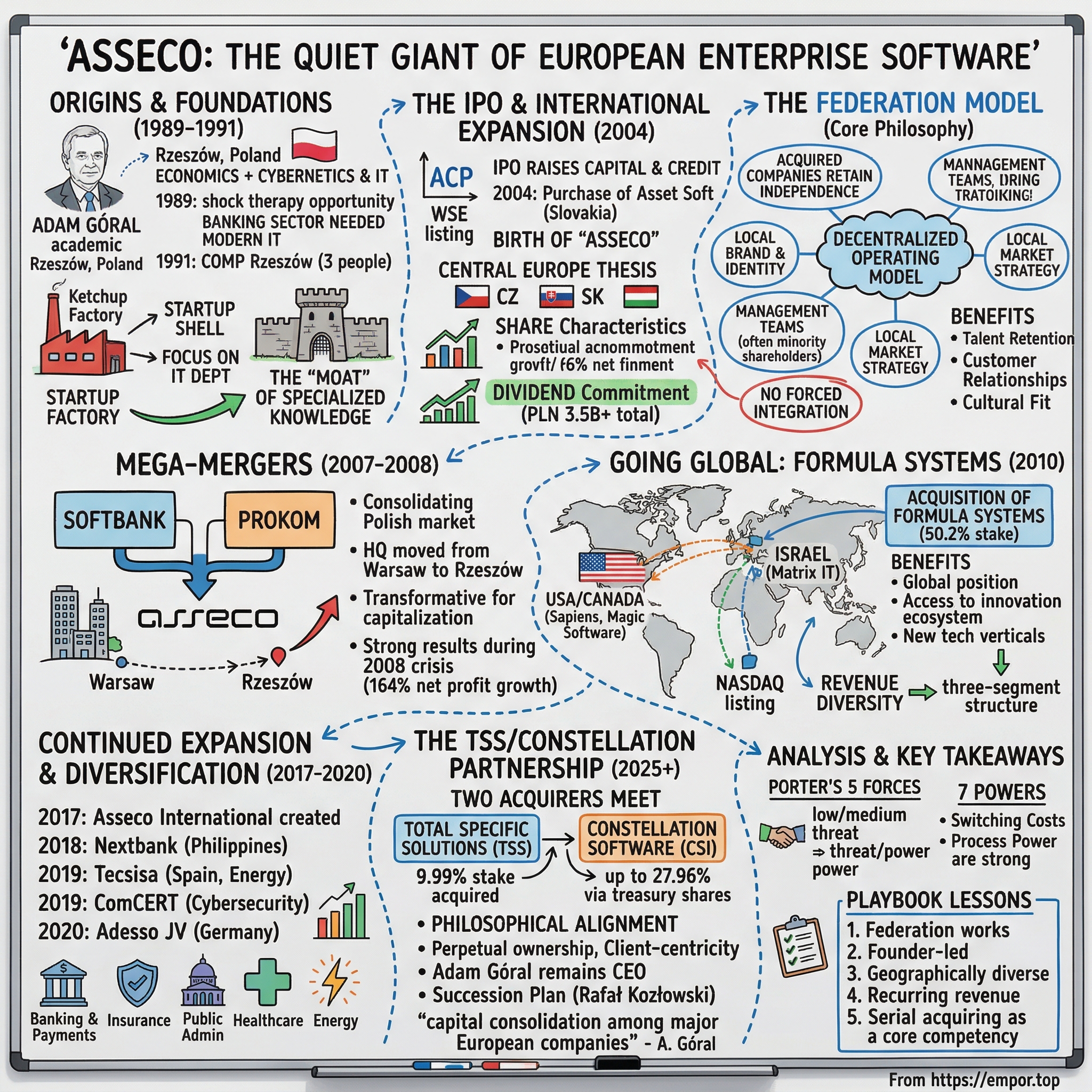
Asseco Poland: The Quiet Giant of European Enterprise Software
Introduction & Episode Roadmap
In the heart of southeastern Poland, far from the tech clusters of Warsaw and Kraków, sits a city that most global investors have never heard of: Rzeszów. With a population under 200,000, this provincial capital in the Subcarpathian Voivodeship would seem an unlikely birthplace for Europe's sixth-largest software producer. Yet from this modest city, a former economics professor named Adam Góral built something extraordinary—a global software empire spanning 60+ countries, employing 34,000 people, and generating over PLN 17 billion in annual revenue.
Asseco Poland S.A. is a Polish multinational information technology company headquartered in Rzeszów, Poland, and serves as the flagship entity of the Asseco Group, a global federation specializing in the development and delivery of enterprise software solutions.
The central question this article explores: How did a small IT startup from a provincial Polish city become Europe's 6th largest software producer through over 150 acquisitions—all while maintaining a unique "federation" model that preserves acquired companies' independence?
Now Asseco is the largest IT company in the Central and Eastern European region. It is present in more than 60 countries around the world and employs 34,000 people.
This is a story about post-communist entrepreneurship at its finest—about seizing the opportunity of Poland's chaotic 1989 transition while competitors hesitated. It's about the strategic wisdom of the federation model versus forced integration. And most recently, it's about what happens when one of the world's most admired software roll-up machines, Constellation Software, recognizes a kindred spirit in Central Europe.
In 2024, Asseco Group achieved PLN 17.1 billion in sales revenue, of which PLN 13.5 billion came from the sale of its proprietary IT products and services.
The partnership between Asseco and Total Specific Solutions (TSS)—Constellation's European arm—represents perhaps the most significant development in European enterprise software in years. Two acquirer-operators, built on virtually identical philosophies of decentralization and operational autonomy, have found each other across the continent. The implications for the European software landscape are profound.
Origins: From Academic to Entrepreneur in Post-Communist Poland
1989: A Country in Chaos, An Entrepreneur in Waiting
Picture Poland in the final months of 1989. The Berlin Wall has fallen. Solidarity has swept the communist government from power. Hyperinflation rages at 50% per month. State-owned enterprises are collapsing. And in a cramped university office in Rzeszów, a 36-year-old economics lecturer named Adam Góral watches the chaos unfold—not with fear, but with recognition of opportunity.
A graduate of Academy of Economics in Cracow (major in economic cybernetics and IT); he is a PhD in economy. In 1979-1990 he worked in a branch of the Maria Skłodowska-Curie University in Rzeszów; at the beginning he was an assistant and when he ended cooperation with this university he already had a position of a lecturer.
Góral's academic specialty—economic cybernetics and computer science—was an unusual combination in communist Poland, where universities trained people for state-planned economies, not entrepreneurial ventures. But the discipline required understanding both economics and information systems, a combination that would prove prescient when private enterprise suddenly became legal.
The Balcerowicz Plan, also termed "Shock Therapy," was a method for rapidly transitioning from an economy based on state ownership and central planning, to a capitalist market economy. Named after the Polish minister and economist Leszek Balcerowicz, the free-market economic reforms were adopted in Poland in 1989.
Poland's "shock therapy" created both devastation and opportunity. As state enterprises collapsed and Western capital hesitated, nimble Polish entrepreneurs could establish themselves in sectors that had previously been state monopolies. Banking was one such sector—Polish banks desperately needed modern IT systems to operate in a market economy, and they had nowhere to turn.
Established on January 18, 1989, as a limited liability company and evolving into a joint-stock entity, Asseco Poland was founded by Adam Góral and initially developed from the COMP Rzeszów startup, marking one of Poland's earliest IT ventures.
The timing is remarkable—January 18, 1989, just months before the Round Table Agreements that would end communist rule. Góral didn't wait for the dust to settle; he moved while others deliberated.
The Ketchup Factory Origin Myth
Asseco was founded as COMP Rzeszów in 1991 by Adam Goral. It began as a ketchup factory, but Goral focused on the development of the manufacturer's information technology department, which soon became the center of the business.
This detail—a ketchup factory—captures something essential about post-communist entrepreneurship. In a country where private enterprise had been illegal for forty years, the path to building a software company wasn't always direct. Entrepreneurs used whatever corporate shells they could access, whatever assets were available, whatever institutional knowledge existed. That Góral found his way to software development through a food processing company speaks to the improvisational genius required in that era.
He started in 1991 with a team of three people.
Three people. In a provincial city. Building banking software for an industry in chaos. The ambition seems almost delusional in retrospect—but Góral understood something his competitors didn't: Polish banks had no choice but to modernize, and they would prefer working with local providers who understood Polish regulations and spoke the language.
The Rzeszów Advantage
Why Rzeszów? The question seems obvious—why not Warsaw, where the banks were headquartered and capital flowed? But Góral's decision to stay in his hometown proved strategically brilliant.
Rzeszów offered lower costs, a talented pool of graduates from the local technical university, and freedom from the cutthroat competition of Warsaw's emerging tech scene. By building expertise in banking software—particularly the def3000 suite that would become Asseco's flagship product—Góral created what Warren Buffett might call a "moat" of specialized knowledge.
The def3000 suite is a flagship solution offered by Asseco to banking institutions. It features several dozen specialized modules that can be easily integrated into a bank's legacy IT environment, allowing for flexible adaptation of the solution to meet the bank's specific requirements.
The def3000 system became Asseco's foundation—not just technically, but philosophically. It established the company's pattern of building deep, specialized solutions for specific industries rather than pursuing horizontal software plays. This vertical focus would define every acquisition for the next three decades.
Since 1991, he developed COMP Rzeszów, which, after its IPO on the Warsaw Stock Exchange (WSE) as Asseco Poland, became the leader of the Asseco Group's growth on international markets. He graduated from the Kraków University of Economics (majoring in economic cybernetics and computer science) and holds a doctorate in economic sciences. From 1979 to 1990, he worked at a branch of MariaCurie-Skłodowska University in Rzeszów, initially as an assistant, and ended his association with the university as an assistant professor.
Góral's academic background wasn't just intellectual credentialing—it shaped how he approached business building. The PhD-holder brought systematic thinking to acquisition targets, management incentives, and organizational design. The "federation model" that would later distinguish Asseco wasn't accidental; it reflected deliberate organizational theory applied to the practical challenge of integrating diverse software companies.
The IPO and First Transformation: Going International (2004)
A Regional Champion Goes Public
By 2004, COMP Rzeszów had spent thirteen years building its reputation in Polish banking software. Asseco Poland S.A. has been listed on the Warsaw Stock Exchange (WSE) under the ticker symbol ACP since its debut on September 27, 2004, initially as Comp Rzeszów S.A.
The IPO wasn't just about raising capital—it was about signaling credibility to larger clients and positioning for the cross-border expansion that Góral had been planning for years. Poland's 2004 entry into the European Union created new opportunities, and Asseco intended to seize them.
The company became multinational with the 2004 purchase of the Slovak company Asset Soft, and the company was renamed Asseco. It continued to make acquisitions, purchasing the Polish software companies Softbank and Prokom.
The Asset Soft acquisition deserves attention because it established the pattern Asseco would follow for the next two decades. Rather than simply acquiring technology or talent, Góral bought a positioned player in a neighboring market—a company with local relationships, local language capability, and local regulatory knowledge.
The current corporation is the result of a 2004 merger between Asset Soft AS and COMP Rzeszów SA.
The "Asseco" name emerged from this merger—a fresh brand for a company with international ambitions. The etymology isn't publicly documented, but the name itself signals the break from the provincial "COMP Rzeszów" identity. This was no longer just a Polish company; it was the beginning of a European platform.
The Central European Thesis
Góral's strategic logic was elegant: Central European markets—Czech Republic, Slovakia, Hungary—shared enough characteristics with Poland (post-communist economies, EU accession, modernizing banking sectors) that Asseco's Polish expertise translated naturally. But they were different enough that local presence mattered enormously.
Asseco's international footprint began with its first overseas acquisition in 2004, when it purchased a 55% stake in Slovak firm ASSET Soft a.s., which was subsequently renamed Asseco Slovakia a.s. in 2005. This entry into Central Europe was followed by the establishment of Asseco South Eastern Europe (Asseco SEE) in 2007, formed through acquisitions of Romanian firms Net Consulting and FIBa Software, facilitating expansion into Serbia and other South-East European markets.
The pattern was clear: acquire local champions, preserve their identities, provide them capital and cross-selling opportunities, but let them run their own operations. This wasn't standard private equity thinking; it was more like the holding company structures of Berkshire Hathaway or, more relevantly, Constellation Software.
The year 2004 marked the birth not just of a new company name but of a new acquisition philosophy. For many years, Asseco has pursued an effective acquisition policy at home and abroad. Since 2004, it has successfully completed over 140 acquisitions, increasing its business scale and geographic reach many times over. That 140+ acquisition count (now over 150) began in earnest with Asset Soft, and the template established then continues to this day.
For investors, the 2004 IPO established another pattern: consistent dividend payments that would accumulate to remarkable totals. Asseco is consistently building shareholder value and sharing the profit it generates with its shareholders. Since its IPO on the WSE, the Company has paid in total more than PLN 3.5 billion in dividends to its shareholders.
This commitment to capital returns—even while pursuing aggressive acquisition growth—distinguishes Asseco from typical growth companies that reinvest everything. It reflects Góral's academic training in shareholder value and his understanding that patient, long-term investors value consistent returns alongside growth.
The Mega-Mergers: Softbank & Prokom Acquisitions (2007-2008)
Consolidating the Polish IT Market at the Peak of Global Crisis
By 2006, Asseco had established itself as a meaningful player in Central European software. But Góral had larger ambitions. The Polish IT market remained fragmented, with three major players competing for the largest contracts: the original Asseco, Softbank, and Prokom Software. The consolidation that followed transformed Asseco from a regional player into the dominant force in Polish technology.
On 4 January 2007, as a result of the merger of Asseco Poland (formerly: COMP Rzeszów S.A.) and Softbank, the company name was changed from Softbank Spółka Akcyjna to Asseco Poland Spółka Akcyjna, and the headquarters moved from Warsaw to Rzeszów.
The symbolism of moving headquarters from Warsaw—Poland's financial and political capital—to provincial Rzeszów was deliberate. This was Góral's company, run his way, from his hometown. The Warsaw establishment was being absorbed into the Subcarpathian venture, not the other way around.
Major milestones included management and support in merger processes with three major Polish IT vendors (Softbank, Prokom and ABG).
The Softbank merger brought integration expertise and a complementary customer base. But the Prokom acquisition would prove even more transformative.
Prokom: Bringing Home Poland's IT Crown Jewel
Prokom Software was arguably Poland's most prestigious IT company—a blue-chip constituent of the WIG20 index with decades of government and banking relationships. Acquiring Prokom meant Asseco was playing in an entirely different league.
On 1 April 2008 the Regional Court in Rzeszów registered the merger of Asseco Poland S.A. with Prokom Software S.A. The resulting company became the largest listed IT company in Poland and one of the ten largest by capitalization in Europe.
The timing seems almost reckless—completing a transformative merger in April 2008, just months before the global financial crisis would devastate capital markets worldwide. But Góral understood that crises create opportunities for well-capitalized acquirers. While competitors retrenched, Asseco expanded.
In the first half of 2008, financial results of the Asseco Group increased significantly. Net profit amounted to PLN 150.8 million, exceeding the result from the same period of the previous year by 164%. The Group generated sales revenues of PLN 1,167.9 million, a 133% increase compared to the first half of 2007.
The numbers speak for themselves—164% net profit growth during the first half of 2008, as the world's financial system teetered. The merged entity proved immediately accretive, validating Góral's acquisition thesis.
Integration Philosophy: The Federation Model Emerges
What distinguished these mega-mergers from typical M&A was Góral's approach to integration—or rather, his deliberate choice to limit it. The Asseco Group operates on the basis of a unique cooperation model - the federation model. Asseco Poland, as the Company with a leading role in the Group, is the largest shareholder in its constituent companies, but does not seek to own 100% of the shares and integrate Group members.
This ran contrary to conventional M&A wisdom, which emphasized synergy extraction through aggressive integration. But Góral observed that software companies' primary assets—their employees and customer relationships—were precisely what aggressive integration destroyed. By preserving acquired companies' identities, brands, and management teams, Asseco retained the talent and relationships that made acquisitions valuable in the first place.
Within our Federation we allow the companies to freely operate as they did before the acquisition. At the same time we give them the edge of being a part of a wealthy, multinational firm, increasing their reliability and market position.
The philosophy would prove prescient. Software companies live or die by their people, and the best people won't stay at companies that strip away their autonomy. The federation model wasn't just ethical—it was practical.
By the end of 2008, Asseco had transformed from a regional specialist into Poland's undisputed IT champion. The path to becoming a global player was now clear—but it would require looking beyond Europe entirely.
Going Global: The Formula Systems Acquisition (2010)
The Deal That Changed Everything
If the Softbank and Prokom mergers consolidated Asseco's Polish dominance, the 2010 acquisition of Formula Systems transformed the company into a truly global enterprise. The deal brought Asseco to three new continents, provided access to the world's most innovative technology ecosystem, and established the three-segment structure that defines the company today.
In 2010 Polish software maker Asseco acquired a 50.2% stake in the company. Formula Systems was founded in 1985 by Dan Goldstein and his brother Gad.
Formula Systems wasn't a typical acquisition target. Listed on both the Tel Aviv Stock Exchange and NASDAQ, the Israeli holding company controlled three publicly-traded subsidiaries: Matrix IT (Israel's largest IT services company), Magic Software Enterprises, and Sapiens International Corporation. Acquiring Formula meant acquiring a portfolio of sophisticated technology assets with established positions across Israel, North America, and beyond.
The purchase of a 51.2 percent stake in the Israeli-based software-services company from Emblaze Ltd. and a member of Formula's board will help Asseco raise annual revenue by about 50 percent, Chief Executive Officer Adam Goral said today.
A 50% revenue increase from a single transaction—this was transformative by any measure. But the strategic value exceeded even the financial impact.
The acquisition of Formula Systems is our first step in building a truly global position of Asseco. The Formula Systems Group provides us with access to unique know-how and the world's leading innovations. We are entering very promising markets. Today we open the door to global clients who have been out of our reach so far.
The Strategic Logic: Why Israel?
Israel's technology ecosystem is legendary—a nation of 9 million people punches far above its weight in cybersecurity, artificial intelligence, and enterprise software. Formula Systems gave Asseco direct access to this innovation engine.
Formula Systems is a holding company established in 1985. The holding owns shares in three IT companies: Matrix IT, Magic Software Enterprises, and Sapiens International Corporation. Shares of Formula Systems are listed on TASE (Tel Aviv Stock Exchange) as well as on NASDAQ Global Markets. Companies of the Formula Systems group operate in Israel, USA, Canada, Japan, United Kingdom, Germany, Netherlands, France, Hungary, and India.
The NASDAQ listing deserves particular attention. For a Polish company, having a US-listed subsidiary provided credibility with American clients and exposure to American capital markets. Sapiens' insurance software and Magic's integration platforms could now be marketed to global clients with the backing of a €1+ billion European parent.
The year 2010 was of key significance for Asseco's development. This was when the Asseco Family was joined by the Israeli holding of Formula Systems. The company that comprised three entities (Matrix IT, Sapiens, Magic Software) enabled Asseco to enter three continents (North America, Australia and Asia) providing Asseco Group members with a great dose of innovation and creative thinking.
A Federation of Federations
Formula Systems itself operated as a holding company—essentially a federation of publicly-traded technology companies. The philosophical alignment with Asseco's existing model was remarkable. Both organizations believed in decentralized governance, operational autonomy, and preservation of acquired companies' identities.
International markets, represented by the Formula Systems and Asseco International segments, accounted for 88% of the Group's total revenue.
Today, Formula Systems represents the largest contributor to Asseco's consolidated results, with nearly PLN 11 billion in annual sales. What began as a Polish banking software company now derives 88% of its revenue from international operations.
The Formula acquisition established the current three-segment reporting structure: Asseco Poland (domestic operations), Asseco International (European operations outside Poland), and Formula Systems (primarily Israel and North America). This tripartite structure reflects not just geographic reality but organizational philosophy—each segment operates with substantial autonomy while sharing capital, expertise, and strategic direction with the parent.
For investors evaluating Asseco, the Formula segment deserves particular attention. Its exposure to Israeli innovation, North American markets, and the insurance technology vertical through Sapiens creates growth opportunities and risk profiles quite different from the Polish public sector contracts that dominated early Asseco.
Building the Federation: The Unique Asseco Model
A Holding Company Unlike Any Other
To understand Asseco, you must understand its federation model—because without this organizational philosophy, the company simply wouldn't work. With over 150 acquired companies operating across 60+ countries, conventional integration approaches would have created chaos. Instead, Góral built something that resembles a loose confederation more than a traditional corporate hierarchy.
They describe themselves as a "federation" of companies because they have a decentralized organizational structure. Like Constellation, Asseco's decentralized model provides its group members with the operational freedom to preserve their brand and business culture, while also providing them with access to the capital, marketing, and other resources of a multinational organization with a very strong global market position.
The comparison to Constellation Software is apt and increasingly relevant given TSS's recent investment. Both organizations share a fundamental belief: software companies' value resides in their people and customer relationships, and aggressive integration destroys precisely what made acquisitions attractive.
Companies that choose to join the Asseco Group maintain a wide range of autonomy in their day-to-day operations, while the Group sets their strategic development directions, establishes goals and supervises their achievement. The Group's operation under the federation model relies on mutual trust, people-based business and a set of clearly defined rules for cooperation among Group entities.
How the Federation Actually Works
In practice, the federation operates through clearly defined boundaries. Acquired companies retain:
- Their brand names and local identities
- Their management teams (often minority shareholders)
- Operational decision-making authority
- Local market strategy
Asseco Poland provides:
- Capital for expansion and acquisitions
- Strategic direction and performance oversight
- Cross-selling opportunities and references
- Shared best practices and technology platforms
The question arises, however, why a federation and not a corporation? We focus on freedom of action and entrepreneurship. Previous managers (usually minority shareholders) continue to manage the company's operations. We rely on their experience and knowledge of local markets. What unites us are not only common business goals, but above all vision, values and partnership relations.
The minority shareholding structure is particularly clever. By leaving former owners with meaningful equity stakes, Asseco aligns incentives without paying full control premiums. Managers who retain ownership stakes have every incentive to grow their businesses—they're still entrepreneurs, not corporate employees.
The Three Segments Explained
The modern Asseco Group operates through three reporting segments that reflect both geographic reality and organizational evolution:
Asseco Poland: The parent company and domestic operations, generating approximately PLN 2.1 billion in annual revenue. This segment focuses on banking software (including the flagship def3000 suite), public sector contracts, healthcare IT, and energy sector solutions. It remains profitable and cash-generative, providing the base from which international expansion proceeds.
Asseco International: The holding company established in 2017 to manage European operations outside Poland. This includes Asseco Central Europe (Czech Republic, Slovakia, Hungary), Asseco South Eastern Europe (Balkans, Romania), and various Western European operations. Revenue of approximately PLN 4.1 billion reflects substantial scale in these markets.
Formula Systems: The Israeli holding company acquired in 2010, generating nearly PLN 11 billion in revenue. This segment provides exposure to North American markets, insurance technology through Sapiens, and the broader Israeli innovation ecosystem.
Foreign markets represented by the Formula Systems and Asseco International segments together accounted for 88% of the Group's revenues.
This geographic diversification provides natural hedging against country-specific risks while enabling specialization within each segment. A recession in Poland wouldn't cripple the entire group; strength in Israeli tech can offset weakness in Balkan banking.
Why This Model Works
Software businesses are not factories. You cannot extract "synergies" by centralizing development teams or homogenizing products. Every market has unique regulatory requirements, customer preferences, and competitive dynamics. The federation model respects this reality.
From the very beginning our strategy has been defined by the following motto: "we think globally, act locally". This resulted from our experience in the banking sector, which was reluctant to cooperate with small, local companies despite the fact that they offered good IT systems.
Banks—Asseco's original customers—exemplify why local presence matters. Financial institutions deal with sensitive data and regulatory oversight. They want vendors who understand local regulations, speak local languages, and will be present for decades of maintenance and upgrades. A Polish company might struggle selling to Czech banks; a Czech company (that happens to be part of a Polish group) faces no such barriers.
For investors, the federation model creates both opportunities and challenges. The upside: exceptional talent retention, strong customer relationships, and cultural fit in diverse markets. The challenge: limited synergy extraction and complexity in financial consolidation. Minority interests reduce the net profit attributable to Asseco Poland shareholders, even when underlying businesses perform well.
2017-2020: Structural Reorganization & Continued Expansion
Building Infrastructure for the Next Phase
By 2017, Asseco's federation had grown organically—a collection of acquisitions accumulated over 13 years without a formal structure beyond the parent company. The creation of Asseco International represented an effort to professionalize international operations and create a clear hierarchy for European businesses.
In 2017, the company established Asseco International, a holding which would be responsible for the management, supervision and support of Asseco Group companies operating on the international markets.
This reorganization reflected the group's increasing complexity. With dozens of subsidiaries across Central and Southeastern Europe, coordinating strategy, sharing best practices, and allocating capital required dedicated management attention. Asseco International provided this structure while preserving the federation's decentralized operating philosophy.
Expanding the Geographic Footprint
The late 2010s saw Asseco pushing into new markets and new sectors:
In 2018, the company entered the Philippines market by acquiring a 60% stake in the Kraków-based company Nextbank Software Sp. z o.o., which provides IT solutions for the banking sector in the country.
The Philippines acquisition represented Asseco's first significant Asian market entry—a banking software provider for the country's emerging digital finance sector. The deal illustrated Asseco's pattern: find a company with local expertise and market position, acquire a controlling stake, and provide capital for growth.
In the same year, Asseco-owned Formula Systems acquired a number of companies in the United States including Adaptik, Alius Corp and PVBS.
Through Formula Systems, Asseco expanded its North American presence with specialized acquisitions—insurance technology, healthcare software, and other vertical market solutions. The Formula holding company provided the platform for these deals while the acquired companies retained operational independence.
In 2019, Asseco acquired 51% of shares in the Spanish IT company Tecsisa which provides services for the energy sector as well as 69.01% of shares in ComCERT which specializes in the provision of cybersecurity services.
Tecsisa brought energy sector expertise to the group—a sector that would become increasingly important as European utilities digitized and energy transition accelerated. ComCERT added cybersecurity capabilities, a capability Asseco has continued to develop as cyber threats proliferate.
In 2020, the company entered the German banking market by establishing Adesso Banking Solutions GmbH in partnership with the German Adesso company specializing in systems for insurance sector firms and bank consulting.
The German market—Europe's largest economy—had been notably absent from Asseco's footprint. The Adesso partnership represented a new approach: rather than acquiring outright, Asseco formed a joint venture with a local partner to establish presence in a market where credibility barriers were high.
Navigating the Pandemic
The COVID-19 pandemic tested every business, but technology companies with strong recurring revenue and remote work capabilities fared better than most. The founder of Asseco has been included in the list of "Best Presidents of WIG30 companies for difficult times" prepared by the Parkiet daily. The purpose of the ranking is to identify managers who, in the face of the pandemic, have been able to react quickly and set the right direction for their companies in new market realities.
Góral's decades of experience building a diversified, resilient organization paid dividends during crisis. The federation model's decentralization meant local managers could respond to local conditions without waiting for head office approval. Strong customer relationships in banking and public administration—sectors that required continuous IT support regardless of economic conditions—provided revenue stability.
The TSS/Constellation Partnership: A New Chapter (2025)
When Two Acquirers Meet
In January 2025, the global software investing community took notice when Total Specific Solutions—the European arm of Constellation Software—announced its acquisition of a stake in Asseco Poland. This wasn't just another deal; it represented the convergence of two organizations built on virtually identical philosophies.
In January 2025, Total Specific Solutions (TSS), a Netherlands-based software group, acquired a 9.99% stake in Asseco Poland from Cyfrowy Polsat for approximately PLN 705 million at PLN 85 per share.
The transaction came in stages. First, TSS acquired Cyfrowy Polsat's stake, removing a telecom-focused shareholder with no strategic overlap. Then came the bigger move:
Total Specific Solutions ("TSS"), operating through subsidiary Yukon Niebieski Kapital B.V., a leading European Software group, has signed an agreement to acquire 12,318,863 shares of Asseco Poland, representing 14.84% of the company's capital. The acquisition is subject to obtaining necessary regulatory approvals. Upon completion of the transaction, TSS will hold a total of 20,618,892 shares of Asseco Poland, representing 24.84% of the company's capital.
After receiving all required regulatory approvals, Topicus' subsidiary TSS Europe B.V. has completed the acquisition of 14.84% of treasury shares in the capital of Asseco Poland S.A. The transaction closed in October 2025, making TSS Asseco's largest shareholder.
Why This Partnership Makes Sense
Understanding why TSS invested requires understanding what Constellation Software has built. Mark Leonard's Canadian conglomerate has compounded shareholder value at exceptional rates for decades by acquiring vertical market software companies and providing them with capital and best practices while preserving their operational autonomy.
TSS' strategy is for a large part modelled after Constellation Software ("CSI"), a publicly traded investment firm on the Canadian stock exchange which holds a controlling vote in TSS' parent company Topicus.com. Much like CSI, TSS is focused on acquiring vertical market software companies with strong customer bases and market positions.
The philosophical alignment between Asseco and Constellation/TSS is remarkable:
The existing decentralized model at Asseco paves the way for TSS to come in and begin implementing their practices, which require a decentralized culture.
Both organizations believe in: - Acquiring rather than building - Preserving acquired companies' autonomy - Retaining management teams - Long-term ownership (perpetual, not private equity-style) - Capital efficiency and return on invested capital
"Together, we will build a partnership of two strong European IT Groups based on perpetual ownership, decentralized governance, and client centricity." – says Ramon Zanders, TSS Group CEO.
What Adam Góral Said
Góral's public statements reveal his strategic thinking:
"Our groups are built through acquisitions, and companies operate within a federated model. I chose to partner with TSS because I believe that in a time of increasing dominance by global software giants, only capital consolidation among major European companies provides an opportunity to create teams that, in the coming years, can effectively compete for greater market share."
This framing matters. Góral isn't selling his company; he's bringing in a strategic partner to accelerate a strategy he's pursued for three decades. The "federated model" language explicitly connects Asseco's philosophy to TSS/Constellation's approach.
The Shareholders' Agreement
The parties signed a shareholders' agreement governing their cooperation:
Implementing a management incentive program to support long-term stability and achieving strategic business objectives. According to the agreement, TSS will not exceed a maximum 27.96% stake in Asseco's share capital.
The stake cap is significant—TSS commits to remaining a minority shareholder, preventing concerns about a creeping takeover. The management incentive program aligns Asseco's leadership with long-term value creation.
Asseco will stay a public company listed on the Warsaw bourse, with Adam Goral remaining at its helm.
Succession Planning
The TSS partnership also facilitates leadership transition:
In 2023, Adam Góral designated Rafał Kozłowski as his future successor. Kozłowski currently serves as Vice President of Asseco, having previously held various management positions within the Asseco Group for many years. Góral has clearly stated that after Kozłowski assumes the CEO position, he intends to remain involved in the company and continue to support its growth as Chairman of the Supervisory Board.
In January 2027, I would like to move to the Supervisory Board, and Rafał Kozłowski, whom I have been preparing for this new role for several years, would then become the President of the Management Board of Asseco Poland.
Kozłowski's background—CFO experience, Formula Systems board membership, deep operational knowledge—positions him well for the CEO role. The TSS partnership provides stability during this transition, ensuring continuity regardless of leadership changes.
Business Model Deep Dive & Product Portfolio
What Asseco Actually Does
At its core, Asseco develops and sells enterprise software—the mission-critical systems that banks, insurers, governments, and utilities depend on to operate. Unlike consumer software companies with recognizable brands, Asseco's products work behind the scenes, processing transactions, managing policies, and running critical infrastructure.
The company focuses on key sectors including banking and payments, insurance, public administration, healthcare, energy, telecommunications, and defense, offering proprietary products such as core banking systems, e-health platforms, ERP solutions, cybersecurity tools, and cloud services.
The emphasis on "proprietary products" is crucial. Asseco generates most of its revenue from its own software rather than reselling others' products or providing pure services.
In terms of product groups, solutions for the finance sector remained the largest contributor at 32% of total revenues, followed by infrastructure and other services (23%), solutions for public institutions (21%), other IT solutions (15%), and ERP solutions (9%).
The def3000 Flagship
Asseco's flagship product for the banking sector is the comprehensive IT suite def3000, used by financial institutions in Poland. The firm also provides IT consulting, systems integration, and implementation services for large and midsize industrial enterprises.
The def3000 suite exemplifies Asseco's product philosophy: deep, comprehensive solutions for specific verticals rather than horizontal platforms competing with global giants. A Polish bank choosing def3000 gets software designed for Polish regulations, with Polish-language support, from a vendor committed to the Polish market for decades.
The def3000 suite is a flagship solution offered by Asseco to banking institutions. It features several dozen specialized modules that can be easily integrated into a bank's legacy IT environment, allowing for flexible adaptation of the solution to meet the bank's specific requirements. def3000/CB has been already implemented, among others, for Getin Noble Bank, Toyota Bank Poland, Eurobank, Deutsche Bank PBC, while individual modules of the suite are operated by dozens of banks across Poland.
Proprietary Software Focus
In 2024, Asseco Group achieved PLN 17.1 billion in sales revenue, of which PLN 13.5 billion came from the sale of its proprietary IT products and services.
That's roughly 79% proprietary revenue—a ratio that provides higher margins and stronger customer lock-in compared to resellers or pure services firms. When customers depend on your proprietary software for mission-critical operations, switching costs are enormous and renewal rates are high.
Sector Diversification
The company builds an international group of technology companies, whose federal model allows for the use of local entrepreneurship and market knowledge. When a company joins the group, it increases its implementation capabilities and credibility towards demanding customers.
Asseco's sector diversification—finance, public administration, healthcare, energy, telecommunications—provides revenue stability. Economic cycles affect sectors differently; a downturn in banking might coincide with increased government IT spending. The diversification is deliberate, not accidental.
Recent Financial Performance & 2024-2025 Results
Record Results in 2024
"2024 turned out to be a record year for Asseco. We achieved the highest net profit in our more than 30-year history. These results show that the strategy we have adopted, focusing on the development of proprietary software and related services, as well as strong diversification, allows us to grow steadily."
The numbers justify Góral's satisfaction:
Revenues at PLN 17.1 billion PLN, non-IFRS operating profit up 6% to PLN 2.1 billion and non-IFRS net profit up by 8% to PLN 577 million.
Operating profit was 10% higher than in 2023, at PLN 1.8 billion (EUR 416 million). Net profit attributable to shareholders of the parent company, after an 8% increase, reached PLN 520 million (EUR 121 million), a record high.
Asseco continued its expansion strategy by adding 14 new companies to the Group during 2024, further diversifying its geographic footprint and service offerings.
Currency Headwinds
After excluding currency effects, our revenue increased by 6% and operating profit by 14%.
The currency adjustment is significant. With 88% of revenue from international operations, zloty strength against the Israeli shekel and euro reduced reported results. Underlying performance was stronger than headline numbers suggested.
H1 2025: Momentum Continues
The company reported an 8% increase in sales revenues to PLN 9.0 billion, while non-IFRS operating profit jumped 14% to PLN 1.1 billion. Non-IFRS net profit attributable to shareholders of the parent company grew even more impressively at 23% to reach PLN 318 million.
During H1 2025, the Group added 13 new companies across multiple markets, significantly expanding its geographic footprint and technological capabilities.
The acquisition pace accelerated—13 companies in six months suggests the TSS partnership is already bearing fruit, either through direct collaboration or through the capital and confidence the partnership provides.
Valuation Context
The company marked the 15th anniversary of its listing in 2019, with its market capitalization reaching approximately PLN 16.2 billion as of November 2025. The company's share price achieved a 52-week high of PLN 254.00 in October 2025 amid broader IT sector growth.
Capital Returns
Asseco continues to deliver value to shareholders, having paid out over PLN 3.5 billion in dividends since its IPO. For 2024, the Management Board has recommended a PLN 269 million dividend payout, which translates to PLN 3.94 per share.
The consistent dividend—even while pursuing aggressive acquisition growth—reflects Góral's shareholder-friendly philosophy. Many growth companies argue that reinvesting all capital creates superior long-term returns; Asseco demonstrates that growth and returns can coexist.
Playbook: Business & Investing Lessons
Lesson 1: The Power of the Federation Model
The most important lesson from Asseco's story is organizational: you can build an acquisition-driven conglomerate without destroying the value you acquire. The federation model preserves the entrepreneurship, customer relationships, and institutional knowledge that make software companies valuable.
We started as a handful of people and today we are the largest IT company in Poland and in the region of Central and Eastern Europe. This success would not have been possible without our consistent implementation of the federation business model we adopted.
Most acquirers destroy value through integration hubris—believing they can run acquired businesses better than incumbent management, that synergies justify disruption, that corporate standards should override local expertise. Asseco proves the opposite: humility about integration creates better outcomes.
Lesson 2: Founder-Led Excellence
The rank shows that at the Warsaw Stock Exchange, the companies which are managed by their founders and owners achieve the best results.
Góral has led Asseco for 34 years—through Poland's transition from communism, through multiple financial crises, through transformative acquisitions. That continuity provides strategic consistency impossible for companies cycling through professional management every few years.
Lesson 3: Geographic & Sector Diversification
Strong business diversification at the level of products, sectors and geographic markets, as well as long-term relationships with customers and a high share of recurring revenues ensure stable growth for the Asseco Group.
Asseco's resilience comes from diversification. No single market, sector, or customer can materially damage the group. This deliberate diversification required saying no to opportunities that would have concentrated risk—discipline that pays dividends during downturns.
Lesson 4: The Strategic Value of Recurring Revenue
Enterprise software's economics favor vendors. Once a bank implements a core banking system, switching costs are enormous—years of migration risk, staff retraining, regulatory validation. Asseco's customers typically stay for decades, providing predictable revenue and the foundation for expansion.
Lesson 5: Roll-Ups Done Right
Since 2004, it has successfully completed more than 150 acquisitions, increasing its scale of operations and geographic reach many times over.
150+ acquisitions in 20 years averages to 7-8 per year—a remarkable pace sustained over decades. But Asseco isn't just buying companies; it's building a coherent organization with consistent philosophy, governance structures, and capital allocation frameworks. That's the difference between successful serial acquirers and "roll-up" disasters.
Porter's 5 Forces & Hamilton's 7 Powers Analysis
Porter's Five Forces Analysis
1. Threat of New Entrants: LOW
Enterprise software for banking, government, and insurance creates formidable barriers to entry: - Regulatory compliance requirements take years to develop - Reference customers and certifications are essential for new business - Implementation complexity requires deep domain expertise - Customer switching costs create incumbency advantages
A startup cannot credibly bid on a core banking system against Asseco; they lack the track record, regulatory approvals, and implementation capability that decades of experience provide.
2. Bargaining Power of Suppliers: LOW-MEDIUM
Asseco develops proprietary software, reducing dependence on external technology suppliers. The primary "supplier" is talent—software engineers—where competition is intensifying across Europe as tech companies expand and remote work enables global recruiting.
70% of Asseco's revenue is derived from customers in the finance/banking, public, and infrastructure sectors. Banking in particular is a key aspect of their offering, accounting for 32% of revenue.
The reliance on skilled engineers creates wage pressure, but Asseco's geographic spread (including lower-cost locations in Eastern Europe) and employee ownership culture help retain talent.
3. Bargaining Power of Buyers: MEDIUM
Large institutions like banks and governments have procurement power, but switching costs limit their leverage once systems are implemented. Long-term maintenance contracts create annuity-like revenue streams.
Asseco's diversification mitigates customer concentration risk—no single customer dominates, though segment-level concentration (e.g., Polish banking) exists.
4. Threat of Substitutes: MEDIUM
Cloud-based platforms from global vendors (SAP, Oracle, Microsoft) offer alternatives to Asseco's on-premise solutions. However, local regulatory requirements, language needs, and customization capabilities provide protection in Asseco's core markets.
The substitution threat is real but manageable—Asseco is investing in cloud capabilities and AI integration to remain competitive.
5. Industry Rivalry: MEDIUM-HIGH
Enterprise software is competitive, with global giants and local specialists fighting for contracts. However, Asseco's federated structure allows it to compete as a local champion in each market while leveraging group scale for major tenders.
Hamilton Helmer's 7 Powers Framework
Switching Costs: STRONG
This is Asseco's primary competitive power. Once a bank implements def3000 or an insurer deploys Sapiens systems, switching costs are enormous—often exceeding the cost of the original implementation. Multi-year contracts with maintenance provisions create recurring revenue and long-term customer relationships.
Scale Economies: MODERATE
Software development benefits from scale (development costs spread across more customers), but Asseco's federated model limits traditional scale advantages. Each subsidiary maintains some development independence, trading scale efficiency for local responsiveness.
Network Effects: LIMITED
Unlike platform businesses, enterprise software doesn't generate strong network effects. However, Asseco's ecosystem of 150+ companies creates modest network benefits through shared expertise and cross-referrals.
Counter-Positioning: MODERATE
Asseco's federation model counter-positions against global vendors who promise standardization and integration. For customers valuing local knowledge and customization, Asseco offers something the giants cannot—genuine local presence with global backing.
Cornered Resource: MODERATE
Deep expertise in specific verticals (Polish banking, Israeli defense, Balkan payments) and long-standing customer relationships represent cornered resources that competitors cannot easily replicate.
Process Power: STRONG
The acquisition playbook Asseco has refined over 150+ deals represents genuine process power. Finding targets, negotiating deals, integrating (or not integrating) acquisitions, and aligning incentives—these processes are embedded in organizational culture and difficult to copy.
Branding: LIMITED
Enterprise software decisions are rarely driven by brand; procurement teams evaluate capabilities, references, and pricing. Asseco's various brands matter locally but don't create consumer-style brand power.
Competitive Positioning Summary
Asseco occupies a defensible position: the leading Central/Eastern European enterprise software provider with global reach through Formula Systems. Switching costs and process power (acquisition capability) are the primary sources of durable competitive advantage.
Bull & Bear Cases
Bull Case
1. TSS Partnership Accelerates Value Creation
The Constellation/TSS partnership brings world-class M&A expertise to Asseco's existing acquisition machine. If Asseco can implement Constellation-style hurdle rates and integration practices while maintaining its federated culture, returns on invested capital could improve meaningfully.
In 2022, TSS made a large (73%) strategic investment in Sygnity. The intention was to implement Constellation's playbook at the company. Sygnity leveraged the experience of TSS to optimize their operations and use expertise in the acquisition process. In the first year with new management, Sygnity went from 17% EBITDA margins to 21% and has continued to grow since.
The Sygnity precedent suggests TSS can improve margins at acquired companies. Applied to Asseco's larger portfolio, even modest margin improvements would drive substantial earnings growth.
2. European Software Consolidation Opportunity
The fragmented European enterprise software market offers decades of acquisition runway. Asseco's local presence across the region positions it perfectly to identify and acquire regional champions that global players overlook.
3. Recurring Revenue Resilience
High switching costs and mission-critical applications provide revenue resilience through economic cycles. Even in recessions, banks cannot turn off their core systems.
4. Digital Transformation Tailwinds
Government digitalization, banking modernization, and energy transition all require IT investment. Asseco's sector exposure aligns with these long-term trends.
5. Undervaluation vs. Global Peers
Listed on the Warsaw Stock Exchange rather than NASDAQ or London, Asseco trades at discounts to comparable global software companies. Increased visibility through the TSS partnership could narrow this gap.
Bear Case
1. Management Succession Risk
Adam Góral has led Asseco for 34 years. Despite succession planning with Rafał Kozłowski, founder transitions are inherently risky. Will the federation model survive without its architect?
2. Currency Exposure
With 88% international revenue, zloty strength against the dollar, shekel, and euro reduces reported results. While underlying performance remains strong, currency volatility creates earnings unpredictability.
3. Global Competitor Pressure
Cloud-native competitors (ServiceNow, Workday, cloud offerings from SAP/Oracle) are disrupting traditional enterprise software. Asseco's on-premise heritage may become a liability as customers increasingly prefer cloud solutions.
4. Minority Interest Complexity
The federation model means significant minority interests reduce profits attributable to Asseco Poland shareholders. Growing subsidiaries disproportionately benefits minority shareholders rather than the parent company.
5. Integration Risk from TSS Influence
While the TSS partnership promises improvement, it also introduces potential for cultural clashes. If TSS pushes for operational changes that conflict with Asseco's federation philosophy, key talent might leave.
Key Performance Indicators to Watch
1. Proprietary Software Revenue as % of Total Revenue
Currently at approximately 79%, this metric indicates Asseco's value creation and pricing power. Higher proprietary revenue suggests stronger customer lock-in and better margins. A decline might signal commoditization or loss of competitive positioning.
2. Order Backlog Growth (at Constant Currency)
Looking ahead, Asseco's order backlog for 2025 indicates continued growth, with a 9% increase in fixed-rate orders and a 6% increase in variable-rate orders compared to the previous year.
The order backlog provides visibility into future revenue. Tracking this metric at constant currency removes FX noise and reveals underlying business momentum. Consistent backlog growth indicates healthy demand; decline suggests market challenges.
3. Acquisition Count and Quality
With the TSS partnership, investors should monitor both acquisition volume and quality. Are deals getting done at reasonable prices? Is integration (or non-integration) proceeding smoothly? Are acquired companies meeting performance expectations?
Regulatory and Accounting Considerations
Minority Interest Complexity
Asseco's consolidated statements include numerous subsidiaries with significant minority shareholders. The net profit attributable to parent company shareholders is substantially lower than consolidated net profit—a complexity that requires careful analysis.
Goodwill and Intangible Assets
150+ acquisitions have generated substantial goodwill on the balance sheet. Investors should monitor impairment testing disclosures and be aware that economic stress could trigger writedowns.
Currency Translation Effects
With major subsidiaries reporting in Israeli shekels, euros, and dollars, currency translation affects both revenue and asset values. The company provides constant-currency growth metrics that help analysts assess underlying performance.
Geopolitical Exposure
The Russian invasion of Ukraine caused a radical change in the geopolitical situation of the entire region in which the Company is located. The Company does not conduct any significant business operations in Russia, Belarus or in Ukraine, nor does it hold any cash in Russian banks. This situation had no direct impact on these financial statements.
Limited direct Russian/Ukrainian exposure, but ongoing geopolitical tensions in Central/Eastern Europe create macro risks.
Conclusion: A Quiet Giant Ready for Its Next Chapter
From a ketchup factory in provincial Rzeszów to Europe's sixth-largest software producer—Asseco's journey reflects the best of post-communist entrepreneurship. Adam Góral's vision, patience, and organizational innovation created something genuinely distinctive: a global technology company built through acquisitions yet operating as a federation of autonomous businesses.
The 2025 partnership with TSS/Constellation represents validation of this approach from the world's most admired serial acquirer. When Mark Leonard's organization invests nearly 25% of its capital in a company, sophisticated investors take notice.
Looking forward, Asseco faces the challenges common to all enterprise software companies—cloud disruption, talent competition, customer concentration—while enjoying advantages unique to its federation model: exceptional geographic diversification, strong local relationships, and organizational flexibility.
For long-term investors, Asseco offers exposure to European software consolidation, Central European economic growth, and one of the world's most proven acquisition machines—all at valuations modest compared to US-listed peers. The succession from Góral to Kozłowski introduces transition risk, but the TSS partnership provides stability and expertise that should smooth this handover.
Three decades after Poland's transition from communism, Asseco stands as proof that ambitious entrepreneurs in emerging markets can build globally competitive companies—not by copying Western models, but by developing innovative approaches suited to their unique circumstances. The federation model worked when no one expected it to. With Constellation's backing, it may work even better in the decades ahead.


 RSS Feed
 Spotify
 Apple Podcasts
 Amazon Music
 Audible
 YouTube