 Chat with
this content: Summary, Analysis, News...
Chat with
this content: Summary, Analysis, News...
 Subscribe on LinkedIn


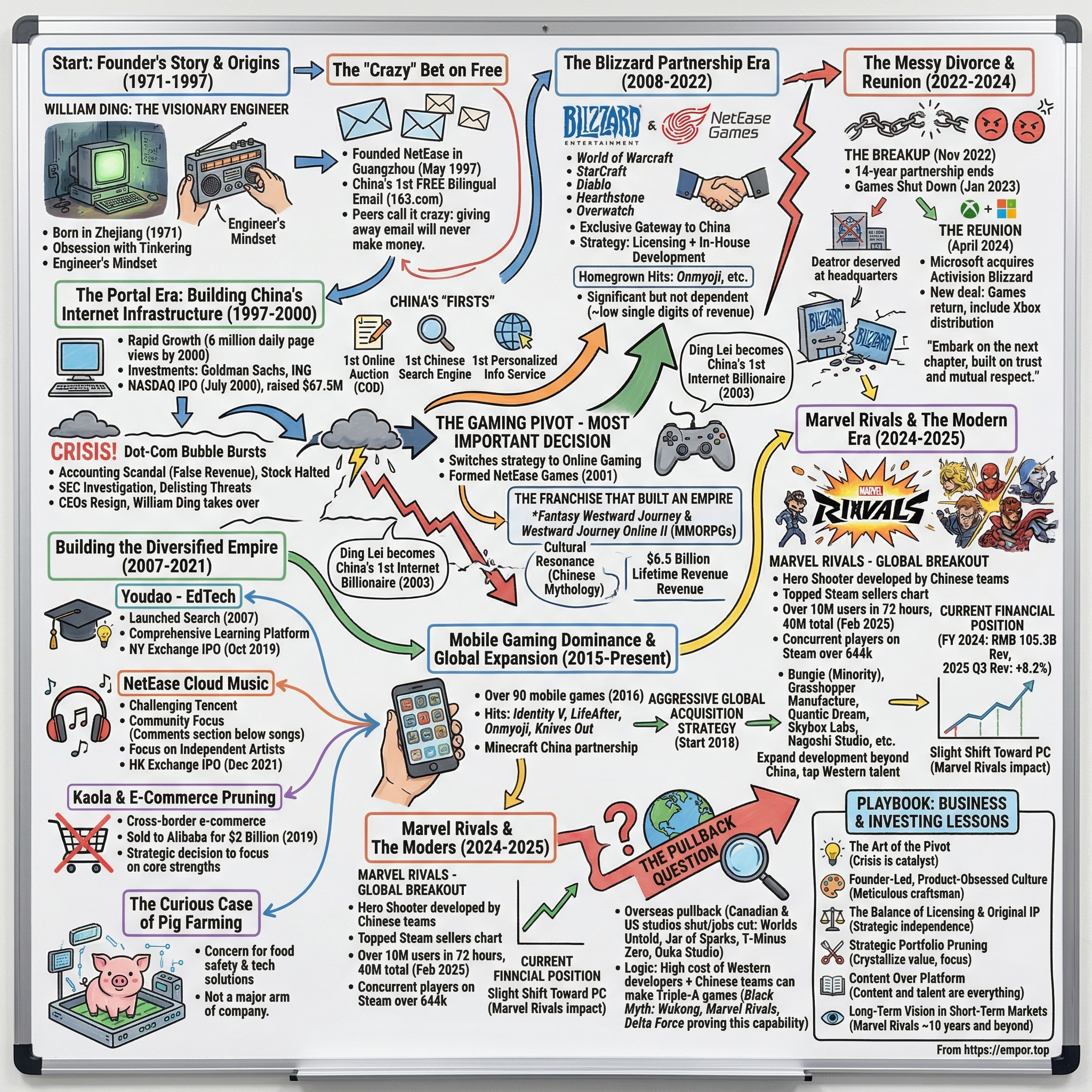
NetEase: From Free Email to Gaming Empire
I. Introduction & Episode Roadmap
In 1997, a 26-year-old engineer sat in a rented room smaller than a parking space in Guangzhou, China. The room measured less than 8 square meters—cramped, humid, and lit by the glow of a cathode-ray monitor. William Ding Lei had just quit his comfortable job at an American software company to chase what his colleagues called a fool's dream: giving away email for free in a country where most people couldn't even afford to dial into the internet.
His own brother refused to join the venture, fearing imminent disaster.
Nearly three decades later, that cramped room has transformed into a sprawling corporate campus in Hangzhou. For fiscal year 2024, NetEase reported total net revenues of RMB 105.3 billion (US$14.4 billion), up from RMB 103.5 billion in 2023. By market capitalization, NetEase is worth $68.4 billion. It is among the world's top ten game companies, alongside Apple, Tencent, Google, Xbox, and Nintendo. NewZoo lists NetEase as No. 5 by annual publisher revenue.
The company that once offered free email now operates over 140 live games globally. In the second quarter of 2025, the company's PC version of Fantasy Westward Journey achieved record-high simultaneous online player counts, while its mobile edition posted quarterly revenue highs. Marvel Rivals topped Steam's global top sellers chart shortly after its launch on December 6, amassing over 10 million registered users within 72 hours and over 40 million to date.
The central question animating this deep dive: How did a free email provider from 1997 become China's gaming powerhouse and the world's fifth-largest game publisher? The answer reveals a masterclass in reinvention, a near-death experience that catalyzed transformation, the art of building in-house franchises while operating Western crown jewels, and now, a fascinating strategic inflection point as NetEase reconsiders its global ambitions in an era when Chinese developers have proven they can make world-class triple-A games.
The themes that emerge from NetEase's journey—founder-led vision, pivoting from existential crisis, the balance of licensing and original IP, and strategic portfolio pruning—offer lessons for any company navigating technological and competitive disruption. Ding Lei's story is not merely one of entrepreneurial success; it's a case study in how to build an enduring content business in one of the world's most complex markets.
II. Founder's Story & Origins (1971-1997)
The Visionary Engineer
Ding Lei (Chinese: 丁磊; born October 1, 1971; also known as William Ding) is a Chinese billionaire businessman, and the founder and CEO of NetEase. William Ding was born in 1971 in eastern China's Zhejiang province, the son of an engineer who worked at a state research institute.
The formative years matter. Growing up in Fenghua, Ningbo, Ding absorbed his father's engineering mindset and developed what would become a lifelong obsession with tinkering. Ding developed an affinity for electronic gadgets while young and managed to assemble a six-tube radio when he was in middle school. This wasn't idle hobby—in 1980s China, assembling a functional radio from components required genuine technical ingenuity and determination.
Born in Ningbo, Zhejiang province, to an engineer father who worked at a state research institute, Ding developed an early interest in computers and pursued a bachelor's degree in communication technology from the University of Electronic Science and Technology of China in Chengdu.
After graduation, Ding's career path was conventional—at first. He left that position in 1995, after two years, relocating to the country's third-largest city, Guangzhou, in southern China. There he accepted a high-paying position as a project manager and technical support engineer at the China offices of U.S.-based software company Sybase. He stayed with Sybase for only one year before departing in 1996 to join Guangzhou Feijie Company as a systems analyst. Ding again left after a year.
But something was brewing. Ding founded NetEase in May 1997 in Beijing as an Internet portal specifically designed for users in mainland China. By then, he had realized two things: first, that the Internet represented the future of information technology, and second, that the majority of the mainland Chinese population either did not have or were unlikely to use their disposable income to pay for Internet service.
The "Crazy" Bet on Free
William Ding changed the state of the Chinese Internet industry with the founding and evolution of NetEase. When he launched the company in 1997, most of China's immense population did not have easy or affordable access to the Internet.
The founding story itself has become legend in Chinese tech circles. With 500,000 RMB in startup capital, Ding Lei founds NetEase in Guangzhou. With personal savings and money from friends, Ding Lei founds NetEase (163.com). The company's first major project is to develop China's first free bilingual email system, which becomes a massive hit and defines the company's early success.
Ding founded NetEase in 1997 with two friends and about $60,000 in Guangzhou, offering China's first free e-mail service.
The skepticism was intense and personal. Ding's peers called him crazy, saying he would never make money giving away access. His own brother declined to join for fear of imminent disaster. But Ding held fast to a conviction that would prove prescient: the volume of traffic generated by free services would eventually attract paying advertisers.
The company's official website address—163.com—carries historical resonance. It sold e-mail servers to internet access providers before developing its own websites that focused on bilingual e-mail and chat rooms, such as the popular 163 email domain. The "163" was attributed to the past when Chinese internet users had to dial "163" to access the Internet before broadband availability—a numerical reminder of just how nascent the market truly was.
What made Ding different from other aspiring Chinese internet entrepreneurs of that era? The answer lies in his engineering background combined with an unusual market intuition. While others saw China's limited internet penetration as a barrier, Ding saw it as an opportunity. If you built the infrastructure for engagement—email, bulletin boards, community—the users would come. And if you built the users, the revenue would follow.
III. The Portal Era: Building China's Internet Infrastructure (1997-2000)
Creating China's "Firsts"
The late 1990s in China were an era of breathless possibility. The internet was arriving, and nobody quite knew what it would become. In this vacuum, Ding Lei moved with remarkable speed.
Building on the success of the portal NetEase.com, Ding expanded the business into new segments with innovative technologies. In the process, he created many "firsts" within China's Internet industry, including the country's first online auction (which paved the way for e-commerce applications) and the first Chinese-language search engine and online community.
Each of these "firsts" represented not just technical achievement but market-shaping innovation. China's first online auction predated Alibaba's dominance and demonstrated that e-commerce could work in a market where credit card penetration was minimal. He added China's first personalized information service, the first Chinese-language search engine, and his country's first online auction site. The latter required some ingenuity once it became evident that most of China's population did not have credit cards to pay for items online. Ding solved the problem with the inclusion of a cash-on-delivery option for online purchasers.
This willingness to adapt Western internet concepts to Chinese market realities would become a NetEase hallmark.
Rapid Growth & Validation
Ding's gamble paid off. After only three years of operation, NetEase.com was experiencing some 6 million page views daily. The substantial success of Ding's unorthodox endeavor started attracting investors, and it was not long before the company had financial backing from several of the leading financial giants of the time, including the bank ING and Goldman Sachs.
Six million page views daily was extraordinary for a Chinese internet property in 1999-2000. For context, China's total internet user base at the time numbered in the tens of millions—NetEase had built one of the nation's most trafficked destinations in under three years.
The NASDAQ IPO—Riding the Dot-Com Wave
NetEase's public offering on Nasdaq in July 2000 raised $67.5 million. This event was a major milestone, providing essential capital for the company's growth and signaling its international ambitions.
The timing deserves examination. The dot-com bubble (or dot-com boom) was a stock market bubble that ballooned during the late 1990s and peaked on Friday, March 10, 2000. This period of market growth coincided with the widespread adoption of the World Wide Web and the Internet, resulting in a dispensation of available venture capital and the rapid growth of valuations in new dot-com startups.
NetEase went public just months after the bubble peaked. The Nasdaq index rose 86% in 1999 alone, and peaked on March 10, 2000, at 5,048 units. The mega-merger of AOL with TimeWarner seemed to validate investors' expectations about the "new economy". Then the bubble imploded.
NetEase successfully lists on the NASDAQ, but is immediately hit by the dot-com bubble burst. NetEase goes public on the NASDAQ. The timing is terrible, coinciding with the bursting of the dot-com bubble. The stock price plummets from its IPO price, pushing the company to the brink of collapse.
The IPO provided capital at precisely the moment when capital would become scarce. What happened next would nearly destroy the company—but would ultimately define its future.
IV. The Near-Death Experience & Gaming Pivot (2001-2003)
Crisis: Accounting Scandal & Delisting Threat
If the late 1990s represented boundless optimism for China's internet sector, 2001 delivered a brutal reckoning. For NetEase, the general market carnage coincided with a company-specific disaster.
Adding to the company's problems, in May 2001, NetEase announced that it had discovered accounting malfeasance in which contract terms had been misrepresented in financial statements.
The chief executive officer and chief operating officer of NetEase.com Inc. resigned Monday shortly after the China-based Internet company said it expanded the scope of its internal investigation to include a review of its audited financial statements for the fiscal year ended December 31, 2000. Chairman and founder William Ding will replace CEO King Lai and COO Susan Chen, who left to pursue other opportunities. On May 8, 2001, NetEase.com announced that it has discovered that one or more of its employees may not have correctly reported the terms of several contracts between the company and third party advertisers to NetEase.com's internal finance department.
In 2001, NetEase faced allegations of false revenue reporting. This led to a stock suspension on Nasdaq and the threat of delisting, forcing a critical strategic re-evaluation.
Netease was thrust into a fight for survival. Trading of its stock was halted on the Nasdaq, and the company faced the very real threat of delisting. The SEC investigation loomed large, threatening to cripple Netease with fines and legal battles.
Another possible ending for Netease may be its delisting from the NASDAQ national market and its transfer to the Over the Counter (OTC) market, which is usually ignored by investors and stock analysts and has a much lower trading volume than the national market.
Meanwhile, since the per-share price of Netease has been below US$1 for more than 30 trading days, it will also face the danger of delisting for low prices. According to NASDAQ rules, if the stock price of one business is lower than US$1 for 30 consecutive days, it will be given a 90-day period to raise the price above US$1 for 10 consecutive trading days to avoid delisting.
The situation could hardly have been worse. NetEase faced SEC investigation, delisting threats on both accounting and stock-price grounds, and a collapsing advertising market. Ding Lei went looking for investors but found few takers.
In August 2001, following an internal investigation, NetEase restated its fiscal 2000 financial results and corrected, before public dissemination, its financial results for the quarter ended March 31, 2001. Without admitting or denying the allegations in the Commission's complaint, NetEase consented to entry of a final judgment permanently enjoining the company from violating reporting, books and records, and internal control provisions of the federal securities laws. In accepting NetEase's settlement offer, the Commission considered the company's cooperation with the SEC investigation.
The Gaming Pivot—The Most Important Decision
What Ding Lei did next would define NetEase's future for decades.
He recognized the need for swift and decisive action to navigate this existential crisis. First, Ding took steps to address the SEC's concerns. He hired a new CFO with extensive experience in US GAAP accounting standards and worked diligently with auditors to restate Netease's financial results. Transparency, Ding realized, was crucial to rebuilding trust with investors and regulators. Simultaneously, Ding recognized the need for a fundamental shift in Netease's business strategy.
The dot-com crash had exposed the fragility of relying solely on advertising revenue, particularly in a volatile market like China. Ding, always an astute observer of emerging trends, recognized that a new wave of internet usage was building: online gaming. Online gaming, still in its infancy in the early 2000s, was rapidly gaining traction in China, particularly among younger demographics.
Ding Lei makes the pivotal decision to enter the online gaming market, saving the company. With NetEase on the verge of bankruptcy, Ding Lei makes a crucial decision to enter the online gaming market. He sees the potential for a recurring revenue model and greenlights the development of 'Fantasy Westward Journey' and 'The Westward Journey Online'.
In 2001, the company formed NetEase Games to focus on gaming. In December, the company launched its proprietary MMORPG Westward Journey Online II. It reached 22 million users, with an average of over 400,000 concurrent players, by 2006.
Fantasy Westward Journey—The Franchise That Built an Empire
The strategic insight that guided NetEase's gaming pivot went beyond simply entering a growing market. Ding understood that success in Chinese gaming required cultural resonance.
Ding's gamble, however, was far from a shot in the dark. He understood that the key to success in this nascent market lay not just in replicating Western gaming trends but in crafting experiences deeply resonant with Chinese players. This insight would lead to the creation of two iconic games that would catapult Netease to the forefront of the Chinese gaming industry: "Westward Journey Online II" and "Fantasy Westward Journey Online".
Released in 2002, "Westward Journey Online II" marked Netease's first major foray into the MMORPG (Massively Multiplayer Online Role-Playing Game) genre. The game, drawing inspiration from the immensely popular Hong Kong film "A Chinese Odyssey" (starring Stephen Chow), tapped into a rich vein of Chinese mythology and folklore. Players could choose from a variety of distinct character classes, each with their own unique abilities and storylines, and embark on epic quests across a vibrant and meticulously crafted fantasy world.
Fantasy Westward Journey was released for the Microsoft Windows platform in December 2001. The game is the most popular online game in China as of May 2007 by peak concurrent users (PCU), with a peak count of 1.5 million. Registered users reached 25 million by April 2005, with 576,000 peak concurrent players.
Together with Westward Journey II, it is one of the highest-grossing video games of all time, having earned an estimated $6.5 billion in lifetime revenue as of 2019 and having 400 million users as of 2015.
The mobile transition was equally successful. A mobile version of the game was released for the Apple iOS and Google Android operating systems in 2015. It had grossed over $800 million in China alone by 2016. In 2017, it grossed $1.5 billion worldwide, bringing the mobile version's total revenue to approximately $2.3 billion by 2017.
With Journey to the West and Journey to the West II, NetEase witnessed a great success with a whopping 449% year-on-year growth in 2003, 209% in 2004, and 119% in 2004. The game eventually attracted some 300 million users. By 2003, Ding had become China's wealthiest person and its first internet billionaire.
Ding Lei Becomes China's First Internet Billionaire
By 2003, Ding had become the richest individual in mainland China, marking him as the country's first internet and gaming billionaire.
The transformation was astonishing. In less than three years, Ding Lei went from fighting delisting to becoming the richest man in China. He was 32 years old. The pivot from email portal to gaming powerhouse demonstrated something essential about NetEase's organizational DNA: the ability to execute dramatic strategic shifts under pressure.
For investors, the lesson from this period is profound. Near-death experiences can catalyze transformation. The accounting scandal forced NetEase to diversify away from advertising-dependent revenue toward the recurring subscription and in-game purchase model that gaming offered. What looked like existential crisis became strategic opportunity.
V. The Blizzard Partnership Era (2008-2022)
Securing the Crown Jewels of Western Gaming
By the late 2000s, NetEase had established itself as a gaming powerhouse through its homegrown franchises. But Ding Lei had larger ambitions: bringing the world's most beloved Western gaming franchises to Chinese players.
The cooperation between Blizzard and NetEase started in 2008. Based in a country where the console game industry was extremely underdeveloped, NetEase was the first to extend an olive branch to the then-renowned Blizzard, bringing Blizzard Battle.net to China.
In 2008, it started a partnership with Blizzard Entertainment to publish the studio's games in China.
The initial partnership focused on World of Warcraft, at the time the world's most successful subscription-based MMORPG with tens of millions of active players globally. For Blizzard, NetEase offered something irreplaceable: deep understanding of Chinese gamers, regulatory expertise, and the infrastructure to operate at scale in the world's largest gaming market.
Expanding the Partnership
Over the following years, the partnership expanded dramatically. In 2013, the company licensed Hearthstone, Blizzard's free-to-play online strategy card game.
In 2008, it started a partnership with Blizzard Entertainment to publish the studio's games in China. In 2013, the company licensed Hearthstone, Blizzard's free-to-play online strategy card game.
The partnership eventually encompassed Blizzard's entire portfolio: World of Warcraft, the StarCraft series, the Diablo series, Hearthstone, Heroes of the Storm, and Overwatch. The breadth of this relationship made NetEase the exclusive gateway to Blizzard's universe for hundreds of millions of Chinese gamers.
In November, Blizzard announced Diablo Immortal, a mobile RPG that would be co-developed by NetEase. The game was later also confirmed for PC and released in June 2022.
The Model: Licensing + In-House Development
NetEase's strategy during this era was sophisticated: operate world-class Western franchises while simultaneously building proprietary games. The Blizzard partnership provided reliable revenue streams and kept NetEase at the cutting edge of game operations. But the long-term success and highest margins came from original IP.
Games like Fantasy Westward Journey and later Onmyoji demonstrated that NetEase could create global hits without relying on external partners. This dual approach—licensing for scale, original IP for margin and independence—would prove prescient when the Blizzard relationship eventually soured.
Since returning to the helm, Ding has developed NetEase into one of China's largest and most successful companies for massively multiplayer online role-playing games (MMORPGs). In 2009, NetEase entered into a lucrative licensing agreement with Irvine, California–based Blizzard Entertainment to bring the U.S. gaming company's hugely successful World of Warcraft to audiences in mainland China. Under the agreement, the two companies also launched several other games, which were well received. In March 2012, NetEase and Blizzard extended the agreement to continue their partnership for an additional three years.
For investors tracking this period, the key insight is that NetEase never became dependent on Blizzard despite the partnership's scale. The licensed titles represented "low single digits" of total revenue and net income, as the company would later reveal during the breakup negotiations. This strategic balance—significant partnership that didn't create existential dependency—positioned NetEase well for what came next.
VI. The Messy Divorce & Reunion with Blizzard (2022-2024)
The Breakup—November 2022
What had been a stable 14-year partnership suddenly collapsed in late 2022, in one of the gaming industry's most public corporate divorces.
After a 14 year partnership, Blizzard Activision ended its licensing agreement with NetEase in November 2022. As a result, World of Warcraft, Hearthstone, Warcraft III: Reforged, Overwatch, StarCraft, Diablo III, and Heroes of the Storm were shut down in China on January 23, 2023.
On November 16, 2022, Hangzhou-based NetEase and Blizzard Entertainment, a division of video game holding company Activision Blizzard, separately announced that they had broken off talks on a new licensing deal to extend their long-running partnership. As a result, Blizzard had to shut down local services for several of its most popular titles in mainland China.
The public statements from both sides were diplomatically worded but couldn't hide the acrimony. "The two parties have not reached a deal to renew the agreements that is consistent with Blizzard's operating principles and commitments to players and employees, and the agreements are set to expire in January 2023," said Blizzard.
The Public Feud
What happened behind closed doors was far uglier than the press releases suggested.
Sources close to the matter told The New York TImes that there were numerous factors in the failure to renew the deal, much of which centred on NetEase's concerns regarding the Chinese government's tightening hold on the games industry. The company reportedly attempted to change the contract to ensure compliance, while asking Activision to disclose details such as annual revenue to Chinese regulators.
In the contract renegotiations with Activision, conducted every few years since the partnership started, NetEase said it wanted to end the companies' joint venture agreement. NetEase said it wanted Activision to license its games directly to NetEase, which would give NetEase more control over operations and allow it to better comply with the new regulations without Activision's help.
It sounds as if NetEase had been clashing with ABK CEO Bobby Kotick for several years before this specific dispute, chiefly because of NetEase's investments into what ABK considered rival spin-off companies. In fact, Activision and NetEase inked a deal in 2019 to stop NetEase from "hiring former Activision employees or investing in gaming studios directed by them."
The situation escalated dramatically. At some point in the conversation, which was conducted at times through translators, Activision executives felt that [NetEase CEO William] Ding threatened Mr. Kotick. The Chinese government was reviewing the Microsoft acquisition, and the executives recalled that Mr. Ding said NetEase could sway the government either to block or support that deal depending on the outcome of the licensing discussion.
Though both companies insisted the failed partnership was of no financial signifigance, Blizzard suggested NetEase's proposals ran contrary to its operating principles, while NetEase implied Blizzard negotiated in bad faith and blasted Blizzard for a last-minute WoW-saving proposal it said was "brash, unseemly and commercially illogical." A NetEase exec ultimately pinned the blame on an unnamed Blizzard "jerk."
Both parties traded blame for the breakdown. NetEase reportedly ceremoniously destroyed Blizzard iconography at its headquarters, and CEO Simon Zhu blamed "one jerk" for the death of the partnership.
The Reunion—April 2024
What changed? Two major developments: Microsoft's completion of its Activision Blizzard acquisition, and Bobby Kotick's departure from the combined company.
It took a year and a half before a new agreement could be reached in April 2024. The two companies also agreed to distribute NetEase titles on Xbox platforms.
"Separately, Microsoft Gaming and NetEase have also entered into an agreement to explore bringing new NetEase titles to Xbox consoles and other platforms. "We at Blizzard are thrilled to reestablish our partnership with NetEase and to work together, with deep appreciation for the collaboration between our teams, to deliver legendary gaming experiences to players in China," said Johanna Faries, President of Blizzard Entertainment.
"Celebrating our collaborations, we are thrilled to embark on the next chapter, built on trust and mutual respect, to serve our users in this unique community that we've built together," said William Ding, Chief Executive Officer and Director, NetEase.
Blizzard titles World of Warcraft and Hearthstone continued to generate strong enthusiasm from the Chinese gaming community, while the return of Overwatch 2 on February 19, 2025 further fueled players' passion.
The Blizzard saga illustrates both the risks and the resilience of NetEase's business model. The breakup caused disruption but not disaster—precisely because NetEase had maintained strategic independence through its own IP development. The reunion, facilitated by new ownership at Blizzard and expanded to include Xbox distribution opportunities for NetEase titles, demonstrated that sometimes divorce creates the conditions for a healthier remarriage.
VII. Building the Diversified Empire: Music, Education, E-Commerce (2007-2021)
Youdao—Education Technology
While gaming remained NetEase's core, Ding Lei spent the 2010s building a diversified empire spanning education, music, and e-commerce.
In December 2007, the company officially launched its own search engine, Youdao, to replace its partnership with Google since 2000. It went on to develop a series of applications under the brand, including a shopping assistant, Youdao dictionary, and more.
Youdao, Inc. was established in 2007 as a subsidiary of NetEase, Inc. The company has evolved from a dictionary application into a comprehensive learning platform. It focuses on innovative educational technology and online learning solutions.
In October 2019, NetEase spun off Youdao in an IPO on the New York Stock Exchange. Youdao, Inc., an intelligent learning firm of China's internet giant NetEase, rang the opening bell on the New York Stock Exchange on Friday to mark its initial public offering (IPO) in the U.S. equity market. The IPO involved 5.6 million American Depositary Shares (ADSs) and was priced at 17 U.S. dollars per ADS, NetEase announced.
The Nasdaq-listed parent company upgraded the edtech unit earlier this year by merging all of its education-related portfolios including the company's massive open online course (MOOC) platforms to the current NetEase Youdao. Ding Lei, the president of NetEase, included education as a strategic focus for the first time at the beginning of this year, along with gaming, e-commerce, and music.
NetEase Cloud Music—Challenging Tencent
Perhaps NetEase's most culturally significant diversification came in music streaming. In 2013, at a time when China's online music market was dominated by Tencent and Alibaba with high copyright barriers, Ding Lei insisted on "reinventing the player."
Ever since NetEase decided to join China's music streaming competition in 2013, it has maintained one clear position: It's a platform not just for listening to music, but also talking about music and giving recommendations. NetEase Cloud Music's flagship feature is the comments section below each song, where users share emotional reactions or personal stories inspired by the song.
The community-driven approach differentiated NetEase Cloud Music from competitors. While rival Tencent held licensing deals with the big three record labels, NetEase focused on independent artists. By 2018, over 70,000 independent artists had uploaded over 1.2 million songs to the platform. In November 2018, NetEase signed a non-exclusive partnership with indie label Merlin Network. In September 2019, Alibaba announced it had invested $700 million to gain a minority stake in NetEase Cloud Music. The service surpassed 800 million registered users by the end of 2019.
Chinese tech giant NetEase's subsidiary Cloud Village – which operates music streaming service NetEase Cloud Music – officially listed on the Hong Kong Stock Exchange on December 2. Cloud Village raised HK $3.28 billion.
As of the end of December 2024, the platform had over 773,500 registered independent artists who contributed approximately 4.4 million music tracks. In 2024, the NetEase Musician platform celebrated its 10th anniversary.
Kaola & The Alibaba Sale
Not every diversification worked out. NetEase's cross-border e-commerce platform Kaola became a case study in strategic portfolio pruning.
Alibaba Group has acquired NetEase Kaola for $2 billion, the two companies said today, and will integrate it into Tmall, creating the largest cross-border e-commerce platform in China.
"We are pleased to have found a strategic fit for Kaola within Alibaba's extensive ecosystem, where Kaola will continue to provide Chinese consumers with high-quality import products and services. At the same time, the completion of this strategic transaction will allow NetEase to focus on its growth strategy, investing in markets that allow us to best leverage our competitive advantages."
The $2 billion sale demonstrated Ding Lei's willingness to exit businesses where NetEase lacked sustainable competitive advantage, freeing capital and management attention for core strengths.
The Curious Case of Pig Farming
No discussion of NetEase's diversification would be complete without mentioning its most unexpected venture.
In 2012, it was confirmed that Ding branched NetEase's activities out into pork production. The pig farm is centered around technology and environmental sustainability, and is not meant to become a major arm of the company.
Ding's foray into pig farming was driven by concerns over food safety and a desire to apply technological solutions to traditional industries.
The pig farm is not financially material, but it reveals something about Ding Lei's personality and approach: a willingness to pursue unconventional ideas and apply internet-era thinking to traditional industries.
VIII. Mobile Gaming Dominance & Global Expansion (2015-Present)
Key Mobile Hits
As mobile gaming exploded globally, NetEase was ready. By 2016, the company had a portfolio of more than 90 mobile games, with 41 more in development. In May 2016, NetEase announced a new partnership with Microsoft and Mojang Studios to bring Minecraft to Asia. Free to play versions for PC, iOS, and Android launched in August, September, and October of the following year. In October 2017, the game had nearly 30 million players.
The company developed and published several global hits including Identity V, LifeAfter, Onmyoji, and Knives Out—battle royale titles that achieved massive audiences in Asia and beyond.
Global Studio Acquisitions
Starting in 2018, NetEase embarked on an aggressive campaign to build global development capability through acquisitions and studio creation.
It invested US$100 million in Bungie for a minority stake in the company and a seat on the board of directors in June 2018. NetEase took over publishing duties of EVE Online in China, starting in August.
"We have been big fans of the worlds Bungie has created, and are drawn to Bungie's passion and creativity in online games development," said NetEase CEO and Director, William Ding. "Bungie and NetEase share the same vision and ambition to deliver incredible experiences to millions of players all around the globe. We are excited to partner with Bungie as they transform from a single franchise development team into a global, multi-franchise entertainment studio."
NetEase acquired Grasshopper Manufacture from GungHo Online Entertainment in October 2021.
The acquisition and investment spree expanded dramatically. Over the years, NetEase invested in companies including Bungie, Nagoshi Studio, Ouka Studios, Satelight, Grasshopper Manufacture, Humanoid Origin, Quantic Dream, Something Wicked Games, Reel Wolves, PlayPulse, Liquid Swords, Skybox Labs, Studio Flare, Anchor Point Studios, Bad Brain Game Studios, PinCool, Youdao, Maestro, Xiaoice, Jobtong, Build A Rocket Boy, MyDearest, Fantastic Pixel Castle, Worlds Untold, Jumpship, Second Dinner, Astrid Entertainment, Kepler Interactive, BulletFarm, Sandsoft and T-Minus Zero Entertainment.
The Global Strategy
The strategy was clear: expand NetEase's development footprint beyond China, tap into Western creative talent, and build capability across PC and console gaming where Chinese companies had historically been weaker.
In an effort to bring its games to English speaking audiences, NetEase opened its first U.S. office, in the San Francisco Bay Area, in February 2015.
In November 2022, it acquired a stake in Liquid Swords, founded by Just Cause game director Christofer Sundberg in 2020. In May 2022, Jack Emmert founded Jackalope Games as NetEase's first U.S. studio in Austin. It was rebranded as Jackalyptic Games on May 18, 2023, and entered into a partnership with Games Workshop. In July 2022, NetEase teamed with former Halo Studios employee Jerry Hook to establish Jar Of Sparks and also invested in Polish VR studio Something Random. It acquired Quantic Dream in August, following a 2019 minority investment.
IX. Marvel Rivals & The Modern Era (2024-2025)
Marvel Rivals—The Global Breakout
In December 2024, NetEase achieved something remarkable: a global gaming phenomenon developed primarily by Chinese teams.
Marvel Rivals is a hero shooter video game developed and published by NetEase Games in collaboration with Marvel Games. The game was released for PlayStation 5, Windows, and Xbox Series X/S on December 6, 2024.
Since its launch on December 6th, 2024, Marvel Rivals has become one of the most popular hero shooters in the world. The game topped Steam's global top sellers chart, amassing over 10 million users within 72 hours.
When Marvel Rivals season 1 started, the game reached 644,269 concurrent players on Steam. This made it the 14th highest game of all time by this metric.
In terms of popularity, Marvel Rivals is the most successful Marvel Games title in recent years. As of February 2025, it had amassed over 40 million players worldwide, a milestone not reached by earlier Marvel releases.
"And this is a product we're going to keep investing both on development and marketing. And we do believe this product, we're going to keep operating, keep enhancing, keep investing for 10 years and beyond," said Bill Pang, Vice President of Corporate Development at NetEase.
Current Financial Position
NetEase, Inc., a leading internet and game services provider, announced its unaudited financial results for the third quarter ended September 30, 2025. Net revenues were RMB28.4 billion (US$4.0 billion), an increase of 8.2% compared with the same quarter of 2024. Games and related value-added services net revenues were RMB23.3 billion (US$3.3 billion), an increase of 11.8% compared with the same quarter of 2024.
Mobile games represented approximately 72.7% of online game revenue in 2024, a slight dip from 75.2% in 2023.
The slight shift away from mobile toward PC reflects Marvel Rivals' impact and NetEase's strategic pivot toward PC/console gaming.
The Pullback Question
But even as Marvel Rivals demonstrated Chinese developers could compete at the highest level globally, NetEase began retreating from its overseas expansion.
A few years after announcing the creation or acquisition of nearly 20 western and Japanese game studios geared toward making new big-budget video games, Chinese giant NetEase is pulling back, big-time. Signs of that shift began appearing last November with the suspension of operations and job cuts at Canadian developer Worlds Untold, a studio NetEase had unveiled just a year earlier. January saw a similar combo of production freeze, spending cuts and the need for new funding at Seattle-based Jar of Sparks, a studio NetEase had been "proud to announce" in July 2022. A third studio, Sweden-based Liquid Swords, announced on Monday that it was laying off workers due to "shifting market conditions." But the cuts are not ending there.
One of Game File's sources says NetEase plans to divest itself of the majority of its overseas teams, leading to the potential closure of more than a dozen game studios, if they can't secure new post-NetEase funding. A NetEase rep declined to comment but they did say that "all studios and projects are in constant review and evaluation, and NetEase will determine changes needed to be made throughout that process." In a season of hurt for much of the game industry, a further NetEase pullback is likely to deliver pain around the globe.
The casualties extend across multiple continents and include some of the industry's most promising talent. T-Minus Zero in Austin, Texas, led by veteran developer Rich Vogel, fell victim to the strategic shift. Jar of Sparks in Seattle, under the guidance of Jerry Hook, also received closure notices. Worlds Untold in Vancouver, helmed by Mac Walters, couldn't escape the widespread cuts. Even NetEase's Tokyo-based Ouka Studio faced the same fate, demonstrating that the company's pullback wasn't limited to North American operations.
"Chinese game companies remain highly motivated to explore overseas markets, and we may see more overseas headquarters established by these companies for game publishing. However, it is likely that Chinese game companies will slow down their investments in overseas studios. The global success of games developed by Chinese studios, such as Black Myth: Wukong, Marvel Rivals, and Delta Force, has boosted confidence in their domestic capabilities."
The logic is straightforward: "Part of that reason is the high cost of U.S. developers in particular. Another reason is that China's game developers have also matured enough to make triple-A games," proved by the success of Black Myth: Wukong.
X. Playbook: Business & Investing Lessons
Lesson 1: The Art of the Pivot
NetEase's 2001-2003 transformation from near-delisting to gaming empire stands as one of the most dramatic corporate pivots in tech history. When advertising revenue collapsed and accounting scandals threatened to destroy the company, Ding Lei didn't just survive—he completely reimagined what NetEase could be. The lesson: existential crisis can be the catalyst for strategic reinvention that would never occur in comfortable times.
Lesson 2: Founder-Led, Product-Obsessed Culture
Ding Lei believes in "interest-driven" innovation, encouraging teams to pursue projects they are genuinely passionate about. This has resulted in a corporate culture at NetEase that values creativity and quality, allowing the company to build a portfolio of products with strong user loyalty and long lifecycles.
Ding Lei's philosophy is rooted in craftsmanship. He has said his product strategy is "to be like a craftsman, meticulously polishing our products." This stands in contrast to the more platform-oriented approach of Tencent, NetEase's primary competitor.
Lesson 3: The Balance of Licensing & Original IP
NetEase's relationship with Blizzard exemplifies sophisticated portfolio management. The partnership provided scale, prestige, and learning opportunities—but NetEase never became dependent on it. Original IP like Fantasy Westward Journey and Onmyoji generated higher margins and strategic independence. When the Blizzard relationship fractured, NetEase absorbed the hit without existential damage.
Lesson 4: Strategic Portfolio Pruning
The sale of Kaola to Alibaba for $2 billion and the spinoffs of Youdao and Cloud Music demonstrate willingness to exit businesses where NetEase lacks sustainable competitive advantage. Rather than empire-building for its own sake, Ding Lei has shown he'll crystallize value in non-core segments to focus on strengths.
Lesson 5: Content Over Platform
NetEase has explicitly articulated this philosophy: "For a platform provider [like Tencent], games are just one of the many ways to monetize traffic. For us, content and talent are everything." This content-first orientation has resulted in some of gaming's longest-running franchises and highest-quality productions.
Lesson 6: Long-Term Vision in Short-Term Markets
NetEase's commitment to Marvel Rivals illustrates patient capital allocation. As management stated: this is "a product we're going to keep investing both on development and marketing...for 10 years and beyond." In an industry often characterized by short-term optimization, this long-term orientation creates competitive advantage.
XI. Analysis: Porter's 5 Forces & Hamilton's 7 Powers
Porter's 5 Forces Analysis
1. Threat of New Entrants: MODERATE-LOW
Barriers to entry in gaming are substantial and rising. NetEase reportedly spends approximately 15% of revenue on R&D—billions of dollars annually. Building hits like Marvel Rivals requires not just capital but accumulated expertise in game design, live operations, and community management. IP licensing relationships (Marvel, Blizzard, Mojang) take years to cultivate. However, the mobile gaming segment remains relatively accessible, as demonstrated by MiHoYo's meteoric rise with Genshin Impact.
2. Bargaining Power of Suppliers: MODERATE
Key suppliers include IP licensors (Marvel, Microsoft/Blizzard), platform operators (Apple App Store, Google Play, Steam, console platforms), and talent. IP licensing power varies—the Blizzard breakup showed NetEase could survive without Western franchises, but Marvel Rivals' success required Marvel cooperation. Platform fees (typically 30%) remain a significant cost. Talent is increasingly competitive, though NetEase's retreat from Western studios suggests labor costs have become problematic.
3. Bargaining Power of Buyers: LOW
Individual gamers have minimal negotiating power. The free-to-play model with optional in-game purchases means players self-select their spending levels. Network effects in multiplayer games increase switching costs. Brand loyalty to franchises like Fantasy Westward Journey runs deep—some players have engaged for over 20 years.
4. Threat of Substitutes: MODERATE-HIGH
Gaming competes for attention with social media, streaming video, short-form content, and other entertainment. TikTok/Douyin and similar platforms represent significant time-allocation competition. However, gaming offers interactive engagement that passive content cannot replicate, and habit formation creates stickiness.
5. Competitive Rivalry: HIGH
Tencent and NetEase are most dominant, together accounting for over 70% of total market.
Tencent and NetEase are among the world's biggest mobile game makers, and the two companies accounted for more than 80% of revenue generated by China's top ten gaming companies in the first quarter of 2023.
Competition is intense on multiple fronts. Domestically, Tencent remains the dominant force with superior platform integration through WeChat. MiHoYo has emerged as a formidable challenger with Genshin Impact and Honkai: Star Rail. Globally, NetEase competes with Western publishers like Electronic Arts, Activision, and Take-Two. The gaming industry is characterized by hit-driven economics where a single blockbuster can reshape competitive dynamics.
Hamilton's 7 Powers Analysis
1. Scale Economies: PRESENT
NetEase's operating leverage is significant. Development costs are fixed while distribution is increasingly marginal. A hit game like Marvel Rivals or Fantasy Westward Journey can serve tens of millions of players with relatively modest incremental cost. However, scale in gaming is game-specific rather than company-wide—each new title essentially requires re-earning market position.
2. Network Effects: PRESENT (MODERATE)
Multiplayer games exhibit strong network effects—the value increases with more players. Fantasy Westward Journey's guilds and social communities create switching costs. Marvel Rivals' 6v6 format requires active player bases for matchmaking quality. However, network effects are game-specific and don't necessarily transfer across titles.
3. Counter-Positioning: PRESENT
NetEase has explicitly positioned as a content company against Tencent's platform model. This creates a genuine strategic trade-off for Tencent: adopting NetEase's "craftsman" approach would undermine its diversified traffic monetization model. NetEase's willingness to invest in long development cycles for quality games is difficult for a platform company optimizing for traffic monetization to replicate.
4. Switching Costs: MODERATE
Player switching costs exist through invested time, social relationships, and accumulated progress/assets. Fantasy Westward Journey's economy—with daily in-game currency trades exceeding millions of dollars—creates substantial lock-in. However, new games can overcome these costs through compelling experiences, as Marvel Rivals demonstrated by rapidly attracting 40 million players.
5. Branding: PRESENT
NetEase has strong brand recognition among Chinese gamers, associated with quality original content and premium game operations. The company's reputation for polished products provides an advantage in new game launches. The Westward Journey and Onmyoji franchises carry significant brand equity.
6. Cornered Resource: LIMITED
NetEase's creative talent and development expertise represent valuable resources, but gaming industry talent is mobile. The retreat from Western studios suggests NetEase hasn't successfully cornered international development resources. However, deep understanding of Chinese gaming culture and regulatory navigation constitute harder-to-replicate resources.
7. Process Power: PRESENT
NetEase has developed sophisticated capabilities in game development, live operations, and community management over 25+ years. The ability to maintain games like Fantasy Westward Journey as revenue generators for over two decades suggests operational excellence that's difficult to replicate. The company's game engine technology and tooling represent embedded process advantages.
Competitive Position Versus Key Rivals
vs. Tencent: NetEase operates as the quality-focused alternative to Tencent's platform dominance. Tencent and NetEase are juggernauts, but their strategies and market positions differ. Tencent's broad, diversified approach gives it a unique advantage in information and global reach, while NetEase's focused gaming strategy makes it a formidable competitor in its own right. NetEase cannot match Tencent's platform integration but can win on product quality and creative excellence.
vs. MiHoYo: The emergence of MiHoYo with Genshin Impact represented a new competitive threat—a company that combined anime aesthetics, open-world gameplay, and aggressive global distribution in ways that resonated powerfully with younger gamers. NetEase has responded by pursuing similar global ambitions with Marvel Rivals.
vs. Western Publishers: NetEase increasingly competes globally for PC/console gamers. Marvel Rivals directly challenges Overwatch (Blizzard) in the hero shooter category. Success validates NetEase's ability to compete on quality, though the retreat from Western studios suggests operational challenges in managing cross-cultural development.
XII. Key Performance Indicators to Track
For investors monitoring NetEase, three KPIs merit particular attention:
1. Monthly/Daily Active Users (MAU/DAU) for Key Titles
User engagement is the leading indicator of revenue. For live-service games like Marvel Rivals, Fantasy Westward Journey, and Blizzard titles, active user trends signal future monetization potential. Pay particular attention to: - New title launch metrics (Marvel Rivals' 40M players in ~3 months) - Retention curves for flagship titles - Concurrent player counts as indicator of engagement intensity
2. Average Revenue Per User (ARPU) by Game Category
The mix shift from mobile (historically ~75% of gaming revenue) toward PC/console affects profitability dynamics. PC/console games typically have different monetization profiles than mobile. Track: - Mobile vs. PC/console revenue mix changes - ARPU trends within each category - Premium purchase patterns versus free-to-play base
3. New Title Success Rate and Pipeline Quality
Gaming is hit-driven. NetEase's ability to consistently launch successful new titles determines long-term growth. Monitor: - Number and quality of announced upcoming titles - Early performance metrics for new releases - Franchise expansion (sequels, mobile versions) versus new IP development
XIII. Risk Factors and Regulatory Considerations
Regulatory Environment
China's gaming regulations present ongoing uncertainty. The government has implemented restrictions on playtime for minors, approval processes for new game licenses, and content guidelines that affect development. While NetEase has navigated this environment successfully, regulatory changes could impact future titles.
Geopolitical Risk
Geopolitical Tensions: Ongoing tensions between China and Western countries could affect both companies' international strategies.
NetEase's global expansion faces geopolitical headwinds. The retreat from Western studios reflects not just cost considerations but also the challenges of managing cross-border operations in an environment of increasing U.S.-China tension.
Key-Person Risk
NetEase remains founder-controlled, with Ding Lei holding approximately 46% of outstanding shares. His vision has guided the company through multiple transformations, but founder-dependence creates succession risk.
Competition from Tencent and Emerging Players
Like Tencent, NetEase faces significant challenges, especially navigating the highly regulated Chinese market. Additionally, competition from emerging giants like MiHoYo and Lilith Games adds pressure.
Tencent's platform advantages in distribution (WeChat, QQ) remain formidable. MiHoYo has demonstrated that new entrants can capture significant market share with breakout hits.
XIV. Myth vs. Reality
Myth: NetEase is a gaming company. Reality: While gaming generates ~80% of revenue, NetEase operates a diversified portfolio including music streaming (NetEase Cloud Music), education technology (Youdao), and e-commerce. The diversification provides strategic optionality and recurring revenue streams.
Myth: The Blizzard breakup was a disaster for NetEase. Reality: NetEase disclosed that Blizzard titles represented "low single digits as a percentage of total net revenues and net income." The partnership was prestigious but not existentially important. The reunion on potentially better terms validated NetEase's negotiating position.
Myth: NetEase can't compete globally with Western publishers. Reality: Marvel Rivals' success—40 million players in three months, ranking as the most successful Marvel Games title in years—demonstrates NetEase can create globally competitive products. The question is whether this success can be replicated across a broader portfolio.
Myth: The overseas studio pullback signals strategic weakness. Reality: The retreat reflects a rational assessment that Chinese development teams can produce world-class games at lower cost. Black Myth: Wukong, Marvel Rivals, and Delta Force all demonstrate this capability. The pullback represents capital discipline rather than strategic failure.
XV. Conclusion: The Road Ahead
NetEase stands at a fascinating inflection point. The company has proven it can create globally competitive games from Chinese development teams. Marvel Rivals' success validates years of investment in talent and capability. The Blizzard relationship has been restored on terms that include Xbox distribution opportunities.
Yet questions remain. Can NetEase continue generating breakout hits in an increasingly competitive market? Will the retreat from Western studios limit future creative capability? How will evolving U.S.-China relations affect global expansion? Can newer franchises ever match the staying power of the 20-year-old Westward Journey franchise?
William Ding, Chief Executive Officer and Director of NetEase: "Over the years, we have honed our innovation capabilities and proven them title after title by delivering exceptional gaming experiences. This edge has afforded us a strong domestic foundation to extend our distinctive, sophisticated games to players worldwide. User experience remains the heart of our value system as we look to raise the bar for creativity and tech-inspired games while enriching and expanding our vibrant player community. Through close collaboration with partners and top talent around the world, we aim to create even greater value for players and sustain our momentum across markets."
From that cramped room in Guangzhou to the world's fifth-largest game publisher, from free email to Marvel Rivals, from near-delisting to China's first internet billionaire—NetEase's journey embodies the volatility and opportunity of China's digital economy. For investors, the company offers exposure to gaming's largest markets, a founder-led culture of quality, and the optionality of diversified businesses. The risks are real—regulatory, competitive, and geopolitical. But so is the track record of adaptation and reinvention.
William Ding's brother, who refused to join NetEase in 1997, might have different advice today.


 RSS Feed
 Spotify
 Apple Podcasts
 Amazon Music
 Audible
 YouTube