 Chat with
this content: Summary, Analysis, News...
Chat with
this content: Summary, Analysis, News...
 Subscribe on LinkedIn


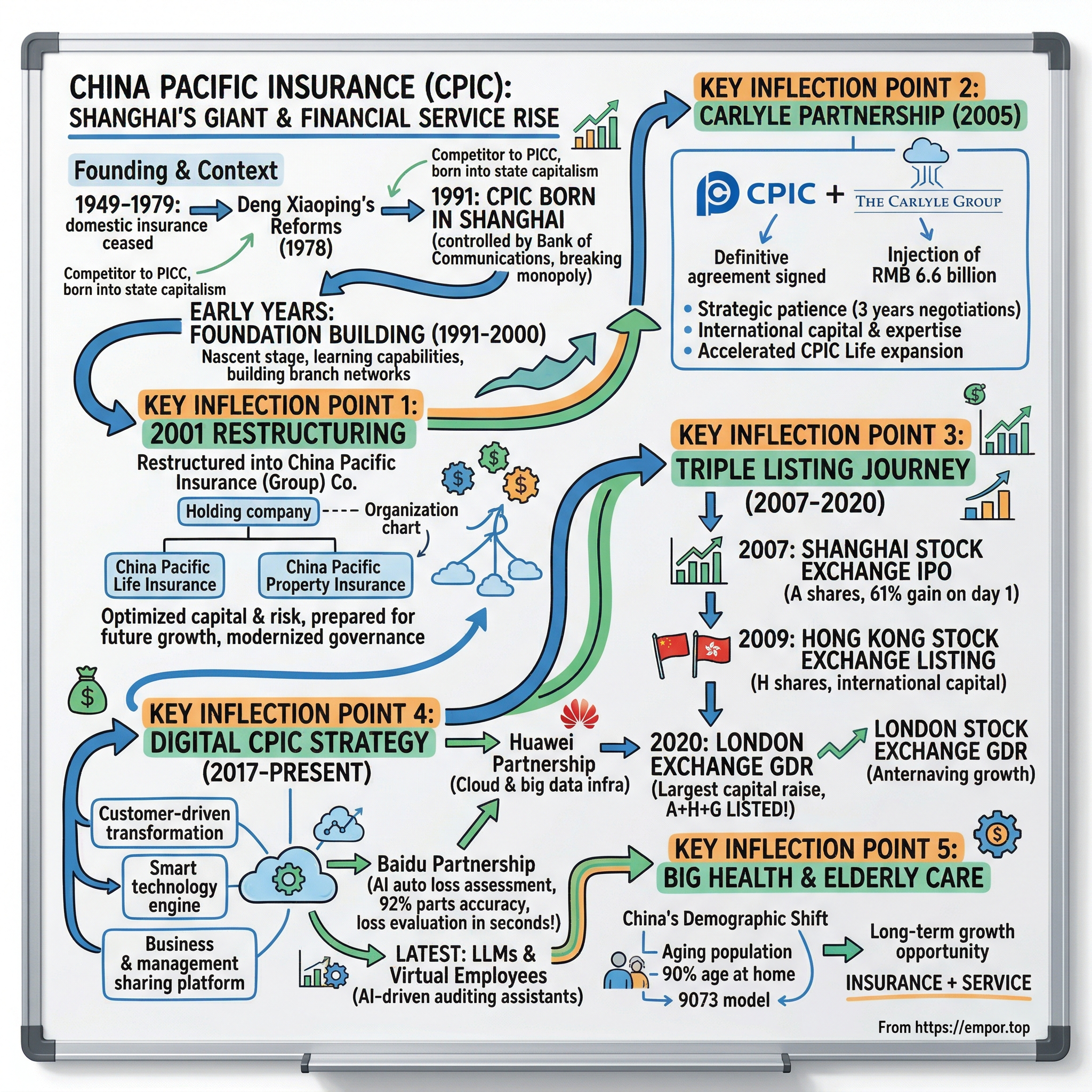
China Pacific Insurance: Shanghai's Insurance Giant & The Rise of Chinese Financial Services
The Central Question
Picture May 13, 1991—Deng Xiaoping's economic reforms have been underway for over a decade, but China's insurance industry remains a near-monopoly controlled by a single state-owned behemoth. In Shanghai, the country's historic financial nerve center, a new company is born with approval from the People's Bank of China. China Pacific Insurance Company was founded on May 13, 1991, marking the emergence of what would become one of the world's largest insurers.
Today, China Pacific Insurance has a market cap of $36.4 billion and trailing 12-month revenue of $43.4 billion as of December 2024. The company is the second largest property insurance company (after PICC) and the third largest life insurance company (after China Life Insurance and Ping An Insurance) in Mainland China.
How did a company born during China's early market reforms, competing against entrenched state monopolies and private sector pioneers, evolve into a Fortune Global 500 insurer listed on three continents? The CPIC story is fundamentally about state capitalism meeting market forces—a company navigating between government backing and genuine commercial competition, between protecting China's emerging middle class and satisfying international investors, between legacy distribution networks and digital disruption.
The themes that emerge are universal to financial services transformation: how incumbents adapt to deregulation, how technology reshapes distribution, and how demographic shifts create structural opportunities. But they're also distinctly Chinese—state-owned enterprise reform, the dance between Shanghai and Beijing power centers, and the astonishing scale of a market with 1.4 billion potential customers.
China's Insurance Vacuum & Economic Awakening (1949-1990)
To understand CPIC's founding moment, one must appreciate the void it was created to fill. Modern insurance first arrived in China via foreign traders in the early 1800s—Canton's waterfront bustled with British insurers underwriting merchant cargo. By the 1940s, China boasted more than 240 insurance companies—some 180 of which were Chinese owned.
Then came revolution. In 1949, the Chinese government took over all insurance operations on the mainland, establishing People's Insurance Company of China (PICC). What followed was systematic elimination of the private insurance sector. During the three decades from 1949 to 1979, there was not sufficient recognition of the role of the insurance industry in China, and the insurance industry ground to a halt. The last foreign insurance company was closed in 1953 as the government first imposed substantial deposit requirements on insurance companies, and then imposed heavy taxation. In 1953, the private Chinese insurance companies were consolidated into Taiping Insurance Co., which was effectively an arm of PICC.
The ideological logic was straightforward: in a workers' state where the government provides all social welfare, what need exists for private risk transfer? In 1959, insurance operations were abolished, except for foreign (marine and aviation) insurance needs, and PICC became a department of the central bank. For two decades, domestic insurance essentially ceased to exist.
Deng Xiaoping's "Reform and Opening Up" beginning in 1978 changed everything. Economic reforms launched under Deng Xiaoping in 1978 paved the way to a rebirth in China's insurance sector. In 1979, the People's Insurance Company of China was separated from the central bank and reestablished as an independently operating, although state-controlled, company.
In the early 1990s, China's insurance market was undergoing significant transformation amid the country's shift from a planned economy to a socialist market economy, initiated by reforms dating back to 1978. The need was structural: as the economy liberalized, state-owned enterprises could no longer rely solely on government guarantees, and a growing private sector needed risk transfer mechanisms. The PBOC's regulatory framework emphasized expanding access to insurance to support economic liberalization, as the market had been reestablished only in 1979 after a two-decade hiatus and remained underdeveloped.
The market needed competitors. PICC officially retained its monopoly on the Chinese insurance market into the late 1980s. In 1988, however, the company's monopoly was abolished. Licenses were granted to new entrants—Ping An in Shenzhen, and in Shanghai, a company that would carry the Pacific name.
For long-term investors, this historical context matters immensely. CPIC emerged not as a scrappy startup but as a deliberate policy response to market structure—a controlled injection of competition into a monopolistic sector. The government wanted an alternative to PICC, but one still connected to state institutions. This DNA of "competitive state enterprise" persists today.
Founding & Early Years: Birth in Post-Tiananmen China (1991-2000)
The political timing of CPIC's founding was remarkable. Just two years after the Tiananmen Square protests raised questions about China's reform trajectory, Shanghai was doubling down on financial sector development. In November 1987, the Shanghai branch of the Bank of Communications took the lead in setting up an insurance division, breaking the 30-year monopoly of the Shanghai branch of the PICC. Then, in April 1991, the China Pacific Insurance Company, controlled by the Bank of Communications, was incorporated.
CPIC Group is an insurance and investment holding company founded in April 1991 and has its headquarters in Shanghai. CPIC Group owns controlling stakes in China Pacific Property Insurance, which specializes in non-life insurance business and China Pacific Life Insurance.
The company's parentage through the Bank of Communications was critical. Unlike Ping An, which was established in Shenzhen's special economic zone with a more private-sector orientation, CPIC emerged from Shanghai's state banking apparatus. This gave it immediate credibility with regulators, access to established corporate relationships, and a distribution network through bank branches. But it also embedded certain bureaucratic tendencies that would later require transformation.
Ping An Insurance Company of China expanded its business to the whole country, becoming the third national comprehensive insurance company in China (after PICC and CPIC). The competitive landscape was now set: PICC as the legacy state giant, Ping An as the private pioneer, and CPIC as Shanghai's champion—positioned between the two in terms of state affiliation and commercial aggressiveness.
The 1990s were years of foundation-building rather than explosive growth. In the early 2000s, the company's total premium income hovered around RMB 10 billion annually, reflecting its nascent stage following establishment in 1991. The company was learning the insurance business—building actuarial capabilities, establishing branch networks, and developing products for an unfamiliar market.
In November 1993, with the approval of the PBOC, the China Ping An Insurance Company, headquartered in Shenzhen, set up a branch in Shanghai. In 1994, a second foreign-funded insurance company, the Japanese Tokyo Maritime Fire Insurance Corporation, started business in Shanghai. Not long after that, Shanghai also approved two regional insurance companies, the Tian'an Insurance Company and Dazhong Insurance Company.
The competitive dynamics established during this period—three domestic giants plus regional challengers and encroaching foreign players—would define the industry structure for decades. But CPIC's organizational form was about to change dramatically.
The 2001 Restructuring: From Insurance Company to Financial Holding Group
Key Inflection Point #1
As China prepared for WTO accession in December 2001, domestic insurers faced an existential question: could they compete with global giants once market barriers fell? The regulatory answer was consolidation and modernization. For CPIC, this meant fundamental transformation.
In 2001, China Pacific Insurance Company underwent restructuring. China Pacific Insurance (Group) Co., Ltd. was established and China Pacific Property Insurance Co., Ltd. and China Pacific Life Insurance Co., Ltd were established with China Pacific Insurance (Group) Co., Ltd. as the holding company.
China Pacific Life Insurance Co. Ltd (CPIC Life) is a national life insurance company. It was founded on November 9, 2001 and has headquarters in Shanghai.
The restructuring served multiple strategic purposes. First, separating life and property insurance into distinct subsidiaries allowed each business to optimize for its specific risk characteristics and capital requirements. Life insurance, with its long-duration liabilities and investment component, operates fundamentally differently from property and casualty insurance's shorter-cycle, loss-ratio-driven economics.
Second, the holding company structure created a platform for future capital-raising. Rather than one monolithic entity, investors could potentially access specific business lines. This would prove prescient as CPIC approached public markets.
Third, the reorganization represented a deliberate modernization of governance. The company's core values are "integrity and prudent management," and it is committed to continuous product and service innovation to meet client needs. Moving from an operating company to a holding structure imposed more formal board governance, clearer management accountability, and improved financial transparency.
China's WTO accession created both threat and opportunity. A financially stronger CPIC Life would be able to compete more vigorously against international competition, allowed to enter the China market after the full opening of the industry under WTO rules. The geographic and product restrictions that had protected domestic players would gradually lift—foreign insurers would eventually be allowed full nationwide operations.
Currently, CPIC Life has an 11 percent share in China market, of which the top three players combined have over 80 percent. The market was—and remains—extraordinarily concentrated at the top. But that concentration also meant enormous room for growth as insurance penetration expanded among China's emerging middle class.
The restructuring set the stage for CPIC's next transformation: bringing in outside capital and expertise through a landmark private equity partnership.
The Carlyle Partnership: Private Equity Comes to China Insurance (2005)
Key Inflection Point #2
In December 2005, The Carlyle Group and CPIC announced what was then China's largest private equity transaction in the financial services sector. CPIC Group and global private equity firm, The Carlyle Group, today signed a definitive agreement to equally participate in the injection of RMB 6.6 billion new capital into China Pacific Life Insurance Co., Ltd. (CPIC Life), the country's third largest life insurer.
The Carlyle partnership, which will hold a 24.975 percent stake in CPIC Life after the injection, includes international financial services leader Prudential Financial, Inc. of the United States as the strategic investor.
CPIC Life's chairman, Mr. Wang Guoliang said: "This is the most important development in China Pacific Life's history. Our agreement with Carlyle will dramatically accelerate CPIC Life's expansion plans and its participation in the world's fastest growing life insurance market."
The significance of this deal extended far beyond the capital injection. CPIC actively sought international capital, additional management expertise and technology to achieve a generation leap. After three years of negotiations, CPIC Group officially formed this strategic partnership with Carlyle that delivers the capital injection for the modernization of CPIC Group to become a financial holding company.
Three years of negotiations—that timeline reveals both the complexity of the transaction and the strategic patience involved. Cross-border deals in Chinese financial services required navigating regulatory approvals, valuation disputes, governance negotiations, and cultural adjustments. Carlyle and Prudential weren't just writing checks; they were committing to transformation.
These measures will enable CPIC Life to fully exploit its existing position as China's third largest life insurer in the world's fastest growing market for life insurance and related services. Carlyle will nominate a new management team under the leadership of CPIC Life's chairman, Mr. Wang Guoliang.
The management team commitment was crucial. Western private equity doesn't typically write passive checks—it expects governance influence and operational improvement. For a state-connected Chinese insurer, accepting foreign board representation and management input represented a significant cultural shift.
The Carlyle investment also signaled to the market that CPIC was preparing for public listing. Private equity firms don't invest in illiquid minority stakes unless they see a clear exit path. For China's insurance sector, that path pointed toward Hong Kong and Shanghai stock markets.
For investors analyzing CPIC today, the Carlyle chapter matters because it established the company's pattern of using external partnerships to drive transformation. From Carlyle's governance influence to later technology partnerships with Huawei and Baidu, CPIC has consistently sought external catalysts for change rather than relying solely on internal evolution.
Going Public: The Triple Listing Journey (2007-2020)
Key Inflection Point #3: Capital Market Access
Shanghai Stock Exchange IPO (2007)
CPIC's initial public offering on the Shanghai Stock Exchange arrived at the peak of China's bull market euphoria. Its A shares were listed on the Shanghai Stock Exchange on December 25, 2007, with IPO price 30 yuan per share. At the first trading day, its share price closed at 48.17 yuan, 61% more than its IPO price.
A 61% first-day gain sounds spectacular, but it reflected the bubble conditions of late 2007. Within months, reality intervened. CPIC dropped below the IPO price of RMB¥30 on 26 March 2008 and closed at RMB¥27.98.
The 2008 global financial crisis triggered investment losses of RMB 1.51 billion in the third quarter alone due to a domestic stock market slump. CPIC, like all insurers with equity portfolios, suffered when markets cratered. The timing of the IPO—near a market peak—left early investors underwater for years.
Hong Kong Stock Exchange Listing (2009)
Despite the challenging environment, CPIC pressed forward with international capital market access. Its H shares were listed on the Hong Kong Stock Exchange on 23 December 2009 with IPO price of HK$28 per share.
The Hong Kong listing served distinct purposes from the Shanghai listing. H-shares traded in Hong Kong dollars and were accessible to international institutional investors who couldn't or wouldn't participate in mainland markets. The dual listing created currency diversification, broadened the shareholder base, and imposed Hong Kong's more stringent disclosure requirements.
London Stock Exchange GDR - Historic Triple Listing (2020)
A decade later, CPIC achieved something unprecedented in the insurance industry. CPIC raises US$1.8 billion (prior to any exercise of the over-allotment option) through listing of GDRs in London on the Shanghai-London Stock Connect Segment of London Stock Exchange. This was the largest capital raise via an admission to London Stock Exchange in 2020.
China Pacific Insurance officially became the first Chinese insurance company to issue GDRs and the first ever A+H+G (Shanghai, Hong Kong, London) listed insurance company. China Pacific Insurance's GDR issuance achieved a number of innovative breakthroughs under the Shanghai-London Stock Connect, being the first GDR to adopt Chinese Accounting Standards, to introduce cornerstone investor mechanism, to receive public float waiver as a non-European company.
The final investors mainly consist of cornerstone investors and long-term investors, including the cornerstone investor, Swiss Re Principal Investments Company Asia Pte. Ltd., which fully embodies the recognition of the long-term investment value of CPIC by the international capital market and its confidence in the long-term development of Chinese insurance industry.
The Swiss Re cornerstone investment was strategically brilliant. As one of the world's leading reinsurers with deep expertise in risk assessment, Swiss Re's commitment served as validation for other international investors. By introducing the ESG pioneer, Swiss Re Group as a cornerstone investor, CPIC continued to optimize its shareholding structure, improve the governance mechanism and accelerate its ESG strategic layout. At present, Swiss Re has dispatched senior executives to the board of directors of the Group. By performing their duties, they will continue to play a role in the corporate governance mechanism, which will help strengthen the Group's professional operation capabilities in its core insurance business.
At the time of listing, it was the largest GDR issuance in UK since 2015 and the largest London IPO in 2020. Accomplishing this during the COVID-19 pandemic—through virtual ceremonies no less—demonstrated CPIC's capital markets sophistication.
The triple listing structure serves ongoing strategic purposes: the Shanghai A-shares provide domestic liquidity and satisfy regulatory expectations, the Hong Kong H-shares attract Asian institutional capital, and the London GDRs create an offshore USD fundraising platform and European investor access. For a company with international ambitions, this multi-market presence is valuable infrastructure.
Digital CPIC: The Technology Transformation (2017-Present)
Key Inflection Point #4
Insurance is fundamentally an information business. Underwriting is about assessing risk based on data; claims management is about verifying facts efficiently; distribution is about reaching customers at moments of need. When digital technology transforms how information flows, it transforms insurance.
In 2017, CPIC officially announced its Digital CPIC strategy, the core tenets of which include a focus on customer-driven transformation by providing products and services based on customer insights; developing client applications through the creation of a smart technology engine; establishing a business and management sharing platform to create new tools, paradigms, and sectors.
"For traditional financial services companies, digitalization is neither a label nor a trend, but a key factor that is crucial to the long-time survival of an enterprise," said Yang Xiaoling, CPIC Vice President and Chief Digital Officer.
The urgency was genuine. Ping An had invested billions in technology and spawned fintech subsidiaries that threatened to disintermediate traditional distribution. ZhongAn, China's first online-only insurer backed by Alibaba, demonstrated that insurance could be sold without agents through e-commerce platforms. CPIC's legacy distribution model faced existential challenge.
The Huawei Partnership
CPIC and Huawei signed a strategic cooperation agreement in September 2014. Subsequently, the two companies have set up a technology applications laboratory to jointly explore how new ICT technologies might be used in the insurance business.
In June 2017, Kong Qingwei, Chairman of CPIC and Huawei Founder Ren Zhengfei met in Shenzhen, China and two months later, they met again in Shanghai. They have expressed the intention to fully capitalize on the joint laboratory to unleash the full potential of the two companies' combined advantages.
Through 2017, CPIC and Huawei continued to deepen their cooperation in multiple fields, including data center and enterprise cloud construction, Big Data and Artificial Intelligence (AI), and digital security. The two companies are working closely to promote the construction of CPIC's cloud data center infrastructure, create innovative industry applications, and improve digital security. Both CPIC and Huawei are expected to jointly explore and research further innovations for the "CPIC cloud," "smart customer services," and "digital risk control."
The Huawei partnership focused on infrastructure—the cloud backbone, data architecture, and communications networks that enable digital services. This is foundational rather than customer-facing, but without robust infrastructure, customer-facing innovation is impossible.
The Baidu Partnership: AI in Claims
CPIC upgraded its claims process with a combination of a computer vision solution, digital platform, and mobile apps, which it built in partnership with Baidu.
CPIC partnered with Baidu to release "CPIC•AI", an intelligent auto loss assessment product. With the support of the big data of insurance claims and tens of millions of accident case studies, combined with Baidu's face recognition and AI algorithm technologies, "CPIC•AI" is an all-rounded intelligent and zero-manual loss assessment solution.
With coverage of over 97% passenger vehicle brands on the market and 92% auto parts identification accuracy, this product provides intelligent, digital, differentiated and highly efficient loss assessment solution to customers. Not only does it realize loss evaluation within seconds, it also offers tiered claims payment.
By leveraging a computer vision solution in its claims process, CPIC was able to improve its operational efficiency. The carrier is in the process of deploying the solution to all of its branches in China and estimates that it could eventually save more than 100 million yuan (US$15 million) by doing so.
The claims automation story illustrates how AI creates value in insurance: faster processing improves customer experience while reducing labor costs. But it also requires massive data—millions of historical claims, images of damage, repair cost databases. CPIC's scale provides training data that smaller insurers cannot match.
Latest Developments: LLMs and Virtual Employees
China Pacific Insurance and other Chinese insurers are starting to embrace virtual employees in the form of artificial intelligence-driven large language models to work alongside real staff and improve productivity. CPIC is bringing out tradeable digitized labor in the insurance sector, Vice President Yu Bin said at its "science and technology open day" on Sept. 21.
CPIC has developed a 'virtual employee' that is being tried out in three posts, namely as a pre-auditing inspector, as an auditing assistant and as a post-audit manager of the insurer's auditing department. The virtual staff members help solve the problem of a dearth of auditors and expand the scope of auditing. In future, more digital employees will be introduced in other company posts.
China Pacific Insurance (Group) Co., Ltd. has launched three major strategies: big health and elderly care, AI+, and internationalization, to drive corporate transformation and high-quality development in response to the complex business environment.
The progression from cloud infrastructure (2014) to computer vision claims (2017-2020) to large language model employees (2023-present) traces the maturation of CPIC's technology strategy. Each layer builds on the previous—you can't deploy AI without data infrastructure, and you can't deploy LLMs without AI foundation.
For investors, the key question is whether technology investment translates into competitive advantage. CPIC's digital spending is substantial, but so is competitors' spending. The race is not about who invests most, but who captures value most effectively.
The Big Health & Elderly Care Strategy: Positioning for China's Demographic Shift
Key Inflection Point #5
With nearly 300 million people aged 60 and above (more than one-fifth of its population), China is aging at a pace unprecedented in human history. Yet instead of treating this as a looming crisis, China is reframing aging as an opportunity to build a new pillar of growth: the longevity economy.
According to the most recent data provided by China's National Bureau of Statistics in 2024, as of 2023, the population aged 60 years and above accounted for 21.1% of the entire population in China, while the population aged 65 and above accounts for 15.4% of the total population.
The China Population Aging Development Trend Forecast Report indicates that China will reach critical milestones in the acceleration of aging between 2035 and 2050, with the older adult population projected to peak in 2053. From 2021 to 2035, the older adult population is expected to increase from 300 million to 400 million, representing an accelerated growth rate. Simultaneously, the proportion of extremely old individuals (aged 80 and above) will continue to climb.
This demographic reality creates structural demand for insurance products—pension annuities, long-term care insurance, health insurance for chronic conditions. China's elderly care market is expected to reach 22 trillion yuan ($3.25 trillion) by 2031, compared with 9 trillion yuan today.
China Pacific Insurance (Group) Co., Ltd. has announced continued focus on the elderly care market, leveraging its strengths in insurance, healthcare, financial strength, and service network to innovate in integrating insurance with healthcare services and long-term fund management.
The silver economy, encompassing products and services for the elderly, reached an estimated RMB 7 trillion (US$966 billion) by end-2024, while longevity-specific submarkets are rapidly scaling from smaller bases.
The strategic logic is compelling: as the population ages, demand for risk protection shifts from property and auto (younger demographic needs) toward health, pension, and care products (older demographic needs). An insurer positioned for this shift captures a growing market while competitors fight over stagnating segments.
According to the National Health Commission, approximately 90% of senior adults in China prefer aging at home, while 7% rely on community support and 3% stay in institutional care facilities. This "9073" distribution creates opportunities for insurers to bundle coverage with home care services, health management, and care coordination.
CPIC's "Insurance + Service" model aims to integrate insurance products with service delivery—not just paying claims when care is needed, but actively coordinating care to improve outcomes and manage costs. This echoes the managed care evolution in U.S. health insurance, though adapted to Chinese market conditions.
The challenge is execution. This market faces multiple challenges, including insufficient service supply, inconsistent quality, labor shortages, unequal resource distribution between urban and remote areas, complexity of coordination and high pricing. Building the care service infrastructure requires capabilities beyond traditional insurance underwriting.
Business Model Deep Dive: How CPIC Makes Money
China Pacific Insurance (Group) Co., Ltd. is an insurance group organized around 2 sectors of activity: life insurance (63% of gross written premiums) and non-life insurance (37%): car, fire, casualty and health, travel, etc.
It operates through Life and Health Insurance, Property and Casualty Insurance, Asset Management, and Other Business segments.
Life Insurance: The Engine of Growth
Life insurance dominates CPIC's business mix, providing the majority of premiums and driving long-term value creation. The company offers life, health, automobile, liability, agricultural, property and casualty, and accident insurance products; pension and annuity insurance products; investments with insurance funds.
The life insurance business model creates "float"—premiums collected today that won't be paid out as claims for decades. This float is invested to generate returns, creating a second profit stream beyond underwriting margins. Warren Buffett famously described float as "free money" if underwriting discipline is maintained.
Property & Casualty: Motor Vehicle Dominance
People's Property Insurance, Ping An Property Insurance, and Pacific Property Insurance have emerged as car insurance companies in China, with a market share of more than 60%.
China Pacific leans on marine roots to dominate export cargo and hull covers, while expanding engineering lines in Central provinces.
Motor insurance provides shorter-duration, more predictable cash flows than life insurance. Combined ratios—the sum of loss ratio and expense ratio—determine profitability. A combined ratio below 100% indicates underwriting profit; above 100% means losses.
In the first three quarters of 2025, CPIC P&C recorded ¥160.2 billion in gross written premiums, up 0.1%, of which auto insurance accounted for ¥80.46 billion, up 2.9%. Due to our proactive adjustment of business mix, non-auto gross written premiums were ¥79.74 billion, down 2.6% year on year. The combined ratio was 97.6%, down 1 percentage point year on year.
Distribution Channels
The company utilizes multiple distribution channels, including agency, bancassurance, and group channels, to reach its customers.
CPIC has over 5,400 branches and a workforce of more than 90,000 employees. CPIC provides risk assurance solutions to over 100 million customers through a nationwide marketing network.
CPIC serves approximately 183 million customers as of December 31, 2024.
The agency channel—individual agents selling policies door-to-door—has traditionally driven life insurance distribution in China. But this model faces challenges from digital alternatives and regulatory pressure on commission structures. CPIC has invested in "agency force transformation" to shift from quantity to quality.
Investment Portfolio
The company's investment portfolio, as of December 2022, totaled RMB 1.49 trillion (approximately USD 220 billion). A significant portion of this portfolio is allocated to fixed income instruments, representing 70%. Equity investments made up 15%, while alternative investments accounted for 15%. CPIC's investment income for 2022 reached RMB 46 billion (around USD 6.8 billion), with an overall investment yield of 3.2%.
Our strategy is quite traditional: For the life insurance company, we've got slightly more than 80% allocated to fixed income; the rest is in public and private equities, commercial real estate, and some policy loans.
By the end of Q3 2025, the group's investment assets approached ¥3 trillion, up 8.8% year on year. In the first three quarters of 2025, the annualized net investment yield was 2.6%, and the annualized total investment yield was 5.2%.
The investment portfolio is dominated by fixed income because insurance liabilities are largely fixed-rate. Asset-liability matching requires duration alignment—long-duration liabilities matched against long-duration bonds. Equity exposure provides return enhancement but introduces volatility.
Financial Performance
In its latest earnings report for the year ended December 31, 2024, China Pacific Insurance (Group) Co., Ltd. reported a strong financial performance with a 24.7% increase in group operating income, reaching RMB404.089 billion.
China Pacific Insurance (Group) Co., Ltd. announced a significant projected increase in its annual earnings for the year ending December 31, 2024. The preliminary estimates suggest that the net profit attributable to shareholders of the parent company is expected to be in the range of RMB42.2 billion to RMB46.3 billion. This represents a year-on-year increase of about 55% to 70%, compared to the net profit of RMB27.257 billion reported in the previous year.
CPIC's total assets expanded robustly, surpassing RMB 1 trillion by the late 2010s and reaching RMB 2,834.9 billion in 2024. Solvency ratios remained well above China's regulatory minimum of 100%, with core ratios typically exceeding 150% and comprehensive ratios over 200%; for instance, in 2023, the core ratio stood at 171% and the comprehensive at 257%.
Competitive Landscape: The Big Three + Digital Disruptors
The Traditional Titans
The market shows moderate concentration. PICC P&C, Ping An, and China Pacific lead volumes, but the combined share of the top five carriers is more than half of the premium share, confirming space for agile challengers.
PICC uses a nationwide branch grid and close government ties to secure infrastructure contracts. Ping An's AI-driven underwriting and claims robots serve 242 million customers. China Pacific leans on marine roots to dominate export cargo and hull covers, while expanding engineering lines in Central provinces.
Each of the big three has distinct competitive positioning:
PICC: The original state monopoly, PICC retains the largest distribution network and deepest government relationships. Its strength lies in large corporate accounts and policy-driven insurance programs like agricultural coverage.
Ping An: The technology leader, Ping An has invested aggressively in AI, healthcare platforms, and fintech subsidiaries. Ping An, harnessing its universal-banking ecosystem, adeptly cross-sells policies spanning wealth management, loans, and healthcare services.
CPIC: Positioned between the two, CPIC combines state enterprise stability with commercial ambition. Its Shanghai base provides strength in export-related marine insurance and corporate accounts in the Yangtze River Delta economic region.
Digital Disruption
Digital-native ZhongAn lifted premium 24.7% in 2024 by white-labelling its policy-admin stack to incumbents, exemplifying competition on technology rather than balance-sheet heft.
ZhongAn, a frontrunner in pure online distribution, swiftly rolls out micro-duration covers in mere days, due to its cloud-native architecture. Ant Insurance Services, capitalizing on Alipay's vast user base of 1 billion, drives the Chinese online insurance market towards a focus on contextual, event-based products.
Tencent's WeSure leverages the 1.3 billion-user WeChat base to cross-sell life, health, and property products.
The digital disruptors present two distinct challenges. First, platform-native insurers like ZhongAn can design products and processes without legacy system constraints. Second, tech giants like Alibaba and Tencent control distribution—they can choose which insurers' products to feature on their platforms, extracting value from the industry without bearing insurance risk.
Meanwhile, traditional powerhouses like PICC and China Pacific, in a bid to safeguard their market share, are modernizing their legacy systems in collaboration with AI partners.
Foreign Competition
Recently reformed government policies welcoming foreign players into the country with 100% ownership might increase competitiveness as many global giant insurers are already in the race to capture potential market share.
Foreign players, AIA and Allianz, are strategically positioning themselves in high-value life and specialty commercial lines, leveraging their global underwriting expertise.
Foreign insurers have historically held minimal market share in China—the total foreign market share was 1.96% in property insurance as of 2017. But regulatory liberalization creates openings, particularly in specialty lines where global expertise matters. Foreign players compete on product sophistication rather than distribution scale.
Porter's Five Forces Analysis
1. Threat of New Entrants: MODERATE-LOW
Entry barriers in Chinese insurance remain substantial. The NFRA was established on 10 March 2023 to replace the China Banking and Insurance Regulatory Commission (CBIRC) as part of the plan on reforming Party and state institutions. Regulatory approval for new insurance licenses requires substantial capital commitments and demonstrated management expertise.
Capital requirements create natural barriers. Establishing a national insurance company requires billions of RMB in registered capital, and solvency regulations mandate ongoing capital adequacy. Smaller entrants face disadvantage in asset-liability matching and diversification.
However, digital-only licenses present an entry vector. Regulators have approved innovative charter types that allow technology-native firms to enter with lower capital requirements for specific product lines. ZhongAn's success demonstrates this path.
Assessment: Traditional entry barriers protect incumbents, but digital disruption creates new competitive vectors. Net: MODERATE-LOW threat.
2. Bargaining Power of Suppliers: LOW
Insurance suppliers include reinsurers, technology vendors, and labor. Swiss Re Principal Investments Company Asia serves as cornerstone investor, embodying the recognition of long-term investment value by international capital markets.
Global reinsurers (Swiss Re, Munich Re, Hannover Re) provide capacity and expertise, but multiple options exist and switching costs are manageable. Technology vendors compete aggressively for insurance clients—Huawei, Baidu, and Alibaba all seek insurance partnerships.
The agent workforce historically held bargaining power through licensing and customer relationships, but digital distribution reduces agent dependency.
Assessment: LOW supplier power benefits insurers.
3. Bargaining Power of Buyers: MODERATE-HIGH
Framework tenders typically bundle property, liability, and business-interruption clauses, favouring carriers with claims networks spanning all provinces. Competitive bidding compresses margins; nonetheless, the stability and scale offset pricing pressure.
Individual policyholders have limited bargaining power—insurance products are complex and switching costs create inertia. But corporate accounts negotiate aggressively, and government procurement processes squeeze margins.
Digital comparison platforms increase price transparency for consumers, enabling easier shopping and intensifying price competition.
Assessment: MODERATE-HIGH buyer power, particularly in corporate and digital segments.
4. Threat of Substitutes: MODERATE-INCREASING
Traditional substitutes include self-insurance (retaining risk), government social insurance programs, and savings products. Ant Group's Xiang Hu Bao amassed over 100 million participants—mutual aid platforms represent a significant substitute threat, though regulators have constrained their growth.
Expanding government social insurance, particularly in health and long-term care, may reduce demand for commercial coverage. The "substitute" risk is that government programs crowd out private insurance rather than complement it.
Assessment: MODERATE-INCREASING substitution threat from platform alternatives and government programs.
5. Competitive Rivalry: HIGH
China Life Insurance Co., Ltd., China Pacific Insurance (Group) Co., Ltd., and Ping An Insurance (Group) Company of China, Ltd., are the leading players in the market.
Competition among the Big Three is intense across all dimensions—product features, pricing, distribution reach, technology capabilities, and brand. Each player has resources to match competitor moves, creating escalating investment requirements.
Digital disruptors add a different competitive dimension—they compete on user experience and ecosystem integration rather than traditional insurance metrics.
Assessment: HIGH rivalry is the defining characteristic of China's insurance market.
Hamilton Helmer's 7 Powers Framework
Applying Hamilton Helmer's strategic framework illuminates CPIC's competitive positioning:
Scale Economies: CPIC benefits from scale in claims data (enabling better risk pricing), distribution network (lowering per-policy acquisition costs), and investment portfolio (accessing superior return opportunities). However, Ping An and PICC have comparable scale advantages.
Network Effects: Limited direct network effects in insurance—one customer's policy doesn't become more valuable as others buy. However, ecosystem plays (insurance bundled with healthcare, financial services) create indirect network effects. Ping An leads here; CPIC is catching up.
Counter-Positioning: CPIC's digital transformation represents counter-positioning against legacy systems—but competitors are making similar moves. No clear counter-positioning advantage currently exists.
Switching Costs: Life insurance creates meaningful switching costs—policies with cash value are costly to surrender. Property insurance has lower switching costs but customer inertia provides some protection.
Branding: CPIC's "Pacific Insurance" brand carries recognition and trust associations with Shanghai's financial sector. Brand matters more in life insurance (trust for long-term commitment) than property insurance (price-driven purchase).
Cornered Resource: No clear cornered resource—talent, technology, and data are available to competitors.
Process Power: CPIC's underwriting and claims processes benefit from decades of accumulated learning. Process advantages exist but aren't clearly superior to competitors.
Assessment: CPIC possesses moderate competitive advantages through scale and switching costs, but lacks a decisive strategic moat against similarly-scaled competitors. The company operates in a structurally attractive market (demographic tailwinds, low penetration) but faces intense rivalry.
Bull Case vs. Bear Case
Bull Case
Demographic Tailwinds: China's aging population creates structural demand growth for health insurance, pension products, and long-term care coverage. China's elderly care market is expected to reach 22 trillion yuan ($3.25 trillion) by 2031. CPIC's strategic focus on "big health and elderly care" positions it to capture this growth.
Underpenetrated Market: Insurance penetration in China remains well below developed markets, suggesting years of above-GDP growth potential as middle-class consumers adopt coverage.
Digital Transformation Success: CPIC's technology investments with Huawei and Baidu are bearing fruit in claims automation and customer experience. Continued digital progress could improve both margins and competitive positioning.
Triple Listing Advantage: Access to capital in Shanghai, Hong Kong, and London provides financial flexibility and governance pressure toward best practices. Swiss Re's board participation adds expertise.
Strong Financial Position: Solvency ratios remained well above China's regulatory minimum of 100%, with core ratios typically exceeding 150% and comprehensive ratios over 200%. Capital strength enables both organic growth and opportunistic expansion.
Bear Case
Ping An Dominance: Ping An's technology ecosystem is arguably years ahead of CPIC. In a winner-take-more digital environment, CPIC risks falling further behind in technology-driven value creation.
Platform Disintermediation: Tech giants control distribution through super-apps. If insurance becomes a commoditized feature within Alibaba or Tencent ecosystems, underwriters lose pricing power and customer relationships.
Real Estate Exposure: Chinese insurers hold significant real estate investments—both directly and through corporate bonds. Ongoing property sector stress could impair investment returns.
Regulatory Risk: In 2023, the total value of fines issued for non-compliance and rule breaches by banks exceeded RMB2.8bn. Most enforcement actions relate to lending, corporate governance and internal control violations. The financial regulatory reform will lead to higher requirements regarding compliance and risk control for domestic companies, as well as tougher enforcement actions being taken by the new regulator.
Low Interest Rate Environment: Plans to enhance investment research and management to balance long-term and short-term returns, aiming to achieve better matching between assets and liabilities in response to declining rates and pressure on liability management and investment yield. Persistent low rates compress investment returns on the substantial fixed-income portfolio.
Growth Deceleration: Total revenue reached RMB 436.4 billion in 2021, before a temporary dip to RMB 329.0 billion in 2022 amid economic disruptions from the COVID-19 pandemic. Recovery followed, with revenue climbing to RMB 321.7 billion in 2023 and RMB 401.9 billion in 2024. Revenue growth has been volatile, raising questions about sustainable trajectory.
Key Metrics for Ongoing Monitoring
For investors tracking CPIC's fundamental progress, three KPIs deserve particular attention:
1. New Business Value (NBV) Growth in Life Insurance: NBV measures the present value of expected future profits from new policies sold, adjusted for risk. It's the purest indicator of value creation in life insurance—a business can grow premiums while destroying value if pricing is inadequate. Sustained positive NBV growth signals healthy underwriting discipline and effective distribution.
2. Combined Ratio in Property & Casualty: The combined ratio (loss ratio plus expense ratio) determines underwriting profitability. CPIC targets ratios below 100%. The combined ratio was 97.6%, down 1 percentage point year on year. Sustained improvement in combined ratio—particularly in motor insurance where competition is fierce—demonstrates pricing power and operational efficiency.
3. Net Investment Yield: Given the scale of the investment portfolio (approaching RMB 3 trillion), even small changes in yield materially impact profits. In the first three quarters of 2025, the annualized net investment yield was 2.6%, down 0.3 percentage points. Declining yields pressure margins; stabilization or improvement signals effective asset management.
Regulatory & Accounting Considerations
The NFRA was established on 10 March 2023 to replace the China Banking and Insurance Regulatory Commission (CBIRC) as part of the plan on reforming Party and state institutions, also taking over some roles from the People's Bank of China (PBC) and the China Securities Regulatory Commission (CSRC).
At the central government level, all financial sectors, excluding the securities industry, will be regulated by the NFRA, including the approval and supervision authority of financial holding companies, which has been transferred from the People's Bank of China. The PBOC will now be more focused on monetary policy formulation and macro-prudential supervision. The NFRA has also taken over the role of financial consumer protection from the China Securities Regulatory Commission.
The regulatory consolidation under NFRA has implications for CPIC:
- Enhanced Supervision: Unified regulation means consistent standards but also more comprehensive scrutiny. Compliance costs may increase.
- Consumer Protection Focus: NFRA's consumer protection mandate may constrain aggressive sales practices, potentially reducing near-term growth but improving long-term industry health.
- Capital Requirements: C-ROSS II (China Risk-Oriented Solvency System Phase 2) imposed stricter capital requirements effective 2022. CPIC's strong solvency position provides buffer, but ongoing capital discipline remains essential.
Accounting Considerations: CPIC reports under Chinese Accounting Standards (CAS), with supplementary reporting under IFRS for Hong Kong listing and GDR purposes. China Pacific Insurance's GDR issuance was the first GDR to adopt Chinese Accounting Standards. IFRS 17, the new international insurance accounting standard, affects how insurance contracts are measured and disclosed. Investors should note that life insurance financials are particularly sensitive to discount rate assumptions for long-duration liabilities.
Conclusion: The Long Game
CPIC's story is one of institutional evolution—from a 1991 startup blessed with state connections, through private equity partnership and public listings, to today's technology-driven transformation. The company occupies a middle position in China's insurance hierarchy: larger than regional players and digital upstarts, but smaller and less technologically aggressive than Ping An.
The bull thesis rests on demographic inevitability: China's aging population needs insurance, and CPIC is positioned to serve that need. The bear thesis questions whether positioning alone creates value—or whether Ping An's technology lead and platform companies' distribution control will squeeze CPIC's market position.
What makes CPIC intellectually interesting is what it reveals about Chinese state capitalism more broadly. The company exists because the government wanted competition in insurance—but controlled competition, with participants connected to state institutions. CPIC's shareholders include Shanghai state-owned enterprises and sovereign wealth funds, yet it competes on commercial terms against private-sector rivals.
CPIC is a Fortune 500 company, ranking 182nd as of August 2022. Reaching Fortune 500 status from 1991 founding—that's a 31-year journey from zero to global significance. The question for the next 31 years is whether CPIC can maintain relevance as technology reshapes distribution, demographics reshape demand, and competition reshapes market structure.
For long-term fundamental investors, CPIC offers exposure to China's insurance market at reasonable valuations, with strong capital backing and improving operational metrics. The risks are substantial—competitive intensity, technology disruption, and macroeconomic uncertainty all create downside scenarios. But the structural opportunity of serving China's emerging insurance needs remains compelling.
The race continues.


 RSS Feed
 Spotify
 Apple Podcasts
 Amazon Music
 Audible
 YouTube