 Chat with
this content: Summary, Analysis, News...
Chat with
this content: Summary, Analysis, News...
 Subscribe on LinkedIn


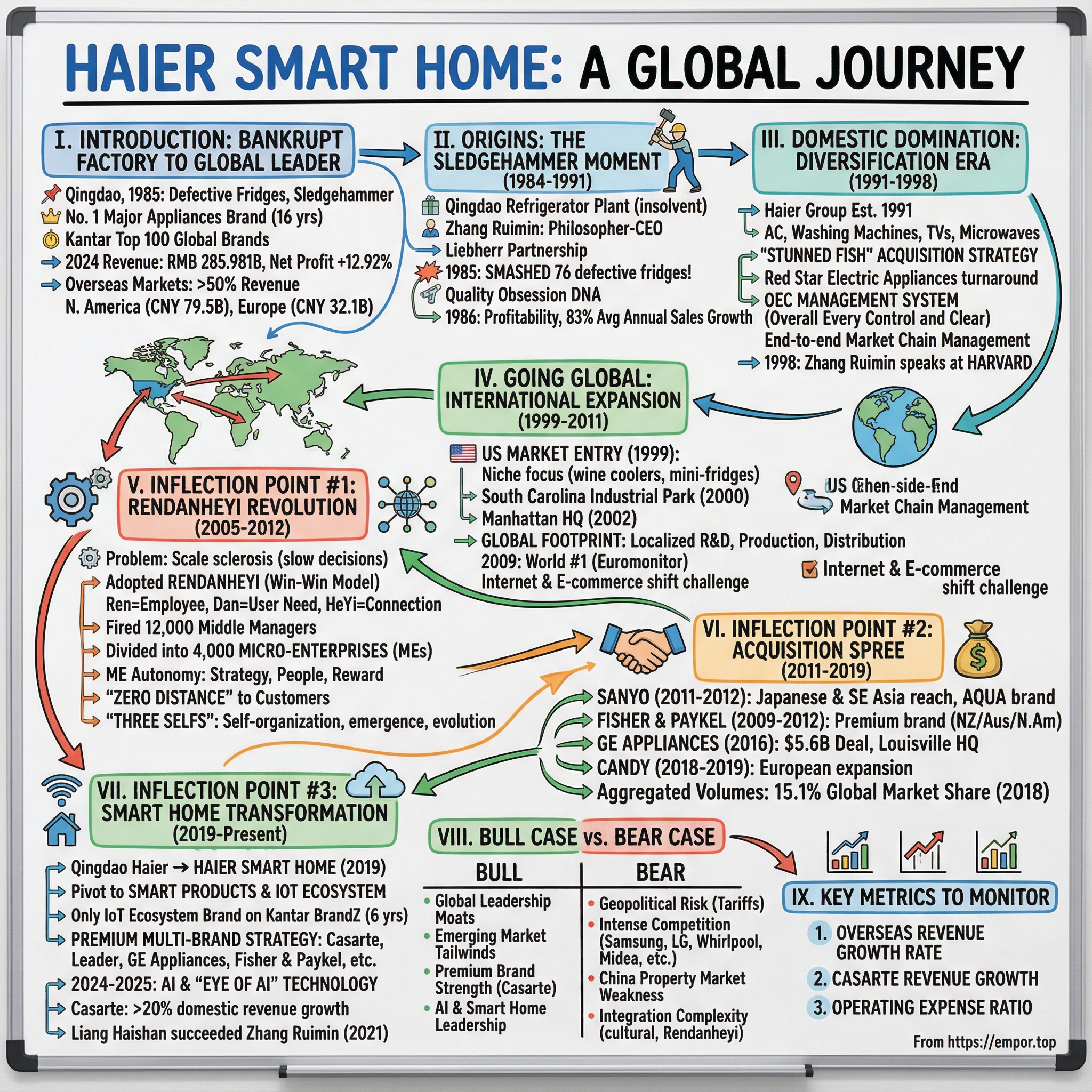
Haier Smart Home: From Sledgehammers to Smart Ecosystems
The untold story of how a bankrupt Chinese refrigerator factory became the world's largest appliance company and pioneered a management revolution being studied at Harvard.
I. Introduction: The Most Unlikely Global Champion
Picture the scene: Qingdao, China, 1985. A 35-year-old factory director stands before dozens of defective refrigerators, sledgehammer in hand. What he does next will become one of the most famous acts in Chinese business history—and launch a forty-year journey that would ultimately upend a century of Western dominance in global home appliances.
Today, that company—Haier—has been ranked the No. 1 Major Appliances Brand by Euromonitor for 16 consecutive years, and listed in the Kantar BrandZ Top 100 Global Brands for seven years in a row. In 2024, the company achieved revenue of RMB 285.981 billion—approximately $40 billion—with net profit growing by 12.92% to RMB 18.741 billion.
The numbers tell only part of the story. Overseas markets now contribute more than 50% of Haier Smart Home's revenue. North America remains the largest foreign market at CNY 79.5 billion, followed by Europe at CNY 32.1 billion. This isn't a Chinese company selling cheap goods to China. This is a global industrial titan operating premium brands across six continents.
The central question of this episode: How did a bankrupt Chinese refrigerator factory become the world's largest appliance company and pioneer a management revolution that's being studied at Harvard and IMD?
The answer involves four interconnected themes: an almost religious obsession with quality that began with a sledgehammer, a contrarian approach to internationalization, a radical management model that eliminated 12,000 middle managers, and a prescient bet on the smart home transformation. Each would prove essential. Together, they created something unprecedented: a Chinese company that didn't just compete with Western giants—it acquired them.
II. Origins: The Sledgehammer Moment (1984-1991)
The Context: China's Economic Opening
To understand Haier's origin, you must first understand the China of 1984. Deng Xiaoping's economic reforms had only just begun. Enterprise zones were experimental concepts. "Made in China" was synonymous with cheap, unreliable goods that no self-respecting Western consumer would touch.
In 1984, Zhang Ruimin was appointed general manager of the Qingdao Refrigerator Plant—a company that was insolvent and going bankrupt. He inherited a small, collectively-owned factory with a 1.47 million yuan loss.
The factory's condition reflected the chaos of late-stage socialism. Prior leadership had seen three directors resign in quick succession amid chronic mismanagement. Upon arrival, Zhang confronted severe operational challenges—workers were so demoralized and undisciplined that basic sanitation had broken down within the factory premises.
Zhang Ruimin: The Philosopher-CEO
Zhang Ruimin was born on January 5, 1949 in Laizhou, Shandong. He studied at the University of Science and Technology of China where he graduated with a master's degree in business administration. He has studied extensively about western management theories and has taken several courses on the subject.
This background would prove crucial. Unlike many Chinese factory managers of his era—pragmatic engineers focused on meeting production quotas—Zhang was an intellectual, a voracious reader who devoured Peter Drucker and would later develop his own management philosophy. In later interviews, he would describe his role not as a captain steering a ship, but as its architect or designer: "That's different from a captain's role, in which the route is often fixed and the destination defined. For example, in the past, our destination was to build the enterprise into a walled garden. Today, however, our destination is [better thought of as] a rainforest [or a self-adaptive ecosystem]."
But in 1984, the immediate challenge was survival. The factory was one of many troubled enterprises partly owned by the city of Qingdao, one of China's first enterprise zones. Zhang was an assistant city manager, instructed to find a managing director who could turn the company around. He found no one willing to tackle the job, so he took it himself.
The Liebherr Partnership & Birth of "Haier"
With China opening up to world markets, foreign corporations began searching for partnerships. Early in his tenure as general manager, Zhang traveled to Germany to visit the company's German partner, from whom they were purchasing technology and know-how. He quickly realized that the company had a serious problem in terms of reputation and quality; it also reflected poorly upon his country.
Germany's refrigerator company Liebherr entered into a joint-venture contract with Qingdao Refrigerator Co., offering technology and equipment to its Chinese counterpart. The current brand "Haier" came from the last two syllables of the Chinese transliteration of Liebherr—a phonetic homage to the German partner that gave the factory its first taste of world-class manufacturing standards.
The Sledgehammer: Management Theater That Changed Everything
The year was 1985. A customer complaint had arrived about a defective refrigerator. Zhang ordered an inspection of the entire warehouse. Of 400 refrigerators in stock, 76 were found to have defects.
In most companies, in most eras, the response would be straightforward: repair what could be fixed, scrap what couldn't, and move on. Zhang Ruimin chose a different path.
In 1985, in order to raise employees' awareness about quality and increase their support of the brand-building strategy, Zhang Ruimin took the lead in smashing 76 defective refrigerators. It was a watermark event that pushed Haier to become a household name.
This willingness to shatter the status quo in service of customers became the stuff of management legend. Indeed, early in his tenure at Haier Group—then known as Qingdao Refrigerator General Factory—Zhang issued sledgehammers to factory workers and directed them to destroy a batch of defective refrigerators they'd produced, a memorable and public signal that the old ways of working were unacceptable.
The act was deliberately theatrical. Each refrigerator was worth two months of a worker's salary at the time. Some workers wept. But the message was unmistakable: quality was now non-negotiable.
This dramatic act was intended to instill a zero-tolerance culture for defects and signal a commitment to customer satisfaction over cost-cutting. This event, preserved with one sledgehammer displayed at Haier's headquarters and another in China's National Museum, marked the beginning of rigorous quality enforcement. The sledgehammer itself became an artifact—a physical reminder that mediocrity would no longer be tolerated.
Early Results
The transformation was rapid. By 1986, Qingdao Refrigerator had returned to profitability and grew in sales at an average of 83 percent annually. Between 1984 and 2000, sales grew from CNY ¥3.5 million to ¥40.5 billion—a compound annual growth rate that would make Silicon Valley venture capitalists weep with envy.
In 1988, under Zhang's leadership, Haier won the first national gold medal for quality in China's refrigerator industry history.
The sledgehammer wasn't just a symbolic act—it was the foundation for everything that followed. Quality obsession became encoded in the company's DNA. And that DNA would prove essential as Haier embarked on its next phase: domestic domination.
III. Domestic Domination: The Diversification Era (1991-1998)
Becoming Haier Group
In December 1991, Zhang Ruimin established Haier Group and became its president. At the same time, Haier started diversification under his leadership.
The timing was no accident. By the early 1990s, Haier had established itself as the quality leader in Chinese refrigerators. But the home appliance market was fragmenting. Televisions, washing machines, air conditioners—Chinese consumers were beginning to demand the full suite of modern conveniences. Zhang saw an opportunity to leverage Haier's quality reputation across multiple product categories.
In 1988, the municipal government had asked Haier to take over some of the city's other ailing appliance manufacturers. The company assumed control of Qingdao Electroplating Company (manufacturing microwave ovens). In 1991, the company changed its name to "Qingdao Haier Group" and acquired Qingdao Air Conditioner Plant and Qingdao Freezer.
During the period 1991–1998, Zhang Ruimin pursued mergers and acquisitions as well as industrial park developments. Haier acquired a number of targets in washers, TVs, and air conditioners, and some of these targets had different ownership structures.
The "Stunned Fish" Strategy
Zhang developed a distinctive approach to acquisitions that became known internally as the "Stunned Fish" strategy—acquiring companies that were fundamentally sound but poorly managed, then reviving them through cultural transformation rather than asset stripping.
In July 1995, the Qingdao municipal government decided to transfer all of Red Star Electric Appliances' shares to Haier Group. Red Star was originally similar to the former Haier, a major city-level enterprise in Qingdao, but due to poor management, even while Haier rose to the top brand of home appliances in China, Red Star bled a loss of more than RMB100 million and became insolvent.
Zhang Ruimin, founder and CEO of China's Haier Group, must decide whether to acquire Red Star Electric Appliance Co., an insolvent local manufacturer of washing machines. Although Haier, slated to become one of China's first global brand names, has successfully turned around other failing enterprises by infusing its distinctive culture and management style, it is not clear whether that approach will work at Red Star.
The turnaround story later inspired a case study at Harvard, establishing Zhang as the first Chinese business leader whose management methods were being taught to American MBA students.
The OEC Management System
A cornerstone of this expansion was the implementation of the OEC (Overall Every Control and Clear) management-control system. Zhang established the "All-around Optimized Management Approach" (OEC), the "Market Chain" management system, and the "Integration of Individuals and Goals" concept to build Haier into a company defined by its operational excellence.
Haier also introduced market-chain management in the 1990s, restructuring departments into end-to-end chains where each unit served the next as an internal customer. This was radical for Chinese state-owned enterprises, where departmental silos and buck-passing were endemic.
Zhang implemented stringent, military-style rules at Haier. Employees must push their chairs under their desks when leaving their seats or face a fine of 100 yuan ($15.60). If a shuttle bus driver is late for a shift, he or she must pay for employees' taxi rides to work.
These reforms propelled Haier's domestic dominance. By the mid-1990s, it held the top market share for refrigerators in China and expanded leadership in other categories, achieving annual growth rates exceeding 30%.
Harvard Recognition
In 1998, Zhang Ruimin spoke at Harvard University, becoming the first Chinese business leader to appear on the Harvard podium.
Zhang Ruimin's management systems have been used as case studies related to business mergers, financial management, and corporate culture by professors at Harvard Business School, University of Southern California, Lausanne's IMD (Switzerland), INSEAD, and Kobe University. A case study detailing Haier's "Market Chain" management system was made a part of the European Union's case study library.
For a Chinese manufacturer to be studied at the world's premier business schools just fourteen years after nearly going bankrupt was extraordinary. But Zhang wasn't satisfied. He had conquered China. Now he wanted the world.
So what does this mean for investors? The 1990s established Haier's two most durable competitive advantages: an uncompromising quality culture and a replicable playbook for turning around struggling acquisitions. Both would prove essential in the global expansion that followed.
IV. Going Global: The International Expansion (1999-2011)
The US Market Entry: A Niche Strategy
Most Chinese companies expanding internationally in the late 1990s followed a predictable playbook: export low-cost goods to developing markets, then gradually move upmarket. Zhang Ruimin chose the opposite approach.
To break into the American market, Zhang realized that Haier would need to offer niche products such as wine coolers and mini-refrigerators, popular with hotels and college dormitories.
Haier entered the US market in 1999 with a deliberately narrow focus. Rather than competing head-to-head with GE, Whirlpool, and Maytag in mainstream refrigerators—where brand recognition and distribution networks would crush a Chinese newcomer—Haier targeted segments the giants had neglected.
By the turn of the century, Haier claimed up to 60 percent of the electric wine cooler market. The strategy was pure Sun Tzu: attack where the enemy is not.
Building the Global Footprint
In 1999, Zhang Ruimin invested US$30 million to build the Haier Industrial Park in South Carolina, USA. In this seven-year stage, Haier established 18 manufacturing plants, 17 distribution centers, and 9 R&D centers, underpinned by a three-pronged strategy of R&D, production, and distribution.
The South Carolina facility, opened in 2000, was a statement of intent. By 2002, US revenues reached USD $200 million. Also in 2002, Haier moved into the Greenwich Savings Bank Building in midtown Manhattan—a trophy address that signaled Haier wasn't just a manufacturer; it was building a global brand.
European & Global Expansion
Zhang began a concerted effort to expand Haier's presence abroad, beginning in Europe, where Haier already had connections thanks to its partnership with Liebherr. In 1993, the company also began shipping its products to the Middle East and Africa, and entered South East Asia in 1996.
Production facilities were constructed in Pakistan in 2002 and Jordan in 2003. The pattern was clear: Haier wasn't pursuing an export-only model. It was building local manufacturing presence to serve regional markets, understanding that true globalization required local roots.
The Milestone: World #1
In 1996, Zhang was awarded the Five-Star Diamond Lifetime Achievement Award by the American Academy of Hospitality Science, and in 1997 was named Entrepreneur of the Year by Asia Weekly. In 1999, Zhang ranked 26th among the Global 30 Most Respected Entrepreneurs, according to the Financial Times.
By 2005, revenues at Haier had surpassed $12 billion and the company employed over 30,000 people. According to Euromonitor International, Haier ranked first globally in sales volume of major appliances from 2009 to 2018—a position it maintains to this day.
But Zhang wasn't celebrating. As he would later reflect: "One was the arrival of the internet, especially the mobile internet and e-commerce. In that period, we didn't manage to keep up with the times. We spent too much time observing, even though we were right to observe that another age would come."
The company had achieved global scale. Now it needed to achieve something harder: organizational transformation for the digital age.
V. Key Inflection Point #1: The Rendanheyi Revolution (2005-2012)
The Problem with Scale
By 2005, Haier had built a global manufacturing empire. It was also becoming dangerously sclerotic.
The classic symptoms of scale were appearing: slow decision-making, information filtering through multiple management layers, frontline employees disconnected from customer feedback. Haier had grown into a juggernaut with 99,000 employees around the world—but Zhang worried that with more than 100 factories globally, the company was becoming too cumbersome, thwarting its ability to quickly respond to market shifts.
While a price war was ongoing in the home appliances industry in the period 2005–2012, Zhang Ruimin adopted the strategy of production on demand for zero inventory. But this required something more fundamental than process improvement—it required reimagining how the entire organization functioned.
Birth of Rendanheyi
Once a devotee of the Six Sigma approach, as championed by CEO of General Electric, Jack Welch, Zhang has developed his own management ideology: Rendanheyi. By dividing a company up into micro-enterprises on an open platform and dismantling the traditional 'empire' system of management, Rendanheyi creates 'zero distance' between employee and the needs of the customer. At the core of Rendanheyi is the cultivation of entrepreneurship: by removing the costly level of middle management, you encourage innovation, flexibility, and risk-taking.
The term "Rendanheyi" combines three Chinese concepts: "Ren" refers to each employee; "Dan" refers to needs of each user; and "HeYi" refers to the connection between each employee and needs of each user.
Haier adopted Rendanheyi—otherwise known as the Win-Win Model of Individual-Goal Combination—in 2005 as a business model to allow the company to transform in step with the impact that the Internet was bringing to the traditional economy.
Organizational Deconstruction
After firing 12,000 middle-managers, Haier divided itself into 4,000 independent "micro-enterprises," referred to as MEs. Those now unwanted middle managers were given the choice to join the new model as entrepreneurs running their own MEs, or let Haier help them find jobs elsewhere.
Within Haier, the classic organizational pyramid does not exist and is replaced by a network of more than 4,000 microenterprises (small cells employing 10–15 people). Each of these micro enterprises has decision-making autonomy along three main lines: Strategy: deciding what kind of partnership to form and what path to choose for itself. People and organization: deciding how to work, whom to hire, and how to manage its workforce. Reward: deciding how to manage pay, rewards, and careers of its people.
Haier runs on thousands of MEs, each with full decision-making power over products, strategy, and budgets; direct accountability for profit and loss; a focus on customers, not pleasing bosses. The key? No one waits for approval from higher-ups, because there are no higher-ups.
The Three Selfs
All the MEs need to create their opportunities. We call this the "three selfs"—self-organization, self-emergence, self-evolution—in which self-emergence is the identification of new demand, usually by frontline workers.
"If a ME consistently underperforms, it is either restructured or shut down. There's no artificial protection." The model was deliberately Darwinian.
Global Recognition
Zhang is widely regarded as a global thought leader on organizational design and post-bureaucratic enterprise models. In 2023, he received the Thinkers50 Lifetime Achievement Award, the only Chinese entrepreneur ever to be so honored.
Since 2017, Haier in collaboration with Gary Hamel's Management Laboratory has hosted a forum every year in Qingdao, inviting global economists and management experts to discuss the rendanheyi business model.
For investors, Rendanheyi matters because it creates structural cost advantages. By eliminating middle management, Haier reduced labor costs while simultaneously increasing speed to market. The model would prove essential when Haier began acquiring Western companies—it provided a framework for integration that preserved local autonomy while enforcing accountability.
VI. Key Inflection Point #2: The Acquisition Spree (2011-2019)
Sanyo (2011-2012): Learning the M&A Playbook
Haier completed its acquisition of SANYO Electric's refrigerator, washing machine and other consumer electric appliances business in Japan, Indonesia, Malaysia, the Philippines and Vietnam. The two companies have completed the acquisition process by the end of March as planned, including the transfer of SANYO Electric's operations as well as customer care and after-sales service.
In line with the agreement, Haier would operate in Japan as its Asian Headquarters, using its "Haier" and "AQUA" brands. Haier would use the "Haier" brand in Vietnam, Indonesia, the Philippines and Malaysia, while simultaneously using the "SANYO" brand in these markets for a specified period of time.
The deal was the first time a Chinese firm had bought major business segments from a large Japanese manufacturer.
The Sanyo acquisition provided more than market share—it delivered R&D capabilities and manufacturing expertise. "What is most important for us is to better understand Japanese consumers, and provide high-quality appliances to meet the demands of their lives through our localized operations, technology innovation, and resource consolidation," said Liang Haishan, Haier's Executive VP. Following the acquisition, Haier decided to keep AQUA's DNA—its unique technology, function and concept—intact.
Sanyo's white goods division had excellent technology and products, but its employee model was not focused on talent expansion. The appliance maker had adhered to the tradition of age-based promotion rather than having employees rise through the ranks based on merit. Entrepreneurial talent combined with an impressive technology background allowed Sanyo to reverse its losses within eight months of its acquisition by Haier.
Fisher & Paykel (2009-2012): The Premium Brand Play
In 2012, Haier purchased over 90% of Fisher & Paykel Appliance shares. No changes in manufacturing or board of directors were made.
Fisher & Paykel Appliances was troubled financially since 2009 when Haier bought a 20 percent stake. And Haier announced on Tuesday that it further boosted its stake to 90 percent.
The acquisition was valued at NZD 869 million (approximately USD 560 million), making it one of the largest M&A deals in New Zealand's history. Haier acquired a 90% stake in Fisher & Paykel, with the remaining 10% held by the company's founders and management.
Many New Zealanders were mourning the loss of control of a homegrown brand that began 78 years ago and grew to represent a rare manufacturing success story. The company's stoves, refrigerators, washing machines and dishwashers became ubiquitous in New Zealand homes, while innovations such as its dish-drawer dishwasher found a niche in the U.S.
The Fisher & Paykel acquisition was strategic on multiple levels. It gave Haier a premium brand positioned for affluent consumers in Australia, New Zealand, and North America. It also provided a template for how Haier would handle Western acquisitions: maintain local management, preserve brand identity, inject capital for growth.
The company cut its teeth on overseas deals in 2012 with Fisher & Paykel. That successful takeover helped convince GE executives to accept Haier's bid later. The Fisher & Paykel takeover proved that Haier could integrate its Chinese way of doing business with a foreign company's culture.
GE Appliances (2016): The Crowning Achievement
There's a certain poetic symmetry to this deal. In 1998, Zhang became the first Chinese entrepreneur to give a speech at Harvard. In 2016, he sealed a $5.4 billion deal with GE to buy General Electric Appliances (GEA).
In 1992, General Electric Appliances had proposed acquiring Haier, but the latter rejected the offer, realizing that GE intended to use Haier as a pawn for its development in China. Twenty-four years later, the tables had turned completely.
Haier acquired GE Appliances for $5.6 billion, which included an approximate $200 million increase from the originally announced sale price to account for increased working capital in the business.
Today marks the beginning of GE Appliances being part of Qingdao Haier. As previously announced, GE Appliances would continue to be headquartered in Louisville, Kentucky and operated independently under the day to day direction of the current management team. A board of directors, with representatives from the senior leadership teams of Qingdao Haier and GE Appliances, and two independent directors, would help guide the strategy and operations of the business.
As part of the transaction, GE entered into a long-term agreement with Haier to continue use of the GE Appliances brand.
"Haier and GE share the same vision, and value innovation, customer service, and developing products of the highest quality," said Zhang Ruimin. "This transaction underscores Haier's devotion to creating a global platform for innovation, which will benefit both Haier and GE Appliances and deliver enhanced value to all stakeholders."
After the acquisition, GE Appliances directors asked how Haier would lead them after annexation. Zhang's response was clear: "I am not your leader. Our common leader is the user."
Since Haier took over, GE Appliances has seen consistent growth in U.S. market share, with more than $2 billion invested and 4,000 new jobs created since 2016. What followed was nothing short of astonishing. Market share, which had languished around a mere two percent for the previous four years, skyrocketed to 20 percent. Haier had achieved what GE could not: a resounding success in the appliance market.
Chinese appliance company Haier's 2016 acquisition of iconic GE Appliances ushered in strategic and structural changes to encourage innovation and entrepreneurship at the U.S. company and to help it grow. Haier, which had a model designed to bring the company closer to users of its products, wanted GEA to adopt a version of the model that suited the U.S. market, U.S. consumers, and GEA's employees.
After the purchase, GE Appliances began its transformation, and thanks to the implementation of Rendanheyi, four years later its revenue had grown more than 1.8 times and its profit had multiplied over three times the pre-acquisition figures.
Candy (2018-2019): Completing the European Puzzle
The Chinese group Qingdao Haier Co. acquired for 475 million euro Candy SpA, the historic household appliance brand of the Fumagalli family, among the European leaders in the small and large free standing and built-in appliances.
Qingdao Haier Co., Ltd. completed the acquisition of Candy S.p.A. Candy became a wholly-owned subsidiary of Qingdao Haier. The celebration at Candy's premises in Brugherio, led by Qingdao Haier Chairman, Haishan Liang, and Haier Europe CEO, Yannick Fierling, together with Beppe and Aldo Fumagalli, marked the importance of Candy's integration into Haier as Haier's operations platform for the European market and headquarters of Haier Europe.
The aggregated volumes of Haier and Candy groups in 2018 represented a global market share of 15.1% on major appliances, 22.7% on freestanding refrigeration appliances and 19.8% in home laundry appliances (according to Euromonitor data). Combined revenue ranked fifth in Western Europe and aimed to enter the top three by 2022.
After the acquisition of Candy-Hoover Group in 2019, Haier Europe has doubled its turnover and has set a clear growth strategy for the next years.
For investors, the acquisition spree demonstrates both ambition and discipline. Haier paid full prices for quality assets but extracted value through operational improvements rather than financial engineering. The pattern suggests management prioritizes sustainable competitive position over short-term returns.
VII. Key Inflection Point #3: Smart Home Transformation (2019-Present)
The Pivot to Smart Home
In 2019, Qingdao Haier became Haier Smart Home, then, in 2020, Haier Smart Home incorporated Haier Electronics Group. The name change was more than cosmetic. It was a direct result of a major strategy shift among Chinese household manufacturers, which was to pivot away from cheap, basic appliances to smart products.
Whilst Haier in the 1990's was focused on the Chinese market, improving quality to international standards, the 2000's was about reaching across the world, but with localisation and customisation. The 2010's have been all about digitalisation, embracing the power of automation and data, to the point where Haier is now one of the world's leading producers of "smart" products, embedded with IoT, and connected intelligently.
IoT Ecosystem Strategy
Haier, the number one brand in the household appliances sector, has once again distinguished itself as the only Internet of Things (IoT) ecosystem brand on the Kantar BrandZ Most Valuable Global Brands 2024 list, marking the sixth consecutive year it has achieved this accolade. This achievement underscores Haier's enduring global leadership and innovation in integrating technology with user-centric solutions.
Stanford Artificial Intelligence Laboratory had identified three barriers to the adoption of smart home technology. At the time, Haier's core competencies lay within the large appliance sector and not the small electronics sector. Subsequently, it partnered with the then leading IoT platform IngDan owned by Cogobuy to overcome its shortcomings. By utilizing Cogobuy's ecosystem and supply chain, Haier was able to integrate components and edge voice analysis into smart appliance products.
The Premium Multi-Brand Strategy
The Company distributes its products through a portfolio of world-renowned brands, including Haier, Casarte, Leader, Candy, GE Appliances, AQUA, and Fisher & Paykel.
For domestic products, Haier positioned its namesake brand for mass-market consumers while targeting the premium Casarte brand to wealthy households. As Casarte products have constantly outperformed in sales growth versus Haier's other brands in China, we expect the company's high-end products to improve the overall revenue mix over the next few years. Also, the Chinese government's ongoing subsidies on home appliance trade-ins should boost Haier's domestic sales.
Casarte, the company's premium appliance brand, continues to lead in China's high-end market, surpassing 20 million customers.
2024-2025: AI & Continued Growth
Haier Smart Home announced its financial results for the first quarter of 2025. In Q1 2025, the Company maintained its growth momentum from 2024, delivering total revenue of RMB 79.12 billion, up 10.1% YoY. Net profit attributable to the parent company reached RMB 5.49 billion, representing a 15.1% increase, while net profit attributable to the parent company excluding non-recurring items grew 15.6% YoY to RMB 5.36 billion. Net cash flow from operating activities improved to RMB 2.28 billion, up 15.1% YoY.
At AWE 2025 (Appliance & Electronics World Expo exhibition in Shanghai), the Company introduced its "AI Vision" technology, enabling smart appliances not only to process voice commands but also to visually interpret their surroundings—bringing the vision of unmanned housework closer to reality.
Haier introduced its pioneering "Eye of AI" technology, equipping smart devices not only to "process voice commands" but also to "visually interpret" their environments. Revolutionary applications include range hoods that track cooking pots, ovens that monitor grilling progress, and washing machines that analyze laundry cycles, all achieving effortless, hands-free appliance management.
Casarte maintained strong momentum with over 20% YoY domestic revenue growth.
Haier Smart Home Co., Ltd. reported a significant rise in its financial results for the first half of 2025. Global revenue reached RMB 156.49 billion, marking a 10.2% increase compared to the same period in 2024. Net profit rose by 15.6% to RMB 12.03 billion, while net operating cash flow increased by 32.2% year-on-year. These gains were achieved despite market challenges, such as increasing US tariffs and global logistics issues.
Amid a competitive market in China, rising US tariffs, and global logistics volatility, Haier implemented a focused three-pillar strategy: Product Mix Optimization & Blockbuster Launches, AI-Driven Lean Operations, and Localization & Regional Empowerment—strengthening local-for-local manufacturing and giving regional leaders greater autonomy, enabling faster decision-making, closer user engagement, and the creation of a differentiated consumer value proposition.
Leadership Transition
Zhang Ruimin is the Founder of Haier Group and the architect of the RenDanHeYi model. From 1984 to 2021, he served as Haier's CEO and Chairman, transforming the company from a regional refrigerator factory into a global leader in IoT ecosystems.
He was also the chairman of the board and chief executive officer of Haier Group until his resignation in 2021. He was succeeded in these roles by Liang Haishan.
He now serves as Chairman Emeritus, focusing on the evolution of management thought.
VIII. Bull Case vs. Bear Case
The Bull Case
1. Global Leadership with Sustainable Moats
The Major Home Appliances Market is expected to reach USD 418.85 billion in 2025 and grow at a CAGR of greater than 4% to reach USD 505.21 billion by 2030. Haier Smart Home Co., Ltd., Whirlpool Corporation, LG Electronics Inc., Samsung Electronics Co., Ltd. and Electrolux AB are the major companies operating in this market.
Haier's position as the world's #1 appliance brand by volume for 16 consecutive years reflects genuine competitive advantages: a multi-brand portfolio spanning price points, manufacturing scale across geographies, and the Rendanheyi organizational model that enables faster product development than hierarchical competitors.
2. Emerging Market Tailwinds
Emerging Markets showed robust growth, with revenue rising over 20% overall. By region: South Asia grew by more than 30%, Southeast Asia by over 20%, and Middle East & Africa by more than 50% YoY.
2024 marks the 20th anniversary since we first entered India market and it has been a year of tremendous achievement as our revenue grew over 30% to USD 1 billion for the first time.
The Indian market "performed particularly well," as sales jumped by more than 30 percent to over USD 1 billion for the first time. The company aims to double sales there to USD 2 billion by 2027.
3. Premium Brand Strength
The company's premium brand Casarte exemplifies how it leads through high-end innovative offerings that have seen a thirteen-fold increase over seven years, topping industry averages across price points and market share growth metrics.
4. AI and Smart Home Leadership
Since pioneering the smart home strategy a decade ago, Haier Smart Home has consistently led the industry. With the launch of AI Vision, the company has transcended traditional smart appliances, advancing towards truly intelligent homes.
The Bear Case
1. Geopolitical Risk
Rising US tariffs and trade tensions pose genuine threats to Haier's North American business, its largest overseas market. While local-for-local manufacturing mitigates some exposure, tariff escalation could compress margins on imported components.
2. Intense Competition
Price competition in the electrical appliances market has been intense over recent years as major players fight for market share. With products becoming increasingly commoditized and buyers able to easily compare prices online, maintaining margins has become a significant challenge. Brand loyalty has declined as consumers focus more on getting the lowest prices.
Samsung, LG, Whirlpool, Haier, and Midea group dominate global share, while challengers such as Hisense, Bosch-Siemens Hausgeräte, and SharkNinja expand rapidly through innovation.
3. China Property Market Weakness
The prolonged slump in Chinese real estate development affects new home formation—historically a key driver of appliance demand. While trade-in subsidies provide support, a sustained property downturn could constrain domestic growth.
4. Integration Complexity
Managing seven global brands across diverse markets requires extraordinary coordination. While Rendanheyi provides a framework, cultural integration of acquired entities remains challenging, as evidenced by the multi-year process required to fully implement the model at GE Appliances.
Porter's Five Forces Analysis
| Force | Assessment |
|---|---|
| Threat of New Entrants | Low. Capital requirements for global appliance manufacturing exceed $1 billion. Brand building requires decades. Distribution networks take years to establish. |
| Supplier Power | Moderate. Steel, copper, and semiconductor suppliers have some leverage, but Haier's scale provides negotiating power. In-house component manufacturing reduces dependency. |
| Buyer Power | Moderate to High. Large retailers like Home Depot, Lowe's, and major Chinese e-commerce platforms can extract margin concessions. Consumer switching costs are low. |
| Threat of Substitutes | Low for major appliances (refrigerators, washers). Moderate for small appliances where alternatives exist. |
| Competitive Rivalry | High. Global competition from Whirlpool, LG, Samsung, Electrolux, and Midea. Price competition intense in mid-market segments. |
Hamilton Helmer's 7 Powers Framework
| Power | Haier's Position |
|---|---|
| Scale Economies | Strong. Global manufacturing footprint enables cost advantages through procurement leverage and production optimization. |
| Network Effects | Emerging. IoT ecosystem creates potential network effects as smart appliances communicate—but not yet a decisive advantage. |
| Counter-Positioning | Strong. Rendanheyi model represents a genuine organizational innovation that hierarchical competitors cannot easily replicate without painful restructuring. |
| Switching Costs | Weak. Appliances are commodity products; consumers can switch brands easily. Smart home ecosystems may increase switching costs over time. |
| Branding | Moderate to Strong. Multi-brand strategy (Haier, Casarte, GE Appliances, Fisher & Paykel) provides positioning across segments and geographies. |
| Cornered Resource | Moderate. Deep manufacturing expertise in China; GE Appliances brand in North America through 2056 licensing agreement. |
| Process Power | Strong. Rendanheyi represents genuine process innovation enabling faster product development and lower overhead costs. |
IX. Key Metrics to Monitor
For long-term investors tracking Haier Smart Home, three KPIs matter most:
1. Overseas Revenue Growth Rate
Why it matters: Overseas markets now exceed 50% of total revenue, and emerging markets (South Asia, Southeast Asia, Middle East & Africa) are growing 20-50% annually. This metric captures both geographic diversification progress and the company's ability to compete against Western incumbents on their home turf.
Haier's overseas revenue grew 12.6% YoY, outpacing the 4% expansion in Q1 2024. Standout performances include: Europe: 31.4% YoY revenue growth; North America: Double-digit growth in high-end brands; Emerging Markets: South Asia grew over 30%, Southeast Asia over 20%, and Middle East & Africa surged over 50%.
2. Casarte Revenue Growth
Why it matters: Casarte is Haier's premium brand in China—essentially its margin expansion engine. Premium products carry higher gross margins and demonstrate brand equity that protects against commoditization. Casarte's performance is a proxy for Haier's ability to move up the value chain.
Casarte maintained strong momentum with over 20% YoY domestic revenue growth.
3. Operating Expense Ratio
Why it matters: The Rendanheyi model's financial impact shows up in expense ratios. Selling expense ratio and administrative expense ratio measure operational efficiency gains from the decentralized structure. Improvement here indicates the management model is delivering tangible benefits.
The Company reduced its selling expense ratio to 9.6%, an improvement of 0.1 ppt YoY, while its administrative expense ratio fell to 3.1%, representing a YoY improvement of 0.1 ppt.
X. Conclusion: The Learning Organization
Forty years ago, Zhang Ruimin stood in a failing factory with a sledgehammer, making a statement about quality. Today, his successor Liang Haishan leads a $40 billion global company that owns some of the world's most recognized appliance brands.
The journey from Qingdao Refrigerator Plant to Haier Smart Home offers several lessons:
First, quality obsession compounds. The sledgehammer moment wasn't just theater—it established a culture that enabled everything that followed. Haier's ability to acquire and improve Western brands like GE Appliances and Fisher & Paykel rested on genuine manufacturing excellence.
Second, management innovation matters. Rendanheyi remains controversial—not every organization can or should eliminate middle management. But for Haier, the model enabled scale without sclerosis. When your competitors are trapped in traditional hierarchies debating quarterly budgets, you can move faster.
Third, internationalization requires patience. Haier spent nearly two decades building its global infrastructure before making transformational acquisitions. The niche strategy in the US—starting with wine coolers and compact refrigerators—seemed modest at the time but proved strategically sound.
Fourth, transitions matter. Zhang Ruimin's evolution from hands-on operator to management philosopher to Chairman Emeritus represents a thoughtful leadership succession. The company's continued performance post-transition suggests institutional strength beyond any single individual.
In 2024, Haier Group reported revenue of RMB 401.6 billion (approximately Euro 47.5 billion) and operates in nearly 200 countries with a workforce of over 130,000 employees. The company is recognized for its leadership in Smart Living Ecosystem, Comprehensive Health Industry Ecosystem, and Digital Economy Industry Ecosystem.
The story isn't over. Smart home adoption remains in early innings globally. AI integration is just beginning. Emerging market penetration has enormous runway. Whether Haier can maintain its #1 position through the next decade of technological transformation remains to be seen.
But one thing is clear: the bankrupt refrigerator factory that Zhang Ruimin inherited in 1984 has become something unprecedented—a Chinese company that didn't just compete with Western giants but acquired them, didn't just export commodity products but builds premium brands, didn't just manufacture appliances but is reinventing what home appliances can become.
That sledgehammer is still on display in Qingdao. It reminds visitors—and employees—of where Haier came from. And implicitly, of what's possible when a company refuses to accept mediocrity.
Note: This analysis is based on publicly available information and company filings as of November 2025. Investors should conduct their own due diligence and consider their individual circumstances before making investment decisions.


 RSS Feed
 Spotify
 Apple Podcasts
 Amazon Music
 Audible
 YouTube