Blue Star: Can India's Original Cooling Company Win the Room AC Wars It Didn't Start?
I. Introduction & Episode Roadmap
On the morning of August 7, 2026, B. Thiagarajan sat down for Blue Star's quarterly earnings call and did something that Indian consumer-durables executives generally avoid in the middle of a growth story. He told analysts that the company had deliberately chosen to eat a margin hit rather than lose shelf space. "We took a hit in the operating margin in order to more or less maintain our market share," he said.3 It was an unusually plain admission. Blue Star had wanted to push through roughly thirteen percentage points of price increase to cover a brutal run in copper and a weakening rupee. It got five.3
The stock had already begun to tell the story. Shares that traded near ₹1,729 in the first days of August finished the month around ₹1,480, valuing the company at roughly ₹30,400–30,900 crore — well below the ₹40,000 crore milestone that Chairman Vir S. Advani had proudly announced to shareholders at the 2025 annual general meeting.6 On a trailing basis the shares still changed hands at something close to fifty-eight times earnings and around nine times book value.2 That is a multiple that assumes a great many things go right at once.
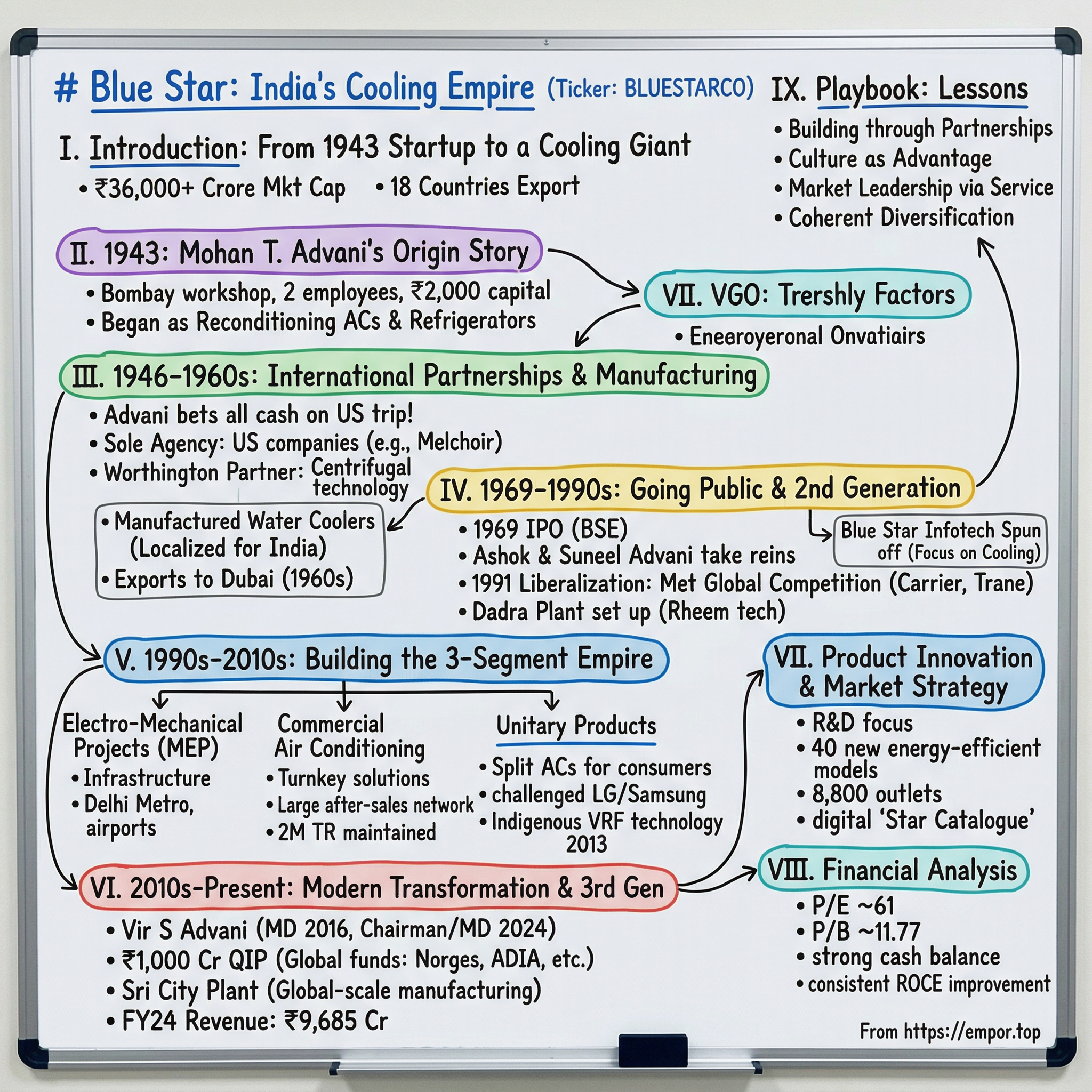
This is a company that has been cooling India for longer than India has been independent. Mohan T. Advani founded it on September 27, 1943, in the middle of the Second World War, when imports had stopped and the sensible move was to wait.6 Three generations of Advanis later, the family still controls it, holding roughly 36.5% of the equity with none of it pledged.11 Revenue for the year ended March 31, 2026 was ₹12,402 crore.1
And yet the interesting thing about Blue Star in 2026 is not its age. It is that the business most investors associate with the brand — room air conditioners, the blue-and-white boxes bolted above Indian living-room windows — is no longer the company's largest or most profitable segment. That title now belongs to Electro-Mechanical Projects and Commercial Air Conditioning, the very division that nearly destroyed the company in 2012.17
So the question this story tries to answer is not "is India going to buy more air conditioners?" Almost certainly it is; household penetration sits somewhere around 7–8% against roughly 80% in China.4 The harder question is whether Blue Star specifically captures that growth at an acceptable return on the capital it is now pouring into factories — in a market where no player holds even a fifth of the share, where the government has just rewritten the rules on the single most expensive component in an air conditioner, and where management's own guidance moved in the wrong direction inside a single quarter.
Here is the route. First, the origins, kept deliberately tight, because they explain culture rather than the current case. Then the near-death experience of 2011–13, which is the single most useful piece of history for testing anything management says today about project discipline. Then the people actually running the company, and their record of promises against outcomes. Then the two businesses that matter — projects and room ACs — with the disconfirming evidence sitting right next to the claims it tests. Then the localization bet and the policy shock that complicated it, the financial trajectory, the competitive structure, and finally a clear-eyed accounting of what would have to be true for the bull case to work, and what would break it.
 Subscribe on LinkedIn
II. Origins in Brief: 1943–2000s
The founding legend of Blue Star is not a garage story. It is a refrigerator story.
In the 1930s, a young Mohan T. Advani — MTA to everyone who worked with him — took a job at Bombay Garage, the Indian distributor for the American Frigidaire brand. His father wanted him to sit the Indian Civil Service examinations, the respectable path for an ambitious young man in colonial Bombay. MTA had decided instead that a hot, tropical country would eventually need reliable cooling for the three things life depends on: air, food, and water. His enthusiasm was conspicuous enough that Bombay Garage sent him to Frigidaire's factory in England for a year of training in air conditioning and refrigeration fundamentals.6
Then the war came, imports stopped, and Bombay Garage's business stalled. Which is precisely when MTA left to start his own. On September 27, 1943, with two employees and about ₹2,000, Blue Star Engineering Company began by reconditioning air conditioners and refrigerators — repairing the machines nobody could import.6 It was, in the strictest sense, an arbitrage on scarcity: the country's installed base of cooling equipment was aging and irreplaceable, and someone had to keep it running.
The name mattered to him. Almost every Indian firm of that era was named after its founder or family. MTA chose "Blue Star" for what it signified — blue for clear skies and, more to the point, for coolness; star for the guiding light. Eighty-three years later the company still runs on the same brand.6
The next two decades built the technical spine. Agency relationships with American engineering houses brought modern refrigeration technology into India, and Blue Star pioneered the domestic water cooler — a product category that sounds trivial until you consider that in mid-century India, a reliable cold-water dispenser in a factory or a railway station was a genuine piece of public infrastructure. From cooling boxes, the company moved to cooling buildings, and eventually to equipping some of India's first skyscrapers with full mechanical, electrical and plumbing systems.6
The company listed its shares in 1969, and the second generation — Ashok M. Advani and Suneel M. Advani, both still honoured as Chairpersons Emeriti at the 2025 AGM — took over.6 They ran Blue Star through two very different Indias: the licence-permit era, when capacity itself was rationed by the state and the winning skill was navigating New Delhi, and then the post-1991 liberalization, when the skill abruptly became competing with global brands that could now walk in.
What crystallised during that stretch is the three-segment architecture the company still reports today: large commercial and institutional projects; packaged and unitary products sold through a distribution channel; and a small, high-margin professional electronics arm distributing specialised instrumentation. Each has completely different economics. Projects consume working capital and carry execution risk. Unitary products consume advertising and inventory and carry weather risk. Professional electronics is a modest, capital-light distribution business.
It is worth pausing on how much of that architecture was an artefact of Indian industrial policy rather than deliberate strategy. Under the licence regime, a company could not simply decide to build more air conditioners; capacity was allocated. The rational response was to diversify into whatever adjacent activity you could get permission to do — which is how a cooling company ends up distributing scientific instruments and data security products. After 1991, when the constraint flipped from permission to competition, those legacy limbs became either niche profit pools or distractions, depending on the year. Blue Star kept its professional electronics arm small and profitable rather than either scaling it or shedding it, which is a defensible answer but not an obviously optimal one.
The other durable inheritance is a preference for organic growth. Through eight decades and three generations, Blue Star has expanded principally by adding factories, product lines and channel partners rather than by buying competitors. In an industry where at least one major rival simply purchased its way into the consumer category, that is a meaningful behavioural signature — one that has kept the balance sheet clean and the share count low, and that has also meant the company has never bought itself a step-change in market position.
That structure is the inheritance. It is also the reason a single "Blue Star" investment thesis is difficult to write: the company is at least two businesses stapled together, with different customers, different cash-conversion cycles, and different failure modes. Which brings us to the year one of those failure modes actually fired.
III. The Near-Death Experience: The 2010–13 Projects Crisis
Every corporate history has a chapter it prefers to summarise in one sentence. For Blue Star, that chapter is FY2012.
Set the scene. In the years after the global financial crisis, India was in the middle of a construction boom, and the Gulf was in the middle of a bigger one. Blue Star's Electro-Mechanical Projects business — the division that wins turnkey contracts to build the cooling, electrical, plumbing and fire-fighting guts of large buildings — had spent that boom bidding aggressively for work, at home and through overseas subsidiaries in Malaysia and Qatar. Fixed-price contracts. Bid in a boom. That is the setup for the oldest accident in the engineering-and-construction business.
The accident arrived on schedule. Input costs climbed. The Middle East construction market softened. The dollar strengthened, and overseas subsidiaries absorbed foreign-exchange losses.9 By January 2012, Blue Star reported a quarterly loss of roughly ₹33 crore, which it attributed to high input costs.8 Financial expenses, which had been a rounding error, became a real line item as working capital ballooned to fund jobs that were no longer earning their keep.
The full-year damage was worse than any single quarter. In the company's own subsequent accounting, FY2012 produced a net loss of about ₹89 crore.7 The Electro-Mechanical Projects and Packaged Air Conditioning segment — then 59% of revenue — went to a segment loss of roughly ₹85 crore.7 A company that had earned real profits the year before spent a year discovering that a project book is a promise to deliver at a price, and prices had moved.
Here is the mechanism, in plain English, because it matters more than the numbers. When Blue Star signs a fixed-price MEP contract, it is effectively writing an option to the customer: whatever happens to steel, copper, cable, labour and freight over the next eighteen to thirty-six months, the price is the price. In a stable or deflationary cost environment, the contractor keeps the difference. In an inflationary one, the contractor eats it. And because these contracts are financed with working capital — you buy materials and pay wages long before you collect retention money — a cost shock and a liquidity squeeze arrive as the same event. That is not bad luck. That is the structural design of the business.
The recovery is genuinely instructive. FY2013 revenue barely moved, rising about 2% to ₹2,767 crore. Net profit came back to ₹51.73 crore.7 The projects segment swung from an ₹85 crore loss to a ₹72 crore profit — a roughly ₹157 crore turn on essentially flat revenue.7 That did not come from a market recovery. It came from what management described as minimising cost overruns and closing jobs faster, alongside price increases, value engineering and tighter working-capital management.7
And it came with a deliberate strategic choice: bid less, bid better. The carry-forward order book actually shrank 12% to ₹1,418 crore that year.7 A shrinking order book presented as good news is a rare thing in Indian capital goods, and it is the most credible single data point in the entire company history for the proposition that Blue Star learned something about project selection.
There is a second lesson buried in the sequence, and it concerns what an outside investor could actually have seen coming. Very little, is the honest answer. Percentage-of-completion accounting means a project contractor recognises revenue and profit as work progresses, based on management's own estimate of total cost to complete. If those estimates are optimistic — and in a boom, they usually are — reported profits look fine right up until the estimates are revised, at which point several years of over-recognition land in a single quarter. That is why the FY2012 deterioration appeared to arrive suddenly when it had in fact been building for years, and it is why segment margin trends over multiple quarters, rather than any single reported number, are the only meaningful early-warning system in this kind of business. Nothing about that accounting reality has changed since.
B. Thiagarajan, who had been promoted to head the air conditioning and refrigeration products group in 2009, joined the board in 2013, in the middle of that repair job. The recovery is therefore part of the operating DNA of the people running the company now, not ancient history from a prior regime.
But there is a limit to how much comfort to draw. The 2012 crisis was not caused by a lack of discipline alone; it was caused by fixed-price contracting colliding with a cost shock. Blue Star tightened underwriting. It did not — and structurally could not — remove the exposure. Fourteen years later, in the June 2026 quarter, the same segment's margin compressed by about 110 basis points year on year, again on input costs.15 The scale is nothing like 2012. But the direction is a reminder that the vulnerability is dormant, not eliminated.
The right conclusion is narrow rather than triumphant: the record supports the claim that management improved project selection and cost control, and it does not support a claim that the segment is now insulated from cost inflation. Anyone underwriting Blue Star's projects growth today should treat every reported order-book number as a gross figure whose profitability will be determined by a commodity cycle that has not yet been tested at 2012 severity. That test is the thing to watch, and it applies with particular force to the newest and fastest-growing part of the order book, which we will get to shortly.
IV. Third-Generation Transition & Who Actually Runs Blue Star Today
On April 1, 2024, Vir S. Advani formally became Chairman and Managing Director of Blue Star, completing a succession that had been telegraphed for years.10 He had joined the business in 2000, become an Executive Director in 2010, and Managing Director in 2016. The third generation was now, on paper, in charge.
On paper is the operative phrase, and understanding why is essential before crediting or blaming anyone for a given quarter.
Blue Star runs an unusual dual structure. Vir Advani is Chairman and Managing Director. B. Thiagarajan is also Managing Director. Advani writes the annual letter, delivers the AGM address, and frames the long arc: the credo, the R&D agenda, the ESG commitments, the six-fold rise in market capitalisation over six years.6 Thiagarajan takes the earnings calls, fields the analyst questions, and supplies almost all of the granular operating commentary that investors actually model from — market share by month, price pass-through percentages, capex tranches, segment margin guidance.3
You can hear the difference in how each man talks. Advani's AGM address is written in the register of institutional continuity — the founder's name invoked, the Chairpersons Emeriti thanked by name, the credo quoted verbatim, the company positioned inside a national narrative about India's "decade of opportunity" and the coming decade for cooling.6 It is the language of a custodian planning in decades, and it is worth taking seriously precisely because family owners with a 36.5% stake genuinely do think that way. It is also, unavoidably, the language of someone whose specific claims are hard to falsify inside a quarter.
Thiagarajan's register is the opposite. He is the executive who ran the air conditioning and refrigeration products business through the years when Blue Star was climbing from a mid-single-digit to a mid-teens share of the room AC market, who was on the podium in 2016 announcing the ambition to become "the largest Indian manufacturer in the AC&R industry" with two new integrated factories,12 and who now answers analysts with monthly market-share deltas and basis-point bridges. He volunteers uncomfortable numbers. He also, more than once, has attached a specific figure to an ambition and then had to revise it. Those two traits travel together: an executive who never gives a number can never be caught missing one.
That division of labour is not a governance problem in itself. Plenty of family businesses professionalise this way, and Blue Star's version has the advantage of putting a career operator, rather than a family member, in front of the analyst community. But it does mean that the "management credibility" question has two different answers depending on which set of statements you are testing.
Test Advani's version first, because it is the more sweeping one. At the 77th AGM on August 6, 2025, he told shareholders that "over the years we have invested in growth capital, and in spite of a substantial increase in capital employed, we have consistently delivered ROCE of higher than 25%."6 That was a fair description of the immediately preceding years — return on capital employed had run in the mid-twenties from FY2023 through FY2025.2 It stopped being true almost immediately. In FY2026, capital employed rose to ₹3,258 crore from ₹2,427 crore while profit before exceptional items and tax fell,1 and return on capital employed dropped to roughly 21%.2
That is not a scandal. It is one year, and a year with genuinely adverse weather. But it is a useful calibration: the "consistently above 25%" framing was a description of a favourable window presented as a durable characteristic, and it broke within twelve months of being said. The honest version of the claim is that Blue Star has historically earned attractive returns on capital in a business with modest fixed assets and a large distribution overlay, and that those returns compress meaningfully when working capital expands faster than profit.
Now test Thiagarajan's version, which is more specific and therefore more falsifiable. In August 2025, after the GST Council cut the rate on air conditioners from 28% to 18% effective September 22, 2025,26 he publicly projected that Blue Star's room AC sales could rise around 20% on the tax cut.14 Then, on the Q1 FY2027 call in August 2026, the company cut its own full-year operating margin guidance for the unitary products business — the framework it had been describing in the 8–8.5% region was reset to a floor above 6.5% with 7–7.5% described as aspirational, against a backdrop where management now believes industry-wide room AC margins may structurally settle at 7–7.5% rather than the historical 8–8.5%.3
Read those two statements together and a pattern emerges that is worth naming precisely. Management's volume forecasts have been directionally reasonable — room AC primary sales volumes did grow around 18% in the June 2026 quarter.3 Its margin forecasts have been the fragile ones, because they implicitly assume that volume growth translates into pricing power. In Q1 FY2027, volumes grew and margins collapsed at the same time. Blue Star's own room AC volume growth of roughly 18% trailed an estimated market growth of roughly 21%, and revenue growth of roughly 21% trailed market growth of roughly 25%.3 The company grew, spent margin defending its position, and still grew slower than the market.
To management's credit, the explanation offered was concrete rather than evasive, and it came with a month-by-month share narrative: about 50 basis points of share lost in April, 10 basis points regained in May after promotions, 50 basis points regained in June, netting to about 30 basis points of share lost for the quarter to roughly 14.25%.3 Executives who are hiding something rarely volunteer a monthly share ledger. There was also a specific recovery plan with a timeline — modest improvement in Q2, stronger improvement in Q3, and Q4 described as the "defining quarter for margin recovery."3 That is a falsifiable promise with a date on it, which is what an investor should want.
On alignment: the promoter group holds about 36.5% with nothing pledged.11 That is a substantial economic stake — enough that a permanent impairment of the business would cost the family far more than any plausible salary. Reported executive compensation for FY2025 has been discussed in the range of roughly ₹15 crore for Advani and roughly ₹12.5 crore for Thiagarajan; the fixed-versus-variable split is best read directly from the remuneration schedule in the annual report rather than from summaries.27
One more data point on capital discipline, and it deserves a more careful reading than it usually gets. In 2016, Blue Star announced a ₹215 crore programme to build two integrated factories — one on 24 acres at Samba in Jammu, one on 20 acres at Sri City in Andhra Pradesh — targeting roughly a million additional units of capacity.12 The Jammu plant was premised on state fiscal incentives, principally excise relief. When GST replaced the excise regime and the state did not clarify whether the relief would survive, Blue Star put the investment on hold and eventually walked away from the site.13
It is fair to call that capital discipline: the company refused to sink concrete into a project whose returns depended on a subsidy that had evaporated. It is not fair to call it foresight. The incentive regime changed underneath a commitment the company had already announced, and the disciplined act was recognising a mistake rather than avoiding one. That is still worth something — plenty of Indian manufacturers built into stranded incentive schemes anyway — but it is a smaller compliment than it is usually paid, and it is directly relevant to how much credit the PLI-driven capacity expansion deserves.
V. The Core Engine: Electro-Mechanical Projects & Commercial AC
Walk into a large hyperscale data centre under construction on the outskirts of Mumbai or Chennai and the thing that will strike you is how little of the building is computers. Most of the capital cost, and nearly all of the engineering difficulty, is the machinery that keeps the computers from cooking themselves: chillers, air handling units, pumps, ducting, electrical distribution, fire suppression. Somebody has to design that system, procure it, install it, commission it, and guarantee it works on a date certain.
That is Blue Star's largest business now, and almost nobody thinks of the company that way.
In FY2026, the Electro-Mechanical Projects and Commercial Air Conditioning segment generated ₹6,762.80 crore of revenue, up 12.8%, against ₹5,997.99 crore the prior year. It produced a segment result of ₹501.91 crore, or 7.4% of revenue.1 Both the revenue and the absolute profit exceeded the unitary products business.1 The division that lost ₹85 crore in FY2012 is now the growth engine and the larger profit pool.
The segment nobody prices
The composition of that work has quietly shifted. Management attributes the year's performance to demand from buildings, data centres and factories, with commercial air conditioning supported by government, industrial and retail customers, while offices, education and IT-sector demand stayed subdued in the March 2026 quarter. Ducted systems and chillers grew robustly; variable refrigerant flow systems progressed steadily.1 Read that list carefully and you can see the customer base rotating away from commercial real estate — the cyclical, credit-sensitive buyer that burned the company in 2012 — toward industrial and infrastructure buyers with different funding sources.
Then there is the claim that dominates the forward story. On the August 2026 call, Thiagarajan disclosed that Blue Star had booked roughly ₹1,500 crore of data centre order inflow in the June quarter alone. He guided to about ₹3,000 crore of data centre orders for FY2027, converting to roughly ₹1,400 crore of revenue in the same year, and projected that data centre MEP work would reach close to 20% of company revenue — around ₹4,000 crore — by FY2029. He characterised the work as highly profitable, with good cash flows, project cycles of eight to twelve months, and favourable payment terms.315
Why data centre cooling is a different business
Before assessing that claim, it is worth understanding why data centre cooling is a genuinely different engineering problem from cooling an office tower, because the difference is the source of whatever pricing power exists in the work.
An office building is cooled to keep people comfortable. Loads vary by the hour, occupancy fluctuates, and if the system underperforms for twenty minutes on a Tuesday afternoon, people complain and nothing else happens. A data centre is cooled to stop tens of millions of dollars of silicon from throttling or failing. The heat load is enormous, constant, and concentrated — a single rack of modern accelerators can dissipate more heat than an entire floor of desks — and it never takes a weekend off. Redundancy is not a nice-to-have; the system must be designed so that any single component can fail without the temperature moving. And the whole assembly has to be commissioned and proven before the customer will energise a single server.
That combination — high stakes, tight tolerances, hard deadlines, and a customer for whom downtime costs far more than the cooling system — is what allows a competent MEP contractor to earn more than commodity contracting margins. It also means the customer is deeply sophisticated, will audit the design, and will not hesitate to switch contractors on the next campus if the last one slipped. The work is better than office HVAC, but it is better because it is harder, not because the customer is generous.
Which is why the ₹4,000 crore, 20%-of-revenue-by-FY2029 projection is the single most consequential forward-looking statement in the Blue Star story — and why it deserves both respect and scepticism.
The respect: the order inflow is real, disclosed, and large relative to the segment. The consolidated order book stood at ₹7,764 crore at the end of June 2026, up 13.5% year on year,3 having grown 10.5% to ₹6,923 crore at the March 2026 year-end.1 Data centre MEP genuinely does have better characteristics than the fixed-price commercial construction that caused the 2012 crisis: shorter cycles mean less time for costs to drift away from the bid, and hyperscale customers are better credits than mid-tier property developers.
The scepticism has three parts, and they are specific rather than reflexive.
First, an eight-to-twelve month cycle reduces cost-inflation exposure but does not eliminate it, and the segment's own recent numbers show it. In the June 2026 quarter, this segment grew revenue 15.1% to ₹1,625 crore while its EBIT margin fell to 6.8% from 7.9%.15 Even the "good" segment gave up margin in a commodity spike. Full-year FY2027 guidance for the segment is 6.5–7.0% margin on roughly 10% revenue growth3 — which is to say management is guiding to margins below the 7.4% just delivered, in a year they expect to be a data centre year. If data centre work were as accretive as the framing implies, guidance would be moving the other way. That tension is worth sitting with.
Second, "orders" and "revenue" are different things, and the gap between them is where project businesses go wrong. A ₹3,000 crore order guidance converting to ₹1,400 crore of same-year revenue is arithmetically sensible for a business with under-a-year cycles, but it means the FY2029 target of ~₹4,000 crore requires the pipeline to roughly triple and stay tripled. That depends on Indian data centre capital expenditure sustaining a boom, and on Blue Star holding share against global MEP contractors and domestic rivals who can see the same opportunity.
Third — and this is the historical falsification that belongs right here rather than in a risks section — Blue Star has been an enthusiastic bidder into a construction boom before. In 2010 and 2011, the boom was Gulf commercial property; the company chased it through overseas subsidiaries and paid for it with a loss year.79 Nothing about the data centre opportunity is structurally identical, and the post-2013 underwriting discipline is real. But the pattern the investor is being asked to trust — that this time the company will grow into a hot end-market without repeating the pricing errors of the last one — is exactly the pattern that failed once. The claim is not rejected by history; it is narrowed. What it narrows to is this: Blue Star's project business can grow fast in a boom, and the open question is what its bid discipline looks like at the top of the cycle, not the bottom.
What Blue Star actually sells here
The competitive position is honest but unglamorous. This is not a brand business. Voltas runs a comparable projects arm, and institutional clients qualify vendors on technical capability, past execution and balance-sheet strength rather than logo recognition. Where Blue Star wins, it wins on repeat institutional relationships, on the ability to integrate complex mechanical and electrical scope under one contract, and on a post-2013 willingness to pass on work it does not want. Those are genuine advantages. They are also advantages that generate a 7.4% margin — thinner than the unitary products segment's 8.2%1 — because the customer is sophisticated, the scope is bespoke, and the contractor bears the execution risk.
For an investor, the practical takeaway is that the order book and its conversion, not the announcement flow, is the thing to track. Announcements of data centre wins will be plentiful. What matters is whether segment revenue and segment result both compound, quarter after quarter, at margins that hold. And it matters because the other half of the company just delivered its worst margin quarter in years.
VI. The Consumer Engine: Unitary Products and the Room AC Wars
Indian summers are a demand signal with a mind of their own.
In the June 2025 quarter, unseasonal rain arrived across most of the country and the room AC season simply did not happen the way it was supposed to. Blue Star's revenue that quarter grew modestly to ₹2,982 crore, but EBITDA fell to ₹200 crore from ₹238 crore, and net profit dropped to ₹121 crore from ₹169 crore — a decline of about 28%.629 A year later, in the June 2026 quarter, summer arrived late again, the trade was carrying a pile of unsold inventory, copper was at record highs, and the rupee had weakened.3
Two bad summers in a row, in a category where roughly a third of the year's sales can land in a single quarter, is how a structurally attractive market produces structurally unattractive quarters.
The size of the prize, and who gets it
Start with the size of the prize, because it is genuinely large. India's household air conditioner penetration sits at roughly 7.8%, against about 80% in China and around 36% in Indonesia.4 The industry sold a record 12.5 million units in FY2025 according to ICRA estimates cited in industry commentary, growing 20–25% year on year, and the market is widely projected to roughly double by FY2030.4 China's own adoption curve went from near-nothing to near-universal urban penetration inside about fifteen years. If India follows even a slower version of that curve, the volume opportunity is enormous and multi-decade.
That is the structural bull case, and it is well founded. It also says nothing whatsoever about who captures it.
Because look at the market structure. Voltas, the Tata Group company, is generally credited with the volume lead at roughly 18.5%, with estimates ranging from about 18% to 21%. LG is cited near 18%. Blue Star is around 14.3%, targeting 14.75% by FY2027. Havells' Lloyd brand sits near 10%.5 Daikin, Samsung, Godrej, Haier, Panasonic and the Carrier–Midea joint venture fill out the rest. Every one of these numbers deserves a health warning: the sources themselves note that shares are quoted from different baselines, sometimes room AC only, sometimes the broader market, sometimes company claims without third-party audit.5 Treat the ranks as directional and the gaps as noise.
But the shape of the distribution is the point, and it is not noisy at all: no player holds even a fifth of the market. In a category where the product is broadly comparable, the energy-efficiency ratings are set by regulation, and a quarter of the units are physically built by the same contract manufacturers, a market this fragmented is a market where nobody sets price.
The quarter that tested the pricing-power thesis
Which brings us to the June 2026 quarter, the single most useful piece of evidence in this entire story.
Unitary Products revenue grew 12.7% to ₹1,689 crore. Segment EBIT margin fell to 2.9% from 5.8% — a compression of roughly 290 basis points in one year.15 The causes, per management, were commodity inflation led by copper at record levels, rupee depreciation against a bill of materials that is roughly 40% imported, and a sharp increase in the cost of consumer finance schemes used to move product.3 Blue Star targeted a 13% price increase and achieved 5%.3
Now translate that into English. A company with a seventy-year-old brand, a distribution network reaching thousands of outlets, and the number-three or number-four position in its category attempted to pass on a cost shock to consumers and recovered under 40% of it. And in exchange for absorbing the rest, it still lost about 30 basis points of share for the quarter.3 That is the cleanest available test of whether Blue Star has pricing power in room air conditioners, and the answer the evidence gives is: not much, under stress.
This matters because "brand and distribution" is the standard justification for paying a premium multiple for an Indian consumer durables company. The Q1 FY2027 data does not destroy that argument — Blue Star did retain most of its share, and it did grow volumes at close to market rates while defending price positioning — but it bounds it severely. What Blue Star's brand and distribution appear to buy is the ability to stay in the game during a cost shock, at the cost of margin. That is defensibility. It is not pricing power. The two are frequently conflated, and they have very different implications for terminal margins.
There is a second admission on that call that undercuts a different popular narrative. Asked about the Production Linked Incentive scheme, Thiagarajan noted that the benefit is getting diluted — that because the scheme incentivises incremental sales over a 2022 base year and is available across the industry, it functions more like a broad subsidy than a company-specific production incentive, and the money ends up in pricing rather than in margin.3 That is management, unprompted, explaining why its own government support is not a moat. It is a genuinely useful piece of disclosure, and it should be weighted heavily against any framing of PLI as a structural competitive advantage.
Weather, tax policy, and the rest of the segment
Weather and policy have compounded the volatility rather than smoothed it. The GST cut from 28% to 18% on air conditioners, effective September 22, 2025,26 should be a long-run demand accelerant — it lowered the effective retail price of an air conditioner by a meaningful amount and removed the "luxury good" tax framing from a product that in much of India is now closer to a necessity. But rate cuts announced in advance create an air pocket: buyers who know a price cut is coming stop buying until it arrives. Management's projection that the cut would lift full-year volume growth toward 20%14 was, in the event, directionally achieved on volumes and comprehensively missed on margins.
The unitary segment is also more than room ACs, and the rest of it has been soft. Commercial refrigeration — deep freezers and cold rooms — declined about 15% in the June 2026 quarter on weak demand from ice cream original equipment manufacturers, which management characterised as an industry-wide phenomenon rather than share loss.3 Across FY2026, muted demand from frozen food and quick-service restaurant customers kept that market largely stagnant, while storage water coolers, sold mostly to government and corporate buyers, grew at double digits.1 The full-year picture for the segment was a 5.1% revenue decline to ₹5,332 crore, with segment margin slipping only slightly to 8.2% from 8.4% — the March 2026 quarter was strong, helped by cost rationalisation, deferred discretionary spending, and channel stocking ahead of summer.1
There was also a regulatory product transition running underneath all of this that is easy to miss. New Bureau of Energy Efficiency norms took effect on January 1, 2026, and Blue Star launched a wide new room AC range in the March quarter to comply, including a premium flagship series spanning price points.1 Efficiency-norm transitions are a recurring feature of this industry and they cut both ways: they force a costly portfolio refresh and can strand old inventory, but they also periodically reset the competitive field, because a brand that gets its new range to market early and at the right price can pick up shelf space from one that does not. Management subsequently described a further six-month product portfolio rejig underway as of the June 2026 quarter.3 For an outside investor, the practical implication is that "cost inflation" and "product transition" were happening simultaneously, and disentangling how much of the margin compression belonged to each is not possible from disclosed data.
The other detail worth flagging is the composition of that strong March quarter. Channel stocking is primary sales into distributors, not secondary sales to consumers. A strong March quarter driven partly by pre-season stocking, followed by a June quarter in which management cited "huge inventory pileup of room ACs in the trade," is a sequence investors should watch rather than dismiss. It does not imply anything improper — pre-season stocking is standard practice in this industry — but it does mean that a single strong primary-sales quarter is weaker evidence of consumer demand than it appears.
So where does this leave the consumer engine? The structural demand case is intact and probably underrated over ten years. The claim that Blue Star will convert that demand into expanding margins is currently unproven and, on the most recent evidence, running the other way. The forward test management has set for itself is explicit: unitary products EBIT margin above 6.5% for FY2027, with the December and March quarters described as the decisive ones.3 That is the number. If it lands, the input-cost explanation was correct. If it does not, the more troubling interpretation — that industry margins are resetting lower as capacity floods in and the mix skews to entry-level products, which is precisely what Thiagarajan himself suggested might be happening3 — becomes the base case.
And the reason capacity is flooding in brings us to the factories.
VII. The Localization Bet: Manufacturing, PLI, and the Compressor Choke Point
In January 2023, on an industrial estate at Sri City in Andhra Pradesh, a few kilometres from the Tamil Nadu border, Blue Star Climatech — a wholly-owned subsidiary — began commercial production of room air conditioners.16 The plant was the physical expression of a strategic bet: that in a market where everyone's product is broadly similar, the winner would be whoever controlled the most of their own cost structure.
The capital commitment has been substantial and staged. The initial Sri City facility cost roughly ₹350 crore, taking capacity from a base of about 3 lakh room AC units, with a stated path toward 12 lakh units by FY2026 and the plant's full potential of 18 lakh units by FY2027, for cumulative investment approaching ₹900 crore.16 In March 2025, the company announced a further ₹400 crore tranche, adding commercial air conditioning capacity at Kala Amb in Himachal Pradesh and a new commercial freezers unit.17 FY2027 capex guidance runs ₹300–350 crore, of which ₹60–70 crore was deployed in the June quarter.3
Layer on the policy support. Blue Star was among the applicants in the third round of the government's Production Linked Incentive scheme for white goods, a programme designed to cut India's dependence on imported air conditioner and LED components, with the government committing thousands of crores across selected manufacturers.18 The company also sought to add heat exchanger and sheet metal manufacturing under the scheme at Sri City. On paper, this is a textbook import-substitution story: build local capacity, collect an incentive, structurally lower your landed cost, and widen the gap against importers.
The compressor problem
Then, on May 8, 2026, the Department for Promotion of Industry and Internal Trade issued an order that made the story considerably more complicated.20
Here is what a compressor is, and why this matters more than any other component decision in an air conditioner. The compressor is the pump at the heart of the refrigeration cycle — the part that squeezes refrigerant gas to high pressure so it can shed heat outside and then expand and absorb heat inside. It is the most expensive single component in the machine, the hardest to manufacture to tolerance, and the one that most determines energy efficiency. An air conditioner without a compressor is a fan in a box. In cost terms, it is roughly the equivalent of the engine in a car.
The DPIIT order capped imports of compressors for air conditioners up to 2 tonnes — which covers the overwhelming majority of the residential market — at 30% of each company's FY2025 import volumes. Refrigerator compressors were capped at 40%. Compressors above 2 tonnes, used in commercial applications, were capped at a far less restrictive 90%.20 The policy intent is Make in India: force localisation by choking the import route.
The arithmetic problem is that the domestic capacity to replace those imports does not exist yet. Industry estimates put annual Indian AC compressor demand at roughly 15 million units against domestic manufacturing capacity of only about 7–8 million.1920 Capping imports at 30% of prior-year volumes against a base that already relied on imports for half the market is not a nudge toward localisation. In the near term it is a supply constraint, and it landed just as the peak heat season was underway.
The market read the implications instantly. On the news, Amber Enterprises fell 16.27%, Blue Star fell 3.99% to ₹1,591.90, Havells fell 2.34%, and Voltas fell 1.44%.20
But the specifically Blue Star problem is subtler than a supply crunch, and it lies in the formula. Because the quota is calculated as a percentage of each company's own historical import volume, it hands larger absolute allocations to the companies that imported the most in FY2025. Those tend to be the multinationals with the largest existing volumes and, in several cases, their own or affiliated compressor manufacturing. Thiagarajan said so publicly, expressing concern that the quota-based regime might favour companies with a history of relying heavily on imports.20 Blue Star has no in-house or joint-venture residential compressor manufacturing to fall back on.
Set this next to the "localization moat" claim and the claim does not survive intact. Blue Star has genuinely invested in domestic assembly capacity, and that investment does real work — it reduces logistics costs, shortens lead times, improves working capital, and qualifies the company for incentives. But assembly is not vertical integration. On the highest-value component in the product, Blue Star remains dependent on external supply, now under a quota system whose design disadvantages it relative to larger incumbents. The company is exposed on compressors, not insulated. And it cannot fix that before FY2028 at the earliest, because building compressor capacity is a multi-year industrial project, not a procurement decision.
What a real hedge looks like
There is one important counter-example, and it is worth understanding because it shows what a real hedge looks like. On the commercial side, Blue Star signed a technology tie-up with Taiwan's Hanbell Precise Machinery for the supply of hermetic screw compressors in the 25 to 500 tonne range, on an exclusive basis for India. That deal let Blue Star manufacture its own screw chillers domestically instead of importing finished machines — five water-cooled and five air-cooled models — and roughly doubled its chiller manufacturing capability from about 200 units a year to around 400.21 It cut freight and customs costs and gave the company control over a critical input.
That is a genuine local-sourcing hedge, and notably it sits on the side of the business where the DPIIT quota is loosest — commercial compressors above 2 tonnes face a 90% cap rather than 30%.20 The residential side, which is where the margin pressure actually is, has no equivalent arrangement.
The net read is uncomfortable but clear. Blue Star is committing real, sizeable capital to localisation, which is the correct long-run strategy in a market this size. It has one credible integration success on the commercial side, executed years ago. But on the residential side it is a well-capitalised assembler operating inside a policy regime it did not design and cannot influence much, competing against rivals with deeper component integration. The specific thing to watch is not the capex announcements — those will keep coming — but whether Blue Star announces a compressor manufacturing arrangement of its own, whether through a joint venture, a technology licence, or an equity stake in a domestic producer. Absent that, the localisation story remains a cost-reduction programme rather than a competitive advantage.
VIII. Capital Structure & Financial Trajectory
There is a moment in every growth company's life when the income statement and the cash flow statement start telling different stories. Blue Star reached that moment in FY2026.
Rewind first to September 2023, when the company launched a qualified institutional placement to raise ₹1,000 crore, with a floor price of ₹784.55 per share set at a 2% discount to the prevailing market price.22 The stated purpose was a balanced and optimum capital structure to fund growth. The dilution was modest — in the region of 3.5% — and the stock rallied on the announcement. For a company about to embark on a multi-year manufacturing build, raising equity from a position of strength rather than borrowing into a capex cycle was sound sequencing, and it is worth noting because it is a decision that looks better in hindsight than it did to shareholders being diluted at the time.
Then came FY2025, which was, by any measure, a record year. Revenue crossed ₹10,000 crore for the first time, reaching ₹11,967.65 crore. Operating profit before other income rose to ₹875.92 crore, or 7.3% of revenue. Net profit came in at ₹591.28 crore, with earnings per share of ₹28.76.1 Vir Advani used the AGM stage to note that ₹100 invested in the company in 2019 had grown to ₹630 by March 31, 2025 — a compound annual return of roughly 35%.6 It was, fairly, a victory lap.
The year the victory lap ended
FY2026 was the year the victory lap ended.
Revenue grew, but only 3.6%, to ₹12,401.99 crore. Operating profit before other income actually improved 6.2% to ₹930.41 crore, lifting the margin to 7.5% from 7.3% — a genuine cost-management achievement in a weak year.1 And yet profit before exceptional items and tax fell 3.9% to ₹741.94 crore, and net profit declined to ₹527.33 crore from ₹591.28 crore. Earnings per share fell to ₹25.65.1
The gap between rising operating profit and falling net profit is the whole story, and it has three components.
The first is finance cost, which rose to ₹72.14 crore from ₹48.80 crore, which the company attributed directly to higher borrowing to support working capital.1 The second is other income, which fell 17.5% to ₹61.91 crore because average cash surplus levels were lower.1 Both of these are symptoms of the same underlying condition: cash that used to sit on the balance sheet earning treasury income was now tied up in inventory and receivables, and the shortfall was funded with debt.
The third is an accounting item worth understanding rather than skipping. Following the notification of India's new Labour Codes and the corresponding guidance from the Institute of Chartered Accountants of India, Blue Star recognised an incremental gratuity and leave-encashment liability. It initially estimated ₹56.35 crore as at December 2025, then reassessed and finalised the figure at ₹38.83 crore in the March quarter, reversing ₹17.52 crore.1 The company disclosed this transparently and classified it as a non-recurring exceptional item, which is the right treatment. It is not a red flag. But it is a reminder that a chunk of the reported year-on-year profit decline is a regulatory accounting change rather than operating deterioration, and any analysis that treats the full ₹64 crore profit decline as pure business weakness is overstating the case.
Where the cash went
Now the balance sheet, where the outline of a real concern appears. Blue Star's net cash position — cash and investments less borrowings, on the company's own definition — fell to ₹175.45 crore at March 31, 2026, from ₹640.35 crore a year earlier.1 Gross borrowings rose to roughly ₹810 crore from ₹381 crore.2 Capital employed jumped 34% to ₹3,258.41 crore.1 And return on capital employed, which had run at 25–26% for three consecutive years, fell to about 21%.2
The cash flow statement is blunter still. Cash generated from operations fell to roughly ₹154 crore in FY2026 from ₹688 crore in FY2025.2 Inventory days sat around 131, essentially unchanged, and debtor days around 63.2 In other words, this was not a collapse in collection discipline; it was a company carrying a full season's inventory into a season that did not arrive, while simultaneously growing a projects business whose billing cycle inherently consumes cash before it produces it.
That last point is the structural one, and it deserves emphasis because it will persist. As the mix shifts toward Electro-Mechanical Projects, Blue Star's cash conversion gets structurally worse, not better, even when everything is going well. Project revenue is recognised on percentage of completion; cash arrives on milestones and retention releases. A company growing its projects segment at 12–15% is a company that must fund that growth with working capital. The data centre business may improve this — management specifically described favourable payment terms and good cash flows on that work3 — but that is a claim awaiting evidence, and the evidence will show up in the cash flow statement, not the order book.
The credit agencies noticed the same trend, from the other side of the table. CRISIL reaffirmed its A1+ short-term rating in December 2024, which is the top of the scale and reflects a fundamentally sound liquidity position.23 CARE Ratings, reviewing the company in July 2025, noted gearing rising from 0.18 times to 0.24 times, explicitly reflecting increased working capital borrowings.24 These are not distress signals — a company with under 0.25 times gearing and an A1+ rating has enormous financial flexibility. But two independent agencies flagging the same working-capital direction, before the FY2026 numbers confirmed it, is the kind of second-layer signal worth cataloguing.
By the June 2026 quarter, the seasonal rhythm had reasserted itself: net cash recovered to ₹900 crore, against ₹371 crore a year earlier, as post-season collections came in.15 That is a meaningful year-on-year improvement and cuts against a simple deterioration narrative. It also illustrates why annual balance sheet snapshots mislead in this business — Blue Star's working capital swings enormously with the season, peaking in cash at midyear and troughing at the fiscal year-end after pre-season stocking.
On distributions, one correction to the standard narrative is required. FY2025 carried a total dividend of ₹9.00 per share. For FY2026, the board recommended ₹8.50 per share.1 That is a reduction, not a continuation of growth — modest in absolute terms, entirely defensible given the profit decline and the capex programme, but it is a cut, and describing Blue Star's dividend as consistently growing would be inaccurate.
On valuation, the facts without the verdict: the shares traded at approximately 58 times trailing earnings with a book value near ₹167 per share and a market capitalisation of roughly ₹30,655 crore in late August 2026.2 Sell-side conviction has been mobile — Motilal Oswal moved to a Neutral stance in November 2025 after a more constructive earlier view.25 Independent commentary noted that the company had missed consensus earnings expectations by a wide margin in a recent quarter.28 What a multiple in that range requires is straightforward to state: both segments executing simultaneously, unitary margins recovering to management's stated floor, and the projects business converting its data centre pipeline without a repeat of 2012-style bid errors. Every one of those is currently an open question rather than a settled fact.
IX. Industry Structure & Competitive Position
Imagine you are a private equity firm deciding whether to enter the Indian room air conditioner market. You would run the five forces, and four of the five answers would give you pause.
Buyer power in unitary products is high and rising. The Indian consumer shops air conditioners on price-comparison sites, waits for festive discounts, responds to GST changes within days, and faces essentially zero switching cost between brands. Energy efficiency is standardised by Bureau of Energy Efficiency star ratings, which means the primary technical differentiator is government-certified and comparable across brands — a regulator has effectively commoditised the spec sheet. The Q1 FY2027 pass-through failure is the empirical proof: when Blue Star tried to charge more, buyers moved.3 In Electro-Mechanical Projects, buyer power is genuinely lower, because institutional customers select on qualification, technical capability and track record, and switching contractors mid-project is expensive. This asymmetry is the single most important structural fact about Blue Star: it is a price-taker in the business that carries its brand and a qualified specialist in the business that carries its profit.
Supplier power is, at this moment, acute — and it is acute in a very specific place. The compressor import quota has handed pricing leverage to domestic compressor manufacturers, who now face demand roughly double their capacity with the import alternative legally constrained.1920 That is close to a textbook definition of temporary supplier power, and it will persist until domestic capacity catches up, which is a multi-year process.
Rivalry is intense and fragmented, with no player above roughly a fifth of the market.5 Worse, from an incumbent's perspective, the competitive set includes global consumer electronics companies for whom air conditioning is one line of a much larger India business — LG, Samsung, Daikin, Panasonic, Haier — and who can therefore tolerate a lower return in cooling for longer than a pure-play can.
Substitution is genuinely low. There is no alternative to mechanical cooling in a Delhi May, and the air cooler, which serves the value end, is a complement to AC adoption rather than a substitute at the margin where Blue Star competes.
New entrants face moderate barriers, and the relevant precedent is instructive: Havells did not build an air conditioning business, it bought one, acquiring the Lloyd brand in 2017 for approximately ₹1,600 crore. That is the price of buying a distribution footprint and a brand rather than compounding one over decades. It is also a path Blue Star has consistently not taken — the company has grown its consumer business organically, which is a real point in favour of capital discipline, though it also means growth has been slower than a checkbook could have delivered.
Seven Powers, honestly scored
Run Hamilton Helmer's 7 Powers over the same business and the honest answer is that Blue Star has partial powers rather than a moat.
The strongest candidate is process power in project execution — the accumulated organisational capability, built painfully after 2013, to price, sequence and close complex MEP jobs without cost overruns. Process power is the hardest of Helmer's powers to copy because it lives in thousands of small operating decisions rather than in a patent or a contract. The FY2013 turnaround, which swung the projects segment by roughly ₹157 crore on flat revenue,7 is the best evidence it exists. The counter-evidence is that the same segment gave up 110 basis points of margin in a single recent quarter on input costs.15 Process power that erodes under a commodity spike is real but bounded.
The second candidate is scale economies plus a distribution advantage in unitary products. Blue Star's channel reach across thousands of outlets and hundreds of towns is genuinely expensive to replicate, and it is why the company holds a mid-teens share against much larger global rivals. But scale economies in a business where roughly a quarter of India's room ACs are physically manufactured by a third-party contract manufacturer are weaker than they look. Amber Enterprises alone is credited with roughly a 24% share of the room AC market as an OEM/ODM supplier and 26–27% of RAC manufacturing, serving brands across the industry.30 When several competing "brands" order from the same factory, the manufacturing scale advantage largely accrues to the contract manufacturer, not to the brand. This is worth naming once because it explains why brand differentiation in Indian room ACs is thinner than the advertising suggests — not because Amber is material to Blue Star's financials.
What Blue Star does not have, on the current evidence, is branding power in Helmer's technical sense — the ability to charge a durable price premium for an identical product. A company with branding power does not pass through 5 points of a needed 13 and lose share anyway.3
Myth versus reality
Three consensus narratives about Blue Star deserve a direct fact-check, because each one shapes how the company gets valued.
Myth: Blue Star is a room air conditioner company. Reality: it has not been, on either revenue or profit, since at least FY2026. This is not a semantic point — it determines the peer group. A company whose largest profit pool is turnkey mechanical and electrical contracting should be benchmarked, at least in part, against project and engineering businesses, which carry execution risk, consume working capital, and historically command lower multiples than consumer franchises. Much of the tension in Blue Star's valuation comes from a market that prices the logo it recognises rather than the profit pool that actually exists. An investor who understands the mix is buying a hybrid: roughly half a branded consumer business with weak pricing power, roughly half an EPC contractor with decent but cyclical returns.
Myth: under-penetration guarantees margin expansion. Reality: penetration growth and margin expansion can move in opposite directions, and there is a mechanical reason why. The marginal Indian household buying its first air conditioner is, almost by definition, more price-sensitive and less brand-loyal than the household buying its third. As penetration climbs, mix skews toward entry-level units and value channels — precisely the dynamic management itself invoked when suggesting industry room AC margins might settle lower than their historical range.3 Volume growth is close to assured. Margin expansion is a separate bet that requires either consolidation or component-cost advantage, and neither is currently visible.
Myth: FY2026's profit decline means the business deteriorated. Reality: partly, but less than the headline suggests, and the composition matters. Operating profit before other income actually rose that year, and margin improved.1 The decline in reported net profit came from a combination of a one-off regulatory accounting charge, lower treasury income, and higher finance costs — the last two both consequences of working capital absorbing cash.1 The genuine deterioration was in cash conversion and returns on capital, not in the operating business. That is a more specific and more useful diagnosis than "profits fell," and it points at a different set of things to monitor.
A footnote on the smallest segment
Professional Electronics and Industrial Systems is about 2.5% of revenue, at ₹306.83 crore in FY2026, down 12% as regulatory uncertainty weighed on its med-tech solutions business. Interestingly, its segment margin improved to 11.4% from 8.5%, helped by strength in industrial solutions serving automotive and steel customers.1 It is a small, decent business and a rounding error in the investment case; it is mentioned here so that it is not mistaken for a growth pillar.
X. Playbook: Business & Investing Lessons
Strip Blue Star's eighty-three years down to transferable lessons and five survive.
Fixed-price project businesses look like infrastructure plays until the cost curve moves. The 2012 episode is the cleanest available case study in Indian capital goods of how a contractor can be growing revenue, winning orders, and expanding internationally right up until the moment that a commodity spike and a liquidity squeeze convert an order book into a loss. The lesson is not "avoid project businesses." It is that an order book is a gross number, and its value depends entirely on underwriting quality that outside investors cannot directly observe. The only honest proxy is the historical record of margin stability through cost cycles — and for Blue Star, that record contains one severe failure and one subsequent decade of repair.
A government incentive available to your competitors is not a moat. The PLI scheme is real money and it lowers the industry's cost of building capacity in India. But Thiagarajan's own observation — that the benefit is being diluted into pricing3 — is the most valuable sentence in the entire Blue Star disclosure record for an investor trying to size the localisation opportunity. Subsidies that are broadly available get competed away to the customer. The residual value accrues to whoever has a cost position the subsidy does not equalise, which in air conditioning means whoever owns the compressor.
Distribution scale buys defensibility, not pricing power, in a commodity-adjacent category. This distinction is frequently blurred in Indian consumer durables analysis. Blue Star's channel let it hold roughly 14% share while absorbing a cost shock. It did not let the company charge more. Both facts are true and both matter, but only one of them supports margin expansion.
Family control can coexist with professional management, but test the claim rather than assuming it. Blue Star's structure — third-generation chairman, career-professional co-MD, 36.5% promoter holding with nothing pledged11 — is a reasonable governance arrangement. The Jammu episode shows the company will abandon announced capital projects when the economics disappear,1213 which is more than many peers can say. But the same management said returns on capital had been consistently above 25% shortly before they were not.62 Discipline is demonstrated in the record, not in the framing.
Watch where a company sits in the value chain, not where its logo sits. The most under-appreciated fact in Indian room air conditioning is that a large share of the physical manufacturing is done by a handful of contract manufacturers serving competing brands. That arrangement transfers manufacturing scale economics away from the brand owners and toward the contractors, and it is a large part of why brand-level margins in this category are thinner than a consumer-durables multiple would imply. The corollary is that a brand's only durable cost advantage must come from something the contract manufacturer cannot equalise — component integration, distribution density, or after-sales service economics. Blue Star is investing in the first two. Whether that is enough is precisely the open question.
Specific, dated guidance is a gift to investors, even when it is missed. Blue Star's management gives falsifiable numbers: a margin floor, a quarter by which recovery should appear, a monthly market-share ledger. That is more accountability than most Indian mid-caps offer. The correct response is not to punish the specificity but to actually keep score. The FY2027 unitary margin guidance and the FY2029 data centre revenue target are both scoreable, and both should be scored.
XI. Bull vs. Bear Case
Bull Case
The demand case is the strongest part of the story and it does not depend on anything management does. At roughly 7.8% household penetration against 80% in China,4 India's air conditioning market has a runway measured in decades rather than years, and the September 2025 GST reduction to 18%26 structurally lowered the price of entry for the marginal household. A market projected to roughly double by FY20304 can support several profitable participants even if none of them ever achieves pricing power.
Within that market, Blue Star has quietly rebuilt itself around a segment most investors do not price. Electro-Mechanical Projects and Commercial AC is now the larger revenue and profit contributor,1 serving institutional customers with lower price sensitivity, and it has attached itself to the fastest-growing capital expenditure cycle in Indian infrastructure. The ₹1,500 crore of data centre order inflow in a single quarter is not a projection — it is booked work.3 If even a portion of the FY2029 aspiration converts, the company's mix shifts toward its higher-quality earnings stream.
The manufacturing investment is real and staged rather than speculative, with capacity climbing toward 18 lakh room AC units at Sri City16 and additional commercial capacity funded from operating cash flow and a 2023 equity raise rather than from a leveraged balance sheet.22 The Hanbell arrangement demonstrates that this management team can execute a genuine component-level integration when the opportunity exists.21
And the governance base is sound: a substantial unpledged family holding,11 top-tier short-term credit ratings,23 a dividend that has been paid through a down year,1 and a management team that discloses inconvenient numbers on the record.
Bear Case
The most damaging evidence is recent and comes from management itself. A 290 basis point collapse in unitary products EBIT margin in a single year, with only 5 of a needed 13 points of price increase recovered and share lost anyway,315 is direct evidence that the brand does not carry pricing power under stress. If industry room AC margins are genuinely resetting from 8–8.5% to 7–7.5% as capacity floods in — a possibility management itself raised3 — then the entire terminal-margin assumption embedded in a high-fifties trailing multiple2 is too high.
The compressor policy is a structural, company-specific disadvantage that Blue Star cannot solve quickly. A quota calculated off historical import volumes favours the largest importers and the vertically integrated multinationals; Blue Star has no residential compressor manufacturing of its own and no announced equivalent to the Hanbell arrangement on that side of the business.2021
The financial trajectory deteriorated on the metrics that matter most for a capital-intensive growth story. Operating cash flow fell from roughly ₹688 crore to ₹154 crore, borrowings roughly doubled, and return on capital employed fell from 26% to about 21%,2 while the company's own net cash position dropped by roughly ₹465 crore year on year.1 One year is not a trend. Two would be.
The projects growth story carries an unhedged historical warning. Blue Star has grown into a construction boom before and paid for it.79 Nothing in the data centre pipeline has yet been tested through a comparable cost or liquidity shock, and management's own FY2027 segment margin guidance of 6.5–7.0%3 sits below the 7.4% just delivered — which is management, in effect, declining to promise that the data centre mix is margin-accretive in the near term.
An activist would find several additional threads to pull. Why does a company with an eighty-three-year brand require consumer-finance schemes and increased advertising to hold share in its core category? What is the return on the ₹900 crore Sri City programme if industry margins reset lower and PLI benefits are competed away — and has that sensitivity been disclosed? Why does a dual-MD structure persist three years into a generational transition, and what happens to operating continuity when the career operator eventually steps back? Is the disclosure around segment capital employed sufficient for investors to judge whether projects or unitary products is actually earning its cost of capital? None of these is an allegation. All of them are questions a concentrated holder would put to the board.
Finally, weather. Two consecutive summers have disrupted the demand curve.13 No amount of distribution investment offsets a monsoon that arrives in April, and climate variability arguably makes that risk higher, not lower, going forward.
Weighing it
The historical record does not reject the structural demand thesis; it barely touches it. What the record does is narrow two specific claims. The "brand and distribution equal pricing power" claim is narrowed to "brand and distribution equal share defensibility at a margin cost," and the June 2026 quarter is the evidence. The "localisation is a moat" claim is narrowed to "localisation is a cost-reduction programme with a policy-driven gap at the compressor," and the May 2026 DPIIT order is the evidence. The "disciplined project underwriting" claim survives largely intact — the FY2013 turnaround is genuine and the post-2013 record is clean — but it remains untested at the top of a boom cycle, which is exactly where the company now finds itself.
If an investor tracks only two or three numbers on this company, they should be these. First, Unitary Products segment EBIT margin, quarterly — management has committed to above 6.5% for FY2027 with the December and March quarters as the proof points,3 and this single line answers whether the pricing-power question has a better answer than the one Q1 FY2027 gave. Second, the conversion of the data centre order book into segment revenue and segment result, not the announcement of new orders — booked work is easy, profitable delivered work is the claim. Third, cash generated from operations relative to reported profit, which is where a projects-heavy mix, a growing inventory base, and any deterioration in bid quality would show up first.
XII. Current Risk Radar
Input costs and currency. Roughly 40% of the room AC bill of materials is imported, and copper has been at record levels.3 This is the most immediate lever on unitary profitability, and it works with almost no lag because the company cannot pass through cost increases quickly. A sustained copper rally combined with rupee weakness would make the FY2027 margin floor unreachable regardless of execution quality.
Regulatory and policy. The DPIIT compressor quota is the freshest and most Blue Star–specific risk in the file, both because of the supply constraint itself and because of the grandfathering formula that disadvantages smaller historical importers.1920 A secondary policy consideration: the GST reduction was a windfall for demand, but tax policy that can move ten points down can move back up, and the resulting demand air pockets are real.
Data centre execution. The FY2029 target of roughly 20% of revenue from data centre MEP3 is a forward promise resting on a capital expenditure cycle outside Blue Star's control and on execution capability at a scale the company has not previously run in this vertical. Track conversion, not announcements.
Working capital and cash conversion. FY2026 saw operating cash flow fall to roughly a fifth of the prior year while borrowings roughly doubled.2 A second consecutive year of that pattern would change the character of the balance sheet and would likely draw a rating agency response, given both CRISIL and CARE have already flagged the direction.2324
Inventory and channel health. Management explicitly described a large room AC inventory build in the trade entering the June 2026 quarter,3 and inventory days across FY2026 held at roughly 131 — close to a third of a year of stock on the balance sheet.2 Inventory is the quiet risk in this business: it ties up capital, it is exposed to efficiency-norm transitions that can obsolete a range, and a channel already carrying stock will not absorb a price increase. This is a leading indicator that shows up before margins do, and it is only visible through commentary and working-capital days rather than as a disclosed line item.
Weather and seasonality. Structural, recurring and uncontrollable. The relevant discipline for an investor is to avoid extrapolating from any single summer in either direction.
Competitive intensity. With no player above roughly a fifth of the market and both Samsung and Daikin reported to be gaining,5 industry pricing discipline is unlikely to improve. Capacity additions across the industry — including Blue Star's own — mechanically increase the incentive to fill factories with volume, which is how margin resets happen.
Supply chain and geopolitics. Vir Advani specifically flagged the Middle East situation as a potential source of supply chain disruption in his FY2026 outlook commentary,1 which is worth noting because the company both imports components and runs an international projects business in that region — the same geography that contributed to the 2012 losses.
International expansion. Exports currently run at roughly $80–85 million annually, with an ambition to add another $100 million by FY2028, partly through custom design manufacturing of heat pump products for US original equipment manufacturers. Management has explicitly noted that tariff uncertainty is delaying the scaling of that plan.3 This is optionality, not a base-case earnings driver, and it should be valued accordingly — a technical capability and a few customer wins in Europe and North America6 are not yet a commercial franchise.
XIII. Epilogue & Outlook
In September 1943, a thirty-year-old man with two employees and a war on decided that the constraint in Indian cooling was not demand but supply, and that if he could not import machines he would rebuild them. Eighty-three years later, his grandson runs a ₹12,400 crore company1 facing a version of the same problem: the demand is unmistakably there, and the constraint is what the company can source, build and price.
The next twelve to eighteen months are unusually legible as a test, because management has volunteered the criteria. Does unitary products EBIT margin climb back above the 6.5% floor by the December and March quarters, as promised?3 Does the data centre order inflow become data centre revenue at the margins claimed? Does operating cash flow recover toward the ₹688 crore level of FY20252 or settle at something closer to FY2026's ₹154 crore, telling us that a projects-weighted mix simply requires more working capital than the old business did?
None of those questions is about whether India will air-condition itself. It will. The questions are about capture: whether a mid-teens-share participant in a fragmented, weather-cyclical, policy-exposed category can convert an enormous volume opportunity into returns on capital that justify the price the market has been paying.
The most useful thing about Blue Star as a case study is that the company has already been through the specific failure that its current strategy risks repeating, and it recovered. It bid too aggressively into a construction boom, lost money, cut its order book on purpose, rebuilt margins, and spent a decade earning the right to be trusted with a project business again. That is a genuine, verifiable, and relatively rare piece of corporate history.
What it does not do is settle the present question. The 2012 crisis tested project discipline, and Blue Star passed the retest. The 2026 challenge is different in kind: a consumer business where the company demonstrably cannot price, sitting alongside a policy regime it cannot influence, funded by capital expenditure it has already committed. There is no historical episode that tells us how this management team handles that combination, because it has not faced it before.
So the company built on surviving one near-miss is being asked to prove itself again, in public, with dated guidance on the record and a quarterly scorecard. That is, at least, a fair test — and unusually, one where the investor has been handed the marking scheme.
XIV. Recent News
As of September 1, 2026, the most recent reported results are for the quarter ended June 30, 2026, announced August 6 with the earnings call held August 7. Revenue grew 13.3% to ₹3,378 crore while profit before tax and exceptional items fell 23.7% to ₹125.6 crore and net profit declined about 15% to ₹102.5 crore; EBITDA margin compressed to 5.2% from 6.7%.315 Management reset FY2027 margin expectations lower and identified the December and March quarters as the decisive period for recovery.3
The May 8, 2026 DPIIT order capping compressor imports remains the live regulatory development. Industry response has centred on the mismatch between the quota and available domestic capacity, and on the design of the grandfathering formula.1920 Any relaxation, extension or industry relief measure would be materially relevant to Blue Star's FY2027 unitary products cost structure.
On the projects side, the disclosed ₹1,500 crore of data centre order inflow in the June quarter and the ₹7,764 crore consolidated order book are the reference points against which subsequent quarters should be measured, alongside the company's own FY2027 targets of roughly ₹3,000 crore in data centre orders and ₹1,400 crore of data centre revenue.315
Items to watch as they are published: the September and December 2026 quarterly results and any further revision to FY2027 guidance; developments on the compressor import quota and any domestic compressor capacity announcements involving Blue Star; data centre order-to-revenue conversion disclosed in quarterly investor updates; and the FY2026 annual report's remuneration and related-party schedules.
References
-
Blue Star Limited Press Release — Q4 FY26 and FY26 Results, 2026-05-06 ↩↩↩↩↩↩↩↩↩↩↩↩↩↩↩↩↩↩↩↩↩↩↩↩↩↩↩↩↩
-
Blue Star Ltd — Consolidated Financials, Ratios and Cash Flows, Screener.in ↩↩↩↩↩↩↩↩↩↩↩↩↩↩
-
Earnings Call Transcript: Blue Star Q1 FY2027 — Profit Falls as Margins Tighten, Investing.com, 2026-08-07 ↩↩↩↩↩↩↩↩↩↩↩↩↩↩↩↩↩↩↩↩↩↩↩↩↩↩↩↩↩↩↩↩↩↩↩↩↩↩↩↩
-
India's Air Conditioner Market: On the Path to Mass Adoption — ORIM, 2025-04-28 ↩↩↩↩↩
-
India AC Market Share 2026: Voltas, LG, Blue Star and Lloyd — Multibagg Market Pulse, 2026 ↩↩↩↩
-
Speech of Vir S. Advani, Chairman & Managing Director, at the 77th Annual General Meeting — Blue Star Limited, 2025-08-06 ↩↩↩↩↩↩↩↩↩↩↩↩↩↩
-
Blue Star FY13 Results Press Release: Net Profit at Rs 51.73 crores — Blue Star Limited ↩↩↩↩↩↩↩↩↩↩
-
Blue Star Posts Rs 33 cr Loss on High Input Costs — Business Standard, 2012-01-27 ↩
-
Construction Slowdown to Hit Blue Star Financials — Business Standard, 2012-01-23 ↩↩↩
-
Vir S. Advani to Succeed as Chairman & Managing Director Effective April 1, 2024 — Blue Star Limited, 2024-01-30 ↩
-
Blue Star Ltd — Shareholding Pattern and Promoter Pledge Data, MoneyWorks4Me ↩↩↩↩
-
Blue Star to Set Up Two New Manufacturing Facilities at Jammu and Sri City — Blue Star Limited ↩↩↩
-
AC Manufacturer Blue Star Halts J&K Investment Over GST Issue — SAG Infotech, 2017-03-27 ↩↩
-
Blue Star Expects AC Sales to Rise Around 20% on Tax Cut Boost, Says MD — Business Standard, 2025-08-25 ↩↩
-
Blue Star Q1FY27 Slides: Revenue Rises 13% as Margins Compress — Investing.com, 2026-08-07 ↩↩↩↩↩↩↩↩↩
-
Blue Star Investing Rs 900 crore in Sri City Plant by FY27 — The Hans India, 2024-04-05 ↩↩↩
-
Blue Star Shares Gain as Company Unveils Rs 400 crore Capacity Expansion Plan — Business Standard, 2025-03-07 ↩
-
PLI Scheme for White Goods — Third Round Selections, Press Information Bureau ↩
-
DPIIT Caps AC and Refrigerator Compressor Imports at 30–40% of FY25 Volumes — Business Upturn, 2026-05 ↩↩↩↩
-
Amber, Blue Star, Havells and Voltas Shares Fall as Compressor Import Caps Threaten Supply — Angel One, 2026-05-18 ↩↩↩↩↩↩↩↩↩↩
-
Blue Star Ties Up with Hanbell for Compressors — Blue Star Limited ↩↩↩
-
Blue Star Launches QIP to Raise Rs 1,000 crore, Floor Price at Rs 784.55 — Business Standard, 2023-09-18 ↩↩
-
Blue Star Limited Rating Rationale — CRISIL Ratings, 2024-12-02 ↩↩↩
-
Blue Star Newly Rated Neutral at Motilal Oswal — Business Standard, 2025-11-25 ↩
-
GST on Air Conditioners: AC GST Rate and HSN Code — ClearTax ↩↩↩
-
Amber Enterprises India Ltd — Company Profile and Consolidated Financials, Screener.in ↩
 LinkedIn
 WhatsApp
 Reddit
 Hacker News
 Email
Email Kindle
 RSS Feed
 Spotify
 Apple Podcasts
 Amazon Music
 Audible
 YouTube