 Chat with
this content: Summary, Analysis, News...
Chat with
this content: Summary, Analysis, News...
 Subscribe on LinkedIn


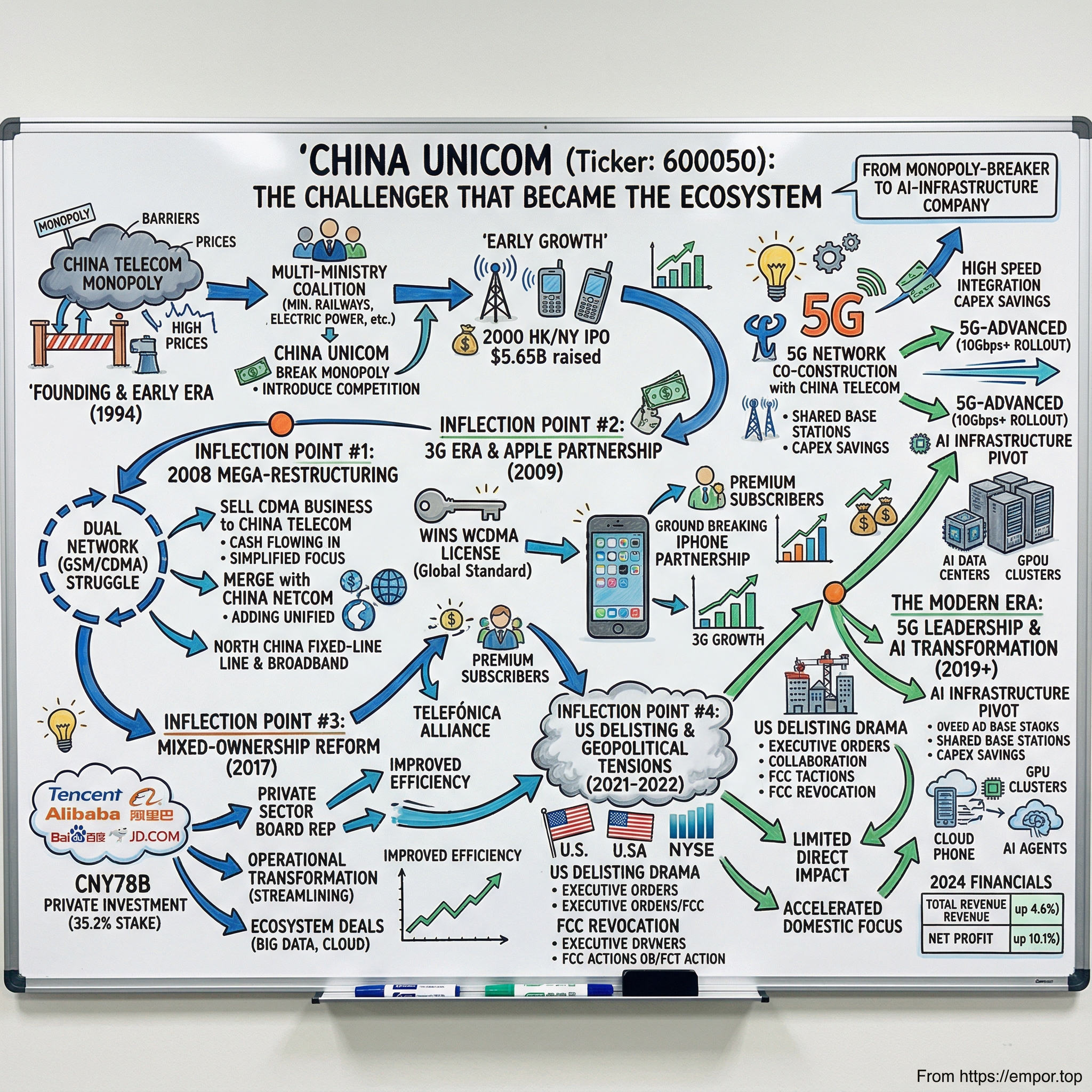
China Unicom: The Challenger That Became the Ecosystem
How a Government-Mandated Competitor Survived Four Rounds of Industry Restructuring, Pioneered China's iPhone Era, Became Ground Zero for SOE Mixed-Ownership Reform, and Positioned Itself as an AI-Infrastructure Company
I. Introduction & Episode Roadmap
Picture the summer of 1994 in Beijing—a city where pagers still outnumber mobile phones, where a single call costs more than the average worker's daily wage, and where an entire nation's telecommunications needs flow through one monolithic ministry. On July 19th, representatives from an unlikely coalition of government entities—the Ministry of Electronics Industry, Ministry of Electric Power, Ministry of Railways, and the State Economic and Trade Commission—gathered to witness what they called a "historic moment." With just 1.34 billion RMB in registered capital (roughly $150 million at the time), they established China United Telecommunications Corporation, better known as China Unicom.
This marked the first time that China introduced competition in the basic telecom business field, symbolising the official beginning of telecom industry reform in China. The company carried a mission that would define its identity for three decades: "breaking the monopoly, introducing competition, and developing the telecom industry."
Fast forward thirty-one years. As of 2022, China Unicom is the third-largest wireless carrier in China and the sixth largest mobile provider in the world. In March 2025, the company reported robust financial results for 2024, with its net profit rising 10.5 percent year-on-year to 9.03 billion yuan ($1.25 billion), while revenue grew 4.6 percent to 389.6 billion yuan.
The central question animating this deep dive is one that carries lessons far beyond Chinese telecommunications: How does a state-created challenger to a government monopoly not merely survive but thrive through four rounds of industry restructuring, pioneer transformative partnerships (including bringing the iPhone to China), serve as the test case for one of China's most ambitious state-owned enterprise reforms, navigate U.S. delisting and geopolitical fractures, and now position itself at the vanguard of AI-powered infrastructure?
The answer lies in understanding China Unicom not as a typical telecommunications company, but as a case study in strategic adaptation—a company whose DNA has been rewritten multiple times by external forces, yet which has consistently found ways to extract competitive advantage from apparent constraints. China Unicom stands out as the only major Chinese telecom operator to achieve double-digit net profit growth for three consecutive years.
This story matters because it illuminates how state-owned enterprises in the world's most dynamic telecom market navigate the intersection of government policy, technological disruption, international competition, and geopolitical tension. For investors evaluating exposure to Chinese infrastructure, for strategists studying how incumbents adapt, and for anyone seeking to understand the mechanics of China's digital transformation, China Unicom offers a masterclass.
II. The Founding Context: Breaking China's Telecom Monopoly (1992–1994)
Before understanding what China Unicom became, one must grasp what it was designed to destroy.
Prior to July 1994, China Telecom was the sole provider of telecommunications services in China. Before the establishment of China Unicom, China's public telecommunications network was exclusively operated by the Ministry of Posts and Telecommunications, which combined government and enterprise functions. This was not simply a monopoly—it was the government itself operating as the sole provider, with predictable results: long wait times for installations, exorbitant prices, and technological stagnation.
The numbers tell the story of dysfunction. Mobile phones were luxury items, priced at 28,000 RMB per unit—roughly equivalent to several years of an average urban worker's salary. The supply-demand contradiction in the Chinese telecom market had become, in the bureaucratic language of the era, "very sharp."
In the second half of 1992, the former Ministry of Electronics Industry, Ministry of Electric Power, and Ministry of Railways jointly submitted a report to the State Council of China, formally requesting the formation of China Unicom. The report particularly pointed out that the supply and demand contradiction in the Chinese telecom market was very sharp and that only by introducing competition could the telecom industry develop faster.
What makes this founding remarkable is its multi-ministry structure. China Unicom was founded as a state-owned enterprise in 1994 by the Ministry of Railways, the Ministry of Electronics and the Ministry of Electric Power Industry; the establishment was approved by the State Council in December 1993. This coalition was born not from altruism but necessity—these ministries had built their own telecommunications networks for internal use and sought permission to expand them commercially. They united against the Ministry of Posts and Telecommunications' stranglehold.
On July 19, 1994, representatives from the former Ministry of Electronics Industry, Ministry of Electric Power, Ministry of Railways, State Economic and Trade Commission, and the 10 major shareholders witnessed the historic moment of the establishment of China United Telecommunications Corporation.
The immediate impact was transformative for consumers, if initially painful for China Unicom itself. Pressured by other ministries and dissenting customers, the Chinese government officially started the telecom industry reforms in 1994 by introducing a new competitor: China Unicom. China Unicom could hardly compete with the giant China Telecom.
The competitive dynamics were brutal. Due to China Unicom's bold promotion of GSM, the former China Telecom was forced to respond, which helped promote the construction of the GSM network, causing the price of mobile phones at that time to drop significantly from 28,000 RMB per unit to 4,000-5,000 RMB. Mobile phone prices collapsed by more than 80% as actual competition forced efficiency onto a sector that had known only bureaucratic inertia.
The founding DNA of China Unicom embedded several characteristics that would prove enduring: a perpetual underdog mentality relative to larger state competitors, comfort with being a reform instrument rather than merely a commercial entity, and institutional relationships across multiple government power centers that would prove useful in navigating subsequent restructurings.
This multi-ministry heritage meant China Unicom was never simply a company trying to maximize shareholder returns—it was always, simultaneously, a policy instrument for broader state objectives. Understanding this dual nature is essential for anyone seeking to evaluate China Unicom's strategic moves, which have consistently balanced commercial logic with political necessity in ways foreign investors sometimes find opaque.
III. Early Growth & Going Global: The IPO Era (1995–2002)
The mid-1990s presented China Unicom with its first strategic test: how to build a national network from scratch while competing against an entrenched incumbent with overwhelming advantages in infrastructure, customer relationships, and government support.
The company's answer was aggressive technological leapfrogging. In 1995, China Unicom used GSM digital mobile communication technology to build China's second public mobile communication network in Beijing, Tianjin, Shanghai, and Guangzhou. Rather than attempting to replicate China Telecom's existing infrastructure, Unicom bet on newer digital standards that could deliver better service quality despite its limited coverage.
This strategy of using technology adoption to compensate for scale disadvantages would become a recurring pattern. Throughout its history, China Unicom has consistently been more aggressive than its larger rivals in embracing international standards and partnerships, using its position as the smaller player to justify moves that a dominant incumbent might resist.
By 1997, the company received approval to offer data services, marking an early diversification beyond voice telephony. In 1999, it obtained licenses for Internet services in July and initiated IP telephony trials in April, with nationwide expansion following in March 2000.
The decision to pursue international capital markets reflected both necessity and ambition. China Unicom needed funding for network buildout that domestic markets could not easily provide, while the discipline of international disclosure requirements and investor scrutiny offered a mechanism to demonstrate credibility against skeptics who doubted a government-created competitor could ever operate commercially.
On June 22, 2000, the company was incorporated in Hong Kong and was listed on the Hong Kong Stock Exchange. The IPO raised approximately US$5.65 billion through listings on the Hong Kong Stock Exchange and American Depositary Shares on the New York Stock Exchange, making it one of the largest Chinese IPOs of that era.
The corporate structure that emerged was Byzantine by any measure. In 2002, another intermediate parent company "China United Network Communications Limited" was established in Shanghai to own 51% stake of "China Unicom (BVI) Limited" as well as listing the shares in the Shanghai Stock Exchange. This created a layered system of BVI holding companies, A-shares, H-shares, and ADRs that would persist for decades—each layer serving different purposes for regulatory compliance, capital raising, and government oversight.
A major milestone came in 2002, when China Unicom became the world's first operator to run both GSM and CDMA networks simultaneously. This dual-network strategy reflected the company's attempt to address multiple market segments—GSM for cost-conscious mass-market consumers, CDMA for users seeking higher quality voice and data services.
By late 2002, the company's structure illustrated the complexity of Chinese state enterprise capitalism. As of 31 December 2002, state-owned China Unicom Group owned 74.6% shares of the A share company, in turn the A share company owned 73.84% of the BVI company. This cascading ownership structure provided the government ultimate control while enabling access to international capital markets.
The early 2000s represented a period of growth, but also mounting strategic tension. Operating dual GSM and CDMA networks consumed capital at rates that strained the company's ability to invest competitively in either technology. The CDMA network, in particular, struggled to achieve the subscriber scale needed to justify its infrastructure costs. This strategic diffusion would only be resolved through the mega-restructuring that would transform China's entire telecommunications landscape in 2008.
For investors examining China Unicom's history, this period establishes a crucial pattern: the company's strategic direction has often been shaped less by autonomous commercial decisions than by government policy interventions that reshape the competitive landscape. Understanding when and how such interventions occur—and positioning for their consequences—has been essential to navigating China Unicom as an investment.
IV. INFLECTION POINT #1: The 2008 Mega-Restructuring
If you had to choose a single event that transformed China Unicom from a struggling dual-network operator into a coherent national competitor, it would be the restructuring of May-June 2008. This government-mandated reorganization represented the most significant reshuffling of China's telecommunications industry since its initial formation, and it handed China Unicom a strategic clarity it had previously lacked.
The Context of Crisis and Opportunity
In 1998, due to a ministerial reorganization, the MTP was replaced by the new Ministry of Information Industry (MII). The MII took two large scale reshuffling actions targeting the inefficient state-monopoly. In 1999 the first restructuring split China Telecom's business into three parts (fixed-line, mobile and satellite). China Mobile and China Satcom were created to run, respectively, the mobile and satellite sectors but China Telecom continued to be a monopoly of fixed-line services.
By 2008, China's telecommunications market had become lopsided in a way that threatened the government's broader industrial objectives. China Mobile dominated 70% of the country's mobile subscribers. This dominance was problematic not merely for competitive reasons but because it concentrated too much strategic infrastructure under one entity and left the other operators too weak to serve as meaningful alternatives for critical national communications needs.
The Reform Architecture
On May 24, 2008, the MII, the NDRC and the Ministry of Finance of the PRC jointly issued the Announcement on Deepening the Reform of the Structure of the Telecommunications Sector. The principals objectives included supporting the formation of three telecommunications services providers, each with nationwide network resources, comparable scale and standing, full-service capabilities and competitive strength, in order to help optimize the allocation of telecommunications resources and foster market competition.
The restructuring's genius lay in its comprehensive rebalancing of assets among the three operators, designed to create genuine three-way competition rather than a dominant leader with two marginal followers.
China Unicom's Transformation
On June 2, 2008, China Unicom announced its intention to sell its CDMA business and assets to China Telecommunications Corporation (China Telecom Group) for a combined total of 110 billion RMB and to merge the remainder of the company, in a share swap valued at US$56.3 billion (based on Unicom's stock last traded price) on June 2, 2008, with China Netcom.
This represented a double transformation. First, the sale of CDMA to China Telecom allowed Unicom to shed a capital-intensive network that had never achieved profitable scale. The sale of CDMA business to Telecom is expected to help clarify Unicom's business focus in the future and facilitate the smooth transfer of GSM to 3G by consolidating resources. The merger between Unicom and Netcom is also expected to help Unicom to promptly establish leading technology advantages based on 3G technologies.
Second, the merger with China Netcom provided geographic completeness and fixed-line capabilities that mobile-focused Unicom had lacked. Netcom is the leading broadband and fixed-line operator in 10 provinces in the northern part of mainland China, including the capital Beijing. Unicom, having sold its CDMA business to China Telecom, will focus on its more profitable GSM operations.
The Merger Execution
China Unicom (Hong Kong) Limited (China Unicom, formerly known as China Unicom Limited) yesterday announced that its merger with China Netcom Group Corporation (Hong Kong) Limited (China Netcom) had become effective. Chang Xiaobing, the chairman and CEO of China Unicom, will continue to be the chairman and CEO of the merged group.
The merger was completed on 6 October 2008. Upon completion of the transaction, the merged company will integrate telecoms capabilities in mobile, fixed-line, broadband, data, and value-added services, and is expected to be granted a 3G licence by the government. Based on Unicom and Netcom subscriber data, as at 30 June, the merged company would have a total subscriber base of 259 million customers, including 128 million GSM subscribers, 109 million fixed-line subscribers, and 23.36 million broadband subscribers.
Strategic Implications
The restructuring handed China Unicom several decisive advantages:
-
Strategic Focus: Exiting CDMA eliminated the resource drain of maintaining two mobile technologies and allowed concentration on GSM's evolution to 3G.
-
Geographic Completeness: Netcom's northern China fixed-line dominance complemented Unicom's national mobile coverage.
-
Positioning for 3G: The merger positioned Unicom to receive the WCDMA license—internationally the most advanced 3G standard—setting up the company's subsequent iPhone partnership.
The main aim of the restructuring is to stimulate competition and enhance the overall competitiveness of the country's telecoms industry. Most significantly, the industry reshuffle will create a more level playing field among all telecoms operators, helping Telecom and the merged entity of Netcom and Unicom to compete more effectively with China Mobile, which dominates 70% of the country's mobile subscribers.
The 2008 restructuring fundamentally shaped China Unicom's strategic identity for the next decade. Rather than a company perpetually stretched between incompatible network technologies, it emerged as a focused GSM/WCDMA operator with fixed-line depth in northern China and a clear path to 3G leadership through international-standard technology.
For investors, the 2008 restructuring illustrates a crucial dynamic: in China's state-controlled telecommunications sector, strategic clarity often arrives not through organic competitive evolution but through government-mandated restructuring that redistributes assets and capabilities across the market. Understanding the political economy that drives such interventions—and recognizing the signs that one may be approaching—remains essential for positioning in Chinese telecom equities.
V. INFLECTION POINT #2: The 3G Era & Apple Partnership (2009–2013)
The restructuring of 2008 was not merely about corporate combinations—it was the prelude to a technological transition that would reshape Chinese telecommunications and cement China Unicom's position as the gateway for global technology partnerships.
Winning the 3G Standard Lottery
On 7 January 2009, China Unicom was awarded WCDMA license to expand its business to 3G telecommunication. UMTS (Universal Mobile Telecommunications System) was launched in major cities across China on May 17, 2009.
The allocation of 3G licenses reflected the government's deliberate balancing of the three operators. China Mobile received the TD-SCDMA license—a homegrown Chinese standard that struggled for international handset support. China Telecom inherited CDMA2000 along with Unicom's CDMA network. China Unicom received WCDMA—the dominant international 3G standard supported by the widest array of handsets and the clear winner in terms of global ecosystem compatibility.
WCDMA was the technology behind 3G networks across Europe, Japan, and most of Asia. It meant China Unicom's network could support virtually any international smartphone without modification—a competitive advantage that would prove transformative when a certain California-based company came calling.
The iPhone Partnership: Ground Zero for Apple in China
In the years immediately following the iPhone's 2007 launch, China represented both Apple's greatest opportunity and its most frustrating challenge. Millions of grey-market iPhones had already flooded the country through Hong Kong and other channels, demonstrating massive demand while highlighting the regulatory and partnership obstacles that kept Apple from officially serving the market.
Apple spokesman Alan Hely confirmed in August 2009: "We have signed a multi-year deal with China Unicom to bring iPhone to China, and we expect the launch to be in the fourth quarter of 2009."
China Unicom began selling the iPhone in 2009. In October 2009, the iPhone 3G and 3GS became the first iPhone models to be officially available for sale in mainland China through a deal between Apple and China Unicom.
The partnership's significance extended beyond handset sales. China Unicom struck a 3-year deal to finally bring the iPhone to China's massive subscriber-base potential. The carrier will offer two different "3G iPhones" to its 141 million subscribers and it will buy the phones wholesale from Apple—no revenue sharing deal here.
The wholesale purchase model, rather than revenue sharing, reflected Apple's negotiating leverage and China Unicom's desperation for differentiation. But the deal delivered what both parties needed: Apple gained its first official foothold in the world's largest mobile market, while China Unicom acquired a unique device that could attract premium subscribers away from China Mobile's dominant network.
Initial Struggles and Eventual Success
The partnership's early results disappointed. Apple's first foray into selling its iPhone in China at the end of 2009 failed to hit analyst expectations. Months after the official launch of the iPhone 3GS model, sales were nowhere near on track to hit the 5 million Apple's partner, China Unicom, had announced as its goal.
Many argued that high prices and regulations limiting Wi-Fi chips in smartphones were to blame. The Wi-Fi restriction was particularly damaging—Chinese regulations initially prohibited smartphones from including Wi-Fi capability, forcing the official Chinese iPhone to lack a feature that grey-market versions possessed.
Yet the partnership ultimately proved transformative for both companies. Li Gang, who led the team that negotiated China Unicom's first contract with Apple in 2009, said earlier in 2012 that the partnership has produced "better-than-expected results". Those results are particularly evident in the operator's 3G subscriber figures. China Unicom recently revealed that it had passed the 60 million user mark for its 3G services.
The Telefónica Alliance
The iPhone partnership was complemented by international strategic relationships that strengthened China Unicom's position.
In 2009, China Unicom (Hong Kong) agreed to a US$1 billion cross-holding with Spain's Telefónica. In January 2011, the two partners agreed a further US$500 million tie-up in each other, which following completion in late 2011, Telefónica will hold a 9.7% shares in China Unicom (H.K.), while the red chip company will own 1.4% shares of the Spanish firm.
The companies also agreed to deepen their cooperation in areas such as procurement, mobile service platforms, service to MNC's wholesale carriers, roaming, technology, among others.
This cross-holding represented the first significant foreign strategic investment in a major Chinese telecom operator—a relationship that would provide both procurement advantages and international legitimacy, even as it created complications when geopolitical tensions later intensified.
Building the Cloud Computing Foundation
In April 2012, China Unicom was a founding member in the formation of Cloud Computing Industry Alliance in Beijing. Other members of the alliance include Baidu, Tencent, and Alibaba.
This alliance foreshadowed the mixed-ownership reform that would come five years later, establishing working relationships with China's technology giants that would later convert into equity partnerships.
In July 2009, China Unicom signed a $700 million deal with infrastructure vendor Ericsson to upgrade the company's GSM network.
The 3G era established several patterns that continue to characterize China Unicom's strategy. First, the company demonstrated willingness to partner with international players—Apple, Telefónica, Ericsson—in ways that larger competitors avoided. Second, it showed how technological standard selection (WCDMA) could create partnership opportunities that offset scale disadvantages. Third, the period revealed both the opportunities and limitations of premium positioning in a market where China Mobile's sheer scale remained overwhelming.
For investors, this era illustrates how technology transitions create windows of strategic opportunity for properly positioned challengers—windows that close once the market matures and scale advantages reassert themselves.
VI. INFLECTION POINT #3: Mixed-Ownership Reform (2017)
If 2008's restructuring reshaped China Unicom's competitive position, the 2017 mixed-ownership reform reshaped its fundamental nature as an enterprise. This wasn't merely a capital raise or strategic partnership—it was a landmark experiment in Chinese state-owned enterprise reform, with China Unicom serving as the proving ground.
The Reform Pilot
Since Xi Jinping's assumption of leadership, the Chinese government had been exploring ways to inject private sector dynamism into state-owned enterprises while maintaining ultimate state control. The concept of "mixed ownership" emerged as the preferred mechanism: allowing private capital to acquire meaningful minority stakes that would bring commercial discipline without ceding strategic control.
China Unicom, the country's second-largest telecom company, was among the first group of state-owned enterprises (SOEs) to pilot the mixed-ownership reform as the government worked to revitalize torpid SOEs, a key link in developing a market economy.
The SOE is pressing ahead with its 78 billion yuan ($12.3 billion) mixed-ownership reform. It is widely seen as a test case for the country's pan-SOE makeover.
The Strategic Investors
China Unicom's CNY78 billion (USD11.7 billion) mixed ownership reform plan has been green-lit by the China Securities and Reform Commission (CSRC). Under the plan, strategic investors will take a roughly 35.2% stake in the group's Shanghai-listed unit, Unicom A Share Company, through the issuance of around 9 billion new shares and the sale of 1.90 billion shares by Unicom Group, at a price of CNY6.83 per share.
According to the plan, more than a dozen strategic investors, including tech heavyweights Tencent Holdings Ltd, Alibaba Group Holding Ltd, Baidu Inc and JD.com Inc, will buy a 35.2 percent stake in China Unicom's Shanghai-listed arm.
The investor roster read like a who's who of Chinese technology:
Baidu would invest 7 billion yuan in the company for a 3.3 percent stake. Tencent invested 11 billion yuan and gained a 5.18 percent stake, with other investments coming from Alibaba and JD.
Unicom's new strategic investors include internet firms Tencent, Baidu, JD.com, Alibaba and Suning.
Following the transaction, Unicom Group will hold a 36.7% stake in Unicom A Share Company, whilst strategic investors will hold 35.2%, and public shareholders another 25.4%, with the final 2.7% held by employees.
Why BAT All Invested
The convergence of China's "Big Three" internet companies—Baidu, Alibaba, and Tencent—into a single telecommunications investment was unprecedented. Each had commercial rationales, but the collective significance transcended individual business logic.
An access to the basic telecom infrastructure resources, such as servers and bandwidth, can greatly help Tencent and Alibaba's cloud computing and other businesses.
According to China Unicom, bringing in new investors will help the company improve its innovative capacity and allow it to transform from a traditional mobile carrier to an integrated information and technology operator.
Unicom OpCo will use the proceeds of the sale to enhance its 4G capabilities, invest in innovative businesses, conduct 5G technical network tests and build pre-commercial trial networks.
Board Representation and Real Governance
The reform went beyond capital injection to actual governance participation:
Among its 13 new board members, four are from the private sector—way beyond many people's expectations. One of them is Robin Li, CEO of Baidu, China's largest online search engine company and a pioneer in artificial intelligence technology. The move signals that China Unicom really wants to give private investors a say in the company's business decisions. Other new board members include three representatives from tech heavyweights Alibaba, Tencent and JD.
Operational Transformation
The reform triggered genuine operational changes:
After announcing in August 2017 that it had attracted industry heavyweights including Alibaba, Tencent, Baidu and JD as private investors, China Unicom has sought to streamline its organization, cut redundant departments and boost efficiency. Wang Xiaochu, chairman of China Unicom, said at a board meeting in February that overhauling corporate structure is one of the reform's top priorities. "We started with our Beijing headquarters, where the number of departments has been slashed from 27 to 18," Wang said. As a result, the number of employees at the headquarters has also been cut by half, from 1,781 to 865.
Since then, China Unicom has inked a series of deals with Baidu, Tencent and Alibaba in a wide range of areas, such as big data, cloud computing, the internet of things and smart electronic gadgets. Peter Liu, research director at consultancy Gartner Inc, said China Unicom is the biggest beneficiary of the mixed-ownership reform, and it is utilizing cutting-edge technologies from internet giants to access more channels and potential customers.
Financial Results
China Unicom posted a 2.59 billion yuan pretax profit in 2017, up from 784 million yuan in 2016. It declared a final dividend of 5.2 fen per share. The Chinese telco also benefited from the completion of the capital injection delivered by the mixed-ownership reform, with its liabilities-to-assets ratio down to 46.8% from 62.9% a year earlier.
Extending the Partnerships
In December 2022, China Unicom extended strategic cooperation agreements with four strategic investors Tencent, JD, Alibaba and Baidu. In 2017, China Unicom introduced the above four companies as strategic investors, and inked deals with them, as part of its broader push to pioneer State-owned companies' mixed ownership reform. China Unicom said in a statement that over the past five years, it has expanded the depth and breadth of cooperation with the strategic investors in business, products, channels, devices, capital and other fields, which has achieved win-win results.
The mixed-ownership reform represented a fundamental evolution in China Unicom's operating model, creating institutional ties to China's technology ecosystem that would prove essential for the company's subsequent pivot toward digital services and AI infrastructure. It also demonstrated—to domestic and international observers—that meaningful private participation in strategic state assets was possible within China's system, even if ultimate control remained with state shareholders.
VII. INFLECTION POINT #4: US Delisting & Geopolitical Tensions (2021–2022)
The trade tensions between the United States and China that escalated during the Trump administration eventually reached into capital markets, with China's telecommunications operators becoming targets in what both sides described as matters of national security.
The Executive Order
Executive Order 13959 is a U.S. Presidential Executive Order signed on November 12, 2020, by President Donald Trump. Its title and stated goal are "Addressing the Threat From Securities Investments That Finance Communist Chinese Military Companies." The executive order prohibits all U.S. investors from purchasing or investing in securities of companies identified by the U.S. government as "Communist Chinese military companies". A "Communist Chinese military company" is any company that the U.S. Department of Defense (DoD) has identified pursuant to Section 1237 of the National Defense Authorization Act for Fiscal Year 1999.
The Delisting Drama
The actual delisting process proved chaotic, with the NYSE reversing course multiple times:
Three Chinese companies will be booted off the New York Stock Exchange this month under an executive order signed in November by President Donald Trump. The exchange says China Telecom Corp. Limited, China Mobile Limited, and China Unicom Hong Kong Limited will be delisted from the exchange. Trump issued an order Nov. 12 barring investment in publicly traded companies that the U.S. government says are owned or controlled by the Chinese military. The statement issued late Thursday says the exchange will suspend trading of the companies as early as Jan. 7 or as late as Jan. 11.
The New York Stock Exchange said it no longer plans to delist three Chinese telecommunications giants: China Telecom, China Mobile and China Unicom. Four days earlier, the NYSE said it planned to drop those listings to comply with a November executive order from President Trump.
Then the reversal was reversed:
China's three biggest telecommunications firms said they requested a review of the New York Stock Exchange's decision to delist their shares more than a week ago, a move triggered by an executive order issued by former U.S. President Donald Trump. The drama surrounding the delisting, which played out over a few days with the bourse at one point reversing the decision before enforcing it again, caused wild swings in the companies' stock as investors were left with little time to react to the various moves. It also prompted some global equity indexes to remove the securities.
FCC Revocation
The regulatory pressure extended beyond securities markets:
In March 2021, the FCC initiated proceedings to revoke China Unicom's authorization to operate in the U.S. due to "national security" concerns. In January 2022, the FCC revoked China Unicom's authorization to operate in the United States, giving it 60 days to cease providing telecommunications services. In September 2022, the FCC added China Unicom to a list of companies considered "national security threats".
In December 2024, the U.S. Court of Appeals for the Ninth Circuit rejected China Unicom's challenge of the 2022 FCC revocation of its authorization to operate in the U.S. In March 2025, the FCC opened an investigation into China Unicom and other Chinese companies regarding operations in the U.S. in violation of restrictions. Also in March 2025, the United States House Select Committee on Strategic Competition between the United States and the Chinese Communist Party initiated an inquiry into China Unicom and issued subpoenas for company records in April 2025.
Strategic Implications
The delisting and regulatory actions crystallized several realities:
-
Limited Direct Impact: The China Securities Regulatory Commission (CSRC) said the planned delistings were "politically motivated" but added that even if the three telecom firms are delisted in the U.S., the impact on the companies will be "rather limited." The market value of each company's U.S.-listed shares is only around 2% of their total equity, the CSRC says.
-
Accelerated Domestic Focus: The reduced access to U.S. capital markets accelerated China Unicom's already-strong orientation toward domestic markets and Belt & Road-aligned international expansion.
-
Hong Kong Centrality: U.S. investors can keep hold of their stakes by exchanging their ADS holdings for shares listed in Hong Kong, where all three dual-listed telecom firms trade on the Hong Kong stock exchange. In three separate filings with market operator Hong Kong Exchanges and Clearing (HKEX) on Monday, the three telecom companies said that investors can deposit their ADS holdings with the Bank of New York Mellon and receive Hong Kong shares in return.
For investors, the geopolitical tensions created a bifurcation in China Unicom's investor base—Western institutional investors who departed or reduced positions versus Asian and domestic investors who absorbed the selling. This shift in ownership composition has implications for shareholder priorities and corporate governance, even if the operational business remained largely unchanged.
VIII. The Modern Era: 5G Leadership & AI Transformation (2019–2025)
The contemporary chapter of China Unicom's story represents an attempt to transcend its historical identity as a telecommunications carrier and become something more ambitious: an AI-infrastructure company positioned at the center of China's digital transformation.
5G Network Building: The Co-Construction Model
In 2019, all three telecoms were issued 5G national licenses. But rather than pursuing independent buildout, China Unicom pioneered a network-sharing model that would become a template for 5G infrastructure globally.
While significantly saving capital expenditure, the Company would enjoy the doubling of 5G network coverage, bandwidth, capacity and transmission speed, providing users with better experience. Currently, the two companies (China Unicom and China Telecom) shared 50,000 5G base stations and jointly saved investment costs of RMB10 billion.
In 2019, China Unicom and China Telecom signed the 5G Network Co-construction and Co-sharing Framework Cooperation Agreement, under which it was agreed that both parties would share the access network and build their own core networks, share 5G frequency resources and divide the network construction area.
This co-construction approach reflected both necessity (neither Unicom nor Telecom could match China Mobile's scale independently) and strategic insight (sharing infrastructure while maintaining brand competition could deliver equivalent coverage at dramatically lower capital intensity).
Since launching commercial use of 4G and 5G in 2014 and 2019 respectively, China Telecom and China Unicom have collaborated to accelerate network deployment, with over 2 million shared 4G mid-frequency base stations and more than 1.21 million 5G base stations in operation, achieving continuous coverage in towns and effective coverage in well-off administrative villages.
5G-Advanced Rollout (2024–2025)
Chinese carrier China Unicom aims to establish continuous 5G-Advanced (5G-A) coverage in key areas across 300 cities by the end of 2025, following initial pilot deployments in major cities in 2024. By July this year, the company plans to achieve seamless 5G-A coverage in urban areas of 39 cities before expanding further. The telco announced its 5G-A plans in Harbin, coinciding with the Asian Winter Games.
China Unicom Beijing and Huawei held an event to announce their deployment of the world's first large-scale integrated 5G-Advanced intelligent network. The network supports a world-leading 5G-Advanced smart commercial complex, with high- and low-band integrated networking, at the Workers' Stadium.
Field tests recorded a downlink peak rate of 11.2 Gbps, allowing a crowd of up to 68,000 people to simultaneously and smoothly watch 1080p videos. Meanwhile, the uplink peak rate reached 4 Gbps, sufficient to support services like UHD shallow compression.
The AI Transformation Strategy
China Unicom will fully embrace artificial intelligence to upgrade its business, and it plans a 28 percent year-on-year increase in computing power expenditure this year, said its chairman. During the 2024 earnings briefing in Hong Kong, Chen Zhongyue, chairman of China Unicom, emphasized the company's strategic pivot toward AI integration. "China Unicom will fully embrace AI to upgrade our cloud computing business, enabling integrated operations of intelligent computing (AI-driven) and general computing. By combining AI model training, inference, and cluster scheduling capabilities, we aim to deliver flexible, one-stop AI services for customers."
Despite a 17 percent year-on-year decline in total 2024 capital expenditures to 61.37 billion, computing-related investments climbed 19 percent. This reflects China Unicom's aggressive push to upgrade internet data centers into AI-optimized data centers, amid surging demand for generative AI and large language model infrastructure.
China Unicom unveiled a big plan to accelerate the company's intelligent computing infrastructure, including exploring a 100,000-GPU cluster deployment and targeting 45 EFLOPS of computing power, by the end of 2025. The plan, announced by Chen Zhongyue at the company's partner conference in Shanghai, is expected to position it among the world's most powerful AI computing benchmarks.
Cloud Phone & Edge Computing Innovation
In September 2024, China Unicom launched a publicly available cloud phone service powered by ground-breaking cloud-network synergy technology. By November 6, 2024, the service had gained 10,000 registered users.
China Unicom's cloud AI services represent a new type of business model. Instead of taking the traditional approach based on selling gigabytes, it aims to sell experiences. In partnership with Huawei, the telco has been developing cloud AI products for over a year. Its approach spans smartphones, tablets and a smart home robot named Tone Tone, each powered by its unified cloud AI operating system. Crucially, by moving computing power to the cloud, China Unicom says it can reduce hardware investment by over 90%. This addresses the large number of entry-level and mid-range devices that can't currently support AI apps and services because of hardware limitations.
Initial uptake has been impressive: 15 million users have registered for the cloud AI products, of which 4 million are monthly active users.
Financial Performance (2024)
Total revenue was RMB389.59 billion in 2024, up by 4.6% year-on-year. Service revenue reached RMB345.98 billion, up by 3.2% year-on-year. The profit attributable to equity shareholders of the Company was RMB20.61 billion, up by 10.1% year-on-year. In 2024, the Company's net cash flow from operating activities was RMB89.40 billion. Capital expenditure was RMB61.37 billion.
Unicom Cloud revenue reached 68.6 billion yuan, up 17.1% year-on-year, while data center revenue was 25.9 billion yuan, a year-on-year increase of 7.4%. The intelligent computing business drove robust growth in computing power services, with contracted amounts exceeding 26 billion yuan last year.
Its mobile billing subscriber scale exceeded 340 million, with a cumulative net addition of 10.68 million. Its fixed-line broadband subscriber scale exceeded 120 million, with a cumulative net addition of 8.84 million. Both mobile and broadband subscriber scales reached historical highs.
IX. Competitive Landscape & Strategic Analysis
The Triopoly Structure
The three major players in the industry are China Mobile, China Telecom and China Unicom, with a joint market share of 97.7% in 2024.
China Mobile dominates the mobile market with 58% market share, although that has been slowly declining over the years as China Telecom has started to pick up the pace.
As of July 2024, China Mobile leads with 528 million 5G subscribers, followed by China Telecom with 334 million, and China Unicom with 279 million.
Porter's Five Forces Analysis
Threat of New Entrants: Very Low The Chinese telecommunications market presents formidable barriers to entry. License requirements, massive infrastructure investments, and implicit government preference for the existing triopoly make new entry essentially impossible. State-owned capital dominates the industry to guarantee the stable mobile telecommunications service supply and safety.
Bargaining Power of Suppliers: Moderate China Unicom benefits from multiple domestic equipment suppliers (Huawei, ZTE) and the bargaining power created by co-construction arrangements with China Telecom. However, U.S. restrictions on semiconductor supply chains create some supply vulnerabilities for advanced network equipment.
Bargaining Power of Buyers: Moderate-High Individual consumers face low switching costs and can readily compare pricing across three competitive operators. Enterprise customers have more bargaining power due to contract values and the operators' desire to capture digital transformation spending.
Threat of Substitutes: Moderate and Rising Traditional voice and SMS revenue continues declining as messaging apps (WeChat) and VoIP services provide functional substitutes. However, operators are pivoting toward cloud, AI, and enterprise services where substitution threats differ.
Competitive Rivalry: High Competition within the triopoly is intense, particularly in pricing and network coverage. This oligopolistic structure fosters intense non-price competition alongside pricing strategies influenced by regulatory oversight from MIIT. Pricing dynamics have featured repeated reductions in mobile data tariffs, driven by rivalry among the incumbents to capture subscribers amid high penetration rates.
Hamilton Helmer's 7 Powers Framework
Scale Economies: China Unicom lacks this power relative to China Mobile. The co-construction arrangement with China Telecom is explicitly designed to offset this disadvantage.
Network Effects: Limited in traditional telecom but emerging in cloud and digital platform services where Unicom's partnerships with Alibaba, Tencent, and Baidu could create ecosystem advantages.
Counter-Positioning: Unicom's AI-first strategy and cloud phone innovation represent attempts to position against competitors reluctant to cannibalize existing business models.
Switching Costs: Moderate for consumers (phone number portability exists but creates friction); higher for enterprise customers with integrated digital services.
Cornered Resource: Unicom's WCDMA heritage provided this advantage during the 3G era (enabling iPhone exclusivity). Currently, its strategic investor relationships with BAT may constitute a form of cornered resource in ecosystem access.
Branding: Weaker than China Mobile, which benefits from first-mover advantages in consumer awareness.
Process Power: The mixed-ownership reform aimed to inject private-sector operational efficiency. Evidence of operational improvement (headquarters staff reduction, efficiency gains) suggests emerging process advantages.
X. Investment Considerations
Bull Case
-
AI Infrastructure Positioning: China Unicom's aggressive pivot toward intelligent computing infrastructure positions it to capture digital transformation spending as Chinese enterprises adopt AI. Chen Zhongyue emphasized the strategic importance of AI agents in commercial value realization, highlighting that "AI agents are key to unlocking commercial value."
-
Capital Efficiency: The co-construction model with China Telecom delivers coverage parity with China Mobile at substantially lower capital intensity. Declining capex with rising computing investments suggests rational capital allocation.
-
Strategic Partnerships: The BAT investor base provides ecosystem integration opportunities unavailable to competitors—access to cloud workloads, AI capabilities, and consumer applications.
-
Consistent Profit Growth: China Unicom stands out as the only major Chinese telecom operator to achieve double-digit net profit growth for three consecutive years.
-
Valuation: Following U.S. delisting, the stock trades at depressed multiples relative to historical averages and international peers, despite operational improvements.
Bear Case
-
Structural Competitive Disadvantage: Despite reforms, China Unicom remains the smallest of three operators. China Mobile commands approximately 61% of the wireless market share as of 2024, and scale advantages compound over time.
-
Geopolitical Risks: U.S.-China tensions create ongoing regulatory uncertainties. Equipment supply chain vulnerabilities, restrictions on international expansion, and potential further sanctions represent material risks.
-
State Control: Despite mixed ownership, ultimate control remains with state shareholders whose objectives may not align with minority investors. Political directives could override commercial logic on pricing, investment, or strategic direction.
-
Industry Maturation: While the telecom sector faces structural challenges, including declining voice and SMS revenues, the expansion of mobile and broadband services presents significant opportunities. The growth in mobile subscriptions, however, is expected to slow, intensifying competition among operators for a shrinking pool of new customers.
-
Cloud Competition: The cloud and AI services market is intensely competitive, with pure-play providers (Alibaba Cloud, Tencent Cloud) possessing technical advantages that telecom operators may struggle to match.
XI. Key Performance Indicators to Monitor
For investors tracking China Unicom's ongoing performance, three metrics merit particular attention:
1. Computing & Digital Smart Applications (CDSA) Revenue as Percentage of Total Revenue
This metric captures the success of China Unicom's strategic pivot from traditional telecommunications toward digital services. Computing and Digital Smart Applications business revenue consists of service revenue related to data and internet application services of RMB82.49 billion. In 2024, revenue from Computing and Digital Smart Applications business was RMB82.49 billion, up by 9.6% year-on-year. Currently approximately 24% of service revenue, this percentage should increase if the transformation strategy succeeds. Stagnation would suggest the pivot is failing to gain traction.
2. Intelligent Computing Contracted Amount
The intelligent computing business drove robust growth in computing power services, with contracted amounts exceeding 26 billion yuan last year. This forward-looking indicator reveals enterprise demand for AI infrastructure services and provides visibility into future revenue. Growth rates here indicate market acceptance of Unicom's AI-first positioning.
3. 5G Package Subscriber Additions and ARPU Trends
While traditional telecom metrics, 5G subscriber growth and ARPU (Average Revenue Per User) trajectory reveal whether premium services can offset commodity pricing pressure. The company reported a substantial number of 5G package subscribers, reaching 285.60 million as of September 2024. Accelerating additions with stable or rising ARPU would indicate successful monetization of 5G investments.
XII. Regulatory & Accounting Considerations
Regulatory Overhangs
- U.S. sanctions and FCC restrictions continue creating operational constraints on international business
- Ongoing investigations by U.S. House Select Committee create headline risk
- Chinese regulatory changes (Cybersecurity Law, data localization requirements) could affect foreign customer relationships
- Spectrum allocation decisions by MIIT directly impact competitive positioning
Accounting Judgments
- Depreciation policy for 5G network assets: Changes to asset lives materially impact reported profitability
- Revenue recognition for multi-year enterprise contracts
- Related-party transactions with state-controlled entities (China Telecom co-construction arrangements)
- Capitalization versus expensing of network maintenance and upgrade costs
XIII. Conclusion: The Permanent Challenger
China Unicom's three-decade journey from monopoly-breaker to AI-infrastructure company encapsulates the complexity of investing in Chinese state enterprises. The company has survived—and occasionally thrived—through four rounds of government-mandated restructuring, pioneered international partnerships that transformed Chinese consumer technology access, served as the test case for the most significant SOE reform experiment in a generation, and navigated geopolitical pressures that severed its U.S. market access.
What emerges from this history is a company comfortable with its role as perpetual challenger—never the market leader, always requiring strategic creativity to offset scale disadvantages, yet benefiting from enough state support to remain viable through competitive cycles that might eliminate a purely private competitor.
The fundamental question for investors is whether China Unicom's AI and cloud computing pivot represents a genuine transformation of its competitive position or merely the latest iteration of its long-running attempt to escape commodity telecommunications economics. The partnerships with BAT, the aggressive computing infrastructure investments, and the innovative cloud phone services suggest management recognizes that the traditional telecom playbook leads to permanent second-tier status.
The answer will emerge over the next several years as China's digital economy either validates Unicom's infrastructure-first positioning or rewards pure-play cloud providers who lack telecom legacy costs. For investors willing to accept the geopolitical complexity and state-enterprise governance challenges, China Unicom offers exposure to one of the world's most sophisticated telecommunications markets at valuations that reflect significant pessimism about its competitive position—pessimism that may prove excessive if the AI transformation delivers on its promise.
What remains constant across thirty years of transformation is China Unicom's foundational identity: born to challenge monopoly, destined to remain a challenger, yet continuously adapting to ensure that challenge remains relevant in whatever technological era emerges next.


 RSS Feed
 Spotify
 Apple Podcasts
 Amazon Music
 Audible
 YouTube