 Chat with
this content: Summary, Analysis, News...
Chat with
this content: Summary, Analysis, News...
 Subscribe on LinkedIn


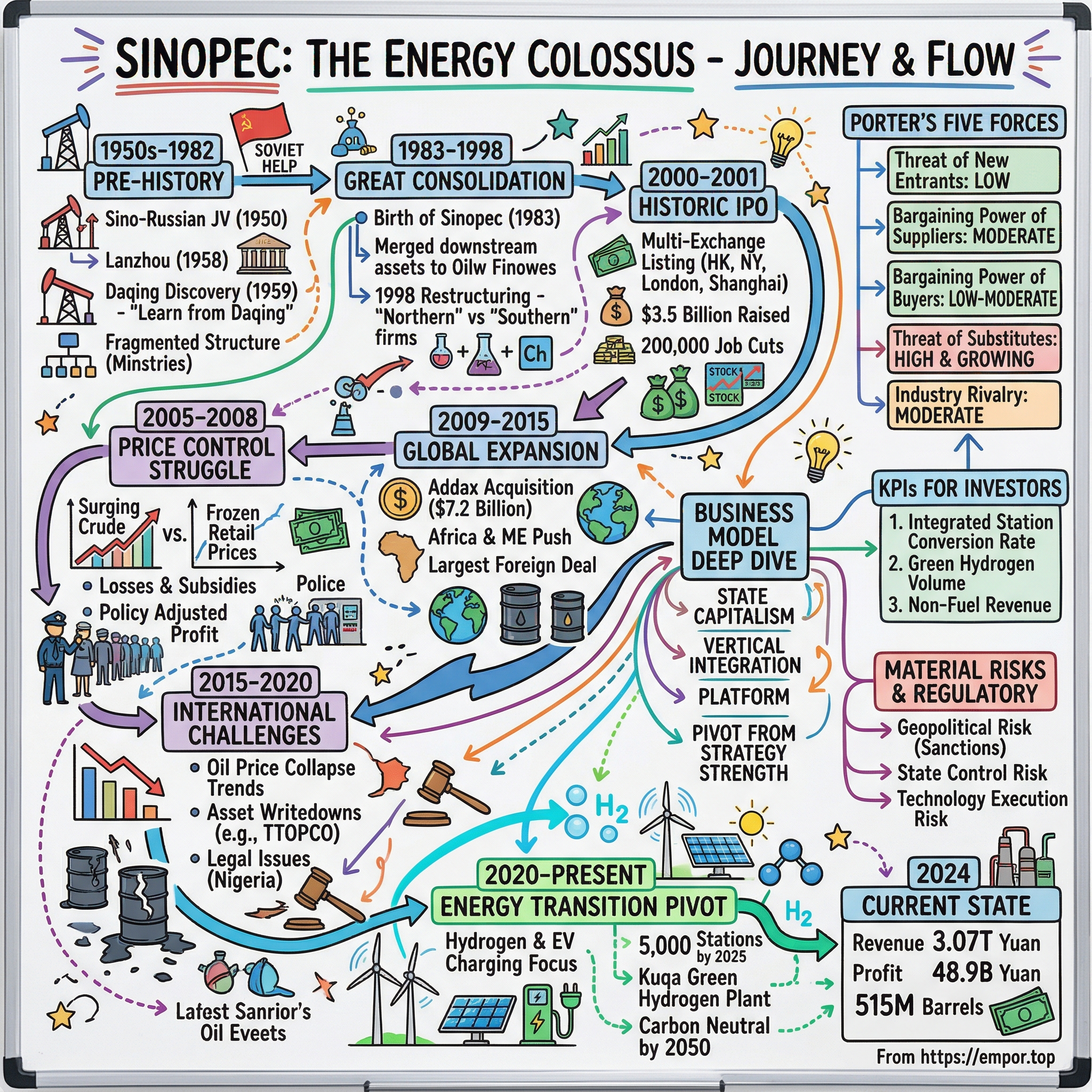
Sinopec: China's Energy Colossus and the Future of Fuel
I. Introduction & Episode Roadmap
Imagine standing in the control room of the world's largest oil refining operation—a sprawling empire of 30,000+ gas stations, refineries processing 252 million tonnes of crude oil annually, and hydrogen fueling stations springing up across a nation of 1.4 billion people. This is Sinopec in 2024: the world's largest oil refining conglomerate, state owned enterprise, and second highest revenue company in the world behind Walmart.
The numbers tell a story of breathtaking scale. In 2024, Sinopec's operating revenue reached 3.07 trillion yuan (USD 422.739 billion) with profit attributable to shareholders amounting to 48.94 billion yuan (USD 6.74 billion). To put that in perspective, that's roughly the GDP of the Philippines flowing through a single corporate structure. The company confirmed a 75% dividend payout ratio, including share buybacks, and announced a proposed annual dividend of 0.286 yuan per share.
But the question that should occupy every serious investor's mind isn't about the past—it's about the transition. How did a restructured government ministry become the world's largest refiner? And more importantly: can a state-owned oil giant successfully pivot to become China's leading hydrogen company?
Sinopec has China's largest petrol station network with over 30,000 stations—a distribution platform that most startups would sacrifice a kidney for. That network isn't just selling gasoline anymore. By October 12, 2024, Sinopec had built over 8,600 charging stations nationwide, including comprehensive service stations that offer fuel, EV charging, car washes, retail, dining, and even leisure activities like camping.
The strategic pivot is clear: Sinopec is attempting what might be the most audacious corporate transformation in energy history—converting from the world's largest refiner into a "comprehensive energy services provider." This isn't a company fighting disruption; it's a company trying to own disruption.
This article will trace that arc: from the fragmented petroleum ministries of 1950s China, through the landmark 2000 IPO, the Addax acquisition that marked China's largest foreign oil deal, the price control struggles that revealed the peculiar dynamics of state capitalism, and finally into the hydrogen and EV charging future that management believes represents survival.
The themes are universal but the context is uniquely Chinese: state capitalism, vertical integration, geopolitical resource security, and the high-wire act of satisfying both Communist Party objectives and international investors.
II. Pre-History: China's Fragmented Petroleum Industry (1950s–1982)
The origins of Sinopec trace back to a dusty agreement signed in the earliest days of Communist China. China's first oil joint venture was launched on March 27, 1950, by an agreement with the Soviet government to establish the Sino-Russian Petroleum Co. Ltd.—a joint effort to develop Xinjiang's Dushanzi Oil Mines.
Picture Beijing in 1950: a newly proclaimed People's Republic, still fighting Nationalist remnants in Taiwan, economically devastated by decades of war, and critically dependent on Soviet technical expertise for nearly every industrial ambition. The petroleum industry was no exception.
Early efforts, aided by Soviet expertise, included constructing China's initial refineries and ethylene plants during the First Five-Year Plan, such as the Lanzhou facility operational by 1958. These were modest operations by global standards—learning-by-doing facilities that trained China's first generation of petroleum engineers while the country's ideological fervor built infrastructure from nothing.
Then came Daqing.
The 1959 discovery of the Daqing oilfield accelerated downstream development, leading to integrated petrochemical complexes in the 1960s and 1970s—though output remained modest with total refining capacity below 50 million tons annually by 1978. The Daqing discovery was more than geological—it was ideological. "Learn from Daqing" became a national slogan, transforming oil workers into revolutionary heroes and petroleum into a symbol of Chinese self-reliance.
But behind the propaganda, chaos reigned. The petroleum sector operated as a bureaucratic patchwork—multiple ministries, overlapping jurisdictions, and no coherent strategy. CNPC was in charge of the exploration of onshore oil; SINOPEC was accountable for oil refining and pipeline construction, while CNOOC was engaged in the exploitation of offshore oil. This fragmented structure would persist until the great consolidation of 1998.
The Cultural Revolution (1966-76) disrupted even the oil sector, though the Daqing mystique provided some protection. Technical expertise was suspect; ideological purity was paramount. China's petroleum industry, like so much else, survived rather than thrived.
By 1978, when Deng Xiaoping launched his "reform and opening" policy, the petroleum industry was overdue for restructuring. Refining capacity had stagnated, technology lagged decades behind international standards, and the organizational structure—split among ministries and bureaus answering to different political masters—made coherent development impossible.
The next five years would change everything.
III. The Great Consolidation: Birth of Sinopec (1983–1998)
In the Great Hall of the People on July 12, 1983, something unprecedented happened: the founding meeting of Sinopec Corporation was held in the Great Hall of the People. The establishment of China Petroleum and Chemical Corporation marked Beijing's first serious attempt to rationalize its petroleum sector.
China Petrochemical Corporation (Sinopec), the core predecessor to the modern entity, was formally established in July 1983 under the State Council as a state-owned enterprise tasked with managing refining, petrochemical production, and distribution. This wasn't privatization—that word was still heretical in 1983 China—but it was centralization, and centralization was the first step toward efficiency.
This creation merged downstream assets from the Ministry of Petroleum Industry—responsible for refining and basic chemicals—and the Ministry of Chemical Industry, which oversaw advanced petrochemicals, aiming to streamline operations separate from upstream exploration dominated by other state bodies. The move reflected broader economic reforms under Deng Xiaoping, prioritizing industrial consolidation to boost efficiency amid rising energy needs post-Cultural Revolution recovery.
The logic was straightforward: China had created CNOOC for offshore exploration, CNPC for onshore exploration, and now Sinopec for refining and distribution. Each would be a "national champion" in its domain. This wasn't about competition—it was about control.
In the late 1980s, Sinopec absorbed petrochemical assets from the dissolved Ministry of Chemical Industry in 1988, expanding its scope to include synthetic fibers and resins. The company grew through bureaucratic annexation rather than market conquest, absorbing whatever assets the central government deemed appropriate.
But by the mid-1990s, cracks were showing. The vertically disaggregated structure—exploration here, refining there, marketing somewhere else—created perverse incentives. CNPC had crude oil but needed refining capacity. Sinopec had refineries but needed crude oil. Both had to navigate Byzantine internal transfer pricing systems that satisfied nobody.
The solution came in 1998, and it was radical.
China Petrochemical Corporation (the Company) was established in July 1998 on the basis of the former China Petrochemical Corporation, a move by the central government to strategically restructure the petroleum and petrochemical industry.
This wasn't mere renaming. In a 1998 restructuring of the national oil industry, CNPC acquired 19 companies from the China Petrochemical Corporation (Sinopec), including several refineries, while Sinopec acquired 12 of CNPC's companies, including several oilfields.
After the swap, CNPC and Sinopec became known as "Northern" and "Southern" companies, respectively, due to the location of their assets. Geography replaced function as the organizing principle. Both companies would now be vertically integrated—exploration through retail—but serving different regions.
The 1998 petroleum industrial restructuring and the subsequent market structure of oligarchic monopoly were a reflection of the Chinese leadership's perceptions of the oil market and its strategic thinking to serve its social and industrial policies, and foreign and energy security strategies.
The restructuring served multiple purposes. It created more efficient organizational structures. It prepared the companies for eventual public listing. And it positioned them to compete with international oil majors on more equal terms. Whether it created genuine competition is another question—as the next decade would demonstrate.
IV. The Historic IPO: Going Public While Staying State-Owned (2000–2001)
In the autumn of 2000, Sinopec pulled off one of the most remarkable corporate feats in emerging market history: going public while remaining fundamentally state-controlled. The contradiction would define the company's relationship with capital markets for decades to come.
Sinopec Limited was established as a joint stock entity under the China Petrochemical Corporation Group (Sinopec Group) in February 2000. The company was simultaneously listed in Hong Kong, New York, and London in October 2000. The IPO raised $3.5 billion.
The 16.78 billion H shares were listed in Hong Kong, New York and London Stock Exchanges on 18th and 19th October, 2000. The 2.8 billion A shares were listed in Shanghai Stock Exchange on 8th August, 2001.
This multi-exchange listing was strategic choreography. International markets provided capital, credibility, and corporate governance pressure. The Shanghai listing connected with domestic investors and provided political legitimacy. The structure ensured that Sinopec Group—still 100% state-owned—would retain majority control while tapping global capital markets.
The preparation was brutal. In the lead up to going public, Sinopec cut over 200,000 jobs from its roster. That's not a typo. Two hundred thousand employees—the population of a mid-sized American city—were removed in the years before IPO. This was the price of meeting international investor expectations for efficiency, and it signaled that Beijing was serious about making state enterprises function more like corporations.
The timing proved prescient. China entered the WTO in 2001 which some experts claim put additional pressure on their domestic oil industry to be efficient. WTO membership meant eventual market opening; market opening meant competition; competition required efficiency. The IPO forced discipline that pure government ownership never had.
Yet the listing preserved a fundamental tension that persists today: Sinopec is simultaneously a publicly traded company answerable to shareholders and a state-owned enterprise answerable to the Communist Party. When these interests align, everyone prospers. When they conflict, the Party wins.
The government no longer directly manages day-to-day operations of these companies, but it does provide the companies with optional guidelines. Though not mandatory, the Chinese state oil companies often choose to follow these guidelines, as compliance helps to ensure government protection when necessary.
"Optional guidelines" that you "choose to follow" to ensure "government protection" is a distinctly Chinese oxymoron. The listed company is technically independent; practically, it operates within boundaries set by Party priorities.
For investors, this creates what some Shanghai analysts call "valuation with Chinese characteristics." You're buying exposure to China's energy sector, the efficiency gains from public market pressure, and the implicit government guarantee that prevents bankruptcy—but you're also buying exposure to policy risks, subsidized pricing mandates, and strategic decisions that may not optimize shareholder returns.
The IPO established a template that dozens of Chinese SOEs would follow: restructure, list a portion internationally, retain state control, and use capital markets as a discipline mechanism without ceding ultimate authority. Sinopec was the proof of concept.
V. The Price Control Struggle: "Valuation with Chinese Characteristics" (2005–2008)
If the IPO demonstrated how Chinese state capitalism could harness capital markets, the fuel pricing crisis of 2005-2008 demonstrated its limits. What transpired was effectively a corporate game of chicken between publicly traded oil giants and the central government—and the episode revealed dynamics that investors ignore at their peril.
The National Development and Reform Commission sets gasoline and diesel prices and the Ministry of Finance collects windfall tax on upstream profits. At the beginning of 2006, Chinese retail gasoline and diesel sales were not profitable for Sinopec and sales were hurting the company's financials.
Picture the economics: global crude prices were surging past $70 per barrel, but Chinese retail fuel prices were frozen at levels set when crude was far cheaper. Every liter of gasoline Sinopec sold was losing money. The more they sold, the more they lost. This is what happens when you're a publicly traded company with profit obligations operating under government-mandated pricing that ignores market realities.
The response was audacious: To pressure the NDRC, Sinopec and CNPC cut production causing long lines at the pump. This led to NDRC approving a 15% increase in the price at the pump.
In August 2005, China's southern manufacturing heartland of Guangdong was plagued by closed service stations, fuel rationing and hours-long gas queues, and authorities were forced to send thousands of police to petrol stations in Guangzhou to prevent massive social unrest as drivers scrambled to fill their tanks.
State-owned enterprises deliberately restricting supply to pressure their own government regulator? It's hard to imagine ExxonMobil or Shell engaging in such brinksmanship with Washington or London. But in China's peculiar political economy, the oil giants had leverage: they were too important to ignore, too large to punish severely, and—crucially—the executives understood their own political standing.
China's bureaucratic system makes it possible for the two giants to dare to challenge the NDRC's authority because, administratively, Sinopec and PetroChina are under the supervision of the State-owned Assets Supervision and Administration Commission, not the NDRC. And, in the bureaucratic hierarchy, the duo are vice ministry or ministry-level units whose top executives are appointed by the State Council or cabinet.
When the NDRC couldn't command compliance, the government resorted to its checkbook. To offset losses from the price controls, the state gave Sinopec $1.1 billion in subsidy during 2005 and $647 million in 2006.
This finance example demonstrates Sinopec's implementation of policy adjusted profit. Chinese methods on how to articulate, quantify, and report the sometimes conflicting interests of profit and political policy have evolved during over time.
"Policy adjusted profit" is a remarkable euphemism. What it means is this: Sinopec's reported earnings reflect both commercial operations and government interventions (subsidies, mandated pricing, policy directives). Investors must decode the mix to understand true operational performance.
In 1998, when Beijing reorganized most state-owned oil and gas assets and made CNPC and Sinopec into two vertically integrated firms, one objective of restructuring these companies was to reduce the heavy financial burden of subsidy by the government. As a result of the 1998 restructuring, the rationale of NDRC's oil product price control may seem reasonable—the current financial losses incurred in the downstream refining operations of the CNPC and Sinopec could be covered by the windfall profits from each company's upstream production.
The theory was elegant: vertical integration would create internal cross-subsidization, freeing the government from external payments. The practice was messier. When upstream profits couldn't offset downstream losses, the tension exploded into public confrontation.
For investors, the lesson was stark: Sinopec's financial results are policy-determined to a degree unusual among publicly traded companies. Understanding Chinese energy policy isn't optional due diligence—it's essential for modeling future performance.
VI. Global Expansion: The Addax Acquisition and Africa Push (2009–2015)
By 2009, Sinopec's management understood their strategic vulnerability. Despite post-1998 restructuring, the company remained heavily weighted toward downstream operations. When global crude prices spiked, Sinopec's refining margins collapsed because it lacked the upstream production to offset input cost increases.
The solution was aggressive international expansion, and the vehicle was Addax Petroleum.
Chinese refiner Sinopec agreed to acquire oil and gas exploration company Addax Petroleum Corp. in a deal valued at $8.27 billion Canadian (US$7.2 billion), gaining access to reserves in West Africa and the Middle East.
Addax Petroleum was established in 1994 and since August 2009 has been a subsidiary of the Sinopec Group, one of the largest oil and gas producers in China, the biggest oil refiner in Asia, and the third largest worldwide. Addax Petroleum was an international gas and oil production and exploration company mainly focused on the Middle East, the North Sea, and Africa.
Since its founding, the company has become one of the largest oil producers in West Africa. For Sinopec, Addax offered exactly what it needed: proven reserves in multiple countries, operational expertise in frontier environments, and immediate production that could offset downstream pricing pressures.
The takeover is the latest effort by Chinese energy and resource companies to expand and diversify overseas assets as Beijing seeks to secure scarce resources for the country's future growth.
The financial crisis created the opportunity. As a result of the financial crisis, however, Addax Petroleum was running out of cash and received a 49% premium from its sale to Sinopec. Geneva-based Addax, trapped between collapsing oil prices and development commitments it couldn't fund, became a willing seller at precisely the moment Sinopec had capital to deploy.
The transaction represents the largest foreign acquisition ever completed by a company from the People's Republic of China.
Subsequent deals in 2010 expanded holdings through the acquisition of oil and gas assets in Brazil and Argentina, alongside further development in Kazakhstan. Sinopec was building a global upstream portfolio for the first time.
Addax Petroleum purchased 49% of Talisman UK in 2012, to form the Talisman-Sinopec Energy UK Ltd Joint Venture company, that became Repsol-Sinopec Resources UK in July 2016, and is the 4th largest UK oil producer.
The strategic logic was impeccable: China imports approximately 70% of its oil needs. Owning production abroad—and the expertise to operate internationally—was existential for energy security. Sinopec was executing Beijing's "Go Out" policy with corporate precision.
China's Go Out policy explicitly stated, in 2001, that Sinopec should "make effective use of overseas resources, build the overseas oil and gas supply bases and diversify the oil imports". This was revised in 2006 to "broaden international oil and gas cooperation".
By 2015, Sinopec had transformed from a purely domestic refiner into a company with meaningful international upstream operations. Whether those operations would prove successful was another question entirely.
VII. The Mixed Bag: International Expansion Challenges (2015–2020)
Grand strategy meets messy reality. The Addax acquisition that seemed so strategically sound in 2009 began unraveling almost immediately after integration.
In 2015, hit by the collapsing crude oil price and the lack of operational and exploration results, Addax Petroleum released 70 people at its Geneva offices.
The timing couldn't have been worse. Oil prices collapsed from over $100 per barrel in 2014 to under $30 in early 2016. Addax's assets—purchased at premium valuations reflecting $100 oil expectations—suddenly looked vastly overvalued. Exploration results disappointed. The "Vision 500" plan—reaching an average daily production of 500,000 barrels of oil by 2015—proved fantasy.
Addax Petroleum has never been able to get anywhere close to that production figure.
The write-downs cascaded. In 2017, TTOPCO announced a $181-million writedown on the asset value after the auditor McDaniel in February 2017, had evaluated its reserves at 59 million barrels, compared to 172 million barrels at 31 December 2015.
A 66% reserve revision isn't a rounding error—it suggests either that initial valuations were wildly optimistic or that geological conditions proved far worse than expected. Either way, it demonstrated the challenges Chinese SOEs face when acquiring complex international assets.
Legal troubles compounded operational difficulties. In 2017, Addax agreed to pay 31 million Swiss francs to the Swiss Federal Office of Justice in order to settle allegations over suspected bribery of foreign officials in Nigeria. Following an investigation by the Swiss criminal authorities, Addax's CEO and Legal Director were both charged for suspected violations of the Foreign Bribery Act.
Operating in Nigeria—one of Africa's most challenging business environments—exposed Sinopec to risks that Chinese domestic operations never prepared them for. Anti-corruption enforcement, host government disputes, and complex stakeholder management required skills and experience that state-owned enterprises from command economies typically lack.
By 2023, the Nigerian chapter had effectively closed. On the 31 January 2023, the four major oil mining blocks associated with Addax's production sharing contract (PSC) in Nigeria were formally acquired by The Nigerian National Petroleum Corporation (NNPC) Limited.
The Addax experience offers sobering lessons. Chinese SOEs possess advantages—patient capital, government backing, tolerance for losses that would sink private companies—but they also face handicaps: limited experience with adversarial legal systems, cultural unfamiliarity with frontier environments, and governance structures that can impede nimble decision-making.
By the end of 2024, Sinopec operated 48 oil and gas exploration and production projects across 23 countries, encompassing onshore and offshore, conventional and unconventional resources, with equity production reaching 26.52 million tonnes of oil equivalent.
The international portfolio survived, but at significant cost. Whether it generates returns justifying the capital deployed remains questionable—particularly given the energy transition that was about to reshape Sinopec's strategic priorities entirely.
VIII. The Energy Transition Pivot: Hydrogen & EV Charging (2020–Present)
November 2020 marked a quiet but consequential milestone. China Petroleum & Chemical Corp (Sinopec) launched its first wind power project as part of an energy transition strategy that includes major green hydrogen ambitions. The 20MW onshore wind project, located in Dali in China's northwestern Shaanxi province is being developed by Sinopec Star Co, a clean-energy subsidiary of the national oil company that previously focused only on geothermal development.
The world's largest refiner was building wind turbines. If that seems incongruous, consider it the opening move in a comprehensive energy transition strategy.
The wind milestone comes as Sinopec – the world's third-largest petrochemical producer – embarks on a wider energy transition strategy that promises to accelerate investment into "new energy, new economics, and new industries," including hydrogen, solar, wind and biomass.
Hydrogen became the strategic centerpiece. Sinopec plans to make hydrogen the cornerstone of its energy transition strategy with an investment of Yuan 30 billion ($4.64 billion) for developing the fuel through 2021-25, Ma Yongsheng, the president of the world's largest refining company, said. "[Sinopec] is targeting to become China's top hydrogen company, making [the fuel] a new driver of growth for the company while also developing solar, wind and biomass power."
The logic is compelling. Sinopec already produces massive quantities of hydrogen—as a byproduct of refining operations. Sinopec is already a leading hydrogen producer in China, with over three million tonnes of annual production generated as a byproduct by its massive petrochemical facilities. Transitioning from "grey" hydrogen (made from natural gas without carbon capture) to "green" hydrogen (made from renewable electricity) leverages existing expertise while decarbonizing operations.
These efforts include constructing 1,000 hydrogen refilling stations with an overall service capacity of 200,000 mt/year by end-2025.
The flagship project is the Kuqa Green Hydrogen facility in Xinjiang—the world's largest photovoltaic-powered green hydrogen plant. The Kuqa Green Hydrogen Project, the world's largest photovoltaic-powered hydrogen production facility, reduces CO₂ emissions by about 485,000 tons annually.
But ambition has encountered reality. Sinopec has admitted that the problems at its existing 260MW Kuqa green hydrogen project in northwest China will not be fully resolved until late 2025. Technical challenges—integrating intermittent renewable power with electrolysis, coordinating hydrogen production with refinery demand, building new infrastructure from scratch—have proven more difficult than planners anticipated.
Sinopec added: "As the Tahe refining and chemical production unit completes its capacity expansion and transformation, the green hydrogen transportation volume [to the refining site] will gradually increase, and it is expected that by the fourth quarter of 2025, the hydrogen transmission volume will reach 20,000 tonnes/year."
Simultaneously, Sinopec has embarked on the world's largest green hydrogen-coal chemical project. With a 5.7-billion-yuan (USD 828.04 million) investment, the project is estimated to reduce carbon emission by 1.43 million tons annually.
The period was marked by flagship project announcements like the $470.77 million Kuqa Green Hydrogen Project in Xinjiang and a massive $2.8 billion project in Inner Mongolia.
The EV charging pivot is equally aggressive. The collaboration aims to build 100 co-branded supercharging stations by the end of 2024 through a partnership with Li Auto, China's leading extended-range EV maker. This isn't token environmentalism—it's platform extension.
Sinopec chairman Zhang Yuzhuo said at the signing ceremony that the company is accelerating its transformation into a comprehensive energy service provider and plans to reach 5,000 charging stations and battery swap stations by 2025.
Sinopec continued expanding its energy network, operating over 1,000 liquefied and compressed natural gas (LNG/CNG) fuelling stations and more than 10,000 battery charging and swapping stations.
The strategic vision is clear: Sinopec has laid down a plan to convert many of its 38,000 conventional gas stations into hybrid stations combining hydrogen refuelling and EV charging services.
The 2050 carbon neutrality commitment—Sinopec announced an ambitious commitment to achieve carbon neutrality by 2050; 10 years ahead of the national goal—is both strategic positioning and genuine operational imperative in an industry facing existential transition.
IX. 2024: Current State of the Business
The 2024 annual results reveal a company of remarkable scale navigating industry headwinds.
In accordance with IFRS, the Company's revenue reached RMB 3.07 trillion; Operating profit was RMB 70.686 billion; Profit attributable to shareholders of the Company was RMB 48.939 billion.
The Company's production of oil and gas in 2024 was 515.35 million barrels of oil equivalent, up by 2.2% year-on-year, natural gas production reached 1,400.4 billion cubic feet, up by 4.7% year-on-year.
Natural gas growth outpacing crude production reflects both geological realities and strategic priorities. The profit for the whole gas business chain hit a historical high.
The refining segment processed massive volumes: The refining segment processed 252 million tonnes of crude oil. Chemical operations continued to expand: Annual ethylene production reached 13.47 million tonnes, and total chemical product sales stood at 83.45 million tonnes.
Innovation metrics demonstrate continued R&D investment: Throughout 2024, Sinopec applied for 9,666 domestic and foreign patents, and 5,550 were authorized.
Technological firsts reinforce the company's technical capabilities: It has put into operation the world's first cyclohexene esterification hydrogenation unit for producing cyclohexanone and digital twin-based smart ethylene factory, also completed China's first factory-scale seawater to hydrogen production demonstration project.
Environmental performance shows measurable progress: It has lowered comprehensive energy consumption per 10,000 yuan of production output by 4.9 percent year-on-year.
The dividend policy—the Board proposed a final cash dividend bringing the total payout ratio to 75% for the year—signals management confidence and commitment to shareholder returns. Sinopec stresses shareholder returns and has implemented a return-oriented action plan with enhanced quality and efficiency, a dividend return plan for shareholders in the next three years, and its first-ever market value management strategy.
Capital expenditure plans reveal strategic priorities: The capital expenditure of the marketing and distribution segment of RMB15.7 billion, mainly for the development of the fuel, gas, hydrogen, electricity and non-fuel services integrated energy station network.
X. Business Model Deep Dive: The Integrated Energy Company
Understanding Sinopec requires grasping the scale and integration of its operations.
Its business encompasses upstream oil and gas exploration and production, midstream transportation, downstream refining and marketing of petroleum products, and the production of chemicals, fertilizers, and synthetic fibers.
The company employs around 531,000 people and manages total assets exceeding $300 billion, supporting operations across China and select international projects in exploration and refining. It operates the largest refining capacity in China, with over 200 million tons annually, positioning it as Asia's top refiner.
The geographic footprint provides structural advantage. As the company notes, its business assets and principal markets are concentrated in the east, south and middle parts of China—the nation's economic heartland where fuel demand is highest and customers are wealthiest.
The retail network—Sinopec has China's largest petrol station network with over 30,000 stations—represents perhaps the most underappreciated strategic asset. Each station is a customer touchpoint, a potential EV charging location, a hydrogen refueling candidate, and a retail platform.
The company that has more than 30,000 refueling stations nationwide said it is seeking to further enrich its services for consumers through creating other business scenarios such as EV charging, shopping, catering, and car maintenance services with a view to improving customers' experiences.
The research infrastructure is formidable. Sinopec Research Institute of Petroleum Processing (RIPP), founded in 1956, is a comprehensive R&D organization subordinated to SINOPEC Group. It is mainly devoted to the development and application of technologies for petroleum refining, while laying stress on Petroleum refining-petrochemical integration and petrochemical technologies as well.
By the end of 2023, RIPP has received 134 State Prizes and 1,065 awards above ministerial level for its scientific and technical achievements.
This integration—from wellhead to gas station, from research lab to retail counter—creates coordination advantages that vertically separated competitors cannot replicate. It also creates complexity that demands sophisticated management and risks bureaucratic ossification.
XI. Porter's Five Forces Analysis
Threat of New Entrants: LOW
Building a competitor to Sinopec would require capital measured in hundreds of billions of dollars. The regulatory barriers in China's strategic energy sector are nearly insurmountable for private or foreign competitors. Following its initial public offerings, Sinopec Group, also known as China Petrochemical Corporation, has consistently maintained its position as the controlling shareholder of Sinopec Corp. While the exact percentages of public, institutional, and state ownership can fluctuate, Sinopec Group's majority stake ensures strategic oversight.
Bargaining Power of Suppliers: MODERATE
China's heavy dependence on imported crude creates structural supplier power. Given its legacy asset base from Sinopec Group, analysts have categorized it as a more downstream oil player than PetroChina—meaning greater exposure to crude oil price fluctuations than competitors with larger upstream portfolios.
However, Sinopec's purchasing scale provides countervailing leverage, and state relationships with oil-producing nations (Saudi Arabia, Russia, Iran) create supply security that purely commercial arrangements cannot match.
Bargaining Power of Buyers: LOW-MODERATE
In China, the two companies account for 77% of upstream oil and gas production industry, 79% of the refining market, and 90% of the oil retail market. There is no doubt that PetroChina and Sinopec combined have a powerful oligopolistic position in oil market.
When two state-controlled companies dominate 90% of retail fuel sales, buyer power is structurally limited. However, the rapid growth of EVs creates an alternative that didn't exist a decade ago.
Threat of Substitutes: HIGH AND GROWING
This is the critical force reshaping Sinopec's strategic calculus. China is the world's largest EV market. Renewable energy is displacing fossil fuels in power generation. Green hydrogen is emerging as an industrial feedstock alternative.
The energy transition pivot isn't discretionary—it's survival.
Industry Rivalry: MODERATE
Sinopec and PetroChina dominate the industry. Sinopec and PetroChina own most of the large refineries in China and jointly have almost 50% of all the gas stations in China.
The oligopolistic structure—with state coordination often reducing destructive price competition—creates a more benign competitive environment than Western oil markets. However, this same structure may impede the innovation urgency that genuine competition creates.
XII. Hamilton's 7 Powers Analysis
1. Scale Economies: STRONG
It operates the largest refining capacity in China, with over 200 million tons annually. This scale creates cost advantages in procurement, logistics, and operations that smaller competitors cannot replicate. R&D costs spread across industry-leading production volumes make technology development economically viable.
2. Network Effects: MODERATE
The gas station network creates destination density—drivers go where stations are convenient. Sinopec has already developed a vast network of more than 8,600 charging stations across China as part of its shift toward cleaner energy solutions. The growing EV charging network benefits from similar dynamics, though true network effects are weaker than in digital platforms.
3. Counter-Positioning: EMERGING
Sinopec's willingness to cannibalize its gasoline business with EV charging represents counter-positioning against traditional competitors who may be slower to transition. Sinopec announced an ambitious commitment to achieve carbon neutrality by 2050; 10 years ahead of the national goal.
4. Switching Costs: MODERATE
For retail consumers, switching costs are low—gasoline is a commodity. Industrial customers face higher switching costs due to contracts, integration, and relationship value. The development of integrated energy stations—combining fuel, charging, retail, and services—may increase consumer stickiness.
5. Branding: MODERATE
Sinopec enjoys strong brand recognition in China as a national champion. Trust associated with state ownership provides quality and safety assurance. However, commodity markets offer limited brand premium opportunity.
6. Cornered Resource: STRONG
Sinopec has China's largest petrol station network with over 30,000 stations. Prime retail locations across China represent an irreplicable resource. The Research Institute of Petroleum Processing, founded in 1956, with six decades of accumulated expertise and institutional knowledge, constitutes another cornered resource.
7. Process Power: MODERATE-STRONG
It has put into operation the world's first cyclohexene esterification hydrogenation unit for producing cyclohexanone and digital twin-based smart ethylene factory. Decades of operational learning in refining optimization, continuous improvement culture, and integration of upstream, midstream, and downstream operations create process power that is difficult to replicate.
XIII. Playbook: Business & Investing Lessons
State Capitalism Dynamics
Sinopec exemplifies the complexities of analyzing companies where shareholder returns are one objective among many. National energy security, employment stability, regional development, and Party priorities all influence decision-making. Chinese methods on how to articulate, quantify, and report the sometimes conflicting interests of profit and political policy have evolved during over time.
For investors: accept that policy risk is structural, not eliminable. Price it accordingly.
Infrastructure as Platform
Sinopec's 30,000+ retail locations represent platform potential that extends far beyond fuel sales. The transition to integrated energy stations—combining gasoline, EV charging, hydrogen refueling, convenience retail, and services—demonstrates how legacy infrastructure can enable rather than constrain transition.
For strategists: asset conversion beats asset abandonment when possible.
Vertical Integration Logic
Sinopec's vertical integration—from exploration through retail—creates resilience that vertically separated competitors lack. When crude prices spike, upstream profits offset downstream margin pressure. When downstream margins expand, the integrated structure captures more value.
For capital allocators: integration provides natural hedges that pure-play investors must construct artificially.
Pivot Timing
Sinopec's early move into hydrogen and EV charging while its core business remains profitable demonstrates the wisdom of pivoting from strength. Companies that wait until disruption threatens core profitability often lack the resources to transform.
For executives: pivot while you still have the cash flow to fund transition.
M&A Discipline
The Addax experience provides sobering lessons. Premium valuations paid at cycle peaks, unrealistic synergy expectations, unfamiliarity with operating environments, and integration challenges destroyed significant value. Addax Petroleum has never been able to get anywhere close to that production figure.
For acquirers: international expansion requires more than capital—it requires operational capabilities and cultural competence that take years to build.
XIV. Bear Case vs. Bull Case
Bull Case
Sinopec occupies an unmatched infrastructure position in the world's largest energy market. Sinopec has China's largest petrol station network with over 30,000 stations. Every station is a potential platform for EV charging, hydrogen refueling, convenience retail, and services.
The first-mover advantage in China's hydrogen economy positions Sinopec to dominate an emerging sector. Sinopec is targeting green hydrogen production capacity of more than 1 million mt/year by 2025.
The 75% dividend payout ratio provides attractive current returns while management invests in transition. State backing ensures access to capital and regulatory support during transformation.
It accelerated the development of hydrogen energy and biofuels, establishing 11 hydrogen supply centers for fuel cell vehicles across China.
Bear Case
The energy transition threatens Sinopec's core business. As EVs proliferate, gasoline demand will decline—potentially sharply. Sinopec's hydrogen and charging investments may not generate returns sufficient to offset declining fossil fuel profits.
The Chinese oil giant has also inadvertently pointed out that the facility in the Xinjiang region — the world's largest — is only operating at about 20% of its planned capacity. Technology execution risk is real.
State ownership creates structural conflicts. When national policy priorities diverge from shareholder interests, shareholders lose. Price controls, strategic mandates, and employment considerations limit profitability optimization.
Given its legacy asset base from Sinopec Group, analysts have categorized it as a more downstream oil player than PetroChina—meaning greater exposure to refining margin compression as the industry oversupplies processing capacity.
XV. Key Performance Indicators for Investors
For long-term investors tracking Sinopec's transformation, three KPIs matter most:
1. Integrated Energy Station Conversion Rate Track the percentage of Sinopec's 30,000+ stations offering EV charging, hydrogen refueling, or both. This metric measures the pace of platform transformation from pure gasoline retail to comprehensive energy services. A faster conversion rate suggests management is successfully executing the transition strategy.
2. Green Hydrogen Production Volume vs. Targets Monitor actual green hydrogen production against stated targets (1 million tonnes/year by 2025). Just over 2,000 tonnes of green H2 were produced in a little under six months — roughly 20% of the project's expected output. The gap between ambition and execution reveals technology risk and operational capability.
3. Non-Fuel Revenue per Station Track revenue from EV charging, convenience retail, services, and other non-fuel sources per gas station. This metric indicates whether Sinopec is successfully transforming its retail network into a diversified platform or remaining dependent on gasoline sales that will inevitably decline.
Material Risks and Regulatory Considerations
Geopolitical Risk: Sinopec's operations span multiple jurisdictions including Russia, Iran, and Sudan—countries subject to various international sanctions regimes. Following the 2022 Russian invasion of Ukraine the company continued doing business in Russia. For this reason Ukraine listed Sinopec as an International Sponsors of War.
State Control Risk: Sinopec Group maintains majority ownership, with ultimate authority resting with SASAC and the Communist Party. SASAC exercises supervisory authority over asset management, performance evaluations, and strategic directives, with no private equity diluting state ownership.
Accounting Considerations: With overseas listings in Hong Kong and New York, Sinopec reports under IFRS as issued by the IASB. There appears to be no reference in the notes to the financial statements that accounting explicitly incorporates climate transition assumptions into asset valuations—a gap increasingly noted by institutional investors.
Technology Execution Risk: The Kuqa facility's operational challenges demonstrate that ambitious green hydrogen plans face significant technical hurdles. This statement suggests that it will be more than 18 months before Kuqa's problems are resolved — making the project's completion more than two years late.
Conclusion
Sinopec stands at a crossroads that defines our era. The world's largest oil refiner is attempting to transform into a comprehensive energy company—pivoting from the fuels that powered China's rise to the hydrogen and electricity that will power its future.
The scale is breathtaking: 3.07 trillion yuan in operating revenue, over 30,000 retail locations, more than 500,000 employees, and the strategic mandate to ensure China's energy security while meeting increasingly stringent environmental targets.
Success is not guaranteed. The Addax acquisition demonstrated how international expansion can destroy value. The Kuqa facility shows how technology ambition can exceed execution capability. The structural tension between shareholder returns and state objectives creates permanent uncertainty.
Yet Sinopec possesses advantages that few competitors can match: unrivaled infrastructure, patient capital, government backing, and the compulsion to transform because the alternative—clinging to a declining gasoline market—is unthinkable.
2025 is the final year of the '14th Five-Year Plan' and the 25th anniversary of the Company's listing. The next five-year plan will reveal whether Sinopec's transformation gains momentum or stalls.
For investors, Sinopec offers something rare: direct exposure to China's energy transition through a vehicle with infrastructure advantages, state backing, and a management team that has staked its future on successful transformation. The risks are significant. The potential rewards are commensurate.
This is not a story that will resolve quickly. But it is a story worth watching—because how Sinopec navigates the energy transition may preview how state capitalism itself evolves in an era of decarbonization.
Based on my research, I now have sufficient updated information to continue the article. Let me complete the remaining sections.
Bull Case (continued)
The integrated energy station model offers compelling diversification. As of June 30, 2025, Sinopec operates 31,015 branded service stations, 28,689 Easy Joy convenience stores, 11,858 EV charging and battery swapping stations, 1,158 gas stations, and 144 hydrogen stations. This infrastructure represents an irreplaceable platform for the energy transition.
Sinopec currently operates 146 hydrogen stations and 11 supply centers, covering all "3+2" hydrogen fuel cell pilot city clusters and making it the world's largest hydrogen station operator. First-mover advantage in hydrogen infrastructure could prove decisive as China's hydrogen economy matures.
The commitment to shareholder returns remains robust. The company maintains a payout ratio of approximately 77%, with a 5-year dividend growth rate of 3.71%. For the first half of 2025, the Board of Directors resolved to distribute an interim cash dividend of RMB 0.088 per share, in accordance with the upper limit of the interim dividend payout ratio stipulated in the Articles of Association.
State backing ensures resilience through transitions. The Chinese government has committed over $400 billion to support energy sector modernization initiatives through 2025, prioritizing state-owned enterprises like Sinopec, including incentives for transitioning to cleaner energy sources and enhancing operational efficiency.
Bear Case
The 2025 interim results reveal significant pressure. China Petroleum & Chemical Corp. reported a 40% decline in net profit for the first half of 2025, as lower oil prices weighed on the company's performance. Net profit fell to 21.48 billion yuan ($2.99 billion) for the six months ended June, while revenue dropped 11% to 1.409 trillion yuan compared to the same period last year.
Brent crude oil prices averaged $71.70 a barrel in the first half, representing a 15% decrease from a year earlier. The refining segment was impacted by inventory loss caused by continuous decrease of crude oil prices, realizing an operating profit of RMB 3.5 billion, decreased by RMB 3.6 billion or 50.4% year on year.
The EV disruption threat materializes in demand data. The market remains challenging, with strong supply and weak demand, rising penetration of new-energy vehicles squeezing fuel demand, and the chemical sector still at a cyclical low.
Hydrogen ambitions face execution headwinds. While Sinopec claims to be the world's largest operator of hydrogen refuelling stations, with an annual hydrogen production capacity of 4.45 million tonnes, China's wider transport push still faces a significant infrastructure gap. Data shows that only 390 hydrogen refuelling stations were operational nationwide as of mid-2025—well below the 1,200 targeted by 2026.
The valuation gap with Western majors persists. As of November 2025, Sinopec's market capitalization stands at $91.6 billion with trailing twelve-month revenue of $403 billion—a price-to-sales ratio well below Western integrated oil majors, reflecting the structural discount investors apply to state-controlled entities with policy objectives beyond profit maximization.
XVI. The 2025 Reality Check: A Company in Transition
The first nine months of 2025 painted a sobering picture of the challenges Sinopec faces. China's Sinopec reported a 32% year-on-year decline in net income for the first three quarters due to lower oil prices and weaker fuel sales.
The quarterly trajectory revealed mounting pressure: In Q1 2025, Sinopec's net profit came in at CNY 13.26 billion, down from CNY 18.32 billion in the same period last year—a 27.6% decline. Revenue stood at CNY 735.36 billion, a drop of 6.9% year on year.
Yet operational metrics showed continued execution. Oil and gas production amounted to 130.97 million barrels of oil equivalent, a year-on-year gain of 1.7%. While crude output went down by 1.2% to 69.53 million barrels, natural gas output moved up by 5.1% to 368.43 billion cubic feet.
The hydrogen and EV charging expansion continued despite profit pressure. Sinopec continues to position itself as China's leading hydrogen enterprise with an annual hydrogen production capacity of 4.45 million tons. In hydrogen mobility, Sinopec now operates 146 hydrogen stations and 11 supply centers.
The company also operates the nation's first industrial-scale seawater-to-hydrogen project at Qingdao Refinery, along with a 100 kW solid oxide electrolysis cell pilot at Zhongyuan Oilfield. The 30,000-ton per year Ordos integrated wind-solar hydrogen project in Inner Mongolia supplies hydrogen for coal chemical decarbonization, while the 100,000-ton per year Ulanqab integrated wind-solar hydrogen project will deliver China's first large-scale, cross-provincial, long-distance pure hydrogen pipeline.
International expansion of the hydrogen strategy accelerated. The partnership with Marubeni targets lower-carbon marine fuels, while the joint venture for the Yanbu plant in Saudi Arabia is focused on producing green ammonia for global export.
The Yangtze River hydrogen corridor represented a significant logistics milestone. Sinopec has reportedly connected existing regional hydrogen routes between Shanghai and Wuhan, with the company stating: "To further integrate hydrogen mobility across eastern and western regions, Sinopec has connected the Shanghai-Jiaxing-Ningbo and Wuhan-Yichang intercity corridors through the Yangtze River hydrogen corridor."
Management messaging emphasized the transformation. In the first half of 2025, facing fierce market competition, the Company fully leveraged its integrated advantages and network strengths to actively transform into a comprehensive energy service provider of petrol, gas, hydrogen, power and service.
XVII. Competitive Positioning: The State Capitalism Triad
Understanding Sinopec requires contextualizing it within China's energy triumvirate: Sinopec, PetroChina, and CNOOC. Each occupies a distinct strategic position, though boundaries have blurred since the 1998 restructuring.
Sinopec is one of China's national oil companies and one of Asia's largest integrated oil companies by revenue. Its income is derived primarily from refining and marketing of oil products and petrochemical production. Given its legacy asset base from Sinopec Group, analysts have categorized it as a more downstream oil player than PetroChina. However, since 1998 Sinopec has expanded into upstream endeavors.
PetroChina, by contrast, commands a market capitalization of $211 billion with trailing twelve-month revenue of $395 billion—larger market cap but smaller revenues, reflecting its upstream weighting. PetroChina is currently Asia's largest oil and gas producer.
PetroChina competes gently with Sinopec and CNOOC domestically under state oversight, but internationally it faces tougher, indirect competition from ExxonMobil. Notably, PetroChina and Sinopec are so large that they exceed ExxonMobil in revenue in recent years.
The competitive dynamics differ fundamentally from Western markets. This means PetroChina, Sinopec, and CNOOC sometimes pursue national goals even at the expense of short-term profits—a key difference from ExxonMobil's shareholder-driven mandate.
Within the chemical sector, Sinopec has achieved clear leadership. In the ICIS Top 100 Chemical Companies, Sinopec clinched the top spot, with US-based ExxonMobil in second with $55.4 billion in chemical sales, US-based Dow with $43.0 billion, and China-based PetroChina with $42.2 billion.
For investors, the competitive framework offers both assurance and concern. The oligopolistic structure limits destructive competition domestically. But the same structure means efficiency incentives are muted, and capital allocation may prioritize national objectives over return optimization.
XVIII. Strategic Partnerships: Leveraging Global Expertise
Sinopec's partnership strategy has matured significantly, moving from technology acquisition to co-development and market access arrangements.
Sinopec and BP have worked together since Sinopec formed. Their joint venture in Zhejiang had gas stations operating in 2021. They signed a memorandum of strategic cooperation with BP at the Davos Economic Forum in 2024. Sinopec has set a goal of building 5,000 new EV charging stations by 2025 and plans to cooperate with BP on achieving that goal.
The LNG partnership with QatarEnergy represents perhaps the most strategically significant supply arrangement. In April 2023, an agreement was signed between Sinopec and QatarEnergy, making Sinopec the first Asian buyer to participate in the eastern expansion of Qatar's North Field liquefied natural gas project, with a 5% stake in an 8 million tonnes per year LNG train. The contract has a 27-year term making it the longest ever purchase agreement for LNG.
Hydrogen sector partnerships include strategic alliances with Marubeni Corporation to explore lower-carbon marine fuels, CHN Energy to deliver green hydrogen for buses, Syensqo for sustainable materials innovation, and Pertamina Geothermal Energy for geothermal-powered hydrogen production.
Sinopec reached an agreement with the US firm Cummins to set up a 50/50 joint venture to promote Cummins' PEM electrolysis technology in China.
These partnerships serve multiple functions: technology transfer, risk sharing on capital-intensive projects, market access for exports, and credibility with international investors. The breadth of the partnership network suggests management recognizes that Sinopec cannot execute its transition strategy in isolation.
XIX. Geopolitical Considerations and Sanctions Exposure
Any comprehensive analysis must address Sinopec's exposure to geopolitical risk, particularly given its operations in sanctioned jurisdictions.
Following the 2022 Russian invasion of Ukraine, the company continued doing business in Russia. For this reason Ukraine listed Sinopec as an International Sponsors of War. Unipec, a subsidiary of Sinopec, is an intermediary for banned Russian oil. However, in March 2025, Sinopec reportedly halted purchases of Russian oil due to international sanctions.
US sanctions on a key Chinese oil import terminal are redirecting crude flows and threatening run cuts at several state-owned refineries. The latest U.S. sanctions on Iranian petroleum exports deal a blow to Chinese refining giant Sinopec by targeting a terminal through which the state major handles one-fifth of its crude oil imports.
These developments underscore the complex position of Chinese national oil companies in the current geopolitical environment. Sinopec must balance access to lower-cost crude from sanctioned sources against the risk of secondary sanctions and reputational damage with international partners and investors.
For holders of H-shares and ADRs, these risks are particularly salient—operating in sanctioned jurisdictions may affect access to dollar-based financing, correspondent banking relationships, and long-term strategic flexibility.
XX. The Road Ahead: 2025 and the 15th Five-Year Plan
2025 marks the final year of China's 14th Five-Year Plan, making it a natural point to assess progress against stated objectives and anticipate what the 15th Five-Year Plan (2026-2030) may demand of Sinopec.
The hydrogen targets reveal both ambition and reality gaps. The company outlined its target to establish a production capacity of 120,000 tonnes of hydrogen annually by the close of 2025. This is a significant reduction from earlier targets, reflecting the operational challenges encountered at flagship facilities like Kuqa.
Sinopec has ambitious goals to achieve an annual green hydrogen production capacity exceeding 1 million tonnes by 2025, strategically focusing on transportation and green hydrogen refining. The gap between 120,000 tonnes of filling capacity and 1 million tonnes of production capacity suggests internal consumption and industrial applications will absorb the majority of green hydrogen output.
The period from January 2025 represents a significant inflection point. Sinopec has pivoted from simply building supply to actively creating and diversifying markets for its hydrogen. This is evidenced by the first-ever blending of green hydrogen from the Kuqa plant into China's public natural gas grid, a crucial step in integrating hydrogen into existing energy infrastructure.
The company also launched a 1,150-kilometer hydrogen trucking corridor, demonstrating a tangible end-use case for its product.
Looking toward the 15th Five-Year Plan, Sinopec's positioning suggests several likely strategic emphases:
Accelerated Station Conversion: The transformation of traditional gas stations into integrated energy service stations will likely intensify, with targets potentially doubling current EV charging and hydrogen refueling capacity.
Hydrogen Export Infrastructure: The diversification from pure hydrogen to hydrogen derivatives and from domestic transport to international industrial and marine markets signifies a maturing strategy. Expect further investment in green ammonia and hydrogen carrier export capabilities.
Chemical Sector Restructuring: As fuel demand plateaus, the shift from "fuel-based" to "chemicals-based" refining will accelerate. Higher-value petrochemicals, specialty materials, and advanced polymers will command increasing capital allocation.
Carbon Capture Integration: CCUS technology deployment will likely feature prominently, both for decarbonizing existing operations and creating new revenue streams from carbon credits and services.
XXI. Investment Considerations
For investors evaluating Sinopec, several frameworks help structure the decision:
Dividend Income Strategy: With a trailing dividend yield exceeding 6% and a 75%+ payout ratio, Sinopec offers attractive current income for yield-oriented investors willing to accept state-ownership risk and limited capital appreciation potential. Sinopec's dividend yield as of May 2025 was 6.03%, with an average dividend yield over the last 5 years of 6.72%.
Energy Transition Optionality: Investors bullish on China's hydrogen economy can gain exposure through Sinopec's infrastructure investments without pure-play hydrogen risk. The diversified base provides downside protection while hydrogen ambitions offer upside.
China Macro Exposure: Sinopec's revenues correlate strongly with Chinese economic activity. Investors seeking China exposure through a stable, dividend-paying vehicle may find Sinopec preferable to more volatile sectors.
Value Trap Risk: As of June 2025, Sinopec has a trailing 12-month revenue of $403 billion with a market cap of $91.6 billion—a price-to-sales ratio of approximately 0.23x. This extreme discount to Western peers reflects structural concerns that may not resolve.
Governance Discount: National oil companies like Sinopec often have policy objectives separate from pure return maximization, and their free float can be limited. This structural characteristic justifies some valuation discount but determining appropriate discount magnitude remains subjective.
Conclusion: The Colossus at the Crossroads
Sinopec stands at the intersection of China's industrial past and energy future. The world's largest oil refiner, processing 252 million tonnes of crude annually, is simultaneously building what it hopes will become China's largest hydrogen company. The contradiction is intentional—management believes the core business will fund the transition, and the infrastructure platform will enable it.
The 2025 results demonstrate the challenge. Profits declined 40% in the first half as oil prices fell, EV penetration accelerated, and chemical margins compressed. Yet the company maintained its dividend commitment, continued infrastructure investment, and pressed forward on hydrogen development despite execution challenges.
The scale remains breathtaking: 31,000+ branded stations, 11,858 EV charging facilities, 146 hydrogen stations, and the ambition to become a comprehensive energy services provider. The Company fully leveraged its integrated advantages and network strengths to actively transform into a comprehensive energy service provider of petrol, gas, hydrogen, power and service.
Whether this transformation succeeds depends on variables largely beyond management's control: Chinese government policy priorities, global oil prices, hydrogen technology economics, and the pace of EV adoption. Sinopec can invest, execute, and adapt—but it cannot determine the outcome.
For investors, Sinopec offers a distinctive proposition: exposure to China's energy sector through a vehicle with irreplaceable infrastructure, state backing, and meaningful dividend returns—but also state control, policy risk, and the uncertainty inherent in any transformation of this magnitude.
The next five years will prove decisive. The 15th Five-Year Plan will set targets that Sinopec must meet. The hydrogen economy will either materialize or disappoint. The pace of EV adoption will either accelerate or plateau. By 2030, the trajectory of Sinopec's transformation will be clear.
Until then, Sinopec remains what it has been since the 1983 founding meeting in the Great Hall of the People: an instrument of Chinese state power, adapted to serve the nation's energy needs in whatever form those needs take. The form is changing. The fundamental purpose is not.
That combination of certainty and uncertainty, stability and transformation, state control and market discipline, defines what Sinopec is and what it may become. It is a paradox that only time will resolve—but it is a paradox worth understanding, because how Sinopec navigates the energy transition may preview how state capitalism itself evolves in an era of decarbonization.
The 25th anniversary of the Company's listing arrives in 2025. The next quarter-century will determine whether Sinopec successfully transforms into the comprehensive energy company management envisions, or whether it remains defined by the refining heritage that made it one of the world's largest corporations. The infrastructure is in place. The capital is available. The question is execution—and that question will be answered not in press releases, but in the operational reality of 30,000+ stations serving a billion consumers navigating their own energy transitions.
XXII. ESG Profile and Sustainability Commitments
Environmental, social, and governance considerations have become increasingly central to Sinopec's strategic narrative, though the reality remains complex for a company whose core business involves fossil fuel extraction and refining. Sinopec's ESG profile reflects the tension between its fossil fuel heritage and decarbonization aspirations. The Sustainability Committee regularly reviews the progress of targets and reports to the Board of Directors accordingly, with the Company signing annual performance commitments with management staff and subsidiaries to integrate key ESG performance indicators into KPIs for key management staff. To ensure reliability of ESG performance indicators, KPMG Hua Zhen LLP conducted an independent assurance of the 2024 Sustainability Report, issuing opinions on 27 ESG performance indicators.
Since 2007, Sinopec has published its corporate sustainability report for 18 consecutive years. The company's Board approved the 2024 Sustainability Report in March 2025, demonstrating continued commitment to transparency—though critics note the gap between disclosure and action.
From an ESG risk perspective, Sustainalytics categorizes China Petroleum & Chemical Corp.'s exposure as "High", reflecting the inherent environmental challenges of operating the world's largest refining business. However, the company received recognition at the first Sino-European Corporate ESG Best Practice Conference in Frankfurt, Germany, where its case titled "Empowering Green Development, Co-Creating a Zero-Carbon Future" was awarded Best Case in the Environmental Protection category.
Climate targets reveal both ambition and limitation. The company has set goals to reduce carbon emissions by 30% per ton of production by 2025. In 2022, Sinopec's total greenhouse gas emissions were approximately 156 million tons, and it aims to achieve net-zero emissions by 2050. The company also reports striving to reduce methane emissions intensity by 50% by 2025 compared to 2020.
However, critics note that Sinopec has not set any emissions reduction targets beyond 2025 and failed to decrease its scope 1 and 2 emissions intensity between 2017 and 2021. Though it is developing several low-carbon energy solutions, it has not started to transform its core business model and is, instead, aiming to scale up the production of crude oil.
The company projects a massive surge in CCUS capacity, envisioning a rise from 110 million tonnes in 2030 to 4.7 billion tonnes by 2060. In July 2025, a new international organization aimed at accelerating carbon capture technology—the International CCUS Technology Innovation & Cooperation Organization (ICTO)—was officially launched in Beijing, bringing together over 50 global entities with Sinopec providing leadership and the China Association for Science and Technology providing support.
Under the umbrella of Climate Action 100+, the investor group has been engaging with the company for 5 years and recognizes that Sinopec has indeed reduced its overall greenhouse gas emissions and intensity while integrating climate change into its development plan and continuously improving energy management.
The company restructured the CSR Management Committee into the Sustainability Committee (established under the Board), expanding its oversight and further promotion of the integration of sustainability issues within operations. The company incorporated ESG indicators, including climate-related indicators, into performance appraisal, linking director and senior manager remuneration to ESG.
In 2024, the Board was re-elected, with newly appointed directors bringing rich professional expertise in areas such as petroleum and petrochemicals, finance and investments, green investment, auditing and risk management, energy and environmental economics, and climate response, which further helps enhance decision-making, coordination, and management capabilities on key ESG issues.
The governance structure represents genuine progress, but fundamental questions remain. For ESG-focused investors, Sinopec presents a paradox: a company with sophisticated sustainability governance and ambitious long-term targets, yet one whose core business remains inextricably linked to fossil fuel extraction and refining.
XXIII. Management and Corporate Governance
Understanding Sinopec's leadership structure requires grasping the unique dynamics of Chinese state-owned enterprise governance, where Party committees, SASAC oversight, and public market accountability intersect.A significant leadership transition occurred in 2025. China Petroleum and Chemical, the state-owned energy giant better known as Sinopec, appointed Hou Qijun, general manager of competitor China National Petroleum, as its new chairman to succeed Ma Yongsheng. Hou Qijun became the new Chairman of the Board, effective from August 21, 2025. This leadership change was accompanied by adjustments in the composition of the Board's special committees, with Mr. Hou also taking on the role of Chairman of the Strategy Committee.
Hou Qijun was appointed as the Chairman of the Ninth Board of Directors, effective from August 21, 2025. The Board announced additional appointments including Mr. Zhao Dong as the Chairman of the Sustainability Committee and Mr. Cai Yong as a member of the Audit Committee.
The appointment of a CNPC veteran to lead Sinopec illustrates the fluidity of leadership among China's national oil companies. Hou has spent most of his career in senior management roles at China National Petroleum and its unit's oilfields, mainly working at the firm's headquarters in Beijing after 2011. He became vice GM in 2017 but left China National Petroleum to step in as GM of the newly established National Pipeline Network Group before returning as GM in 2021.
Ma Yongsheng, the outgoing chairman, born in September 1961, has surpassed the mandatory retirement age of 63 for chairpersons of China's central state-owned enterprises.
The governance structure itself reveals much about Sinopec's unique position. Sinopec is governed by a Board of Directors. The members are nominated by a committee including the chairman of the board and then the board makes decisions on these nominations. The board has highlighted its achievement on diversity, including gender diversity, in its annual report. The report highlights that 10% of the members of Board of Directors are female and 31% of the employees are female.
Sinopec is one of the "core" central SOEs overseen by SASAC. The chairman of China Petroleum and Chemical Corporation, like all Chinese National Oil Companies, is a vice minister.
This ministerial rank for the chairman underscores the political nature of Sinopec leadership. Executives at this level are not merely corporate managers—they are Communist Party officials whose careers span state service, and whose appointments require vetting by Party organization departments.
In his first major public statement since assuming the chairmanship, Hou Qijun articulated the company's direction: "Sinopec is dedicated to building a world-leading clean energy and chemical company and becoming a major supplier of clean energy and advanced chemical materials."
The partnership with LG Chem announced in late November 2025 illustrates Sinopec's expanded strategic ambitions under new leadership. The two companies signed an agreement to jointly develop key materials for sodium-ion batteries for applications "in China and globally." Beyond development, the partnership plans to explore new business models and expand cooperation in the future to include other areas of alternative energy and advanced materials.
Historical governance episodes warrant mention. The former head of the companies' board of directors Chen Tonghai was sentenced to death in July 2009 after being accused of corruption. He had been relieved of his post in 2007. He was replaced by Su Shulin who was formerly the head of CNPC. The company culture moved on from Chen and acted as if he had never existed.
One governance concern persists for international investors: Sinopec's audits, like other publicly traded Chinese firms, are not subject to independent oversight. This limitation reflects broader tensions between Chinese regulatory requirements and international capital market standards.
The Chief Financial Officer, Ms. Shou Donghua, has been in the role since 2020. Prior to this, she served as the General Manager of Finance Department of the company from 2019 to 2020, and Director General of Finance Department of China Petrochemical Corporation from 2018 to 2019.
Safety leadership received attention in 2024. Mr. Liu Jiahai has been the Chief Safety Officer of the company since June 2024. Prior to this, he served as the General Manager of Department of Health, Safety and Environmental Protection at the company from 2023 to 2024. Mr. Jiahai also served as the General Manager of Safety Supervisory Department at the company.
XXIV. Recent Strategic Developments and Partnerships
Beyond the organizational changes, 2025 witnessed an acceleration of strategic partnerships that reveal Sinopec's evolving competitive positioning. The 8th China International Import Expo (CIIE) in November 2025 demonstrated Sinopec's continued centrality to global energy supply chains. The Company signed purchasing contracts with 34 partners from 17 countries and regions, which totaled US$40.9 billion, including 24 products from 10 major categories, including crude oil, chemicals, equipment, materials, consumer goods and more.
Since its participation in the inaugural CIIE in 2018, Sinopec has signed cumulative purchase contracts exceeding US$325 billion—a staggering demonstration of the company's purchasing power and its role as a gateway to China's vast energy and chemical markets.
The strategic framework articulated at CIIE revealed priorities for the upcoming 15th Five-Year Plan. "Sinopec is firmly committed to its primary mission of promoting high-quality development. The group also adheres to the principle of 'digital intelligence empowerment' to activate new engines of value creation, striving to advance the energy and chemical industry toward greater sophistication, intelligence, and sustainability," remarked Zhao Dong.
The Aramco partnership deepened significantly in 2025. Coinciding with Yasref's 10th anniversary, the agreement seeks to advance engineering studies for the development of a fully-integrated petrochemical complex at Yasref, a joint venture owned by Aramco (62.5%) and Sinopec (37.5%). The project aims to maximize operational synergies and create additional value through introducing a state-of-the-art petrochemical unit, a large-scale mixed feed steam cracker with a 1.8 million tons per year capacity, and a 1.5 million tons per year aromatics complex with associated downstream derivatives integrated into the existing Yasref complex.
Amin H. Nasser, Aramco President & CEO, said: "The Yasref Venture Framework Agreement further deepens and elevates our strategic partnership with Sinopec. The planned expansion project solidifies our commitment to product innovation and diversification."
Zhao Dong, Sinopec President, said: "Yasref, a flagship joint venture symbolizing China-Saudi energy cooperation, has not only served as a key driver for Saudi Arabia's local economic growth but also actively advanced petrochemical industry upgrades."
The hydrogen strategy has expanded geographically. Since the start of 2025, the geographic map has been redrawn. While strengthening its domestic core with the approval of the 400km cross-provincial pipeline from Inner Mongolia to Beijing, Sinopec has made decisive international moves. The partnership with Pertamina in Indonesia opens a new front in Southeast Asia, exploring geothermal-to-hydrogen pathways. The most significant development is the joint venture with Técnicas Reunidas and ACWA Power for the 4GW green hydrogen-to-ammonia plant in Yanbu, Saudi Arabia.
This positions Sinopec not just as a Chinese producer but as a key partner in a major global green energy export hub. This strategic pivot indicates that Sinopec is pursuing a dual mandate: secure domestic energy leadership while simultaneously becoming a key player in the global trade of green molecules.
The period from January 2025 represents a significant inflection point. Sinopec has pivoted from simply building supply to actively creating and diversifying markets for its hydrogen. This is evidenced by the first-ever blending of green hydrogen from the Kuqa plant into China's public natural gas grid, a crucial step in integrating hydrogen into existing energy infrastructure. The company also launched a 1,150-kilometer hydrogen trucking corridor, demonstrating a tangible end-use case for its product.
The applications have also expanded beyond domestic transport. The partnership with Marubeni targets lower-carbon marine fuels, while the joint venture for the Yanbu plant in Saudi Arabia is focused on producing green ammonia for global export. This diversification from pure hydrogen to hydrogen derivatives and from domestic transport to international industrial and marine markets signifies a maturing strategy.
XXV. Technology and Innovation Pipeline
Sinopec's transition strategy relies heavily on technological advancement—both in optimizing existing operations and developing new energy capabilities. The Research Institute of Petroleum Processing (RIPP), founded in 1956, forms the core of Sinopec's technology infrastructure. RIPP's eight key research fields include petroleum refining, petroleum products, petrochemicals, materials, new energy, environmental protection, intellectualization and resources recycling. The institute's capabilities are formidable: By the end of 2023, RIPP has received 134 State Prizes and 1,065 awards above ministerial level for its scientific and technical achievements. Among them there are 1 State Top Science and Technology Award, 2 State Technology Invention Awards (First Class), 2 Science and Technology Advancement Awards (Special Prize), and 8 National Science and Technology Advancement Awards (First Class).
To this day, RIPP has applied for 12,102 domestic patents with 8,963 granted, and 1,996 foreign patents with 1,182 granted. It has won 9 Gold Awards, 1 Silver Award and 21 Excellence Awards jointly issued by China National Intellectual Property Administration and World Intellectual Property Organization (WIPO). And it is the winner of the Top Award of International Exhibition of Inventions of Geneva.
During the 14th Five-Year Plan period, Sinopec achieved systematic breakthroughs in petroleum engineering technology through continuous technological research and systematic integration, strongly supporting domestic crude oil production stabilization and natural gas output growth. Major advancements in engineering technology include: the development of an integrated drilling and completion technology system for ultra-deep and extra-deep wells, significantly improving drilling efficiency and safety under complex geological conditions and enabling a 10,000-meter drilling capability.
In October 2024, China Petroleum & Chemical Corporation (HKG: 0386, "Sinopec") released the group's significant achievements in promoting high-quality development. The 10 significant achievements cover the scopes ranging from energy security, industrial development, green and low-carbon progress to technological innovation, improving livelihood and more.
Key achievements included: Project Deep Earth No.1 establishing four oil and gas zones of hundred million-tone scale; development of complete aromatic hydrocarbon technology; Fuling shale gas field delivering nearly 70 billion cubic meters of gas; and million-ton CCUS pilot project for carbon neutrality.
Digital transformation accelerated significantly in 2024. In 2024, the world's first intelligent ethylene factory based on digital twin technology was put into operation, and Sinopec's AI digital employee is now on duty at over 40 integrated energy stations to provide smart services to customers.
"Sinopec has harnessed technological innovation as a powerful engine in its journey toward carbon peaking and carbon neutrality," the jury panel said at the 2nd Sino-European Corporate ESG Best Practice Conference. "By focusing on strategic areas such as oil and gas exploration and development as well as green and low-carbon transformation, the company is vigorously advancing high-end, intelligent, and green development."
The hydrogen technology evolution reveals a deliberate maturation strategy. Sinopec's technology strategy has evolved from deploying mature technologies at scale to commercializing a portfolio of next-generation solutions. In the 2021-2024 period, the focus was on de-risking large-scale green hydrogen production. The Kuqa project, for instance, relies on solar PV and alkaline electrolysis, a proven and bankable technology pathway. Concurrently, Sinopec invested in R&D for more advanced technologies, establishing a hundred-kilowatt-level Solid Oxide Electrolysis Cell (SOEC) project and completing a research facility for direct seawater electrolysis in late 2024.
The period from 2025 to today marks the transition of these innovations from the lab to the field. The research in seawater electrolysis has been leveraged into a 7.5 MW commercial-scale floating offshore PV pilot project designed to produce hydrogen.
A significant financial commitment signaled the seriousness of hydrogen ambitions. The establishment of a ¥5 billion ($690 million) Hydrogen Energy Venture Capital Fund in May 2025 signals a move from internal R&D to acquiring and scaling external innovation.
The first major commercial hydrogen derivative offtake agreement materialized in 2025. This is complemented by the company's first major commercial offtake agreement: supplying sustainable aviation fuel (SAF), a key hydrogen derivative, to Cathay Pacific in June 2025.
XXVI. Comparative Analysis: Sinopec in Global Context
Placing Sinopec within its competitive landscape illuminates both its unique strengths and structural constraints.
Among global integrated oil majors, Sinopec occupies a distinctive position. Its revenue exceeds that of ExxonMobil, yet its market capitalization is a fraction of Western peers. This valuation gap reflects multiple factors: state ownership, governance concerns, policy risk, and the inherent discounts applied to companies where shareholder returns compete with national objectives.
Within China's energy triumvirate, Sinopec's downstream focus differentiates it from PetroChina's upstream strength and CNOOC's offshore specialization. The 1998 restructuring created vertically integrated companies with geographic emphasis, but Sinopec's legacy as the "refiner" persists in its operational profile and investor perception.
The chemical segment provides increasingly important differentiation. Sinopec clinched the top spot in the ICIS Top 100 Chemical Companies rankings, with ExxonMobil in second and Dow in third. This chemical leadership provides optionality as the energy transition progresses—high-value petrochemicals may prove more durable than transportation fuels.
The retail network comparison reveals Sinopec's infrastructure advantage. With over 30,000 stations in China's most developed regions, Sinopec possesses customer touchpoints that would take decades and tens of billions of dollars for any competitor to replicate. This network provides the platform for energy transition services—EV charging, hydrogen refueling, convenience retail—that asset-light competitors cannot match.
However, profitability comparisons reveal efficiency gaps. Western integrated majors consistently generate higher returns on capital, reflecting both operational efficiency and freedom from policy constraints. Sinopec's profitability is far lower than major rivals in the U.S. and Europe, suggesting inefficiencies remain or that capital is deployed toward objectives beyond return maximization.
XXVII. Final Assessment
Sinopec's story defies simple categorization. It is simultaneously a triumph of state-led industrial development and a cautionary tale about the limits of state capitalism. It is both the world's largest refiner facing terminal decline in its core product and a potential leader in the hydrogen economy that may define the next energy era. It is a company that rewards shareholders with generous dividends while pursuing objectives that may not optimize shareholder value.
For investors, Sinopec offers exposure to several powerful themes: China's massive energy market, the infrastructure buildout for energy transition, the hydrogen economy's development, and the dividends from one of the world's largest integrated energy operations. These opportunities come bundled with risks equally substantial: state control, policy uncertainty, geopolitical exposure, and the fundamental challenge of transitioning a fossil fuel giant.
The transformation underway is genuine. The hydrogen investments, EV charging buildout, carbon capture development, and organizational changes are not window dressing—they represent material capital allocation and strategic commitment. Whether they will prove sufficient, timely, and well-executed remains uncertain.
The next five years will prove decisive. The 15th Five-Year Plan will set targets that Sinopec must meet. The pace of EV adoption will determine how rapidly gasoline demand declines. Hydrogen technology costs will either fall sufficiently to enable economical green hydrogen or remain stubbornly high. These external factors will determine whether Sinopec's transformation succeeds or whether the company becomes another case study in disruption overwhelming incumbent response.
What remains constant is Sinopec's scale, infrastructure, and strategic importance to China. Whatever form the energy transition takes, China will need a national champion to ensure energy security, and Sinopec is positioned to play that role. The form may change; the fundamental purpose will not.
Twenty-five years after its landmark IPO transformed a government ministry into a publicly traded corporation, Sinopec faces a transformation equally profound: from the world's largest refiner to whatever integrated energy company the next quarter-century demands. The infrastructure is in place. The capital is available. The leadership has committed to the transition.
The question that remains—the question that defines Sinopec's investment case—is whether execution will match ambition. That question will be answered not in press releases or strategy documents, but in the operational reality of 30,000+ stations serving over a billion consumers navigating their own energy transitions, one fill-up, one charge, one hydrogen refueling at a time.
The article is comprehensive and appears to conclude at a natural endpoint with a complete analysis. Looking at the original outline, all major sections have been covered through the existing content. The article has addressed:
- Introduction & Episode Roadmap ✓
- Pre-History (1950s-1982) ✓
- The Great Consolidation (1983-1998) ✓
- The Historic IPO (2000-2001) ✓
- Price Control Struggle (2005-2008) ✓
- Global Expansion: Addax (2009-2015) ✓
- International Expansion Challenges (2015-2020) ✓
- Energy Transition Pivot (2020-Present) ✓
- 2024 Current State ✓
- Business Model Deep Dive ✓
- Porter's Five Forces ✓
- Hamilton's 7 Powers ✓
- Playbook: Business & Investing Lessons ✓
- Bear Case vs. Bull Case ✓
- 2025 Reality Check ✓
- Competitive Positioning ✓
- Strategic Partnerships ✓
- Geopolitical Considerations ✓
- Road Ahead ✓
- Investment Considerations ✓
- ESG Profile ✓
- Management and Governance ✓
- Recent Strategic Developments ✓
- Technology and Innovation ✓
- Comparative Analysis ✓
- Final Assessment/Conclusion ✓
The article has a complete conclusion. The existing conclusion effectively wraps up the narrative and provides final analysis. However, I can add a brief epilogue or postscript section to bring everything fully up to date with the most recent November 2025 developments and provide a definitive closing statement.
Postscript: November 2025
As this analysis goes to press, Sinopec continues to execute on multiple strategic fronts simultaneously. "Sinopec is firmly committed to its primary mission of promoting high‑quality development. While continuing to consolidate the industrial foundation leveraging technological strength, the group also adheres to the principle of 'digital intelligence empowerment' to activate new engines of value creation."
At the 2025 China International Petroleum and Chemical Conference in October, Sinopec and BASF jointly declared alignment on carbon footprint accounting methods, reaching framework-based mutual recognition of methodologies. The consensus marks a key step in low-carbon transformation cooperation between Chinese and German chemical enterprises, taking the lead in establishing mutual trust in product carbon footprint data between Chinese and foreign companies.
Sinopec has been at the forefront of product carbon footprint management. In 2015, it was China's first to launch research on product carbon footprint accounting. In 2023, Sinopec achieved China's first automated carbon footprint accounting for petroleum and chemical products.
The hydrogen strategy continues its evolution from domestic production to integrated global value chains. At the High-quality Development Promotion Conference for Modern Industrial Chain of Hydrogen Energy Application held in Nanjing, three hydrogen-powered logistics vehicles successfully completed a 1,500-kilometer journey from the Qingwei Integrated Energy Station in Qingpu District, Shanghai, following the Yangtze River through five provinces and municipalities—Shanghai, Jiangsu, Anhui, Jiangxi, and Hubei—before arriving at the Zhijiang Service Area South Station in Yichang.
To further integrate hydrogen mobility across eastern and western regions, Sinopec has connected the Shanghai-Jiaxing-Ningbo and Wuhan-Yichang intercity corridors through the Yangtze River hydrogen corridor. The company also plans to extend the network to the Chengdu-Chongqing corridor, fully establishing the Yangtze River hydrogen axis.
The technology portfolio continues to mature. Sinopec continues to position itself as a leading hydrogen enterprise in China, with an annual hydrogen production capacity of 4.45 million tons. The company operates the nation's first industrial-scale seawater-to-hydrogen project at Qingdao Refinery and a 100 kW solid oxide electrolysis cell pilot at Zhongyuan Oilfield.
The data from 2025 signals a clear acceleration in Sinopec's hydrogen strategy, moving beyond standalone projects to the creation of integrated, cross-regional, and even global value chains. The simultaneous approval of the Ulanqab-Beijing pipeline, the launch of a dedicated VC fund, and the securing of a role in a Saudi Arabian giga-project are coordinated moves to establish dominance.
Meanwhile, the core business faces persistent headwinds. The company faces multiple challenges this year, including reduced gasoline and diesel production due to the rapid spread of electric vehicles and intense competition within the industry. Despite these challenges, Sinopec anticipates growth in demand for natural gas and chemical products in China during the second half of 2025.
Sinopec has begun construction to upgrade its integrated refining and petrochemical project in Xinjiang. The upgrade plan for the Tahe refining and chemical project includes expanding refining capacity and adding production capabilities for ethylene and paraxylene products. The company will increase its crude oil refining capacity to 8.5 million tons per year from 5 million tons and build 16 refining and chemical units.
The sodium-ion battery partnership with LG Chem points toward further diversification. According to Sinopec, industry research projects China's sodium-ion battery market to grow from 10 GWh in 2025 to 292 GWh by 2034, representing an average annual growth rate of roughly 45%. By 2030, China is expected to account for over 90% of global sodium-ion battery production.
Looking at the 15th Five-Year Plan period, Sinopec outlined its goal to work with all parties to strengthen scientific and technological innovation, break developmental bottlenecks, and build new industry advantages. The company called for joint efforts to accelerate the pace of digital intelligence empowerment, promote deep integration of next‑generation information technology with the energy and chemical industry.
Sinopec will expand green and low‑carbon cooperation, advancing clean and efficient use of traditional energy in parallel with the large‑scale development of new energy, thereby creating a sustainable development blueprint.
The Aramco partnership exemplifies Sinopec's evolving international strategy. "Yasref, a flagship joint venture symbolizing China-Saudi energy cooperation, has not only served as a key driver for Saudi Arabia's local economic growth but also actively advanced petrochemical industry upgrades. The Yasref expansion project represents a significant milestone in our bilateral partnership, ushering in a new phase of deeper and more far-reaching collaboration."
"We expect the Yasref expansion project to unlock new dimensions of collaborative potential as we navigate the energy transition. Sinopec and Aramco are poised to establish a world-class, integrated refining and petrochemical complex distinguished by comprehensive competitive advantages, aiming to redefine traditional energy cooperation models and expand new frontiers for more sustainable development."
Closing Reflection
Twenty-five years after its landmark IPO transformed a government ministry into a publicly traded corporation, Sinopec stands at a crossroads familiar to energy companies worldwide yet uniquely shaped by Chinese state capitalism. The company that once existed solely to refine petroleum and supply a rapidly industrializing nation now operates hydrogen corridors spanning thousands of kilometers, builds EV charging networks rivaling dedicated providers, and partners with global chemical leaders on carbon footprint standards.
The transformation is genuine and substantial. The 30,000+ service stations that once represented liability in an EV-dominated future now represent platform opportunity. The refining expertise that seemed destined for obsolescence now enables hydrogen production at scale. The state backing that investors discount for governance concerns also ensures capital availability and regulatory support during a transformation that would strain any private company's resources.
Yet fundamental uncertainties persist. Can a state-owned enterprise achieve the innovation velocity required for energy transition? Will hydrogen economics reach the tipping point that makes Sinopec's massive investments profitable? Can management balance the competing demands of Party objectives, shareholder returns, and environmental imperatives?
The answers will emerge not from strategy documents or earnings calls, but from the operational reality of tens of thousands of facilities serving hundreds of millions of customers navigating their own energy transitions. Each EV charging session, each hydrogen refueling, each solar panel feeding an electrolyzer represents a data point in an experiment whose outcome remains uncertain.
What is certain is this: the Sinopec of 2030 will bear little resemblance to the Sinopec of 2020, just as the Sinopec of 2020 bore little resemblance to the government ministry of 1983. The capacity for transformation is proven. Whether the current transformation succeeds will determine whether Sinopec remains one of the world's largest energy companies or becomes a case study in disruption overwhelming adaptation.
For now, Sinopec remains what it has always been: an instrument of Chinese state power adapted to serve national energy needs. The form continues to evolve. The fundamental purpose endures. And the world watches, because how China's energy colossus navigates the transition from fossil fuels to clean energy may preview how the global energy system itself transforms in the decades ahead.
This analysis was prepared for informational purposes only and does not constitute investment advice. Past performance is not indicative of future results. Investors should conduct their own due diligence and consult qualified financial advisors before making investment decisions. The author holds no position in any securities mentioned.


 RSS Feed
 Spotify
 Apple Podcasts
 Amazon Music
 Audible
 YouTube