Prada: The House That Turned Taste Into a Growth Engine
I. The Glass Galleria and the New Question
Under the glass and iron vault of Milan's Galleria Vittorio Emanuele II, the light falls the same way it did in 1913. Tourists still photograph the mosaic floor. Locals still cut through the arcade on the way from the Duomo to La Scala. And in this week of November 2026, visitors are queuing for something new at the oldest address in the Prada story: Pradasphere, an exhibition that walks people through the house's past and then, almost without a seam, delivers them into a place where they can buy its present.1
The walk is the point. A museum asks people to admire. A shop asks them to pay. Pradasphere is built to do both in one continuous path, and the company has put a number on how much that blending could be worth: management has said the new Galleria experience could add about €100 million in annual revenue.1 For a group that sold roughly €5.7 billion of goods in 2025, that is not transformative on its own.2 What it reveals is the theory of the business. Prada believes heritage, ideas and culture can be converted into spending, and that the conversion can be engineered.
For most of the past five years that theory looked spectacularly right. The group reported twenty consecutive quarters of revenue growth through 2025.3 Miu Miu, the younger sister label that many investors once treated as a footnote, turned into one of the hottest names in luxury. And in December 2025 the Prada family made the boldest strategic move in two decades, closing the acquisition of Versace and bringing a loud, gilded, Medusa-headed Milanese rival under the same roof.3
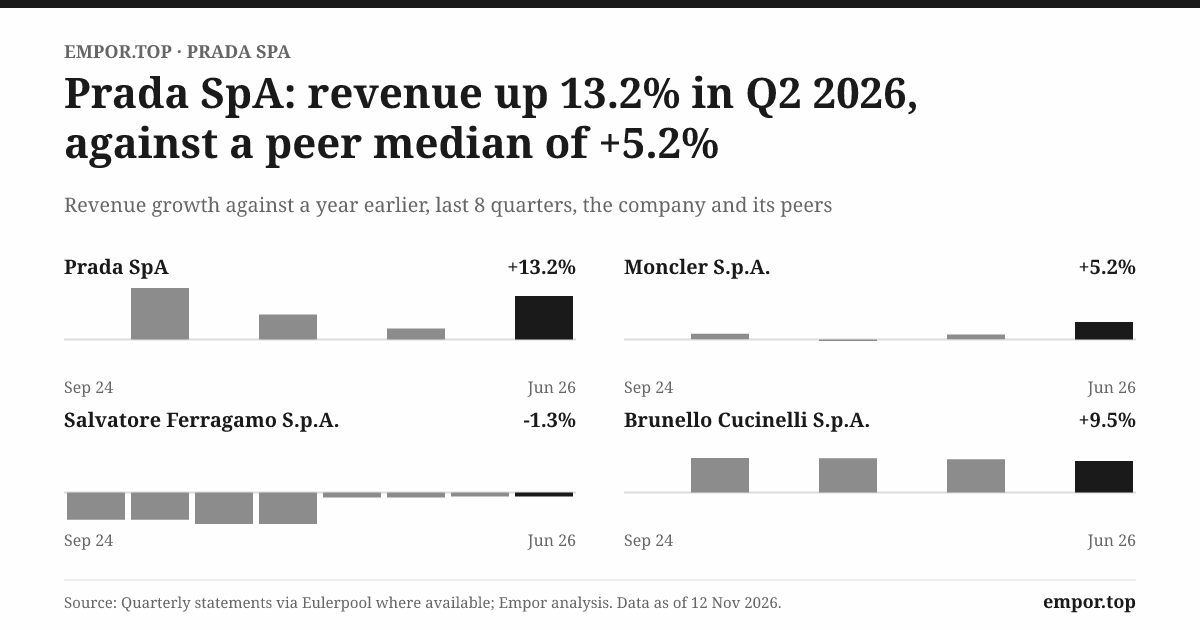
Now the numbers are asking a harder question. Over the first nine months of 2026, Prada Group revenue rose 15% at constant currency.4 That sounds like a company still in full stride. Strip out Versace, which was not in the group a year earlier, and organic growth was 4%. In the third quarter alone, organic growth was 1%.4 The headline figure is real, but most of it was bought rather than grown. The legacy business, the part that has carried the story since the pandemic, is barely moving.
Three questions follow from that gap, and they run through everything that comes next. The first is what happens to the group when Miu Miu's growth cools, because it has already cooled sharply. The second is whether the Prada label itself, which shrank slightly in 2025, can return to convincing growth. The third is whether Versace, a brand that was losing money before Prada bought it and is expected to keep losing money through 2026, can be revived without draining the group that rescued it.2
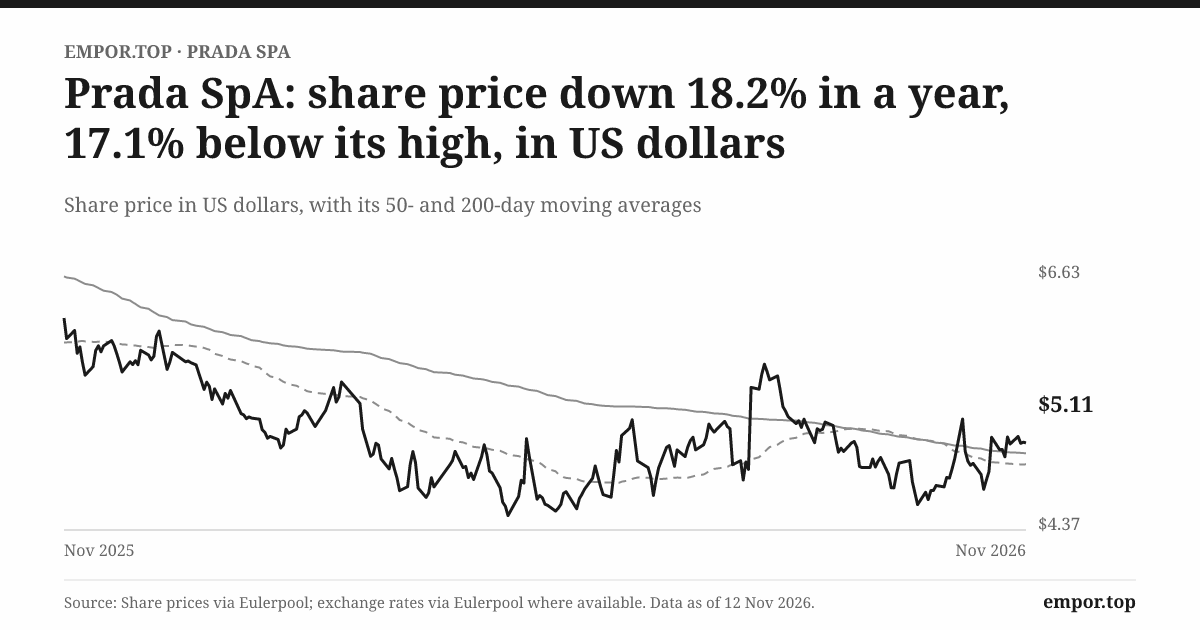
The stock market has already noticed. Prada's shares trade around €4.61, about 14% below their high of the past year, giving the company a market value of roughly €11.4 billion. Add the debt and leases that came with growth and the deal, and the enterprise value is about €15.2 billion. Investors are no longer paying for a house in full bloom. They are paying for a house that has to prove its next season.
A note on boundaries, because it matters for every number in this story. The listed company is Prada S.p.A., traded in Hong Kong under stock code 1913.3 It is the parent of the whole group. Its consolidated results include Miu Miu, the smaller labels Church's and Car Shoe, and, from 2 December 2025, Versace.3 When this story speaks of revenue, margins and debt, it means the consolidated group, not the parent company's standalone accounts, which mostly reflect the holding and licensing structure inside the group.
The verdict to carry forward is simple to state and hard to settle. The recent reported growth rate overstates the strength of the core business. Prada's future turns on two things it cannot buy: whether its creative engine can keep customers paying full price, and whether management can make Versace earn the money and attention it now consumes. To see why the first question is the one Prada has wrestled with for a century, the story has to begin in the same arcade, with a very different kind of shop.
 Subscribe on LinkedIn
II. A Trunk Shop Becomes a House of Ideas
The first Prada store opened in the Galleria in 1913, a leather-goods shop selling trunks, bags and travel accessories to a Milanese bourgeoisie that was beginning to cross Europe by train and liner.3 It was a family business built on craft and on a certain kind of customer: wealthy, conservative and loyal. For decades that was enough. The shop was respected, but it was not a global name, and by the time the founder's granddaughter came into the business it was a small, slightly dusty house with a fine reputation and limited ambition.
That granddaughter was Miuccia Prada. She did not arrive by the obvious route. She studied political science and earned a doctorate in the subject, an unusual credential for someone who would go on to run one of fashion's most influential studios.3 Her intellectual habits never left the work. Prada collections under her direction have often felt like arguments: about taste, about what counts as beautiful, about whether ugliness can be chic. That sensibility became the house's real product. The bags and coats were the vehicle.
The other half of the partnership was Patrizio Bertelli, a leather-goods entrepreneur from Tuscany who became her husband and her business partner.3 If Miuccia supplied the ideas, Bertelli supplied the machine. He was the one who pushed manufacturing, distribution and expansion, the one who wanted Prada to be not merely admired in Milan but sold in New York, Tokyo and Hong Kong.
Fashion folklore remembers him as a ferocious, hands-on operator with strong opinions on every store fixture. The more useful point for investors is what the pairing produced: a creative director who could make a product feel inevitable, joined to an owner who could make it available everywhere. Many fashion houses have one of those gifts. Very few have had both inside the same marriage, the same company and the same controlling shareholding, for half a century.
That fusion also explains a quirk that persists today. At Prada, creative and commercial authority were never cleanly separated, because the two people who held them shared a kitchen table. Decisions about what to make and decisions about where to sell it were taken in the same conversation. It made the company fast and coherent when the partners agreed. It also meant that the strategy of the business was, to an unusual degree, the judgment of two people, and later of their son.
The best early example of that union was nylon. In an era when luxury meant leather, Prada made bags from a tough industrial fabric and sold them at luxury prices.3 It was a provocation dressed as a product. The nylon bag said that the value of a luxury object lies not in the rarity of its material but in the idea behind it and the name on it. That is the most important lesson in the company's history, because it cuts both ways. If an idea can turn nylon into a status object, an idea that falls out of favour can turn the same object into inventory.
From leather goods, the house moved into ready-to-wear, footwear and a much wider retail network, and Miu Miu was created as a second, younger and more playful label under Miuccia's direction.3 The family also tried to build a broader luxury group by buying other designers' houses, a chapter that ended badly and returns later in this story when Versace arrives. What survived from the expansion years was a particular operating model: design in Milan, make much of the product in the group's own facilities, and sell as much as possible through stores the company controls.
Today that model has real scale. The group reports 25 owned factories and about 18,000 employees, a figure that now includes Versace.3 Owning factories means Prada can control quality, protect know-how, and move faster from sketch to shelf. Owning stores means it controls how products are presented, what prices are charged and when, if ever, they are marked down. Both choices are about protecting the brand experience from people who might cheapen it.
Think of it as the difference between a restaurant that owns its farm and its dining room and one that buys from wholesalers and sells through delivery apps. The integrated restaurant controls every ingredient and every table setting, and it keeps the margin that middlemen would otherwise take. When the room is full, it is the more profitable business by a wide margin. When the room is half empty, it is still paying for the farm.
Both choices carry costs that never go away. Factories and stores are capital commitments, and a leased flagship on a famous street is a promise to pay rent for years whether customers come or not. Vertical integration does not guarantee that the next collection will sell. It only guarantees that when it does not, Prada will feel the pain directly, without a wholesaler or a contract manufacturer to share it.
There is a further subtlety. Owning the factories means owning the decision about how much to make. A brand that sells through its own shops decides its own buying, and if it is too optimistic, the unsold goods land on its own balance sheet rather than a department store's. Integration hands Prada the steering wheel. It also removes the airbags.
That is the capability today's growth bets must prove they still have: the union of an idea people want and a commercial system disciplined enough to sell it at full price. The group learned what happens when the first half fails in the middle of the 2010s, when the stores kept opening and the customers stopped coming in the numbers the owners expected.
III. When the Full-Price Promise Broke
Picture a Prada boutique in 2015. The marble is polished, the lighting perfect, the staff trained. The handbags on the shelves are beautiful. And too many of them are still there at the end of the season.
Prada listed in Hong Kong in 2011, at the top of a luxury boom driven by Chinese demand and global tourism.3 The listing told investors the story they wanted to hear: a family-controlled European house, vertically integrated, with a growing network of directly operated stores across Asia. For a while the business rewarded that confidence. Then it stopped.
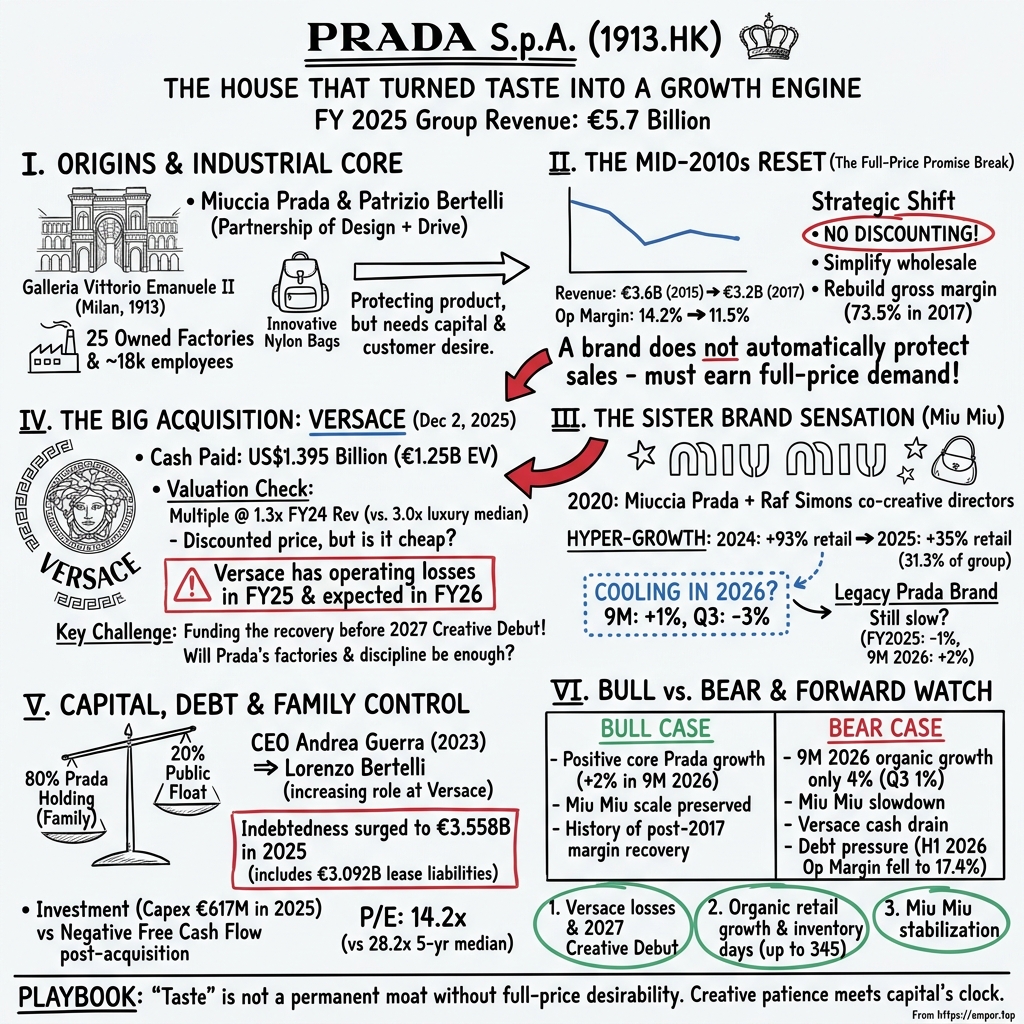
Group revenue fell from about €3.6 billion in 2015 to about €3.2 billion in 2017.56 Over the same period, operating margin slid from roughly 14% to about 11.5%.56 The decline is more striking when set against the years just before it. In 2014 the operating margin had been close to 20%.3 In three years, a house that had been one of the most profitable in fashion lost almost half its margin.
The mechanism matters more than the percentages. Prada's costs are mostly fixed in the short run: store leases, staff, factories, design teams, marketing. When sales per store fall, those costs do not fall with them, and every lost euro of revenue drops disproportionately to profit. That is operating leverage, and it works in reverse just as powerfully as it works on the way up.
A rough piece of arithmetic shows how sharp the blade was. Revenue fell by around a tenth between 2015 and 2017. Operating profit, which is revenue multiplied by margin, fell from roughly €500 million to roughly €370 million, a drop of more than a quarter.56 A tenth less selling produced a quarter less profit. That is what fixed costs do to a luxury house when the customers thin out.
A brand that had opened stores on the assumption of rising traffic was suddenly carrying an expensive network through a period of weaker desirability, a slowing China and shifting tourist flows. The stores did not become worse. The traffic through them simply stopped justifying their cost.
The more uncomfortable part of the record is that the brand alone did not save the business. The consensus story about luxury, then and now, is that great brands enjoy pricing power that shields them from cycles. Prada's mid-2010s experience is a direct falsification of the strong version of that claim. The brand was famous. The stores were beautiful. Sales and profits fell for several years in a row anyway, because customers were not converting enough of what they saw into full-price purchases.
Management's response, as described in the results of that period, was operational rather than romantic.56 The group rationalised operations and costs. It became more selective with wholesale partners, the department stores and multi-brand retailers that can push volume but also discount aggressively and blur a brand's image. And it worked to reduce markdowns, so that more of what Prada sold went out at full price. That last point is the heart of luxury economics. A €2,000 bag sold at full price and one sold at 30% off cost the same to make. The difference is pure margin, and it is also pure brand signal. Customers who learn to wait for a sale stop paying full price.
By 2017, the evidence that the reset was working showed up in one line. Gross margin improved to 73.5%, and the company attributed the gain to a higher share of full-price sales.6 In plain terms, for every €100 of goods sold, Prada kept about €73.50 after the cost of making them, and it kept more because it was discounting less. Revenue returned to growth the following year.3
It would be easy to turn this into a triumphant turnaround story, and that would be a mistake. Operating margin kept falling in 2018 and 2019, to under 10%, even after the full-price reset.3 The discipline helped what Prada kept on each sale, but the expensive network of stores, staff and marketing absorbed the gain, and revenue growth of a few percent a year was not enough to leverage it.
The shareholders, meanwhile, kept getting paid. In 2017, the worst year of the slump, dividends paid came to about 130% of net profit, meaning the company handed out more than it earned.63 For a family holding 80% of the shares, that dividend was also the family's income. It is a detail worth remembering when the story turns to how this controlling shareholder allocates capital, because a payout above earnings in a profit slump is a choice, not an accident. Then the pandemic closed shops worldwide, and in 2020 the operating margin collapsed to almost nothing and the group reported a loss.3 The recovery that followed was real, but it was not the product of the reset alone. It also needed a new burst of desire for what Prada was making.
So the verdict on the slump is narrow and useful. The reset demonstrated better execution: tighter wholesale, fewer markdowns, a cleaner brand. It did not demonstrate immunity to fashion cycles, Chinese demand swings or changing customer taste, and nothing in the company's own record suggests such immunity exists. The brand is a necessary condition for full-price demand, not a sufficient one.
Which raises the question that defines the next chapter. If discipline could protect margins but not create demand, where would the new demand come from? Prada's answer, as it turned out, was a change in who held the pen, and a sister label that would grow faster than almost anyone expected.
IV. The Sister Brand Takes the Lead
In February 2020, just days before the pandemic began to shut Italy down, Prada made an announcement that would have been unthinkable a decade earlier.7 Raf Simons, the Belgian designer known for his precise, youth-obsessed work at Jil Sander, Dior and Calvin Klein, would join Miuccia Prada as co-creative director of the Prada label, with equal responsibility for creative decisions.
For a house whose identity had been fused with one woman's mind for more than thirty years, the move was a deliberate answer to a question every family fashion house eventually faces: what happens to the brand when its founder-designer is no longer there? Rather than wait for an abrupt succession, Prada chose to share authorship while Miuccia was still at the centre. The arrangement kept her voice in the collection and introduced another sensibility into it, testing whether the house's identity could live in a dialogue rather than a single signature.
It was also an unusual piece of corporate design. Most fashion successions are binary: one creative director leaves, another arrives, and the brand lurches toward a new identity. Prada tried to engineer a gradient instead, with the incoming voice learning the house from inside the studio while the founding voice was still present to argue with it. Whether that model can be repeated, at Prada itself or at Versace, is one of the quieter questions behind the investment case, because the group's value depends so heavily on creative continuity that no balance sheet records.
The timing was brutal and, in a strange way, fortunate. The pandemic reset luxury retail. Stores closed, tourism vanished, and when demand returned it came back in a rush of pent-up spending, much of it from younger customers who had spent a year online. Prada's revenue rebounded strongly from the 2020 trough.3 But the most remarkable growth did not come from the label Simons joined. It came from the one Miuccia ran on her own.
Miu Miu had always been the more mischievous of the two brands, younger and more playful, less burdened by the austere seriousness of Prada itself. In the post-pandemic years it caught a cultural wave: low-rise skirts, cropped sweaters, ballet flats and a knowing, slightly subversive sense of youth that spread across social media and red carpets. The business numbers were extraordinary even by luxury's boom standards. Miu Miu's retail sales grew 93% in 2024.2 They grew another 35% in 2025, on top of that already enlarged base.2 By the end of 2025, Miu Miu represented 31.3% of the group's retail sales, while the Prada label accounted for 66.5%.2
To grasp what those growth rates mean, imagine a brand selling €100 of goods at the start of 2024. Growing 93% takes it to about €193. Growing another 35% takes it to about €260. In two years, Miu Miu's retail business became roughly two and a half times its earlier size, the kind of trajectory more common in software than in luxury fashion, where mature houses celebrate high single-digit growth.
Those percentages turned a side story into a structural fact. A brand that once contributed a modest slice of sales was now nearly a third of the retail business, and in 2025 it was doing all of the growing. The Prada label's own retail sales fell 1% that year.2 Without Miu Miu, the group's run of consecutive growth quarters would have looked very different.
Here the evidence needs a caution that the company itself makes necessary. Prada reports as a single segment and does not disclose operating profit by brand.3 Investors can see that Miu Miu sold far more goods; they cannot see how much profit each euro of those sales earned. It is plausible that a fast-growing brand selling at full price through existing stores and factories earned rich incremental margins. It is also plausible that rapid store openings, marketing and product expansion consumed a good share of the gain. The company does not let anyone settle the question. Retail growth is evidence of demand. It is not proof of profit contribution.
Then the boom slowed, abruptly. Over the first nine months of 2026, Miu Miu's retail sales grew 1%. In the third quarter, they fell 3%.4 The decline from +93% to +35% to roughly flat in three years is the arc of a hot brand meeting its own comparisons. Management and bullish analysts can fairly point out that Miu Miu is lapping two of the strongest years any luxury label has posted in a generation; a brand that nearly doubled and then grew by another third cannot be expected to keep compounding at that pace. That context is real and belongs in the story.
Run the same €100 thought experiment forward. A brand that had reached €260 and then grew 1% sits at about €263. It is still more than two and a half times as large as it was before the boom, and that is the strongest argument the bulls have. The wave did not wash away; it left a much bigger business on the beach. The question is whether that business is now a stable plateau or the first step down the far side of a hill.
The comparison argument cannot, however, be used to explain away the slowdown. Tough comparisons explain why growth decelerates. They do not explain why a brand's sales turn negative. The third-quarter decline is the first concrete sign that the Miu Miu wave may have crested, at least for now, and the history in the previous chapter shows what happens when a hot product becomes a familiar one. Desire does not usually disappear overnight. It thins out, the same items stay on the shelves a little longer, and the temptation to discount grows.
The Prada label offers a partial counterweight. After falling 1% in 2025, its retail sales rose 2% over the first nine months of 2026, and 1% in the third quarter.4 The second quarter had been stronger, with Prada retail sales up 6%.8 That is improvement, and an encouraging one for the larger brand. It is not yet acceleration. A 1% third quarter is the kind of number that keeps a business stable, not the kind that replaces a lost growth engine.
Put the two brands side by side and the shape of 2026 becomes clear. In 2024 and 2025, a booming Miu Miu masked a flat Prada. In 2026, a recovering Prada is roughly offsetting a cooling Miu Miu, and neither is growing fast. The consolidated top line looks healthy only because Versace has been added on top.
That brings the historical question into sharp focus. In the mid-2010s, the company learned that a great brand could stall for years. The response then was operating discipline. The response this decade was creative renewal, and it worked brilliantly for Miu Miu. The test now is whether the house can renew demand again through product and full-price retail, or whether today's best-known designs will become tomorrow's inventory. One clue is already worrying. Inventory days, a measure of how long goods sit before they are sold, rose to about 345 in 2025 from about 289 the year before.3 Part of that jump reflects Versace's balance sheet arriving at year-end against only a month of its sales, which flatters nothing and distorts the ratio. But it is the metric to watch as Miu Miu slows, because the first sign of fading desire is usually stock that will not move.
The live record of how management explains all of this sits in the results presentations and call replays for 2024, 2025 and each 2026 update.9 Read across them, the useful exercise is to watch whether the explanation of Miu Miu shifts from cultural momentum to comparisons, regions and product breadth, and whether Andrea Guerra and Lorenzo Bertelli offer concrete markers for the brand's next phase or rely on the brand's general desirability. A company with a clear plan names what it will watch. A company relying on momentum names what it believes.
Miu Miu's rise proved that the house could still create a growth engine. Its slowdown proves the engine is cyclical. And just as that cycle began to turn, the group made a decision that added a third brand, a large debt load and a turnaround to the story.
V. Can Prada Make Versace Fit?
On 2 December 2025, the deal closed. Versace, the house Gianni Versace founded in Milan in 1978 and his sister Donatella carried through decades of glamour, tragedy and reinvention, passed from the American group Capri Holdings to Prada.3 Two of Milan's most famous fashion names, long rivals in sensibility, now sit under one listed parent. Prada is the intellectual's luxury, Versace the showman's. Whether they can share a roof is the most expensive question in this story.
The transaction itself was simple in structure. When the agreement was announced in April 2025, the parties valued Versace at an enterprise value of €1.25 billion.10 At closing, Prada reported cash consideration of about US$1.395 billion, subject to the usual adjustments.3 It was paid in cash and financed with borrowing: a €1.0 billion five-year term loan and a bridge facility of up to €500 million were arranged for the purchase.3 No new shares were issued. Existing shareholders were not diluted. They were levered instead.
The first instinct of investors is to ask whether the price was fair. Prada's own transaction circular for the Hong Kong exchange gave a ready answer. The deal valued Versace at about 1.3 times its 2024 revenue and about 1.7 times its expected 2025 revenue, against a median of 3.0 times in a sample of luxury transactions that Prada selected for comparison.11 When Capri bought Versace in 2018, it had paid about 2.6 times revenue.1112 On those benchmarks, Prada bought Versace for roughly half of what luxury houses have tended to fetch, and for meaningfully less than Capri paid seven years earlier.
That is the version of the story most people remember: Prada picked up a famous name at a discount from a distressed seller. The record supports it as far as it goes. Capri had struggled with Versace, and its own filings show a brand whose sales had fallen and whose profits had turned to losses under its ownership.13 A motivated seller and a strategic buyer with manufacturing know-how is a classic recipe for a good price.
But revenue multiples are a measure of what something sells for, not of what it earns. A business that loses money can look cheap on sales and still be expensive on every measure that pays shareholders. Reuters Breakingviews made the sceptical case when the deal was announced, arguing that on Capri's own forecast of Versace's 2028 sales, the implied multiple still looked rich next to the lower multiple at which Burberry, another struggling luxury name, traded on its forecast sales.14 The two comparisons rest on different bases, one on recent transactions, the other on a listed peer's forward estimates, and neither settles fair value. Together they bracket the honest answer: Prada did not overpay relative to past deals, but it paid a real price for a business that does not yet produce profit.
The earnings problem is not hidden. Prada has said that Versace incurred operating losses in 2025 and that it expects losses of a similar magnitude in 2026.2 Because consolidation began only on 2 December, Versace contributed about €65 million of revenue to the group's 2025 accounts, a single month of sales.2 The transaction circular's pro forma estimate put a full year of Versace revenue at about €684 million.11 So the group took on a business worth more than a tenth of its revenue, which is losing money, and will keep losing money for at least its first full year inside Prada.
The industrial logic is the strongest part of management's case, and it deserves a fair hearing. Prada owns factories, supply chains, and production routines that Versace, under a group built around American accessible-luxury brands, may not have enjoyed. Better manufacturing could improve product quality, shorten lead times and reduce cost. Shared back-office systems, logistics and real-estate expertise could cut overheads. Those are plausible sources of improvement.
What shared factories cannot do is create desire. A turnaround in luxury lives or dies on whether customers want the product, and that is a creative and commercial question, not an industrial one. Prada's own history makes the point twice: the mid-2010s slump showed that good factories and stores could not sell products customers had stopped wanting, and the Miu Miu boom showed that the right creative moment can create demand almost out of nowhere.
The circular's own numbers also tell a story about momentum. Divide the €1.25 billion enterprise value by the two multiples and the implied revenue base falls from close to €1 billion for 2024 to around €735 million for 2025.11 The pro forma full-year figure of about €684 million sits lower still.11 Whatever the precise accounting periods, the direction is unambiguous: Prada bought Versace while its sales were still shrinking. A low multiple on falling revenue is cheaper than it looks only if the falling stops.
Why was the seller so willing? Capri had agreed in 2023 to be acquired by Tapestry, the owner of Coach, and that deal was abandoned in late 2024 after American antitrust regulators challenged it in court.13 Left on its own with a weakened balance sheet and struggling brands, Capri chose to sell Versace and focus on Michael Kors and Jimmy Choo.1213 That context explains the price better than any multiple. Prada was not the winner of a competitive auction for a thriving asset. It was the buyer of last resort, or at least of best resort, for a house its owner needed to sell.
That is why the timetable matters. The group's nine-month 2026 update said Versace was laying the foundations for its creative debut in 2027.4 Translate that from corporate language and it means the commercial proof point is still ahead. Throughout 2026, Prada has been absorbing Versace's losses, its staff, its stores and its leases without yet putting a new collection in front of customers. The first real evidence of whether the new home works will arrive with that 2027 debut and the sell-through that follows.
There is also a person at the centre of the integration. Lorenzo Bertelli, the son of Miuccia Prada and Patrizio Bertelli, took the role of executive chairman of Versace.3 That gives the family's next generation direct operational responsibility for the most consequential deal of their era. It also concentrates accountability in a way that will be impossible to separate from succession at Prada itself.
The most useful way to test management's credibility on Versace is to line up the materials from the deal announcement in April 2025, the 2025 annual results in March 2026, and the nine-month update in October 2026.1024 Across those documents, the company has given investors two concrete anchors: the 2026 loss would be similar in size to 2025's, and the creative debut is planned for 2027.24 What investors most need next is a third and fourth anchor, a date for breakeven and a budget for the investment the recovery will absorb, including how many Versace stores will be closed, refitted or opened. Until those arrive, brand awareness and long-term potential carry much of the weight in the narrative. Those are reasons for hope, not milestones.
The verdict on the deal is therefore conditional. The purchase price looks disciplined against the transaction sample, but the deal is not cheap on earnings, because there are no earnings. Prada has to fund losses before Versace can add a single euro of profit. The price is defensible only if the new operating home and the creative reset deliver a brand that customers want again. Which raises the deeper question behind the whole group: what exactly is Prada's edge, and how much protection does it really give?
VI. What a Prada Brand Can—and Cannot—Defend
Inside a directly operated Prada store, the sale begins long before a customer touches a bag. It begins months earlier in a Milan studio, when a collection is designed, and in a Prada factory, when it is made. It continues through the window display, the lighting, the selection of what goes on which shelf in which city. And it ends with a decision that matters more than any other in luxury: whether the price on the tag will hold.
That chain is Prada's business model in miniature. The group sells finished goods, through stores it operates itself and through wholesale partners.3 There are no subscriptions, no long-term contracts and no recurring fees. Every season, revenue has to be earned again from customers who are free to spend their money elsewhere. What drives it is desirability, the cadence of collections, tourism flows, local demand in Asia, Europe and the Americas, and above all the share of goods that sell at full price.3 That is a fundamentally different kind of business from one with locked-in customers, and it explains why Prada's history is a story of booms and resets rather than a smooth compounding line.
So what is the edge? Start with what the evidence clearly supports. Prada and Miu Miu are identifiable creative brands with distinct points of view, built over decades and capable, as Miu Miu showed, of generating enormous waves of demand. The group controls much of its own production through its 25 owned factories and much of its distribution through its directly operated stores.3 It spends materially on renewing the product: about €160 million on design and product development in 2025, around 2.8% of revenue.3 Those are real capabilities. They let Prada manage presentation, protect quality and decide when not to discount.
Now apply the classic test of competitive strength, Michael Porter's five forces, to the actual business. Customers hold real power. A buyer choosing a handbag can walk from Prada to Louis Vuitton, Gucci, Saint Laurent, Hermès, Chanel or a dozen others without any switching cost at all; there is no software to migrate, no contract to break. Loyalty in luxury is emotional, and it can be lost. Wholesale partners also matter, because department stores and multi-brand retailers can push volume and set prices, but Prada does not disclose how concentrated its wholesale exposure is.3 The company says its trade-receivable credit risk relates mainly to those partners, and gross overdue balances rose in 2025, though the net amount more than 120 days overdue stayed small.3
Rivalry is the strongest force. The competition is not just other brands but other ideas, other moments, other ways to spend discretionary money. LVMH reported revenue of €80.8 billion in 2025, roughly fourteen times Prada's group revenue.15 That is not a like-for-like comparison, since LVMH sells wine, spirits, perfume, jewellery and retail as well as fashion, and its sheer breadth makes market-share conclusions meaningless. What the gap does reveal is spending power. The largest groups can outspend Prada on marketing, store locations and talent, and can absorb a bad season at one brand with a good season at another. Size does not guarantee desirability, as every multi-brand group has learned at some point, but scale buys time.
Prada's answer to that asymmetry has been focus. It competes with a few strong labels rather than dozens, and it puts its money into making those labels distinctive. The Versace deal is, in part, an attempt to narrow the gap by adding a third major name. It is also a move toward the very portfolio complexity that the largest groups spend so much effort managing.
Supplier power is modest because Prada makes much of its product in-house, though skilled artisans and premium materials are not limitless. The threat of new entrants is low at the top of the market, because building a luxury house takes decades, but new aesthetics and designer labels can steal attention at the margin. Substitutes are subtler: experiences, travel and other forms of status spending all compete for the same euro.
Then there is the cost of the edge. In 2025 the group spent about €617 million on capital expenditure, about 10.8% of revenue.3 That money goes into stores, factories and systems, and it raises the bar for returns: a flagship that costs millions to fit out and commits the company to years of rent has to sell enough goods at full price to justify itself. Inventory days rose to about 345 from about 289, which makes sell-through and buying discipline especially important as growth slows.3 Luxury inventory does not spoil, but it ages. A bag that sits for a year has either been made too many times or loved too little.
The evidence also has limits, and they are the company's own disclosures, not gaps in anyone's curiosity. Prada does not publish customer concentration, brand-level operating profit, or a consistent measure of full-price sell-through across its labels.3 It reports a single segment. That means even a careful investor cannot prove how much of the group's profit comes from Miu Miu versus Prada, how much from leather goods versus clothing, or how much margin is lost to discounting in any given year. Those gaps matter, because they limit how confidently anyone can claim the moat is deep or persistent.
Currency is the other force that never shows up in a Porter diagram but always shows up in the results. Prada reports in euros and sells in dollars, yuan, won, yen and a dozen other currencies. It hedges identified future cash flows with forwards and options, but hedging smooths transactions rather than abolishing exposure.3 In 2025, the group's translation reserve, the part of equity that records how the euro value of foreign subsidiaries moves, fell from about €149 million to about €3 million, mainly because the dollar, the won and the renminbi weakened against the euro.3 That is why the company leads with constant-currency growth, and why investors need to read both versions of the number. A customer in Seoul paying the same price in won can deliver fewer euros to Milan.
Tourism adds a second layer. Luxury customers often buy where prices are lowest or the experience is most memorable, which is one reason the Galleria matters. When the euro is weak, Americans and Asians shop in Milan and Paris; when it strengthens, they shop at home or not at all. Prada's regional sales can swing on exchange rates and travel flows that have nothing to do with the product.
Technology deserves a proportionate word. Artificial intelligence may change how collections are designed, marketed and merchandised, how stores forecast demand and how clienteling works. The company has not quantified any direct threat from AI to physical luxury goods, and there is no evidence that a customer who wants a Prada bag can be satisfied by a digital substitute. It is an operating tool, not a near-term existential risk.
Weigh it all and the conclusion narrows rather than collapses. Prada has evidence of a differentiated brand, integrated production and disciplined direct retail. It does not have disclosed customer lock-in, stable market share or proof that every one of its labels can command a premium. The moat is real as a source of pricing power when the product is desired, and it has shown in the mid-2010s that it erodes when the product is not. That is a cyclical moat, and a difficult one to measure. Which is precisely why who controls the company, and how patiently they spend its money, matters so much.
VII. The Family's Long Bet Meets a Larger Balance Sheet
In 2023, Prada did something it had rarely done: it handed the chief executive's job to an outsider. Andrea Guerra, who had spent a decade running Luxottica, the eyewear group, became CEO.3 Guerra brought a reputation for operational rigour, retail discipline and an ability to manage large, complex organisations, along with a decade of experience working alongside a powerful founder-owner at Luxottica. For a family house whose founders were in their seventies, the appointment was a signal that the next phase would be run by professionals while the family kept the vision.
Guerra's Luxottica years matter for a specific reason. Luxottica was the archetype of a vertically integrated fashion-adjacent business: it designed, manufactured, distributed and retailed its own products and licensed brands, and it did so under a powerful founder who never stopped being the owner. Guerra learned to run a large integrated machine while answering to a controlling shareholder with strong views. At Prada, he inherited a smaller version of the same arrangement, with two controlling founders instead of one and a creative product far more exposed to taste than spectacles.
The arithmetic of his tenure is easy to state. Under Guerra, group revenue kept growing through 2023, 2024 and 2025, and operating margin rose above 22%, comfortably above anything the group had reported since at least 2014.3 Those were genuinely strong years, and the CEO deserves part of the credit. But much of that growth came from a Miu Miu wave that began before he arrived, and the hardest test of his tenure, the slowdown in organic growth and the Versace integration, is happening now. Good managers are easiest to judge in difficult years. Guerra's is arriving.
There is also the question of succession, which in a family company is never only about the chief executive. As the founders' son and an executive director, Lorenzo Bertelli is the family's most visible next-generation executive, and his role at Versace gives him the first major operating responsibility of his career.3 A successful turnaround would establish him as a credible future leader of the group. A failed one would raise awkward questions about how the family separates its succession plans from its capital-allocation decisions.
The family, though, remains firmly in charge. Patrizio Bertelli is executive chairman. Miuccia Prada is an executive director and still the creative force behind both main brands. Lorenzo Bertelli is an executive director and, since the deal, executive chairman of Versace.3 The company's ownership makes the hierarchy explicit. Prada Holding owns about 80% of Prada S.p.A., and only about 20% floats on the Hong Kong exchange.16 Ultimate control traces back to Miuccia Prada and Patrizio Bertelli through their holding companies.3
Family control can be an advantage in luxury. A controlling family can make decisions over decades, protect a brand from quarterly pressure and invest in creative risk that a public board might reject. Many of the most durable luxury houses, Hermès and Chanel among them, have long-standing family ownership. But concentrated control also means minority shareholders have limited influence over major decisions, including whether to borrow heavily to buy a loss-making brand. The 20% float can sell its shares; it cannot easily change the strategy.
The board offers some counterweight. At the end of 2025 it had 11 members, including five women, four of them independent non-executive directors.3 The company reported no significant internal-control failings in 2025, and its auditors gave an unqualified opinion.3 Those are necessary signals, though not sufficient ones, of governance quality. The related-party disclosures show purchases, sales, services and leases with entities connected to the controlling shareholders, and the company describes them in its notes; nothing in those disclosures establishes non-arm's-length dealing.3 For a business with an 80% owner, the tables are worth watching each year, especially as Versace adds another layer of intra-group trade.
Pay is another lens. Lorenzo Bertelli's remuneration increased from February 2026 to about €600,000 fixed salary, €600,000 in bonus and incentives, and about €27,500 in benefits, alongside his enlarged responsibility for Versace.3 By the standards of global luxury executives these are not extravagant amounts, and the increase came with a genuinely larger job. The more important question is whether variable pay for the top team is tied to measurable outcomes like organic growth, margins or returns on the Versace investment. That is the test to apply to each year's remuneration report: whether the bonus and long-term incentive terms for the chief executive, the finance director and the family executives reward the outcomes this story keeps returning to, or simply reward size. A group that has just grown by acquisition can hit revenue targets without growing at all.
The capital-allocation record deserves a hard look, because Versace is not the family's first multi-brand bet. Around the turn of the millennium, Prada bought stakes in Jil Sander and Helmut Lang as part of an attempt to build a broader luxury group.17 It did not work. Helmut Lang was unprofitable through Prada's ownership and was sold to Japan's Link Theory Holdings; sector sources put its value at around €50 million.17 Jil Sander was sold in early 2006 to the London private-equity firm Change Capital Partners.17 Both disposals were the final acts of a restructuring that had followed heavy losses.
That episode is a caution, not a verdict. It predates the Hong Kong listing, the current management team and the operating model that rebuilt margins after 2017. Versace is also a different kind of asset: a much larger brand with global recognition, bought from a struggling seller rather than built from a designer's personal label. But the old record shows the same family's past willingness to stretch beyond its core, and it shows how hard it is to transplant another designer's house into Prada's system. That earns the Versace deal a burden of proof rather than the benefit of the doubt.
The balance sheet now carries that bet. At the end of 2025, lease-inclusive net financial indebtedness was about €3.56 billion, roughly double the €1.78 billion of a year earlier.3 It helps to separate the two kinds of obligation inside that figure. Excluding leases, the net financial position was a deficit of about €466 million, which is the funded borrowing, the money Prada actually owes lenders after counting its cash.3 Lease liabilities were about €3.09 billion, the accounting value of future rent on stores and offices, of which Versace added about €491 million.3 Leases are not borrowings, but they are not optional either. A store lease is a fixed commitment that does not shrink when sales do, and that is precisely what made the mid-2010s slump so painful.
The cash record reconciles two truths. Over 2014 to 2025, operating cash flow was about 215% of net profit, a sign that reported earnings were backed by real cash.3 But in 2025, after lease payments, capital spending and the Versace acquisition, the company's own measure of cash flow after investment was about negative €616 million, compared with about positive €750 million in 2024.3 Over the twelve years to 2025, free cash flow before acquisitions came to about €6.2 billion, and dividends absorbed about 45% of it.3 The rest went into cash balances, debt reduction and, eventually, the Versace war chest. Debt to equity, a simple measure of how much of the business is financed by lenders, rose from about 0.6 at the end of 2024 to about 1.0 a year later.3 That is not a dangerous level for a profitable group, but it is the highest since the lease accounting change of 2019, and it was taken on at the moment organic growth began to slow.
The 2025 swing is the cost of investing and acquiring. It is not a sign of poor earnings quality. It is a reminder that strong cash conversion is not the same as freely distributable cash, especially in a year when the group was borrowing to buy a business. The company reported that it complied with all financial covenants at year-end and expected to keep doing so.3
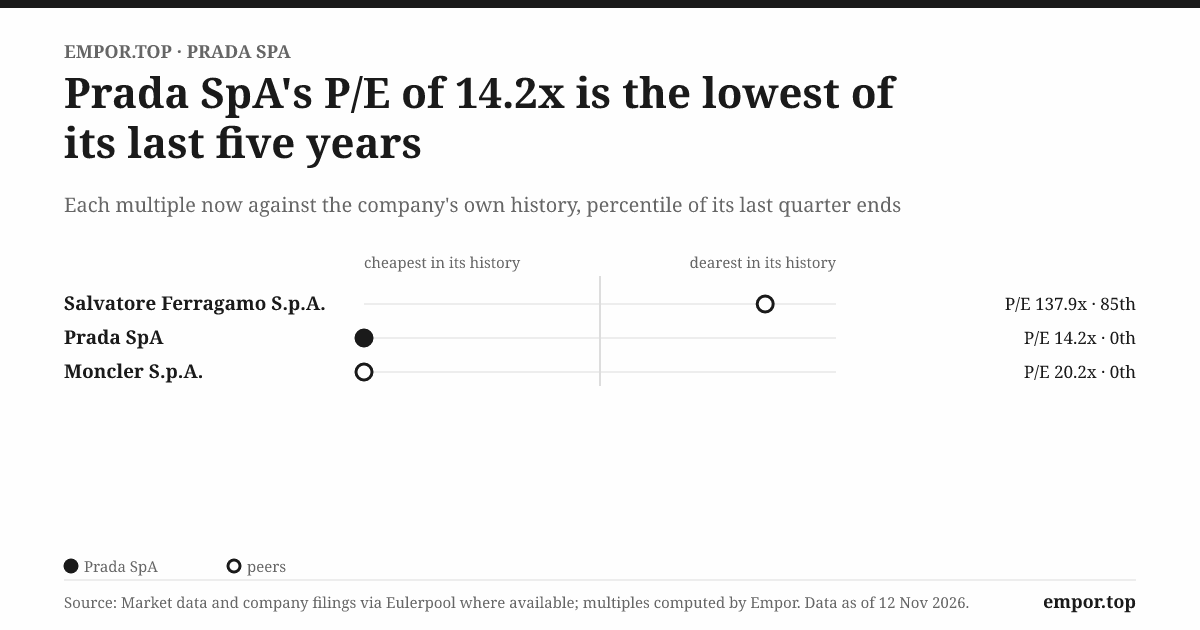
The market's verdict sits in the valuation. At about €4.61 a share, Prada trades at roughly 14 times trailing earnings, against a five-year median of about 28 times. Enterprise value is about seven times EBITDA, and the dividend yield is about 3.6%. Those are low numbers by Prada's own history. They are clues to lower expectations, not proof of a bargain. Trailing earnings include a first half of 2026 in which the operating margin fell sharply, and an acquisition that has not yet earned a profit. The discount may reflect genuine uncertainty about whether the core can grow and whether Versace can recover. Family control can support patience. The market is asking whether patience will be rewarded.
VIII. Analysis & Bear vs. Bull Case
Two pictures define the case. One is Miu Miu's 1% retail growth over the first nine months of 2026, a brand that nearly doubled two years earlier now barely moving. The other is Versace's 2027 creative debut, a moment that has not yet happened and on which much of the deal's value now depends.4 One shows the cycle turning. The other is a promise still to be tested.
The bull case starts with what is real. Prada's own label has returned to positive retail growth in 2026, after falling slightly in 2025.42 Miu Miu is much larger than it was before its boom, so even flat growth leaves it as a far bigger business than in 2023. The group has a long record of turning profit into cash, and it has shown, after the mid-2010s slump, that it can restore full-price discipline when demand weakens. Operating margin reached 22.7% in 2025, nearly double the 2017 low.2 A bull would argue that the house has the creative depth to renew demand again, that the price paid for Versace was low by transaction standards, and that Prada's factories and retail system give it a better chance than Capri had of reviving the brand.
The bear case is in the most recent numbers. Organic growth over nine months was 4%, and only 1% in the third quarter.4 Miu Miu went from 35% growth in 2025 to 1% in nine months of 2026, with a decline in the third quarter.42 Operating margin in the first half of 2026 fell to 17.4%, from 22.2% a year earlier.8 Part of that compression comes from consolidating a loss-making Versace, and part from slower growth against a cost base built for faster expansion. Versace is expected to stay loss-making through 2026.2 The bear does not argue that Prada has lost its brands. The bear argues that fashion cycles and acquisition costs are moving faster than the group's ability to renew them.
Treat the acquisition price fairly in both directions. The 1.3-times revenue multiple is well below the median of Prada's own transaction sample, and that is a genuine point in management's favour.11 But a revenue multiple does not answer whether Versace can return to profit, and it does not tell investors what return the €1.25 billion enterprise value and the additional debt must earn to justify themselves. A skeptical investor would ask the obvious questions. What return on capital does management expect from Versace, and by when? How much of current group growth is acquisition and how much is core? What milestones would trigger a change of course if Versace or Miu Miu disappoints, whether that means slowing store openings, cutting costs, or reconsidering the portfolio?
Returns give the debate a hard edge. Return on invested capital, a measure of how much operating profit after tax the business earns on the money tied up in it, fell from about 14.7% in 2024 to about 11.3% in 2025, and about 10.7% over the twelve months to June 2026.38 Some of that decline is mechanical, because Versace's purchase price and leases entered the capital base before its sales could contribute a full year. But it shows the burden the deal must lift. For Versace to earn even a modest 9% after-tax return on its €1.25 billion enterprise value, it would need to generate something above €110 million of operating profit after tax each year. Today it loses money. That gap, from losses to a nine-figure profit, is the size of the turnaround investors are underwriting.
Hamilton Helmer's 7 Powers framework sharpens the moat argument already made through Porter's forces. Prada's clearest power is branding: customers pay more for an identical-quality object because of the name and the idea. That power is real, but it is not permanent; Miu Miu's slowdown and the mid-2010s slump show it fluctuates with taste. Prada has a modest process power in its integrated factories and product-development routines, which may help Versace's execution. It has no meaningful network effects, no switching costs and no cornered resource beyond its creative talent, which is a resource that can retire, depart or fall out of fashion. Scale economies favour much larger rivals. Counter-positioning is weak in a market where every house sells through similar channels. The edge, in other words, rests on two powers, one of which is cyclical by nature.
An activist would push further, and the pressure points are easy to find. The first is disclosure. A group with three major labels, one of them loss-making, reports a single segment and no brand-level profit, which makes it nearly impossible for outsiders to judge whether Miu Miu's boom created value or whether Versace is improving. Asking for brand-level operating results would be the activist's opening move. The second is the payout. Prada has paid dividends of nearly half its profit in recent years, while borrowing to buy Versace, and a skeptic would ask whether the group can afford both a generous dividend and a costly turnaround without stretching the balance sheet further.3 The third is accountability. With an 80% controlling shareholder whose son runs the acquired brand, the board's independent directors carry an unusual burden in holding management to milestones. An activist cannot win a vote at Prada. It can, however, ask the questions in public, and the market's low multiple suggests those questions are already being priced.
That makes three KPIs matter more than the rest. The first is organic retail growth for the legacy brands, Prada and Miu Miu, stripped of Versace: the latest reading is 4% organic group growth for nine months and 1% in the third quarter, decelerating.4 The second is inventory days, which rose to about 345 in 2025 from about 289: the clearest early warning of fading full-price demand.3 The third is Versace's operating loss and investment: guided to remain at a similar magnitude in 2026 as in 2025.2 If organic growth recovers, inventory falls and Versace's losses shrink after the 2027 debut, the bull case holds. If organic growth stays near zero, inventory builds and Versace's losses persist, the bear case wins.
The live version of the story sits in the results calls and presentations for 2025, the first half of 2026 and the nine-month update.9 Comparing prepared remarks with analyst questions is the best way to test management. The questions that matter are about margin pressure, regional demand, Miu Miu's deceleration and the timing and cost of Versace's recovery. The answers that matter are specific: numbers, dates and named actions. General appeals to desirability and potential are part of every luxury company's language. What distinguishes a credible management team is what it says when the numbers disappoint.
The weighed verdict is narrower than either camp would like. The bull case has a credible brand and a real execution record, but the latest data have narrowed it: growth is modest organically, Miu Miu has slowed sharply, and Versace remains a loss-making promise. The bear case does not require Prada's brands to fail; it only requires the cycle to stay soft long enough for Versace's costs and the group's fixed base to weigh on margins. The deciding evidence will arrive in the next twelve to eighteen months, and it will be operational, not rhetorical.
IX. Playbook: Business & Investing Lessons
Prada's story is best told as two moments set side by side. In 2017, a brand that had lost half its margin rebuilt profitability by refusing to discount. In 2026, a sister brand that had nearly doubled in a year saw its sales turn negative in a quarter. Between them, operating margin climbed from about 11.5% to 22.7%, and then fell back to 17.4% in the first half of 2026.628 The lessons live in that arc.
The first lesson is that a brand is not a balance-sheet asset until customers keep choosing it at full price. In the mid-2010s, Prada's name was as famous as ever and its stores were as beautiful as ever, and none of that stopped revenue and margins from falling. The recovery came from a decision to sell less at a discount and more at full price, and the 2017 gross-margin improvement was the evidence. Every luxury investor is tempted to treat brand as a permanent moat. Prada shows that brand is a recurring test, sat every season at the till.
The second lesson is that a sister brand can diversify a portfolio and still become its largest source of volatility. Miu Miu was supposed to be the smaller, younger complement to the main label. For two years it carried the group, growing so fast that it reshaped the mix and masked a flat Prada label. Then it stalled. The lesson for founders and investors is that a diversified brand portfolio is only diversified if the brands move independently. When one becomes the growth engine, it also becomes the single point of failure. Miu Miu did not make Prada less risky. It made Prada's risk wear a different dress.
The third lesson is that an acquisition price is the beginning of the return calculation, not the end of it. Prada paid a low revenue multiple for Versace, and that headline will be repeated for years. But the brand is losing money, the purchase was funded with debt, and the creative debut that will show whether customers care is still ahead. A cheap price on a loss-making asset is only cheap if the turnaround works. Otherwise it is simply the down payment on a much larger bill. The Jil Sander and Helmut Lang sales two decades ago are the reminder: the price Prada paid for those houses mattered far less than the losses it absorbed while trying to make them work.
The fourth lesson is that creative control can be patient, but capital still needs a clock. The Prada family has the control to take a long view, and in luxury that can be an advantage. But minority investors, lenders and even the family's own balance sheet deserve milestones: when Versace stops losing money, what investment it absorbs before then, and what the group will do if the 2027 debut disappoints. Patience without a clock is just hope. Patience with a clock is strategy.
X. Epilogue
Tonight, Prada stands at an awkward moment. Its headline growth is solid, its legacy brands are barely growing, its hottest label has cooled, and its largest acquisition is still a cost rather than a contributor. The market has priced in doubt, trading the stock at roughly half its five-year median earnings multiple. The next chapters will be written in operating results, not in press releases.
The first chapter arrives with the full-year 2026 results, due in early 2027. Those numbers will show how much organic growth the legacy brands managed for the whole year, and whether the third-quarter slowdown deepened or stabilised. If Prada's own label keeps growing and Miu Miu steadies after its lower 2026 comparisons, the case for a renewed core strengthens. If Miu Miu's decline widens, the group will have to explain how it plans to refresh a brand that only recently seemed unstoppable.
The second chapter is the balance sheet. Inventory days, gross margin, operating margin and cash after lease payments and investment will reveal whether the group is still selling its goods at full price and whether the cost of carrying Versace is under control. A falling inventory figure would be the most reassuring single signal. A rising one would be the most worrying.
The third and decisive chapter is Versace's 2027 creative debut. The new collection will be the first real test of whether Prada's ownership can change what customers think of the brand. The following annual report will show whether Versace's revenue, operating losses, capital spending and lease burden are moving in the right direction. If sales respond and losses shrink, the low acquisition multiple will look like a coup. If not, the deal will begin to look like the Jil Sander and Helmut Lang chapter written at a larger scale and with borrowed money.
Play out the possibilities and the stakes become concrete. In the best case, Prada's own label settles into steady mid-single-digit growth, Miu Miu stabilises at its much larger size, and Versace's 2027 collection generates genuine excitement, so that by the end of 2027 the brand's losses are visibly shrinking. In that world, today's low earnings multiple would look like a moment of excessive pessimism, and the debt taken on for Versace would start to look like a bargain financing for a third growth engine.
In the middle case, the legacy brands grow slowly, Miu Miu drifts sideways and Versace's debut is respectable but not transformative. Margins would stay below their 2025 peak, debt would be paid down gradually, and Prada would look like a solid, slower luxury house with a promising but unproven third brand. That is roughly what the current price appears to assume.
In the worst case, Miu Miu's decline deepens, inventory builds, discounting returns and Versace's losses persist or widen after the debut. That would echo the mid-2010s slump, except that this time the group would face it carrying acquisition debt and a much larger lease book. The company has recovered from such a moment before. It would be doing so with less room for error.
Through all three, the test of management is consistency. Each new explanation should be measured against the last one. A clear milestone, met or missed and honestly explained, is worth more than another statement about long-term potential. The questions this story began with remain open, but they are answerable. The evidence will come, quarter by quarter, at the till.
XI. Outro
Back in the Galleria, the light still falls through the glass roof onto the mosaic floor. The shop that opened there in 1913 sold trunks to travellers. The space that bears the Prada name today sells something harder to pin down: an idea of taste, a history, a feeling that owning a piece of it means belonging to a particular way of seeing the world. Pradasphere turns that history into a walk and the walk into a shopping trip.1
That is what makes Prada unlike a simple luxury growth story. Its enduring asset is the ability to make a point of view commercially compelling, to turn nylon into status and a younger label into a phenomenon. Its risk is believing that yesterday's point of view, or a famous name bought for tomorrow, will keep selling by itself. The house has proved before that it can recover when it remembers the difference. The next collection, and the one after that, will decide whether it still does.
References
-
Pradasphere Opens in Milan — Associated Press, 2026-11-11 ↩↩↩
-
Annual Report 2025 — Prada S.p.A., 2026-04-01 ↩↩↩↩↩↩↩↩↩↩↩↩↩↩↩↩↩↩↩↩↩↩↩↩↩↩↩↩↩↩↩↩↩↩↩↩↩↩↩↩↩↩↩↩↩↩↩↩↩↩↩↩↩↩
-
9M 2026 Revenue Update — Prada Group, 2026-10-22 ↩↩↩↩↩↩↩↩↩↩↩↩
-
Co-Creative Directors Announcement — Prada Group, 2020-02-23 ↩
-
Investor Relations: Results and Presentations — Prada Group ↩↩
-
Basis of Consideration: Versace Acquisition — Prada S.p.A. HKEX Circular, 2025 ↩↩↩↩↩↩
-
Capri Holdings Form 8-K: Versace Purchase Agreement — U.S. SEC, 2025-04-10 ↩↩
-
Capri Holdings 2025 Annual Report — Capri Holdings, 2025 ↩↩↩
-
Reuters Breakingviews: Prada's Crisis-Era Versace Deal Still Looks Pricey — Reuters, 2025-04-10 ↩
 LinkedIn
 WhatsApp
 Reddit
 Hacker News
 Email
 Kindle
 RSS Feed
 Spotify
 Apple Podcasts
 Amazon Music
 Audible
 YouTube