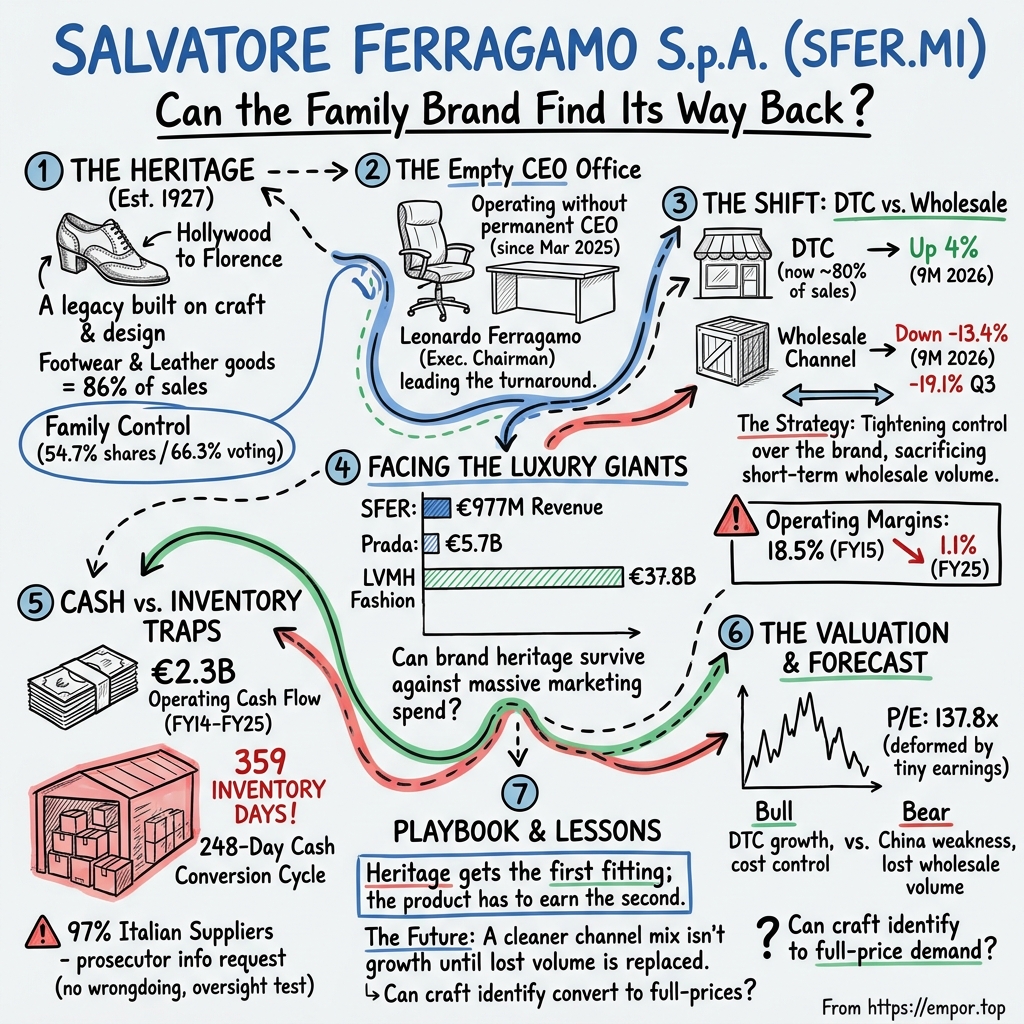
Salvatore Ferragamo: Can the Family Brand Find Its Way Back?
I. The Shop Window and the Empty CEO’s Office
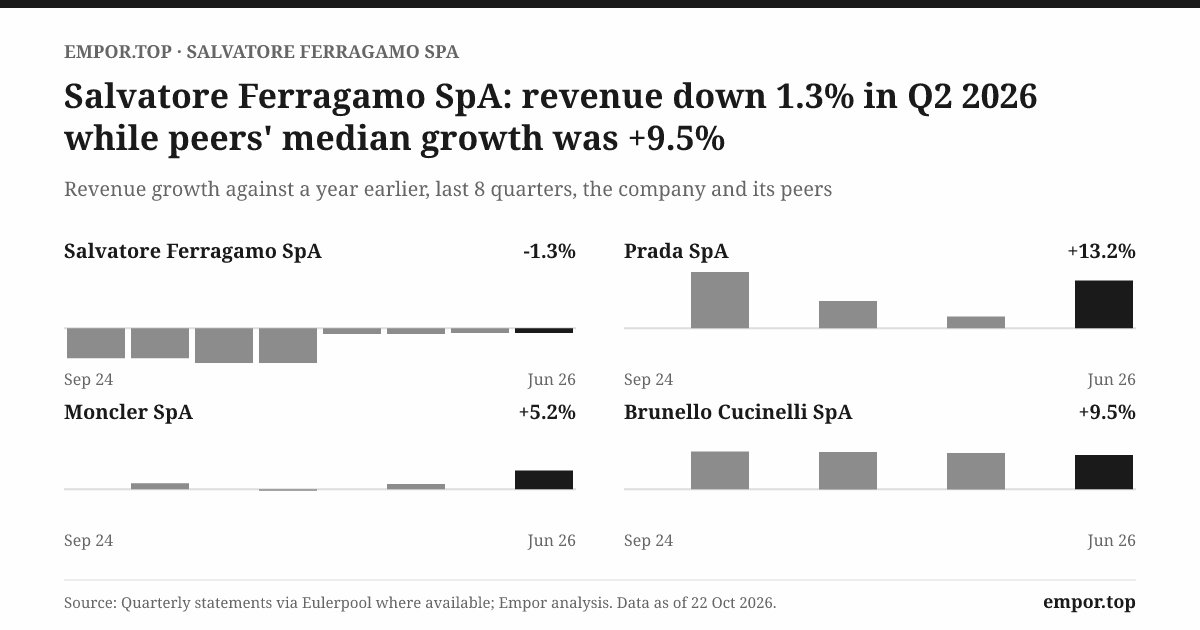
On the evening of October 20, 2026, Salvatore Ferragamo told the market something that sounded, at first hearing, like a non-event. Over the first nine months of the year the Florentine house had sold €675 million of shoes, handbags, scarves and clothes, and at constant exchange rates that was up 0.2% on the year before.1 Flat. A rounding error. The kind of number that gets a line in the Italian financial papers and nothing more.
But inside that flat line two businesses were moving in opposite directions. The part of Ferragamo that sells directly to customers, through its own stores and its own website, grew 4% at constant currency.1 The part that sells to department stores, multi-brand boutiques and distributors fell 13.4%.1 One engine was accelerating while the other was being deliberately throttled back, and the result was a company that, in aggregate, stood perfectly still.
The throttling was a choice. Management described the wholesale decline as "the continued strategic rationalization toward a more controlled distribution and selected key accounts, consistent with the brand's positioning."2 In plain language, Ferragamo is firing some of its customers. It is pulling product out of retailers that discount too readily, display it badly or sit in the wrong neighbourhoods, and betting that a smaller, cleaner distribution footprint will make the brand worth more over time. The cost is revenue now. The hoped-for reward is pricing power later.
The third quarter showed how expensive that bet can feel in a single season. Direct-to-consumer sales were flat year on year at constant currency, while wholesale fell 19.1%, and total revenue for the quarter slid about 3.5%.1 For the first time in more than a year, the direct business was not growing fast enough to cover the hole wholesale was leaving behind. Management called it "DTC resilience" and pointed out that this was the fifth consecutive quarter in which direct sales had not gone backwards.2 A sceptic would call it a stall. Both readings are defensible, which is exactly the problem.
And then there is the empty office. Ferragamo has been run since March 2025 without a permanent chief executive. Marco Gobbetti, the former Burberry boss hired in 2022 to restore the brand's heat, left by mutual agreement on March 6, 2025, and executive powers passed to the chairman, Leonardo Ferragamo, son of the founder, supported by an advisory committee of family members and former executives.3 More than eighteen months later the search has not produced a successor. A luxury house in the middle of a turnaround is being steered by its controlling family, which is either a sign of patient stewardship or a symptom of a company that has not decided who is accountable for the turnaround. The story ahead tries to work out which.
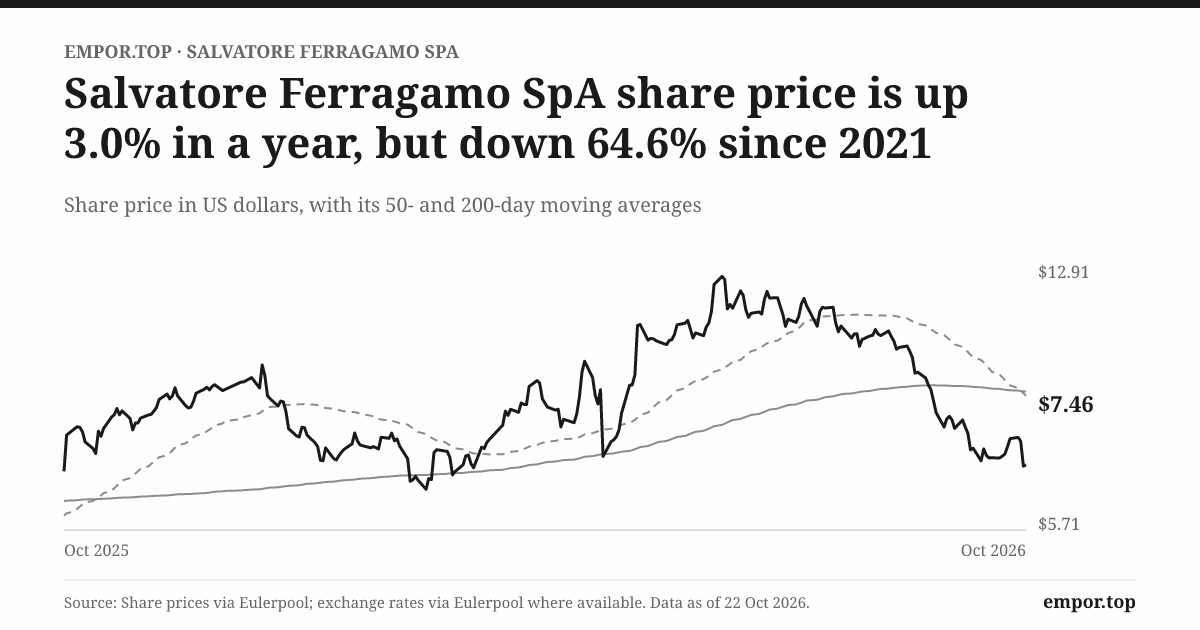
The stakes are bigger than one quarter. The real questions are whether direct retail can restore growth rather than just reshuffle it, whether the craft and the name still translate into the ability to sell at full price, and whether the modest profit improvement of 2026 can survive the next downturn in luxury demand. A brand that once earned operating margins in the high teens ended 2025 with a margin of about 1%.4 The market has noticed: the shares trade near the bottom of their range for the past year, almost 40% below their 52-week high.
One piece of housekeeping before the story begins. The company whose shares trade on Euronext Milan under the ticker SFER is Salvatore Ferragamo S.p.A., the Florence-based parent of the Ferragamo Group.4 When this story talks about revenue, stores, margins and cash, it means the consolidated Group unless it says otherwise, because that is where the brand's economics live. The parent's own accounts, which tell a different and more tangled story about how profit moves between Florence and the world, get their own chapter later.
To understand why a family would accept a smaller business today in exchange for a better brand tomorrow, it helps to go back to the man whose name is on the door, and to the first time his business nearly disappeared.
 Subscribe on LinkedIn
II. The Shoemaker Who Brought Hollywood Craft to Florence
Salvatore Ferragamo was born in 1898 in Bonito, a village in the hills east of Naples, one of fourteen children in a poor family.5 He was apprenticed to a Naples shoemaker as a boy, opened a tiny shop of his own in his village while still barely a teenager, and in 1912, aged fourteen, emigrated to the United States to join his brothers, starting out in a Boston shoe factory.5 The factory taught him what he did not want to become. Machine-made shoes were cheap, uniform and, to his mind, badly made for the feet that had to wear them.
He went west. By 1920 he had a shop in Santa Barbara, close to where the early film studios were shooting, and in 1923 he opened the Hollywood Boot Shop, where he made shoes for the industry's stars and became known as the "Shoemaker to the Stars."5 What separated him from other cobblers with famous clients was an obsession with why shoes hurt. He studied human anatomy, mathematics and chemical engineering at a Los Angeles university, applied what he learned to the distribution of body weight across the arch, and over his career accumulated roughly 300 patents.5 The romance of the Ferragamo story is Hollywood glamour. The substance of it is engineering.
In 1927 he made the decision that defines the company to this day: he went home, not to Naples, but to Florence, and built a workshop there.5 Florence offered something Los Angeles could not, a deep bench of skilled artisans who could produce handmade shoes at scale. The plan was to make in Italy and sell to America. Then the 1929 crash wiped out the overseas orders, and by around 1930 Ferragamo was bankrupt.5 It is worth lingering on that, because it is the first appearance of a theme this story will return to. A business built around a single distinctive product, sold through a channel it did not fully control, could be undone quickly by a shock to demand.
He rebuilt by selling closer to home. In 1936 he opened a shop in the Palazzo Spini Feroni, the medieval palazzo on Via de' Tornabuoni, and in 1938 he bought the building, which remains the company's headquarters.5 During the material shortages of the late 1930s he developed the cork wedge heel, which became a best-seller, and in 1947 his near-transparent "invisible" sandal won the Neiman Marcus Award.5 When he died in 1960 his widow, Wanda, took over, and over the following decade the six children joined, each running a different part of the business, with Fiamma leading design and Ferruccio eventually becoming chief executive.5
The family generation turned a shoemaker into a fashion house. Ferragamo launched ready-to-wear in 1980, began opening its own stores in the 1980s, licensed eyewear to Luxottica in 1998 and expanded aggressively into Asia, where by 2003 it had more than 200 directly controlled stores worldwide and over 250 franchise operations in the region.5 It also tried diversification, acquiring majority control of the French couture house Emanuel Ungaro in 1996, an excursion that did not become part of the brand's lasting identity.5 The lesson the family seems to have taken is that Ferragamo works best as Ferragamo.
The product mix confirms it. Nearly a century after the Florence workshop opened, footwear and leather goods together made up about 86% of Group sales in 2025.4 This is not a fashion conglomerate with a shoe department. It is a shoe and bag company that also sells clothes and scarves.
The next turn of the story came in June 2011, when the family brought the company to the Milan stock exchange.6 The details matter, because they shape who the company answers to. The listing was a secondary offering. Ferragamo Finanziaria, the family holding company, sold about 38.3 million existing shares, roughly 22.7% of the capital; the company itself issued no new stock, raised no money and diluted no one.7 The family turned part of its paper wealth into cash and gained a public market price for the rest, while keeping firm control of the operating group.
That structure still holds. Ferragamo Finanziaria owned about 55% of the shares and, thanks to Italy's loyalty-share rules that give long-term holders extra votes, about 66% of the voting rights in April 2026.8 Public investors own a minority stake in a business whose direction is set in a family holding.
So the founder's legacy gives the listed company something real: a credible product identity rooted in fit and construction, a palazzo, an archive, a name that sophisticated shoppers recognise. What the legacy does not give, by itself, is proof that the brand can still command growth or margins today. That has to be tested in the place where the brand meets the customer, which in 2026 means the store.
III. A Pair of Shoes, Two Ways to Sell It
Picture two customers on the same afternoon. The first walks into a Ferragamo boutique, sits down, and tries on a pair of loafers while a sales associate who knows the line brings out a second size and a matching belt. The store is lit, stocked and staffed exactly the way Florence wants. The price on the box is the price she pays. Her name, her size and what she bought go into the company's client records, and next season someone will call her when the new collection arrives.
The second customer buys the same loafers in a department store across town. They sit on a table among a dozen other brands. If they have not sold by the end of the season, the store may mark them down, and the discount may be visible on a website that the first customer also reads. Ferragamo was paid when it shipped the shoes to the retailer, at a wholesale price below retail, and it knows almost nothing about who wore them home.
That is the whole strategic debate at Ferragamo in two scenes. Same product, two very different economic relationships.
Start with what is being sold. Ferragamo's revenue is overwhelmingly one-off sales of physical items: shoes, handbags and small leather goods, ready-to-wear, silk and accessories, each priced individually.4 There are no subscriptions and no multi-year customer contracts. Every season the company has to persuade people to buy again, which makes revenue extremely sensitive to product relevance, store traffic and the mood of wealthy consumers in a handful of cities.
In 2025, direct-to-consumer sales, meaning the company's own stores and e-commerce, made up 77% of Group revenue.4 Wholesale accounted for about 20%. Licences, mainly eyewear, watches and fragrance, plus some service income, came to about 1.7%, and rental income on property was a rounding error at 0.3%.4 By the first nine months of 2026, DTC had climbed to 80% of sales and wholesale had shrunk to 18%.2
Why push the mix further toward direct? The case for it has three parts. The first is margin per item: when Ferragamo sells a bag in its own store it captures the full retail price rather than a wholesale price. The second is price discipline: a brand that controls where its products appear can limit discounting, which protects what a shopper believes the product is worth. The third is information: every direct sale tells the company something about who is buying and what they want, which it can use in the next collection.
Management's analyst presentations through 2026 have leaned on exactly those proof points. In the second quarter, direct sales rose 6.6% at constant currency, and the company said a larger share of shoppers who entered its stores made a purchase, with higher full-price sales, higher average prices and more items per transaction.9 In Europe over the first nine months, the company reported double-digit gains in both store conversion and average ticket in its primary retail channel, meaning its full-price stores rather than outlets.2 In North America, it pointed to full-price sales in primary retail as the driver of double-digit direct growth.2
Those are the right indicators to watch, and they point in the right direction. But retail activity measures are not the same as sales, and an investor should hold management to the totals. Over nine months, direct sales reached roughly €537 million.2 That is a genuine improvement after two years of decline. It is also a modest rate for a business that has been shrinking, and the third quarter showed the limits of that progress.1
Now the other side of the ledger. Wholesale continued to contract.1 The company says some of that reflects deliberate account reductions.2 Some of it is not. Wholesale demand for second-tier luxury brands has been weak across the industry, and Ferragamo's own regional data show that its wholesale declines were concentrated in Europe and Asia-Pacific, where demand was soft anyway.2 Separating the deliberate cuts from the involuntary ones is not possible from outside, because the company does not disclose how much of the decline comes from accounts it closed versus orders that simply shrank.
This is where the strategy carries a real risk. Wholesale is a variable-cost channel. The retailer pays for the shop floor, the staff and the rent. Owned stores are the opposite: Ferragamo signs the lease, pays the staff and carries the inventory whether or not customers arrive. At the end of September 2026 the company ran 354 directly operated stores, down from 358 at the start of the year, with 152 in Asia-Pacific alone.2 Those stores carried lease liabilities of more than half a billion euros on the 2025 balance sheet.4 When wholesale revenue disappears, the fixed costs of the owned network do not shrink with it. The lost volume has to be replaced by more customers walking into Ferragamo's own doors and spending more when they do.
There is a further subtlety. Wholesale is not only revenue; it is also reach. A department store in a city where Ferragamo has no boutique puts the brand in front of people who might never seek it out. Shrinking that presence protects the image in the short run but can narrow the funnel of new customers in the long run. The trade-off is defensible for a brand whose wholesale partners were discounting heavily. It is risky for a brand that needs new customers more than it needs fewer bad ones.
Licensing deserves a sentence, not a chapter. Royalty income from eyewear, watch and fragrance partners was about €12 million in the first nine months of 2026, up slightly.2 It is welcome, high-margin money, but at under 2% of revenue it is supplementary income, not a recovery engine.
So the direct channel is the centre of the recovery plan, and the evidence that it is working is real but early: five quarters without decline, rising conversion and ticket in key markets, and a mix that has moved roughly four percentage points toward DTC in a year. The open question is whether the shoes and bags inside those stores are desirable enough to pull in the extra customers the strategy requires. That depends on whether the Ferragamo name still means what it used to, in a market that has changed around it.
IV. The Brand Name Meets the Luxury Machine
Stand in the shoe department of a Milan department store and look at what surrounds a pair of Ferragamo loafers. On one side, the leather goods of houses owned by LVMH, with advertising budgets measured in billions. On the other, Prada and Miu Miu, riding one of the strongest runs in the industry. Further along, focused specialists in sneakers, outerwear or quiet-luxury knitwear. The shopper holding the Ferragamo box can put it down and walk ten metres to any of them. Nothing stops her.
That is the competitive reality. Ferragamo is a single-brand company with revenue of about €977 million in 2025.4 LVMH's Fashion & Leather Goods division alone generated about €37.8 billion the same year, almost forty times as much, even after an 8% reported decline.10 Prada Group, itself a family-controlled Italian house, reported revenue of about €5.7 billion, close to six times Ferragamo's.11 These are not perfect peers. LVMH's division contains Louis Vuitton and Dior, and Prada has two brands with very different trajectories. But they are the businesses Ferragamo competes with for shelf space, media attention, talented designers and the same wealthy customers.
The forces bearing down on a mid-sized house
Run Michael Porter's five forces through Ferragamo's economics and the picture is uncomfortable. The bargaining power of buyers is high at the consumer level, because switching costs are close to zero: nobody is locked into a shoe brand, and wealthy shoppers buy from several houses at once. At the wholesale level, department stores have historically held real power over mid-sized brands, deciding how much space to give them and when to mark them down. Ferragamo's retreat from wholesale is partly an attempt to escape that power, at the cost of volume.
Supplier power is moderate. Ferragamo relies on a network of specialist Italian manufacturers, and sourced 97% of its supplier spend in 2024 from Italian companies.12 Those relationships are long; about 43% of manufacturers had worked with the company for more than eleven years.12 Long relationships are an asset, but they are not exclusive. The same districts in Tuscany, the Marche and the Veneto supply almost every luxury house, and skilled craftspeople are a scarce resource that bigger brands can outbid for.
The threat of substitutes is real but diffuse: quiet-luxury labels, niche designers and resale platforms all compete for the same wallet. The threat of new entrants at the top of luxury is low, because building a heritage brand takes decades. Rivalry among existing players, however, is intense, and scale matters a great deal in it. A house ten or forty times larger can spend more on flagship stores, celebrity ambassadors, runway shows and digital marketing in absolute terms, while spending less as a share of sales.
Hamilton Helmer's seven powers framework sharpens the point. Of the seven, the only one Ferragamo can credibly claim is branding: the durable ability to charge more for an objectively similar product because of what the name means to customers. It has no network effects, no meaningful switching costs and no scale economies relative to its larger rivals; if anything, scale works against it. It has a modest form of cornered resource in its archive, its palazzo and its long supplier relationships, but those are not exclusive in any economic sense. Counter-positioning, process power and network power do not apply.
What the record says about the brand
So the moat question collapses into a single test: does the Ferragamo brand still command pricing power? The positive case is concrete. Footwear and leather goods remain the core of the business, and footwear is a category where fit, construction and comfort matter, which plays to the founder's engineering heritage. The company's design is visible: its September 2026 runway show in Milan generated an estimated €36.1 million of earned media value, the highest in recent seasons, and drew strong reviews, with Vogue Runway's critic writing that "were shoemaking as appreciated as painting, Salvatore Ferragamo would count as one of its greatest Old Masters."2 And the direct channel reinforces Ferragamo's pricing discipline.
Now test that against the record, over the longest span that bears on the claim. If Ferragamo had pricing power, its revenue and margins would show it. Instead, revenue fell at about 3.7% a year over the decade to 2025, so that the company was meaningfully smaller in 2025 than it had been in 2015.4 Operating margin, which stood at about 18.5% in 2015, was about 1.1% in 2025.4 A brand with genuine pricing power rarely shrinks for a decade while its larger rivals keep investing and expanding.
Is that unfair, because it captures a business in the middle of a reset? Partly. But the decline is not one bad year. It runs through three chief executives, multiple creative directors and two distinct strategic plans. The same brand, the same family and broadly the same product categories produced the result.
The most recent product data cut both ways. Over the first nine months of 2026, shoe sales grew about 2.6% at constant currency, while leather goods and handbags fell about 3.5%.2 That is notable, because the company's marketing in 2026 has concentrated on handbags: the Hug East-West, a new silhouette of its Hug bag, and the Cara bag, which management called "an emerging Ferragamo signature" after celebrity seeding and runway exposure.2 Direct sales of leather goods did rise at a mid-single-digit rate, so the bags may be working in Ferragamo's own stores, but total handbag sales were still falling, dragged by double-digit wholesale declines.2 Press attention, earned media value and social interactions are visibility, not commerce. The proof will be in comparable sales, average ticket and the gross margin line.
There is one more piece of evidence on the brand that rarely makes the headlines: how much the company spends on the product itself. Research and development, essentially the design and prototyping of new collections, cost about €25 million in 2025, roughly 2.6% of revenue, down from about €29 million the year before, and all of it was incurred by the Florentine parent.4 Trimming that line is understandable in a year of losses. But a house whose recovery depends on making its product desirable again is spending less on making product, at the same moment that larger rivals can outspend it many times over in absolute terms. Cost discipline and creative ambition are pulling in opposite directions here, and the income statement shows which one won in 2025.
The conclusion is that Ferragamo's brand is a real intangible asset, with differentiated heritage in footwear and a plausible but unproven claim to pricing power. The ten-year record does not reject the idea that the brand has value, but it does reject the idea that brand recognition alone protects relevance. The narrower, testable version of the claim is this: if the brand still has pricing power, sustained full-price growth in the direct channel should show up in rising gross margins over several seasons. The last time Ferragamo promised a reset of exactly this kind, the evidence took a very different turn.
V. The 2017 Plan That Could Not Hold Its Targets
On February 3, 2017, Ferragamo's management stood in front of investors with a plan for 2017 to 2020.13 The chief executive was Eraldo Poletto, charged with modernising a brand that had started to feel dated to younger shoppers. His pitch had the clean logic that turnaround plans always have. Refresh the product so it appeals to a younger, more contemporary customer. Clear out the old inventory that was cluttering the stores. Make the existing network of nearly 700 boutiques work harder, measured in sales per square metre. Do all of that, and revenue would grow at twice the rate of the luxury market over four years, with gross margins and profits rising alongside.13
Ten months later, on December 14, 2017, the board said it could no longer confirm those ambitions.13 The "transition phase" that had characterised 2017 would extend into 2018, it said, and the medium-term targets had become harder to reach.13 No replacement guidance was offered. The shares fell more than 8% the next day.14 Poletto left in 2018 after less than two years in the job, and Micaela Le Divelec was appointed chief executive in July of that year.15
What went wrong is a pattern worth understanding, because it bears directly on the company's current reset. Inventory clearance, the act of selling off old stock to make room for the new, depresses margins while it happens, because the old product goes out at a discount. A product refresh takes several seasons to reach stores and win customers, because luxury collections are designed a year or more ahead. And store productivity only improves once both of the first two steps are done. Each step is reasonable. Stacked together, they mean the numbers get worse before they get better, and nobody can say precisely how long "before" lasts.
So it proved. Core profit fell 14% in 2018 to €214 million as turnaround costs weighed on falling sales, the dividend was cut, and the company said it had "little visibility" on the market.15 Reuters noted that Ferragamo had by then spent two years struggling to revitalise the brand and attract younger customers.15 The 2017 plan did not fail because its diagnosis was wrong. It failed because the cure took longer than the targets assumed, and management had promised a destination without a credible map of the road.
Now follow the line forward, because the long record is the strongest test of any recovery claim. Revenue edged up in 2019, collapsed during the pandemic in 2020, then rebounded sharply in 2021 and 2022 as luxury enjoyed a global boom.4 If the 2017 reset had truly rebuilt the brand, that boom should have carried Ferragamo back to its old scale. It did not. From 2022 to 2025, revenue fell at almost 8% a year in the company's own currency, and the operating margin slid from about 10% to about 1%.4 Gobbetti arrived in 2022 with a new creative director, Maximilian Davis, and a new strategy; by early 2025 revenue had fallen another 8% in a year and he was gone.3
That history matters for the current plan in two ways. First, it falsifies the comfortable idea that a heritage brand recovers on its own once the right designer arrives. Ferragamo has had two designer-led resets in a decade, and neither restored growth. Second, it shows how a company can make every individual decision sensibly and still lose years.
Compared with 2017, the present strategy has a different shape. It does not promise a growth rate. It talks instead about channel quality, selective wholesale, a stronger direct business, tighter costs and a more focused assortment. Those are observable actions, and the company has delivered on several of them: costs are lower, the wholesale cut is visible, direct sales are growing, and in the first half of 2026 the company returned to a small net profit.9 But the core claim, that these actions will lead to durable growth in sales and profit together, is the same claim the 2017 plan made, and it is no more proven today than it was then. The difference is that this time the evidence is arriving quarter by quarter, and the latest quarter was the weakest of the year. To see whether the reset is working, the place to look is the region-by-region detail of 2026.
VI. More Control, Less Wholesale: The Recovery Test
The slide that opened the revenue section of Ferragamo's October 2026 presentation was two stacked bars, one for the first nine months of 2025 and one for 2026, each split into direct, wholesale and other.2 The bars were almost exactly the same height. What had changed was the colours inside them. Direct sales had grown from about 76% to 80% of the total, wholesale had shrunk from 21% to 18%, and the "other" slice, hedging, licences and rent, had shrunk too.2 In a single image it summed up the strategy: the same size business, re-weighted toward the part Ferragamo controls.
Whether that counts as progress depends on where you look, and the regional map tells a story of two worlds.
North America is the bright spot. Net sales there grew about 11% at constant currency over nine months, making North America the company's largest region at about 34% of net sales.2 Direct sales rose at a double-digit rate, driven by full-price sales in primary retail, and wholesale grew too.2 Even there, momentum cooled: the region's third-quarter sales rose just 2%, and management had already flagged in August that growth slowed in July, partly because of a softer US market and partly because it cut the summer discount period short.92 That second reason is telling. Ferragamo sacrificed some summer revenue to avoid markdowns, which is exactly what a brand trying to rebuild pricing power should do, and exactly what makes near-term revenue harder to read.
Europe, the Middle East and Africa tell a split story. Direct sales grew at a mid-single-digit rate, with conversion and average ticket up double digits, but wholesale fell sharply enough to drag total net sales in the region down about 7%.2 Central and South America grew about 5%.2
Then there is Asia. Asia-Pacific net sales fell about 5% over nine months, with direct sales only slightly below the prior year, because continued weakness in China was largely offset by growth in other markets in the region.2 In the third quarter alone, Asia-Pacific sales fell about 11%, hit by double-digit wholesale declines.2 Japan was down about 2% over nine months and 5% in the third quarter.2 That matters because Asia was once Ferragamo's growth engine; it still hosts 152 of the company's 354 directly operated stores, the largest share of the network.2 A region where Ferragamo carries so many stores but is losing sales is a region where the fixed costs of direct retail bite hardest.
The shape of the store network shows where that tension lands. Of the 354 directly operated stores at the end of September 2026, 152 were in Asia-Pacific, 63 in Europe, the Middle East and Africa, 53 each in North America and Japan, and 33 in Central and South America.2 Over nine months the company closed a net four stores: one each in Europe and North America and two in Japan, while the Asia-Pacific count did not change.2 In other words, the network has barely been touched in the region where sales are weakest. That could mean management believes Asia will recover and wants to be positioned when it does. It could also mean that the most painful decisions about the store estate have not yet been made, and the €46 million of impairment charges in 2025 suggest the company already knows some of those stores are worth less than it once thought.4
The economics behind full-price selling are worth spelling out, because they explain why management keeps talking about conversion and average ticket. If the same number of people walk into a store, a higher share of them buy something, and each buys a little more at full price, then revenue per store rises without the company spending more on rent or staff. That flows almost directly to profit. Higher full-price sales also mean less product ends up in outlets, which improves gross margin. The company reported that core profit before depreciation rose almost 25% to about €90 million in the first half of 2026, citing strict cost control, and that Ferragamo swung to a net profit of €1.5 million, against an adjusted loss of €16 million a year earlier.9 That is the mechanism showing up in the accounts, at least in one half-year.
But the mechanism has to be measured in sales and margins, not in shop-floor statistics alone. Over nine months, net sales across all channels rose just 0.2% at constant currency.1 The cleanest comparison is the one from the third quarter: direct sales were stable, while wholesale continued to contract.1 At that pace, the cleaner mix becomes a smaller business.
E-commerce sits inside the direct figures, not alongside them. Ferragamo defines DTC as its directly operated stores plus its own online boutiques, and it does not publish a separate e-commerce growth rate in its quarterly updates.2 That means online cannot be credited as a hidden growth engine. It should be judged as part of the direct channel, alongside store productivity.
On product, the company's assortment is showing early movement, but not the kind that proves a franchise. Shoes, the heart of the brand, grew modestly. Ready-to-wear rose about 5%, from a small base.2 Handbags, where the marketing has been loudest, fell in total. Launches like the Cara bag deserve to be watched for repeat performance in the seasons after their debut, because one well-reviewed show is the beginning of a product story, not its end.
So three operating indicators decide this chapter. The first is whether direct-to-consumer growth re-accelerates.2 The second is whether wholesale declines slow once rationalisation is complete.1 The third is whether reported operating margin rises from sales growth and gross margin rather than cost cuts alone.4 If direct growth re-accelerates while wholesale stabilises, the strategy will have earned its claim. If wholesale keeps falling faster than direct grows, Ferragamo will have built a better-controlled version of a smaller company.
Behind every one of those sales, though, sits a question that is easy to miss: when a pair of Ferragamo shoes is sold in Tokyo or New York, how much of the profit stays in Florence?
VII. Florence Makes the Product; the Parent Makes the Margin Question
Follow a single pair of shoes. They are designed in Florence, made by a specialist manufacturer in Tuscany under contract to the parent company, and invoiced by Salvatore Ferragamo S.p.A., the listed parent, to a distribution subsidiary in, say, the United States. The American subsidiary pays the parent a transfer price, puts the shoes in its stores, sells them to a customer at retail and books the difference as its own revenue. The customer pays once. But inside the group, the shoes have been sold twice.
That structure is common across luxury, and it shapes how the listed parent's own accounts look. Parent-only revenue in 2025 was about €594 million, against about €977 million for the consolidated Group.4 Most of the parent's revenue, about €475 million or 80%, came from wholesale sales, and those sales were primarily to Group companies, not to outside retailers.4 In other words, the parent is largely a designer, manufacturer and wholesaler to its own subsidiaries, which do most of the selling to end customers.
The two sets of numbers are not interchangeable. Parent-only revenue and operating profit measure how much value Florence keeps under the group's internal pricing rules. Consolidated revenue and earnings measure what the whole Ferragamo system makes from the world's customers. When the investor reads "Ferragamo," the consolidated figures are the right lens for the business. The parent's figures are the right lens for how profit is allocated, which matters for tax and, potentially, for future disputes.
How is that allocation set? Ferragamo uses an Advance Pricing Agreement, a pact negotiated with tax authorities that fixes the method for pricing transactions between the parent and its foreign distributors. Think of it as a pre-agreed rule that each distribution subsidiary should earn roughly the kind of return an independent distributor doing the same job would earn, no more and no less. If a subsidiary earns more than that benchmark in a year, money flows back to the parent; if it earns less, the parent compensates it.
The size of those adjustments is the striking number. In 2025, the parent booked a net negative operating-profit adjustment of about €81 million in favour of its foreign distribution subsidiaries, down from about €138 million in 2024.4 A further €21 million or so was applied to the Chinese subsidiary to align its profits with independent-party levels.4 Translated, the parent paid out tens of millions of euros so that its distributors could show benchmark-level profits in years when their markets, especially in Asia, were weak. That is how the mechanism is supposed to work; it is not evidence of wrongdoing. It does mean that the parent absorbs a large share of the group's downturns, and that the parent's profitability is partly a function of an agreement with tax authorities rather than of market forces alone.
The APA framework runs through 2026, and the renewal of the US arrangement for 2024 to 2028 was still at a preliminary stage of review in the company's latest annual report.4 Renewals are when such agreements get renegotiated, and an outcome that shifts more profit into high-tax foreign jurisdictions or alters the benchmark returns would change the group's tax bill and the parent's results. The company describes its related-party transactions as ordinary-course and at market conditions.4 The unresolved piece is not whether the arrangement is legitimate. It is how the profit split will look once the renewals conclude, and whether the parent's recent recovery reflects better business or simply smaller adjustments.
That recovery is real but small. Parent operating profit was about €0.6 million in 2025, after a loss of about €39 million in 2024.4 Much of the swing coincides with the APA adjustment shrinking by some €57 million. Meanwhile, the consolidated Group still reported a net loss for 2025, after impairment charges of about €46 million on stores and other assets.4
One reassurance belongs here, too. The parent's royalty income of about €12 million in 2025 was primarily earned from eyewear, watch and fragrance licensees; the company does not disclose any royalty paid by the listed company to the family holding for use of the name.4 In some family-controlled companies, the brand is owned upstream and rented back to the listed entity, which leaks value to the controlling shareholder. Ferragamo's disclosures describe a parent that receives brand income rather than paying it.
Why does all of this matter to someone who owns a share? Because the share is a claim on the parent, and the parent's value rests on the whole system: Florentine design and sourcing, foreign distributors that carry the stores and leases, and an internal pricing arrangement that decides where profit lands. A healthy system earns money in all three places. In 2025, the system as a whole barely earned anything, and the internal arrangement mostly moved losses around. That brings the story to the cash, which tells a more reassuring tale, at least about the past.
VIII. The Cash Is Real; the Earnings Recovery Is Not Settled
Lay two numbers side by side. From 2014 through 2025, Ferragamo reported cumulative net profit of about €812 million. Over the same twelve years, it generated about €2.3 billion of cash from operations, almost three times as much.4 For a company whose income statement has looked so weak lately, that is a striking result, and it deserves an explanation before it earns any credit.
The gap is mostly accounting, and it is mostly honest. A retailer with hundreds of stores records large depreciation charges every year, and since 2019 international accounting rules have required companies to treat store leases as assets that are depreciated over time. Depreciation reduces profit but costs no cash in the year it is booked. In 2025 alone, depreciation, amortisation and write-downs totalled about €187 million, including about €46 million of impairments.4 Impairments, the accounting admission that some stores are worth less than their book value, cut reported earnings further without draining the bank account. Add them back and the cash picture looks much healthier than the profit line.
There is a catch. Lease payments are real cash, and under the current accounting rules they sit in the financing section of the cash-flow statement rather than in operations. So operating cash flow flatters a store-heavy company somewhat; part of what looks like cash generation is money that will go straight back out in rent.
Where did the free cash go? Over the twelve years, free cash flow, operating cash minus capital spending on stores and systems, came to about €1.6 billion.4 About a third of it, roughly €530 million, went to shareholders as dividends, the largest share of which went to the controlling family.4 Cash and short-term investments rose by about €179 million over the period.4 The rest went largely to lease payments and share buybacks. That is not a record of wasted capital. It is a record of a business that spun off cash even as it shrank.
Recent years are thinner. Operating cash flow in 2025 was about $124 million, or roughly €110 million at the year's average exchange rate, and free cash flow was around $79 million.4 Both are well below the long-run average: the twelve-year total implies operating cash of roughly €190 million a year and free cash of about €130 million, so 2025 delivered something like half the historical free cash rate.
The reason is partly the inventory machine. A luxury house has to design, commission and stock a collection long before it sells. Ferragamo carried about 359 days of inventory relative to its cost of sales at the end of 2025, up from about 256 days in 2014.4 Put another way, a typical item sat in the company's warehouses and stores for close to a year before it sold. After subtracting what Ferragamo owes its suppliers and adding what customers owe it, the company had about 248 days of cash tied up in the operating cycle.4 When sales fall, inventory piles up and cash conversion suffers. When a strategy calls for cutting discounts and clearance, as Ferragamo's does, inventory can stay high for longer. Ernesto Greco, the board member and former general manager who has been central to the interim leadership, said in August 2026 that the company was considering buying back some unsold inventory from stores to protect the brand's value.9 That is a brand-protecting move with a working-capital cost.
The balance sheet gives the company room to manage this, but it needs to be read in two ways. Financial borrowings were about €104 million at the end of 2025, while cash and current financial assets totalled about €250 million, leaving an adjusted net cash position of about €144 million if store leases are excluded.16 Include the €583 million of lease liabilities, and the picture flips to net financial debt of about €440 million.16 Both readings are correct. The first says Ferragamo owes its banks very little and has no refinancing pressure in its filings.4 The second says it has committed to years of rent on a store network that has to keep earning its keep. No credit rating agency publishes a view on the company, and the filings do not identify covenant breaches.4
Receivables are a minor matter. At June 2025, net trade receivables were about €76 million, mostly owed by wholesale customers and department stores, generally due within 90 days.17 The bad-debt provision rose from about €4.7 million to €5.6 million, and write-offs were trivial, though the company does not publish an ageing table showing how much is overdue.17 As wholesale shrinks, so does this exposure.
That connects the cash back to the strategy. Fewer wholesale accounts mean fewer receivables and less credit risk. But a business that depends so heavily on direct sales depends heavily on store productivity and inventory discipline, because every unsold bag in a Ferragamo store is Ferragamo's problem, not a department store's. The cash has made the turnaround survivable. It has not made it successful. And when a turnaround's success is uncertain, investors look to the people in charge, which at Ferragamo means the family.
IX. The Family’s Company, the Family’s Decisions
In the boardroom of Palazzo Spini Feroni, the building the founder bought in 1938, the person running Salvatore Ferragamo S.p.A. today is his son. Leonardo Ferragamo has been chairman for years, and since March 2025 he has also held executive powers, steering the company with the support of an advisory committee that has included James Ferragamo, the former general manager Ernesto Greco and the former chief executive Michele Norsa.3 There is no permanent CEO. Greco, a board member, has increasingly spoken for the company on strategy.918
Start with who controls the company, because everything else follows from it. Ferragamo Finanziaria, the family holding, owned 54.714% of the shares in April 2026 but commanded 66.275% of the votes, because Italian rules allow long-standing shareholders to earn extra voting rights.8 The next largest holder, Majestic Honour Limited, owned just under 6%, and the free float was about 37%.8 The family's stake has edged up from about 54.3% at the end of 2023 and 2024.198 In August 2026, Reuters reported that the family had denied speculation that it was considering cutting its stake.9 In practical terms, no outside shareholder can force a change of strategy, leadership or capital allocation. Accountability runs through the family.
That can be a strength. Families can take the long view, accept a smaller business to protect a brand, and resist the quarterly pressure that pushes listed companies into short-term fixes. The wholesale rationalisation is exactly the kind of decision a family owner can make more easily than a company exposed to activists. It can also be a weakness. A controlling shareholder that votes two-thirds of the shares does not need to persuade anyone, and a company that has gone more than eighteen months without a permanent chief executive has concentrated both power and accountability in the same family that chose the last several leaders.
The record of those choices is the right test. Since the 2011 listing, Ferragamo has had a series of chief executives, including Michele Norsa, Eraldo Poletto, Micaela Le Divelec and Marco Gobbetti, plus interim arrangements in between. Gobbetti, the most high-profile hire, arrived in January 2022 with a résumé that included five years running Burberry and earlier stints leading Givenchy and Celine inside LVMH.3 His tenure had been extended to 2026 less than a year before he left in March 2025.3 The termination package was about €4.45 million gross, plus €50,000 for waivers, on top of accrued pay.20 The company's finance chief, Pierre La Tour, also left, and Paolo La Morgia became interim CFO and the manager responsible for financial reporting.20 Senior turnover on that scale, during losses, is not by itself evidence of bad governance, but it does mean the strategy now being executed is owned by the board rather than by a single accountable executive.
The board has nine members, three of them independent at the end of 2025, including a lead independent director, and the majority slate in 2024 was proposed by the family holding.2018 Shareholders have generally gone along: the 2024 remuneration report won about 98.9% of votes cast.20 With two-thirds of the votes in family hands, that tells an observer more about the voting structure than about minority enthusiasm.
Incentives are where governance becomes concrete. For 2026, the remuneration policy gives more weight to adjusted operating profit and suspends the third cycle of the long-term incentive plan.20 The shift makes sense in a turnaround, because it ties pay to the most immediate measure of recovery. It also carries a familiar risk. Adjusted profit excludes items management judges to be non-recurring, and in a company that booked about €46 million of impairments in 2025, the gap between adjusted and reported earnings can be large.4 The pay test that matters is whether reward tracks the reported operating profit that shareholders actually receive. Leonardo Ferragamo's total reported compensation for 2025 was about €771,000, modest by luxury-industry standards for an executive chairman.20
Capital allocation has been conservative. The IPO raised nothing for the company, and in the years since, the disclosed uses of cash have centred on stores, systems, dividends and buybacks rather than any transformative acquisition. The company bought back shares in 2018, 2019, 2021 and 2022, spending about €54 million net of shares used for incentive plans.4 Shareholders authorised a new buyback at the 2026 annual meeting, the board launched it in May, and by September 30 the company held about 4.1 million treasury shares, about 2.43% of its capital.2122
Unlike LVMH, which built its fashion division through decades of acquisitions, or Prada, which has pursued deals of its own, Ferragamo's investment case does not depend on any purchase price, synergy estimate or integration plan. There is no recent acquisition to label as overpaid. That removes one category of risk. It also puts the entire burden of recovery on organic execution.
A sceptical outside investor would push on the buyback. Ferragamo cut its capital spending to about €46 million in 2025 from about €71 million the year before, trimmed its headcount from about 3,585 to 3,357 and is still refurbishing stores and upgrading e-commerce and point-of-sale systems.4 Returning cash through buybacks while the business needs investment, and while the controlling family's own stake rises as the share count falls, is a choice that deserves a clear explanation from a permanent leader.
What would restore credibility is not complicated. A permanent leadership arrangement with a named, accountable chief executive. Consistent communication about what success looks like and by when. And, above all, several consecutive quarters in which full-price sales and reported operating profit improve together. The family has bought itself time with its balance sheet. The question it cannot defer is who will be accountable for spending that time well. One area where accountability suddenly became very concrete in late 2025 was not on the shop floor at all, but in the workshops behind it.
X. The Workshop’s Shadow
In early December 2025, Italian police visited the headquarters of thirteen fashion and luxury companies with a request from Milan prosecutor Paolo Storari.23 The list included Salvatore Ferragamo, along with Prada, Versace, Dolce & Gabbana and others.23 The request asked for internal governance documents and audit information on the brands' supply chains, after searches of workshops employing migrant workers in exploitative conditions had turned up luxury bags, wallets and clothing.23 The brands were not under formal investigation.23
The context made the request serious. In the previous year, Milan prosecutors had opened investigations into subsidiaries or suppliers linked to several famous names, and units connected to Loro Piana, Dior, Giorgio Armani, Alviero Martini and Valentino had been placed under temporary court administration to fix compliance problems.23 Under Italian law, a company can be held responsible for offences committed by representatives, such as approved suppliers, acting in its interest.23 For luxury brands that sell the idea of Italian craft, the risk is not only legal. It is that the story on the price tag does not match the conditions in the workshop.
Ferragamo's own account is precise. The prosecutor's request, dated December 3, 2025, concerned governance, internal controls and the production supply chain; Ferragamo delivered the documents, and reported ongoing discussions with the prosecutor's office and regular updates to the board.4 Its auditor, KPMG, then asked shareholders to approve additional fees, explaining that more work was needed on impairment testing and on the review of third-party processes "also in light of" the prosecutor's request.24 That is an auditor signalling that it took the matter seriously enough to expand its procedures. It is not a finding of wrongdoing, and no such finding has been disclosed.
Why does the supply chain matter so much to this particular business? Because Ferragamo does not make most of its own products in factories it owns. It relies on a network of specialist manufacturers, many of them small family firms, who cut leather, stitch uppers and assemble bags to the company's designs. Some of those suppliers, in turn, use subcontractors. Every layer of that chain adds capacity and flexibility, and every layer reduces how much the brand can see.
The positive evidence is real. Ferragamo's supplier relationships are a potential advantage.12 In 2025, the company created a second-level supplier qualification compliance function, a team that checks the checkers.4 They do not guarantee visibility into a supplier's own subcontractors, which is exactly where the Milan investigations have found problems at other houses.
This is a risk that connects directly to the customer proposition. Ferragamo's case for charging luxury prices rests on craft, on the idea that a pair of its shoes is made with exceptional care by skilled Italian hands. That claim is only an advantage if the company can verify how its products are made and protect workers and quality across the whole chain. A disclosed enforcement action, a court administration order, or even a credible exposé would damage that claim more than it would damage a brand built on logos alone. The most useful evidence ahead will be the closure or outcome of the prosecutor's review and any disclosed remediation or control-test results. Until then, the workshop's shadow is part of the investment case, and it sits beside a valuation that is already difficult to read.
XI. The Turnaround Has to Show Up in the Accounts
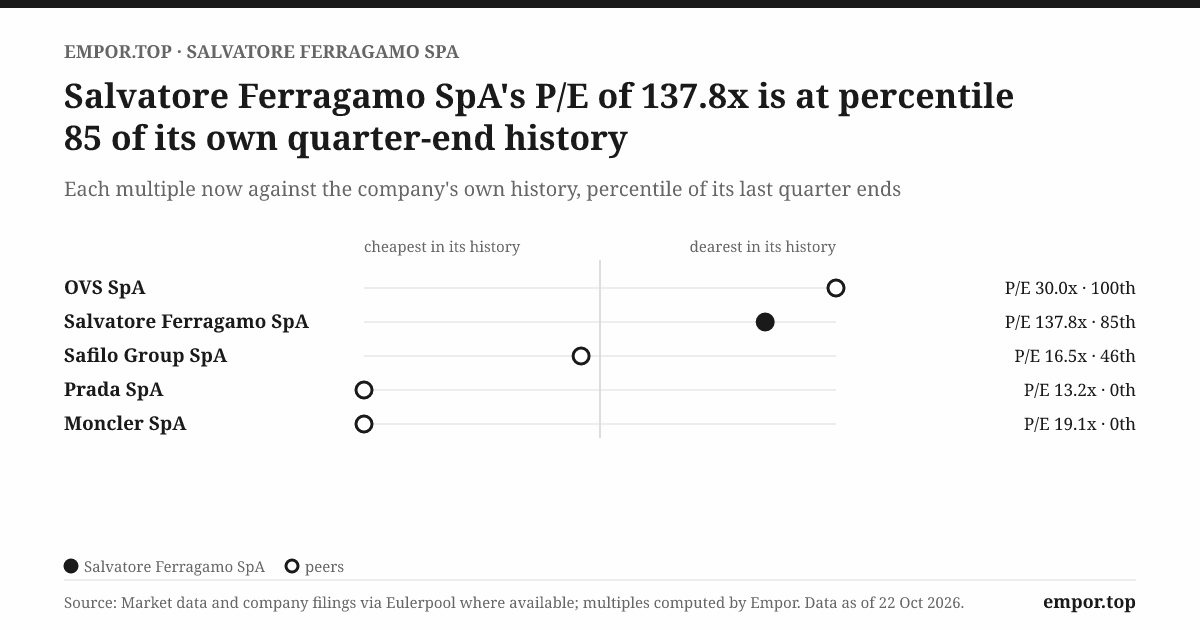
On October 22, 2026, a Ferragamo share cost about €6.66, giving the company a market value of about €1.1 billion. The shares were close to their 52-week low and had fallen more than 80% from their peak at the worst point of the past five years. And yet, on the most commonly quoted valuation measure, the stock looked wildly expensive: about 138 times trailing earnings, against a five-year median of about 48 times.
That paradox is the place to start, because it explains why the price-to-earnings ratio is nearly useless here. When earnings almost disappear, any positive price divided by a tiny profit produces an enormous multiple. Ferragamo's trailing twelve-month earnings per share were about six euro cents. The corresponding earnings yield, profit as a share of the price, is about 0.7%. Neither number says the shares are cheap or expensive. They say the earnings base is too small to anchor a valuation.
More interpretable measures look at the business before the denominator collapses. The company's enterprise value, its market value plus net debt including leases, is about €1.5 billion, roughly 1.6 times annual sales and 8.6 times EBITDA. For a dated reference point, Moncler, a far more profitable Italian luxury house, was valued on October 21, 2026 at about 3.7 times revenue, 9.0 times EBITDA and 18.3 times earnings.25 Moncler is not a like-for-like target, with different scale, product mix, growth and margins. But the comparison shows something useful. On EBITDA, the two companies are priced almost the same, because Ferragamo's EBITDA is inflated by adding back the depreciation of its store leases. On revenue, Ferragamo trades at less than half of Moncler's multiple. The market is pricing Ferragamo's sales as worth far less, because it doubts those sales can earn a Moncler-like margin.
A bottom, or another false dawn
The bull case rests on the operating record of 2026. Direct sales have avoided decline for five consecutive quarters, which management calls positive momentum, and full-price sales, conversion and average ticket have improved in the United States and Europe.2 Second-quarter sales rose 4.6% at constant currency, and the first half produced a net profit after a loss a year earlier, with core profit up almost a quarter on cost control.9 The store network is smaller and more focused on productivity, at 354 stores.2 The creative direction is drawing the best reviews in years. Put together, a bull would argue that Ferragamo is at the bottom of a long reset, with costs reset lower and a cleaner channel mix, so that even modest sales growth would produce a sharp rise in profit.
The bear case rests on the longer record. Revenue fell at about 3.7% a year over a decade, and operating margin fell from the high teens to about 1%.4 Every previous reset, in 2017 and again in 2022, promised recovery and delivered a smaller company. China remains weak, the third quarter of 2026 showed direct growth stalling at zero, and the chief executive's office has been empty for more than eighteen months. A bear would argue that the 2026 profit improvement is cost-cutting rather than demand, and that a company with a 359-day inventory cycle and a fixed-cost store network is highly exposed to another downturn in luxury spending.
Currency adds a further layer. Ferragamo reports in euros but earns most of its revenue in dollars, renminbi, yen, won and pesos.4 In 2025, all of those weakened against the euro, so reported revenue fell 5.7% while constant-currency revenue fell 3.8%.4 Hedges added about €13 million to revenue, but the income statement still carried about €29 million of net currency losses, partly offset by about €18 million of derivative gains.4 In 2026, the hedging contribution to revenue has nearly vanished, falling from €8.5 million in the first nine months of 2025 to €0.6 million, which is part of why reported revenue fell 2.8% while constant-currency revenue was flat.2 Other income of about €18 million in 2025 did nothing to rescue a pre-tax loss of about €53 million.4 Currency and derivatives move earnings around from year to year; they are volatile, not recurring, and they should not be mistaken for operating improvement.
Weigh the two, and the bear case remains stronger on the evidence available today. The early signs of recovery are real, but they cover a few quarters, while the record of decline covers a decade and two failed resets, and the most recent quarter went the wrong way. The bull case is intact but unproven. What would change that judgment is clear: sales growth and reported operating profit improving together, for several quarters, without relying on cost cuts or currency.
A skeptical long-short investor would frame the challenge bluntly, even though no activist is present and the voting structure makes one nearly powerless. Why should minority shareholders accept family control, a leadership vacuum and a buyback that raises the family's percentage stake before a permanent chief executive is named and a durable recovery is visible? The honest answer is that the family's patience is the strategy, and minority holders are passengers on it.
For anyone tracking the story, three measures carry the weight. The growth of direct-to-consumer sales at constant currency, last seen at 4% for nine months and flat in the third quarter. The total revenue line after wholesale rationalisation, flat over nine months and down in the third quarter. And reported operating margin, about 1% in 2025. Those three numbers will say whether the turnaround is showing up in the accounts. Before turning to what comes next, it is worth asking what this long Florentine saga teaches.
XII. Playbook: Business & Investing Lessons
Go back to the runway at the Triennale in Milan on September 26, 2026, where Ferragamo showed its spring-summer 2027 collection to some of the best reviews the house had received in years.2 Fifty-three celebrities and talent wore the clothes around the show, and its top social post drew 3.9 million interactions.2 Three weeks later, the third-quarter numbers showed total revenue down. Both events are true. The lessons of Ferragamo live in the space between them.
The first lesson is that heritage gets you the first fitting; the product has to earn the second. Salvatore Ferragamo's engineering of the arch and the cork wedge gave the company a story that still opens doors, and in 2026 it still filled front rows. But a famous name alone did not reverse the decade-long decline. For founders, the point is that a legacy is a customer-acquisition asset, not a retention strategy. For investors, it is a warning against paying for a brand's past as if it guaranteed its future.
The second lesson is that a cleaner channel mix is not growth until the lost sales are replaced. Ferragamo's decision to retreat from wholesale may well prove right for the brand. But in the third quarter of 2026, the shift had not prevented the company from getting smaller. Strategy decks love the word "rationalisation" because it makes a decline sound deliberate. The test is whether the controlled channel grows fast enough to cover what was given up, and until it does, the cleaner mix is a cost, not a win.
The third lesson is that cash can make a turnaround survivable without making it successful. Ferragamo's cash generation gave it room to be patient. That same patience has allowed resets to stretch across years, even as inventory has remained a burden. Cash buys time. It does not tell you whether the time is being used well.
The fourth lesson is that in a family company, continuity is an advantage only when someone is clearly accountable for results. The family's control lets Ferragamo make long-term choices that a widely held company might shy away from. But the prolonged chief executive vacancy has blurred who owns the outcome. Long-term ownership is a virtue when it comes with a named owner of the plan.
XIII. Epilogue
Tonight, Ferragamo stands at a flat line that hides a fork in the road. The recovery remains unproven, and the company is still waiting for a permanent leader. The next few moments will decide which way it goes.
The first is the full-year results in early 2027, the first full year of the channel reset under the current interim leadership. If direct sales growth re-accelerates in the fourth quarter, traditionally the most important for luxury gifting, and wholesale declines begin to ease as the rationalisation cycle matures, the company will be able to show that the cleaner mix can grow. If direct growth stays flat while wholesale keeps falling at double-digit rates, the bear case that Ferragamo is building a better version of a smaller business will look correct.
The second is product. What matters now is whether attention to the Cara and Hug bags, and the next season of shoes, converts into full-price sell-through, higher average tickets and repeat purchases over several seasons. A handbag line that keeps falling in total while the marketing grows louder would be the clearest sign that visibility is not becoming demand.
The third is margins. Total revenue and reported operating margin need to rise together. The recovery must come from growth, not cost cuts alone.
The fourth is leadership and governance. The appointment of a permanent chief executive will say a great deal about how the family intends to share accountability. The renewal of the transfer-pricing agreements, including the US arrangement for 2024 to 2028, will clarify how profit is divided between Florence and the world.4 And any disclosed outcome of the Milan prosecutor's review, or of Ferragamo's own supply-chain remediation, will determine whether the craft story on the price tag is fully protected.4
Set against the story's central questions, each outcome has a clear meaning. Direct growth outpacing wholesale decline would answer whether control can replace volume. Rising full-price sales would answer whether the brand still has pricing power. A permanent, accountable leader delivering reported profit would answer whether family stewardship can deliver results rather than only patience. For now, none of the questions is settled. The channel shift is visible. The conversion of product relevance into sustained reported profit is not.
XIV. Outro
Nearly a century after Ferragamo returned to Florence and opened his workshop, the company that bears his name sells most of its products through its own stores and website.2
That is the strange symmetry of Ferragamo. After decades becoming a global fashion house, it is trying, in a sense, to become a workshop again. The shoe on the bench is finished, and it is beautiful. Craft is the inheritance. Whether someone walks in and chooses it at full price, season after season, is the verdict that nobody in Florence, not even a Ferragamo, can decide alone.
References
-
9M 2026 Consolidated Revenue Release — Salvatore Ferragamo S.p.A., 2026-10-20 ↩↩↩↩↩↩↩↩↩
-
9M 2026 Revenue Update Analyst Presentation — Salvatore Ferragamo S.p.A., 2026-10-20 ↩↩↩↩↩↩↩↩↩↩↩↩↩↩↩↩↩↩↩↩↩↩↩↩↩↩↩↩↩↩↩↩↩↩↩↩
-
Salvatore Ferragamo Parts Ways with CEO Marco Gobbetti — FashionUnited, 2025-02-04 ↩↩↩↩↩
-
Annual Report 2025 — Salvatore Ferragamo S.p.A., 2026-03-11 ↩↩↩↩↩↩↩↩↩↩↩↩↩↩↩↩↩↩↩↩↩↩↩↩↩↩↩↩↩↩↩↩↩↩↩↩↩↩↩↩↩↩↩↩↩↩
-
Salvatore Ferragamo Italia S.p.A. — Company History, Reference for Business ↩↩↩↩↩↩↩↩↩↩↩
-
Ferragamo Grows Revenue and Returns to Black as Relaunch Strategy Advances — Reuters via Euronext, 2026-08-03 ↩↩↩↩↩↩↩↩
-
Ferragamo Unable to Confirm Objectives — World Footwear, 2017-12-14 ↩↩↩↩
-
Italy’s Ferragamo Unable to Confirm Medium-Term Targets — Reuters via FashionNetwork, 2017-12-15 ↩
-
Ferragamo’s 2018 Core Profit Falls as Turnaround Costs Weigh — Reuters via Yahoo Finance, 2019-03-12 ↩↩↩
-
FY2025 Results Release — Salvatore Ferragamo S.p.A., 2026-03-11 ↩↩
-
Half-Year Financial Report as at 30 June 2025 — Salvatore Ferragamo Group, 2025 ↩↩
-
2026 Remuneration Policy Report and Fees Paid in 2025 — Salvatore Ferragamo S.p.A., 2026 ↩↩↩↩↩↩
-
Italy Sweatshop Probe Snares More Luxury Brands — FashionUnited, 2025-12-04 ↩↩↩↩↩↩
-
KPMG Fee Report to the 2026 Shareholders’ Meeting — Salvatore Ferragamo S.p.A., 2026 ↩
 LinkedIn
 WhatsApp
 Reddit
 Hacker News
 Email
 Kindle
 RSS Feed
 Spotify
 Apple Podcasts
 Amazon Music
 Audible
 YouTube