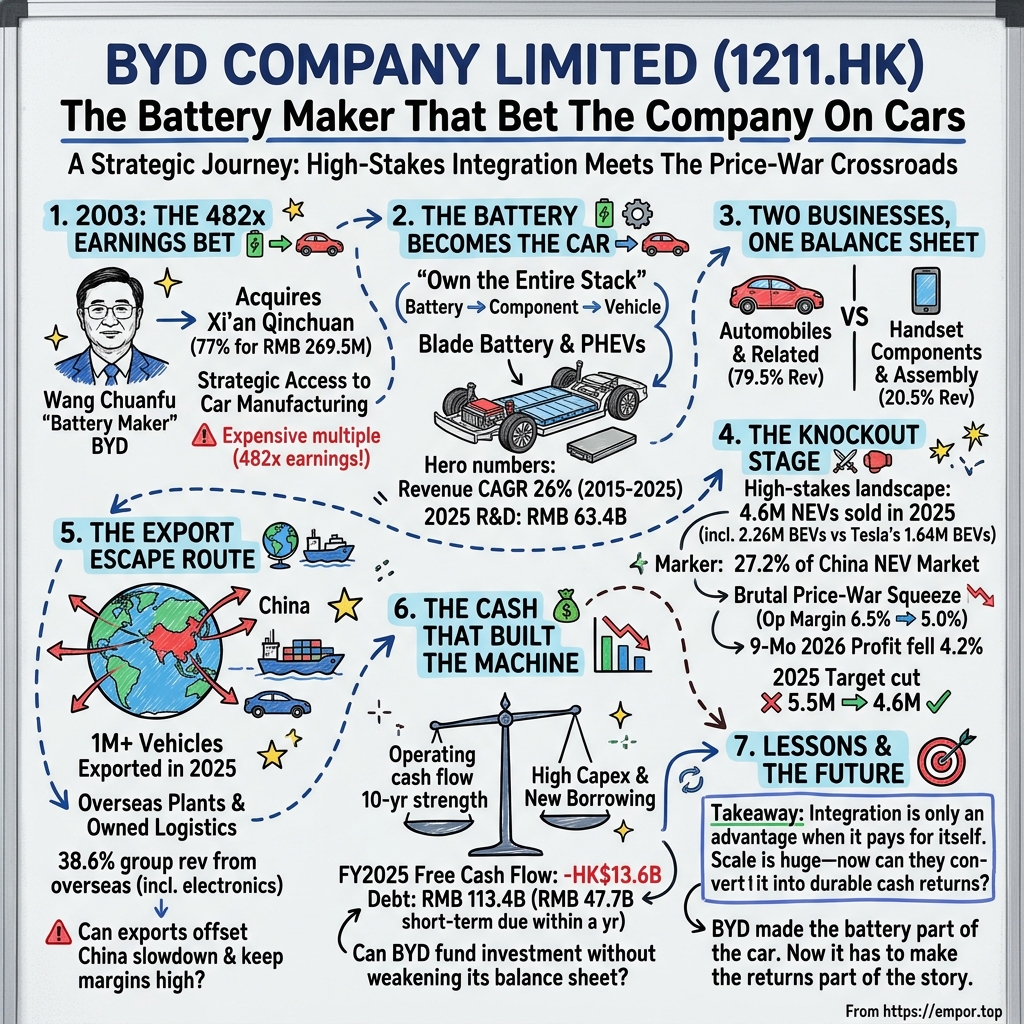
BYD Company Limited: The Battery Maker That Bet the Company on Cars
I. The Battery Maker at the Price-War Crossroads
In January 2003, shareholders of a young Hong Kong-listed battery company opened their newspapers to news that made no sense to them. 比亚迪 (BYD) had been listed for barely six months. It made rechargeable cells for mobile phones and was winning contracts that had belonged to the big Japanese battery makers, and it had just agreed to buy a struggling state-linked carmaker in the city of Xi'an.
The market's answer came fast. The shares fell by roughly a third while the deal was being digested, and almost everyone around the company, its own early backers included, had argued against it.12 A battery maker, people asked, buying a car factory? It sounded like a founder's vanity project.
Twenty-three years later, that vanity project is the company. In 2025 BYD sold about 4.6 million new-energy vehicles, which in China means battery-electric cars plus plug-in hybrids. About 2.25 million of them were pure battery-electric, comfortably more than Tesla's 1.64 million deliveries, which made BYD the world's largest seller of fully electric cars for the first time.3
More than one million of those vehicles were sold outside China.3 The same group that once made phone batteries in a Shenzhen workshop now reports revenue of roughly RMB800 billion a year, about four-fifths of it from cars.4
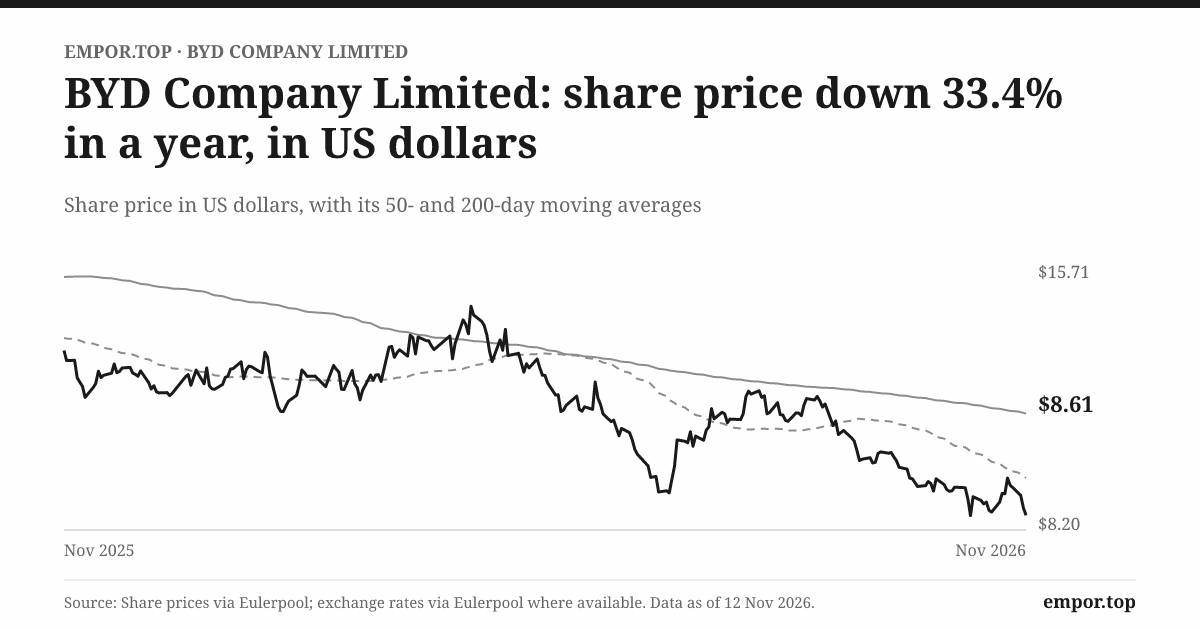
And yet the scene in Hong Kong on 12 November 2026 is not a victory lap. BYD's shares closed at HK$67.55, a whisker above their 52-week low and about 40% below their high of the past year, which gave the whole company a market value of about US$75 billion. The reason sits in the latest numbers.
For the nine months to September 2026, revenue was flat against the year before, at about RMB566 billion, and profit attributable to shareholders fell about 4%, to RMB22.3 billion.5 That followed a 2025 in which revenue rose only 3.5% while net profit fell 19%, the company's first annual profit decline since 2021.46 A business that had compounded revenue at about 26% a year for a decade had, in the space of eighteen months, stopped growing.
That contradiction is the heart of this story. BYD has built something few others in the car industry have built, a single company that designs its own battery chemistry, makes the cells, makes many of the chips and motors around them, and then bolts the whole thing into millions of cars at prices that rivals in Europe, Japan and America struggle to match.
It got there by spending heavily and moving fast. Now it is spending more heavily than ever, on factories in Brazil, Thailand and Hungary, on a new generation of fast-charging batteries, and on thousands of charging stations, at the very moment its home market has turned into what its founder calls a "brutal knockout stage."7
So the stakes are simple to state and hard to answer. The first question is whether BYD's integration really gives it a lasting cost and product edge, or whether it is merely the biggest player in a market where everyone is getting cheaper at the same time. The second is whether the push abroad can offset a price war at home, and whether cars sold in São Paulo and Bangkok earn more than cars sold in Shenzhen once the cost of ships, dealers and new plants is counted.
The third, and the one that matters most to an owner of the shares, is whether the enormous investment of the past few years can turn back into cash. In 2025, for the first time in five years, BYD spent far more on factories and equipment than its operations brought in.4
One boundary needs to be clear before the story starts. The listed company, BYD Company Limited, is a group. It contains the car business, the battery business that supplies it and sells to others, and a large electronics operation that makes components and assembles handsets for other brands.
Cars and related products account for most of the revenue and nearly all of the investment case, so cars are the spine of this story.4 But the electronics arm is too big to ignore, and the group balance sheet, with its cash, debt and guarantees, belongs to all of it.
To understand why investors are so divided about BYD today, it helps to go back to the decision that made it a car company at all, and to the price that seemed so absurd at the time.
 Subscribe on LinkedIn
II. The 482-Times-Earnings Bet
王传福 Wang Chuanfu did not come from money or from cars. He was born in February 1966 in Wuwei, a poor county in Anhui province, one of eight children in a farming family. His father died when he was 13 and his mother a few years later, and an older brother helped pay for his schooling.2
He studied chemistry at Central South University of Technology, then took a master's degree at the Beijing General Research Institute of Nonferrous Metals, a state laboratory that worked on battery materials.2 In 1993 the institute set up a battery venture in Shenzhen and sent Wang to run it. Two years later he left and, with a loan from a cousin who worked in finance, incorporated his own company in Shenzhen.2
The early BYD story is a lesson in cheapness as strategy. The Japanese companies that dominated rechargeable batteries, Sanyo and Panasonic among them, ran automated production lines that a start-up could not afford. Wang broke the process into small manual steps and staffed them with low-cost workers, so that a line which cost a fortune in machines in Japan cost a fraction of it in people in Shenzhen.2
The approach let BYD undercut incumbents on nickel and then lithium-ion cells, and by the early 2000s it had won mobile-phone customers such as Motorola.2 It listed its H shares in Hong Kong on 31 July 2002.8[^9] In 2003 BYD's sales of lithium-ion batteries were about RMB2.1 billion and nickel batteries about RMB1.2 billion.9 It was a battery company, and a successful one.
Then came Xi'an. On 31 March 2003, after announcing the plan in January, BYD completed the purchase of 77% of 西安秦川汽车 Xi'an Qinchuan Automobile, a small carmaker, for RMB269.5 million in cash.9 Qinchuan's recent earnings were tiny, so tiny that by one contemporary calculation the price came to about 482 times the target's prior-year profit.1
That figure is what investors heard, and it is why the shares dived.1 To a market that valued BYD on its battery profits, the company appeared to be pouring its new IPO cash into a barely profitable factory in a business where it had no experience, against foreign joint ventures with decades of know-how.
The record, read closely, tells a more interesting story than the headline multiple. BYD's own accounts valued Qinchuan's identifiable net assets at about RMB288 million at the time of the deal, which meant that BYD's 77% share of those assets was worth roughly RMB222 million on the company's own valuation. The premium it paid over that, booked as goodwill, was only about RMB48 million.9
In other words, BYD paid roughly 1.2 times the fair value of the assets it got, and the eye-watering earnings multiple mostly reflected how little Qinchuan was earning on those assets, not how much BYD was paying for them. In the nine months BYD owned it in 2003, the car business added about RMB507 million of revenue and about RMB25 million of operating profit.9 Within a year BYD agreed to pay a further RMB52.5 million to lift its stake to 92%.9
What did that money really buy? Not earnings, and not mainly machines. It bought a seat at the table. Car making in China was a regulated, licence-heavy industry, and building a new carmaker from scratch meant years of approvals and plant construction. Qinchuan already had production capacity, a product line and the permissions to build and sell vehicles. Buying it turned the question from "may we make cars?" into "can we make good ones?"
That is the right way to benchmark the deal, and also the limit of what can be said about it. There is no clean set of comparable transactions for a small, struggling Chinese automaker in 2003, so the 482-times multiple cannot be called cheap or expensive by reference to peers.
A multiple of nearly five hundred is a warning sign in any market, a sign that the buyer is paying for something other than current profit. The useful question is what strategic access was worth, and whether BYD had a plan that could make it pay.
Hindsight answers the first part generously. Cars had become the group's dominant business.4 Warren Buffett's Berkshire Hathaway, introduced to the company through the investor 李录 Li Lu and Charlie Munger, bought about 10% of BYD in 2008, 225 million shares for about US$230 million, when the shares traded between roughly HK$3 and HK$8.10
Berkshire began selling in August 2022, after the shares had multiplied many times over, and had sold out entirely by mid-2025.10 That arc, from mocked acquisition to one of the most celebrated growth investments of its era, is the version most people know.
The human side of that arc is less well known. Li Lu had first bought into BYD in 2002, using money Munger had entrusted to his fund, and both men had opposed the car deal at the time.2 By 2008 they had changed their minds. When Berkshire came to invest, Wang reportedly turned down an offer for a bigger stake, keeping control of the company in the founder's hands.2 That instinct, to take outside capital without ceding control, would reappear when BYD raised money again in 2025.
The more careful version is narrower. The Qinchuan purchase made BYD's later automotive story possible. It does not prove that every yuan BYD has since poured into cars earned a good return, and BYD's path from 2003 to its breakout was not smooth. Its profits stalled for long stretches in the 2010s, and as late as 2019 the whole group earned a net margin of barely 1%.4 The bet on cars was right about direction long before it was right about returns.
The deal also created a harder question. Plenty of companies can buy a factory and assemble cars. BYD's founder was a battery chemist, and the obvious hope was that his company could make the battery itself an advantage, so that the most expensive part of an electric car became the part BYD knew best. Whether that hope became a business is the next chapter.
III. The Battery Becomes the Car
Picture a laboratory test that BYD broadcast online in late March 2020, during the first weeks of the pandemic. Engineers drove a steel nail through a battery pack, the kind of abuse that can make a conventional electric-car battery smoke, catch fire or explode.
The pack BYD was showing off, a long flat cell it called the 刀片电池 Blade Battery, reportedly stayed at 30 to 60 degrees Celsius with no visible smoke or flame. In the same comparison, a battery built on the nickel-rich chemistry many Western carmakers favoured passed 500 degrees and burned.11
The test was theatre, but it was theatre with a strategy behind it. To understand why, it helps to know that electric-car batteries come in two broad families. One uses nickel, manganese and cobalt. It stores more energy for its weight, which means longer range, but the materials are expensive and the chemistry is more prone to overheating. The other uses lithium iron phosphate, usually shortened to LFP.
It is cheaper, more stable and longer-lived, but it stores less energy in the same space, which used to make it the choice for buses and budget cars. BYD's insight with Blade was mechanical as much as chemical. By making the cells long and thin and stacking them directly into the pack, it said, it could use about 50% more of the space inside than a conventional LFP pack.11 Think of it as packing a suitcase with books stood on end instead of boxes with air around them. The cheap, safe chemistry suddenly carried enough energy for mainstream cars.
That mattered commercially because the battery is the single costliest component of an electric car. A carmaker that buys its batteries pays a supplier's margin and competes for supply with every other carmaker. A carmaker that designs and builds its own can shape the cell around the car, the car around the cell, and capture the margin for itself.
BYD had done this for years with plug-in hybrids, which pair a battery and electric motor with a small petrol engine, and battery-electric models under one roof. In March 2022 it went further and stopped building purely petrol-powered cars altogether, which it described as a world first for a carmaker. It kept making the small engines used in its plug-in hybrids.12
The hybrids turned out to be the quiet hero. Chinese buyers who wanted lower running costs but worried about charging on long trips found that a BYD plug-in hybrid offered both, at prices close to a petrol car's. Model families such as the 王朝 Dynasty and 海洋 Ocean series, and later cheap city cars such as the Seagull, gave BYD a product at nearly every price point.
In 2025 its sales were split almost evenly, about 2.29 million plug-in hybrids and about 2.25 million battery-electric cars.3 Above the mass brands sit three premium labels, 腾势 Denza, 方程豹 Fangchengbao and 仰望 Yangwang, which in the first half of 2026 grew their combined sales by 61% and made up about 12.8% of BYD's passenger-car volume, according to the company.13
None of this came cheap. BYD spent about RMB63 billion on research and development in 2025, roughly 7.9% of revenue and up from about 7% the year before.144 That is a very high ratio for a mass-market carmaker, and the company is not shy about the people it pays.
At a shareholder meeting on 29 September 2026, management said BYD employed about 120,000 engineers and filed around 52 patents a day.15 For most of the past decade, the spending and the growth moved together.
The bill for owning the stack goes well beyond the laboratory, though. In 2024 BYD's capital expenditure was about RMB92.5 billion. In 2025 it rose to about RMB140 billion, of which roughly RMB134.5 billion went into the automotive segment.4 That is about a sixth of a year's revenue, spent on buildings, machines and tooling. Depreciation in the car business rose by about a quarter in 2025, to roughly RMB71 billion, while car revenue grew about 5%.4
Vertical integration is a bargain with the economic cycle. When volumes rise, owning the battery plant, the motor plant and the chip fab spreads fixed costs across more cars and lets BYD cut prices faster than rivals who buy from suppliers. When volumes stall, the same plants keep costing money, and there is no supplier to absorb the pain. The integrated carmaker is the one holding the inventory.
The newest proof point illustrates both sides. In March 2026 BYD launched a second-generation Blade battery with what it calls 闪充 flash charging. The company says it can provide a meaningful charge in five minutes, a full one in about nine, and only about three extra minutes in temperatures of minus 30 degrees.13
By 28 August, management said, it had built 10,000 flash-charging stations in five months, and it credited the new models with a month-by-month recovery in sales and market share.13 The company says it plans about 6,000 such stations abroad and describes the network as a "moat."15
Here the reader has to separate two kinds of evidence. Charging speeds, nail tests and patent counts are technical claims. Most are the company's own, and some have outside recognition; the flash-charging work received official recognition from the industry ministry in July 2026, according to BYD.13 Commercial proof is different.
It shows up as customers returning, as prices that hold without discounts, as segment margins that rise, and as plants that turn spending into cash. On that second ledger the recent record is mixed. Group operating margin fell from about 6.5% in 2024 to about 5% in 2025, even as R&D intensity rose.4 The battery became the car. Whether it became a better business than its rivals' is the question the rest of this story tests.
There is also a long history to weigh. BYD's ambitions have never been confined to cars. Over the years it has invested in solar panels, energy storage, electric buses and monorail-style urban rail, and in September 2026 management pitched storage and solar as part of an "AI energy solutions" opportunity, arguing that data centres will need stable power.13 Those ventures are evidence of a sweeping industrial ambition.
They are not, on the company's own segment reporting, evidence that each adjacent business became a material profit engine, since the filings fold them into broader lines rather than reporting them as stand-alone earners.4 When a company with a gift for building factories finds a new reason to build more, investors should ask for the segment numbers before the vision.
The integration instinct is still expanding. Asked about semiconductors at the September 2026 shareholder meeting, management drew a direct line from batteries. Power batteries, it said, were once not a Chinese strength and are now a global leader; in the "second half" of the electric-car revolution, the intelligent half, chips and software could matter even more than batteries, and BYD "will not be just an assembly plant."15 That is a coherent strategy. It is also a promise of more capital spending, in an industry where chip design and software talent cost far more than factory workers.
That habit of building more than one thing raises a more practical question. BYD is not only a car company. A large part of its revenue still comes from a business most Western drivers have never heard of.
IV. Two Businesses, One Balance Sheet
Walk into a BYD electronics plant and there is not a car in sight. The lines turn out metal and glass housings, structural parts and fully assembled devices for some of the world's best-known consumer-electronics brands. This is the other BYD, the descendant of the battery-and-components shop that Wang built in the 1990s, and it is not a footnote.
In 2025 the handset components and assembly business brought in about RMB155 billion of external revenue, roughly a fifth of the group, down about 2.7% on the year.4 Cars and related products brought in about RMB649 billion, up about 5.1%, and accounted for the other four-fifths.4 To put the smaller business in perspective, on its own it would rank as a very large electronics manufacturer.
The electronics arm is a contract business. It wins programmes from device brands, builds to their specifications, and lives or dies by their product cycles. BYD's largest single customer bought about RMB101 billion of goods and services in 2025, about 12.5% of group revenue, up slightly from the year before.4
The company does not name that customer or say which segment it buys from. The five largest customers together took about 18% of sales, so no single buyer dominates the consolidated group, but one relationship is large enough to matter.4
So which business carries BYD? The segment accounts give a clear answer. Before tax, the car segment earned about RMB28.4 billion in 2025, down about 22% from RMB36.3 billion in 2024.4 The electronics segment earned about RMB2.7 billion, down about 35%.4 On those figures, electronics contributed less than a tenth of segment profit while taking a fifth of revenue. Its margin, about 1.5% of segment sales before tax, is the margin of an assembler, not of a technology franchise.
That comparison matters for how investors read the group's 2025 decline. Revenue rose 3.5%, yet attributable profit fell about 19%, to roughly RMB32.6 billion.4 Both segments earned less, but the car business lost far more in absolute terms, about RMB8 billion of pre-tax profit against about RMB1.5 billion in electronics.4 The earnings decline was, overwhelmingly, a car story.
The capital story is even more one-sided. The car segment absorbed about RMB134.5 billion of the group's roughly RMB140 billion of capital spending in 2025, while electronics took about RMB5 billion.4 The car segment also carries about RMB754 billion of the group's RMB884 billion of assets.4 Electronics is a modest consumer of capital that produces a modest, steady profit. Cars are where the money goes and where the returns have to come from.
That is why group-level cash and debt cannot be assigned neatly to one business. BYD's treasury pools cash, borrows centrally and guarantees the debts of its subsidiaries. The electronics arm helps fund the whole, and the whole stands behind the car plants.
A shareholder owns both, and also owns a slice of profit the segments do not explain. In 2025 about RMB8.6 billion of group pre-tax profit sat in "adjustments and eliminations" rather than in either operating segment, a reminder that items such as grants, treasury income and central costs move the group result too.4
What about the other ventures, the solar panels, the energy storage containers, the urban rail? BYD's reporting folds them into its two big segments rather than breaking them out, which means the company does not publish their revenue or profit separately.4
Management talks about storage with growing enthusiasm, and in September 2026 said it was "very confident" in the business as battery capacity is freed up.13 Until BYD reports those businesses on their own, the honest way to treat them is as part of the car-and-battery machine, not as a hidden second growth engine.
The verdict here is straightforward. Electronics diversifies the revenue and spreads some fixed costs, but it is not the source of BYD's value and it did not cause the 2025 slowdown. The investment case rises and falls with the car business. And in 2025 the car business ran into the fiercest competition the industry had seen.
V. The Scale Advantage Meets China's Knockout Stage
In late March 2026, Wang Chuanfu stood before investors and analysts in Shenzhen to explain the decline in annual profit. He did not describe a normal downturn. Competition in China's new-energy vehicle market, he said, "has reached a fever pitch, and is undergoing a brutal knockout stage."7
The phrase was striking because BYD was, by most measures, the winner. It had just extended its global sales lead.3 Yet the knockout stage was knocking BYD's margins about too. To see why, it helps to look at the market the way a Chinese car buyer sees it.
Stand in a Chinese car showroom district in 2025 and the choice is dizzying. A buyer can pick from BYD, from 吉利 Geely and its sub-brands, from 零跑 Leapmotor, from technology-company-backed brands, from Tesla, and from the foreign joint ventures that once owned the market. Many of the cars are plug-in hybrids or battery-electric models with similar range, similar screens and similar driver-assistance features. Prices are posted, compared online and cut in public. When one brand drops a price, every rival's customers know within hours.
That is the definition of high buyer power. In the language of Michael Porter's five forces, rivalry is intense, products are easy to compare, and the cost of switching from one brand to another is close to zero, because a family buying its second or third car has no software lock-in or service contract tying it to the first.
Suppliers matter less to BYD than to most rivals, because BYD makes so many of its own components. The threat of new entrants is real but bounded by the capital required. Substitutes, mainly petrol cars, are shrinking. The force that bites is the one between rival carmakers, and it bites hard.
The scoreboard shows what that rivalry did. BYD's share of China's new-energy vehicle retail market fell from about 34% in 2024 to about 27% in 2025, and its domestic NEV retail sales fell about 6%, to roughly 3.5 million.16 Over the same year Geely grew its NEV retail sales by about 81%, to about 1.56 million, taking 12% of the market.16 BYD remained more than twice Geely's size. But the trend is not what a protected position looks like.
Here the category comparison needs care. BYD's 4.6 million NEVs in 2025 include plug-in hybrids, so comparing that figure with Tesla's deliveries flatters BYD. The fair contest is battery-electric against battery-electric, and BYD's lead was real.3 Its plug-in hybrid sales, by contrast, fell about 8% in 2025, which shows that the rivals were catching BYD in the very product that powered its rise.3
So what is BYD's advantage, exactly? Five claims recur, and each needs a test. The first is battery and component integration, which should lower cost. The second is purchasing scale. The third is engineering capacity. The fourth is model cadence, the ability to refresh products faster than rivals. The fifth is a brand ladder running from the cheap Seagull to the six-figure Yangwang.
The test for all five is the same. If they gave BYD a structural edge, it would show up as margins that hold while rivals' collapse, as prices that hold without discounts, and as market share that rises.
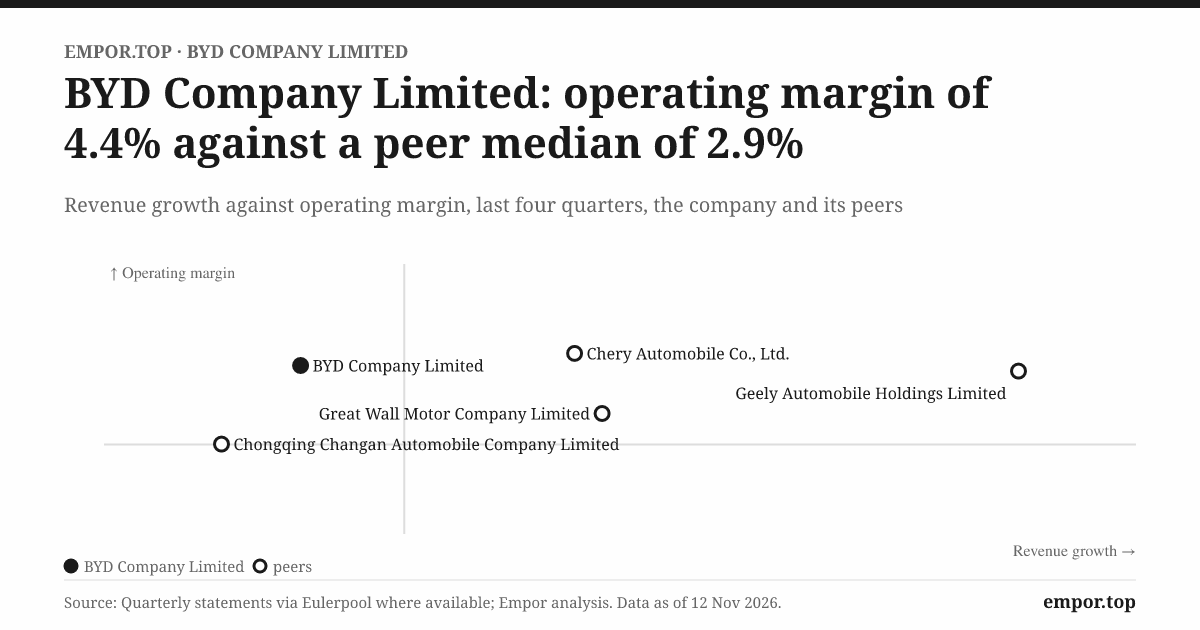
In 2025 BYD's gross margin fell from about 19.4% to about 17.7%, which the company attributed mainly to product mix.4 Its operating margin fell too.4 Its domestic share fell. The edge, in other words, did not protect profits in the worst year of the price war.
That does not mean the edge is imaginary. A carmaker that can cut prices and still earn a gross margin in the high teens is in a different position from one losing money on every car, and many Chinese rivals are in the second group. Scale and integration let BYD keep cutting prices through the war and still make money.
But surviving a price war is a different thing from being immune to one. The most defensible reading is that BYD's advantage is a cost and execution lead that makes it among the last companies standing. The evidence does not show a profit pool that competitors cannot reach.
The latest management records sharpen this picture. On a 10 September 2026 call with 19 analysts, BYD's investor-relations team opened with grim industry data. China's passenger-car retail sales in August 2026 were down about 24% year on year, and down about 21% for the year to date.13 Management described the market as "weakly repairing" and "extremely differentiated," and said BYD's sales were recovering month by month, helped by the flash-charging models, with market share "gradually" rising.13
Notice what the prepared answers emphasised and what they left out. They gave technology claims and brand growth in detail, but no figure for price realisation, discounting or per-vehicle margin. When the subject turned to overseas factories, the company noted that progress "will be affected by local policy, supply-chain support and the pace of engineering construction," a careful hedge rather than a timetable.13
Nineteen days later, at an extraordinary shareholder meeting with 64 invited investors, Wang and his senior team sat before the room to field questions. The tone was expansive. BYD, management said, has "a bottomless pool of technology," a newly launched Fangchengbao model had drawn orders beyond expectations, and it could sell 10,000 or even 15,000 a month.15 Asked how management sees the future, the answer was revealing. BYD is a technology leader with much undiscovered value, management said, and a company's value and competitiveness "cannot be measured only from a financial perspective."15
That sentence deserves to be read slowly by anyone who owns the shares. It is an invitation to judge BYD by engineers and patents rather than by margins and cash. Independent investors should decline the invitation. The technology is impressive, but the reason to own a company is the cash its technology produces. And in the year BYD's technology lead was supposed to matter most, it delivered sales leadership without margin leadership.
The technology lead is therefore best treated as a moving claim. BYD's sales leadership is concrete and measurable. Its ability to convert that leadership into sustained price realisation and higher margins than Geely, Tesla and other Chinese rivals has yet to be demonstrated. That gap, between being the biggest and being the most profitable, was about to show up in a very public way, when BYD quietly lowered its own target for 2025.
VI. A Lower Target, Then a New Growth Question
In March 2025, BYD told analysts it was aiming to sell 5.5 million vehicles that year.17 It was a confident number, set at the start of a year in which the company was still riding the momentum of 2024, when revenue had grown about 29%.4
By August, the confidence had gone. Reuters reported in early September 2025, citing people familiar with the matter, that BYD had cut its internal goal to about 4.6 million vehicles, as much as 16% below the original figure, and had told some suppliers.17 The company did not respond to Reuters' request for comment.17 The report linked the cut to fiercer competition from Geely and Leapmotor and to weak domestic demand.17
It matters what kind of target this was. BYD does not publish formal annual sales guidance the way many Western carmakers do. The 5.5 million figure was communicated to analysts, and the cut surfaced through anonymous sources rather than an announcement.
That makes it a softer commitment than a guided number, and BYD never publicly explained the shortfall in the way a company missing guidance would. But the original figure was meant to inform investors, and it moved their expectations, so it belongs in the record of what management said and what it delivered.
The ending is two-sided. BYD did sell about 4.6 million vehicles in 2025, hitting the reduced figure.3 That is a sign of competent execution once the bar was reset. It is also a miss of roughly 900,000 cars against the target set eight months earlier, a gap larger than the annual sales of many carmakers.
What did the miss cost? The financial slowdown is easiest to understand as a chain. Revenue growth fell from about 29% in 2024 to 3.5% in 2025.4 Gross margin fell nearly two points, which on RMB804 billion of revenue meant roughly RMB8 billion less gross profit than the year before.4
At the same time BYD kept spending. Expensed research costs rose by almost RMB5 billion, and selling and administrative costs by almost RMB4 billion.4 Lower impairment charges and a swing from foreign-exchange losses to gains softened the blow, but operating profit still fell about 20%, to about RMB40 billion.4
Put simply, BYD sold more cars than ever at lower prices and lower margins, while refusing to cut the spending it regards as its future. That is a defensible choice for a company that believes it is building a long lead. It is also exactly how a price war transfers value from producers to customers.
One cost did move the other way. BYD's reported workforce fell from about 969,000 at the end of 2024 to about 870,000 a year later, while revenue still grew.14 The company does not explain how much of that reflects fewer people and how much a change in how it counts them, so it is safer to read the drop as a sign of pressure on costs than as a planned efficiency drive.
Government money is part of the picture, and it is larger than many investors assume. In 2025 BYD booked about RMB13.8 billion of "other income," most of it government grants: about RMB10 billion of grants tied to assets and about RMB2.5 billion tied to income.4 Against total profit before tax of about RMB39.8 billion, that is roughly a third.4
The asset-related grants deserve a word of explanation. When a local government helps pay for a factory, the accounting rules spread that help over the life of the plant, so it shows up as income year after year rather than all at once. That makes it recurring for as long as the plants depreciate, but it is still support from the state, not profit from selling cars. A shareholder trying to judge vehicle economics should notice how much of the profit line it holds up.
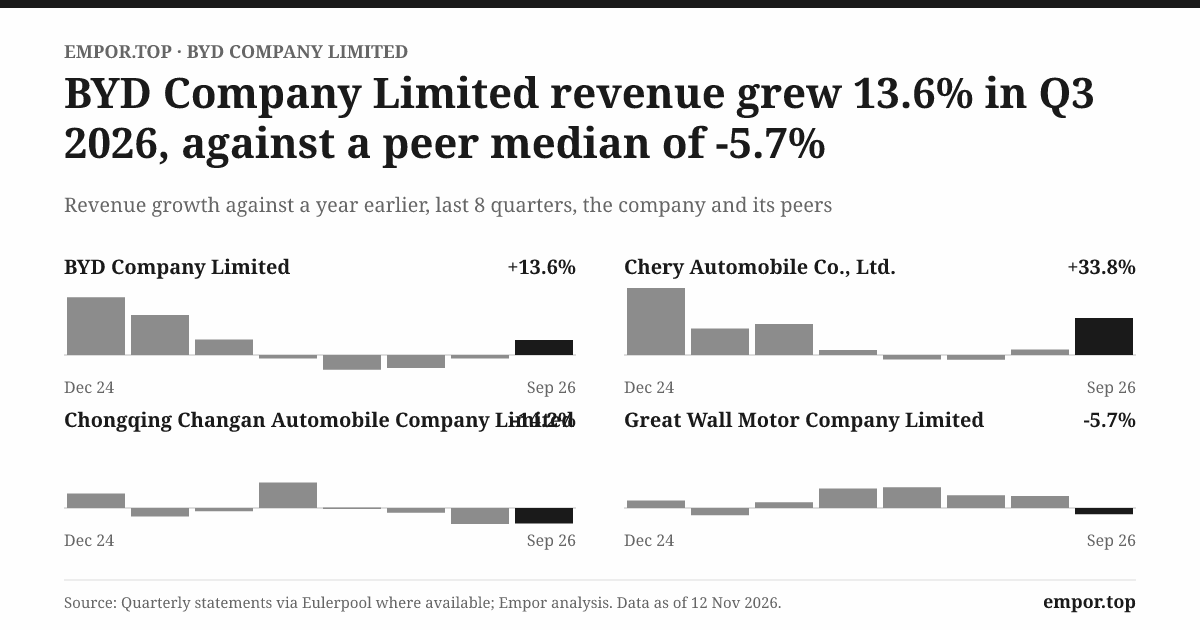
Then came 2026, and a story in two halves. The first half was the low point. Revenue for January to June fell about 7% from a year earlier and attributable profit about 20%, with the first quarter the weakest of all.18 By the second quarter, profit was growing again, and in the third quarter revenue rose about 14% to RMB221.5 billion while attributable profit rose about 28% to about RMB10 billion.5
Profit excluding one-off items rose about 25% in the quarter, which suggests the rebound was not just a matter of windfalls.5 For the nine months as a whole, that recurring profit was up about 2.5%, to about RMB21 billion, a much less dramatic picture than either the headline quarterly jump or the nine-month decline.5
Yet the nine-month view is sobering. Revenue for January to September was flat, and attributable profit was down about 4%.5 Look inside the income statement and two big moves stand out. The first is currency.
Finance costs swung from a net gain of about RMB2.9 billion a year earlier to a net cost of about RMB7.4 billion, which the company put down mainly to exchange losses.5 That roughly RMB10 billion swing, more than any other single line, explains the drop in profit. Gross margin, meanwhile, actually improved slightly, from about 17.9% to about 18.5%.5
The second move cuts the other way. Expensed research and development fell from about RMB43.7 billion to about RMB36.3 billion, a drop of about 17%.5 That saving of more than RMB7 billion propped up the nine-month result. It sits awkwardly beside management's promise, at the September shareholder meeting Wang attended, that BYD will "continue to increase R&D investment."15
The quarterly report does not say how much development spending was capitalised rather than expensed, so the cash commitment to research may be steadier than the expense line suggests. But the reported profit recovery leaned on lower R&D expense at the very moment management was promising more of it.
So the third-quarter rebound is encouraging but not yet proof. Selling more cars with stable gross margins is the right direction. Currency losses can reverse as easily as they arrived. But a recovery helped by a lower R&D charge and supported by government grants is not yet the same thing as restored vehicle economics.
The test for the full year is simple to state. Can BYD grow its volumes while lifting operating margin back above the 2025 level of about 5%, instead of relying on volume alone? Much of the answer, management insists, lies outside China.
VII. The Export Escape Route
On the docks of Chinese ports, BYD's cars now leave on BYD's own ships. The company has built a fleet of car-carrying roll-on, roll-off vessels, eight of them in service by the end of 2025, so that it controls the most expensive and least reliable link in the export chain.4 It is the integration habit applied to the ocean.
The ships were busy. In 2025 BYD exported more than one million complete vehicles, about 2.4 times the year before.4 Revenue from customers outside China rose about 40%, to roughly RMB311 billion, which lifted the overseas share of group revenue from about 29% to nearly 39%.4 Over the same year, revenue from customers in China fell about 11%.4 Put those numbers side by side and the shape of BYD's 2025 is clear. The home market shrank, and the rest of the world filled most of the gap.
One caution belongs right here. The overseas revenue figure covers the whole group, including electronics sold to foreign customers, so it overstates car exports. BYD does not split overseas revenue between cars and electronics, and it does not report a margin for overseas car sales.4 The million-plus exported vehicles are a clean car figure. The overseas revenue share is not.
Why go abroad so hard? Partly because the price war at home pushed BYD to find buyers who would pay more, and partly because export markets were opening as Chinese technology caught up. In Europe, BYD's sales rose about 270% in 2025 to almost 188,000 cars.19 In markets including Thailand, Singapore and Brazil, BYD says it was the top-selling new-energy brand in 2025.4
Momentum carried into 2026, with European registrations up about 144% in the first five months, to more than 100,000.19 Management likes to describe a ladder abroad, from "China's BYD" to "the world's BYD" to "the local BYD," with buyers starting on a Seagull and climbing towards the luxury Yangwang.15
The ladder needs local factories, because trade friction is the great threat to an exporter. The United States is effectively closed to Chinese electric cars by tariffs, and BYD itself warns that geopolitical tensions could raise trade barriers elsewhere.74 So BYD has been building where it sells. Its plant in Rayong, Thailand, began production in July 2024 with a designed capacity of 150,000 cars a year, sources about half of its parts locally, and had delivered its 130,000th car in Thailand by July 2026.20
In Brazil, BYD built its largest complex outside Asia at Camaçari, in the state of Bahia. The first car rolled off the line on 1 July 2025, and the plant reached its 10,000th vehicle in late November, adding a second shift.21 It started by assembling kits shipped from China, with full local manufacturing to come, and has a planned capacity of 150,000 a year.21
At the September 2026 shareholder meeting management said the Brazilian plant would produce about 250,000 vehicles this year, a figure that would far exceed that stated capacity and that the company has not reconciled publicly.15
Hungary is the test case for Europe, and it has been slower. The Szeged plant was originally meant to start production at the end of 2025. In June 2026 BYD's executive vice president 李柯 Stella Li confirmed that assembly would begin in the fourth quarter of 2026, about a year late, and called Hungary "the number one priority right now."19 A planned US$1 billion plant in Turkey, announced in 2024, was on hold.19 Management said in September that Hungary would "soon" begin formal production.15
The physical footprint abroad is growing fast but is still small next to the Chinese base. BYD's non-current assets located overseas roughly doubled in 2025, to about RMB32 billion, against about RMB436 billion in China.4 For now, most of what BYD sells abroad is still built at home and shipped.
That has a cost that showed up in the latest accounts. By the end of September 2026, BYD's inventories had swelled about 60% in nine months, to roughly RMB222 billion, almost exactly a quarter's revenue.5 The company said the increase was mainly due to the growth of the overseas car business.5
Cars in transit, cars on foreign dealer lots and cars waiting in bonded warehouses all tie up cash. Trade receivables rose about 53% for the same reason, and BYD's provisions for inventory impairment rose too.5 Long shipping cycles had already lengthened inventory days in 2025, the company noted.4
On the positive side, customer advance payments for cars rose about 81%, to about RMB93 billion, which suggests real orders behind the pipeline.5 But the working-capital shape of the export business is plainly different from the domestic one. At home, BYD's customers and dealers pay quickly. Abroad, the cars sit longer before anyone pays.
There is one more channel to examine, because investors often ask whether a sprawling Chinese group moves sales through related parties. The answer, on the company's disclosures, is that related-party sales are small. In 2025 they came to about RMB1.6 billion, about 0.2% of revenue, while related-party purchases were about RMB10.8 billion, about 1.3%, with prices described as based on market rates.4
The material channel is finance. BYD Auto Finance, the car-loan company, is a related party, and it held about RMB24.6 billion of the group's deposits at the end of 2025, paying about RMB781 million of interest on them.4 That is worth monitoring as a concentration of cash, not evidence that related parties are inflating sales.
So the verdict on exports is clear in direction and open on economics. Overseas growth is material, and local production should reduce tariff risk over time. But BYD does not disclose the margin on overseas car sales, and the build-up of inventory and receivables shows that the export model consumes cash before it returns it.
The decisive evidence will be plant-level output and utilisation, local sourcing, and some disclosure of what an overseas car earns after freight, dealers and new factories. Until then, the escape route is also a cash commitment, and cash is the next part of the story.
VIII. The Cash That Built the Machine—and the New Borrowing
For most of the past decade, BYD had a trick that many investors never fully appreciated. It was paid by customers long before it paid its suppliers. That gap, multiplied across hundreds of billions of yuan of purchases, worked like an interest-free loan from the supply chain, and it financed a remarkable share of the company's growth.
The clues are in the working-capital numbers. In 2014 BYD waited, on average, about 148 days to collect what customers owed it, the profile of a supplier to buses, fleets and government buyers.4 As consumer car sales took over, those collection days fell steadily, to about 21 by 2025.4
Meanwhile BYD took a long time to pay its own suppliers. In 2025 payables still stood at roughly 115 days of cost of sales against about 76 days of inventory.4 Put the three together and the cash cycle was negative: on average, BYD collected cash about 18 days before it paid for the goods that produced it.4
The result shows up over a long span. Across the twelve years from 2014 to 2025, BYD's operating cash flow came to about four and a half times its net profit.4 Part of that gap is depreciation, a non-cash charge that grows as the factories multiply. Much of the rest is the supplier float. That cash, not accounting profit, paid for the plants of the early 2020s.
Then the float began to shrink, and the reason was political as much as financial. As the price war deepened, China's government grew alarmed about suppliers being squeezed. New rules taking effect in June 2025 required large companies to pay smaller suppliers within 60 days, and BYD joined more than a dozen carmakers in pledging to do so.22 At the time, payment periods of more than 150 days were common at BYD and some rivals, against about 90 at Tesla, according to one brokerage's figures.22
Paying suppliers faster is good for the supply chain and costly for the carmaker. In 2025 BYD's operating cash flow fell from about RMB133 billion to about RMB59 billion, and the company attributed the drop mainly to more cash paid for goods and services.4 Days payable, which had been about 142 in 2024, fell to about 115.4
That drop collided with BYD's biggest investment year yet. With capital spending of about RMB140 billion against operating cash of about RMB59 billion, free cash flow, meaning operating cash less capital spending, swung from positive to deeply negative, by more than US$13 billion.4 It was the first negative year since 2019.4
Something had to fill the hole, and it was borrowing. At the end of 2024 BYD's bank loans totalled about RMB28.6 billion. A year later, bank loans and bonds had reached about RMB113.4 billion, roughly four times as much.4 About RMB47.7 billion of that was due within a year, and the rest within five years.4
Lease liabilities added another RMB17.6 billion or so.4 On top of that, BYD carried about RMB17.1 billion of perpetual instruments that its accounts classify as equity rather than debt, a financing choice that makes leverage look lower than a creditor might measure it.4
There is a second layer of obligations beneath the balance sheet. BYD's guarantees for the debts of its own subsidiaries rose from about RMB37.8 billion to about RMB84.9 billion during 2025.4 Those guarantees support borrowing inside the group, much of it presumably tied to new plants and overseas operations, and BYD gave no guarantees for related parties.4 They do not add to consolidated debt, but they show how far the group's credit is being stretched across its expansion.
Customers' money is the other caveat. BYD's collection speed improved sharply, but receivables grew again with exports. At the end of 2025, trade receivables were about RMB37 billion, and long-term receivables, including the current portion, about RMB24 billion more.4 The auditor flagged receivables as a key audit matter because of their size.4
At the group level, the five largest debtors accounted for about 16% of trade receivables and contract assets, a moderate concentration.4 The parent company's own, much smaller receivables book is far more concentrated, with five debtors owing about 71% of it, but that balance is only about RMB475 million.4 By September 2026 group trade receivables had risen to about RMB56 billion, and credit-loss provisions were rising with them.5
So far, this is a story of stress. The other side is real strength. BYD reported no past-due long-term borrowings in 2025, paid interest of between 1.5% and about 3% on its disclosed long-term loans, and held all of its loans in renminbi.4 中诚信国际 China Chengxin International, a domestic rating agency, gave it a triple-A rating with a stable outlook, citing BYD's position in the electric-vehicle supply chain, its R&D, profitability and access to financing.23
The same rating report warned about heavy upfront investment, rapid technological change, intense competition, overseas operating risk and relatively high leverage.23 International agencies rate the group investment grade as well, at A2 from Moody's and A from Fitch for the guarantor of a 2026 bond.24
The 2026 accounts show the company working on the problem. In the nine months to September, operating cash flow rose about a third to about RMB54.5 billion, and cash spent on new plants and equipment fell about a quarter, to about RMB87.4 billion.5 BYD repaid about RMB110 billion of debt, cut short-term borrowings roughly in half and issued about RMB15 billion of bonds.5
It also leaned harder on suppliers in a new form. Bills payable, short-dated promissory notes handed to suppliers, more than tripled to about RMB79 billion.5 That is still supplier financing, just in a different envelope. Cash in the bank, the monetary funds line, fell from about RMB75 billion to about RMB31 billion.5
Then there is the equity. In March 2025 BYD placed about 129.8 million new H shares and raised gross proceeds of about HK$43.5 billion, then about US$5.6 billion.47 The company said the money would go to research, overseas expansion, working capital and general purposes.
By the end of 2025 it had spent all of it, the largest slice, about RMB19.7 billion, on overseas expansion.4 Later that year a bonus issue and capitalisation of reserves tripled the share count to about 9.1 billion, which changed no one's economic stake but makes per-share figures before and after hard to compare.4
Dividends have kept flowing through all of this. Dividends paid during 2025 equalled about 42% of that year's profit.4 Over the twelve years to 2025, cash dividends exceeded cumulative free cash flow by about a third.4 In plain terms, BYD's shareholders have been paid from a mix of operating cash, supplier credit, borrowing and new equity, not from a surplus left after investment.
None of this was spent on a buying spree. BYD has made no large acquisitions over this period. Its most notable deal was buying out its partner in Denza, the premium brand it started as a joint venture with Mercedes-Benz, and the capital has gone overwhelmingly into BYD's own plants.15 That keeps the question clean. The issue is not whether BYD overpaid for other people's businesses. It is whether its own factories, in China and abroad, will earn enough to justify the spending.
The verdict is that the old cash machine was real, but it was partly powered by a supplier float that regulation is now shrinking. The balance sheet can absorb the current cycle, with strong ratings and access to cheap renminbi debt.
But debt quadrupled in a year, guarantees more than doubled, and a large equity raise was spent within months. The proof the company now owes investors is sustained positive free cash flow after capital spending and dividends. That is a harder standard than any BYD had to meet when Qinchuan was its biggest bet.
IX. Lessons from the Bet That Became the Business
Go back to the spring of 2003 one more time. Wang Chuanfu had just made the bet that nearly everyone around him opposed: BYD's purchase of a struggling carmaker in Xi'an.92 Every lesson in this story starts there, and every lesson ends at the question of what the next RMB140 billion will earn.
The first lesson is about what an expensive entry really buys. The Qinchuan deal looked absurd on earnings, but far less so on assets.19
What it actually bought was a place in the car industry. What BYD built on that access made the price make sense. Founders are often told that a high entry price ruins returns. BYD suggests a narrower truth: the price of a licence is judged by what you build on it, not by what it earns the day you buy it.
The second lesson is about integration. BYD's own factories can lower costs, but they also leave it carrying idle machines when demand softens.4 Integration is a weapon in a price war only for as long as the factories stay full.
The third lesson is about cash. For a decade, supplier financing helped BYD grow, but Beijing's faster-payment rules showed how quickly that support could change.22 When a business is financed by its suppliers, the suppliers' patience is part of the balance sheet.
The fourth lesson is about targets. BYD hit its revised 2025 goal after cutting the original one, a reminder to record both numbers.17 A target cut in silence and then met is still a target missed.
The final lesson is about who is accountable. Wang Chuanfu owned about 16.9% of BYD at the end of 2025, and 吕向阳 Lv Xiangyang, the vice-chairman, about 13%.415 That is a meaningful stake, enough to tie the founder's own fortune to the share price, and the 2025 placing diluted it as the company raised money to fund growth.
Board pay is modest by global standards, with directors and supervisors receiving about RMB14.5 million in total in 2025.4 The 2025 employee share plan bought existing A shares in the market rather than issuing new ones, so it did not dilute shareholders.4 Half of the six-person board in 2025 was independent, and the founder chaired the strategy committee and sat on the pay and nomination committees.4
The incentives point towards growth and scale more than towards return on capital. That is not a governance failure; it is a cultural fact. The founder's view, stated openly in September 2026, is that BYD's value cannot be judged only by its finances.15 Investors who share that view will forgive the spending. Investors who do not should hold management to the standard the company has yet to set itself: return on the capital it deploys.
What, then, is the overall verdict? Whether BYD's advantages are strong enough to deliver that return is the question the bull and bear cases answer differently.
X. Analysis & Bear vs. Bull Case
Here is the paradox in one frame. In late October 2026, BYD reported a third-quarter profit up 28%.5 Two weeks later, its shares remained near their 52-week low. The market is not arguing about whether BYD can sell cars. It is arguing about whether selling cars will make BYD's owners rich again.
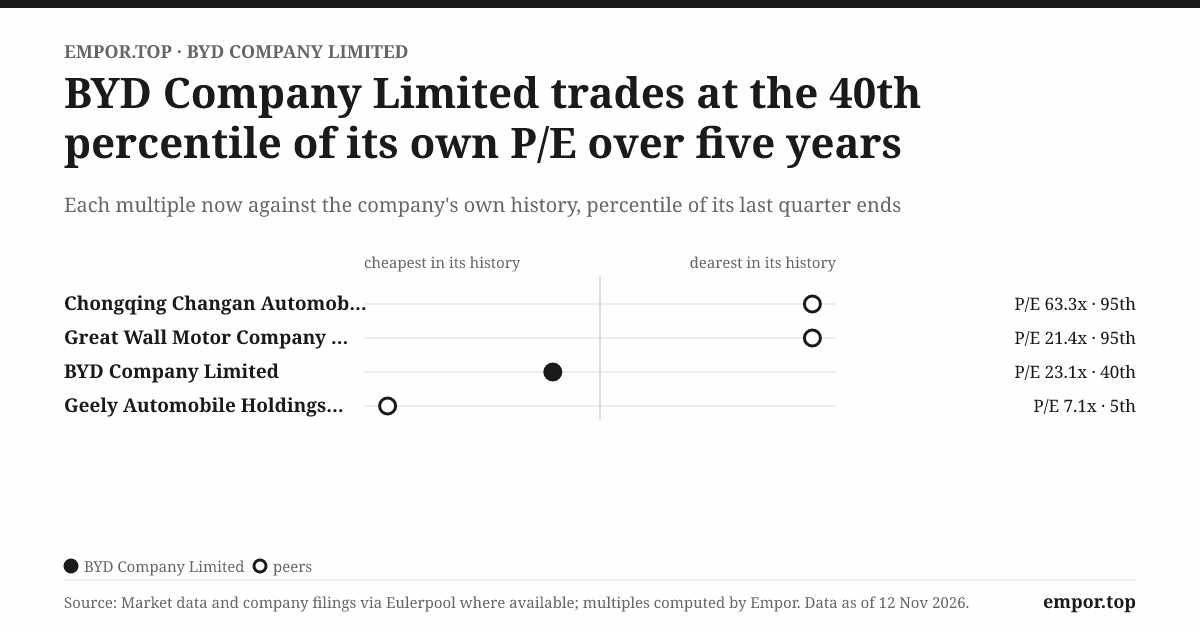
Start with valuation, as context rather than a verdict. At HK$67.55, BYD traded on about 23 times its trailing earnings, almost exactly its own five-year median of about 24 times. That multiple implies an earnings yield of about 4.3%.
The enterprise value, including net debt, was about 6.3 times EBITDA, a measure that adds back BYD's heavy depreciation, and the shares traded at about 0.6 times sales. The figure that stands out is free cash flow, which over the last reported year was negative, giving a free-cash-flow yield of about minus 7.7%.45
In plain terms, the market is paying a normal BYD multiple for BYD's earnings, while the cash that earnings are supposed to represent is still being reinvested and then some. The price assumes that the investment cycle will turn back into cash. It does not assume a collapse, and it does not assume a return to the growth rates of 2022 and 2023.
The moat question deserves a full test, and Hamilton Helmer's 7 Powers is a useful lens because it asks which advantages actually let a company earn more than its cost of capital for long periods.
Scale economies are BYD's strongest claim. It makes more new-energy vehicles than anyone, spreads R&D across millions of units, and buys raw materials in vast quantities. That power is real. But scale economies are relative. Geely's rapid growth in 2025 shows that several rivals now operate at a size where the cost gap narrows.16
Process power, the embedded know-how that lets a company make things in ways others struggle to copy, is BYD's second claim. Its battery-to-vehicle integration, from Blade cells to flash charging, comes closest. The open question is how long that lead lasts, since battery makers such as 宁德时代 CATL sell competing technology to everyone else.
Counter-positioning, a model that incumbents cannot copy without harming themselves, describes BYD's rise against the foreign joint ventures, which were slow to give up petrol cars. Against other Chinese EV makers, that power has largely gone.
Brand power is emerging but unproven. The premium labels are growing, and management says many overseas buyers of its Song models are switching from traditional premium brands.15 Yet domestic share losses suggest limited pricing power.16
Switching costs and network effects are weak. Car buyers switch brands freely, and the flash-charging network, the closest thing to a network effect, is new and open to imitation. Cornered resources, such as exclusive licences or patents that lock out rivals, are not evident at the scale that would protect profits.
Put Porter and Helmer together and the conclusion is consistent. BYD has a real cost and execution advantage, built on scale and process. It does not have the kinds of power, switching costs, network effects or a cornered resource that protect prices when rivals match the product. Its edge lets it outlast competitors. It has not let it out-earn them.
Now the bull case, stated as strongly as the evidence allows. BYD has a broad product range in the industry, substantial battery capability, and a large export machine in China. Third-quarter results showed a return to revenue growth and stronger recurring profit.5
Customer advance payments also rose sharply, a sign of real orders.5 As the Thai, Brazilian and Hungarian plants ramp up, overseas cars should carry less freight, fewer tariffs and better prices. In this telling, the domestic knockout stage ends with fewer survivors and BYD as the largest, and margins recover as competitors fall away.
The bear case is just as coherent. China's passenger-car market was contracting in 2026, and a smaller market means fewer sales for everyone, including the winner.13 BYD's share losses in 2025 showed Geely and others catching up.16 The 2026 profit recovery leaned on lower R&D expense, while grant income remained material.54
Rising export-linked working capital suggests that the push consumes cash before it produces any, and BYD does not tell investors what an overseas car earns.5 Debt rose sharply, and management continues to urge investors to look beyond the financial statements.415
How should an independent investor weigh the two? The bull case relies on things that have not happened yet: the end of the price war, high utilisation at new plants, and a premium that overseas buyers keep paying. The bear case relies on things that are already in the accounts. That does not make the bear case right. It means the burden of proof sits with the bulls, and the next few reports will carry it.
A skeptical activist would focus on four questions. Why does a company that spent RMB140 billion on capital projects in 2025 not disclose margins for its overseas car business? Why did reported R&D expense fall in 2026 while management promised more? How much of reported profit depends on grants and currency gains? And why classify RMB17 billion of perpetual securities as equity in a year when debt rose sharply? None of these implies wrongdoing. Each is a disclosure gap the company could close.
Management credibility deserves a balanced score. On the positive side, BYD met its reduced 2025 target, kept its cost structure competitive through a vicious price war, and brought its Thai and Brazilian plants into production.
On the negative side, it cut its 2025 target without public explanation, saw the Hungary plant slip about a year, and put the Turkey project on hold.19 It is also asking investors to judge it on technology rather than returns. The record is that of a builder that delivers products and volume, and that has been less precise about returns and timing.
Three numbers will tell investors most about whether the bull or the bear case is winning.
The first is the car segment's pre-tax margin. In 2025 it was about 4.4%, down from about 5.9% in 2024, on segment profit of about RMB28.4 billion against segment revenue of about RMB652 billion.4 If integration is really an advantage, this number has to rise even while prices stay competitive.
The second is operating cash flow after capital spending. It was deeply negative in 2025 and still negative, though much less so, in the first nine months of 2026, at roughly minus RMB33 billion against roughly minus RMB74 billion a year earlier.5 It is the cleanest measure of whether the investment cycle has peaked.
The third is overseas car volume together with any disclosure of its profitability. Exports passed one million cars in 2025 and kept growing in 2026, but BYD does not report an overseas car margin.4 The proxy to watch, until it does, is whether inventory and receivables tied to the overseas business stop growing faster than overseas sales.5
Valuation, again, is context rather than a target. A multiple close to its own long-run median says the market is neither panicking about BYD nor celebrating it. It is waiting to see whether earnings turn into cash. That waiting game sets the scene for what comes next.
XI. Epilogue
Tonight, in mid-November 2026, BYD stands in an odd place. Its quarterly revenue is growing again. Its quarterly profit is up by more than a quarter. Its export ships are full and its foreign factories are coming on line. And its share price sits near the bottom of its range, because the nine-month numbers still show profit below last year's and the cash still runs the wrong way.5
The next decisive moment arrives when BYD reports its full-year 2026 results, which on its usual calendar would come in late March 2027. Three questions will be answered that day.
The first is whether full-year revenue grows again while operating margin climbs back above 2025's roughly 5%. If both happen, the 2025 slump begins to look like a trough in a price war that BYD survived as the largest player. If revenue grows but margins do not, it will confirm the bearish reading that BYD's volume comes at the cost of its profitability, and that the knockout stage is still going on.
The second is whether cash from operations covers both capital spending and dividends. That is the line where the old BYD, financed by suppliers, meets the new one, financed by banks and bondholders. If operating cash covers the capital spending, then the 2025 borrowing will look like a bridge.
If it does not, the company will need more debt, more bills payable or more equity, and the story becomes one of a capital-hungry plateau. Watch, too, whether debtor concentration, credit-loss provisions and payable days stay under control, because each is a lever that can flatter or drain the cash line.
The third is overseas. Hungary's production start, Brazil's ramp and Thailand's utilisation will show whether BYD's local-factory strategy is turning shipping costs and tariffs into margin. Investors should watch whether the inventory build that swelled the balance sheet in 2026 begins to shrink, and whether BYD finally discloses what an overseas car earns. Along the way, they should watch whether the debt and guarantees that rose so sharply in 2025 begin to fall.
Each outcome maps onto the questions that opened this story. A rising car margin would show that integration is a durable advantage, not just a survival tool. Cash from operations covering capital spending and dividends would show that BYD can fund its ambitions without relying on new borrowing or equity. Profitable overseas growth would show that exports are an escape route, not just a place to park inventory.
Units alone will not settle any of it. BYD has proved it can sell cars in enormous numbers. It has yet to prove it can do so while earning a high return on the capital it keeps adding. That is the tension that remains.
XII. Outro
In 2003, a battery maker bought 77% of a small car company in Xi'an for RMB269.5 million and watched its shares tumble.91 In 2025, the company that grew out of that deal sold about 4.6 million new-energy vehicles, more than any other carmaker in the world.3 It is hard to think of many acquisitions that looked so wrong on paper and turned out so consequential.
But the callback cuts both ways. In 2003, the hard question was what BYD had to pay to get into the car business. Today the question is what it must spend to stay ahead, and whether that spending will ever come back as cash.
The company that once made phone batteries better and cheaper than the Japanese has made itself one of the most integrated carmakers on earth. It now has to prove that integration is not just a way to win a price war, but a way to earn a return after it.
BYD made the battery part of the car. Now it has to make the returns part of the story.
References
-
BYD Dives on Acquisition News — South China Morning Post, 2003-01-24 ↩↩↩↩↩
-
Wang Chuanfu: A Name Everyone in the West Should Know — Interconnected (Kevin Xu), 2024-02-08 ↩↩↩↩↩↩↩↩↩
-
BYD Officially Crushes Tesla in All-Electric Sales for 2025, Secures Global BEV Crown — Electrek, 2026-01-02 ↩↩↩↩↩↩↩↩
-
2025 Annual Report — BYD Company Limited, 2026-03-27 ↩↩↩↩↩↩↩↩↩↩↩↩↩↩↩↩↩↩↩↩↩↩↩↩↩↩↩↩↩↩↩↩↩↩↩↩↩↩↩↩↩↩↩↩↩↩↩↩↩↩↩↩↩↩↩↩↩↩↩↩↩↩↩↩↩↩↩↩↩↩↩↩↩↩↩↩↩↩
-
2026 Third Quarterly Report — BYD Company Limited, 2026-10-29 ↩↩↩↩↩↩↩↩↩↩↩↩↩↩↩↩↩↩↩↩↩↩↩↩↩↩
-
China's BYD Sees First Profit Drop Since 2021 — Associated Press, 2026-03-27 ↩
-
'Brutal Knockout Stage' for Electric Cars Approaching According to BYD Boss — CarsGuide, 2026-04-08 ↩↩↩↩
-
Notes to the Accounts, 2003 — BYD Company Limited, 2004-03-05 ↩↩↩↩↩↩↩↩
-
Warren Buffett Just Sold His Entire Stake in Tesla-Rival BYD — Fortune, 2025-09-22 ↩↩
-
BYD Launches Blade Battery for Improved Fire Safety in Electric Vehicles — pv magazine, 2020-03-31 ↩↩
-
BYD Stops Making Fossil-Fuel Powered Cars, Goes Fully Electric — Caixin Global, 2022-04-05 ↩
-
2026 Investor Relations Activity Record, 10 September — BYD Company Limited, 2026-09-10 ↩↩↩↩↩↩↩↩↩↩
-
2025 Sustainability Report — BYD Company Limited, 2026-03-27 ↩↩
-
2026 Investor Relations Activity Record, 29 September (First Extraordinary General Meeting) — BYD Company Limited, 2026-09-29 ↩↩↩↩↩↩↩↩↩↩↩↩↩↩
-
Automakers' Share in China NEV Market in 2025: BYD Leads with 27.2% — CnEVPost, 2026-01-12 ↩↩↩↩↩
-
China's BYD Cuts 2025 Sales Target by 16%, Sources Say — Reuters via MarketScreener, 2025-09-04 ↩↩↩↩↩
-
BYD Hungary Plant to Start Production in Q4 2026, One Year Behind Schedule — EVwire, 2026-06-11 ↩↩↩↩↩
-
BYD Thailand Deliveries Surpass 130,000 as Local Plant Marks Second Anniversary — CnEVPost, 2026-07-14 ↩
-
BYD Brazil Plant Produced 10,000 Vehicles and Added the Second Shift — CarNewsChina, 2025-11-26 ↩↩
-
10+ Chinese Automakers Promise Shorter Payment Periods as Pressure Mounts on Suppliers — TechNode, 2025-06-13 ↩↩↩
-
BYD 2025 Annual Rating Report — China Chengxin International, 2025 ↩↩
 LinkedIn
 WhatsApp
 Reddit
 Hacker News
 Email
 Kindle
 RSS Feed
 Spotify
 Apple Podcasts
 Amazon Music
 Audible
 YouTube